THE LABRADOR JOURNAL
Reading edition
1833
INTRODUCTION
THE Labrador trip, long contemplated, was made with the usual object, that of procuring birds and making the drawings of them for the continuation of the "Birds of America," the publication of which was being carried on by the Havells, under the supervision of Victor, the elder son, who was in London at this time. To him Audubon writes from Eastport, Maine, under date of May 31, 1833:—
"We are on the eve of our departure for the coast of Labrador. Our party consists of young Dr. George Shattuck of Boston, Thomas Lincoln of Dennysville, William Ingalls, son of Dr. Ingalls of Boston, Joseph Coolidge, John, and myself. I have chartered a schooner called the 'Ripley,' commanded by Captain Emery, who was at school with my friend Lincoln; he is reputed to be a gentleman, as well as a good sailor. Coolidge, too, has been bred to the sea, and is a fine, active youth of twenty-one. The schooner is a new vessel, only a year old, of 106 tons, for which we pay three hundred and fifty dollars per month for the entire use of the vessel with the men, but we supply ourselves with provisions.[172] The hold of the vessel has been floored, and our great table solidly fixed in a tolerably good light under the main hatch; it is my intention to draw whenever possible, and that will be many hours, for the daylight is with us nearly all the time in those latitudes, and the fishermen say you can do with little sleep, the air is so pure. I have been working hard at the birds from the Grand Menan, as well as John, who is overcoming his habit of sleeping late, as I call him every morning at four, and we have famous long days. We are well provided as to clothes, and strange figures indeed do we cut in our dresses, I promise you: fishermen's boots, the soles of which are all nailed to enable us to keep our footing on the sea-weeds, trousers of fearnought so coarse that our legs look like bears' legs, oiled jackets and over-trousers for rainy weather, and round, white, wool hats with a piece of oil cloth dangling on our shoulders to prevent the rain from running down our necks. A coarse bag is strapped on the back to carry provisions on inland journeys, with our guns and hunting-knives; you can form an idea of us from this. Edward Harris is not to be with us; this I regret more than I can say. This day seven vessels sailed for the fishing-grounds, some of them not more than thirty tons' burden, for these hardy fishermen care not in what they go; but I do, and, indeed, such a boat would be too small for us."
The 1st of June was the day appointed for the start, but various delays occurred which retarded this until the 6th, when the journal which follows tells its own tale.
Of all the members of the party Mr. Joseph Coolidge, now (1897) living in San Francisco, is the sole survivor.
M. R. A.
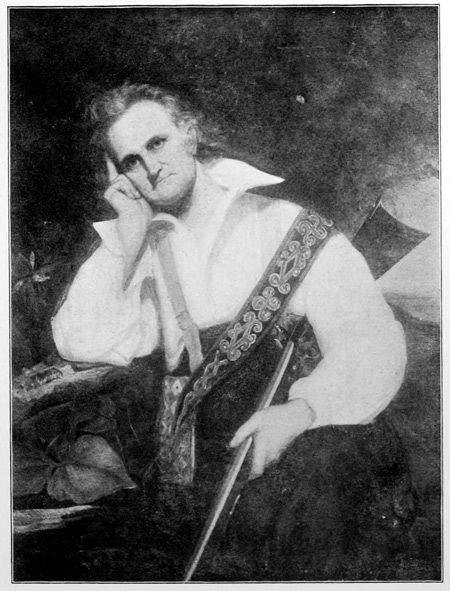
AUDUBON. From the portrait by George P. A. Healy, London, 1838. Now in the possession of the Boston Society of Natural History.
THE LABRADOR JOURNAL
1833
Eastport, Maine, June 4. Our vessel is being prepared for our reception and departure, and we have concluded to hire two extra sailors and a lad; the latter to be a kind of major-domo, to clean our guns, etc., search for nests, and assist in skinning birds. Whilst rambling in the woods this morning, I found a Crow's nest, with five young, yet small. As I ascended the tree, the parents came to their offspring crying loudly, and with such perseverance that in less than fifteen minutes upwards of fifty pairs of these birds had joined in their vociferations; yet when first the parents began to cry I would have supposed them the only pair in the neighborhood.
Wednesday, June 5. This afternoon, when I had concluded that everything relating to the charter of the "Ripley" was arranged, some difficulty arose between myself and Mr. Buck, which nearly put a stop to our having his vessel. Pressed, however, as I was, by the lateness of the season, I gave way and suffered myself to be imposed upon as usual, with a full knowledge that I was so. The charter was signed, and we hoped to have sailed, but to-morrow is now the day appointed. Our promised Hampton boat is not come.
Thursday, June 6. We left the wharf of Eastport about one o'clock p. m. Every one of the male population came to see the show, just as if no schooner the size of the "Ripley" had ever gone from this mighty port to Labrador. Our numerous friends came with the throng, and we all shook hands as if never to meet again. The batteries of the garrison, and the cannon of the revenue cutter, saluted us, each firing four loud, oft-echoing reports. Captain Coolidge accompanied us, and indeed was our pilot, until we had passed Lubec. The wind was light and ahead, and yet with the assistance of the tide we drifted twenty-five miles, down to Little River, during the night, and on rising on the morning of June 7 we were at anchor near some ugly rocks, the sight of which was not pleasing to our good captain.
June 7. The whole morning was spent trying to enter Little River, but in vain; the men were unable to tow us in. We landed for a few minutes, and shot a Hermit Thrush, but the appearance of a breeze brought us back, and we attempted to put to sea. Our position now became rather dangerous, as we were drawn by the current nearly upon the rocks; but the wind rose at last, and we cleared for sea. At three o'clock it became suddenly so foggy that we could not see the bowsprit. The night was spent in direful apprehensions of ill luck; at midnight a smart squall decided in our favor, and when day broke on the morning of June 8 the wind was from the northeast, blowing fresh, and we were dancing on the waters, all shockingly sea-sick, crossing that worst of all dreadful bays, the Bay of Fundy. We passed between the Seal Islands and the Mud Islands; in the latter Procellaria wilsonii, the Stormy Petrel, breeds abundantly; their nests are dug out of the sand in an oblique direction to the depth of two, or two and a half feet. At the bottom of these holes, and on the sand, the birds deposit their pure white eggs. The holes are perforated, not in the banks like the Bank Swallow, but are like rat holes over the whole of the islands. On Seal Islands Larus argentatus, the Herring Gull, breeds as abundantly as on Grand Menan, but altogether on trees. As we passed Cape Sable, so called on account of its being truly a sand-point of some caved-in elevation, we saw a wrecked ship with many small crafts about it. I saw there Uria troile, the Foolish Guillemot, and some Gannets. The sea was dreadful, and scarcely one of us was able to eat or drink this day. We came up with the schooner "Caledonia," from Boston for Labrador; her captain wished to keep in our company, and we were pretty much together all night and also on Sunday.
June 9. We now had a splendid breeze, but a horrid sea, and were scarce able to keep our feet, or sleep. The "Caledonia" was very near to us for some time, but when the breeze increased to a gale, and both vessels had to reef, we showed ourselves superior in point of sailing. So good was our run that on the next morning, June 10, we found ourselves not more than thirty miles from Cape Canseau, ordinarily called Cape Cancer. The wind was so fair for proceeding directly to Labrador that our captain spoke of doing so, provided it suited my views; but, anxious as I am not to suffer any opportunity to escape of doing all I can to fulfil my engagements, I desired that we should pass through what is called "The Gut of Canseau," and we came into the harbor of that name[173] at three of the afternoon. Here we found twenty vessels, all bound to Labrador, and, of course, all fishermen. We had been in view of the southeastern coast of Nova Scotia all day, a dreary, poor, and inhospitable-looking country. As we dropped our anchor we had a snowfall, and the sky had an appearance such as I never before recollect having seen. Going on shore we found not a tree in blossom, though the low plants near the ground were all in bloom; I saw azaleas, white and blue violets, etc., and in some situations the grass really looked well. The Robins were in full song; one nest of that bird was found; the White-throated Sparrow and Savannah Finch were also in full song. The Fringilla nivalis[174] was seen, and we were told that Tetrao canadensis[175] was very abundant, but saw none. About a dozen houses form this settlement; there was no Custom House officer, and not an individual who could give an answer of any value to our many questions. We returned on board and supped on a fine codfish. The remainder of our day was spent in catching lobsters, of which we procured forty. They were secured simply by striking them in shallow water with a gaff-hook. It snowed and rained at intervals, and to my surprise we did not observe a single seabird.
June 11. Larus marinus (the Great Black-backed Gull) is so superior both in strength and courage to Fulmars, Lestris, or even Gannets, to say nothing of Gulls of all sorts, that at its approach they all give way, and until it has quite satiated itself, none venture to approach the precious morsel on which it is feeding. In this respect, it is as the Eagle to the Vultures or Carrion Crows. I omitted saying that last night, before we retired to rest, after much cold, snow, rain, and hail, the frogs were piping in all the pools on the shore, and we all could hear them clearly, from the deck of the "Ripley." The weather to-day is beautiful, the wind fair, and when I reached the deck at four a. m. we were under way in the wake of the whole of the fleet which last evening graced the Harbor of Canseau, but which now gave life to the grand bay across which all were gliding under easy pressure of sail. The land locked us in, the water was smooth, the sky pure, and the thermometer was only 46°, quite cold; indeed, it was more grateful to see the sunshine whilst on deck this morning, and to feel its warmth, than I can recollect before at this season. After sailing for twenty-one miles, and passing one after another every vessel of the fleet, we entered the Gut of Canseau, so named by the Spanish on account of the innumerable Wild Geese which, in years long past and forgotten, resorted to this famed passage. The land rises on each side in the form of an amphitheatre, and on the Nova Scotia side, to a considerable height. Many appearances of dwellings exist, but the country is too poor for comfort; the timber is small, and the land, very stony. Here and there a small patch of ploughed land, planted, or to be planted, with potatoes, was all we could see evincing cultivation. Near one house we saw a few apple-trees, yet without leaves. The general appearance of this passage reminded me of some parts of the Hudson River, and accompanied as we were by thirty smaller vessels, the time passed agreeably. Vegetation about as forward as at Eastport; saw a Chimney Swallow, heard some Blue Jays, saw some Indians in a bark canoe, passed Cape Porcupine, a high, rounding hill, and Cape George, after which we entered the Gulf of St. Lawrence. From this place, on the 20th of May last year, the sea was a complete sheet of ice as far as a spy-glass could inform. As we advanced, running parallel with the western coast of Cape Breton Island, the country looked well, at the distance we were from it; the large, undulating hills were scattered with many hamlets, and here and there a bit of cultivated land was seen. It being calm when we reached Jestico Island, distant from Cape Breton about three miles, we left the vessel and made for it. On landing we found it covered with well grown grass sprinkled everywhere with the blossoms of the wild strawberry; the sun shone bright, and the weather was quite pleasant. Robins, Savannah Finches, Song Sparrows, Tawny Thrushes, and the American Redstart were found. The Spotted Sand-piper, Totanus macularius, was breeding in the grass, and flew slowly with the common tremor of their wings, uttering their "wheet-wheet-wheet" note, to invite me to follow them. A Raven had a nest and three young in it, one standing near it, the old birds not seen. Uria troile[176] and U. grylle[177] were breeding in the rocks, and John saw several Ardea herodias[178] flying in pairs, also a pair of Red-breasted Mergansers that had glutted themselves with fish so that they were obliged to disgorge before they could fly off. Amongst the plants the wild gooseberry, nearly the size of a green pea, was plentiful, and the black currant, I think of a different species from the one found in Maine. The wind rose and we returned on board. John and the sailors almost killed a Seal with their oars.
June 12. At four this morning we were in sight of the Magdalene Islands, or, as they are called on the chart, Amherst Islands; they appeared to be distant about twenty miles. The weather was dull and quite calm, and I thought the prospect of reaching these isles this day very doubtful, and returned to my berth sadly disappointed. After breakfast a thick fog covered the horizon on our bow, the islands disappeared from sight, and the wind rose sluggishly, and dead ahead. Several brigs and ships loaded with lumber out from Miramichi came near us, beating their way towards the Atlantic. We are still in a great degree land-locked by Cape Breton Island, the highlands of which look dreary and forbidding; it is now nine a. m., and we are at anchor in four fathoms of water, and within a quarter of a mile of an island, one of the general group; for our pilot, who has been here for ten successive years, informs us that all these islands are connected by dry sand-bars, without any other ship channel between them than the one which we have taken, and which is called Entrée Bay, formed by Entrée Island and a long, sandy, projecting reef connected with the main island. This latter measures forty-eight miles in length, by an average of about three in breadth; Entrée Island contains about fifteen hundred acres of land, such as it is, of a red, rough, sandy formation, the northwest side constantly falling into the sea, and exhibiting a very interesting sight. Guillemots were seen seated upright along the projecting shelvings in regular order, resembling so many sentinels on the look-out. Many Gannets also were seen about the extreme point of this island. On Amherst Island we saw many houses, a small church, and on the highest land a large cross, indicating the Catholic tendency of the inhabitants. Several small schooners lay in the little harbor called Pleasant Bay, and we intend to pay them an early visit to-morrow. The wind is so cold that it feels to us all like the middle of December at Boston.
Magdalene Islands, June 13. This day week we were at Eastport, and I am sure not one of our party thought of being here this day. At four this morning we were seated at breakfast around our great drawing-table; the thermometer was at 44°; we blew our fingers and drank our coffee, feeling as if in the very heart of winter, and when we landed I felt so chilled that it would have been quite out of the question to use my hands for any delicate work. We landed between two great bluffs, that looked down upon us with apparent anger, the resort of many a Black Guillemot and noble Raven, and following a tortuous path, suddenly came plump upon one of God's best finished jewels, a woman. She saw us first, for women are always keenest in sight and sympathy, in perseverance and patience, in fortitude, and love, and sorrow, and faith, and, for aught I know, much more. At the instant that my eyes espied her, she was in full run towards her cottage, holding to her bosom a fine babe, simply covered with a very short shirt, the very appearance of which set me shivering. The woman was dressed in coarse French homespun, a close white cotton cap which entirely surrounded her face tied under her chin, and I thought her the wildest-looking woman, both in form and face, I had seen for many a day. At a venture, I addressed her in French, and it answered well, for she responded in a wonderful jargon, about one third of which I understood, and abandoned the rest to a better linguist, should one ever come to the island. She was a plain, good woman, I doubt not, and the wife of an industrious fisherman. We walked through the woods, and followed the road to the church. Who would have thought that on these wild islands, among these impoverished people, we should have found a church; that we should have been suddenly confronted with a handsome, youthful, vigorous, black-haired, black-bearded fellow, in a soutane as black as the Raven's wedding-dress, and with a heart as light as a bird on the wing? Yet we met with both church and priest, and our ears were saluted by the sound of a bell which measures one foot by nine and a half inches in diameter, and weighs thirty pounds; and this bell may be heard a full quarter of a mile. It is a festival day, La Petite Fête de Dieu. The chapel was illuminated at six o'clock, and the inhabitants, even from a distance, passed in; among them were many old women, who, staff in hand, had trudged along the country road. Their backs were bent by age and toil, their eyes dimmed by time; they crossed their hands upon their breasts, and knelt before the sacred images in the church with so much simplicity and apparent truth of heart that I could not help exclaiming, "This is indeed religion!" The priest, Père Brunet, is originally from Quebec. These islands belong, or are attached, to Lower Canada; he, however, is under the orders of the Bishop of Halifax. He is a shrewd-looking fellow, and, if I mistake not, has a dash of the devil in him. He told me there were no reptiles on the island, but this was an error; for, while rambling about, Tom Lincoln, Ingalls, and John saw a snake, and I heard Frogs a-piping. He also told me that Black and Red Foxes, and the changeable Hare, with Rats lately imported, were the only quadrupeds to be found, except cows, horses, and mules, of which some had been brought over many years ago, and which had multiplied, but to no great extent. The land, he assured us, was poor in every respect,—soil, woods, game; that the Seal fisheries had been less productive these last years than formerly. On these islands, about a dozen in number, live one hundred and sixty families, all of whom make their livelihood by the Cod, Herring, and Mackerel fisheries. One or two vessels from Quebec come yearly to collect this produce of the ocean. Not a bird to be found larger than a Robin, but certainly thousands of those. Père Brunet said he lived the life of a recluse, and invited us to accompany him to the house where he boarded, and take a glass of good French wine. During our ramble on the island we found the temperature quite agreeable; indeed, in some situations the sun was pleasant and warm. Strawberry blossoms were under our feet at every step, and here and there the grass looked well. I was surprised to find the woods (by woods I mean land covered with any sort of trees, from the noblest magnolia down to dwarf cedars) rich in Warblers, Thrushes, Finches, Buntings, etc. The Fox-tailed Sparrow breeds here, the Siskin also. The Hermit and Tawny Thrushes crossed our path every few yards, the Black-capped Warbler flashed over the pools, the Winter Wren abounded everywhere. Among the water-birds we found the Great Tern (Sterna hirundo) very abundant, and shot four of them on the sand-ridges. The Piping Plover breeds here—shot two males and one female; so plaintive is the note of this interesting species that I feel great aversion to killing them. These birds certainly are the swiftest of foot of any water-birds which I know, of their size. We found many land-snails, and collected some fine specimens of gypsum. This afternoon, being informed that across the bay where we are anchored we might, perhaps, purchase some Black Fox skins, we went there, and found Messieurs Muncey keen fellows; they asked £5 for Black Fox and $1.50 for Red. No purchase on our part. Being told that Geese, Brents, Mergansers, etc., breed eighteen miles from here, at the eastern extremity of these islands, we go off there to-morrow in boats. Saw Bank Swallows and House Swallows. The woods altogether small evergreens, extremely scrubby, almost impenetrable, and swampy beneath. At seven this evening the thermometer is at 52°. This morning it was 44°. After our return to the "Ripley," our captain, John, Tom Lincoln, and Coolidge went off to the cliffs opposite our anchorage, in search of Black Guillemots' eggs. This was found to be quite an undertaking; these birds, instead of having to jump or hop from one place to another on the rocks, to find a spot suitable to deposit their spotted egg, as has been stated, are on the contrary excellent walkers, at least upon the rocks, and they can fly from the water to the very entrance of the holes in the fissures, where the egg is laid. Sometimes this egg is deposited not more than eight or ten feet above high-water mark, at other times the fissure in the rock which has been chosen stands at an elevation of a hundred feet or more. The egg is laid on the bare rock without any preparation, but when the formation is sandy, a certain scoop is indicated on the surface. In one instance, I found two feathers with the egg; this egg is about the size of a hen's, and looks extravagantly large, splashed with black or deep umber, apparently at random, the markings larger and more frequent towards the great end. At the barking of a dog from any place where these birds breed, they immediately fly towards the animal, and will pass within a few feet of the observer, as if in defiance. At other times they leave the nest and fall in the water, diving to an extraordinary distance before they rise again. John shot a Gannet on the wing; the flesh was black and unpleasant. The Piping Plover, when missed by the shot, rises almost perpendicularly, and passes sometimes out of sight; this is, I am convinced by the many opportunities I have had to witness the occurrence, a habit of the species. These islands are well watered by large springs, and rivulets intersect the country in many directions. We saw large flocks of Velvet Ducks feeding close to the shores; these did not appear to be in pairs. The Gannet dives quite under the water after its prey, and when empty of food rises easily off the water.
June 14, off the Gannett Rocks. We rose at two o'clock with a view to proceed to the eastern extremity of these islands in search of certain ponds, wherein, so we were told, Wild Geese and Ducks of different kinds are in the habit of resorting annually to breed. Our informer added that formerly Brents bred there in abundance, but that since the erection of several buildings owned by Nova Scotians, and in the immediate vicinity of these ponds or lakes, the birds have become gradually very shy, and most of them now proceed farther north. Some of these lakes are several miles in circumference, with shallow, sandy bottoms; most of them are fresh water, the shores thickly overgrown with rank sedges and grasses, and on the surface are many water-lilies. It is among these that the wild fowl, when hid from the sight of man, deposit their eggs. Our way to these ponds would have been through a long and narrow bay, formed by what seamen call sea-walls. In this place these walls are entirely of light-colored sand, and form connecting points from one island to another, thus uniting nearly the whole archipelago. Our journey was abandoned just as we were about to start, in consequence of the wind changing, and being fair for our passage to Labrador, the ultimatum of our desires. Our anchor was raised, and we bid adieu to the Magdalenes. Our pilot, a Mr. Godwin from Nova Scotia, put the vessel towards what he called "The Bird Rocks," where he told us that Gannets (Sula bassana) bred in great numbers. For several days past we have met with an increased number of Gannets, and as we sailed this morning we observed long and numerous files, all flying in the direction of the rocks. Their flight now was low above the water, forming easy undulations, flapping thirty or forty times, and sailing about the same distance; these were all returning from fishing, and were gorged with food for their mates or young. About ten a speck rose on the horizon, which I was told was the Rock; we sailed well, the breeze increased fast, and we neared this object apace. At eleven I could distinguish its top plainly from the deck, and thought it covered with snow to the depth of several feet; this appearance existed on every portion of the flat, projecting shelves. Godwin said, with the coolness of a man who had visited this Rock for ten successive seasons, that what we saw was not snow—but Gannets! I rubbed my eyes, took my spy-glass, and in an instant the strangest picture stood before me. They were birds we saw,—a mass of birds of such a size as I never before cast my eyes on. The whole of my party stood astounded and amazed, and all came to the conclusion that such a sight was of itself sufficient to invite any one to come across the Gulf to view it at this season. The nearer we approached, the greater our surprise at the enormous number of these birds, all calmly seated on their eggs or newly hatched brood, their heads all turned to windward, and towards us. The air above for a hundred yards, and for some distance around the whole rock, was filled with Gannets on the wing, which from our position made it appear as if a heavy fall of snow was directly above us. Our pilot told us the wind was too high to permit us to land, and I felt sadly grieved at this unwelcome news. Anxious as we all were, we decided to make the attempt; our whale-boat was overboard, the pilot, two sailors, Tom Lincoln, and John pushed off with guns and clubs. Our vessel was brought to, but at that instant the wind increased, and heavy rain began to fall. Our boat neared the rock, and went to the lee of it, and was absent nearly an hour, but could not land. The air was filled with Gannets, but no difference could we perceive on the surface of the rock. The birds, which we now could distinctly see, sat almost touching each other and in regular lines, seated on their nests quite unconcerned. The discharge of the guns had no effect on those that were not touched by the shot, for the noise of the Gulls, Guillemots, etc., deadened the sound of the gun; but where the shot took effect, the birds scrambled and flew off in such multitudes, and in such confusion, that whilst some eight or ten were falling into the water either dead or wounded, others pushed off their eggs, and these fell into the sea by hundreds in all directions. The sea now becoming very rough, the boat was obliged to return, with some birds and some eggs; but the crew had not climbed the rock, a great disappointment to me. Godwin tells me the top of the rock is about a quarter of a mile wide, north and south, and a little narrower east and west; its elevation above the sea between three and four hundred feet. The sea beats round it with great violence, except after long calms, and it is extremely difficult to land upon it, and much more so to climb to the top of it, which is a platform; it is only on the southeast shore that a landing can be made, and the moment a boat touches, it must be hauled up on the rocks. The whole surface is perfectly covered with nests, placed about two feet apart, in such regular order that you may look through the lines as you would look through those of a planted patch of sweet potatoes or cabbages. The fishermen who kill these birds, to get their flesh for codfish bait, ascend in parties of six or eight, armed with clubs; sometimes, indeed, the party comprises the crews of several vessels. As they reach the top, the birds, alarmed, rise with a noise like thunder, and fly off in such hurried, fearful confusion as to throw each other down, often falling on each other till there is a bank of them many feet high. The men strike them down and kill them until fatigued or satisfied. Five hundred and forty have been thus murdered in one hour by six men. The birds are skinned with little care, and the flesh cut off in chunks; it will keep fresh about a fortnight. The nests are made by scratching down a few inches, and the edges surrounded with sea-weeds. The eggs are pure white, and as large as those of a Goose. By the 20th of May the rock is already covered with birds and eggs; about the 20th of June they begin to hatch. So great is the destruction of these birds annually that their flesh supplies the bait for upwards of forty fishing-boats, which lie close to the Byron Island each season. When the young are hatched they are black, and for a fortnight or more the skin looks like that of the dog-fish. They become gradually downy and white, and when two months old look much like young lambs. Even while shooting at these birds, hundreds passed us carrying great masses of weeds to their nests. The birds were thick above our heads, and I shot at one to judge of the effect of the report of the gun; it had none. A great number of Kittiwake Gulls breed on this rock, with thousands of Foolish Guillemots. The Kittiwake makes its nest of eel-weeds, several inches in thickness, and in places too small for a Gannet or a Guillemot to place itself; in some instances these nests projected some inches over the edge of the rock. We could not see any of their eggs. The breeze was now so stiff that the waves ran high; so much so that the boat was perched on the comb of the wave one minute, the next in the trough. John steered, and he told me afterwards he was nearly exhausted. The boat was very cleverly hauled on deck by a single effort. The stench from the rock is insufferable, as it is covered with the remains of putrid fish, rotten eggs, and dead birds, old and young. No man who has not seen what we have this day can form the least idea of the impression the sight made on our minds. By dark it blew a gale and we are now most of us rather shaky; rain is falling in torrents, and the sailors are reefing. I forgot to say that when a man walks towards the Gannets, they will now and then stand still, merely opening and shutting their bills; the Gulls remained on their nests with more confidence than the Guillemots, all of which flew as we approached. The feathering of the Gannet is curious, differing from that of most other birds, inasmuch as each feather is concave, and divided in its contour from the next. Under the roof of the mouth and attached to the upper mandible, are two fleshy appendages like two small wattles.
June 15. All our party except Coolidge were deadly sick. The thermometer was down to 43°, and every sailor complained of the cold. It has rained almost all day. I felt so very sick this morning that I removed from my berth to a hammock, where I soon felt rather more easy. We lay to all this time, and at daylight were in sight of the Island of Anticosti, distant about twenty miles; but the fog soon after became so thick that nothing could be observed. At about two we saw the sun, the wind hauled dead ahead, and we ran under one sail only.
June 16, Sunday. The weather clear, beautiful, and much warmer; but it was calm, so we fished for cod, of which we caught a good many; most of them contained crabs of a curious sort, and some were filled with shrimps. One cod measured three feet six and a half inches, and weighed twenty-one pounds. Found two curious insects fastened to the skin of a cod, which we saved. At about six o'clock the wind sprang up fair, and we made all sail for Labrador.
June 17. I was on deck at three this morning; the sun, although not above the horizon, indicated to the mariner at the helm one of those doubtful days the result of which seldom can be truly ascertained until sunset. The sea was literally covered with Foolish Guillemots, playing in the very spray of the bow of our vessel, plunging under it, as if in fun, and rising like spirits close under our rudder. The breeze was favorable, although we were hauled to the wind within a point or so. The helmsman said he saw land from aloft, but the captain pronounced his assertion must be a mistake, by true calculation. We breakfasted on the best of fresh codfish, and I never relished a breakfast more. I looked on our landing on the coast of Labrador as a matter of great importance. My thoughts were filled, not with airy castles, but with expectations of the new knowledge of birds and quadrupeds which I hoped to acquire. The "Ripley" ploughed the deep, and proceeded swiftly on her way; she always sails well, but I thought that now as the land was expected to appear every moment, she fairly skipped over the waters. At five o'clock the cry of land rang in our ears, and my heart bounded with joy; so much for anticipation. We sailed on, and in less than an hour the land was in full sight from the deck. We approached, and saw, as we supposed, many sails, and felt delighted at having hit the point in view so very closely; but, after all, the sails proved to be large snow-banks. We proceeded, however, the wind being so very favorable that we could either luff or bear away. The air was now filled with Velvet Ducks; millions of these birds were flying from the northwest towards the southeast. The Foolish Guillemots and the Alca torda[179] were in immense numbers, flying in long files a few yards above the water, with rather undulating motions, and passing within good gunshot of the vessel, and now and then rounding to us, as if about to alight on the very deck. We now saw a schooner at anchor, and the country looked well at this distance, and as we neared the shore the thermometer, which had been standing at 44°, now rose up to nearly 60°; yet the appearance of the great snow-drifts was forbidding. The shores appeared to be margined with a broad and handsome sand-beach; our imaginations now saw Bears, Wolves, and Devils of all sorts scampering away on the rugged shore. When we reached the schooner we saw beyond some thirty fishing-boats, fishing for cod, and to our great pleasure found Captain Billings of Eastport standing in the bow of his vessel; he bid us welcome, and we saw the codfish thrown on his deck by thousands. We were now opposite to the mouth of the Natasquan River, where the Hudson's Bay Company have a fishing establishment, but where no American vessels are allowed to come in. The shore was lined with bark-covered huts, and some vessels were within the bight, or long point of land which pushes out from the extreme eastern side of the entrance of the river. We went on to an American Harbor, four or five miles distant to the westward, and after a while came to anchor in a small bay, perfectly secure from any winds. And now we are positively on the Labrador coast, latitude 50° and a little more,—farther north than I ever was before. But what a country! When we landed and passed the beach, we sank nearly up to our knees in mosses of various sorts, producing as we moved through them a curious sensation. These mosses, which at a distance look like hard rocks, are, under foot, like a velvet cushion. We scrambled about, and with anxiety stretched our necks and looked over the country far and near, but not a square foot of earth could we see. A poor, rugged, miserable country; the trees like so many mops of wiry composition, and where the soil is not rocky it is boggy up to a man's waist. We searched and searched; but, after all, only shot an adult Pigeon-Hawk, a summer-plumage Tell-tale Godwit, and an Alca torda. We visited all the islands about the harbor; they were all rocky, nothing but rocks. The Larus marinus was sailing magnificently all about us. The Great Tern was plunging after shrimps in every pool, and we found four eggs of the Totanus macularius;[180] the nest was situated under a rock in the grass, and made of a quantity of dried grass, forming a very decided nest, at least much more so than in our Middle States, where the species breed so very abundantly. Wild Geese were seen by our party, and these birds also breed here; we saw Loons and Eider Ducks, Anas obscura[181] and the Fuligula [Œdemia] americana.[182] We came to our anchorage at twenty minutes past twelve. Tom Lincoln and John heard a Ptarmigan. Toads were abundant. We saw some rare plants, which we preserved, and butterflies and small bees were among the flowers which we gathered. We also saw Red-breasted Mergansers. The male and female Eider Ducks separate as soon as the latter begin to lay; after this they are seen flying in large flocks, each sex separately. We found a dead Basking Shark, six and a half feet long; this fish had been wounded by a harpoon and ran ashore, or was washed there by the waves. At Eastport fish of this kind have been killed thirty feet long.
June 18. I remained on board all day, drawing; our boats went off to some islands eight or ten miles distant, after birds and eggs, but the day, although very beautiful, did not prove valuable to us, as some eggers from Halifax had robbed the places ere the boats arrived. We, however, procured about a dozen of Alca torda, Uria troile, a female Eider Duck, a male Surf Duck, and a Sandpiper, or Tringa,—which, I cannot ascertain, although the least[183] I ever saw, not the Pusilla of Bonaparte's Synopsis. Many nests of the Eider Duck were seen, some at the edge of the woods, placed under the rampant boughs of the fir-trees, which in this latitude grow only a few inches above the surface of the ground, and to find the nest, these boughs had to be raised. The nests were scooped a few inches deep in the mossy, rotten substance that forms here what must be called earth; the eggs are deposited on a bed of down and covered with the same material; and so warm are these nests that, although not a parent bird was seen near them, the eggs were quite warm to the touch, and the chicks in some actually hatching in the absence of the mother. Some of the nests had the eggs uncovered; six eggs was the greatest number found in a nest. The nests found on grassy islands are fashioned in the same manner, and generally placed at the foot of a large tussock of grass. Two female Ducks had about twelve young on the water, and these they protected by flapping about the water in such a way as to raise a spray, whilst the little ones dove off in various directions. Flocks of thirty to forty males were on the wing without a single female among them. The young birds procured were about one week old, of a dark mouse-color, thickly covered with a soft and warm down, and their feet appeared to be more perfect, for their age, than any other portion, because more necessary to secure their safety, and to enable them to procure food. John found many nests of the Larus marinus, of which he brought both eggs and young. The nest of this fine bird is made of mosses and grasses, raised on the solid rock, and handsomely formed within; a few feathers are in this lining. Three eggs, large, hard-shelled, with ground color of dirty yellowish, splashed and spotted with dark umber and black. The young, although small, were away from the nest a few feet, placing themselves to the lee of the nearest sheltering rock. They did not attempt to escape, but when taken uttered a cry not unlike that of a young chicken under the same circumstances. The parents were so shy and so wary that none could be shot. At the approach of the boats to the rocks where they breed, a few standing as sentinels gave the alarm, and the whole rose immediately in the air to a great elevation. On another rock, not far distant, a number of Gulls of the same size, white, and with the same hoarse note, were to be seen, but they had no nests; these, I am inclined to think (at present) the bird called Larus argentatus (Herring Gull), which is simply the immature bird of Larus marinus.[184] I am the more led to believe this because, knowing the tyrannical disposition of the L. marinus, I am sure they would not suffer a species almost as powerful as themselves in their immediate neighborhood. They fly altogether, but the white ones do not alight on the rocks where the Marinus has its nests. John watched their motion and their cry very closely, and gave me this information. Two eggs of a Tern,[185] resembling the Cayenne Tern, were found in a nest on the rocks, made of moss also, but the birds, although the eggs were nearly ready to hatch, kept out of gunshot. These eggs measured one and a half inches in length, very oval, whitish, spotted and dotted irregularly with brown and black all over. The cry of those Terns which I saw this afternoon resembles that of the Cayenne Tern that I met with in the Floridas, and I could see a large orange bill, but could not discern the black feet. Many nests of the Great Tern (Sterna hirundo) were found—two eggs in each, laid on the short grass scratched out, but no nest. One Tringa pusilla [minutilla], the smallest I ever saw, was procured; these small gentry are puzzles indeed; I do not mean to say in nature, but in Charles's[186] Synopsis. We went ashore this afternoon and made a Bear trap with a gun, baited with heads and entrails of codfish, Bruin having been seen within a few hundred yards of where the lure now lies in wait. It is truly interesting to see the activity of the cod-fishermen about us, but I will write of this when I know more of their filthy business.
June 19. Drawing as much as the disagreeable motion of the vessel would allow me to do; and although at anchor and in a good harbor, I could scarcely steady my pencil, the wind being high from southwest. At three a. m. I had all the young men up, and they left by four for some islands where the Larus marinus breeds. The captain went up the little Natasquan River. When John returned he brought eight Alca torda and four of their eggs identified; these eggs measure three inches in length, one and seven-eighths in breadth, dirty-white ground, broadly splashed with deep brown and black, more so towards the greater end. This Alca feeds on fish of a small size, flies swiftly with a quick beat of the wings, rounding to and fro at the distance of fifty or more yards, exhibiting, as it turns, the pure white of its lower parts, or the jet black of its upper. These birds sit on the nest in an almost upright position; they are shy and wary, diving into the water, or taking flight at the least appearance of danger; if wounded slightly they dive, and we generally lost them, but if unable to do this, they throw themselves on their back and defend themselves fiercely, biting severely whoever attempts to seize them. They run over and about the rocks with ease, and not awkwardly, as some have stated. The flesh of this bird when stewed in a particular manner is good eating, much better than would be expected from birds of its class and species. The Larus argentatus breeds on the same islands, and we found many eggs; the nests were all on the rocks, made of moss and grasses, and rather neat inwardly. The Arctic Tern was found breeding abundantly; we took some of their eggs; there were two in each nest, one and a quarter inches long, five-eighths broad, rather sharp at the little end. The ground is light olive, splashed with dark umber irregularly, and more largely at the greater end; these were deposited two or three on the rocks, wherever a little grass grew, no nest of any kind apparent. In habits this bird resembles the S. hirundo, and has nearly the same harsh note; it feeds principally on shrimps, which abound in these waters. Five young L. marinas were brought alive, small and beautifully spotted yet over the head and back, somewhat like a Leopard; they walked well about the deck, and managed to pick up the food given them; their cry was a "hac, hac, hac, wheet, wheet, wheet." Frequently, when one was about to swallow a piece of flesh, a brother or sister would jump at it, tug, and finally deprive its relative of the morsel in an instant. John assured me that the old birds were too shy to be approached at all. John shot a fine male of the Scoter Duck, which is scarce here. Saw some Wild Geese (Anser canadensis), which breed here, though they have not yet formed their nests. The Red-breasted Merganser (Mergus serrator) breeds also here, but is extremely shy and wary, flying off as far as they can see us, which to me in this wonderfully wild country is surprising; indeed, thus far all the sea-fowl are much wilder than those of the Floridas. Twenty nests of a species of Cormorant,[187] not yet ascertained, were found on a small detached, rocky island; these were built of sticks, sea-weeds, and grasses, on the naked rock, and about two feet high, as filthy as those of their relations the Floridians.[188] Three eggs were found in one nest, which is the complement, but not a bird could be shot—too shy and vigilant. This afternoon the captain and I walked to the Little Natasquan River, and proceeded up it about four miles to the falls or rapids—a small river, dark, irony waters, sandy shores, and impenetrable woods along these, except here and there is a small space overgrown with short wiry grass unfit for cattle; a thing of little consequence, as no cattle are to be found here. Returning this evening the tide had so fallen that we waded a mile and a half to an island close to our anchorage; the sailors were obliged to haul the boat that distance in a few inches of water. We have removed the "Ripley" closer in shore, where I hope she will be steady enough for my work to-morrow.
June 20. Thermometer 60° at noon. Calm and beautiful. Drew all day, and finished two Uria troile. I rose at two this morning, for we have scarcely any darkness now; about four a man came from Captain Billings to accompany some of our party to Partridge Bay on a shooting excursion. John and his party went off by land, or rather by rock and moss, to some ponds three or four miles from the sea; they returned at four this afternoon, and brought only one Scoter Duck, male; saw four, but could not discover the nests, although they breed here; saw also about twenty Wild Geese, one pair Red-necked Divers, one Anas fusca, one Three-toed Woodpecker, and Tell-tale Godwits. The ponds, although several miles long, and of good proportion and depth, had no fish in them that could be discovered, and on the beach no shells nor grasses; the margins are reddish sand. A few toads were seen, which John described as "pale-looking and poor." The country a barren rock as far as the eye extended; mosses more than a foot deep on the average, of different varieties but principally the white kind, hard and crisp. Saw not a quadruped. Our Bear trap was discharged, but we could not find the animal for want of a dog. An Eider Duck's nest was found fully one hundred yards from the water, unsheltered on the rocks, with five eggs and clean down. In no instance, though I have tried with all my powers, have I approached nearer than eight or ten yards of the sitting birds; they fly at the least appearance of danger. We concluded that the absence of fish in these ponds was on account of their freezing solidly every winter, when fish must die. Captain Billings paid me a visit, and very generously offered to change our whale-boat for a large one, and his pilot boat for ours; the industry of this man is extraordinary. The specimen of Uria troile drawn with a white line round the eye[189] was a female; the one without this line was a young bird. I have drawn seventeen and a half hours this day, and my poor head aches badly enough. One of Captain Billings' mates told me of the Procellarias breeding in great numbers in and about Mount Desert Island rocks, in the months of June and July; there they deposit their one white egg in the deepest fissures of the rocks, and sit upon it only during the night. When approached whilst on the egg, they open their wings and bill, and offer to defend themselves from the approach of intruders. The Eider Ducks are seen leaving the islands on which they breed, at daybreak every fair morning, in congregated flocks of males or females separately, and proceed to certain fishing grounds where the water is only a few fathoms deep, and remain till towards evening, when the females sit on their eggs for the night, and the males group on the rocks by themselves. This valuable bird is extremely abundant here; we find their nests without any effort every time we go out. So sonorous is the song of the Fox-colored Sparrow that I can hear it for hours, most distinctly, from the cabin where I am drawing, and yet it is distant more than a quarter of a mile. This bird is in this country what the Towhee Bunting is in the Middle States.
June 22. I drew all day at an adult Gannet which we brought from the great rock of which I have spoken; it was still in good order. Many eggs of the Arctic Tern were collected to-day, two or three in a nest; these birds are as shy here as all others, and the moment John and Coolidge landed, or indeed approached the islands on which they breed, they all rose in the air, passed high overhead, screaming and scolding all the time the young men were on the land. When one is shot the rest plunge towards it, and can then be easily shot. Sometimes when wounded in the body, they sail off to extraordinary distances, and are lost. The same is the case with the Larus marinus. When our captain returned he brought about a dozen female Eider Ducks, a great number of their eggs, and a bag of down; also a fine Wild Goose, but nothing new for the pencil. In one nest of the Eider ten eggs were found; this is the most we have seen as yet in any one nest. The female draws the down from her abdomen as far towards her breast as her bill will allow her to do, but the feathers are not pulled, and on examination of several specimens I found these well and regularly planted, and cleaned from their original down, as a forest of trees is cleared of its undergrowth. In this state the female is still well clothed, and little or no difference can be seen in the plumage unless examined. These birds have now nearly all hatched in this latitude, but we are told that we shall over-reach them in that, and meet with nests and eggs as we go northeast until August. So abundant were the nests of these birds on the islands of Partridge Bay, about forty miles west of this place, that a boat load of their eggs might have been collected if they had been fresh; they are then excellent eating. Our captain called on a half-breed Indian in the employ of the Northeast Fur and Fish Co., living with his squaw and two daughters. A potato patch of about an acre was planted in sand, for not a foot of soil is there to be found hereabouts. The man told him his potatoes grew well and were good, ripening in a few weeks, which he called the summer. The mosquitoes and black gnats are bad enough on shore. I heard a Wood Pewee. The Wild Goose is an excellent diver, and when with its young uses many beautiful stratagems to save its brood, and elude the hunter. They will dive and lead their young under the surface of the water, and always in a contrary direction to the one expected; thus if you row a boat after one it will dive under it, and now and then remain under it several minutes, when the hunter with outstretched neck, is looking, all in vain, in the distance for the stupid Goose! Every time I read or hear of a stupid animal in a wild state, I cannot help wishing that the stupid animal who speaks thus, was half as wise as the brute he despises, so that he might be able to thank his Maker for what knowledge he may possess. I found many small flowers open this day, where none appeared last evening. All vegetable life here is of the pygmy order, and so ephemeral that it shoots out of the tangled mass of ages, blooms, fructifies, and dies, in a few weeks. We ascertained to-day that a party of four men from Halifax took last spring nearly forty thousand eggs, which they sold at Halifax and other towns at twenty-five cents per dozen, making over $800; this was done in about two months. Last year upwards of twenty sail were engaged in "egging;" so some idea may be formed of the birds that are destroyed in this rascally way. The eggers destroy all the eggs that are sat upon, to force the birds to lay again, and by robbing them regularly, they lay till nature is exhausted, and few young are raised. In less than half a century these wonderful nurseries will be entirely destroyed, unless some kind government will interfere to stop the shameful destruction.
June 22. It was very rainy, and thermometer 54°. After breakfast dressed in my oilskins and went with the captain in the whale-boat to the settlement at the entrance of the true Natasquan, five miles east. On our way we saw numerous Seals; these rise to the surface of the water, erect the head to the full length of the neck, snuff the air, and you also, and sink back to avoid any further acquaintance with man. We saw a great number of Gulls of various kinds, but mostly L. marinus and L. tridactylus; these were on the extreme points of sand-bars, but could not be approached, and certainly the more numerous they are, the more wild and wary. On entering the river we saw several nets set across a portion of the stream for the purpose of catching salmon; these seines were fastened in the stream about sixty yards from either shore, supported by buoys; the net is fastened to the shore by stakes that hold it perpendicular to the water; the fish enter these, and entangle themselves until removed by the fishermen. On going to a house on the shore, we found it a tolerably good cabin, floored, containing a good stove, a chimney, and an oven at the bottom of this, like the ovens of the French peasants, three beds, and a table whereon the breakfast of the family was served. This consisted of coffee in large bowls, good bread, and fried salmon. Three Labrador dogs came and sniffed about us, and then returned under the table whence they had issued, with no appearance of anger. Two men, two women, and a babe formed the group, which I addressed in French. They were French Canadians and had been here several years, winter and summer, and are agents for the Fur and Fish Co., who give them food, clothes, and about $80 per annum. They have a cow and an ox, about an acre of potatoes planted in sand, seven feet of snow in winter, and two-thirds less salmon than was caught here ten years since. Then three hundred barrels was a fair season; now one hundred is the maximum; this is because they will catch the fish both ascending and descending the river. During winter the men hunt Foxes, Martens, and Sables, and kill some Bear of the black kind, but neither Deer nor other game is to be found without going a great distance in the interior, where Reindeer are now and then procured. One species of Grouse and one of Ptarmigan, the latter white at all seasons; the former I suppose to be the Willow Grouse. The men would neither sell nor give us a single salmon, saying that so strict were their orders that, should they sell one the place might be taken from them. If this should prove the case everywhere, I shall not purchase many for my friends. The furs which they collect are sent off to Quebec at the first opening of the waters in spring, and not a skin of any sort was here for us to look at. We met here two large boats containing about twenty Montagnais Indians, old and young, men and women. They carried canoes lashed to the sides, like whale-ships, for the Seal fishery. The men were stout and good-looking, spoke tolerable French, the skin redder than any Indians I have ever seen, and more clear; the women appeared cleaner than usual, their hair braided and hanging down, jet black, but short. All were dressed in European costume except the feet, on which coarse moccasins of sealskin took the place of shoes. I made a bargain with them for some Grouse, and three young men were despatched at once. On leaving the harbor this morning we saw a black man-of-war-like looking vessel entering it with the French flag; she anchored near us, and on our return we were told it was the Quebec cutter. I wrote a note to the officer commanding, enclosing my card, and requesting an interview. The commander replied he would receive me in two hours. His name was Captain Bayfield, the vessel the "Gulnare." The sailor who had taken my note was asked if I had procured many birds, and how far I intended to proceed. After dinner, which consisted of hashed Eider Ducks, which were very good, the females always being fat when sitting, I cut off my three weeks' beard, put on clean linen, and with my credentials in my pocket went to the "Gulnare." I was received politely, and after talking on deck for a while, was invited into the cabin, and was introduced to the doctor, who appeared to be a man of talents, a student of botany and conchology. Thus men of the same tastes meet everywhere, yet surely I did not expect to meet a naturalist on the Labrador coast. The vessel is on a surveying cruise, and we are likely to be in company the whole summer. The first lieutenant studies ornithology and collects. After a while I gave my letter from the Duke of Sussex to the captain, who read and returned it without comment. As I was leaving, the rain poured down, and I was invited to remain, but declined; the captain promised to do anything for me in his power. Saw many Siskins, but cannot get a shot at one.
June 23. It was our intention to have left this morning for another harbor, about fifty miles east, but the wind being dead ahead we are here still. I have drawn all day, at the background of the Gannets. John and party went off about six miles, and returned with half a dozen Guillemots, and ten or twelve dozen eggs. Coolidge brought in Arctic Terns and L. marinus; two young of the latter about three weeks old, having the same voice and notes as the old ones. When on board they ran about the deck, and fed themselves with pieces of fish thrown to them. These young Gulls, as well as young Herons of every kind, sit on the tarsus when fatigued, with their feet extended before them in a very awkward-looking position, but one which to them is no doubt comfortable. Shattuck and I took a walk over the dreary hills about noon; the sun shone pleasantly, and we found several flowers in full bloom, amongst which the Kalmia glauca, a beautiful small species, was noticeable. The captain and surgeon from the "Gulnare" called and invited me to dine with them to-morrow. This evening we have been visiting the Montagnais Indians' camp, half a mile from us, and found them skinning Seals, and preparing the flesh for use. Saw a robe the size of a good blanket made of seal-skins tanned so soft and beautiful, with the hair on, that it was as pliant as a kid glove; they would not sell it. The chief of the party proves to be well informed, and speaks French so as to be understood. He is a fine-looking fellow of about forty; has a good-looking wife and fine babe. His brother is also married, and has several sons from fourteen to twenty years old. When we landed the men came to us, and after the first salutations, to my astonishment offered us some excellent rum. The women were all seated apart outside of the camp, engaged in closing up sundry packages of provisions and accoutrements. We entered a tent, and seated ourselves round a cheerful fire, the smoke of which escaped through the summit of the apartment, and over the fire two kettles boiled. I put many questions to the chief and his brother, and gained this information. The country from here to the first settlement of the Hudson's Bay Co. is as barren and rocky as that about us. Very large lakes of great depth are met with about two hundred miles from this seashore; these lakes abound in very large trout, carp, and white fish, and many mussels, unfit to eat, which they describe as black outside and purple within, and are no doubt unios. Not a bush is to be met with, and the Indians who now and then go across are obliged to carry their tent poles with them, as well as their canoes; they burn moss for fuel. So tedious is the travelling said to be that not more than ten miles on an average per day can be made, and when the journey is made in two months it is considered a good one. Wolves and Black Bear are frequent, no Deer, and not many Caribous; not a bird of any kind except Wild Geese and Brent about the lakes, where they breed in perfect peace. When the journey is undertaken in the winter, which is very seldom the case, it is performed on snow-shoes, and no canoes are taken. Fur animals are scarce, yet some few Beavers and Otters are caught, a few Martens and Sables, and some Foxes and Lynx, but every year diminishes their numbers. The Fur Company may be called the exterminating medium of these wild and almost uninhabitable climes, where cupidity and the love of gold can alone induce man to reside for a while. Where can I go now, and visit nature undisturbed? The Turdus migratorius[190] must be the hardiest of the whole genus. I hear it at this moment, eight o'clock at night, singing most joyously its "Good-night!" and "All's well!" to the equally hardy Labradorians. The common Crow and the Raven are also here, but the Magdalene Islands appear to be the last outpost of the Warblers, for here the Black-poll Warbler, the only one we see, is scarce. The White-throated and the White-crowned Sparrows are the only tolerably abundant land birds. The Indians brought in no Grouse. A fine adult specimen of the Larus marinus killed this day has already changed full half of its primary feathers next the body; this bird had two young ones, and was shot as it dove through the air towards John, who was near the nest; this is the first instance we have seen of so much attachment being shown to the progeny with danger at hand. Two male Eider Ducks were shot and found very much advanced in the moult. No doubt exists in my mind that male birds are much in advance of female in their moults; this is very slow, and indeed is not completed until late in winter, after which the brilliancy of the bills and the richness of the coloring of the legs and feet only improve as they depart from the south for the north.
June 24. Drawing most of this day, no birds procured, but some few plants. I dined on board the "Gulnare" at five o'clock, and was obliged to shave and dress—quite a bore on the coast of Labrador, believe me. I found the captain, surgeon, and three officers formed our party; the conversation ranged from botany to politics, from the Established Church of England to the hatching of eggs by steam. I saw the maps being made of this coast, and was struck with the great accuracy of the shape of our present harbor, which I now know full well. I returned to our vessel at ten, and am longing to be farther north; but the wind is so contrary it would be a loss of time to attempt it now. The weather is growing warmer, and mosquitoes are abundant and hungry. Coolidge shot a White-crowned Sparrow, a male, while in the act of carrying some materials to build a nest with; so they must breed here.
June 25. Made a drawing of the Arctic Tern, of which a great number breed here. I am of Temminck's opinion that the upper plumage of this species is much darker than that of S. hirundo. The young men, who are always ready for sport, caught a hundred codfish in half an hour, and somewhere secured three fine salmon, one of which we sent to the "Gulnare" with some cod. Our harbor is called "American Harbor," and also "Little Natasquan;" it is in latitude 50° 12´ north, longitude 23° east of Quebec and 61° 53´ west of Greenwich. The waters of all the streams which we have seen are of a rusty color, probably on account of the decomposed mosses, which appear to be quite of a peaty nature. The rivers appear to be formed by the drainage of swamps, fed apparently by rain and the melting snows, and in time of freshets the sand is sifted out, and carried to the mouth of every stream, where sand-bars are consequently met with. Below the mouth of each stream proves to be the best station for cod-fishing, as there the fish accumulate to feed on the fry which runs into the river to deposit spawn, and which they follow to sea after this, as soon as the fry make off from the rivers to deep water. It is to be remarked that so shy of strangers are the agents of the Fur and Fish Company that they will evade all questions respecting the interior of the country, and indeed will willingly tell you such untruths as at once disgust and shock you. All this through the fear that strangers should attempt to settle here, and divide with them the profits which they enjoy. Bank Swallows in sight this moment, with the weather thick, foggy, and an east wind; where are these delicate pilgrims bound? The Black-poll Warbler is more abundant, and forever singing, if the noise it makes can be called a song; it resembles the clicking of small pebbles together five or six times, and is renewed every few minutes.
June 26. We have been waiting five days for wind, and so has the "Gulnare." The fishing fleet of six or seven sails has made out to beat four miles to other fishing grounds. It has rained nearly all day, but we have all been on shore, to be beaten back by the rain and the mosquitoes. John brought a female White-crowned Sparrow; the black and white of the head was as pure as in the male, which is not common. It rains hard, and is now calm. God send us a fair wind to-morrow morning, and morning here is about half-past two.
June 27. It rained quite hard when I awoke this morning; the fog was so thick the very shores of our harbor, not distant more than a hundred yards, were enveloped in gloom. After breakfast we went ashore; the weather cleared up and the wind blew fresh. We rambled about the brushwoods till dinner time, shot two Canada Jays, one old and one young, the former much darker than those of Maine; the young one was full fledged, but had no white about its head; the whole of the body and head was of a deep, very deep blue. It must have been about three weeks old, and the egg from which it was hatched must have been laid about the 10th of May, when the thermometer was below the freezing-point. We shot also a Ruby-crowned Wren;[191] no person who has not heard it would believe that the song of this bird is louder, stronger, and far more melodious than that of the Canary bird. It sang for a long time ere it was shot, and perched on the tops of the tallest fir-trees removing from one to another as we approached. So strange, so beautiful was that song that I pronounced the musician, ere it was shot, a new species of Warbler. John shot it; it fell to the ground, and though the six of us looked for it we could not find it, and went elsewhere; in the course of the afternoon we passed by the spot again, and John found it and gave it to me. We shot a new species of Finch, which I have named Fringilla lincolnii; it is allied to the Swamp Sparrow in general appearance, but is considerably smaller, and may be known at once from all others thus far described, by the light buff streak which runs from the base of the lower mandible, until it melts into the duller buff of the breast, and by the bright ash-streak over the eye. The note of this bird attracted me at once; it was loud and sonorous; the bird flew low and forward, perching on the firs, very shy, and cunningly eluding our pursuit; we, however, shot three, but lost one. I shall draw it to-morrow.[192]
June 28. The weather shocking—rainy, foggy, dark and cold. I began drawing at daylight, and finished one of my new Finches and outlined another. At noon the wind suddenly changed and blew hard from the northwest, with heavy rain, and such a swell that I was almost sea-sick, and had to abandon drawing. We dined, and immediately afterward the wind came round to southwest; all was bustle with us and with the "Gulnare," for we both were preparing our sails and raising our anchors ere proceeding to sea. We sailed, and managed so well that we cleared the outer cape east of our harbor, and went out to sea in good style. The "Gulnare" was not so fortunate; she attempted to beat out in vain, and returned to her anchorage. The sea was so high in consequence of the late gales that we all took to our berths, and I am only now able to write.
June 29. At three this morning we were off the land about fifteen miles, and about fifty from American Harbor. Wind favorable, but light; at about ten it freshened. We neared the shore, but as before our would-be pilot could not recognize the land, and our captain had to search for the harbor where we now are, himself. We passed near an island covered with Foolish Guillemots, and came to, for the purpose of landing; we did so through a heavy surf, and found two eggers just landed, and running over the rocks for eggs. We did the same, and soon collected about a hundred. These men told me they visited every island in the vicinity every day, and that, in consequence they had fresh eggs every day. They had collected eight hundred dozen, and expect to get two thousand dozen. The number of broken eggs created a fetid smell on this island, scarcely to be borne. The L. marinus were here in hundreds, and destroying the eggs of the Guillemots by thousands. From this island we went to another, and there found the Mormon arcticus[193] breeding in great numbers. We caught many in their burrows, killed some, and collected some of the eggs. On this island their burrows were dug in the light black loam formed of decayed moss, three to six feet deep, yet not more than about a foot under the surface. The burrows ran in all directions, and in some instances connected; the end of the burrow is rounded, and there is the pure white egg. Those caught at the holes bit most furiously and scratched shockingly with the inner claw, making a mournful noise all the time. The whole island was perforated with their burrows. No young were yet hatched, and the eggers do not collect these eggs, finding them indifferent. They say the same of the eggs of the Alca torda, which they call "Tinkers."[194] The Mormon, they call "Sea Parrots." Each species seems to have its own island except the Alca torda, which admits the Guillemots. As we advanced, we passed by a rock literally covered with Cormorants, of what species I know not yet; their effluvia could be perceived more than a mile off. We made the fine anchorage where we now are about four o'clock. We found some difficulty in entering on account of our pilot being an ignorant ass; twice did we see the rocks under our vessel. The appearance of the country around is quite different from that near American Harbor; nothing in view here as far as eye can reach, but bare, high, rugged rocks, grand indeed, but not a shrub a foot above the ground. The moss is shorter and more compact, the flowers are fewer, and every plant more diminutive. No matter which way you glance, the prospect is cold and forbidding; deep banks of snow appear here and there, and yet I have found the Shore Lark (Alauda alpestris[195]) in beautiful summer plumage. I found the nest of the Brown Lark (Anthus spinoletta[196]) with five eggs in it; the nest was planted at the foot of a rock, buried in dark mould, and beautifully made of fine grass, well and neatly worked in circularly, without any hair or other lining. We shot a White-crowned Sparrow, two Savannah Finches, and saw more, and a Red-bellied Nuthatch; this last bird must have been blown here accidentally, as not a bush is there for it to alight upon. I found the tail of an unknown Owl, and a dead Snow-bird which from its appearance must have died from cold and famine. John brought a young Cormorant alive from the nest, but I cannot ascertain its species without the adult, which we hope to secure to-morrow. At dusk the "Gulnare" passed us. All my young men are engaged in skinning the Mormon arcticus.
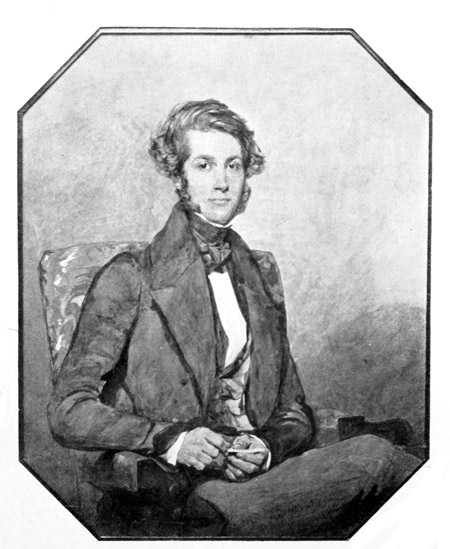
VICTOR GIFFORD AUDUBON. FROM THE MINIATURE BY F. CRUIKSHANK, 1838.
June 30. I have drawn three birds this day since eight o'clock, one Fringilla lincolnii, one Ruby-crowned Wren, and a male White-winged Crossbill. Found a nest of the Savannah Finch with two eggs; it was planted in the moss, and covered by a rampant branch; it was made of fine grass, neither hair nor feathers in its composition. Shot the L. marinus in fine order, all with the wings extending nearly two inches beyond the tail, and all in the same state of moult, merely showing in the middle primaries. These birds suck other birds' eggs like Crows, Jays, and Ravens. Shot six Phalacrocorax carbo[197] in full plumage, species well ascertained by their white throat; found abundance of their eggs and young.
July 1. The weather was so cold that it was painful for me to draw almost the whole day, yet I have drawn a White-winged Crossbill[198] and a Mormon arcticus. We have had three of these latter on board, alive, these three days past; it is amusing to see them running about the cabin and the hold with a surprising quickness, watching our motions, and particularly our eyes. A Pigeon Hawk's[199] nest was found to-day; it was on the top of a fir-tree about ten feet high, made of sticks and lined with moss, and as large as a Crow's nest; it contained two birds just hatched, and three eggs, which the young inside had just cracked. The parent birds were anxious about their newly born ones, and flew close to us. The little ones were pure white, soft and downy. We found also three young of the Charadrius semipalmatus,[200] and several old ones; these birds breed on the margin of a small lake among the low grasses. Traces have been seen of Hares or Rabbits, and one island is perforated throughout its shallow substratum of moss by a species of Rat, but in such burrows search for them is vain. The "Gulnare" came in this evening; our captain brought her in as pilot. We have had an almost complete eclipse of the moon this evening at half-past seven. The air very chilly.
July 2. A beautiful day for Labrador. Drew another M. arcticus. Went on shore, and was most pleased with what I saw. The country, so wild and grand, is of itself enough to interest any one in its wonderful dreariness. Its mossy, gray-clothed rocks, heaped and thrown together as if by chance, in the most fantastical groups imaginable, huge masses hanging on minor ones as if about to roll themselves down from their doubtful-looking situations, into the depths of the sea beneath. Bays without end, sprinkled with rocky islands of all shapes and sizes, where in every fissure a Guillemot, a Cormorant, or some other wild bird retreats to secure its egg, and raise its young, or save itself from the hunter's pursuit. The peculiar cast of the sky, which never seems to be certain, butterflies flitting over snow-banks, probing beautiful dwarf flowerets of many hues pushing their tender stems from the thick bed of moss which everywhere covers the granite rocks. Then the morasses, wherein you plunge up to your knees, or the walking over the stubborn, dwarfish shrubbery, making one think that as he goes he treads down the forests of Labrador. The unexpected Bunting, or perhaps Sylvia, which perchance, and indeed as if by chance alone, you now and then see flying before you, or hear singing from the creeping plants on the ground. The beautiful fresh-water lakes, on the rugged crests of greatly elevated islands, wherein the Red and Black-necked Divers swim as proudly as swans do in other latitudes, and where the fish appear to have been cast as strayed beings from the surplus food of the ocean. All—all is wonderfully grand, wild—aye, and terrific. And yet how beautiful it is now, when one sees the wild bee, moving from one flower to another in search of food, which doubtless is as sweet to it, as the essence of the magnolia is to those of favored Louisiana. The little Ring Plover rearing its delicate and tender young, the Eider Duck swimming man-of-war-like amid her floating brood, like the guardship of a most valuable convoy; the White-crowned Bunting's sonorous note reaching the ear ever and anon; the crowds of sea-birds in search of places wherein to repose or to feed—how beautiful is all this in this wonderful rocky desert at this season, the beginning of July, compared with the horrid blasts of winter which here predominate by the will of God, when every rock is rendered smooth with snows so deep that every step the traveller takes is as if entering into his grave; for even should he escape an avalanche, his eye dreads to search the horizon, for full well does he know that snow—snow—is all that can be seen. I watched the Ring Plover for some time; the parents were so intent on saving their young that they both lay on the rocks as if shot, quivering their wings and dragging their bodies as if quite disabled. We left them and their young to the care of the Creator. I would not have shot one of the old ones, or taken one of the young for any consideration, and I was glad my young men were as forbearing. The L. marinus is extremely abundant here; they are forever harassing every other bird, sucking their eggs, and devouring their young; they take here the place of Eagles and Hawks; not an Eagle have we seen yet, and only two or three small Hawks, and one small Owl; yet what a harvest they would have here, were there trees for them to rest upon.
July 3. We had a regular stiff gale from the eastward the whole day, accompanied with rain and cold weather, and the water so rough that I could not go ashore to get plants to draw. This afternoon, however, the wind and waves abated, and we landed for a short time. The view from the topmost rock overlooking the agitated sea was grand; the small islets were covered with the angry foam. Thank God! we were not at sea. I had the pleasure of coming immediately upon a Cormorant's nest, that lay in a declivity not more than four or five yards below me; the mother bird was on her nest with three young; I was unobserved by her for some minutes, and was delighted to see how kindly attentive she was to her dear brood; suddenly her keen eye saw me, and she flew off as if to dive in the sea.
July 4. At four this morning I sent Tom Lincoln on shore after four plants and a Cormorant's nest for me to draw. The nest was literally pasted to the rock's edge, so thick was the decomposed, putrid matter below it, and to which the upper part of the nest was attached. It was formed of such sticks as the country affords, sea-moss and other garbage, and weighed over fifteen pounds. I have drawn all day, and have finished the plate of the Fringilla lincolnii, to which I have put three plants of the country, all new to me and probably never before figured; to us they are very fitting for the purpose, as Lincoln gathered them. Our party divided as usual into three bands: John and Lincoln off after Divers; Coolidge, Shattuck, and Ingalls to the main land, and our captain and four men to a pond after fish, which they will catch with a seine. Captain Bayfield sent us a quarter of mutton, a rarity, I will venture to say, on this coast even on the Fourth of July. John and Lincoln returned with a Red-necked Diver, or Scapegrace, Coolidge and party with the nest and two eggs of the Colymbus glacialis.[201] This nest was found on the margin of a pond, and was made of short grasses, weeds, etc.; well fashioned and fifteen inches in diameter. After dinner John and I went on shore to release a Uria grylle that we had confined in the fissure of a rock; the poor thing was sadly weak, but will soon recover from this trial of ours.
July 5. John and Lincoln returned at sunset with a Red-necked Diver, and one egg of that bird, they also found Uria grylle, whose pebbled nests were placed beneath large rolling stones on the earth, and not in fissures; Lincoln thought them a different species, but John did not. They brought some curious Eels, and an Arctic Tern, and saw the tracks of Deer and Caribou, also Otter paths from one pond to another. They saw several Loons and tolled them by running towards them hallooing and waving a handkerchief, at which sight and cry the Loon immediately swam towards them, until within twenty yards. This "tolling" is curious and wonderful. Many other species of water-fowl are deceived by these manœuvres, but none so completely as the Loon. Coolidge's party was fortunate enough to kill a pair of Ptarmigans, and to secure seven of the young birds, hatched yesterday at furthest. They met with these on the dreary, mossy tops of the hills, over which we tread daily in search of knowledge. This is the species of Grouse of which we heard so much at Dennysville last autumn, and glad I am that it is a resident bird with us. The Larus marinus was observed trying to catch the young of the Eiders. I drew from four o'clock this morning till three this afternoon; finished a figure of the Colymbus septentrionalis.[202] Feeling the want of exercise, went off with the captain a few miles, to a large rough island. To tread over the spongy moss of Labrador is a task beyond conception until tried; at every step the foot sinks in a deep, soft cushion which closes over it, and it requires a good deal of exertion to pull it up again. Where this moss happens to be over a marsh, then you sink a couple of feet deep every step you take; to reach a bare rock is delightful, and quite a relief. This afternoon I thought the country looked more terrifyingly wild than ever; the dark clouds, casting their shadows on the stupendous masses of rugged rock, lead the imagination into regions impossible to describe. The Scoter Ducks, of which I have seen many this day, were partially moulted, and could fly only a short distance, and must be either barren or the young bachelors, as I find parents in full plumage, convincing me that these former moult earlier than the breeding Ducks. I have observed this strange fact so often now that I shall say no more about it; I have found it in nearly all the species of the birds here. I do not know of any writer on the history of birds having observed this curious fact before. I have now my hands full of work, and go to bed delighted that to-morrow I shall draw a Ptarmigan which I can swear to, as being a United States species. I am much fatigued and wet to the very skin, but, oh! we found the nest of a Peregrine Falcon on a tremendous cliff, with a young one about a week old, quite white with down; the parents flew fiercely at our eyes.
July 6. By dint of hard work and rising at three, I have drawn a Colymbus septentrionalis and a young one, and nearly finished a Ptarmigan; this afternoon, however, at half-past five, my fingers could no longer hold my pencil, and I was forced to abandon my work and go ashore for exercise. The fact is that I am growing old too fast; alas! I feel it—and yet work I will, and may God grant me life to see the last plate of my mammoth work finished. I have heard the Brown Lark (Anthus spinoletta) sing many a time this day, both on the wing and whilst sitting on the ground. When on the wing it sings while flying very irregularly in zigzags, up and down, etc.; when on a rock (which it prefers) it stands erect, and sings, I think, more clearly. John found the nest of a White-crowned Bunting with five eggs; he was creeping through some low bushes after a Red-necked Diver, and accidentally coming upon it, startled the female, which made much noise and complaint. The nest was like the one Lincoln found placed in the moss, under a low bough, and formed of beautiful moss outwardly, dried, fine grass next inside, and exquisitely lined with fibrous roots of a rich yellow color; the eggs are light greenish, slightly sprinkled with reddish-brown, in size about the same as eggs of the Song Sparrow. This Fringilla[203] is the most abundant in this part of Labrador. We have seen two Swamp Sparrows only. We have found two nests of the Peregrine Falcon, placed high on rocky declivities. Coolidge and party shot two Oyster Catchers; these are becoming plentiful. Lieutenant Bowen of the "Gulnare" brought me a Peregrine Falcon, and two young of the Alca torda, the first hatched we have seen, and only two or three days old.
July 7. Drawing all day; finished the female Grouse and five young, and prepared the male bird. The captain, John, and Lincoln, went off this afternoon with a view to camp on a bay about ten miles distant. Soon after, we had a change of weather, and, for a wonder, bright lightning and something like summer clouds. When fatigued with drawing I went on shore for exercise, and saw many pretty flowers, amongst them a flowering Sea-pea, quite rich in color. Dr. Kelly from the "Gulnare" went with me. Captain Bayfield and Lieutenant Bowen went off this morning on a three weeks' expedition in open boats, but with tents and more comforts than I have ever enjoyed in hunting excursions. The mosquitoes quite as numerous as in Louisiana.
July 8. Rainy, dirty weather, wind east. Was at work at half-past three, but disagreeable indeed is my situation during bad weather. The rain falls on my drawing-paper, despite all I can do, and even the fog collects and falls in large drops from the rigging on my table; now and then I am obliged to close my skylight, and then may be said to work almost in darkness. Notwithstanding, I finished my cock Ptarmigan, and three more young, and now consider it a handsome large plate. John and party returned, cold, wet, and hungry. Shot nothing, camp disagreeable, and nothing to relate but that they heard a Wolf, and found an island with thousands of the Mormon arcticus breeding on it. To-morrow I shall draw the beautiful Colymbus glacialis in most perfect plumage.
July 9. The wind east, of course disagreeable; wet and foggy besides. The most wonderful climate in the world. Cold as it is, mosquitoes in profusion, plants blooming by millions, and at every step you tread on such as would be looked upon with pleasure in more temperate climes. I wish I were a better botanist, that I might describe them as I do birds. Dr. Wm. Kelly has given me the list of such plants as he has observed on the coast as far as Macatine Island. I have drawn all day at the Loon, a most difficult bird to imitate. For my part, I cannot help smiling at the presumption of some of our authors, who modestly assert that their figures are "up to nature." May God forgive them, and teach me to copy His works; glad and happy shall I then be. Lincoln and Shattuck brought some fresh-water shells from a large pond inland; they saw a large bird which they took for an Owl, but which they could not approach; they also caught a frog, but lost it out of their game bag.
July 10. Could I describe one of these dismal gales which blow ever and anon over this desolate country, it would in all probability be of interest to one unacquainted with the inclemency of the climate. Nowhere else is the power of the northeast gale, which blows every week on the coast of Labrador, so keenly felt as here. I cannot describe it; all I can say is that whilst we are in as fine and safe a harbor as could be wished for, and completely land-locked all round, so strong does the wind blow, and so great its influence on our vessel, that her motion will not allow me to draw, and indeed once this day forced me to my berth, as well as some others of our party. One would imagine all the powers of Boreas had been put to work to give us a true idea of what his energies can produce, even in so snug a harbor. What is felt outside I cannot imagine, but greatly fear that few vessels could ride safely before these horrid blasts, that now and then seem strong enough to rend the very rocks asunder. The rain is driven in sheets which seem scarcely to fall on sea or land; I can hardly call it rain, it is rather a mass of water, so thick that all objects at any distance from us are lost to sight every three or four minutes, and the waters comb up and beat about us in our rock-bound harbor as a newly caged bird does against its imprisoning walls. The Great Black-backed Gull alone is seen floating through the storm, screaming loudly and mournfully as it seeks its prey; not another bird is to be seen abroad; the Cormorants are all settled in the rocks close to us, the Guillemots are deep in the fissures, every Eider Duck lays under the lee of some point, her brood snugly beneath her opened wings, the Loon and the Diver have crawled among the rankest weeds, and are patiently waiting for a return of fair weather, the Grouse is quite hid under the creeping willow, the Great Gray Owl is perched on the southern declivity of some stupendous rock, and the gale continues as if it would never stop. On rambling about the shores of the numerous bays and inlets of this coast, you cannot but observe immense beds of round stone of all sizes, some of very large dimensions rolled side by side and piled one upon another many deep, cast there by some great force of nature. I have seen many such places, and never without astonishment and awe. If those great boulders are brought from the bottom of the sea, and cast hundreds of yards on shore, this will give some idea of what a gale on the coast of Labrador can be, and what the force of the waves. I tried to finish my drawing of the Loon, but in vain; I covered my paper to protect it from the rain, with the exception only of the few inches where I wished to work, and yet that small space was not spared by the drops that fell from the rigging on my table; there is no window, and the only light is admitted through hatches.