THE EUROPEAN JOURNALS (continued 4)
Reading edition
March 10. I visited Mr. James B. Fraser,[116] a great traveller in Asia and Africa, and saw there a large collection of drawings and views in water-colors of the scenery of these countries. The lecture at the Wernerian Society was very interesting; it was on the uses of cotton in Egypt, and the origin of the name in the English language. I dined at Mr. Neill's; among the guests was a Mr. Blair, the superintendent of the Botanical Gardens here; he has been in different parts of America frequently. There were several other gentlemen present interested in like subjects, and we talked of little else than trees and exotic plants, birds and beasts; in fact it was a naturalists' dinner, but a much better one than naturalists generally have who study in the woods. I was obliged to leave early, as I had an engagement at Miss Neville's. Tea was served, after which Miss Neville rose, and said she would open the concert. I was glad to see her simply but beautifully dressed in a plain white gown of fine muslin, with naught but her fine auburn hair loose in large curls about her neck, and a plain scarf of a light-rose color. She sang and played most sweetly; the gentlemen present were all more or less musical, and we had fine glees, duets, trios. The young lady scarcely left off singing, for no sooner was a song finished than some one asked for another; she immediately replied, "Oh, yes," and in a moment the room was filled with melody. I thought she must be fatigued, and told her so, but she replied: "Mr. Audubon, singing is like painting; it never fatigues if one is fond of it, and I am." After a handsome supper we had more singing, and it was past two o'clock when I rose, shook hands with Miss Neville, bowed to the company, and made my exit.
March 12. I can scarcely believe that this day, there is in many places six feet of snow, yet with all this no invitation is ever laid aside, and last evening I went to dinner in a coach drawn by four horses. At noon to-day I went with Mr. Lizars to the Assembly Rooms, to see the fencing. About a thousand persons, all in full dress, gathered in a few minutes, and a circle being formed, eight young men came in, and went through the first principles of fencing; we had fine martial music and a succession of fencing turns till two o'clock, when the assault began between the two best scholars. Five hits were required to win the prize—a fine sword—and it was presented to the conqueror, a Mr. Webster. At half-past six I dined at Mr. Hamilton's, where a numerous and agreeable party was assembled. At ten Miss Neville and her mother came with still others. We had dancing and singing, and here I am, quite wearied at half-past three; but I must be up early to-morrow morning.
March 13. The little I slept had a bad effect on me, for I rose cross of mind and temper. I took a long walk on the London road, returned and reached Brae House, and breakfasted with the famous Mrs. Grant,[117] an old lady very deaf, but very agreeable withal. Her son and daughter and another lady formed our party. We talked of nothing but America; Mrs. Grant is positively the only person I have met here who knows anything true about my country. I promised to call again soon. This evening I dined at Sir James Riddell's, and I do not know when I have spent a more uncomfortable evening; the company were all too high for me, though Sir James and his lady did all they could for me. The ton here surpassed that at the Earl of Morton's; five gentlemen waited on us while at table, and two of these put my cloak about my shoulders, notwithstanding all I could say to the contrary. Several of these men were quite as well dressed as their master. What will that sweet lady, Mrs. Basil Hall think of a squatter's hut in Mississippi in contrast with this? No matter! whatever may be lacking, there is usually a hearty welcome. Oh! my America, how dearly I love thy plain, simple manners.
March 14. I have been drawing all day, two Cat-birds and some blackberries for the Countess of Morton, and would have finished it had I not been disturbed by visitors. Mr. Hays came with his son; he asked me if it would not be good policy for me to cut my hair and have a fashionable coat made before I reached London. I laughed, and he laughed, and my hair is yet as God made it.
March 17. I had long wished to visit Roslyn Castle and the weather being beautiful I applied to Mrs. Dickie for a guide, and she sent her son with me. We passed over the North Bridge and followed the turnpike road, passing along the foot of the Pentland Hills, looking back frequently to view Edinburgh under its cloud of smoke, until we had passed a small eminence that completely hid it afterwards from our sight. Not an object of interest lay in our way until we suddenly turned southeast and entered the little village of Roslyn. I say little, because not more than twenty houses are there, and these are all small except one. It is high, however, so much so that from it we looked down on the ruined castle, although the elevation of the castle above the country around is very great. On inquiry, we were assured that the chapel was the only remaining edifice worthy of attention. We walked down to it and entered an enclosure, when before us stood the remains of the once magnificent Chapel of Roslyn. What volumes of thoughts rushed into my mind. I, who had read of the place years before, who knew by tradition the horrors of the times subsequent to the founding of the edifice, now confronted reality. I saw the marks of sacrilegious outrage on objects silent themselves and which had been raised in adoration to God. Strange that times which produced such beautiful works of art should allow the thief and the murderer to go almost unpunished. This Gothic chapel is a superb relic; each stone is beautifully carved, and each differs from all the others. The ten pillars and five arches are covered with the finest fret-work, and all round are seen the pedestals that once supported the images that Knox's party were wont to destroy without thought or reason. I went down some mouldering steps into the Sacristy, but found only bare walls, decaying very fast; yet here a curious plant was growing, of a verdigris color. To reach the castle we went down and along a narrow ridge, on each side of which the ground went abruptly to the bottom of a narrow, steep valley, through which a small, petulant stream rushed with great rapidity over a rocky bed. This guards three sides of the promontory on which Roslyn Castle once was; for now only a few masses of rubbish were to be seen, and a house of modern structure occupies nearly the original site. In its day it must have been a powerful structure, but now, were it existing, cannon could destroy it in a few hours, if they were placed on the opposite hills. A large meadow lay below us, covered with bleaching linen, and the place where we stood was perfectly lonely, not even the reviving chirp of a single bird could be heard, and my heart sank low while my mind was engaged in recollections of the place. In silence we turned and left the Castle and the little village, and returned by another route to busy Edinburgh. The people were just coming out of church, and as I walked along I felt a tap on my shoulder and heard good Mr. Neill say, "Where are you going at the rate of six miles an hour?" and he took me home to dine with him, after we had been to my lodgings, where I put my feet in ice cold water for ten minutes, when I felt as fresh as ever.
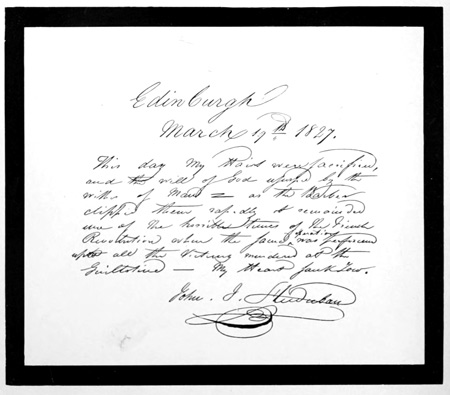
FACSIMILE OF ENTRY IN JOURNAL
March 19, 1827. This day my hair was sacrificed, and the will of God usurped by the wishes of man. As the barber clipped my locks rapidly, it reminded me of the horrible times of the French Revolution when the same operation was performed upon all the victims murdered at the guillotine; my heart sank low.
John J. Audubon.[118]
Shortly after breakfast I received a note from Captain Hall, and another from his brother, both filled with entreaties couched in strong terms that I should alter my hair before I went to London. Good God! if Thy works are hated by man it must be with Thy permission. I sent for a barber, and my hair was mowed off in a trice. I knew I was acting weakly, but rather than render my good friend miserable about it, I suffered the loss patiently.
March 20. I visited Mr. Hays at his office, and had the pleasure of seeing all the curious ancient manuscripts, letters, mandates, Acts of Parliament, etc., connected with the official events of Scotland with England for upwards of three hundred years past. Large volumes are written on parchment, by hand, and must have been works of immense labor. The volumes containing the mere transfers of landed estates filed within the last forty years amounted to almost three thousand, and the parcels of ancient papers filled many rooms in bundles and in bags of leather, covered with dust, and mouldering with age. The learned antiquarian, Mr. Thompson, has been at great pains to put in order all these valuable and curious documents. The edifice of the Registry is immense, and the long, narrow passages proved a labyrinth to me. Mr. Hays' allotted portion of curiosities consists of Heraldry, and I saw the greatest display of coats of arms of all sorts, emblazoned in richest style on sleek vellum and parchment.
March 21. Called on Miss D——, the fair American. To my surprise I saw the prints she had received the evening before quite abused and tumbled. This, however, was not my concern, and I regretted it only on her account, that so little care should be taken of a book that in fifty years will be sold at immense prices because of its rarity.[119] The wind blew great guns all morning. Finding it would be some days before my business would permit me to leave, I formed an agreement to go to see the interior of the Castle, the regalia, and other curiosities of the place to-morrow. I received a valuable letter of introduction to the Secretary of the Home Department, Mr. Peel, from the Lord Advocate of Scotland, given me at the particular request of the Countess of Morton, a most charming lady; the Earl of Morton would have written himself but for the low state of his health.
March 22. After lunch the Rev. Wm. Newbold and I proceeded to the Castle; the wind blew furiously, and consequently no smoke interfered with the objects I wished to see. We passed a place called the "Mound," a thrown-up mass of earth connecting now the New with the Old city of Edinburgh. We soon reached the gates of the Castle, and I perceived plainly that I was looked upon as an officer from the continent. Strange! three days ago I was taken for a priest, quick transition caused only by the clipping of my locks. We crossed the drawbridge and looked attentively at the deep and immense dried ditches below, passed through the powerful double gates, all necessary securities to such a place. We ascended continually until we reached the parapets where the King stood during his visit, bowing, I am told, to the gaping multitude below, his hat off, and proud enough, no doubt, of his high station. My hat was also off, but under different impulses; I was afraid that the wind would rob me of it suddenly. I did not bow to the people, but I looked with reverence and admiration on the beauties of nature and of art that surrounded me, with a pleasure seldom felt before. The ocean was rugged with agitated waves as far as the eye could reach eastwardly; not a vessel dared spread its sails, so furious was the gale. The high mountains of wild Scotland now and then faintly came to our view as the swift-moving clouds passed, and suffered the sun to cast a momentary glance at them. The coast of the Frith of Forth exhibited handsome villas, and noblemen's seats, bringing at once before me the civilization of man, and showing how weak and insignificant we all are. My eyes followed the line of the horizon and stopped at a couple of small elevations, that I knew to be the home of the Countess of Morton; then I turned to the immense city below, where men looked like tiny dwarfs, and horses smaller than sheep. To the east lay the Old Town, and now and then came to my ears the music of a band as the squall for a moment abated. I could have remained here a whole day, but my companion called, and I followed him to the room where the regalia are kept. We each wrote our names, paid our shilling, and the large padlock was opened by a red-faced, bulky personage dressed in a fanciful scarlet cloth, hanging about him like mouldering tapestry. A small oblong room, quite dark, lay before us; it was soon lighted, however, by our conductor. A high railing of iron, also of an oblong form, surrounded a table covered with scarlet cloth, on which lay an immense sword and its scabbard, two sceptres, a large, square, scarlet cushion ornamented with golden tassels, and above all the crown of Scotland. All the due explanations were cried out by our conductor, on whose face the reflection of all the red articles was so powerfully displayed just now that it looked like a large tomato, quite as glittering, but of a very different flavor, I assure thee. We looked at all till I was tired; not long did this take, for it had not one thousandth portion of the beauties I had seen from the parapet. We left the Castle intending to proceed to the stone quarries three miles distant, but the wind was now so fierce, and the dust so troubled my eyes, that the jaunt was put off till another day. I paid young Kidd three guineas for his picture. Have just had some bread and butter and will go to bed.
March 23. Young Kidd breakfasted with me, and no sooner had he gone than I set to and packed up. I felt very low-spirited; the same wind keeps blowing, and I am now anxious to be off to Mr. Selby's Newcastle, and my dear Green Bank. My head was so full of all manner of thoughts that I thought it was Saturday, instead of Friday, and at five o'clock I dressed in a great hurry and went to Mr. Henry Witham's with all possible activity. My Lucy, I was not expected till to-morrow! Mr. Witham was not at home, and his lady tried to induce me to remain and dine with her and her lovely daughter; but I declined, and marched home as much ashamed of my blunder as a fox who has lost his tail in a trap. Once before I made a sad blunder; I promised to dine at three different houses the same day, and when it came I discovered my error, and wrote an apology to all, and went to none.
Twizel House, Belford—Northumberland, April 10, 1827. Probably since ten years I have not been so long without recording my deeds or my thoughts; and even now I feel by no means inclined to write, and for no particular reason. From Friday the 23d of March till the 5th of April my time was busily employed, copying some of my drawings, from five in the morning till seven at night. I dined out rarely, as I found the time used by this encroached too much on that needed by my ardent desire to improve myself in oil and in perspective, which I wished to study with close attention. Every day brought me packets of letters of introduction, and I called here and there to make my adieux. I went often in the evening to Mr. Lizars'; I felt the parting with him and his wife and sister would be hard, and together we attended meetings of the different societies. The last night I went to the Royal Society. Sir Wm. Hamilton[120] read a paper against phrenology, which would seem to quite destroy the theory of Mr. Combe. I left many things in the care of my landlady, as well as several pictures, and at six o'clock on the morning of April 5, left Edinburgh, where I hope to go again. The weather was delightful. We passed Dunbar and Berwick, our road near the sea most of the time, and at half-past four, the coach stopped opposite the lodge of Twizel House. I left my baggage in the care of the woman at the lodge, and proceeded through some small woods towards the house, which I saw after a few minutes,—a fine house, commanding an extensive view of the country, the German Ocean, and Bamborough Castle. I ascended the great staircase with pleasure, for I knew that here was congeniality of feeling. Hearing the family were out and would not return for two hours, I asked to be shown to the library, and told my name. The man said not a word, went off, and about ten minutes after, whilst I was reading the preface of William Roscoe to his "Leo X.," returned and said his master would be with me in a moment. I understood all this. Mr. Selby came in, in hunting-dress, and we shook hands as hunters do. He took me at once out in his grounds, where Mrs. Selby, his three daughters, and Captain Mitford his brother-in-law were all engaged transplanting trees, and I felt at home at once. When we returned to the house Mr. Selby conducted me to his laboratory, where guns, birds, etc., were everywhere. I offered to make a drawing and Captain Mitford went off to shoot a Chaffinch. We had supper, after which the eagerness of the young ladies made me open my box of drawings; later we had music, and the evening passed delightfully. I thought much of home I assure thee, and of Green Bank also, and then of my first sight of thee at Fatland, and went to bed thanking God for the happy moments he has granted us. The next morning I felt afraid my early habits would create some disturbance in the repose of the family, and was trying to make good my outing at five, and thought I had already done so, when to my surprise and consternation the opening of the hall door made such a noise as I doubted not must have been heard over the whole establishment; notwithstanding, I issued into the country fresh air, and heard all around me the Black-birds, Thrushes, and Larks at their morning songs. I walked, or rather ran about, like a bird just escaped from a cage; plucked flowers, sought for nests, watched the fishes, and came back to draw. All went well; although the shooting season (as the English please to call it) was long since over, we took frequent walks with guns, and a few individuals were the sufferers from my anxiety to see their bills, and eyes, and feathers; and many a mile did I race over the moors to get them. More or less company came daily to see my drawings, and I finished a drawing for Mr. Selby of three birds, a Lapwing for Mrs. Selby, who drew fully as well as I did, and who is now imitating my style, and to whom I have given some lessons. Also I finished a small picture in oil for the charming elder daughter Louise; the others are Jane and Fanny. So much at home did we become that the children came about me as freely as if I had long known them; I was delighted at this, for to me to have familiar intercourse with children, the most interesting of beings, is one of my greatest enjoyments, and my time here was as happy as at Green Bank; I can say no more. The estate is well situated, highly ornamented, stocked with an immensity of game of the country, and trout abound in the little rivulets that tumble from rock to rock towards the northern ocean. To-morrow I leave this with Captain Mitford for his country seat.
Mitford Castle, near Morpeth, Northumberland, April 11, 1827. I rose as early as usual, and not to disturb my kind friends, I marched down the staircase in my stockings, as I often do where the family are not quite such early risers; instead of opening the hall door I sat down in the study, and outlined a Lapwing, in an extremely difficult position, for my friend Selby, and did not go on my walk until the servants made their appearance, and then I pushed off to the garden and the woods to collect violets. I felt quite happy, the fragrance of the air seemed equal to that of the little blue flowers which I gathered. We breakfasted, and at ten o'clock I bid farewell to Mrs. Selby; good, amiable lady, how often she repeated her invitation to me to come and spend a goodly time with them. Mr. Selby and the children walked down to the lodge with the captain and me, and having reached the place too early we walked about the woods awhile. The parting moment came at last, all too soon, our baggage was put on the top of the "Dart," an opposition coach, and away we rolled. My good companion Captain Mitford kept my spirits in better plight than they would otherwise have been, by his animated conversation about game, fishing, America, etc., and after a ride of about twelve miles we entered the small village of Alnwick, commanded by the fine castle of the Duke of Northumberland. Having to change horses and wait two hours, we took a walk, and visited the interior of that ancient mass of buildings, the whole being deserted at present, the Duke absent. I saw the armory, the dungeons, the place for racking prisoners, but the grotesque figures of stone standing in all sorts of attitudes, defensive and offensive, all round the top of the turrets and bastions, struck me most. They looked as if about to move, or to take great leaps to the ground, to cut our throats. This castle covers five acres of ground, is elevated, and therefore in every direction are good views of the country. From it I saw the cross put up in memory of King Malcolm killed by Hammond. At two precisely (for in England and Scotland coaches start with great punctuality) we were again en route. We passed over the Aln River, a very pretty little streamlet, and reached Felton, where we changed horses. The whole extent of country we passed this day was destitute of woods, and looked to me very barren. We saw little game; about five we arrived within two miles of Morpeth, where the captain and I alighted; we walked to a pretty little vale and the ruins of the old castle lay before us, still doomed to moulder more, and walking on reached the confluence of two small, pretty streams from which originated the name of my friend's ancestors, Meetingford. We reached the house, and having heard of his brother's indisposition, the captain and I entered quietly, and I was presented to the owner of the hall. I saw before me a thin, pale, emaciated being who begged I would go to him, as he could not rise. I shook his withered hand and received his kind welcome. During the evening I had ample opportunity to observe how clever and scientific he was, and regretted the more his frail body. He was extremely anxious to see my drawings, and he examined them more closely than I can ever remember any one to have done before, and was so well acquainted with good drawing that I felt afraid to turn them over for his inspection. After looking at probably a hundred without saying a single word, he exclaimed suddenly: "They are truly beautiful; our King ought to purchase them, they are too good to belong to a single individual." We talked much on subjects of natural history, and he told me that he made it a rule that not a gun was ever fired during the breeding season on any part of his beautiful estate; he delighted to see the charming creatures enjoy life and pleasure without any annoyance. Rooks, Jackdaws, Wood-Pigeons, and Starlings were flying in hundreds about the ruined castle. We sat up till after twelve, when hot water and spirits were produced, after which we said good-night; but I needed nothing to make me sleep, for in five minutes after I lay down I was—I know not where.
April 12. I am now at last where the famous Bewick produced his handsome and valuable work on the birds of England. It is a dirty-looking place, this Newcastle, and I do not know if it will prove at all pleasant. This morning early the captain and myself took a good ramble about Mitford Hall grounds; saw the rookery, the ruins of the castle, and walked some way along the little river front. We breakfasted about ten with his brother, who wished to see my drawings by daylight. Afterwards my baggage was taken to Morpeth, and the captain and I walked thither about twelve. Our way was along a pretty little stream called the Wansbeck, but the weather changed and the rain assured me that none of the persons we expected to see in the village would come, on this account, and I was not mistaken. At half-past four I mounted the coach for this place, and not an object of interest presented itself in the journey of thirteen miles.
Newcastle-upon-Tyne, April 13. At ten o'clock I left the inn, having had a very indifferent breakfast, served on dirty plates; therefore I would not recommend the "Rose and Crown," or the hostess, to any friend of mine. Yet my bed was quite comfortable, and my sleep agreeably disturbed about one hour before day by some delightful music on the bugle. I often, even before this, have had a wish to be a performer on this instrument, so sure I am that our grand forests and rivers would re-echo its sonorous sounds with fine effect. I passed through many streets, but what a shabby appearance this Newcastle-upon-Tyne has, after a residence of nearly six months in the beautiful city of Edinburgh. All seems dark and smoky, indeed I conceive myself once more in Manchester. The cries of fish, milk, and vegetables, were all different, and I looked in vain for the rosy cheeks of the Highlanders. I had letters to the members of the Johnson family, given me by Captain Mitford, and therefore went to St. James Square, where I delivered them, and was at once received by a tall, fine-looking young gentleman, who asked me if I had breakfasted. On being answered in the affirmative, he requested me to excuse him till he had finished his, and I sat opposite the fire thinking about the curious pilgrimage I had now before me. Will the result repay the exertions? Alas! it is quite impossible for me to say, but that I shall carry the plan out in all its parts is certain unless life departs, and then I must hope that our Victor will fall into my place and accomplish my desires, with John's help to draw the birds, which he already does well. Mr. Edward Johnson soon re-entered, bringing with him Mr. John Adamson, secretary to the Literary and Philosophical Society of this place. I presented the letter for him from Mr. Selby, but I saw at once that he knew me by name. Soon after he very kindly aided me to find suitable lodgings, which I did in Collingwood Street. We then walked to Mr. Bewick's, the engraver, son of the famous man, and happily met him. He is a curious-looking man; his head and shoulders are both broad, but his keen, penetrating eyes proved that Nature had stamped him for some use in this world. I gave him the letters I had for him, and appointed a time to call on his father. I again suffered myself to be imposed upon when I paid my bill at the inn on removing to my lodgings, and thought of Gil Blas of Santillane. Five persons called to see my drawings this afternoon, and I received a note from Mr. Bewick inviting me to tea at six; so I shall see and talk with the wonderful man. I call him wonderful because I am sincerely of the opinion that his work on wood is superior to anything ever attempted in ornithology. It is now near eleven at night. Robert Bewick (the son) called for me about six, and we proceeded to his father's house. On our way I saw an ancient church with a remarkably beautiful Lanterne at top, St. Nicholas' Church I was told, then we passed over the Tyne, on a fine strong bridge of stone, with several arches, I think six or seven. This is distant from the sea, and I must say that the Tyne here is the only stream I have yet seen since my landing resembling at all a river. It is about as large as Bayou Sara opposite the Beech Woods, when full. I saw some of the boats used in carrying coals down the stream; they are almost of oval shape, and are managed with long, sweeping oars, and steerers much like our flat-boats on the Ohio. My companion did not talk much; he is more an acting man than a talker, and I did not dislike him for that. After ascending a long road or lane, we arrived at Bewick's dwelling, and I was taken at once to where he was at work, and saw the man himself. He came to me and welcomed me with a hearty shake of the hand, and took off for a moment his half-clean cotton night-cap tinged with the smoke of the place. He is tall, stout, has a very large head, and his eyes are further apart than those of any man I remember just now. A complete Englishman, full of life and energy though now seventy-four, very witty and clever, better acquainted with America than most of his countrymen, and an honor to England. Having shown me the work he was at, a small vignette cut on a block of box-wood not more than three by two inches, representing a dog frightened during the night by false appearances of men formed by curious roots and branches of trees, rocks, etc., he took me upstairs and introduced me to his three daughters—all tall, and two of them with extremely fine figures; they were desirous to make my visit an agreeable one and most certainly succeeded. I met there a Mr. Goud, and saw from his pencil a perfect portrait of Thomas Bewick, a miniature, full-length, in oil, highly finished, well drawn and composed. The old gentleman and I stuck to each other; he talked of my drawings, and I of his woodcuts, till we liked each other very much. Now and then he would take off his cotton cap, but the moment he became animated with the conversation the cap was on, yet almost off, for he had stuck it on as if by magic. His eyes sparkled, his face was very expressive, and I enjoyed him much more, I am sure, than he supposed. He had heard of my drawings and promised to call early to-morrow morning with his daughters and some friends. I did not forget dear John's wish to possess a copy of his work on quadrupeds, and having asked where I could procure one, he answered "Here." After coffee and tea had been served, young Bewick, to please me, brought a bagpipe of a new construction, called a "Durham," and played simple, nice Scotch and English airs with peculiar taste; the instrument sounded like a hautboy. Soon after ten the company broke up, and we walked into Newcastle. The streets were desolate, and their crookedness and narrowness made me feel the more the beauty of fair Edinburgh.
April 14. The weather is now becoming tolerable and spring is approaching. The Swallows glide past my windows, and the Larks are heard across the Tyne. Thomas Bewick, his whole family, and about a hundred others have kept me busy exhibiting drawings. Mr. Bewick expressed himself as perfectly astounded at the boldness of my undertaking. I am to dine with him to-morrow, Mr. Adamson to-day, and Mr. Johnson on Wednesday if I do not go on to York that day.
April 15. Mr. Adamson called for me at church time, and we proceeded a short distance and entered St. Nicholas' church. He ordered an officer to take me to what he called the mansion house and I was led along the aisles to a place enclosed by an iron railing and showed a seat. In looking about me I saw a large organ over the door I had entered, and in front of this were seated many children, the lasses in white, the lads in blue. An immense painting of the Lord's Supper filled the end opposite the entrance, and the large Gothic windows were brilliant with highly colored glass. A few minutes passed, when a long train of office bearers and the magistrates of the town, headed by the mayor, came in procession and entered the mansion house also; a gentleman at my elbow rose and bowed to these and I followed his example; I discovered then that I was seated in the most honorable place. The service and sermon were long and tedious; often to myself I said, "Why is not Sydney Smith here?" Being in church I sat patiently, but I must say I thought the priest uncommonly stupid. Home to luncheon and afterwards went to Heath, the painter,[121] who with his wife received me with extreme kindness. He showed me many sketches, a number of which were humorous. He likes Newcastle better than Edinburgh, and I would not give an hour at Edinburgh, especially were I with friend Lizars, his wife, and sister, for a year here. So much for difference of taste.—I have just returned from old Bewick's. We had a great deal of conversation, all tending towards Natural History; other guests came in as the evening fell, and politics and religion were touched upon. Whilst this was going on old Bewick sat silent chewing his tobacco; the son, too, remained quiet, but the eldest daughter, who sat next to me, was very interesting, and to my surprise resembles my kind friend Hannah Rathbone so much, that I frequently felt as if Miss Hannah, with her black eyes and slender figure, were beside me. I was invited to breakfast to-morrow at eight with Mr. Bewick to see the old gentleman at work.
April 16. I breakfasted with old Bewick this morning quite sans cérémonie, and then the old man set to work to show me how simple it was to cut wood! But cutting wood as he did is no joke; he did it with as much ease as I can feather a bird; he made all his tools, which are delicate and very beautiful, and his artist shop was clean and attractive. Later I went with Mr. Plummer, the officiating American consul at this place, to the court-rooms, and Merchant Coffee House, also to a new fish market, small and of a half-moon form, contiguous to the river, that I have forgotten to say is as dirty and muddy as an alligator hole. The coal boats were moving down by hundreds, with only one oar and a steerer, to each of which I saw three men. We then went to the Literary and Philosophical Society rooms; the library is a fine, large room with many books—the museum small, but in neat order, and well supplied with British specimens. Since then I have been showing my drawings to at least two hundred persons who called at my lodgings. I was especially struck with a young lady who came with her brother. I saw from my window a groom walking three fine horses to and fro, and almost immediately the lady and gentleman entered, whip in hand, and spurred like fighting-cocks; the lady, with a beaver and black silk neckerchief, came in first and alone, holding up with both hands her voluminous blue riding-habit, and with a ton very unbecoming her fine eyes and sweet face. She bowed carelessly, and said: "Compliments, sir;" and perceiving how much value she put on herself, I gave her the best seat in the room. For some time she sat without a word; when her brother began to put questions, however, she did also, and so fast and so searchingly that I thought them Envoies Extraordinaires from either Temminck or Cuvier. Mr. Adamson, who sat by all the time, praised me, when they had gone, for my patience, and took me home to dine with him en famille. A person (a glazier, I suppose), after seeing about a hundred pictures, asked me if I did not want glass and frames for them. How I wish I was in America's dark woods, admiring God's works in all their beautiful ways.
April 17. Whilst I was lying awake this morning waiting for it to get light, I presently recollected I was in Newcastle-upon-Tyne, and recalled the name of Smollett, no mean man, by the bye, and remembered his eulogium of the extraordinary fine view he obtained when travelling on foot from London to this place, looking up the Tyne from Isbet Hill, and I said, "If Smollett admired the prospect, I can too," and leaped from my bed as a hare from his form on newly ploughed ground at the sound of the sportsman's bugle, or the sight of the swift greyhound. I ran downstairs, out-of-doors, and over the Tyne, as if indeed a pack of jackals had been after me. Two miles is nothing to me, and I ascended the hill where poor Isbet, deluded by a wretched woman, for her sake robbed the mail, and afterwards suffered death on a gibbet; and saw—the sea! Far and wide it extended; the Tyne led to it, with its many boats with their coaly burdens. Up the river the view was indeed enchanting; the undulating meadows sloped gently to the water's edge on either side, and the Larks that sprang up before me, welcoming the sun's rise, animated my thoughts so much that I felt tears trickling down my cheeks as I gave praise to the God who gave life to all these in a day. There was a dew on the ground, the bees were gathering honey from the tiniest flowerets, and here and there the Blackbird so shy sought for a fibrous root to entwine his solid nest of clay. Lapwings, like butterflies of a larger size, passed wheeling and tumbling over me through the air, and had not the dense smoke from a thousand engines disturbed the peaceful harmony of Nature, I might have been there still, longing for my Lucy to partake of the pleasure with me. But the smoke recalled me to my work, and I turned towards Newcastle. So are all transient pleasures followed by sorrows, except those emanating from the adoration of the Supreme Being. It was still far from breakfast time; I recrossed the Tyne and ascended the east bank for a couple of miles before returning to my lodgings. The morning afterward was spent as usual. I mean, holding up drawings to the company that came in good numbers. Morning here is the time from ten to five, and I am told that in London it sometimes lengthens to eight of the evening as we term it. Among these visitors was a Mr. Donkin, who remained alone with me when the others had left, and we had some conversation; he is an advocate, or, as I would call it, a chancellor. He asked me to take a bachelor's dinner with him at five; I accepted, and he then proposed we should drive out and see a house he was building two miles in the country. I again found myself among the rolling hills, and we soon reached his place. I found a beautiful, low house of stone, erected in the simplest style imaginable, but so well arranged and so convenient that I felt satisfied he was a man of taste as well as wealth. Garden, grounds, all was in perfect harmony, and the distant views up and down the river, the fine woods and castle, all came in place,—not to satiate the eye, but to induce it to search for further beauties. On returning to town Mr. Donkin showed me the old mansion where poor Charles the First was delivered up to be beheaded. He could have escaped through a conduit to the river, where a boat was waiting, but the conduit was all darkness and his heart failed him. Now I should say that he had no heart, and was very unfit for a king. At Mr. Donkin's house I was presented to his partners, and we had a good dinner; the conversation ran much on politics, and they supported the King and Mr. Canning. I left early, as I had promised to take a cup of tea with old Bewick. The old gentleman was seated as usual with his night-cap on, and his tobacco pouch in one hand ready to open; his countenance beamed with pleasure as I shook hands with him. "I could not bear the idea of your going off without telling you in written words what I think of your 'Birds of America;' here it is in black and white, and make whatever use you may of it, if it be of use at all," he said, and put an unsealed letter in my hand. We chatted away on natural-history subjects, and he would now and then exclaim: "Oh that I was young[122] again! I would go to America. What a country it will be." "It is now, Mr. Bewick," I would retort, and then we went on. The young ladies enjoyed the sight and remarked that for years their father had not had such a flow of spirits.
April 19. This morning I paid a visit of farewell to Mr. Bewick and his family; as we parted he held my hand closely and repeated three times, "God preserve you." I looked at him in such a manner that I am sure he understood I could not speak. I walked slowly down the hilly lane, and thought of the intrinsic value of this man to the world, and compared him with Sir Walter Scott. The latter will be forever the most eminent in station, being undoubtedly the most learned and most brilliant of the two; but Thomas Bewick is a son of Nature. Nature alone has reared him under her peaceful care, and he in gratitude of heart has copied one department of her works that must stand unrivalled forever; I say "forever" because imitators have only a share of real merit, compared with inventors, and Thomas Bewick is an inventor, and the first wood-cutter in the world! These words, "first wood-cutter" would, I dare say, raise the ire of many of our hearty squatters, who, no doubt, on hearing me express myself so strongly, would take the axe, and fell down an enormous tree whilst talking about it; but the moment I would explain to them that each of their chips would produce under his chisel a mass of beauties, the good fellows would respect him quite as much as I do. My room was filled all day with people to see my works and me whom some one had said resembled in physiognomy Napoleon of France. Strange simile this, but I care not whom I resemble, if it be only in looks, if my heart preserves the love of the truth.
Saturday, April 21. I am tired out holding up drawings, I may say, all day; but have been rewarded by an addition of five subscribers to my work. Am off to-morrow to York. God bless thee, my Lucy.
York, Sunday, April 22, 1827. Left Newcastle at eight; the weather cold and disagreeable, still I preferred a seat on top to view the country. Passed through Durham, a pretty little town with a handsome castle and cathedral, planted on an elevated peninsula formed by a turn of the river Wear, and may be seen for many miles. It is a rolling country, and the river wound about among the hills; we crossed it three times on stone bridges. Darlington, where we changed horses, is a neat, small place, supported by a set of very industrious Quakers; much table linen is manufactured here. As we approached York the woods became richer and handsomer, and trees were dispersed all over the country; it looked once more like England, and the hedges reminded me of those about "Green Bank." They were larger and less trimmed than in Scotland. I saw York Minster six or seven miles before reaching the town, that is entered by old gates. The streets are disgustingly crooked and narrow, and crossed like the burrows of a rabbit-warren. I was put down at the Black Swan. Though the coach was full, not a word had been spoken except an occasional oath at the weather, which was indeed very cold; and I, with all the other passengers, went at once to the fires. Anxious to find lodgings not at the Black Swan, I went to Rev. Wm. Turner, son of a gentleman I had met at Newcastle, for information. His father had prepared him for my visit at my request, and I was soon installed at Mrs. Pulleyn's in Blake Street. My present landlady's weight, in ratio with that of her husband, is as one pound avoirdupois to one ounce apothecary! She looks like a round of beef, he like a farthing candle. Oh that I were in Louisiana, strolling about the woods, looking in the gigantic poplars for new birds and new flowers!
April 23, Monday. The weather looked more like approaching winter than spring; indeed snow fell at short intervals, and it rained, and was extremely cold and misty. Notwithstanding the disagreeable temperature, I have walked a good deal. I delivered my letters as early as propriety would allow, but found no one in; at least I was told so, for beyond that I cannot say with any degree of accuracy I fear. The Rev. Mr. Turner called with the curator of the Museum, to whom I showed some drawings. After my dinner, eaten solus, I went out again; the Minster is undoubtedly the finest piece of ancient architecture I have seen since I was in France, if my recollection serves me. I walked round and round it for a long time, examining its height, form, composition, and details, until my neck ached. The details are wonderful indeed,—all cut of the same stone that forms the mass outwardly. Leaving it and going without caring about my course, I found myself in front of an ancient castle,[123] standing on a mound, covered with dark ivy, fissured by time and menacing its neighborhood with an appearance of all tumbling down at no remote period. I turned east and came to a pretty little stream called the Ouse, over which I threw several pebbles by way of exercise. On the west bank I found a fine walk, planted with the only trees of size I have seen in this country; it extended about half a mile. Looking up the stream a bridge of fine stone is seen, and on the opposite shores many steam mills were in operation. I followed down this mighty stream till the road gave out, and, the grass being very wet and the rain falling heavily, I returned to my rooms. York is much cleaner than Newcastle, and I remarked more Quakers; but alas! how far both these towns are below fair Edinburgh. The houses here are low, covered with tiles, and sombre-looking. No birds have I seen except Jackdaws and Rooks. To my surprise my host waited upon me at supper; when he enters my room I think of Scroggins' ghost. I have spent my evening reading "Blackwood's Magazine."
April 24. How doleful has this day been to me! It pleased to rain, and to snow, and to blow cold all day. I called on Mr. Phillips, the curator of the Museum, and he assured me that the society was too poor to purchase my work. I spent the evening by invitation at the Rev. Wm. Turner's in company with four other gentlemen. Politics and emancipation were the chief topics of conversation. How much more good would the English do by revising their own intricate laws, and improving the condition of their poor, than by troubling themselves and their distant friends with what does not concern them. I feel nearly determined to push off to-morrow, and yet it would not do; I may be wrong, and to-morrow may be fairer to me in every way; but this "hope deferred" is a very fatiguing science to study. I could never make up my mind to live and die in England whilst the sweet-scented jessamine and the magnolias flourish so purely in my native land, and the air vibrates with the songs of the sweet birds.
April 25. I went out of the house pretty soon this morning; it was cold and blowing a strong breeze. I pushed towards the river with an idea of following it downwards two hours by my watch, but as I walked along I saw a large flock of Starlings, at a time when I thought all birds were paired, and watched their motions for some time, and thereby drew the following conclusion, namely: that the bird commonly called the Meadow Lark with us is more nearly related to the Starling of this country than to any other bird. I was particularly surprised that a low note, resembling the noise made by a wheel not well greased, was precisely the same in both, that the style of their walk and gait was also precisely alike, and that in short flights the movement of the wings had the same tremulous action before they alighted. Later I had visitors to see my pictures, possibly fifty or more. It has rained and snowed to-day, and I feel as dull as a Martin surprised by the weather. It will be strange if York gives me no subscribers, when I had eight at Newcastle. Mr. P—— called and told me it would be well for me to call personally on the nobility and gentry in the neighborhood and take some drawings with me. I thanked him, but told him that my standing in society did not admit of such conduct, and that although there were lords in England, we of American blood think ourselves their equals. He laughed, and said I was not as much of a Frenchman as I looked.
April 26. I have just returned from a long walk out of town, on the road toward Newcastle. The evening was calm, and the sunset clear. At such an hour how often have I walked with my Lucy along the banks of the Schuylkill, Perkiomen Creek, the Ohio River, or through the fragrant woods of Louisiana; how often have we stopped short to admire the works of the Creator; how often have we been delighted at hearing the musical notes of the timid Wood Thrush, that appeared to give her farewell melody to the disappearing day! We have looked at the glittering fire-fly, heard the Whip-poor-will, and seen the vigilant Owl preparing to search field and forest! Here the scene was not quite so pleasing, though its charms brought youth and happiness to my recollection. One or two Warblers perched on the eglantine, almost blooming, and gave their little powers full vent. The shrill notes of Thrushes (not ours) came from afar, and many Rooks with loaded bills were making fast their way towards the nests that contained their nearly half-grown offspring. The cattle were treading heavily towards their pens, and the sheep gathered to the lee of each protecting hedge. To-day have I had a great number of visitors, and three subscribers.
April 27. A long walk early, and then many visitors, Mr. Vernon[124] among them, who subscribed for my work. All sorts of people come. If Matthews the comic were now and then to present himself at my levees, how he would act the scenes over. I am quite worn out; I think sometimes my poor arms will give up their functions before I secure five hundred subscribers.
Saturday, 28th. During my early walk along the Ouse I saw a large butterfly, quite new to me, and attempted to procure it with a stroke of my cane; but as I whirled it round, off went the scabbard into the river, more than half across, and I stood with a naked small sword as if waiting for a duel. I would have swam out for it, but that there were other pedestrians; so a man in a boat brought it to me for sixpence. I have had a great deal of company, and five subscribers. Mr. Wright took me all over the Minster, and also on the roof. We had a good spy-glass, and I had an astonishing view of the spacious vales that surround the tile-covered city of York. I could easily follow the old walls of defence. It made me giddy to look directly down, as a great height is always unpleasant to me. Now I have packed up, paid an enormous bill to my landlady.
Leeds, Sunday, April 28. The town of Leeds is much superior to anything I have seen since Edinburgh, and I have been walking till I feel quite exhausted. I breakfasted in York at five this morning; the coach did not start till six, so I took my refreshing walk along the Ouse. The weather was extremely pleasant; I rode outside, but the scenery was little varied, almost uniformly level, well cultivated, but poor as to soil. I saw some "game" as every bird is called here. I was amused to see the great interest which was excited by a covey of Partridges. What would be said to a gang of Wild Turkeys,—several hundred trotting along a sand-bar of the Upper Mississippi? I reached Leeds at half-past nine, distant from York, I believe, twenty-six miles. I found lodgings at once at 39 Albion Street, and then started with my letters.
April 30. Were I to conclude from first appearances as to the amount of success I may expect here, compared with York, by the difference of attention paid me at both places so soon after my arrival, I should certainly expect much more here; for no sooner was breakfast over than Mr. Atkinson called, to be followed by Mr. George and many others, among them a good ornithologist,[125]—not a closet naturalist, but a real true-blue, who goes out at night and watches Owls and Night-jars and Water-fowl to some purpose, and who knows more about these things than any other man I have met in Europe. This evening I took a long walk by a small stream, and as soon as out of sight undressed and took a dive smack across the creek; the water was so extremely cold that I performed the same feat back again and dressed in a hurry; my flesh was already quite purple. Following the stream I found some gentlemen catching minnows with as much anxiety as if large trout, playing the little things with beautiful lines and wheels. Parallel to this stream is a canal; the adjacent country is rolling, with a number of fine country-seats. I wish I had some one to go to in the evenings like friend Lizars.
May 1, 1827. This is the day on which last year I left my Lucy and my boys with intention to sail for Europe. How uncertain my hopes at that time were as to the final results of my voyage,—about to leave a country where most of my life had been spent devoted to the study of Nature, to enter one wholly unknown to me, without a friend, nay, not an acquaintance in it. Until I reached Edinburgh I despaired of success; the publication of a work of enormous expense, and the length of time it must necessarily take; to accomplish the whole has been sufficient to keep my spirits low, I assure thee. Now I feel like beginning a New Year. My work is about to be known, I have made a number of valuable and kind friends, I have been received by men of science on friendly terms, and now I have a hope of success if I continue to be honest, industrious, and consistent. My pecuniary means are slender, but I hope to keep afloat, for my tastes are simple; if only I can succeed in rendering thee and our sons happy, not a moment of sorrow or discomfort shall I regret.
May 2. Mr. George called very early, and said that his colleague, the Secretary of the Literary and Philosophical Society, would call and subscribe, and he has done so. I think I must tell thee how every one stares when they read on the first engraving that I present for their inspection this name: "The Bonaparte Fly-catcher"—the very bird I was anxious to name the "Rathbone Fly-catcher" in honor of my excellent friend "Lady" Rathbone, but who refused to accept this little mark of my gratitude. I afterwards meant to call it after thee, but did not, because the world is so strangely composed just now that I feared it would be thought childish; so I concluded to call it after my friend Charles Bonaparte. Every one is struck by the name, so explanations take place, and the good people of England will know him as a great naturalist, and my friend. I intend to name, one after another, every one of my new birds, either for some naturalist deserving this honor, or through a wish to return my thanks for kindness rendered me. Many persons have called, quite a large party at one time, led by Lady B——. I am sorry to say I find it generally more difficult to please this class of persons than others, and I feel in consequence more reserved in their presence, I can scarcely say why. I walked out this evening to see Kirkstall Abbey, or better say the ruins of that ancient edifice. It is about three miles out of Leeds and is worthy the attention of every traveller. It is situated on the banks of the little river Ayre, the same I bathed in, and is extremely romantic in its appearance, covered with ivy, and having sizable trees about and amongst its walls. The entrance is defended by a board on which is painted: "Whoever enters these ruins, or damages them in the least, will be prosecuted with all the rigor of the law." I did not transgress, and soon became very cautious of my steps, for immediately after, a second board assured every one that spring-guns and steel-traps are about the gardens. However, no entreaty having been expressed to prevent me from sketching the whole, I did so on the back of one of my cards for thee. From that spot I heard a Cuckoo cry, for I do not, like the English, call it singing. I attempted to approach the bird, but in vain; I believe I might be more successful in holding a large Alligator by the tail. Many people speak in raptures of the sweet voice of the Cuckoo, and the same people tell me in cold blood that we have no birds that can sing in America. I wish they had a chance to judge of the powers of the Mock-bird, the Red Thrush, the Cat-bird, the Oriole, the Indigo Bunting, and even the Whip-poor-will. What would they say of a half-million of Robins about to take their departure for the North, making our woods fairly tremble with melodious harmony? But these pleasures are not to be enjoyed in manufacturing towns like Leeds and Manchester; neither can any one praise a bird who sings by tuition, like a pupil of Mozart, as a few Linnets and Starlings do, and that no doubt are here taken as the foundation stone of the singing powers allotted to European birds generally. Well, is not this a long digression for thee? I dare say thou art fatigued enough at it, and so am I.
May 3. Until two o'clock this day I had only one visitor, Mr. John Marshall, a member of Parliament to whom I had a letter; he told me he knew nothing at all about birds, but most generously subscribed, because, he told me, it was such a work as every one ought to possess, and to encourage enterprise. This evening I dined with the Messrs. Davy, my old friends of Mill Grove; the father, who for many months has not left his bed-chamber, desired to see me. We had not met since 1810, but he looked as fresh as when I last saw him, and is undoubtedly the handsomest and noblest-looking man I have ever seen in my life, excepting the Marquis de Dupont de Nemours. I have at Leeds only five subscribers,—poor indeed compared with the little town of York.
May 5. I breakfasted with young Mr. Davy, who after conducted me to Mr. Marshall's mills. We crossed the Ayre in a ferry boat for a half-penny each, and on the west bank stood the great works. The first thing to see was the great engine, 150 horse-power, a stupendous structure, and so beautiful in all its parts that no one could, I conceive, stand and look at it without praising the ingenuity of man. Twenty-five hundred persons of all ages and both sexes are here, yet nothing is heard but the burr of machinery. All is wonderfully arranged; a good head indeed must be at the commander's post in such a vast establishment.
Manchester, May 6 1827. My journey was uneventful and through the rain. I reached Mr. Bentley's soon after noon, and we were both glad to meet.
May 7. The rooms of the Natural History Society were offered to me, to show my work, but hearing accidentally that the Royal Institution of Manchester was holding an exhibition at the Messrs. Jackson's and thinking that place better suited to me, I saw these gentlemen and was soon installed there. I have had five subscribers. I searched for lodgings everywhere, but in vain, and was debating what to do, when Dr. Harlan's friend, Mr. E. W. Sergeant, met me, and insisted on my spending my time under his roof. He would take no refusal, so I accepted. How much kindness do I meet with everywhere. I have had much running about and calling on different people, and at ten o'clock this evening was still at Mr. Bentley's, not knowing where Mr. Sergeant resided. Mr. Surr was so kind as to come with me in search of the gentleman; we found him at home and he gave me his groom to go for my portmanteau. Of course I returned to Mr. Bentley's again, and he returned with me to see me safely lodged. Mr. Sergeant insisted on his coming in; we had coffee, and sat some time conversing; it is now past two of the morning.
May 8. I saw Mr. Gregg and the fair Helen of Quarry Bank this morning; they met me with great friendship. I have saved myself much trouble here by exhibiting no drawings, only the numbers of my work now ready. Mr. Sergeant has purchased my drawing of the Doves for twenty pounds.
May 13, Sunday. My time has been so completely occupied during each day procuring subscribers, and all my evenings at the house of one or another of my friends and acquaintances that my hours have been late, and I have bidden thee good-night without writing it down.[126] Manchester has most certainly retrieved its character, for I have had eighteen subscribers in one week, which is more than anywhere else.
Liverpool, Monday, May 14. I breakfasted with my good friend Bentley, and left in his care my box containing 250 drawings, to be forwarded by the "caravan,"—the name given to covered coaches. I cannot tell how extremely kind Mr. Sergeant has been to me during all my stay. He exerted himself to procure subscribers as if the work had been his own, and made my time at his house as pleasant as I could desire. I was seated on top of the coach at ten o'clock, and at three was put down safely at Dale St. I went immediately to the Institution, where I found Mr. Munro. I did not like to go to Green Bank abruptly, therefore shall spend the night where I am, but sent word to the Rathbones I was here. I have called on Dr. Chorley and family, and Dr. Traill; found all well and as kind as ever. At six Mr. Wm. Rathbone came, and gave me good tidings of the whole family; I wait impatiently for the morrow, to see friends all so dear.
May 19, Saturday night. I leave this to-morrow morning for London, a little anxious to go there, as I have oftentimes desired to be in sight of St. Paul's Church. I have not been able to write because I felt great pleasure in letting my good friends the Rathbones know what I had done since I was here last; so the book has been in the fair hands of my friend Hannah. "Lady" Rathbone and Miss Hannah are not at Green Bank, but at Woodcroft, and there we met. While I waited in the library how different were my thoughts from those I felt on my first entry into Liverpool. As I thought, I watched the well-shaped Wagtails peaceably searching for food within a few paces of me. The door opened, and I met my good, kind friends, the same as ever, full of friendship, benevolence, and candor. I spent most of the morning with them, and left my book, as I said, with them. Thy book, I should have written, for it is solely for thee. I was driven into Liverpool by Mr. Rd. Rathbone, with his mother and Miss Hannah, and met Mr. Chorley by appointment, that we might make the respectful visits I owed. First to Edward Roscoe's, but saw only his charming wife; then to William Roscoe's. The venerable man had just returned from a walk, and in an instant our hands were locked. He asked me many questions about my publication, praised the engraving and the coloring. He has much changed. Time's violent influence has rendered his cheeks less rosy, his eye-brows more bushy, forced his fine eyes more deeply in their sockets, made his frame more bent, his walk weaker; but his voice had all its purity, his language all its brilliancy. I then went to the Botanic Gardens, where all was rich and beautiful; the season allows it. Then to Alexander Gordon's and Mr. Hodgson. Both out, and no card in my pocket. Just like me. I found the intelligent Swiss[127] in his office, and his "Ah, Audubon! Comment va?" was all-sufficient. I left him to go to Mr. Rathbone's, where I have spent every night except the last. As usual I escaped every morning at four for my walk and to write letters. I have not done much work since here, but I have enjoyed that which I have long desired, the society of my dear friends the Rathbones. Whilst writing this, I have often wished I could take in the whole at one glance, as I do a picture; this need has frequently made me think that writing a good book must be much more difficult than to paint a good picture. To my great joy, Mr. Bentley is going with me to London. With a heavy heart I said adieu to these dear Rathbones, and will proceed to London lower in spirits than I was in Edinburgh the first three days.
Shrewsbury, May 20. After all sorts of difficulties with the coach, which left one hour and a half late, we reached Chester at eleven, and were detained an hour. I therefore took a walk under the piazzas that go all through the town. Where a street has to be crossed we went down some steps, crossed the street and re-ascended a few steps again. Overhead are placed the second stories of every house; the whole was very new and singular to me. These avenues are clean, but rather low; my hat touched the top once or twice, and I want an inch and a half of six feet, English measure. At last we proceeded; passed the village of Wrexham, and shortly after through another village, much smaller, but the sweetest, neatest, and pleasantest spot I have seen in all my travels in this country. It was composed of small, detached cottages of simple appearance, divided by gardens sufficiently large for each house, supplied with many kinds of vegetables and fruit trees, luxuriant with bloom, while round the doors and windows, and clambering over the roofs, were creeping plants and vines covered with flowers of different hues. At one spot were small beds of variegated tulips, the sweet-scented lilies at another, the hedges looked snowy white, and everywhere, in gentle curves, abundance of honeysuckle. This village was on a gentle declivity from which, far over the Mersey, rising grounds were seen, and the ascending smoke of Liverpool also. I could not learn the name of this little terrestrial paradise, and must wait for a map to tell me. We dined in a hurry at Eastham, and after passing through a narrow slip in Wales, and seeing what I would thus far call the most improved and handsomest part of England, we are now at Shrewsbury for five hours. Mr. Bentley and I had some bread and butter and pushed out to see the town, and soon found ourselves on the bank of the Severn, a pretty little stream about sixty yards wide. Many men and boys were doing what they called fishing, but I only saw two sprats in one of the boys' hats during the whole walk. Some one told us that up the river we should find a place called the "Quarry" with beautiful trees, and there we proceeded. About a dozen men, too awkward to be sailors, were rowing a long, narrow, pleasure boat, while one in the bow gave us fine music with the bugle. We soon reached the Quarry, and found ourselves under tall, luxuriant, handsome trees forming broad avenues, following the course of the river, extremely agreeable. Indeed, being a woodsman, I think this the finest sight I have seen in England. How the Severn winds round the town, in the form of a horse-shoe! About the centre of this horse-shoe, another avenue, still more beautiful, is planted, going gently up the hill towards the town. I enjoyed this walk more than I can tell thee, and when I thought of the disappointment I had felt at five hours delay at Shrewsbury, and the pleasure I now felt, I repeated for the more than one thousand and first time, "Certainly all is for the best in this world, except our own sins."
London, May 21, 1827. I should begin this page perhaps with a great exclamation mark, and express much pleasure, but I have not the wish to do either; to me London is just like the mouth of an immense monster, guarded by millions of sharp-edged teeth, from which if I escape unhurt it must be called a miracle. I have many times longed to see London, and now I am here I feel a desire beyond words to be in my beloved woods. The latter part of the journey I spent closely wrapped in both coat and cloak, for we left Shrewsbury at ten, and the night was chilly; my companions were Mr. Bentley and two Italians, one of whom continually sang, and very well, while the other wished for daylight. In this way we continued till two of the morning, and it was then cold. From twelve until four I was so sleepy I could scarcely hold up my head, and I suffered much for the want of my regular allowance of sleep which I take between these hours; it is not much, yet I greatly missed it. We breakfasted at Birmingham at five, where the worst stuff bearing the name of coffee that I ever tasted was brought to us. I say tasted, for I could do no more. The country constantly improved in beauty; on we drove through Stratford-on-Avon, Woodstock, and Oxford. A cleaner and more interesting city I never saw; three thousand students are here at present. It was ten o'clock when we entered the turnpike gate that is designated as the line of demarcation of London, but for many miles I thought the road forming a town of itself. We followed Oxford Street its whole length, and then turning about a few times came to the Bull and Mouth tavern where we stay the night.
May 23. Although two full days have been spent in London, not a word have I written; my heart would not bear me up sufficiently. Monday was positively a day of gloom to me. After breakfast Mr. Bentley took a walk with me through the City, he leading, and I following as if an ox to the slaughter. Finally we looked for and found lodgings, at 55 Great Russell Street, to which we at once removed, and again I issued forth, noting nothing but the great dome of St. Paul's Cathedral. I delivered several letters and was well received by all at home. With Mr. Children[128] I went in the evening to the Linnæan Society and exhibited my first number. All those present pronounced my work unrivalled, and warmly wished me success.
Sunday, May 28. Ever since my last date I have been delivering letters, and attending the meetings of different societies. One evening was spent at the Royal Society, where, as in all Royal Societies, I heard a dull, heavy lecture. Yesterday my first call was on Sir Thos. Lawrence; it was half-past eight, as I was assured later would not do. I gave my name, and in a moment the servant returned and led me to him. I was a little surprised to see him dressed as for the whole day. He rose and shook hands with me the moment I pronounced my good friend Sully's name. While he read deliberately the two letters I had brought, I examined his face; it did not exhibit the look of genius that one is always expecting to meet with in a man of his superior talents; he looked pale and pensive. He wished much to see my drawings, and appointed Thursday at eight of the morning, when, knowing the value of his time, I retired. Several persons came to see me or my drawings, among others Mr. Gallatin, the American minister. I went to Covent Garden Theatre with Mr. Bentley in the evening, as he had an admittance ticket. The theatre opens at six, and orders are not good after seven. I saw Madame Vestris; she sings middling well, but not so well in my opinion as Miss Neville in Edinburgh. The four brothers Hermann I admired very much; their voices sounded like four flutes.
May 29. I have been about indeed like a post-boy, taking letters everywhere. In the evening I went to the Athenæum at the corner of Waterloo Place, expecting to meet Sir Thomas Lawrence and other gentlemen; but I was assured that about eleven or half-past was the fashionable time for these gentlemen to assemble; so I returned to my rooms, being worn out; for I must have walked forty miles on these hard pavements, from Idol Lane to Grosvenor Square, and across in many different directions, all equally far apart.
Tuesday, May 30. At twelve o'clock I proceeded with some of my drawings to see Mr. Gallatin, our Envoy extraordinaire. He has the ease and charm of manner of a perfect gentleman, and addressed me in French. Seated by his side we soon travelled (in conversation) to America; he detests the English, and spoke in no measured terms of London as the most disagreeable place in Europe. While we were talking Mrs. and Miss Gallatin came in, and the topic was changed, and my drawings were exhibited. The ladies knew every plant, and Mr. Gallatin nearly every bird. I found at home that new suit of clothes that my friend Basil Hall insisted upon my procuring. I looked this remarkable black dress well over, put it on, and thus attired like a mournful Raven, went to dine at Mr. Children's. On my return I found a note from Lord Stanley, asking me to put his name down as a subscriber; this pleased me exceedingly, as I consider Lord Stanley a man eminently versed in true and real ornithological pursuits. Of course my spirits are better; how little does alter a man. A trifle raises him, a little later another casts him down. Mr. Bentley has come in and tells me three poor fellows were hanged at Newgate this morning for stealing sheep. My God! how awful are the laws of this land, to take a human life for the theft of a miserable sheep.
June 1. As I was walking, not caring whither, I suddenly met a face well known to me; I stopped and warmly greeted young Kidd of Edinburgh. His surprise was as great as mine, for he did not know where I had been since I left Edinburgh. Together we visited the exhibition at the British gallery. Ah! what good work is here, but most of the painters of these beautiful pictures are no longer on this earth, and who is there to keep up their standing? I was invited to dine with Sir Robert Inglis,[129] and took a seat in the Clapham coach to reach his place. The Epsom races are in full activity about sixteen miles distant, and innumerable coaches, men on horseback, barouches, foot passengers, filled the road, all classes from the beau monde to the beggar intent on seeing men run the chance of breaking their necks on horses going like the wind, as well as losing or gaining pence, shillings, or guineas by the thousand. Clapham is distant from London five miles, and Sir Robert invited me to see the grounds while he dressed, as he came in almost as I did. How different from noisy London! I opened a door and found myself on a circular lawn so beautifully ornamented that I was tempted to exclaim, "How beautiful are Thy works, O God!" I walked through avenues of foreign trees and shrubs, amongst which were tulip-trees, larches, and cypresses from America. Many birds were here, some searching for food, while others gave vent to their happy feelings in harmonious concerts. The house itself was covered with vines, the front a mass of blooming roses exuberant with perfume. What a delightful feast I had in this peaceful spot! At dinner there were several other guests, among them the widow of Sir Thomas Stanford Raffles, governor of Java, a most superior woman, and her conversation with Dr. Horsfield was deeply interesting. The doctor is a great zoölogist, and has published a fine work on the birds of Java. It was a true family dinner, and therefore I enjoyed it; Sir Robert is at the head of the business of the Carnatic association of India.
Friday, June 2. At half-past seven I reached Sir Thomas Lawrence, and found him writing letters. He received me kindly, and at once examined some of my drawings, repeating frequently, "Very clever, indeed!" From such a man these words mean much. During breakfast, which was simple enough and sans cérémonie, he asked me many questions about America and about my work. After leaving him I met Mr. Vigors[130] by appointment, who said everything possible to encourage me, and told me I would be elected as a foreign member to the Athenæum. Young Kidd called to see me, and I asked him to come and paint in my room; his youth, simplicity, and cleverness have attached me to him very much.
June 18. Is it not strange I should suffer whole weeks to pass without writing down what happens to me? But I have felt too dull, and too harassed. On Thursday morning I received a long letter from Mr. Lizars, informing me that his colorers had struck work, and everything was at a stand-still; he requested me to try to find some persons here who would engage in that portion of the business, and he would do his best to bring all right again. This was quite a shock to my nerves; but I had an appointment at Lord Spencer's and another with Mr. Ponton; my thoughts cooled, I concluded to keep my appointments. On my return I found a note from Mr. Vigors telling me Charles Bonaparte was in town. I walked as quickly as possible to his lodgings, but he was absent. I wrote him a note and came back to my lodgings, and very shortly was told that the Prince of Musignano was below, and in a moment I held him by the hand. We were pleased to meet each other on this distant shore. His fine head was not altered, his mustachios, his bearded chin, his keen eye, all was the same. He wished to see my drawings, and I, for the first time since I had been in London, had pleasure in showing them. Charles at once subscribed, and I felt really proud of this. Other gentlemen came in, but the moment the whole were gone my thoughts returned to the colorers, and my steps carried me in search of some; and this for three days I have been doing. I have been about the suburbs and dirtier parts of London, and more misery and poverty cannot exist without absolute starvation. By chance I entered a print shop, and the owner gave me the name of a man to whom I went, and who has engaged to color more cheaply than it is done in Edinburgh, and young Kidd has taken a letter from me to Mr. Lizars telling him to send me twenty-five copies.
June 19. I paid a visit to Sir Thomas Lawrence this morning and after waiting a short time in his gallery he came to me and invited me into his painting-room. I had a fair opportunity of looking at some of his unfinished work. The piece before me represented a fat man sitting in an arm-chair, not only correctly outlined but beautifully sketched in black chalk, somewhat in the style of Raphael's cartoons. I cannot well conceive the advantage of all that trouble, as Sir Thomas paints in opaque color, and not as I do on asphaltum grounds, as I believe the old masters did, showing a glaze under the colors, instead of over, which I am convinced can be but of short duration. His colors were ground, and his enormous palette of white wood well set; a large table was literally covered with all sorts of brushes, and the room filled with unfinished pictures, some of which appeared of very old standing. I now had the pleasure of seeing this great artist at work, which I had long desired to do. I went five times to see Mr. Havell the colorer, but he was out of town. I am full of anxiety and greatly depressed. Oh! how sick I am of London.
June 21. I received a letter from Mr. Lizars that was far from allaying my troubles. I was so struck with the tenure of it that I cannot help thinking now that he does not wish to continue my work. I have painted a great deal to-day and called on Charles Bonaparte.
June 22. I was particularly invited to dine at the Royal Society Club with Charles Bonaparte, but great dinners always so frighten me that I gave over the thought and dined peaceably at home. This evening Charles B. called with some gentlemen, among whom were Messrs. Vigors, Children, Featherstonehaugh, and Lord Clifton. My portfolios were opened before this set of learned men, and they saw many birds they had not dreamed of. Charles offered to name them for me, and I felt happy that he should; and with a pencil he actually christened upwards of fifty, urging me to publish them at once in manuscript at the Zoölogical Society. These gentlemen dropped off one by one, leaving only Charles and Mr. Vigors. Oh that our knowledge could be arranged into a solid mass. I am sure the best ornithological publication of the birds of my beloved country might then be published. I cannot tell you how surprised I was when at Charles's lodgings to hear his man-servant call him "your Royal Highness." I thought this ridiculous in the extreme, and I cannot conceive how good Charles can bear it; though probably he does bear it because he is good Charles. I have no painting to do to-morrow morning, or going to bed at two would not do. I was up at three this morning, and finished the third picture since in London.
June 28. I have no longer the wish to write my days. I am quite wearied of everything in London; my work does not proceed, and I am dispirited.
July 2. I am yet so completely out of spirits that in vain have I several times opened my book, held the pen, and tried to write. I am too dull, too mournful. I have finished another picture of Rabbits; that is all my consolation. I wish I was out of London.
Leeds, September 30, 1827. I arrived here this day, just five months since my first visit to the place, but it is three long months since I tarnished one of thy cheeks, my dear book. I am quite ashamed of it, for I have had several incidents well deserving to be related even in my poor humble style,—a style much resembling my paintings in oil. Now, nevertheless, I will in as quick a manner as possible recapitulate the principal facts.
First. I removed the publication of my work from Edinburgh to London, from the hands of Mr. Lizars into those of Robert Havell, No. 79 Newman St., because the difficulty of finding colorers made it come too slowly, and also because I have it done better and cheaper in London. I have painted much and visited little; I hate as much as ever large companies. I have removed to Great Russell St., number 95, to a Mrs. W——'s, an intelligent widow, with eleven children, and but little cash.
Second. The King!! My dear Book! it was presented to him by Sir Walter Waller, Bart., K.C.H., at the request of my most excellent friend J. P. Children, of the British Museum. His Majesty was pleased to call it fine, permitted me to publish it under his particular patronage, approbation, and protection, became a subscriber on the usual terms, not as kings generally do, but as a gentleman, and my friends all spoke as if a mountain of sovereigns had dropped in an ample purse at once, and for me. The Duchess of Clarence also subscribed. I attended to my business closely, but my agents neither attended to it nor to my orders to them; and at last, nearly at bay for means to carry on so heavy a business, I decided to make a sortie for the purpose of collecting my dues, and to augment my subscribers, and for that reason left London this day fortnight past for Manchester, where I was received by my friends à bras ouverts. I lived and lodged at friend Sergeant's, collected all my money, had an accession of nine subscribers, found a box of beautiful bird-skins sent Bentley by my dear boy Johnny,[131] left in good spirits, and here I am at Leeds. On my journey hither in the coach a young sportsman going from London to York was my companion; he was about to join a shooting expedition, and had two dogs with him in a basket on top of the coach. We spoke of game, fish, and such topics, and presently he said a work on ornithology was being published in London by an American (he told me later he took me for a Frenchman) named Audubon, and spoke of my industry and regretted he had not seen them, as his sisters had, and spoke in raptures of them, etc. I could not of course permit this, so told him my name, when he at once shook hands, and our conversation continued even more easily than before. I am in the same lodgings as formerly. My landlady was talking with a meagre-looking child, who told a sad story of want, which my good landlady confirmed. I never saw greater pleasure than sparkled in that child's face as I gave her a few pieces of silver for her mother. I never thought it necessary to be rich to help those poorer than ourselves; I have considered it a duty to God, and to grow poorer in so doing is a blessing to me. I told the good landlady to send for one of the child's brothers, who was out of work, to do my errands for me. I took a walk and listened with pleasure to the song of the little Robin.
October 1. I called at the Philosophical Hall and at the Public Library, but I am again told that Leeds, though wealthy, has no taste; nevertheless I hope to establish an agency here.
October 3. I visited the museum of a Mr. Calvert, a man who, like myself, by dint of industry and perseverance is now the possessor of the finest collection I have seen in England, with the exception of the one at Manchester. I received a letter from Mr. Havell only one day old; wonderful activity this in the post-office department. I have been reading good Bewick's book on quadrupeds. I have had no success in Leeds, and to-morrow go to York.
York, October 5. Mr. Barclay, my agent here, I soon found had done almost nothing, had not indeed delivered all the numbers. I urged him to do better, and went to the Society Hall, where I discovered that the number which had been forwarded from Edinburgh after I had left there was miserably poor, scarcely colored at all. I felt quite ashamed of it, although Mr. Wright thought it good; but I sent it at once to Havell for proper treatment. Being then too late to pay calls, I borrowed a volume of Gil Blas, and have been reading.
October 6. No luck to-day, my Lucy. I am, one would think, generally either before or after the proper time. I am told that last week, when the Duke of Wellington was here, would have been the better moment. I shall have the same song given me at Newcastle, I dare foretell. I have again been reading Gil Blas; how replete I always find it of good lessons.
October 8. I walked this morning with Mr. Barclay to the house of Mr. F——, a mile out of town, to ascertain if he had received the first number. His house was expressly built for Queen Elizabeth, who, I was told, had never been in it after all. It resembles an old church, the whole front being of long, narrow windows. The inside is composed of large rooms, highly decorated with ancient pictures of the F—— family. The gardens are also of ancient appearance; there were many box-trees cut in the shape of hats, men, birds, etc. I was assured the number had not been received, so I suppose it never was sent. On our return Mr. Barclay showed me an asylum built by Quakers for the benefit of lunatics, and so contrived with gardens, pleasure-grounds, and such other modes of recreation, that in consequence of these pleasant means of occupying themselves many had recovered.
October 9. How often I thought during these visits of poor Alexander Wilson. When travelling as I am now, to procure subscribers, he as well as myself was received with rude coldness, and sometimes with that arrogance which belongs to parvenus.
October 11. It has been pouring down rain during all last night and this day, and looks as if it would not cease for some time; it is, however, not such distressing falls of water as we have in Louisiana; it carries not every object off with the storm; the banks of the rivers do not fall in with a crash, with hundreds of acres of forest along with them; no houses are seen floating on the streams with cattle, game, and the productions of the husbandman. No, it rains as if Nature was in a state of despondency, and I am myself very dull; I have been reading Stanley's Tales.
October 12. This morning I walked along the Ouse; the water had risen several feet and was quite muddy. I had the pleasure of seeing a little green Kingfisher perched close to me for a few minutes; but the instant his quick eye espied me, he dashed off with a shrill squeak, almost touching the water. I must say I longed for a gun to have stopped him, as I never saw one fresh killed. I saw several men fishing with a large scoop-net, fixed to a long pole. The fisherman laid the net gently on the water, and with a good degree of force he sank it, meantime drawing it along the bottom and grassy banks towards him. The fish, intent on feeding, attempted to escape, and threw themselves into the net and were hauled ashore. This was the first successful way of fishing I have seen in England. Some pikes of eight or ten pounds were taken, and I saw some eels. I have set my heart on having two hundred subscribers on my list by the first of May next; should I succeed I shall feel well satisfied, and able to have thee and our sons all together. Thou seest that castles are still building on hopeful foundations only; but he who does not try anything cannot obtain his ends.