The New Atlanta.
Reading edition
Population, Area and Government.
Atlanta’s population is estimated at 105,600. By the census of 1900 it was 89,872. The census of 1880 gave Atlanta a population of 39,000, and by the city assessment of the next year the real estate was valued at $14,721,883, and the personal property at $7,474,258. By 1890 the population had grown to 65,000 and real estate was valued at $39,729,894. In the same period personal property grew to $11,906,605. The decade between 1880 and 1890 was a period during which Atlanta made remarkable advance, but during the great depression through which the whole country has passed since 1890 the progress of this city has been astonishing. In spite of a somewhat lower scale of valuation for suburban real estate, the assessor’s report for 1903 showed realty valued at $49,728,034, and personalty $13,628,201. This value was created in thirty-nine years, for Atlanta came out of the Civil War naked and desolate.
By census taken in 1900 the population of Atlanta, by wards, was found to be as follows:
First Ward 15,596
Second Ward 14,628
Third Ward 12,943
Fourth Ward 17,072
Fifth Ward 12,415
Sixth Ward 14,754
Seventh Ward 2,464
———
Total 89,872
Since then the population has increased to 105,600.
Area and Expansion.
Atlanta is a city of magnificent distances, covering about eleven square miles. With abundance of room and fresh air, the circular form of the city makes it compact, and the residence portions are, as a rule, equidistant from the business center. The corporate line is described by a radius of a mile and three-quarters. In two places this circle is expanded to take in suburban communities which had been formed with irregular boundaries before the circular corporation line reached them. These are Inman Park and West End, which extend from half a mile to a mile beyond the circle which elsewhere forms the corporate limits.
Atlanta is situated on rolling ground, which gives every facility for drainage and contributes materially to the effectiveness of the elaborate system of sewers. This rolling country extends in every direction, and suburban communities are rapidly extending. The electric lines reach out for six or eight miles on all sides of the city, and afford quick and cheap access for the outlying towns. As a result of this elaborate system of rapid transit, there has been a remarkable expansion of the city within the past ten years, and the pressure on the center has been greatly relieved. It is estimated that the suburban trains and street-car systems of Atlanta bring in and carry out 30,000 people a day.
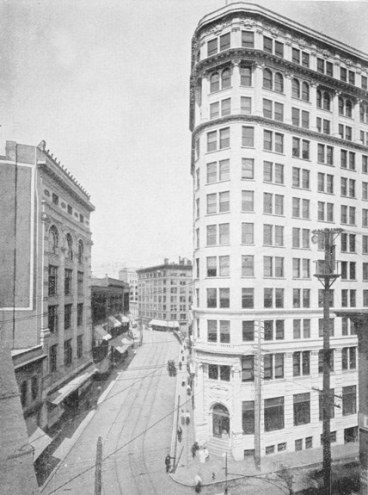
CENTURY BUILDING.
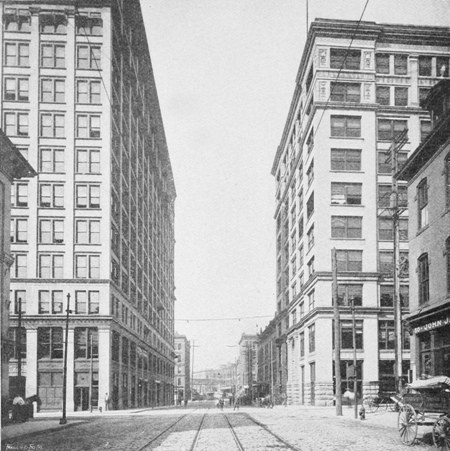
PRUDENTIAL AND EMPIRE BUILDINGS.
City Government.
The city government of Atlanta is administered by a Mayor and General Council and Executive Boards. The legislative body is composed of councilmen from the different wards, elected by the whole city, and aldermen who are elected in a like manner. The aldermen and councilmen vote separately on matters involving the expenditure of money, and the concurrence of both bodies is necessary to an appropriation. The Mayor has the usual veto power.
The tax rate is one and a quarter per cent. and the ratio of assessment to real value of property is about sixty per cent. The assessed value of real and personal property is $63,356,235.
The city owns property valued at eleven millions, and has a bonded debt of $3,481,500. Deducting the Sinking Fund of $274,997.68, the net debt is $3,206,502.32. There is no floating debt, and the bonded debt is limited by the State Constitution to seven per cent. on the taxable value of the property. The net debt is therefore $1,000,000 under the limit.
The Charter requires the Mayor and General Council to carry over a balance of $175,000 in cash from year to year. This keeps the Treasury in good condition and the city is able to float three and one-half per cent. bonds at par and above.
There is a Sinking Fund Commission, which was created by a special act of the Legislature, and the Mayor and General Council are required to set aside each year from the revenues of the city an amount sufficient to retire the bonded debt within thirty years.
The expenditures of the city for the year 1903 were $1,646,888.49. In the same period, the revenues and other receipts, including bonds, the proceeds of which were expended, were $2,036,548.32. The difference is accounted for by a balance carried over from the previous year.
Police.
Atlanta has a fine Police Department, divided into three watches of eight hours each. It has valuable auxiliaries in the mounted men and the bicycle corps, numbering forty men.
There is a fine central station, which cost $100,000, and a Police signal system with telephone connections. The expenditures of the Department during 1903 amounted to $151,151.23.
Fire Protection.
Atlanta has a model Fire Department, well equipped with modern apparatus, and supplied with water at fire pressure from the pumping-station of the waterworks. In 1903 the Department cost $123,235.00; the number of fires was 502 and the value of buildings and contents at risk $3,070,777. The damage was $142,050.
The average fire loss for eighteen years was $123,647.
Sanitary Department.
Atlanta spent $109,023.54 on sanitation in 1903, and about 250 men were employed under the Board of Health in keeping the city clean. There are the usual precautions in infectious and contagious diseases. The sewer-system of the city was constructed on a plan designed by Rudolph Hering, of New York.
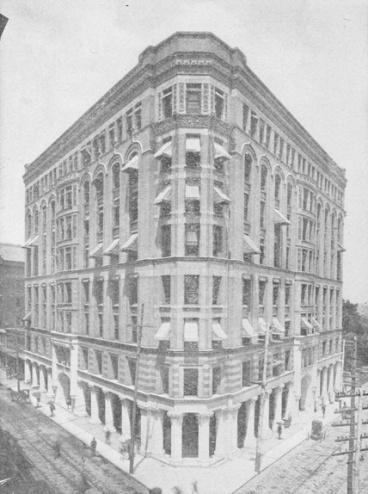
EQUITABLE BUILDING.
Mortuary Record.
The deaths from diseases in Atlanta during 1903 were 1,941, of which 926 were of white people and 1,015 of colored. The population within the corporate limits in the census year was 89,872. In 1903 it was estimated by the Sanitary Department at 110,000. This makes the rate of mortality 17.64. Of the population in 1903, it is estimated that 44,000 were colored and 66,000 were white, which makes the rate of mortality 23.06 for colored and 14.03 for white.
Waterworks.
The Waterworks Department of Atlanta has one of the best plants in the country and furnishes pure water at the nominal price of ten cents per thousand gallons for domestic consumption. Liberal rates are made to manufacturers, and even at the low prices charged, the Department pays a handsome net revenue to the city.
The works have a daily pumping capacity of 35,000,000 gallons, and the actual consumption in 1903 was 9,136,277 gallons per day. The supply comes from the Chattahoochee River, above the city, and above the mouth of Peachtree Creek. The river flows down from the mountain section, which is sparsely settled, and so far the supply is satisfactory. The water passes through a settling basin, after which it is filtered, and comes to the city as clear as crystal.
Sewers.
In addition to the amount disbursed by the Sanitary Department, the city spent $55,765.43 the same year in constructing sewers.
Streets.
During 1903 Atlanta spent $70,913.08 on streets. Since 1880 the city has spent $3,827,171 on streets, sewers and sidewalks. There are 64.34 miles of paved streets, 233.04 miles of paved sidewalks, and 106.21 miles of sewers. There are seven miles of asphalt streets and several miles of vitrified brick. The rest is paved with granite blocks, chert and macadam.
Boulevards.
Atlanta has some beautiful streets for driving. Peachtree, Washington, Whitehall and Peters Streets and Capitol Avenue are paved with asphalt, and this smooth surface makes a fine speedway. Whitehall and Peachtree Streets, connecting at the viaduct, form a continuous asphalt boulevard three and one-half miles long. This is connected north of the city with a macadam pike to Buckhead, and south of the city with a chert road to College Park, six miles beyond the city limits. This forms a continuous boulevard fifteen miles long in a north and south line, with a smooth surface, which is well adapted to carriages, bicycles and automobiles.
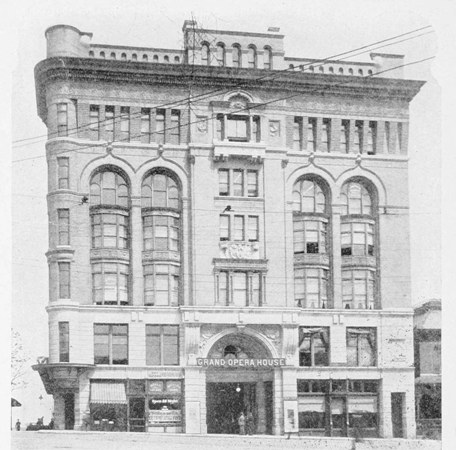
GRAND OPERA HOUSE.
Prominent Structures.
Atlanta has many handsome buildings, notable among which are the State Capitol, the new Court-House, the Carnegie Library, of white marble, the Grand Opera House, the nine great fire-proof office buildings, and the beautiful Piedmont Hotel, which is also a fire-proof structure. The Federal Prison, three miles out, is one of the most important in the United States. There are several other large hotels, notably the Kimball, the Aragon, the Majestic and the Marion.
The value of buildings erected in 1903 was reported by the City Building Inspector as $3,161,445, and the number of permits issued was 3,441. A marked increase in the average value of dwellings was noted. Following is a list of the office-buildings for which Atlanta is famous. They make the heart of Atlanta look like the lower part of Manhattan Island. Each has a steel frame, with non-combustible partitions, every modern convenience, and a costly interior finish of marble and hard-wood. The elevator and janitor service is first-class, and lavatories, barber shops and restaurants are well placed. The ground floor in a majority of these buildings is occupied by banks, whose offices are superbly finished. The population of these palatial hives of industry amounts to several thousand, and the facilities they offer for doing business are unequalled elsewhere in the Southern States.
List of Fire-Proof Office Buildings.
Equitable Building, eight stories.
English-American Building, eleven stories.
Austell Building, nine stories.
Prudential Building, ten stories.
Empire Building, fourteen stories.
Peters Building, eight stories.
Century Building, twelve stories.
[1]Fourth National Bank Building, sixteen stories.
[1]Candler Building, seventeen stories.
The aggregate cost of these nine structures, exclusive of the land on which they rest, was $4,000,000. They are all occupied, except the two under construction, in which space is being contracted for.
The Building Inspector’s record shows that in the nine years since the Exposition of 1895, buildings to the value of $15,256,169 have been erected. In the same period 4,666 dwellings built house a new population of 20,000. Since the census of 1900 new dwellings number 2,663.
Car Wheel Works.
The Atlanta Carwheel & Manufacturing Company has, on the Southern Railway belt line near the waterworks pumping-station, an extensive plant for the manufacture of steam-railroad and street-car wheels.
The site covers ten acres and the main building is 230 by 118 feet, with several annexes. The works employ 100 to 150 men, and this is one of the largest establishments of its kind in the country.