Residential Advantages.
Reading edition
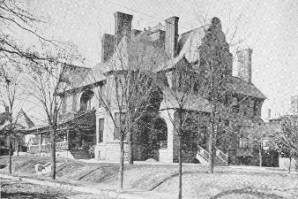
W. P. INMAN’S RESIDENCE.
It is hard to enumerate the advantages of life in Atlanta. They are so many that it is impossible to catalogue them all in brief space. The climate is the best enjoyed by any city in the country, the spirit of the people makes anyone welcome who is worthy of a welcome anywhere, and the opportunities for business, education, culture, enjoyment and social pleasure unsurpassed. The institutions for the preservation of order, sanitation and public comfort are excellent. The fraternities are numerously represented, and fraternity life is a feature of the city’s many attractions.
Visitors from a distance are always charmed with the residence streets of Atlanta. The homes are made attractive by grassy lawns, which beautify the scene and avoid the heat of those cities where solid blocks of flats rise directly from the sidewalk.
There are many beautiful suburbs which are easily and quickly reached by the car lines, and these are constantly extending. Atlanta has a fine market, supplied at all times with fish, game and vegetables, and an abundance of fresh meats. The shops and stores are up-to-date, and conducted in metropolitan style.
The Climate.
Atlanta is on the crest of the ridge dividing the watershed of the Atlantic Ocean from that of the Gulf of Mexico, and its elevation of 1,052 feet gives a bracing atmosphere. The mean annual temperature, based on all available records, is 60.8 degrees. The highest annual mean was 64.0 in 1871, preceded by the lowest, 56.9, in 1868. The mean temperature of the winter months is 44.1, of the spring months, 60.5, of the summer, 77.0, and of the autumn, 61.5. The highest monthly mean was 82.2, in July, 1875, the lowest, 34.4, in February, 1895. The warmest winter month was December, 1889, with a mean of 57.2; the coolest summer month was June, 1866, mean, 68.9. The highest temperature on record is 100, which occurred on July 19, 1887, and is the only instance of its kind. The lowest temperature on record is -8.5, on February 13, 1899. The temperature has registered at zero, or below, but on three other dates in the last twenty-six years, viz.:— -1, January 6, 1884; -2, January 11, 1886, and zero February 8, 1895.
Summer nights are cool and the low percentage of humidity makes the days comfortable. The average date of first killing frost is November 4th, and of the last in spring, March 29th, leaving an average growing season of 219 days.
Monthly Mean Temperature.
The average monthly temperature for each month, as shown by the record of many years, is given below:
January 42.6 July 78.6
February 45.7 August 76.9
March 51.7 September 71.7
April 60.9 October 61.5
May 69.0 November 51.4
June 75.6 December 44.1
Annual average 60.8
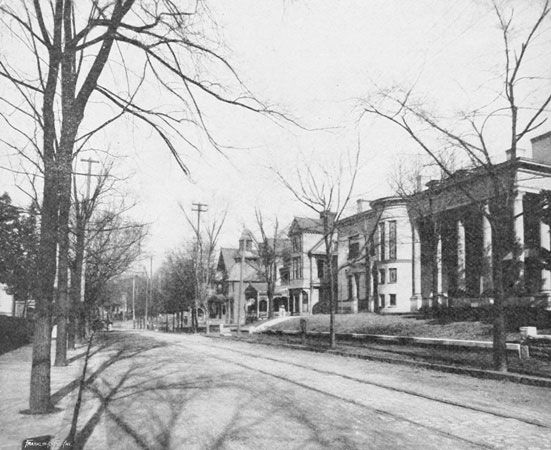
WASHINGTON STREET.
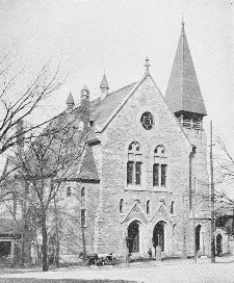
CENTRAL PRESBYTERIAN CHURCH.
Rainfall by Months.
The normal precipitation by months by the Weather Bureau:
January, 5.10 inches; February, 5.23; March, 5.65; April, 4.23; May, 3.38; June, 4.04; July, 4.22; August, 4.58; September, 3.51; October, 2.36; November, 3.49; December, 4.29.
The annual average rainfall is 50.08.
Parks.
Atlanta has several fine parks and places of resort.
The L. P. Grant Park, on the edge of the city near a battle-field of 1864, is a sylvan retreat of rare beauty, with a Zoo and Cyclorama added to the attractions of nature. It is the resort of picnic parties from the surrounding towns for many miles.
Piedmont Park, the site of fairs and expositions, is in the suburbs, half a mile beyond the city limits, on one of the battle-grounds of the Civil War. It has a lake and a picturesque site, with a number of large buildings.
Lakewood, as its name suggests, affords opportunity for aquatic sports. The same is true of East Lake, where there is elaborate provision for bathing. Ponce de Leon Springs, within the city limits, and the Chattahoochee River, eight miles out, are places of resort.
The Kirkwood Land Company has in preparation one of the most beautiful residence parks in America, and Atkins Park will be another place of loveliness.
To all these parks and places of resort there is an excellent street-car service. The exposition grounds at Piedmont Park also have connection with the city by the Southern Railway.
Department of the Gulf.
In 1903 the Department of the Gulf, U. S. Army, was re-established and headquarters located at Atlanta, and the following officers are in command: Brigadier-General Thomas H. Berry, commanding; Major Millard F. Waltz, Adjutant General; Major Lewis E. Goodier, Judge-Advocate; Lieut.-Colonel Samuel R. Jones, Chief Quartermaster; Lieut.-Colonel Henry B. Osgood, Chief Commissary; Lieut.-Colonel Edwin F. Gardiner, Chief Surgeon; Major Elijah W. Halford, Chief Paymaster; Captain Manly B. Curry, Paymaster; Lieut. H. H. Sheen, A. D. C.; Lieut. A. M. Ferguson, A. D. C.
Fort McPherson.
An Army post is always an attraction because of the parades and the music, and its disbursements add materially to a city’s income. Fort McPherson, four miles out on the Central of Georgia Railway and two car lines, is one of the best-constructed posts in the United States and much visited by citizens.
It is a community in itself, with an independent waterworks system and a complete system of sewerage. There are permanent barracks, ample for one regiment, and during the Spanish War several thousand soldiers were quartered here at one time by using wooden barracks in addition. The officers’ quarters are unusually good, and there is a well-appointed hospital.
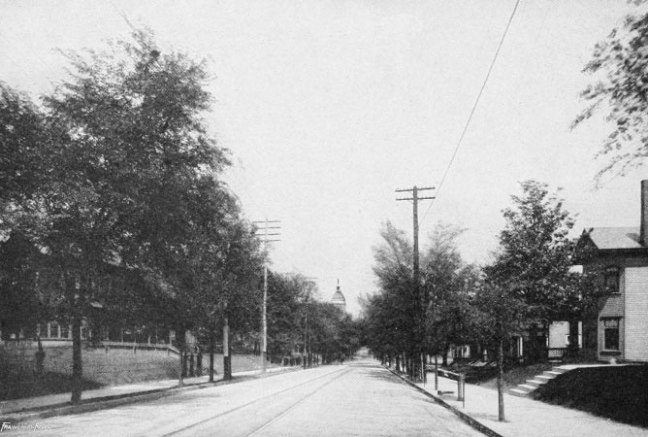
CAPITOL AVENUE—VIEW FROM WOODWARD AVENUE.
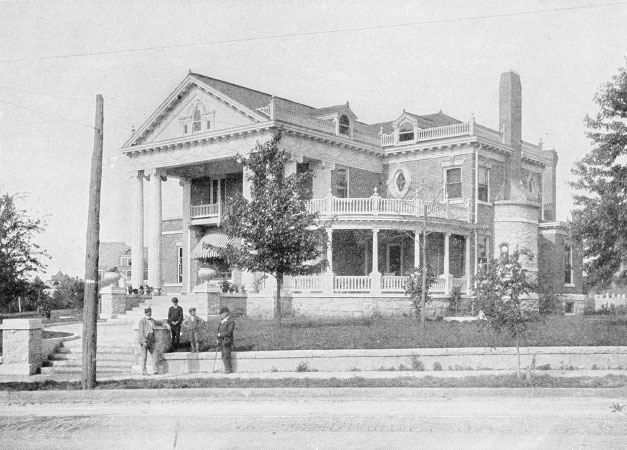
RESIDENCE OF ASA G. CANDLER.
Hospitals.
In the Grady Hospital Atlanta has a large and well-equipped institution supported by the city. There are in addition, St. Joseph’s Infirmary and the Presbyterian Hospital, besides a number of excellent sanatoriums conducted by physicians, notably those of Drs. Elkin and Cooper, Dr. Noble and Dr. Robinson, the Halcyon and the National Surgical Institute.
Churches.
Atlanta has 141 churches and the attendance on religious services is one of the noticeable features of the city’s life. This city is headquarters for several important denominational organizations, especially those of missionary work. It is the home of the Bishop of Georgia, Right Reverend C. K. Nelson (Episcopal), and of Bishop W. A. Candler of the Methodist Church.
The Baptist Home Mission Board is located here, and there is a similar organization of the Presbyterian Church represented. The Catholic Marist College and a convent are located near the two leading churches of that faith.
The colored people have two Bishops in Atlanta, Bishop W. J. Gaines and Bishop H. M. Turner.
Orphan Asylums.
Atlanta has four orphan asylums. The Methodist Orphan Asylum is located at Decatur, several miles east of the city, and the Baptist Orphan Asylum is at Hapeville, nine miles south of Atlanta. The Jewish Orphan Asylum is within the city limits.
The Carrie Steele Orphans’ Home is an institution for colored children about three miles east of the city.
Other Asylums.
The Home for the Friendless and the Florence Crittenden Home for unfortunate women are charities of a high order, carefully managed under the direction of some of the best women in Atlanta.
In addition there are numerous free kindergartens.
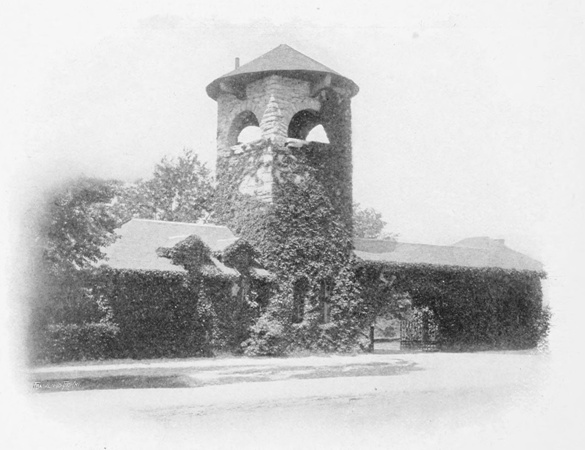
“REQUIESCAT IN PACE.”
GATE OF WEST VIEW CEMETERY.
Footnotes:
[1] Now under construction.
[2] Under construction—nearly completed.