Educational Facilities.
Reading edition
Atlanta has an imposing array of educational institutions, extending from the public school system to the great polytechnic institute known as the Georgia Institute of Technology. There is a variety of technical schools, including law, medicine, dentistry, handicrafts, business colleges, industrial schools and divinity schools.
There are sixteen white and six colored Grammar schools, a Girls’ High School, a Boys’ High School, and a night school. The total expenditure for these institutions during the year 1903 was $184,286.20. The cost per pupil was $16.75, and the number of pupils 11,000.
There is the usual organization of Superintendent, Assistant Superintendent, principal and teachers, under a Board of Education.
The teachers meet in normal class once a week, and many of them spend their vacations at summer schools of the great universities. There is a fine esprit de corps, and excellent work is done.
Atlanta’s great educational institution is the Georgia Institute of Technology, supported by the State of Georgia, with an additional annual appropriation from the city. It has about 500 students, and the work is the best of its kind in the South. There are machine shops in wood and in the metals, a blacksmith shop, a textile school, and department of electrical engineering and mechanical engineering. In addition there is excellent work in mathematics, chemistry, and the other scientific schools, with a good education in English.
Graduates of this institution have been distinguished for the thoroughness and the practical value of their education, which has enabled them to go from the shops and recitation-rooms directly into manufacturing and engineering pursuits.
A number of them hold very high and responsible positions in the management of great enterprises, and almost without exception, the graduates hold good positions in productive industry.
There are 600 students attending the medical colleges of Atlanta.
The Atlanta College of Physicians and Surgeons is one of the best equipped in the country, and its course is very thorough. It has a very large attendance from all parts of the Southern States, and some from beyond that territory.
The Eclectic College of Medicine and Surgery is also well attended.
The Dental College holds a position of eminence among institutions of that kind.
The members of the Medical and Dental professions of the city rank high.
There are several excellent institutions for the education of girls, notably the Agnes Scott Institute, the Southern Female College and the Washington Seminary.
The Southern Military College is an excellent institution for boys, and Hunter’s School for boys has a fine reputation.
In the institutions of higher education there are about 5,000 students, nearly equally divided between whites and blacks.
The people of Atlanta have raised $250,000 which has been tendered the Synods of the Southern Presbyterian Church, to secure the location of a $1,000,000 University in the city or its immediate suburbs. Commissioners from the Synods of the Southern States met in Atlanta in December, 1903, and voted to accept the tender.
Of the amount subscribed, $150,000 comes from Presbyterians and $100,000 from the public, including all classes and almost all religious denominations. Of the $100,000 contributed by the public, about $25,000 came from working men and salaried employees of business houses. In some cases even domestic servants contributed. In all there are about 3,000 subscribers for amounts ranging from 10 cents to $25,000. At a great mass meeting held in the Grand Opera House, Monday evening, March 30th, $50,000 was raised.
The Carnegie Library.
The Carnegie Library of Atlanta was organized May 6th, 1899, and received all of the property and books of the Young Men’s Library, which had been a subscription library, and had 15,000 books and property worth $40,000, when the city received a gift of $100,000 from Mr. Andrew Carnegie for a building. Mr. Carnegie subsequently added $25,000 to the original gift for the building, and $20,000 for stock and furniture. Total cost of the Library equipped was $145,000. The lot, which was a gift of the Young Men’s Library Association, cost $35,000. For the year 1904 the City of Atlanta has appropriated $10,100 for the maintenance of the Library.
There are in the Library 26,105 volumes classified and catalogued after the most approved methods. There are 13,420 registered borrowers, and the circulation for 1903 was 111,558 volumes for home use, about 400 volumes daily being issued.
The State Library has a large collection of law books, and a rare collection of colonial history of this and other Southern States.
Institutions for Negro Education.
Atlanta has some of the largest institutions for negro education in the country. They are: Atlanta University, Clark University, Gammon Theological Seminary, the Atlanta Baptist College, Morris Brown College, and Spelman Seminary.
The Spelman Seminary has a fine training school for nurses, and industrial training for women.
Clark University has industrial training for men.
Theatres.
Atlanta has two fine theatres—the Grand and the Bijou.
The Atlanta Lecture Association is one of the best in the United States, and regularly brings the best talent of the country to the Atlanta platform. Its membership is about 1,000. The Baptist Tabernacle has a lyceum course.
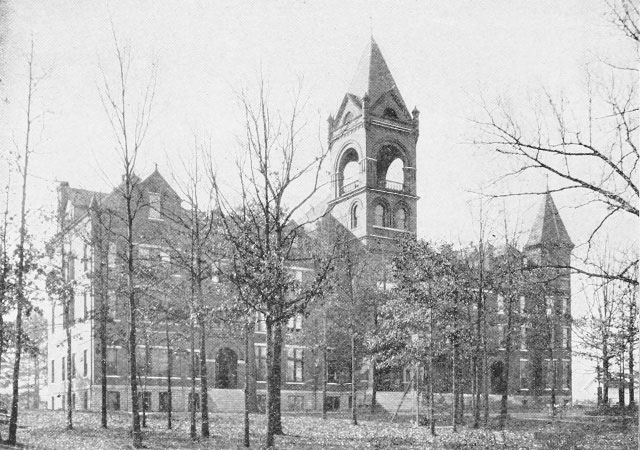
AGNES SCOTT INSTITUTE.