Volume 11 — Volume XI. (continued 5)
Reading edition
This last question was induced by the cloud which spread over Ascanio's face.
"The matter is, my poor Aubry," said he, "that your trouble is thrown away."
"How so?" cried Aubry. "Haven't you the letter still?"
"It is here," said Ascanio, placing his hand upon the pocket of his doublet.
"Ah! that's well. Give it to me, and I will take it to Benvenuto."
"That letter will never leave me, Jacques."
"Why so?"
"Because I don't know what use Benvenuto proposes to make of it."
"He means to use it to save you."
"And to crush the Duchesse d'Etampes, it may be. Aubry, I will not help to ruin a woman."
"But this woman seeks to ruin you. This woman detests you: no, I am wrong, she adores you."
"And you would have me, in return for that feeling—"
"Why, it's exactly the same as if she hated you since you don't love her. Besides, it's she who has done all this."
"What! she who has done it?"
"Why, yes, it was she who caused your arrest, and carried off Colombe."
"Who told you that?"
"No one; but who else could it have been?"
"Why the provost, or D'Orbec, or Marmagne, to whom you admit that you told the whole story."
"Ascanio! Ascanio!" cried Jacques in despair, "you are destroying yourself!"
"I prefer to destroy myself, rather than do a dastardly deed, Aubry."
"But this is no dastardly deed, for Benvenuto is the one who undertakes to do it."
"Listen to me, Aubry," said Ascanio, "and don't be angry at what I say. If Benvenuto stood in your place, and should say to me, 'It was Madame d'Etampes, your enemy, who caused your arrest, who carried off Colombe, who now has her in her power and intends to force her to do what she does not wish to do,—I cannot save Colombe unless I have that letter,'—I would make him swear that he would not show it to the king, and then I would give it to him. But Benvenuto is not here, and I am not certain that it is the duchess who is persecuting me. This letter would not be safe in your hands, Aubry: forgive me, but you yourself admit that you are an arrant chatterbox."
"I promise you, Ascanio, that the day I have just passed has aged me ten years."
"You may lose the letter, or, with the best intentions, I know, make an injudicious use of it, Aubry, so the letter will remain where it is."
"But, my dear fellow," cried Jacques, "remember that Benvenuto himself said that nothing but this letter can save you."
"Benvenuto will save me without that, Aubry; Benvenuto has the king's word that he will grant him whatever favor he asks on the day that his Jupiter is safely cast. When you thought that Benvenuto was going mad because he shouted, 'To the casting!' he was beginning to rescue me."
"But suppose the casting should be unsuccessful?" said Aubry.
"There's no danger," rejoined Ascanio with a smile.
"But that sometimes happens to the most skilful founders in France, so I am told."
"The most skilful founders in France are mere schoolboys compared to Benvenuto."
"But how much time is required for the casting?"
"Three days."
"And how much more before the statue can be put before the king?"
"Three days more."
"Six or seven days in all. And suppose Madame d'Etampes forces Colombe to marry D'Orbec within six days?"
"Madame d'Etampes has no power over Colombe. Colombe will resist."
"Very true, but the provost has power over Colombe as his daughter, and King François I. has power over Colombe as his subject; suppose the provost and the king both order her to marry him?"
Ascanio became frightfully pale.
"Suppose that when Benvenuto demands your liberty, Colombe is already the wife of another, what will you do with your liberty then?"
Ascanio passed one hand across his brow to wipe away the cold sweat which the student's words caused to start thereon, while with the other hand he felt in his pocket for the precious letter; but just as Aubry felt certain that he was on the point of yielding, he shook his head as if to banish all irresolution.
"No!" he said, "no! No no one save Benvenuto. Let us talk of something else."
These words he uttered in a tone which indicated that, for the moment at least, it was useless to insist.
"In that case," said Aubry, apparently forming a momentous resolution; "in that case, my friend, if we are to talk on other subjects we may as well do it to-morrow morning, or later in the day, for I am afraid we may remain here for some time. For my own part, I confess that I am worn out by my tribulations of the day and my labor to-night, and shall not be sorry for a little rest. Do you remain here, and I will go back to my own cell. When you want to see me again, do you call me. Meanwhile, spread this mat over the hole I have made, so that our communications may not be cut off. Good night! the night brings counsel, they say, and I hope that I shall find you more reasonable to-morrow morning."
With that, and refusing to listen to the observations of Ascanio, who sought to detain him, Jacques Aubry plunged head first into his gallery, and crawled back to his cell. Ascanio, meanwhile, following up the advice his friend had given him, dragged the mat into the corner of his cell as soon as the student's legs had disappeared. The means of communication between the two cells thereupon disappeared altogether.
He then tossed his doublet upon one of the two chairs which, with the table and the lamp, constituted the furnishings of his apartment, stretched himself out upon the bed, and, overdone with fatigue as he was, soon fell asleep, his bodily weariness carrying the day over his mental torture.
Aubry, instead of following Ascanio's example, although he was quite as much in need of sleep as he, sat down upon his stool, and began to reflect deeply, which, as the reader knows, was so entirely contrary to all his habits, that it was evident that he was meditating some grand stroke.
The student's immobility lasted about fifteen minutes, after which he rose slowly, and, with the step of a man whose irresolution is at an end for good and all, walked to the hole, and crawled into it again, but this time with so much caution and so noiselessly, that, when he reached the other end and raised the mat, he was overjoyed to perceive that the operation had not aroused his friend.
That was all that the student wished. With even greater caution than he had theretofore exhibited, he crept stealthily forth from his underground gallery, and approached with bated breath the chair on which Ascanio's doublet lay. With one eye fixed upon the sleeping youth, and his ears on the alert for the slightest sound, he took from the pocket the precious letter so eagerly coveted by Cellini, and placed in the envelope a note from Gervaise, which he folded in exactly the same shape as the duchess's letter, sure that Ascanio would believe, so long as he did not open it, that lovely Anne d'Heilly's missive was still in his possession.
As silently as ever he stole back to the mat, raised it, crawled into the hole once more, and disappeared like the phantoms who sink through trap-doors at the opera.
It was high time, for he was no sooner back in his cell, than he heard Ascanio's door grinding on its hinges, and his friend's voice crying, in the tone of one suddenly aroused from sleep,—
"Who's there?"
"I," responded a soft voice, "do not be afraid, for it is a friend."
Ascanio, who was but half dressed, rose at the sound of the voice, which he seemed to recognize, and saw by the light of his lamp a veiled woman standing by the door. She slowly approached him and raised her veil. He was not mistaken,—it was Madame d'Etampes.
XVI WHEREIN IT IS PROVED THAT A GRISETTE'S LETTER, WHEN IT IS BURNED, MAKES AS MUCH FLAME AND ASHES AS A DUCHESS'S
There was upon Anne d'Heilly's mobile features an expression of sadness mingled with compassion, which deceived Ascanio completely, and confirmed him, even before she had opened her mouth, in the impression that she was entirely innocent of any share in the catastrophe of which he and Colombe were victims.
"You here, Ascanio!" she said in a melodious voice; "you, to whom I would have given a palace to live in, I find in a prison!"
"Ah, madame!" cried the youth, "it is true, is it not, that you know nothing of the persecution to which we are subjected!"
"Did you suspect me for an instant, Ascanio?" said the duchess; "in that case you have every reason to hate me, and I can only bewail in silence my ill fortune in being so little known to him I know so well."
"No, madame, no," said Ascanio; "I was told that you were responsible for it all, but I refused to believe it."
"'T was well done of you! Ascanio, you do not love me, but with you hatred at least is not synonymous with injustice. You were right, Ascanio; not only am I not responsible for it, but I knew nothing whatever about it. It was the provost, Messire d'Estourville: he learned the whole story, I know not how, told it all to the king, and obtained from him the order to arrest you and recover Colombe."
"And Colombe is with her father?" demanded Ascanio eagerly.
"No, Colombe is with me."
"With you, madame!" cried the young man. "Why with you?"
"She is very lovely, Ascanio," murmured the duchess, "and I can understand why you prefer her to all the women in the world, even though the most loving of them all offers you the richest of duchies."
"I love Colombe, madame," said Ascanio, "and you know that love, which is a treasure sent from Heaven, is to be preferred to all earthly treasures."
"Yes, Ascanio, yes, you love her above everything. For a moment I hoped that your passion for her was only a passing fancy; I was mistaken. Yes, I realize now," she added with a sigh, "that to keep you apart any longer would be to run counter to God's will."
"Ah, madame!" cried Ascanio, clasping his hands, "God has placed in your hands the power to bring us together. Be noble and generous to the end, madame, and make two children happy who will love you and bless you all their lives."
"Yes," said the duchess. "I am vanquished, Ascanio; yes, I am ready to protect and defend you; but alas! it may be too late even now."
"Too late! what do you mean?" cried Ascanio.
"It may be, Ascanio, it may be that at this moment I am lost myself."
"Lost, madame! how so, in God's name?"
"For having loved you."
"For having loved me! You, lost because of me!"
"Yes, imprudent creature that I am, lost because of you; lost because I wrote to you."
"How so? I do not understand you, madame."
"You do not understand that the provost, armed with an order from the king, has directed a general search to be made at the Hôtel de Nesle? You do not understand that this search, the principal purpose of which is to find proofs of your affair with Colombe, will be most rigorously carried out in your bedroom."
"What then?" demanded Ascanio, impatiently.
"Why," continued the duchess, "if they find that letter, which in a moment of frenzy I wrote to you, if it is recognized as mine, if it is laid before the king, whom I was then deceiving, and whom I was willing to betray for you, do you not understand that my power is at an end from that moment? Do you not understand that I can then do nothing either for you or for Colombe? Do you not understand, in short, that I am lost?"
"Oh!" cried Ascanio, "have no fear, madame! There is no danger of that; the letter is here; it has never left me."
The duchess breathed freely once more, and the expression of her face changed from anxiety to joy.
"It has never left you, Ascanio!" she repeated; "it has never left you! To what sentiment, pray tell me, do I owe the fact that fortunate letter has never left you?"
"To prudence, madame," murmured Ascanio.
"Prudence! mon Dieu! mon Dieu! I am wrong once more! And yet I surely should be convinced ere this. Prudence! Ah well!" she added, seeming to make a powerful effort to restrain her feelings, "in that case, as I have naught but your prudence to thank, Ascanio, do you think it very prudent to keep it upon your person, when they may come to your cell at any moment and search you by force? do you think it prudent, I say, to keep a letter which, if it is found, will put the only person who can save you and Colombe in a position where it will be impossible for her to help you?"
"Madame," said Ascanio, in his melodious voice, and with that tinge of melancholy which all pure hearts feel when they are forced to doubt, "I know not if the purpose to save Colombe and myself exists at the bottom of your heart as it does upon your lips; I know not whether the desire to see that letter again, and nothing more, is the motive of your visit to me; I know not whether, as soon as you have it in your possession, you may not lay aside this rôle of protectress which you have assumed, and become our enemy once more; but this I do know, madame, that the letter is yours, that it belongs to you, and that the moment you claim it I cease to have the right to keep it from you."
Ascanio rose, went straight to the chair upon which his doublet lay, put his hand in the pocket, and took out a letter, the envelope of which the duchess recognized at a glance.
"Here, madame," he said, "is the paper you are so anxious to possess, and which can be of no use to me, while it may injure you seriously. Take it, tear it up, destroy it. I have done my duty; you may do what you choose."
"Ah! yours is indeed a noble heart, Ascanio!" cried the duchess, acting in obedience to one of those generous impulses which are sometimes found in the most corrupt hearts.
"Some one comes, madame! take care!" cried Ascanio.
"True," said the duchess.
At the sound of approaching footsteps she hastily thrust the paper into the flame of the lamp, which consumed it in an instant. The duchess did not let it drop until the flame had almost scorched her fingers, when the letter, three fourths consumed, drifted slowly downward: when it reached the floor it was entirely reduced to ashes, but the duchess was not content until she had placed her foot upon them.
At that moment the provost appeared in the doorway.
"I was told that you were here, madame," he said, looking uneasily from the duchess to Ascanio, "and I hastened to descend and place myself at your service. Is there aught in which I, or they who are under my orders, can be of any use to you?"
"No, messire," she replied, unable to conceal the feeling of intense joy which overflowed from her heart upon her face. "No, but I am none the less obliged to you for your readiness and your good will; I came simply to question this young man whom you arrested, and to ascertain if he is really as guilty as he was said to be."
"And what is your conclusion?" queried the provost, in a tone to which he could not refrain from imparting a slight tinge of irony.
"That Ascanio is less guilty than I thought. I beg you, therefore, messire, to show him every consideration in your power. The poor child is in wretched quarters. Could you not give him a better room?"
"We will look to it to-morrow, madame, for you know that your wishes are commands to me. Have you any other commands, and do you wish to continue your examination?"
"No, messire," was the reply, "I know all that I wished to know."
With that the duchess left the dungeon, darting at Ascanio a parting glance of mingled gratitude and passion.
The provost followed her and the door closed behind them.
"Pardieu!" muttered Jacques Aubry, who had not lost a word of the conversation between the duchess and Ascanio. "Pardieu! it was time."
It had been Marmagne's first thought on recovering consciousness to send word to the duchess that he had received a wound which might well prove to be mortal, and that before he breathed his last he desired to impart to her a secret of the deepest moment. Upon receipt of that message the duchess hastened to his side. Marmagne then informed her that he had been attacked and wounded by a certain student named Jacques Aubry, who was endeavoring to gain admission to the Châtelet in order to get speech of Ascanio and carry to Cellini a letter that was in Ascanio's possession.
The duchess needed to hear no more, and, bitterly cursing the passion which had led her once more to overstep the limits of her ordinary prudence, she hurried to the Châtelet although it was two o'clock in the morning, demanded to be shown to Ascanio's cell, and there enacted the scene we have described, which had ended in accordance with her wishes so far as she knew, although Ascanio was not altogether deceived.
As Jacques Aubry said, it was high time.
But only half of his task was accomplished, and the most difficult part remained to do. He had the letter which had come so near being destroyed forever; but in order that it should have its full effect it must be in Cellini's hands, not in Jacques Aubry's.
Now Jacques Aubry was a prisoner, very much a prisoner, and he had learned from his predecessor that it was no easy matter to get out of the Châtelet, once one was safely lodged therein. He was therefore, we might say, in much the same plight as the rooster who found the pearl, greatly perplexed as to the use to be made of his treasure.
To attempt to escape by resorting to violence would be utterly vain. He might with his dagger kill the keeper who brought his food, and take his keys and his clothes; but not only was that extreme method repugnant to the student's kindly disposition,—it did not afford sufficiently strong hopes of success. There were ten chances to one that he would be recognized, searched, relieved of his precious letter, and thrust back into his cell.
To attempt to escape by cunning was even less hopeful. The dungeon was eight or ten feet underground, there were huge iron bars across the air-hole through which the one faint ray of light filtered into his cell. It would take months to loosen one of those bars, and, suppose one of them to be removed, where would the fugitive then find himself?—in some courtyard with insurmountable walls, where he would inevitably be found the next morning?
Bribery was his only remaining resource; but, as a consequence of the sentence pronounced by the lieutenant criminal, whereby Gervaise was awarded twenty Paris sous for the loss of her honor, the prisoner's whole fortune was reduced to ten Paris sous, a sum utterly inadequate to tempt the lowest jailer of the vilest prison, and which could not decently be offered to the turnkey of a royal fortress.
Jacques Aubry was therefore, we are forced to confess, in the direst perplexity.
From time to time it seemed as if a hopeful idea passed through his mind; but it was evident that it was likely to entail serious consequences, for each time that it returned, with the persistence characteristic of hopeful ideas, Aubry's face grew perceptibly darker, and he heaved deep sighs, which proved that the poor fellow was undergoing an internal conflict of the most violent description.
This conflict was so violent and so prolonged that Aubry did not once think of sleep the whole night long: he passed the time in striding to and fro, in sitting down and standing up. It was the first time that he had ever kept vigil all night for purposes of reflection; his previous experiences in that line had been on convivial occasions only.
At daybreak the struggle seemed to have ended in the complete triumph of one of the opposing forces, for Jacques heaved a more heart-breaking sigh than any he had yet achieved, and threw himself upon his bed like a man completely crushed.
His head had hardly touched the pillow when he heard steps on the staircase, the key grated in the lock, the door turned upon its hinges, and two officers of the law appeared in the doorway; they were the lieutenant criminal and his clerk.
The annoyance of the visit was tempered by the student's gratification in recognizing two old acquaintances.
"Aha! my fine fellow," said the magistrate, recognizing Aubry, "so it's you, is it, and you succeeded after all in getting into the Châtelet? Tudieu! what a rake you are! You seduce young women and run young noblemen through the body! But beware! a nobleman's life is more expensive than a grisette's honor, and you'll not be quit of this affair for twenty Paris sous!"
Alarming as the worthy magistrate's words undoubtedly were, the tone in which he uttered them reassured the prisoner to some extent. This jovial-faced individual, into whose hands he had had the good luck to fall, was such a good fellow to all appearance that it was impossible to think of him in connection with anything deadly. To be sure it was not the same with his clerk, who nodded his head approvingly at each word that fell from his principal's lips. It was the second time that Jacques Aubry had seen the two men side by side, and, deeply engrossed as he was by his own precarious situation, he could not forbear some internal reflections upon the whimsical chance which had coupled together two beings so utterly opposed to each other in character and feature.
The examination began. Jacques Aubry made no attempt at concealment. He declared that, having recognized the Vicomte de Marmagne as a man who had on several occasions betrayed his confidence, he seized his page's sword and challenged him; that Marmagne had accepted the challenge, and that after exchanging a few thrusts the viscount fell. More than that he did not know.
"You know no more than that! you know no more than that!" muttered the judge. "Faith, I should say that was quite enough, and your affair's as clear as day, especially as the Vicomte de Marmagne is one of Madame d'Etampes's great favorites. So it seems that she has complained of you to the higher powers, my boy."
"The devil!" exclaimed the scholar, beginning to feel decidedly ill at ease. "Tell me, Monsieur le Juge, is the affair so bad as you say?"
"Worse! my dear friend, worse! I am not in the habit of frightening those who come before me; but I give you warning of this, so that if you have any arrangements to make—"
"Arrangements to make!" cried the student. "Tell me, Monsieur le Lieutenant Criminel, for God's sake! do you think my life's in danger?"
"Certainly it is, certainly. What! you attack a nobleman in the street, you force him to fight, you run a sword through him, and then you ask if your life's in danger! Yes, my dear friend, yes,—in very great danger."
"But such affairs happen every day, and I don't see that the guilty ones are prosecuted."
"True, among gentlemen, my young friend. Oh! when it pleases two gentlemen to cut each other's throats, it's a privilege of their rank, and the king has nothing to say; but if the common people take it into their head some fine day to fight with gentlemen, as they are twenty times as numerous, there would soon be no more gentlemen, which would be a great pity."
"How many days do you think my trial will last?"
"Five or six, in all likelihood."
"What!" cried the student, "five or six days! No more than that?"
"Why should it? The facts are clear enough; a man dies, you confess that you killed him, and justice is satisfied. However," added the judge, assuming a still more benevolent expression, "if two or three days more would be agreeable to you—"
"Very agreeable."
"Oh well! we will spin out the report, and gain time in that way. You are a good fellow at heart, and I shall be delighted to do something for you."
"Thanks," said the student.
"And now," said the judge, rising, "have you any further request to make?"
"I would like to see a priest: is it impossible?"
"No; it is your right."
"In that case, Monsieur le Juge, ask them to send one to me."
"I will do your errand. No ill will, my young friend."
"Good lack! on the contrary, I am deeply grateful."
"Master Student," said the clerk in an undertone, stepping to Aubrey's side, "would you be willing to do me a favor?"
"Gladly," said Aubrey; "what might it be?"
"It may be that you have friends or relatives to whom you intend to bequeath all your possessions?"
"Friends? I have but one, and he's a prisoner like myself. Relatives? I have only cousins, and very distant cousins at that. So, say on, Master Clerk, say on."
"Monsieur, I am a poor man, father of a family, with five children."
"What then?"
"I have never had any opportunities in my position, which I fill, as you can testify, with scrupulous probity. All my confrères are promoted over my head."
"Why is that?"
"Why? Ah! why? I will tell you."
"Do so."
"Because they are lucky."
"Aha!"
"And why are they lucky?"
"That's what I would ask you, Master Clerk."
"And that's what I am about to tell you, Master Student."
"I shall be very glad to know."
"They are lucky,"—here the clerk lowered his voice a half-tone more,—"they are lucky because they have the rope a man was hanged with in their pocket: do you understand?"
"No."
"You're rather dull. You will make a will, eh?"
"A will! why should I?"
"Dame! so that there may be no contest among your heirs. Very good! write in your will that you authorize Marc-Boniface Grimoineau, cleric to Monsieur le Lieutenant Criminel, to claim from the executioner a hit of the rope you are hanged by."
"Ah!" said Aubry, in a choking voice. "Yes, now I understand."
"And you will grant my request?"
"To be sure!"
"Young man, remember what you have promised me. Many have made the same promise, but some have died intestate, others have written my name, Marc-Boniface Grimoineau so badly that there was a chance for cavilling; and others still, who were guilty, monsieur, on my word of honor very guilty, have been acquitted, and gone off elsewhere to be hanged; so that I was really in despair when you fell in my way."
"Very well, Master Cleric, very well; if I am hanged, you shall have what you want, never fear."
"Oh, you will be, monsieur, you will he, don't you doubt it!"
"Well, Grimoineau," said the judge.
"Here I am, monsieur, here I am. So it's a bargain, Master Student?"
"It's a bargain."
"On your word of honor?"
"On my word!"
"I think that I shall get it at last," muttered the clerk as he withdrew. "I will go home and tell my wife and children the good news."
He left the cell on the heels of the lieutenant criminal, who was grumbling good-humoredly at having to wait so long.
XVII WHEREIN IT IS PROVED THAT TRUE FRIENDSHIP IS CAPABLE OF CARRYING DEVOTION TO THE MARRYING POINT
Aubry, once more alone, was soon more deeply absorbed in thought than before; and the reader will agree that there was ample food for thought in his conversation with the lieutenant criminal. We hasten to say, however, that one who could have read his thoughts would have found that the situation of Ascanio and Colombe, depending as it did upon the letter in his possession, occupied the first place, and that before thinking of himself, a thing which he proposed to do in good time, he deliberated as to what was to be done for them.
He had been meditating thus for half an hour more or less, when the door of his cell opened once more, and the turnkey appeared on the threshold.
"Are you the man who sent for a priest?" he growled.
"To be sure I am," said Jacques.
"Deuce take me, if I know what they all want with a damned monk," muttered the turnkey; "but what I do know is that they can't leave a poor man in peace for five minutes. Come in, come in, father," he continued, standing aside to allow the priest to pass, "and be quick about it."
With that he closed the door, still grumbling, and left the new comer alone with the prisoner.
"Was it you who sent for me, my son?" the priest asked.
"Yes, father," replied the student.
"Do you wish to confess?"
"No, not just that: I wish to talk with you concerning a simple case of conscience."
"Say on, my son," said the priest, seating himself upon the stool, "and if any feeble light that I can give you will help you—"
"It was to ask your advice that I ventured to send for you."
"I am listening."
"Father," said Aubry, "I am a great sinner."
"Alas!" said the priest; "happy is the man who acknowledges it."
"But that is not all; not only am I a great sinner myself, as I said, but I have led others into sin."
"Is there any way of undoing the harm you have done?"
"I think so, father, I think so. She whom I dragged with me into the pit was an innocent young girl."
"You seduced her, did you?"
"Seduced; yes, father, that is the word."
"And you wish to atone for your sin?"
"That at least is my intention."
"There is but one way to do it."
"I know it well, and that is why I have been undecided so long: if there were two ways I would have chosen the other."
"You wish to marry her?"
"One moment, no! I will not lie: no, father, I do not wish to do it, but I am resigned."
"A warmer, more devoted feeling would be much better."
"What would you have, father? There are people who are born to marry, and others to remain single. Celibacy was my vocation, and nothing less than my present situation, I swear—"
"Very well, my son, the sooner the better, as you may repent of your virtuous intentions."
"What will be the earliest possible moment?" Aubry asked.
"Dame!" said the priest, "as it is a marriage in extremis, there will be no difficulty about the necessary dispensations, and I think that by day after to-morrow—"
"Day after to-morrow let it be," said the student with a sigh.
"But the young woman?"
"What of her?"
"Will she consent?"
"To what?"
"To the marriage."
"Pardieu! will she consent? That she will, with thanks. Such propositions aren't made to her every day."
"Then there is no obstacle?"
"None."
"Your parents?"
"Absent."
"And hers?"
"Unknown."
"Her name?"
"Gervaise-Perrette Popinot."
"Do you wish me to tell her of your purpose?"
"If you will kindly take that trouble, father, I shall be truly grateful."
"She shall be informed this very day."
"Tell me, father, tell me, could you possibly hand her a letter?"
"No, my son: we who are admitted to minister to the prisoners have sworn to deliver no message for them to any person until after their death. When that time comes, I will do whatever you choose."
"Thanks, it would be useless; marriage it must be, then," muttered Aubry.
"You have nothing else to say to me?"
"Nothing, except that, if you doubt the truth of what I say, and if she makes any objection to granting my request, you will find in the office of the lieutenant criminal a complaint lodged by said Gervaise-Perrette Popinot, which will prove that what I have said is the exact truth."
"Rely upon me to smooth away all obstacles," replied the priest, who realized that Jacques's proposed action was not prompted by enthusiasm for the marriage, but that he was yielding to necessity; "and two days hence—"
"Two days hence—"
"You will have restored, her honor to the woman whose honor you took from her."
"Alas!" muttered the student with a deep sigh.
"Ah, my son!" said the priest, "the more a sacrifice costs you, the greater pleasure it affords to God."
"By Mahomet's belly!" cried Jacques; "in that case God should be very grateful to me! go, father, go!"
Indeed, Jacques had had to overcome very bitter opposition in his own mind before arriving at such a resolution. As he had told Gervaise, he had inherited his antipathy to the marriage tie from his father, and nothing less than his friendship for Ascanio, and the thought that it was he who had caused his ruin, together with the incentive afforded by the noblest examples of self-sacrificing devotion to be found in history,—nothing less than all of this was necessary to bring him to the pitch of abnegation at which he had now arrived.
But, the reader may ask, where lies the connection between the marriage of Gervaise and Aubry, and the happiness of Ascanio and Colombe, and how did Aubry expect to save his friend by marrying his mistress? To such a question I can only answer that the reader lacks penetration; to which the reader may retort, to be sure, that it is not his business to have that quality. In that case, I beg him to take the trouble to read the end of this chapter, which he might have passed over had he been endowed with a more subtle intellect.
When the priest had gone, Aubry, recognizing the impossibility of drawing back, seemed to become more tranquil. It is characteristic of resolutions, even the most momentous, to bring tranquillity in their wake: the mind which has wrestled with its perplexity is at rest; the heart which has fought against its sorrow is, as it were, benumbed.
Jacques remained passive in his cell, until, having heard sounds in that occupied by Ascanio, which he supposed to be caused by the entrance of the jailer with his breakfast, he concluded that they would surely be left in peace for a few hours. He waited some little time after the noise had ceased, then crawled into his underground gallery, passed through it, and raised the mat with his head.
Ascanio's cell was plunged in most intense darkness.
Aubry called his friend's name in a low tone, but there was no reply. The cell was untenanted.
Aubry's first feeling was one of joy. Ascanio was free, and if Ascanio was free there was no need for him to—But almost immediately he remembered what was said the night before about providing him with better quarters. It was plain that the suggestion of Madame d'Etampes had been heeded, and the sounds he heard were caused by his friend's being moved.
Aubry's hope was as dazzling, therefore, but as evanescent, as a flash of lightning. He let the mat fall and crawled backward into his cell. Every source of consolation was taken from him, even the presence of the friend for whom he had sacrificed himself.
He had no resource left but reflection. But he had already reflected so long, and his reflections had led to such a disastrous result, that he preferred to sleep.
He threw himself upon his bed, and as he was very much in arrears in the matter of sleep, it was not long before he was entirely unconscious of his surroundings, notwithstanding the perturbed condition of his mind.
He dreamed that he was condemned to death and hanged; but through the deviltry of the hangman, the rope was badly greased, and his neck was not broken. He was buried in due form, none the less, and in his dream was beginning to gnaw his arms, as men buried alive always do, when the clerk, determined to have his bit of rope, came to secure it, opened the coffin in which he was immured, and restored his life and liberty.
Alas! it was only a dream, and when the student awoke his life was still in great danger, and his liberty altogether non-existent.
The evening, the night, and the next day passed away, and brought him no other visitor than his jailer. He tried to ask him a few questions, but could not extract a word from him.
In the middle of the second night, as Jacques was in the midst of his first sleep, he was awakened with a start by the grinding of his door upon its hinges. However soundly a prisoner may be sleeping, the sound of an opening door always awakens him.
The student sat up in bed.
"Up with you, and dress yourself," said the jailer's harsh voice; and Aubry could see by the light of the torch he held, the halberds of two of the provost's guards behind him.
The second branch of his order was unnecessary; as the student's bed was entirely unprovided with bedclothes, he had lain down completely dressed.
"Where do you propose to take me, pray?" demanded Jacques, still asleep with one eye.
"You are very inquisitive," said the jailer.
"But I would like to know."
"Come, come; no arguing, but follow me."
Resistance was useless, so the prisoner obeyed.
The jailer walked first, then came Aubry, and the two guards brought up the rear of the procession.
Jacques looked around with an inquietude which he did not seek to conceal. He feared a nocturnal execution; but one thing comforted him, he saw no priest or hangman.
After a few moments he found himself in the first room to which he was taken at the time of his coming to the prison; but instead of escorting him to the outer door, which he hoped for an instant that they would do, so prone to illusions does misfortune render one, his guide opened a door at one corner of the room and entered an inner corridor leading to a courtyard.
The prisoner's first thought on entering the courtyard, where he felt the fresh air and saw the starlit sky, was to fill his lungs, and lay in a stock of oxygen, not knowing when he might have another opportunity.
The next moment he noticed the ogive windows of a fourteenth century chapel on the other side of the yard, and began to suspect what was in the wind.
The truth-telling instinct of the historian compels us to state that at the thought his strength wellnigh failed him.
However, the memory of Ascanio and Colombe, and the grandeur of the self-sacrifice about to be consummated, sustained him in his distress. He walked with a firm step toward the chapel, and when he stood in the doorway everything was explained.
The priest stood by the altar; in the choir a woman was waiting; the woman was Gervaise.
Half-way up the choir he met the governor of the Châtelet.
"You desired to make reparation, before your death, to the young woman whose honor you stole from her: your request was no more than just and it is granted."
A cloud passed over the student's eyes; but he put his hand over Madame d'Etampes's letter, and his courage returned.
"Oh, my poor Jacques!" cried Gervaise, throwing herself into the student's arms: "oh, who could have dreamed that this hour which I have so longed for would strike under such circumstances!"
"What wouldst thou have, my dear Gervaise?" cried the student, receiving her upon his breast. "God knows those whom he should punish and those whom he should reward: we must submit to God's will."
"Take this," he added beneath his breath, slipping Madame d'Etampes's letter into her hand; "for Benvenuto and for him alone!"
"What's that?" exclaimed the governor, walking hastily toward them; "what's the matter!"
"Nothing; I was telling Gervaise how I love her."
"As she will not, in all probability, have time to ascertain the contrary, protestations are thrown away; go to the altar and make haste."
Aubry and Gervaise went forward in silence to the waiting priest. When they were in front of him they fell upon their knees and the mass began.
Jacques would have been very glad of an opportunity to exchange a few words with Gervaise, who, for her part, was burning up with the desire to express her gratitude to Aubry; but two guards stood beside them listening to every word and watching every movement. It was very fortunate that a momentary feeling of sympathy led the governor to allow them to exchange the embrace under cover of which the letter passed from Jacques's hands to Gervaise's. That opportunity lost, the close surveillance to which they were subjected would have rendered Jacques's devotion of no avail.
The priest had received his instructions, doubtless, for he cut his discourse very short. It may be, too, that he thought it would be trouble thrown away to enjoin due regard to his duties as a husband and father upon a man who was to be hanged within two or three days.
The discourse at an end, the benediction given, the mass said, Aubry and Gervaise thought they would be allowed to speak together privately for a moment, but not so. Despite the tears of Gervaise, who was literally dissolved in them, the guards forced them to part.
They had time, however, to exchange a glance. Aubry's said, "Remember my commission." Gervaise's replied, "Never fear; it shall be done to-night, or to-morrow at latest."
Then they were led away in opposite directions. Gervaise was politely escorted to the street door, and Jacques was politely taken back to his cell.
As the door closed upon him, he heaved a deeper sigh than any of those he had perpetrated since he entered the prison: he was married.
Thus it was that Aubry, like another Curtius, plunged headlong, through devotion, into the hymeneal gulf.
XVIII THE CASTING
Now, with our readers' permission, we will leave the Châtelet for a moment, and return to the Hôtel de Nesle.
The workmen responded quickly to Benvenuto's cries, and followed him to the foundry.
They all knew him as he appeared when at work; but never had they seen such an expression upon his face, never such a flame in his eyes. Whoever could have cast him in a mould at that moment, as he was on the point of casting his Jupiter, would have endowed the world with the noblest statue ever created by the genius of an artist.
Everything was ready: the wax model in its envelope of clay, girt round with iron bands, was awaiting in the furnace which surrounded it the hour of its life. The wood was all arranged: Benvenuto set fire to it in four different places, and as it was spruce, which the artist had been long collecting that it might be thoroughly dry, the fire quickly attacked every part of the furnace, and the mould was soon the centre of an immense blaze. The wax thereupon began to run out through the air-holes while the mould was baking: at the same time the workmen were digging a long ditch beside the furnace, into which the metal was to be poured in a state of fusion, for Benvenuto was anxious not to lose a moment, and to proceed to the casting as soon as the mould was thoroughly baked.
For a day and a half the wax trickled from the mould; for a day and a half, while the workmen divided into watches and took turn and turn about like the sailors on a man-of-war, Benvenuto was constantly on hand, hovering about the furnace, feeding the fire, encouraging the workmen. At last he found that the wax had all run out, and that the mould was thoroughly baked; this completed the second part of his work; the last part was the melting of the bronze and the casting of the statue. When that stage was reached the workmen, who were utterly unable to comprehend such superhuman strength and such an intensity of passion, endeavored to induce Benvenuto to take a few hours' rest; but that would mean so many hours added to Ascanio's captivity and the persecution of Colombe. Benvenuto refused. He seemed to be made of the same bronze of which he was about to make a god.
When the ditch was dug, he wound stout ropes about the mould, and with the aid of windlasses prepared for that purpose, he raised it with every possible precaution, swung it out over the ditch, and let it down slowly until it was on a level with the furnace. He fixed it firmly in place there by piling around it the dirt taken from the ditch, treading it down, and putting in place, as the dirt rose about the mould, the pieces of earthen pipe which were to serve as air-holes. All these preparations took the rest of the day. Night came. For forty-eight hours Benvenuto had not slept nor lain down, nor even sat down. The workmen implored, Scozzone scolded, but Benvenuto would hear none of it: he seemed to be sustained by some more than human power, and made no other reply to the entreaties and scolding than to assign to each workman his task, in the short, stern tone of an officer manœuvring his troops.
Benvenuto was determined to begin the casting at once: the energetic artist, who was accustomed to see all obstacles yield before him, exerted his imperious power upon himself; he ordered his body to act, and it obeyed, while his companions were obliged to withdraw, one after another, as in battle wounded soldiers leave the field and seek the hospital.
The casting furnace was ready: it was filled with round ingots of brass and copper, symmetrically piled one upon another, so that the heat could pass between them, and the fusion be effected more quickly and more completely. He set fire to the wood around it as in the case of the other furnace, and as it was mostly spruce, the resin which exuded from it, in conjunction with the combustible nature of the wood, soon made such a fierce flame that it rose higher than was anticipated, and lapped the roof of the foundry, which took fire at once, being of wood. At the sight of this conflagration, and more especially at the heat which it gave forth, all the artist's comrades, save Hermann, drew back; but Hermann and Benvenuto were a host in themselves. Each of them seized an axe and cut away at the wooden pillars which upheld the roof, and in an instant it fell in. Thereupon Hermann and Benvenuto with poles pushed the burning fragments into the furnace, and with the increased heat the metal began to melt.
But Benvenuto had at last reached the limit of his strength. For nearly sixty hours he had not slept, for twenty-four he had not eaten, and during the whole of that time he was the soul of the whole performance, the axis upon which the whole operation turned. A terrible fever took possession of him: a deathly pallor succeeded to his usual high color. In an atmosphere so intensely hot that no one could live beside him, he felt his limbs tremble and his teeth chatter as if he were amid the snows of Lapland. His companions remarked his condition and drew near to him. He tried to resist, to deny that he was beaten, for in his eyes it was a disgrace to yield even before the impossible; but at last he was fain to confess that his strength was failing him. Fortunately, the fusion was nearly accomplished: the most difficult part of the operation was past, and what remained to be done was mere mechanical work. He called Pagolo; Pagolo did not reply. But the workmen shouted his name in chorus and he at last appeared; he said that he had been praying for the successful issue of the casting.
"This is no time to pray!" cried Benvenuto, "and the Lord said, 'He who works prays.' This is the time for work, Pagolo. Hark ye: I feel that I am dying; but whether I die or not, my Jupiter must live. Pagolo, my friend, to thee I intrust the management of the casting, sure that thou canst do it as well as I, if thou wilt. Understand, Pagolo, the metal will soon be ready; thou canst not mistake the proper degree of heat. When it is red thou wilt give a sledge hammer to Hermann, and one to Simon-le-Gaucher.—My God! what was I saying? Ah, yes!—Then they must knock out the two plugs of the furnace; the metal will flow out, and if I am dead you will tell the king that he promised me a boon, and that you claim it in my name, and that it—is—O my God! I no longer remember. What was I to ask the king? Ah, yes!—Ascanio—Seigneur de Nesle—Colombe, the provost's daughter—D'Orbec—Madame d'Etampes—Ah! I am going mad!"
Benvenuto staggered and fell into Hermann's arms, who carried him off like a child to his room, while Pagolo, intrusted with the superintendence of the work, gave orders for it to go on.
Benvenuto was right: he was going mad, or rather a terrible delirium had taken possession of him. Scozzone, who doubtless had been praying as Pagolo had, hurried to his side; but Benvenuto continued to cry, "I am dying! I am dying! Ascanio! Ascanio! what will become of Ascanio?"
A thousand delirious visions were crowding in upon his brain: Ascanio, Colombe, Stefana, all appeared and disappeared like ghosts. In the throng which passed before his eyes was Pompeo the goldsmith, whom he slew with his dagger; and the keeper of the post-house at Sienna, whom he slew with his arquebus. Past and present were confounded in his brain. How it was Clement VII. who detained Ascanio in prison; again it was Cosmo I. who sought to force Colombe to marry D'Orbec. Then he would appeal to Queen Eleanora, thinking he was addressing Madame d'Etampes, and would implore and threaten her by turns. Then he would make sport of poor weeping Scozzone, and bid her beware lest Pagolo should break his neck clambering around on the cornices like a cat. Intervals of complete prostration would succeed these paroxysms, and it would seem as if he were at the point of death.
This agonizing state of affairs endured three hours. Benvenuto was in one of his periods of torpor when Pagolo suddenly rushed into the room, pale and agitated, crying:—
"May Jesus and the Virgin help us, master! for all is lost now, and we can look nowhere but to Heaven for help."
Worn out, half conscious, dying as he was, these words, like a sharp stiletto, reached the very bottom of his heart. The veil which clouded his intellect was torn away, and, like Lazarus rising at the voice of the Lord, he rose upon his bed, crying:—
"Who dares to say that all is lost when Benvenuto still lives?"
"Alas! I, master," said Pagolo.
"Double traitor!" cried Benvenuto, "is it written that thou shalt forever prove false to me? But never fear! Jesus and the Virgin whom you invoked just now are at hand, to bear aid to men of good will, and punish traitors!"
At that moment he heard the workmen lamenting and crying:—
"Benvenuto! Benvenuto!"
"He is here! he is here!" cried the artist, rushing from his room, pale of face, but with renewed strength and clearness of vision. "Here he is! and woe to them who have not done their duty!"
In two hounds Benvenuto was at the foundry; he found all the workmen, whom he had left so full of vigor and enthusiasm, in a state of utter stupefaction and dejection. Even Hermann the colossus seemed to be dying of fatigue; he was tottering on his legs and was compelled to lean against one of the supports of the roof which remained standing.
"Now listen to what I say," cried Benvenuto in an awful voice, falling into their midst like a thunderbolt. "I don't as yet know what has happened, but I swear to you beforehand that it can be remedied, whatever it may he,—upon my soul it can! Now that I am present, obey me on your lives! but obey passively, without a word, without a gesture, for the first man who hesitates I will kill.
"So much for the ill disposed.
"I have but one word to say to those who are disposed to do their duty: the liberty and happiness of Ascanio, your companion of whom you are all so fond, will follow the successful issue of this task. To work!"
With that Cellini approached the furnace to form his own opinion of what had taken place. The supply of wood had given out, and the metal had cooled, so that it had turned to cake, as the professional phrase goes.
Benvenuto at once determined that the disaster could be repaired. Pagolo's watchfulness had relaxed in all likelihood, and he had allowed the heat of the fire to abate: the thing to be done was to make the fire as hot as ever, and to reduce the metal to a liquid state once more.
"Wood!" cried Benvenuto, "wood! Go look for wood wherever it can possibly be found; go to the bakers, and buy it by the pound if necessary; bring every stick of wood that there is in the house to the smallest chip. Break in the doors of the Petit-Nesle, Hermann, if Dame Perrine doesn't choose to open them; everything in that direction is lawful prize, for it's an enemy's country. Wood! wood!"
To set the example Benvenuto seized an axe and attacked the two posts which were still standing: they soon fell with the last remnants of the roof, and Benvenuto at once pushed the whole mass into the fire: at the same time his comrades returned from all directions laden with wood.
"Ah!" cried Benvenuto, "now are you ready to obey me?"
"Yes! yes!" cried every voice, "yes! we will do whatever you bid us do, so long as we have a breath of life in our bodies."
"Select the oak then, and throw on nothing but oak at first: that burns more quickly, and consequently will repair the damage sooner."
Immediately oak began to rain down upon the fire, and Benvenuto was obliged to cry enough.
His energy infected all his comrades; his orders, even his gestures, were understood and executed on the instant. Pagolo alone muttered from time to time between his teeth:—
"You are trying to perform impossibilities, master: it is tempting Providence."
To which Cellini's only reply was a look which seemed to say, "Never fear; we have an account to settle hereafter."
Meanwhile, notwithstanding Pagolo's sinister predictions, the metal began to fuse anew, and to hasten the fusion Benvenuto at intervals threw a quantity of lead into the furnace, stirring up the lead and copper and brass with a long bar of iron, so that, to borrow his expression, the metal corpse began to come to life again. At sight of the progress that was making, Benvenuto was so elate that he was unconscious of fever or weakness; he too came to life once more.
At last the metal began to boil and seethe. Benvenuto at once opened the orifice of the mould and ordered the plugs of the furnace to be knocked out, which was done on the instant; but, as if this immense work was to be a veritable combat of Titans to the end, Benvenuto perceived, as soon as the plugs were removed, not only that the metal did not run freely enough, but that there was some question as to whether there was enough of it. Thereupon, with one of those heaven-sent inspirations which come to none but artists, he cried:—
"Let half of you remain here to feed the fire, and the rest follow me!"
With that he rushed into the house, followed by five of his men, and an instant later they all reappeared, laden with silver plate, pewter, bullion, and pieces of work half completed. Benvenuto himself set the example, and each one cast his precious burden into the furnace, which instantly devoured everything, bronze, lead, silver, rough pig-metal, and beautiful works of art, with the same indifference with which it would have devoured the artist himself if he had thrown himself in.
Thanks to this reinforcement of fusible matter, the metal became thoroughly liquefied, and, as if it repented of its momentary hesitation, began to flow freely. There ensued a period of breathless suspense, which became something very like terror when Benvenuto perceived that all of the bronze did not reach the orifice of the mould: he sounded with a long rod and found that the mould was entirely filled without exhausting the supply of metal.
Thereupon he fell upon his knees and thanked God: the work was finished which was to save Ascanio and Colombe: now would God permit that the result should fulfil his hopes?
It was impossible to know until the following day.
The night that followed was, as can readily be imagined, a night of agony, and, worn out as Benvenuto was, he slept for a very few moments only, and his sleep even for those few moments was far from being restful. His eyes were hardly closed before real objects gave place to imaginary ones. He saw his Jupiter, the king of the gods in beauty as well as power, as shapeless and deformed as his son Vulcan. In his dream he was unable to understand this catastrophe. Was it the fault of the mould! Was it the fault of the casting? Had he made a miscalculation? or was destiny making sport of him? At the sight his temples throbbed furiously, and he awoke with his heart jumping, and bathed in perspiration. For some time his mind was so confused that he could not separate fact from vision. At last, however, he remembered that his Jupiter was still hidden in the mould, like a child in its mother's womb. He recalled all the precautions he had taken. He implored God not only to make his work successful, but to do a merciful deed. Thereupon he became somewhat calmer, and fell asleep again—under the weight of the never-ending weariness which seemed to have laid hold on him forever—only to fall into a second dream as absurd and as terrifying as the first.
Day broke at last, and with its coming Benvenuto shook himself clear of all symptoms of drowsiness: in an instant he was on his feet and fully dressed, and hastened at once to the foundry.
The bronze was evidently still too hot to be exposed to the air, but Benvenuto was in such haste to ascertain what he had still to fear, or what he might hope, that he could not contain himself, and began to uncover the head. When he put his hand to the mould he was so pale that one would have thought him at the point of death.
"Are you still sick, master?" inquired a voice, which he recognized as Hermann's; "you vould do much petter to stay in your ped."
"You are wrong, Hermann, my boy," said Benvenuto, amazed to find him astir so early, "for I should die in my bed. But how happens it that you are out of bed at this hour?"
"I vas taking a valk," said Hermann, blushing to the whites of his eyes; "I like much to valk. Shall I help you, master?"
"No, no!" cried Benvenuto; "no one but myself is to touch the mould! Wait, wait!"
And he began gently to uncover the head. By a miraculous chance there was just the necessary amount of metal. If it had not occurred to him to throw all his silver plate and other objects into the furnace, the head would have been missing and the casting a failure.
Fortunately the head was not missing, and was wonderfully beautiful.
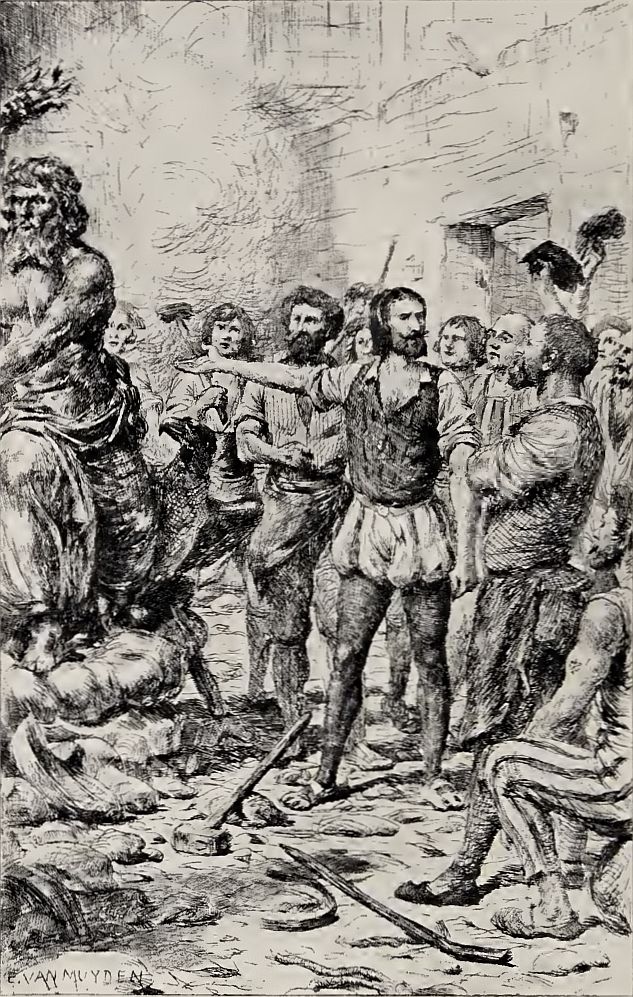
The sight of it encouraged Benvenuto to expose the other portions of the body one after another. Little by little the mould fell away like bark, and at last Jupiter, freed from head to foot from his trammels, appeared in all the majesty befitting the sovereign of Olympus. In no part of the work had the bronze betrayed the artist, and when the last morsel of clay fell away, all the workmen joined in a shout of admiration; for they had come out one by one and gathered about Cellini, who did not even notice their presence, so absorbed was he by the thoughts to which this complete success gave rise.
But at the shout, which made him too a god, he raised his head, and said with a proud smile:—
"We shall see if the King of France will refuse the first boon asked by the man who has made such a statue!"
The next instant, as if he repented his first impulse of pride, which was entirely characteristic of him, he fell upon his knees, and with clasped hands rendered thanks to the Lord aloud.
As he was finishing his prayer Scozzone ran out to say that Madame Jacques Aubry desired to speak to him in private, having a letter from her husband, which she could hand to none but Benvenuto.
Benvenuto made Scozzone repeat the name twice, for he had no idea that the student was in the hands of a lawful wife.
He obeyed the summons none the less, leaving his companions swollen with pride in their master's renown. Pagolo meanwhile, on scrutinizing the statue more closely, observed that there was an imperfection in the heel, some accident having prevented the metal from filling every part of the mould.
XIX JUPITER AND OLYMPUS
On the same day that Benvenuto removed his statue from the mould, he sent word to François I. that his Jupiter was cast, and asked him on what day it was his pleasure that the King of Olympus should appear before the King of France.
François replied that his cousin, the Emperor, and he were to hunt in the forest of Fontainebleau on the following Thursday, and that he need do nothing more than have his statue transported to the grand gallery of the château on that day.
The reply was very short; it was evident that Madame d'Etampes had strongly prejudiced the king against his favorite artist. But Benvenuto—was it through pride or confidence in God?—said simply, with a smile,—
"It is well."
It was Monday. Benvenuto caused the Jupiter to be loaded upon a wagon, and rode beside it, not leaving it for an instant, lest some mishap might befall it. On Thursday, at ten o'clock, statue and artist were at Fontainebleau.
To any one who saw Benvenuto, though it were only to see him ride by, it was evident that pride and radiant hope were triumphant in his heart. His conscience as an artist told him that he had executed a chef-d'œuvre, and his honest heart that he was about to perform a meritorious action. He was doubly joyous, therefore, and carried his head high, like a man who, having no hatred in his heart, was equally without fear. The king was to see his Jupiter, and could not fail to be pleased with it; Montmorency and Poyet would remind him of his promise; the Emperor and the whole court would be present, and François could not do otherwise than as he had given his word to do.
Madame d'Etampes, with less innocent delight, but with quite as much ardent passion, was maturing her plans. She had triumphed over Benvenuto at the time of his first attempt to confound her by presenting himself at her own hôtel and at the Louvre. The first danger was safely past, but she felt that the king's promise to Benvenuto was a second equally great danger, and it was her purpose, at any cost, to induce his Majesty to disregard it. She therefore repaired to Fontainebleau one day in advance of Cellini, and laid her wires with the profound feminine craft which in her case almost amounted to genius.
Cellini was destined very soon to feel its effects.
He had no sooner crossed the threshold of the gallery where his Jupiter was to be exhibited, than he felt the blow, recognized the hand that had dealt it, and stood for a moment overwhelmed.
This gallery, ordinarily resplendent with paintings by Rosso, which were in themselves enough to distract the attention from almost any masterpiece, had been embellished during the last three days by statues sent from Rome by Primaticcio,—that is to say, the marvels of antique sculpture, the types sanctified by the admiration of twenty centuries, were there before him, challenging comparison, crushing all rivalry. Ariadne, Venus, Hercules, Apollo, even Jupiter himself, the great Olympian Jove,—ideal figures, dreams of genius, eternities in bronze,—formed, as it were, a supernatural assemblage which it was impious to approach, a sublime tribunal whose judgment every artist should dread.
There was something like profanation and blasphemy in the thought of another Jupiter insinuating himself into that Olympus, of Benvenuto throwing down the gauntlet to Phidias, and, notwithstanding his trust in his own merit, the devout artist recoiled.
Furthermore, the immortal statues had taken possession of all the best places, as it was their right to do, and there was no place left for Cellini's poor Jupiter but some dark corner which could only be reached by passing under the stately and imposing glances of the ancient gods.
Benvenuto stood in the doorway with bowed head, and with an expression in which sadness and artistic gratification were mingled.
"Messire Antoine Le Maçon," he said to the king's secretary, who stood beside him, "I ought to and will send my Jupiter back instantly; the disciple will not attempt to contend with the masters; the child will not attempt to contend with his parents; my pride and my modesty alike forbid!"
"Benvenuto," replied the secretary, "take the advice of a sincere friend,—if you do that, you are lost. I tell you this between ourselves, that your enemies hope to discourage you, and then to allege your discouragement as a proof of your lack of skill. It will be useless for me to make excuses for you to the king. His Majesty, who is impatient to see your work, would refuse to listen, and, with Madame d'Etampes continually urging him to do it, would withdraw his favor from you forever. She anticipates that result, and I fear it. It's with the living, not with the dead, Benvenuto, that you have to contend."
"You are right, messire," the goldsmith rejoined, "and I understand you perfectly. Thank you for reminding me that I have no right to have any self-esteem here."
"That's all right, Benvenuto. But let me give you one more bit of advice. Madame d'Etampes is too fascinating to-day not to have some perfidious scheme in her head: she took the king and the Emperor off for a ride in the forest with irresistible playfulness and charm; I am afraid for your sake that she will find a way to keep them there until dark."
"Do you think it?" cried Benvenuto, turning pale. "Why, if she succeeds in doing that, I am lost; for my statue would then have to be exhibited by artificial light, which would deprive it of half its merit."
"Let us hope that I am mistaken," said Le Maçon, "and see what comes to pass."
Cellini waited in painful suspense. He placed his Jupiter in as favorable a light as possible, but he did not conceal from himself the fact that its effect would be comparatively slight by twilight, and that after nightfall it would be positively bad. The duchess's hatred had reckoned no less accurately than the artist's skill; she anticipated in 1541 a trick of the critics of the nineteenth century.
Benvenuto watched the sun sink toward the horizon with despair at his heart, and listened eagerly to every sound without the château. Except for the servants the vast structure was deserted.
Three o'clock struck; thenceforth the purpose of Madame d'Etampes could not be mistaken, and her success was beyond question. Benvenuto fell upon a chair, utterly crushed. All was lost: his renown first of all. That feverish struggle, in which he had been so near succumbing, and which he had already forgotten because he had thought that it made his triumph sure, would have no other result than to put him to shame. He gazed sorrowfully at his statue, around which the shadows of night were already beginning to fall, and whose lines began to appear less pure.
Suddenly an inspiration came to him; he sprang to his feet, called little Jehan, whom he had brought with him, and rushed hastily from the gallery. Nothing had yet occurred to suggest the king's return. Benvenuto hurried to a cabinet-maker in the town, and with his assistance and that of his workmen made, in less than an hour, a stand of light-colored oak, with four rollers, which turned in every direction, like casters.
He trembled now lest the king should return too soon: but at five o'clock the work was completed, night had fallen, and the crowned heads had not returned to the château. Madame d'Etampes, wherever she was, was in a fair way to triumph.
In a very short time Benvenuto had the statue in place upon the almost invisible stand. Jupiter held in his left hand the sphere representing the world, and in his right, a little above his head, the thunderbolt, which he seemed to be on the point of launching into space: amid the tongues of the thunderbolt the goldsmith concealed a lamp.
These preparations were hardly completed when a flourish of trumpets announced the return of the king and the Emperor. Benvenuto lighted the lamp, stationed little Jehan behind the statue, by which he was entirely concealed, and awaited the king's coming, not without trepidation, evidenced by the violent beating of his heart.
Ten minutes later the folding doors were thrown wide open, and François I. appeared, leading Charles V. by the hand.
The Dauphin, Dauphine, the King of Navarre, and the whole court followed the two monarchs; the provost, his daughter, and D'Orbec were among the last. Colombe was pale and dejected, but as soon as she espied Cellini, she raised her head, and a smile of sublime confidence appeared upon her lips and lighted up her face.
Cellini met her glance with one which seemed to say, "Have no fear; whatever happens, do not despair, for I am watching over you."
As the door opened, little Jehan, at a signal from his master, gave the statue a slight push, so that it moved softly forward upon its smoothly rolling stand, and, leaving the antique statues behind, went to meet the king, so to speak, as if it were alive. Every eye was at once turned in its direction. The soft light of the lamp falling from above produced an effect much more agreeable than daylight.
Madame d'Etampes bit her lips.
"Methinks, Sire," said she, "that the flattery is a little overdone, and that it was for the king of earth to go to meet the king of heaven."
The king smiled, but it was easy to see that the flattery did not offend him; as his wont was, he forgot the artist for his art, saved the statue half the journey by walking to meet it, and examined it for a long time in silence. Charles V., who was by nature an astute politician rather than a great artist, although he did one day, in a moment of good humor, pick up Titian's pencil,—Charles V. and the courtiers, who were not entitled to an opinion, waited respectfully to hear that of François before pronouncing their own.
There was a moment of silent suspense, during which Benvenuto and the duchess exchanged a glance of bitter hatred.
Suddenly the king cried,—
"It is beautiful! it is very beautiful! and I confess that my expectations are surpassed."
Thereupon every one overflowed in compliments and extravagant praise, the Emperor first of all.
"If one could conquer artists like cities," said he to the king, "I would declare war on you instantly, to win this one, my cousin."
"But, after all," interrupted Madame d'Etampes, in a rage, "we do not even look at the beautiful antique statues a little farther on, which have somewhat more merit, perhaps, than our modern gewgaws."
The king thereupon walked toward the antique statues, which were lighted from below by the torches, so that the upper portions were in shadow; they were beyond question much less effective than the Jupiter.
"Phidias is sublime," said the king, "but there may be a Phidias in the age of François I. and Charles V., as there was in the age of Pericles."
"Oh, we must see it by daylight," said Anne, bitterly; "to appear to be is not to be: an artificial light is not art. And what is that veil? is it to conceal some defect, Master Cellini, tell us frankly?"
She referred to a very light drapery thrown over the statue to give it more majesty.
Thus far Benvenuto had remained beside his statue, silent, and apparently as cold as it; but at the duchess's words, he smiled disdainfully, shot lightning from his black eyes, and, with the sublime audacity of a heathen artist, snatched the veil away with his powerful hand.
He expected that the duchess would burst forth with renewed fury.
But by an incredible exertion of her will power, she smiled with ominous affability, and graciously held out her hand to Cellini, who was amazed beyond measure by this sudden change of tactics.
"I was wrong," she said aloud, in the tone of a spoiled child; "you are a great sculptor, Cellini; forgive my critical remarks; give me your hand, and let us be friends henceforth. What say you?"
She added in an undertone, with extreme volubility: "Think well of what you are about to ask, Cellini. Let it not be the marriage of Colombe and Ascanio, or I swear that Colombe, Ascanio, and yourself, all three, are undone forever!"
"And suppose I request something else, madame," said Benvenuto, in the same tone; "will you second my request?"
"Yes," said she, eagerly; "and I swear that, whatever it may be, the king will grant it."
"I have no need to request the king's sanction to the marriage of Colombe and Ascanio, for you will request it yourself, madame."
The duchess smiled disdainfully.
"What are you whispering there?" said François.
"Madame la Duchesse d'Etampes," Benvenuto replied, "was obliging enough to remind me that your Majesty had promised to grant me a boon in case you were content with my work."
"And the promise was made in my presence, Sire," said the constable, coming forward; "in my presence and Chancelier Poyet's. Indeed, you bade my colleague and myself remind you—"
"True, constable," interposed the king, good-humoredly; "true, if I failed to remember myself; but I remember famously, on my word! So your intervention, while it is perfectly agreeable to me, is quite useless. I promised Benvenuto to grant whatever boon he might ask when his Jupiter was cast. Was not that it, constable? Have I a good memory, chancellor? It is for you to speak, Master Cellini: I am at your service; but I beg you to think less of your own merit, which is immense, than of our power, which is limited; we make no reservations, saving our crown and our mistress."
"Very good, Sire," said Cellini, "since your Majesty is so well disposed toward your unworthy servitor, I will ask for the pardon of a poor student, who fell into a dispute upon the Quai du Châtelet with the Vicomte de Marmagne, and in self-defence passed his sword through the viscount's body."
Every one marvelled at the moderation of his request, and Madame d'Etampes most of all; she gazed at Benvenuto with an air of stupefaction, and as if she thought that she could not have heard aright.
"By Mahomet's belly!" exclaimed François, "you do well to invoke my right of pardon in that matter, for I heard the chancellor himself say yesterday that it was a hanging affair."
"Oh, Sire!" cried the duchess, "I intended to speak to you myself concerning that young man. I have had news of Marmagne, who is improving, and who sent word to me that he sought the quarrel, and the student—What is the student's name, Master Benvenuto?"
"Jacques Aubry, Madame la Duchesse."
"And the student," continued Madame d'Etampes, hurriedly, "was in no wise in the wrong; and so, Sire, instead of rebuking Benvenuto, or cavilling at him, grant his request promptly, lest he repent of having been of modest."
"Very well," said François; "what you desire shall be done, master; and as he gives twice who gives quickly,—so says the proverb,—let the order to set this young man at liberty be despatched to-night. Do you hear, my dear chancellor?"
"Yes, Sire; and your Majesty shall be obeyed."
"As to yourself, Master Benvenuto," said François, "come to me on Monday at the Louvre, and we will adjust certain matters of detail in which you are interested, and which have been somewhat neglected of late by my treasurer."
"But your Majesty knows that admission to the Louvre—"
"Very good! very good! the person who gave the order can rescind it. It was a war measure, and as you now have none but friends at court, everything will be re-established upon a peace footing."
"As your Majesty is in a granting mood," said the duchess, "I pray you to grant a trifling request which I prefer, although I did not make the Jupiter."
"No," said Benvenuto in an undertone, "but you have often acted the part of Danaë."
"What is your request?" said François, who did not hear Benvenuto's epigram. "Say on, Madame la Duchesse, and be sure that the solemnity of the occasion can add nothing to my desire to be agreeable to you."
"Very well, Sire; your Majesty might well confer upon Messire d'Estourville the great honor of signing on Monday next the marriage contract of my young friend, Mademoiselle d'Estourville, with Comte d'Orbec."
"Why, I should be conferring no favor upon you by so doing," rejoined the king, "but I should afford myself a very great pleasure, and should still remain your debtor, I swear."
"So it is agreed, Sire, for Monday?" asked the duchess.
"For Monday," said the king.
"Madame la Duchesse," said Benvenuto, under his breath, "do you not regret that the beautiful lily you ordered Ascanio to execute is not finished, that you might wear it upon such an occasion?"
"Of course I regret it," was the reply; "but it's impossible, for Ascanio is in prison."
"Very true, but I am free; I will finish it and bring it to Madame la Duchesse."
"Oh! upon my honor! if you do that I will say—"
"You will say what, madame?"
"I will say that you are a delightful man."
She gave her hand to Benvenuto, who gallantly imprinted a kiss upon it, after asking the king's permission with a glance.
At that moment a slight shriek was heard.
"What is that?" the king asked.
"Sire, I ask your Majesty's pardon," said the provost, "but my daughter is ill."
"Poor child!" murmured Benvenuto; "she thinks that I have abandoned her."
XX A PRUDENT MARRIAGE
Benvenuto would have returned to Paris the same evening, but the king was so persistent that he could not avoid remaining at the château until the following morning.
With the rapidity of conception and promptness of decision which were characteristic of him, he determined to arrange for the next day the dénouement of a transaction which he began long before. It was a collateral matter which he wished to have off his hands altogether before devoting himself entirely to Ascanio and Colombe.
He remained at the château to supper on that evening and until after breakfast on the Friday, and not until noon did he set out on his return journey, accompanied by little Jehan, after taking leave of the king and Madame d'Etampes.
Both were well mounted, and yet, contrary to his wont, Cellini did not urge his horse. It was evident that he did not wish to enter Paris before a certain hour, and it was seven o'clock in the evening when he alighted at Rue de la Harpe.
Furthermore, instead of betaking himself at once to the Hôtel de Nesle, he called upon one of his friends named Guido, a physician from Florence; and when he had made sure that his friend was at home, and could conveniently entertain him at supper, he ordered little Jehan to return alone, to say that he had remained at Fontainebleau and would not return until the next day, and to be ready to open the door when he should knock. Little Jehan at once set out for the Hôtel de Nesle, promising to abide by his instructions.
The supper was served,—but before they took their places at the table Cellini asked his host if he did not know some honest and skilful notary whom he could send for to prepare a contract that could not be assailed. He recommended his son-in-law, who was immediately summoned.
He arrived as they were finishing their supper, some half-hour later. Benvenuto at once left the table, closeted himself with him, and bade him draw up a marriage contract leaving the names in blank. When they had read and re-read the contract, as drawn up, to make sure that there was no flaw in it, Benvenuto paid him handsomely, put the contract in his pocket, borrowed from his friend a second sword of just the length of his own, put it under his cloak, and, as it had become quite dark, started for the Hôtel de Nesle.
When he reached his destination, he knocked once; but though he knocked very gently, the door immediately opened. Little Jehan was at his post.
Cellini questioned him: the workmen were at supper and did not expect him until the morrow. He bade the child maintain the most absolute silence as to his arrival, then crept up to Catherine's room, to which he had retained a key, entered softly, closed the door, concealed himself behind the hangings, and waited.
After a short time, he heard a light footstep on the staircase. The door opened a second time, and Scozzone entered, lamp in hand; she took the key from the outside, locked the door, placed the lamp on the chimneypiece, and sat down in a large arm-chair, so placed that Benvenuto could see her face.
To his vast astonishment, that face, formerly so open and joyous and animated, was sad and thoughtful. The fact was that poor Scozzone was in the throes of something very like remorse.
We have seen her when she was happy and thoughtless: then Benvenuto loved her. So long as she was conscious of that love, or rather of that kindly feeling in her lover's heart, so long as the hope of becoming the sculptor's wife some day was present like a golden cloud in all her dreams, so long she maintained herself at the level of her anticipations, and made atonement for her past by her love. But as soon as she discovered that she had been deceived by appearances, and that what she had mistaken for passion on Cellini's part was at most a mere whim, she descended the ladder of hope round by round. Benvenuto's smile, which had made that faded heart blossom anew, was taken from her, and the heart lost its freshness once more.
With her childish light-heartedness her childish purity had gradually vanished; her old nature, powerfully assisted by ennui, gently recovered the upper hand. A newly painted wall keeps its colors in the sun and loses them in the rain: Scozzone, abandoned by Cellini for some unknown mistress, was no longer held to him save by a remnant of her pride. Pagolo had long paid court to her: she spoke to Cellini of his love, thinking that his jealousy would be aroused. Her expectation was not realized: Cellini, instead of losing his temper, began to laugh, and, instead of forbidding her to see Pagolo, actually ordered her to receive him. Thereafter she felt that she was entirely lost; thereafter she abandoned her life to chance with her former indifference, and let it blow about in the wind of circumstances like a poor, fallen withered leaf.
Then it was that Pagolo triumphed over her indifference. After all was said, Pagolo was young; Pagolo, aside from his hypocritical expression, was a handsome youth; Pagolo was in love, and was forever repeating to her that he loved her, while Benvenuto had long since ceased to tell her so. The words, "I love you," are the language of the heart, and the heart always feels the need of speaking that language more or less ardently with some one.
Thus, in a moment of idleness, of anger, perhaps of illusion, Scozzone had told Pagolo that she loved him; she had told him so without really loving him; she had told him so with Cellini's image in her heart and his name upon her lips.
Then it immediately occurred to her that the day might come when Cellini, weary of his mysterious, unavailing passion, would return to her, and, if he found her constant, notwithstanding his express orders, would reward her devotion, not by marriage, for the poor girl had lost her last illusion in that regard, but by some remnant of esteem and compassion which she might take for a resurrection of his former love.
It was such thoughts as these which made Scozzone sad and thoughtful, and caused her to feel remorse.
In the midst of her silent reverie, she started and raised her head. She heard a light step on the stairway, and the next moment a key was rapidly turned in the lock, and the door opened.
"How did you come in? Who gave you that key, Pagolo?" she cried, rising from her chair. "There are only two keys to that door,—one is in my possession and the other in Cellini's."
"Ah! my dear Catherine," laughed Pagolo, "you're a capricious creature: sometimes you open your door to a fellow, and again you keep it closed; and when one attempts to enter by force, even though you have given him a right to do it, you threaten to call for help. So you see I had to resort to stratagem."
"Oh yes! tell me that you stole the key from Cellini, without his knowledge; tell me that he doesn't know you have it, for if he gave it to you I should die of shame and chagrin."
"Set your mind at rest, my lovely Catherine," said Pagolo, locking the door, and sitting down near the girl, whom he forced to a seat beside him. "No, Benvenuto doesn't love you, it is true: but he's like those misers who have a treasure of which they make no use themselves, but which they won't allow anybody else to touch. No, I made the key myself. He who can do great things can do small things. Tell me if I love you, Catherine, when my hands, which are accustomed to making pearls and diamonds bloom on golden stalks, consented to shape an ignoble piece of iron. It is true, wicked one, that the ignoble piece of iron was a key, and that the key unlocked the door of paradise."
With that, Pagolo would have taken Catherine's hand, but, to the vast amazement of Cellini, who did not lose a word or a gesture of this scene, Catherine repulsed him.
"Well, well," said Pagolo, "is this whim likely to last long, pray?"
"Look you, Pagolo," said Catherine, in a melancholy tone, which went to Cellini's heart; "I know that when a woman has once yielded she has no right to draw back afterward; but if the man for whom she has been so weak has a generous heart,—when she says to him that she was acting in good faith at the time, because she had lost her reason, but that she was mistaken,—it is that man's duty, believe me, not to take an unfair advantage of her momentary error. Well, Pagolo, I tell you this: I yielded to you, and yet I did not love you; I loved another, and that other Cellini. Despise me you may,—indeed you ought,—but torment me no more, Pagolo."
"Good!" exclaimed Pagolo, "good! you arrange the matter marvellously well, upon my word! After the time you compelled me to wait for the favor with which you now reproach me, you think that I will release you from a definite engagement which you entered into of your own free will? No, no! And when I think that you are doing all this for Benvenuto, for a man who is twice your age or mine, for a man who doesn't love you, for a man who despises you, for a man who treats you as a courtesan!"
"Stop, Pagolo, stop!" cried Scozzone, blushing with shame and jealousy and rage. "Benvenuto doesn't love me any more, that is true; but he did love me once, and he esteems me still."
"Very good! Why doesn't he marry you, as he promised to do?"
"Promised? Never. No, Benvenuto never promised to make me his wife; for if he had promised, he would have done it. I aspired to mount so high as that: the aspiration led me to hope that it might be so; and when the hope had once taken shape in my heart, I could not confine it there, it overflowed, and I boasted of a mere hope as if it were a reality. No, Pagolo, no," continued Catherine, letting her hand fall into the apprentice's with a sad smile,—"no, Benvenuto never promised me aught."
"Then, see how ungrateful you are, Scozzone!" cried Pagolo, seizing her hand, and mistaking what was simply a mark of dejection for a return to him; "you repulse me, who have promised you and offered you all that Benvenuto, by your own admission, never promised or offered you, while I am convinced that if he were standing there—he who betrayed you—you would freely make to him the confession you so bitterly regret having made to me, who love you so dearly."
"Oh if he were here!" cried Scozzone, "if he were here, Pagolo, you would remember that you betrayed him through hatred, while I betrayed him because I loved him, and you would sink into the ground!"
"Why so?" demanded Pagolo, bold as a lion because he believed Benvenuto to be far away; "why so, if you please? Hasn't every man the right to win a woman's love when that woman doesn't belong to another? If he were here, I would say to him: 'You abandoned Catherine,—poor Catherine, who loved you so well. She was in despair at first, until she fell in with a kind-hearted, worthy fellow, who appreciated her at her true worth, who loved her, and who promised her what you would never promise her,—to make her his wife. He has inherited your rights, and that woman belongs to him.' Tell me, Catherine, what reply your Cellini could make to that?"
"None at all," said a stern, manly voice behind the enthusiastic Pagolo,—"absolutely none at all."
At the same instant a powerful hand fell upon his shoulder, nipped his eloquence in the bud, and threw him to the floor, as pale and terrified as he had been boastful and rash a moment before.
It was a strange picture: Pagolo on his knees, bent double, with colorless cheeks, and deadly terror depicted on his features; Scozzone, half risen from her chair, motionless and dumfounded, like a statue of Astonishment; and lastly, Benvenuto standing with folded arms, a sword in its sheath in one hand, a naked sword in the other, with an expression in which irony and menace struggled for the mastery.
There was a moment of awful silence, Pagolo and Scozzone being equally abashed beneath the master's frown.
"Treachery!" muttered Pagolo, "treachery!"
"Yes, treachery on your part, wretch!" retorted Cellini.
"You asked to see him, Pagolo," said Scozzone; "here he is."
"Yes, here he is," said the apprentice, ashamed to be thus treated before the woman he was so anxious to please; "but he is armed, and I have no weapon."
"I have brought you one," said Cellini, stepping back, and throwing down the sword he held in his left hand at Pagolo's feet.
Pagolo looked at the sword, but made no movement.
"Come," said Cellini, "pick up the sword and stand up yourself. I am waiting."
"A duel?" muttered the apprentice, whose teeth were chattering with terror; "am I able to fight a duel on equal terms with you?"
"Very well," said Cellini, passing his weapon from one hand to the other, "I will fight with my left hand, and that will make us equal."
"I fight with you, my benefactor?—you, to whom I owe everything? Never! never!"
A smile of profound contempt overspread Benvenuto's face, while Scozzone recoiled without seeking to conceal the disgust which showed itself in her expression.
"You should have remembered my benefactions before stealing from me the woman I intrusted to your honor and Ascanio's," said Benvenuto. "Your memory has come back to you too late. On guard, Pagolo! on guard!"
"No! no!" murmured the coward, falling back upon his knees.
"As you refuse to fight like an honest man," said Benvenuto, "I propose to punish you as a scoundrel."
He replaced his sword in its sheath, drew his dagger, and walked slowly toward the apprentice without the slightest indication either of anger or compassion upon his impassive features.
Scozzone rushed between them with a shriek; but Benvenuto, without violence, with a motion of his arm as irresistible as that of a bronze statue endowed with life, put her aside, and the poor girl fell back half dead upon her chair. Benvenuto walked on toward Pagolo, who receded as far as the wall. There the master overtook him, and said, putting his dagger to his throat,—
"Commend your soul to God: you have five minutes to live."
"Mercy!" cried Pagolo in an inarticulate voice; "do not kill me! mercy! mercy!"
"What!" said Cellini, "you know me, and, knowing me, seduced the woman who belonged to me. I know all, I have discovered everything, and you hope that I will spare you! You are laughing at me, Pagolo, you are laughing at me."