Volume 11 — Volume XI. (continued 6)
Reading edition
On this evening, as usual, Colombe was living over again the delicious hour she had passed with Ascanio, when, happening to raise her eyes, she uttered a sharp cry.
He was standing before her, gazing at her in silence.
He found her changed, but lovelier than ever. Pallor and melancholy were most becoming to her ideally beautiful face. She seemed to belong still less to earth. And so Ascanio, gazing admiringly upon her enhanced charms, was assailed once more by his former modest apprehensions, which Madame d'Etampes's passion had dissipated for a moment. How could this celestial creature ever love him?
The two lovely children, who had loved each other so long without a word, and who had already suffered so much, were at last face to face. They ought, no doubt, to have traversed in an instant the space they had traversed step by step, and separately, in their dreams. They might now come to an understanding first of all, and then allow all their long pent-up emotion to find expression in an outburst of joy.
But they were both too timid for that, and although their emotion betrayed each to the other, their angel hearts did not come together until they had first made a detour.
Colombe, speechless and blushing, had risen to her feet by a sudden impulse. Ascanio, pale with the intensity of his emotion, repressed with a trembling hand the rapid beating of his heart.
They both began to speak at once: he to say, "Forgive me, mademoiselle, but you gave me leave to show you some jewels;" she to say, "I am glad to see that you are entirely recovered, Monsieur Ascanio."
They ceased speaking simultaneously, but nevertheless they had perfectly understood each other: and Ascanio, emboldened by the involuntary smile which the incident naturally brought to the maiden's lips, rejoined, with somewhat more assurance:—
"Are you so kind as to remember that I was wounded?"
"Indeed, yes; and Dame Perrine and I have been very anxious and astonished not to see you."
"I did not intend to come again."
"Why not, pray?"
At this decisive moment Ascanio was fain to lean against a tree for support, but in a moment he summoned all his strength and all his courage, and said breathlessly:—
"I may confess it now: I loved you!"
"And now?"
The question came from Colombe's lips almost without her knowledge: it would have put to flight all the doubts of an older hand than Ascanio, but it simply revived his hopes a little.
"Now, alas!" he continued, "I have measured the distance that lies between us, and I know that you are happily betrothed to a noble count."
"Happily!" interposed Colombe, with a bitter smile.
"What! you do not love the count! Great God! Pray tell me, is he not worthy of you?"
"He is rich and powerful, far above me: but you have seen him?"
"No, and I was afraid to inquire. Besides, I cannot say why, but I felt certain that he was young and attractive, and that he was agreeable to you."
"He is older than my father, and he frightens me," said Colombe, hiding her faee in her hands with a gesture of abhorrence which she could not repress.
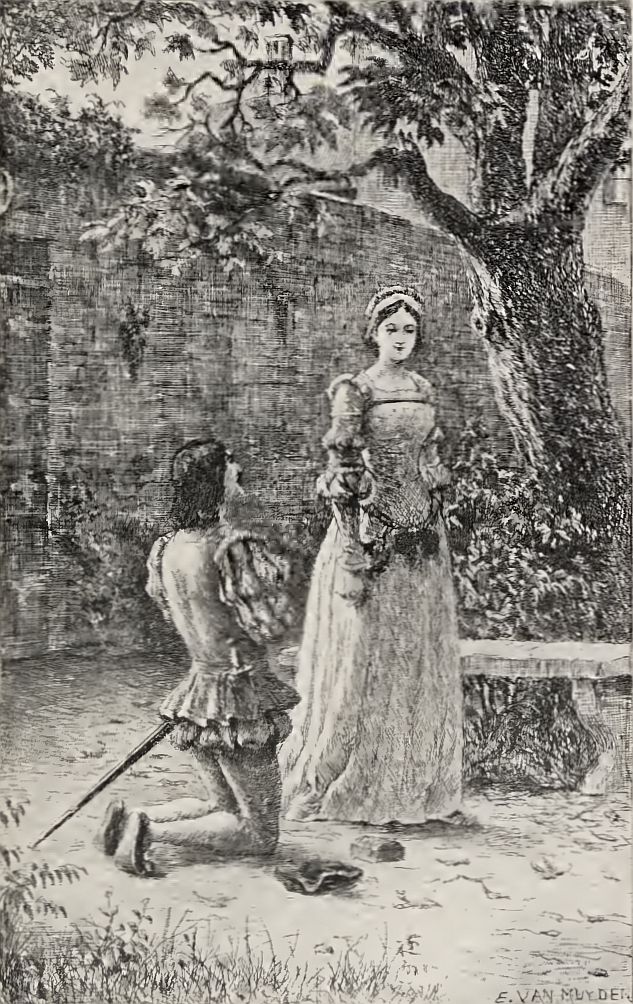
Ascanio, beside himself with joy, fell on his knees, with clasped hands, pale as death, his eyes half closed, but a sublime light shone out from beneath his eyelids, and a smile fit to rejoice God's heart played about his colorless lips.
"What is the matter, Ascanio?" said Colombe in alarm.
"What is the matter!" cried the young man, finding in the excess of his joy the audacity which sorrow first gave him; "What is the matter! why, I love you, Colombe!"
"Ascanio! Ascanio!" murmured Colombe, in a tone that was half reproof, half pleasure, and it must be said, as soft as a confession of love.
But they understood each other; their hearts were united, and before they were conscious of it, their lips had followed suit.
"My friend," said Colombe, softly pushing Ascanio away.
They gazed into one another's faces in ecstasy: the two angels recognized each other at last. Life does not contain two such moments.
"And so," said Ascanio, "you do not love Comte d'Orbec: you are free to love me."
"My friend," said Colombe, in her sweet, grave voice, "no one save my father ever kissed me before, and he, alas! very rarely. I am an ignorant child, and I know nothing of life; but I know from the thrill which your kiss caused me that it is my duty henceforth to belong only to you or to Heaven. Yes, if it were otherwise, I am sure that it would be a crime! Your lips have consecrated me your fiancée and your wife, and though my father himself should say no, I would listen only to the voice of God, which says yes in my heart. Here is my hand, which is yours."
"Angels of paradise, hear her and envy me!" cried Ascanio.
Such ecstasy is not to be pictured or described. Let those who can remember, remember, ft is impossible to put upon paper the words, the looks, the hand-pressures of these pure-hearted lovely children. Their spotless souls flowed together, as do the waters from two springs, without changing their nature or their color. Ascanio did not sully with the shadow of an impure thought the chaste brow of his beloved; Colombe laid her head in perfect trust upon her lover's shoulder. Had the Virgin Mary looked down upon them from on high she would not have turned her head away.
When one begins to love, one is in haste to bring to the support of his love all that he can of his past, present, and future. As soon as they could speak calmly, Ascanio and Colombe described to each other all their sorrows, all their hopes, of the days just gone by. It was charming to both to find that each had the other's story to tell. They had suffered much, and they smiled upon each other as they remembered their suffering.
But when they came to speak of the future, then they became serious and sad. What had God in store for them for the morrow? According to all divine laws they were made for each other; but human prejudices would declare their union ill assorted, monstrous. What were they to do? How persuade Comte d'Orbec to renounce his wife? how persuade the Provost of Paris to give his daughter to an artisan?
"Alas! my friend," said Colombe, "I promised you that I would belong to you or to Heaven,—I see that it must be to Heaven.
"No," said Ascanio, "to me. Two children like ourselves cannot move the world alone; but I will speak to my dear master, Benvenuto Cellini. He is powerful, Colombe, and sees all things from a higher level! He acts on earth as God ordains in heaven, and whatever his will has undertaken he accomplishes. He will give you to me. I do not know how he will do it, but I am sure. He loves obstacles. He will speak to King François; he will persuade your father. The only thing he could not bring to pass you did without his intervention,—you loved me. The rest ought to be very simple. You see that I believe in miracles now, my best beloved."
"Dear Ascanio, you hope and I hope. Would you like me also to try an experiment? There is a person whose influence over my father's mind is unbounded. Shall I not write to Madame d'Etampes?"
"Madame d'Etampes!" cried Ascanio. "Mon Dieu! I had forgotten her."
Thereupon he told her, simply and without affectation, how he had seen the duchess, how she had declared her love for him, and how, that very day, within an hour, she had pronounced herself the enemy of his beloved. But of what consequence was it? Benvenuto's task would be a little more difficult, that was all. One adversary more would not terrify him.
"My dear," said Colombe, "you have faith in your master, and I have faith in you; speak to Cellini as soon as possible, and let him decide our fate."
"To-morrow I will tell him everything. He loves me so well that he will understand me instantly. But what is it, my Colombe? How sad you are!"
Each sentence of Ascanio's narrative had made Colombe doubly conscious of her love for him by forcing the sharp sting of jealousy into her heart, and more than once she convulsively pressed Ascanio's hand, which she held in her own.
"Ascanio, Madame d'Etampes is very beautiful. She is beloved by a great king. Mon Dieu! did she make no impression upon your heart?"
"I love you!" said Ascanio.
"Wait here for me."
She returned a moment later with a beautiful fresh white lily.
"When you are working at that woman's lily of gold and jewels," said she, "glance sometimes at the simple lilies from your Colombe's garden."
With that she put her lips to the flower and handed it to the apprentice, as coquettishly as Madame d'Etampes herself could have done.
At that moment Dame Perrine appeared at the end of the path.
"Adieu and au revoir!" said Colombe, putting her hand to her lover's lips with a furtive, graceful gesture.
The governess approached them.
"Well, my child," she said to Colombe, "have you given the delinquent a good scolding, and selected your jewels?"
"Take this, Dame Perrine," said Ascanio, putting the box of trinkets in the good woman's hands still unopened; "Mademoiselle Colombe and I have decided that you shall yourself choose whatever suits you best, and I will come again to-morrow for the others."
With that he ran off with his joy, darting a farewell glance at Colombe, which told her all that he had to tell.
Colombe sat with her hands folded upon her breast as if to confine the happiness it contained,—while Dame Perrine was making her choice among the marvels brought by Ascanio.
Alas! the poor child was very soon and very cruelly awakened from her sweet dreams.
A woman appeared, escorted by one of the provost's men.
"Monseigneur le Comte d'Orbec, who is to return day after to-morrow," said this woman, "places me at madame's service from to-day. I am familiar with the newest and prettiest styles, and I am commanded by Monsieur le Comte and Messire le Prévôt to make for madame a magnificent brocade gown, as Madame la Duchesse d'Etampes is to present madame to the queen on the day of her Majesty's departure for Saint-Germain, four days hence."
After the scene we have described, the reader may imagine the despairing effect of this twofold news upon Colombe.
XIX LOVE AS AN IDEA
The next morning at daybreak Ascanio, resolved to place his destiny in his master's hands at once, repaired to the foundry where Cellini worked every morning. But as he was about to knock at the door of what the master called his cell, he heard Scozzone's voice. He supposed that she was posing, and he discreetly withdrew, to return a little later. Meanwhile he walked about the gardens of the Grand-Nesle, reflecting upon what he should say to Cellini, and what Cellini would probably say to him.
But Scozzone was not posing,—far from it. She had never before set foot in the cell, to which no one, to her great disappointment, was ever admitted. So it was that the master's wrath was terrible to behold, when, happening to turn his head, he saw Catherine behind him, with her great eyes open wider than ever. The imprudent damsel's desire to see found little to gratify it, after all. A few drawings upon the walls, a green curtain before the window, a statue of Hebe begun, and a collection of sculptor's utensils, comprised the whole contents of the room.
"What do you want, little serpent? Why have you come here? In God's name will you follow me to hell?" cried Benvenuto at sight of Catherine.
"Alas! master," said Scozzone, in her softest voice, "I assure you I am not a serpent. I confess that rather than part from you I would joyfully follow you to hell if necessary, and I come here because it is the only place where I can speak to you in secret."
"Very well! make haste! What have you to say to me?"
"O mon Dieu! Benvenuto," exclaimed Scozzone, spying the outlined statue, "what an admirable figure! It is your Hebe. I had no idea it was so far advanced; how lovely it is!"
"Is it not?" said Benvenuto.
"Ah, yes! very lovely, and I understand that you would not want me to pose for such a subject. But who is your model?" inquired Scozzone, anxiously. "I have not seen any woman go in or out."
"Hush! Come, my dear girl, you surely did not come here to talk of sculpture."
"No, master it's about our Pagolo. I did as you bade me, Benvenuto. He took advantage of your absence last evening to annoy me with his eternal love, and, as you commanded, I listened to him to the end."
"Aha! the traitor! What did he say to you?"
"Oh! it's enough to make one die with laughing, and I would have given anything in the world could you have been there. Please understand that, in order not to arouse suspicion, the hypocrite finished the clasp you had given him to make, while he was speaking to me, and the file that he held in his hand added not a little to the pathos of his speech.
"'Dear Catherine,' said he, 'I am dying for love of you; when will you take pity on my martyrdom? One word, I only ask for one word. Just see to what I expose myself for your sake! if I had not finished this clasp, the master might suspect something, and if he suspected anything he would kill me without mercy; but I defy everything for your lovely eyes. Jésu! this accursed work doesn't advance at all. After all, Catherine, what good does it do you to love Benvenuto? He doesn't thank you for it; he is always indifferent to you. And I would love you with a love which would be so ardent and so circumspect at the same time! No one would discover it, you would never be compromised, and you could rely on my discretion, whatever might happen. Look you,' he added, made bold by my silence, 'I have already found a safe retreat, hidden from every eye, where I could take you without fear.'—Ha! ha! you would never guess the place the sly rascal had selected, Benvenuto. I give you a hundred, a thousand guesses; none but men with hang-dog looks, and eyes on the ground discover such out of the way corners. He proposed to quarter me,—where do you suppose?—in the head of your great statue of Mars. 'We can go up,' he said, 'with a ladder.' He assured me that there is a very pretty apartment there, out of every one's sight, and with a magnificent view of the surrounding country."
"Faith, it's not a bad idea," said Benvenuto, with a laugh; "and what reply did you make, Scozzone?"
"I replied with a great burst of laughter, which I could not keep back, and which sorely disappointed Mons. Pagolo. He undertook then to be very pathetic, to reproach me with having no heart, and with wishing to cause his death, and so forth, and so forth. All the time working away with hammer and file, he talked to me in that strain for a full half-hour, for he's a loquacious rascal when he gives his mind to it."
"What reply did you give him finally, Scozzone?"
"What reply? Just as you knocked at the door, and he placed his clasp, finished at last, upon the table, I took his hand, and said to him very soberly, 'Pagolo, you have talked like a jewel!' That was why you found him looking so like an idiot when you came in."
"You were wrong, Scozzone; you should not have discouraged him so."
"You told me to listen to him and I listened. Do you think it's so very easy for me to listen to handsome boys? Suppose something should happen some fine day?"
"You should not only listen to him, my child, but you must give him an answer: it is indispensable to my plan. Speak to him at first without anger, then indulgently, and then encouragingly. When you have reached that point, I will tell you what else you must do."
"But that may have results you do not intend, do you know? At least you should be there."
"Never fear, Scozzone, I will appear at the right moment. You have only to rely upon me, and follow my instructions to the letter. Go now, little one, and leave me to my work."
Catherine tripped lightly away, laughing in pleased anticipation of the fine trick Cellini proposed to play upon Pagolo, of the nature of which, however, she could not form the least conception.
Benvenuto, when she had left him, did not resume his work, as he had said; he rushed to the window which looked obliquely upon the garden of the Petit-Nesle, and stood there in rapt contemplation. A knock at the door rudely aroused him from his reverie.
"Hail and tempest!" he cried in a rage, "who is there now? can I not be left in peace? Ten thousand devils!"
"Forgive me, master," said Ascanio's voice; "if I disturb you, I will go away."
"What! is it you, my child? No, no, surely not; you never disturb me. What is it, pray? what do you want with me!"
Benvenuto lost no time in opening the door for his beloved pupil.
"I interfere with your solitude and your work," said Ascanio.
"No, Ascanio, you are always welcome."
"Master, I have a secret to confide to you, a service to ask of you."
"Speak. Will you have my purse? do you need my arm or my thoughts?"
"I may have need of them all, dear master."
"So much the better! I am yours body and soul, Ascanio. I have a confession to make to you, too: yes, a confession, for although I have committed no sin, I think, still I shall have some remorse until I am absolved by you. But do you speak first."
"Very well, master.—But, great Heaven! what is that cast?" cried Ascanio, interrupting himself.
His eye had just fallen upon the statue of Hebe, and in the statue he recognized Colombe.
"It is Hebe," replied Benvenuto, with glistening eyes; "it is the goddess of youth. Do you think it beautiful, Ascanio?"
"Oh, wonderful! But those features: I know them, I cannot be mistaken!"
"Rash boy! Since you raise the veil half-way, I must needs snatch it away altogether, and so, after all, your confidence will come after mine. Sit down, Ascanio; you shall have my heart spread out before you like an open book. You need me, you say: I, too, need that you should hear me. I shall be relieved of a great weight when you know all."
Ascanio sat down, paler than the culprit about to listen to the reading of the death sentence.
"You are a Florentine, Ascanio, and I do not need to ask you if you know the story of Dante Alighieri. One day he saw a child named Beatrice passing along the street, and he loved her. The child died and he loved her still, for it was her soul that he loved and souls do not die; but he crowned her with a crown of stars, and placed her in paradise. That done, he set about analyzing human passions, sounding the depths of poetry and philosophy; and when, purified by suffering and contemplation, be readied the gates of heaven, where Virgil, that is, Wisdom, was to leave him, he was not obliged to stop for lack of a guide, because he found Beatrice, that is, Love, awaiting him on the threshold.
"Ascanio, I have my Beatrice, dead like the other, and adored as she was. This has been hitherto a secret between God and her and myself. I am weak to resist temptation; but my adoration for her has remained intact amid all the impure passions to which I have yielded. I had placed my light too high for corruption to reach it. The man plunged heedlessly into dissipation, the artist remained true to his mysterious betrothal; and if I have done anything creditable, Ascanio,—if inert matter, silver or clay, has been made to assume form and life under my fingers, if I have sometimes succeeded in imparting beauty to marble and life to bronze,—it has been because my resplendent vision has given me counsel, support, and instruction for twenty years past.
"But I know not how it is, Ascanio: perhaps there is a distinction between the poet and the goldsmith, between the moulder of ideas, and the moulder of gold. Dante dreams: I need to see. The name of Maria is all-sufficient to him; I must have before me the face of the Madonna. We divine his creations; we touch mine. That perhaps is why my Beatrice was not enough, or rather was too much for me, a sculptor. Her mind was ever present with me, but I was compelled to seek the human form. The angelic woman who shed a bright light upon my life had been beautiful, most certainly, beautiful above all in the qualities of her heart, but she did not realize the type of undying beauty upon which my imagination dwelt. I found myself constrained therefore to seek elsewhere, to invent.
"Now, tell me this, Ascanio; do you think that, if my sculptor's ideal had presented itself to me living on this earth, and if I had bestowed a share of my admiration upon it, I should have been ungrateful and faithless to my poetic ideal? Do you think that my celestial apparition would in that case have ceased to visit me, that the angel would be jealous of the woman? Do you think it? I ask you the question, Ascanio, and you will know some day why I ask it of you rather than of another,—why I tremble as I await your reply, as if you were my Beatrice herself."
"Master," said Ascanio gravely and sadly, "I am too young to have an opinion upon such lofty subjects: I think, however, in my heart, that you are one of the chosen men whom God leads, and that what you find upon your path has been placed there by God, not by chance."
"That is really your belief, is it not, Ascanio? You are of opinion that the terrestrial angel, the realization of my longing, would be sent by God, and that the other celestial angel would not be angry at my desertion? In that case, I may venture to tell you that I have found my ideal, that it is living, that I can sec it, and almost touch it. Ascanio, the model of all beauty, of all purity, the type of infinite perfection to which we artists aspire, is near at hand, it breathes, and I can admire, it every day. Ah! all that I have done hitherto is as nothing compared with what I will do. This Hebe, which you think beautiful, and which is, in very truth, my chef-d'œuvre, does not satisfy me as yet: my living dream stands beside its image, and seems to me a hundred times more glorious; but I will attain it! I will attain it! Ascanio, a thousand white statues, all of which resemble it, are already forming and rising in my brain. I see them, I feel their presence, and some day they will come forth.
"And now, Ascanio, would you like me to show you my lovely inspiration? it should be close by us. Every morning, when the sun rises, it shines upon me from below. Look."
Benvenuto drew the curtain aside from the window, and pointed to the garden of the Petit-Nesle.
In her leafy avenue Colombe was walking slowly along, her head resting upon her hand.
"How fair she is, is she not?" said Benvenuto ecstatically. "Phidias and old Michel-Angelo created nothing purer, and the ancients, if they equal, do not surpass that graceful young head. How beautiful she is!"
"Ah! yes, beautiful indeed!" murmured Ascanio, who had resumed his seat, without strength to move or to think.
There was a moment's pause, while Benvenuto feasted upon his joy, and Ascanio brooded over his pain.
"But, master," the apprentice timidly ventured to say, "where will this artist's passion lead you? What do you mean to do?"
"Ascanio," replied Cellini, "she who is dead is not and cannot be mine. God simply showed her to me, and did not implant any human love for her in my heart. Strangely enough, he did not even lead me to feel what she was to me until he had taken her from the world. She is naught but a memory in my life, a vague, indistinct image. But if you have understood me, Colombe more nearly touches my existence, my heart: I dare to love her: I dare to say to myself, 'She shall be mine!'
"She is the daughter of the Provost of Paris," said Ascanio, trembling.
"And even if she were a king's daughter, Ascanio, you know what my will is capable of. I have attained whatever object I have sought to attain, and I never longed for aught more ardently. I know not as yet by what means I shall gain my end, but she must be my wife."
"Your wife! Colombe your wife!"
"I will apply to my mighty sovereign," continued Benvenuto. "I will people the Louvre and Chambord with statues if he wishes. I will cover his tables with ewers and candelabra, and when I ask no other price than Colombe he will not he François I. if he refuses. O Ascanio, I am hopeful, I am hopeful! I will seek him in the midst of his whole court. See, three days hence, when he starts for Saint-Germain, you will come with me. We will carry the silver salt-box, which is completed, and the designs for a gateway at Fontainebleau. Every one will admire them, for they are fine, and he will admire them, and will marvel more than the others. I will give him a similar surprise every week. I have never been conscious of a more fruitful creative power. My brain is boiling night and day: this love of mine, Ascanio, has increased my power and renewed my youth. When François sees all his wishes gratified as soon as they are formed,—ah! then I will no longer request, but demand. He will make me great, and I will make myself rich, and the Provost of Paris, for all his provostship, will be honored by the alliance. Upon my soul, Ascanio, I am going mad! Such thoughts make me lose control of myself. She mine! Dreams of heaven! Do you realize what it means, Ascanio? Colombe mine! Embrace me, my child; since I have confessed it all to you, I dare to listen to my hopes. My heart is calmer now; you have in a measure legalized my happiness. You will understand some day what I mean by that. Meanwhile, it seems to me that I love you more dearly since you have received my confidence: it was good of you to listen. Embrace me, dear Ascanio!"
"But you do not seem to think, master, that perhaps she doesn't love you."
"Oh, hush, Ascanio! I have thought of it, and then I have envied your youth and beauty. But what you say of the far-seeing designs of God reassures me. She is waiting for me to come to her. Whom should she love? some courtier fop, altogether unworthy of her! Furthermore, whoever he may be for whom she is destined, I am as nobly born as he, and I have more genius."
"Comte d'Orbec, they say, is hex fiancé."
"Comte d'Orbec? so much the better! I know him. He is the king's treasurer, and I go to him for the gold and silver to be used in my work, and for the sums which his Majesty's bounty allots to me. Comte d'Orbec is a crabbed, worn out old curmudgeon! He doesn't count, and there will be little glory in supplanting such an animal. Go to, Ascanio; it is I whom she will love, not for my sake, but for her own, because I shall be the demonstration of her loveliness, so to speak, because she will be appreciated, adored, immortalized. Moreover, I have said, 'I wish it!' and, I say again, I never have used that phrase that I have not succeeded. There is no human power which can hold out against the energy of my passion. I shall, as always, go straight to my goal, with the inflexibility of destiny. She shall be mine, I tell you, though I have to turn the whole kingdom topsy-turvy. And if perchance any rival should block my way—Demonio! let him beware! You know me, Ascanio: I will kill him with this hand now grasping thine. But forgive me, Ascanio, in God's name! Egotist that I am, I forget that you have a secret to confide to me, and a service to ask at my hands. I shall never pay my debt to you, dear child, but say on, say on. For you, as well as myself, I can do what it is my will to do."
"You are wrong, master: there are things which God alone can do, and I know that I must rely upon Him and none other. I will leave my secret, therefore, between my feebleness and His might."
Ascanio left the room.
He had hardly closed the door when Cellini drew the green curtain, and, placing his table by the window, began to model his Hebe, his heart filled with joy in the present, and a sense of security for the future.
END OF VOL. I.