Volume 11 — Volume XI. (continued 2)
Reading edition
"May God help me!" said the governor; "with your insolent assurance you'll make me lose my wits! But tell me, in order that these wings may sustain your weight in the air,—a thing which seems impossible to me, I confess,—what form shall you give them?"
"I have thought deeply thereupon, as you may well imagine, since my safety depends entirely upon the shape of my wings."
"With what result?"
"After examining all flying things, I have concluded that, if I wish to reproduce by art what they have received from God, I can copy the bat most successfully."
"But when all is said, Benvenuto," continued the governor, "even if you had the materials with which to make a pair of wings, would not your courage fail you when the time came to use them?"
"Give me what I need for their construction, my dear governor, and I'll reply by flying away."
"What do you need, in God's name?"
"Oh! mon Dieu! almost nothing; a little forge, an anvil, files, tongs and pincers to make the springs, and twenty yards of oiled silk for the membranes.
"Good! very good!" said Master Georgio; "that reassures me somewhat, for, clever as you may be, you never will succeed in obtaining all those things here."
"'T is done," rejoined Benvenuto.
The governor leaped from his chair; but he instantly reflected that it was a material impossibility. And yet, for all that, his poor brain had not a moment's respite. Every bird that flew by his window he imagined to be Benvenuto Cellini, so great is the influence of a master mind over one of moderate capacity.
The same day Master Georgio sent for the most skilful machinist in all Rome, and ordered him to measure him for a pair of bat's wings.
The machinist stared at the governor in blank amazement, without replying, thinking, with some reason, that Master Georgio had gone mad.
But as Master Georgio insisted, as Master Georgio was wealthy, and as Master Georgio had the wherewithal to pay for insane freaks, if he chose to indulge in them, the machinist set about the task, and a week later brought him a pair of magnificent wings, fitted to an iron waist to be worn upon the body, and worked by means of an extremely ingenious arrangement of springs, with most encouraging regularity.
Master Georgio paid his man the stipulated price, measured the space required to accommodate the apparatus, went up to Benvenuto's cell, and without a word overturned everything therein, looking under the bed, peering up the chimney, fumbling in the mattress, and leaving not the smallest corner unvisited.
Then he went out, still without speaking, convinced that, unless Benvenuto was a sorcerer, no pair of wings similar to his own could be hidden in his cell.
It was clear that the unhappy governor's brain was becoming more and more disordered.
Upon descending to his own quarters, Master Georgio found the machinist waiting for him; he had returned to call his attention to the fact that there was an iron ring at the end of each wing, intended to support the legs of a man flying in a horizontal position.
The machinist had no sooner left him than Master Georgio locked himself in, donned the iron waist, unfolded his wings, hung up his legs, and, lying flat upon his stomach, made his first attempt at flying.
But, try as he would, he could not succeed in rising above the floor.
After two or three trials, always with the same result, he sent for the mechanic once more.
"Master," said he, "I have tried your wings, but they won't work."
"How did you try them?"
Master Georgio described his repeated experiments in detail. The mechanic listened with a sober face, and said, when he had concluded:—
"I am not surprised; as you lay on the floor, you hadn't a sufficient quantity of air under your wings. You must go to the top of the castle of San Angelo, and boldly launch yourself into space."
"And you think that in that way I can fly?"
"I am sure of it."
"If you are so sure of it, would it not be as well to make the experiment yourself?"
"The wings are proportioned to the weight of your body and not of mine," replied the machinist. "Wings to carry my weight would need to measure a foot and a half more from tip to tip."
And with that he bowed and took his leave.
"The devil!" exclaimed Master Georgio.
Throughout that day Master Georgio indulged in various vagaries, which tended to prove that his reason, like Roland's, was penetrating farther and farther into imaginary realms.
In the evening, just at bedtime, he summoned all the servants, all the jailers, all the guards.
"If," said he, "you learn that Benvenuto Cellini is intending to fly away, let him go, and notify me, nothing more; for I shall know where to go to capture him, even in the dark, since I am myself a veritable bat, while he, whatever he may say, is only a false bat."
The poor governor was quite mad; but as they hoped that a night's rest would have a soothing effect upon him, they decided to wait until morning before advising the Pope.
Moreover it was an abominable night, dark and rainy, and no one cared to go out in such weather; always excepting Benvenuto Cellini, who had selected that very night for his escape, in a spirit of contrariety doubtless.
And so, as soon as he heard the clock strike ten, and the footsteps indicating that the sentinel had been relieved, he fell on his knees and offered a fervent prayer, after which he set to work.
In the first place he removed the heads of the four nails, which alone held the iron plates in place. The last yielded to his efforts just at midnight.
He heard the steps of the sentinel going up to the platform; he stood with his ear glued to the door, without breathing, until the relieved sentinel came down, the steps died away in the distance, and silence reigned once more.
The rain fell with redoubled force, and Benvenuto's heart leaped for joy as he heard it heating against the window.
He at once tried to remove the iron plates; as there was nothing to hold them, they yielded to his efforts, and he placed them, one by one, against the wall.
He then lay flat upon the floor, and attacked the bottom of the door with his modelling tool, sharpened like a dagger, and fitted to a wooden handle. The oak was entirely changed to carbon, and gave way at the first touch.
In an instant Benvenuto had made, an aperture at the bottom of the door sufficiently large to allow him to crawl through it. He reopened the belly of his statue, took out the strips of linen, coiled them around his waist like a girdle, armed himself with his modelling tool, of which he had, as we have said, made a dagger, and fell on his knees once more and prayed.
Then he passed his head through the hole, then his shoulders, then the rest of his body, and found himself in the corridor.
He stood erect; but his legs trembled so that he was compelled to lean against the wall for support. His heart was beating as if it would burst, and his head was on fire. A drop of perspiration trembled at the end of each hair, and he clutched the handle of his dagger in his hand, as if some one were trying to tear it away from him.
However, as everything was quiet, as nothing was stirring and not a sound was to be heard, Benvenuto soon recovered himself, and felt his way along the wall of the corridor with his hand, until the wall came to an end. Then he put out his foot and felt the first step of the staircase, or, more properly speaking, the ladder, which led to the platform.
He mounted the rungs, one by one, shivering as the wood creaked under his feet, until he felt a breath of air; then the rain beat against his faee as his head rose above the level of the platform, and as he had been in most intense darkness for a quarter of an hour, he was able to judge at once what reason he had to fear or hope.
The balance seemed to incline toward hope.
The sentinel had taken refuge from the storm in his sentry-box. How, as the sentinels who mounted guard upon the castle of San Angelo were stationed there, not to inspect the platform, but to look down into the moat and survey the surrounding country, the closed side of the sentry-box faced the top of the ladder by which Benvenuto ascended.
The artist crept cautiously on his hands and knees toward that part of the platform which was farthest removed from the sentry-box. There he securely fastened one end of his improvised rope to a jutting projection some six inches in length, and then knelt for the third time.
"O Lord!" he muttered, "O Lord! do Thou help me, since I am seeking to help myself."
With that prayer upon his lips, he let himself down by his hands, heedless of the bruises upon his knees and his forehead, which, from time to time, rubbed against the face of the wall, and at last reached the solid earth.
When he felt the ground beneath his feet, his breast swelled with an infinitude of joy and pride. He contemplated the immense height from which he had descended, and could not avoid saying in an undertone, "Free at last!" But his joy was short-lived.
As he turned away from the tower, his knees trembled under him; directly in front of him rose a wall recently built, and of which he knew nothing; he was lost.
Everything seemed to give way within him, and in his despair he fell to the ground; but as he fell, his foot struck against something hard,—it was a long beam; he gave a slight exclamation of surprise and delight; he was saved.
Ah! no one knows what heart-rending alternations of joy and hope one short minute of life can contain.
Benvenuto seized the beam as a shipwrecked sailor seizes the spar which may save him from drowning. Under ordinary circumstances two strong men would have found difficulty in lifting it; he dragged it to the wall, and stood it on end against it. Then he climbed to the top of the wall, clinging to the beam with his hands and knees, but when he arrived there his strength was insufficient to raise the beam and lower it on the other side.
For a moment his head swam; he closed his eyes, and it seemed as if he were struggling in a lake of flames.
Suddenly he remembered his strips of linen, by means of which he had descended from the platform.
He slid down the beam to the ground once more, and ran to the spot where he had left them hanging; but he had fastened them so securely at the opposite end, that he could not detach them. In his desperation he raised himself from the ground by hanging to them, pulling with all his strength, and hoping to break them. Fortunately one of the knots slipped at last, and Benvenuto fell to the ground, grasping a fragment some twelve feet long.
This was all that he needed; he rose with a bound, and, filled with fresh vigor, climbed up to the top of the wall once more, fastened the cord to the end of the beam, and slid down on the other side.
When he reached the end of the cord he felt in vain for the ground with his feet, and, upon looking over his shoulder, saw that it was still some six feet away. He let go the cord, and dropped.
He lay still for an instant; he was completely exhausted, and there was no skin left upon his legs and hands. For some moments he gazed stupidly at his bleeding flesh; but five o'clock struck, and he saw that the stars were beginning to pale.
He rose; but as he rose, a sentinel whom he had not noticed, but who had undoubtedly witnessed his performance, walked toward him. Benvenuto saw that he was lost, and that he must either kill or be killed. He drew his modelling tool from his belt, and marched straight toward the guard, with such a determined expression that worthy doubtless realized that he had not only a powerful man, but a deathly despair, to contend with. Benvenuto was determined not to give ground, but suddenly the soldier turned his back upon him as if he had not seen him. The prisoner understood what that meant.
He ran to the last rampart, and found himself some twelve or fifteen feet above the moat. Such a trifle was not likely to stop a man like Benvenuto Cellini, in his present predicament, when he had left part of his cord hanging from the top of the tower, and the other part attached to the beam, so that he had nothing left with which to lower himself, and there was no time to lose. He hung by his hands from a ring in the masonry, and, with a mental prayer, let himself drop.
This time he fainted outright.
An hour passed before he came to himself; but the coolness which is always noticeable in the air as dawn approaches, revived him. He lay for an instant with his mind in confusion, then passed his hand over his forehead and remembered everything.
He felt a sharp pain in his head, and saw blood upon the stones where he lay, which had trickled down from his face. He put his hand to his forehead a second time, not to collect his thoughts, but to investigate his wounds, which he found were but skin deep. He smiled and tried to stand up, but fell heavily back; his right leg was broken three inches above the ankle. The leg was so benumbed that at first he felt no pain.
He at once removed his shirt and tore it into strips, then put the ends of the bone together as well as he could, and applied the bandage, binding it with all his strength, and passing it under the sole of his foot now and then, in order to keep the bones in place.
Then he dragged himself on all fours toward one of the city gates which was within five hundred yards. After half an hour of atrocious suffering, he reached the gate only to find that it was closed. But he noticed a large stone under the gate, which yielded to his first attempt to remove it, and he passed through the hole left by it.
He had not taken twenty steps beyond the gate when he was attacked by a pack of famished dogs, who were attracted by the odor of blood. He drew his modelling tool, and despatched the largest and most savage with a blow in the side. The others immediately threw themselves upon their defunct comrade and devoured him.
Benvenuto dragged himself along to the church of La Transpontina, where he fell in with a water-carrier who had just filled his jars and loaded his donkey. He called him.
"Look you." he said; "I was with my mistress; circumstances compelled me, although I went in at the door, to come out through the window. I leaped from the first floor, and broke my leg; carry me to the steps of Saint Peter's, and I will give you a golden crown."
The water-carrier, without a word, took the wounded man on his shoulder, and carried him to the designated spot. Having received his pay, he went his way without so much as looking behind.
Thereupon Benvenuto, still on all fours, made his way to the palace of Monseigneur de Montluc, the French Ambassador, who lived only a few steps away.
Monseigneur de Montluc exerted himself so zealously in his behalf, that at the end of a month Benvenuto was cured, at the end of two months he was pardoned, and at the end of four months he started for France with Ascanio and Pagolo.
The poor governor, who had gone mad, lived and died a madman, constantly imagining that he was a bat, and making the most violent efforts to fly.
IV SCOZZONE
When Benvenuto Cellini arrived in France, François I. was at the château of Fontainebleau with his whole court. The artist stopped in the town, sending word of his arrival to the Cardinal of Ferrara. The cardinal, who knew that the king was impatiently awaiting his coming, at once transmitted the intelligence to his Majesty. Benvenuto was received by the king the same day.
"Benvenuto," he said, addressing him in that mellifluous and expressive tongue in which the artist wrote so well, "for a few days, while you are recovering from your fatigue and vexation, repose, enjoy yourself, make merry, and meanwhile we will reflect and determine upon some noble work for you to execute."
Thereupon he ordered apartments in the château to be made ready for the artist, and that he should want for nothing.
Thus Benvenuto found himself at the outset installed in the very centre of French civilization, at that time behind that of Italy, with which it was already struggling for supremacy, and which it was soon to surpass. As he looked around, he could easily believe that he had never left the Tuscan capital, for he found himself in the midst of the arts and artists he had known at Florence; Primaticcio had succeeded Leonardo da Vinci and Rosso.
It was for Benvenuto, therefore, to show himself not unworthy of these illustrious predecessors, and to carry the art of statuary as high in the eyes of the most gallant court of Europe as those three great masters had carried the art of painting. And so Benvenuto determined to anticipate the king's wishes by not waiting for him to command the noble work promised, and to execute it himself, of his own motion, and with his own resources. He had readily discovered the king's affection for the royal residence where he had met him, and determined to flatter his preference by executing a statue to be called the "Nymph of Fontainebleau."
A lovely work to undertake was this statue, crowned at once with oak and wheat-ears and vines; for Fontainebleau is partly field, partly forest, and partly vineyard. The nymph of whom Benvenuto dreamed must therefore be reminiscent of Ceres and Diana and Erigone,—three types of marvellous beauty melted into one, and which, while retaining their distinctive characteristics, should still form but a single whole. Then there should be represented upon the pedestal the attributes of those three goddesses; and they who have seen the fascinating figures about the statue of Perseus know the Florentine master's method of executing those marvellous details.
But it was his misfortune that, although he had in his own mind his ideal of beauty, he was sadly in need of a human model for the material part of his work. Where was he to find this model, in whose single person could be found the threefold beauty of three goddesses?
Certain it is, that if, as in the olden days, the days of Apelles and Phidias, the beauties of the day, those queens of loveliness, had come of their own accord to pose for Benvenuto, he would have found what he sought within the precincts of the court; for there was a whole Olympus in the flower of youth and beauty. There were Catherine de Medicis, then but one and twenty; Marguerite de Valois, Queen of Navarre, who was called the Fourth Grace and the Tenth Muse; and lastly, Madame la Duchesse d'Etampes, whom we shall meet frequently in the course of this narrative, and who was known as the loveliest of blue-stockings and the most learned of beauties. In this galaxy the artist could have found more than he needed; but the days of Apelles and Phidias had long gone by, and he must look elsewhere.
It was with great pleasure, therefore, that he learned that the court was about to set out for Paris. Unfortunately, as Benvenuto himself says, the court in those days travelled like a funeral procession. Preceded by twelve to fifteen thousand horse, halting for the night in some place where there were no more than two or three houses, wasting four hours every evening in pitching the tents, and four hours every morning in striking them,—in this way, although the distance was but sixteen leagues, five days were spent in the journey from Fontainebleau to Paris.
Twenty times on the way Benvenuto was tempted to push forward, but as often the Cardinal of Ferrara dissuaded him, saying that, if the king was compelled to pass a single day without seeing him, he would certainly ask what had become of him, and when he learned that he had left the procession would look upon his unceremonious departure as a failure of respect toward himself. So Benvenuto chafed at his bit, and tried to kill time during the long halt by sketching his nymph of Fontainebleau.
At last he arrived at Paris. His first visit was to Primaticcio, who was commissioned to continue the work of Leonardo da Vinci and Rosso at Fontainebleau. Primaticcio, who had lived long at Paris, should be able at once to put him upon the path he was seeking, and to tell him where to look for models.
A word, in passing, as to Primaticcio.
Il Signor Francesco Primaticcio, who was commonly called at this time Le Bologna, from his birthplace, had studied under Jules Romain for six years, and had lived eight years in France, whither François I. had summoned him upon the advice of the Marquis of Mantua, his great purveyor of artists. He was, as any one may see at Fontainebleau, a man of prodigious fecundity, with a broad, florid manner, and irreproachable regularity of outline. For a long time Primaticcio, with his encyclopedic brain, his vast store of knowledge, and his boundless talent, which embraced all varieties of painting,—for a long time, we say, he was despised, but in our day he has been avenged for three centuries of injustice. Under the inspiration of religious ardor, he painted the pictures in the chapel of Beauregard; in moral subjects he personified the principal Christian virtues at the Hôtel Montmorency; and the immensity of Fontainebleau was filled to overflowing with his works. At the Golden Gate and in the Salle du Bal he treated the most graceful subjects of mythology and allegory; in the Gallery of Ulysses and the Chamber of Saint Louis he was an epic poet with Homer, and translated with his brush the Odyssey and a portion of the Iliad. Then he passed from the Age of Fable to heroic times, and historical subjects became his study. The principal incidents in the life of Alexander and Romulus, and the surrender of Havre, were reproduced in the painting with which he decorated the Grand Gallery and the apartment adjoining the Salle du Bal. He turned his attention to the beauties of nature in the great landscapes of the Cabinet of Curiosities. In short, if we care to take the measurement of his eminent talent, to consider the various forms in which it found expression, and to reckon up its work, we shall find that in ninety-eight large pictures and a hundred and thirty smaller ones he has treated, one after another, landscapes, marine views, historical, allegorical, and religious subjects, portraits, and the themes of epic poetry.
He was, as may be seen, a man likely to appreciate Benvenuto; and so, as soon as Benvenuto arrived at Paris, he ran to Primaticcio with open arms, and was welcomed by him in the same temper.
After the first serious conversation between the two friends meeting thus in a foreign land, Benvenuto opened his portfolio, imparted all his ideas to Primaticcio, showed him all his sketches, and asked him if there was any one of the models he was accustomed to use who fulfilled the necessary conditions.
Primaticcio shook his head, smiling sadly. In truth, they were no longer in Italy, the daughter of Greece and rival of her mother. France was in those days, as it is to-day, the land of grace, and prettiness, and coquetry; but in vain would one have sought in the domain of the Valois that imperious loveliness which inspired the genius of Michel-Angelo and Raphael, of John of Bologna and Andrea del Sarto, on the banks of the Tiber and the Arno. To be sure, if the painter or sculptor had been at liberty to choose a model at will among the aristocracy, he would soon have found the types he sought; but like those shades which are detained on this side of the Styx, he was perforce content to see those noble, lovely forms, the constant objects of his artistic aspirations, pass over into the Elysian Fields which he was forbidden to enter.
It turned out as Primaticcio anticipated: Benvenuto passed in review his whole army of models, and saw not one who seemed to combine all the qualities essential for the work of which he was dreaming.
Thereupon he caused all the Venuses at a crown the sitting whose names were furnished him to be summoned to the Cardinal of Ferrara's palace, where he was installed, but none of them fulfilled his expectations.
Benvenuto was almost at his wit's end when, one evening, as he was returning home alone along Rue des Petits-Champs, after supping with three compatriots whom he had met at Paris,—namely, Pietro Strozzi, the Count of Anguillara, his brother-in-law, and Galeotto Pico, nephew of the famous Pico della Mirandole,—he noticed a graceful, lovely girl walking in front of him. Benvenuto fairly leaped for joy: the girl was, of all whom he had thus far seen, by far the best qualified to give shape to his dream. He followed her, therefore. She walked along by the church of Saint-Honoré, and turned into Rue du Pelican; there she looked around to see if she was still followed, and, seeing Benvenuto within a few steps, hastily opened a door and disappeared. Benvenuto went to the same door and opened it in time to see the skirt of the young woman's dress disappear at a bend in the stairway, which was lighted by a smoking lamp.
He went up to the first floor: a chamber door stood ajar, and in the chamber he discovered the girl he had followed.
Without explaining the artistic motive of his intrusion, indeed, without saying a word, Benvenuto, desirous to ascertain whether the outlines of her body corresponded with those of her face, walked around and around the poor, bewildered girl, as he might have done had she been a statue, taking her arms and raising them above her head in the attitude which he proposed that his Nymph of Fontainebleau should assume; and she obeyed his gestures mechanically.
There was little of Ceres in the model now before his eyes, and still less of Diana, but very much of Erigone. The master thereupon made up his mind, in view of the manifest impossibility of finding the three types united in one person, to be satisfied with the Bacchante. But for the Bacchante he had certainly found all that he desired,—sparkling eyes, coral lips, teeth like pearls, graceful neck, well rounded shoulders, and broad hips; and in the slender wrists and ankles, and the long nails, there was a suggestion of aristocratic blood, which removed the artist's last hesitation.
"What is your name, mademoiselle?" Benvenuto, with his foreign accent, at last asked the poor girl, whose wonder momentarily increased.
"Catherine, monsieur, at your service," she replied.
"Very good! Here is a golden crown, Mademoiselle Catherine, for the trouble I have caused you. Come to me to-morrow at the Cardinal of Ferrara's hotel on Rue Saint-Martin, and I will give you as much more for the same service."
The girl hesitated an instant, thinking that he was making sport of her. But the gold crown seemed to prove that he was speaking seriously, and after a very brief pause, she said,—
"At what time?"
"Ten o'clock in the morning: does that suit your convenience?"
"Perfectly."
"So that I may rely upon you?"
"I will come."
Benvenuto saluted her as he would have saluted a duchess, and returned home with a glad heart. He at once burned all his idealistic sketches, and set to work upon one based upon flesh and blood. Having completed the drawing, he placed a quantity of wax upon a pedestal, and beneath his dexterous touch it instantly assumed the shape of the nymph of whom he had dreamed; so that when Catherine appeared at the door of his studio the next morning, a part of his task was already done.
As we have said, Catherine utterly failed to understand Benvenuto's motives. She was vastly astonished, therefore, when, having closed the door behind her, he showed her the statue already begun, and explained why he had asked her to come.
Catherine was a light-hearted, joyous creature, and laughed heartily at her mistake; her bosom swelled with pride at the thought of posing as a model for a goddess to be presented to a king, so she removed her clothing, and of her own motion assumed the pose indicated by the statue,—so gracefully, and withal so exactly, that the artist, when he turned and saw her posed so naturally and well, exclaimed in delight.
Benvenuto at once set to work: his was, as we have said, one of those noble, vigorous, artistic natures in which inspiration is aroused by the work beneath their hands, and which seem to become illumined as their work proceeds. He had thrown aside his doublet, and as he went back and forth from the model to the copy, from nature to art, he seemed, with his bare neck and arms, like Jupiter, ready to kindle everything that he touched into flame. Catherine, accustomed to the commonplace or worn out organization of the young men of the lower classes with whom she had associated, or the young noblemen whose plaything she had been, gazed at this man with the inspired glance, quickened respiration, and swelling breast, with an unfamiliar sensation of wonder. She seemed herself to rise to the master's level; her eyes shone, and the artist's inspiration was communicated to the model.
The sitting lasted two hours; at the end of that time Benvenuto gave Catherine her gold crown, and took leave of her as ceremoniously as before, making an appointment for the following day at the same hour.
Catherine returned to her own room, and did not go out during the day. The next morning she was at the studio ten minutes before the appointed time.
The same scene was repeated. On that day, as on the day before, Benvenuto's inspiration rose to sublime heights; beneath his hand, as beneath that of Prometheus, the clay seemed to breathe. The Bacchante's head was already modelled, and seemed a living head set upon a shapeless trunk. Catherine smiled upon this celestial sister, fashioned in her image; she had never been so happy, and, strangely enough, she was unable to explain the sentiment which caused her happiness.
On the following day the master and the model met again at the same hour; but Catherine was conscious of a sensation, absent on the preceding days, which caused the blood to rush to her face as soon as she began to disrobe. The poor child was beginning to love, and love brought modesty in its train.
On the fourth day it was still worse, and Benvenuto was compelled several times to remind her that he was not modelling the Venus de Medicis, but Erigone, drunken with debauchery and wine. Moreover, her patience would be tried but a little longer; two days more, and the model's services would be no longer required.
In the afternoon of the second day, Benvenuto, having given the last touch to his statue, thanked Catherine for her complaisance, and gave her four gold crowns; but Catherine let them fall to the floor. The poor child's dream was ended; from that moment she must return to her former condition, and that condition had become hateful to her since the day that she entered the master's studio. Benvenuto, who had no suspicion of what was taking place in the girl's heart, picked up the four crowns, handed them to her once more, pressing her hand as he did so, and said to her that, if he ever could be of service to her, she must apply to no one but him. Then he passed into the apartment where his apprentices were at work, seeking Ascanio, to whom he wished to exhibit his completed statue.
Catherine kissed the tools the master had used, one after another, and went away, weeping.
The next morning Catherine appeared at the studio while Benvenuto was alone, and when he, astonished to see her again, asked her why she had come, she knelt at his feet and asked him if he did not need a servant.
Benvenuto had an artist's heart, quick to detect feeling in another. He divined what was taking place in the poor child's heart, and raised her from the floor, kissing her upon the forehead as he did so.
From that moment Catherine was a part of the studio, which, as we have said, she brightened and made cheerful with her childish ways, and enlivened by her unceasing activity. She had become almost indispensable to everybody, above all to Benvenuto. She it was who superintended and managed everything, scolding and caressing Ruperta, who was dismayed at her first appearance in the household, but ended by loving her as everybody else did.
The Erigone lost nothing by this arrangement. Having the model always at hand, Benvenuto had retouched and perfected it with greater care than he had ever before bestowed upon one of his statues, and had then carried it to François I., whose admiration knew no bounds, and who ordered him to execute it in silver. He subsequently conversed for a long time with the goldsmith, asked him if he was pleased with his studio, where it was situated, and whether there were beautiful things to be seen there; and when he dismissed him, he determined in his own mind to take him by surprise some morning, but said nothing to him of his intention.
Thus did matters stand when this history opens,—Benvenuto working, Catherine singing, Ascanio dreaming, and Pagolo praying.
On the day following that on which Ascanio returned home so late, thanks to his excursion in the neighborhood of the Hôtel de Nesle, there was a loud knocking at the street door. Dame Ruperta at once rose to answer the summons, but Scozzone (the reader will remember that this was the name given to Catherine by Benvenuto) was already out of the room.
A moment later they heard her voice, half joyous, half terrified, crying,—
"O mon Dieu! master! mon Dieu! it is the king! The king in person has come to see your studio!"
And poor Scozzone, leaving all the doors open behind her, reappeared, pale and trembling, on the threshold of the workshop, where Benvenuto was at work, surrounded by his pupils and apprentices.
V GENIUS AND ROYALTY
In very truth, François I. was entering the courtyard with all his retinue. He led by the hand the Duchesse d'Etampes. The King of Navarre followed with the Dauphine, Catherine de Medicis. The Dauphin, afterwards Henri II., came next, with his aunt, Marguerite de Valois, Queen of Navarre. Almost all the nobility accompanied them.
Benvenuto went to meet them, without confusion or embarrassment, and welcomed the king, princes, great lords, and beautiful women as a friend welcomes friends. And yet there were in the throng the most illustrious names of France, and the most resplendent beauties in the world. Marguerite charmed, Madame d'Etampes entranced, Catherine de Medicis astonished, Diane de Poitiers dazzled. But Benvenuto was familiar with the purest types of antiquity and of the sixteenth century in Italy, even as the beloved pupil of Michel-Angelo was accustomed to the society of kings.
"You must needs permit us, madame, to admire by your side the marvels we are to behold," said François I. to the Duchesse d'Etampes, who replied with a smile.
Anne de Pisseleu, Duchesse d'Etampes, who since the king's return from his captivity in Spain had succeeded the Comtesse de Châteaubriand in his favor, was at this time in all the splendor of a truly royal loveliness. Her figure was erect and graceful, and she carried her charming head with a dignity and feline grace which recalled at once the cat and panther, which she also resembled in her habit of pouncing upon one unexpectedly, and in her murderous appetites. With all this the royal courtesan was very clever at assuming an air of sincerity and candor which would disarm the most suspicious. Nothing could be more mobile or more treacherous than the features of this pale-lipped woman, to-day Hermione, to-morrow Galatea, with her smile, sometimes cajoling, sometimes terrible,—her glance, at one moment caressing and suggestive, and the next flaming with wrath. She had a habit of raising her eyelids so slowly that one could never tell whether they would disclose a languorous or a threatening expression. Haughty and imperious, she subjugated François I. by holding his passions enthralled; proud and jealous, she insisted that he should call upon the Comtesse de Châteaubriand to return the jewels he had given her; by returning them in the form of bullion, the lovely and melancholy countess did at least protest against the profanation. Supple and deceitful, she had closed her eyes more than once when the king's capricious fancy seemed to distinguish some charming young woman at court, whom, however, he invariably abandoned very soon to return to his beautiful enchantress.
"I was in haste to see you, Benvenuto, for two months have now passed since your coming to our realm, and vexatious affairs of state have since that time forbade my turning my thoughts to things artistic. Impute it to my brother and cousin, the Emperor, who gives me not a moment of repose."
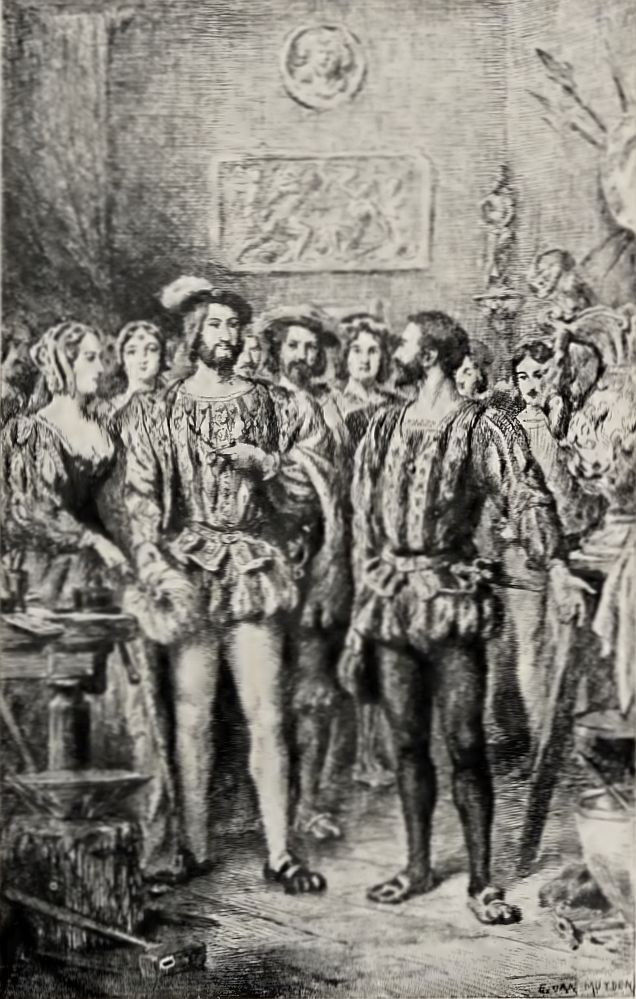
"If it is your will, Sire, I will write to him, and pray that he will give you time to be a great friend to art, since you have proved to him ere this that you are a mighty captain."
"Pray, do you know Charles V.?" inquired the King of Navarre.
"Four years since, Sire, I had the honor, being then at Rome, to present a missal of my making to his sacred Majesty, and make a speech to him which seemed to touch him nearly."
"What said his sacred Majesty to you?"
"He said that he already knew me from having seen upon the Pope's cope, three years before, a carved stud, which did me honor."
"Ah! I see that you are spoiled for royal compliments," said François I.
"Sire, 't is true that I have had the fortune to please many cardinals, grand dukes, princes, and kings."
"Prithee, show me your beautiful designs, that I may see if I shall not be a harder judge to please than others."
"Sire, I have had very little time; however, here are a vase and silver basin which I have commenced, and which are perhaps not too unworthy of your Majesty's attention."
The king examined the two works of art for five minutes without a word. It seemed that the handiwork made him forget the workman. At last, as the ladies gathered curiously about him, he spoke.
"See, mesdames," he cried, "what marvellous workmanship! Observe the hold and novel shape of this vase! What ingenuity and marvellous modelling in the bas-reliefs and bosses, mon Dieu! Especially do I admire the beauty of the lines; and see how true to life and how diverse are the attitudes of the figures! Look at the one holding her arms over her head; the fugitive gesture is so naturally seized that one wonders that she doesn't continue the movement. In very truth, I believe that the ancients never did anything so fine. I remember the best works of antiquity, and those of the most eminent artists of Italy; but nothing ever made so deep an impression upon me as this. O Madame de Navarre, I pray you look at this pretty child lost among the flowers, and waving her little foot in the air; how graceful and pretty and instinct with life it all is!"
"Others have complimented me, great king," cried Benvenuto, "but you understand me!"
"Have you aught else!" asked the king, greedily.
"Here is a medallion representing Leda and her swan, made for Cardinal Gabriel Cesarini; and here a seal cut in intaglio, representing Saint John and Saint Ambrose; this is a reliquary, enamelled by myself—"
"Do you strike medals?" interposed Madame d'Etampes.
"As Cavadone of Milan did, madame."
"And you work in enamel?" said Marguerite.
"Like Amerigo of Florence."
"And you engrave seals?" inquired Catherine.
"Like Lantizco of Perouse. Pray, did you think, madame, that my talent is confined to the production of tiny golden toys and great silver pieces? I can do a little of everything, God be praised! I am a passable military engineer, and I have twice prevented the capture of Rome. I can turn a sonnet prettily, and your Majesty has but to order me to compose a poem, provided that it be in praise of yourself, and I will undertake to execute it neither better nor worse than if my name were Clement Marot. As to music, which my father taught me with a stick, I found the method an admirable one, and I am so good a performer on the flute and cornet that Clement VII. employed me among his musicians at the age of twenty-four. Furthermore, I discovered the secret of compounding an excellent powder, and I can also make beautiful carbines and surgical instruments. If your Majesty is at war, and chooses to employ me as man-at-arms, you will find that I am not to be despised in that capacity, and that I know as well how to handle an arquebus as to sight a culverin. As a hunter I have brought down my twenty-five peacocks in a day, and as an artillerist I have freed the Emperor from the Prince of Orange, and your Majesty from the Connétable de Bourbon: traitors seem not to be fortunate when they encounter me."
"Of which exploit are you the prouder," the young Dauphin interrupted, "of having killed the constable or the twenty-five peacocks?"
"I am proud of neither, monseigneur. Like all other gifts, address is God-given, and I simply used my address."
"By my faith, I was ignorant that you had already rendered me so great a service," said the king,—"a service which, however, my sister Marguerite will be at great pains to pardon you. Was it indeed you who slew the Connétable de Bourbon? Prithee, how came it to pass?"
"Mon Dieu! it was the simplest thing in the world. The constable's army had arrived unexpectedly before Rome, and a vigorous assault upon the fortifications was in progress. I sallied forth, with a few friends, to watch the fighting. As I left my house, I instinctively put my arquebus over my shoulder. When we reached the walls of the city, I saw that there was nothing to be done; but, I said to myself, it shall not be said that I came hither to so little purpose. So I aimed my arquebus toward the point where I saw a numerous and compact group of soldiers, and singled out one who stood a head taller than his companions. He fell, and a great uproar at once arose, caused by the shot I had fired. I had, in truth, slain Bourbon. I learned afterward that it was he who towered above his companions."
While Benvenuto was relating this incident with a most indifferent air, the circle of lords and ladies of which he was the centre spread out somewhat, and they all gazed with respect, and almost with terror, at this unconscious hero. François I. alone remained at his side.
"And so, my dear fellow," he said, "I see that you loaned me your gallantry before consecrating your genius to me."
"Sire," Benvenuto rejoined with a smile, "I believe, in good sooth, that I was born to be your servitor. An incident of my early youth has always seemed to me to admit of no other interpretation. Your crest is a salamander, is it not?"
"Yes, with this device: Nutrisco et extinguo."
"Very well! When I was about five years old, I was sitting one day with my father in a small room where they had been scalding the lye, and where a rousing fire of young oak was still burning. It was very cold. Happening to glance at the fire, I espied a tiny creature like a lizard diverting itself in the spot where the heat was most intense. I pointed it out to my father, and my father—pray pardon me this detail of a somewhat brutal custom of my country—struck me a violent blow, and said to me, with great gentleness, 'I do not strike thee because thou hast done wrong, dear child, but so that thou mayst remember that the little lizard thou hast seen in the fire is a salamander. No human being has ever seen that animal save thou.' Was not that a premonition of fate, Sire? Indeed, I think I was predestined to do as I have done, for at the age of twenty I was about to set out for England, when the sculptor Pietro Torregiano, who was to take me thither, told me that in his youth he one day struck our Michel-Angelo in the face, on the occasion of some studio quarrel. Ah! I abandoned all thought of the journey then; not for a prince's title would I have travelled with one who had raised his hand against my great sculptor. I remained in Italy, and from Italy, instead of going to England, I came to France."
"France, proud of your choice, Benvenuto, will see to it that you do not sigh for your fatherland."
"Oh! my fatherland is art, and my prince he who commands the richest cup at my hands."
"Have you any beautiful work now in contemplation, Cellini?"
"O yes, Sire,—a Christ. Not a Christ upon the Cross, but Christ in His radiance and glory; and I shall copy as closely as possible the infinite beauty of the guise in which he revealed himself to me."
"What!" laughed Marguerite, the sceptic; "in addition to all the kings of earth, have you seen the King of Heaven, too?"
"Yes, madame," replied Benvenuto, with childlike simplicity.
"Oh! pray tell us of that," said the Queen of Navarre.
"Willingly, madame," said Benvenuto, with a confident air, which implied that it did not occur to him that any one could doubt any part of his story.
"Some time before," he continued, "I had seen Satan and all his legions, whom a necromancing friend of mine, a priest, evoked for me at the Coliseum. Indeed, we had much ado to rid ourselves of them. But the dread souvenir of those infernal apparitions was forever banished from my mind when, in answer to my fervent prayer, the blessed Saviour of mankind appeared to me, in a flood of sunlight, crowned with glory, and brought sweet consolation to me in the misery of my captivity."
"And are you sure beyond a peradventure," demanded the Queen of Navarre, "so sure that you have no shadow of doubt, that Christ really appeared to you?"
"I have no doubt of it, madame."
"In that case, Benvenuto, go on and fashion a Christ for our chapel," said François I., with his usual good humor.
"Sire, if your Majesty will so far indulge me, I pray you to order something different, and allow me to postpone the execution of that work."
"Why so?"
"Because I promised God to undertake it for no other sovereign than Him."
"À la bonne heure! Be it so! Benvenuto, I need twelve candlesticks for my table."
"Ah! that is a different matter; and therein, Sire, you shall be obeyed."
"It is my wish that they should take the form' of twelve silver statues."
"The effect will be magnificent, Sire."
"They must represent six gods and six goddesses, and be of my own height."
"Why, your order is for a whole epic poem," said the Duchesse d'Etampes; "for a work of marvellous, surprising splendor, is it not, Monsieur Benvenuto?"
"I am never surprised, madame."
"I should be greatly surprised, my self," retorted the duchess, somewhat piqued, "if other sculptors than those of the olden time could carry such a task to completion."
"I hope, nevertheless, to execute it as satisfactorily as they could have done," rejoined Benvenuto, coolly.
"Oho! are you not inclined to boast a little, Monsieur Benvenuto?"
"I never boast, madame."
As he made this reply with perfect calmness, Cellini looked at Madame d'Etampes, and the haughty duchess lowered her eyes, in spite of herself, under that firm, assured glance, in which there was no trace of irritation. Her resentment was aroused by the consciousness of his superiority, to which she yielded even while resisting it, and without knowing in what it consisted. She had thought hitherto that beauty was the greatest power in the world; she had forgotten genius.
"What treasure," said she, with a bitter sneer, "would suffice to recompense such talent as yours?"
"None that I can command, i' faith," rejoined François I., "and apropos, Benvenuto, I remember that you have as yet received but five hundred crowns. Will you be content with the stipend which I allowed my painter, Leonardo da Vinci, seven hundred gold crowns yearly? I will pay over and above that for all works which you may execute for me."
"Sire, your offer is worthy such a king as François I., and—I venture to say it—of such an artist as Cellini. And yet I shall make so bold as to prefer a request to your Majesty."
"It is granted in advance, Benvenuto."
"Sire, I am but ill and narrowly accommodated in this edifice. One of my pupils has discovered a location much more favorably situated than this for the execution of such great works as my king may choose to command. The property in question belongs to your Majesty; it is the Grand-Nesle. It is at the disposal of the Provost of Paris, but he does not dwell therein; he occupies only the Petit-Nesle, which I will gladly leave in his possession."
"So be it, Benvenuto," said François; "take up your abode at the Grand-Nesle, and I shall have only to cross the river to talk with you and admire your masterpieces."
"Consider, Sire," interposed Madame d'Etampes, "that you thereby, for no motive, deprive a nobleman, and one devoted to my service, of property appertaining to his office."
Benvenuto glanced at her, and for the second time Anne lowered her eyes beneath that steady, piercing gaze. Cellini rejoined, with the same naïve good faith with which he had described the supernatural apparitions:—
"I, too, am of noble birth, madame; my family descends from a gallant officer, who held high rank under Julius Cæsar,—one Fiorino, of Cellino, near Montefiascone,—and who gave his name to Florence; while your provost and his ancestors, if my memory serves me, have never given their name to anything. However," continued Benvenuto, turning to François, and changing his expression and his tone, "it may be that I have made too hold it may be that I shall incur the hatred of powerful and influential persons, who, despite your Majesty's protection, may prove too strong for me at last. The Provost of Paris is said to have something very like an army at his orders."
"I have been told," the king interrupted, "that on a certain day, at Rome, one Cellini, a goldsmith, retained, in default of payment therefor, a silver vase ordered by Monsieur Farnese, then cardinal, and to-day Pope."
"It is true, Sire."
"Furthermore, that the cardinal's whole household stormed the goldsmith's studio, sword in hand, with the design of carrying away the vase by force."
"That, too, is true."
"But this Cellini, in ambush behind the door, armed with his carbine, did defend himself so valorously that he put Monseigneur le Cardinal's people to flight; and was paid by the cardinal on the following day."
"All that, Sire, is strictly true."
"Very good! are not you the Cellini in question?"
"Yes, Sire; let your Majesty but continue to bestow your favor upon me and nothing has any power to terrify me."
"In that case, go straight before you," said the king, smiling in his beard; "go where you will, since you are of noble blood."
Madame d'Etampes said no more, but she registered a mental vow of deadly hatred to Cellini from that moment,—the hatred of an offended woman.
"One last favor, Sire," said Cellini. "I cannot present all my workmen to you; they are ten in number, some French, some German, all worthy, talented comrades. But here are my two pupils whom I brought from Italy with me, Pagolo and Ascanio. Come forward, Pagolo, and raise your head and your eyes a little; not impertinently, but like an honest man who has no evil action to blush for. This good fellow lacks inventive genius perhaps, Sire, and is slightly lacking in earnestness, too; but he is a careful, conscientious artist, who works slowly, but well, who comprehends my ideas perfectly, and executes them faithfully. And this is Ascanio, my noble-hearted, amiable pupil, and my beloved child. It is doubtless true that he has not the vigorous creative faculty which will represent in a bas-relief the serried ranks of two hostile armies meeting in deadly encounter, and tearing each other to pieces, or lions and tigers clinging with claws and teeth to the edge of a vase. Nor has he the original fancy which invents horrible chimeras and impossible dragons. No; but his soul, which resembles his body, has the instinct of a divine ideal, so to speak. Ask him to design an angel, or a group of nymphs, and no one can equal the exquisite poesy and grace of his work. With Pagolo I have four arms, with Ascanio I have two souls; and then he loves me, and I am very happy to have always by my side a pure and devoted heart like his."
While his master was speaking, Ascanio stood near him, modestly, but without embarrassment, in an attitude of unstudied grace, and Madame d'Etampes could not remove her eyes from the fascinating young Italian, black-eyed and black-haired, who seemed a living copy of Apollino.
"If Ascanio," said she, "understands grace and beauty so well, and if he cares to come some morning to the Hôtel d'Etampes, I will furnish him with precious stones and gold, with which he may cause some marvellous flower to bloom for me."
Ascanio bowed and thanked her with a glance.
"And I," said the king, "grant to him, as well as to Pagolo, a yearly pension of one hundred crowns."
"I undertake to make them earn their pension, Sire," said Benvenuto.
"But who is the lovely child with the long eyelashes, hiding yonder in the corner?" said François, spying Scozzone for the first time.
"Oh, pay no attention to her, Sire," replied Benvenuto, with a frown; "she is the only one of the beautiful things in this studio whom I like not to have noticed."
"Aha! you are jealous, my Benvenuto."
"Mon Dieu! Sire, I like not that any hand should be laid upon my property; to compare small things with great, it is as if some other should dare to think of Madame d'Etampes; you would be furious, Sire. Scozzone is my duchess."
The duchess, who was gazing at Ascanio, bit her lips at this unceremonious interruption. Many courtiers smiled in spite of themselves, and all the ladies giggled. As for the king, he laughed outright.
"Foi de gentilhomme! your jealousy is within its right, Benvenuto, and an artist and a king may well understand each other. Adieu, my friend: I commend my statues to your attention. You will commence with Jupiter, naturally, and when you have finished the model you will show it to me. Adieu, and good luck! We will meet at the Hôtel de Nesle."
"To bid me show you the model is a simple matter, Sire; but how shall I gain entrance to the Louvre?"
"Your name will be given at the gates, with orders to introduce you to my presence."
Cellini bowed, and with Pagolo and Ascanio, escorted the king and court to the street. At the door he knelt and kissed the king's hand.
"Sire," he said with deep feeling, "you have heretofore saved me from captivity, perhaps from death, through the intervention of Monseigneur de Montluc; you have overwhelmed me with wealth, you have honored my poor studio with your presence; but far more than all this, Sire, is the fact, and I know not how to thank you that it is so, that you so magnificently anticipate all my dreams. We ordinarily work only for a chosen few scattered through the centuries, but I shall have, had the signal honor of finding a living judge, always present, always enlightened. Until now I have been only the workman of the future; permit me henceforth to call myself your Majesty's goldsmith."
"My workman, my goldsmith, my artist, and my friend, Benvenuto, if the last title seems to you no more deserving of contempt than the others. Adieu, or rather, au revoir."
It is needless to say that all the princes and nobles followed the example set by the king, and loaded Cellini with flattery and offers of friendship.
When all were gone, and Benvenuto was left alone in the courtyard with his pupils, they thanked him, Ascanio effusively, Pagolo with something very like constraint.
"Nay, do not thank me, my children, it's not worth while. But look you, if you do in truth consider yourselves under any obligation to me, I wish, since this subject of conversation was introduced to-day, to ask a service at your hands; it relates to something which I have very much at heart. You heard what I said to the king apropos of Catherine, and what I said to him truly expressed the deepest feeling of my heart. The child is necessary to my life, my friends; to my life as an artist, because, as you know, her services as a model are offered so freely and joyously; to my life as a man, because I think that she loves me. I pray you, therefore, although she is beautiful, and although you are young, as she also is, do not let your thoughts rest upon Catherine; there are enough other lovely girls in the world. Do not tear my heart, do not insult my affection by casting bold glances upon my Scozzone; nay, rather watch over her in my absence, and advise her as if you were her brothers. I conjure you, observe my wishes herein, for I know myself and my feeling in this matter, and I swear before God, that if I should discover aught amiss, I would kill her and her accomplice."
"Master," said Ascanio, "I respect you as my master, and I love you as my father; have no fear."
"Blessed Jesus!" cried Pagolo, clasping his hands, "may God preserve me from thinking of such an infamous action! Do I not know that I owe everything to you, and would it not be a crime thus to abuse your sacred confidence in me, and to repay your benefactions by such dastardly treachery?"
"Thanks, my friends," said Benvenuto, pressing their hands. "I have perfect faith in you, and I am content. Now, Pagolo, return to your work, for I have promised the seal at which you are working to M. de Villeroi for to-morrow; while Ascanio and myself pay a visit to the estate which our gracious king has bestowed upon us, and of which we will take possession on Sunday next, peaceably or by force."
Then he turned to Ascanio.
"Come, Ascanio," said he, "let us go and see if this Nesle habitation, which seemed to you so eligible in its external aspect, has internal appointments corresponding to its reputation."
Before Ascanio had time to offer any observation, Benvenuto, with a parting glance over the studio to see if every workman was in his place, and a light tap upon Scozzone's plump, rosy cheek, passed his arm through his pupil's, drew him toward the door, and went out with him.
VI TO WHAT USE A DUENNA MAY BE PUT
They had taken hardly ten steps in the street, when they met a man of some fifty years, rather short of stature, but with a handsome, mobile countenance.
"I was about to call upon you, Benvenuto," said the new arrival, whom Ascanio saluted with respect, mingled with veneration, and whose hand Benvenuto cordially grasped.
"Is your business of importance, my dear Francesco?" said the goldsmith. "In that case, I will return with you; or was it for no other purpose than a friendly call? In that case, come with us."
"It was to proffer you some friendly advice, Benvenuto."
"I will gladly listen. Advice is always a good thing to receive when it is proffered by a friend."
"But that which I have to give you is for no other ear than yours."
"This youth is another myself, Francesco; say on."
"I would already have done so, had I thought that I ought to do it," replied Benvenuto's friend.
"Pardon, master," said Ascanio, discreetly moving apart.
"Very well; go alone whither I purposed going with you, dear boy," said Benvenuto; "as you know, when you have seen a thing it is as if I had myself seen it. Look most carefully into every detail: see if the studio will have a good light, if the courtyard will be a convenient place for a furnace, and if it will be possible to separate our workshop from that of the other apprentices. Do not forget the tennis-court."
With that Benvenuto passed his arm through the stranger's, waved his hand to Ascanio, and returned to the studio, leaving the young man standing in the middle of Rue Saint-Martin.
In very truth there was in the commission intrusted to him by his master more than enough to embarrass Ascanio. His embarrassment was by no means slight, even when Benvenuto proposed that they should make the visit of inspection in company. Judge, then, what it became when he found himself confronted with the prospect of making it all alone. He had watched Colombe two Sundays without daring to follow her, had followed her on the third without daring to accost her, and now he was to present himself at her home; and for what purpose? To examine the Hôtel de Nesle, which Benvenuto proposed, by way of pastime, to take from Colombe's father on the following Sunday, willy-nilly.
It was a false position for anybody; it was terrible for a lover.
Fortunately it was a long distance from Rue Saint-Martin to the Hôtel de Nesle. Had it been only a step or two, Ascanio would not have taken them; but it was a half-league, so he started.
Nothing so familiarizes one with danger as to be separated from it by a considerable time or distance. To all strong minds and happy dispositions, reflection is a powerful auxiliary. Ascanio belonged to the latter class. In those days it was not fashionable to be disgusted with life before one had fairly entered upon it. All the impulses were ingenuous and ingenuously expressed,—joy by laughter, sorrow by tears. Affectation was a thing almost unknown, in life as in art, and a comely youth of twenty was in no wise ashamed in those days to confess that he was happy.
But in all Ascanio's embarrassment there was a certain amount of joy. He had not expected to see Colombe again until the following Sunday, and he was to see her that very day. Thus he had gained six days, and six days of waiting are, as everybody knows, six centuries according to a lover's reckoning.
And so, as he approached his destination, the affair became more simple in his eyes. He it was, to be sure, who had advised Benvenuto to ask the king for the Hôtel de Nesle for his studio, but could Colombe take it ill of him that he had desired to be near her? This installation of the Florentine goldsmith in the old palace of Amaury could not, it was true, be carried out without interference with Colombe's father, who looked upon it as his own; but would any real injury be inflicted upon Messire Robert d'Estourville when he did not occupy it? Moreover, there were a thousand ways in which Benvenuto could pay for his occupancy;—a chased cup for the provost, a necklace for his daughter (and Ascanio would undertake to make the necklace), might, and undoubtedly would, in that artistic age, make the rough places smooth. Ascanio had seen grand dukes, kings, and popes ready to give their coronets, sceptres, or tiaras as the price of one of the marvellous examples of his master's art. After all, then, supposing that matters should take that course, Messire Robert would eventually be in Master Benvenuto's debt; for Master Benvenuto was so generous that, if Messire Robert showed a disposition to be courteous and compliant, Ascanio was certain that he, Master Benvenuto, would deal right royally with him.
By the time he reached the end of Rue Saint-Martin, Ascanio looked upon himself as a messenger of peace, chosen by the Lord to maintain harmonious relations between two powers.
And yet, notwithstanding that conviction, Ascanio was not sorry—surely lovers are strange creatures—to lengthen his journey by ten minutes, and instead of crossing the Seine by boat, he walked the whole length of the quays, and crossed by the Pont aux Moulins. It may be that he chose that road because it was the same he had taken the evening before when following Colombe.
Whatever his motive for making the detour, he finally found himself in front of the Hôtel de Nesle in about twenty minutes.
But when he saw the little ogive door that he must pass through, when he saw the turrets of the lovely little Gothic palace boldly raising their heads above the wall, when he thought that behind those jalousies, half closed because of the heat, was his beautiful Colombe, the whole card-house of happy dreams which he had built on the road vanished like the structures one sees in the clouds, and which the wind overturns with one blow of its wing; he found himself face to face with reality, and reality did not seem to him the most reassuring thing in the world.
However, after a few moments of hesitation—hesitation which is the harder to understand, in that he was absolutely alone upon the quay in the intense heat—he realized that he must make up his mind to do something. As there was nothing for him to do but find his way into the hotel, he walked to the door and raised the knocker. But God only knows when he would have let it fall, had not the door chanced to open at that moment, bringing him face to face with a sort of Master Jacques, a man about thirty years of age, half servant, half peasant. It was Messire Robert d'Estourville's gardener.
Ascanio and the gardener mutually recoiled a step.
"What do you want?" said the gardener; "whom do you seek?"
Ascanio, thus compelled to go forward with his mission, summoned all his courage, and replied bravely:—
"I desire to inspect the hotel."
"To inspect the hotel!" cried the gardener in amazement; "in whose name?"
"In the king's name!" Ascanio replied.
"In the king's name!" cried the gardener. "Jesus-Dieu! does the king intend to take it from us?"
"Perhaps so!"
"But what does it mean?"
"Pray understand, my friend," said Ascanio, with a self-possession upon which he mentally congratulated himself, "that I have no explanation to give you."
"True. With whom do you desire to speak?"
"Is Monsieur le Prévôt within?" inquired Ascanio, knowing perfectly well that he was not.
"No, Monsieur; he is at the Châtelet."
"Indeed! Who takes his place in his absence?"
"His daughter is here; Mademoiselle Colombe."
Ascanio felt that he was blushing to his ears.
"And there is Dame Perrine, too," the gardener continued. "Does Monsieur desire to speak with Dame Perrine or with Mademoiselle Colombe?"
This was a very simple question, surely, and yet it caused a terrible conflict in Ascanio's mind. He opened his mouth to say that he wished to see Mademoiselle Colombe, and yet it was as if the audacious words refused to pass his lips, and he asked for Dame Perrine. The gardener, who had no suspicion that his question, which seemed so simple to him, had caused such a disturbance, bowed in token of obedience, and went across the courtyard toward the door of the Petit-Nesle. Ascanio followed him.
He had to cross a second courtyard, pass through a second door, then cross a small flower garden, ascend a flight of steps, and traverse a long gallery. At the end of the gallery the gardener opened the door and said:—
"Dame Perrine, here is a young gentleman, who asks to inspect the hotel, in the king's name."
With that he stood aside and made room for Ascanio, who took his place in the doorway.
As he glanced into the room, a cloud passed before his eyes, and he leaned against the door frame for support. A very simple, and yet entirely unforeseen thing had happened; Dame Perrine was with Colombe, and he found himself in the presence of both.
Dame Perrine was sitting at the spinning-wheel, spinning. Colombe was at work at her embroidery frame. They raised their heads at the same instant and looked toward the door.
Colombe instantly recognized Ascanio. She expected him, although her reason told her that he was not likely to come. As for him, when he saw the maiden's eyes raised to his face, although their expression was infinitely soft and sweet, it seemed to him that he was dying.
The fact is, that he had anticipated a thousand difficulties, had dreamed of a thousand obstacles to be surmounted before he could win his way to his beloved. Those obstacles would have aroused all his energy and strengthened his resolution; and lo! everything came about as naturally and simply as if God, touched by the purity of his passion, had smiled upon it and blessed it from the first. He found himself in her presence when he was least expecting it, and of all the beautiful speech he had prepared, the fervent eloquence of which was to amaze and move her, he could not recall a phrase, a word, a syllable.
Colombe, for her part, sat motionless and dumb. The two pure-souled young creatures, who, as if they had been already joined in wedlock in heaven, felt that they belonged to one another, and who, when once their lives had brought them close together, would thenceforth form, like Salmacis and Hermaphrodite, but one existence, were terrified at their first meeting, trembled, hesitated, and stood face to face unable to find words.
Dame Perrine, half rising from her chair, and preparing to put aside her spinning, was the first to break the silence.
"What did that blockhead Raimbault say?" cried the worthy duenna. "Did you hear, Colombe?" As Colombe did not reply, she continued, walking toward Ascanio: "What is your pleasure here, my young master? Why, God forgive me!" she suddenly exclaimed, as she recognized the visitor, "it's the gallant youth who so politely handed me the holy water at the church door these last three Sundays! What is your pleasure, my handsome friend?"
"I would be glad to speak with you," faltered Ascanio.
"With me alone?" queried Dame Perrine coquettishly.
"With you—alone—"
As he made this reply Ascanio told himself that he was a consummate ass.
"Come this way, then, young man," said Dame Perrine, opening a door at the side of the room, and signing to Ascanio to follow her.
Ascanio did as she bade him, but as he left the room he cast upon Colombe one of those long, eloquent glances wherein lovers can say so much, and which, however unintelligible they may be to indifferent observers, are always understood at last by the person to whom they are addressed. Colombe undoubtedly lost no portion of its meaning, for her eyes, how she knew not, having met the youth's, she blushed prodigiously, and when she felt that she was blushing, she cast her eyes down upon her embroidery, and began to mangle a poor inoffensive flower. Ascanio saw the blush, and, stopping abruptly, stepped toward Colombe; but at that moment Dame Perrine turned and called him, and he was compelled to follow her.
He had no sooner crossed the threshold of the door than Colombe dropped her needle, let her arms fall beside her chair, threw back her head, and breathed a long sigh, in which were mingled, by one of those inexplicable miracles which the heart alone can perform, regret at Ascanio's departure, and a sort of relief to feel that he was no longer there.
The young man was very perceptibly in a bad humor; with Benvenuto, who had given him such a strange commission to fulfil; with himself, for his inability to take advantage of his opportunity; but most of all with Dame Perrine, who was cruel enough to make him leave the room just when Colombe's eyes seemed to bid him remain.
So it was that, when the duenna inquired as to the purpose of his visit, Ascanio replied in a most deliberate manner, determined to be revenged upon her for his own bungling:—
"The purpose of my visit, my dear Madame, is to beg you to show me the Hôtel de Nesle from one end to the other."
"Show you the Hôtel de Nesle!" cried Dame Perrine; "why, in Heaven's name, do you desire to see it?"
"To see if it will be convenient for us, if we shall be comfortable here, and if it is worth while for us to leave our present quarters to come and live here."
"What! come and live here! Pray have you hired the hotel of Monsieur le Prévôt?"
"No, but his Majesty gives it to us."
"His Majesty gives it to you!" exclaimed Dame Perrine, more and more amazed.
"Absolutely," replied Ascanio.
"To you?"
"Not precisely, my good woman, but to my master."
"And who is your master, if I may ask, young man? Some great foreign nobleman, no doubt?"
"Better than that, Dame Perrine,—a great artist, come hither from Florence, expressly to serve his Most Christian Majesty."
"Aha!" said the good woman, who did not understand very well; "what does your master make?"
"What does he make? Why, he makes everything: rings to put on maidens' fingers; ewers to put upon kings' tables; statues to place in the temples of the gods; and in his leisure moments he besieges or defends cities, as his caprice leads him to cause an emperor to tremble, or to reassure a pope."
"Jésus Dieu!" cried Dame Perrine: "what is your master's name?"
"His name is Benvenuto Cellini."
"It's strange that I don't know that name," muttered the duenna; "what is his profession?"
"He is a goldsmith."
Dame Perrine gazed wonderingly at Ascanio.
"A goldsmith!" she muttered, "a goldsmith! And do you fancy that Monsieur le Prévôt will give up his palace like this to a—goldsmith?"
"If he doesn't give it up, we will take it."
"By force?"
"Even so."
"But your master will hardly dare to contend against Monsieur le Prévôt, I trust."
"He has contended against three dukes and two popes."
"Jésus Dieu! Two popes! He's not a heretic surely?"
"He is as good a Catholic as you and I, Dame Perrine: have no fear on that score; Satan is in no wise our ally. But in default of the devil, we have the king on our side."
"So! but Monsieur le Prévôt has a more powerful protector than the king."
"Whom has he, pray?"
"Madame d'Etampes."
"Then we are on equal terms," said Ascanio.
"But suppose Messire d'Estourville refuses?"
"Master Benvenuto will take."
"And suppose Messire d'Estourville shuts himself up here as in a citadel?"
"Master Cellini will lay siege to it."
"Consider that the provost has twenty-four sergeants-at-arms."
"Master Benvenuto Cellini has ten apprentices: still we are on equal terms, you see, Dame Perrine."
"But Messire d'Estourville is personally a sturdy fighter. At the tournament which took place at the time of the marriage of François I., he was one of the challengers, and all those who dared measure swords with him were unhorsed."
"Ah well! Dame Perrine, then he is just the man for Benvenuto, who has never met his match, and who, like Messire d'Estourville, always unhorses his adversaries. But there is this difference between them: a fortnight afterward, they who have encountered your provost are on their legs again in good health and spirits, while they who have my master to deal with never raise their heads again, and three days after are dead and buried."
"Evil will come of this! evil will come of this!" muttered Dame Perrine. "Young man, they say that fearful things are done in cities taken by assault."
"Have no fear on that head, Dame Perrine," rejoined Ascanio with a smile. "You will have to do with generous conquerors."
"What I mean, my dear child," said Dame Perrine, who was not sorry perhaps, to secure a friend among the besiegers, "is that I fear there may be bloodshed; for, so far as your proximity to us is concerned, you will understand that it cannot fail to be very agreeable to us, since society is somewhat scanty in this accursed desert to which Messire d'Estourville has consigned his daughter and myself, like two wretched nuns, although neither she nor I have taken the vows, thank God! It isn't good for man to be alone, so saith Holy Writ, and when Holy Writ mentions man, woman is included. Is not that your opinion, young man?"
"That goes without saying."
"And we are entirely alone, and therefore very doleful in this vast habitation."
"Why, do you receive no visitors here?" Ascanio asked.
"Jésus Dieu! it's worse than if we were nuns, as I told you. Nuns have parents at least, and friends who come and talk to them through the grating. They have the refectory where they can assemble and talk together. It's not very diverting, I know, but it's something nevertheless. But we have only Messire le Prévôt, who comes from time to time to lecture his daughter for growing too lovely, I think,—it's her only crime, poor child,—and to scold me because I don't watch her closely enough,—God save the mark! when she doesn't see a living soul in the world except myself, and, aside from what she says to me, doesn't open her mouth except to pray. I beg you, therefore, young man, not to say to any one that you have been admitted here, that you have inspected the Grand-Nesle under my guidance, or that you talked with us for an instant at the Petit-Nesle."
"What!" cried Ascanio, "after our visit to the Grand-Nesle, I am to return with you to the Petit? In that case I shall—" He checked himself, realizing that his joy was carrying him too far.
"I think it would not be courteous, young man, after presenting yourself, as you did, to Mademoiselle Colombe, who is the mistress of the house in her father's absence, and after asking to speak with me alone,—I do not think it would be courteous, I say, to leave the Hôtel de Nesle without taking leave of her. But if you prefer not to do so, you are quite at liberty, as you know, to go into the street directly from the Grand-Nesle, which has its own exit."
"No, no, no indeed!" cried Ascanio, eagerly. "Peste! I flatter myself, Dame Perrine, that I have been as well brought up as anybody on earth, and that I know what good breeding requires in one's treatment of ladies. But, let us do what we have to do, Dame Perrine, without a moment's delay, for I am in very great haste."
Indeed, now that Ascanio knew that he was to return by way of the Petit-Nesle he was in a great hurry to be done with the Grand. And as Dame Perrine was terribly afraid of being surprised by the provost when she least expected it, she had no inclination to delay Ascanio! so she took down a bunch of keys from behind a door, and walked on before him.
Let us, in company with Ascanio, east a hasty glance at this Hôtel de Nesle, where the principal scenes of our narrative will be laid.
The Hôtel, or rather the Séjour de Nesle, as it was more commonly called at that time, occupied, as our readers already know, the site on the left bank of the Seine, on which the Hôtel de Nevers was subsequently built, to be in its turn succeeded by the Mint and the Institute. It was the last building in Paris toward the southwest, and beyond its walls nothing could be seen save the city moat, and the verdant lawns of the Pré-aux-Clercs. It was built by Amaury, Lord of Nesle in Picardie, toward the close of the eighth century. Philippe le Bel bought it in 1308 and made it his royal residence. In 1520 the Tour de Nesle, of bloody and licentious memory, was separated from it, when the quay, the bridge over the moat, and the Porte de Nesle were constructed, and thenceforth the grim tower stood alone upon the river bank, like a sinner doing penance.
But the Séjour de Nesle luckily was so vast that the lopping off of part of it was not noticed. It was as large as a small village; a high wall, pierced by a broad ogive door and a smaller servants' door, protected it on the side of the quay. On entering you found yourself at first in an immense courtyard surrounded by walls; there was a door in the wall at the left, and one at the back. Passing through the door at the left, as Ascanio did, you came to a charming little building in the Gothic style of the fourteenth century; it was the Petit-Nesle, which had its own separate garden. If, on the other hand, you passed through the door in the rear wall, you saw at your right the Grand-Nesle,—all of stone, and flanked by two turrets,—with its high peaked roofs, surrounded by balustrades, its angular façade, its high windows with glass of many colors, and its twenty weather-vanes crying in the wind; there was room enough to provide accommodation for three bankers of to-day.
If you went on, you lost yourself in all sorts of gardens, and you found among them a tennis-court, a bowling-green, a foundry, and an arsenal; and still farther on the stable-yards, stables, cattle-sheds, and sheepfolds; there was accommodation for the establishments of three farmers of to-day.
The whole property, it should be said, was sadly neglected, and consequently in very bad condition, for Raimbault and his two assistants hardly sufficed to take proper care of the garden belonging to the Petit-Nesle, where Colombe raised flowers, and Dame Perrine vegetables. But the whole was of vast extent, well lighted, and substantially built, and with a slight outlay of trouble and money, it could be made the finest workshop in the world.
Even if the place had been infinitely less suitable, Ascanio would have been none the less enchanted with it, as his principal desire was to be brought near to Colombe.
His visit to the larger building was made very short: in less time than it takes to write it, the active youth saw everything that there was to see, and formed an opinion upon everything that he saw. Dame Perrine, finding it impossible to keep pace with him, good-naturedly handed him the keys, which he faithfully restored to her when his investigation was at an end.
"Now, Dame Perrine," said he, "I am at your service."
"Very good: let us return for a moment to the Petit-Nesle, as you agree with me that it is the proper thing to do."
"I should say as much! It would be extremely discourteous to do otherwise."
"But not a word to Colombe of the object of your visit."
"Mon Dieu! what shall I say to her, then?" cried Ascanio.
"You're easily embarrassed, my handsome lad. Did you not tell me that you are a goldsmith?"
"Indeed, yes."
"Very well, talk to her about jewels; that is a subject that always gladdens the heart of the most virtuous maiden. She is or is not a true daughter of Eve, and if she is a true daughter of Eve she loves anything that glitters. Besides, she has so little diversion in her solitude, poor child! that it would be a blessing to entertain her a little. To be sure, the most suitable entertainment for a girl of her age would be a good marriage; and Master Robert never comes hither that I do not whisper in his ear, 'Find a husband for the poor dear; pray find a husband for her.'"
Without stopping to consider what conjectures as to the relations between herself and the provost might be set on foot by this declaration of her familiar manner of addressing him, Dame Perrine led the way back to the Petit-Nesle and to the room where they had left Colombe.
Colombe was still absorbed in thought, and in the same attitude in which we left her. But no one knows how many times she had raised her head and fixed her eyes upon the door through which the comely youth had gone from her sight; any one who had observed these oft-repeated glances might have thought that she was expecting him. But as she saw the door turning upon its hinges, Colombe went about her work once more so earnestly that neither Dame Perrine nor Ascanio could suspect that it had been interrupted.
How she had divined that the young man was following the duenna is something that might have been explained by magnetism, if magnetism had then been invented.
"I bring back with me our donor of holy water, my dear Colombe, for he it is, as I thought. I was about to show him out by the door of the Grand-Nesle, when he reminded me that he had not taken leave of you. It was true enough, for you didn't say one little word to each other before. However, neither of you is dumb, God be praised!"
"Dame Perrine—" faltered Colombe, greatly embarrassed.
"Well! what is it? You must not blush like that. Monsieur Ascanio is an honorable young man, as you are a virtuous young woman. Furthermore, it seems that he is an artist in jewels, precious stones, and such gewgaws as suit the fancy of most pretty girls. He will come and show them to you, my child, if you wish."
"I need nothing," murmured Colombe.
"Possibly not at this moment; but it is to be hoped that you will not die a recluse in this accursed solitude. We are but sixteen years old, Colombe, and the day will come when we shall be a lovely fiancée, to whom all sorts of jewels will be presented, and after that a great lady, who must have all sorts of finery. When that time comes, it will be as well to give the preference to this youth's as to those of some other artist, who surely will not be comparable to him."
Colombe was on the rack. Ascanio, to whom Dame Perrine's forecasts of the future were but moderately pleasing, noticed her suffering, and came to the rescue of the poor child, to whom direct conversation was a thousand times less embarrassing than this monologue by a self-constituted interpreter.
"Oh! mademoiselle," said he, "do not deny me the great privilege of bringing some of my handiwork to you; it seems to me now as if I made them for you, and as if when making them I was thinking of you. Oh! believe it, I pray you, for we artists in jewels sometimes mingle our own thoughts with the gold and silver and precious stones. In the diadems with which your heads are crowned, the bracelets which encircle your white arms, the necklaces which rest so lovingly upon your shoulders, in the flowers, the birds, the angels, the chimeras, which we make to tremble at your ears, we sometimes embody our respectful adoration."
It is our duty as an historian to state that at these soft words Colombe's heart dilated, for Ascanio, mute so long, was speaking at last, and speaking as she had dreamed that he would speak; for without raising her eyes the girl could feel his burning glance fixed upon her, and there was nothing, even to the unfamiliar tone of his voice, which did not impart a singular charm to these words which sounded so strangely in Colombe's ears, and a profound and irresistible meaning to the flowing, harmonious language of love, which maidens understand before they can speak it.
"I know," Ascanio continued, with his eyes still fixed upon Colombe, "I know that we can add nothing to your beauty. God is made none the richer by decking out his altar. But we can at least surround your graceful form with those things which are attractive and beautiful like itself; and when we poor, humble artificers of splendor and enchantment from the depths of our obscurity see you pass by in a blaze of glory, we console ourselves for being so far below you by the thought that our art has helped to raise you to the height whereon you stand."
"O Monsieur!" replied Colombe, covered with confusion, "your lovely things will probably be always unfamiliar to me, or at least useless. I live in solitude and obscurity, and so far is it from being the case that the solitude and obscurity are oppressive to me, that I confess that I love them, I confess that I would like to live here always, and yet I also confess that I would like well to see your jewels, not for myself but for them,—not to wear them, but to admire them."
Trembling with fear lest she had said too much, and perhaps with a longing to say even more, Colombe bowed and left the room so swiftly, that to the eyes of a man more knowing in such matters her exit would have worn the aspect of a flight.
"Well, well!" exclaimed Dame Perrine; "that's not a long way from something like coquetry. There is no doubt, young man, that you talk like a book. Yes, yes, one can but believe that you Italians have secret means of fascinating people. No stronger proof is needed than this,—that you have enlisted me on your side at once, and 'pon honor, I find myself wishing that Messire le Prévôt will not deal too hardly with you. Au revoir, young man, and bid your master be on his guard. Warn him that Messire d'Estourville is as hard of heart as the devil, and wields great influence at court. For which reason, if your master will take my advice, he will abandon all thought of living at the Grand-Nesle, and especially of taking forcible possession of it. As for you—but we shall see you again, shall we not? Above all, do not believe Colombe; the property of her deceased mother is sufficient to enable her to indulge in baubles twenty times more costly than those you offer her. And look you, bring also some less elaborate articles; it may occur to her to make me a little present. I am not yet, thank God! so old that I need decline a little flirtation. You understand, do you not?"
Deeming it necessary, the better to make her meaning clear, to enforce her words with a gesture, she laid her hand upon the young man's arm. Ascanio jumped like one suddenly awakened from a sound sleep. Indeed, it seemed to him as if it were all a dream. He could not realize that he was under Colombe's roof, and he doubted whether the white apparition whose melodious voice was still whispering in his ear, whose slender form had just vanished from his sight, was really she for one glance from whose eyes he would have given his life that morning.
Overflowing with his present happiness and his future prospects, he promised Dame Perrine whatever she wished, without even listening to what she asked him to do. What mattered it to him? Was he not ready to give all that he possessed to see Colombe once more?
Thinking that to prolong his visit would be unbecoming, he took leave of Dame Perrine, promising to return the next day.
As he left the Petit-Nesle, Ascanio almost collided with two men who were about to enter. By the way in which one of them stared at him, even more than by his costume, he felt sure that it was the provost.
His suspicion was changed to certainty when he saw them knock at the same door by which he had just come out, and he regretted that he had not sooner taken his leave; for who could say that his imprudence would not be visited upon Colombe?
To negative the idea that his visit was of any importance, assuming that the provost noticed it, Ascanio walked away without once turning to look back toward the only corner of the world of which he would at that moment have cared to be king.
When he returned to the studio, he found Benvenuto absorbed in thought. The man who stopped them in the street was Primaticcio, and he was on his way, like the honorable confrère he was, to inform Cellini that, during the visit François I. paid him that morning, the imprudent artist had succeeded in making a mortal enemy of Madame la Duchesse d'Etampes.
VII A LOVER AND A FRIEND
One of the two men who entered the Hôtel de Nesle as Ascanio emerged therefrom was indeed Messire Robert d'Estourville, Provost of Paris. Who the other was we shall learn in a moment.
Five minutes after Ascanio's departure, while Colombe was still listening and dreaming in her bedroom, whither she had fled, Dame Perrine hurriedly entered, and informed the young woman that her father was awaiting her in the adjoining room.
"My father!" cried Colombe in alarm. "Mon Dieu! mon Dieu!" she added in an undertone, "can it be that he met him?"
"Yes, your father, my dear child," rejoined Dame Perrine, replying to the only portion of the sentence that she heard, "and with him another old man whom I do not know."