Volume 11 — Volume XI. (continued 2)
Reading edition
"For her part, it is certain, that she was as full of indulgence and kindly feeling for me as she was cold and dignified with my slothful comrades. She sometimes came to sit in the studio beside her father, and I would sometimes feel her eyes fixed on my face as she bent over my work. I was proud and happy in her preference, although I did not explain my feeling to myself. If one of my comrades indulged in a little vulgar flattery, and informed me that my master's daughter was in love with me, I received his insolence so wrathfully that he never repeated it.
"An accident which befell Stefana proved to me how deeply she had become rooted in my heart.
"One day when she was in the studio looking at a piece of work, she did not take away her little white hand quickly enough, and a bungling workman, who was tipsy, I think, struck the little finger and the finger beside it with his chisel. The poor child shrieked at first, then, as if ashamed of it, smiled to reassure us, but her hand as she held it up was covered with blood. I think I should have killed the fellow had my mind not been concentrated upon her.
"Gismondo Gaddi, who was present, said that he knew a surgeon in the neighborhood, and ran to fetch him. The villanous medicaster dressed the wound, and came every day to see Stefana; but he was so ignorant and careless that gangrene set in. Thereupon the ass pompously declared that, despite his efforts, Stefana's right arm would always be paralyzed.
"Raphael del Moro was in too straitened circumstances to be able to consult another physician; but when I heard the imbecile announce his decision, I refused to abide by it. I hurried to my room, emptied the purse which contained all my savings, and ran off to Giacomo Rastelli of Perouse, the Pope's surgeon, and the most eminent practitioner in all Italy. At my earnest entreaty, and as the sum I offered him was by no means contemptible, he came at once, exclaiming, 'O these lovers!' After examining the wound, he announced that he would answer for it that Stefana would be able to use the right arm as well as the other within a fortnight. I longed to embrace the worthy man. He set about dressing the poor maimed lingers, and Stefana was at once relieved. But a day or two later it was necessary to remove the decayed bone.
"She asked me to be present at the operation to give her courage, whereas I was entirely lacking in it myself, and my heart felt very small in my breast. Master Giacomo made use of some great instrument which caused Stefana terrible pain. She could not restrain her groans, which echoed in my heart. My temples were bathed in a cold perspiration.
"At last the torture exceeded my strength; the cruel tool which tortured those poor, delicate fingers tortured me no less. I rose, begging Master Giacomo to suspend the operation, and to wait for me a quarter of an hour.
"I went down to the studio, and there, as if inspired by my good genius, I made an instrument of thin, sharp steel which would cut like a razor. I returned to the surgeon, who with that operated so gently and easily that the dear girl felt almost no pain. In five minutes it was all over, and a fortnight later she gave me the hand to kiss, which, as she said, I had preserved.
"But it would be impossible for me to describe the poignant emotion I passed through when I saw the suffering of my poor Résignée, as I sometimes called her.
"Resignation was, in truth, the natural condition of her mind. Stefana was not happy; her father's improvidence and recklessness distressed her beyond measure; her only consolation was religion; like all unhappy women she was pious. Very often, as I entered some church to pray, for I have always loved God, I would spy Stefana in a corner weeping and praying.
"Whenever, as too frequently happened, Master Del Moro's reckless extravagance left her penniless, she would appeal to me with a simple, trustful confidence, which went to my heart. She would say, dear girl, with the simplicity characteristic of noble hearts: 'Benvenuto, I beg you to pass the night at work, to finish that reliquary, or that ewer, for we have no money at all.'
"I soon adopted the habit of submitting to her every piece of work that I completed, and she would point out its imperfections and advise me with extraordinary sagacity. Solitude and sorrow had inspired and elevated her mind more than one would think possible. Her words, which were at once innocent and profound, taught me more than one secret of my art, and often opened new possibilities to my mind.
"I remember one day when I showed her a medal which I was engraving for a cardinal, and which had a representation of the cardinal's head on one side, and on the other Jesus walking on the sea, and holding out his hand to St. Peter, with this legend: 'Quare dubitasti?' Wherefore didst thou doubt?
"Stefana was well pleased with the portrait, which was a very good likeness, and very well executed. She looked at the reverse in silence for a long while.
"'The face of Our Lord is very beautiful,' she said at last, 'and if it were intended for Apollo or Jupiter I should find nothing to criticise. But Jesus is something more than beautiful; Jesus is divine. The lines of this face are superb in their purity, but where is the soul? I admire the man, but I look in vain for the God. Consider, Benvenuto, that you are not an artist simply, but a Christian as well. My heart, you know, has often bled; that is to say, alas! my heart has often doubted; and I, too, have shaken off my depression when I saw Jesus holding out his hand to me, and have heard the sublime words, "Wherefore hast thou doubted?" Ah, Benvenuto, your image of him is less beautiful than he. In his celestial countenance there was the sadness of the afflicted father, and the clemency of the king who pardons. His forehead shone, but his mouth smiled; he was more than great, he was good.'
"'Wait a moment, Stefana,' said I.
"I effaced what I had done, and in a few moments I once more began upon the Savior's face under her eyes.
"'Is that better?' I asked, as I handed it to her.
"'Oh yes!' she replied, with tears in her eyes; 'so our blessed Lord appeared to me when I was heavy-hearted. Yes, I recognize him now by his expression of compassion and majesty. Ah, Benvenuto! I advise you always henceforth to follow this course: before taking the wax in hand, be sure of the thought; you possess the instrument, master the expression; you have the material part, seek the spiritual part; let your fingers never be aught but the servants of your mind.'
"Such was the counsel given me by that child of sixteen, in her sublime good sense. When I was alone I reflected upon what she had said to me, and realized that she was right. Thus did she guide and enlighten my instinct. Having the form in my mind, I sought the idea, and to combine the form and the idea in such wise that they would issue from my hands a perfectly blended whole, as Minerva came forth all armed from the brain of Jupiter.
"Mon Dieu! how lovely is youth, and how its memories do overpower one! Ascanio, Colombe, this lovely evening we are passing together reminds me of all those I passed by Stefana's side sitting upon a bench outside her father's house. She would gaze up at the sky, and I would gaze at her. It was twenty years ago, but it seems only yesterday; I put out my hand and fancy that I can feel hers, but it is yours, my children; what God does is well done.
"Oh, simply to see her in her white dress was to feel tranquillity steal over my soul! Often when we parted we had not uttered a word, and yet I carried away from those silent interviews all sorts of fine and noble thoughts, which made me better and greater.
"But all this had an end, as all happiness in this world has.
"Raphael del Moro had but little farther to go to reach the lowest depths of destitution. He owed his kind neighbor Gismondo Gaddi two thousand ducats, which he knew not how to pay. The thought drove this honest man to desperation. He wished at least to save his daughter, and intrusted his purpose to give her to me to one of the workmen, doubtless that he might broach the subject to me. But he was one of the idiots whom I had lost my temper with when they threw Stefana's sisterly affection at my head as a reproach. The blockhead did not even allow Raphael to finish.
"'Abandon that scheme, Master Del Moro,' he said; 'the suggestion would not be favorably received, my word for it.'
"The goldsmith was proud: he believed that I despised him on account of his poverty, and he never referred to the subject again.
"Some time after, Gismondo Gaddi came to demand payment of his debt, and when Raphael asked for more time.
"'Hark ye,' said Gismondo, 'give me your daughter's hand, and I will give you a receipt in full.'
"Del Moro was transported with joy. To be sure Gaddi had the reputation of being a little covetous, a little high-tempered, and a little jealous, but he was rich, and what the poor esteem and envy most, alas! is wealth. When Raphael mentioned this unexpected proposition to his daughter, she made no reply; but that evening, as we left the bench where we had been sitting together, to return to the house, she said to me, 'Benvenuto, Gismondo Gaddi has asked my hand in marriage, and my father has given his consent.'
"With those simple words she left me. I leaped to my feet, and in a sort of frenzy I went out of the city and wandered about over the fields. Throughout the night, now running like a madman, and again lying at full length upon the grass and weeping, a myriad of mad, desperate, frenzied thoughts chased one another through my disordered brain.
"'She, Stefana, the wife of that odious Gismondo!' I said to myself, when I had in some degree recovered my self-control, and was seeking to collect my wits. 'The thought overpowers me and terrifies me as well, and as she would certainly prefer me, she makes a mute appeal to my friendship, to my jealousy. Ah, yes! I am jealous, furiously jealous; but have I the right to be? Gaddi is morose and violent tempered, but let us be just to one another. What woman would be happy with me? Am I not brutal, capricious, restless, forever involved in dangerous quarrels and unholy intrigues? Could I conquer myself? No, never; so long as the blood boils in my veins as at present, I shall always have my hand on my dagger, and my foot outside the house.
"'Poor Stefana! I should make her weep and suffer, I should see her lose color and pine away. I should hate myself, and should soon come to hate her as well, as a living reproach. She would die, and I should have her death to answer for. No, I am not made—alas! I feel that I am not—for calm, peaceful family joys; I must have liberty, space, conflict, anything rather than the peace and monotony of happiness. I should break in my grasp that fragile, delicate flower. I should torture that dear, loving heart by my insults, and my own existence, my own heart would be blighted by remorse. But would she be happier with this Gismondo Gaddi? Why should she marry him? We were so happy together. After all, Stefana must know that an artist's instincts and temperament do not easily accommodate themselves to the rigid bonds, the commonplace necessities of family life. I must say farewell to all my dreams of glory, renounce the thought of making my name famous, and abandon art, which thrives on liberty and power. How can one create when held a prisoner at the domestic fireside? Say, O Dante Alighieri! O Michel-Angelo, my master, how you would laugh to see your pupil rocking his children to sleep, and asking his wife's pardon! No, I will be brave in my own behalf, and generous to Stefana: sad and alone I will dream out my dream and fulfil my destiny.'
"You see, my children, that I make myself no better than I am. There was some selfishness in my decision, but there was also much deep and sincere affection for Stefana, and my raving seemed to border closely on common sense.
"The next morning I returned to the workshop in a reasonably tranquil frame of mind. Stefana also seemed calm, but she was paler than usual. A month passed thus. One evening Stefana said, as we parted,—
"'In a week, Benvenuto, I shall be Gismondo Gaddi's wife.'
"As she did not leave me at once, I had time to look at her. She stood with her hand on her heart, bending beneath her burden of sorrow, and her sweet smile was sad enough to make one weep. She gazed at me with a sorrowful expression, but without the least indication of reproach. It seemed to me as if my angel, ready to leave earth behind, was saying farewell to me. She stood thus, mute and motionless, for a moment, then entered the house.
"I was destined never to see her more in this world.
"This time again I left the city bareheaded and running like a madman; but I did not return the next day, or the next; I kept on until I reached Rome.
"I remained at Rome five years; I laid the foundation of my reputation, I won the friendship of the Rope, I had duels and love affairs and artistic success, but I was not contented,—something was lacking. Amid my engrossing occupations I never passed a day without turning my eyes toward Florence. There was no night when I did not see in my dreams Stefana, pale-faced and sad, standing in the doorway of her father's house, and gazing at me.
"After five years I received a letter from Florence, sealed with black. I read and reread it so many times that I know it now by heart.
"It ran thus:—
"'Benvenuto, I am dying. Benvenuto, I loved you.
"'Listen to the dreams I dreamed. I knew you as well as I knew myself. I foresaw the power that is in you, and that will make you great some day. Your genius, which I read upon your broad forehead, in your ardent glance and your passionate gestures, would impose grave duties on her who should bear your name. I was ready to undertake them. Happiness had for me the solemnity of a divine mission. I would not have been your wife, Benvenuto, I would have been your friend, your sister, your mother. Your noble existence belongs to all mankind, I know, and I would have assumed no other right than that of diverting you in your ennui, of uplifting you in your moments of depression. You would have been free, my friend, always and everywhere. Alas! I had long since become accustomed to your lamentable absences from home, to all the exactions of your impulsive nature, to all the whims of your tempest-loving heart. Every powerful temperament has pressing needs. The longer the eagle has soared aloft, the longer he is obliged to rest on earth. But when you had torn yourself free from the feverish dreams of your genius, I would have found once more at the awakening my sublime Benvenuto, whom I love so dearly, and who would have belonged to me alone! I would never have reproached you for the hours of neglect, for they would have contained no insult for me. For my own part, knowing you to be jealous, as is every noble heart, jealous as the God of Holy Writ, I would have remained in seclusion when you were away, in the solitude which I love, awaiting your return and praying for you.
"'Such would my life have been.
"'But when I saw that you abandoned me, I bowed submissively to God's will and yours, closed my eyes, and placed my fate in the hands of duty. My father ordered me to enter into a marriage which would save him from dishonor, and I obeyed. My husband has been harsh, stern, pitiless; he has not been content with my docile submission, but demanded a love beyond my power to give, and punished me brutally for my involuntary sadness. I resigned myself to endure everything. I have been, I trust, a pure and dignified spouse, but always very sad at heart, Benvenuto. God has rewarded me, however, even in this world, by giving me a son. My child's kisses have for four years past prevented me from feeling insults, blows, and last of all poverty! for my husband ruined himself trying to gain too much, and he died last month from chagrin at his ruin. May God forgive him as I do!
"'I shall be dead myself within the hour, dead from the effects of my accumulated suffering, and I bequeath my son to you, Benvenuto.
"'Perhaps all is for the best. Who can say if my womanly weakness would have been equal to the task I would have undertaken with you. He, my Ascanio,—he is like me,—will be a stronger and more submissive companion for you; he will love you better, if not more dearly. I am not jealous of him.
"'Do for my child what I would have done for you.
"'Adieu, my friend. I loved you and I love you still, and I tell you without shame or remorse, at the very doors of eternity, for my love was holy. Adieu! be great, and I shall be happy: raise your eyes sometimes to heaven that I may see you.
"'Your STEFANA.'"
"Now, Colombe and Ascanio, will you have confidence in me, and are you ready to do what I advise?"
The young people replied with a single exclamation.
V DOMICILIARY VISITS
On the day following that on which this story was told in the garden of the Petit-Nesle, by the moon's pale light, Benvenuto's studio wore its accustomed aspect. The master was working at the gold salt dish, the material for which he had so valiantly defended against the four bravos, who strove to take it from him, and his life with it. Ascanio was chiselling Madame d'Etampes's lily; Jacques Aubry, reclining lazily on a lounging-chair, was putting question after question to Cellini, who paid no attention to him, and imposed upon the inquisitive student the necessity of framing his own replies. Pagolo was gazing at Catherine, who was busy with some woman's work. Hermann and the others were filing, welding, chiselling, and Scozzone's joyous singing furnished the element of cheerfulness in this tranquil, busy scene.
The Petit-Nesle was by no means so tranquil, for Colombe had disappeared.
There all was excitement and apprehension; they were seeking her everywhere, and calling her name. Dame Perrine was shrieking at the top of her voice, and the provost, who had been sent for in hot haste, was trying to lay hold upon something, in the midst of the good woman's lamentations, which might put him on the track of the absent one, who was in all probability a fugitive.
"Look you, Dame Perrine; do you say that you last saw her a few moments after I went away last night?" demanded the provost.
"Alas! yes, messire. Jésus Dieu! what a misfortune! The poor, dear child seemed a bit cast down as she went to take off all her beautiful court fixings. She put on a simple white dress—saints in Paradise, have pity on us!—and then she said to me, 'Dame Perrine, it's a lovely evening, and I will go and take a turn or two in my path.' It might have been about seven o'clock. Madame here," added Perrine, pointing to Pulchérie, the woman who had been installed as her assistant or superior,—"Madame here had already gone to her room, doubtless to work at those lovely dresses which she makes so well, and I was at work sewing in the room below. I don't know how long I remained there,—it is possible that after a while my poor tired eyes closed in spite of me, and that I lost myself a moment."
"As usual," interposed Pulchérie sharply.
"At all events," continued Dame Perrine, not deigning to reply to this insidious slander, "about ten o'clock I left my chair and went to the garden to see if Colombe had not forgotten herself. I called and found no one: I supposed then that she had gone to her own room and to bed without disturbing me, as the dear child has done a thousand times. Merciful Heaven! who would have thought—Ah! Messire le Prévôt, I can safely say that she followed no lover, but some ravisher. I reared her in the way—"
"And this morning," the provost broke in impatiently, "this morning?"
"This morning when I found that she didn't come down—Holy Virgin help us!"
"To the devil with your litanies!" cried Messire d'Estourville. "Say what you have to say simply and without all these jeremiads. This morning?"
"Ah! Monsieur le Prévôt, you can't prevent my weeping until she is found. This morning, messire, being alarmed at not seeing her (she is always so early!) I knocked at her door to wake her, and, as she did not answer, I opened the door. No one. The bed was not even rumpled, messire. With that I called and cried, and lost my head, and you want me not to weep!"
"Dame Perrine," said the provost sternly; "have you admitted any one here during my absence?"
"I admit any one! the idea!" rejoined the governess with every indication of stupefaction, feeling a little conscience-stricken in that regard. "Didn't you forbid me, messire? Since when, pray, have I allowed myself to disobey your orders? Admit some one? Oh yes, of course!"
"This Benvenuto, for instance, who had the assurance to deem my daughter so fair; has he never tried to buy you?"
"Good lack! he would have been more likely to try to fly to the moon. I would have received him prettily, I promise you."
"I am to understand, then, that you have never admitted a man, a young man, to the Petit-Nesle?"
"A young man! Merciful Heaven! a young man! Why not the devil himself?"
"Pray who is the handsome boy," said Pulchérie, "who has knocked at the door at least ten times since I have been here, and in whose face I have shut the door as often?"
"A handsome boy? Your sight must be poor, my dear, unless it was Comte d'Orbec. Ah, bon Dieu! I know: you may mean Ascanio. You know Ascanio, Messire? the young fellow who saved your life. Yes, I did give him my shoe-buckles to repair. But he, that apprentice! Wear glasses, my love! May these walls and pavements speak, if they ever saw him here!"
"Enough," interposed the provost severely. "If you have betrayed my confidence, Dame Perrine, I swear that you shall pay me for it! I am going now to this Benvenuto; God knows how the clown will receive me, but go I must."
Contrary to his expectation Benvenuto received the provost with perfect civility. In the face of his cool and easy manner and his good humor, Messire d'Estourville did not dare mention his suspicions. But he said that his daughter, having been unnecessarily alarmed the evening before, had fled in her panic terror like a mad girl; that it was possible that she might have taken refuge in the Grand-Nesle without Benvenuto's knowledge,—or else that she might have fainted somewhere in the grounds as she was passing through. In short, he lied in the most bungling way imaginable.
But Cellini courteously accepted all his fables and all his excuses; indeed, he was so obliging as to appear to notice nothing out of the way. He did more, he sympathized with the provost with all his heart, declaring that he would be happy to assist in restoring his daughter to a father who had always hedged her around with such touching affection. To hear him, one might suppose the fugitive was very much in the wrong, and could not too soon return to so pleasant a home and so loving a parent. Moreover, to prove the sincerity of his interest in Messire d'Estourville's affliction, he placed himself at his disposal to assist him in his search in the Grand-Nesle and elsewhere.
The provost, half convinced, and the more deeply affected by these eulogiums, in that he knew in his heart that he did not deserve them, began a careful search of his former property, of which he knew all the ins and outs. There was not a door that he did not open, not a wardrobe nor a chest into which he did not peer, as if by inadvertence. Having inspected every nook and corner of the hotel itself, he went into the garden, and searched the arsenal, foundry, stables and cellar, scrutinizing everything most rigorously. Benvenuto, faithful to his first offer, accompanied him throughout his investigations, and assisted him to the utmost of his ability, offering him all the keys, and calling his attention to this or that corridor or closet which the provost overlooked. He advised him to leave one of his people on guard in each spot as he left it, lest the fugitive should evade him by stealing from place to place.
Having continued his perquisitions for two hours to no purpose, Messire d'Estourville, feeling sure that he had omitted nothing, and overwhelmed by his host's politeness, left the Grand-Nesle, with profuse thanks and apologies to its master.
"Whenever it suits your pleasure to return," said the goldsmith, "and if you desire to renew your investigations here, my house is open to you at all times, as when it was your own. Indeed it is your right, messire; did we not sign a treaty whereby we agreed to live on neighborly terms?"
The provost thanked Benvenuto, and as he knew not how to return his courtesy, he loudly praised, as he went away, the colossal statue of Mars, which the artist was at work upon, as we have said. Benvenuto led him around it, and complacently called his attention to its amazing proportions; it was more than sixty feet high and nearly twenty in circumference at its base.
Messire d'Estourville withdrew much dejected. As he had failed to find his daughter in the precincts of the Grand-Nesle, he was convinced that she had found shelter somewhere in the city. But even at that time the city was sufficiently large to make his own task as chief officer of the police an embarrassing one. Then, too, there was this question to be solved. Had she been kidnapped, or had she fled? Was she the victim of some other person's violence, or had she yielded to her own impulse? There was nothing to set at rest his uncertainty upon this point. He hoped that in the first event she would succeed in escaping, and in the second would return of her own volition. He therefore waited with what patience he could muster, none the less questioning Dame Perrine twenty times a day, who passed her time calling upon the saints in paradise, and swearing by all the gods that she had admitted no one; and indeed she was no more suspicious than Messire d'Estourville himself of Ascanio.
That day and the next passed without news. The provost thereupon put all his agents in the field: a thing he had hitherto omitted to do, in order that the unfortunate occurrence, in which his reputation was so deeply interested, might not be noised abroad. To be sure he simply gave them Colombe's description, without giving them her name, and their investigations were made upon an entirely different pretext from the real one. But although he resorted to all his secret sources of information, all their searching was without result.
Surely he had never been an affectionate or gentle father, but if he was not in despair, he was in a bad temper, and his pride suffered if his heart did not. He thought indignantly of the fine match which the little fool would perhaps miss by reason of this escapade, and with furious rage of the witticisms and sarcasms with which his misadventure would be greeted at court.
He had to make up his mind at last to confide his woful tale to Comte d'Orbec. Colombe's fiancé was grieved by the news, in the same way as a merchant is grieved who learns that part of his cargo has been jettisoned, and not otherwise. He was a philosopher, was the dear count, and promised his worthy friend that, if the affair did not make too much noise, the marriage should come off none the less; and, as he was a man who knew how to strike when the iron was hot, he seized the opportunity to whisper to the provost a few words as to the plans of Madame d'Etampes regarding Colombe.
The provost was dazzled at the honor which might be in store for him: his anger redoubled, and he cursed the ungrateful girl who was ruining her own chances of such a noble destiny. We spare our readers the details of the conversation between the two old courtiers to which this avowal of Comte d'Orbec led; we will say simply that grief and hope were combined therein in a curiously touching way. As misfortune brings men together, the prospective father-in-law and son-in-law parted more closely united than ever, and without making up their minds to renounce the brilliant prospects of which they had caught a glimpse.
They agreed to keep the occurrence secret from everybody; but the Duchesse d'Etampes was too intimate a friend, and too deeply interested as an accomplice, not to be let into their confidence. It was a wise move on their part, for she took the thing much more to heart than the father and husband had done, and, as we know, she was better qualified than any other to give the provost information and direct his search.
She knew of Ascanio's love for Colombe, and she had herself forced him, so to speak, to listen to the whole conspiracy. The young man, realizing that a blow was to be aimed at the honor of his beloved, had perhaps resolved upon some desperate act. But Ascanio had himself told her that Colombe did not love him, and not loving him she would be unlikely to lend herself to such a design. Now the Duchesse d'Etampes knew him upon whom her suspicion first fell sufficiently well to be sure that he would never have the courage to defy his mistress's scorn and her resistance; and yet, despite all her reasoning, and although in her eyes all the probabilities pointed to Ascanio's innocence, her jealous instinct told her that Colombe must be sought at the Hôtel de Nesle, and that they must make sure of Ascanio before everything.
But, on the other hand, Madame d'Etampes could not tell her friends the source of that conviction, for she must in that case confess her love for Ascanio, and that, in the imprudence of her passion, she had made known to him all her designs upon Colombe. She simply said to them that she would be very much mistaken if Benvenuto were not the culprit, Ascanio his accomplice, and the Grand-Nesle the place of concealment. To no purpose did the provost argue with her, and swear that he had inspected and searched every corner, she would not yield her point, saying that she had her reasons for the faith that was in her, and she was so obstinate in her opinion that she ended by arousing suspicion in the mind of Messire d'Estourville, who was certain nevertheless that he had made a thorough search.
"However," said the duchess, "I will send for Ascanio, I will see him and question him myself, never fear."
"O madame! you are too kind," said the provost.
"And you too stupid," muttered the duchess between her teeth. She dismissed them, and set about reflecting upon the method she should adopt to induce the young man to come to her; but before she had decided upon any, Ascanio was announced; it was as if he had anticipated her wish.
He was cold and calm. The gaze with which Madame d'Etampes received him was so piercing that you would have said she wished to read to the very bottom of his heart; but Ascanio did not seem to notice it.
"Madame," said he, as he saluted her, "I have come to show you your lily, which is almost finished; almost nothing is lacking to complete it save the two hundred thousand crown dewdrop you promised to furnish me."
"Very well! and your Colombe?" was the only reply vouchsafed by Madame d'Etampes.
"If you mean Mademoiselle d'Estourville, madame," rejoined Ascanio gravely, "I will beg you on my knees not to pronounce her name again before me. Yes, madame, I most humbly and earnestly implore you that this subject may never be mentioned between us, in pity's name!"
"Aha! spite!" said the duchess, who did not remove her penetrating gaze from Ascanio's face for an instant.
"Whatever the feeling which influences me, madame, and though I were to be disgraced in your eyes, I shall venture to decline hereafter to talk with you upon this subject. I have sworn a solemn oath that everything connected with that memory shall be dead and buried in my heart."
"Am I mistaken?" thought the duchess; "and has Ascanio no part in this transaction? Can it be that the child has followed some other adorer, voluntarily or perforce, and, although lost to my ambitious schemes, has served the interests of my passion by her flight?"
Having indulged in these reflections beneath her breath, she continued, aloud:—
"Ascanio, you beg me not to speak of her again, but you will at least allow me to speak of yourself. You see that in obedience to your entreaty I do not insist, but who knows if this second subject will not be even more disagreeable to you than the first? Who knows—"
"Forgive me for interrupting you, madame," said the young man, "but your kindness in granting me the favor I ask emboldens me to ask another. Although of noble birth, I am simply a poor, obscure youth, reared in the gloom of a goldsmith's workshop, and from that artistic cloister I am suddenly transported to a brilliant sphere, involved in the destiny of empires, and, weak creature that I am, having powerful noblemen for enemies, and a king for rival. And such a king, madame! François I., one of the most powerful princes in Christendom! I have suddenly found myself elbow to elbow with the most illustrious names of the age. I have loved hopelessly, I have been honored with a love I could not return! And with whose love? Great God! yours, madame, one of the loveliest and noblest women on earth! All this has sown confusion within me and without; it has bewildered and crushed me, madame.
"I am as terrified as a dwarf awaking to find himself among giants: I haven't an idea in its place, not a feeling which I can explain. I feel lost among all these terrible animosities, all these implacable passions, all these soaring ambitions. Madame, give me time to breathe, I conjure you; permit the poor shipwrecked wretch to collect his thoughts, the convalescent to recover his strength. Time, I hope, will restore order in my mind and my life. Time, madame, give me time, and in pity's name see in me to-day only the artist who comes to ask if his lily is to your taste."
The duchess stared at Ascanio in doubt and amazement; she had not supposed that this young man, this child, was capable of speaking in this grave, stern, poetic fashion; she felt morally constrained to obey him, and confined her conversation to the lily, praising and advising Ascanio, and promising to do her utmost to send him very soon the large diamond to complete his work. Ascanio thanked her, and took his leave with every mark of gratitude and respect.
"Can that be Ascanio?" said Madame d'Etampes to herself, when he had gone; "he seems ten years older. What gives him this almost imposing gravity? Is it suffering? is it happiness? Is he sincere, in short, or acting under the influence of that accursed Benvenuto? Is he playing a part with the talent of a consummate artist, or is he simply following his own nature?"
Anne was perplexed. The strange vertigo which gradually overpowered all those who contended with Benvenuto Cellini began to steal over her, despite her strength of mind. She set spies upon Ascanio, who followed him on the rare occasions when he left the studio, but that step led to no result. At last she sent for the provost and Comte d'Orbec, and advised them, as another would have ordered, to make a second and unexpected domiciliary visit to the Grand-Nesle.
They followed her advice; but although surprised at his work, Benvenuto received them even more cordially than he received the provost alone on the former occasion. One would have said, so courteous and expansive was he, that their presence implied no suspicions that were insulting to him. He told Comte d'Orbec good-humoredly of the ambush that he fell into as he left his house with his golden burden a few days before,—on the same day, he observed, on which Mademoiselle d'Estourville disappeared. This time as before he offered to accompany his visitors through the château, and to assist the provost in recovering his authority as a father, whose sacred duties he understood so well. He was very happy that he happened to be at home to do honor to his guests, for he was to start that same day within two hours for Romorantin, having been named by François I., in his condescension, as one of the artists who were to go to meet the Emperor.
For events in the world of politics had moved on as rapidly as those of our humble narrative. Charles V., emboldened by his rival's public promise, and by the secret undertaking of Madame d'Etampes, was within a few day's journey of Paris. A deputation had been selected to go out to receive him, and D'Orbec and the provost found Cellini in travelling costume.
"If he leaves Paris with the rest of the escort," D'Orbec whispered to the provost, "in all probability he didn't carry off Colombe, and we have no business here."
"I told you so before we came," retorted the provost.
However, they decided to go through with their perquisition, and set about it with painstaking minuteness. Benvenuto accompanied them at first, but as he saw that their investigations were likely to be very prolonged, he asked their permission to leave them, and return to the studio to give some orders to his workmen, as he was to take his leave very soon, and desired to find the preparations for casting his Jupiter finished at his return.
He did in fact return to the studio, and distributed the work among his men, bidding them obey Ascanio as if he were himself. He then said a few words in Italian in Ascanio's ear, bade them all adieu, and prepared to take his departure. A horse all saddled, and held by little Jehan, awaited him in the outer courtyard.
At that moment Scozzone went up to Benvenuto and took him aside.
"Do you know, master," she said with a sober face, "that your departure leaves me in a very difficult position?"
"How so, my child?"
"Pagolo is becoming fonder of me all the time."
"Ah! is it so?"
"And he is forever talking to me about his love."
"What do you reply?"
"Dame! as you bade me, master. I say that I will see, and that perhaps it may be arranged."
"Very well."
"How is it very well? You don't understand, Benvenuto, that he takes everything that I say to him most seriously, and that I may be entering into a real engagement with him. It's a fortnight since you laid down a rule of conduct for me to adopt, is it not?"
"Yes, I think so; I hardly remember."
"But I have a better memory than you. During the first five days I replied by reasoning gently with him: I told him he must try to conquer his passion, and love me no more. The next five days I listened in silence, and that was a very compromising kind of an answer; but you bade me do it, so I did it. Since then I have been driven to talk of my duty to you, and yesterday, master, I reached a point where I besought him to be generous, while he pressed me to confess my love for him."
"If that is so, it puts a different face on the matter," said Benvenuto.
"Ah, at last!" said Scozzone.
"Yes, now listen, little one. During the first three days of my absence, you will let him think that you love him; during the next three, you will confess your love."
"What, you bid me do that, Benvenuto!" cried Scozzone, deeply wounded at the master's too great confidence in her.
"Never you fear. What have you to reproach yourself for when I authorize you to do it?"
"Mon Dieu! nothing, I know," said Scozzone; "but being placed as I am between your indifference and his love, I may end by falling in love with him outright."
"Nonsense! in six days? Aren't you strong enough to remain indifferent to him six days?"
"Yes, indeed! I give you six days; but don't remain away seven, I beg you."
"No fear, my child, I will return in time. Adieu, Scozzone."
"Adieu, master," returned Scozzone, sulking, smiling, and weeping all at once.
While Cellini was giving Catherine these instructions, the provost and D'Orbec returned to the studio.
When they were left to themselves, with unrestricted freedom of movement, they went about their search in a sort of frenzy; they explored the garrets and cellars, sounded all the walls, moved all the furniture; they detained all the servants they met, and displayed the ardor of creditors with the patience of hunters. A hundred times they retraced their steps, examining the same thing again and again, like a sheriff's officer with a writ to serve, and when they had finished they were flushed and excited, but had discovered nothing.
"Well, messieurs," said Benvenuto, preparing to mount his horse, "you found nothing, eh? So much the worse! so much the worse! I understand what a painful thing it must be for turn sensitive hearts like yours, but notwithstanding my sympathy with your suffering and my desire to assist in your search I must begone. If you feel called upon to visit the Grand-Nesle in my absence, do not hesitate, but make yourself perfectly at home here. I have given orders that the house be open to you at all times. My only consolation for leaving you in so anxious a frame of mind is the hope that I shall learn upon my return that you have found your daughter, Monsieur le Prévôt, and you your fair fiancée, Monsieur d'Orbec. Adieu, messieurs."
Thereupon he turned to his companions, who were standing in a group at the door, all save Ascanio, who doubtless did not care to stand faee to face with his rival.
"Adieu, my children," he said. "If during my absence Monsieur le Prévôt desires to inspect my house a third time, do not forget to receive him as its former master."
With that little Jehan threw open the door, and Benvenuto galloped away.
"You see that we are idiots, my dear fellow," said Comte d'Orbec to the provost. "When a man has kidnapped a girl, he doesn't go off to Romorantin with the court."
VI CHARLES THE FIFTH AT FONTAINEBLEAU
It was not without grave doubts and a terrible sinking at the heart that Charles V. stepped foot upon French territory, where earth and air were, so to speak, his enemies, whose king he had treated unworthily when he was a prisoner in his hands, and whose Dauphin he had perhaps poisoned,—he was at least accused of it. Europe anticipated terrible reprisals on the part of François I. from the moment that his rival placed himself in his power. But Charles's audacity, great gambler in empires that he was, would not permit him to draw back; and as soon as he had skilfully felt the ground and paved the way, he boldly crossed the Pyrenees.
He counted upon finding devoted friends at the French court, and thought that he could safely trust to three guaranties: the ambition of Madame d'Etampes, the overweening conceit of the Connétable Anne de Montmorency, and the king's chivalrous nature.
We have seen how and for what reason the duchess chose to serve his interests. With the constable it was a different matter. The great stumbling-block in the way of statesmen of all lands and all periods is the question of alliances. Politics, which, in this matter and many others, is perforce conjectural only, is often mistaken, alas! like the science of medicine, in studying the symptoms of affinities between peoples, and in risking remedies for their animosities. Now the constable was a monomaniac on the subject of the Spanish alliance. He had got it into his head that France's salvation lay in that direction, and provided that he could satisfy Charles V., who had been at war with his master twenty years out of twenty-five, he cared but little how much he displeased his other allies, the Turks and the Protestants, or let slip the most magnificent opportunities, like that which gave Flanders to François I.
The king had blind confidence in Montmorency. In truth the constable had in the last war against the Emperor displayed a hitherto unheard of resolution, and had checked the enemy's advance. To be sure he did it at the cost of the ruin of a province, by laying the country waste before him, by devastating a tenth part of France. But what especially impressed the king was his minister's haughty roughness of manner, his inflexible obstinacy, which to a superficial mind might seem cleverness and unswerving firmness of resolution. The result was that François listened to the "great suborner of men," as Brantôme calls him, with a deference equal to the fear inspired in his inferiors by this terrible reciter of paternosters, who alternated his prayers with hangings.
Charles V. could therefore safely rely upon the persevering friendship of the constable.
He placed even more reliance upon his rival's generosity. Indeed, François I. carried magnanimity to an absurd point.
"My kingdom," he said, "has no toll-house, like a bridge, and I do not sell my hospitality." The astute Charles knew that he could trust the word of the "knightly king."
Nevertheless, when the Emperor was fairly' upon French territory, he could not overcome his apprehension and his doubts. He found the king's two sons awaiting him at the frontier, and throughout his journey they overwhelmed him with attentions and honors. But the crafty monarch shuddered as he thought that all this appearance of cordiality might conceal some deep-laid snare.
"I must say that I sleep very ill," he said, "in a foreign country."
He brought an anxious preoccupied face to the fêtes which were given him, and, as he advanced farther and farther toward the heart of the country, he became more and more sad and gloomy.
Whenever he rode into a city, he would ask himself, amid all the haranguing, as he passed beneath the triumphal arches, if that was the city where he was to be imprisoned; then he would murmur beneath his breath, "Not this or any other city, but all France, is my dungeon; all these assiduous courtiers are my jailers." And each hour as it passed added something to the apprehension of this tiger, who believed himself to be in a cage, and saw bars on all sides.
One day, as they were riding along, Charles d'Orléans, a fascinating, frolicsome child,—who was in great haste to be amiable and gallant, as a son of France, before dying of the plague like any peasant,—leaped lightly to the saddle behind the Emperor and threw his arms about his waist, crying gleefully, "Now you are my prisoner!" Charles became pale as death, and nearly fainted.
At Châtellerault, the poor imaginary captive was met by François, who welcomed him fraternally, and on the following day presented the whole court to him,—the valorous, magnificent nobility, the glory of the country, and the artists and men of letters, the glory of the king. The fêtes and merry-makings began in good earnest. The Emperor wore a brave face everywhere, but in his heart he was afraid, and constantly reproached himself for his imprudence. From time to time, as if to test his liberty, he would go out at daybreak from the château where he had lain at night, and he was delighted to see that his movements were not interfered with outside of the honors paid him. But could he be sure that he was not watched from a distance? Sometimes, as if from mere caprice, he changed the itinerary arranged for his journey, to the despair of François I., because part of the ceremonial prescribed by him went for naught as a consequence.
When he was within two day's ride of Paris he remembered with terror the French king's sojourn at Madrid. For an emperor the capital would seem to be the most honorable place of detention, and at the same time the surest. He therefore begged the king to escort him at once to Fontainebleau, of which he had heard so much. This overturned all of François's plans, but he was too hospitable to allow his disappointment to appear, and at once sent word to the queen and all the ladies to repair to Fontainebleau.
The presence of his sister Eleanora, and her confidence in her husband's good faith, allayed the Emperor's anxiety to some extent. But, although reassured for the moment, Charles V. was never able to feel at his ease while he was within the dominions of the King of France. François was the mirror of the past, Charles the type of the future. The sovereign of modern times never rightly understood the hero of the Middle Ages; it was impossible that there should be any real sympathy between the last of the chevaliers and the first of the diplomatists.
It is true Louis XI. might, strictly speaking, lay claim to this latter title, but in our opinion Louis XI. was not so much the scheming diplomatist as the grasping miser.
On the day of the Emperor's arrival there was a hunting party in the forest of Fontainebleau. Hunting was a favorite pastime of François I. It was not much better than a terrible bore to Charles V. Nevertheless he seized with avidity this further opportunity to see if he was not a prisoner; he let the hunt pass, took a by-road, and rode about at random until he was lost. But when he found that he was entirely alone in the middle of the forest, as free as the air that blew through the branches, or as the birds that flew through the air, he was almost wholly reassured, and began to recover his good humor in some measure. And yet the anxious expression returned to his faee when, upon his making his appearance at the rendezvous, François came to him, flushed with the excitement of the chase, and still holding in his hand the bleeding boar-spear. The warrior of Marignano and Pavia was much in evidence in the king's pleasures.
"Come, my dear brother, let us enjoy ourselves!" said François, passing his arm through Charles's in a friendly way, when they had both alighted at the palace gate, and, leading him to the Galerie de Diane, resplendent with the paintings of Rosso and Primaticcio. "Vrai Dieu! you are as thoughtful as I was at Madrid. But you will agree, my dear brother, that I had some reason for being so, for I was your prisoner, while you are my guest; you are free, you are on the eve of a triumph. Rejoice therefore with us, if not because of the fêtes, which are doubtless beneath the notice of a great politician like yourself, at least in the thought that you are on your way to humble all those beer-drinking Flemings, who presume to talk of renewing the Communes. Or, better still, forget the rebels, and think only of enjoying yourself with friends. Does not my court impress you pleasantly?"
"It is superb, my brother," said Charles, "and I envy you. I too have a court—you have seen it—but a stern, joyless court, a gloomy assemblage of statesmen and generals like Lannoy, Peschiara, and Antonio de Leyra. But you have, beside your warriors and statesmen, beside your Montmorencys and Dubellays, beside your scholars, beside Budée, Duchâtel, and Lascaris,—beside all these you have your poets and your artists, Marot, Jean Goujon, Primaticcio, Benvenuto; and, above all, your adorable women,—Marguerite de Navarre, Diane de Poitiers, Catherine de Medicis, and so many others; and verily I begin to believe, my dear brother, that I would willingly exchange my gold mines for your flower-strewn fields."
"Ah! but you have not yet seen the fairest of all these lovely flowers," said François naïvely to Eleanora's brother.
"No, and I am dying with longing to see that marvellous pearl of loveliness," said the Emperor, who understood that the king alluded to Madame d'Etampes; "but even now I think that it is well said that yours is the fairest realm on earth, my brother."
"But you have the fairest countship, Flanders; the fairest duchy, Milan."
"You refused the first last month," said the Emperor, smiling, "and I thank you for so doing; but you covet the other, do you not?" he added with a sigh.
"Ah! let us not talk of serious matters to-day, my cousin, I beg you," said François; "after the pleasures of war there is nothing, I confess, which I like less to disturb than the pleasures of a festal occasion like the present."
"It is the truth," rejoined Charles, with the grimace of a miser, who realizes that he must pay a debt, "it is the truth that the Milanese is very dear to my heart, and that it would be like tearing my heart out to give it to you."
"Say rather to return it to me, my brother; that word would be more accurate, and would perhaps soften your disappointment. But that is not the matter in hand now; we must enjoy ourselves. We will talk of the Milanese later."
"Gift or restitution, given or returned," said the Emperor, "you will none the less possess one of the finest lordships in the world; for you shall have it, my brother; it is decided, and I will keep my engagements with you as faithfully as you keep yours with me."
"Mon Dieu!" cried François, beginning to be vexed at this everlasting recurrence to serious matters; "what do you regret, my brother? Are you not King of the Spains, Emperor of Germany, Count of Flanders, and lord, either by influence or by right of your sword, of all Italy, from the foot of the Alps to the farthest point of Calabria?"
"But you have France!" rejoined Charles with a sigh.
"You have the Indies and their golden treasures; you have Peru and the mines!"
"But you have France!"
"You reign over an empire so vast that the sun never sets upon it."
"But you have France! What would your Majesty say, if I should cast an eye on this diamond among kingdoms, as fondly and gloatingly as you gaze upon that pearl of duchies, Milan?"
"Look, you, my brother," said François gravely, "I have instincts rather than ideas upon these momentous questions; but, as they say in your country, 'Do not touch the queen!' so I say to you, 'Do not touch France!'"
"Mon Dieu!" exclaimed Charles; "are we not cousins and allies?"
"Most certainly," was François's reply, "and I most earnestly hope that nothing will happen henceforth to embitter our relationship or disturb our alliance."
"I too hope so," said the Emperor. "But," he continued, with his cunning smile and hypocritical expression, "can I answer for the future, and prevent my son Philip, for instance, from falling out with your son Henri?"
"Such a quarrel would not be dangerous for France, if Augustus is succeeded by Tiberius."
"What matter who the master is?" said Charles, waxing warm; "the Empire will still be the Empire, and the Rome of the Cæsars was still Rome when the Cæsars had ceased to be Cæsars in everything save name."
"True, but the Empire of Charles V. is not the Empire of Octavius, my brother," said François, a little piqued. "Pavia was a glorious battle, but it was no Actium; then, too, Octavius was very wealthy, while, notwithstanding your Indian treasures and your Peruvian mines, you are well known to be in straitened circumstances financially; your unpaid troops were driven to sack Rome to procure means of subsistence, and now that Rome is sacked they are in revolt."
"And you, my brother," said Charles, "have alienated the royal domains, as I am informed, and are driven to treat Luther very tenderly, so that the German princes may consent to loan you money."
"Not to mention the fact," retorted François, "that your Cortes is very far from being so manageable as the Senate, while I can boast that I have freed the Kings of France from their dependence forever."
"Beware that your parliaments don't put you back into leading-strings some fine day."
The discussion was growing warm, both monarchs were getting excited, and the long standing antipathy which had kept them apart so long, was beginning to glow afresh. François was on the point of forgetting the duties of hospitality, and Charles the dictates of prudence, when the former suddenly remembered that he was beneath his own roof.
"On my word, my good brother," he exclaimed abruptly, laughing aloud, "I believe, by Mahomet's belly! that we were near losing our tempers. I told you that we must not talk of serious matters, but must leave such discussions to our ministers, and keep for ourselves only our good friendship. Come, let us agree, once for all, that you are to have the world, less France, and drop the subject."
"And less the Milanese, my brother," said Charles, realizing the imprudence he had been guilty of, and seeking at once to avoid its effects, "for the Milanese is yours. I have promised it to you, and I renew my promise."
As they exchanged these mutual assurances of continuing good will, the door of the gallery opened, and Madame d'Etampes appeared. The king walked quickly to meet her, took her hand, and led her to where the Emperor stood, who, seeing her then for the first time, and, being fully informed as to what had taken place between her and Monsieur de Medina, fixed his most penetrating gaze upon her as she approached.
"My brother," said the king smiling, "do you see this fair dame?"
"Not only do I see her," replied Charles, "but I admire her."
"Very well! you do not know what she wants?"
"Is it one of my Spains? I will give it her."
"No, no, brother, not that."
"What then?"
"She wants me to detain you at Paris until you have destroyed the treaty of Madrid, and confirmed by acts the promise you have given me."
"If the advice is good, you should follow it," rejoined the Emperor, bowing low before the duchess, as much to hide the sudden pallor which these words caused to overspread his face, as to perform an act of courtesy.
He had no time to say more, nor could François see the effect produced by the words he had laughingly let fall, and which Charles was quite ready to take seriously, for the door opened again and the whole court poured into the gallery.
During the half-hour preceding dinner, when this clever, cultivated, corrupt throng was assembled in the salons of the palace, the scene we described apropos of the reception at the Louvre was re-enacted in all its essential details. There were the same men and the same women, the same courtiers and the same valets. Loving and malevolent glances were exchanged as usual, and sarcastic remarks and gallant speeches were indulged in with the customary freedom.
Charles V., spying Anne de Montmorency, whom he with good reason deemed to be his surest ally, went to him, and talked in a corner with him and the Duke of Medina, his ambassador.
"I will sign whatever you choose, constable," said the Emperor, who knew the old campaigner's loyalty; "prepare a deed of cession of the Duchy of Milan, and by Saint James, though it be one of the brightest jewels of my crown, I will sign an absolute surrender of it to you."
"A deed!" cried the constable, hotly putting aside the suggestion of a precaution which implied distrust. "A deed, Sire! what is your Majesty's meaning? No deed, Sire, no deed; your word, nothing more. Does your Majesty think that we shall have less confidence in you than you had in us, when you came to France with no written document to rely upon?"
"You will do as you should do, Monsieur de Montmorency," rejoined the Emperor, giving him his hand, "you will do what you should do."
The constable walked away.
"Poor dupe!" exclaimed the Emperor; "he plays at politics, Medina, as moles dig their holes, blindly."
"But the king, Sire?" queried Medina.
"The king is too proud of his own grandeur of soul not to be sure of ours. He will foolishly let us go, Medina, and we will prudently let him wait. To make him wait, my lord, is not to break my promise, but to postpone its fulfilment, that is all."
"But Madame d'Etampes?" suggested Medina.
"As to her we shall see," said the Emperor, moving up and down a magnificent ring with a superb diamond, which he wore on his left thumb. "Ah! I must have a long interview with her."
While these words were rapidly exchanged in low tones between the Emperor and his minister, the duchess was mercilessly making sport of Marmagne, apropos of his nocturnal exploits, all in presence of Messire d'Estourville.
"Can it be of your people, Monsieur de Marmagne," she was saying, "that Benvenuto tells every comer this extraordinary story? Attacked by four bandits, and with but one arm free to defend himself, he simply made these gentry escort him home. Were you one of these gentlemanly bravos, viscount?"
"Madame," replied poor Marmagne, in confusion, "it did not take place precisely in that way, and Benvenuto tells the story too favorably for himself."
"Yes, yes, I doubt not that he embroiders it a little, and adds a few details by way of ornament, but the main fact is true, viscount, the main fact is true; and in such matters the main fact is everything."
"Madame," returned Marmagne, "I promise you that I will have my revenge, and I shall be more fortunate next time."
"Pardon, viscount, pardon! it's not a question of revenge, but of beginning another game. Cellini, I should say, has won the first two bouts."
"Yes, thanks to my absence," muttered Marmagne, with increasing embarrassment; "because my men took advantage of my not being there to run away, the miserable villains!"
"Oh!" said the provost, "I advise you, Marmagne, to admit that you are beaten in that direction; you have no luck with Cellini."
"In that case it seems to me that we may console each other, my dear provost," retorted Marmagne, "for if we add known facts to the mysterious rumors which are in circulation,—the capture of the Grand-Nesle to the reported disappearance of one of its fair inmates,—Cellini would seem not to have brought you luck either, Messire d'Estourville. To be sure, he is said to be actively interested in the fortunes of your family, if not in your own, my dear provost."
"Monsieur de Marmagne," cried the provost fiercely, in a furious rage to learn that his paternal infelicity was beginning to be noised abroad,—"Monsieur de Marmagne, you will explain to me later what you mean by your words."
"Ah messieurs, messieurs!" exclaimed the duchess, "do not forget, I beg you, that I am here. You are both in the wrong. Monsieur le Prévôt, it is not for those who know so little about seeking to ridicule those who know so little about finding. Monsieur de Marmagne, in the hour of defeat we must unite against the common enemy, and not afford him the additional satisfaction of seeing the vanquished slashing at one another's throats. They are going to the salle-à-manger; your hand, Monsieur de Marmagne. Ah, well! since it seems that men, for all their strength, avail nothing against Cellini, we will see if a woman's wiles will find him equally invincible. I have always thought that allies were simply in the way, and have always loved to make war alone. The risk is greater, I know, but at least the honors of victory are not to be shared with any one."
"The impertinent varlet!" exclaimed Marmagne; "see how familiarly he is talking to our great king. Would not one say he was nobly born, whereas he is naught but a mere stone-cutter."
"What's that you say, viscount? Why, he is a nobleman, and of the most venerable nobility!" said the duchess, with a laugh. "Do you know of many among our oldest families who descend from a lieutenant of Julius Cæsar, and who have the three fleurs-de-lis and the lambel of the house of Anjou in their crest? 'T is not the king who honors the sculptor by speaking to him, messieurs, as you see; the sculptor, on the other hand, confers honor upon the king by condescending to address him."
"François I. and Cellini were in fact conversing at that moment with the familiarity to which the great ones of earth had accustomed the chosen artist of Heaven.
"Well, Benvenuto," the king was saying, "how do we come on with our Jupiter?"
"I am preparing to cast it, Sire."
"And when will that great work be performed?"
"Immediately upon my return to Paris, Sire."
"Take our best foundrymen, Cellini, and omit nothing to make the operation successful. If you need money, you know that I am ready."
"I know that you are the greatest, the noblest, and the most generous king on earth, Sire," replied Benvenuto; "but thanks to the salary which your Majesty orders paid to me, I am rich. As to the operation concerning which you are somewhat anxious, Sire, I will, with your gracious permission, rely upon my own resources to prepare and execute it. I distrust all your French foundrymen, not that they are unskilful, but because I am afraid that their national pride will make them disinclined to place their skill at the service of an artist from beyond the Alps. And I confess, Sire, that I attach too much importance to the success of my Jupiter to allow any other than myself to lay hand to it."
"Bravo, Cellini, bravo!" cried the king; "spoken like a true artist."
"Moreover," added Benvenuto, "I wish to be entitled to remind your Majesty of the promise you made me."
"That is right, my trusty friend. If we are content with it, we are to grant you a boon. We have not forgotten. Indeed, if we should forget, we bound ourselves in the presence of witnesses. Is it not so, Montmorency? and Poyet? Our constable and our chancellor will remind us of our plighted word."
"Ah! your Majesty cannot conceive how precious that word has become to me since the day it was given."
"Very well! it shall be kept, Monsieur. But the doors are open. To table, messieurs, to table!"
François thereupon joined the Emperor, and the two together walked at the head of the procession formed by the illustrious guests. Both wings of the folding doors being thrown open, the two sovereigns entered side by side and took places facing each other, Charles between Eleanora and Madame d'Etampes, François between Catherine de Medicis and Marguerite de Navarre.
The banquet was exquisite and the guests in the best of spirits. François was in his element, and enjoyed himself in kingly fashion, but laughed like a serf at all the tales told him by Marguerite de Navarre. Charles overwhelmed Madame d'Etampes with compliments and attentions. The others talked of art and politics, and so the time passed.
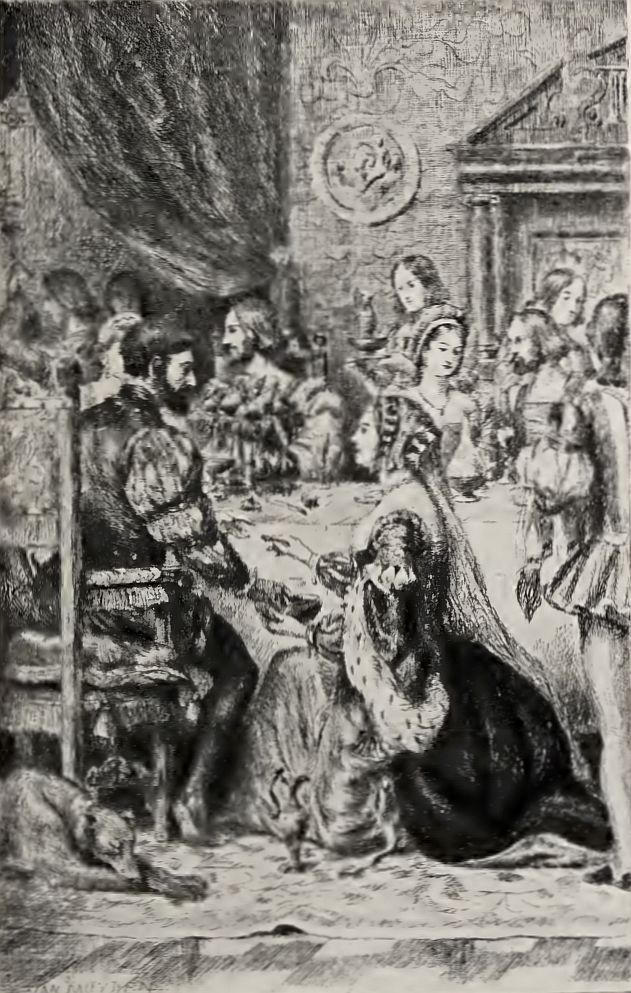
At dessert, as was customary, the pages brought water for the guests to wash their hands. Thereupon Madame d'Etampes took the ewer and basin intended for Charles V. from the hands of the servitor, while Marguerite did the same for François, poured water from the ewer into the basin, and, kneeling upon one knee, according to the Spanish etiquette, presented the basin to the Emperor. He dipped the ends of his fingers, gazing at his noble and beautiful attendant the while, and laughingly dropped the superb ring, of which we have spoken, into the water.
"Your Majesty is losing your ring," said Anne, dipping her own taper fingers into the water, and daintily picking up the jewel, which she handed to the Emperor.
"Keep the ring, madame," the Emperor replied, in a low voice; "the hands in which it now is are too noble and too beautiful for me to take it from them again. It is to bind the bargain for the Duchy of Milan," he added, in a still lower tone.
The duchess smiled and said no more. The pebble had fallen at her feet, but the pebble was worth a million.
As they returned from the salle-à-manger to the salon, and passed thence to the ball-room, Madame d'Etampes stopped Benvenuto, who was brought near to her by the press.
"Messire Cellini," said she, handing him the ring which constituted a pledge of the alliance between the Emperor and herself, "here is a diamond which you will hand, if you please, to your pupil Ascanio, for the crown of my lily; it is the dew drop I promised him."
"And it has fallen from Aurora's fingers in very truth, madame," rejoined the artist with a mocking smile and affected gallantry.
He glanced at the ring, and started back in surprise, for he recognized the diamond he had long ago set for Pope Clement VII. and had himself carried to the sublime Emperor on the sovereign Pontiff's behalf.
To induce Charles V. to divest himself of such a priceless jewel, especially in favor of a woman, there must necessarily be some secret understanding, some occult treaty, between himself and the recipient.
While Charles continues to pass his days and nights at Fontainebleau, in the alternations of distrust and confidence, we have endeavored to describe, while he schemes, intrigues, burrows underground, promises, retracts, and promises anew, let us cast a glance upon the Grand-Nesle, and see if anything of interest is occurring among those of its occupants who have remained there.
VII THE GHOSTLY MONK
The whole colony was in a state of intense excitement. The ghost of the monk, the unsubstantial guest of the convent, upon the ruins of which Amaury's palace was built, had returned within three or four days. Dame Perrine had seen him walking around at night in the gardens of the Grand-Nesle, clad in his long white frock, and treading so lightly that he left no footprints on the ground, and made no noise.
How happened it that Dame Perrine, whose domicile was the Petit-Nesle, had seen the ghostly visitor walking in the garden of the Grand-Nesle at three o'clock in the morning? We cannot tell except by committing a very grave indiscretion, but we are historians first of all, and our readers are entitled to know the most secret details of the lives of the characters we have brought upon the stage, especially when those details are calculated to throw a bright light upon the sequel of our narrative.
Dame Perrine, by virtue of Colombe's disappearance, by the retirement of Pulchérie, for whose presence there was no further pretext, and by the departure of the provost, was left absolute mistress of the Petit-Nesle; for the gardener Raimbault and his assistants were, for economical reasons, engaged in Messire d'Estourville's service during the day only. Dame Perrine found herself, therefore, queen of the Petit-Nesle, but at the same time a solitary queen, so that she nearly died of ennui during the day, and of fear at night.
It occurred to her that there was a remedy for this unfortunate condition of affairs, during the day at least; her friendly relations with Dame Ruperta opened the doors of the Grand-Nesle to her. She asked permission to visit her neighbors, and it was most cordially granted.
But upon availing herself of this permission Dame Perrine was naturally brought in contact with her neighbors of the other sex. Dame Perrine was a buxom creature of thirty-six years, who confessed to twenty-nine of them. Plump and rosy still, and always prepossessing, her coming was quite an event in the studio, where ten or twelve worthy fellows were forging, cutting, filing, hammering, chiselling,—good livers all, fond of play on Sundays, of wine on Sundays and holidays, and of the fair sex all the time. Three of our old acquaintances, after three or four days had passed, were all brought down with the same arrow.
They were little Jehan, Simon-le-Gaucher, and Hermann the German.
Ascanio, Jacques Aubry, and Pagolo escaped the charm, having their minds on other things.
The other comrades may well have felt some sparks of this Greek fire, but they realized their inferior position, no doubt, and poured the water of their humility upon the first sparks before they became a conflagration.
Little Jehan loved after the manner of Cherubino, that is to say, he was in love with loving. Dame Perrine, as the reader will readily understand, had too much common sense to respond to such an ignis fatuus as that.
Simon-le-Gaucher could offer more reliable future prospects, and his flame promised to be more enduring, but Dame Perrine was a very superstitious person. She had seen Simon cross himself with his left hand, and she reflected that it would be necessary for him to sign the marriage contract with his left hand. Dame Perrine was convinced that the sign of the cross executed with the left hand was calculated to destroy rather than to save a soul, and in like manner no one could have persuaded her that a marriage contract signed with the left hand could have any other result than an unhappy menage. She therefore, but without disclosing the reasons for her repugnance, received Simon-le-Gaucher's first advances in a way to make him renounce all hope.
Hermann remained. Ah, Hermann! that was a different matter.
Hermann Was no coxcomb, like little Jehan, nor a man with the seal of Nature's displeasure upon him, like left-handed Simon; in Hermann's personality there was something honest and outspoken which appealed to Dame Perrine's heart. Moreover, Hermann, instead of having a left hand for the right and vice versa, made use of either or both so energetically that he seemed to have two right hands. He was a magnificent man too, according to all vulgar ideas. Dame Perrine therefore had fixed her choice upon Hermann.
But, as we know, Hermann was as innocent as Celadon. The result was that Dame Perrine's first broadsides, the pouting and sighs and sidelong glances, were utterly powerless against the naïve timidity of the honest German. He contented himself with staring at Dame Perrine out of his great round eyes; but, like the blind men of the Gospel, "eyes had he, but he saw not," or if he did see, he saw the buxom governess as a whole simply, without noting details. Dame Perrine repeatedly proposed that they should go for a walk on the Quai des Augustins, or in the gardens of the Grand—or Petit-Nesle, and on every occasion she selected Hermann for her cavalier. This made Hermann very happy internally. His great Teutonic heart beat five or six extra pulsations a minute when Dame Perrine was hanging upon his arm; but either because he found some difficulty in pronouncing the French language, or because it gave him greater pleasure to hear the object of his secret thoughts talk, Dame Perrine could rarely extract anything more from him than these two sacramental phrases, "Ponchour, matemoizelle," and "Atieu, matemoizelle," which Hermann generally pronounced at an interval of two hours; the first when Dame Perrine took his arm, the second when she let it go. Now, although this title of Mademoiselle was immensely flattering to Dame Perrine, and although there was something very agreeable in talking two hours without fear of interruption, she would have been glad to have her monologue broken in upon by an occasional interjection which might give her some idea of the progress she was making in the heart of her mute attendant.
Her progress, however, was none the less real for not being expressed in words or by play of feature; the fire was kindled in the honest German's heart, and, being fanned every day by Dame Perrine's presence, became a veritable volcano. Hermann began at last to be conscious of the preference Dame Perrine accorded him, and he was only waiting until he was a little more certain of it to declare himself. Dame Perrine understood his hesitation. One evening, as he parted from her at the door of the Petit-Nesle, she saw that he was so agitated that she thought it would be a real kindness on her part to press his hand. Hermann, transported with delight, responded by a similar demonstration; but to his great amazement Dame Perrine gave a piercing shriek. In his delirious bliss, Hermann did not measure his pressure. He thought that the tighter he squeezed her hand, the more accurate idea he would convey of the violence of his passion; and he very nearly crushed the poor governess's fingers.
Hermann was thunderstruck by her shriek; but Dame Perrine, fearing to discourage him just as he had summoned up courage to make his first advance, forced herself to smile, and said, as she separated her fingers, which were almost glued together for the moment:—
"It's nothing, nothing, dear Monsieur Hermann; it's nothing, absolutely nothing."
"Tausend pardons, Matemoizelle Perrine," said the German, "but I lofe you sehr viel, and I haf pressed your hant as I lofe you! Tausend pardons!"
"There's no need, Monsieur Hermann, there's no need. Your love is an honorable love, I trust, which a woman need not blush to win."
"O Tieu! O Tieu!" cried Hermann, "indeed, my lofe is honorable, Matemoizelle Perrine; put I haf not yet tared to speak to you of it; put since die wort haf escaped me, I lofe you, I lofe you, I lofe you sehr viel, Matemoizelle Perrine."
"And I, Monsieur Hermann," said Dame Perrine mincingly, "think I can say, for I believe you to be a gallant youth, incapable of compromising a poor woman, that—Mon Dieu! how shall I say it?"
"Oh say it! say it!" cried Hermann.
"Well! that—ah, it is wrong of me to confess it!"
"Nein, nein! it is not wrong. Say it! say it!"
"Very well. I confess that I am not indifferent to your passion."
"Sacrement!" cried the German, beside himself with joy.
Now one evening when, after a promenade, the Juliet of the Petit-Nesle had escorted her Romeo to the door of the Grand-Nesle, she espied as she was returning alone through the garden door, the white spectre we have mentioned, which, in the opinion of the worthy governess, could be no other than that of the monk. It is needless to say that Dame Perrine entered the house half dead with fear, and barricaded herself in her room.
The next morning the whole studio was acquainted with the story of the nocturnal apparition. Dame Perrine, however, contented herself with relating the simple fact without going into details. The ghostly monk had appeared. That was the whole of it. It was useless to question her, for she would say nothing more.
All that day the ghostly monk was the engrossing subject of conversation at the Grand-Nesle. Some believed in the appearance of the phantom, others laughed at it. It was noticed that Ascanio was the leader of the sceptics, the others being little Jehan, Simon-le-Gaucher, and Jacques Aubry. The faction of the believers included Dame Ruperta, Scozzone, Pagolo, and Hermann.
In the evening they all assembled in the second courtyard of the Petit-Nesle. Dame Perrine, when questioned in the morning as to the origin of the legend of the ghostly monk, requested that she might have the day to refresh her memory, and when night came she announced that she was ready to relate the awful story. Dame Perrine was as knowing in the matter of stage effects as a modern dramatist, and she knew that a ghost story loses all its effect if told in the sunlight, while, on the other hand, that effect is doubled if it is told in the dark.
Her audience consisted of Hermann, who sat at her right, Dame Ruperta, who sat at her left, Pagolo and Scozzone, who sat side by side, and Jacques Aubry, who lay on the grass between his two friends, little Jehan and Simon-le-Gaucher. Ascanio had declared that he held such old women's tales in utter contempt, and would not even listen to them.
"Unt zo, Matemoizelle Perrine," said Hermann after a moment of silence, while each one arranged his posture so as to listen at ease, "unt zo you are going to tell us the story of the monk's ghost?"
"Yes," said Dame Perrine, "yes; but I ought to warn you that it's a terrible story, and perhaps not a very comfortable one to listen to at this hour; but as we are all devout persons, although there may be some sceptics among us on the subject of ghosts, and as Monsieur Hermann is strong enough to put Satan himself to flight if he should make his appearance, I will venture to tell you the story."
"Pardon, pardon, Matemoizelle Perrine, put if Satan comes I must tell you not to count on me; I will fight mit men, ja, all you choose, put not mit der Teufel."
"Never mind! I will fight him if he comes, Dame Perrine," said Jacques Aubry. "Go on, and don't be afraid."
"Is there a charcoal-purner in your story, Matemoizelle Perrine?" queried Hermann.
"A charcoal-burner? No, Monsieur Hermann."
"All right; it's all the same."
"Why a charcoal-burner?"
"Because in all the Cherman stories there is a charcoal-purner. Put never mind, it must be a fine story all the same. Go on, Matemoizelle Perrine."
"You must know, then," began Dame Perrine, "that there was formerly on this spot where we now sit, and before the Hôtel de Nesle was built, a community of monks, composed of the handsomest men ever seen, the shortest of whom was as tall as Monsieur Hermann."
"Peste! what a community that must have been!" cried Jacques Aubry.
"Be quiet, babbler!" said Scozzone.
"Yes, be quiet, pappler!" echoed Hermann.
"I'll be quiet, I'll be quiet," said the student; "go on, Dame Perrine."
"The prior, whose name was Enguerrand, was a particularly fine specimen. They all had glossy black beards, with black and gleaming eyes; but the prior had the blackest beard and the brightest eyes of all. Moreover the worthy brethren were devout and austere in their devotion to an unparalleled degree, and their voices were so melodious and sweet that people came from leagues around simply to hear them sing the vesper service. At least so I have been told."
"Oh the poor monks!" said Ruperta.
"It's extremely interesting," said Jacques Aubry.
"Es ist sehr wunderbar," said Hermann.
"One day," pursued Dame Perrine, flattered by the marks of appreciation evoked by her narrative, "a handsome young man was brought before the prior, who requested to be admitted to the convent as a novice; he had no beard as yet, but he had large eyes as black as ebony, and long dark hair with a glossy shimmer like jet, so that he was admitted without hesitation. He said that his name was Antonio, and requested to be attached to the personal service of the prior, a request which was granted without hesitation. I spoke of voices just now, but Antonio's was the fresh and melodious voice par excellence. Everybody who heard him sing on the following Sunday was carried away by it, and yet there was a something in the voice which distressed even while it fascinated you, a quality which aroused worldly rather than celestial ideas in the hearts of those who listened to it; but all the monks were so pure of heart that none but strangers experienced this singular emotion, and Don Enguerrand, who was utterly unconscious of anything of the sort, was so enchanted with Antonio's voice that he appointed him thenceforth to sing the responses in the anthems alone, alternately with the organ.
"The conduct of the young novice was most exemplary, and he waited upon the prior with incredible zeal and earnestness. The only thing for which he could possibly be reproved was his constant fits of distraction from his devotions; always and everywhere his glowing eyes were fastened upon the prior.
"'What are you looking at, Antonio?' Don Enguerrand would say to him.
"'I am looking at you, my father,' would be the reply.
"'Look at your prayer-book, Antonio. Now what are you looking at?'
"'You, my father.'
"'Antonio, look at the image of the Virgin. What are you looking at now?'
"'You, my father.'
"'Antonio, look at the crucifix which we adore.'
"Don Enguerrand began to notice, after a time, upon searching his conscience, that since Antonio's reception into the community he had been more troubled than formerly by evil thoughts. Never before had he sinned more than seven times a day, which, as we all know, is the reckoning of the saints,—sometimes even he had examined his conduct for the day without being able to find more than five or six sins, an extraordinary thing. But now the total of his daily peccadillos mounted as high as ten, twelve, or even fifteen. He would try to make up for it on the following day; he would pray and fast and scourge himself, would the worthy man. Ah! but the farther he went, the greater became the reckoning, until at last it reached a full score. Poor Don Enguerrand knew not which way to turn; he felt that he was damned in spite of all he could do, and he noticed—an observation which might have comforted another, but which increased his consternation—that his most austere monks were under the same strange, incredible, incomprehensible influence; so that their confession, which formerly lasted twenty minutes, half an hour, or an hour at most, now occupied several hours.
"About this time, an occurrence which had been creating a great stir in the province for a month past at last became known at the convent. The lord of a castle near by had lost his daughter Antonia. Antonia had disappeared one fine evening exactly as my poor Colombe has disappeared. But there is this difference: I am sure that Colombe is an angel, while it seems that Antonia was possessed of the devil. The poor father had sought the fugitive high and low, just as Monsieur le Prévôt has sought Colombe. Only the convent remained to be visited, and as he knew that the evil spirit, the better to elude search, sometimes conceals himself in monasteries, he sent his chaplain to Don Enguerrand to ask permission to make search in his. The prior assented, with the best possible grace. Perhaps, he thought, he might by means of this visit discover something concerning the magic influence which had been weighing upon him and his brethren for a month past. But no! the search had no result whatever, and the nobleman was about to retire more despairing than ever, when all the monks passed in procession before him and Don Enguerrand, on their way to the chapel for the evening service. He looked at them mechanically, one after another, until the last one passed, when he cried out:—
"'God in heaven! that is Antonia! that is my daughter!'
"Antonia, for it was she, became as pale as a lily.
"'What are you doing in this sacred garb?' continued the father.
"'What am I doing, father?' said Antonia; 'I am loving Don Enguerrand with all my heart.'
"'Leave this convent instantly, wretched girl!' cried her father.
"'I will go out only as a corpse, father,' replied Antonia.
"Thereupon, despite her father's outcries, she darted into the chapel on the heels of the monks, and took her place in her accustomed stall. The prior stood as if turned to stone. The furious nobleman would have pursued his daughter, but Don Enguerrand begged him not to profane the holy place by such a scandalous scene, and to wait until the service was at an end. The father consented, and followed Don Enguerrand into the chapel.
"The anthem was about to be chanted, and the majestic prelude upon the organ was like the voice of God. A wonderfully beautiful strain, but instinct with bitter irony, and awful to bear, responded to the sublime tones of the instrument; it was Antonia's voice, and every listening heart shuddered. The organ took up the chant, calm, grave, impressive, and seemed as if it were seeking to drown with its divine magnificence the bitter strains which insulted it from the stalls. Again, as if in acceptance of the challenge, Antonia's voice arose more wildly despairing, more impious, than before. Everybody awaited in speechless dismay the result of this awful dialogue, this alternation of blasphemy and prayer, this strange conflict between God and Satan, and it was amid the most intense and agonizing silence that the celestial music burst forth like a peal of thunder, when the blasphemous strain died away, and poured out upon the heads of the listeners, all bowed save one, the torrents of its wrath. It was something like the dread voice which the guilty will hear on the judgment day. Antonia tried to keep up the contest, but her song this time was nothing more than a shrill, heart-rending cry, like the laugh fit the damned, and she fell pale and stiff upon the pavement of the chapel. When they raised her, she was dead."
"Jésus Maria!" cried Dame Ruperta.
"Poor Antonia!" said Hermann innocently.
"Little fool!" muttered Jacques Aubry.
The others kept silence, so great was the impression produced even upon the sceptics by Dame Perrine's narrative, but Scozzone wiped away a tear, and Pagolo crossed himself.
"When the prior," resumed Dame Perrine, "saw the devil's messenger thus crushed by the wrath of God, he believed, poor dear man, that he was forever delivered from the snares of the tempter; but he reckoned without his host, a very appropriate expression, as he had been so imprudent as to extend his hospitality to one possessed of the devil. On the following night, just after he had dropped off to sleep, he was awakened by the clanking of chains; he opened his eyes, instinctively turned them toward the door, and saw that it swung open unaided, and at the same time a phantom clad in the white robe of a novice drew near the bed, took him by the arm, and cried, 'I am Antonia! Antonia, who loves thee! and God has given me full power over thee because thou hast sinned, in thought if not in act.' And every night at midnight the terrible apparition returned, implacably true to its word, until at last Don Enguerrand made a pilgrimage to the Holy Land, and died, by the special favor of God, just as he knelt before the Holy Sepulchre.
"But Antonia was not satisfied. She fell back upon all the monks in general, and, as there were very few who had not sinned as deeply as the poor prior, she visited them all one after another during the night, roughly awaking them, and crying in an awe-inspiring voice: 'I am Antonia! I am Antonia, who loves thee!'
"Hence the name of the ghostly monk.
"When you are walking through the streets at night, and a figure with a gray or white hood dogs your steps, hasten home; it is the ghostly monk in quest of prey.
"When the convent was demolished to make room for the château, they hoped to be rid of the spectre, but it seems that he is fond of the spot. At various times he has reappeared. And now, God forgive us our sins! the unhappy wretch has appeared again. May God preserve us from his wicked designs!"
"Amen!" said Dame Ruperta, crossing herself.
"Amen!" said Hermann, with a shudder.
"Amen!" said Jacques Aubry, laughing.
And each of the others repeated the word with an inflection corresponding to the impression produced upon him.
VIII WHAT ONE SEES AT NIGHT FROM THE TOP OF A POPLAR
On the following day, which was that on which the whole court was to return from Fontainebleau, it was Dame Ruperta's turn to announce to the same auditory that she had a momentous revelation to make.
As may be imagined, after such an interesting announcement, the whole party assembled once more in the same spot at the same hour.
They were entirely at their ease, because Benvenuto had written to Ascanio that he should stay behind for two or three days to prepare the hall where his Jupiter was to be displayed, which Jupiter was to be cast immediately upon his return.
The provost had simply made his appearance at the Hôtel de Nesle to ask if there was any news of Colombe; but upon being informed by Dame Perrine that everything was in statu quo, he at once returned to the Châtelet.
The occupants of the Grand and Petit-Nesle enjoyed entire freedom of action, therefore, both masters being absent.
In the ease of Jacques Aubry, although he was to have met Gervaise that evening, curiosity carried the day over love, or rather he hoped that Dame Ruperta would be less diffuse than Dame Perrine, and that she would have finished so early that he might hear her story and still keep his appointment.