Chapter VII · UNIFORMS AND INSIGNIA OF THE U. S. COAST GUARD
Reading edition
The uniforms and insignia of the officers and enlisted men of the U. S. Coast Guard are very similar to those of the Navy, and they are made of dark blue cloth for wear in cold or temperate weather and of white duck for wear in the tropics or in hot weather. A variation from this general rule is found in the case of the Keepers and surfmen on duty at the Life-Saving Stations who have uniforms of khaki or olive-drab cotton duck instead of the white uniforms of the seagoing men of the Coast Guard.
UNIFORMS OF OFFICERS OF THE U. S. COAST GUARD
Commissioned officers of the Coast Guard are required to have complete outfits of full dress, dress, evening dress, blue service dress and white service dress uniforms; the occasions for wearing the various uniforms being as follows:
TABLE OF OCCASIONS FOR UNIFORMS
Occasion. Uniform.
1. State occasions at home and abroad. Full dress.
2. Receiving or calling officially upon the President of the United States or the president or sovereign or a member of the royal family of any country.
3. At ceremonies and entertainments where it is desired to do special honor to the occasion.
4. At general muster on the first Sunday of each month.
5. When receiving an ex-President of the United States, the Vice President or the Secretary of the Treasury.
6. When receiving an Assistant Secretary of the Treasury. Dress uniform.
7. When receiving a member of the President’s Cabinet other than the Secretary of the Treasury.
8. When receiving the Chief Justice of the United States, the President of the Senate, the Speaker of the House of Representatives, or a Committee of Congress.
9. When receiving the Governor of an island or group of islands occupied by the United States, or a Governor of one of the States or Territories of the United States, when within the waters of the state or territory or islands of which he is governor.
10. When receiving a Diplomatic Representative of the United States above the rank of Charge d’affaires when within the waters of the country to which he is accredited.
11. When receiving a military or naval officer of or above the rank of Brigadier General or Commodore.
12. When making the first visit in port to commanding officers and on occasions of ceremony and duty on shore where such uniform would be appropriate.
13. When serving upon Coast Guard service courts.
14. At muster on Sundays other than the first Sunday of each month.
15. On all occasions of ordinary duty and service. Service dress or white service dress.
16. On occasions of ceremony in the evening to which officers are invited in their official capacity, such as public balls, dinners and evening receptions. Evening dress uniform.
When serving as a part of the Navy during war the uniform prescribed for all ordinary occasions of duty is service dress, blue or white depending upon the temperature and weather.
The Full Dress Uniform consists of a frock coat of dark blue cloth; trousers of dark blue cloth with a stripe of gold lace braid down each outer leg seam, the stripe being one inch wide for all officers above the rank of Third Lieutenant and one-half inch for Third Lieutenant; gold shoulder knots; full dress cap; white gloves; black shoes; and the sword suspended by slings from a full dress belt, the belt and slings being covered with gold lace braid, the belts for all lieutenants and officers of corresponding rank having four stripes of dark blue silk woven through the gold braid.
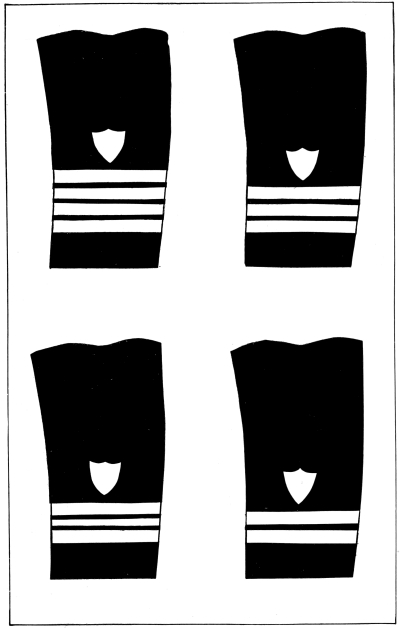
U. S. Coast Guard. Officers’ sleeve braiding indicating rank
Gold braid on full dress, dress, evening dress and blue service coats. Black braid on overcoats, without the shields
1. Captain Commandant 2. Senior Captain
3. Captain 4. First Lieutenant
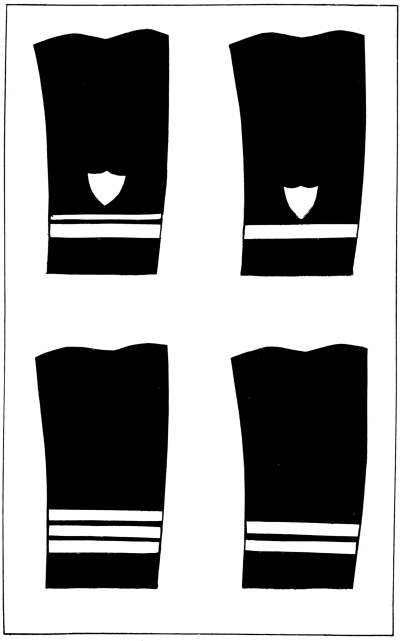
U. S. Coast Guard. Officers’ sleeve braiding indicating rank
Gold braid on full dress, dress, evening dress and blue service coats. Black braid on overcoats, without the shields
1. Second Lieutenant 2. Third Lieutenant
3. Engineer in Chief 4. Lieutenant of Engineers
The full dress coat extends nearly to the knee, is double-breasted with two rows of gilt Coast Guard buttons, nine in each row, has a standing collar trimmed with gold lace braid, the braid being one-half inch wide for officers of the rank of Third Lieutenant and one inch wide for officers above that rank. The sleeves are trimmed with stripes of gold braid as shown in the illustrations, the number of stripes for officers of the Line being as follows:
Captain Commandant.—Four stripes one-half inch wide, the lower stripe two inches above the edge of the cuff, and a gold embroidered shield one inch high above the stripes.
Senior Captain.—Three stripes of one-half inch wide with the gold shield above.
Captain.—Two stripes one-half inch wide with one stripe one-quarter of an inch wide between them and the gold shield above.
First Lieutenant.—Two stripes one-half inch wide with the gold shield above.
Second Lieutenant.—One stripe one-half inch wide with one stripe one-quarter inch wide above it and the gold shield above.
Third Lieutenant.—One stripe one-half inch wide and the gold shield above.
Engineer Officers wear the same stripes as prescribed for officers of the Line of corresponding rank, but not the gold shield.
Constructors and District Superintendents wear the same stripes as officers of the Line of corresponding ranks with the addition of stripes of distinctive color between the gold stripes; these distinctive stripes being of light brown velvet for Constructors and of light green cloth for District Superintendents.
The shoulder knots are made of gold wire cord and consist of a twisted strap terminating in an oval pad. The Corps insignia of the Coast Guard consisting of a silver foul anchor one and five-eighths inches long surcharged with a gold shield and the insignia of rank are embroidered upon the gold lace in the center of the pad.
The full dress cap for commissioned officers is made of dark blue cloth, bell-crowned, with a sloping visor of leather covered with dark blue cloth, the visors for Captain Commandant, Senior Captain and Captains being decorated with a design of oak leaves and those for the Engineer in Chief and Captains of Engineers being decorated with a one-half inch gold band around the edge. The Coast Guard insignia are embroidered on the fronts of the caps and consist of a gold spread eagle with a silver shield upon his breast, the talons of the eagle resting upon a silver foul anchor. Across the front of the cap just above the visor is a chin strap of one-half inch gold braid secured by a small gilt button at each end of the visor. The full dress cap for the Captain Commandant only has a narrow welt of gold braid around the upper edge of the crown.
The full dress belt for the Captain Commandant, Senior Captains, Captains and Staff officers of corresponding rank is covered with gold lace braid and that for Lieutenants and Staff officers of corresponding rank is covered with gold lace braid having four narrow stripes of dark blue silk woven through it.
The Dress Uniform.—Is the same as the full dress except that plain trousers of dark blue or white are worn.
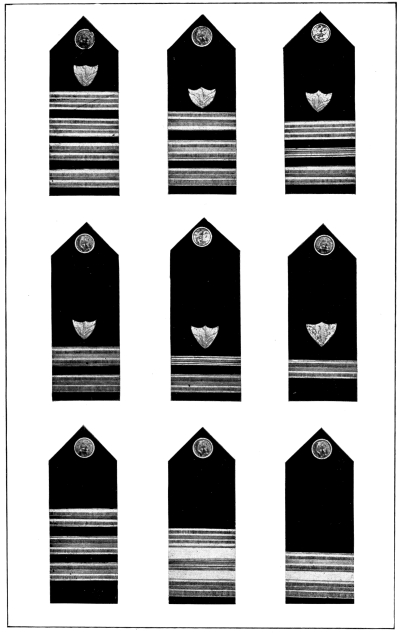
U. S. Coast Guard. Officers’ shoulder marks indicating rank
Worn on the white service uniform coat and the overcoat. The shields above the stripes indicate Line officers. Gold stripes without the shields indicate Engineer officers. Light brown stripes between the gold stripes. Constructors. Light green stripes between the gold stripes, District Superintendent.
1. Captain Commandant 2. Senior Captain 3. Captain
4. First Lieutenant 5. Second Lieutenant 6. Third Lieutenant
7. Engineer Officers 8. Staff Officers 9. Staff Officers
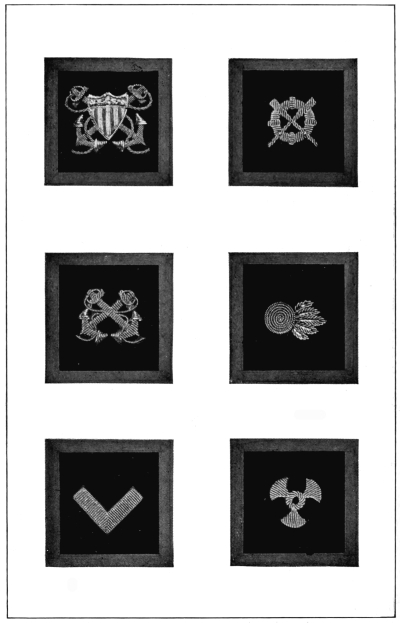
U. S. Coast Guard. Warrant officers’ collar insignia
1. Master’s Mate 2. Keeper
3. Boatswain 4. Gunner
5. Carpenter 6. Machinist
The Service Dress Uniform consists of the blue or white service coat, plain blue or white trousers and the blue or white service cap, black shoes being worn with the blue uniform and white shoes with the white uniform. When the sword is worn with this uniform it is suspended from a belt of black leather worn under the coat.
The Blue Service Coat is made of dark blue cloth or serge, with a standing collar, single-breasted, extending to about ten inches below the waist, trimmed around the collar, down both front edges, around the bottom and up the side seams of the back with black mohair braid one and one-quarter inches wide. The sleeves bear the same gold stripes indicating the rank of the wearer as those on the full dress coat, and on both sides of the collar are embroidered the insignia of rank with the insignia indicating Line or Staff in rear of it.
These insignia for commissioned officers of the Line are as follows:
Captain Commandant A silver spread eagle with a shield upon his breast.
Senior Captain A silver oak leaf.
Captain A gold oak leaf.
First Lieutenant Two silver bars.
Second Lieutenant One silver bar.
Third Lieutenant No insignia of rank, the Coast Guard insignia only being worn.
The Coast Guard insignia worn on the collar by commissioned officers of the Line consist of a silver foul anchor surcharged with a gold shield.
Officers of the Staff Corps (Engineers and Constructors) wear the insignia of rank of their corresponding rank in the Line and instead of the Coast Guard insignia worn by the Line officers they wear the insignia of their corps, as follows:
Engineer Officers.—A silver foul anchor surcharged with four gold oak leaves.
Constructors.—A silver foul anchor surcharged with a branch of gold leaves.
The White Service Coat for commissioned officers is a single-breasted coat of the same length as the blue service coat, with standing collar, buttoned with a single row of five Coast Guard gilt buttons, and having on each breast a pocket with a flap buttoned by a small gilt button. Shoulder marks indicating the rank and corps of the wearer are worn with this coat.
Shoulder Marks.—The shoulder marks worn on the shoulders of the white service coat and also upon the shoulders of the overcoat to indicate the rank and corps of the wearer are five inches long and two and a quarter inches wide, covered with dark blue cloth, and decorated with gold stripes and corps insignia to indicate the rank and corps of the wearer, these stripes and insignia being the same for the various ranks and corps as those worn on the sleeves of the full dress coat as previously described.
The Blue Service Cap is of the same shape and design as the full dress cap except that the braid around the band is of black mohair and the visor is made of black patent leather, the decorations on the visor for the Captain Commandant, Senior Captains, Captains, Engineer in Chief and Captains of Engineers being of gold embroidery the same as for the full dress cap.
The White Service Cap is of the same shape and description as the blue service cap except that the sides and crown above the band are of white duck.
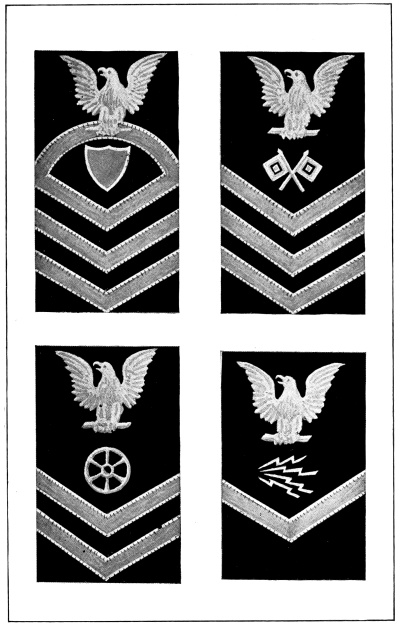
U. S. Coast Guard. Petty officers’ chevrons
1. Master-at-Arms 2. Signal Quartermaster
3. Water Tender 4. Electrician, Third Class
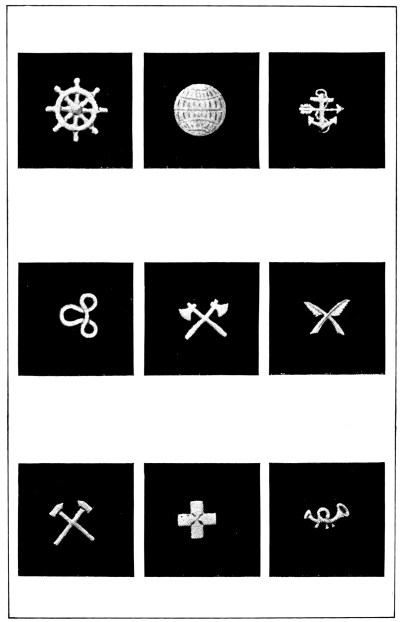
U. S. Coast Guard. Petty officers’ specialty marks
1. Wheelman 2. Electrician 3. Coxswain
4. Sailmaker 5. Carpenter, Plumber, Painter 6. Yeoman
7. Blacksmith 8. Bayman 9. Bugler
The Sword and Sword Knot are the same as those for the officers of the U. S. Navy except that the letters “U. S. C. G.” are etched upon one side of the blade.
The Overcoat for Commissioned Officers of the Coast Guard is the same as that for officers of the U. S. Navy (see page 116), the rank and corps being indicated by the shoulder knots the same as those worn on the white service coat, and the rank also being indicated by stripes of black braid upon the sleeves, the number and widths of the stripes being the same as for the full dress and blue service coats.
The Cloak for Commissioned Officers is the same as that for officers of the U. S. Navy (see page 117).
The Warrant officers of the U. S. Coast Guard are required to have complete outfits of blue dress, blue service dress, and for all except the Keepers of Life-Saving Stations, white service uniforms. The Keepers of Life-Saving Stations are required to have an olive-drab cotton service uniform in lieu of the white service uniform required for other warrant officers.
The Blue Dress Uniform for Warrant officers is the same as the blue service uniform for commissioned officers except that in place of the gold braid on the sleeves of the coat there is one stripe of black mohair braid one inch in width, and on each side of the collar the insignia of rank are worn, these insignia being for the various ranks as follows:
Master’s Mate Two gilt foul anchors crossed surcharged with a silver shield.
Keeper A gilt life buoy surcharged with two gilt oars crossed.
Boatswain Two gilt foul anchors crossed.
Gunner A gilt spherical shell bursting into flame.
Carpenter A gilt carpenter’s square.
Machinist A gilt propeller wheel.
The Blue Service Uniform is the same as the blue dress uniform.
The White Service Uniform for Warrant officers is the same as that for the commissioned officers except that the shoulder marks are not worn on the coat, the rank being indicated by metal insignia worn on the collar as described for the blue service coat, and the insignia worn upon the cap being two gilt foul anchors crossed and surmounted by a silver shield.
The Olive-drab Service Uniform worn by the Keepers of Life-Saving Stations is of the same design as the white service uniform worn by other warrant officers but the buttons and insignia worn with it are of dull finish bronze metal.
The Overcoat for Warrant Officers is the same as that for commissioned officers except that there are no stripes on the sleeves and the shoulder marks are not worn with it.
The Sword and Belt worn by warrant officers is the same as that worn by commissioned officers with service uniform.
UNIFORMS OF ENLISTED MEN OF THE COAST GUARD
The uniforms of the enlisted men of the Coast Guard are practically the same in style and design as those worn by the enlisted men of the U. S. Navy with minor differences in the buttons and insignia of rank and the rating badges and specialty marks.
The uniforms of the Chief Petty Officers have the buttons of the Coast Guard design on the coats and the insignia on the caps consisting of a vertical gilt foul anchor surmounted by a silver shield.
For Surfmen stationed at Life-Saving Stations the summer uniform is made of olive-drab cotton duck and the buttons and insignia worn upon the coats and caps are of dull finish bronze metal.
The insignia of rank or rating for Petty Officers are worn upon the right sleeve of the coat or shirt midway between the shoulder seam and the elbow, and consist of a chevron with a spread eagle above it and a specialty mark below the eagle in the upper angle of the chevron.
The chevron is worn with the point down and is made of stripes of cloth three-eighths of an inch wide set one-quarter of an inch apart, these stripes being of scarlet cloth for blue coats and shirts and of blue cloth for white and olive-drab coats and shirts.
The eagle and the specialty marks are embroidered in white silk for blue coats and shirts and in blue silk for white and olive-drab coats and shirts.
The chevron for Chief Petty Officers consists of three stripes with an arc of a circle connecting the ends of the upper stripe; that for First class petty officers of three stripes, that for Second class petty officers of two stripes and that for Third class petty officers of one stripe, as illustrated.
The Specialty Marks indicating the particular duty or assignment of the petty officers and of certain other men having special duties are, as shown in the illustrations, as follows:
Master-at-Arms.—An upright shield.
No. 1 Surfman.—A circular life buoy surmounted by two oars crossed.
Signal Quartermaster.—Two flags crossed diagonally.
Wheelman.—A ship’s steering wheel with eight spokes.
Coxswain.—A vertical anchor crossed by a horizontal arrow.
Electrician.—A hemisphere on a vertical axis.
Electricians, First, Second and Third Class.—A device representing forked lightning, four streaks.
Sailmakers.—A closed clew iron with two eyes.
Blacksmith.—Two sledges crossed diagonally.
Yeoman and Ships Writer.—Two quill pens crossed diagonally.
Machinist and Oiler.—A ship’s propeller with three blades.
Water Tender.—A valve wheel with six spokes.
First and Second Class Carpenters, Plumbers and Painters.—Two axes crossed diagonally.
Bayman (Hospital Nurse).—A red Geneva cross.
Service Stripes.—For each three years service in the Coast Guard or U. S. Navy an enlisted man of the Coast Guard wears one service stripe. These stripes are three-eighths of an inch wide and eight inches long and are worn diagonally across the outer side of the left sleeve of the coat or shirt. They are made of scarlet cloth for blue coats and shirts and of blue cloth for white and olive-drab coats and shirts.
Branch Marks.—All enlisted men of the Coast Guard except buglers and mess attendants wear a narrow stripe around the shoulder seam of the right sleeve of the uniform shirts to indicate the branch of the service to which they belong; the stripe being red for the Engineer’s force and for all others white on blue shirts and blue on white shirts.
Buttons.—The metal buttons for the Coast Guard have a plain outer rim with an inner rim of rope design enclosing a design in relief, this design consisting of a vertical foul anchor surmounted by an eagle with the wings lifting with a wreath of laurel on one side of the anchor and a wreath of oak leaves on the other side. The buttons are of bright gilt for blue and white clothes and of dull finish bronze for olive drab clothes.
Enlisted men of the Coast Guard wear a black silk cap ribbon on the blue flat cap, the ribbon for men serving aboard ship having the name of the ship and the letters “C. G.,” thus,
U. S. S. ALGONQUIN, C. G.
and the ribbon for men serving at shore stations having the inscription,
U. S. COAST GUARD.
Leggings.—When on landing duty or guard duty ashore officers and enlisted men wear leggings of olive-drab similar to those worn in the U. S. Navy.
Gloves of iron gray wool are worn by enlisted men in cold weather.

SEAL OF THE DEPARTMENT OF COMMERCE