Chapter V · UNIFORMS AND INSIGNIA OF THE U. S. NAVY
Reading edition
The uniforms of the officers and enlisted men of the United States Navy are made of dark blue cloth for wear in cold or temperate weather and of white duck for wear in hot or tropical weather.
U. S. NAVAL OFFICERS’ UNIFORMS
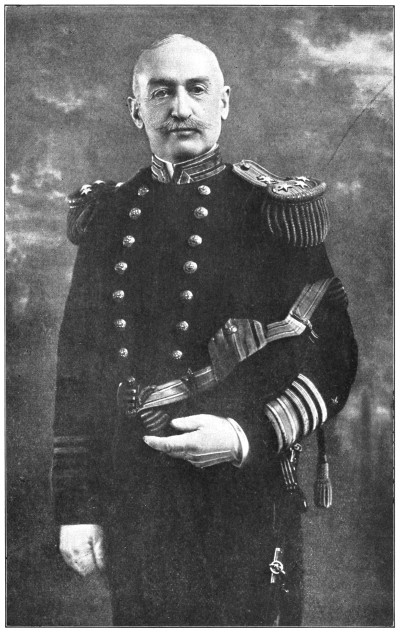
Copyright, G. V. Buck, Washington, D. C.
Admiral William S. Benson Chief of Naval Operations, United States Navy
Commissioned officers of the Navy are required to have complete outfits of special full dress, evening dress, full dress, undress, blue service dress and white service dress uniforms; the occasions upon which the various uniforms are required to be worn by officers of the Navy and the Marine Corps being given in the official regulations as follows:
Occasion. Uniform.
1. State occasions, at home or abroad. NAVY.—Special full dress, or white special full dress. MARINE CORPS.—Special full dress (with full dress trousers, if in line with troops), or white special full dress.
2. Receiving or being received by the President, an ex-President, the Vice President, or the Secretary of the Navy of the United States, or the sovereign, chief executive or ruler of any country, or any member of a royal family, or an ambassador of the United States or of any country, at home or abroad.
3. At ceremonies, solemnities, or entertainments, when desirable to do special honor to the occasion.
4. At general inspection on the first Saturday in the month. In inclement weather, service dress may be prescribed.
5. First visits to officers of flag rank, or exchanging visits of ceremony with foreign officials. Navy.—Full dress, or white full dress. Marine Corps.—Special full dress (with full dress trousers, if in line with troops), or white full dress.
6. Ceremonies, solemnities, or entertainments where dress uniform is not sufficient.
7. Reception of— Navy.—Dress, or white dress. Marine Corps.— Special full dress (with full dress trousers, if in line with troops), or white undress.
(a) Assistant Secretary of the Navy.
(b) Member of the President’s Cabinet other than the Secretary of the Navy.
(c) Chief Justice of the United States.
(d) Governor general of islands or groups of islands occupied by the United States, visiting a ship or station officially, within the waters or limits of his government.
(e) Governor of one of the States or Territories of the United States, visiting a ship or station within the waters or limits of his government.
(f) President of the Senate.
(g) Speaker of the House of Representatives.
(h) Committee of Congress.
(i) Envoy extraordinary and minister plenipotentiary, minister resident, or other diplomatic representative of or above the rank of chargé d’affaires, within the waters of the nation to which he is accredited.
(j) Flag officer going aboard his flagship to assume command; also when he relinquishes command.
8. First visit in port to commanding officers, and ordinary occasions of duty and ceremony on shore. Navy.—Dress, or white dress. Marine Corps.—Special full dress (with full dress trousers, if in line with troops), or white undress.
9. At Saturday morning inspection, except the first in the month. In inclement or hot weather, service dress or white service dress may be prescribed, in either case with swords.
10. Reporting for duty. Navy.—Undress, or white undress. Marine Corps.—Undress, or white undress.
11. Serving as member of a general court-martial, court of inquiry, examining or retiring board. Navy.—Undress, or white undress. Marine Corps.—Undress, or white undress, or field dress.
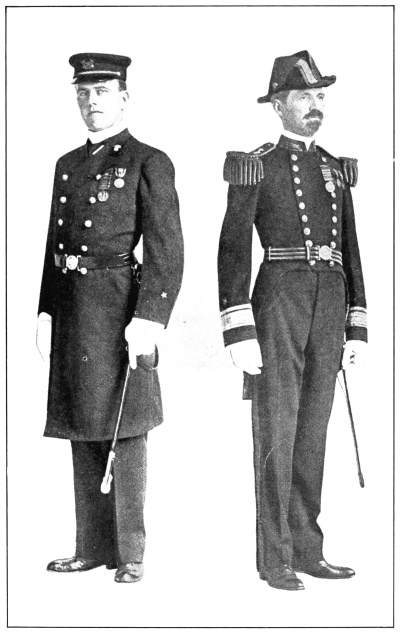
U. S. Naval officers’ special full dress uniform GunnerRear Admiral
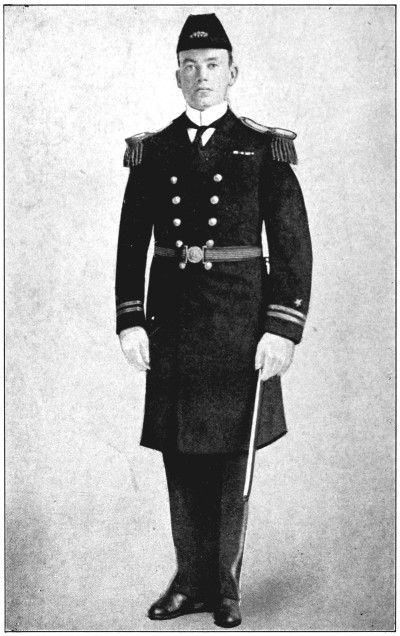
U. S. Naval officer. Full dress uniform
Rank: Lieutenant, indicated by the stripes on the sleeve; the tops of the epaulets also bear the insignia of rank.
Corps: The Line of the Navy, indicated by the star on the sleeve.
Occasion. Uniform.
12. Serving as member of a summary court-martial. Navy and Marine Corps.—The uniform of the day with side arms.
13. Serving as judge advocate of a general court-martial, or court of inquiry, recorder of a summary court-martial, deck court officer, member of a board| other than an examining or retiring board, witness before a court or board, counsel for the accused. Navy and Marine Corps.—The uniform of the day.
14. Upon occasions of special ceremony, by officers on duty with enlisted men under arms on shore, when the uniform prescribed for other officers| is special full dress or full dress. Navy.—Undress with leggings, or white undress with leggings. Marine Corps.—Full dress, or white undress. (No leggings ever to be worn with full dress.)
15. Visiting foreign officers other than commanding officers. Navy.—Undress, or white undress, without swords. Marine Corps.—Undress or white undress, without swords.
16. At informal daytime receptions, to which officers are invited in their official capacity, when frock coats are appropriate.
17. At all times not otherwise provided for. Navy.—Service dress or white service dress when suitable). Marine Corps.—Undress (or white undress when suitable) without swords.
18. On duty with enlisted men under arms ashore, except as specified in No. 14. Navy.—Service dress, blue or white, as prescribed, and leggings, with swords (or revolvers or both). Marine Corps.—Undress, or field dress, with or without leggings, as prescribed; revolvers also if prescribed.
19. When prescribed by the senior officer present. Navy.—White service dress with blue trousers. Marine Corps.—White undress with blue undress trousers, without swords.
20. At the option of and under restrictions imposed by the commanding officer, when the uniform of the day is white service dress; to be worn only by officers on board their own ship or at exercise in boats.
21. Ceremonies in the evening to which officers are invited in their official capacity, such as public balls, dinners, and evening receptions. In hot weather, and in other circumstances where appropriate, dinner dress may be prescribed. Navy.—Evening full dress. Marine Corps.—Special full dress or mess dress.
22. At informal evening occasions to which officers are invited in their official capacity. In hot weather, or in other circumstances where appropriate, mess dress may be prescribed. Navy.—Evening dress. Marine Corps.—Mess dress.
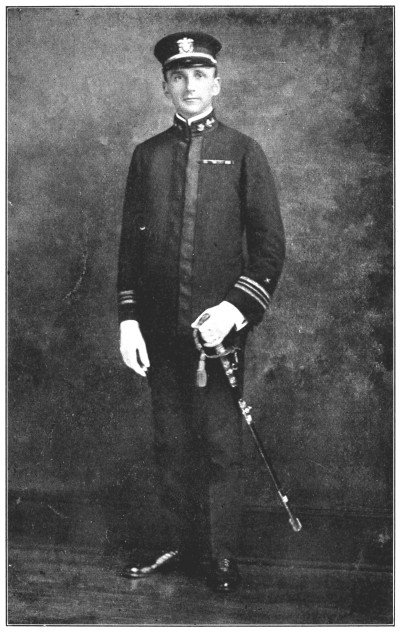
Photo by Harris & Ewing, Washington, D. C.
U. S. Naval officer. Blue service uniform
Rank: Lieutenant Commander, shown by the gold leaf on the collar and the stripes on the sleeve.
Corps: Line of the Navy, shown by the anchor on the collar and the star on the sleeve.
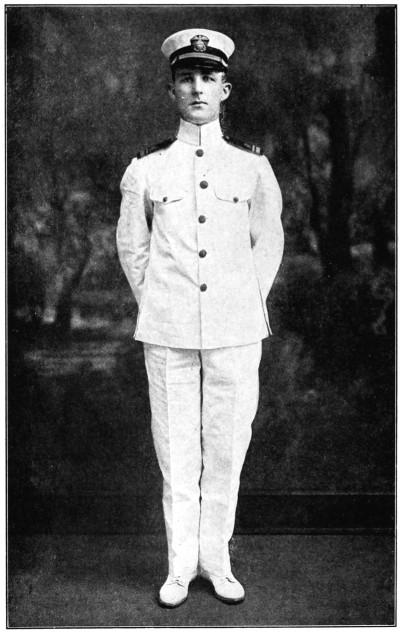
Photo by G. V. Buck, Washington, D. C.
U. S. Naval officer. White service uniform
Rank: Lieutenant Junior Grade, indicated by the stripes on the shoulder marks.
Corps: The Line of the Navy, indicated by the stars on the shoulder marks.
Occasion. Uniform.
23. On occasions of ceremony, as in No. 19, or in hot weather and other circumstances where appropriate, as a substitute for Uniform C. Navy.—Dinner dress. Marine Corps.—Mess dress, with white mess jacket.
24. On ordinary social occasions in the evening to which officers are invited in their official capacity, and where hot weather and other circumstances make it appropriate. Navy.—Mess dress. Marine Corps.—Mess dress, with white mess jacket. White trousers may be prescribed for both Navy and Marine Corps.
25. When authorized under No. 21 by the commanding officer.
In time of war the uniform prescribed for all ordinary occasions of duty is service dress, blue or white depending upon the temperature and weather.
The special full dress uniform consists of the cocked hat, a double breasted coat with tails at the back only as is the case in the ordinary civilian evening dress coat, trousers with gold stripes down the outer leg seams, black shoes, gold epaulets and the sword carried from a belt and slings of black cloth having gold stripes through it.
The full dress uniform consists of the same trousers, cocked hat, sword and belt as for special full dress, with a double-breasted frock coat with a rolling collar and lapels, and gold epaulets.
The evening dress uniform consists of a dark blue cloth evening dress coat and a white waistcoat cut after the prevailing style for civilian evening dress but fitted with gilt navy buttons, plain dark blue trousers, black patent leather shoes and the blue or white cap. Epaulets and full dress trousers (with the gold stripes on them) may be prescribed, in which case the uniform is known as evening full dress and the cocked hat is worn with it. For wear in hot weather a mess jacket of white is prescribed, cut after the fashion of the evening dress coat but without tails. The shoulder marks are worn with the mess jacket to indicate corps and rank, and either white or blue trousers may be worn with it.
The undress uniform consists of the frock coat without epaulets, plain dark blue or white trousers, the blue or white undress cap, black shoes and the sword carried from a black leather belt and slings.
The blue service dress uniform consists of a dark blue single breasted coat extending to about eight inches below the waist, with standing collar, buttoned up the front with the buttons concealed by a fly-front, and trimmed around the collar, down the front, around the bottom and up the side seams of the back with one and a quarter inch black mohair braid, the undress cap, plain dark blue trousers and black shoes. The white cap and white trousers are sometimes worn with the blue service dress coat.
The white service dress uniform consists of a single-breasted white duck coat extending to about eight inches below the waist, with standing collar, buttoned up the front with five large size gilt navy buttons, with a patch pocket on each breast closed by a flap at the top buttoned by a small size gilt navy button, without braid trimming, and having on each shoulder a shoulder strap (known in the service as a “shoulder mark”) about five inches long and two and a quarter inches wide bearing the insignia which indicates the corps or branch of the Navy to which the wearer belongs and his rank as an officer, plain white trousers, white cap and white shoes.
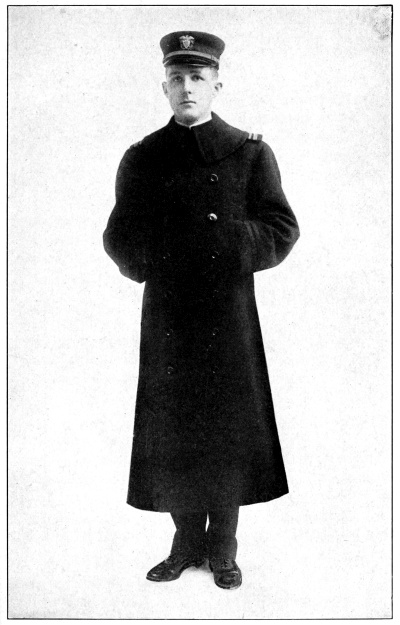
Photo by G. V. Buck, Washington, D. C.
U. S. Navy. Officer in overcoat
Rank: Lieutenant, indicated by the stripes on the shoulder marks and on the sleeves
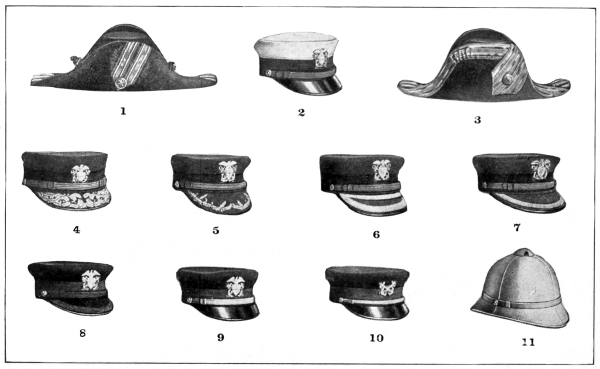
U. S. Naval officers’ cocked hats and caps
1. Cocked hat, commissioned officers below Flag rank.
2. White cap, officers below rank of Commander.
3. Cocked hat, Flag officers.
4. Flag Officers’ cap.
5. Cap, Captain and Commander.
6. Cap, Staff Officers of Flag rank.
7. Staff Officers, rank of Captain and Commander.
8. Chaplain, rank of Captain and Commander.
9. Cap of officers below rank of Commander.
10. Cap, Warrant Officers.
11. Tropical helmet (not worn at present).
The winter service aviation uniform consists of a cap, coat, breeches and spiral wrap puttees of forestry-green woolen cloth, and tan leather shoes. The cap is exactly the same design and style as the white service cap except that the material of the crown above the black mohair band is of forestry-green cloth. The coat is the same as the white service uniform coat except that the material is forestry-green cloth. Standard navy gilt buttons are worn on this coat and the rank is shown by shoulder marks the same as those worn with the white service coat.
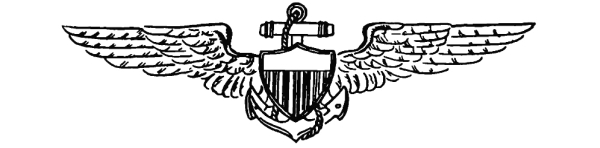
NAVAL AVIATION CORPS INSIGNIA
The Naval Aviation Corps insignia consist of a vertical foul anchor surcharged with a shield of the United States with eagle’s wings extending to the right and left of it as shown in the above illustration. These insignia are made of gilt metal and are worn upon the left breast by all Aviators in the Naval Service, that is by all officers and enlisted men of the Navy and Marine Corps who have qualified as Aviators and are detailed to duty with the Naval Aviation Corps.
The summer service flying uniform for officers of the Navy detailed for aviation duty and for officers of the Naval Reserve Flying Corps consists of a khaki coat of the same style as the white service coat, with which the shoulder marks indicating rank are worn, khaki breeches, woolen wrap puttees of drab color, tan shoes, and a khaki cap of the same style as the white cap.
The working uniform for officers detailed for aviation duty and for officers of the Naval Reserve Flying Corps is a one-piece overall suit of khaki-colored cotton duck, canvas or moleskin.
Dungarees (or overalls), consisting of a blue denim jacket and pair of trousers, are worn by officers when working in engine and firerooms and in turrets and magazines.
When the sword is worn with the service dress uniforms the belt is worn under the coat unless the pistol is worn on the belt, in which case the belt is worn outside of the coat.
White gloves are worn with all uniforms on dress occasions or when the sword is worn except at battle drills or with landing forces on shore expeditions.
The overcoat is a dark blue ulster-coat, reaching about midway from the knee to the foot, double-breasted, buttoning to the neck with seven large flat black buttons on each side, with a wide rolling collar, with a pocket having a vertical opening on each side above the waist, and fitted with waist straps at the back. Shoulder marks of the same design as those for the white service coat are worn with the overcoat and the rank of the wearer is indicated by stripes of black mohair braid on the lower part of the sleeve. The overcoat is lined with black, and a hood is provided to be worn over the head in very cold weather.
A boat cloak or cape of dark blue cloth, cut full, with a rolling collar of black velvet is also provided for officers of the Navy.
The rain coat is a black mackintosh with a cape reaching to the tips of the fingers when the arms hang naturally; and in rainy and wet weather at sea officers usually wear rubber boots, oilskin coats and “sou-wester” hats.
The cocked hat for officers of flag rank (admirals, vice admirals, rear admirals and commodores) is of black silk beaver trimmed with gold lace braid as shown in the illustration, figure 3; and for all other commissioned officers, except chaplains and chief warrant officers, it is trimmed around the outer edge of the top of the crown with black silk lace braid as shown by figure 1.
The blue cap for flag officers is shown by figure 4, and for captains and commanders by figure 5, the cap for officers of the Staff Corps of the rank of rear admiral is shown by figure 6, and for the same classes of officers of the ranks of captain and commander by figure 7. The decorations on the visor shown in the illustrations are embroidered in gold, with the exception of caps for chaplains of the ranks of captain and commander, which have black embroidered bands as shown by figure 8.
The chin strap for all commissioned officers except chaplains is of black leather covered with gold lace braid one-half inch wide; for chaplains it is made of lustrous black mohair, as shown by figure 8. The chin strap for warrant officers’ caps is one-quarter of an inch in width, figure 10.
The cap device embroidered on the center and front of the caps of all commissioned officers consists of a silver shield emblazoned paleways of thirteen pieces, with chief strewn with stars, surmounted by a silver spread eagle, the whole placed upon two crossed foul anchors in gold, as shown by the illustration. The cap device for warrant officers’ caps consists of the two crossed foul anchors in gold, as shown by figure 10.
The blue cap for all commissioned officers below the rank of commander has a plain black patent leather visor, figure 9.
The white caps for all officers are similar in shape to the blue caps, the band, cap devices, chin straps and visor decorations for the different corps and ranks being the same as for the blue caps of the same officers, figure 2.
The cap for Warrant officers is the same as that for commissioned officers except that the device worn on the front consists of two gold foul anchors crossed and the chin strap of gold braid is but one-quarter of an inch wide, figure 10.
INSIGNIA OF RANK AND CORPS
The rank of officers of the Navy is indicated in four ways: first, by stripes upon the sleeves of the special full dress coat, frock coat, evening dress coat, blue service coat and overcoat; second, by rank insignia on each side of the front opening of the collar of the blue service coat; third, by stripes upon the shoulder marks (or straps) worn on the white service coat, the mess jacket and the overcoat; and fourth, by rank insignia on the upper surface of the epaulets worn with special full dress, full dress and evening dress. These stripes indicating rank encircle the sleeves, the lower one being two inches above the edge of the sleeve and parallel to it; on all blue coats except the overcoat they are of gold lace braid, except for chaplains who wear black braid stripes; and on the overcoats of all commissioned officers they are of black mohair braid.
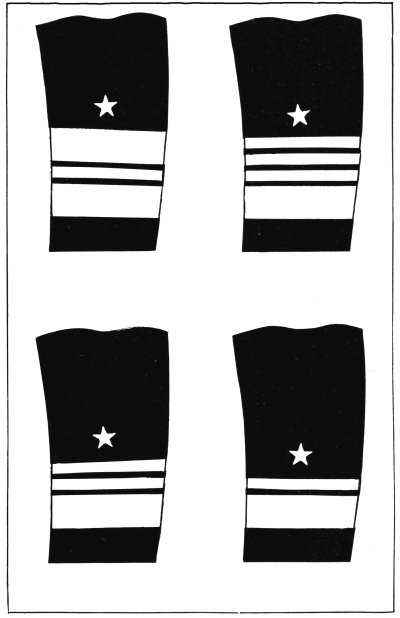
U. S. Navy. Officers’ sleeve braiding indicating rank
Gold braid on special full dress, full dress, evening dress and blue service coats. Black braid on overcoats, without the stars
1. Admiral of the Navy 2. Admiral
3. Vice Admiral 4. Rear Admiral
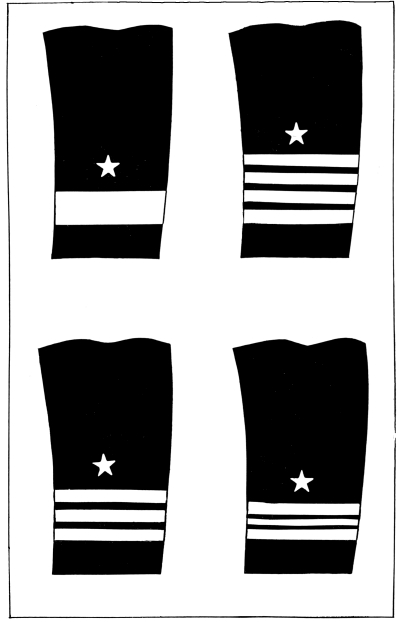
U. S. Navy. Officers’ sleeve braiding indicating rank
Gold braid on special full dress, full dress, evening dress and blue service coats. Black braid on overcoats, without the stars
1. Commodore 2. Captain
3. Commander 4. Lieutenant Commander
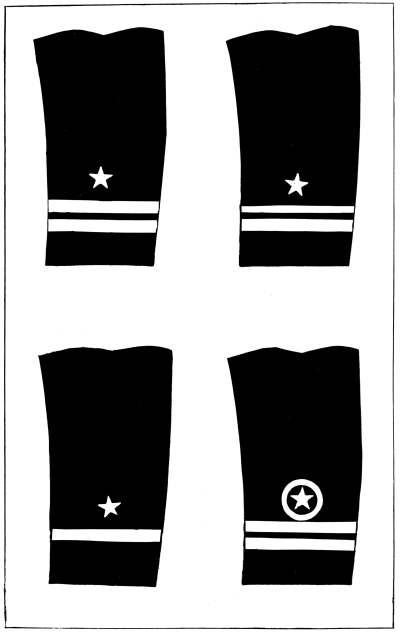
U. S. Navy. Officers’ sleeve braiding indicating rank
Gold braid on special full dress, full dress, evening dress and blue service coats. Black braid on overcoats, without the stars
1. Lieutenant 2. Lieutenant, Junior Grade
3. Ensign 4. Lieutenant, Naval Militia
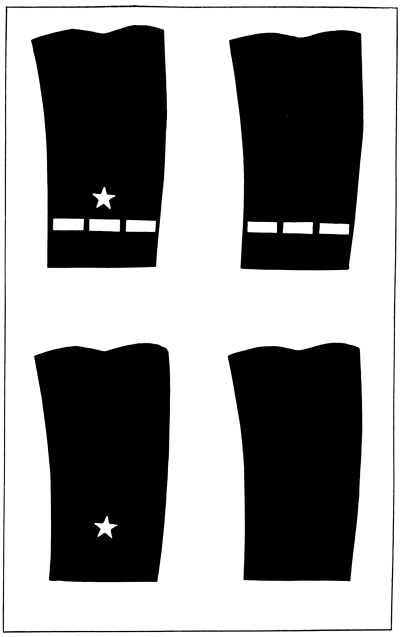
U. S. Navy. Officers’ sleeve braiding indicating rank
Gold braid on special full dress, full dress, evening dress and blue service coats. Black braid on overcoats, without the stars
1. Chief Boatswain, Chief Gunner, Chief Machinist
2. Chief Carpenter, Chief Sailmaker, Chief Pharmacist, Chief Pay Clerk
3. Boatswain, Gunner, Machinist
4. Carpenter, Sailmaker, Pharmacist, Pay Clerk, Mate
The number, width and arrangement of the sleeve stripes indicating the rank of officers, as illustrated, are as follows:
Admiral of the Navy, two stripes two inches wide with one stripe one inch wide between them, the stripes being one-quarter of an inch apart.
Admiral, one stripe two inches wide with three stripes one-half an inch wide above it, the stripes being one-quarter of an inch apart.
Vice Admiral, one stripe two inches wide with two stripes one-half an inch wide above it, the stripes being one-quarter of an inch apart.
Rear Admiral, one stripe two inches wide with one stripe one-half an inch wide above it, the stripes being one-quarter of an inch apart.
Commodore, one stripe two inches wide.
Captain, four stripes each one-half of an inch wide, set one-quarter of an inch apart.
Commander, three stripes each one-half of an inch wide, set one-quarter of an inch apart.
Lieutenant Commander, two stripes one-half of an inch wide with one stripe one-quarter of an inch wide between them, the stripes being set one-quarter of an inch apart.
Lieutenant, two stripes one-half of an inch wide set one-quarter of an inch apart.
Lieutenant Junior Grade, one stripe one-half of an inch wide with one stripe one-quarter of an inch wide set one-quarter of an inch above it.
Ensign, one stripe one-half of an inch wide.
The sleeve stripes for Chief Boatswain, Chief Gunner, Chief Machinist, Chief Carpenter, Chief Sailmaker, Chief Pay Clerk and Chief Pharmacist of the rank of Lieutenant Junior Grade or Ensign are of the same number and widths as those prescribed for Lieutenants Junior Grade or Ensign, except that when made of gold they are woven with dark blue silk thread for widths of one-half inch at intervals of two inches.
The Corps or branch of the service to which the officer belongs is indicated in connection with the rank stripes on the sleeves as follows:
All Line Officers wear a star embroidered in gold, one and one-eighth inches in diameter, on the outside of each sleeve of the special full dress coat, frock coat, evening dress coat and blue service coat, one quarter of an inch above the rank stripes.
For Line Officers of the Naval Militia the gold star is surrounded by a gold circle one and three-eighths inches in diameter.
Staff Officers wear the same sleeve rank stripes as those worn by the Line Officers of the same rank but they do not wear the gold star. The Corps to which Staff Officers belong is indicated by bands of colored cloth around the sleeves filling the intervals between the gold rank stripes, the colors and material of the stripes for the different corps being as follows:
Medical Officers—dark maroon velvet.
Pay Officers—white cloth.
Professors of Mathematics—olive green cloth.
Naval Constructors—dark violet cloth.
Civil Engineers—light blue velvet.
Medical Reserve Officers—crimson cloth.
Dental Officers—orange colored velvet.
When but one stripe is worn, that is for officers of the rank of ensign, the colored cloth is made to show one-quarter of an inch on each side of the stripe.
For Staff Officers of the Naval Militia the colored corps stripes are broken for a distance of one and one-quarter inches at the center of the front of the sleeve.
The rank and corps of officers is shown on the blue service coat in two ways: first, by the stripes on the sleeves as above described; second, by rank and corps insignia worn on each side of the standing collar, to the right and left of the front opening at the neck.
These collar insignia are as illustrated, and consist of the insignia of rank in combination with the device indicating the corps of the wearer.
The Corps device or insignia, indicating to what corps or branch of the service the officer belongs, are:
Line Officers: a silver foul anchor, one and five-eighths inches long over all, one inch wide from tip to tip.
Medical Corps Officers: a silver acorn embroidered upon a gold spread oak leaf, stem to tip one and three-quarters inches, width one inch.
Pay Corps Officers: a silver oak sprig of three leaves and three acorns, one and three-quarters inches long by one inch wide.
Professors of Mathematics: a silver oak leaf and an acorn, one and three-quarters inches long and one inch wide.
Naval Constructors Corps: a gold sprig of two live-oak leaves and an acorn, one and five-eighths inches long and one and three-eighths inches wide.
Civil Engineers Corps: two crossed silver sprigs, each of two live-oak leaves and an acorn, one and three-quarter inches long and one inch wide.
Chaplains: a Latin cross embroidered in silver.
Medical Reserve Corps: a gold acorn embroidered upon a silver spread oak leaf, one and three-quarters inches long and one inch wide.
Dental Corps: a gold spread oak leaf with a silver acorn on either side of the stem, one and three-quarter inches long and one inch wide.
The rank insignia, indicating the rank of the wearer, are practically the same as those for the Army and the Marine Corps, and are as follows:
Admiral—four silver stars.
Vice Admiral—three silver stars.
Rank of Rear Admiral—two silver stars.
Rank of Commodore—one silver star.
Rank of Captain—a silver spread eagle.
Rank of Commander—a silver oak leaf.
Rank of Lieutenant Commander—a gold oak leaf.
Rank of Lieutenant—two silver bars.
Rank of Lieutenant Junior Grade—one silver bar.
Rank of Ensign—no insignia.
Midshipman—a gold anchor.
The insignia indicating the rank and corps of officers are worn on each side of the collar of the blue service coat as illustrated; for Line Officers they are as follows:
Admiral of the Navy—four silver stars, the two end stars being surcharged upon gold foul anchors.
Admiral—four silver stars, the star nearest the back being surcharged upon a gold foul anchor.
Vice Admiral—three silver stars with a silver foul anchor in rear of them.
Rear Admiral—two silver stars with a silver foul anchor in rear of them.
Commodore—one silver star with a silver foul anchor in rear of it.
Captain—a silver spread eagle with a silver foul anchor in rear of it.
Commander—a silver oak leaf with a silver foul anchor in rear of it.
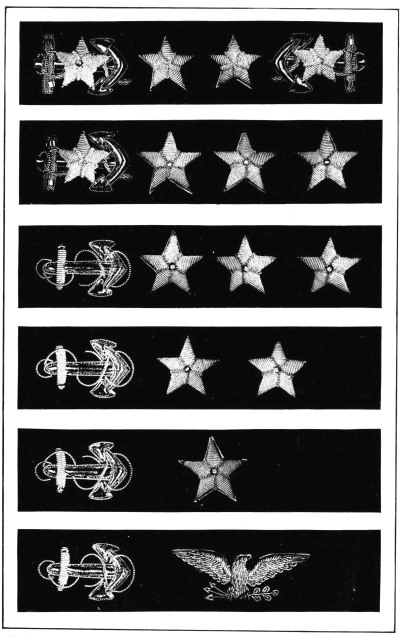
U. S. Navy. Officers’ insignia of rank and Corps on collar of blue service coat, showing right side of collar
1. Admiral of the Navy 2. Admiral
3. Vice Admiral 4. Rear Admiral
5. Commodore 6. Captain
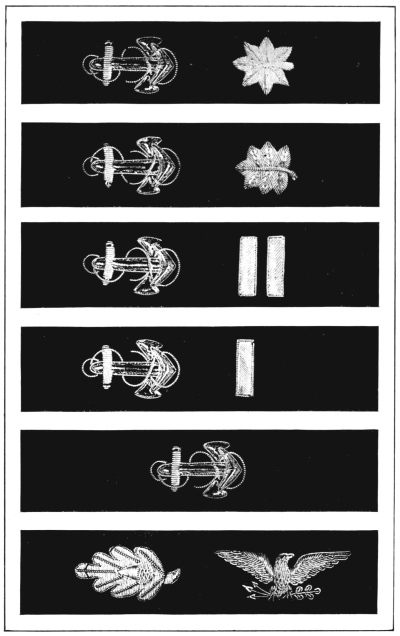
U. S. Navy. Officers’ insignia of rank and Corps on collar of blue service coat, showing right side of collar
1. Commander (Silver leaf) 2.Lieutenant Commander (Gold leaf)
3. Lieutenant 4. Lieutenant, Junior Grade
5. Ensign 6. Medical Officer with the rank of Captain
Lieutenant Commander—a gold oak leaf with a silver foul anchor in rear of it.
Lieutenant—two silver bars vertical with a silver anchor in rear of them.
Lieutenant, Junior Grade—one silver bar vertical with a silver foul anchor in rear of it.
Ensign—a silver foul anchor.
Staff Officers of all ranks wear the Corps device or insignia indicating the particular corps to which they belong (as described on page 121) in place of the silver foul anchor above described and the same rank insignia for the different ranks as described for Line Officers. Thus, a Medical Director with the rank of Captain wears the silver spread eagle indicating the rank and the Medical Corps device of the silver acorn upon the gold leaf indicating the Medical Corps; a Pay Director with the rank of Captain wears the silver spread eagle indicating the rank and the silver oak sprig of three leaves and three acorns indicating the Pay Corps; a Chaplain with the rank of Commander wears the silver leaf indicating the rank and the silver Latin cross indicating his corps; a Professor of Mathematics with the rank of Commander wears the silver leaf indicating the rank and the silver oak leaf and acorn indicating the corps; a Naval Constructor with the rank of Commander wears the silver leaf indicating the rank and the silver two live-oak leaves and acorn indicating the Construction Corps; a Civil Engineer with the rank of Commander wears the silver leaf indicating the rank and the silver crossed live-oak leaves indicating the Corps of Civil Engineers; and a Dental Surgeon with the rank of Lieutenant wears the two silver bars indicating the rank and the gold oak leaf and silver acorns indicating the Dental Corps.
The insignia showing the corps of the Chief Boatswain, Chief Gunner, Chief Machinist, Chief Carpenter, Chief Sailmaker, Chief Pharmacist and Chief Pay Clerk consist of devices worn on each side of the collar of the frock coat just above the V notch in the lapel, as follows:
Chief Boatswain—two foul anchors crossed, embroidered in silver, surcharged at the center by a gold five-pointed star.
Chief Gunner—a flaming spherical shell, embroidered in silver, surcharged at the center by a gold five-pointed star.
Chief Machinist—a three-bladed propeller embroidered in silver, surcharged at the center by a gold five-pointed star.
Chief Carpenter—a carpenter’s square, embroidered in silver with the point down.
Chief Sailmaker—a diamond embroidered in silver.
Chief Pharmacist—a caduceus, embroidered in silver.
Chief Pay Clerk—an oak sprig of three leaves and three acorns, embroidered in silver.
The Corps of Warrant Officers is also shown by corps devices worn on each side of the collar of the frock coat just above the V notch in the lapel, as follows:
Boatswain—two foul anchors crossed, embroidered in gold, surcharged at the center by a silver five-pointed star.
Gunner—a flaming spherical shell, embroidered in gold, surcharged at the center by a silver five-pointed star.
Machinist—a three-bladed propeller, embroidered in gold, surcharged at the center by a silver five-pointed star.
Carpenter—a carpenter’s square embroidered in gold with the point down.
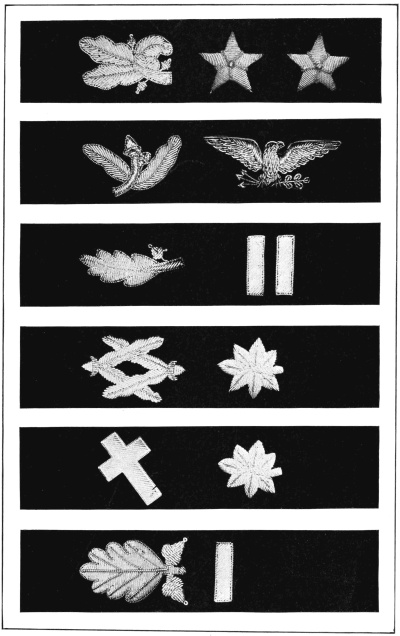
U. S. Navy. Officers’ insignia of rank and Corps on collar of blue service coat, showing right side of collar
1. Officer of the Pay Corps with the rank of Rear Admiral
2. Naval Constructor with the rank of Captain
3. Professor of Mathematics with the rank of Lieutenant
4. Civil Engineer with the rank of Commander
5. Chaplain with the rank of Commander
6. Dental Surgeon with the rank of Lieutenant, Junior Grade
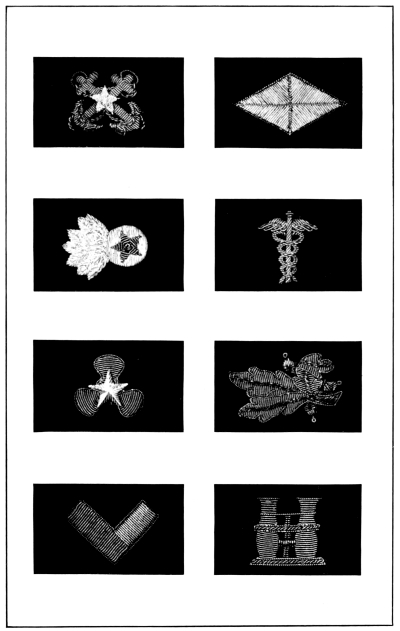
U. S. Navy. Officers’ insignia of rank and Corps on collar of blue service coat, showing right side of collar
1. Chief Boatswain and Boatswain
2. Chief Sailmaker and Sailmaker
3. Chief Gunner and Gunner
4. Chief Pharmacist and Pharmacist
5. Chief Machinist and Machinist
6. Chief Pay Clerk and Pay Clerk
7. Chief Carpenter and Carpenter
8. Mate
Sailmaker—a diamond embroidered in gold.
Pharmacist—a caduceus embroidered in gold.
Pay Clerk—an oak sprig of three leaves and three acorns embroidered in gold.
Mate—a binocular glass, embroidered in gold for a Mate of less than twenty years’ service and in silver for a Mate of over twenty years’ service.
Chief Boatswains, Chief Gunners and Chief Machinists, being Line Officers, wear the gold star above the sleeve stripes; while Chief Carpenters, Chief Sailmakers, Chief Pharmacists and Chief Pay Clerks, being Staff Officers, do not wear the star on the sleeve.
Boatswains, Gunners and Machinists, being Warrant Officers of the Line wear the gold star on the sleeve, but no stripes. Carpenters, Sailmakers, Pharmacists and Pay Clerks have the sleeves of the coat without decoration or insignia.
Chief Boatswains, Chief Gunners, Chief Machinists, Chief Carpenters, Chief Sailmakers, Chief Pharmacists and Chief Pay Clerks wear on the collars of their blue service coats the same devices showing their corps as those already described to be worn upon the collars of their frock coats; and the same is true of the Warrant Officers, Boatswains, Gunners, Machinists, Carpenters, Sailmakers, Pharmacists, Pay Clerks and Mates.
Shoulder marks for officers are worn on the white service coat, mess jacket and overcoat to indicate the corps and rank of the wearer. These marks are of dark blue cloth lined with black silk, stiffened so as to lie flat, 4½ to 5¼ inches long and 2¼ inches wide, finished with a triangular point and a gilt Navy button at the collar end, and they are worn on the top of each shoulder extending from the base of the collar to the shoulder seam.
The designs for the different ranks are as shown in the illustrations. For officers of the Line they are as follows:
Admiral of the Navy—covered with gold lace braid two inches wide, with four silver stars, the two end stars being surcharged upon gold foul anchors.
Admiral—covered with gold lace braid two inches wide, with four silver stars, the one nearest the collar end being surcharged upon a gold foul anchor.
Vice Admiral—covered with gold lace braid two inches wide, with a silver foul anchor and three silver stars, the anchor being nearest the collar end.
Rear Admiral—covered with gold lace braid two inches wide, with two silver stars and a silver foul anchor between them.
Commodore—covered with gold lace braid two inches wide, with one silver star and a silver foul anchor, the anchor being nearest the collar end.
Captain—a gold star at the collar end and four stripes of gold lace braid one-half of an inch wide, set one-quarter of an inch apart.
Commander—a gold star and three stripes of gold lace braid one-half of an inch wide, set one-quarter of an inch apart.
Lieutenant Commander—a gold star and two stripes of gold lace braid one-half of an inch wide with one such stripe one-quarter of an inch wide, between them, stripes set one-quarter of an inch apart.
Lieutenant—a gold star and two stripes of gold lace braid one-half of an inch wide, set one-quarter of an inch apart.
Lieutenant Junior Grade—a gold star and one stripe of gold lace braid one-half of an inch wide and one stripe one-quarter of an inch wide, set one-quarter of an inch apart.
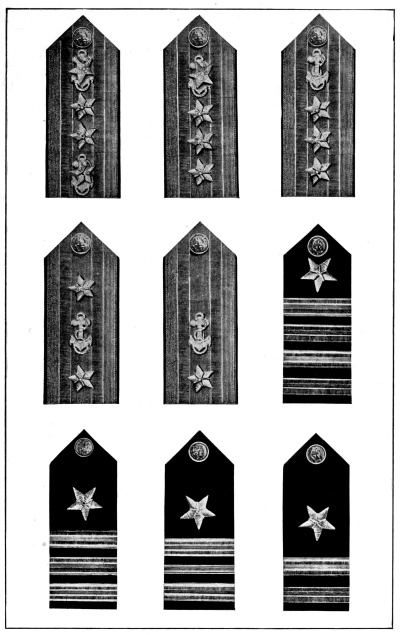
U. S. Navy. Officers’ shoulder marks indicating rank.
Worn on the white service uniform coat, the white mess jacket and the overcoat
1. Admiral of the Navy 2. Admiral 3. Vice Admiral
4. Rear Admiral 5. Commodore 6. Captain
7. Commander 8. Lieutenant Commander 9. Lieutenant
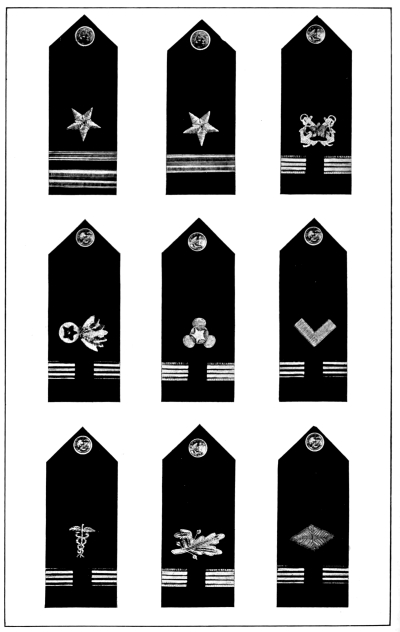
U. S. Navy. Officers’ shoulder marks indicating rank.
Worn on the white service uniform coat, the white mess jacket and the overcoat
1. Lieutenant, Junior Grade 2. Ensign 3. Chief Boatswain
4. Chief Gunner 5. Chief Machinist 6. Chief Carpenter
7. Chief Pharmacist 8. Chief Pay Clerk 9. Chief Sailmaker
Ensign—a gold star and one stripe of gold lace braid one-half of an inch wide.
For officers of the Staff Corps of the rank of Rear Admiral or Commodore the shoulder marks are the same as those for Rear Admiral or Commodore of the Line, except that in place of the silver anchor the corps device indicating the corps to which the officer belongs is used.
For officers of the Staff Corps below the rank of Commodore the stripes for the different ranks are the same as those described for officers of the Line but the star is omitted, the Corps to which the officer belongs being indicated by stripes of colored cloth filling the spaces between the gold stripes, the colors and materials being as follows:
Medical Corps Officers—dark maroon velvet.
Pay Corps Officers—White cloth.
Professors of Mathematics—olive green cloth.
Naval Constructors—dark violet cloth.
Civil Engineers—light blue velvet.
Medical Reserve Officers—crimson cloth.
Dental Officers—orange colored velvet.
The shoulder marks for Chief Boatswain, Chief Gunner, Chief Machinist, Chief Carpenter, Chief Sailmaker, Chief Pharmacist and Chief Pay Clerk, bear the gold stripes indicating their rank of the same width and position as in the case of other officers of their rank, except that the gold stripe is broken at the center by a section of one-half of an inch embroidered in dark blue silk, and the corps is shown by the insignia as described for each on page 124 to be worn on the collars of the frock coats. The insignia in each case are placed on the center of the strap above the stripe.
The shoulder marks for Warrant Officers, Boatswains, Gunners, Machinists, Carpenters, Sailmakers, Pharmacists and Pay Clerks, bear the same insignia indicating the corps of the wearer as those for the Chief Boatswains, Chief Gunners, Chief Machinists, Chief Carpenters, Chief Sailmakers, Chief Pharmacists and Chief Pay Clerks, but the gold stripes indicating rank are omitted.
The shoulder marks for Mates bear a binocular glass embroidered in gold for mates of less than twenty years’ service and in silver for those of over twenty years’ service.
The rank and corps of officers of the Navy is shown upon the gold epaulets worn with special full dress, full dress and evening full dress uniforms by the regular rank and corps insignia placed upon the top of the epaulet. These insignia are the same for the different ranks or grades as those worn on the collars of the blue service coats.
For Officers of the Staff the epaulets have the same insignia for indicating the rank as in the case of the corresponding rank of officers of the Line, but to indicate the particular corps to which the wearer belongs the proper Corps insignia or devices are substituted in the place of the silver foul anchors worn by officers of the Line.
The gilt buttons worn by officers of the Navy upon the coats for which they are prescribed bear in relief an eagle with wings lifting above an anchor placed horizontal; surrounded by thirteen five-pointed stars and a plain circle.
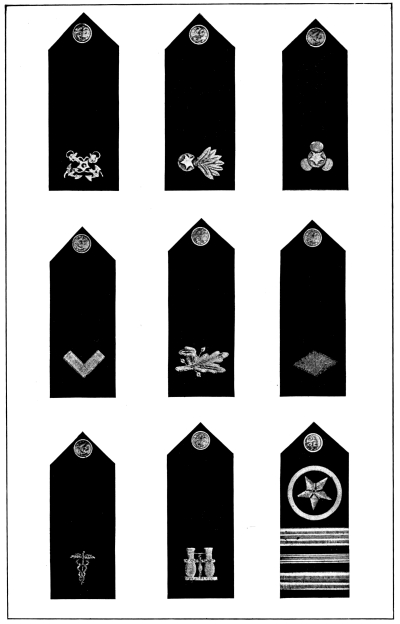
U. S. Navy. Officers’ shoulder marks indicating rank.
Worn on the white service uniform coat, the white mess jacket and the overcoat
1. Boatswain 2. Gunner 3. Machinist
4. Carpenter 5. Pay Clerk 6. Sailmaker
7. Pharmacist 8. Mate 9. Lieutenant Commander,
Naval Militia
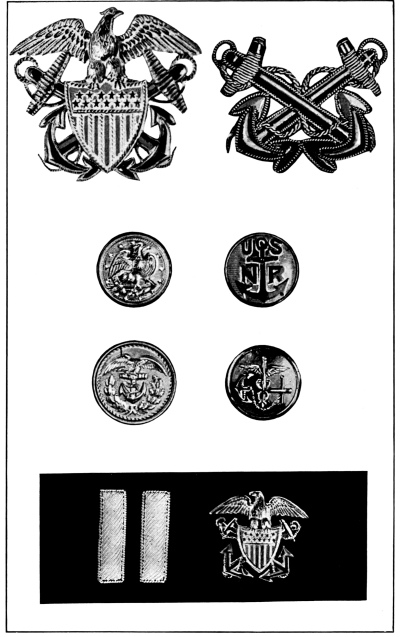
U. S. Navy. Cap insignia
1. Commissioned officers 2. Warrant officers
Service Buttons for Officers
3.U. S. Navy 4. U. S. Naval Reserve
5. U. S. Coast Guard 6. U. S. Public Health Service
7. Collar insignia, Lieutenant, U. S. Naval Reserve, showing left side of collar
Aiguilettes worn by Naval Officers are loops of plaited blue and gold cord terminating in gilt metal ornaments decorated with silver anchors. They are worn by personal aids to the President and the Secretary of the Navy, aides at the White House, members of the personal staff of a Flag Officer in command of a fleet or subdivision of a fleet, and by aides to the Commandants of Naval Stations and the Superintendent of the Naval Academy.
The personal aides to the President wear the aiguilettes on the right side and all other officers for whom they are prescribed wear them on the left side.
They are worn with all uniforms to indicate the special duty of the wearer as an aide entitled to convey the orders of the officer to whose staff he is assigned.
The Sword knot for naval officers is a loop of gold braid ending in a bullion tassel, worn on the hilt of the sword. The original purpose of this loop was to wear it around the right wrist when the sword was carried in the hand to prevent the loss of the sword if it should be accidentally dropped or knocked from the hand in combat. The sword knot is worn by commissioned officers only.
Officers of the Line and of the Staff Corps of the Naval Reserve Force wear the same rank marks as those described for the officers of the regular Navy, but, instead of the silver anchor for the Line Officers and the various Corps devices and insignia to indicate the Corps or branch of the service of the Staff officers of the Staff of the regular Navy, they wear the Naval Reserve Force device on the collar of the blue service coat.
The Naval Reserve Force Device or insignia is of the same design as the device worn on the front of the cap by commissioned officers of the Navy. It is one inch in height, made of metal, the shield and eagle being of silver and the crossed anchors of gold.
The gilt buttons worn by officers of the Naval Reserve Force are of the same sizes as those worn by the officers of the regular service but the design is different, and by this design the fact that an officer is a member of the Naval Reserve Force is shown when he is wearing any uniform having gilt buttons. The Naval Reserve Force gilt button for officers bears a plain vertical anchor and the letters U. S. N. R., as illustrated.
UNIFORMS AND INSIGNIA OF MIDSHIPMEN
The Corps of Midshipmen at the Naval Academy is organized into a regiment of four battalions of four companies each for military formations and drills, with Midshipmen Officers and Petty Officers, as follows:
Midshipman Commander Commanding the Regiment.
Midshipman Lieutenant Commander Commanding a Battalion.
Midshipman Lieutenant Regimental Adjutant and Company Commander.
Midshipman Junior Lieutenant Regimental Commissary and Regimental Signal Officer, Battalion Adjutant, and junior Company officer.
Midshipman Ensign Regimental Aide, Battalion Commissary, and junior Company officer.
Midshipman Regimental Staff Petty Officer.
Midshipman Battalion Staff Petty Officer.
First Petty Officer.
Second Petty Officer.
First-Class Petty Officer.
Second-Class Petty Officer.
The Midshipmen are provided with uniform as follows:
Full dress—consisting of a dark blue double-breasted jacket cut to reach just below the waist, roached at the sides over the hips, pointed at front and back, with standing collar and two rows of gilt buttons down the front and three gilt buttons on each cuff; dark blue trousers, a blue cap similar to that worn by other naval officers, white gloves and black shoes.
Service dress—consisting of a dark blue blouse coat similar in cut and design to the blue service coat of other officers; dark blue trousers, the blue cap and black shoes.
White service dress—consisting of a white duck coat with gilt buttons similar in cut and style to the white service coat of other officers, white duck trousers, white cap and white shoes.
Khaki undress—consisting of a khaki blouse, trousers and cap.
Working dress—consisting of khaki blouse and trousers and white hat.
Working undress—consisting of khaki shirt and trousers and white hat.
The overcoat is an ulster of dark blue cloth, double-breasted, buttoning to the neck with two rows of gilt buttons on the front with a wide rolling collar.
The insignia of the Corps of Midshipmen are a gold anchor worn on the full dress jacket and blue service coat on each side of the collar near the front. All Midshipmen attaining above 85 per cent in standing also wear a gold star on each side of the collar.
The rank of Midshipman Officers is indicated by stripes of gold braid one-eighth of an inch wide sewn around the sleeves of the full dress jacket, service coat and overcoat, the lower stripe being about two inches from the lower edge of the sleeve, the number of stripes for the different grades being:
Midshipman Commander Five stripes one-quarter of an inch apart.
Midshipman Lieutenant Commander Four stripes one-quarter of an inch apart.
Midshipman Lieutenant Three stripes one-quarter of an inch apart.
Midshipman Junior Lieutenant Two stripes one-quarter of an inch apart.
Midshipman Ensign One stripe.
All Midshipman Officers also wear a gold star one inch in diameter three-fourths of an inch above the upper stripe on each sleeve.
The rank of Midshipman Petty Officers is indicated by devices embroidered in gold upon the sleeves, above the elbow, of the full dress jacket, undress coat and overcoat, indicating the different grades as follows:
Regimental staff petty officer—an eagle and an anchor, surmounted by three stars placed pyramidally, with a chevron of three stripes below the anchor.
Battalion staff petty officer—the same as for regimental staff petty officer except there are but two stars.
First and Second Petty Officers—the same as for staff petty officers except there is but one star.
First-class Petty Officer—the same as for first and second petty officers except that the chevrons are omitted.
Second-class Petty Officer—the same as for first-class petty officers except that the star is omitted.
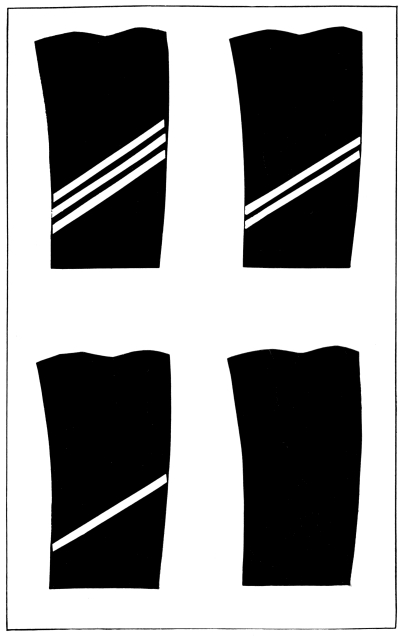
U. S. Navy. Midshipmen. Sleeve stripes indicating class
Gold stripes on the sleeves of the dress coat, undress coat and overcoat
1. First Class 2. Second Class
3. Third Class 4. Fourth Class
The midshipmen are divided into four classes, according to the year’s course, the first class corresponding to seniors at college, the second class corresponding to juniors at college, the third class corresponding to sophomores at college and the fourth class corresponding to freshmen at college.
To distinguish the class to which they belong all midshipmen, except Midshipman Officers and petty officers and fourth classmen, wear service stripes of gold braid one-eighth of an inch wide diagonally across the outside of each sleeve of the full dress jacket, service coat and overcoat from front seam to rear seam, each stripe indicating one year of service at the Naval Academy; thus, the first classmen have three stripes, the second classmen two stripes, the third classmen one stripe, and the fourth classmen plain sleeves with no stripes.
ENLISTED MEN’S UNIFORMS, U. S. NAVY
Enlisted men of the Navy are required to have complete outfits of blue dress, white dress, blue undress, white undress and working dress. Dungaree suits are prescribed for the engineers force and for men of the Artificer Branch. Rain clothes are allowed for the deck force and men who are required to do duty where they would require them.
The occasions upon which the different uniforms of the United States Navy and Marine Corps are worn by the enlisted men are laid down in the regulations as follows:
1. Occasions of ceremony, parades or reviews, unless otherwise ordered. Navy.—Dress. Marine Corps.—Dress.
2. On liberty or leave. Navy.—Dress. Marine Corps.—Dress or field dress.
3. On ordinary occasions, either on or off duty. Navy.—Undress. Marine Corps.—Dress or field dress.
4. At battery drills, and by details of men or individuals engaged in work for which this dress is necessary. Navy.—Working dress. Marine Corps.—Field dress.
5. When prescribed for physical and battery drills, boat exercise under oars, or handling stores or ammunition alongside. Navy.—Undress without jumpers. Marine Corps.—Dress or field dress, without coats, with flannel shirts.
6. In the Tropics in isolated anchorages, or at sea, when prescribed. Navy.—White undress without jumpers. Marine Corps.—Dress or field dress, without coats.
The blue dress uniform for chief petty officers and for officers’ cooks and stewards consists of a double-breasted blue cloth coat with rolling lapel collar and two lower and one breast pocket with flaps, the coat to be worn buttoned, blue cloth trousers, black shoes, a dark blue cloth cap with patent leather visor, white shirt and collar and black bow tie, as illustrated. For all other enlisted men (except bandsmen whose uniform is described later), the blue dress uniform consists of a blue overshirt with a rolling collar, blue cloth trousers, blue flat cap, black neckerchief and black shoes, as illustrated. The overshirt collar falls down the back about nine inches for a width of from fourteen to eighteen inches and is trimmed around the edges with three stripes of narrow white braid and a white five-pointed star in each corner. The overshirt is cut to fit loosely with a shield shaped yoke at the top and a draw string at the waist, the length being such that when the draw string is tightened at the waist the shirt will fall two to four inches below it. The sleeves have tight buttoned cuffs and these are trimmed with stripes of narrow white braid, three stripes for petty officers of the first, second and third classes and men of the seaman first class; two stripes for men of the seaman second class, and one stripe for men of the seaman third class and mess attendants, the men of these different classes being enumerated in the table in Chapter II. The trousers for chief petty officers are cut after the style for civilian trousers, but for other enlisted men they are made to fit snug over the hips with a black ribbon lacing at the back, closed in front by a square flap front with small black buttons at the sides and top, and cut bell shaped at the bottom in order that they may be rolled up easily. The blue cap for all enlisted men except chief petty officers, officers’ stewards and cooks, and bandsmen, is of the style known as the “flat cap.” It has a band two inches wide around which is sewn a black silk cap ribbon bearing the name of the ship or station of the wearer in plain gold letters, the ribbon being tied in a double-bow knot at the left side. Above the band the crown is about four inches greater in diameter than the band and is stretched out flat by a “grommet” or ring worn inside of the edge of the crown.
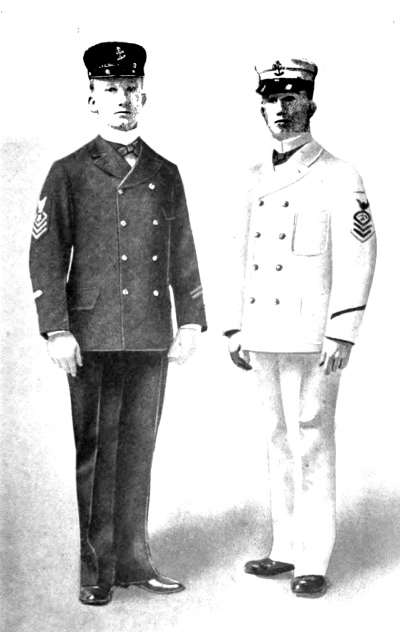
U. S. Navy. Chief petty officer
Blue dress uniform White dress uniform
Seaman Branch, indicated by rating badge on right arm Artificer Branch, indicated by rating badge on left arm
Ex-apprentice, indicated by mark on right arm below elbow Second Enlistment, indicated by one enlistment stripe on left arm
Third Enlistment, indicated by two enlistment stripes on left arm
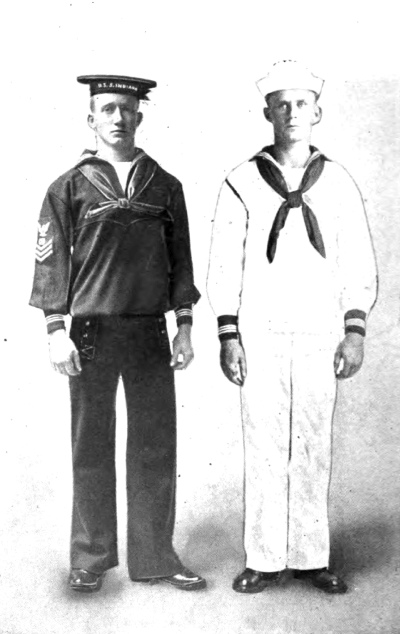
U. S. Navy. Enlisted men
Blue dress uniform White dress uniform
Rating, Petty officer first class, indicated by rating badge with chevron of three stripes Rating, Seaman first class, indicated by three stripes on cuffs
Seaman Branch, indicated by rating badge being on right arm shoulder seam Seaman Branch, indicated by branch mark being on right
The white dress uniform for chief petty officers and officers’ stewards and cooks consists of a white duck coat, white duck trousers, white cap, white shirt and collar, black tie and white shoes, the coat and trousers being made after the same style as the blue dress coat, and the cap having a black visor and band and a white crown. For all other enlisted men (except bandsmen) the white dress uniform consists of a white dress “jumper” shirt with blue cloth collar and cuffs, white trousers, black neckerchief, black shoes and a white hat. The white dress jumper is not tightened at the waist like the blue overshirt but is cut off square about six inches below the waist and allowed to hang free.
The blue undress uniform for chief petty officers and officers’ stewards and cooks is the same as the blue dress uniform for these men except that the material of which it is made is blue serge and a blue flannel shirt may be worn. For all other enlisted men (except bandsmen) the blue undress uniform consists of a blue undress jumper, blue cloth or flannel trousers, blue cap or white hat and black shoes. The blue undress jumper is the same as the overshirt except that there are no stripes of braid or stars on the collar or cuffs and the sleeves are not buttoned at the cuff but cut off square and hemmed.
The white undress uniform for chief petty officers and officers’ stewards and cooks is the same as the white dress for these men. For all other enlisted men (except bandsmen) it consists of a white undress jumper of the same style as the blue undress jumper and white trousers and white hat, the jumper and trousers being made of white navy drill.
The working dress uniform, blue or white, for all enlisted men is the same as undress, blue or white as the case may be, except that chief petty officers and officers’ stewards and cooks may go without the coat and wear the blue flannel shirt if in blue, and other enlisted men do not wear the neckerchief and may wear the watch cap when in blue. The watch cap is a dark blue knitted cap without visor or brim that may be pulled down over the ears for cold weather.
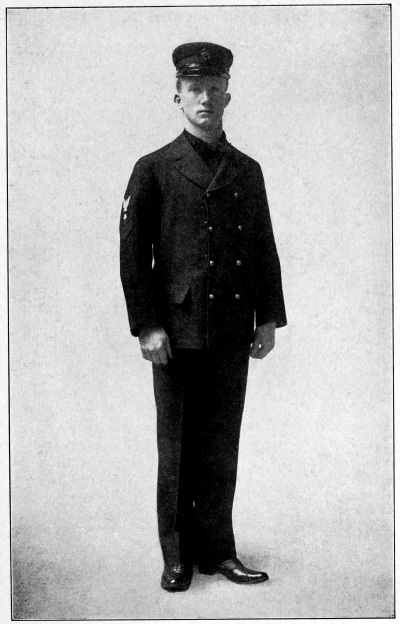
U. S. Navy. Chief petty officer Blue working dress uniform
Rank: Chief Master-at-Arms
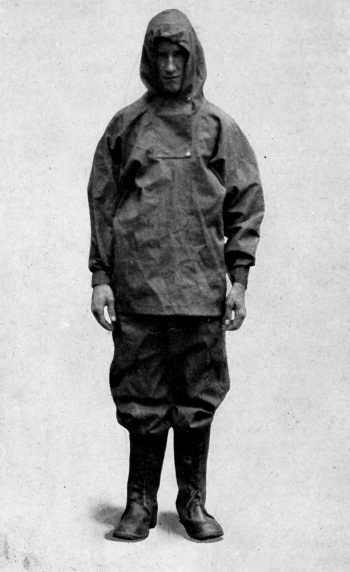
U. S. Navy. Winter uniform
Wind and rain proof uniform worn by crews of U. S. Destroyers and Patrol Vessels during winter in northern waters
Winter Service Uniform.—At various times in the past when vessels of the Navy have been detailed for long periods of duty in the Arctic regions or where the weather conditions are particularly cold and severe, special uniforms have been authorized to be worn by the officers and enlisted men making up the personnel of such expeditions. For the Arctic expeditions these special uniform suits have usually been made of fur similar in pattern to the garments worn by the natives of the Far North.
The conditions under which the Destroyer Flotillas and Patrol Squadrons must operate off the coasts of Northern Europe during the severe weather of the winter months has necessitated the design of a special uniform for their crews. This winter storm uniform consists of heavy waterproof boots of the style known as “Arctics”; wind and rain proof trousers of heavy material; an overshirt of specially heavy wool with a hood; and a wind and rain proof coat with a hood to be worn over all.
While the appearance of a sailor dressed in this uniform is very different from that which we are accustomed to see upon the decks of the trim and smart vessels of the United States Navy, it is made necessary by the severe conditions of the service demanded and adds to efficiency in that it serves to keep the men dry and warm and able to perform their duties when the little vessels of the patrol fleet are swept by heavy seas and chilling gales.
Dungaree suit consists of a jumper and trousers made of blue denim drill.
Gloves for enlisted men are made of dark gray wool.
Bathing trunks of dark blue material are required to be worn by all men bathing “over the side” from a ship.
Pajamas consisting of a shirt and trousers of light weight white cotton drill are provided for enlisted men.
Overcoats for chief petty officers are of dark blue cloth, double breasted, buttoning to the neck with two rows of large black buttons, with a rolling collar, two vertical breast pockets and two lower side pockets with flaps. For all other enlisted men (except bandsmen) the overcoat is the same style but reaches only to the tips of the fingers when the arms hang at the sides.
Uniforms for bandsmen of the navy consist of a blue dress coat, white dress coat, sky-blue trousers, white trousers, blue cap, and white cap, all of the same design and cut as those for the enlisted men of the U. S. Marine Corps (described in Chapter VI) except that navy buttons are worn instead of marine corps buttons, a lyre device is worn on the cap, instead of the marine corps device, and the navy “rating badges” are worn by the bandmaster and first musicians instead of the chevrons worn by the noncommissioned officers of the marine corps.
The overcoat for bandsmen is of sky-blue cloth, double-breasted, buttoning to the neck with two rows of gilt navy buttons, lined with red flannel, falling collar five inches deep, cut to reach about six inches below the knee, and provided with a circular cape of the same color.
The rank and special duty (or “rating” as it is styled in the navy) of the petty officers of the first, second and third classes, as given in the table on page 38, is shown by a “rating badge” which is worn on the right sleeve between the elbow and the shoulder by petty officers of the Seaman Branch and in the corresponding position on the left sleeve by all other petty officers.
The rating badge consists of a spread eagle above a “specialty mark” showing the duty and a chevron showing the “class” or rank of the wearer. These badges are three and one-quarter inches broad.
The chevrons are made of stripes of cloth three-eighths of an inch wide, placed one-quarter of an inch apart as shown in the illustrations. A peculiarity of the navy chevrons is that they are worn with the apex of the angle formed by the two bars of each stripe pointing down instead of up as in the army and marine corps.
The specialty marks are placed in the center of the angle formed by the upper stripe of the chevron and the spread eagle is placed just above the specialty mark.
For use on blue clothing the chevrons are made of scarlet cloth and the eagle and specialty marks are embroidered in white; while for white clothing the chevrons are of blue cloth and the specialty marks and eagle are embroidered in blue.
For petty officers holding three consecutive good-conduct badges (namely, the good-conduct medal and two bars, representing three full enlistments served with efficiency and good conduct) the chevrons are made of gold lace braid and the eagle and specialty marks are embroidered in silver.
The specialty marks indicating the different ranks or “ratings” are, as shown in the illustrations, as follows:
NUMBER OF FIGURE IN ILLUSTRATION. RANK OR “RATING.”
1. Master-at-arms.
2. Boatswain’s mate, or coxswain.
3. Quartermaster.
4. Blacksmith, or shipfitter.
5. Sailmaker’s mate.
6. Printer.
7. Carpenter’s mate, plumber and fitter, painter.
8. Turret captain.
9. Gunner’s mate.
10. Storekeeper.
11. Yeoman.
12. Electrician.
13. Machinist’s mate, boiler maker, water tender, coppersmith, oiler.
14. Hospital corps (red cloth Geneva cross).
15. Bandmaster, musician.
16. Commissary steward.
17. Ship’s cook and baker.
18. Bugler, worn on the left arm above the elbow.
Petty officers detailed to duty in the Naval Aviation Corps wear rating badges of the same design as those worn by other petty officers, the number of stripes in the chevron showing the class, three stripes with an arc of a circle above for chief petty officer class, three stripes for first class, two stripes for second class and one stripe for third class, and the specialty marks showing the various classes of duty being as follows:
Quartermaster Aviation A steering wheel with one eagle’s wing to the right of it and one to the left of it.
Machinist’s Mate Aviation A two-bladed airplane propeller with one eagle’s wing to the right of it and one to the left of it.
Carpenter’s Mate Aviation Two axes crossed with one eagle’s wing to the right of it and one to the left of it.
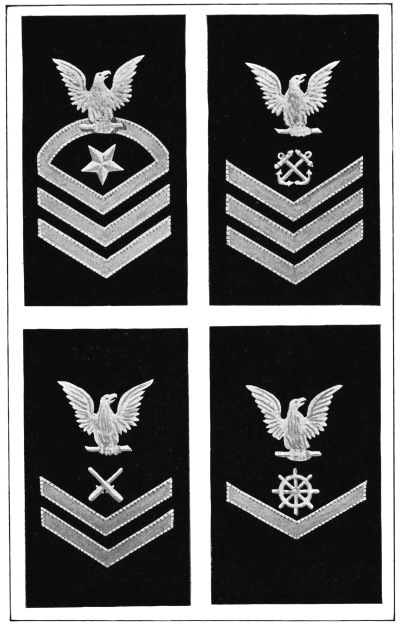
U. S. Navy. Petty officers’ rating badges worn on sleeves of uniform coats, overshirts and jumpers. The special detail is indicated by the specialty mark worn in the angle of the chevron
1. Chief Master-at-Arms 2. Boatswain’s Mate, First Class
3. Gunner’s Mate, Second Class 4. Quartermaster, Third Class
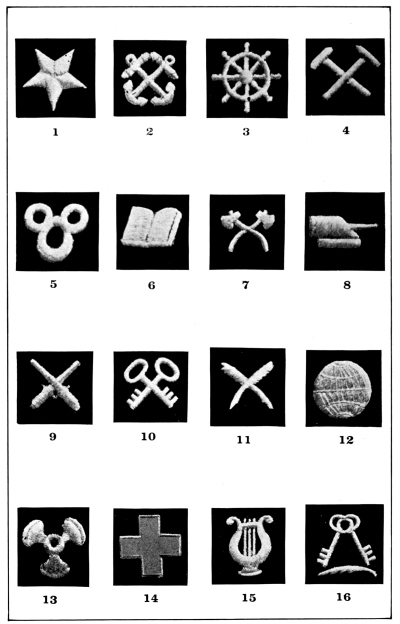
U. S. Navy Petty officers’ specialty marks
These specialty marks measure 2½ inches from tip to tip of the eagle’s wings.
“Distinguishing marks” are worn by certain enlisted men to indicate special duties or stations to which they are detailed or to show certain qualifications. These marks are embroidered in white silk for blue clothing and in blue silk for white clothing and, as illustrated, are as follows:
NUMBER OF FIGURE IN ILLUSTRATION. DUTY OR STATION.
19. Seaman gunner mark, worn below the chevron by petty officers and in place of the rating badge by other men who have qualified as seaman gunners.
20. Gun captain mark, worn by men detailed by the commanding officer as gun captains, on the opposite arm to that on which the rating badge is worn.
21. Gun pointer mark, worn by men who have qualified as gun pointers on the opposite arm to that on which the rating badge is worn; gun pointers of the first class wear the mark with a star above it (Figure 22).
23. The Navy “E,” worn by members of the turret, gun and torpedo crews that make exceptionally high scores on record target practice, and men of the Engineer Division of the ship winning the trophy in the annual engineering competition. Expert rifleman’s mark, worn by enlisted men of the Navy, Marine Corps and Naval Militia qualified as expert riflemen on the left sleeve midway between the wrist and the elbow, and consisting of a square, one inch, containing target rings three-quarters of an inch and one-half of an inch in diameter and a bull’s-eye one-quarter of an inch in diameter, embroidered in blue on white for white clothing, in white on blue for blue clothing and in gray on khaki for khaki-colored clothing.
24. Radio operator, worn by electricians who are radio operators below the rating badge.
25. Torpedoman mark, worn by gunner’s mates who have qualified in torpedoes and mines below the rating badge.
7. Shipwright’s mark, worn by shipwrights in the same place as the rating badge.
14. Hospital Corps mark (the Geneva cross), worn by hospital apprentices on the left arm above the elbow.
17. Ship’s cook of the third and fourth classes, bakers of the second class and officers’ stewards and cooks, worn on the left arm above the elbow.
3. Signalmen, first and second class, worn on the arm above the elbow in place of the rating badge.
15. Musician’s mark, worn by musicians of the first and second class on the left arm above the elbow.
26. Ex-apprentice mark, worn by all men who have passed through the rating of apprentice in the navy; worn on the front of the overshirt and jumper just below the neck opening and on the sleeve of petty officers’ coats on the same side as the rating badge, between the wrist and the elbow.
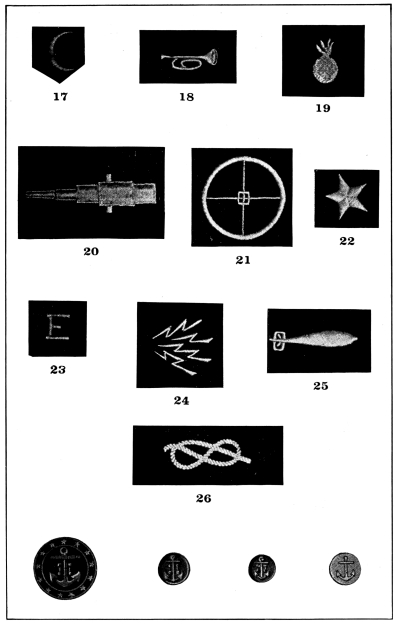
U. S. Navy Enlisted men’s specialty marks, distinguishing marks and buttons
The Branch of the Navy to which all enlisted men not petty officers belong is shown by a branch mark, a stripe of braid three-eighths of an inch wide around the top of the sleeve at the shoulder seam.
For the Seaman Branch the branch mark is worn on the right arm, in blue for white clothing and white for blue clothing; for the artificer branch, engineer force, the branch mark is worn on the left arm in red. Hospital apprentices, shipwrights, musicians, buglers, commissary and messmen wear no branch mark.
Service stripes.—To show the number of enlistments that a man has served all enlisted men who have served one or more enlistments of three or four years wear service stripes, three-eighths of an inch wide, diagonally across the outer side of the left sleeve of the blue coat, white coat, overshirt or jumper. These service stripes are of scarlet cloth on blue clothing and of blue cloth on white clothes. One service stripe is worn for each enlistment of three or four years that the wearer has completed. For petty officers who hold three consecutive good-conduct badges the service stripes are made of gold lace braid.
Neckerchief.—The neckerchief worn by enlisted men with the blue overshirt and white dress jumper is of black silk thirty-six inches square, worn around the neck under the collar, tied in a square knot just below the collar opening in front.
Leggings.—For duty with landing forces ashore enlisted men of the navy wear khaki-colored canvas leggings.
ENLISTED MEN OF THE NAVAL MILITIA
Enlisted men of the Naval Militia wear the same uniforms as those prescribed for the regular Navy with the addition of the distinguishing mark for the Naval Militia, consisting of a vertical foul anchor enclosed in a diamond shaped lozenge. This mark being embroidered in white on a blue ground for blue clothing and in blue on a white ground for white clothing. It is worn on overshirts and jumpers just below the neck opening and on coats (except overcoats) on the same sleeve as the rating badge midway between the wrist and the elbow.
The cap ribbon worn by enlisted men of the Naval Militia bears the words “Naval Militia” followed by the authorized abbreviation for the state or territory to which they belong thus, for the Naval Militia of Massachusetts,
NAVAL MILITIA, MASS.
When United States ships are assigned for the use of the Naval Militia of any state such men of the organization as the Governor of the state may designate may wear on their cap ribbons the name of the ship so assigned with the distinguishing mark for the naval militia before and after the name of the ship.
The Naval Reserve enlisted men wear the same uniform as that prescribed for the various grades of the regular service, with the exceptions that all gilt buttons worn on the uniforms are of the special design prescribed for the Naval Reserve, that is, having upon them in relief a plain vertical anchor surrounded by the letters U. S. N. R., and the cap ribbons bear the words
U. S. NAVAL RESERVE FORCE
The Navy Sword.—The sword carried by all officers of the Navy has a bright steel cut and thrust blade from twenty-six to thirty-two inches long depending upon the height of the wearer, having a half-basket hilt and a grip covered with white shark skin wrapped with a spiral of gilt wire, the hilt being of brass gilded. It is carried in a scabbard of black leather with gilded tip ferrule and gilded straps and rings for attaching the slings which attach it to the belt.
The belt for naval officers is closed at the front and center by a circular belt plate ornament with a raised design of a wreath enclosing a circle of rope one inch in diameter inside of which is an American eagle on a horizontal anchor above a pyramid of cannon balls, the space between the rope circle and the eagle and anchor design having thirteen stars in a circle.
Identification tag.—Every officer and enlisted man of the U. S. Navy on active duty is required to wear an identification tag, which consists of an oval plate of monel metal, one and one-quarter inches by one and one-half inches in size, suspended from the neck by a monel metal wire encased in a cotton sleeve.
On one side of the tag is etched the finger print of the right index finger of the officer or man wearing the tag and on the other side, for officers the letters “U. S. N.,” the surname and initials, the rank and the date of commission or appointment; for enlisted men the letters “U. S. N.,” the surname and initials, the month, day and year of enlistment expressed in numerals thus “1.5.1916.” and the month, day and year of birth similarly expressed.
A copy of the finger print of each officer and enlisted man in the Naval Service is also kept on file at the Bureau of Navigation of the Navy Department in Washington, D. C.
These tags are for the purpose of identification in case of death or wounds so serious as to produce unconsciousness.
UNIFORMS OF ENROLLED WOMEN, U. S. NAVAL RESERVE FORCE
Women are enrolled in the U. S. Naval Reserve Force in the ratings of Chief Yeoman, Yeoman, First, Second or Third Class, and Landsman for Training, and assigned clerical duties on shore. They are required to wear blue or white uniforms consisting of a Norfolk style coat and tailor-made skirt of blue navy serge or white drill, a white beach cloth shirt-waist and black navy neckerchief, black hose and shoes with blue skirt and white ones with white skirt, and a flat brimmed blue felt or white straw sailor hat with the regulation Naval Reserve cap ribbon.
The coat has a rolling lapel collar, four medium navy gilt buttons down the front and three small ones on each cuff, two-inch vertical plaits from shoulders to lower edge at front and back, a one and three-quarter inch belt, and on each side below the waist a pocket with a buttoned flap.
The skirt reaches to within eight inches of the floor and has on each side of the front a pocket with buttoned flap.
The waist is plain tailored, opens down the front with collar to admit of being worn buttoned high or folded back, and has one plain patch pocket on the left side.
Rating badges for Chief Yeoman and for Yeoman, First, Second or Third Class are worn on the left sleeve above the elbow; on the blue coat the chevrons are scarlet, eagles and specialty marks white, and on the white coat chevrons, eagles and specialty marks are all blue.
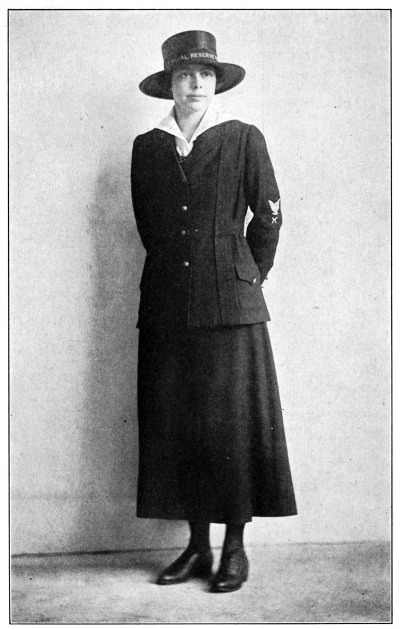
Photo. Harris & Ewing, Washington, D. C.
Enrolled Women, U. S. Naval Reserve Force. Blue service uniform
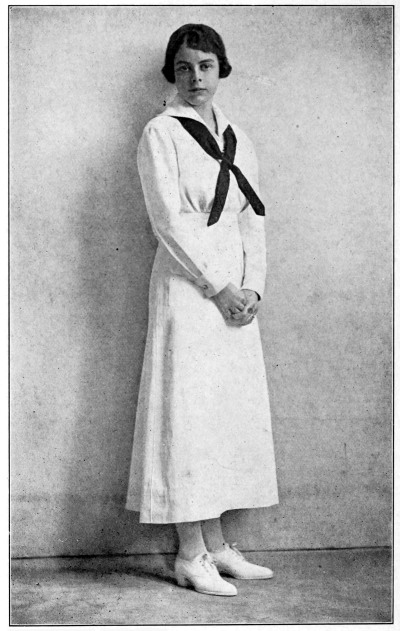
Photo. Harris & Ewing, Washington, D. C.
Enrolled Women, U. S. Naval Reserve Force. White service uniform
SEAL OF THE U. S. MARINE CORPS