Chapter XI · UNIFORMS AND INSIGNIA OF FOREIGN ARMIES AND NAVIES (continued 2)
Reading edition
Engineer officers Black.
Gunnery officers Dark gray.
Torpedo officers Dark gray.
Medical officers Dark blue.
Naval Constructors Black.
Paymasters Light blue.
Legal Department officers Red.
Pilot officers Light gray.
Dockyard Construction officers Black.
The insignia worn upon the cap for commissioned officers is a gold wreath surrounding a circular emblem made up of concentric circles of red, white and black (from the center out) and surmounted by the German Imperial crown. This medallion is also worn upon the center of the front of the enlisted men’s flat caps.
These distinctive corps colors are also worn as the “facings” on the full dress uniforms, that is on the lapels of the coat and on the three-pointed straps on the cuffs, and around the band of the service cap, blue and white, except that pilots wear a gold band on the cap.
Warrant officers in the German Navy wear a dress uniform and a service uniform both blue and white similar in design to that worn by commissioned officers, with their distinctive rank stripes on the sleeves and on the shoulder straps.
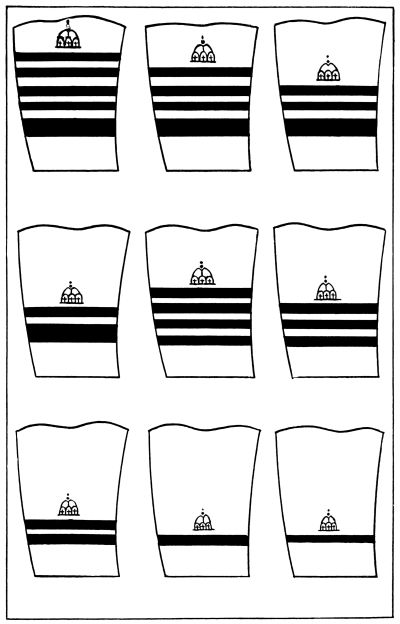
German Navy. Officers’ sleeve decorations indicating rank
1. Grand Admiral 2. Admiral 3. Vice Admiral
4. Rear Admiral 5. Captain 6. Commander
7. Senior Lieutenant 8. Junior Lieutenant 9. Sub Lieutenant
In the German Navy there is a rank intermediate between that of Warrant officers and Chief Petty officers which has no counterpart in the American Navy. This is called Feldwebel. His dress uniform is a blue cap; a short dark blue jacket with rolling lapel collar and a row of small gilt buttons down each side of the front; a blue waistcoat with gilt buttons, and plain dark blue trousers; and his service uniforms, both blue and white, are similar to those of other officers. On the cuffs of the dress jacket he has three narrow gold stripes around the sleeve close together and below them three similar stripes around the sleeve and continuing down the outer seam to the bottom edge of the sleeve, with a vertical strap of dark blue cloth across the stripes with six small gilt buttons on it.
The Bandmaster is a Warrant officer and the distinctive mark of his rank is a gold lyre on the center of his shoulder straps.
The uniforms of the enlisted men are the dress or “parade” uniform, the service uniform and the white uniform.
The dress uniform consists of a sailor flat cap; a white sailor shirt with wide dark blue falling collar; the dark blue dress jacket worn with the collar of the shirt outside of it, and dark blue trousers, the trousers being cut without the wide “spring” or flare at the bottom of the legs so common in other navies.
The blue cap is similar to that worn in other navies but the crown is higher in the front than in the back, which tends to give it a military appearance. The name of the ship or station is worn upon a cap ribbon around the band of the cap, the ends of the ribbon being tied at the back and allowed to fall down the back in streamers. Upon the front of the crown at the center is the red, white and black medallion, the colors of Germany.
The collar of the shirt has three rows of narrow white braid around the edges as in the American and British navies.
The service uniform consists of the blue cap; a dark blue shirt similar to that worn in the American Navy, and dark blue trousers.
The white service uniform is of the same design but of white duck instead of dark blue cloth or flannel.
The rank or rating and the branch of specialty is indicated by distinctive marks worn upon the left sleeve between the elbow and the shoulder. Some of the principal of these marks are:—
Feldwebel A vertical gold anchor with a gold crown above it.
Chief Quartermaster Two gold anchors crossed with a crown above them. (If certified he wears a red chevron of one stripe below the mark.)
Quartermaster Two gold anchors crossed.
Chief Boatswain’s Mate A vertical gold foul anchor with a crown above it.
Boatswain’s Mate The same without the crown.
Chief Gunner’s Mate A vertical foul anchor with two cannon crossed upon it surmounted by a crown, in gold.
Gunner’s Mate The same without the crown.
Chief Machinist’s Mate A vertical anchor with a cog wheel on the shank and a crown above it, in silver.
Machinist’s Mate The same without the crown.
Chief Stoker’s Mate A vertical anchor with two shovels crossed on the shank and a crown above it, in silver.
Stoker’s Mate The same without the crown.
Chief Torpedoist’s Mate An anchor and a mine crossed with a crown above it, in gold.
Torpedoist’s Mate The same without the crown.
Chief Radio Operator A vertical anchor with a crown above it, in gold, with a zig-zag of lightning in red across the shank of the anchor.
Radio Operator The same without the crown.
Telegraphist Two bars of forked lightning crossed, in gold.
Chief Signal Mate A vertical anchor with a crown above it, in gold, and two signal flags in red crossed on the shank of the anchor.
Signal Mate The same without the crown.
Drill Sergeant A vertical anchor with two rifles crossed on the shank and a crown above it, in gold.
Drill Corporal The same without the crown.
Leading Seaman A yellow chevron of one stripe, point down.
Bandsman, first class A chevron of two stripes with a curl at the point of the upper stripe and an anchor surcharged by a lyre above it, in gold.
Second Leader of Band The same with a crown above it.
Gun Captain, first class A flaming shell above a chevron of three stripes, point down, in red.
Gun Captain, second class The same but with two stripes in the chevron.
Gun Captain, third class The same but with one stripe in the chevron.
Machine Gun Captain The same without the chevron.
Range Finder A triangle with a flaming shell in the center and a range finding instrument above it, in red.
Submarine Mine Planter A submarine mine in red.
(The Gun Captains, Range Finders, and Mine Planters of the Marine Artillery, who man the coast defense guns, wear the same rating marks in yellow. In Germany the coast defenses, forts and batteries are manned by the Navy and not by the Army as in the United States.)
The overcoat worn by enlisted men of the German Navy is a short double breasted pilot coat with turn-down lapel collar and a double row of gilt service buttons down the front.
For service ashore in landing parties and when on duty at the coast forts in hot weather or tropics, a khaki helmet is worn instead of the white hat with white uniforms and khaki canvas leggings are also worn. For landing parties as infantry or artillery black leather boots are worn with the blue uniforms, the trousers being tucked inside of the boots.
Uniforms of German Marines
The German Marines are a part of the Navy and are divided into Marine Infantry and Marine Field Artillery. They perform duties similar in many respects to the duties of the United States Marine Corps.
The full dress uniform of the officers consists of a black shako with a large red plume which falls over the front down to the visor; a blue single-breasted tunic with standing collar; epaulets without bullion fringes; breeches of the same color, and black boots. The front edges of the coat and the tops and bottoms of the collar are piped with white cloth and the cuffs are of white cloth with a vertical strap.
The service uniform is of gray cloth and consists of a bell-crowned cap with a white band and sloping visor of black leather; a single-breasted coat with a standing turn-over collar closed by buttons down the front concealed by a fly; breeches, and leggings and shoes of tan leather. The coat has a pocket with flap on each side below the waist. Shoulder straps are worn with the service coat.
The rank of the officer is indicated by insignia worn upon the epaulets and shoulder straps, the insignia being the same as for the German Army officers.
For hot weather a uniform of khaki cotton drill is provided, the general style being the same as for the cloth service uniform except that the head dress is a khaki-colored helmet.
The dress uniform of the enlisted men is similar in color and design to that worn by the officers, the epaulets being replaced by shoulder straps of white cloth. The service uniform of the enlisted men is of the same design as that for officers except that the coat is closed by a single row of gilt buttons and the cap has no visor.
Uniforms of the German Army
The peace time uniforms of the various corps and arms of the German Army present a great variety, the traditions of the services of the former separate kingdoms and political divisions that are now united to form the German Empire being preserved in many instances in the color and design of the uniform or in the bright metal decorations and insignia.
Many of these uniforms are gaudy in color and richly decorated with gold, silver and colored cloth and braid ornaments.
The facings colors worn upon the collars and cuffs and as pipings on the coats and trousers often vary with the individual regiments, and the headdress is in many shapes and colors.
The Line Infantry wear a black helmet with brass spike, Prussian eagle and scale chin strap; a blue single-breasted tunic with gilt buttons, and dark gray trousers; the facings and piping being red, but the infantry regiments of Saxony, Bavaria, Wurttemburg and some other states have variations from this in both color and design.
The Uhlans wear the Czapka helmet; a blue double-breasted tunic with a red plastron front and red facings; and dark gray trousers; the Prussian Hussars wear a black fur busby with heavy gilt decorations and a bag of the distinctive color of the facings, a single-breasted blue tunic heavily decorated with white braid, loops and frogs; a blue pelisse with white braid decorations slung from the left shoulder; dark gray tight fitting breeches with white braid decorations, and black Hessian boots with embroidered tops.
The Prussian Cuirassiers wear white uniforms with black hip boots and cuirasses of brass or iron, the iron being black for some regiments and bright for others.
The Saxon Jager regiments wear uniforms of green cloth and a cap with a feather plume.
The Prussian Dragoon regiments wear helmets with drooping white plumes, light blue jackets, dark gray breeches.
The Field Artillery regiments usually wear black helmets with a spike ending in a brass ball; dark blue coats with gilt buttons, dark gray breeches and black boots.
There are many other distinctive uniforms and the varied colors, bright trappings and decorations and waving plumes made a peace time assemblage of German troops of all arms a most imposing sight; but early in the present century the leaders realized that while all this gaudy panoply and pomp added to the attractiveness of the service, kept alive the traditions of the past, and aided in holding the esprit de corps, it would not do for service on the modern battlefield, where the troops must be as inconspicuous as possible to avoid annihilation under the drum fire of artillery and the rapid fire of machine guns.
As a result a field service uniform of a dull gray color was adopted for all arms but it was not generally issued to the troops until just before the opening of the present world war.
The German officer’s field service uniform consists of a gray single breasted sack coat with a standing turn-over collar; breeches of the same color and black or tan leather boots. With this uniform the old bright helmets are worn with a gray cover to make them less conspicuous, or in many cases a gray cap with sloping visor is worn. The buttons are of gilt allowed to become dull in the field, in some cases of leather or bone, and in other cases the coat is closed by buttons concealed beneath a fly.
The corps and regimental colors are worn in small patches on the collar at each side of the neck opening and also as cuff stripes in some corps. In some corps the distinctive color is also worn around the cap band.
The rank of the German officer is indicated by the braid and insignia on flat shoulder straps covered with braided cord. The shoulder strap for Field Marshal and for General officers is covered with a plaited knot made up of five loops of sets of three cords, the two outer cords being gold and the central cord being silver interwoven with the imperial colors in silk. The shoulder straps for Field officers (Colonels, Lieutenant Colonels and Majors) are of the same design except that the cords are in sets of two, both of silver interwoven with the silk colors. The shoulder straps of the company officers are covered with parallel rows of silver cord interwoven with the silk colors.
The insignia of rank worn upon the shoulder straps on top of the cord decorations are diamond shaped ornaments of gilt metal, and although they do not have the conventional shape of a star they are called stars in the German service.
These insignias are as follows for the various grades of rank:—
Field Marshal Two gold batons crossed.
Colonel General Three stars.
General Two stars.
Lieutenant General One star.
Major General No insignia, the shoulder strap knot being plain.
Colonel Two stars.
Lieutenant Colonel One star.
Major No insignia.
Captain Two stars.
First Lieutenant One star.
Second Lieutenant No insignia.
There is no corresponding rank in the armies of other nations for the German rank of Colonel General, and in the German Army there is no rank of Brigadier General.
In the German Army a Feldwebel is an officer between the commissioned officers and the enlisted men, his rank corresponds to that of the Warrant Officers in the United States Navy and Marine Corps. He wears a double cord upon the shoulders and his rank insignia is a circular medallion with a Prussian eagle on each side of the collar.
The German officer’s overcoat is a heavy ulster of the same gray color as the field uniform; it is double-breasted and the rank of the wearer is indicated by the shoulder straps as in the case of the service coat.
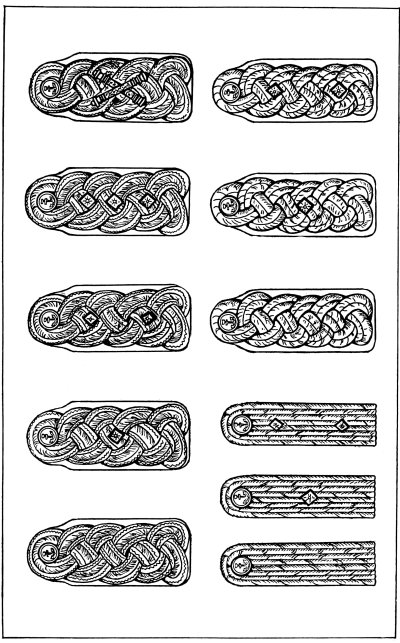
German Army. Officers’ shoulder strap insignia indicating rank
1. Field Marshal 6. Colonel
2. Colonel General 7. Lieutenant Colonel
3. General 8. Major
4. Lieutenant General 9. Captain
5. Major General 10. First Lieutenant
11. Second Lieutenant
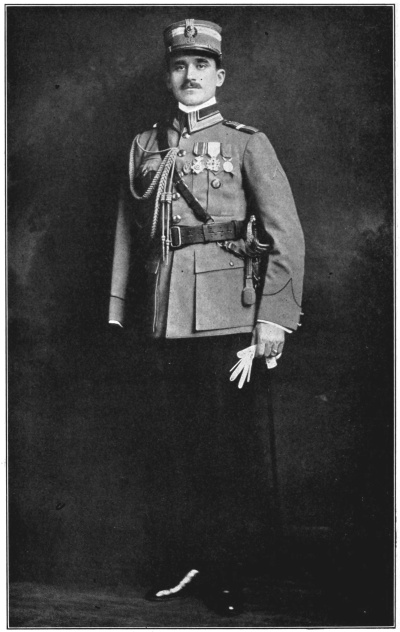
Photo. Harris & Ewing, Washington, D. C.
Roumanian Army. Officers’ service uniform
The enlisted men of the German Army wear a service uniform of the same color and general design as that of the officers. The ordinary field cap is a round loose crowned cap without visor, the coat is a single breasted sack with a standing turn-over collar, and the trousers are of the same gray cloth as the coat. Boots of black or tan leather are worn.
Noncommissioned officers wear a stripe of braid around the cuff and the front edges of the collar at the neck opening and for a short distance along the top of the collar back from the neck opening. A Sergeant Major wears a stripe of narrow braid above the noncommissioned officer’s sleeve stripe.
The enlisted men’s overcoat is a heavy ulster buttoning to the neck with a standing-falling collar, the rank of noncommissioned officers being indicated by the sleeve braid as for the service coat and by patches of color at the front of the collar.
Steel trench helmets are worn in the trenches by both officers and men, this helmet being larger than that worn by the American, British and French troops and having a flaring extension at the rear for the protection of the neck.
Uniforms of the Roumanian Army
The dress and service uniforms of the Roumanian Army are very similar to those of the Austrian Army and the field uniform is of khaki-colored cloth with the facings, pipings and rank insignia of the dress uniforms added.
Foreign War Decorations and Medals
The multiplicity of medals and decorations in all foreign countries makes it very difficult to distinguish one from another, especially since the designs and ribbons used by different countries are frequently quite similar. To describe all of these decorations is not practicable within the scope of this volume, but a few of the ones which are classed as distinctively war decorations are included as they are the ones most commonly seen and talked about.
French War Medals.—The French decorations given for war service are the Legion d’honneur (Legion of Honor), the Medaille Militaire (Military Medal) and the Croix de Guerre (War Cross).
The Legion of Honor was inaugurated by Napoleon I at Les Invalides on July 15, 1804, and the medals and ribbons were bestowed upon both soldiers and civilians. The medal consists of a white star with five double rays; the center of the star, surrounded by a wreath of oak and laurel, bearing on the obverse the head of the Republic surrounded by the words, “République Française, 1870,” and on the reverse two tri-colored flags with the words, “Honneur et Patrie.” Above the star is a small gold wreath and the ribbon is red.
The Medaille Militaire, created by Prince Louis Napoleon in January, 1852, may be bestowed upon Generals and Admirals who have been ministers of the state cabinet or commanders in chief, commanders of Army Corps who have presided over the Superior Council of War and the greatest of the war leaders of France. It is of silver, twenty-eight millimeters in diameter, surmounted by a trophy of arms in silver and suspended by a yellow ribbon with green stripes at the edges. The obverse of the medal bears the head of the Republic surrounded by the words, “République Française, 1870,” and the reverse the words, “Valeur et Discipline.”
The Croix de Guerre, established by law on April 8, 1915, is awarded to soldiers and sailors of all ranks in the service of France and her Allies who perform individual acts of gallantry in operations against the enemy during the present war and are mentioned for such acts in official despatches. The cross is of Florentine bronze, four-armed with two crossed swords between the arms, and is surcharged at the center with a medallion bearing the head of the Republic surrounded by the inscription “République Française” on the obverse and the dates “1914-1915” on the reverse side. The ribbon is green with seven narrow red stripes.
British War Medals.—In Great Britain there are three orders which may be bestowed upon officers by the King—the Order of the Bath, the Order of St. Michael and St. George and the Distinguished Service Order; five crosses or medals which may be awarded to officers or enlisted men of the land forces—the Victoria Cross, the Military Cross, the Distinguished Conduct Medal, the Military Medal and the Meritorious Service Medal; and four crosses or medals which may be bestowed upon officers and enlisted men of the sea forces—the Victoria Cross, the Distinguished Service Cross (corresponding to the Military Cross), the Conspicuous Gallantry Medal (corresponding to the Distinguished Conduct Medal), and the Distinguished Service Medal (corresponding to the Military Medal).
Of all of these the one most highly prized by officers and enlisted men alike both on sea and land is the Victoria Cross, which is awarded individually to an officer or enlisted man of the Navy or Army for some signal act of valor and devotion to his country in the presence of the enemy and during action. Whenever it is possible to do so the V. C. is presented in person by the sovereign.
The Victoria Cross.—This decoration consists of a bronze cross pattée with raised edges and it was instituted by Queen Victoria in 1856 during the Crimean War. On the obverse of the cross at the center it is surcharged with a Royal crown surmounted by a lion passant gardant and below the crown there is a semicircular scroll bearing the words, “For Valour.” On the reverse side is engraved the date of its bestowal. The cross is suspended from a ribbon by means of a bar clasp ornamented with laurel leaves and a link in the shape of the letter “V,” and the name, rank and regiment or ship of the recipient is engraved on the reverse side of the clasp. The ribbon is red for the Army and blue for the Navy.
The Distinguished Service Order.—This order was established in 1886 to reward officers of the military and naval services for meritorious or distinguished service in the field before the enemy. It is a gold cross pattée convexed, enamelled white and edged with bright gold. At the center on one side is a wreath of laurel enamelled in green surrounding the Imperial crown enamelled in red, and on the other side at the center a similar wreath surrounding the Royal cypher “G.R.” The ribbon is red edged with blue.
The Distinguished Service Cross.—This is a plain silver cross pattée convexed. On the obverse at the center enclosed within a raised circle is the Imperial cypher “G.R.I.” surmounted by the crown, while the reverse side is plain. The ribbon is blue, white, blue.
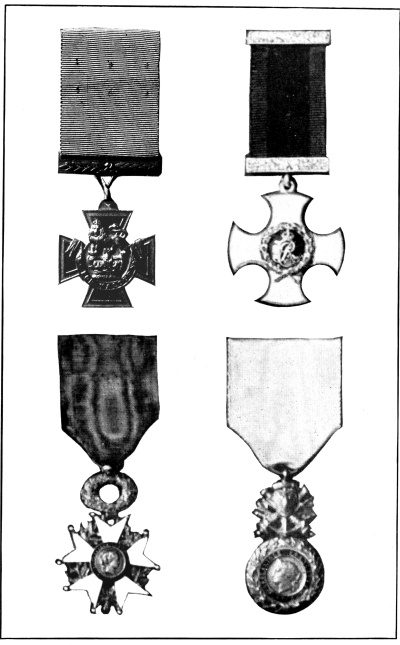
Copyright, Bailey, Banks & Biddle Co., Phila., Pa.
FOREIGN DECORATIONS AND MEDALS
1. Victoria Cross, Great Britain
2. Distinguished Service Order, Great Britain
3. Legion of Honor, France
4. Military Medal, France
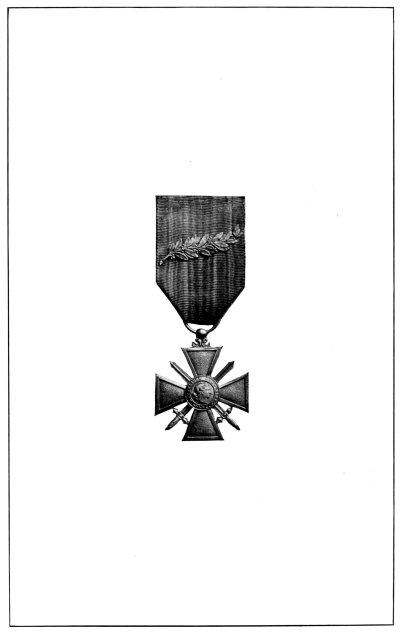
Croix de Guerre (War Cross), France
The Conspicuous Gallantry Medal.—The medal, established during the Crimean War, is of silver, with the effigy of the reigning sovereign on one side and a laurel wreath encircling the words, “For Conspicuous Gallantry,” surmounted by a crown on the other side. It is awarded to Warrant Officers, Midshipmen, Naval Cadets and Clerks in the Royal Navy for conspicuous gallantry in the presence of the enemy. The ribbon is blue, white, blue.
The Distinguished Service Medal.—This medal was established October 14, 1914, to reward petty officers and men of the Royal Navy and noncommissioned officers and men of the Royal Marines for courageous service in action during the present war. It is of silver and the obverse bears the effigy of King George V., while the reverse bears a wreath encircling the words, “For Distinguished Service,” surmounted by a crown. The ribbon is blue with two narrow white stripes through the center.
The Military Cross.—This decoration was established in December, 1914, to reward captains, lieutenants and warrant officers of the Army for deeds of valor or distinguished services in the present war. The cross is of silver and each arm bears the Imperial crown while at the center the Imperial cypher “G.R.I.” appears. The ribbon is white, blue, white.
The Military Medal.—This silver medal was authorized by the King in March, 1916, to be awarded to officers and enlisted men of the Army for conspicuous bravery in the field after recommendation by the commanding general in the field. Its obverse bears the Royal effigy and the reverse a wreath encircling the words, “For Bravery in the Field,” surmounted by a crown. The ribbon is blue, white, blue, with two narrow rod stripes through the central white stripe.
Belgian War Medals.—The decorations and medals awarded in Belgium for war service embrace the Order of Leopold, the Croix Militaire (Military Cross), the Medaille Militaire (Military Medal), the Ordre de la Courenne (Order of the Crown), the Order of Leopold II., the Belgian War Cross and the Medal of Queen Elizabeth.
The Order of Leopold.—This order was instituted by King Leopold I. in 1832, to “reward services rendered to the country.” It is only bestowed upon officers of high rank except in very exceptional cases. It consists of a white enamelled Maltese cross resting upon a green wreath of oak and laurel, surmounted by two crossed swords and a Royal crown. On the obverse at the center is a gold lion rampant on a black circular ground surrounded by the words, “L’Union fait la force.” The color of the ribbon is Royal purple.
The Belgian War Cross.—This cross is made of bronze and is modelled after the French Croix de Guerre. It is bestowed upon officers and men who are mentioned in General Orders for conspicuous acts of gallantry in the field during the present war. It was established October 25, 1915.
The Medal of Queen Elizabeth.—This medal, founded by resolution of September 9, 1916, is bestowed in the name of the Queen upon Belgians or foreigners who have devoted themselves to war work in Belgium.
Italian War Medals.—In Italy there are four Orders, the Order of Annunziata, the Order of St. Maurice and St. Lazarus, the Military Order of Savoy, and the Order of the Crown of Italy; and a number of military and naval medals, including the Sardinian Medal of the Crimea, the Order of the Thousand of Garibaldi fame, the Medal Commemorating the Unity of Italy, the Medal of the African Campaign, the Medal of the Extreme Orient and the Messina Medal, the latter given to those who distinguished themselves at the time of the Messina earthquake in 1908.
The Order of Savoy.—This military order was founded by Victor Emmanuel I. in 1815, to reward services in war on land and sea, and its cross is highly prized. It consists of a white enamelled cross resting upon an enamelled wreath and surmounted by a gold trophy of arms and flags. At the center is a cross surrounded by the words, “Al Merito Militare.” The ribbon is dark blue with a broad red stripe.
The Order of the Crown of Italy.—This order was created in 1868 by Victor Emmanuel II. to reward Italians and foreigners who render conspicuous services to Italy. The cross is of white enamel resting on gold scrolls and bears at the center an iron crown. It is awarded to officers of high rank for services in war.
The Medal for Military Valor.—This medal of two classes, gold and silver, corresponds to the French Croix de Guerre, and is awarded to soldiers and sailors for conspicuous acts of gallantry in action in the presence of the enemy. The gold medal is very rarely bestowed except as an honor to the memory of a soldier or sailor who has lost his life in the execution of the deed which the medal commemorates. The ribbon is blue.
Japanese War Medals.—Japan has several orders, the first and best known one being the Order of the Rising Sun, created in 1876. It is the great national Japanese order and is divided into eight classes, being awarded to officials, officers and rarely to civilians. In the military and naval services the first six classes are awarded to officers and the last two to enlisted men. The decoration consists of a medallion enshrined a cabochon garnet, placed in the center of eight white enamelled rays bezelled in gold and silver, and it is suspended from a gold paulownia leaf. The ribbon is white with narrow red edges.
The Order of the Golden Kite.—This order was founded by Emperor Mutsuhito in 1891, to reward acts of especial bravery in battle on land or sea. The decoration consists of a blue enamelled cross surrounded by clustered rays of red enamel, surcharged upon a silver sword from the guard of which rises a golden kite. The ribbon is green with a narrow white stripe near each edge.
In addition to the decorations of the orders there are a number of war medals in bronze awarded to officers and men for participation in the campaigns of the war with China and the war with Russia.
War Medals of Germany.—Germany has many orders and medals but the one best known as a war medal is the Iron Cross, founded in 1813, to be given to both soldiers and civilians for services to the country. It was revived in 1870, during the Franco-Prussian War. The decoration consists of a black iron cross pattée with a silver edge. At the center is the letter “W”, on the upper arm a crown and on the lower arm the date 1870 for the crosses awarded in that year and 1914 for those awarded in the present war. There are three classes in the order, the size of the cross varying with the class. The ribbon is black with white stripes near each edge for medals awarded to soldiers or sailors and the reverse for those awarded to civilians. The Iron Cross has been lavishly bestowed upon soldiers and sailors in the present war.
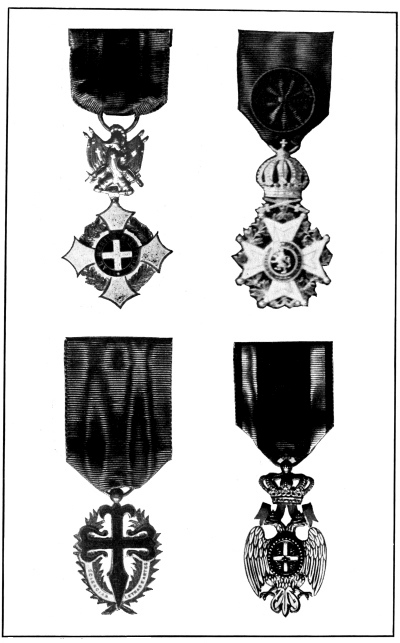
Copyright, Bailey, Banks & Biddle Co., Phila., Pa.
FOREIGN DECORATIONS AND MEDALS
1. Military Order of Savoy, Italy
2. Order of Leopold, Belgium
3. Order of St. James of the Sword, Portugal
4. Order of the White Eagle, Serbia
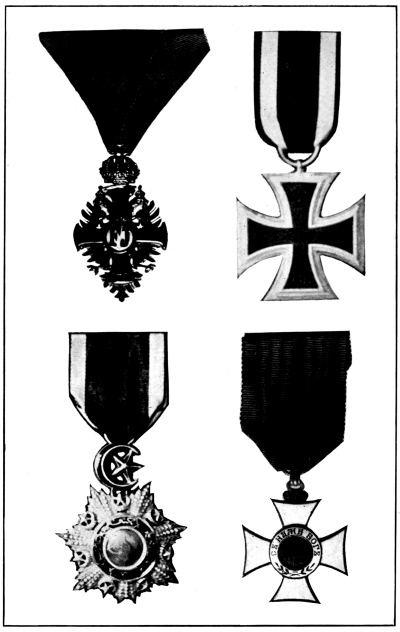
Copyright, Bailey, Banks & Biddle Co., Phila., Pa.
FOREIGN DECORATIONS AND MEDALS
1. Order of Francis Joseph, Austria
2. Iron Cross, Germany
3. Order of Medjidie, Turkey
4. Order of St. Alexander, Bulgaria
Austrian War Medals.—Austria has many orders and decorations, the Order of Francis Joseph being frequently conferred upon high officers for conspicuous service in war. In addition there are distinguished service medals of gold, silver and bronze, according to the importance of the service rewarded, gold and silver medals for bravery in action, and, for services in war alone, the War Decoration for officers and the War Medal for enlisted men.
Turkish War Medals.—Turkey has awarded many decorations and medals upon her own soldiers and sailors as well as upon those of her allies in different wars and upon citizens of other nations in peace time. The best known of her orders are the Order of the Medjidie and the Order of Osmanieh.
The Order of the Medjidie.—The decoration of this order consists of a seven-pointed star of cut silver, each point being composed of five rays. Between the points there are seven small crescents and stars and at the center on a gold background is the Sultan’s cypher surrounded by a circle of red enamel bearing an inscription in Turkish.

SEAL OF THE AMERICAN RED CROSS