Chapter IV · UNIFORMS AND INSIGNIA OF THE UNITED STATES ARMY
Reading edition
The uniforms for the officers and enlisted men of the United States Army are made of blue cloth for wear on dress occasions and of olive-drab colored material for wear on general service and field service occasions, and in addition the officers have uniforms of white linen or cotton duck for wear as a dress uniform in the tropics or during hot weather.
The service uniforms of the olive-drab color are made of woolen cloth or serge for cold weather and of cotton duck for hot weather, the latter being usually known as “khaki” uniforms, though the regulation color is of a somewhat darker shade than that universally known as “khaki.”
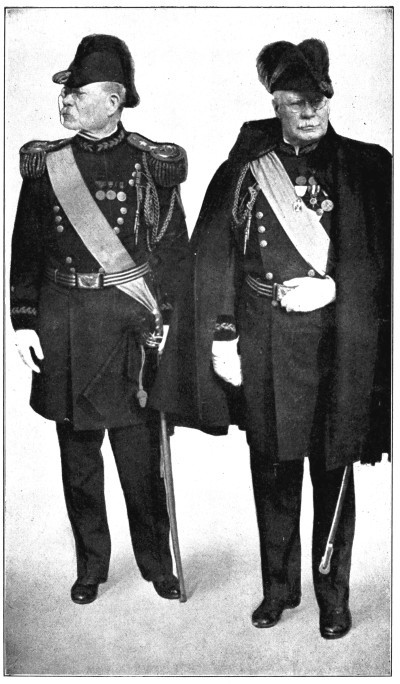
Copyright by Underwood & Underwood
General Tasker H. Bliss, Chief of Staff, U. S. Army, and Major General Hugh L. Scott, U. S. Army
It is a general rule that the officers serving with the troops in garrison or in the field must appear in the same style of uniform as that prescribed for the enlisted men.
During peace times officers serving on detached duty or in the offices of the Departments where there are no enlisted men on duty ordinarily wear civilian clothes, but in time of war all officers and enlisted men are required to wear the olive-drab service uniform at all times except when the full dress and dress uniforms are prescribed for some appropriate special occasion. Officers ordered on active field service are required to carry with them only the service uniforms.
UNITED STATES ARMY OFFICERS’ UNIFORMS
Commissioned officers of the Army are required to have complete outfits of service uniform (woolen olive-drab for temperate and cold weather and cotton olive-drab or “khaki” for the tropics and hot weather), dress uniform, full dress uniform, white uniform and special evening dress uniform, and for wear on certain occasions in the evening a mess dress uniform of blue and one of white is optional.
The occasions upon which these uniforms are usually worn are given in the regulations as follows:
TABLE OF OCCASIONS FOR UNIFORMS
Occasions. Uniform.
1. For habitual garrison wear at all times when under arms, and until sundown when not under arms. Service uniform, woolen or cotton depending upon the temperature.
2. For duty in the field.
3. For ordinary wear after retreat by officers not under arms. Dress uniform (in the Tropics and during hot weather in other places the white uniform may be worn).
4. For social uses before retreat.
5. When off post, except that when riding or taking physical exercise the service uniform may be worn.
6. When on duty with enlisted men for whom dress uniform is prescribed.
7. When on duty with enlisted men for whom mounted dress uniform is prescribed. Dress uniform (mounted).
8. When riding off the reservation.
9. State occasions at home or abroad. Full dress uniform.
10. When receiving the President of the United States.
11. When receiving or calling officially upon the President, sovereign or a member of the royal family of another country.
12. Ceremonies and entertainments when it is desired to do special honor to the occasion.
13. When full dress, dismounted, is prescribed for enlisted men.
14. Special or official functions of a general nature, when prescribed.
15. When on duty with enlisted men for whom full dress, mounted, is prescribed. Full dress uniform (mounted).
16. Social or official functions of a general nature when prescribed.
On the following occasions when officers are required to be mounted.
17. State occasions at home or abroad.
18. When receiving the President of the United States.
19. When receiving or officially calling upon the President, sovereign or a member of the royal family of another country.
20. Ceremonies or entertainments when it is desired to do special honor to the occasion.
21. Social or official functions of a general nature occurring in the evening. Special evening dress uniform.
22. For private formal dinners and other private formal social functions occurring in the evening.
23. For ordinary evening wear when desired.
24. For private formal dinners and other private formal social functions occurring in the evening. Blue mess dress uniform. In the Tropics and at other places in hot weather, the white mess dress uniform may be worn.
25. For ordinary evening wear when desired.
In the Tropics. White uniform.
26. Until sundown when prescribed.
27. For ordinary wear after retreat.
28. For official occasions, under arms, when prescribed.
In the United States in warm weather.
29. For ordinary wear after retreat.
30. For social use after retreat.
31. When off the post, or reservation.
Throughout the military and naval services of the United States when officers of the Army, Navy and Marine Corps appear together in uniform upon occasions of ceremony the following are the uniforms designated for each of the three services:
Designation of Uniform Composition of Uniforms for
Army Navy Marine Corps
Uniform A Full dress Special full dress, or white special full dress. Special full dress (with full dress trousers if in line with troops), or white special full dress.
Uniform B Dress Undress, or white undress. Undress or white undress.
Uniform C Full dress or evening dress. Full dress or Evening full dress; or evening full dress without swords or belts, and with blue caps; or dinner dress. Special full dress, or mess dress.
The service uniform consists of a single-breasted sack coat extending to one-third of the distance from the point of the hip to the knee, fitting tightly at the waist, with a standing collar, buttoned down the front with a row of five army buttons of dull finish bronze, having four patch pockets closed by pocket flaps buttoned with small size army buttons of bronze, one pocket on each breast and one on each side of the front below the waist, the shoulders having straps of the same material as the coat extending from the shoulder seam to the base of the collar secured with a small size bronze button at the collar end (the insignia of rank are worn on these straps), and the sleeves being trimmed with one row of half-inch braid three inches above the end of the sleeve, the braid being black for officers of the General Staff Corps and brown for all other officers; breeches of the same color and material as the coat; tan leather shoes and tan leather strap puttee leggings; the service hat, commonly known as the “campaign hat,” a wide brimmed drab felt hat worn to a peak at the center of the crown and having the officers’ hat cord around the base of the crown; or the service cap, a bell-crowned cap of the same material as the coat with a sloping visor of tan leather and a one-half inch tan leather chin strap above the visor secured by a bronze button at each end of the visor. Olive-drab woolen gloves are worn with this uniform when required. For garrison wear a white shirt, collar and cuffs are worn with this uniform, but in the field a flannel olive-drab shirt is worn.
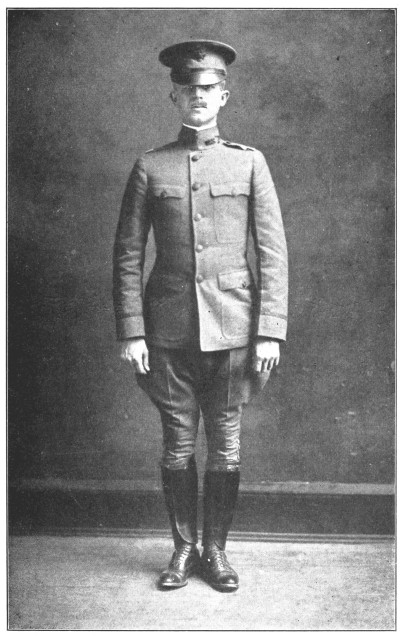
Copyright, Harris & Ewing, Washington, D. C.
U. S. Army officer Olive-drab service uniform
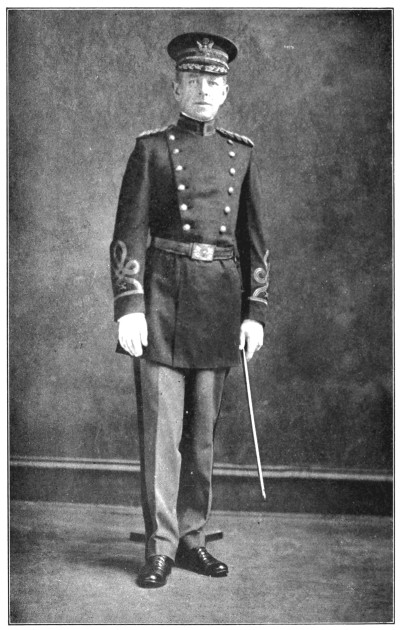
Copyright, Harris & Ewing, Washington, D. C.
U. S. Army. Officer, full dress uniform
Rank: Major, indicated by the three stripes in the sleeve decorations
Corps: Coast Artillery, indicated by the Corps insignia on the sleeves below the knot decoration
In garrison the saber is worn suspended by tan leather slings from a tan leather waist-belt, but for war service in the field the saber is worn with a wide tan leather belt having a suspender strap of tan leather worn from the right shoulder diagonally across the body to rings in the belt in front and in rear of the left hip. This belt was recently adopted from the British Army and is known as the “Sam Browne” belt. In the trenches and on ordinary duty in the field, officers of the Army wear the pistol belt on which the service automatic pistol is carried in a leather or webbing holster.
Insignia of dull bronze metal indicating the arm of the service or the staff corps to which the wearer belongs are worn upon both sides of the collar of the service coat and the insignia of rank in bright metal, silver or gold according to rank are worn upon each shoulder strap of the coat.
For certain drills and for service in the field the coat may be dispensed with, in which case the olive-drab flannel shirt is worn and the corps insignia and insignia of rank are then worn upon the collar of the shirt.
The hat cord worn on the service hat by General Officers is a double cord of gold bullion with acorns of the same material at the ends, and that worn by other commissioned officers is the same except that it has black silk intermixed with the gold.
Army Field Clerks and Field Clerks Quartermaster Corps wear hat cords made of black and silver twisted strands.
Members of the Officers Training Corps undergoing training in the camps provided for that purpose wear a hat cord made of red, white and blue twisted strands.
The overcoat is worn with the service uniform when necessary.
Mounted officers wear tan boots, spurs and drab leather riding gloves with the service uniform.
The dress uniform consists of a dark blue cloth, single-breasted coat extending to one-third of the distance from the point of the hip to the knee; blue cloth trousers (the shade depending upon the rank and corps of the wearer as later described); a bell-crowned cap, of dark blue cloth having the coat of arms of the United States embroidered in gold on the front of the crown at the center, with a sloping visor of black patent leather and a chin strap of gold braid three-eighths of an inch in width and eight inches long attached above the visor by a small gilt Army button at each end of the visor; black shoes; white shirt, collar and cuffs; and white gloves.
The dress coat for General officers (officers of the rank of General, Lieutenant General, Major General and Brigadier General) is double breasted with a standing and falling collar, two rows of buttons down the front as follows: for a General twelve buttons in each row arranged in three groups of four, for a Lieutenant General ten in each row arranged in three groups, the upper and lower groups of three and the central group of four, for a Major General nine in each row arranged in three groups of three each, and for a Brigadier General eight in each row arranged in groups of two; and the cuffs trimmed with three small size gilt army buttons on each back seam. The collar has on each side the proper insignia indicating staff corps, and on each shoulder there is a shoulder strap four inches long and one and seven-eighths inches wide with a border of raised gold embroidery three-eighths of an inch wide, the field of the strap being of dark blue cloth and bearing the stars indicating the rank of the General officer. These shoulder straps are worn with one of the sides touching the shoulder seam of the sleeve.
The dress coat for all other officers is a single-breasted sack coat of dark blue cloth, with a standing collar, closed in front by buttons or hooks concealed by a fly, having a vertical opening on each side at the hip six inches high, the collar, front edges, bottom edge of the coat and the vertical side openings being trimmed with lustrous black mohair braid one and one-half inches wide. On each shoulder a shoulder strap of the same size as that described for General officers is worn, the field of the strap being the distinctive color of the arm of the service to which the wearer belongs and having the insignia of rank embroidered upon it. On each side of the collar the corps insignia are worn to indicate the corps or branch of the service to which the wearer belongs.
The dress trousers for General officers (except Chief of Coast Artillery, Chief of Engineers, Quartermaster General and General Officers of the Quartermaster Corps) are made of dark blue cloth without stripes or other trimming. For the General officers excepted in the last sentence the trousers are of dark blue cloth trimmed down the outer leg seams with stripes as follows:
Chief of Coast Artillery.—Stripes of scarlet cloth one and one-half inches wide.
Chief of Engineers.—Stripes of scarlet cloth one and one-half inches wide with a one-eighth inch piping of white cloth in the center of each stripe.
Quartermaster General and General Officers of the Quartermaster Corps.—Stripes of buff cloth one and one-half inches wide.
For officers below the rank of Brigadier General the dress trousers are of blue cloth with stripes of cloth one and one-half inches wide down the outer leg seams, the color of the cloth for the trousers and stripes depending upon the corps of the officer as follows:
Officers having permanent appointments in the Staff Corps and Departments (except Engineer and Quartermaster officers), dark blue cloth without any stripes.
Officers of the Engineer Corps.—Dark blue cloth with scarlet stripes having a one-eighth inch piping of white through the center of each stripe.
Officers holding permanent appointments in the Quartermaster Corps.—Dark blue cloth with buff stripes.
Officers of cavalry.—Sky-blue cloth with stripes of yellow.
Officers of Artillery.—Sky-blue cloth with stripes of scarlet.
Officers of Infantry.—Sky-blue cloth with stripes of white.
The dress cap for General officers (except the Quartermaster General, Brigadier Generals of the Quartermaster Corps and the Chief of Coast Artillery) has a band of blue-black velvet one and three-quarters inches wide, upon which is embroidered in gold a design of oak leaves, and upon the visor there are two sprays of oak leaves embroidered in gold. The dress caps for the Quartermaster General and Brigadier Generals of the Quartermaster Corps and for the Chief of Coast Artillery are the same as for other General officers except that the cap for the Chief of Coast Artillery has the band of scarlet velvet and that for the Quartermaster General and Brigadier Generals of the Quartermaster Corps have the band of buff velvet.
The dress cap for Field officers (Colonels, Lieutenant Colonels and Majors) of all branches is the same as that for General officers, except that the band is decorated with two bands of gold lace braid one-half an inch wide, one at the top and one at the bottom of the band with a strip of cloth three-quarters of an inch in width between the two gold bands, the color of the cloth being the distinctive color of the arm of the service or staff corps to which the wearer belongs, these distinctive colors being the same as those for the “facings” of the uniforms.
When the saber is worn with the dress uniform the belt is worn under the coat, with full dress slings.
The overcoat is worn with the dress uniform when necessary, and the cloak, or blue cape, may be worn when the officer is not on duty with troops under arms.
When mounted officers in dress uniform wear dress breeches of cloth of the same color as their dress trousers and with the same stripes, black boots, white leather gloves and spurs.
The full dress uniform consists of a double-breasted coat of dark blue cloth extending to about three-fourths of the distance from the point of the hip to the knee, with a standing collar, two rows of large gilt buttons down the front between the line of the collar and the waist; epaulets or shoulder knots, as ordered, for General officers and shoulder knots for all other officers; dark blue cloth trousers for General officers, chaplains and officers holding permanent appointments in the Staff Corps (except officers of the Quartermaster Corps), and the same as dress trousers for all other officers; a chapeau or the dress cap for General officers and the dress cap for all other officers; black shoes; white shirt, collar and cuffs; white gloves; full dress belt and saber.
The full dress coat for General officers (except the Chief of Engineers, the Quartermaster General and the Brigadier Generals of the Quartermaster Corps) has collar and cuffs of blue-black velvet, the collar being ornamented with a band of oak leaves embroidered in gold, and the cuffs having a band of oak leaves embroidered in gold near the top. The full dress coat for the Chief of Engineers has a narrow piping of scarlet velvet down the front, that for the General officers of the Quartermaster Corps has buff collars and cuffs. The rank of the General officer is indicated by the insignia of rank (the appropriate number of stars) upon the cuffs.
The buttons on the front of the full dress coat for General officers are arranged in groups as described for the dress coat.
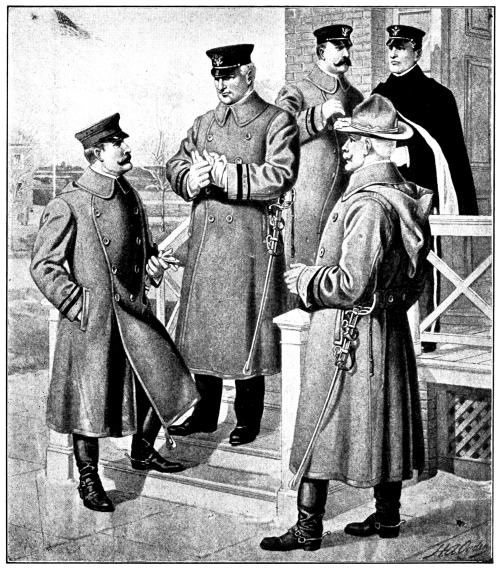
Copyright, 1908, by Brig. Gen. J. B. Aleshire, Qr.-Master General, U. S. A.
U. S. Army. Officers’ winter uniforms
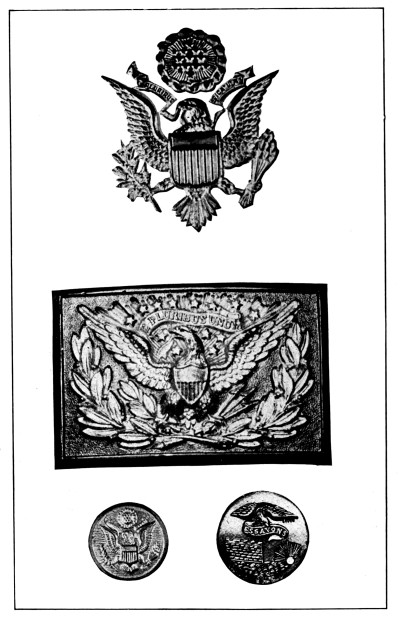
U. S. Army Officers
1. Insignia worn on caps
2. Full dress belt clasp
3. Service buttons (Except for Engineers)
4. Service buttons, Engineers
The full dress coat for all officers below the rank of Brigadier General (except officers of Engineers and officers holding permanent appointments in the Quartermaster Corps) has two rows of large size gilt army buttons down the front, nine in each row equally spaced, two rows of one-half inch gold lace braid around the collar, one at the top and one at the bottom, with the distinctive color of the “facings” of the corps, department or arm of the service filling the space between the two rows. Officers of Engineers have a narrow piping of scarlet cloth down the front of the full dress coat and officers holding permanent appointments in the Quartermaster Corps have this piping of buff cloth and also cuffs of buff cloth two and one-half inches deep. For all officers below the rank of Brigadier General the full dress coat has one row of one-half inch gold lace braid around the sleeve two and one-half inches from the bottom and above this the gold braided designs indicating the rank of the wearer. These ornamentations are in the form of three loops, one large vertical loop with two smaller horizontal loops below it. The insignia indicating the corps, department or arm of the service to which the wearer belongs are worn in the angle at the bottom of the knot.
These knots are made up of from one to five rows of gold soutache braid one-eighth of an inch wide, the number of rows of braid indicating the rank of the wearer.
When mounted all officers wear the breeches described for dress uniform, black boots, white leather gloves and spurs.
The white uniform consists of a single-breasted sack coat of white duck of the same general design as the blue dress coat but trimmed with white braid and having straps of the same material as the coat upon the shoulders reaching from the shoulder seams to the base of the collar, white trousers and a white cap. The insignia indicating the corps, department or arm of service are worn upon the collar of the coat in bright metal and the insignia of rank are worn upon the shoulder straps. The white cap is of the same design and description as the dress cap except that the crown is made of white duck and the band is of white braid.
The special evening dress uniform consists of a dark blue cloth coat cut on the lines of the civilian evening dress coat, having regulation gilt buttons and the sleeves decorated as described for the full dress coat; trousers of dark blue cloth for officers of cavalry, artillery and infantry and full dress trousers for all other officers; white shirt, collar and cuffs; black silk necktie; white evening dress waistcoat with regulation gilt buttons; the dress cap; and black shoes.
The blue mess uniform consists of a dark blue mess jacket cut like the special evening dress coat but without tails, the collar and lapels being faced with silk of the color of the “facings” prescribed for the corps, department or arm of the service and the sleeves trimmed as described for the full dress coat; dress trousers for officers of infantry, cavalry, artillery, quartermaster corps and engineers, and full dress trousers for all other officers; white or blue waistcoat with small regulation gilt buttons; dress cap; white shirt, collar and cuffs; black silk necktie; and black shoes.
The white mess uniform consists of a white mess jacket cut on the same design as the blue mess jacket but with the sleeve trimmings of white braid; white waistcoat; white trousers; white shirt, collar and cuffs; the white cap; and white shoes.
The overcoat for officers is a double-breasted ulster of olive-drab cloth extending to about ten inches below the knee (overcoats reaching to the knee only are authorized for field service), with pleated back and a wide rolling collar, buttoning to the neck, with two rows of large flat horn buttons of the same color as the coat, five in each row, having a pocket with vertical opening on each side at the waist. The rank of the wearer is indicated by the trimmings on the sleeves. The overcoat for General officers has a band of black mohair braid one and one-quarter inches wide around the sleeve two and one-half inches above the end and another band of black mohair braid one-half of an inch wide placed one and one-half inches above the lower band. The overcoats for officers below the rank of Brigadier General have the ornamentations indicating rank as shown by the accompanying illustrations. For officers of the General Staff Corps the bands of black braid below the sleeve knot are seven-eighths of an inch wide.
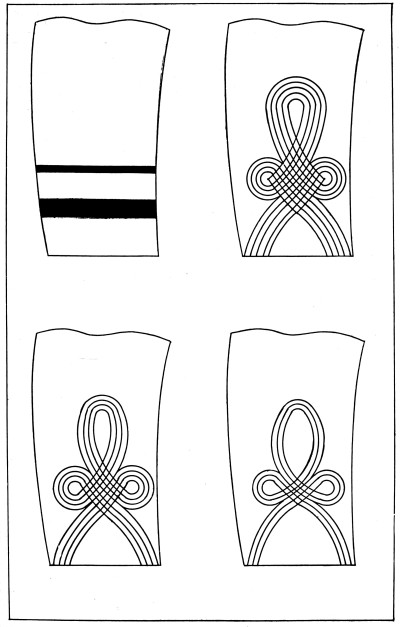
U. S. Army. Officers’ overcoat sleeve braiding (in black) indicating rank
1. All General Officers 2. Colonel
3. Lieutenant Colonel 4. Major
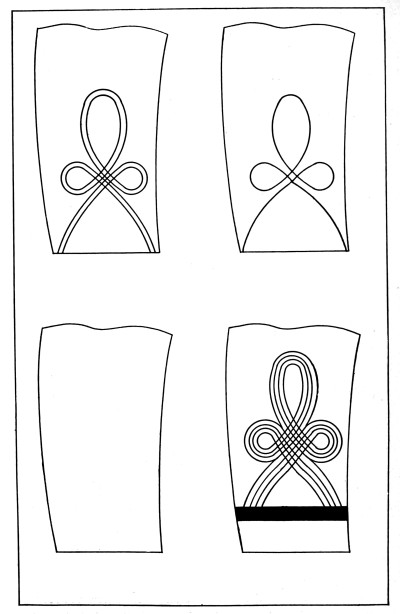
U. S. Army. Officers’ overcoat sleeve braiding indicating rank
Black braid for all except Second Lieutenant
1. Captain 2. First Lieutenant
Second Lieutenant (brown braid)
3. Field clerk 4. Lieutenant Colonel, General Staff Corps
The cape for officers is of dark blue cloth, extending to the knee, with a blue-black velvet rolling collar, lined with cloth depending upon the corps or arm of the service as follows:
General officers and officers of the Staff Corps and Departments
(except Quartermaster General) Dark blue.
Officers of the Quartermaster Corps Buff.
Officers of Infantry Light blue.
Officers of Artillery Scarlet.
Officers of Cavalry Yellow.
Chaplains Black.
The chapeau for General officers is a cocked hat of black silk plush, having on the right side a rosette of black silk five inches long and three inches wide with a strip of gold lace in the center, the coat of arms of the United States being embroidered upon the upper end of the strip. Over the center of the chapeau two black ostrich plumes extend from front to rear, and there are gold bullion tassels at the front and back.
Aiguilettes of braided gold cord three-sixteenths of an inch in diameter are worn by officers of the General Staff Corps, officers of the Adjutant General’s and Inspector General’s Departments, officers of the Bureau of Insular Affairs, aides-de-camp, regimental adjutants, adjutants of Artillery Districts, the Adjutant of the Military Academy at West Point, and Military Attaches at American Embassies and Legations in foreign countries.
Full dress belts for Major Generals are of red Russia leather with three stripes of gold embroidery, for Brigadier Generals of black webbing, for Field Officers (Colonels, Lieutenant Colonels and Majors) of black enamel leather with one wide stripe of gold lace, for officers holding permanent appointments in the staff corps and departments below the rank of major (except Engineers) of black enamel leather covered with a wide stripe of gold lace interwoven with three narrow stripes of black silk, for officers of Engineers the same but with gold stripes interwoven with three narrow stripes of scarlet silk, and for officers of cavalry, infantry and artillery below the rank of major the same but with the gold stripes interwoven with three narrow stripes of silk of the distinctive color of the arm of the service, cavalry yellow, infantry light blue and artillery scarlet.
A sash of buff silk is worn by General officers, the one for Brigadier Generals being worn around the waist over the belt and the ones for all Generals of higher rank being worn across the right shoulder under the epaulet or shoulder knot and diagonally across the body to the left side at the waist and terminating in heavy tassels which hang below the belt.
Epaulets, worn by General officers with full dress uniform, are of gold with heavy gold fringe. On the top is the coat of arms of the United States and the stars indicating rank.
Shoulder knots worn by all officers with full dress uniforms are five and one-half inches long and two and one-half inches wide, made of plaited gold cord and bearing the insignia of rank upon the upper surface.
The sword for officers of the Army is a saber with a slightly curved bright steel blade, a half-basket hilt with the guard of bright steel, and an ebony grip. The scabbard is of bright steel with two plain bands and rings for attaching the saber to the slings.
The saber knot worn on the hilt of the saber for attaching the sword to the wrist, for wear with full dress uniform is of heavy gilt cord ending in a gilt braided acorn for General officers and for other officers a strap of flat gold braid with a row of black silk interwoven in it near each edge; and for wear with service uniform it is made of plaited leather cord ending in a leather tassel.
INSIGNIA OF RANK AND CORPS
The rank of an officer of the Army is indicated in two ways, first, by insignia of rank placed upon the epaulets and shoulder knots worn with full dress uniform, upon the shoulder straps worn with dress uniform, upon the cloth shoulder straps of the service coats and white coats and upon the collar of the olive-drab flannel shirt when it is worn without the coat; second, by the insignia upon the sleeves of the full dress coat, the special evening dress coat, the overcoat and the blue and white mess jackets, this braiding being of gold on the full dress coat, special evening dress coat and blue mess jacket, black upon the overcoat and white upon the white mess jacket.
The insignia of rank referred to above for the various ranks of officers, as shown in the illustrations, are as follows:
General—Four silver stars.
Lieutenant General—One large silver star and two smaller ones, one on each side of the larger star.
Major General—Two silver stars, one inch in diameter.
Brigadier General—One silver star, one inch in diameter.
Colonel—A silver spread eagle, three-quarters of an inch high and two inches from tip to tip of wings.
Lieutenant Colonel—A silver oak leaf, one inch high and one inch wide.
Major—A gold oak leaf, one inch high and one inch wide.
Captain—Two silver bars, one inch long and one-quarter of an inch wide.
First Lieutenant—One silver bar, one inch long and one-quarter of an inch wide.
Second Lieutenant—One gold bar, one inch long and one-quarter of an inch wide.
The insignia of rank upon the sleeves of the full dress coat, special evening dress coats, and blue mess jacket, are as follows:
General—A band of oak leaves in gold at the top of the cuff and four silver stars below the band.
Lieutenant General—A band of oak leaves in gold at the top of the cuff and one large silver star and two smaller silver stars, one on each side of the large star, below the band.
Major General—A band of oak leaves in gold at the top of the cuff and two silver stars one inch in diameter, below the band.
Brigadier General—A band of oak leaves in gold at the top of the cuff and one silver star one inch in diameter, below the band.
Colonel—A gold band one-half of an inch wide around the sleeve with a knot of three loops, one large loop placed vertically and two smaller loops placed horizontally at each side below the large loop, the knot being placed above the gold band, the dimensions of the knot being height eight inches and width six and three-quarters inches. The knot for the rank of colonel is composed of five rows of braid one-eighth of an inch wide spaced one-quarter of an inch apart. The insignia indicating the corps, department or arm of the service is worn in the center of the space formed by the lower curves of the knot and the gold band around the sleeve. For chaplains this insignia is a Latin cross of silver.
Lieutenant Colonel—The same as for a colonel except that the knot is composed of four rows of braid.
Major—The same as for a colonel except that the knot is composed of three rows of braid.
Captain—The same as for colonel except that the knot is composed of two rows of braid.
First Lieutenant—The same as for a colonel except that the knot is composed of one row of braid.
Second Lieutenant—There is no knot, the one-half inch band of gold braid around the sleeve with the insignia indicating the corps, department or arm of the service being the only ornamentation on the sleeves.
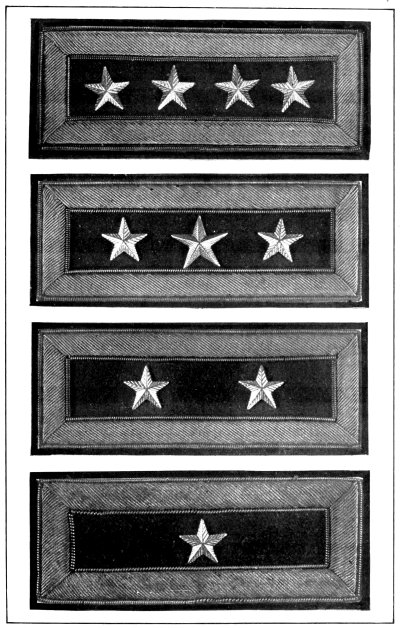
U. S. Army. Officers’ shoulder straps worn on blue dress coats
1. General 2. Lieutenant General
3. Major General 4. Brigadier General
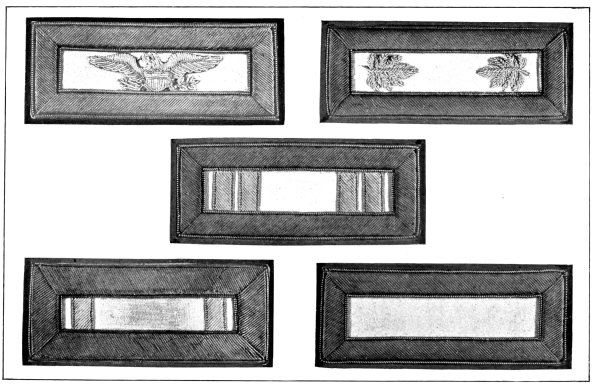
U. S. Army. Officers’ shoulder straps worn on blue dress coats
1. Colonel 2. Lieutenant Colonel (Silver leaf)
3. Captain Major (Gold leaf)
4. First Lieutenant 5. Second Lieutenant
The sleeves of the white mess jackets have the same insignia to indicate rank and corps as those of the full dress coat but the band around the sleeve and the knot are made of white braid.
The rank of General officers is indicated on the overcoat by silver stars placed between the two bands of black braid on each sleeve.
The corps, department or arm of the service to which an officer belongs is shown in two ways; first, by the color of the “facings,” or distinctive color trimmings of the uniform, and second, by the insignia of the different corps, departments and arms of the service worn upon the collars and also upon the sleeves of the full dress coat, special evening dress coat, mess jackets and overcoat.
Facings.—The facings or distinctive colors for the various corps, departments and arms of the service are as follows:
General Officers dark blue.
(except the Quartermaster General and Brigadier
Generals of the Quartermaster Corps)
Quartermaster General and Brigadier buff.
Generals of the Quartermaster Corps
Adjutant General’s Department dark blue.
Inspector General’s Department dark blue.
Judge Advocate General’s Department dark blue.
Quartermaster Corps buff.
Ordnance Department black piped with scarlet.
Signal Corps orange piped with white.
Medical Corps maroon.
Corps of Engineers scarlet piped with white.
Cavalry yellow.
Artillery scarlet.
Infantry light blue.
Chaplains black.
The insignia to designate the corps, department or arm of the service to which an officer belongs, as shown in the illustrations, are made of bright metal, gold or silver according to the corps, for blue and white uniforms and dull finish bronze for service uniforms. They are worn on the sleeves of the full dress coat, special evening dress coat, blue mess jacket and white mess jacket, and on each side of the collars of the dress coat, service coats and olive-drab flannel shirt.
The bright metal insignia are as follows:
All officers.—The letters “U. S.” in Gothic design, five-eighths of an inch high, each letter followed by a period, are worn on each side of the collar of the dress and service coats. For officers of the Reserve Corps the letter “R” is added and for officers of the Volunteers the letter “V” is added. These letters are of gold except for officers of the Engineer Corps who wear them in silver.
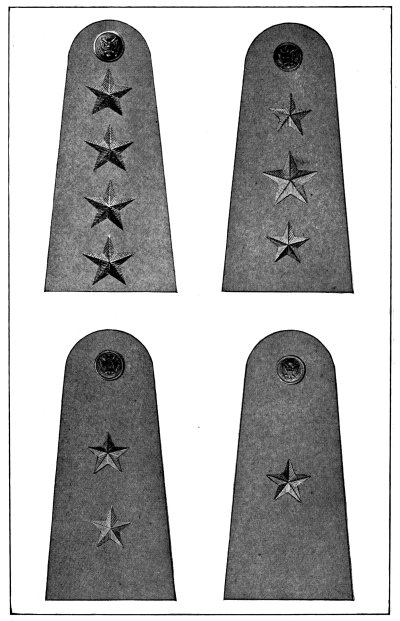
U. S. Army. Officers’ insignia indicating rank
Shoulder straps worn on the olive-drab service coats and the white coat
1. General 2. Lieutenant General
3. Major General 4. Brigadier General
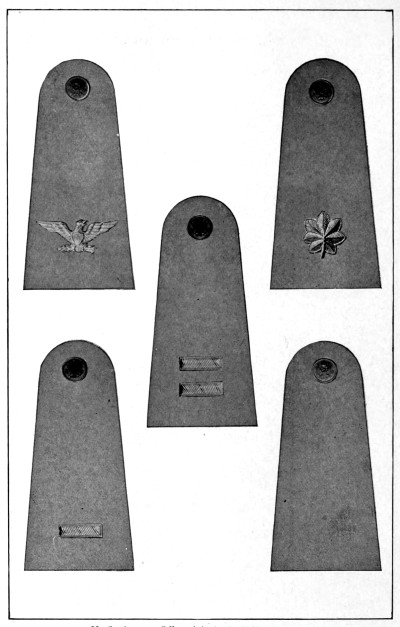
U. S. Army. Officers’ insignia indicating rank
Shoulder straps worn on the olive-drab service coats and the white coat
1. Colonel 2. Lieutenant Colonel (Silver leaf),
Major (Gold leaf)
3. Captain. 4. First Lieutenant (Silver Bar),
5. Field Clerk Second Lieutenant (Gold Bar)
General Staff Corps.—A gold five-pointed star one and a quarter inches in diameter surmounted by the coat of arms of the United States in gold and enamel.
Corps of Engineers.—The letters “U. S.” of silver and a turretted castle of silver.
Chaplains.—A silver Latin cross.
Adjutant General’s Department.—A gold shield one inch high.
Inspector General’s Department.—A sword and fasces of gold, crossed and surmounted by a gold wreath with the inscription “Droit et Avant” in blue enamel on the wreath.
Judge Advocate General’s Department.—A sword and pen crossed and surmounted by a wreath, all of gold.
Quartermaster Corps.—A sword and a key crossed on a wheel surmounted by an eagle, in gold except the rim of the wheel which is in blue enamel set with thirteen gold stars.
Medical Corps.—A caduceus of gold.
Medical Reserve Corps.—The same surmounted by the letters “R. C.” in bronze.
Sanitary Corps.—The same surmounted by the letters “S. C.”
Dental Surgeons.—The same surmounted by the letters “D. C.” in bronze.
Acting Dental Surgeons.—The same in silver with gold letters.
Ordnance Department.—A flaming spherical shell of gold.
Signal Corps.—Two crossed signal flags with a vertical torch at the center, all of gold.
Cavalry.—Two sabers of gold crossed with the number of the regiment in the angle above them.
Field Artillery.—Two field guns of gold crossed with the number of the regiment in the angle above them.
Coast Artillery.—Two gold cannons crossed, surmounted at the center by an oval of red enamel with a gold projectile point up.
Infantry.—Two gold rifles crossed with the number of the regiment in the angle above them.
Philippine Scouts.—The same as for infantry but with the letter “P” in the angle above the crossed rifles.
Porto Rico Regiment.—The same but with the letters “P. R.”
Aides-de-camp.—A shield of the United States surmounted by a spread eagle of gold, the stripes of the shield red and white and the field blue enamel with gold stars, the number of which correspond to the rank of the General officer upon whose staff the aide-de-camp is serving.
Regimental Staff Officers.—Regimental adjutants and quartermasters have the devices of the insignia of the Adjutant General’s Department or of the Quartermaster Corps respectively in the angle below the insignia of their arm of the service.
Veterinarians.—An insignia consisting of a caduceus surcharged with the letters V. C.
Assistant Inspectors of small arms practise for regiments of the Organized Militia wear the insignia of the arm of the service to which the regiment belongs with the number of the regiment above it and a bursting shell below it.
Officers’ Buttons.—The design for Engineers is an eagle with the motto “Essayons” above a fort and rising sun, and for other officers it is the U. S. coat of arms.
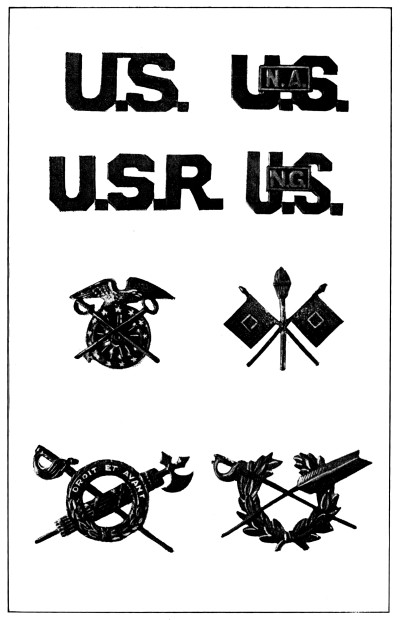
U. S. Army. Officers’ collar insignia indicating arm of the Service, Corps or Department
1. All officers of the Regular Army 2. All officers of the National Army
3. All officers of the Reserve 4. All officers of the National Guard
5. Quartermaster Corps 6. Signal Corps
7. Inspector General’s Department 8. Judge Advocate General’s Department
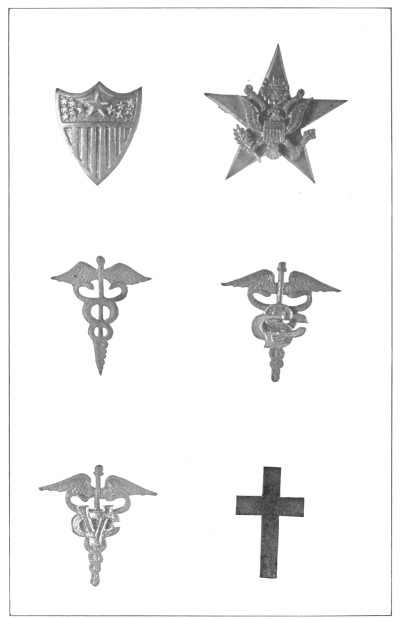
U. S. Army. Officers’ collar insignia indicating arm of the Service, Corps or Department
1. Adjutant General’s Department 2. General Staff Corps
3. Medical Corps 4. Sanitary Corps
5. Veterinary Corps 6. Chaplain
Uniform and Insignia of the Cadets at the U. S. Military Academy, West Point, N. Y.
The Corps of Cadets at the U. S. Military Academy at West Point, N. Y., is organized into Battalions of four companies each. The Corps of Cadets is commanded by an officer of the Army especially detailed for this duty, who, unless of actual higher rank, has the local rank and pay of a Lieutenant Colonel while performing this duty.
The Battalions are commanded by officers of the Army detailed from the Department of Tactics of the Military Academy and while performing the duty of Battalion Commanders they have the rank and pay of Majors.
The other officers of the Corps of Cadets are selected from the cadets at the Academy, the grades of rank being as follows:
Captain.
Adjutant.
Quartermaster.
Lieutenant.
Sergeant Major.
Quartermaster Sergeant.
First Sergeant.
Company Quartermaster Sergeant.
Sergeant.
Corporal.
Privates First Class, according to class standing.
Privates Second Class, according to class standing.
Privates Third Class, according to class standing.
Privates Fourth Class, according to class standing.
The insignia of these various ranks, worn on the full dress coat, are as follows:
Captains.—Chevrons of four stripes of single gold lace braid on a black background, on each arm above the elbow, points up.
Adjutant.—Chevrons of three stripes of single gold lace braid on a black background with three arcs of the same braid beneath, on each arm above the elbow, points up.
Quartermaster.—Chevrons of three stripes of single gold lace braid with three horizontal stripes of the same braid beneath on a black background, on each arm above the elbow, points up.
Lieutenants.—Chevrons of three stripes of single gold lace braid on a black background, on each arm above the elbow, points up.
Sergeant Major.—Chevrons of two stripes of single gold lace braid with two arcs of the same braid beneath on a black background, on each arm above the elbow, points up.
Quartermaster Sergeant.—Chevrons of two stripes of single gold lace braid with two horizontal stripes of the same braid beneath on a black background, on each arm above the elbow, points up.
First Sergeants.—Chevrons of two stripes of single gold lace braid with a diamond shaped lozenge in the angle beneath, on a black background, on each arm above the elbow, points up.
Company Quartermaster Sergeants.—Chevrons of two stripes of single gold lace braid with one horizontal stripe beneath, on a black background, on each arm above the elbow, points up.
Sergeants.—Chevrons of two stripes of single gold lace braid on a black background, on each arm above the elbow, points up.
Color Bearer.—Chevrons the same as for sergeants with a star in the angle beneath.
Corporals.—Chevrons of two stripes of single gold lace braid on a black background, on each arm below the elbow, points up.
Color Corporals.—Chevrons the same as for corporals with a star in the angle beneath.
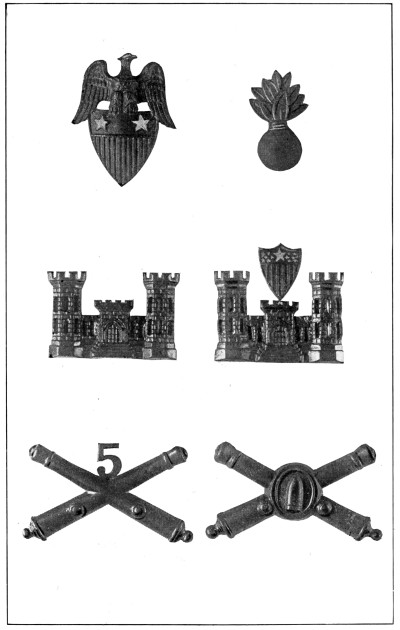
U. S. Army. Officers’ collar insignia indicating arm of the Service, Corps or Department
1. Aide-de-camp to General Officer 2. Ordnance Corps
3. Engineer Corps 4. Adjutant of Engineer Corps
5. Field Artillery 6. Coast Artillery
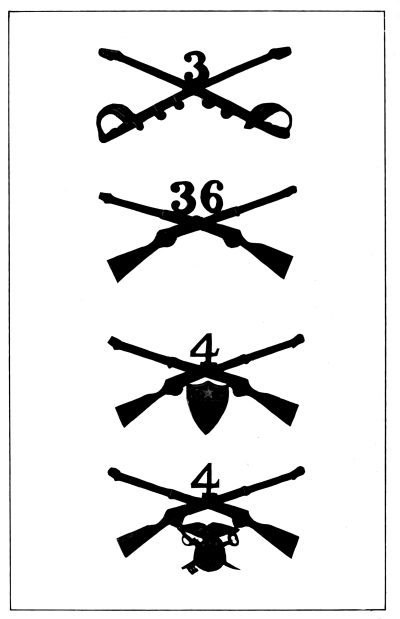
U. S. Army. Officers’ collar insignia indicating arm of the Service, Corps or Department
1. Cavalry
2. Infantry
3. Adjutant of Infantry
4. Quartermaster of Infantry
On the dress coats and overcoats the chevrons worn by the Cadet Officers are of the same designs as those above described for the full dress coats except that they are made of black cloth on a gray background and those worn on the overcoats are of only one-third the size of those for the full dress and dress coats.
The Cadets are divided into four classes according to the year’s course they are pursuing, the first class corresponding to the seniors at a college, the second class corresponding to the juniors, the third class corresponding to the sophomores and the fourth class corresponding to the freshmen.
The class to which a Cadet belongs is indicated by stripes worn upon the sleeves of the full dress and dress coats and the overcoat, three stripes for the first class, two stripes for the second class, one stripe for the third class and none for the fourth class, thus each stripe shows one year of service as a Cadet.
On the sleeves of the full dress coat these stripes are of gold soutache braid placed diagonally across the outer side between the wrist and the elbow; on the sleeves of the overcoat they are the same as for the full dress coat except that they are made of black soutache braid; and for the dress coat the stripes are of black soutache braid placed across the outer side of the sleeve parallel to the broad black braid on the cuff.
Cadets who are classed as “Distinguished” on account of high standing in their studies and drills wear a five-pointed gold star on each side of the collar of the full dress and dress coats.
The uniforms of the West Point cadets are of gray cloth for wear during the winter and of white duck for wear during the summer, the color of the winter uniforms being that which is usually known as “cadet gray.” Each cadet is required to have complete outfits of full dress, dress and white uniforms.
Their full dress uniform consists of a full dress coat, gray or white trousers, full dress hat, black leather shoes, white waist-belt and white cross-belts. Cadet officers wear a plume of black feathers in the hat, a white sword belt and a red silk sash. The Cadet Sergeant Major, Cadet Quartermaster Sergeant and Cadet First Sergeants wear a white sword belt and a red silk sash.
The full dress coat is of gray cloth, fitting closely, single-breasted, with three rows of gilt bell buttons down the front, eight buttons in each row, one row in the center and one row on each side, the coat being cut away just below the waist line across the front and having short skirts behind. The skirts of the coat have twelve gilt bell buttons, three down the plait of each skirt, the upper one at the waist, and three placed lengthwise on each skirt. The coat has a square standing collar with one bell button on each side. Each cuff has three bell buttons. The collar, front of the coat, the cuffs and the skirt of the coat are trimmed with black silk cord in designs as shown in the illustration.
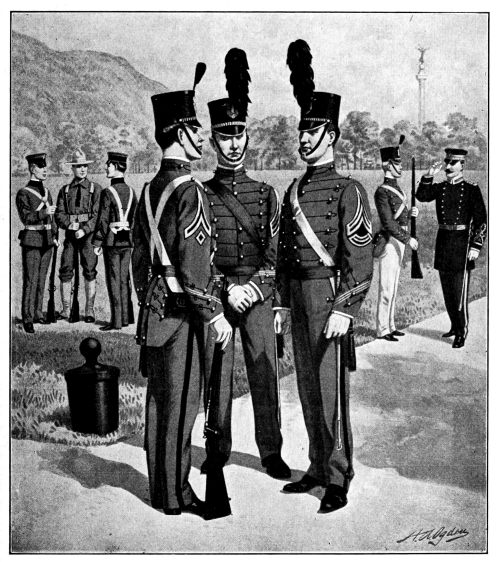
Copyright, 1908, by Brig. General J. B. Aleshire, Qr. Master General. U. S. A.
Cadets, U. S. Military Academy
Full dress, dress and service uniforms
1. Cadet, Sergeant (Dress)
2. Cadet, Private (Campaign Uniform)
3. Cadet, Corporal (Dress)
4. Cadet, First Sergeant (Full Dress)
5. Cadet, Captain (Full Dress)
6. Cadet, Adjutant (Full Dress)
7. Cadet, Private (Full Dress)
8. Captain of Infantry (Full Dress)
The trousers for winter wear with both the full dress and dress uniforms are of gray cloth with black stripes one and one-half inches wide down the outer seams.
The full dress hat is of black felt, bell-crowned, six inches high, with a sloping visor. It is trimmed with gilt decorations, bears the insignia of the Military Academy on a gilt plate in front, has a black pompon set in a gilt socket on the front at the center (a black plume being worn by cadet officers, instead of the pompon), and a gilt scale chain strap worn above the visor.
When mounted the cadets wear gray cloth breeches and riding leggings instead of trousers.
The dress uniform of the cadets consists of a dress coat, dress cap, gray or white trousers, black leather shoes, white waist-belt and white cross-belts and leather gloves. Cadet officers wear a white sword belt and a worsted sash.
The dress coat is of gray cloth, single-breasted, with a straight standing collar, closed down the center of the front by buttons concealed beneath a fly, the coat reaching to about nine inches below the waist. The coat is trimmed around the collar, down the front, around the bottom edge and up the side seams of the back with black mohair braid one inch wide, the braid down the front being double. There is also one stripe of the same braid around each sleeve two and one-half inches from the lower edge of the cuff.
The dress cap is of gray cloth, bell-crowned, three and one-half inches high, with a band of black mohair braid one and three-quarter inches wide and a sloping visor of black patent leather. In the front and center of the cap is worn the insignia of the United States Military Academy in gilt metal one and three-quarter inches high.
The overcoat is of gray kersey, double-breasted, with six buttons on each side down the front, coat to reach within ten inches of the ground when the wearer is standing. It has a stand and fall collar five inches deep. There are also two buttons at the hip and one at the bottom of each plait behind. All of the buttons are gilt, seven-eighths of an inch in diameter, and bear the arms of the U. S. Military Academy with the word “Cadet” around the margin at the top and the letters “U. S. M. A.” around the margin at the bottom. There is also a cape of the same material as the coat, cut circular, extending to the hip buttons. The coat and cape are lined with gray woolen material.
The raincoat is a sleeveless sack overcoat of gray waterproof material with a cape attached to the coat, the skirts of the coat extending to within eight inches of the ground.
The cadets are also furnished with a gray woolen shirt which is sometimes worn at drills without the coat.
At certain of the drills and exercises a service hat of felt similar to the “campaign hat” is worn.
UNIFORM AND INSIGNIA OF FIELD CLERKS, U. S. ARMY
By the Act of Congress of August 29, 1917, the grades of Army Field Clerk and Field Clerk Quartermaster Corps were established in the United States Army. These officers are appointed by the Secretary of War and take precedence in rank next after Cadets and before all noncommissioned officers, so that their position is similar in relative rank to that of Warrant officers in the United States Navy and Marine Corps.
The Army Field Clerks belong to the Adjutant General’s Department and the Field Clerks Quartermaster Corps are a part of that corps.
They wear the same uniform as commissioned officers, omitting all insignia of rank and the brown bands of braid around the cuffs of the service coat. On their service hats they wear a hat cord of black and silver twisted strands.
Army Field Clerks wear on each side of the collar of the service coat a bronze insignia consisting of two quill pens crossed with a miniature adjutant general’s shield in the lower angle.
Field Clerks Quartermaster Corps wear on each side of the collar of the service coat a bronze insignia consisting of two quill pens crossed with a miniature Quartermaster Corps insignia in the lower angle.
ENLISTED MEN’S UNIFORMS, U. S. ARMY
The enlisted men of the Army are required to have complete outfits of service uniform for winter and summer, dress uniform and fatigue uniform, and in addition cooks and bakers, members of the Hospital Corps and members of the general recruiting service have white uniforms.
The occasions upon which the different uniforms are worn are given in the regulations as follows:
TABLE OF OCCASIONS FOR UNIFORMS
Occasion. Uniform.
1. For habitual garrison wear until retreat, when not under arms. Service uniform with the service cap.
2. For habitual garrison wear under arms.
3. For inspection and guard mounting, when ordered by the commanding officer.
4. For all other ceremonies when the weather or climate will not permit the wearing of dress or full dress.
5. When changing station by rail or water.
6. For field duty. Service uniform with the service hat. In the trenches the steel helmet is worn.
7. For habitual wear in garrison after retreat and when on leave. Dress uniform. In the Tropics and in hot weather the cotton service uniform (khaki) is worn instead.
8. For parade and ceremonies except inspection and guard mounting, when weather and climate permit.
9. For parade and other ceremonies garrison (except inspection and guard mounting when ordered. Full dress uniform.
10. For all ceremonies other than garrison when ordered.
11. For cooks and bakers when at work in kitchen or bakery. White uniform.
12. For Hospital Corps men on duty in hospital wards, operating rooms, etc.
13. For members of the general recruiting service when on duty at recruiting stations, etc., when prescribed.
14. On fatigue duty in stables, at mountain battery drills, at work or drill at emplacements of the Coast Artillery. Fatigue uniform.
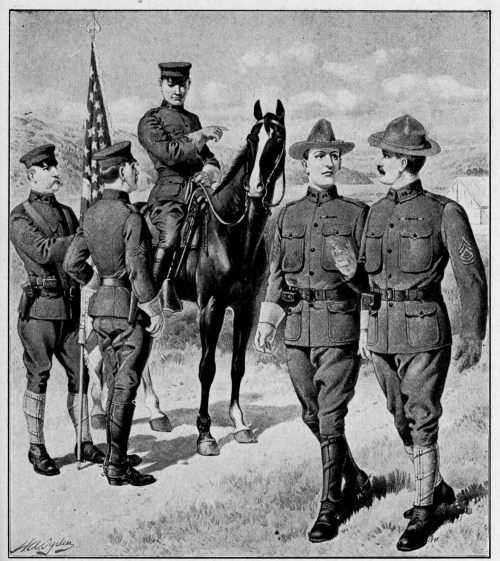
Copyright, 1908, by Brig. Gen. J. B. Aleshire, Qr. Master General, U. S. A.
U. S. Army. Noncommissioned officers, olive-drab service uniform
1. Color Sergeant, Infantry 2. First Sergeant, Field Artillery
3. Company Quartermaster
Sergeant, Cavalry 4. Sergeant, Signal Corps
5. Sergeant Major, Infantry
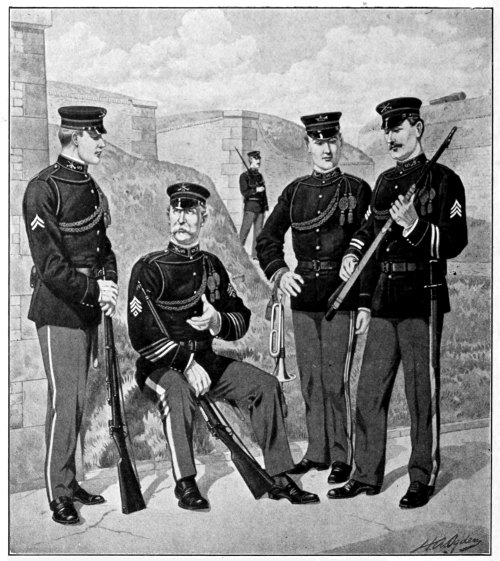
Copyright, 1908, by Brig. General J. B. Aleshire. Qr. Master General, U. S. A.
U. S. Army. Enlisted men, Infantry full dress uniform
1. Corporal 2. First Sergeant
3. Private 4. Musician
5. Sergeant
The service uniform for enlisted men of the Army consists of a single breasted sack coat of olive-drab woolen or cotton material, extending to about ten inches below the waist, with a standing collar, buttoned down the front with one row of five regulation bronze buttons, having four outside patch pockets, one on each breast and on each side below the waist line, each pocket being closed with a shield shaped flap buttoned by a small regulation button, and a strap of the same material as the coat on each shoulder sewed in at the shoulder seam and buttoned at the collar end by a small regulation button; breeches of the same material as the coat, khaki-colored canvas leggings, tan leather shoes; and a service cap or service hat. The service cap is a bell-crowned cap with a sloping tan leather visor and a tan leather chin strap across the front above the visor secured by a small bronze button at each end of the visor. The service hat is the brown felt wide brimmed hat universally called the “campaign hat” and is worn with what is known as the “Montana peak,” that is, brought to a point at the center of the top of the crown by making four dents in the top of the crown. A hat cord of the distinctive color of the corps or arm of the service to which the wearer belongs is worn around the base of the crown of the service hat. During war the steel helmet is worn when on duty in the trenches or on the battle line. In garrison the tan leather belt is worn with the service uniform, and in the field the webbing cartridge belt of the same color as the uniform is worn.
Mounted men wear spurs and tan leather leggings with this uniform.
In the tropics and in hot weather the service uniform of cotton material is worn, and at drills and in the field, the coat is sometimes dispensed with and the olive-drab flannel shirt is worn.
The overcoat and gloves of olive-drab wool are worn when the weather requires.
During time of war this is the only uniform worn by the men or carried by them into the field of operations.
The dress uniform for enlisted men consists of a single-breasted coat of dark blue cloth, extending to about ten inches below the waist, with a standing collar, buttoned down the front with one row of six gilt regulation buttons and having a strap of dark blue cloth on each shoulder; the dress cap of dark blue cloth; sky-blue cloth trousers; a white collar; and tan leather shoes. When under arms in this uniform white gloves are worn except when the overcoat is worn, in which case olive-drab gloves are worn. The dress coat is trimmed around the top and base of the collar and down the front edges of the collar, around the edges of the shoulder straps and around each sleeve four inches from the bottom edge by a narrow piping of the distinctive color of the arm of the service or corps to which the wearer belongs, and there are three small regulation gilt buttons on each cuff and one at the collar end of each shoulder strap.
The trousers of noncommissioned officers have stripes of the same distinctive color down the outer leg seams, the stripes for corporals being one-half inch wide and those for higher noncommissioned officers being one and one-quarter inches wide, those for musicians being double, each part one-half inch wide.
The dress caps for enlisted men are made of a dark blue cloth with a bell crown, a black patent leather sloping visor and a half-inch chin strap of patent leather worn above the visor and secured by a gilt button at each end of the visor. There is one stripe around the band of the cap at the upper edge of the band and one at the lower edge of the band, each stripe being one-half inch in width and of the distinctive color of the corps or arm of the service to which the wearer belongs, these distinctive colors being those as given for the “facings.”
The tan leather or garrison belt is worn with the dress uniform.
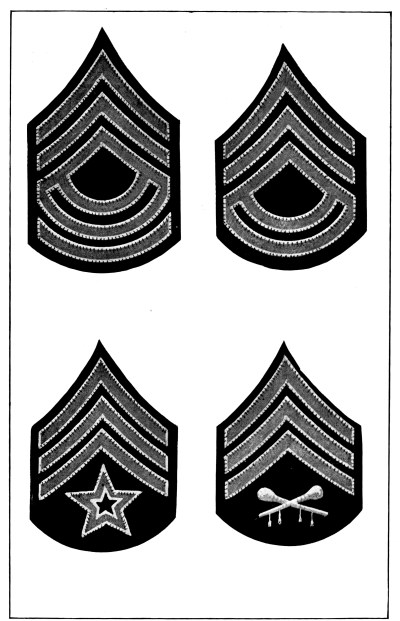
U. S. Army. Noncommissioned officers’ chevrons
1. Regimental Sergeant Major
2. Battalion or Squadron Sergeant Major
3. Color Sergeant
4. Drum Major
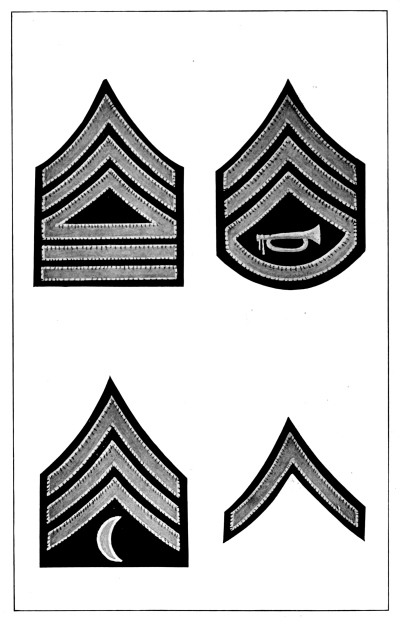
U. S. Army. Noncommissioned officers’ chevrons
1. Regimental Supply Sergeant
2. Sergeant of Field Music
3. Mess Sergeant
4. Lance Corporal
The overcoat is worn with it when the weather requires it.
Mounted men wear breeches with this uniform, the color and trimmings being the same as for the trousers, and riding gloves, riding leggings and spurs.
The full dress uniform for enlisted men is the same as their dress uniform with the addition of a breast cord of the distinctive color of the corps or arm of the service to which they belong. This breast cord is a double plaited loop of round cord worn from one shoulder to the other across the breast with a single cord passing across the back and the front loop ending on the right side in two plaited plates and two tassels.
The fatigue uniform consists of brown canvas or duck working coat and trousers. This is a working uniform. A fur cap is furnished for wear in very cold weather.
The overcoat for enlisted men is a double-breasted ulster made of olive-drab cloth, extending eight to ten inches below the knee (overcoats extending to the knee are authorized for wear in the field), buttoning to the neck with two rows of large flat buttons of the same color as the coat, and having a wide rolling collar. It has a pleat down the center of the back.
Rain clothes for enlisted men are olive-drab waterproof coats or the poncho or rubber blanket worn in the fashion of a cape. Rubber boots are used when required, as in wet trenches.
INSIGNIA OF RANK FOR ENLISTED MEN
The rank of the various noncommissioned officers of the United States Army and Marine Corps and the rating of the corresponding petty officers of the Navy is usually indicated by chevrons, a form of badge derived from the days when heraldry played a great part in the world’s affairs.
“Chevron” is an architectural term denoting the rafters of a roof meeting at an angle at the upper apex, and it is derived from the French word “chevre,” a goat, and so used on account of the fancied resemblance of a pair of such rafters to the horns of a goat.
The chevron in heraldry was employed as a badge of honor to mark the main supporters of the head of the clan, “the top of the house,” and it came to be used in various forms as an emblem of rank for the knights and men-at-arms in feudal days, and from this resulted its common use as an insignia of rank in the armies and navies of the present day.
In some countries chevrons are used as insignia of rank for commissioned officers as well as for noncommissioned officers, but in the United States service the use of chevrons is confined to the latter class.
In the United States Army and Marine Corps the chevrons are worn with the point up but in the Navy they are worn with the point down.
The chevrons indicating the rank of noncommissioned officers are worn midway between the shoulder and the elbow on both sleeves of the service coats, full dress coat and overcoat.
The chevrons for the dress coat are 3¼ inches wide made of stripes of cloth of the distinctive color of the corps, department or arm of the service, each stripe being ⅜ of an inch wide.
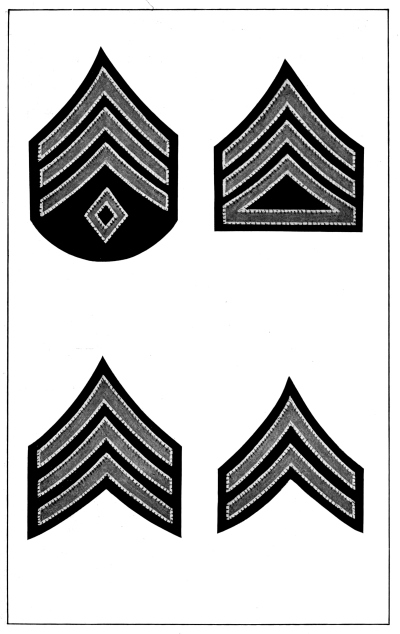
U. S. Army. Noncommissioned officers’ chevrons
1. First Sergeant 2. Company Supply Sergeant
3. Sergeant 4. Corporal
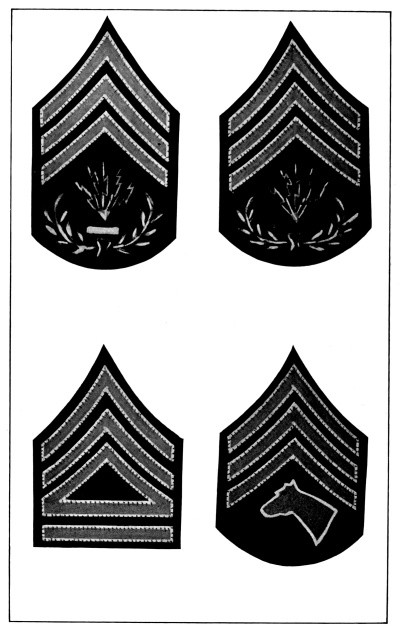
U. S. Army. Noncommissioned officers’ chevrons
1. Electrician Sergeant, First Class
2. Electrician Sergeant, Second Class
3. Battalion Supply Sergeant
4. Stable Sergeant
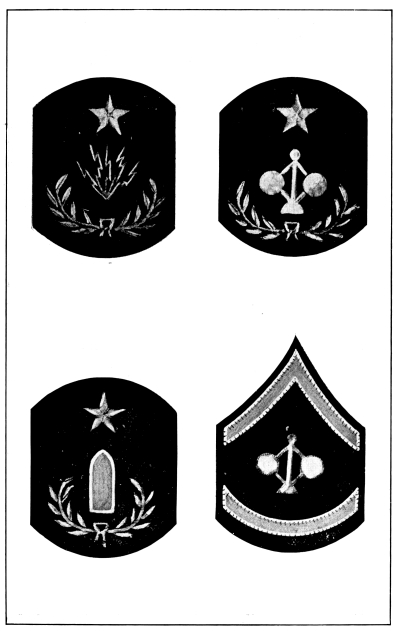
U. S. Army. Noncommissioned officers’ chevrons
Coast Artillery Corps
1. Master Electrician
2. Engineer, Coast Artillery Corps
3. Master Gunner
4. Fireman, Coast Artillery Corps
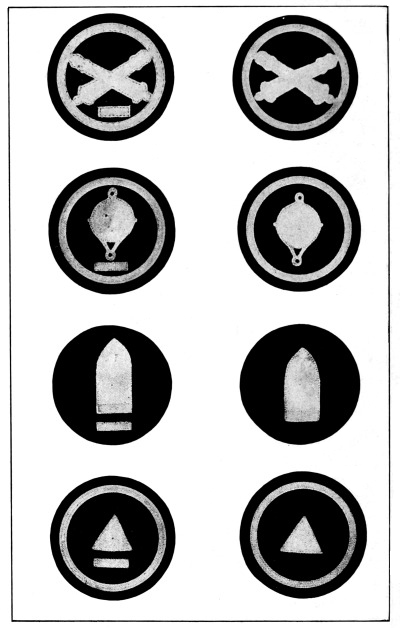
U. S. Army. Noncommissioned officers’ chevrons
Coast Artillery Corps
1. Gun Commander
2. Gun Pointer
3. Casemate Electrician
4. Chief Planter and Chief Loader
5. First Class Gunner
6. Second Class Gunner
7. First Class Observer and Plotter
8. Second Class Observer
These distinctive colors for the chevrons for noncommissioned officers of the various corps, departments and arms of the service are:
Field Artillery and Coast Artillery scarlet.
Cavalry yellow.
Infantry white.
Engineers scarlet piped with white.
Ordnance black piped with white.
Hospital Corps maroon piped with white.
Quartermaster Corps buff.
Army Service Detachment,
U. S. Military Academy green piped with white.
Army Service School Detachment green.
The chevrons for the service coats, the overcoat and the olive-drab shirt are of the same size and design as those for the dress coat except that they are made of olive-drab material, the shade being slightly darker than that of the coat.
There are also a number of special badges to designate certain men assigned to special duties, such as cook, chief mechanics, artificer, farrier, saddler, horseshoer, first and second class gunners, electricians, engineer, gun commander and gun pointer. These special badges are of the same color as the chevrons and are worn in the same manner.
The chevrons and special badges for the different ranks and duties in the various corps, departments and arms of the service are as follows:
Regimental Sergeant Major—Chevron of three stripes and three arcs of a circle below them.
Sergeant Major Senior Grade, Coast Artillery—The same.
Quartermaster Sergeant, Senior Grade—The Quartermaster Corps insignia with a wreath below and a star above it.
Master Hospital Sergeant—The caduceus insignia of the Medical Corps with a wreath below and a star above it.
Master Engineer, Senior Grade—The castle insignia of the Engineer Corps with a wreath below and a star above it.
Master Electrician, Coast Artillery—A design representing forked lightning with a wreath below it and a star above.
Master Electrician, Signal Corps—A wreath with forked lightning at the top and the Signal Corps insignia in the center.
Master Electrician, Quartermaster Corps—A wreath with forked lightning at the top and the Quartermaster Corps insignia in the center.
Band Leader—Chevron of three stripes and two arcs of a circle below them with a trumpet in the center.
Hospital Sergeant, First Class—Chevron of three stripes and one arc of a circle below them with a caduceus in the center.
Hospital Sergeant—Chevron of three stripes with a caduceus below them.
Engineer Coast Artillery Corps—A design representing an engine governor with a wreath below it and a star above.
Ordnance Sergeant—Chevron of three bars with one arc below it and the insignia of the Ordnance Corps in the center.
Sergeant Quartermaster Corps—Chevron of three stripes with the insignia of the Quartermaster Corps below them.
Supply Sergeant, Regimental—Chevrons of three stripes with three horizontal bars below them.
Battalion or Squadron Sergeant Major—Chevron of three stripes with two arcs of a circle below them.
Sergeant Major Junior Grade, Coast Artillery—Chevron of three stripes with two arcs of a circle below them.
Supply Sergeant, Battalion—Chevron of three stripes with two horizontal bars below them.
First Sergeant—Chevron of three stripes with a diamond shaped lozenge below them.
Sergeant First Class, Medical Department—Chevron of three stripes and an arc below them with the caduceus device in the center.
Sergeant, First Class, Quartermaster Corps—Chevron of three stripes with one horizontal stripe below and the Quartermaster Corps insignia in the center.
Sergeant, First Class, Corps of Engineers—Chevron of three stripes with one arc of a circle below them and the Engineer Corps insignia in the center.
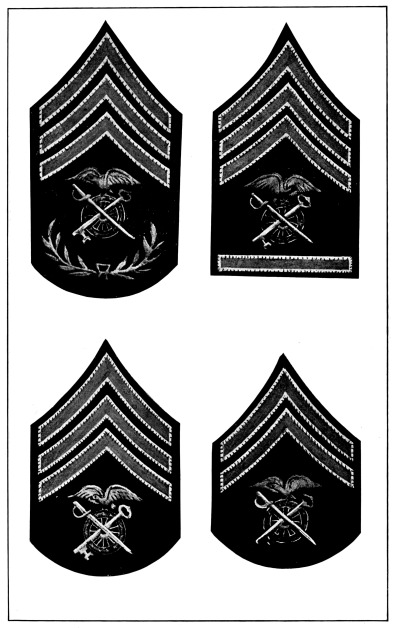
U. S. Army. Noncommissioned officers’ chevrons Quartermaster Corps
1. Quartermaster Sergeant 2. Sergeant, First Class
3. Sergeant 4. Corporal
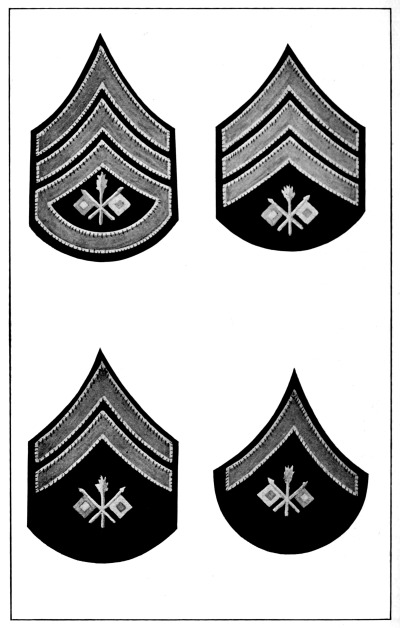
U. S. Army. Noncommissioned officers’ chevrons Signal Corps
1. Sergeant, First Class 2. Sergeant
3. Corporal 4. Lance Corporal
Sergeant First Class, Signal Corps—Chevron of three stripes with one arc of a circle below and the Signal Corps insignia in the center.
Electrician Sergeant, First Class, Coast Artillery—Chevron of three stripes with a wreath below it and a device representing forked lightning in the center and a short stripe between the wreath and the lightning.
Assistant Engineer, Coast Artillery—A device representing an engine governor with a wreath below it.
Master Gunner, Coast Artillery—A projectile placed vertically with a wreath below it and a star above it.
Band Sergeant and Assistant Leader of U. S. Military Academy Band—Chevron of three stripes and two arcs of a circle below them and a lyre in the center.
Assistant Band Leader—Chevron of three stripes and one arc of a circle below them and a trumpet in the center.
Sergeant Bugler—Chevron of three stripes with a bugle below them.
Electrician Sergeant Second Class, Coast Artillery—Chevron of three stripes with a wreath below them and a device representing forked lightning in the center.
Radio Sergeant—Chevron of three stripes with a device representing forked lightning below them.
Color Sergeant—Chevron of three stripes with a star below.
Sergeant—Chevron of three bars.
Company Supply Sergeant—Chevron of three stripes with one horizontal bar below them.
Mess Sergeant—Chevron of three stripes with a crescent below them.
Stable Sergeant—Chevron of three stripes with a horse’s head below them.
Fireman, Coast Artillery—Chevron of one stripe with one arc of a circle below it and a device representing the governor of an engine in the center.
Corporal—Chevron of two stripes.
Lance Corporal (Acting Corporal)—Chevron of one stripe.
Chief Mechanic—Two hammers crossed with a wreath below them.
Cook—A device representing a cook’s hat.
Artificer—Two hammers crossed.
Horseshoer—A horseshoe, toe up.
Mechanic—Two hammers crossed.
Saddler—A saddler’s round knife, edge up.
Wagoner—An eight spoke wheel.
Musician—A lyre.
Trumpeter—A bugle.
First class Private of Engineers—The castle insignia of the Engineer Corps.
First class Private, Signal Corps—The Signal Corps insignia, two crossed flags and a vertical torch.
First class Private Ordnance Corps—The Ordnance Corps insignia, a bursting spherical shell.
First class Private Hospital Corps—The Hospital Corps insignia, a caduceus.
First class Private, Quartermaster Corps—The insignia of the Quartermaster Corps.
Casemate Electrician, Coast Artillery—A mine case with a bar below it, enclosed in a circle.
Badge for Excellence at Target Practice, Coast Artillery—The figure “1.”
Chief Planter, Coast Artillery—A mine case enclosed in a circle.
First class Gunner, Gun Company, Coast Artillery—A projectile, point up, with a bar below it.
Second class Gunner, Gun Company, Coast Artillery—A projectile, point up.
First class Gunner, Mine Company, Coast Artillery—A mine case with a bar below it.
Second class Gunner, Mine Company, Coast Artillery—A mine case.
Gun Commander, Coast Artillery—Two crossed cannon with a bar below, enclosed in a circle.
Gun Pointer, Coast Artillery—Two crossed cannon enclosed in a circle.
Observer and plotter, Coast Artillery—An equilateral triangle with a bar below it, enclosed in a circle.
Observer, Second Class, Coast Artillery—An equilateral triangle enclosed in a circle.
First Class Private, Signal Corps—The crossed flags and torch device of the Signal Corps.
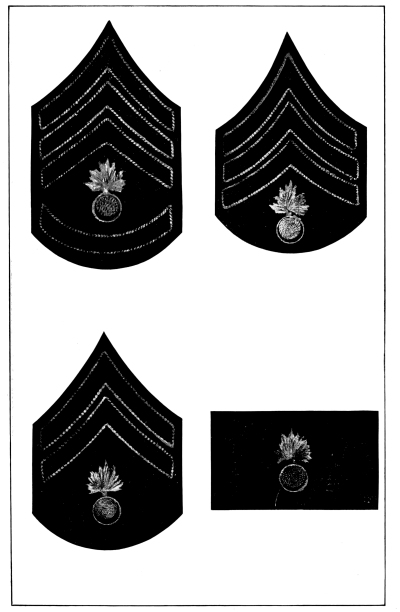
U. S. Army. Noncommissioned officers’ chevrons Ordnance Corps
1. Ordnance Sergeant 2. Sergeant of Ordnance Corps
3. Corporal of Ordnance Corps 4. First Class Private of
Ordnance Corps
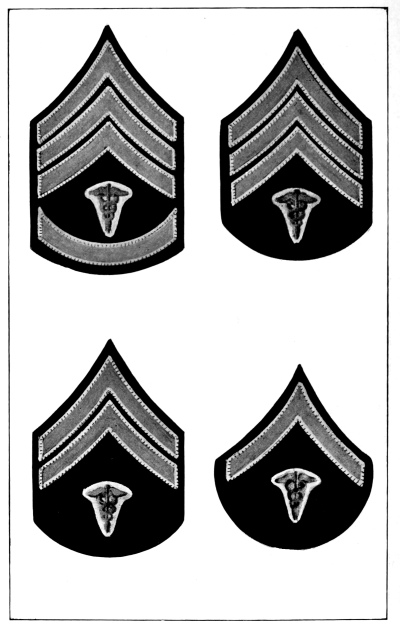
U. S. Army. Noncommissioned officers’ chevrons Medical Corps
1. Sergeant, First Class 2. Sergeant
3. Corporal 4. Lance Corporal
Cap Insignia.—The insignia for the front of the caps of all enlisted men are circular disks one and one-half inches in diameter with a raised rim encircling the coat of arms of the United States, made of gilt metal for dress caps and of bronze metal for service caps.
Collar Insignia.—The corps, department or arm of the service of enlisted men of the U. S. Army is shown by insignia on the coat collars.
For blue dress and white coats these insignia, of gilt metal, worn on each side of the neck opening, consist of block letters and special devices in rear of the letters. The letters “U. S.” for Regular Army, “U. S. V.” for Volunteer Army, “U. S. R.” for Enlisted Reserve Corps, “U. S.” with “N. G.” superimposed for National Guard drafted into the Federal service and “U. S.” with “N. A.” superimposed for National Army. The special devices are:
Band Musician—A lyre with the numbers or letters surcharged upon the face indicating the corps or regiment to which the band belongs; for the Coast Artillery the number of the band, for Engineer bands a castle, for Infantry, Cavalry and Field Artillery bands the number of the regiment, for the Military Academy band the letters “M. A.,” for bands of the Native Troops in the Philippines the letter “P,” for the band of the Porto Rico regiment the letters “P. R.,” for bands of Disciplinary Barracks the letters “D. B.” and for the Recruiting Service bands the letters “R. S.”
Cavalry—Two sabers in their scabbards crossed with the edges up, with the number of the regiment in the upper angle and the letter of the troops in the lower angle.
Coast Artillery—Two cannon crossed with the muzzles up, without the number of the company.
Field Artillery—Two cannon crossed with the muzzles up, the number of the regiment in the upper angle and the letter of the battery in the lower angle.
General Recruiting Service.—The letters “R. S.” enclosed in a wreath with number of company below.
Electricians—A symbol representing forked lightning.
Engineers—The turretted castle device of the Engineer Corps with the number of the regiment above it and the letter of the company on the face of the device.
Hospital Corps—The caduceus device.
Infantry—Two rifles crossed with muzzles up, the number of the regiment in the upper angle and the letter of the company in the lower angle, for the Porto Rico regiment the letters “P. R.” in the upper angle and for Philippine Native Troops the letter “P.” in the upper angle.
Ordnance Corps—A spherical shell flaming at the top.
Quartermaster Corps—A sword and key crossed on a wheel surmounted by an eagle.
Signal Corps—Two signal flags crossed with a torch.
Service Schools and Military Academy Detachments—Two disks with raised rim encircling on one a hammer and quill crossed and one the letters “U. S.”
U. S. Military Academy Artillery Detachment—Two cannon crossed with the letters “M. A.” in the upper angle and “D. E. T.” in the lower angle.
U. S. Military Academy Cavalry Detachment—Two sabres in their scabbards crossed with the letters “M. A.” in the upper angle and “D. E. T.” in the lower angle.
U. S. Military Academy Engineer Detachment—The turretted castle device of the Engineer Corps with the letters “M. A.” above it and “D. E. T.” across the face.
Headquarters Company, Infantry, Cavalry and Field Artillery—The distinctive insignia of the regiment to which it belongs with the number of the regiment in the upper angle and the letters “H. Q.” in the lower angle.
Machine Gun Company, Infantry, Cavalry and Field Artillery—The distinctive insignia of the regiment to which it belongs with the number of the regiment in the upper angle and the letters “M. G.” in the lower angle.
Supply Company, Infantry, Cavalry and Field Artillery—The distinctive insignia of the regiment to which it belongs with the number of the regiment in the upper angle and the letter “S” in the lower angle.
U. S. Army Disciplinary Barracks Guard—The letters “D. B. G.” in gothic design enclosed in a wreath with the letter of the company below.
Noncommissioned Officers of Disciplinary Battalions—The letters “D. B.” in gothic design enclosed in a wreath with the letter of the company below.
Noncommissioned Staff Officers of Engineers—The turretted castle device of the Engineer Corps with the number of the regiment above it.
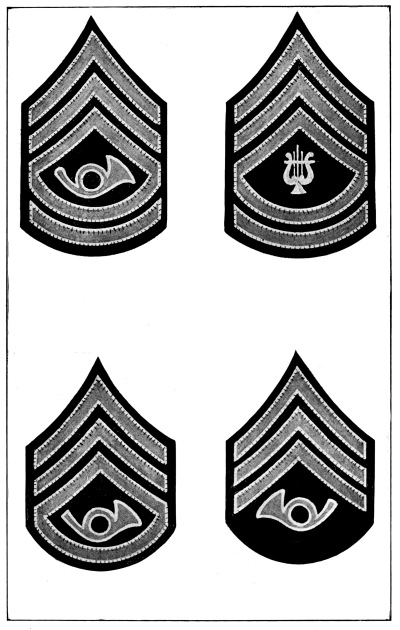
U. S. Army. Noncommissioned officers’ chevrons
1. Band Leader 2. Assistant Leader, West Point Band
3. Chief Trumpeter 4. Sergeant, Band
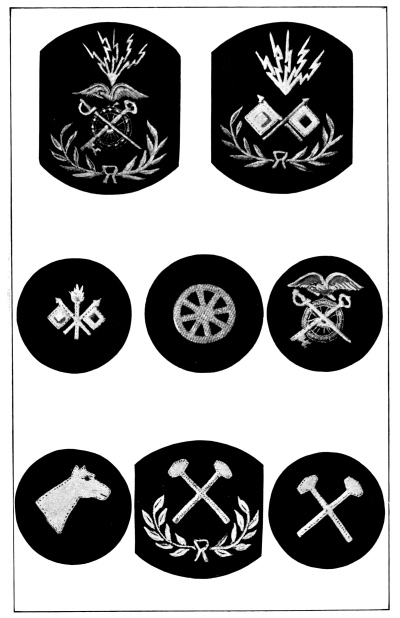
U. S. Army. Noncommissioned officers’ chevrons
1. Master Electrician, Quartermaster Corps
2. Master Signal Electrician
3. First Class Private, Signal Corps
4. Wagoner
5. First Class Private, Quartermaster Corps
6. Farrier
7. Chief Mechanic
8. Mechanic or Artificer
For Service coats the collar insignia consist of bronze metal disks with a raised rim, worn on each side one inch from the neck opening. The disk on the right side bears the letters “U. S.” with the number of the regiment or, where there is no regimental organization, the number of the unit if there is one. To designate men of the Volunteers, Reserves, National Guard and National Army the letters “U. S.” have superimposed upon them the letters “V,” “R,” “N. G.” or “N. A.” respectively. The disk on the left side bears the special device of the corps, department or arm of the service with the letter of the company, battery or troop below it, except for the Engineers where the letter is above the device. The special devices referred to are the same as the gilt ones already described with the following exceptions:
Corps of Interpreters—The letters “INT.”
Machine Gun Battalions or Squadrons—The letters “M. G.” in the upper angles of the crossed rifles or sabers.
Corps of Intelligence Police—The letters “I. P.”
Headquarters of Brigades and Higher Units—The letter “H.”
Headquarters of Trains—The letter “T.”
General Recruiting Service—The letters “RS.”
Disciplinary Barracks Guard—The letters “DBG.”
Trench Mortar Organizations—Crossed cannon with the letters “TM” in the upper angle.
Anti-aircraft Artillery—Crossed cannon with the letters “AA” in the upper angle.
ARMY AVIATION SERVICE INSIGNIA
For officers these insignia are worn on the left breast and are as follows:
Military Aviator—Two wings with a shield between bearing the letters “U. S.” and a star above, embroidered in silver on a blue background except the letters which are in gold thread.
Junior Military Aviator and Reserve Military Aviator—The same, omitting the star.
Military Aeronaut—Two wings with a balloon between bearing the letters “U. S.” and a star above, embroidered in white on a blue background except the letters which are in gold.
Junior Military Aeronaut and Reserve Military Aeronaut—The same, omitting the star.
Observer—A letter “O” with a single wing on the left of it embroidered in white on a blue background.
For enlisted men the insignia are embroidered in white on a blue sleeve cap let in at the shoulder seam and extending down the sleeve 5½ inches:
Enlisted Aviator—Two wings with crossed propellers between them and the number of the squadron above.
Aviation Mechanician—A circle enclosing crossed propellers with the number of the squadron above.
Other Enlisted Men—The same, omitting the circle.
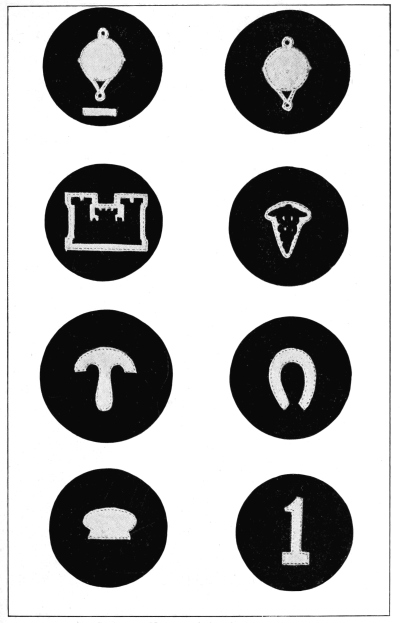
U. S. Army. Noncommissioned officers’ chevrons
1. First Class Gunner, Mine Company
2. Second Class Gunner, Mine Company
3. First Class Private, Engineer Corps
4. First Class Private, Hospital Corps
5. Saddler, Cavalry
6. Horseshoer, Cavalry
7. Cook
8. Badge for Excellence in Target Practice, Coast Artillery
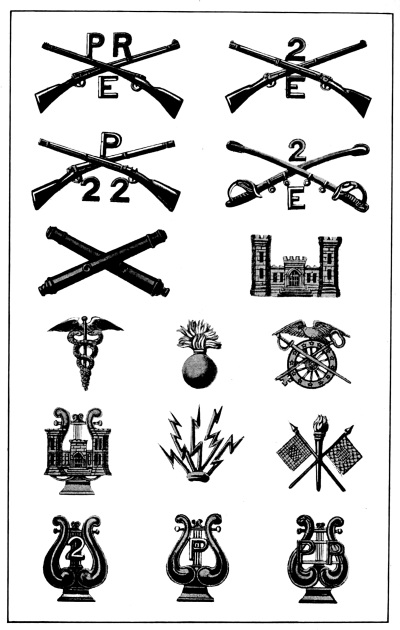
U. S. Army. Enlisted men’s insignia worn on dress coat collars indicating arm of the Service, Corps or Department
1. Infantry, Porto Rico Regiment
2. Infantry
3. Native Philippine Troops
4. Cavalry
5. Artillery
6. Engineer Corps
7. Hospital Corps
8. Ordnance Corps
9. Quartermaster Corps
10. Band Musician, Engineers
11. Electrician
12. Signal Corps
13. Band Musician
14. Band, Philippines
15. Band, Porto Rico
Brassards are bands of cloth worn on the sleeves to designate officers and men assigned to special duties.
Red Cross Brassard.—In time of war with signatories of the Geneva Convention all persons in the military services who are rendered neutral by the terms of that convention wear upon the left arm above the elbow a brassard of white cloth bearing upon it a Geneva cross in red cloth while on duty in the field of operations. The persons entitled to wear this brassard are surgeons, members of the hospital corps, nurses, chaplains and the personnel engaged exclusively with the removal and transportation of the sick and wounded.
Brassards worn on the right upper arm are of the following distinctive colors: blue for agents and signalmen, green for guides and scouts, red for orderlies and messengers, white for trench cleaners, yellow for members of parties carrying munitions, material, food or water, khaki with the word “Salvage” in red letters for members of salvage parties, and blue with the letters “M. P.” outlined in white thread for members of the Military Police.
Field Clerk’s Brassard.—Field clerks of Engineers wear upon the left arm above the elbow a brassard of maroon colored cloth with white edges.
Service Stripes.—All enlisted men of the Army who have served one or more enlistments in the Army, Navy or Marine Corps wear one stripe for each such enlistment on each sleeve of the dress coat midway between the wrist and the elbow. These service stripes are three-eighths of an inch in width and are placed diagonally across the outside of the sleeve.
The color of the stripe is that of the branch of the service in which the enlistment that it represents was served, as follows:
Cavalry, yellow.
Artillery, scarlet.
Engineers, scarlet piped with white.
Infantry, white.
Hospital Corps, maroon piped with white.
Ordnance, black piped with scarlet.
Signal Corps, orange piped with white.
Quartermaster Corps, buff.
Service School Detachment, green.
Service Detachment, Military Academy, green piped with white.
U. S. Navy, scarlet piped with yellow.
U. S. Marine Corps, yellow piped with scarlet.
Buttons.—The buttons worn by enlisted men of the Army on the dress coat are of gilt metal and bear the coat of arms of the United States in relief; those worn on the service coats are of the same size and design but are made of dull finish bronze metal, and those worn on the overcoat are large bronze flat buttons of the same design.
Identification Tag.—Each officer and enlisted man of the U. S. Army is required to wear two aluminum identification tags about the size of a silver half dollar whenever the field kit is worn, one tag to be suspended from the neck underneath the clothing by a cord or thong of leather passed through a hole in the tag, the second tag being suspended from the first one by a cord or thong. Each tag bears stamped upon it the name, rank, company, regiment and corps of the wearer. This tag is for use in identifying the wearer in case of death or serious wounds. In case of death one tag is buried with the body and the duplicate is kept with the record of the place of burial and the cause and date of death.
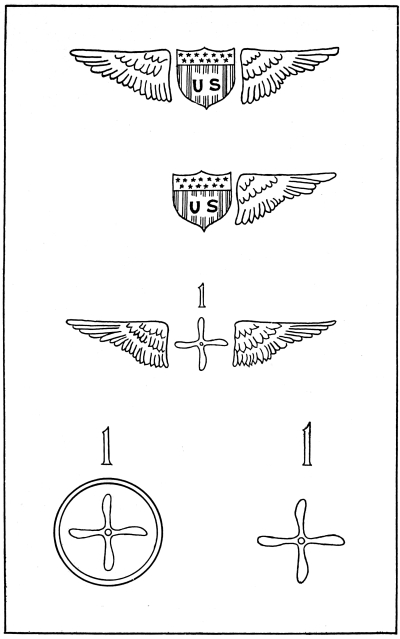
U. S. Army. Aviation Corps Insignia
1. Aviator (Regular aviators have a silver star above the shield. Junior and Reserve aviators have no star)
2. Observer 3. Enlisted Aviator
4. Aviation Mechanic 5. Other enlisted men
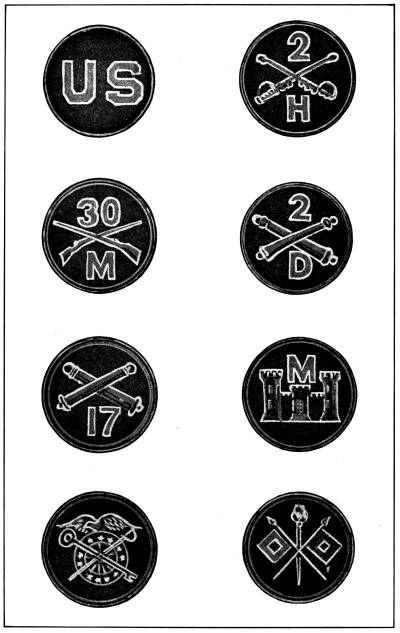
U. S. Army. Enlisted men’s insignia worn on collars of service coats
1. All enlisted men, right side of collar 2. Cavalry
3. Infantry 4. Field Artillery
5. Coast Artillery 6. Engineer Corps
7. Quartermaster Corps 8. Signal Corps
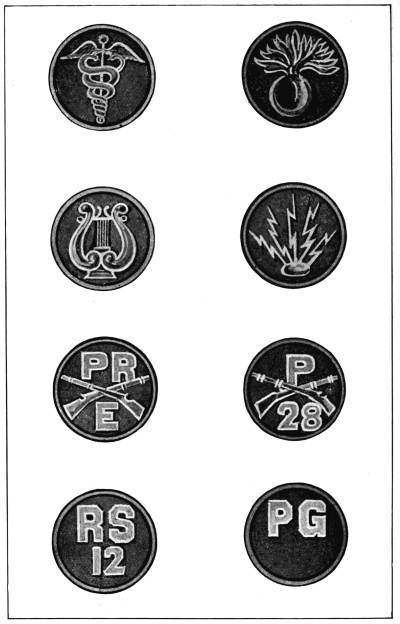
U. S. Army. Enlisted men’s insignia worn on collars of service coats
1. Hospital Corps 2. Ordnance Corps
3. Band Musician 4. Electrician
5. Infantry, Porto Rico Regiment 6. Infantry, Native Troops, Philippines
7. Recruiting Service 8. Prison Guard
Identification Patch.—In order that the men in an advance line of attack upon the battlefield may be recognized by the officers who are controlling their advance and accurately placing the curtain of shrapnel fire ahead of them, it has become necessary to prescribe identification patches upon the backs of the men’s coats between the shoulders. These identification patches are of different designs and colors to mark the different regiments and brigades, circles, triangles, squares and other shapes being used. The shape and color of these patches is not laid down in uniform regulations in the United States Army, but these details are prescribed from time to time in orders from Headquarters of the Field Armies.
United States Guards, National Army, are organized into battalions for guard duty in the United States during the period of the existing emergency. Their prescribed uniform is the blue dress uniform of the regular army with blue overcoats and the customary insignia.
Citizen’s Training Camps.—The uniform for members of these camps consist of olive-drab shirt, breeches and coat, canvas leggings, russet shoes, and field hat with red, white and blue hat cord. The bronze letters “U. S. T. C.” are worn on the collar, and on the left forearm a badge with the same letters.
Reserve Officers’ Training Corps.—The uniforms are olive-drab or “Cadet gray.” Insignia of rank are of white metal for cadet officers and gilt for instructors; Colonel, three diamonds; Lieutenant Colonel, two diamonds; Major, one diamond; Captain, three disks; First Lieutenant, two disks, Second Lieutenant, one disk. Sergeants and corporals wear chevrons prescribed for the Regular Army. On the cap is a wreath enclosing the letters “R. O. T. C.” in bronze and the same letters are worn on the collar. On the left arm is a badge with “R. O. T. C.” embroidered in the color of the arm of the service.
SEAL OF THE U. S. NAVY DEPARTMENT