II The Mailed Warrior
Reading edition
The appearance of the mail-clad warrior opens up an entirely new era in the history of European armour. The light plate defences worn by the Mediterranean nations, whether Greeks, Etruscans, or Romans, were never calculated to secure immunity from wounds; and as a fighting equipment they went down before mail, as stone before bronze, or bronze before iron. Chain-mail body-armour is distinctly represented on the Trajan column, and wherever worn, whether by the Scythian, the Parthian who was armoured down to his horse’s hoofs, or the dreaded Sassanian horse, it seems to have flashed like a beacon of victory, and its wearers ever appear in history as Rome’s most dreaded and formidable foes.
The Scandinavian also, isolated so long and unknown in history, suddenly burst upon Europe as a new and even more redoubtable mail-clad warrior. How so remote a people became acquainted with chain-mail can only be surmised, but it was perhaps through some Scythian channel not open to Western Europe. That the ravaging Viking landed on our shores equipped in mail, the “war nets” of Beowulf, “woven by the smiths, hand-locked, and riveted”; “shining over the waters” or in “the ranks of battle,” is sufficiently recorded by the Chroniclers. Shirts of mail, called “byrnies,” attributed to even the fourth and fifth centuries, are found in Danish peat-bogs fashioned of rings welded and riveted in alternate rows as neatly and skilfully as can possibly be, and all made by the hammer, if it be a fact that wire-drawing was not invented till nearly a thousand years later. The almost perfect specimen we figure, one-tenth the natural size, was found at Vimose, with portions of others. Some have also been found at Thorsberg, and in a burial-place of Roman age in Jutland.
Besides the mail defence, the Danes were armed with a shield, an iron cap, lance, axe, and sword. Thus equipped they proved for a long time almost irresistible, and ventured on the most dangerous and desperate undertakings. When we reflect on their adventurous voyages, the reckless attacks on powerful nations made by mere handfuls of men, and the gallant pertinacity they at all times displayed, it is impossible not to admire their exalted courage. It is easy to detect a rugged poetry, almost chivalry of a kind, underlying the Viking nature, in spite of ruthless cruelty, while the exaltation of deceit when practised on an enemy into a virtue is but a germ of modern statecraft. Their lives depending at every moment on the quality of their weapons caused these to be invested, particularly the sword, with a mystic glamour, which scarcely died out with chivalry itself, and lingers even yet in the more important functions of state. The chieftain’s sword was in fact his inseparable companion, known and endeared to his followers by a name symbolic of the havoc they had seen it wreak upon the enemy, and its fame in sagas was as undying as its owner’s. Tradition elevated the maker of the sword of Odin, a smith, we must believe, who forged swords of uncommon excellence, into a demigod; and has handed down the story of how he made a blade called Mimung so keenly tempered that when challenged to try conclusions with one Amilias, a rival, it sliced him so cleanly in two as he sat in his armour, that the cut only became apparent when, as he rose to shake himself, he fell dead in two halves. The name of this prince of craftsmen yet lives in the mysterious Wayland Smith of English folklore. Another vaunting smith Mimer was slain by the sword Grauer wielded by Sigurd; and the sword Hrunting is made famous by its owner Beowulf, the father of English lyrics. A Danish sword in the British Museum is inscribed in runes Ægenkœra, the awe-inspirer. From the Danes the exaltation of the sword passed to the English, and we find Ethelwulf, Alfred, and Athelstan bequeathing their swords by will as most precious possessions, equivalent to a brother’s or sister’s portion. Thence it passed, in legend at least, to the Britons, King Arthur’s sword Calibon, or Excalibur, presented ultimately by Richard I. to Tancred when in Sicily, being almost as famous as Arthur himself. Even Cæsar is provided by history with a sword named “Crocea mors,” captured from him in combat by our valiant countryman Nennius. The hilts of the Danish swords are described in the Edda as of gold, and Beowulf speaks of hilts that were treasures of gold and jewels. Canute’s huiscarles and Earl Godwin’s crew had swords inlaid with the precious metals, and some English swords were valued at eighty mancuses of gold.
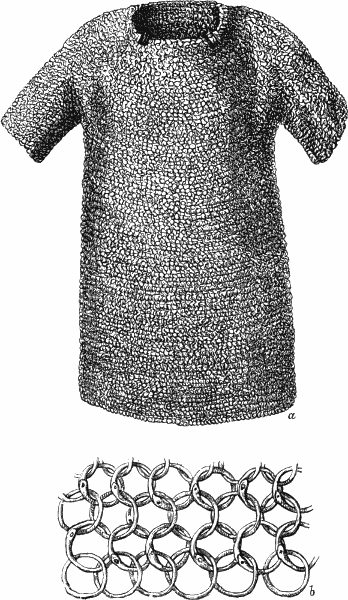
Fig. 1.—Hauberk, or byrnie, of chain-mail, of the fourth or fifth century, found at Vimose, one-tenth of the real size; and part of another, full size, from Thorsberg. From “Danish Arts,” published for the Science and Art Department.
The origin of the remarkable veneration for arms and armour, so apparent in the history of chivalry, is thus traced to wearers of mail, the first figures also to appear in something like what we regard as knightly equipment. The dress of Magnus Barefoot, described in 1093, differed probably but little from that of his predecessors, and consisted of helmet, a red shield with a golden lion, his sword called Leg-biter, a battle-axe, and a coat-of-mail, over which he wore a red silk tunic with a yellow lion.
The wearing of armour, particularly mail, on land, necessitated riding, and the northern rovers, finding the weight intolerable on their inland forays, took to horse whenever possible, harrying by this means an extent of country otherwise almost inaccessible. They even learnt in time to transport their horses over the sea, and in the ninth and tenth centuries landed in England from France as a mounted force, as their descendants after them did at Hastings. The English, on the other hand, rarely wore mail, though the spoils of the Danes might have furnished a fair supply, and they only used cavalry as a small force for scouting. An English king of the eighth century is, however, represented in mail by Strutt, and Harold and his immediate companions may have worn mail at Hastings, as represented in the Bayeux tapestry, and as he certainly did when assisting William in his war against Conan of Brittany. Handsome presents of Norman arms and armour were then made to him by Duke William. A little later we have the curious testimony of Anna Comnena, 1083-1146, that this mail, made entirely of steel rings riveted together, was wholly unknown in Byzantium, and only worn by the inhabitants of Northern Europe.
The definite conversion of the Northmen from sea-rovers to mounted men-at-arms when they settled in Normandy enabled them to lengthen their coats-of-mail, as well as their shields, lances, and swords, and to adopt many French manners and customs. But in facing the infantry wedge at Hastings, the time-honoured fighting formation of Teutonic stocks from the days of Tacitus, they did not disdain to fall back on the old Viking tactics of a pretended flight and rally, practised already by them during two centuries of warfare in England. That the English should have allowed their impenetrable ranks to be broken by so threadbare a stratagem is indeed extraordinary.
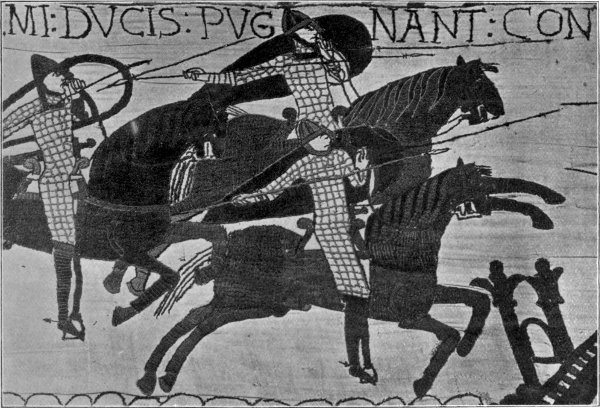
Fig. 2.—Norman knights in mail hauberks and conical helmets. From the Bayeux Tapestry.
The Norman Conquest introduced into England a permanent mail-clad cavalry as the chief strength of the battle, as in France, and infantry was discredited until the disputes of the sons of the Conqueror led once more to an English infantry force taking the field. The mail coat of the cavalry had in the meantime been further lengthened, and changed into a complete sheathing of steel by the addition of long sleeves and mufflers falling over the hands; leggings covering the thighs, shins, and feet; and a capuchin-like hood only leaving the eyes and nose exposed, but which could be thrown back. Thus enveloped, with a thickly-padded garment under the mail, a conical or flat-topped steel helmet, a large kite-shaped shield, and long-reaching weapons, he had little to fear when opposed to light-armed cavalry or infantry. The mail and helmets were always kept bright, as we know, but Anna Comnena adds that even the shields of steel and brass were so brightly polished as to dazzle beholders. Combined with the pennons and banners of various forms, with their glittering emblazonry, the massed men-at-arms of that day must have presented a magnificent spectacle, as the Chroniclers so frequently remind us. The coat-of-mail remained with but trifling variations the chief knightly defence until the close of the thirteenth century, and the protection it afforded was so complete that of 900 combatants who once entered battle in steel armour but three were slain. At Joppa in 1192, during a battle lasting from the rising to the setting sun, only three were killed on the side of the Crusaders; at the battle of Lincoln only three, at Evesham (1260) one knight and two esquires, at Falkirk (1295) but one knight and thirty foot on the winning side. These somewhat random examples seem fairly to represent the loss on the side of the victors, though terrible massacres overtook the losers. The protection was such that Saladin’s bravest warriors reported our men to be impenetrable; blows, they said, fell as if on rocks of flint, for our people were of iron and would yield to no blows. But though so terrible on horseback, the mailed knight, as observed by Anna Comnena, was little dangerous when dismounted. Neither had the English failed to observe this, and thus directed all their efforts to dismount the enemy. They had been severely galled by the bow at Hastings, and they came to recognise it as the one weapon likely to render them really formidable to their Norman oppressors. Henry I. encouraged its use, and we soon find the English arrows described as falling in battle like a shower on the grass or as falling snow. In a skirmish at Bourgthéroude in 1124, the first discharge brought forty horses to the ground before a stroke was struck, and eighty men-at-arms soon fell prisoners into the victors’ hands. At the battle of the Standard, the cloud of arrows pierced the unarmoured Scots, and chiefly contributed to the dreadful slaughter, set down at 11,000. The effects of missile weapons were such that the mailed period of which we are speaking saw three English kings fall victims to the bow, while a fourth, Edward I., escaped a like fate by a miracle. The accounts handed down of the extraordinary range and precision attained soon afterwards by this weapon appear wholly incredible in the light of modern toxophilite displays.
The cross-bow was an even more powerful weapon, whose use had been forbidden in war, but allowed by the Pope to the Crusaders in 1139. Richard I. appears to have introduced it into the English army, which became so expert in its use that in some of the sieges conducted during the twelfth and thirteenth centuries the enemies’ walls could not be manned. It is related of Richard, both at the sieges of Acre and Nottingham, that he himself slew men with this weapon. The numbers of cross-bowmen in our armies appear, however, to have been always relatively small. King John, with 400 knights, had but 250 cross-bowmen, used as skirmishers, keeping a mile in front of the army. The splendid army of Edward I. assembled at Poitou (1242), numbering 1600 knights and 20,000 foot, comprised but 700. The battle of Lincoln, however, was gained by them owing to their shot mowing down the horses of the barons, who were rendered helpless when dismounted. The cross-bow was at first bent by the hand and foot, but was afterwards of steel, when it required mechanical aids to charge it. The short and heavy bolts, called quarrels, struck with greater force than arrows, and the knight hit full on the head or breast by one was fortunate if only stunned. Instances are recorded of twofold mail and the quilted coat being penetrated by them. Cross-bowmen for a long time formed corps d’élite, the weight of the weapon and the armour causing them to be frequently mounted, and so early as King John the mounted “balistarii” were provided with one, two, or even three horses each, with carts to carry the quarrels and even the cross-bows as well. Notwithstanding superior accuracy in aim and penetrating power, it fell into disuse in England soon after the close of the thirteenth century, owing to its heavy weight and liability to damage by wet, and above all, on account of the greater rapidity with which arrows could be discharged from the longbow,—in a ratio of something like ten to one.
Nothing is more constantly met with in chronicles than accounts of the destructive effects of missiles, whether from bow or cross-bow, upon the horses of mounted combatants; yet, apart from the poetic fancy of Wace, who mounts Fitz-Osbert on an iron-clad steed at Hastings, the first mention of horse-armour at all connected with English history is at the battle of Gisors in 1198, when Richard I. speaks of the capture of 140 sets in terms which plainly show that he then met with it for the first time. It has, however, been concluded, from the absence of any mention of horse-armour in English statutes until 1298, that it was unknown here till the close of the thirteenth century. At this time a man-at-arms in France received half as much again in pay if his horse was armoured, and in 1303 every man with an estate of 500 livres was bound to provide horse-armour. A mailed horse appears in the effigy of Sir Robert de Shirland in Sheppey, and a fine figure of a steed completely clad in mail is among the figures of The Painted Chamber, published by the Society of Antiquaries.
The English custom of fighting on foot, it is almost needless to add, had been adopted by the Danish and even the Norman settlers here, and during the civil wars of Henry I., Stephen, and Henry II., the leaders on both sides, including the kings in person, fought their battles dismounted, rendering horse-armour of relatively small importance.
A permanent force was raised by a law of Henry II. in 1181, compelling every burgess or freeman to possess an iron headpiece, a lance, and either a mail hauberk or a gambeson, according to his means: and this was supplemented by the addition, under Henry III. in 1253, of swords and knives to the infantry equipment, and the calling up of a reserve of those possessed of less than 40s. of land, armed with scythes, long-handled axes, knives, and other rustic weapons. Soon afterwards a wild Welsh and Cornish infantry was enrolled, and we hear of lagers and intrenchments, and in 1302 one of the first really crushing defeats is inflicted on chivalry at the hands of burghers by the men of Bruges, who slew forty counts and barons at Cambray.
This extensive arming of the population led to the formation of bands of outlaws, who devastated the country, something in the manner of the free-companies of France at a later time. A young man named William, declining to acknowledge Lewis of France in 1216, drew together a thousand bowmen and conducted a guerilla warfare in the forests of Sussex. The still more renowned Adam Gordon infested the woody country between Wilts and Hants until Prince Edward at last, about 1267, overcame him in single combat. The ancient Ballads abound with instances of such exploits, which are embodied in the romance of Robin Hood.
A contemporary of Richard I. describes the equipment of an English foot-soldier as consisting of an iron headpiece, a coif and coat-of-mail, and “a tissue of many folds of linen, difficult of penetration and artificially worked with the needle, vulgarly called a pourpoint.” He was taught to receive cavalry with the right knee on the ground, the left leg bent, the shield in the left hand and the butt of the lance in the ground with the point to the enemy. Between every two lances was a cross-bowman with a rear rank to load while the front shot. Against this formation the Moslem cavalry’s “surging charges foamed themselves away,” and as at Waterloo, the retreating squadrons were charged again and again by our heavy-armed horse. On the other hand, the same tactics, when employed against forces largely composed of English archers, were unsuccessful; thus the Welsh in 1295 set their long spears on the ground with points towards the cavalry, but the Earl of Warwick placed an archer between every two horsemen and routed them. Wallace’s massed pikemen, three years later, were broken by Edward’s archers and military engines, and routed by the men-at-arms, who dashed into the openings.
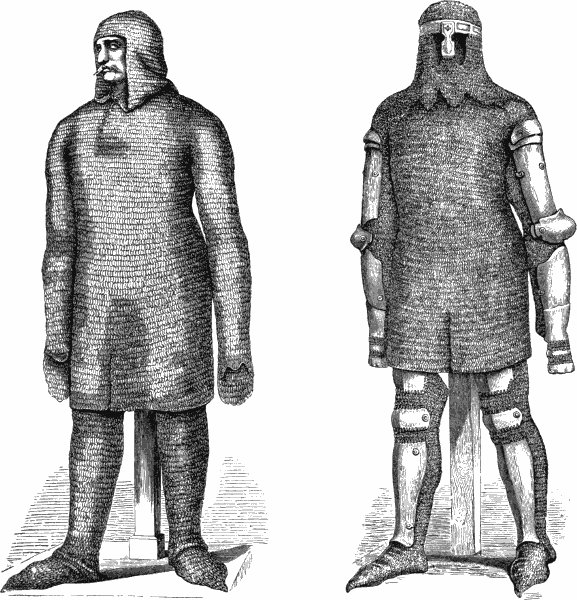
Fig. 3.
1. A complete suit of mail, with coif and mufflers, late twelfth century, said to have been found in a coffin in Goring Church.
2. A thirteenth-century suit, with reinforcing plates, said to have been found with the other.
It does not appear that any special study of mail has been undertaken, or that any good collection of mail has been formed, nor have the many varieties been arranged chronologically in the order in which they appeared. Materials for such a study exist, though not very abundantly, in the Tower, the British Museum, the collection at Woolwich and Dover Castle, the Armourers’ Hall, Warwick Castle, Parham, and in other private collections, and from these and the effigies of mailed knights it can be seen that an almost endless variety exists, not only in the sizes of the links, which vary from ⅙ to ¾ of an inch in diameter, but in the sections of the wire used, which may be round, flat, triangular, trapeziform, quadrate, polygonal, etc. Nor is there less diversity in the method of closing the rings, which was accomplished either by welding, single or double riveting, with a flattening and more or less overlapping of the links, soldering or merely butting. Again, there are many ways of arranging the links, producing mail of very different weights, either double or single, as well as mail in which certain parts are stronger than the rest. In European mail four links are usually made to pass through a centre one, though this is not an invariable rule. The statement in Beckman’s History of Inventions, that wire-drawing was invented in the fourteenth century, was held for a long time to furnish a safe date, but two Corporations of wire-drawers occur in Etienne Boileau’s Paris Livres des Mestiers, in the middle of the thirteenth century, and the art is actually of unknown antiquity. The mail, we read, was kept bright by barreling, but does not appear to have presented much scope for decoration. The Edda speaks of a byrnie of gold, and there are other allusions to gilded mail, and we find hauberks scalloped at the extremities, and finished off with rings of brass.
Two suits of mail (see Fig. 3), illustrated in the catalogue of the loan collection of Ironmongers’ Hall in 1861, now in the possession of Mr. J. E. Gardner, F.S.A., are formed of unriveted links, the ends of the rings being merely butted. Their authenticity has therefore been questioned. The description of them printed in 1861 was to the effect that they had been found in a chest or in a vault of a church in Oxfordshire. In the manuscript catalogue of the collection at Parham is a note to the effect that they were found in stone coffins built in the wall of the church at Goring, Berks, supposed to be coffins of the Beche or De Beche family, and contained skeletons, a third suit having been destroyed except the hood, which is now at Parham. However this may be, the larger suit affords a good representation of the mailed figure of the end of the twelfth, and the small one of that of the thirteenth century, with reinforcing pieces of plate. The possibility of their having been made for lying in state or funerals deserves perhaps a passing note, especially in view of their respective dimensions; and it is in any case very questionable whether the prices paid for them would have remunerated the labour of producing forgeries. Another hauberk of large size was found in Phœnix Park, Dublin, thirty years ago, but a silver badge of an O’Neil found with it showed it to have been buried not earlier than the middle of the fifteenth century. In the thirteenth century the curious and well-known banded mail appears on effigies and other representations, which Mr. J. G. Waller, F.S.A., regards as caused by the passing of a leather thong through each alternate row of rings, for the sake of extra strength. This variety may have originated with the single thong passed through the links of the coif over the forehead and below the knee, seen in early effigies like that of William Longespée (Fig. 4) at Salisbury.
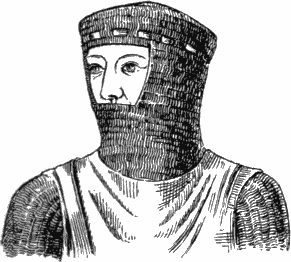
Fig. 4.—Mail coif, flat-topped, with leather thong.
From the effigy of William Longespée, son of Henry II. by Fair Rosamond, who died 1227. Salisbury Cathedral.
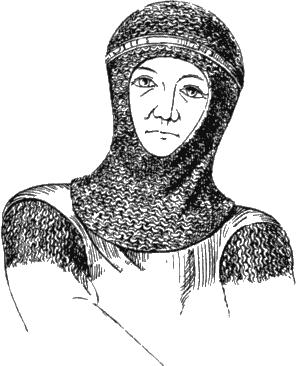
Fig. 5.—Mail coif, round-topped, with jewelled fillet.
From the effigy of Robert de Vere, Earl of Oxford, died 1221. Hatfield Broad-Oak Church.
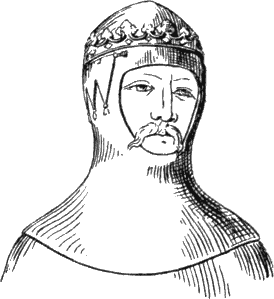
Fig. 6.—Mail coif, conical top, with coronet and mantelet.
From the effigy of John of Eltham, Earl of Cornwall, died 1334. Westminster Abbey.
The defence of the body was for a time wholly left to the mail with the underlying gambeson, and the shield, but the head had always received the additional protection of a cap of steel, called the chapelle-de-fer, worn indifferently under or over the coif of mail. Effigies of the first half of the thirteenth century show it both round and flat at the top (Figs. 4, 5, 6, and 7). The nasal piece associated with the conical helm (Fig. 2) of the eleventh century tended to disappear in the twelfth.
The fact that English armies under Richard I. were made to abandon their ancient formation and to engage on horseback, and to rely on the battle-axe and mace as their chief weapons, and the presence of the large bodies of archers and arbalisters which he brought into the field, led to the introduction, probably by Richard himself, of the great heaume worn over the steel cap and padding, and only put on at the moment of battle. It is first seen on Richard’s second seal, and consisted of a cylinder, usually flat-topped, with two horizontal clefts for vision, and strengthened by bands crossing each other over the face and top. Breathing-holes were added towards the middle of the century, and the grated front was introduced soon after, to admit more air. This is seen in the first seal of Henry III., and another advance, the movable vantail, hinged at the side, in his second seal. An oft-described specimen in the Tower weighs 13 lb. 8 oz., but is regarded by Lord Dillon, the present Curator of the Armouries, as a forgery. About 1270 we sometimes find it with a round top, though the flat top did not go quite out till the beginning of the fourteenth century. The attempts made to seize and drag it off, so often noticed by Chroniclers, led to its being secured by a chain. The further changes seen were improvements in the visor, giving better vision and more air, fixing it more securely, and so transferring the weight from the head to the shoulders, and changing the flat top to a cone, on which blows fell with less stunning effect.
These heaumes, by concealing the face, intensified a difficulty already felt at Hastings, when Duke William was obliged to raise his helmet to contradict a rumour of his death. Recognition, now become impossible, led to the use of heraldic badges, at first painted on the helm, as they already were on the shield; and of crests, first in the fan or peacock’s feather shape, as on the second seal of Richard I., and afterwards to more distinctive crests and badges. The Crusading Chroniclers relate that the crests were brilliant with jewels, and they are represented as circled by coronets in the seals of Henry III. and his son Edward. The heaume of St. Louis, 1249, was gilded. Richard himself, in gala dress, on the day after his marriage with Berengaria, is described by Vinsauf as wearing a Damascus sword with gold hilt and silver-scaled scabbard, his saddle inlaid with precious stones, his horse bitted with gold, and in place of the high defensive plates before and behind in general use two little golden lions with raised paws.
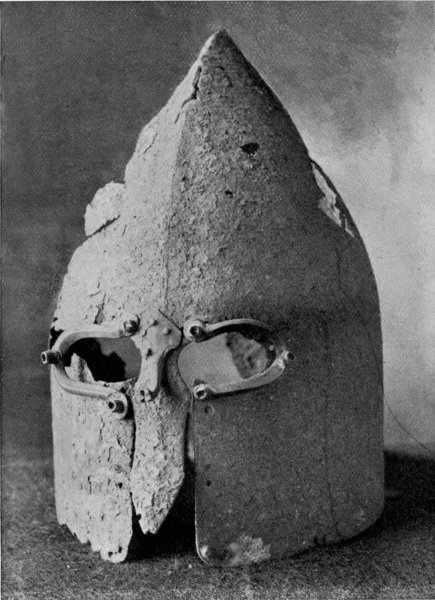
Fig. 7.—Helmet of bronze and iron, from County Down. Twelfth century.
Next to the headpiece the most urgent necessity was to protect the breast against the direct shock of the lance, and for this a rigid defence was of the utmost importance. Thus a beginning was made even during the mail period towards the introduction of plate-armour. Jazerant and scale armour of small plates had been adopted to this end by the Franks, and Charlemagne had introduced the classic breastplate. Something of the kind was perhaps even known to the Viking, and by the twelfth century Scandinavians certainly used a defence called a briostbiorg beneath the mail, extending from the neck to the waist. Chroniclers allude to shining breastplates long before there is the slightest appearance of them in illustrations, though from the time that surcoats were worn over the armour it becomes difficult to see what is beneath. Allusion is often made to a plastron-de-fer; and in the combat between Richard, when Earl of Poitou, and William des Barres we read that an iron defence was worn over the breast. One of the effigies in the Temple Church is equipped with a back and breast plate of single plates united by straps. It is stated that the bodyguard of Henry III., 400 strong, which fled at the battle of Lewes in 1244, wore breastplates; and in 1277, 300 cavalry so armed were sent to Wales.
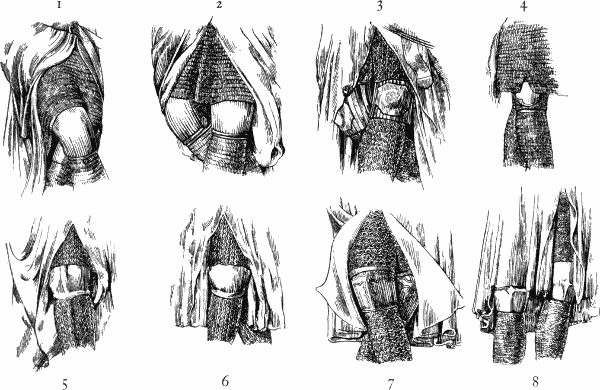
Fig. 8.—Illustration of the development of plate-armour.
1. The gambeson appearing below the chausses, but covering the chaussons of mail, forming an extra protection to the knee. From the effigy of Robert of Normandy.
2. The same, but apparently with an extra applied cap. From the effigy ascribed to one of the Pembrokes in the Temple Church.
3. The quilted gambeson appearing below the chausses and drawn over the chaussons, with the additional protection for the knee-cap of an octagonal plate. From the effigy of Robert de Vere, Earl of Oxford.
4. The chausses and chaussons overlapping, forming a double thickness of mail, with the addition of a quatrefoil plate over the knee-cap. From the effigy attributed to the second Longespée at Salisbury.
5. A ridged knee-defence of cuir-bouilli or plate enveloping the knee, over the mail. From the effigy of Robert Ros in the Temple.
6. Globose knee-cap of Aymer de Valence. Westminster Abbey.
7. Decorated knee-defence from an effigy in Whatton Church.
8. Cross-ridged knee-defence from an effigy of Robert de Bois.
Following the head and breast, the limbs received protection from plate-armour, the knees and shins of mounted men-at-arms being peculiarly exposed to injury in melées with infantry, from blows of the two-handed battle-axe and mace. Additional security was absolutely essential against these weapons, which were introduced both for horse and foot by Richard I., and had grown in favour ever since. These even penetrated mail, the Irish axe in particular being reputed to cut off limbs in spite of its protection. The Scandinavians, with their keen military instincts, had provided themselves in the twelfth century with knee-caps of iron attached to overalls worn over the mail. Our earlier mailed effigies, however, show no special defence for the knee, though the one at Salisbury, attributed by Stothard to William Longespée, already noticed, has a stout thong passing between the links of mail just under it. The effigy of Robert of Normandy, of which there is a cast in the National Portrait Gallery, shows a thick overall under the chausses of mail, and drawn over the mail chaussons at the knee (Fig. 8, No. 1), and a similar appearance is seen in the first seal of Richard I.; in the sleeping guards of the Easter Sepulchre at Lincoln (Fig. 9); and other monuments of the same date. In the effigy attributed to William, Earl of Pembroke, in the Temple, who died in 1289 (Fig. 8, No. 2), and in Stothard’s drawing of the effigy at Whitworth, an appearance of a thick cap is also to be seen, perhaps the extremity of a padded overall overlapping the knee; and in other examples the thick quilted gambeson leg-defence is clearly seen below the mail, covering the knee, and in the case of De Vere, who died 1221, it has the interesting addition of an octagonal plate (Fig. 8, No. 3), apparently of iron, over the kneecap. The effigy, called the second Longespée, at Salisbury (Fig. 8, No. 4), about 1260, exhibits an apparently double thickness of mail at this point, caused by the overlapping of the chausses and chaussons, with the addition of a circular plate with a quatrefoil upon it. Contemporary Chroniclers also mention that greaves were worn by knights in the time of Richard I., though the earliest manuscript illustration of them occurs in Matthew of Paris’s Lives of the Offas.
The feet were cased in mail, and the spurs were simple straight spikes or goads, perhaps worn on one heel only and called the prick-spur. Under the early Plantagenets the point was fixed on a ball, while the rowel spur is seen in the monument to Le Botiler of the reign of Henry III.
Under the heroic Richard the powers of defence seem to have definitely triumphed over those of attack. Knights sheathed in mail over quilted work, and wearing the great battle-helm, appeared invulnerable and able to encounter the most fearful odds, and even to rescue each other when dismounted amidst swarming enemies. The further changes during the mailed period were in the direction of military display, which has always offered an attractive field. Whenever the pressure for improved armament was relieved through the defensive equipment for the time satisfying the wearer, whether a naked savage or well-equipped soldier, attention was turned to the warrior’s personal embellishments, partly to gratify the wearer’s vanity, partly to captivate and dazzle, but chiefly to affright and awe the enemy. The fact that the French and English wore the same armour and equipment, and the common occurrence of internecine wars at this time, rendered distinguishing costumes particularly necessary. By simply throwing away their cognisance at the battle of Noyon, Peter de Maule and others escaped recognition and mingled with the pursuers, while Ralph de Courci mistook the French for his own side and was taken prisoner. Nothing but the different-coloured crosses sewn to the garments of the French, English, and Flemish Crusaders served to distinguish them, and white crosses alone distinguished the party of Simon de Montfort, 1264, from their enemies. Nothing approaching to any uniform is heard of in this age, unless when Richard of Gloucester traversed France in 1250, with a retinue of forty knights equipped all alike, with new harness glittering with gold, on his visit to the Pope.
The beautifully-sculptured guards of the early fourteenth century Easter Sepulchre in Lincoln Cathedral (Fig. 9) present fine examples of the costume of the knight armed with the mace, sword, and shield towards the end of the mailed period. The bassinet on the figure to the right is particularly noteworthy.
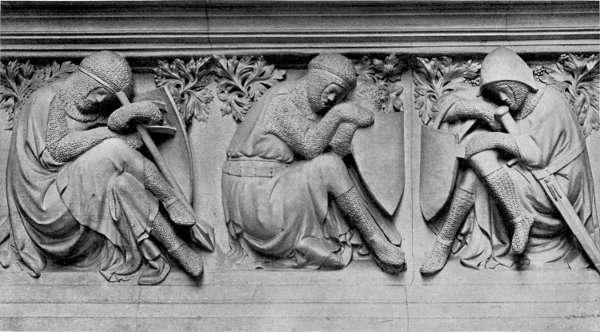
Fig. 9.—The sleeping guards, from the Easter Sepulchre in Lincoln Cathedral.