Chapter IV · (continued 2)
Reading edition
3. An oblong block of sandstone, containing two smooth cavities, probably used for polishing small objects such as jet rings. One of the cavities is a hollowed circle 21⁄2 inches in diameter, and half an inch deep; the other is a groove 3 inches long, half an inch wide, and the same in depth (Fig. 194).
4. Two fragments of a circular grindstone, made of fine red sandstone. One of the portions shows a few inches of the striated circumference as well as a small segment of the central hole. The diameter of the stone when whole would be about 15 inches.
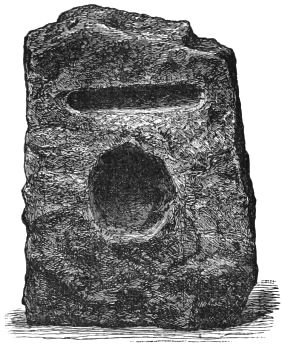
Fig. 194.—Block of Sandstone (1⁄4).
5. Two large irregularly-shaped masses of whitish sandstone, each containing a smooth cavity shaped like a trowel or botanical spud, having the sides curled up. One of these curiously-shaped cavities measures 10 by 8 inches. Its greatest depth, which is at the base and in the line of the shortest diameter, is 3 inches. The other is precisely similar in shape, but of smaller dimensions. The latter stone has friction-marks on another of its sides.
6. Another mass of whitish sandstone, of a semi-globular shape, having a cup-shaped cavity on its flat surface, must also be included under this heading. The diameter of the cup is 51⁄2 inches, and its depth 21⁄2 inches. The rest of the flat surface all round the margin of the cup is smoothed and striated, evidently caused by the sharpening of tools. The cup itself was not used for this purpose, as the marks of the puncheon by which it was chiselled out are distinctly seen. Its probable use was to hold water, so essential to the sharpening of metal tools.
Cup Stone.—A small cup stone found in the interior of the crannog. The stone is smooth on its upper and under surfaces and on one side, but the other sides are irregularly shaped. The cup itself is quite smooth and circular, and looks as if it had been used as a small mortar. Its diameter is only 1 inch, and depth half an inch (Fig. 195).
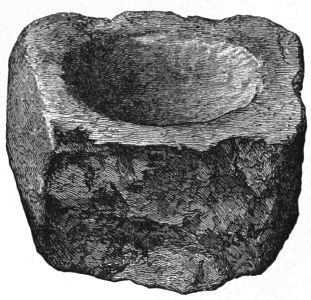
Fig. 195.—Fragment of Stone, with a cup-shaped Cavity (1⁄1).
Querns.—Only two upper quern-stones, both of which are in a fragmentary condition. One was made of a fine quartz conglomerate, and, by putting the fragments together, it was ascertained that it measured 18 inches by 17 inches. It was flat, and more of a millstone shape, and the central hole was large (3 inches in diameter), circular, and not tapering. For the insertion of a handle there was a small square-shaped hole at its margin.
Portion of another quern made of whinstone, and of the usual type, indicates a medium size, of about 1 foot across.
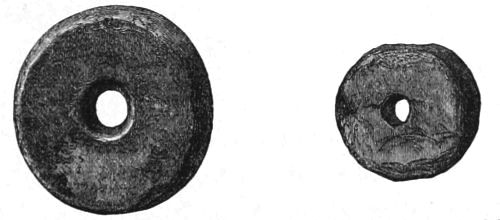
Fig. 196.—Spindle Whorl (1⁄1). Fig. 197.—Spindle Whorl (1⁄1).
Spindle Whorls.—A small spindle whorl neatly made of coarse shale. It is flat and circular, and has a diameter of 1 inch (Fig. 196). Another perforated little object, of smaller dimensions than the former, is made of cannel coal (Fig. 197).
Flint Objects.—Two views of a portion of a curved flint knife, which has been much used, are here given (Fig. 198). Another small flint implement like a scraper is figured, because it exhibits one side which has been artificially polished (Fig. 199). Fig. 200 represents a small central core, neatly chipped all round. There is another large core of flint 31⁄4 inches in diameter, from which many flakes appear to have been struck off. Besides the above there were found a small portion of a finely chipped scraper, and a large quantity of broken flints and chips.
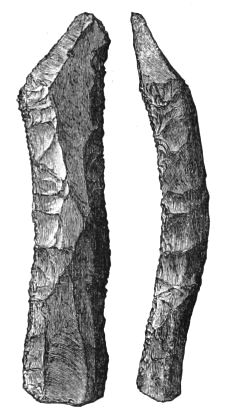
Fig. 198.—Flint Implement (1⁄1).
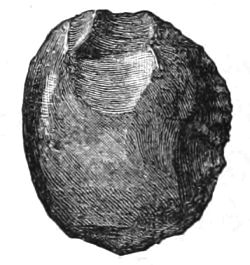
Fig. 199.—Polished Flint Implement (1⁄1).
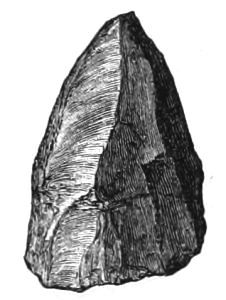
Fig. 200.—Flint Core (1⁄1).
Finally, small pebbles, sometimes highly polished and variegated in colour, thin circular discs of stone about the size of a halfpenny-piece, bits of dark shale as if water-worn, and a large quartz crystal having its angles worn off, may be mentioned among the nondescript articles under this heading. Also a lump of iron slag was found near the middle of the first trench, but, mysteriously, it could not be seen when collecting the objects at the end of the day's work, and was never recovered.
II. Objects of Bone.
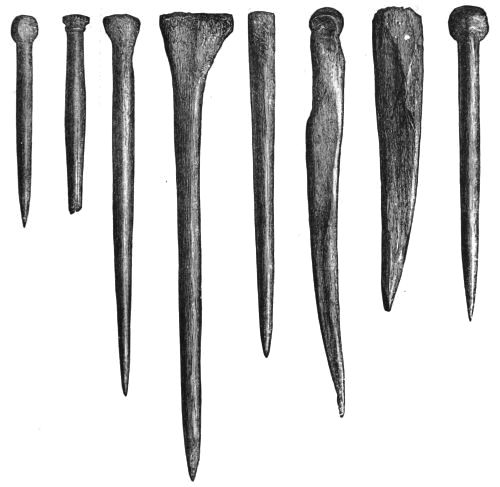
Fig. 201. Fig. 202. Fig. 203. Fig. 204. Fig. 205. Fig. 206. Fig. 207. Fig. 208.
Bone Pins (1⁄1).
Pins.—Twenty bone pins, varying in length from 11⁄2 inch to 31⁄2 inches. These articles are exceedingly well made, with round polished stems, tapering into sharp points. Some have round heads like beads, others are circular but flat on the top, while others again, especially the larger ones, are irregularly shaped. One (Fig. 202) has its head ornamented by a circular ridge, surmounted by a wider rim neatly notched all round, and another has its shank surrounded by two bands of diamond-shaped spaces, formed by a series of incised lines slantingly crossing each other, as shown in Fig. 212. Fig. 210 is the representation of one only partially formed.
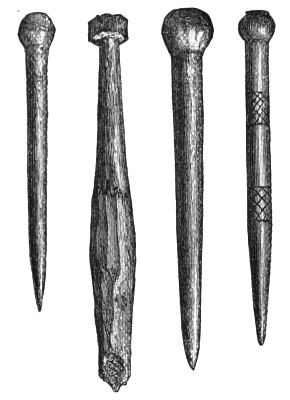
Fig. 209. Fig. 210. Fig. 211. Fig. 212.
Bone Pins (1⁄1).
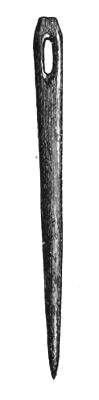
Fig. 213.
Bone Needle (1⁄1).
Needle.—A neatly-formed needle, having an elongated eye at its extremity, precisely similar to a common darning needle. It tapers gently into a sharp tip, and is smoothly polished all over. Its length is 2 inches (Fig. 213).
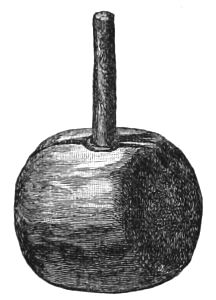
Fig. 214.—Bone Knob (1⁄1).
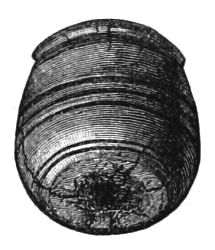
Fig. 215.—Bone Knob (1⁄1).
Knobs.—Three round objects of bone, about the size of a marble, each having a portion of a slender iron pin more or less projecting. Two are quite smooth, globular, and precisely similar to each other in every respect (Fig. 214); the other is ornamented by a few incised circles and ridges (Fig. 215).
Fig. 216 represents a curiously-shaped object of bone, the use of which is unknown to me.
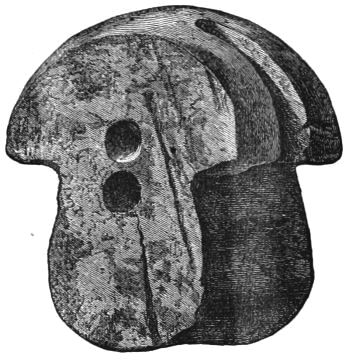
Fig. 216.—Object of Bone (1⁄1).
Worked Bones.—Several portions of bone, exhibiting marks of sharp-cutting instruments, but not assuming the form of any recognisable implements.
Toilet Combs.—Three of these articles, which are in a wonderfully good state of preservation, are here engraved on account of their structure and variety of ornamentation.
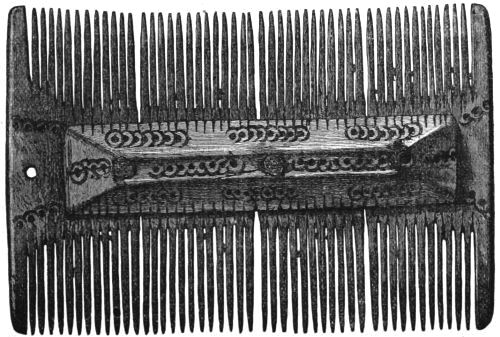
Fig. 217.—Bone Comb (1⁄1).
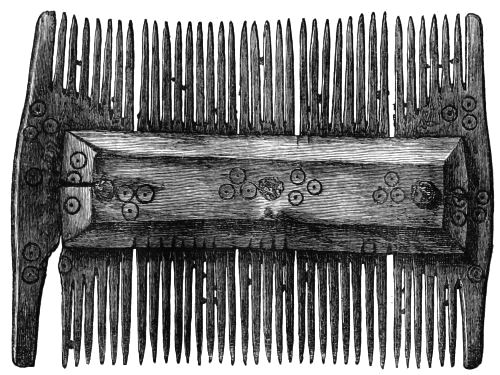
Fig. 218.—Bone Comb (1⁄1).
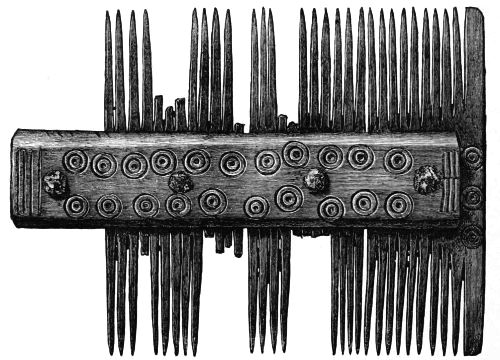
Fig. 219.—Bone Comb (1⁄1).
They are all made on a uniform plan. The body, i.e. the portion containing the teeth, consists of three or four flat pieces kept in position by two transverse bands of bone, one on each side, and riveted together by three or four iron rivets. The comb represented by Fig. 217 has its body made of four portions, but only three rivets. The ornamentation is alike on both sides, and at one end there is a small hole, probably for attaching it to a string. It is 31⁄2 inches long and 21⁄4 inches broad. That figured next (Fig. 218) has the same breadth as the former, but not quite the same length, being only 3 inches long. The ornamentation is similar on both sides.
From slight cuts on the cross bars, corresponding to the intervals between the teeth, it is manifest that the teeth in both these combs were formed by a saw, after the pieces were riveted together.
The third comb here engraved (Fig. 219) is in a somewhat fragmentary condition, but when whole it would be about 4 inches long. The body was made up of four portions, and contained four iron rivets. Its ornamentation consists of a central dot, surrounded by two incised circles, and is alike on both sides. The similarity of the concentric circles induces me to believe that they must have been formed by a die, probably branded on with a hot iron.
Some other fragments of similar combs were found, representing at least three additional combs, with teeth rather finer than those in the illustrations.
III. Objects made of Horn.
Several portions of deer horns, consisting of tines and thick portions of the body of the horn, together with a few of the roe-deer, presenting sometimes marks of a saw and sometimes those of a sharp-cutting tool, were found in the refuse-heap. The few worked objects I have to record were all made from horns of the former animal. One large antler, having portion of the skull attached to it, and the entire lateral half of the skull of a roe-deer with the horn still adherent, show that the horns were not shed ones, but those of animals actually caught and killed. The manufactured implements consist of a few pointed objects, and one or two handles, apparently for knives.
Fig. 220 represents a highly polished dagger-like implement, measuring 71⁄2 inches long. Another, of about the same size, is coarsely cut out of the side of a large horn (Fig. 221). A small pointed object is figured among the bone pins (see Fig. 207).
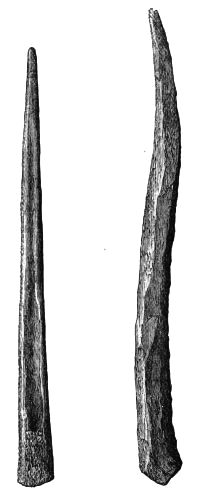
Fig. 220. Fig. 221.
Implement of Horn (1⁄2). Horn (1⁄2).
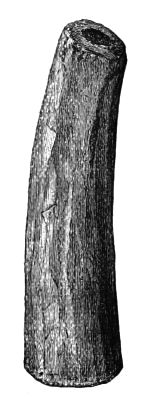
Fig. 222.
Knife-Handle (1⁄2).
Knife-Handles.—One of the handles is well made, having the rough surface removed with a sharp-cutting instrument. It is 4 inches long (Fig. 222). Another is only 3 inches long, and has a notch at one end.
IV. Objects of Wood.
Wooden objects are extremely rare. One or two fragments of what appeared to have been a bowl, portion of the blade of an oar, a bit of board partially burnt and penetrated by four round holes, together with three pins almost identical with those found at Lochlee (see Figs. 112, 114, and 115). The bowl was ornamented by two or three incised parallel lines near the rim. Another small fragment, which might have been of the same vessel, had a clasp of thin brass over it, as if it had been mended.
V. Objects of Metal.
(a.) Articles made of Iron.
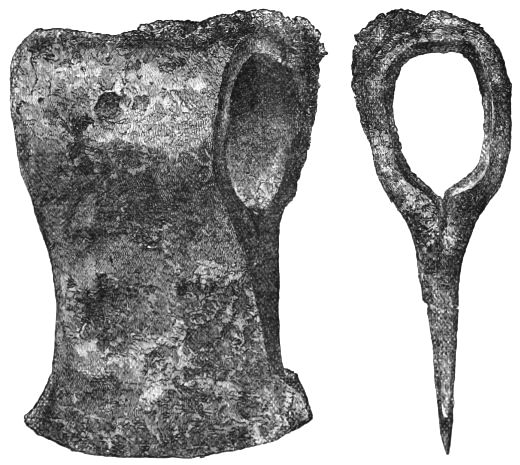
Fig. 223.—Iron Axe (2⁄3).
1. Axe Head.—This implement, which is represented in Fig. 223, measures 3 inches along the cutting edge, 41⁄2 inches from the centre of cutting edge to the back of the hole for handle, and 2 inches through the centre of this aperture. A neighbouring farmer, who had carted a load of the stuff from the midden for potting plants, found this axe-head while making use of the stuff in his greenhouse, and returned it to me.
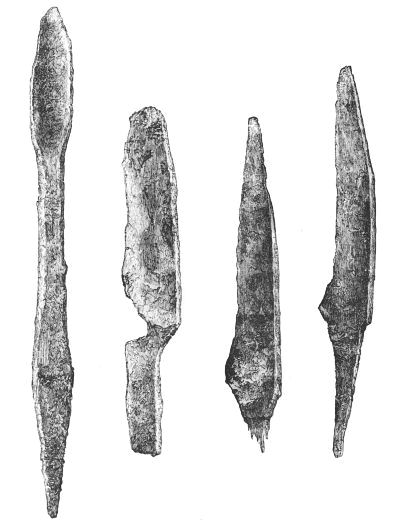
Fig. 224.—Gouge (1⁄3). Fig. 225. Fig. 226. Fig. 227.
Iron Knives (1⁄1).
2. Gouge.—This instrument appears to have had a portion broken off its point. It still measures 14 inches long, and its other extremity is pointed for insertion into a handle (Fig. 224).
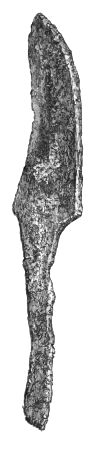
Fig. 228.
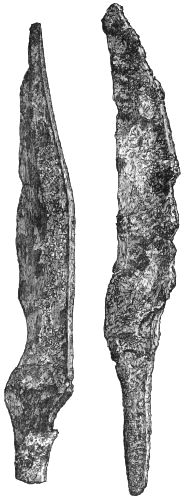
Fig. Fig. 229. Fig. 230.
Iron Knives (1⁄1).
3. Knives.[35]—Six well-shaped knife-blades, all with tangs for insertion into handles. The blades vary in length from 2 to 4 inches (Figs. 225 to 230).
4. Punch.—This implement is 6 inches long, and rectangularly shaped, with its angles slightly flattened (Fig. 231).
5. Awls.—Of these objects there are three: one is very slender and sharp, but only 2 inches long (Fig. 232). Another is 4 inches long, and the third is a much larger implement, being 71⁄4 inches long.
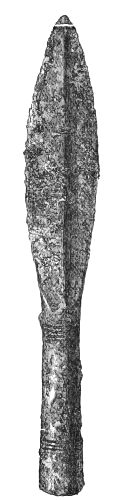
Fig. 233.—Spear Head (1⁄2).
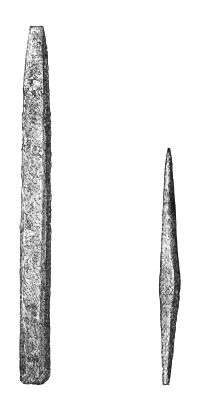
Fig. 231.—Punch (1⁄2).
Fig. 232.—Awl (1⁄1).
6. Spear Head.—This is a well-shaped socketed spear head, 81⁄2 inches long, with a central ridge in the blade. The socket end is ornamented by two groups of circular grooves, each group containing three circles. Portion of the wooden handle was found in the socket (Fig. 233).
7. Arrow Heads.—Three pointed objects like arrow heads are represented in Figs. 234, 235, and 236. Two of these objects are almost identical in size and form. One end is four-sided and tapers to a sharp point, the other is round and hollow as if for the insertion of the stem of an arrow. Length 23⁄4 inches. The third has the socket end very similar to the former, but the front portion is flat, and widens out a little before coming to a sharp point (Fig. 236).
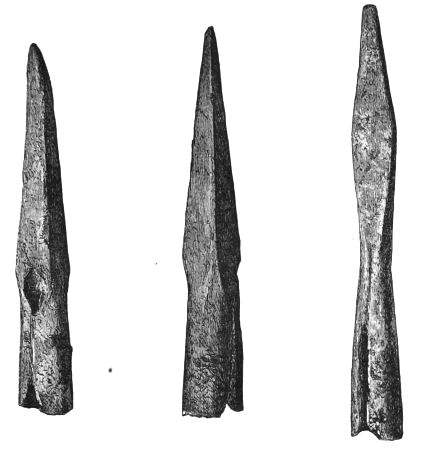
Fig. 234. Fig. 235. Fig. 236.
(?) Arrow Points (1⁄1).
8. Fig. 237 represents a curious object, having a spring attached to each side, both of which are still compressible, and a curved portion containing a round hole. Total length is 5 inches, length of springs 2 inches, length of curved portion 13⁄4 inches. Said to be portion of a padlock, similar in structure and principle to locks now used in China and some parts of India.[36]
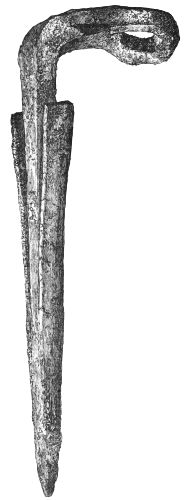
Fig. 237.
Iron Object (1⁄1).
9. Files?—An object shaped like a flat file, cut squarely at one end, and having a sharp-pointed tang at the other. It is of uniform thickness throughout, and measures 31⁄2 inches long, 5⁄8 inch broad, and rather more than 1⁄8 inch thick. There is another object exactly similar to the above in form, but a shade smaller. They look like small files, but no grooves now remain.
10. Spiral Objects.—Fig. 238 represents a slender iron rod, forming a close spiral with three twists at one end, and a slight curve at the other, which presents the appearance of having been fractured. The diameter of the circular portion is rather less than 1 inch. Fig. 239 represents another spiral object terminating in a straight point.
11. Fig. 240 represents two views of a small ornamental instrument with a bifurcated termination, which might have been used as a compass for describing small circles, such as are seen on some of the combs. Its length is 2 inches.
12. Miscellaneous Objects.—When the stuff wheeled from the refuse-heap had dried up and become pulverised during the summer months, several articles were picked up by visitors, among which may be mentioned four large nails, a small ferrule, a small iron link thicker on one side than another, a much-corroded socket still containing a bit of wood, a flat portion of iron welded together, and a few other bits of iron. These, however, cannot be positively asserted as belonging to the crannog objects.
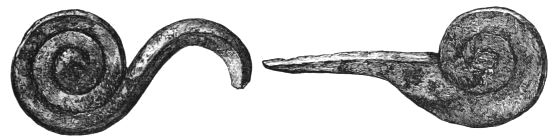
Fig. 238.—Spiral Object (1⁄1). Fig. 239.—Iron Object (1⁄1).
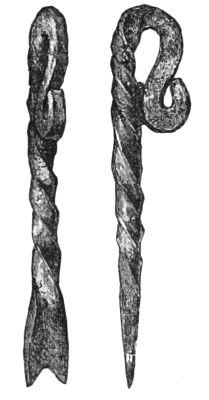
Fig. 240.—Iron Object (1⁄1). Two Views.
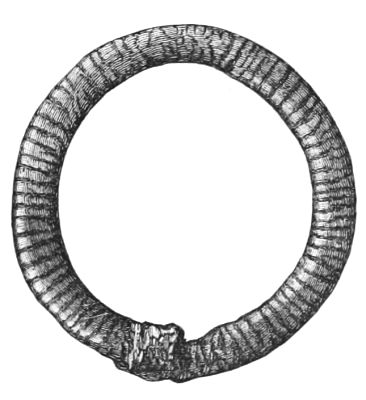
Fig. 241.—Bronze Brooch (1⁄1).
(b.) Articles made of Bronze.
Brooch.—A circular brooch, minus the pin, 11⁄2 inch in diameter, and ornamented on its upper surface by a series of grooves pointing to the centre of the brooch. The under surface is quite plain. A small portion of the pin is still attached to the brooch, and the opposite side of the brooch is worn into a hollow by the friction of the point of the pin. The transverse grooves are also much worn, but where nearly obliterated the external and internal margins of the brooch show the hacks, corresponding with their extremities (Fig. 241).
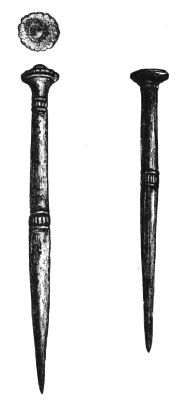
Fig. 242. Fig. 243.
Bronze Pins (1⁄1).
Pins.—Two small pins, having round shanks ornamented by two groups of circular and longitudinal incised lines. Both pins have flat heads, and one has a blue bead stuck in its top. They are nearly of the same length, being a shade less than a couple of inches (Figs. 242 and 243).
Several bits of brass plate, apparently used as clasps for mending purposes. One, indeed, was found attached to a small portion of a wooden bowl. Also a thin brass button 11⁄4 inch in diameter.
(c.) Articles made of Gold.
Finger-Rings.—On the 14th December one of the workmen while clearing out the refuse-heap turned up a curious spectacle-like ornament, made by twisting the ends of a thick and somewhat square-shaped gold wire into the form of a double spiral ring (Fig. 244). Upon close inspection it became evident that originally this article was a handsome spiral finger-ring, containing 51⁄2 twists, but that, from some means or other, two of the twists had been forced apart from the others. The direction of certain scratches, and a slight mark as if a blow had been struck (probably the spade of the finder), seem to me to confirm this explanation. It lay buried half-way down in the midden, close to the base of the large parapet in front of the entrance to the area of the log-pavement. It weighs 300 grains, and its internal diameter measures a shade over 5⁄8 of an inch. On the 16th April, while clearing away the soil on the west side of the crannog, a few feet to the inner side of the inner circle of piles, another spiral ring was found (Fig. 245). It is made of round gold wire, not quite so massive as the former, and contains rather more than six twists. Both ends taper slightly, and, for nearly a whole twist, are ornamented by a series of circular grooves which gives them some resemblance to the tail end of a serpent. The colour of the gold of this ring is a brighter yellow than that of the former. Its internal diameter is exactly 5⁄8 of an inch, and its weight is 245 grains. Both rings were quite clean, and free from all tarnish when exposed.[37]
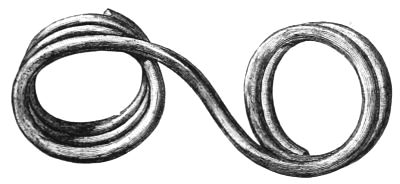
Fig. 244.
Gold Finger-Ring (1⁄1).
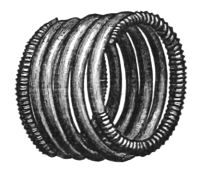
Fig. 245.
Gold Finger-Ring (1⁄1).
Coin.—Mr. Robert Dunlop, iron-moulder, a native of Kilmarnock, but now residing at Airdrie, happened to visit his friends at the beginning of the year, and hearing of the discoveries at the Buston crannog, took the opportunity of visiting it. It was not, however, idle curiosity that prompted him, but a true spirit of inquiry, which often ere now led him to wander abroad as a humble student of nature, and on one occasion even as far as the famous Kent's Cavern. Being a Science teacher in Chemistry he was desirous of securing specimens of the different forms of vivianite, and so picked up from amidst a mass of broken bones and ashes that had just been wheeled from the midden, a lump of a bluish pasty substance, thinking it to be the amorphous form of this mineral. He carried this lump home with him for the purpose of analysing it, but, owing to other duties, was unable to do so till some three months afterwards. Having then taken a portion of the bluish mass, he mixed it with water in a test-tube, and on proceeding to dissolve it, noticed a yellow speck in this blue material. Curious to know what this could be he emptied the tube of its contents, and found what seemed to be a small gold coin doubled up. The slightest effort to restore the coin to its proper shape detached the portions, and almost at the same moment each portion separated into two thin plates. Mr. Dunlop then observed that between the two plates there was a layer of a dark brittle substance which he most judiciously collected into a small glass tube for further analysis. Having then carefully cleaned the four little plates with a weak solution of nitric acid, he had the satisfaction, on putting them together, of restoring the shell of an antique coin, which, as will be seen from Fig. 246, retains its impressions and characters on both sides wonderfully distinct. This valuable contribution to the collection I received at once from its discoverer, as well as the above narrative of its discovery.
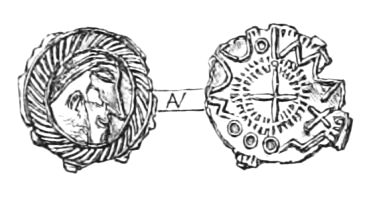
Fig. 246.
Coin found in Buston Crannog.
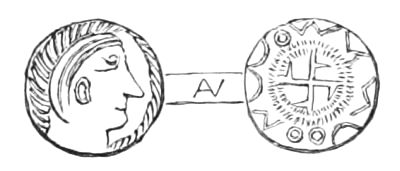
Fig. 247.—For comparison, from Smith's Coll. vol. i. pl. xxii. 9.
Mr. Cochran-Patrick, M.P., to whom I immediately forwarded the different portions of this coin carefully arranged under a glass slide, as well as the glass tube containing remains of its core, submitted them to the consideration of J. Evans, Esq., F.R.S., F.S.A., so well known for his special knowledge of ancient British coins.
The following interesting remarks by Mr. Evans on the subject have been sent to me by Mr. Cochran-Patrick:—
"The two plates of gold seem originally to have formed the shell of an early forgery of a coin, the oxidised core of which forms the contents of the small tube. I thought at first that the substance might be resinous, but I think it is some salt of copper.[38] Some chemist could readily try this. The coin itself belongs to a class of trientes which have been found almost exclusively in England, and are probably of Saxon origin. Enclosed is an impression of one found near Dover. See Smith's Coll. Ant., vol. i. pl. xxii. 9. Others were in the Bagshot Heath or Crondale find. See Num. Chron., N. S., vol. x. 164, pl. xiii. 24 to 26; Num. Chron., vol. vi. They probably belong to the sixth or seventh century. The find is of value as helping to assign a date to the crannog." (Figs. 246 and 247.)
VI. Miscellaneous Objects.
1. Armlets.—Fragments of three armlets made of cannel coal, very similar to those found at Lochlee and Lochspouts.
2. Jet Ornament.—A small link-shaped ornament of jet, with two small holes for attachment in one side (Fig. 248). This object was found on the surface of a mound of débris long after it was wheeled out, and hence no dependence can be put on its antiquity.
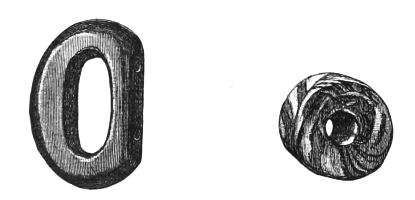
Fig. 248.—Jet Ornament (1⁄1). Fig. 249.—Bead (1⁄1)
3. Beads, Vitreous Paste, etc.—A cylindrically-shaped bead, variegated with three different colours, red and yellow predominating over patches of transparent glass (Fig. 249).
Half of a tiny yellow bead, of a vitreous substance, only 3⁄16 of an inch in diameter.
A round object, of the size of a small marble, made of vitreous paste, variegated with blue and white, but without any aperture.
Another small flattened object, about the size of a shilling, made of a white compact vitreous substance. It is very smooth, rounded on one side, but flattened on the other. Looks like a drop of a semi-liquid that had fallen on a smooth floor. In the York Museum, case C, amongst some other Roman antiquities I observed several similar articles, which are referred to in the Handbook as "roundlets of coloured glass, probably to set in brooches, from the railway excavations, 1874-75."
One or two little round bits of a dark slag.
4. Glass.—Three fragments of thick bright-green glass, all irregularly shaped.
5. Leather.—Several strips and chippings of very thin leather.
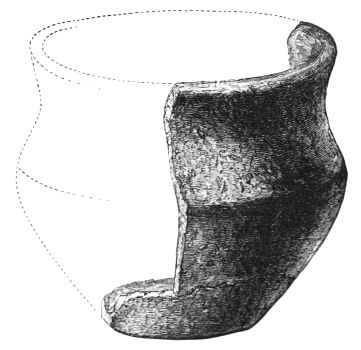
Fig. 250.—Pottery (2⁄3).
6. Pottery.—A small fragment of Samian ware, only about a square inch, with the glaze nearly worn off, but quite unmistakeable in its character.
Fig. 250 represents a fragment of a small dish with its outline. This vessel was made of a hard tinkling ware, black externally, and of a dull white inside, and measured 31⁄2 inches across its mouth and 3 inches in depth.
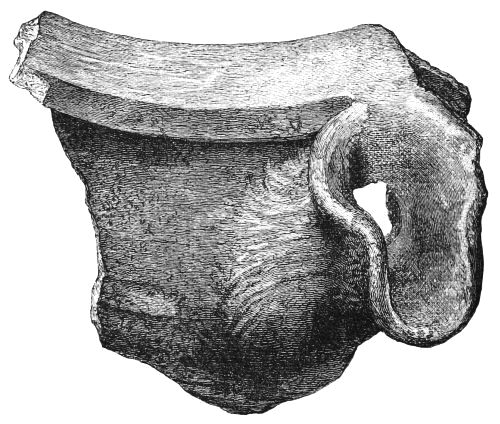
Fig. 251.—Pottery (1⁄1).
Portion of a large vessel made of coarse materials, having a short spout just below its everted rim (Fig. 251). The outside is very black, and the inside has a reddish tinge. Another portion, apparently of the same vessel, shows the striation of the potter's wheel.
Fig. 252 represents a curious little knob of pottery. None of the pottery found here had any appearance of a glaze.
7. Portion of a small object like a button, made of a soft chalky substance, is represented in Fig. 253. It shows some lines as an ornament on its upper surface.
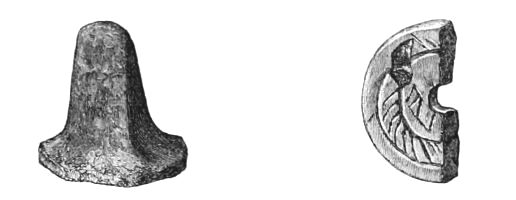
Fig. 252.—Pottery Knob (1⁄1). Fig. 253.—(?) Portion of Button (1⁄1).
8. Crucibles.—A small conical crucible, made of hardened clay arranged in two thin layers, the external of which looks coarser than the other. It has a triangularly-shaped mouth, and at one of its apices there is a slight indentation for facilitating the pouring out of the smelted material. Its depth is 11⁄2 inch, and circumference of mouth 7 inches. It is cracked all over with heat, and a little dark slag forming a horizontal rim on its inner surface still remains to attest its purpose. This relic was found on the west side of the crannog, not far from the site of the second spiral ring, but outside the inner circle of piles (Fig. 254).
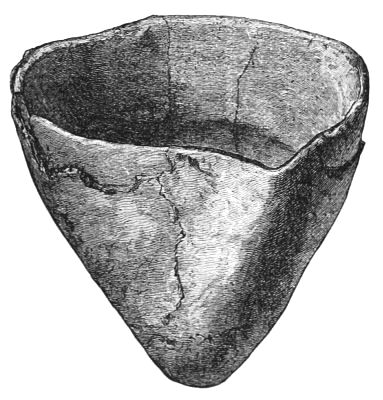
Fig. 254.—Clay Crucible (1⁄1).
A second crucible, neatly formed and quite whole, was found in the débris wheeled out from the lowest stratum of the refuse-heap. It is of the usual conical form, with a three-cornered mouth about 3 inches in circumference, and measures 1 inch in depth. Particles of a yellowish metal, like brass or bronze, are seen mixed with a kind of slag, near one of the corners. The outside has a glazed appearance, as if it had been subjected to great heat, and to the apex of the cone there is a small bit of cinder still adherent.
Portion of a third crucible, very similar to the last described, was also found at the crannog by a visitor, and publicly exhibited at a bazaar in Kilmarnock.[39] This crucible is interesting as furnishing undoubted evidence that it had been used for melting gold, there being several globules of this metal adhering to its sides, both inside and outside.
Report of Osseous Remains found at Buston.
(By Professor Cleland, M.D., F.R.S.)
The osteological specimens obtained from what appears to have been the kitchen-midden of the lake-dwelling at Buston consist in greater part of bones of the ox; while next in frequency are bones of the sheep and the pig. A calcaneum and astragali of the red-deer have been found, as also portions of large red-deer horns, and two portions of roe-deer skull with horns attached. In addition a radius and metacarpal of a goose were found.
The bones of the pig were both full-grown and young; the full-grown, with the teeth worn, being apparently most abundant. They have belonged to an animal of small size, similar probably to that whose remains are found in other Ayrshire deposits.
The remains of the ox and the sheep I account more interesting on account of variety among them.
Ox.—Examining six portions of ox skull, I find one with the horn-core represented by a mere nodule; two specimens each with a portion of horn-core 2·8 inches in greatest diameter, one with a horn-core 2·2 inches diameter at base, and two others with horn-cores 1·8 inches in greatest diameter at base, and one with a horn-core 11⁄2 inch diameter. All the horn-cores are fragmentary; but I judge that none of the last three could have exceeded 5 inches in length, while the first two must have been much longer. Only one of these specimens, that with the smallest horn, has the suture above the occipital bone open. The others must have been adult; and we may judge that we have not to deal with mere aboriginal Bos longifrons, but with varieties of ox. The variation seems not to have been confined to the horns. Among a number of first phalanges the majority were slender and small, but there was considerable variety; and one specimen, contrasting strongly with the others by its stoutness, might have been from a small modern specimen. All the hoof-bones which I collected, about half a dozen, were very small. Three metacarpals were picked up, all measuring about 7 inches long and 1 inch in breadth at the narrowest part of the shaft; and these are all adult specimens. Two adult metatarsals measure, the one 8 inches in length and the other only 7·3, while in breadth they both measure only ·9 of an inch. A complete adult radius measures only 9 inches in length. A lower end of a humerus is only 2·5 inches broad. Among six calcanea the largest measured 5·5 inches, and the shortest 4·3. In one specimen the orbit is 2·4 inches diameter, and in another 2·8 inches, which is decidedly large. On the whole, the evidence is to the effect that while the prevalent variety had small horns, and was generally diminutive and slender-limbed, there was mixed with it a variety with larger horns and stouter limbs, whether of greater height or not I cannot say.
Sheep.—Only one portion of horn-core was found with portion of the skull. The portion of horn-core is between 3 and 4 inches long, and at the base its largest diameter is 1·5 inch, its smallest 1 inch. At its inner margin starts at an angle of about 20° from the vertical plane; while I should say that in modern sheep that angle is always 45° at least. I apprehend that this is probably the so-called goat-horned sheep, scarcely now to be got in Shetland.
The following measurements of limb bones may be interesting, as indicating considerable variety in size as well as deviation from modern proportions, as indicated by comparison with the bones of the same sheep skeleton which I have used for comparison in previous communications.
One adult metatarsal measures 5·7 inches long and ·4 broad, and another 5·2 long and ·4 broad at the narrowest part of the shaft. In the modern specimen this bone is 4·8 long and ·5 broad.
Three specimens of adult radius have been gathered, measuring in length respectively 6·6, 6·, and 5·9; while in the modern specimen the corresponding bone is only 5·2.
Two complete humeri are among the specimens gathered. The largest, not quite adult, is 5·7 inches in greatest length; while the other, quite adult, is only 5 inches long, and in the modern specimen the humerus is 5·2 long. Four additional specimens of the lower end of the humerus have been obtained; and one of them is decidedly larger than the largest complete specimen, and another decidedly smaller than the smallest complete bone.
The sheep was therefore long and slender legged, like those found on other Ayrshire deposits. But it is difficult to determine whether the differences in size depend on sex, or some other cause, such as cultivation.
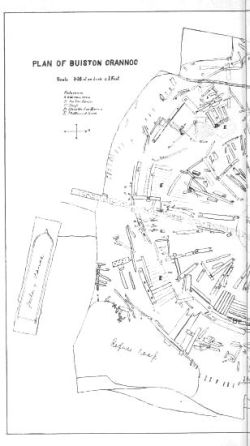
PLAN OF BUISTON CRANNOG
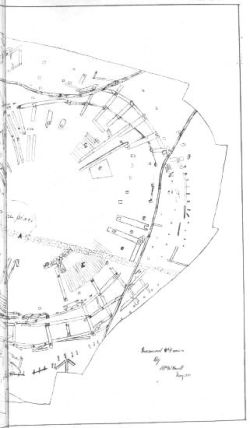
PLATE IV.
No goat bones have been found in connection with this lake-dwelling.