Chapter III · (continued 2)
Reading edition
"The specimens of pigs' bones and of pigs' teeth are numerous, but none other either of the bones or of the teeth are of the size, strength, or proportions which would have enabled their owners to hold their own as wild animals in a country in which the wolf may still have existed.[29]
"The sheep, old dun-faced breed, Ovis aries, variety brachyura. One nearly perfect skull of a sheep of the variety which is known as brachyura,[30] from having a short tail, but which also has the horns of the goat, set on, it is true, with their long axis at a different angle from that which they have in the true goat, but still in themselves of very much the same shape. One lower jaw in this series has the concave posterior boundary, and the sinuosity anterior to its angle, which goats usually and sheep only sometimes, possess. It belonged, however, to an immature individual, the posterior molar not having been evolved, and it cannot be considered to positively prove the presence here of Capra hircus.
"The Red Deer (Cervus elaphus) is very abundantly represented in this series, especially by fragments of horns, some of which bear marks of having themselves been cut and sawn by other implements, whilst one or two may possibly have been used, as the tines of red deer so often were by the early British flint miners, as borers.
"The Roe Deer (Cervus capreolus) is only scantily, though unambiguously, represented in the collection from Lochlee.
"The Horse (Equus caballus) is represented by but a single shoulder-blade; it is of small dimensions relatively to most or all domestic breeds with which I am acquainted; this applies, however, to all the domestic animal remains found here.
"Reindeer (Cervus tarandus).—There are two more or less fragmentary portions of horns, which, after a good deal of comparison with other reindeer horns, and with fragments of red deer horns, I incline to set down as indicating the presence of the former animal in this collection. It is easy to separate reindeer horns from red deer horns when you have the entire antler before you, or even when you have the brow antler only, in most cases; and it is usually easy to separate even a fragment if the fragment is fresh, because the surfaces of the horns in these two horns are different. But here the two fragmentary horns in question have no brow antler left, and their surfaces have been macerated so long as to have desquamated, or, to change from a medical to a geological metaphor, have been denuded a good deal. Still one fragment is, I think, too tabular, and the other is too tabular also, and that just below the origin of what in the red deer is known as the sur-royal antler, to be anything but a reindeer's.
"Writing for Scottish readers, I need not refer to Dr. J. A. Smith's paper 'On Remains of the Reindeer in Scotland,' read before the Society of Antiquaries of Scotland, June 14, 1869, vol. viii. pt. i. pp. 186-223, nor to his references in that exhaustive memoir to preceding writers. But I may mention an additional reference which Dr. J. A. Smith, not being gifted with as much second sight as he is with insight, could not have then referred to, as it is contained in a book of more recent date than is his paper. This reference will be found in Mr. Joseph Anderson's edition of the Orkneyinga Saga, chap. vi. p. 182."
Regarding a subsequent consignment of bones and horns sent to Professor Rolleston, he writes as follows:—
"The only remark which I feel called upon to make relates to the bones and the teeth of the pig; the marrow cavity in the lower jaw of one of the pigs, a young specimen, containing a large quantity of crystals, and the teeth of the older pigs showing a great deal of wear for the teeth of what were, I think, domesticated swine. The crystals were analysed by W. W. Fisher, Esq., of the Chemical Department in the Oxford Museum, and found to be vivianite as supposed. It is not uncommon to have bones from prehistoric 'finds,' which have been much acted on either by fire or water, thus coloured by double decomposition of the bone phosphate with some iron salt furnished either from the bone and flesh or otherwise.
"The horns" (all the worked ones in the collection) "received a few days ago are all of Red Deer (Cervus elaphus), except one, which is of Cervus capreolus. With this consignment came one bone, or rather the ulna and radius of a Bos longifrons, more or less fused into one bone. The horn of the Roe is rather a large one."
The Flora of the Crannog.
As there appears to be some difference of opinion among botanists as to whether certain trees, now common in our forests, such as elm and beech, are indigenous to Scotland, my attention was directed at an early stage of the investigations at Lochlee to the importance of determining the different kinds of wood used in the structure of the crannog. Accordingly, I collected specimens of the wood and other vegetal remains encountered during the excavations, and in due time forwarded them to Professor Balfour, Edinburgh, who had kindly agreed to examine and report upon them, but unfortunately, owing to ill-health, he was unable to do so, and the box containing the specimens, after lying in Edinburgh for some weeks, was returned unopened. Ultimately, however, Dr. Bayley Balfour, Professor of Botany in the University of Glasgow, undertook this task, and it is to him I am therefore indebted for the following report:—
"I shall send by train to-morrow the box of Lochlee vegetable remains. I have examined them carefully, and you will find each specimen numbered, the numbers corresponding with those in the appended list. There is not so much variety in the wood as I anticipated, and I am surprised to find neither oak nor fir. The tissue of the wood is in most cases considerably decomposed, the wood cells, as might be expected, being most affected. Betwixt alder (Alnus glutinosa, L.) and poplar (Populus tremula, L.), the only indigenous species, there is really very little difference in wood structure, and indeed birch (Betula alba, L.) and hazel (Corylus Avellana, L.) are not far removed, so that that when the texture of the wood is much compressed, and decomposition has progressed, an identification is somewhat hazardous, and I have therefore queried my determination in some cases. No beech occurs amongst the specimens you sent me."
The following is a summary of the detailed list:—
I. Brushwood, etc.—The various specimens of wood which were selected from below the log pavement have been classified as belonging to one or other of the following trees, viz., birch (Betula alba), hazel (Corylus Avellana), alder (Alnus glutinosa), and willow (Salix, sp.).
II. Wooden Relics.—One of the implements (Fig. 118), which appeared to be made of a different kind of wood from any of the rest, has been identified by Dr. Balfour as elm (Ulmus montana, Sm.); and the piece of board with the carved diagrams (see pages 134, 135) is found to be ash (Fraxinus excelsior, L.). The rest of the relics were not submitted to Dr. Balfour, as they had so crumbled into dust (except those made of oak, all of which were easily recognised) that their identification appeared impossible.
III. Among the remaining vegetal remains collected from the débris above the log pavement, Dr. Balfour has identified the following species:—
"(1.) Hypnum (Hylocomium) splendens, Dill. This specimen I submitted for confirmation to Mr. Hobkirk of Huddersfield, and after the most careful examination he refers it to the above.
"(2.) Dædalea quercina, P. This I submitted to Dr. M. C. Cooke for confirmation, and he remarks, 'Must be a thin form of that species; but of course it is very much discoloured, and hence difficult to determine.'
"(3.) Bovista nigrescens, P.
"(4.) Polyporus igniarius, Fr. This and the preceding are Dr. M. C. Cooke's identification.
"(5.) Polytrichum commune, L. (Portions from the fringe-like girdles (Fig. 151) and the pigtail-like object described at page 95 were thus labelled.)
"(6.) Pteris aquilina, L.
"(7.) Several masses containing roots and root leaves of a monocotyledonous plant with equitant leaves, heather stems, and rhizomes of fern.
"(8.) Portions of birch bark in stripes rolled together like a ball of thread.
"(9.) Hazel nuts. One gnawed by a squirrel? If, as I conjecture, it has been done by a squirrel, it is interesting, as affording evidence of their occurrence in this locality.
"I am sorry I am unable to be more definite in many cases. The masses made up of monocotyledonous plants would not repay a more extended examination."
General Remarks.
To extract from the above investigations, however suggestive the results may appear, a life history, as it were, of the crannog, or indeed much reliable information regarding the habits of the Celtic races who flourished in the neighbourhood during the period of its existence, would be presumptuous on my part, if not beyond the scope of legitimate inference, especially in face of the meagre results hitherto obtained from Scottish crannogs. The completeness with which the operations have been executed, together with the great variety of relics found, cannot fail to make the Lochlee crannog a standard of comparison for future discoveries of a similar character, at least for some time to come, and hence it was essential to have the present report free from all speculative opinions. I have therefore up to this point entirely confined myself to matters of fact which have come under my own direct cognisance; and as for the relics, I have simply endeavoured to describe them accurately, leaving it to experienced archæologists to determine their historical value. There are however a few points, bearing on the antiquity and duration of the crannog, which, though undoubtedly included in the category of the speculative, I wish to state, as they could only be made by one conversant with all the phases of the excavations; but which, after this caution, must be taken cum grano salis.
1. Position of Relics.—As many of the relics, if judged independently of the rest and their surroundings, would be taken as good representatives of the three so-called ages of Stone, Bronze, and Iron, it is but natural for the reader to inquire if superposition has defined them by a corresponding relationship. On this point I offer no dubious opinion. The polished stone celt, Fig. 55, and the knife, Fig. 129, were found almost in juxtaposition about the level of the lowest fireplace. Though the hammer-stones, as a rule, were more abundant in the lower strata, yet the very first thing indicating human art which was found, when we commenced to dig towards the centre of the mound, was a hammer-stone. Almost all the horn implements were found at or below the level of the first-discovered pavement, and three-fourths of the querns were found above it. Below the same level, and around the hearths, tusks of boars were numerous, whereas almost none were found above it; and in the midden pigs' jaws and teeth were found only at its lowest stratum. Various inferences might be drawn from these remarks, which my readers can do for themselves.
2. Character of the Wood-work.—From the discovery, in the deep section made below the log pavement, of beams with tenons and mortised holes, and large trunks having their branches lopped off as if with a hatchet, it would appear that the first constructors of the crannog were well acquainted with the use of metal tools. It may also be noted that the base of the wood-work of the island was at least 14 feet (after making allowance for the extra height of the mound) below the surface of the field, whereas that of the gangway, within a few feet of the crannog, was only 10 feet. This difference of 4 feet could hardly be accounted for by the inequality of the bed of the lake, as the field appeared here to be quite level, so that we must infer either that it was due to the absolute weight of the island on the portion of the bed of the lake directly below it, or that the gangway was of more recent construction than the island. After all these doubtful elements are eliminated, there remains the important fact that since the island was constructed, 10 feet of silt, at least, had accumulated around it.
That broken planks and old mortised beams were mixed up with the trestle-work in various places, would support the idea of a prior structure; while evidence that the whole superstructure had at one or more times been destroyed by fire was quite conclusive. According to this theory, the elaborate mortised beams at the north-east corner might have been a landing-stage, but, in their present position, they are quite inexplicable.
3. Level of Lake.—Amongst the problems of a discursive character here referred to, perhaps there is none of greater interest than that which deals with the cause and effect of the change that has taken place in the level of the lake. From eye-witnesses we know that, before the first drainage was carried out, the mound used to be covered with water in the winter-time; and Mr. Charles Reid tells me that the line of level which he has adopted in measuring for the plan of the lake is 8 feet 7 inches above the log pavement. Now the area assigned to the lake by Mr. Reid is considerably less than what the old residenters of the district make it out to have been, as several of them have stated that they had seen its waters extend beyond the road on the west side (see Plan), and yet from his data the depth of water would just cover the highest part of the mound, which, it will be remembered, was about the same height above the log pavement. Originally the island must have been higher than the lake, but allowing that the log pavement was only 3 feet above the surface of the water, we have at least 11 feet of change of level to account for. This phenomenon could only be caused by a sinking of the whole island, or a rising of the water, or a combination of both causes. I do not think that the weight of the island and its superincumbent mass would press so heavily on the bottom of the lake as to cause it to sink much, since the enormous amount of wood-work, of which it consisted, being lighter than water, would have a corresponding buoyant effect, and so help to counteract the weight of the aërial portion. Nor has any great compression of its substance taken place from decay, because in the course of making the deep section under the log pavement, we found the contour of the large trees quite symmetrical and perfectly round; and although the wood was very soft it was not compressed, owing to its being completely saturated with water, which of course is virtually incompressible. Although I have often seen small brushwood flattened from pressure, yet I have never seen this effect produced on a branch larger than my wrist, and only in one instance did I notice it on a piece of wood of this size. Moreover, the gangway, which certainly could not sink from its weight, was deeply buried, its uppermost horizontal beams being not less than 7 feet below the surface of the field. We must therefore fall back on the only other alternatives, and assign this change in the relative position of the crannog and level of the lake either to a general compression and sinking of the bed of the lake or to the rising of the water. The latter result is somewhat unusual, because running water, having a tendency to deepen its channel, and the accumulation of sedimentary deposits, often produce an opposite effect, and cause the complete drainage of lake basins. I have therefore carefully examined the outlet of the lake to ascertain if possible the causes that led to this rise in its bed.
Its natural outflow was at the south-east corner, and the little stream, after running southwards for a few yards, quickly turned westwards into a narrow valley which wended towards Fail Loch. Just at this abrupt turning the background rose somewhat steeply to the south, so that the termination of the valley as it entered into the Lochlee basin was very liable to be obstructed by débris washed from the slopes above. Besides being thus favourably situated to catch washed-down materials, it is probable that during the summer the surplus water would be very scanty, and vegetation abundant, so that in the course of time the bed of the outlet would gradually be raised. A section cut across the outlet would readily disclose the sequence of the silted materials, had it not been that the soil was disturbed by a deep covered drain, which was made when the first drainage operations were executed, and ran along its whole course. Also, I understand that previous to this the lake was used as a mill-dam. We cannot therefore get rid of the elements of uncertainty in any calculations which might be based on the change of the level of the lake and the accumulation of silt in its bed and outlet.
I may however mention, on the grounds already stated, that since the foundations of the crannog were laid, the increase in the bed of the lake in its vicinity cannot have been less than 10 or 14 feet; and 11 feet is the lowest estimate that I can assign to the submergence of its surface. On the supposition that this apparent encroachment of the water was uniform, and since the last fireplace was about 6 feet above the lowest, and allowing 11⁄2 feet for the time the former was used, we have then the total period of occupancy of the crannog represented by 71⁄2 feet of total submergence. We have no means of comparing this period with its representation in so many feet of lake sediment, but I may state that since the canoe, found about 100 yards from the crannog, was abandoned, no less than 5 feet of this mossy lake sediment accumulated over it.
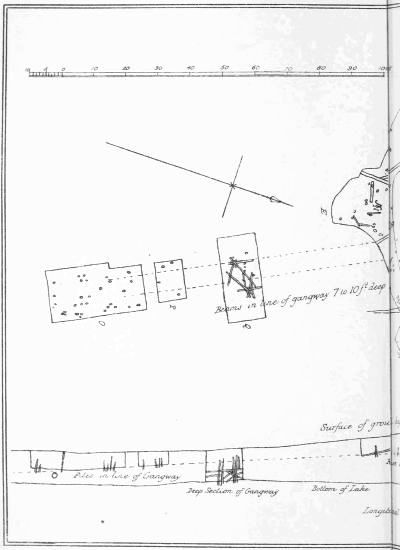
PLATE II.
PLAN & SECTIONS OF
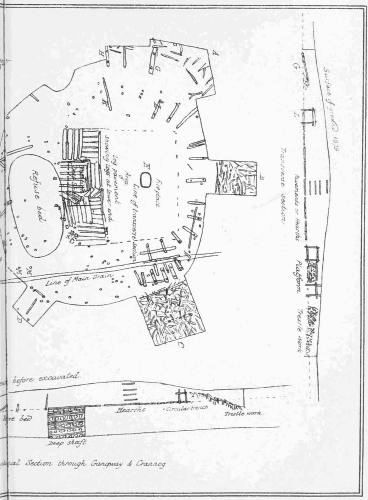
Crannog at Lochlee.
The composition of the silt forming the bed of the lake, especially near the crannog, as already described at pp. 98, 99, points to the fact that for centuries the increase was due principally to the decomposition of vegetable matters, while latterly it was caused more by a deposition of fine clay; and when excavating along the line of the gangway we had an opportunity of verifying the regularity of this succession. A change so marked in the sediment can only be accounted for by a corresponding change in the surrounding scenery, and no explanation is more likely than that the primeval forests had given place to the inroads of agriculture, when some of the upturned virgin soil would be washed down, as it still is, by every trickling rill that finds its way into this lake basin.
[The selection of bones sent to Professor Rolleston for examination is now deposited in the Anatomical Museum at Oxford, and all the rest of the relics are located in the Museum attached to the Burns Monument at Kilmarnock.]