Chapter III
Reading edition
REPORT OF THE DISCOVERY AND EXAMINATION OF A CRANNOG AT LOCHLEE, TARBOLTON, AYRSHIRE (1878-9).
Discovery of the Crannog.—The site of the Lochlee Crannog was a small lake, now entirely dried up, which formerly occupied portions of a few fields on the farm of Lochlee near Tarbolton. The lake was surrounded by a gently undulating country, and lay in a hollow, scooped out of the glacial drift, at an elevation of about 400 feet above the sea-level. Taking a fair estimate of its former extent by a careful examination of sedimentary deposits near its shore, it was ascertained, from accurate measurements and levelling, that its area was about 19 acres; but, owing probably to the accumulation of moss and silt, it is known, in modern times, to have been much greater, especially during winter. Before it was artificially drained, some forty years ago, no one appears to have surmised that a small island, which became visible in the summer-time, and formed a safe habitation for gulls and other sea-birds during the breeding season, was formerly the residence of man; nor am I aware of any historical notices or traditions that such was the case; nor does it appear to have attracted the attention of the poet Burns, though he lived for four years on this farm in the capacity of ploughman to his father, then tenant of the place. The crannog was near the outlet of the lake, and the nearest land, its southern bank, was about 75 yards distant. When the first drainage of the place was carried out, the wrought wood-work exposed in the drains passing through the island, and especially the discovery of two canoes buried in the moss, attracted the attention of the workmen. The shop of a provision merchant at Tarbolton happened to be much frequented by the drainers, and in this way the shopkeeper, Mr. James Brown, came to hear of the finding of the canoes, and the conjectures of the men as to the artificial nature of the island. Mr. Brown, who seems to combine the true spirit of the antiquary with his business habits, never lost sight of the little island at Lochlee and the information he had ascertained regarding it, and on various occasions since, mentioned the subject to gentlemen who, he thought, were likely to take an interest in it. The recent re-drainage of the same locality revived Mr. Brown's curiosity about the structure of this island, now a slight mound in a field, and being himself unable, owing to the infirmities of age, to take any active part in inspecting it, he wrote a letter about the beginning of September to a gentleman at Ayr suggesting an inquiry into the matter; but as the latter did not seem inclined to take it up, a week afterwards he wrote a note to Mr. Anderson, of the National Museum of Antiquities in Edinburgh. This gentleman, recognising the importance of his information, immediately communicated with R. W. Cochran-Patrick, Esq. of Woodside, Hon. Secretary of the Ayr and Wigtown Archæological Association, who lost no time in visiting the locality, and at once discovered the true nature of the mound. Mr. Cochran-Patrick then sent a note to Mr. Turner, factor to the Duke of Portland, under whose supervision the drainage was being conducted, informing him of the discovery, and suggesting, in the interests of Archæological Science, that an examination of the crannog should be made. Meantime these facts were communicated to me by Mr. J. H. Turner, and having had my attention already directed to Lake Dwellings in consequence of a recent opportunity I had of inspecting some of their relics preserved at Zürich, I also became interested in ascertaining the exact nature of the find at Lochlee. Next day Mr. J. H. Turner and I visited the locality, and in the course of a few more visits found ample evidence that the mound was really artificial, and had been at some former period the site of a human habitation. At the same time, as if to deepen our curiosity, a small canoe, hollowed out of a single trunk of oak, was dug up by the workmen out of the moss which formed the bottom of the lake. It was then kindly arranged by Mr. Turner, senior, that some excavations would be made so as to ascertain more accurately the structure of this mound. The general appearance which it presented after these excavations were commenced, as seen in Fig. 33, was that of a grassy knoll, drier, firmer, and slightly more elevated, than the surrounding field. Unfortunately, the large deep main drain which happened to pass through and cut off a segment of this mound, was filled up before attention was directed to its archæological importance, so that we lost the opportunity of inspecting the section which it presented to view. Upon careful inspection, however, we noticed towards the circumference of the mound the tops of a few wooden piles barely projecting above the grass, which at once suggested the idea that they might be portions of a circular stockaded island. Guided by these, I completed what we supposed to be the circumference of the original island, by inserting pins of wood where the piles were deficient. Following the line thus indicated, the workmen were ordered to dig a deep trench round the mound, but to leave whatever wood-work would be exposed as much as possible in situ. Accordingly, this trench was completed, and on the following day, 15th October 1878, systematic explorations were begun in presence of Messrs. Turner, J. H. Turner, Cochran-Patrick, Anderson, Dr. Macdonald (Ayr), and myself.
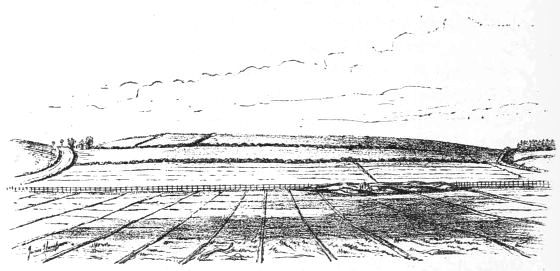
Fig. 33.—The Crannog after the Excavations were commenced.
The Excavations.—The space enclosed by this trench was of a somewhat circular shape, and about 25 yards in diameter. The trench was from 5 to 6 feet deep, and in many parts quite studded with wooden piles, mostly upright, but some slanting. Some of those slanting outwards were forked at the upper end, as if intended to counteract outward pressure. At the bottom of the trench, particularly on the north side, were found various kinds of brushwood, chiefly hazel and birch, here and there trunks of trees, thick slabs of wood, and large stones. The most remarkable objects, however, were thick planks of oak about 6 feet long, with a large square-cut hole at each end. These were visible at various portions of the trench, and lying half-way down, some right across and others with one end sticking out from its inner side. At the north-east side there were two rows of these beams exposed, four in each row, and about 5 feet apart, measuring from the central line of each beam. One row was a little farther out than the other, and had upright piles, somewhat squarely cut, projecting through the holes. These horizontal beams pointed towards the centre of the crannog, and appeared to keep the upper ends of the upright piles in position (see Figs. 34, 35, and 36). Lying underneath these beams, and at right angles to them, were round logs of wood varying in length from 6 to 15 feet, which being caught as it were by the upright piles, were prevented from falling outwards into the trench. Conterminous with the mortised beams, which were scarcely a foot under the surface, there was a rude and much decayed platform of rough planks and saplings resting on transverse beams of split oak-trees. One of these transverse beams which I measured was 141⁄2 feet long and 8 inches broad, and for a few inches at each extremity was not split, so that the portion thus left acted as a catch (for the planks above it), like the flange on the wheel of a railway wagon. Digging underneath this platform, we passed through a compact mass of clay, stones, beams of soft wood, and ultimately brushwood, underneath which, being on a level with the drain, we could not farther explore, owing to the oozing up of water.
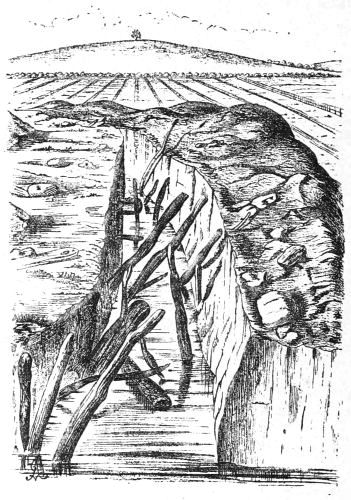
Fig. 34.—View of the Trench on the North side.
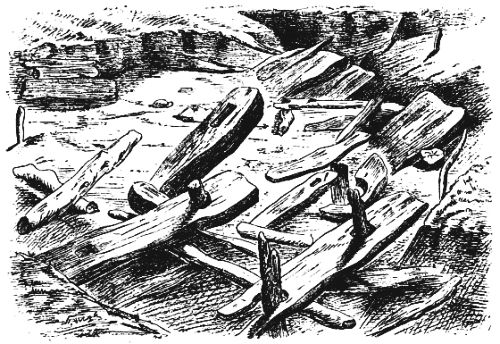
Fig. 35.—Arrangement of Mortised Beams at north-east corner.[25]
We then commenced digging a few feet to the west of the centre of the mound, and soon cleared a trench from 3 to 4 feet deep, about a couple of yards broad, and directed almost due north and south. About 25 feet from the outer trench, measuring northwards, and 53 feet in the opposite direction, we came upon the south edge of a smooth pavement neatly constructed of flat stones. Judging from ashes, charcoal, and small bits of burnt bones which were here observed, that this pavement was a fireplace, we thought it better in the meantime to leave it intact; so we formed another trench at a width of 8 to 10 feet, at right angles to the former, and just touching the southern edge of the pavement, which was continued eastwards till it touched the platform already described. A circular trench was then made round this pavement, at a breadth of about 4 feet, leaving it, with its superincumbent soil, standing in the centre. We had thus a considerable space cleared out at a uniform level, with a small portion of the pavement visible, and an oval-shaped mass of soil about 4 feet in diameter above the rest of it. In the course of these excavations we found three upper quern stones, portions of other two, a wooden vessel in two fragments, a large quartz pebble (Fig. 37), with markings as if made by a hammer on its surface, portion of a pointed horn (Fig. 91), some bones, one or two hammer-stones, and a boar's tusk.
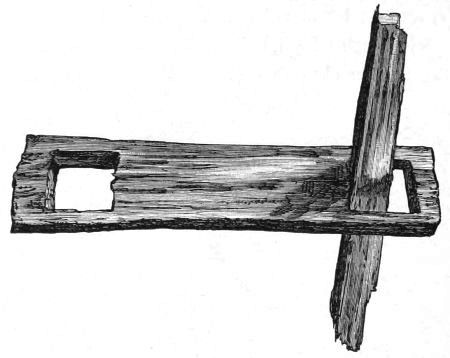
Fig. 36.—Mortised Beam with portion of an upright (scale 1⁄2 inch to the foot).
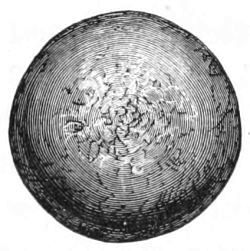
Fig. 37.—Quartz Pebble (1⁄8).
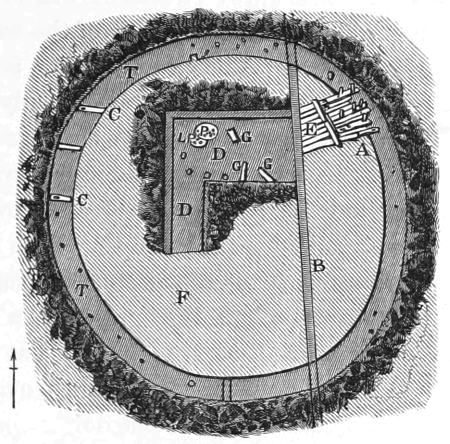
Fig. 38.—Diagram of Excavation.
T, Outer circular trench with stuff thrown outwards. DD, Trenches near centre of crannog. A, Mortised beams at north-east corner. E, Rude platform adjacent to mortised beams. P, LP, Upper and lower pavements or hearths, with stakes surrounding them. GG, Horizontal beams on level with lower pavement. B, Main drain passing through the mound. F, Undisturbed mound. CC, Two transverse beams lying across near the bottom of trench, with a square-cut hole in each, but not containing uprights.
Upon careful inspection we then discovered immediately above the pavement, at a height of 21⁄2 feet, and rather less than a foot from the surface of the mound, another pavement similar to the former. These pavements rested on layers of clay which extended several feet beyond them, and gradually thinned out towards the edge. On a level with the lower pavement we found the remains of a series of massive stakes with square-cut ends, which appeared to surround it. They were very much decayed, and it was difficult to ascertain their original number, but seven were noted, which were kept standing in position for some time. Two well-shaped plank-like beams were lying horizontally at the east side of the lower pavement, and on a level with it. The distance between these upright stakes varied from 2 to 4 feet, and, as already noticed, they were not pointed at their bases but cut across. One, indeed, we found to have a small portion projecting from the centre of its base, which neatly mortised into a hole formed by a piece of wood, a flat stone, and some clay. On a subsequent occasion, when digging lower, we came upon another of these stakes which had pressed down the portion of clay on which it rested nearly a foot. The lower pavement slanted a little to the south-west, and it was also observed that the bottoms of the stakes were somewhat lower in that direction. On the north side they came close to the pavement, but on the south extended about 5 feet beyond it. The upper pavement was about a foot nearer the outer trench, in the direction of the wooden platform already described at its north-east corner, and hence it only partially covered the lower. It was carefully built with stones and clay round a wooden stake, corresponding with the series of stakes on a level with the lower pavement, and the layer of clay underneath it extended eastwards over one of the horizontal beams above referred to. Both these pavements were neatly constructed of flat stones of various sizes, and about an inch and a half thick, and had a raised rim round them also formed of flat stones, but uniformly selected and set on edge. They were slightly oval in shape, and the major and minor axes of the lower one measured 5 and 4 feet respectively. Traces of other pavements between the upper and lower were observed, but before further examination was made the whole mass above the lower or first-discovered pavement was trodden down by visitors.
At this stage I have to record the loss of the active services of Mr. Cochran-Patrick, who hitherto took notes and sketches of each day's proceedings. In consequence of his absence, owing to a protracted illness, and the inability of the other gentlemen to attend, this duty now fell on my inexperienced shoulders; and in giving this short account of the work, I have only to say that, however imperfectly done, I have endeavoured, during very inclement weather, to procure as correct and faithful a record of the explorations as possible.
While making a tentative digging on the south side of the lower pavement, I ascertained that the soil underneath its corresponding layer of clay (which, by the way, extended much farther than any of the other layers) contained boars' tusks, broken bones, and charcoal. After digging for about 4 feet below the level of the pavement, we came upon a layer of chips of wood as if cut by a hatchet, and below this a thick layer of turf with the grassy side downwards. Water here oozed up, but with the spade I could readily distinguish that underneath the turf there were large logs of wood extending farther in all directions than I could then ascertain. With a pole we took the perpendicular height of the level of the surface of the upper hearth above these logs, and it measured exactly 7 feet 9 inches, so that the greatest depth of the accumulated rubbish since the logs were laid, i.e. about centre of mound, would be about 81⁄2 feet. I then determined to clear the soil entirely away round the fireplace down to these logs, still keeping the surrounding trench at the same breadth as before, viz., 4 to 5 feet. While this was being done we inspected the stuff as it was removed, though I now regret this was not done more carefully, and found a great variety of manufactured implements of various materials. Observe that the portion here referred to is well defined,—above by the layer of clay corresponding to the lower or first-discovered pavement, and below by the newly-discovered log pavement. It is fortunate that this was the case, as it turned out so prolific of relics that I have assigned to it the name of relic-bed. Amongst these were a spindle whorl (Fig. 66), two bone chisels (Figs. 69 and 70), and several pointed bone implements (Figs. 71 to 74), a polished stone celt (Fig. 55), a metal knife (Fig. 129), some implements of horn and wood, a fringe-like object manufactured of the stems of a moss (Fig. 151), and a great many hammer-stones. Close to the pavement, but about 2 feet lower, we extracted the skeleton of an animal like that of a goat or sheep, the skull of which was entire, and had short horn-cores attached to it. The relic-bed was made up of partially decomposed vegetable matters, and could be separated into thin layers; the common bracken, moss, parts of the stems of coarse grass, heather, and large quantities of the broken shells of hazel nuts, were frequently met with. The bones were generally broken as if for the extraction of their marrow. The bed of chips of wood was several inches thick, and extended more than half-way round, and had its maximum extent on the south-west side. The logs, all of which were oak, and cut at various lengths, from about 6 feet to 12 feet, seemed to radiate from the central line of the fireplace, like the spokes of a wheel. Underneath these logs were others lying transversely, and in some places a third layer could be detected by probing with a staff. None of these layers of logs were disturbed at this stage of the proceedings.
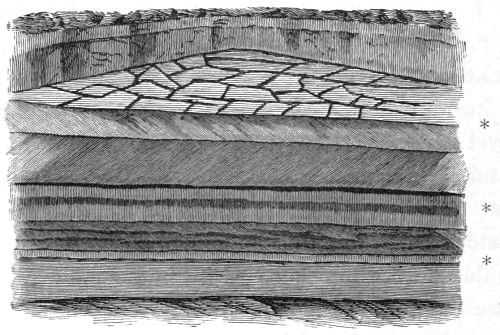
Fig. 39.—Perpendicular Section through the Hearths, showing structure of the first-discovered pavement. The asterisks indicate the position of the three lowest fireplaces, or stony pavements.
A perpendicular section made of the central mass left standing, just touching the southern edge of the first-discovered pavement, and looking towards the south, presented the appearance of stratified rocks of various colours, of which the above is a sketch. At the bottom is the log pavement; then in succession you see turf, clay, a black line of ashes; then again clay, another line of charcoal and ashes, and lastly, the pavement imbedded in a thick layer of clay. The upper pavement and intermediate section are not represented, as they were demolished by visitors some days previous to the taking of the sketch. Upon removing this central mass of clay and ashes intervening between the stony pavement and the log pavement, Dr. Macdonald and I made the important discovery that there were other two stony pavements corresponding exactly with the charcoal lines in the drawing. The one was 18 inches below the first-discovered pavement (or that figured in the drawing, and which has hitherto been called the lower pavement), and the other 16 inches still lower, and about a similar distance above the logs. Both these pavements were slightly oval in shape, about 4 feet in diameter, and beautifully built with flat stones and raised rims round them, precisely similar to the two already described. While in the act of demolishing these fireplaces we came upon another entire skull of a sheep or goat, with horn-cores attached to it, very like the one already mentioned, and found near the same place. At the north-east side, close to the fireplaces, were a few large stones built one above the other, and poised evenly with wedges of wood and stones. A little to the north of these stones, and about 4 feet from the base of the fireplaces, there was a portion of a large square-cut upright stake, a few feet long, resting on a flat circular board, like the bottom of a barrel, and supported by the log pavement. On the south side of the stones, and close to them, was a round flat piece of oak, with a hole in its centre, somewhat like a quern stone. My fist could just go through this hole, and when found it had a small plug of wood loosely fitting it. Near the same place portions of a large shallow dish made of soft wood, and a small bit of a three-plied rope of withs, were picked up. About 5 feet to the south of the centre of the pavements there was a portion of another upright stake resting on the log pavement. Although various other portions of decayed stakes and pins of oak were found while excavating within a few feet of the fireplaces, they were not so systematically arranged as to suggest the idea that they formed the remains of a surrounding hut, as was undoubtedly the case with those corresponding to the first-discovered pavement, and already described.
Before proceeding further, let me pause for a moment and endeavour to recall, in a few words, the salient points already arrived at, and the reasons that led to the next steps in our investigation. At a portion of the outer trench, it may be remembered, there was found, about a foot under the surface, a rude wooden platform resting on a complete solid basis, which then, naturally enough, was supposed to be the surface of the artificial island; and towards the centre a series of at least four hearths, one above the other. Now the level of the lowest hearth was about 3 feet below that of the wooden platform. What then was the cause of this difference in their level? Did the central portion sink from the weight of the superincumbent mass, or was it originally constructed so? Again, although the fireplaces were nearly equidistant from the trench, measuring east and west (about 39 feet), they were eccentric in the diameter at right angles to this line, being, according to the measurements already given, about 14 feet north of the centre of the space enclosed by the trench. It was therefore evident that nothing short of the removal of a large portion of the central débris would be sufficient to give a correct idea of the log pavement and its surrounding structures, and disclose the treasures supposed to be hidden in it. Having adopted this resolution, the men were instructed accordingly, and at once commenced excavating directly south of the fireplaces. Part of the soil was thrown back into the empty space where the fireplaces stood, and the rest wheeled into the field beyond. The space thus inspected was about 25 feet broad, and extended southwards 31 feet from the fireplace. At its southern end we came upon a curved row of upright piles, most of which had the appearance of being dressed like square-cut beams, which penetrated deeply below the log pavement, and appeared to bound it in this direction. Amongst the relics found here were a pair of querns, portions of a wooden plate (Fig. 103), curious wooden implements (Figs. 118 and 119), a wooden hoe lying immediately above the log pavement, and close beside it some black vegetable substance like hair, and a few bone and horn implements. At its south-east corner we just touched the edge of a thick bed of ashes and bones, which will be described fully by and by.
We next removed a broad slice from the portion left standing to the west of the fireplace, and in consequence of certain peculiarities in the arrangement of numerous piles and horizontal beams observed at the north-west corner (see Fig. 40), we determined to remove altogether the broad ring now left between the outer trench and the space cleared in the interior.
It would be rather tedious to describe the various details of this work minutely; besides, it is not necessary in order to convey a general idea of the results obtained. It was a work of many weeks, of great toil and labour, and of much and varied comment by outsiders. One or two visits to the crannog seemed to satisfy the curiosity of most people. There were, however, a few gentlemen whose enthusiasm never fagged, amongst whom I have specially to mention Mr. James Blackwood, F.S.A. Scot., who by constant attendance and counsel rendered valuable aid in the successful accomplishment of these excavations. It will therefore be more convenient to arrange the further observations I have to make in detailing the progress of the excavations under the following heads:—
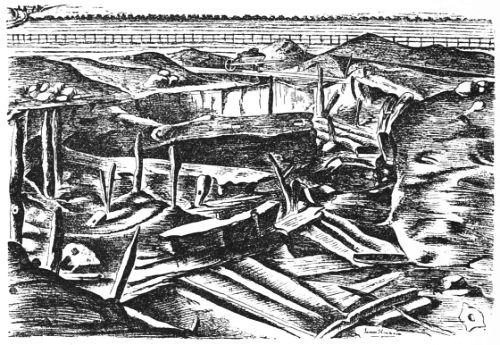
Fig. 40.—View of Wood-work at north-west corner.
1. Log pavement and its surrounding wooden structures.
2. Ash and bone refuse-bed.
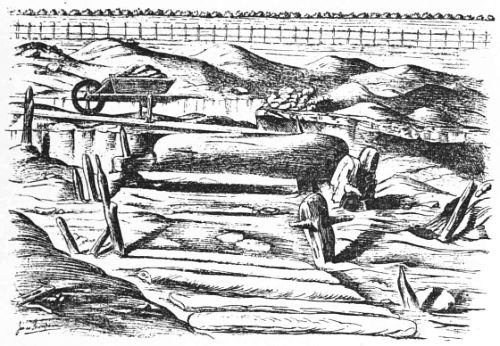
Fig. 41.—Showing Horizontal Beam in its original position.
1. Log Pavement and its surrounding Wooden Structures.—After clearing the whole space enclosed by the original circular trench down to the level of the log pavement, it was still difficult to make out the general plan of its structure, and that of the superstructure erected upon it. In the centre there was a rectangular space about 39 feet square, having its sides nearly facing the four cardinal points, and a flooring of thick oak beams somewhat like railway sleepers (see Figs. 40, 41, and 42). The fireplaces were nearly in the centre, but a little nearer its northern side. The wooden pavement was more carefully constructed at the south side than under the fireplaces; although, quite close to the latter, on its eastern side, were found two beautiful slabs of oak, which were removed, and measured 12 feet by 1 foot 6 inches. These beams had a series of round holes extending along the whole length of one edge, and about 51⁄2 inches apart. They appeared quite symmetrical, as if formed by an auger, and had a diameter of about 1 inch, and a depth of 2 or 3 inches. Close to the southern side of this rectangular space, there were exposed two very curious beams 7 feet 9 inches apart, and lying over a thin layer of clay which intervened between them and the general log pavement. One was slightly curved, and both had a raised rim running along their whole length, and each had a horizontal hole through which the ends of a beam passed (see Fig. 42). Moreover, they had square-cut holes at right angles to the former, as if intended for uprights. The finding of a double-bladed paddle (Fig. 126), close to one of these beams, suggested to the men the idea that they were the remains of a large boat, which, I must say, they very much resembled. Below this clay, and lying immediately over the log pavement, a long piece of a charred beam and the blade-half of an oar were found.
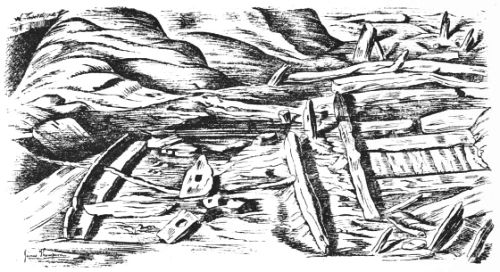
Fig. 42.—Curious Beams lying over Log Pavement.
At the south-east and south-west corners of the wooden pavement the remains of what appeared to be partitions or walls, running northwards, were noticed (see Figs. 40 and 42). These were constructed of short uprights and long slender beams laid along the line of partition, and interspersed with a matty substance like bast, together with clay and earthy matter. At the south end, the logs forming the pavement were laid parallel to each other and in groups, some running north and south, and others at right angles to these. There were two and sometimes three layers of logs, each lying transversely over the other. At the ends of the upper layers there were here and there deeply penetrating piles slightly projecting above the flooring, with a horizontal beam stretched between and tightly jammed, apparently for the purpose of keeping the logs in position. About 12 or 13 feet from the south side, a straight row of these piles and stretchers ran across the log pavement, which, at first sight, I took to be the remains of a partition (see Plan of Crannog, Plate II.).
Surrounding the rectangular log pavement, and just touching its four corners, we could trace a complete circle of firmly-fixed upright piles, arranged in two rows from 2 to 3 feet apart. They were all made of oak, apparently young trees, and projected several feet above the surface of the pavement, some of which were observed on the grassy surface of the mound before excavations were commenced. The most important thing, however, about them was the mode in which they were connected together by transverse beams, similar to, but ruder than, those already described as found at the north-east corner of the outer trench. Some of these beams were bevelled at the ends on their upper surfaces, especially the outer ends, and had two holes, one at each end, through which the pointed ends of the uprights projected. Fig. 41 shows one in its original position. At its inner end there were two strong wooden pins in a slanting direction, which entered the mortised hole through lateral grooves on its under surface and jammed the upright. The ends of these pins diverged and rested on clay, stones, and pieces of wood, and were evidently inserted for the purpose of supporting it. One transverse beam, observed on the west side not far from the former, and forming part of the same elevated platform, had horizontal holes, and lay on a solid mass of wood, stones, and vegetable matter, which was interposed between it and the rude log pavement (the rectangular oak pavement did not extend so far). Fig. 40 is a view taken from about the middle of the bank, close to the south side of the log pavement, and looking north-west. In front are seen the remains of a partition, a little farther back the beam just described, and turning round, at the far-off corner, the beam represented in Fig. 41. Fig. 42 is also taken from the same point, but with the view looking north-east. In both these sketches portions of the oak pavement are seen before any of the logs were disturbed. All the raised beams found in position were from 21⁄2 to 3 feet above the log pavement, and were directed towards the centre of the crannog, so that they presented an appearance which reminded one of the spokes of a large wheel. On the north side this arrangement was very well marked, many of the beams being still in situ, and in one place long beams were found lying over them, and running along the circumference of the crannog, above which were distinctly seen remains of a wooden platform precisely similar to that already described, at the north-east corner, with which, indeed, it was continuous.
It is thus more than probable that a circular platform of wood, presenting a breastwork some 3 feet high, surrounded the central log pavement, except at its southern side, where no traces of the raised horizontal beams were found, and where also the uprights were mostly formed of thick boards, suggesting rather the idea of a division between the wooden pavement and the refuse-bed. On the west side the segment left between the side of the rectangular oak pavement was also covered with logs of wood, but much rougher, and made of a softer wood than oak. This ruder pavement extended below the transverse beams, and merged into a conglomerated mass of stones, brushwood, and beams.
External to this circle of piles and platform, at the sides, but more especially on the south, there were other piles which appeared to form circles. On the south side indications of two or three such circles were noticed, but on the north side we could not ascertain their extent, as the trench was not far enough out to expose them if they did exist. But this point, together with several others, we hope to determine by further excavations as soon as the weather permits.
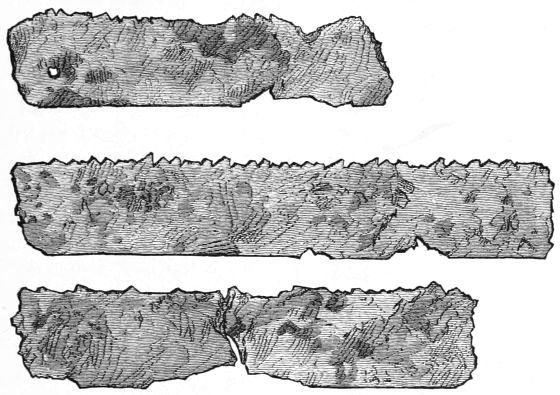
Fig. 43.—Portions of Iron Saw (1⁄4).
About 25 yards south of the crannog I observed a row of stakes in an open drain running towards the nearest land, and the tops of others in the grass, which from their arrangement suggested the idea that they were part of a gangway which formerly extended between it and the shore. This is one of those points not examined when our operations were interrupted by the severity of the weather.
The principal relics found beyond the inner circle row of piles consist of portions of a metal saw (Fig. 43), three flint implements (Figs. 63, 64, and 65), and two bundles of the fringe-like apparatus made of moss, besides those found in the refuse-bed.
2. Refuse-Bed.—The refuse-bed lay at the south-east side of the crannog (see Plan), just at the corner of the central log pavement, and consisted chiefly of gritty ash, decayed bones, and vegetable matters. It extended from the inner circle of stockades to within a few feet of the outer trench. Its breadth would be about 10 or 12 feet, and its length from east to west nearly double that. Its surface was from 3 to 4 feet below that of the field, so that its average depth would not be much short of 3 feet. Some important relics were found here, such as metal instruments and daggers, two fibulæ, several wooden vessels, and a few bone implements. It is noteworthy that the metal objects were all comparatively near the surface of the midden, and also that no boars' tusks or teeth were found in it except at its very lowest stratum.
It was ascertained, through the careful inspection of the Rev. Mr. Landsborough, that some of the large bones, especially leg-bones, contained in their cavities and interstices beautiful green crystals, of which I have collected some fine specimens. According to the analysis of Mr. John Borland, F.C.S., F.R.M.S., they are Vivianite, regarding which he writes as follows:—
"Vivianite.—A phosphate of iron, of somewhat definite composition, arising from the varying degree of oxidation of its base and state of hydration.
"It is found in two conditions—Amorphous and Crystalline—the former not uncommon, the latter rare. The amorphous has been frequently described under the name of blue iron earth; the crystalline was first named, and its relationship to the amorphous pointed out, by Weiner in Hoffmann's Mineralogie, about the year 1818 or 1820; the name being given in compliment to a Mr. Vivian of Cornwall, whose attention was first directed to the mineral.
"It has also been found at Bodenmais in Berne, and in several localities in America.
"Bischoff, in his Elements of Chemical and Physical Geology, as translated for the Cavendish Society, vol. ii. page 35, refers to a paper communicated by Von Carnall to a meeting of the Niederrheinischen Gesellschaft at Bonn, on the 3d December 1846, wherein mention is made of a remarkable instance of the occurrence of this mineral in the Scharley calamine mine, Silesia, which it was presumed was originally worked for lead.
"At a depth of 8 or 9 fathoms the skeleton of a man was found, and on breaking one of the bones crystals of vivianite became visible in the interior. A thigh-bone, when sawn through, showed crystals projecting from the inner surface, and others which were loose. The length of time the bones had lain there was unknown. The working of the Scharley mine began in the thirteenth century, and at the date of the communication had been discontinued for nearly three hundred years.
"Bischoff, however, advances the suggestion that, as the shaft may have been sunk in search of calamine, and not for the working of the lead, the age of the bones would not be so great as might at first be assumed. An analysis of the few crystals placed at my disposal leads to the conclusion that their constitution may be represented by the formula
3FeO.P²O⁵ + Fe²O³.PO⁵ + 15 aq.
"They belong to the monoclinic system of crystallography, and are of greenish-blue colour, becoming darker gradually on exposure to air."
In several places, when digging below the level of the log pavement and thrusting a staff a few feet downwards, gas bubbled up through the water, which, on applying a lighted match, ignited with considerable explosion. This, on analysis, was found to be carburetted hydrogen or marsh gas, with a small quantity of carbonic acid gas.
Before the stuff inside the circular trench was completely cleared away down to the level of the log pavement, our operations had to be abandoned on account of the severity of the weather. Meantime I drew up the above report from a careful journal kept of each day's proceedings and finds, and at the March meeting communicated it to the Society of Antiquaries of Scotland. But, notwithstanding the great variety of relics discovered, and the important information regarding the general structure of the crannog which had been ascertained, there were still several points requiring further elucidation. Of these the following four were the chief, which may be thus succinctly stated:—
Firstly.—From a perusal of the Plan (Plate II.) it will be observed that at the south side there is at least one well-marked circular group of upright piles external to the one surrounding the log pavement; hence the question which pressed for solution was—Whether these groups merged into the one on the north side, or whether there was another corresponding to the former still further out?
Secondly.—It was obvious that the island extended considerably beyond our original circular trench, so that a correct estimate of it could not be formed from our present data.
Thirdly.—We had no reliable information regarding the composition of the island below the log pavement, as deeper digging could not be carried on to any extent without a pump, owing to the accumulation of water—the main drain being nearly on a level with it.
Fourthly.—The supposed gangway had to be examined.
As none of the above problems could be solved without additional excavations, it was clear that, in the interests of science, the work should be resumed. But here occurred a difficulty. As the drainage operations conducted on the farm of Lochlee had now come to a close, and the workmen were removed elsewhere, Mr. Turner gave instructions that no further outlay should be incurred in the investigation of the crannog; and as, moreover, his Grace the late Duke of Portland, in answer to petitions from the Town Council and Philosophical Society of Kilmarnock, had given all the relics to the Corporation of this town, we felt it incumbent on us to restrict applications for more funds to carry on the explorations to the local authorities who had thus, without any expenditure whatever, become the owners of a rare and valuable collection of archæological relics. But the only result of our representation was a grant of £10 from the Philosophical Society; which, however, under the judicious management of Mr. Blackwood, together with a few private contributions kindly given by Messrs. James Blackwood, James Craig, Charles Reid, and Thomas Kennedy, enabled us to bring the work to a tolerably satisfactory conclusion.
Upon resuming operations in the month of April we directed the workmen to clear away the soil at the north-west corner, where, it will be remembered, two mortised beams were exposed in the original circular trench. These were then supposed to be part of the well-defined circle running along the north side, but now, however, they were found to be from 8 to 10 feet external to this circle. Upon careful inspection of the wooden structures at the north-east corner, we found that the inner termination of the platform, conterminous with the elaborate mortised beams at the outer trench, was supported by transverse mortised beams similar to those in the general circle—one of which is figured in Fig. 41. There could, indeed, be hardly any doubt that at this corner two circular rows of uprights with their transverses gradually merged into one on the north. Hence it became a very feasible supposition that those mortised beams at the north-west corresponded with the outer ones at the north-east side, and formed part of an outer circle which also merged into the one on the north. But upon extending excavations so as to expose them completely, this supposition was not borne out. They were in a slanting position, about 15 feet apart, and their outer ends on a level with the log pavement. Half-way between them there was another beam lying in a similar position, but it contained no mortised holes. Their lower or outer extremities were jammed against a sort of network of logs, some running along the circumference and others slanting rapidly downwards, while their inner ends were raised about 2 feet and rested on a mass of stones and logs of wood. The outer hole of the beam, marked H on the Plan, contained a portion of an upright, which had, however, more the appearance of being used as a peg to keep it down. The other mortised holes appeared to be of no use whatever, so that these beams were intended for, and probably served, a different purpose before being placed in their present position.
It was now evident that the margin of the crannog was near, as at the upper or surface portions of the trenches we encountered a layer of fatty clay, which had undoubtedly been deposited by the surrounding lake. This layer gradually got thicker as we advanced outwards, and the dark vegetable débris and wood-work, forming the substance of the island, shelved downwards underneath it. A foot or two beyond the outer end of the beam G, this clay was 3 feet 6 inches thick. Pursuing our investigations northwards towards the point A (Plan Plate II.), we came upon a dense wooden structure formed of stakes, logs, planks, and brushwood, woven together in the most fantastic fashion, which also shelved downwards below the clay. At the point A this clay was no less than six feet deep. Here the water oozed up, but there was no doubt, from the above appearances and the rapidly slanting wood-work,—some stakes now running downwards and outwards at an angle of about 45°,—that we had reached the sloping margin of the island. Imbedded in the clay near the point A were found two pieces of charred stakes, one 31⁄2 feet and the other nearly 6 feet deep. About half-way between the margin of the crannog and the circle of stakes surrounding the log pavement, and 5 feet deep, the workmen discovered, amongst decayed brushwood and chips of wood, a beautiful trough cut out of a single block of wood. It was quite whole when found, and showed very distinctly the markings of the gouge-like instrument by which it was fashioned. It was made of soft wood, which, upon drying, quickly crumbled into dust, but Fig. 44, engraved from a photograph taken by Mr. Blackwood soon after its discovery, gives a very good idea of it.
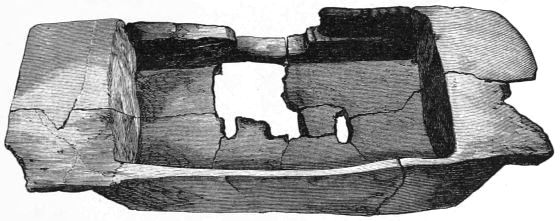
Fig. 44.—Wooden Vessel (1⁄6).
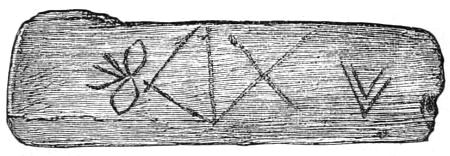
Fig. 45.—Wooden Board (1⁄4).
Instead of pursuing the excavations further in this direction, our means being quite inadequate to clear away the soil at a uniform breadth of about 20 feet all round, we resolved to form a number of cuttings projecting outwards, at suitable intervals, from the circumference of the space already cleared. These cuttings (see Plan, a, b, c, d and e) varied from 10 to 20 feet in breadth, and extended outwards in each case till we were satisfied, from the encroachment of the surrounding clay, that the margin of the crannog had been reached. On the north and north-east trenches the wood-work assumed a most extraordinarily intricate arrangement. It consisted mostly of young trees and branches of birch, the bark of which was quite fresh-like, and distinctly recognisable, mixed with stakes and logs, some of oak, running in all conceivable directions, and constituting a protective barrier,—proof, I should say, against the most violent action of both wind and water. At its inner side, close to the original circular trench, this peculiar structure, which we called trestle-work, was only about 18 inches below the surface, but sloped downwards, at first gradually, and then rapidly, till it disappeared under the clay. At the north-east corner it extended about 20 feet beyond the group of mortised beams, so that the latter could not have been a landing-stage, a theory which was long current amongst the quidnuncs. Near the outer edge of the cutting at this corner (c), there was observed, mixed up with the trestle-work, an oak beam, having two square mortised holes, which must have been originally adapted for a higher purpose than the humble function of packing, which it here served. Lying over the wood-work, and less than two feet below the surface, I picked up portions of a leather boot or shoe, with fragments of a leather lace, crossed diagonally, which had tied it in front; also a small wooden stave like that of a milk-cog. Deeper, and near the outer edge, the workmen found a much corroded dagger or spear head. At the south-east corner (d), a series of upright piles with the remains of a transverse was exposed, but the trestling work had dwindled down to mere brushwood, with an occasional beam mixed up with it. Here the workmen found a thin board made of hard wood, resembling a portion of the end of a small barrel, with diagonal and other markings lightly cut upon it (Fig. 45).
On the south side, external to the refuse-bed, quite a forest of piles was encountered, together with the charred remains of a few mortised transverses and some long beams. From a glance at the Plan it will be observed that, at the cutting e, the outer circle of these uprights curves outwards as if to meet the line of the supposed gangway. It would have been more satisfactory if a larger portion had been here cleared away, and the junction of the gangway with the crannog more accurately determined; but at this particular spot there was such an immense accumulation of rubbish, formerly wheeled from the interior of the mound, that the labour of removing it was too great. The superficial layer of fatty clay appeared here also, and at the point e measured 2 feet 3 inches in thickness. The horizontal beams found at this side, some of which were indicated on the Plan, were from 4 to 5 feet deep, and about the same level some important relics were dug up. Near the point m were found a bridle bit (Fig. 148), a bronze dagger-like instrument (Fig. 145), and a four-plied plaited object made of the long stems of a moss similar to those of which the fringe-like article was manufactured, and referred to on a former occasion. It had the tapering appearance of a cue or pigtail; and measured 17 inches long and about 2 broad in the middle. Near it, and about 5 feet deep, an iron hatchet (Fig. 46), much corroded, but still retaining a small bit of the wooden handle, was discovered by one of the workmen. A few feet to the east of this, and lying across the line of the gangway, a large oar was exposed to view. It was quite whole when found, but being made of soft wood, was so fragile that it broke into pieces in the act of removal. Its extreme length was 91⁄2 feet, and the blade measured 3 feet by 14 inches. The round handle was perforated about its middle by two small holes a couple of inches apart.
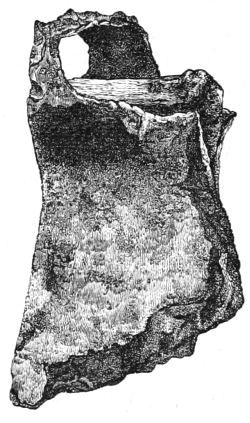
Fig. 46.—Iron Hatchet (1⁄2).
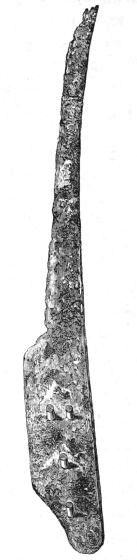
Fig. 47.—Iron Knife (1⁄2).
We made no projecting trench on the south-west side owing to the proximity of a network of recent drains, which, if disturbed, might injuriously interfere with the drainage of the field, but from the general appearance of the wood-work we were satisfied that this portion was symmetrical with the rest of the crannog. The ends of flat beams jutted out at the bottom of the cutting immediately on the west side, which clearly indicated a parallelism with the three exposed a little farther north; and towards the south one or two uprights belonging to the outer series were visible.
Having now collected the chief facts regarding the log pavement, its surrounding and superincumbent structures, and the extent of the crannog, we determined to sink a shaft at the lower end of the log pavement—i.e. about the centre of the crannog—for the purpose of ascertaining, if possible, the thickness, composition, and mode of structure of the island itself. This shaft was rectangular in form, and large enough to allow three men to work in it together. After removing the three or four layers of oak planks which constituted the log pavement, we came upon a thin layer of brushwood and then large trunks of trees laid in regular beds or layers, each layer having its logs lying parallel to each other, but transversely and sometimes obliquely to those of the layer immediately above or below it. At the west end of the trench, after removing the first and second layers of the log pavement, we found part of a small canoe hollowed out of an oak trunk. This portion was 5 feet long, 12 inches deep, and 14 inches broad at the stern, but widened towards the broken end, where its breadth was 19 inches. This was evidently part of an old worn-out canoe, thus economised, and used instead of a prepared log. Much progress in this kind of excavation was by no means an easy task, as it was necessary to keep two men constantly pumping the water which copiously flowed from all directions into the trench, and even then there always remained some at the bottom. As we advanced downwards we encountered layer upon layer of the trunks of trees with the branches closely chopped off, and so soft that the spade easily cut through them. Birch was the prevailing kind of wood, but occasionally beams of oak were found, with holes at their extremities, through which pins of oak penetrated into other holes in the logs beneath. One such pin, some 3 or 4 inches in diameter, was found to pass through no less than four beams in successive layers, and to terminate ultimately in a round trunk over 13 inches in diameter. One of the oak beams was extracted entire, and measured 8 feet 3 inches in length and 10 inches in breadth, and the holes in it were 5 feet apart. Others were found to have small round projections, which evidently fitted into mortised holes in adjacent beams.
Down to a depth of about 4 feet the logs were rudely split, but below this they appeared to be round rough trunks, with the bark still adhering to them. Their average diameter would be from 6 inches to 1 foot, and amongst them were some curiously gnarled stems occasionally displaying large knotty protuberances. Of course the wood in the act of digging the trench was cut up into fragments, and, on being uncovered, its tissues had a natural and even fresh-like appearance, but in a few minutes after exposure to the air they became as black as ink. Amongst the débris thrown up from a depth of 6 feet below the log pavement I picked up the larger portion of a broken hammer-stone or polisher, which, from the worn appearance presented by its fractured edges, must have been used subsequently to its breakage. After a long and hard day's work we reached a depth of 7 feet 4 inches, but yet there were no indications of approaching the bottom of this subaqueous fabric. However, towards the close of the second day's labour, when the probability of total discomfiture in reaching the bottom was freely talked of, our most energetic foreman announced, after cutting through a large flat trunk 14 inches thick, that underneath this he could find no trace of further wood-work. The substance removed from below the lowest logs consisted of a few twigs of hazel brushwood, imbedded in a dark, firm, but friable and somewhat peaty soil, which we concluded to be the silt of the lake deposited before the foundations of the crannog were laid. The depth of this solid mass of wood-work, measuring from the surface of the log pavement, was 9 feet 10 inches, or about 16 feet from the surface of the field.
Amongst the very last spadefuls pitched from this depth was found nearly one-half of a well-formed and polished ring made out of shale, the external and internal diameters of which were 31⁄2 and 2 inches respectively.
Gangway.—The probable existence of some kind of communication between the crannog and the shore of the lake was suggested at a very early stage of these investigations by the discovery of a few oak piles in a drain outside the mound, and to clear up this mystery was now the only problem of importance that remained to be solved. We commenced this inquiry by excavating a rectangular space, 30 feet long, 16 feet broad, and 3 to 4 feet deep, in the line of direction indicated by the piles (marked O on the Plan), and exposed quite a forest of oak stakes. Other trenches, marked P and Q respectively, were then made with exactly similar results. The stakes thus revealed did not at first appear to conform to any systematic arrangement, but by and by we detected, in addition to single piles, small groups of three, four, and five, here and there at short intervals. This observation, however, conveyed little or no meaning, so that we could form no opinion as to the manner in which they were used. No trace of mortised beams was anywhere to be seen. In all the trenches the stuff dug up was of the same character. First or uppermost there was a bed of fine clay rather more than 2 feet thick, and then a soft dark substance formed of decomposed vegetable matters. The source of the latter was evident from the occurrence in its upper stratum of large quantities of leaves, some stems, branches, and the roots of stunted trees, apparently in situ. The tops of the piles in the trench q were from 2 to 3 feet below the surface of the field, but they appeared to rise gradually as we receded from the crannog, and in the trench next the shore one or two were found on a level with the grass. About 4 feet deep the stuff at the bottom of the trench was so soft that a man could scarcely stand on it without sinking ankle-deep. It was not nearly so heavy as ordinary soil, but more adhesive, and of a nutty brown colour, which, on exposure, quickly turned dark. Notwithstanding the flabbiness of this material, the piles felt quite firm, and this fact, together with the experience derived from our examination of the deeper structures of the island, led to the supposition that the piles would be found to terminate in some more solid basis than had yet been made apparent. To remove all doubts on this point, though a long iron rod could be easily pushed downwards without meeting any resistance, we ordered a large deep shaft to be dug in the line of the piles, and the cutting q, being nearest the crannog, was selected for this purpose. This was accomplished with much difficulty, but we were amply rewarded by coming upon an elaborate system of wood-work, which I found no less difficult to comprehend than it now is to describe. The first horizontal beam was reached about 7 feet deep, and for other 3 feet we passed through a complete network of similar beams, lying in various directions. Below this, i.e. 10 feet from the surface, the workmen could find no more beams, and the lake silt became harder and more friable. We then cleared a larger area so as to exhibit the structural arrangement of the wood-work. The reason of grouping the piles now became apparent. The groups were placed in a somewhat zigzag fashion near the sides of the gangway, and from each there radiated a series of horizontal beams, the ends of which crossed each other and were kept in position by the uprights. One group was carefully inspected. The first or lowest beam observed was right across, the next lay lengthways and of course at right angles to the former, then three or four spread out diagonally, like a fan, and terminated in other groups at the opposite side of the gangway, and lastly, one again lay lengthways. (See Plan and Sections.) Thus each beam raised the level of the general structure the exact height of its thickness, though large lozenge-shaped spaces remained in the middle quite clear of any beams. The general breadth of the portion of this unique structure examined was about 10 feet (but an isolated pile was noticed farther out), and its thickness varied from 3 to 4 feet. A large oak plank, some 10 feet long, showing the marks of a sharp cutting instrument by which it was formed, was found lying on edge at its west side, and beyond the line of piles, but otherwise no remains of a platform were seen. All the beams and stakes were made of oak, and so thoroughly bound together that, though not a single joint, mortise, or pin was discovered, the whole fabric was as firm as a rock. No relics were found in any of the excavations along the line of this gangway.
Relics.
The remains of human industry found during the excavations of the Lochlee Crannog, calculated to throw light on the civilisation and social economy of its occupiers, are very abundant. They comprise a large variety of objects, such as warlike weapons, industrial implements, and personal ornaments, made of stone, bone, horn, wood, metal, etc. In the following description of them I have adopted, as perhaps the most convenient, the principle of classification suggested by the materials of which they are composed.
I. Objects made of Stone.
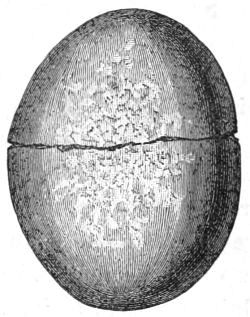
Fig. 48.—Hammer-Stone (1⁄2).
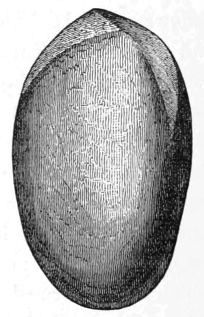
Fig. 49.—Hammer-Stone (1⁄2).
Hammer-Stones.—A great many water-worn pebbles, of a similar character to those found in the surrounding glacial drift and river-courses, which were used as hammers, or pounders, or rubbers, were discovered in the débris all over the crannog, but more abundantly in the deeper layers of a small circular area round the hearths, corresponding to what I have on a former occasion designated the relic-bed. As typical specimens of such implements I have collected no less than nineteen. Of these, fourteen are of a somewhat elongated oval shape, and were used at one or both ends. They vary considerably in size, the major diameter of the largest measuring 6 inches, and the rest graduating downwards to about the half of this. Two are flat and circular, and show friction-markings all round; while other three show signs of having been used on their flat surfaces only. The one represented in Fig. 48, with markings on its flat sides, is divided into two portions, each of which was picked up separately, about a yard asunder, and found to fit exactly. It would thus appear that it was broken while being used on the crannog, and then pitched aside as useless. Some are slightly chipped at one end, others have small finger-like depressions, as if intended to give the user a better grip (Figs. 49, 50, and 51).
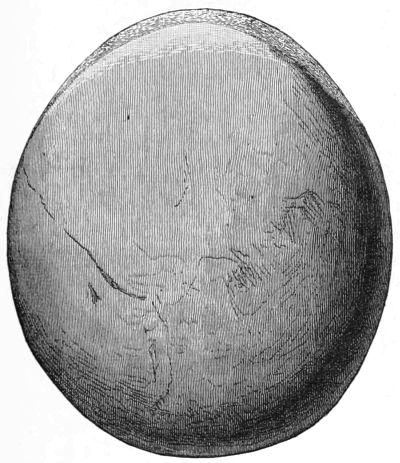
Fig. 50.—Hammer-Stone (1⁄2).
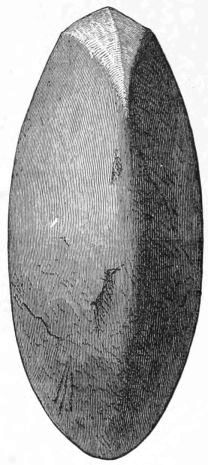
Fig. 51.—Hammer-Stone.
Edge view of the previous implement (1⁄2).
Heating-Stones and Sling-Stones.—A large number of round stones, varying in size from half an inch to three inches in diameter, some having their surfaces roughened and cracked as if by fire, but others presenting no marks whatever, were met with. The former might have been used as heating-stones for boiling water in wooden vessels,—the only ones found on the crannog,—the latter as sling-stones or missiles.
Anvil.—About a foot below the surface, and a few feet to the north of the upper fireplace, a beautiful quartz pebble was found by Mr. Cochran-Patrick, which has the appearance of being used as an anvil. It is discoidal in shape, but a little more rounded on its upper surface, and measures 27 inches in circumference. It is just such an instrument as a shoemaker of the present day would gladly pick up for hammering leather (see Fig. 37).
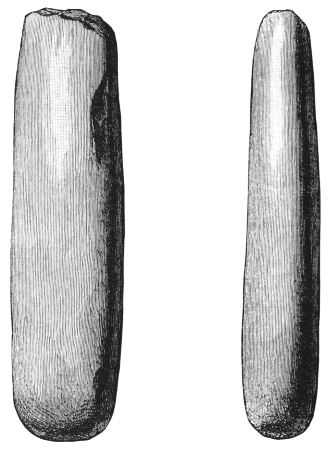
Fig. 52. Fig. 53.
Sharpening-Stones (1⁄2).
Sharpening-Stones or Whetstones.—Four or five whetstones were collected from various parts of the island, three of which are here engraved (Figs. 52, 53, and 54). They are made of a hard smooth claystone, one only being made of a fine-grained sandstone, and vary in length from 5 to 7 inches. Fig. 54 represents what is supposed to be a hone 61⁄4 inches long, and containing a smooth groove. It was found on the site of the crannog by Captain Gillon, long after the explorations had been brought to a close, and is now deposited in the National Museum (see page 126).
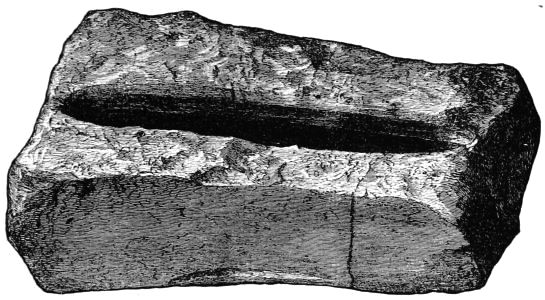
Fig. 54.—Hone (61⁄4 inches in length).
Besides these hones we noticed a large block of a coarse sandstone, having one side covered with deep ruts, supposed to be caused by the sharpening of pointed instruments.
Polished Celt.—Only one polished stone celt was found. It is a wedge-shaped instrument, 51⁄2 inches long, and 2 broad along its cutting edge, which bears the evidence of having been well used, and tapers gently towards the other end, which is round and blunt. It is made of a hard mottled greenstone (Fig. 55).
Circular Stone.—Fig. 56 represents a peculiar circular implement manufactured out of a bit of hard trap rock. It presents two flat surfaces, 3 inches in diameter, with a round periphery, and is 1-3/8 inch thick.
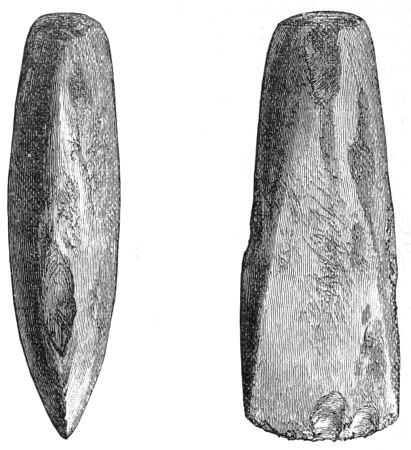
Fig. 55.—Stone Celt (1⁄2).
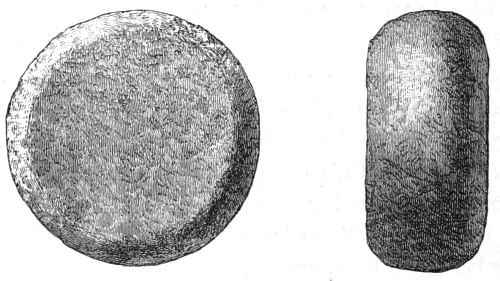
Fig. 56.—Circular Stone (1⁄2).
Querns.—Five upper, and portions of several lower, quern-stones were disinterred at different periods during these excavations, all of which, however—with the exception of the pair found over the log pavement, and an upper stone observed towards the west margin of the crannog, but of which I could find no definite information, as it was stolen soon afterwards,—were imbedded in the débris not far from the site of the fireplaces, and superficial to the level of the middle or first-discovered pavement. Some are made of granite, while others appear to be made of schist or hard whinstone. Besides the central cup-shaped hole, which, of course, all the upper ones possess, one has a second hole slanting slightly inwards, another has a similar hole, but only half-way through, while a third has no second hole at all, and a fourth shows a horizontal depression at its side. The one without a second hole on its surface is nearly circular, but the others are all more or less elongated. Their largest diameters vary from 13 to 14 inches. One is broken into three portions, which, though dug up separately, fit exactly. It measures 14 inches by 11, and the central hole is wide, being no less than 5 inches across. From the upper edge of this hopper-like cavity the stone slopes gently all round to the circumference of its under surface, and the second hole completely perforates it.
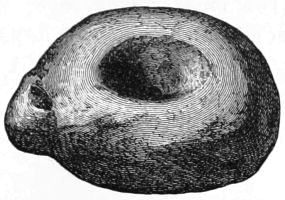
Fig. 57.—Upper Quern Stone (1⁄8).
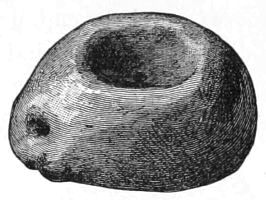
Fig. 58.—Upper Quern Stone (1⁄8)
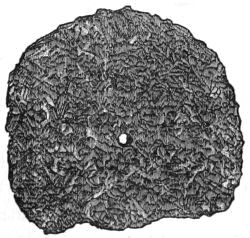
Fig. 59.—Lower Quern-Stone (1⁄8).
Cup-marked Stones.—Two portions of red sandstone, having cup-shaped cavities about 1 inch deep and 3 inches diameter, were found amongst the débris. One of them was lying underneath a horizontal raised beam at the north side of the crannog. The position of the other was not determined. The latter has two circular depressions or grooves round the cup, the outer of which is about 9 inches in diameter (Figs. 60 and 61).
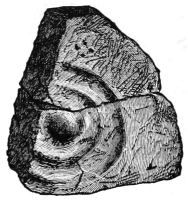
Fig. 60.—Cup Stone (1⁄8).
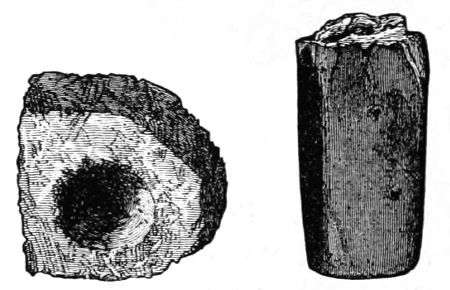
Fig. 61.—Cup Stone (1⁄8). Fig. 62.—Stone (1⁄2).
Other Stone Relics.—Besides the above there are a few other articles of stone bearing the evidence of design, which I must just allude to.
1. A large stone having a deep groove all round about it, as if intended for a rope. The larger portion of this groove was caused by atmospheric agencies, and only one side could be positively stated to have been artificially formed.
2. A thin oval-shaped disc of a light black substance like shale, measuring 3 inches by 2 inches.
3. Portion of a polished stone 2 inches long, having a narrow groove surrounding one end, and through which it appears to have been broken (Fig. 62).
Flint Implements.—Only three flint objects have been discovered on the crannog.
1. A beautifully chipped horseshoe-shaped scraper, found at north-east corner, on a level with the raised wooden platform. It is made of a whitish flint, and measures 1 inch in length by 11⁄4 in breadth (Fig. 63).
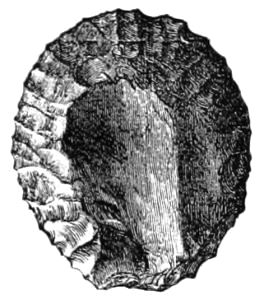
Fig. 63.—Flint Scraper (1⁄1).
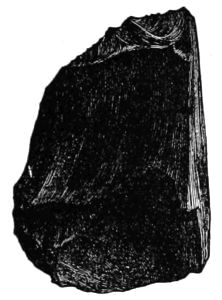
Fig. 64.—Flint Flake (1⁄1).
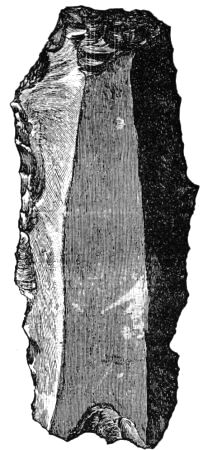
Fig. 65.—Posterior of Flint Flake (1⁄1).
2. A large knife-flake, 3 inches long and 11⁄4 broad, which appears to have been much used at the edges and point. It is also made of a whitish flint, and presents three smooth surfaces above and one below (Fig. 64).
3. The end portion of another flake, made of a dark flint (Fig. 65).
Spindle Whorls.—Three small circular objects, supposed to be spindle whorls, are here classed together. Two are made of clay, and were found in the relic-bed near the fireplaces. The smaller of the two is 11⁄4 inch in diameter, and has a small round hole in the centre; the other has a diameter of 13⁄4 inch, but is only partially perforated, just sufficient to indicate that the act of perforation had been commenced but not completed (Figs. 66 and 67). The third object is a smooth, flat, circular bit of stone, 11⁄2 inch in diameter and 1⁄2 an inch thick, and is perforated in the centre like a large bead (Fig. 68).
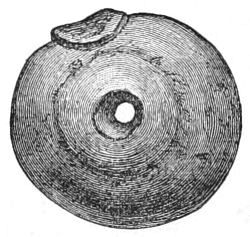
Fig. 66.—Clay Spindle Whorl (1⁄1).
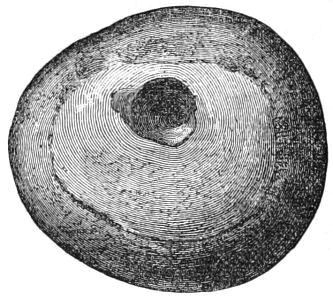
Fig. 67.—Clay Spindle Whorl (1⁄1).
A fourth spindle whorl was found by a visitor from Dumfries-shire and carried away, but it has been returned lately, and is now among the collection. It is made of an oval sandstone pebble, and is slightly larger than the one represented by Fig. 68.
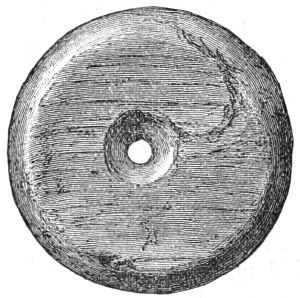
Fig. 68.—Stone (1⁄1).
II. Objects of Bone.
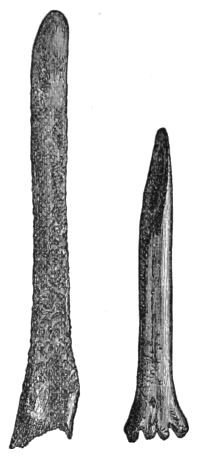
Fig. 69. Fig. 70.
Bone Chisels (1⁄2).
Upwards of twenty implements made of bone have been added to the general collection, all of which were found either in the relic-bed or refuse-heap. The following are the most interesting:—
1. Two Chisels or Spatulæ. One (Fig. 69) is made of a split portion of a shank-bone, and measures 51⁄4 inches long and rather less than 1⁄2 an inch broad. It is very hard, flat, and smoothly ground at one end, and has a sharp rounded edge, which extends further on the left side, thus indicating that it was adapted for being used by the right hand. The other (Fig. 70) is a small leg-bone obliquely cut so as to present a smooth polished surface. Its length is 4 inches and diameter 1⁄2 inch.
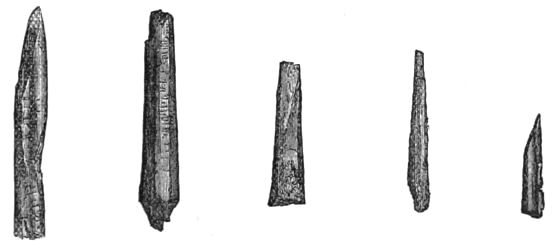
Fig. 71. Fig. 72. Fig. 73. Fig. 74. Fig. 75.
Bone Implements (1⁄2).
2. Five small objects presenting cut and polished surfaces, three of which are sharp and pointed (Figs. 71, 74, 75); one (Fig. 72) appears to have been notched at the end and there broken off; and the last (Fig. 73) presenting well-cut facets, is fashioned into a neat little wedge.
3. Fig. 76 represents a tiny little spoon only 3⁄4 of an inch in diameter, and worn into a hole in its centre. The handle portion is round and straight, and proportionally small, being only two inches long and about the diameter of a crow-quill. Fig. 77 shows another portion of bone somewhat spoon-shaped.
4. Fig. 78 is a drawing of a neatly formed needle-like instrument. It is flat on both sides, finely polished, and gradually tapering into points at its extremities. The eye is near its middle, being two inches from one end and 11⁄2 inch from the other, and large enough for strong twine to pass through it.
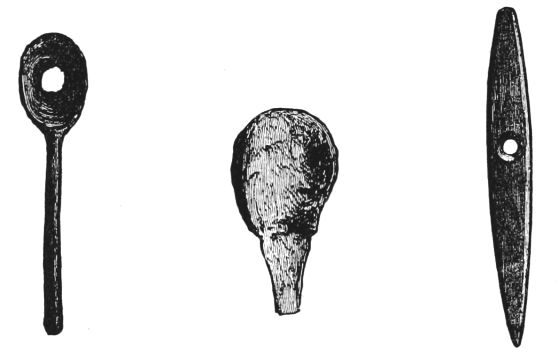
Fig. 76.—Bone (1⁄2). Fig. 77.—Bone (1⁄2). Fig. 78.—Bone (1⁄2).
5. Fig. 79 is a drawing of a portion of bone artificially made into a sharp-pointed instrument. Several similar objects were met with, but as they showed no distinct workmanship I have not preserved them.
6. A great many small ribs, about 6 or 7 inches in length, and portions of others, were found to have the marks of a sharp cutting instrument by which they were pointed and smoothed along their edges, the use of which can only be conjectured. Figs. 80 to 82 are drawings of some of them. Fig. 83 shows a larger rib-bone, highly polished all over and notched round one end.
7. Lastly, there are several portions of round bones which appeared to have been used as handles for knives or suchlike instruments.
III. Objects of Deer's Horn.
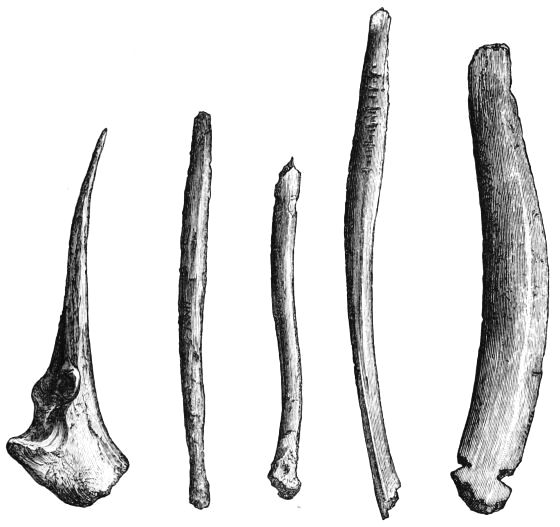
Fig. 79.—Bone (1⁄3). Fig. 80. Fig. 81. Fig. 82. Fig. 83.
Bone Implements (1⁄2).
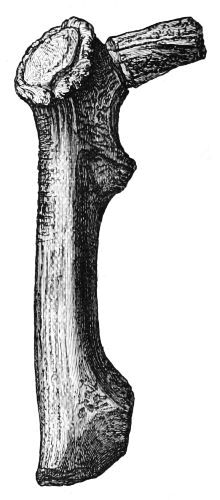
Fig. 84.—Horn (1⁄3).
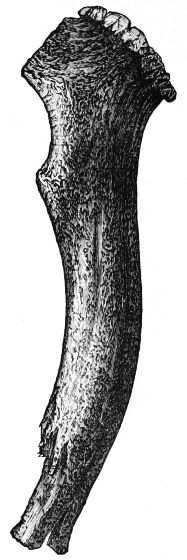
Fig. 85.—Horn (1⁄3).
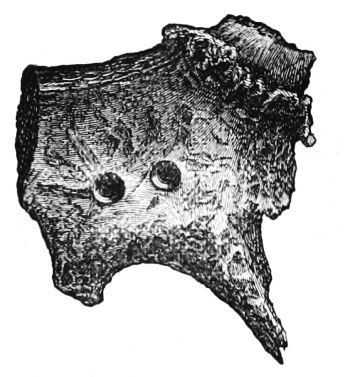
Fig. 86.—Horn (1⁄3).
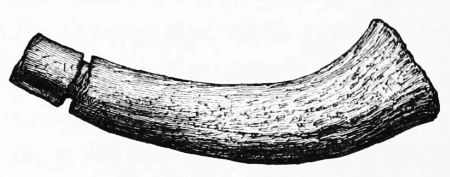
Fig. 87.—Horn (1⁄3).
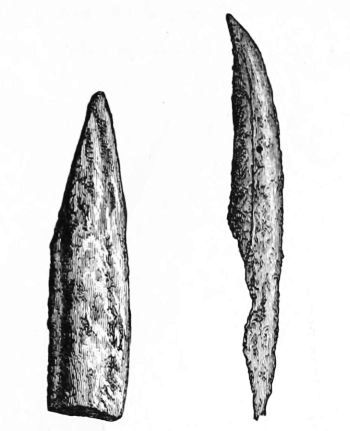
Fig. 88.—Horn (1⁄3). Fig. 89.—Horn (1⁄3).
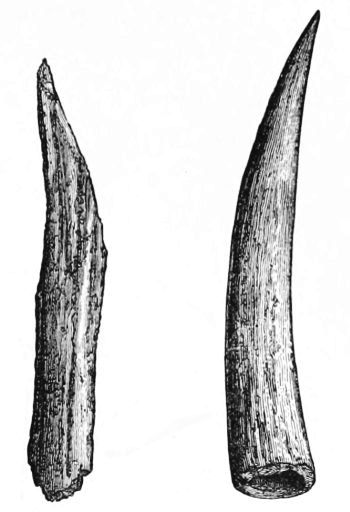
Fig. 90.—Horn (1⁄3). Fig. 91.—Horn (1⁄3).
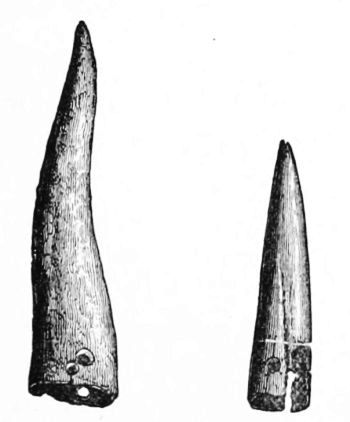
Fig. 92.—Horn (1⁄3). Fig. 93.—Horn (1⁄3).
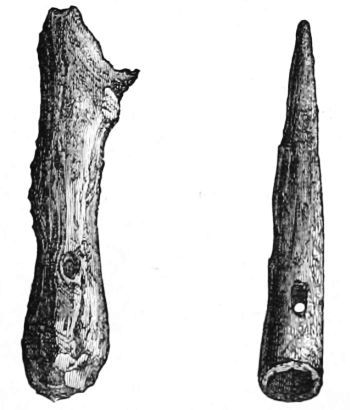
Fig. 94.—Horn (1⁄3). Fig. 95.—Horn (1⁄3).
Out of about forty portions of horn, chiefly of the red deer, bearing evidence of human workmanship, I have selected for illustration sixteen of the most characteristic specimens. Two hammers or clubs, formed from the lower portions of the beam antlers of stags by cutting or sawing off their branches. One (Fig. 84) is 11 inches long, and has about three inches of the brow branch of the horn projecting from it, round the root of which there is a groove as if intended for a string. The markings on the back portion indicate very distinctly that it was used for hammering some hard substance. Fig. 85 is a still more formidable weapon, being 14 inches long and 9 inches in circumference near the burr. Portion of the latter is worn completely away by use. Fig. 86 is the root portion of a large antler, having one surface made smooth, and containing two circular depressions and a few deeply penetrating marks as if made by a sharp instrument. Fig. 87 is a portion of a horn with a groove round one end. Figs. 88, 89, 90 represent split portions of horn sharpened at the point like daggers. Figs. 91, 92, 93 are three pointed portions or tines, two of which were probably used as spear-heads, and contain small holes at the cut ends by which they were fastened on handles. Fig. 94 represents portion of horn (roe) cut at both ends with a hole near its centre, which, however, does not pass through; while Fig. 95 shows another small pointed and curved portion, with a hole, about 1 inch from the end, passing completely through it. Fig. 96 was evidently used as a hook, as the stem portion is smoothly bored and made suitable for a handle. Fig. 97 is a small portion made into a ring. The last object figured under this head is a bodkin 8 inches long, finely polished all over, and pointed at the tip as if with a sharp knife. The other end, which is large and circular, is pierced by a round hole, by means of which it might have been strung to one's person (Fig. 99). The portions of horns not figured consist of clubs, pointed tines, short thick pieces, etc., all of which show the marks of tools upon them.
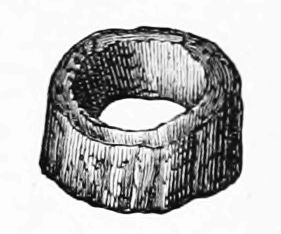
Fig. 97.—Horn (1⁄3).
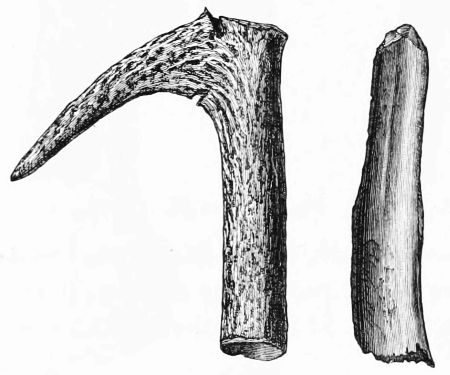
Fig. 96.—Horn (1⁄3). Fig. 98.—Horn (1⁄3).
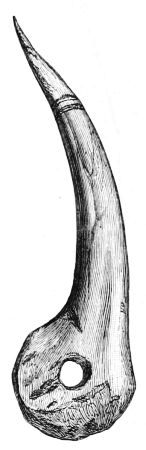
Fig. 99.—Horn (1⁄3).
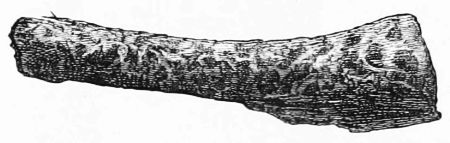
Fig. 100.—Portion of Horn Handle found along with Iron Knife, Fig. 129 (1⁄3).
Besides the above there are a great many fragments of horns, some of which, as mentioned by Professor Rolleston in his report on the fauna, might have been used as implements. One of the fragments labelled by this gentleman as being part of the horn of a reindeer, is a short flat tine, and bears the evidence of having been sawn off. It is 6 inches long and 2 broad at the base.
IV. Objects of Wood.
A large assortment of wooden implements was found chiefly in the refuse-heap, and in the portion of débris corresponding to the area of the log pavement. Owing to the softness of the wood and the large amount of moisture contained in its fibres, most of these relics have already shrunk to less than half their original bulk, and become so changed, though they were kept in a solution of alum for several weeks, that I am doubtful of being able to preserve them at all. Seeing the rapid decay they were undergoing, I got full-sized pencil-drawings taken of them, from which the accompanying illustrations have been engraved. They consist of bowls, plates, ladles, a mallet, a hoe, clubs, pins, etc., together with many objects entirely new to me, but which apparently had been used for culinary or agricultural purposes.
1. Vessels.—Fig. 101. Portions of a circular bowl, diameter 71⁄2 inches, depth (inside) 3 inches, thickness 1⁄4 inch at edges and 1⁄2 inch at bottom; bottom flattened, 3 inches diameter (outside). Other fragments of vessels similar to the above were found.
Fig. 102. Flat dish, like scallop shell, with a ring handle, length 7 inches, breadth 6 inches, thickness varies from 3⁄8 inch to a thin edge. Quite whole when disinterred from refuse-heap.
Fig. 103. Portions of a plate, diameter nearly 10 inches, thickness 3⁄8 of an inch, depth barely 1 inch; a well-formed bead ran round the rim.
Fig. 104. Ladle. Bowl nearly complete, length 10 inches, breadth 8 inches, depth (inside) 31⁄2 inches, thickness 1 to 1⁄2 inch; portion of handle still remaining.
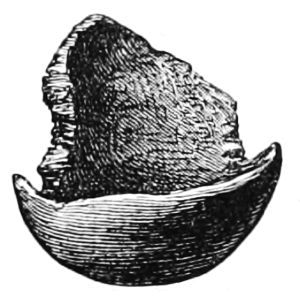
Fig. 101 (1⁄8).
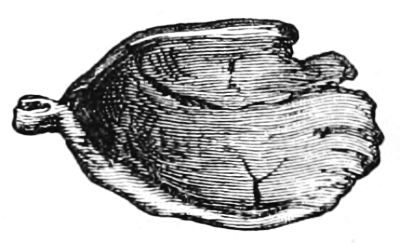
Fig. 102 (1⁄8).
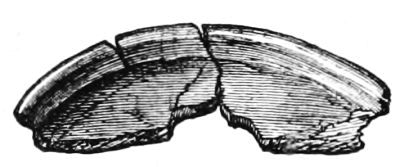
Fig. 103 (1⁄8).
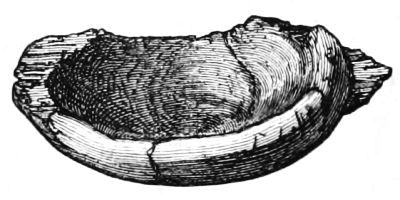
Fig. 104 (1⁄8).
Fig. 44. Trough, 111⁄2 inches long, 6 broad, and 21⁄2 deep (inside). Projecting ears 31⁄2 inches long. Thickness of sides varied from 1⁄4 to 1 inch. Had three rectangular holes in bottom, of which the centre one was larger, measuring 1 by 11⁄2 inch.
All the above vessels were made of soft wood, with the exception of the portions of bowls, which were of oak.
2. Clubs, Pins, etc.; all of which were made of oak.—Fig. 105. Club, 2 feet long, 3 inches broad, and 11⁄2 thick; circumference of handle 31⁄2 inches.
Fig. 106. Club, 141⁄2 inches long, and greatest breadth 21⁄2.
Fig. 107. Sword-like implement, 20 inches long and 21⁄2 broad; sharp at point and edges.
Fig. 108. Implement with round handle and thin blade, containing teeth at one edge, length 15 inches, and breadth 11⁄2.
Fig. 109. Knife-shaped instrument, blade 10 inches long by 1 broad.
Fig. 110. Round polished stick with charred end.
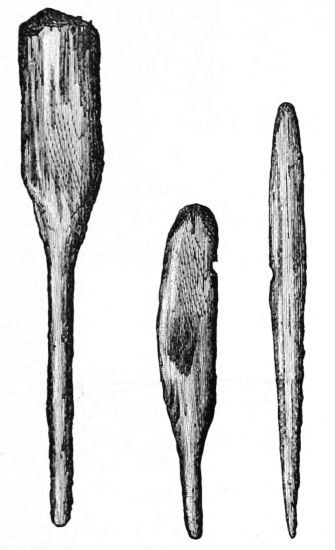
Fig. 105. Fig. 106. Fig. 107.
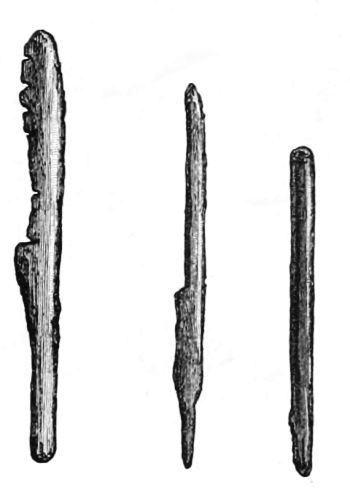
Fig. 108. Fig. 109. Fig. 110.
(Scale 1⁄8.)
Figs. 111 to 115 represent the various kinds of pins which were abundantly met with all over the crannog.
Fig. 115 is 14 inches long, 2 broad, and 11⁄8 thick; the hole in it measures 15⁄8 by 3⁄4 inch.
3. Agricultural Implements, etc.—Fig. 116. Mallet, head of which is 10 inches long and 16 in circumference; handle is 9 inches long and 5 in circumference.
Fig. 117. Scraper or hoe, 10 inches long and 4 broad; was cut out of a trunk of a tree, and had natural branch formed into a handle.
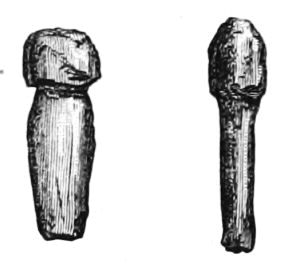
Fig. 111. Fig. 112.
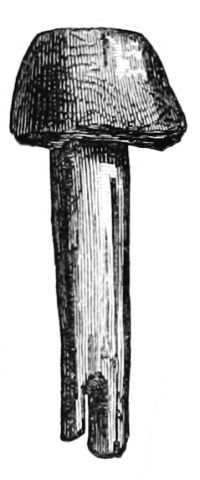
Fig. 113.
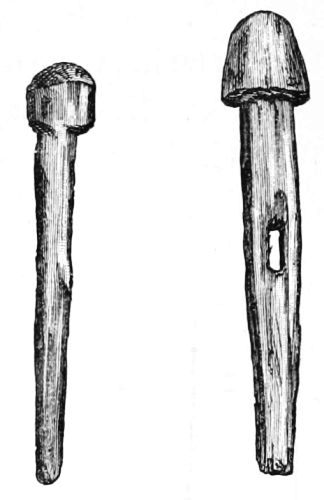
Fig. 114. Fig. 115.
(Scale 1⁄8.)
Fig. 118. Implement like boot or ploughshare, 10 inches long and 12 round the middle.
Fig. 119. Polished implement, 9 inches long, 51⁄4 broad, and 2 thick (through the hole). The lower surface is flatter than the upper, and slightly curved upwards longitudinally.
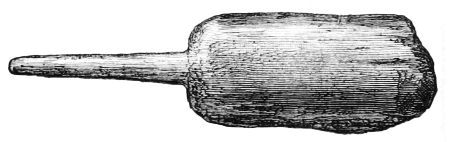
Fig. 116 (1⁄8)
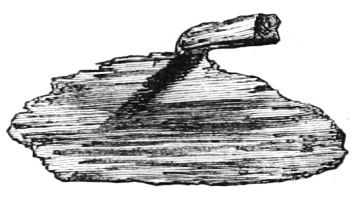
Fig. 117 (1⁄8).
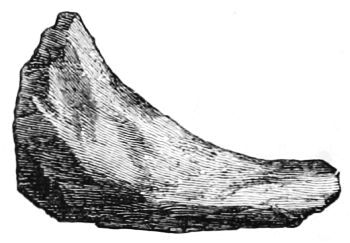
Fig. 118 (1⁄8).
Fig. 120. Horseshoe-shaped implement, 2 inches thick and 2 deep at curve; greatest breadth 41⁄2 inches from the tips of the horns; depth of hollow 31⁄2 inches.
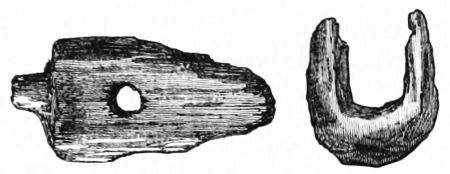
Fig. 119 (1⁄8). Fig. 120 (1⁄8).
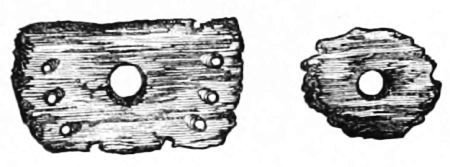
Fig. 121 (1⁄8). Fig. 122 (1⁄8).
Fig. 121. Portion of a circular implement, about 8 inches in diameter, and having a round hole in centre and ten small holes along the margin (if the circle were completed at same rate there would be fifteen holes in the series). The central hole was 11⁄4 inch in diameter, and had a tightly-fitting plug when found. The other holes were narrower in the middle, and large enough to admit of a common lead pencil to pass through. They also slanted slightly inwards, so that their axes, if prolonged, would meet at a common point about 6 inches from the central hole, and in the line of its axis.
Fig. 122. Circular wheel, with hole in its centre and pointed teeth at circumference; diameter 31⁄4 inches, ditto of hole 3⁄4 inch, thickness 1⁄2 an inch.
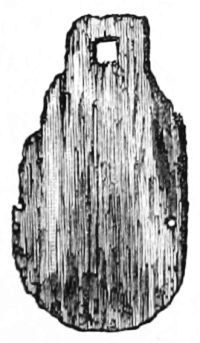
Fig. 123 (1⁄24).
Fig. 123. Smooth piece of wood, 25 inches by 15, with square hole at top and two round ones at sides. Several other portions of boards, containing curious-shaped holes, were found.
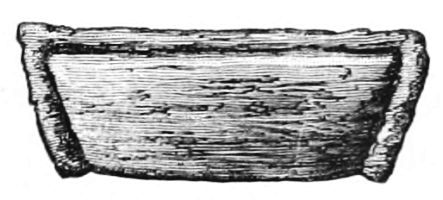
Fig. 124 (1⁄24).
Fig. 124. Piece of wood like the back of a seat in a canoe, 28 inches long by 9 broad. It has a raised bead round the margin.
Fig. 36 shows one of the mortised beams with portion of its upright taken from the outer trench at north-east corner.
Many other pieces of wood have been collected which illustrate various points of interest. One has a square hole showing marks of a gouge; another has a similar hole, but indicates that it was cut out by a straight-edged implement like a small hatchet; while a third, being part of the round tenon of a prepared beam splintered off, contains a number of small holes with wooden pins, showing how it had been mended.
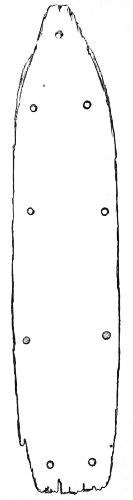
Fig. 125.—Outline of Canoe (1⁄24).
4. Canoes, Paddles, etc.—At the commencement of our explorations, as already mentioned, a canoe, hollowed out of a single oak trunk, was found about 100 yards north of the crannog. Its depth in the moss was well ascertained, owing to the fact that, though lying at the bottom of one of the original drains, it presented no obstruction to the flow of water, and consequently was then undisturbed. During the recent drainage all the drains were made a foot deeper, and hence its discovery. It measures 10 feet long, 2 feet 6 inches broad (inside), and 1 foot 9 inches deep. The bottom is flat and 4 inches thick, but its sides are thin and rise up abruptly. There are nine holes in its bottom, arranged in two rows, and about 15 inches apart, with the odd one at the apex. These holes are perfectly round, and exactly 1 inch in diameter, and when the canoe was disinterred they were quite invisible, being all tightly plugged (Fig. 125).
The oak paddle here figured was found on the crannog. It is double-bladed, 4 feet 8 inches long and 51⁄2 inches broad (Fig. 126).

Fig. 126.—Oak Paddle (1⁄24).
A large oar, together with the blade portion of another, was found on the margin of the crannog, which has already been described (see page 96).
When the original drainage was carried out some forty years ago, I understand that two canoes, each of which was about 12 feet long, were found in the bed of the lake on the south-west side of the crannog.
V. Objects of Metal.
(a.) Articles made of Iron.—1. A gouge, 8 inches long; stem 11⁄4 inch in circumference, slightly fluted before and behind; length of cutting edge 3⁄4 of an inch; handle portion contained beautiful green crystals of vivianite (Fig. 127).
2. A chisel, length 10 inches; handle portion 31⁄2 inches long; contains crystals and small remnant of bone handle; below handle there is a thick rim of iron; cutting edge measures only 1⁄2 an inch, and slopes equally on both sides. Top shows evidence of being hammered (Fig. 128).
3. Two knives. One (Fig. 129) has a blade 6 inches long, and a pointed portion for being inserted into a handle; found on a level with, and close to, the lowest hearth, along with fragments of its handle made of stag's horn. The other (Fig. 47), found by a farmer in the débris long after it was thrown out of the trenches, was hafted on a different plan from the former, the end portion being broad and riveted to its handle by four iron rivets, which still remain. The blade is 6 inches long and much worn, being only 1⁄4 to 1⁄2 inch in breadth, and the handle portion is 31⁄2 inches long. Its position in the crannog is therefore uncertain.
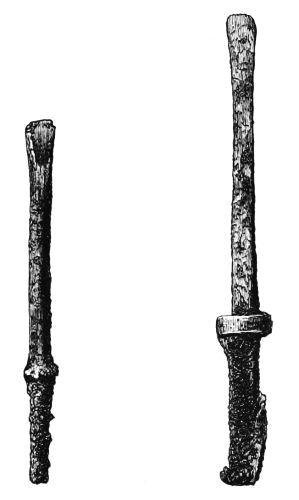
Fig. 127.—Iron Gouge (1⁄4). Fig. 128.—Iron Chisel (1⁄4)
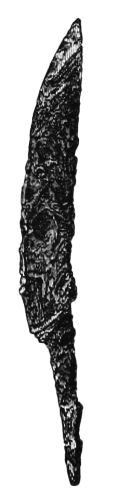
Fig. 129.—Iron Knife (1⁄4).
4. A small punch, 21⁄2 inches long—locality uncertain (Fig. 130).
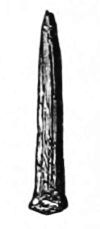
Fig. 130.
Iron Punch (1⁄4).
5. A bulky nail, some 4 inches long and 1⁄2 an inch in diameter, with large head; almost entirely converted into rust—locality uncertain.
6. A round pointed instrument, 11 inches long and 11⁄4 inch in circumference; its end portion is square, with sharp tip, as if adapted for insertion into a handle.
7. An awl, 4 inches long.
8. Two spear-heads, 13 and 91⁄2 inches long, with sockets for wooden handles, portions of which still remain in both sockets. The larger of the two (Fig. 131) is prominently ribbed along its centre, and has a small copper rivet passing through the end of its socket. The other has only a very faint ridge along the centre of the blade (Fig. 132).
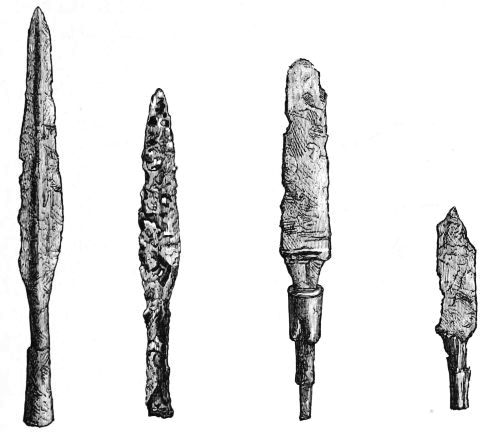
Fig. 131. Fig. 132. Fig. 133. Fig. 134.
Iron Weapons (1⁄4).
9. Five daggers. One (Fig. 133) has portion of a bone handle surrounded by a brass ferrule, and about an inch in front of this the remains of a guard are seen at the hilt of the blade; length of handle 31⁄4 inches, and circumference of ferrule 21⁄2 inches; the portion of the blade remaining is 6 inches long and rather more than an inch broad. Another, much corroded, has fragments of a wooden handle attached to it (Fig. 134). Fig. 135 represents a short pointed dagger, the blade of which is only 41⁄2 inches long, though at the hilt it is 13⁄4 inch broad. The others are mere portions of the blades, one of which is drawn at Fig. 136.
10. A large ring. It is 31⁄2 inches in diameter, and has a small portion of wood attached to one side (Fig. 137).
11. A saw, in three pieces, two of which were joined when found, and the third was lying a few feet apart. The length of the three portions together is 38 inches; average breadth is about 3 inches; teeth perfectly distinct and set. A small hole is seen at the end of one of the fragments. This relic was found at east side, external to the circle of stockades surrounding the log pavement (Fig. 43).
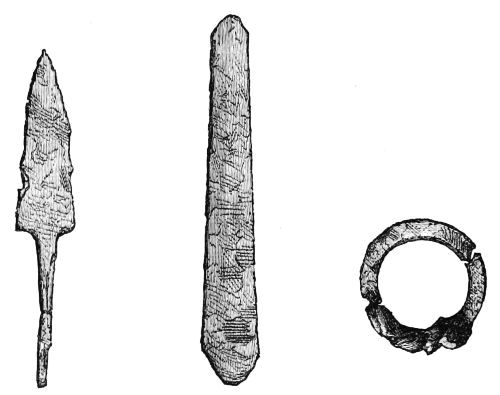
Fig. 135. Fig. 136. Fig. 137.—Iron (1⁄4).
Iron Weapons (1⁄2).
12. An iron shears, 61⁄4 inches long (Fig. 138), was discovered on the site of the crannog by Captain William Gillon, 71st Highland Light Infantry, F.S.A. Scot. In presenting this shears, along with the hone-stone (Fig. 54), to the "National Collection," Captain Gillon thus describes the circumstances which led him to its discovery: "Having been in Ayrshire for the last five months, and within a short distance of Lochlee farm, I have had several opportunities of visiting the site of the crannog, which was discovered there in 1878, and has since proved so rich in relics.... Although the crannog had been filled up, I determined to visit the site in the hope of finding some stray relic which might have escaped the eye of former explorers. In February 1881, Mr. Drummond, farmer, Pockenave, went with me, and as he had been present at the previous excavations, he showed me the most likely place for a 'find.'
"After looking about for half an hour, I was lucky enough to find the shears, which I forwarded to Professor Duns for examination, as I did not observe any articles similar to this in the Museum of Kilmarnock. On a subsequent occasion I found the hone-stone. I did not notice any hone-stones with a like groove in the Kilmarnock Museum, but on driving out to the crannog which is being excavated at Buston, near Kilmaurs, Dr. Munro showed me one which was of the same nature as the one I had found, only the groove was shorter and across the stone, and it had in addition a 'cupped hollow' in the centre, while this one has the groove lengthways." (See Fig. 54.)—Proceed. Soc. Antiq. Scot. vol. iii. new series, p. 247.[26]
13. Fig. 46 (p. 96) represents portion of a much corroded hatchet, about 6 inches long and 2 broad immediately below socket, but gets wider towards the cutting edge. Thickness through centre of socket is 11⁄2 inch. The back of socket was round, and had no projecting portion. Total weight 121⁄2 ounces. It had a small bit of the wooden handle in the socket when found.
14. A curved portion of iron, like part of a door staple, found amongst débris, but locality undetermined.
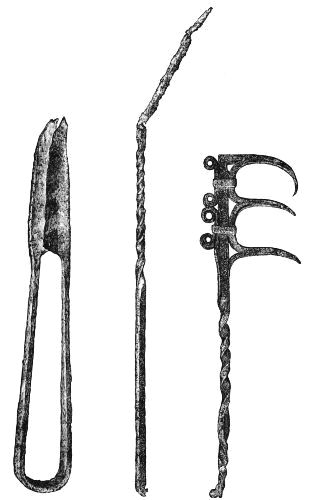
Fig. 138.—Shears (61⁄4 inches). Fig. 139.—Iron (1⁄5).
15. A curious three-pronged implement (Fig. 139) was found, about 3 feet deep, in the large drain a few yards to the south of crannog; the prongs are curved, very sharp at the points, and attached laterally; they are 21⁄2 inches apart and 4 inches long; a portion of the handle is twisted spirally; its total length is 3 feet 9 inches.
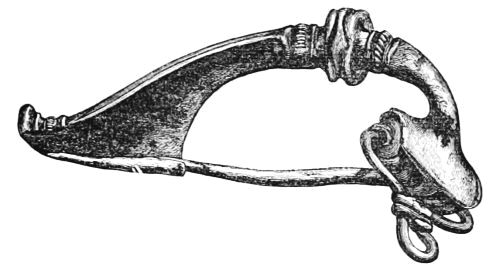
Fig. 140.—Fibula (1⁄1).
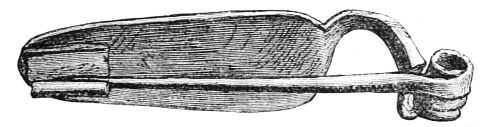
Fig. 141.—Fibula (1⁄1).
16. A much corroded pickaxe was found about the middle of the lake area. The end of the axe portion is nearly 5 inches broad, and the whole length of the implement is 22 inches.
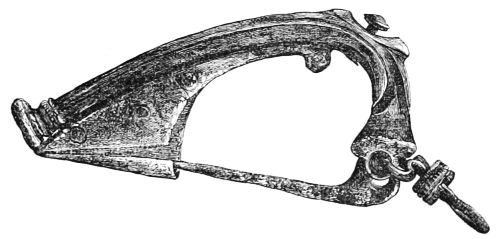
Fig. 142.—Fibula (1⁄1).
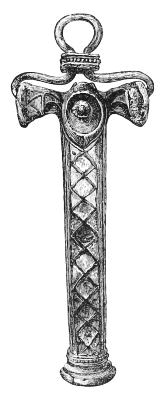
Fig. 143.—Back view of Fibula, Fig. 142.
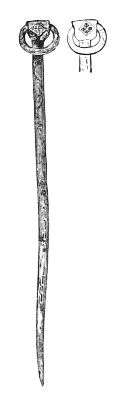
Fig. 144.—Bronze Ring Pin (1⁄2).
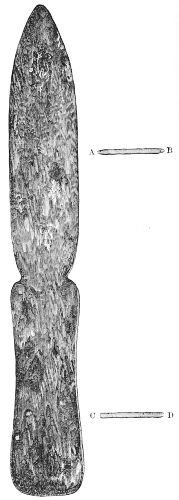
Fig. 145.—Bronze Implement with transverse sections (1⁄2).
(b.) Articles made of Bronze or Brass.—1. Two fibulæ, represented full size in Figs. 140 and 141, found about the centre of the refuse-heap. Figs. 142 and 143 represent side and back views of a third fibula, much more elaborately ornamented, which was subsequently found in the débris when closing up the trenches. The diamond-shaped spaces on its back were originally filled with enamel.
2. A bronze ring pin, 6 inches long. The square-shaped portion at the top has a different device on each side, and the shank from its middle to the point is ornamented on both sides (Fig. 144).[27]
3. A bronze spatula or dagger-shaped instrument. It is very well preserved, and although shaped like a dagger, the edges are not sharp. Its length is about 111⁄4 inches and breadth 11⁄2 inch (Fig. 145).
4. Portion of strong wire, 4 inches long, showing evidence of having been in the fire.
5. Thin spiral finger-ring (Fig. 146).
6. Fig. 147 represents a curious bronze object about 33⁄8 inches long; diameter of ring portion is 1 inch; the transverse bar at the other end is slit longitudinally and pierced transversely by a small hole about its centre.
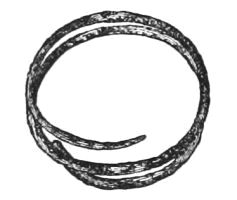
Fig. 146.—Finger Ring (1⁄1).
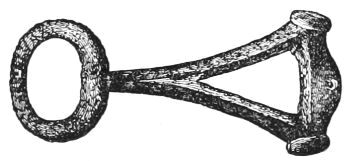
Fig. 147 (1⁄2).
7. Curved and slightly grooved bronze wire, 21⁄4 inches long, and precisely similar to the upper portion of a modern safety-pin.
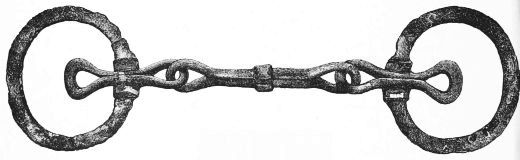
Fig. 148.—Bridle Bit (1⁄2).
(c.) Article made of Iron and Bronze.—A bridle bit. This consists of two large rings and a centre-piece. Its extreme length is 101⁄2 inches, the outer diameter of the rings is rather less than 3 inches, and the centre-piece, which is entirely made of iron, is 33⁄4 inches long. The rings are partly iron and partly bronze, the circular portion being iron and the rest bronze. The bronze portion is 21⁄2 inches long, and has two eyes or loops, one of which is attached to the centre-piece and the other free. This interesting relic was turned up by two visitors poking with a stick at the south-east corner of the refuse-heap (Fig. 148).
A round knob of lead, as if intended for the hilt of a hand weapon, was found very near the surface of the mound.
VI. Miscellaneous Objects.
1. Carved Wood.—Perhaps the most interesting of all the relics discovered on the crannog is a small piece of ash wood, about 5 inches square, having curious diagrams carved on both sides. On one side (Fig. 149), three equidistant spiral grooves, with corresponding ridges between, start from near a common centre and radiate outwards till they join, at uniform distances, a common circle which surrounds the diagram. On the other side (Fig. 150) is a similar diagram, with this difference, that between the points of commencement of the spiral grooves there is a space left which is occupied by a small circular groove surrounding the central depression or point. This figure is surmounted and overlapped by two convoluted and symmetrical grooves meeting each other in an elevated arch, with a small depression in its centre. The relic was found on the west side of the crannog, about 4 feet deep, and near the line of the horizontal raised beams.
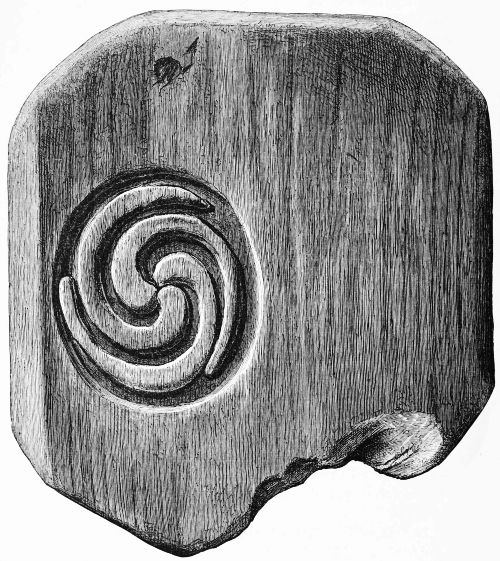
Fig. 149.—Carved Wood (1⁄1).
2. Fringe-like Objects.—Another object which has excited considerable curiosity is an apparatus made like a fringe by simply plaiting together at one end the long stems of a kind of moss (Fig. 151). Portions of similar articles were found in three different parts of the crannog, and all deeply buried. The one figured here, and the most neatly formed, was found in the relic-bed; another about a couple of yards north of the fireplace, and others at the south-west side, a little external to the area of the log pavement. In this latter place a large quantity was found, but although the evidence of having been plaited at one end was quite distinct, the stems of the moss were not prepared with the same care as in the one figured overleaf, as the leaflets were still adhering to them. The cue or pigtail, described at page 95, seems to have been formed of the same material as the so-called girdles or fringes.
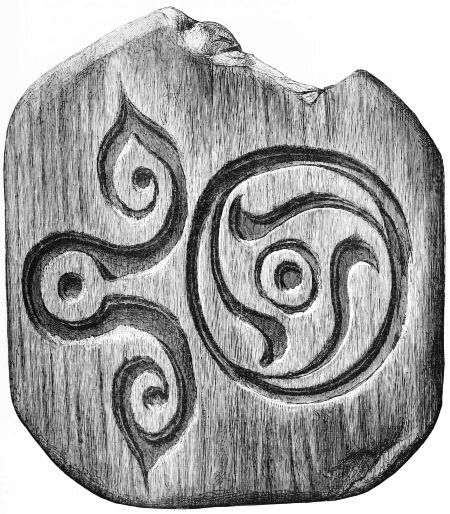
Fig. 150.—Carved Wood—other side of Fig. 149 (1⁄1).
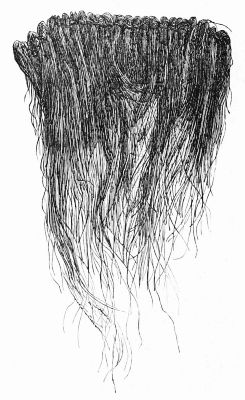
Fig. 151 (1⁄3).—Made from stems of a moss (Polytrichum commune).
3. Leather Objects.—Fig. 152 is the representation of a fragment of a curious object, consisting of two portions of thick leather kept together by stout square-cut copper nails. These nails are broader at one end than the other, and pass completely through the layers of leather, after which they appear to be slightly riveted. The relic, as it stands, contains six nails, arranged in two rows, three in each row, and measures 21⁄2 by 2 inches, but the marks of additional nails are seen all round. Several portions of leather were collected from time to time. On the occasion of Mr. Joseph Anderson's visit to Lochlee, he found a shoe in the stuff just thrown out of the bottom of the outer trench at the south side of the crannog. Other portions were picked up on the surface of the trestle-work, showing marks of having been neatly sewed. Also two stout thongs, one with a slit at the end through which the other thong passed and then formed a knot, together with a portion of coarse leather about the size of the palm of my hand, were found near the junction of the gangway with the crannog.
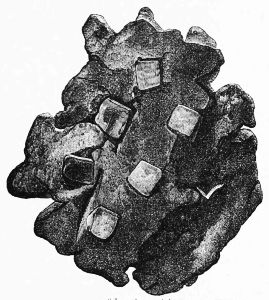
Fig. 152.—Portion of Leather with Copper Nails (1⁄1).
4. Beads.—Two fragments of beads, one fluted, the other smooth, and shaped like dumb-bells (Figs. 153 and 154).
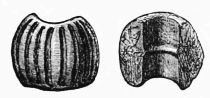
Fig. 153.—Beads (1⁄1).
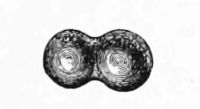
Fig. 154.—Glass (1⁄1).
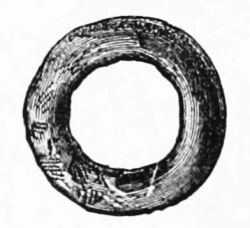
Fig. 155.—Bone Ring (1⁄1).
5. Rings.—A small bone (?) ring 3⁄4 inch in diameter, and portion of another similar to the former, but a little larger.
6. Pottery.—(1.) The bottom of a dish made of reddish pottery, said to be Samian ware, was found in a drain close to the crannog. Its diameter is 31⁄2 inches. (2.) Five small portions of a whitish unglazed ware, with circular striæ, as if made on the wheel, have been picked up in the débris after it had been wheeled out and lain exposed to the weather for some time, but the original situation of a single bit has not been determined. These fragments might all belong to the same vessel, and two of them, though found at different parts and at different times, fit each other exactly.
7. Crucible.—A fragment of a small crucible coarsely made, and not unlike that found at Dowalton (Fig. 15), was for a long time mistaken for a bit of unglazed pottery. It was found in the débris after it was wheeled out and had lain exposed for a while.

Fig. 156. Fig. 157.
Portions of Jet Armlets (1⁄2).
8. Lignite, Jet, etc.—(1.) A small bit of a black substance like a jet button. (2.) Two portions of armlets made of lignite or jet, each about 2 inches long, were found near the wooden platform at the north-east corner. One is a little thicker and coarser than the other, and forms part of a circle, which, if completed, would measure exactly 3 inches across (internal diameter). The other is polished and of a jet black colour, internal diameter 23⁄4 inches. A third fragment of a similar ornament was found in the débris when closing up the crannog. It is more slender and has a smaller diameter than either of the others. The portion of ring made of shale found at the bottom of the deep shaft below the log pavement is smaller than either of these, its internal diameter being only 2 inches, and its external 31⁄4 (Figs. 156 and 157).
9. Tusks.—The large number of boars' tusks met with, quite unconnected with the bones of the animal, especially in the relic-bed around the fireplaces, suggests the idea that they may have been used as implements. One only, however, was found to have decided marks of having been formed into a tool. It is 31⁄2 inches long, and very sharply pointed (Fig. 158).
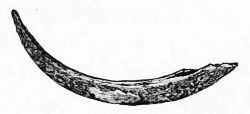
Fig. 158.—Implement of Boar's Tusk (1⁄2)
10. Pigments.—Several soft lumps of what appeared to be a blue and a red pigment were found, but they were not subjected to analysis. A specimen of the latter, which has been kept in a bottle, is now turning blue like the former.
11. Insect Cases.—Large quantities of the horny coverings of insects like beetles were found in patches here and there, together with one or two brilliant-coloured elytra.
12. Shell.—One solitary shell was found near the fireplace, which I believe to be Littorina littorea.
The Fauna of the Crannog.
The following is the report of Professor Rolleston, M.D., F.R.S., F.S.A., on the fauna of the crannog:—
"Among the bones submitted to me by Robert Munro, M.D., Kilmarnock, and reported as having been procured from a crannog at Lochlee, the following animals have their skeletons represented:—
"The Ox, Bos longifrons: no proof of the presence of the wild variety.
"The Pig, Sus scrofa, variety domestica. I am not clear that the wild variety is represented here any more than in the specimens of the preceding species. (One fragment might have belonged to a wild individual, the molar No. 3 in it having all the pinnacles and eminences which have given to the teeth of the Suidæ, as to the whole division of non-ruminant Artiodactyles, the name Bunodont, worn away, and having its grinding surface consequently reduced to one single, however sinuous, continent of dentine bounded by enamel.) As is well known,[28] the bones of an ill-tended and ill-fed self-providing, so-called domestic pig, come to be very like the bones of a thoroughly wild pig; whilst, on the other hand, it is also well known that very great variations exist as to size within the limits even of the wild varieties of Sus scrofa. But in the series now before me there is only one fragment, consisting of the part of the lower jaw which carries the last molar, and a part of the ascending ramus, and of that last molar itself, which could, I think, by any possibility be referred to the wild variety. And even here such a reference could only be justified on the ground of the great degradation which the cusps of the tooth have suffered, it being usually the case that domestic pigs are not allowed to live sufficiently long to get their teeth so worn down. I have however to say that, both from this country and from India, skulls of undoubtedly domestic animals of this species have come into my hands, in which the teeth are worn down far below the limits to which the molars of pigs are allowed to be worn down by modern model-farm managers.
"The texture of the bone furnishes us with no indications, its gloss and tenacity, if such it ever possessed, having been entirely removed by its long maceration in water.
"It is however worth mentioning that this fragment from a Scottish crannog exactly reproduces the contour of a fragment from the Starnberger See. (See Memoir on this "find" in the Archiv für Anthropologie, viii. 1875.) In both, the angle of the jaw has been knocked away, for the sake, doubtless, of the soft and succulent, and I may add sensitive, substances it protected during life, and in both the posterior molar has been left in situ, though much worn down. The posterior molar, however, of the foreign specimen has that superior development of its third molar, which, if Nathusius (Schweineschädel, p. 49) had not taught us better, might have been referred to domestication instead of to better food or sexual (male) character. I owe this specimen to the kindness of J. E. Lee, Esq., F.G.S., and though I hesitate in the case of the Scottish specimen, I have no hesitation in referring this one to the wild variety, as indeed it is referred under the title of Sus scrofa ferox on the label it carried when it came into my hands.