Front matter (continued 5)
Reading edition
Before proceeding to apply the rules by means of which our fourth step or process (see p. 138) may be carried out, a modification may sometimes be introduced which will considerably decrease the size of the number to be counted without affecting the values of the several parts of its resulting terminal date.
We have seen on pages 51-60 that in Maya chronology there were possible only 18,980 different dates—that is, combinations of the 260 days and the 365 positions of the year—and further, that any given day of the 260 could return to any given position of the 365 only after the lapse of 18,980 days, or 52 years.
Since the foregoing is true, it follows, that this number 18,980 or any multiple thereof, may be deducted from the number which is to be counted without affecting in any way the terminal date which the number will reach when counted from the starting point. It is obvious that this modification applies only to numbers which are above 18,980, all others being divided by 13, 20, and 365 directly, as indicated in rules 1, 2, and 3, respectively. This enables us to formulate another rule, which should be applied to the number to be counted before proceeding with rules 1, 2, and 3 above, if that number is above 18,980.
Rule. If the number to be counted is above 18,980, first deduct from it the highest multiple of 18,980 which it contains.
This rule should be applied whenever possible, since it reduces the size of the number to be handled, and consequently involves fewer calculations.
In Table XVI are given 80 Calendar Rounds, that is, 80 multiples of 18,980, in terms of both the Maya notation and our own. These will be found sufficient to cover most numbers.
Applying the above rule to the number 31,741, which was selected for our first example, it is seen by Table XVI that 1 Calendar Round, or 18,980 days, may be deducted from it; 31,741 - 18,980 = 12,761. In other words, we can count the number 12,761 forward (or backward had the count been backward in our example) from the starting point 4 Ahau 8 Cumhu, and reach exactly the same terminal date as though we had counted forward 31,741, as in the first case.
Mathematical proof of this point follows:
12,761 ÷ 13 = 9818⁄1312,761 ÷ 20 = 6381⁄2012,761 ÷ 365 = 34351⁄365
The numerators of the fractions in these three quotients are 8, 1, and 351; these are identical with the numerators of the fractions in the quotients obtained by dividing 31,741 by the same divisors, those indicated in rules 1, 2, and 3, respectively. Consequently, if these three numerators be counted forward from the corresponding parts of the starting point, 4 Ahau 8 Cumhu, the resulting terms together will form the corresponding parts of the same terminal date, 12 Imix 14 Kayab.
Similarly it could be shown that 50,721 or 69,701 counted forward or backward from any starting point would both reach this same terminal date, since subtracting 2 Calendar Rounds, 37,960 (see Table XVI), from the first, and 3 Calendar Rounds, 56,940 (see Table XVI), from the second, there would remain in each case 12,761. The student will find his calculations greatly facilitated if he will apply this rule whenever possible. To familiarize the student with the working of these rules, it is thought best to give several additional examples involving their use.
Table XVI. 80 CALENDAR ROUNDS EXPRESSED IN ARABIC AND MAYA NOTATION
Calendar Rounds Days Cycles, Etc. Calendar Rounds Days Cycles, Etc.
1 18,9802.12.13.0 41 778,1805. 8. 1.11.0
2 37,9605.5.8.0 42 797,1605.10.14. 6.0
3 56,9407.18.3.0 43 816,1405.13. 7. 1.0
4 75,92010.10.16.0 44 835,1205.15.19.14.0
5 94,90013.3.11.0 45 854,1005.18.12. 9.0
6 113,88015.16. 6.0 46 873,0806. 1. 5. 4.0
7 132,86018. 9. 1.0 47 892,0606. 3.17.17.0
8 151,8401. 1. 1.14.0 48 911,0406. 6.10.12.0
9 170,8201. 3.14. 9.0 49 930,0206. 9. 3. 7.0
10 189,8001. 6. 7. 4.0 50 949,0006.11.16. 2.0
11 208,7801. 8.19.17.0 51 967,9806.14. 8.15.0
12 227,7601.11.12.12.0 52 986,9606.17. 1.10.0
13 246,7401.14. 5. 7.0 531,005,9406.19.14. 5.0
14 265,7201.16.18. 2.0 541,024,9207. 2. 7. 0.0
15 284,7001.19.10.15.0 551,043,9007. 4.19.13.0
16 303,6802. 2. 3.10.0 561,062,8807. 7.12. 8.0
17 322,6602. 4.16. 5.0 571,081,8607.10. 5. 3.0
18 341,6402. 7. 9. 0.0 581,100,8407.12.17.16.0
19 360,6202.10. 1.13.0 591,119,8207.15.10.11.0
20 379,6002.12.14. 8.0 601,138,8007.18. 3. 6.0
21 398,5802.15. 7. 3.0 611,157,7808. 0.16. 1.0
22 417,5602.17.19.16.0 621,176,7608. 3. 8.14.0
23 436,5403. 0.12.11.0 631,195,7408. 6. 1. 9.0
24 455,5203. 3. 5. 6.0 641,214,7208. 8.14. 4.0
25 474,5003. 5.18. 1.0 651,233,7008.11. 6.17.0
26 493,4803. 8.10.14.0 661,252,6808.13.19.12.0
27 512,4603.11. 3. 9.0 671,271,6608.16.12. 7.0
28 531,4403.13.16. 4.0 681,290,6408.19. 5. 2.0
29 550,4203.16. 8.17.0 691,309,6209. 1.17.15.0
30 569,4003.19. 1.12.0 701,328,6009. 4.10.10.0
31 588,3804. 1.14. 7.0 711,347,5809. 7. 3. 5.0
32 607,3604. 4. 7. 2.0 721,366,5609. 9.16. 0.0
33 626,3404. 6.19.15.0 731,385,5409.12. 8.13.0
34 645,3204. 9.12.10.0 741,404,5209.15. 1. 8.0
35 664,3004.12. 5. 5.0 751,423,5009.17.14. 3.0
36 683,2804.14.18. 0.0 761,442,48010. 0. 6.16.0
37 702,2604.17.10.13.0 771,461,46010. 2.19.11.0
38 721,2405. 0. 3. 8.0 781,480,44010. 5.12. 6.0
39 740,2205. 2.16. 3.0 791,499,42010. 8. 5. 1.0
40 759,2005. 5. 8.16.0 801,518,40010.10.17.14.0
Let us count forward the number 5,799 from the starting point 2 Kan 7 Tzec. It is apparent at the outset that, since this number is less than 18,980, or 1 Calendar Round, the preliminary rule given on page 143 does not apply in this case. Therefore we may proceed with the first rule given on page 139, by means of which the new day coefficient may be determined. Dividing the given number by 13 we have: 5,799 ÷ 13 = 4461⁄13. Counting forward the numerator of the fractional part of the resulting quotient (1) from the day coefficient of the starting point (2), we reach 3 as the day coefficient of the terminal date.
The second rule given on page 140 tells how to find the day sign of the terminal date. Dividing the given number by 20, we have: 5,799 ÷ 20 = 28919⁄20. Counting forward the numerator of the fractional part of the resulting quotient (19) from the day sign of the starting point, Kan, in the sequence of the twenty-day signs given in Table I, the day sign Akbal will be reached, which will be the day sign of the terminal date. Therefore the day of the terminal date will be 3 Akbal.
The third rule, given on page 141, tells how to find the position which the day of the terminal date occupied in the 365-day year. Dividing the given number by 365, we have: 5,799 ÷ 365 = 15324⁄365. Counting forward the numerator of the fractional part of the resulting quotient, 324, from the year position of the starting date, 7 Tzec, in the sequence of the 365 year positions given in Table XV, the position 6 Zip will be reached as the position in the year of the day of the terminal date. The count by means of which the position 6 Zip is determined is given in detail. After the year position of the starting point, 7 Tzec, it requires 12 more positions (Nos. 8-19, inclusive) before the close of that month (see Table XV) will be reached. And after the close of Tzec, 13 uinals and the xma kaba kin must pass before the end of the year; 13 × 20 + 5 = 265, and 265 + 12 = 277. This latter number subtracted from 324, the total number of positions to be counted forward, will give the number of positions which remain to be counted in the next year following: 324 - 277 = 47. Counting forward 47 in the new year, we find that it will use up the months Pop and Uo (20 + 20 = 40) and extend 7 positions into the month Zip, or to 6 Zip. Therefore, gathering together the values determined for the several parts of the terminal date, we may say that in counting forward 5,799 from the starting point 2 Kan 7 Tzec, the terminal date reached will be 3 Akbal 6 Zip.
For the next example let us select a much higher number, say 322,920, which we will assume is to be counted forward from the starting point 13 Ik 0 Zip. Since this number is above 18,980, we may apply our preliminary rule (p. 143) and deduct all the Calendar Rounds possible. By turning to Table XVI we see that 17 Calendar Rounds, or 322,660, may be deducted from our number: 322,920 - 322,660 = 260. In other words, we can use 260 exactly as though it were 322,920. Dividing by 13, we have 260 ÷ 13 = 20. Since there is no fraction in the quotient, the numerator of the fraction will be 0, and counting 0 forward from the day coefficient of the starting point, 13, we have 13 as the day coefficient of the terminal date (rule 1, p. 139). Dividing by 20 we have 260 ÷ 20 = 13. Since there is no fraction in the quotient, the numerator of the fraction will be 0, and counting forward 0 from the day sign of the starting point, Ik in Table I, the day sign Ik will remain the day sign of the terminal date (rule 2, p. 140). Combining the two values just determined, we see that the day of the terminal date will be 13 Ik, or a day of the same name as the day of the starting point. This follows also from the fact that there are only 260 differently named days (see pp. 41-44) and any given day will have to recur, therefore, after the lapse of 260 days.[101] Dividing by 365 we have: 260 ÷ 365 = 260⁄365. Counting forward the numerator of the fraction, 260, from the year position of the starting point, 0 Zip, in Table XV, the position in the year of the day of the terminal date will be found to be 0 Pax. Since 260 days equal just 13 uinals, we have only to count forward from 0 Zip 13 uinals in order to reach the year position; that is, 0 Zotz is 1 uinal; to 0 Tzec 2 uinals, to 0 Xul 3 uinals, and so on in Table XV to 0 Pax, which will complete the last of the 13 uinals (rule 3, p. 141).
Combining the above values, we find that in counting forward 322,920 (or 260) from the starting point 13 Ik 0 Zip, the terminal date reached is 13 Ik 0 Pax.
In order to illustrate the method of procedure when the count is backward, let us assume an example of this kind. Suppose we count backward the number 9,663 from the starting point 3 Imix 4 Uayeb. Since this number is below 18,980, no Calendar Round can be deducted from it. Dividing the given number by 13, we have: 9,663 ÷ 13 =7434⁄13. Counting the numerator of the fractional part of this quotient, 4, backward from the day coefficient of the starting point, 3, we reach 12 as the day coefficient of the terminal date, that is, 2, 1, 13, 12 (rule 1, p. 139). Dividing the given number by 20, we have: 9,663 ÷ 20 = 4833⁄20. Counting the numerator of the fractional part of this quotient, 3, backward from the day sign of the starting point, Imix, in Table I, we reach Eznab as the day sign of the terminal date (Ahau, Cauac, Eznab); consequently the day reached in the count will be 12 Eznab. Dividing the given number by 365, we have 9,663 ÷ 365 = 26173⁄365. Counting backward the numerator of the fractional part of this quotient, 173, from the year position of the starting point, 4 Uayeb, the year position of the terminal date will be found to be 11 Yax. Before position 4 Uayeb (see Table XV) there are 4 positions in that division of the year (3, 2, 1, 0). Counting these backward to the end of the month Cumhu (see Table XV), we have left 169 positions (173 - 4 = 169); this equals 8 uinals and 9 days extra. Therefore, beginning with the end of Cumhu, we may count backward 8 whole uinals, namely: Cumhu, Kayab, Pax, Muan, Kankin, Mac, Ceh, and Zac, which will bring us to the end of Yax (since we are counting backward). As we have left still 9 days out of our original 173, these must be counted backward from position 0 Zac, that is, beginning with position 19 Yax: 19, 18, 17, 16, 15, 14, 13, 12, 11; so 11 Yax is the position in the year of the day of the terminal date. Assembling the above values, we find that in counting the number 9,663 backward from the starting point, 2 Imix 4 Uayeb, the terminal date is 12 Eznab 11 Yax. Whether the count be forward or backward, the method is the same, the only difference being in the direction of the counting.
This concludes the discussion of the actual arithmetical processes involved in counting forward or backward any given number from any given date; however, before explaining the fifth and final step in deciphering the Maya numbers, it is first necessary to show how this method of counting was applied to the Long Count.
The numbers used above in connection with dates merely express the difference in time between starting points and terminal dates, without assigning either set of dates to their proper positions in Maya chronology; that is, in the Long Count. Consequently, since any Maya date recurred at successive intervals of 52 years, by the time their historic period had been reached, more than 3,000 years after the starting point of their chronology, the Maya had upward of 70 distinct dates of exactly the same name to distinguish from one another.
It was stated on page 61 that the 0, or starting point of Maya chronology, was the date 4 Ahau 8 Cumhu, from which all subsequent dates were reckoned; and further, on page 63, that by recording the number of cycles, katuns, tuns, uinals, and kins which had elapsed in each case between this date and any subsequent dates in the Long Count, subsequent dates of the same name could be readily distinguished from one another and assigned at the same time to their proper positions in Maya chronology. This method of fixing a date in the Long Count has been designated Initial-series dating.
The generally accepted method of writing Initial Series is as follows:
9.0.0.0.0.8 Ahau 13 Ceh
The particular Initial-Series written here is to be interpreted thus: "Counting forward 9 cycles, 0 katuns, 0 tuns, 0 uinals, and 0 kins from 4 Ahau 8 Cumhu, the starting point of Maya chronology (always unexpressed in Initial Series), the terminal date reached will be 8 Ahau 13 Ceh."[102] Or again:
9.14.13.4.17.12 Caban 5 Kayab
This Inital Series reads thus: "Counting forward 9 cycles, 14 katuns, 13 tuns, 4 uinals, and 17 kins from 4 Ahau 8 Cumhu, the starting point of Maya chronology (unexpressed), the terminal date reached will be 12 Caban 5 Kayab."
The time which separates any date from 4 Ahau 8 Cumhu may be called that date's Initial-series value. For example, in the first of the above cases the number 9.0.0.0.0 is the Initial-series value of the date 8 Ahau 13 Ceh, and in the second the number 9.14.13.4.17 is the Initial-series value of the date 12 Caban 5 Kayab. It is clear from the foregoing that although the date 8 Ahau 13 Ceh, for example, had recurred upward of 70 times since the beginning of their chronology, the Maya were able to distinguish any particular 8 Ahau 13 Ceh from all the others merely by recording its distance from the starting point; in other words, giving thereto its particular Initial-series value, as 9.0.0.0.0. in the present case. Similarly, any particular 12 Caban 5 Kayab, by the addition of its corresponding Initial-series value, as 9.14.13.4.17 in the case above cited, was absolutely fixed in the Long Count—that is, in a period of 374,400 years.
Returning now to the question of how the counting of numbers was applied to the Long Count, it is evident that every date in Maya chronology, starting points as well as terminal dates, had its own particular Initial-series value, though in many cases these values are not recorded. However, in most of the cases in which the Initial-series values of dates are not recorded, they may be calculated by means of their distances from other dates, whose Initial-series values are known. This adding and subtracting of numbers to and from Initial Series[103] constitutes the application of the above-described arithmetical processes to the Long Count. Several examples of this use are given below.
Let us assume for the first case that the number 2.5.6.1 is to be counted forward from the Initial Series 9.0.0.0.0 8 Ahau 13 Ceh. By multiplying the values of the katuns, tuns, uinals, and kins given in Table XIII by their corresponding coefficients, in this case 2, 5, 6, and 1, respectively, and adding the resulting products together, we find that 2.5.6.1 reduces to 16,321 units of the first order.
Counting this forward from 8 Ahau 13 Ceh as indicated by the rules on pages 138-143, the terminal date 1 Imix 9 Yaxkin will be reached. Moreover, since the Initial-series value of the starting point 8 Ahau 13 Ceh was 9.0.0.0.0, the Initial-series value of 1 Imix 9 Yaxkin, the terminal date, may be calculated by adding its distance from 8 Ahau 13 Ceh to the Initial-series value of that date:
9.0.0.0.0 (Initial-series value of starting point) 8 Ahau 13 Ceh 9.2.5.6.1 (distance from 8 Ahau 13 Ceh to 1 Imix 9 Yaxkin) 9.2.5.6.1 (Initial-series value of terminal date) 1 Imix 9 Yaxkin
That is, by calculation we have determined the Initial-series value of the particular 1 Imix 9 Yaxkin, which was distant 2.5.6.1 from 9.0.0.0.0 8 Ahau 13 Ceh, to be 9.2.5.6.1, notwithstanding that this fact was not recorded.
The student may prove the accuracy of this calculation by treating 9.2.5.6.1 1 Imix 9 Yaxkin as a new Initial Series and counting forward 9.2.5.6.1 from 4 Ahau 8 Cumhu, the starting point of all Initial Series known except two. If our calculations are correct, the former date will be reached just as if we had counted forward only 2.5.6.1 from 9.0.0.0.0 8 Ahau 13 Ceh.
In the above example the distance number 2.5.6.1 and the date 1 Imix 9 Yaxkin to which it reaches, together are called a Secondary Series. This method of dating already described (see pp. 74-76 et seq.) seems to have been used to avoid the repetition of the Initial-series values for all the dates in an inscription. For example, in the accompanying text—
9.12. 2. 0.16]5 Cib 14 Yaxkin
12. 9.15]
[9.12.14.10.11][104]9 Chuen 9 Kankin
5]
[9.12.14.10.16]1 Cib 14 Kankin
1. 0. 2. 5]
[9.13.14.13. 1]5 Imix 19 Zac
the only parts actually recorded are the Initial Series 9.12.2.0.16 5 Cib 14 Yaxkin, and the Secondary Series 12.9.15 leading to 9 Chuen 9 Kankin; the Secondary Series 5 leading to 1 Cib 14 Kankin; and the Secondary Series 1.0.2.5 leading to 5 Imix 19 Zac. The Initial-series values: 9.12.14.10.11; 9.12.14.10.16; and 9.13.14.13.1, belonging to the three dates of the Secondary Series, respectively, do not appear in the text at all (a fact indicated by the brackets), but are found only by calculation. Moreover, the student should note that in a succession of interdependent series like the ones just given the terminal date reached by one number, as 9 Chuen 9 Kankin, becomes the starting point for the next number, 5. Again, the terminal date reached by counting 5 from 9 Chuen 9 Kankin, that is, 1 Cib 14 Kankin, becomes the starting point from which the next number, 1.0.2.5, is counted. In other words, these terms are only relative, since the terminal date of one number will be the starting point of the next.
Let us assume for the next example, that the number 3.2 is to be counted forward from the Initial Series 9.12.3.14.0 5 Ahau 8 Uo. Reducing 3 uinals and 2 kins to kins, we have 62 units of the first order. Counting forward 62 from 5 Ahau 8 Uo, as indicated by the rules on pages 138-143, it is found that the terminal date will be 2 Ik 10 Tzec. Since the Initial-series value of the starting point 5 Ahau 8 Uo is known, namely, 9.12.3.14.0, the Initial Series corresponding to the terminal date may be calculated from it as before:
9.12.3.14.0] (Initial-series value of the starting point) 5 Ahau 8 Uo
3.2] (distance from 5 Ahau 8 Uo forward to 2 Ik 10 Tzec)
[9.12.3.17.2] (Initial-series value of the terminal date) 2 Ik 10 Tzec
The bracketed 9.12.3.17.2 in the Initial-series value corresponding to the date 2 Ik 10 Tzec does not appear in the record but was reached by calculation. The student may prove the accuracy of this result by treating 9.12.3.17.2 2 Ik 10 Tzec as a new Initial Series, and counting forward 9.12.3.17.2 from 4 Ahau 8 Cumhu (the starting point of Maya chronology, unexpressed in Initial Series). If our calculations are correct, the same date, 2 Ik 10 Tzec, will be reached, as though we had counted only 3.2 forward from the Initial Series 9.12.3.14.0 5 Ahau 8 Uo.
One more example presenting a "backward count" will suffice to illustrate this method. Let us count the number 14.13.4.17 backward from the Initial Series 9.14.13.4.17 12 Caban 5 Kayab. Reducing 14.13.4.17 to units of the 1st order, we have 105,577. Counting this number backward from 12 Caban 5 Kayab, as indicated in the rules on pages 138-143, we find that the terminal date will be 8 Ahau 13 Ceh. Moreover, since the Initial-series value of the starting point 12 Caban 5 Kayab is known, namely, 9.14.13.4.17, the Initial-series value of the terminal date may be calculated by subtracting the distance number 14.13.4.17 from the Initial Series of the starting point:
9.14.13. 4.17] (Initial-series value of the starting point) 12 Caban 5 Kayab
14.13. 4.17] (distance from 12 Caban 5 Kayab backward to 8 Ahau 13 Ceh)
[9. 0. 0. 0. 0] (Initial-series value of the terminal date) 8 Ahau 13 Ceh
The bracketed parts are not expressed. We have seen elsewhere that the Initial Series 9.0.0.0.0 has for its terminal date 8 Ahau 13 Ceh; therefore our calculation proves itself.
The foregoing examples make it sufficiently clear that the distance numbers of Secondary Series may be used to determine the Initial-series values of Secondary-series dates, either by their addition to or subtraction from known Initial-series dates.
We have come now to the final step in the consideration of Maya numbers, namely, the identification of the terminal dates determined by the calculations given under the fourth step, pages 138-143. This step may be summed up as follows:
Fifth Step in Solving Maya Numbers
Find the terminal date to which the number leads.
As explained under the fourth step (pp. 138-143), the terminal date may be found by calculation. The above direction, however, refers to the actual finding of the terminal dates in the texts; that is, where to look for them. It may be said at the outset in this connection that terminal dates in the great majority of cases follow immediately the numbers which lead to them. Indeed, the connection between distance numbers and their corresponding terminal dates is far closer than between distance numbers and their corresponding starting points. This probably results from the fact that the closing dates of Maya periods were of far more importance than their opening dates. Time was measured by elapsed periods and recorded in terms of the ending days of such periods. The great emphasis on the closing date of a period in comparison with its opening date probably caused the suppression and omission of the date 4 Ahau 8 Cumhu, the starting point of Maya chronology, in all Initial Series. To the same cause also may probably be attributed the great uniformity in the positions of almost all terminal dates, i.e., immediately after the numbers leading to them.
We may formulate, therefore, the following general rule, which the student will do well to apply in every case, since exceptions to it are very rare:
Rule. The terminal date reached by a number or series almost invariably follows immediately the last term of the number or series leading to it.
This applies equally to all terminal dates, whether in Initial Series, Secondary Series, Calendar-round dating or Period-ending dating, though in the case of Initial Series a peculiar division or partition of the terminal date is to be noted.
Throughout the inscriptions, excepting in the case of Initial Series, the month parts of the dates almost invariably follow immediately the days whose positions in the year they designate, without any other glyphs standing between; as, for example, 8 Ahau 13 Ceh, 12 Caban 5 Kayab, etc. In Initial Series, on the other hand, the day parts of the dates, as 8 Ahau and 12 Caban, in the above examples, are almost invariably separated from their corresponding month parts, 13 Ceh or 5 Kayab, by several intervening glyphs. The positions of the day parts in Initial-series terminal dates are quite regular according to the terms of the above rule; that is, they follow immediately the lowest period of the number which in each case shows their distance from the unexpressed starting point, 4 Ahau 8 Cumhu. The positions of the corresponding month parts are, on the other hand, irregular. These, instead of standing immediately after the days whose positions in the year they designate, follow at the close of some six or seven intervening glyphs. These intervening glyphs have been called the Supplementary Series, though the count which they record has not as yet been deciphered.[105] The month glyph in the great majority of cases follows immediately the closing[106] glyph of the Supplementary Series. The form of this latter sign is always unmistakable (see fig. 65), and it is further characterized by its numerical coefficient, which can never be anything but 9 or 10.[107] See examples of this sign in the figure just mentioned, where both normal forms a, c, e, g, and h and head variants b, d, and f are included.
The student will find this glyph exceedingly helpful in locating the month parts of Initial-series terminal dates in the inscriptions. For example, let us suppose in deciphering the Initial Series 9.16.5.0.0 8 Ahau 8 Zotz that the number 9.16.5.0.0 has been counted forward from 4 Ahau 8 Cumhu (the unexpressed starting point), and has been found by calculation to reach the terminal date 8 Ahau 8 Zotz; and further, let us suppose that on inspecting the text the day part of this date (8 Ahau) has been found to be recorded immediately after the 0 kins of the number 9.16.5.0.0. Now, if the student will follow the next six or seven glyphs until he finds one like any of the forms in figure 65, the glyph immediately following the latter sign will be in all probability the month part, 8 Zotz in the above example, of an Initial-series' terminal date. In other words, although the meaning of the glyph shown in the last-mentioned figure is unknown, it is important for the student to recognize its form, since it is almost invariably the "indicator" of the month sign in Initial Series.
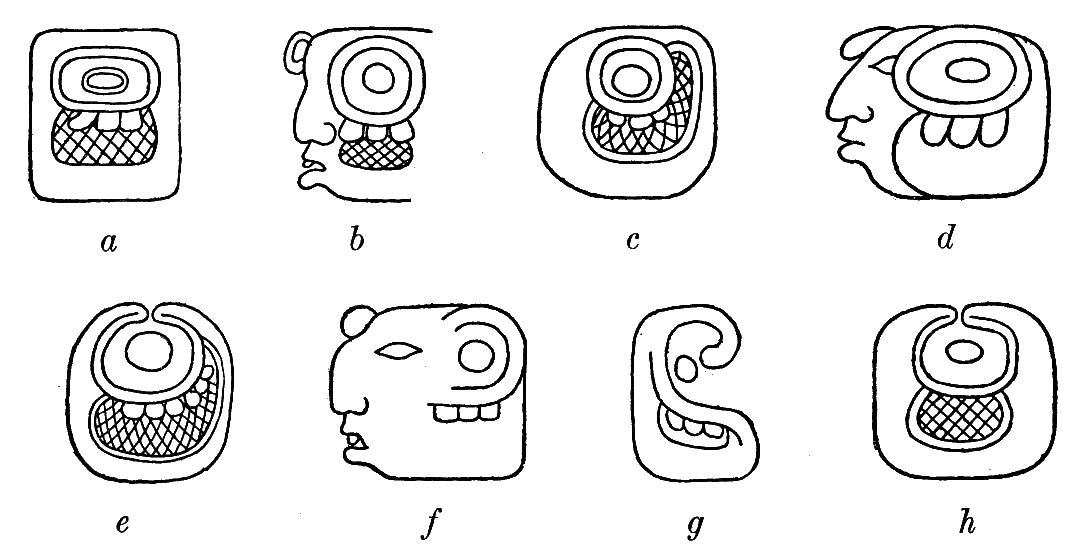
Fig. 65. Sign for the "month indicator": a, c, e, g, h, Normal forms; b, d, f, head variants.
In all other cases in the inscriptions, including also the exceptions to the above rule, that is, where the month parts of Initial-series terminal dates do not immediately follow the closing glyph of the Supplementary Series, the month signs follow immediately the day signs whose positions in the year they severally designate.
In the codices the month signs when recorded[108] usually follow immediately the days signs to which they belong. The most notable exception[109] to this general rule occurs in connection with the Venus-solar periods represented on pages 46-50 of the Dresden Codex, where one set of day signs is used with three different sets of month signs to form three different sets of dates. For example, in one place the day 2 Ahau stands above three different month signs—3 Cumhu, 3 Zotz, and 13 Yax—with each of which it is used to form a different date—2 Ahau 3 Cumhu, 2 Ahau 3 Zotz, and 2 Ahau 13 Yax. In these pages the month signs, with a few exceptions, do not follow immediately the days to which they belong, but on the contrary they are separated from them by several intervening glyphs. This abbreviation in the record of these dates was doubtless prompted by the desire or necessity for economizing space. In the above example, instead of repeating the 2 Ahau with each of the two lower month signs, 3 Zotz and 13 Yax, by writing it once above the upper month sign, 3 Cumhu, the scribe intended that it should be used in turn with each one of the three month signs standing below it, to form three different dates, saving by this abbreviation the space of two glyphs, that is, double the space occupied by 2 Ahau.
With the exception of the Initial-series dates in the inscriptions and the Venus-Solar dates on pages 46-50 of the Dresden Codex, we may say that the regular position of the month glyphs in Maya writing was immediately following the day glyphs whose positions in the year they severally designated.
In closing the presentation of this last step in the process of deciphering numbers in the texts, the great value of the terminal date as a final check for all the calculations involved under steps 1-4 (pp. 134-151) should be pointed out. If after having worked out the terminal date of a given number according to these rules the terminal date thus found should differ from that actually recorded under step 5, we must accept one of the following alternatives:
1. There is an error in our own calculations; or 2. There is an error in the original text; or 3. The case in point lies without the operation of our rules.
It is always safe for the beginner to proceed on the assumption that the first of the above alternatives is the cause of the error; in other words, that his own calculations are at fault. If the terminal date as calculated does not agree with the terminal-date as recorded, the student should repeat his calculations several times, checking up each operation in order to eliminate the possibility of a purely arithmetical error, as a mistake in multiplication. After all attempts to reach the recorded terminal date by counting the given number from the starting point have failed, the process should be reversed and the attempt made to reach the starting point by counting backward the given number from its recorded terminal date. Sometimes this reverse process will work out correctly, showing that there must be some arithmetical error in our original calculations which we have failed to detect. However, when both processes have failed several times to connect the starting point with the recorded terminal date by use of the given number, there remains the possibility that either the starting point or the terminal date, or perhaps both, do not belong to the given number. The rules for determining this fact have been given under step 2, page 135, and step 4, page 138. If after applying these to the case in point it seems certain that the starting point and terminal date used in the calculations both belong to the given number, we have to fall back on the second of the above alternatives, that is, that there is an error in the original text.
Although very unusual, particularly in the inscriptions, errors in the original texts are by no means entirely unknown. These seem to be restricted chiefly to errors in numerals, as the record of 7 for 8, or 7 for 12 or 17, that is, the omission or insertion of one or more bars or dots. In a very few instances there seem to be errors in the month glyph. Such errors usually are obvious, as will be pointed out in connection with the texts in which they are found (see Chapters V and VI).
If both of the above alternatives are found not to apply, that is, if both our calculations and the original texts are free from error, we are obliged to accept the third alternative as the source of trouble, namely, that the case in point lies without the operation of our rules. In such cases it is obviously impossible to go further in the present state of our knowledge. Special conditions presented by glyphs whose meanings are unknown may govern such cases. At all events, the failure of the rules under 1-4 to reach the terminal dates recorded as under 5 introduces a new phase of glyph study—the meaning of unknown forms with which the beginner has no concern. Consequently, when a text falls without the operation of the rules given in this chapter—a very rare contingency—the beginner should turn his attention elsewhere.
Chapter V
THE INSCRIPTIONS
The present chapter will be devoted to the interpretation of texts drawn from monuments, a process which consists briefly in the application to the inscriptions[110] of the material presented in Chapters III and IV.
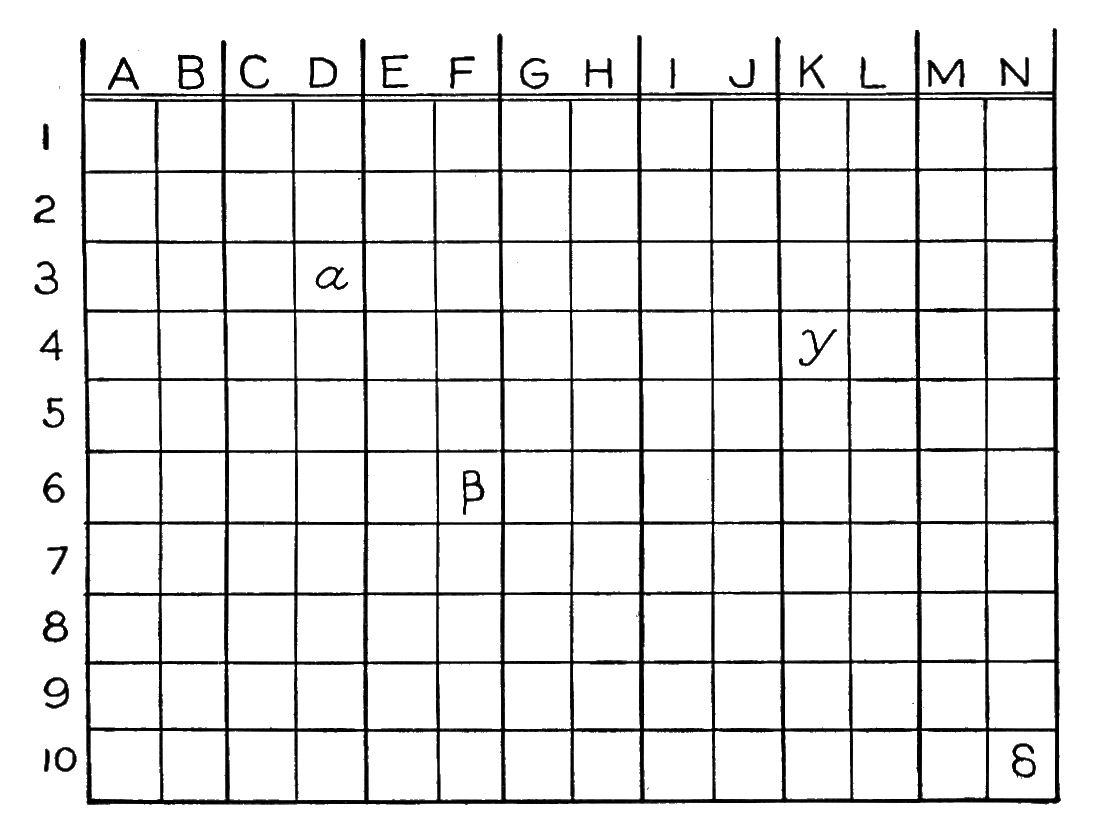
Fig. 66. Diagram showing the method of designating particular glyphs in a text.
Before proceeding with this discussion it will first be necessary to explain the method followed in designating particular glyphs in a text. We have seen (p. 23) that the Maya glyphs were presented in parallel columns, which are to be read two columns at a time, the order of the individual glyph-blocks[111] in each pair of columns being from left to right and from top to bottom. For convenience in referring to particular glyphs in the texts, the vertical columns of glyph-blocks are lettered from left to right, thus, A, B, C, D, etc., and the horizontal rows numbered from top to bottom, thus, 1, 2, 3, 4, etc. For example, in figure 66 the glyph-blocks in columns A and B are read together from left to right and top to bottom, thus, A1 B1, A2 B2, A3 B3, etc. When glyph-block B10 is reached the next in order is C1, which is followed by D1, C2 D2, C3 D3, etc. Again, when D10 is reached the next in order is E1, which is followed by F1, E2 F2, E3 F3, etc. In this way the order of reading proceeds from left to right and from top to bottom, in pairs of columns, that is, G H, I J, K L, and M N throughout the inscription, and usually closes with the glyph-block in the lower right-hand corner, as N10 in figure 66. By this simple system of coordinates any particular glyph in a text may be readily referred to when the need arises. Thus, for example, in figure 66 glyph α is referred to as D3; glyph β as F6; glyph γ as K4; glyph δ as N10. In a few texts the glyph-blocks are so irregularly placed that it is impracticable to designate them by the above coordinates. In such cases the order of the glyph-blocks will be indicated by numerals, 1, 2, 3, etc. In two Copan texts, Altar S (fig. 81) and Stela J (pl. 15), made from the drawings of Mr. Maudslay, his numeration of the glyphs has been followed. This numeration appears in these two figures.
BUREAU OF AMERICAN ETHNOLOGYBULLETIN 57 PLATE 6
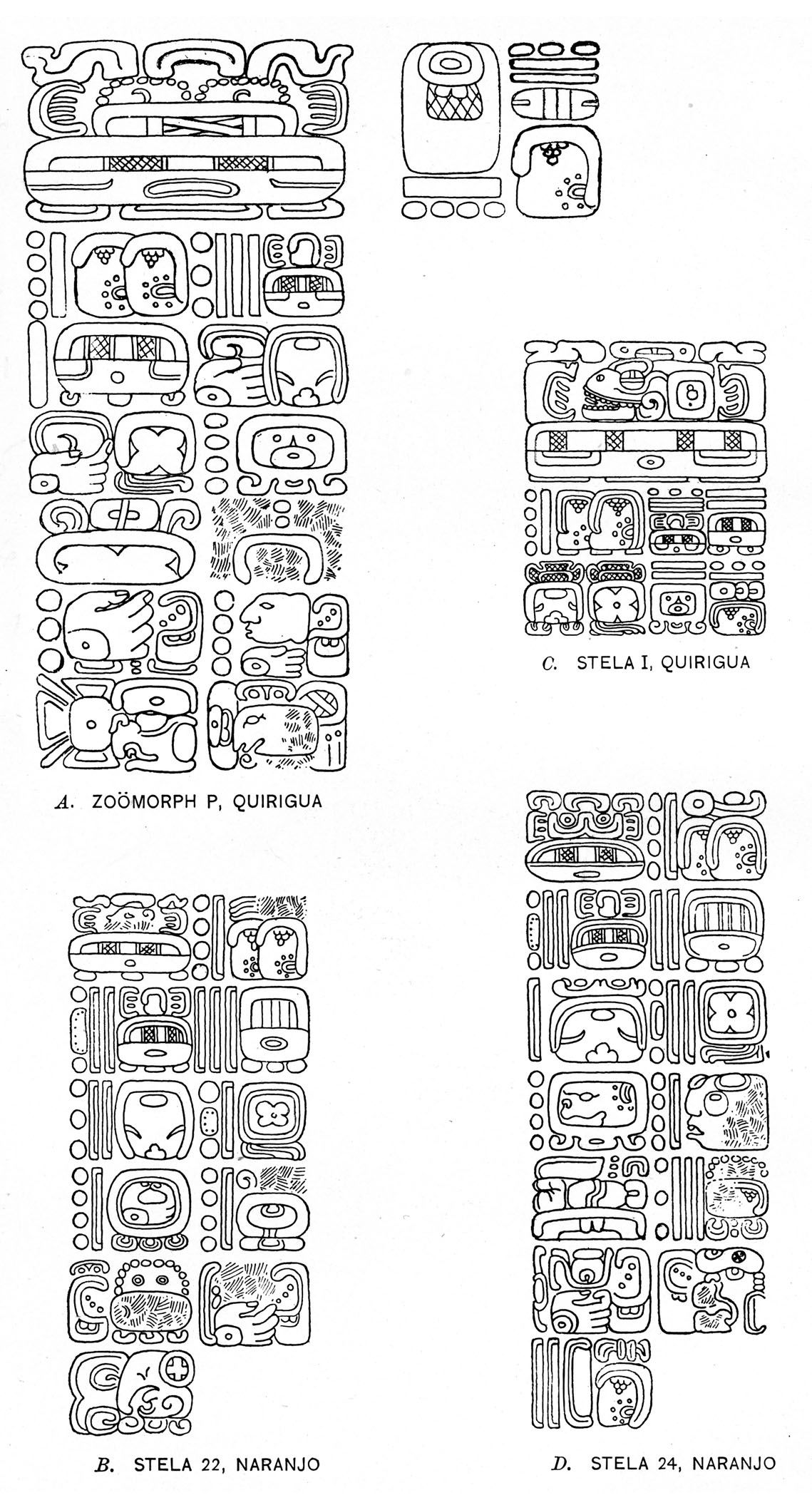
GLYPHS REPRESENTING INITIAL SERIES, SHOWING USE OF BAR AND DOT NUMERALS AND NORMAL-FORM PERIOD GLYPHS
Texts Recording Initial Series
Because of the fundamental importance of Initial Series in the Maya system of chronology, the first class of texts represented will illustrate this method of dating. Moreover, since the normal forms for the numerals and the period glyphs will be more easily recognised by the beginner than the corresponding head variants, the first Initial Series given will be found to have all the numerals and period glyphs expressed by normal forms.[112]
In plate 6 is figured the drawing of the Initial Series[113] from Zoömorph P at Quirigua, a monument which is said to be the finest piece of aboriginal sculpture in the western hemisphere. Our text opens with one large glyph, which occupies the space of four glyph-blocks, A1-B2.[114] Analysis of this form shows that it possesses all the elements mentioned on page 65 as belonging to the so-called Initial-series introducing glyph, without which Initial Series never seem to have been recorded in the inscriptions. These elements are: (1) the trinal superfix, (2) the pair of comblike lateral appendages, (3) the normal form of the tun sign, (4) the trinal subfix, and (5) the variable central element. As stated above, all these appear in the large glyph A1-B2. Moreover, a comparison of A1-B2 with the introducing glyphs given in figure 24 shows that these forms are variants of one and the same sign. Consequently, in A1-B2 we have recorded an Initial-series introducing glyph. The use of this sign is so highly specialized that, on the basis of its occurrence alone in a text, the student is perfectly justified in assuming that an Initial Series will immediately follow.[115] Exceptions to this rule are so very rare (see p. 67) that the beginner will do well to disregard them altogether.
The next glyph after the introducing glyph in an Initial Series is the cycle sign, the highest period ever found in this kind of count[116]. The cycle sign in the present example appears in A3 with the coefficient 9 (1 bar and 4 dots). Although the period glyph is partially effaced in the original enough remains to trace its resemblance to the normal form of the cycle sign shown in figure 25, a-c. The outline of the repeated Cauac sign appears in both places. We have then, in this glyph, the record of 9 cycles[117]. The glyph following the cycle sign in an Initial Series is always the katun sign, and this should appear in B3, the glyph next in order. This glyph is quite clearly the normal form of the katun sign, as a comparison of it with figure 27, a, b, the normal form for the katun, will show. It has the normal-form numeral 18 (3 bars and 3 dots) prefixed to it, and this whole glyph therefore signifies 18 katuns. The next glyph should record the tuns, and a comparison of the glyph in A4 with the normal form of the tun sign in figure 29, a, b, shows this to be the case. The numeral 5 (1 bar prefixed to the tun sign) shows that this period is to be used 5 times; that is, multiplied by 5. The next glyph (B4) should be the uinal sign, and a comparison of B4 with figure 31, a-c, the normal form of the uinal sign, shows the identity of these two glyphs. The coefficient of the uinal sign contains as its most conspicuous element the clasped hand, which suggests that we may have 0 uinals recorded in B4. A comparison of this coefficient with the sign for zero in figure 54 proves this to be the case. The next glyph (A5) should be the kin sign, the lowest period involved in recording Initial Series. A comparison of A5 with the normal form of the kin sign in figure 34, a, shows that these two forms are identical. The coefficient of A5 is, moreover, exactly like the coefficient of B4, which, we have seen, meant zero, hence glyph A5 stands for 0 kins. Summarizing the above, we may say that glyphs A3-A5 record an Initial-series number consisting of 6 cycles, 18 katuns, 5 tuns, 0 uinals, and 0 kins, which we may write thus: 9.18.5.0.0 (see p. 138, footnote 1).
Now let us turn to Chapter IV and apply the several steps there given, by means of which Maya numbers may be solved. The first step on page 134 was to reduce the given number, in this case 9.18.5.0.0, to units of the first order; this may be done by multiplying the recorded coefficients by the numerical values of the periods to which they are respectively attached. These values are given in Table XIII, and the sum of the products arising from their multiplication by the coefficients recorded in the Initial Series in plate 6, A are given below:
A3 = 9 × 144,000 = 1,296,000
B3 = 18 × 7,200 = 129,600
A4 = 5 × 360 = 1,800
B4 = 0 × 20 = 0
A5 = 0 × 1 = 0
————
1,427,400
Therefore 1,427,400 will be the number used in the following calculations.
The second step (see step 2, p. 135) is to determine the starting point from which this number is counted. According to rule 2, page 136, if the number is an Initial Series the starting point, although never recorded, is practically always the date 4 Ahau 8 Cumhu. Exceptions to this rule are so very rare that they may be disregarded by the beginner, and it may be taken for granted, therefore, in the present case, that our number 1,427,400 is to be counted from the date 4 Ahau 8 Cumhu.
The third step (see step 3, p. £136) is to determine the direction of the count, whether forward or backward. In this connection it was stated that the general practice is to count forward, and that the student should always proceed upon this assumption. However, in the present case there is no room for uncertainty, since the direction of the count in an Initial Series is governed by an invariable rule. In Initial Series, according to the rule on page 137, the count is always forward, consequently 1,427,400 is to be counted forward from 4 Ahau 8 Cumhu.
The fourth step (see step 4, p. 138) is to count the given number from its starting point; and the rules governing this process will be found on pages 139-143. Since our given number (1,427,400) is greater than 18,980, or 1 Calendar Round, the preliminary rule on page 143 applies in the present case, and we may therefore subtract from 1,427,400 all the Calendar Rounds possible before proceeding to count it from the starting point. By referring to Table XVI, it appears that 1,427,400 contains 75 complete Calendar Rounds, or 1,423,500; hence, the latter number may be subtracted from 1,427,400 without affecting the value of the resulting terminal date: 1,427,400 - 1,423,500 = 3,900. In other words, in counting forward 3,900 from 4 Ahau 8 Cumhu, the same terminal date will be reached as though we had counted forward 1,427,400.[118]
In order to find the coefficient of the day of the terminal date, it is necessary, by rule 1, page 139, to divide the given number or its equivalent by 13; 3,900 ÷ 13 = 300. Now since there is no fractional part in the resulting quotient, the numerator of an assumed fractional part will be 0; counting forward 0 from the coefficient of the day of the starting point, 4 (that is, 4 Ahau 8 Cumhu), we reach 4 as the coefficient of the day of the terminal date.
In order to find the day sign of the terminal date, it is necessary, under rule 2, page 140, to divide the given number or its equivalent by 20; 3,900 ÷ 20 = 195. Since there is no fractional part in the resulting quotient, the numerator of an assumed fractional part will be 0; counting forward 0 in Table I, from Ahau, the day sign of the starting point (4 Ahau 8 Cumhu), we reach Ahau as the day sign of the terminal date. In other words, in counting forward either 3,900 or 1,427,400 from 4 Ahau 8 Cumhu, the day reached will be 4 Ahau. It remains to show what position in the year this day 4 Ahau distant 1,427,400 from the date 4 Ahau 8 Cumhu, occupied.
In order to find the position in the year which the day of the terminal date occupied, it is necessary, under rule 3, page 141, to divide the given number or its equivalent by 365; 3,900 ÷ 365 = 10250⁄365. Since the numerator of the fractional part of the resulting quotient is 250, to reach the year position of the day of the terminal date desired it is necessary to count 250 forward from 8 Cumhu, the year position of the day of the starting point 4 Ahau 8 Cumhu. It appears from Table XV, in which the 365 positions of the year are given, that after position 8 Cumhu there are only 16 positions in the year—11 more in Cumhu and 5 in Uayeb. These must be subtracted, therefore, from 250 in order to bring the count to the end of the year; 250 - 16 = 234, so 234 is the number of positions we must count forward in the new year. It is clear that the first 11 uinals in the year will use up exactly 220 of our 234 positions (11 × 20 = 220), and that 14 positions will be left, which must be counted in the next uinal, the 12th. But the 12th uinal of the year is Ceh (see Table XV); counting forward 14 positions in Ceh, we reach 13 Ceh, which is, therefore, the month glyph of our terminal date. In other words, counting 250 forward from 8 Cumhu, position 13 Ceh is reached. Assembling the above values, we find that by calculation we have determined the terminal date of the Initial Series in plate 6, A, to be 4 Ahau 13 Ceh.
At this point there are several checks which the student may apply to his result in order to test the accuracy of his calculations; for instance, in the present example if 115, the difference between 365 and 250 (115 + 250 = 365) is counted forward from position 13 Ceh, position 8 Cumhu will be reached if our calculations were correct. This is true because there are only 365 positions in the year, and having reached 13 Ceh in counting forward 250 from 8 Cumhu, counting the remaining 115 days forward from day reached by 250, that is, 13 Ceh, we should reach our starting point (8 Cumhu) again. Another good check in the present case would be to count backward 250 from 13 Ceh; if our calculations have been correct, the starting point 8 Cumhu will be reached. Still another check, which may be applied is the following: From Table VII it is clear that the day sign Ahau can occupy only positions 3, 8, 13, or 18 in the divisions of the year;[119] hence, if in the above case the coefficient of Ceh had been any other number but one of these four, our calculations would have been incorrect.
We come now to the final step (see step 5, p. 151), the actual finding of the glyphs in our text which represent the two parts of the terminal date—the day and its corresponding position in the year. If we have made no arithmetical errors in calculations and if the text itself presents no irregular and unusual features, the terminal date recorded should agree with the terminal date obtained by calculation.
It was explained on page 152 that the two parts of an Initial-series terminal date are usually separated from each other by several intervening glyphs, and further that, although the day part follows immediately the last period glyph of the number (the kin glyph), the month part is not recorded until after the close of the Supplementary Series, usually a matter of six or seven glyphs. Returning to our text (pl. 6, A), we find that the kins are recorded in A5, therefore the day part of the terminal date should appear in B5. The glyph in B5 quite clearly records the day 4 Ahau by means of 4 dots prefixed to the sign shown in figure 16, e'-g', which is the form for the day name Ahau, thereby agreeing with the value of the day part of the terminal date as determined by calculation. So far then we have read our text correctly. Following along the next six or seven glyphs, A6-C1a, which record the Supplementary Series,[120] we reach in C1a a sign similar to the forms shown in figure 65. This glyph, which always has a coefficient of 9 or 10, was designated on page 152 the month-sign "indicator," since it usually immediately precedes the month sign in Initial-series terminal dates. In C1a it has the coefficient 9 (4 dots and 1 bar) and is followed in C1b by the month part of the terminal date, 13 Ceh. The bar and dot numeral 13 appears very clearly above the month sign, which, though partially effaced, yet bears sufficient resemblance to the sign for Ceh in figure 19, u, v, to enable us to identify it as such.
Our complete Initial Series, therefore, reads: 9.18.5.0.0 4 Ahau 13 Ceh, and since the terminal date recorded in B5, C1b agrees with the terminal date determined by calculation, we may conclude that this text is without error and, furthermore, that it records a date, 4 Ahau 13 Ceh, which was distant 9.18.5.0.0 from the starting point of Maya chronology. The writer interprets this text as signifying that 9.18.5.0.0 4 Ahau 13 Ceh was the date on which Zoömorph P at Quirigua was formally consecrated or dedicated as a time-marker, or in other words, that Zoömorph P was the monument set up to mark the hotun, or 5-tun period, which came to a close on the date 9.18.5.0.0 4 Ahau 13 Ceh of Maya chronology.[121]
In plate 6, B, is figured a drawing of the Initial Series on Stela 22 at Naranjo.[122] The text opens in A1 with the Initial-series introducing glyph, which is followed in B1 B3 by the Initial-series number 9.12.15.13.7. The five period glyphs are all expressed by their corresponding normal forms, and the student will have no difficulty in identifying them and reading the number, as above recorded.
By means of Table XIII this number may be reduced to units of the 1st order, in which form it may be more conveniently used. This reduction, which forms the first step in the process of solving Maya numbers (see step 1, p. 134), follows:
B1 = 9 × 144,000 = 1,296,000
A2 = 12 × 7,200 = 86,400
B2 = 15 × 360 = 5,400
A3 = 13 × 20 = 260
B3 = 7 × 1 = 7
————
1,388,067
And 1,388,067 will be the number used in the following calculations.
The next step is to find the starting point from which 1,388,067 is counted (see step 2, p. 135). Since this number is an Initial Series, in all probability its starting point will be the date 4 Ahau 8 Cumhu; at least it is perfectly safe to proceed on that assumption.
The next step is to find the direction of the count (see step 3, p. 136); since our number is an Initial Series, the count can only be forward (see rule 2, p. 137).[123]
Having determined the number to be counted, the starting point from which the count commences, and the direction of the count, we may now proceed with the actual process of counting (see step 4, p. 138).
Since 1,388,067 is greater than 18,980 (1 Calendar Round), we may deduct from the former number all the Calendar Rounds possible (see preliminary rule, page 143). According to Table XVI it appears that 1,388,067 contains 73 Calendar Rounds, or 1,385,540; after deducting this from the given number we have left 2,527 (1,388,067 - 1,385,540), a far more convenient number to handle than 1,388,067.
Applying rule 1 (p. 139) to 2,527, we have: 2,527 ÷ 13 = 1945⁄13, and counting forward 5, the numerator of the fractional part of the quotient, from 4, the day coefficient of the starting point, 4 Ahau 8 Cumhu, we reach 9 as the day coefficient of the terminal date.
Applying rule 2 (p. 140) to 2,527, we have: 2,527 ÷ 20 = 1267⁄20; and counting forward 7, the numerator of the fractional part of the quotient, from Ahau, the day sign of our starting point, 4 Ahau 8 Cumhu, in Table I, we reach Manik as the day sign of the terminal date. Therefore, the day of the terminal date will be 9 Manik.
Applying rule 3 (p. 141) to 2,527, we have: 2,527 ÷ 365 = 6337⁄365; and counting forward 337, the numerator of the fractional part of the quotient, from 8 Cumhu, the year position of the starting point, 4 Ahau 8 Cumhu, in Table XV, we reach 0 Kayab as the year position of the terminal date. The calculations by means of which 0 Kayab is reached are as follows: After 8 Cumhu there are 16 positions in the year, which we must subtract from 337; 337 - 16 = 321, which is to be counted forward in the new year. This number contains just 1 more than 16 uinals, that is, 321 = (16 × 20) + 1; hence it will reach through the first 16 uinals in Table XV and to the first position in the 17th uinal, 0 Kayab. Combining this with the day obtained above, we have for our terminal date determined by calculation, 9 Manik 0 Kayab.
The next and last step (see step 5, p. 151) is to find the above date in the text. In Initial Series (see p. 152) the two parts of the terminal date are generally separated, the day part usually following immediately the last period glyph and the month part the closing glyph of the Supplementary Series. In plate 6, B, the last period glyph, as we have seen, is recorded in B3; therefore the day should appear in A4. Comparing the glyph in A4 with the sign for Manik in figure 16, j, the two forms are seen to be identical. Moreover, A4 has the bar and dot coefficient 9 attached to it, that is, 4 dots and 1 bar; consequently it is clear that in A4 we have recorded the day 9 Manik, the same day as reached by calculation. For some unknown reason, at Naranjo the month glyphs of the Initial-series terminal dates do not regularly follow the closing glyphs of the Supplementary Series; indeed, in the text here under discussion, so far as we can judge from the badly effaced glyphs, no Supplementary Series seems to have been recorded. However, reversing our operation, we know by calculation that the month part should be 0 Kayab, and by referring to figure 49 we find the only form which can be used to express the 0 position with the month signs—the so-called "spectacles" glyph—which must be recorded somewhere in this text to express the idea 0 with the month sign Kayab. Further, by referring to figure 19, d'-f', we may fix in our minds the sign for the month Kayab, which should also appear in the text with one of the forms shown in figure 49.
Returning to our text once more and following along the glyphs after the day in A4, we pass over B4, A5, and B5 without finding a glyph resembling one of the forms in figure 49 joined to figure 19, d'-f'; that is, 0 Kayab. However, in A6 such a glyph is reached, and the student will have no difficulty in identifying the month sign with d'-f' in the above figure. Consequently, we have recorded in A4, A6 the same terminal date, 9 Manik 0 Kayab, as determined by calculation, and may conclude, therefore, that our text records without error the date 9.12.15.13.7 9 Manik 0 Kayab[124] of Maya chronology.
The next text presented (pl. 6, C) shows the Initial Series from Stela I at Quirigua.[125] Again, as in plate 6, A, the introducing glyph occupies the space of four glyph-blocks, namely, A1-B2. Immediately after this, in A3-A4, is recorded the Initial-series number 9.18.10.0.0, all the period glyphs and coefficients of which are expressed by normal forms. The student's attention is called to the form for 0 used with the uinal and kin signs in A4a and A4b, respectively, which differs from the form for 0 recorded with the uinal and kin signs in plate 6, A, B4, and A5, respectively. In the latter text the 0 uinals and 0 kins were expressed by the hand and curl form for zero shown in figure 54; in the present text, however, the 0 uinals and 0 kins are expressed by the form for 0 shown in figure 47, a new feature.
Reducing the above number to units of the 1st order by means of Table XIII, we have:
A3 = 9 × 144,000 = 1,296,000
B3a = 18 × 7,200 = 129,600
B3b = 10 × 360 = 3,600
A4a = 0 × 20 = 0
A4b = 0 × 1 = 0
————
1,429,200
Deducting from this number all the Calendar Rounds possible, 75 (see Table XVI), it may be reduced to 5,700 without affecting its value in the present connection.
Applying rules 1 and 2 (pp. 139 and 140, respectively) to this number, the day reached will be found to be 10 Ahau; and by applying rule 3 (p. 141), the position of this day in the year will be found to be 8 Zac. Therefore, by calculation we have determined that the terminal date reached by this Initial Series is 10 Ahau 8 Zac. It remains to find this date in the text. The regular position for the day in Initial-series terminal dates is immediately following the last period glyph, which, as we have seen above, was in A4b. Therefore the day glyph should be B4a. An inspection of this latter glyph will show that it records the day 10 Ahau, both the day sign and the coefficient being unusually clear, and practically unmistakable. Compare B4a with figure 16, e'-g', the sign for the day name Ahau. Consequently the day recorded agrees with the day determined by calculation. The month glyph in this text, as mentioned on page 157, footnote 1, occurs out of its regular position, following immediately the day of the terminal date.
As mentioned on page 153, when the month glyph in Initial-series terminal dates is not to be found in its usual position, it will be found in the regular position for the month glyphs in all other kinds of dates in the inscriptions, namely, immediately following the day glyph to which it belongs. In the present text we found that the day, 10 Ahau, was recorded in B4a; hence, since the month glyph was not recorded in its regular position, it must be in B4b, immediately following the day glyph. By comparing the glyph in B4b with the month signs in figure 19, it will be found exactly like the month sign for Zac (s-t), and we may therefore conclude that this is our month glyph and that it is Zac. The coefficient of B4b is quite clearly 8 and the month part therefore reads, 8 Zac. Combining this with the day recorded in B4a, we have the date 10 Ahau 8 Zac, which corresponds with the terminal date determined by calculation. The whole text therefore reads 9.18.10.0.0 10 Ahau 8 Zac.
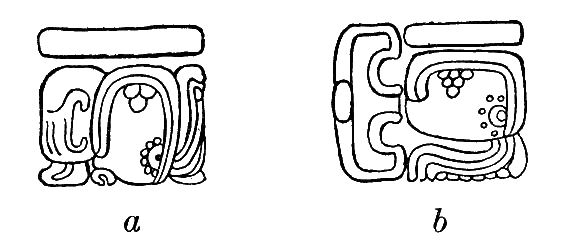
Fig. 67. Signs representing the hotun, or 5-tun, period.
It will be noted that this date 9.18.10.0.0 10 Ahau 8 Zac is just 5.0.0 (5 tuns) later than the date recorded by the Initial Series on Zoömorph P at Quirigua (see pl. 6, A). As explained in Chapter II (pp. 33-34), the interval between succeeding monuments at Quirigua is in every case 1,800 days, or 5 tuns. Therefore, it would seem probable that at Quirigua at least this period was the unit used for marking the lapse of time. As each 5-tun period was completed, its close was marked by the erection of a monument, on which was recorded its ending date. Thus the writer believes Zoömorph P marked the close of the 5-tun period ending 9.18.5.0.0 4 Ahau 13 Ceh, and Stela I, the 5-tun period next following, that ending 9.18.10.0.0 10 Ahau 8 Zac. In other words, Zoömorph P and Stela I were two successive time-markers, or "period stones," in the chronological record at Quirigua. For this 5-tun period so conspicuously recorded in the inscriptions from the older Maya cities the writer would suggest the name hotun, ho meaning 5 in Maya and tun being the name of the 360-day period. This word has an etymological parallel in the Maya word for the 20-tun period, katun, which we have seen may have been named directly from its numerical value, kal being the word for 20 in Maya and kaltun contracted to katun, thus meaning 20 tuns. Although no glyph for the hotun has as yet been identified,[126] the writer is inclined to believe that the sign in figure 67, a, b, which is frequently encountered in the texts, will be found to represent this time period. The bar at the top in both a and b, figure 67, surely signifies 5; therefore the glyph itself must mean "1 tun." This form recalls the very unusual variant of the tun from Palenque (see fig. 29, h). Both have the wing and the (*) element.

The next Initial Series presented (see pl. 6, D) is from Stela 24 at Naranjo.[127] The text opens with the introducing glyph, which is in the same relative position as the introducing glyph in the other Naranjo text (pl. 6, B) at A1. Then follows regularly in B1-B3 the number 9.12.10.5.12, the numbers and period glyphs of which are all expressed by normal forms. By this time the student should have no difficulty in recognizing these and in determining the number as given above. Reducing this according to rule 1, page 134, the following result should be obtained:
B1 = 9 × 144,000 = 1,296,000
A2 = 12 × 7,200 = 86,400
B2 = 10 × 360 = 3,600
A3 = 5 × 20 = 100
B3 = 12 × 1 = 12
————
1,386,112
Deducting[128] from this number all the Calendar Rounds possible, 73 (see preliminary rule, p. 143, and Table XVI), we may reduce it to 572 without affecting its value in so far as the present calculations are concerned (1,386,112 - 1,385,540). First applying rule 1, page 139, and next rule 2, page 140, to this number (572), the student will find the day reached to be 4 Eb. And applying rule 3, page 141, he will find that the year position reached will be 10 Yax;[129] hence, the terminal date as determined by calculation will be 4 Eb 10 Yax.
BUREAU OF AMERICAN ETHNOLOGYBULLETIN 57 PLATE 7
GLYPHS REPRESENTING INITIAL SERIES, SHOWING USE OF BAR AND DOT NUMERALS AND HEAD-VARIANT PERIOD GLYPHS
Turning again to the text (pl. 6, D), the next step (see step 5, p. 151) is to find the glyphs representing the above terminal date. In this connection it should be remembered that the day part of an Initial-series terminal date usually follows immediately the last period glyph of the number. The glyph in A4, therefore, should record the day reached. Comparing this form with the several day signs in figure 16, it appears that A4 more closely resembles the sign for Eb (fig. 16, s-u) than any of the others, hence the student may accept Eb as the day sign recorded in A4. The 4 dots prefixed to this sign show that the day 4 Eb is here indicated. The month sign, as stated on page 152, usually follows the last glyph of the Supplementary Series; passing over B4, A5, B5, and A6, we reach the latter glyph in B6. Compare the left half of B6 with the forms given in figure 65. The coefficient 9 or 10 is expressed by a considerably effaced head numeral. Immediately following the month-sign "indicator" is the month sign itself in A7. The student will have little difficulty in tracing its resemblance to the month Yax in figure 19, q, r, although in A7 the Yax element itself appears as the prefix instead of as the superfix, as in q and r, just cited. This difference, however, is immaterial. The month coefficient is quite clearly 10,[130] and the whole terminal date recorded will read 4 Eb 10 Yax, which corresponds exactly with the terminal date determined by calculation. We may accept this text, therefore, as recording the Initial-series date 9.12.10.5.12 4 Eb 10 Yax of Maya chronology.
In the foregoing examples nothing but normal-form period glyphs have been presented, in order that the first exercises in deciphering the inscriptions may be as easy as possible. By this time, however, the student should be sufficiently familiar with the normal forms of the period glyphs to be able to recognize them when they are present in the text, and the next Initial Series figured will have its period glyphs expressed by head variants.
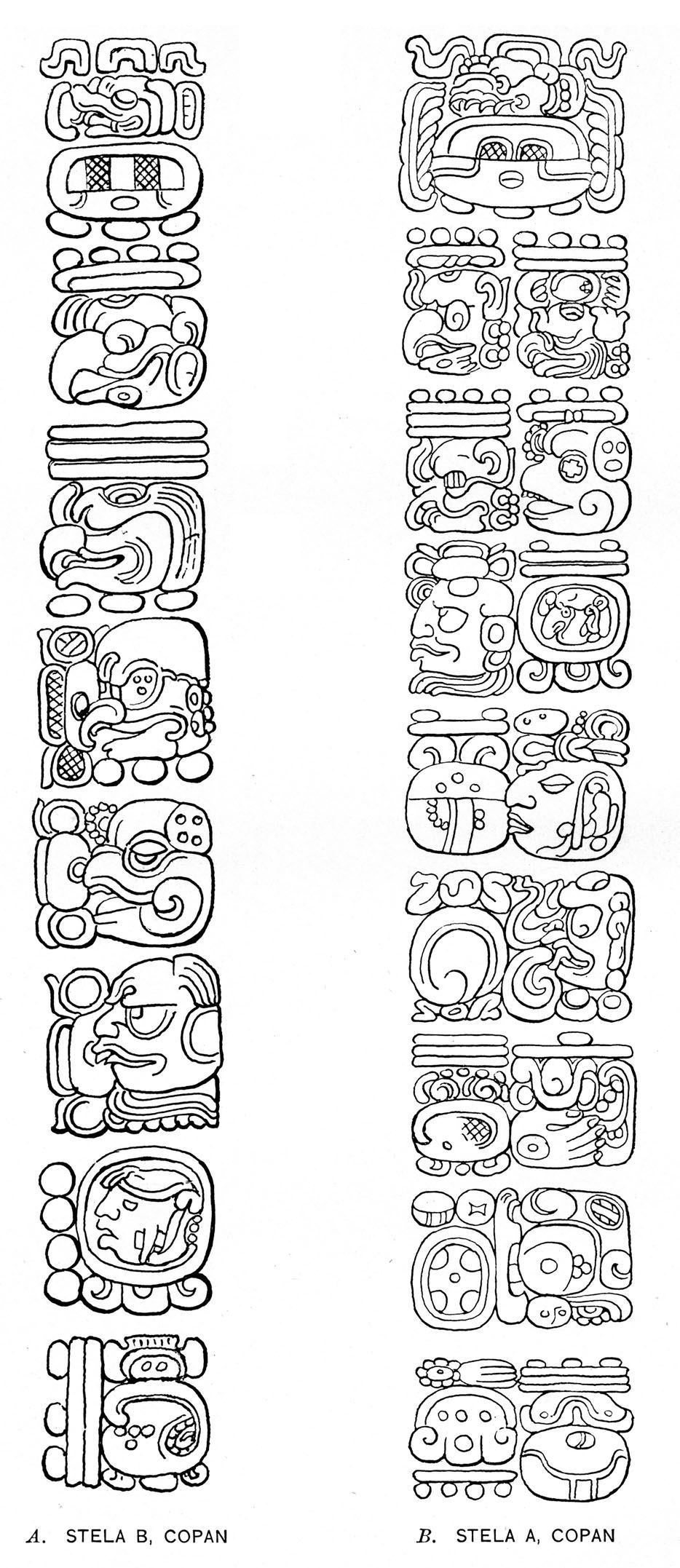
In A, plate 7, is figured the Initial Series from Stela B at Copan.[131] The introducing glyph appears at the head of the inscription in A1 and is followed by a head-variant glyph in A2, to which is prefixed a bar and dot coefficient of 9. By its position, immediately following the introducing glyph, we are justified in assuming that A2 records 9 cycles, and after comparing it with d-f, figure 25, where the head variant of the cycle sign is shown, this assumption becomes a certainty. Both heads have the same clasped hand in the same position, across the lower part of the face, which, as explained on page 68, is the essential element of the cycle head; therefore, A2 records 9 cycles. The next glyph, A3, should be the katun sign, and a comparison of this form with the head variant for katun in e-h, figure 27, shows this to be the case. The determining characteristic (see p. 69) is probably the oval in the top of the head, which appears in both of these forms for the katun. The katun coefficient is 15 (3 bars). The next glyph, A4, should record the tuns, and by comparing this form with the head variant for the tun sign in e-g, figure 29, this also is found to be the case. Both heads show the same essential characteristic—the fleshless lower jaw (see p. 70). The coefficient is 0 (compare fig. 47). The uinal head in A5 is equally unmistakable. Note the large curl protruding from the back part of the mouth, which was said (p. 71) to be the essential element of this sign. Compare figure 31, d-f, where the head variant for the uinal is given. The coefficient of A5 is like the coefficient of A4 (0), and we have recorded, therefore, 0 uinals. The closing period glyph of the Initial Series in A6 is the head variant for the kin sign. Compare this form with figure 34, e-g, where the kin head is figured. The determining characteristic of this head is the subfixial element, which appears also in the normal form for the kin sign (see fig. 34, a). Again, the coefficient of A6 is like the coefficient of A4 and A5, hence we have recorded here 0 kins.
The number recorded by the head-variant period glyphs and normal-form numerals in A2-A6 is therefore 9.15.0.0.0; reducing this by means of Table XIII, we have:
A2 = 9 × 144,000 = 1,296,000
A3 = 15 × 7,200 = 108,000
A4 = 0 × 360 = 0
A5 = 0 × 20 = 0
A6 = 0 × 1 = 0
————
1,404,000
Deducting from this number all the Calendar Rounds possible, 73 (see Table XVI), it may be reduced to 18,460. Applying to this number rules 1 and 2 (pp. 139 and 140, respectively), the day reached will be found to be 4 Ahau. Applying rule 3 (p. 141), the position of 4 Ahau in the year will be found to be 13 Yax. Therefore the terminal date determined by calculation will be 4 Ahau 13 Yax.
According to step 5 (p. 151), the day reached should follow immediately the last period glyph, which in this case was in A6; hence the day should be recorded in A7. This glyph has a coefficient 4, but the glyph does not resemble either of the forms for Ahau shown in B5, plate 6, A, or in B4a, C of the same plate. However, by comparing this glyph with the second variant for the day sign Ahau in figure 16, h'-i', the two forms will be found to be identical, and we may accept A7 as recording the day 4 Ahau. Immediately following in A8 is the month sign, again out of its usual place as in plate 6, C. Comparing it with the month signs in figure 19, it will be found to exactly correspond with the sign for Yax in q-r. The coefficient is 13. Therefore the terminal date recorded, 4 Ahau 13 Yax, agrees with the terminal date reached by calculation, and the whole Initial Series reads 9.15.0.0.0 4 Ahau 13 Yax. This date marks the close not only of a hotun in the Long Count, but of a katun as well.
In B, plate 7, is figured the Initial Series from Stela A at Copan.[132] The introducing glyph appears in A1 B1, and is followed by the Initial-series number in A2-A4. The student will have no difficulty in picking out the clasped hand in A2, the oval in the top of the head in B2, the fleshless lower jaw in A3, the large mouth curl in B3, and the flaring subfix in A4, which are the essential elements of the head variants for the cycle, katun, tun, uinal, and kin, respectively. Compare these glyphs with figures 25, d-f, 27, e-h, 29, e-g, 31, d-f, and 34, e-g, respectively. The coefficients of these period glyphs are all normal forms and the student will have no difficulty in reading this number as 9.14.19.8.0.[133]
Reducing this by means of Table XIII to units of the 1st order, we have:
A2 = 9 × 144,000 = 1,296,000
B2 = 14 × 7,200 = 108,000
A3 = 19 × 360 = 6,840
B3 = 8 × 20 = 160
A4 = 0 × 1 = 0
————
1,403,800
Deducting from this all the Calendar Rounds possible, 73 (see Table XVI), and applying rules 1 and 2 (pp. 139 and 140, respectively), to the remainder, the day reached will be 12 Ahau. And applying rule 3 (p. 141), the month reached will be 18 Cumhu, giving for the terminal date as reached by calculation 12 Ahau 18 Cumhu. The day should be recorded in B4, and an examination of this glyph shows that its coefficient is 12, the day coefficient reached by calculation. The glyph itself, however, is unlike the forms for Ahau previously encountered in plate 6, A, B5 and C, B4b, and in plate 7, A, A7. Turning now to the forms for the day sign Ahau in figure 16, it is seen that the form in A4 resembles the third variant j' or k', the grotesque head, and it is clear that the day 12 Ahau is here recorded. At first sight the student might think that the month glyph follows in A5, but a closer inspection of this form shows that this is not the case. In the first place, since the day sign is Ahau the month coefficient must be either 3, 8, 13, or 18, not 7, as recorded (see Table VII), and, in the second place, the glyph itself in A5 bears no resemblance whatsoever to any of the month signs in figure 19. Consequently the month part of the Initial-series terminal date of this text should follow the closing glyph of the Supplementary Series. Following along the glyphs next in order, we reach in A9 a glyph with a coefficient 9, although the sign itself bears no resemblance to the month-glyph "indicators" heretofore encountered (see fig. 65).
The glyph following, however, in A9b is quite clearly 18 Cumhu (see fig. 19, g'-h'), which is the month part of the terminal date as reached by calculation. Therefore, since A9a has the coefficient 9 it is probable that it is a variant of the month-glyph "indicator";[134] and consequently that the month glyph itself follows, as we have seen, in B9. In other words, the terminal date recorded, 12 Ahau 18 Cumhu, agrees with the terminal date reached by calculation, and the whole text, so far as it can be deciphered, reads 9.14.19.8.0 12 Ahau 18 Cumhu. The student will note that this Initial Series precedes the Initial Series in plate 7, A by exactly 10 uinals, or 200 days. Compare A and B, plate 7.
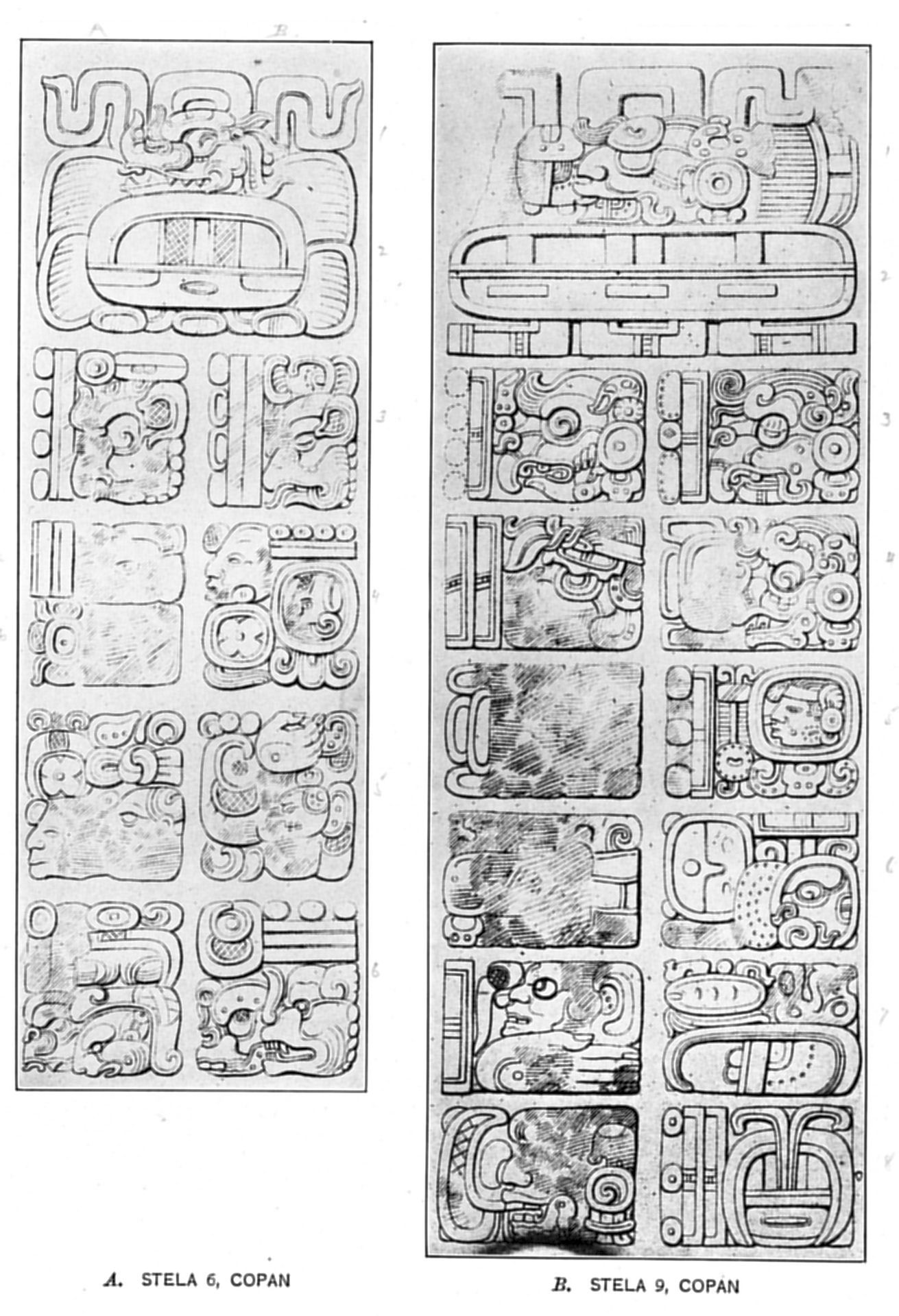
In plate 8, A, is figured the Initial Series from Stela 6 at Copan.[135] The introducing glyph occupies the space of four glyph-blocks, A1-B2, and there follows in A3-B4a the Initial-series number 9.12.10.0.0. The cycle glyph in A3 is partially effaced; the clasped hand, however, the determining characteristic of the cycle head, may still be distinguished. The katun head in B3 is also unmistakable, as it has the same superfix as in the normal form for the katun. At first sight the student might read the bar and dot coefficient as 14, but the two middle crescents are purely decorative and have no numerical value, and the numeral recorded here is 12 (see pp. 88-91). Although the tun and uinal period glyphs in A4a and A4b,[136] respectively, are effaced, their coefficients may be distinguished as 10 and 0, respectively. In such a case the student is perfectly justified in assuming that the tun and uinal signs originally stood here. In B4a the kin period glyph is expressed by its normal form and the kin coefficient by a head-variant numeral, the clasped hand of which indicates that it stands for 0 (see fig. 53, s-w).[137] The number here recorded is 9.12.10.0.0.
BUREAU OF AMERICAN ETHNOLOGYBULLETIN 57 PLATE 8
GLYPHS REPRESENTING INITIAL SERIES, SHOWING USE OF BAR AND DOT NUMERALS AND HEAD-VARIANT PERIOD GLYPHS
Reducing this to units of the 1st order by means of Table XIII, we have:
A3 = 9 × 144,000 = 1,296,000
B3 = 12 × 7,200 = 86,400
A4a = 10 × 360 = 3,600
A4b = 0 × 20 = 0
B4a = 0 × 1 = 0
————
1,386,000
Deducting from this number all the Calendar Rounds possible, 73 (see Table XVI), and applying to the remainder rules 1, 2, and 3 (pp. 139-141), respectively, the date reached by the resulting calculations will be 9 Ahau 18 Zotz. Turning to our text again, the student will have little difficulty in identifying B4b as 9 Ahau, the day of the above terminal date. The form Ahau here recorded is the grotesque head, the third variant j' or k' in figure 16. Following the next glyphs in order, A5-A6, the closing glyph of the Supplementary Series is reached in B6a. Compare this glyph with the forms in figure 65. The coefficient of B6a is again a head-variant numeral, as in the case of the kin period glyph in B4a, above. The fleshless lower jaw and other skull-like characteristics indicate that the numeral 10 is here recorded. Compare B6a with figure 52, m-r. Since B6a is the last glyph of the Supplementary Series, the next glyph B6b should represent the month sign. By comparing the latter form with the month signs in figure 19 the student will readily recognize that the sign for Zotz in e or f is the month sign here recorded. The coefficient 18 stands above. Consequently, B4b and B6b represent the same terminal date, 9 Ahau 18 Zotz, as reached by calculation. This whole Initial Series reads 9.12.10.0.0 9 Ahau 18 Zotz, and according to the writer's view, the monument upon which it occurs (Stela 6 at Copan) was the period stone for the hotun which began with the day 9.12.5.0.1 4 Imix 4 Xul[138] and ended with the day 9.12.10.0.0 9 Ahau 18 Zotz, here recorded.
In plate 8, B, is figured the Initial Series from Stela 9 at Copan.[139] The introducing glyph stands in A1-B2 and is followed by the five period glyphs in A3-A5. The cycle is very clearly recorded in A3, the clasped hand being of a particularly realistic form. Although the coefficient is partially effaced, enough remains to show that it was above 5, having had originally more than the one bar which remains, and less than 11, there being space for only one more bar or row of dots. In all the previous Initial Series the cycle coefficient was 9, consequently it is reasonable to assume that 4 dots originally occupied the effaced part of this glyph. If the use of 9 cycles in this number gives a terminal date which agrees with the terminal date recorded, the above assumption becomes a certainty. In B3 six katuns are recorded. Note the ornamental dotted ovals on each side of the dot in the numeral 6. Although the head for the tun in A4 is partially effaced, we are warranted in assuming that this was the period originally recorded here. The coefficient 10 appears clearly. The uinal head in B4 is totally unfamiliar and seems to have the fleshless lower jaw properly belonging to the tun head; from its position, however, the 4th in the number, we are justified in calling this glyph the uinal sign. Its coefficient denotes that 0 uinals are recorded here. Although the period glyph in A5 is also entirely effaced, the coefficient appears clearly as 0, and from position again, 5th in the number, we are justified once more in assuming that 0 kins were originally recorded, here. It seems at first glance that the above reading of the number A3-A5 rests on several assumptions:
1. That the cycle coefficient was originally 9. 2. That the effaced glyph in A4 was a tun head. 3. That the irregular head in B4 is a uinal head. 4. That the effaced glyph in A5 was a kin sign.
The last three are really certainties, since the Maya practice in recording Initial Series demanded that the five period glyphs requisite—the cycle, katun, tun, uinal, and kin—should follow each other in this order, and in no other. Hence, although the 3d, 4th, and 5th glyphs are either irregular or effaced, they must have been the tun, uinal, and kin signs, respectively. Indeed, the only important assumption consisted in arbitrarily designating the cycle coefficient 9, when, so far as the appearance of A3 is concerned, it might have been either 6, 7, 8, 9, or 10. The reason for choosing 9 rests on the overwhelming evidence of antecedent probability. Moreover, as stated above, if the terminal date recorded agrees with the terminal date determined by calculation, using the cycle coefficient as 9, our assumption becomes a certainty. Designating the above number as 9.6.10.0.0 then and reducing this by means of Table XIII, we obtain:
A3 = 9 × 144,000 = 1,296,000
B3 = 6 × 7,200 = 43,200
A4 = 10 × 360 = 3,600
B4 = 0 × 20 = 0
A5 = 0 × 1 = 0
————
1,342,800
Deducting from this number all the Calendar Rounds possible, 70 (see Table XVI), and applying rules 1, 2, and 3 (pp. 139, 140, and 141, respectively) to the remainder, the date determined by the resulting calculations will be 8 Ahau 13 Pax. Turning to our text again, the student will have little difficulty in recognizing the first part of this date, the day 8 Ahau, in B5. The numeral 8 appears clearly, and the day sign is the profile-head h' or i', the second variant for Ahau in figure 16. The significance of the element standing between the numeral and the day sign is unknown. Following along through A6, B6, A7, B7, the closing glyph of the Supplementary Series is reached in A8. The glyph itself is on the left and the coefficient, here expressed by a head variant, is on the right. The student will have no difficulty in recognizing the glyph and its coefficient by comparing the former with figure 65, and the latter with the head variant for 10 in figure 52, m-r. Note the fleshless lower jaw in the head numeral in both places. The following glyph, B8, is one of the clearest in the entire text. The numeral is 13, and the month sign on comparison with figure 19 unmistakably proves itself to be the sign for Pax in c'. Therefore the terminal date recorded in B5, B8, namely, 8 Ahau 13 Pax, agrees with the terminal date determined by calculation; it follows, further, that the effaced cycle coefficient in A3 must have been 9, the value tentatively ascribed to it in the above calculations. The whole Initial Series reads 9.6.10.0.0 8 Ahau 13 Pax.
Some of the peculiarities of the numerals and signs in this text are doubtless due to its very great antiquity, for the monument presenting this inscription, Stela 9, records the next to earliest Initial Series[140] yet deciphered at Copan.[141] Evidences of antiquity appear in the glyphs in several different ways. The bars denoting 5 have square ends and all show considerable ornamentation. This type of bar was an early manifestation and gave way in later times to more rounded forms. The dots also show this greater ornamentation, which is reflected, too, by the signs themselves. The head forms show greater attention to detail, giving the whole glyph a more ornate appearance. All this embellishment gave way in later times to more simplified forms, and we have represented in this text a stage in glyph morphology before conventionalization had worn down the different signs to little more than their essential elements.
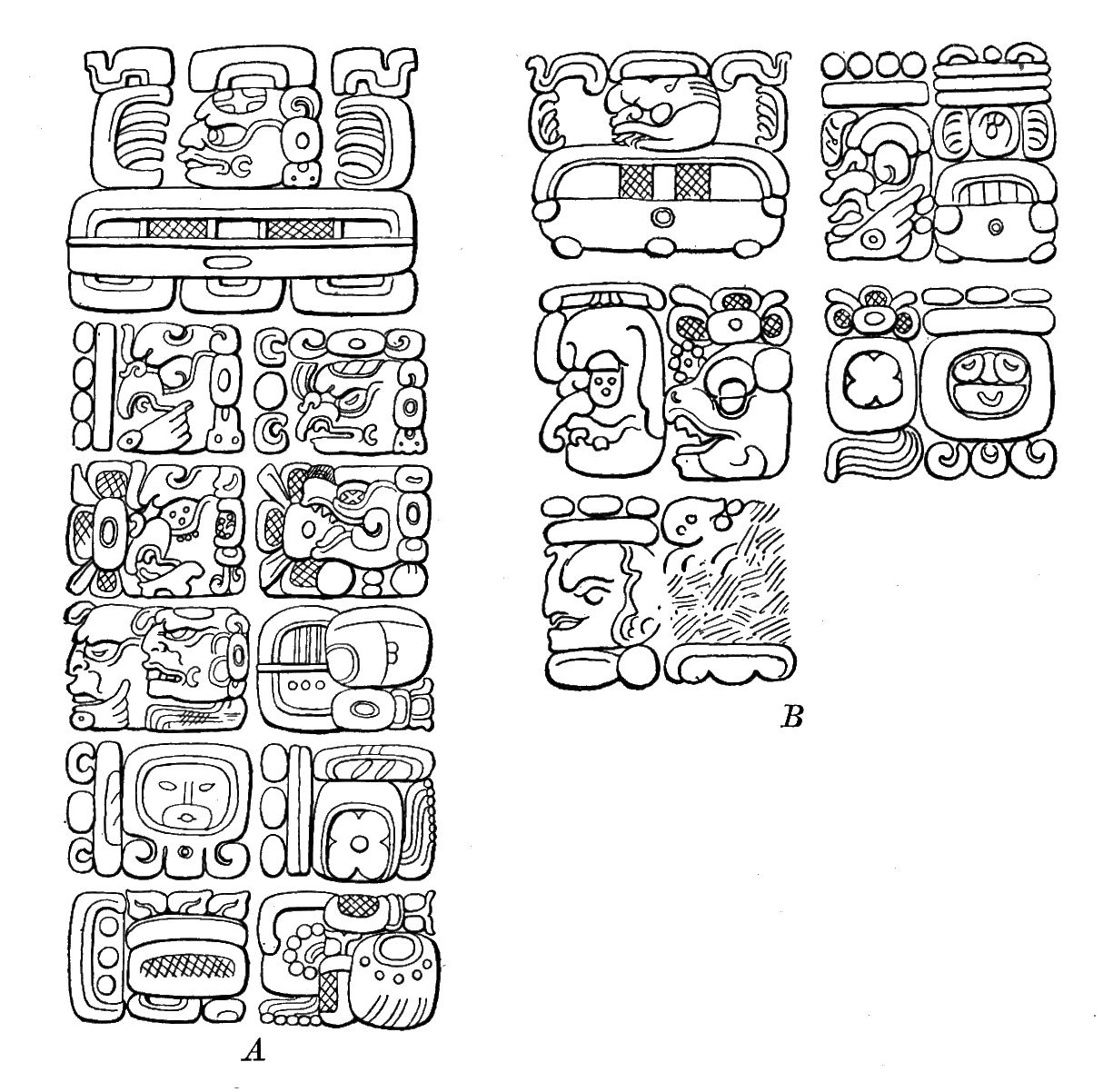
Fig. 68. Initial Series showing bar and dot numerals and head-variant period glyphs: A, Stela C (west side), Quirigua; B, Stela M, Copan.
In figure 68, A, is figured the Initial Series on the west side of Stela C at Quirigua.[142] The introducing glyph in A1-B2 is followed by the number in A3-A5, which the student will have no difficulty in reading except for the head-variant numeral attached to the kin sign in A5. The clasped hand in this glyph, however, suggests that 0 kins are recorded here, and a comparison of this form with figure 53, s-w, confirms the suggestion. The number therefore reads 9.1.0.0.0. Reducing this number by means of Table XIII to units of the 1st order, we obtain:
A3 = 9 × 144,000 = 1,296,000
B3 = 1 × 7,200 = 7,200
A4 = 0 × 360 = 0
B4 = 0 × 20 = 0
A5 = 0 × 1 = 0
————
1,303,200
Deducting from this number all the Calendar Rounds possible, 68 (see Table XVI), and applying rules 1, 2, and 3 (pp. 139, 140, and 141, respectively) to the remainder, we reach for the terminal date 6 Ahau 13 Yaxkin. Looking for the day part of this date in B5, we find that the form there recorded bears no resemblance to 6 Ahau, the day determined by calculation. Moreover, comparison of it with the day signs in figure 16 shows that it is unlike all of them; further, there is no bar and dot coefficient. These several points indicate that the day sign is not the glyph in B5, also that the day sign is, therefore, out of its regular position. The next glyph in the text, A6, instead of being one of the Supplementary Series is the day glyph 6 Ahau, which should have been recorded in B5. The student will readily make the same identification after comparing A6 with figure 16, e'-g'. A glance at the remainder of the text, will show that no Supplementary Series is recorded, and consequently that the month glyph will be found immediately following the day glyph in B6. The form in B6 has a coefficient 13, one of the four (3, 8, 13, 18) which the month must have, since the day sign is Ahau (see Table VII). A comparison of the form in B6 with the month signs in figure 19 shows that the month Yaxkin in k or l is the form here recorded; therefore the terminal date recorded agrees with the terminal date reached by calculation, and the text reads 9.1.0.0.0 6 Ahau 13 Yaxkin.[143]
In figure 68, B, is shown the Initial Series on Stela M at Copan.[144] The introducing glyph appears in A1 and the Initial-series number in B1a-B2a. The student will note the use of both normal-form and head-variant period glyphs in this text, the cycle, tun, and uinal in B1a, A2a, and A2b, respectively, being expressed by the latter, and the katun and kin in B1b and B2a, respectively, by the former. The number recorded is 9.16.5.0.0, and this reduces to units of the first order, as follows (see Table XIII):
B1a = 9 × 144,000 = 1,296,000
B1b = 16 × 7,200 = 115,200
A2a = 5 × 360 = 1,800
A2b = 0 × 20 = 0
B2a = 0 × 1 = 0
————
1,413,000
Deducting from this number all the Calendar Rounds possible, 74 (see Table XVI), and applying rules 1, 2, and 3 (pp. 139, 140, and 141, respectively) to the remainder, the terminal date reached by the resulting calculations will be 8 Ahau 8 Zotz. Turning to our text, the student will have no difficulty in recognizing in B2b the day 8 Ahau. The month glyph in this inscription irregularly follows immediately the day glyph. Compare the form in A3a with the month signs in figure 19 and it will be found to be the sign for Zotz (see fig. 19, e-f). The coefficient is 8 and the whole glyph represents the month part 8 Zotz, the same as determined by calculation. This whole Initial Series reads 9.16.5.0.0 8 Ahau 8 Zotz.
The Maya texts presented up to this point have all been drawings of originals, which are somewhat easier to make out than either photographs of the originals or the originals themselves. However, in order to familiarize the student with photographic reproductions of Maya texts a few will be inserted here illustrating the use of bar and dot numerals with both normal-form and head-variant period glyphs, with which the student should be perfectly familiar by this time.
In plate 9, A, is figured a photograph of the Initial Series on the front of Stela 11 at Yaxchilan.[145] The introducing glyph appears in A1 B1; 9 cycles in A2; 16 katuns in B2, 1 tun in A3, 0 uinals in B3, and 0 kins in B4. The student will note the clasped hand in the cycle head, the oval in the top of the katun head, the large mouth curl in the uinal head, and the flaring postfix in the kin head. The tun is expressed by its normal form. The number here recorded is 9.16.1.0.0, and reducing this to units of the first order by means of Table XIII, we have:
A2 = 9 × 144,000 = 1,296,000
B2 = 16 × 7,200 = 115,200
A3 = 1 × 360 = 360
B3 = 0 × 20 = 0
A4 = 0 × 1 = 0
————
1,411,560
Deducting from this number all the Calendar Rounds possible, 74 (see Table XVI), and applying rules 1, 2, and 3 (pp. 139, 140, and 141, respectively), to the remainder, the terminal date reached by the resulting calculations will be 11 Ahau 8 Tzec. The day part of this date is very clearly recorded in B4 immediately after the last period glyph, and the student will readily recognize the day 11 Ahau in this form. Following along the glyphs of the Supplementary Series in C1 D1, C2 D2, the closing glyph is reached in C3b. It is very clear and has a coefficient of 9. The glyph following (D3) should record the month sign. A comparison of this form with the several month signs in figure 19 shows that Tzec is the month here recorded. Compare D3 with figure 19, g-h. The month coefficient is 8. The terminal date, therefore, recorded in B4 and D3 (11 Ahau 8 Tzec) agrees with the terminal date determined by calculation, and this whole text reads 9.16.1.0.0 11 Ahau 8 Tzec. The meaning of the element between the tun coefficient and the tun sign in A3, which is repeated again in D3 between the month coefficient and the month sign, is unknown.
BUREAU OF AMERICAN ETHNOLOGYBULLETIN 57 PLATE 9
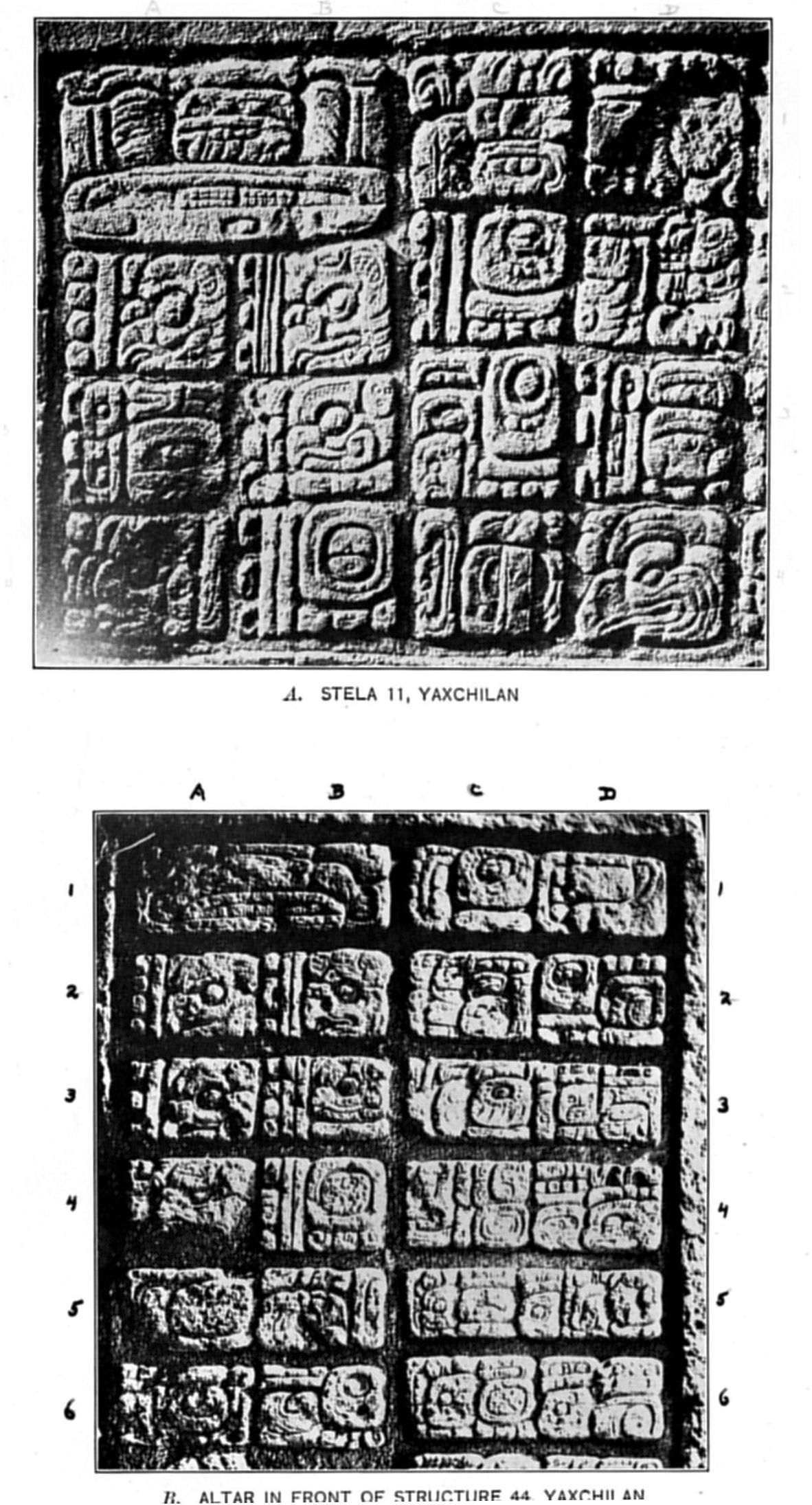
GLYPHS REPRESENTING INITIAL SERIES, SHOWING USE OF BAR AND DOT NUMERALS AND HEAD-VARIANT PERIOD GLYPHS
In plate 9, B, is figured the Initial Series on an altar in front of Structure 44 at Yaxchilan.[146] The introducing glyph appears in A1 B1 and is followed by the number in A2-A4. The period glyphs are all expressed as head variants and the coefficients as bar and dot numerals. Excepting the kin coefficient in A4, the number is quite easily read as 9.12.8.14.? An inspection of our text shows that the coefficient must be 0, 1, 2, or 3. Let us work out the terminal dates for all four of these values, commencing with 0, and then see which of the resulting terminal days is the one actually recorded in A4. Reducing the number 9.12.8.14.0 to units of the first order by means of Table XIII, we have:
A2 = 9 × 144,000 = 1,296,000
B2 = 12 × 7,200 = 86,400
A3 = 8 × 360 = 2,880
B3 = 14 × 20 = 280
A4 = 0 × 1 = 0
————
1,385,560
Deducting from this number all the Calendar Rounds possible, 73 (see Table XVI), and applying rules 1, 2, and 3 (pp. 139, 140, and 141, respectively), to the remainder, the terminal day reached will be 11 Ahau 3 Pop. Therefore the Initial-series numbers 9.12.8.14.1, 9.12.8.14.2, and 9.12.8.14.3 will lead to the three days immediately following 9.12.8.14.0 11 Ahau 3 Pop. Therefore our four possible terminal dates will be:
9.12.8.14.0 11 Ahau 3 Pop
9.12.8.14.1 12 Imix 4 Pop ←
9.12.8.14.2 13 Ik 5 Pop
9.12.8.14.3 01 Akbal 6 Pop
Now let us look for one of these four terminal dates in the text. The day reached by an Initial Series is almost invariably recorded immediately after the last period glyph; therefore, if this inscription is regular, the day glyph should be B4. This glyph probably has the coefficient 12 (2 bars and 2 numerical dots), the oblong element between probably being ornamental only. This number must be either 11 or 12, since if it were 13 the 3 dots would all be of the same size, which is not the case. An inspection of the coefficient in B4 eliminates from consideration, therefore, the last two of the above four possible terminal dates, and reduces the possible values for the kin coefficient in A4 to 0 or 1. Comparing the glyph in B4 with the day signs in figure 16, the form here recorded will be found to be identical with the sign for Imix in figure 16, a. This eliminates the first terminal date above and leaves the second, the day part of which we have just seen appears in B4. This further proves that the kin coefficient in A4 is 1. The final confirmation of this identification will come from the month glyph, which must be 4 Pop if we have correctly identified the day as 12 Imix. If, on the other hand, the day were 11 Ahau, the month glyph would be 3 Pop. Passing over A5 B5, A6 B6, C1 D1, and C2, we, reach in D2a the closing glyph of the Supplementary Series, here showing the coefficient 9. Compare this form with figure 65. The month glyph, therefore, should appear in D2b. The coefficient of this glyph is very clearly 4, thus confirming our identification of B4 as 12 Imix. (See Table VII.) And finally, the month glyph itself is Pop. Compare D2b with figure 19, a. The whole Initial Series in plate 9, B, therefore reads 9.12.8.14.1 12 Imix 4 Pop.
In plate 10, is figured the Initial Series from Stela 3 at Tikal.[147] The introducing glyph, though somewhat effaced, may still be recognized in A1. The Initial-series number follows in B1-B3. The head-variant period glyphs are too badly weathered to show the determining characteristic in each case, except the uinal head in A3, the mouth curl of which appears clearly, and their identification rests on their relative positions with reference to the introducing glyph. The reliability of this basis of identification for the period glyphs of Initial Series has been thoroughly tested in the texts already presented and is further confirmed in this very inscription by the uinal head. Even if the large mouth curl of the head in A3 had not proved that the uinal was recorded here, we should have assumed this to be the case because this glyph, A3, is the fourth from the introducing glyph. The presence of the mouth curl therefore confirms the identification based on position. The student will have no difficulty in reading the number recorded in B1-B3 as 9.2.13.0.0.
Reducing this number by means of Table XIII to units of the first order, we obtain:
B1 = 9 × 144,000 = 1,296,000
A2 = 2 × 7,200 = 14,400
B2 = 13 × 360 = 4,680
A3 = 0 × 20 = 0
B3 = 0 × 1 = 0
————
1,315,080
Deducting all the Calendar Rounds possible from this number, 69 (see Table XVI), and applying rules 1, 2, and 3 (pp. 139, 140, and 141, respectively) to the remainder, the terminal date reached will be 4 Ahau 13 Kayab. It remains to find this date in the text. The glyph in A4, the proper position for the day glyph, is somewhat effaced, though the profile of the human head may yet be traced, thus enabling us to identify this form as the day sign Ahau. Compare figure 16, h', i'. The coefficient of A4 is very clearly 4 dots, that is, 4, and consequently this glyph agrees with the day as determined by calculation, 4 Ahau. Passing over B4, A5, B5, and A6, we reach in B6 the closing glyph of the Supplementary Series, here recorded with a coefficient of 9. Compare B6 with figure 65. The month glyph follows in A7 with the coefficient 13. Comparing this latter glyph with the month signs in figure 19, it is evident that the month Kayab (fig. 19, d'-f') is recorded in A7, which reads, therefore, 13 Kayab. Hence the whole text records the Initial Series 9.2.13.0.0 4 Ahau 13 Kayab.
BUREAU OF AMERICAN ETHNOLOGYBULLETIN 57 PLATE 10
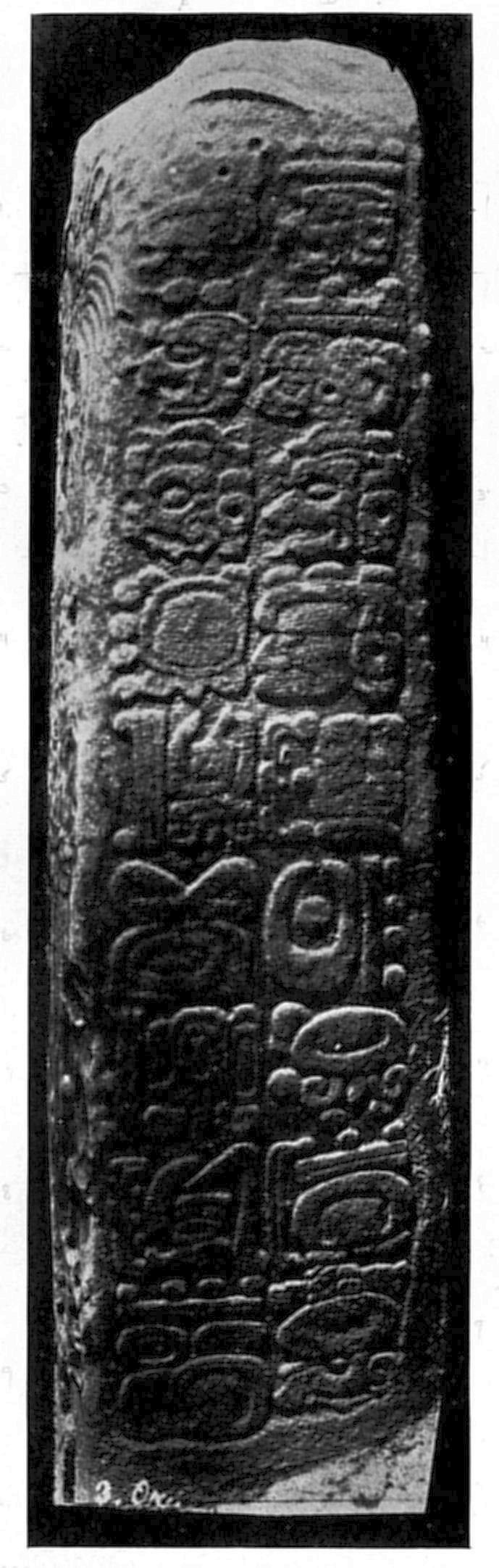
GLYPHS REPRESENTING INITIAL SERIES, SHOWING USE OF BAR AND DOT NUMERALS AND HEAD-VARIANT PERIOD GLYPHS—STELA 3, TIKAL
BUREAU OF AMERICAN ETHNOLOGYBULLETIN 57 PLATE 11
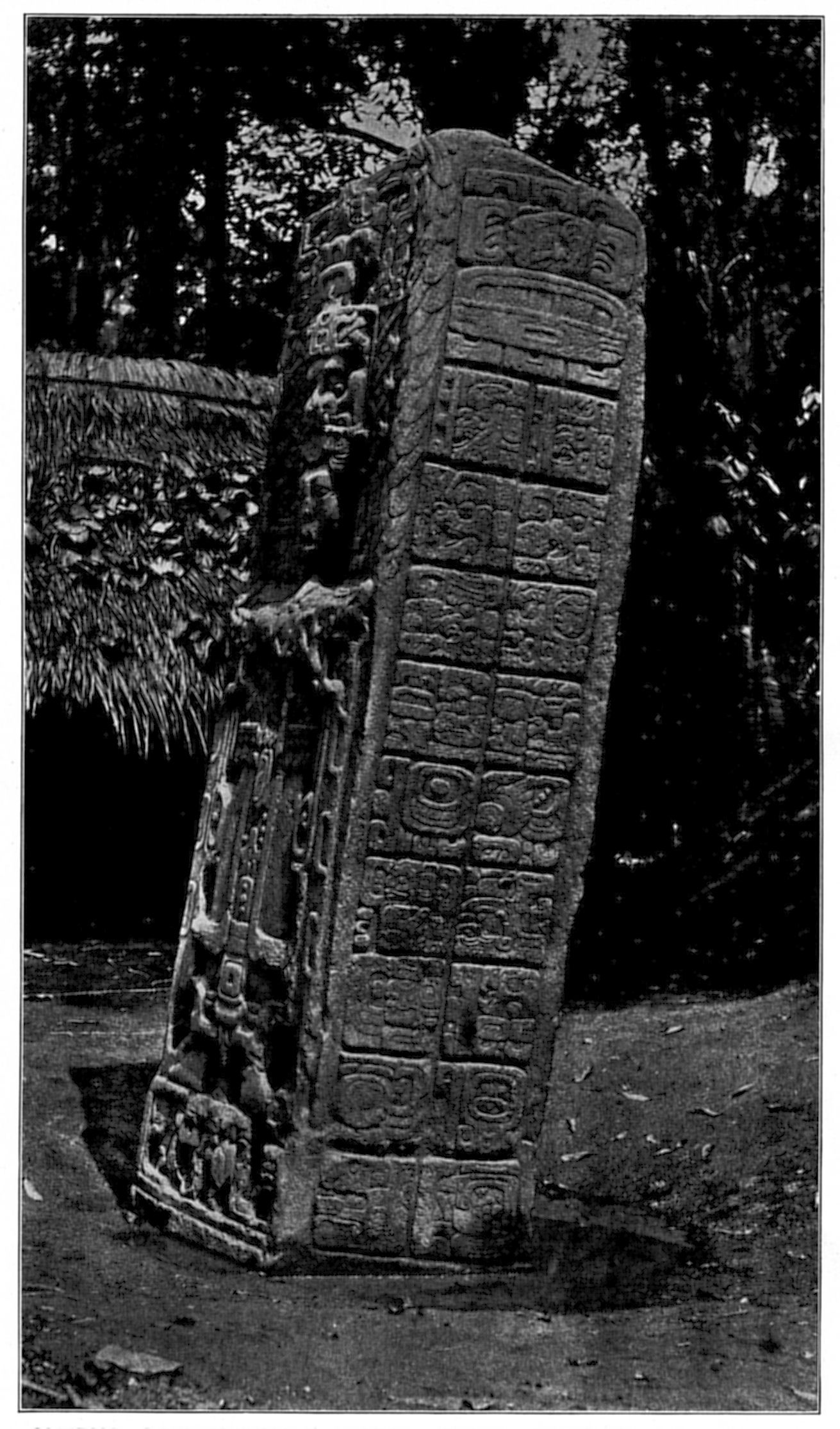
GLYPHS REPRESENTING INITIAL SERIES, SHOWING USE OF BAR AND DOT NUMERALS AND HEAD-VARIANT PERIOD GLYPHS—STELA A (EAST SIDE), QUIRIGUA
This Initial Series is extremely important, because it records the earliest contemporaneous[148] date yet found on a monument[149] in the Maya territory.
In plate 11 is figured the Initial Series from the east side of Stela A at Quirigua.[150] The introducing glyph appears in A1-B2 and the Initial-series number in A3-A5. The student will have little difficulty in picking out the clasped hand in A3, the oval in the top of the head in B3, the fleshless lower jaw in A4, the mouth curl in B4, as the essential characteristic of the cycle, katun, tun, and uinal heads, respectively. The kin head in A5 is the banded-headdress variant (compare fig. 34, i, j), and this completes the number, which is 9.17.5.0.0. Reducing this by means of Table XIII to units of the first order, we have: