Front matter (continued 4)
Reading edition
But because this is true it does not necessarily follow that 13 cycles made 1 great cycle. Before deciding this point let us examine the two Initial Series mentioned above, as not proceeding from the date 4 Ahau 8 Cumhu, but from a date 4 Ahau 8 Zotz, exactly 13 cycles in advance of the former date.
These are in the Temple of the Cross at Palenque and on the east side of Stela C at Quirigua. In these two cases, if the long numbers expressed in terms of cycles, katuns, tuns, uinals, and kins are reduced to kins, and counted forward from the date 4 Ahau 8 Cumhu, the starting point of Maya chronology, in neither case will the recorded terminal day of the Initial Series be reached; hence these two Initial Series could not have had the day 4 Ahau 8 Cumhu as their starting point. It may be noted here that these two Initial Series are the only ones throughout the inscriptions known at the present time which are not counted from the date 4 Ahau 8 Cumhu.[77] However, by counting backward each of these long numbers from their respective terminal days, 8 Ahau 18 Tzec, in the case of the Palenque Initial Series, and 4 Ahau 8 Cumhu, in the case of the Quirigua Initial Series, it will be found that both of them proceed from the same starting point, a date 4 Ahau 8 Zotz, exactly 13 cycles in advance of the starting point of Maya chronology. Or, in other words, the starting point of all Maya Initial Series save two, was exactly 13 cycles later than the starting point of these two. Because of this fact and the fact that the cycles were numbered from 1 to 13, inclusive, as shown above, Mr. Bowditch and Mr. Goodman have reached the conclusion that in the inscriptions only 13 cycles were required to make 1 great cycle.
It remains to present the points against this hypothesis, which seem to indicate that the great cycle in the inscriptions contained the same number of cycles (20) as in the codices:
1. In the codices where six orders (great cycles) are recorded it takes 20 of the 5th order (cycles) to make 1 of the 6th order. This absolute uniformity in a strict vigesimal progression in the codices, so similar in other respects to the inscriptions, gives presumptive support at least to the hypothesis that the 6th order in the inscriptions was formed in the same way.
2. The numerical system in both the codices and inscriptions is identical even to the slight irregularity in the second place, where only 18 instead of 20 units were required to make 1 of the third place. It would seem probable, therefore, that had there been any irregularity in the 5th place in the inscriptions (for such the use of 13 in a vigesimal system must be called), it would have been found also in the codices.
3. Moreover, in the inscriptions themselves the cycle glyph occurs at least twice (see fig. 57, a, b) with a coefficient greater than 13, which would seem to imply that more than 13 cycles could be recorded, and consequently that it required more than 13 to make 1 of the period next higher. The writer knows of no place in the inscriptions where 20 kins, 18 uinals, 20 tuns, or 20 katuns are recorded, each of these being expressed as 1 uinal, 1 tun, 1 katun, and 1 cycle, respectively.[78] Therefore, if 13 cycles had made 1 great cycle, 14 cycles would not have been recorded, as in figure 57, a, but as 1 great cycle and 1 cycle; and 17 cycles would not have been recorded, as in b of the same figure, but as 1 great cycle and 4 cycles. The fact that they were not recorded in this latter manner would seem to indicate, therefore, that more than 13 cycles were required to make a great cycle, or unit of the 6th place, in the inscriptions as well as in the codices.
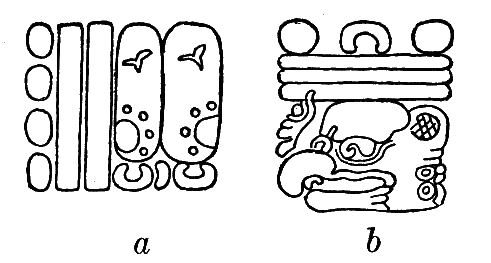
Fig. 57. Signs for the cycle showing coefficients above 13: a, From the Temple of the Inscriptions, Palenque; b, from Stela N, Copan.
The above points are simply positive evidence in support of this hypothesis, however, and in no way attempt to explain or otherwise account for the undoubtedly contradictory points given in the discussion of (1) on pages 108-109. Furthermore, not until these contradictions have been cleared away can it be established that the great cycle in the inscriptions was of the same length as the great cycle in the codices. The writer believes the following explanation will satisfactorily dispose of these contradictions and make possible at the same time the acceptance of the theory that the great cycle in the inscriptions and in the codices was of equal length, being composed in each case of 20 cycles.
Assuming for the moment that there were 13 cycles in a great cycle; it is clear that if this were the case 13 cycles could never be recorded in the inscriptions, for the reason that, being equal to 1 great cycle, they would have to be recorded in terms of a great cycle. This is true because no period in the inscriptions is ever expressed, so far as now known, as the full number of the periods of which it was composed. For example, 1 uinal never appears as 20 kins; 1 tun is never written as its equivalent, 18 uinals; 1 katun is never recorded as 20 tuns, etc. Consequently, if a great cycle composed of 13 cycles had come to its end with the end of a Cycle 13, which fell on a day 4 Ahau 8 Cumhu, such a Cycle 13 could never have been expressed, since in its place would have been recorded the end of the great cycle which fell on the same day. In other words, if there had been 13 cycles in a great cycle, the cycles would have been numbered from 0 to 12, inclusive, and the last, Cycle 13, would have been recorded instead as completing some great cycle. It is necessary to admit this point or repudiate the numeration of all the other periods in the inscriptions. The writer believes, therefore, that, when the starting point of Maya chronology is declared to be a date 4 Ahau 8 Cumhu, which an "ending sign" and a Cycle 13 further declare fell at the close of a Cycle 13, this does not indicate that there were 13 cycles in a great cycle, but that it is to be interpreted as a Period-ending date, pure and simple. Indeed, where this date is found in the inscriptions it occurs with a Cycle 13, and an "ending sign" which is practically identical with other undoubted "ending signs." Moreover, if we interpret these places as indicating that there were only 13 cycles in a great cycle, we have equal grounds for saying that the great cycle contained only 10 cycles. For example, on Zoömorph G at Quirigua the date 7 Ahau 18 Zip is accompanied by an "ending sign" and Cycle 10, which on this basis of interpretation would signify that a great cycle had only 10 cycles. Similarly, it could be shown by such an interpretation that in some cases a cycle had 14 katuns, that is, where the end of a Katun 14 was recorded, or 17 katuns, where the end of a Katun 17 was recorded. All such places, including the date 4 Ahau 8 Cumhu, which closed a Cycle 13 at the starting point of Maya chronology, are only Period-ending dates, the writer believes, and have no reference to the number of periods which any higher period contains whatsoever. They record merely the end of a particular period in the Long Count as the end of a certain Cycle 13, or a certain Cycle 10, or a certain Katun 14, or a certain Katun 17, as the case may be, and contain no reference to the beginning or the end of the period next higher.
There can be no doubt, however, as stated above, that the cycles were numbered from 1 to 13, inclusive, and then began again with 1. This sequence strikingly recalls that of the numerical coefficients of the days, and in the parallel which this latter sequence affords, the writer believes, lies the true explanation of the misconception concerning the length of the great cycle in the inscriptions.
Table XI. SEQUENCE OF TWENTY CONSECUTIVE DATES IN THE MONTH POP
01 Ik 0 Pop 11 Eb 10 Pop
02 Akbal 1 Pop 12 Ben 11 Pop
03 Kan 2 Pop 13 Ix 12 Pop
04 Chicchan 3 Pop 01 Men 13 Pop
05 Cimi 4 Pop 02 Cib 14 Pop
06 Manik 5 Pop 03 Caban 15 Pop
07 Lamat 6 Pop 04 Eznab 16 Pop
08 Muluc 7 Pop 05 Cauac 17 Pop
09 Oc 8 Pop 06 Ahau 18 Pop
10 Chuen 9 Pop 07 Imix 19 Pop
The numerical coefficients of the days, as we have seen, were numbered from 1 to 13, inclusive, and then began again with 1. See Table XI, in which the 20 days of the month Pop are enumerated. Now it is evident from this table that, although the coefficients of the days themselves do not rise above 13, the numbers showing the positions of these days in the month continue up through 19. In other words, two different sets of numerals were used in describing the Maya days: (1) The numerals 1 to 13, inclusive, the coefficients of the days, and an integral part of their names; and (2) The numerals 0 to 19, inclusive, showing the positions of these days in the divisions of the year—the uinals, and the xma kaba kin. It is clear from the foregoing, moreover, that the number of possible day coefficients (13) has nothing whatever to do in determining the number of days in the period next higher. That is, although the coefficients of the days are numbered from 1 to 13, inclusive, it does not necessarily follow that the next higher period (the uinal) contained only 13 days. Similarly, the writer believes that while the cycles were undoubtedly numbered—that is, named—from 1 to 13, inclusive, like the coefficients of the days, it took 20 of them to make a great cycle, just as it took 20 kins to make a uinal. The two cases appear to be parallel. Confusion seems to have arisen through mistaking the name of the period for its position in the period next higher—two entirely different things, as we have seen.
A somewhat similar case is that of the katuns in the u kahlay katunob in Table IX. Assuming that a cycle commenced with the first katun there given, the name of this katun is Katun 2 Ahau, although it occupied the first position in the cycle. Again, the name of the second katun in the sequence is Katun 13 Ahau, although it occupied the second position in the cycle. In other words, the katuns of the u kahlay katunob were named quite independently of their position in the period next higher (the cycle), and their names do not indicate the corresponding positions of the katun in the period next higher.
Applying the foregoing explanation to those passages in the inscriptions which show that the enumeration of the cycles was from 1 to 13, inclusive, we may interpret them as follows: When we find the date 4 Ahau 8 Cumhu in the inscriptions, accompanied by an "ending sign" and a Cycle 13, that "Cycle 13," even granting that it stands at the end of some great cycle, does not signify that there were only 13 cycles in the great cycle of which it was a part. On the contrary, it records only the end of a particular Cycle 13, being a Period-ending date pure and simple. Such passages no more fix the length of the great cycle as containing 13 cycles than does the coefficient 13 of the day name 13 Ix in Table XI limit the number of days in a uinal to 13, or, again, the 13 of the katun name 13 Ahau in Table IX limit the number of katuns in a cycle to 13. This explanation not only accounts for the use of the 14 cycles or 17 cycles, as shown in figure 57, a, b, but also satisfactorily provides for the enumeration of the cycles from 1 to 13, inclusive.
If the date "4 Ahau 8 Cumhu ending Cycle 13" be regarded as a Period-ending date, not as indicating that the number of cycles in a great cycle was restricted to 13, the next question is—Did a great cycle also come to an end on the date 4 Ahau 8 Cumhu—the starting point of Maya chronology and the closing date of a Cycle 13? That it did the writer is firmly convinced, although final proof of the point can not be presented until numerical series containing more than 5 terms shall have been considered. (See pp. 114-127 for this discussion.) The following points, however, which may be introduced here, tend to prove this condition:
1. In the natural course of affairs the Maya would have commenced their chronology with the beginning of some great cycle, and to have done this in the Maya system of counting time—that is, by elapsed periods—it was necessary to reckon from the end of the preceding great cycle as the starting point.
2. Moreover, it would seem as though the natural cycle with which to commence counting time would be a Cycle 1, and if this were done time would have to be counted from a Cycle 13, since a Cycle 1 could follow only a Cycle 13.
On these two probabilities, together with the discussion on pages 114-127, the writer is inclined to believe that the Maya commenced their chronology with the beginning of a great cycle, whose first cycle was named Cycle 1, which was reckoned from the close of a great cycle whose ending cycle was a Cycle 13 and whose ending day fell on the date 4 Ahau 8 Cumhu.
The second point (see p. 108) on which rests the hypothesis of "13 cycles to a great cycle" in the inscriptions admits of no such plausible explanation as the first point. Indeed, it will probably never be known why in two inscriptions the Maya reckoned time from a starting point different from that used in all the others, one, moreover, which was 13 cycles in advance of the other, or more than 5,000 years earlier than the beginning of their chronology, and more than 8,000 years earlier than the beginning of their historic period. That this remoter starting point, 4 Ahau 8 Zotz, from which proceed so far as known only two inscriptions throughout the whole Maya area, stood at the end of a great cycle the writer does not believe, in view of the evidence presented on pages 114-127. On the contrary, the material given there tends to show that although the cycle which ended on the day 4 Ahau 8 Zotz was also named Cycle 13,[79] it was the 8th division of the grand cycle which ended on the day 4 Ahau 8 Cumhu, the starting point of Maya chronology, and not the closing division of the preceding grand cycle. However, without attempting to settle this question at this time, the writer inclines to the belief, on the basis of the evidence at hand, that the great cycle in the inscriptions was of the same length as in the codices, where it is known to have contained 20 cycles.
Let us return to the discussion interrupted on page 107, where the first method of expressing the higher numbers was being explained. We saw there how the higher numbers up to and including 1,872,000 were written, and the digression just concluded had for its purpose ascertaining how the numbers above this were expressed; that is, whether 13 or 20 units of the 5th order were equal to 1 unit of the 6th order. It was explained also that this number, 1,872,000, was perhaps the highest which has been found in the inscriptions. Three possible exceptions, however, to this statement should be noted here: (1) On the east side of Stela N at Copan six periods are recorded (see fig. 58); (2) on the west panel from the Temple of the Inscriptions at Palenque six and probably seven periods occur (see fig. 59); and (3) on Stela 10 at Tikal eight and perhaps nine periods are found (see fig. 60). If in any of these cases all of the periods belong to one and the same numerical series, the resulting numbers would be far higher than 1,872,000. Indeed, such numbers would exceed by many millions all others throughout the range of Maya writings, in either the codices or the inscriptions.
Before presenting these three numbers, however, a distinction should be drawn between them. The first and second (figs. 58, 59) are clearly not Initial Series. Probably they are Secondary Series, although this point can not be established with certainty, since they can not be connected with any known date the position of which is definitely fixed. The third number (fig. 60), on the other hand, is an Initial Series, and the eight or nine periods of which it is composed may fix the initial date of Maya chronology (4 Ahau 8 Cumhu) in a much grander chronological scheme, as will appear presently.

Fig. 58. Part of the inscription on Stela N, Copan, showing a number composed of six periods.
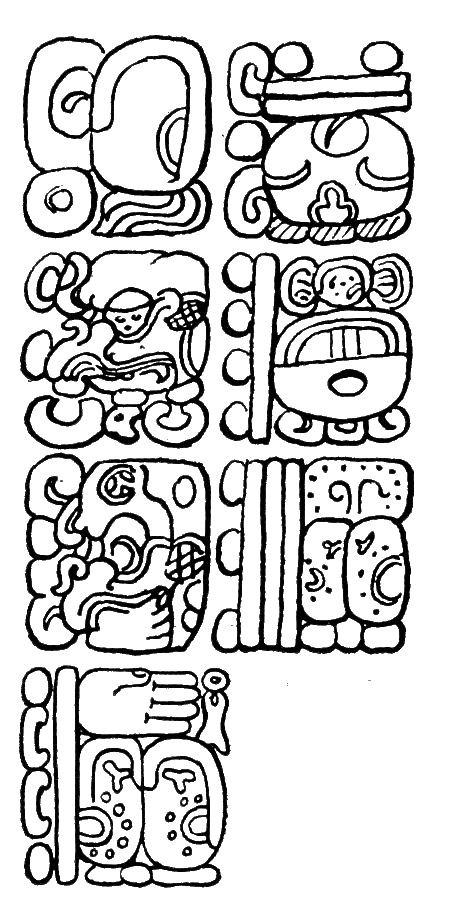
Fig. 59. Part of the inscription in the Temple of the Inscriptions, Palenque, showing a number composed of seven periods.
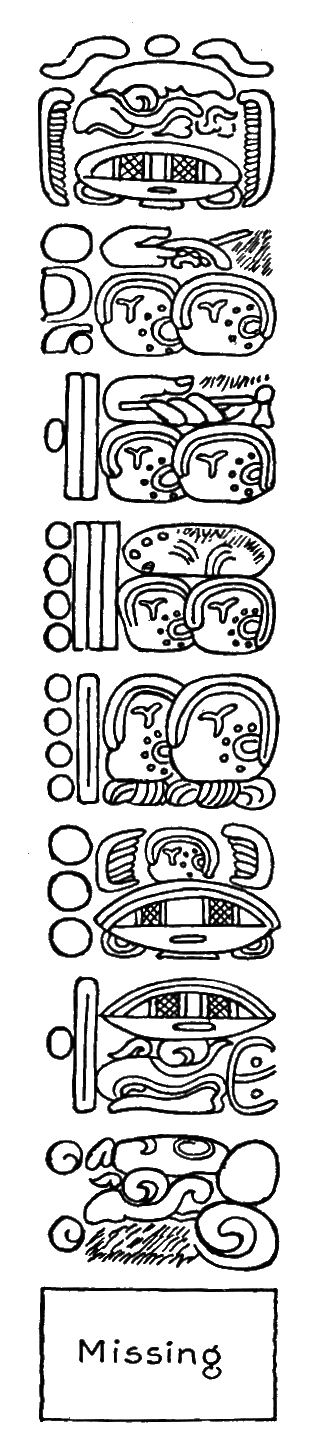
Fig. 60. Part of the inscription on Stela 10, Tikal (probably an Initial Series), showing a number composed of eight periods.
The first of these three numbers (see fig. 58), if all its six periods belong to the same series, equals 42,908,400. Although the order of the several periods is just the reverse of that in the numbers in figure 56, this difference is unessential, as will shortly be explained, and in no way affects the value of the number recorded. Commencing at the bottom of figure 58 with the highest period involved and reading up, A6,[80] the 14 great cycles = 40,320,000 kins (see Table VIII, in which 1 great cycle = 2,880,000, and consequently 14 = 14 × 2,880,000 = 40,320,000); A5, the 17 cycles = 2,448,000 kins (17 × 144,000); A4, the 19 katuns = 136,800 kins (19 × 7,200); A3, the 10 tuns = 3,600 kins (10 × 360); A2, the 0 uinals, 0 kins; and the 0 kins, 0 kins. The sum of these products = 40,320,000 + 2,448,000 + 136,800 + 3,600 + 0 + 0 = 42,908,400.
The second of these three numbers (see fig. 59), if all of its seven terms belong to one and the same number, equals 455,393,401. Commencing at the bottom as in figure 58, the first term A4, has the coefficient 7. Since this is the term following the sixth, or great cycle, we may call it the great-great cycle. But we have seen that the great cycle = 2,880,000; therefore the great-great cycle = twenty times this number, or 57,600,000. Our text shows, however, that seven of these great-great cycles are used in the number in question, therefore our first term = 403,200,000. The rest may be reduced by means of Table VIII as follows: B3, 18 great cycles = 51,840,000; A3, 2 cycles = 288,000; B2, 9 katuns = 64,800; A2, 1 tun = 360; B1, 12 uinals = 240; B1, 1 kin = 1. The sum of these (403,200,000 + 51,840,000 + 288,000 + 64,800 + 360 + 240 +1) = 455,393,401.
The third of these numbers (see fig. 60), if all of its terms belong to one and the same number, equals 1,841,639,800. Commencing with A2, this has a coefficient of 1. Since it immediately follows the great-great cycle, which we found above consisted of 57,600,000, we may assume that it is the great-great-great cycle, and that it consisted of 20 great-great cycles, or 1,152,000,000. Since its coefficient is only 1, this large number itself will be the first term in our series. The rest may readily be reduced as follows: A3, 11 great-great cycles = 633,600,000; A4, 19 great cycles = 54,720,000; A5, 9 cycles = 1,296,000; A6, 3 katuns = 21,600; A7, 6 tuns = 2,160; A8, 2 uinals = 40; A9, 0 kins = 0.[81] The sum of these (1,152,000,000 + 633,600,000 + 54,720,000 + 1,296,000 + 21,600 + 2,160 + 40 + 0) = 1,841,639,800, the highest number found anywhere in the Maya writings, equivalent to about 5,000,000 years.
Whether these three numbers are actually recorded in the inscriptions under discussion depends solely on the question whether or not the terms above the cycle in each belong to one and the same series. If it could be determined with certainty that these higher periods in each text were all parts of the same number, there would be no further doubt as to the accuracy of the figures given above; and more important still, the 17 cycles of the first number (see A5, fig. 58) would then prove conclusively that more than 13 cycles were required to make a great cycle in the inscriptions as well as in the codices. And furthermore, the 14 great cycles in A6, figure 58, the 18 in B3, figure 59, and the 19 in A4, figure 60, would also prove that more than 13 great cycles were required to make one of the period next higher—that is, the great-great cycle. It is needless to say that this point has not been universally admitted. Mr. Goodman (1897: p. 132) has suggested in the case of the Copan inscription (fig. 58) that only the lowest four periods—the 19 katuns, the 10 tuns, the 0 uinals, and the 0 kins—A2, A3, and A4,[82] here form the number; and that if this number is counted backward from the Initial Series of the inscription, it will reach a Katun 17 of the preceding cycle. Finally, Mr. Goodman believes this Katun 17 is declared in the glyph following the 19 katuns (A5), which the writer identifies as 17 cycles, and consequently according to the Goodman interpretation the whole passage is a Period-ending date. Mr. Bowditch (1910: p. 321) also offers the same interpretation as a possible reading of this passage. Even granting the truth of the above, this interpretation still leaves unexplained the lowest glyph of the number, which has a coefficient of 14 (A6).
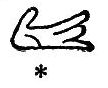
The strongest proof that this passage will not bear the construction placed on it by Mr. Goodman is afforded by the very glyph upon which his reading depends for its verification, namely, the glyph which he interprets Katun 17. This glyph (A5) bears no resemblance to the katun sign standing immediately above it, but on the contrary has for its lower jaw the clasping hand (*), which, as we have seen, is the determining characteristic of the cycle head. Indeed, this element is so clearly portrayed in the glyph in question that its identification as a head variant for the cycle follows almost of necessity. A comparison of this glyph with the head variant of the cycle given in figure 25, d-f, shows that the two forms are practically identical. This correction deprives Mr. Goodman's reading of its chief support, and at the same time increases the probability that all the 6 terms here recorded belong to one and the same number. That is, since the first five are the kin, uinal, tun, katun, and cycle, respectively, it is probable that the sixth and last, which follows immediately the fifth, without a break or interruption of any kind, belongs to the same series also, in which event this glyph would be most likely to represent the units of the sixth order, or the so-called great cycles.
The passages in the Palenque and Tikal texts (figs. 59 and 60, respectively) have never been satisfactorily explained. In default of calendric checks, as the known distance between two dates, for example, which may be applied to these three numbers to test their accuracy, the writer knows of no better check than to study the characteristics of this possible great-cycle glyph in all three, and of the possible great-great-cycle glyph in the last two.
Passing over the kins, the normal form of the uinal glyph appears in figures 58, A2, and 59, B1 (see fig. 31, a, b), and the head variant in figure 60, A8. (See fig. 31, d-f.) Below the uinal sign in A3, figure 58, and A2, figure 59, and above A7, in figure 60 the tuns are recorded as head variants, in all three of which the fleshless lower jaw, the determining characteristic of the tun head, appears. Compare these three head variants with the head variant for the tun in figure 29, d-g. In the Copan inscription (fig. 58) the katun glyph, A4, appears as a head variant, the essential elements of which seem to be the oval in the top part of the head and the curling fang protruding from the back part of the mouth. Compare this head with the head variant for the katun in figure 27, e-h. In the Palenque and Tikal texts (see figs. 59, B2, and 60, A6, respectively), on the other hand, the katun is expressed by its normal form, which is identical with the normal form shown in figure 27, a, b. In figures 58, A5, and 59, A3, the cycle is expressed by its head variant, and the determining characteristic, the clasped hand, appears in both. Compare the cycle signs in figures 58, A5, and 59, A3, with the head variant for the cycle shown in figure 25; d-f. The cycle glyph in the Tikal text (fig. 60, A5) is clearly the normal form. (See fig. 25, a-c.) The glyph following the cycle sign in these three texts (standing above the cycle sign in figure 60 at A4) probably stands for the period of the sixth order, the so-called great cycle. These three glyphs are redrawn in figure 61, a-c, respectively. In the Copan inscription this glyph (fig. 61, a) is a head variant, while in the Palenque and Tikal texts (a and b of the same figure, respectively) it is a normal form.
Inasmuch as these three inscriptions are the only ones in which numerical series composed of 6 or more consecutive terms are recorded, it is unfortunate that the sixth term in all three should not have been expressed by the same form, since this would have facilitated their comparison. Notwithstanding this handicap, however, the writer believes it will be possible to show clearly that the head variant in figure 61, a, and the normal forms in b and c are only variants of one and the same sign, and that all three stand for one and the same thing, namely, the great cycle, or unit of the sixth order.
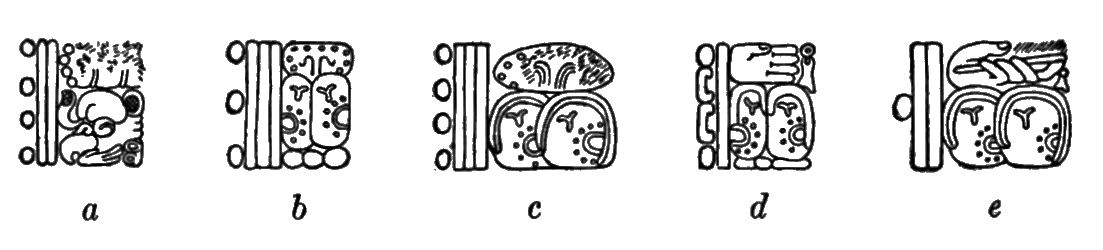
Fig. 61. Signs for the great cycle (a-c), and the great-great cycle (d, e): a, Stela N, Copan; b, d, Temple of the Inscriptions, Palenque; c, e, Stela 10, Tikal.
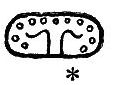
In the first place, it will be noted that each of the three glyphs just mentioned is composed in part of the cycle sign. For example, in figure 61, a, the head variant has the same clasped hand as the head-variant cycle sign in the same text (see fig. 58, A5), which, as we have seen elsewhere, is the determining characteristic of the head variant for the cycle. In figure 61, b, c, the normal forms there presented contain the entire normal form for the cycle sign; compare figure 25, a, c. Indeed, except for its superfix, the glyphs in figure 61, b, c, are normal forms of the cycle sign; and the glyph in a of the same figure, except for its superfixial element, is similarly the head variant for the cycle. It would seem, therefore, that the determining characteristics of these three glyphs must be their superfixial elements. In the normal form in figure 61, b, the superfix is very clear. Just inside the outline and parallel to it there is a line of smaller circles, and in the middle there are two infixes like shepherds' crooks facing away from the center (*). In c of the last-mentioned figure the superfix is of the same size and shape, and although it is partially destroyed the left-hand "shepherd's crook" can still be distinguished. A faint dot treatment around the edge can also still be traced. Although the superfix of the head variant in a is somewhat weathered, enough remains to show that it was similar to, if indeed not identical with, the superfixes of the normal forms in b and c. The line of circles defining the left side of this superfix, as well as traces of the lower ends of the two "shepherd's crook" infixes, appears very clearly in the lower part of the superfix. Moreover, in general shape and proportions this element is so similar to the corresponding elements in figure 61, b, c, that, taken together with the similarity of the other details pointed out above, it seems more than likely that all three of these superfixes are one and the same element. The points which have led the writer to identify glyphs a, b, and c in figure 61 as forms for the great cycle, or period of the sixth order, may be summarized as follows:

1. All three of these glyphs, head-variant as well as normal forms, are made up of the corresponding forms of the cycle sign plus another element, a superfix, which is probably the determining characteristic in each case.
2. All three of these superfixes are probably identical, thus showing that the three glyphs in which they occur are probably variants of the same sign.
3. All three of these glyphs occur in numerical series, the preceding term of which in each case is a cycle sign, thus showing that by position they are the logical "next" term (the sixth) of the series.
Let us next examine the two texts in which great-great-cycle glyphs may occur. (See figs. 59, 60.) The two glyphs which may possibly be identified as the sign for this period are shown in figure 61, d, e.
A comparison of these two forms shows that both are composed of the same elements: (1) The cycle sign; (2) a superfix in which the hand is the principal element.
The superfix in figure 61, d, consists of a hand and a tassel-like postfix, not unlike the upper half of the ending signs in figure 37, l-q. However, in the present case, if we accept the hypothesis that d of figure 61 is the sign for the great-great cycle, we are obliged to see in its superfix alone the essential element of the great-great-cycle sign, since the rest of this glyph (the lower part) is quite clearly the normal form for the cycle.
The superfix in figure 61, e, consists of the same two elements as the above, with the slight difference that the hand in e holds a rod. Indeed, the similarity of the two forms is so close that in default of any evidence to the contrary the writer believes they may be accepted as signs for one and the same period, namely, the great-great cycle.
The points on which this conclusion is based may be summarized as follows:
1. Both glyphs are made up of the same elements—(a) The normal form of the cycle sign; (b) a superfix composed of a hand with a tassel-like postfix.
2. Both glyphs occur in numerical series the next term but one of which is the cycle, showing that by position they are the logical next term but one, the seventh or great-great cycle, of the series.
3. Both of these glyphs stand next to glyphs which have been identified as great-cycle signs, that is, the sixth terms of the series in which they occur.
By this same line of reasoning it seems probable that A2 in figure 60 is the sign for the great-great-great cycle, although this fact can not be definitely established because of the lack of comparative evidence.
This possible sign for the great-great-great cycle, or period of the 8th order, is composed of two parts, just like the signs for the great cycle and the great-great cycle already described. These are: (1) The cycle sign; (2) a superfix composed of a hand and a semicircular postfix, quite distinct from the superfixes of the great cycle and great-great cycle signs.
However, since there is no other inscription known which presents a number composed of eight terms, we must lay aside this line of investigation and turn to another for further light on this point.
An examination of figure 60 shows that the glyphs which we have identified as the signs for the higher periods (A2, A3, A4, and A5,) contain one element common to all—the sign for the cycle, or period of 144,000 days. Indeed, A5 is composed of this sign alone with its usual coefficient of 9. Moreover, the next glyphs (A6, A7, A8, and A9[83]) are the signs for the katun, tun, uinal, and kin, respectively, and, together with A5, form a regular descending series of 5 terms, all of which are of known value.
The next question is, How is this glyph in the sixth place formed? We have seen that in the only three texts in which more than five periods are recorded this sign for the sixth period is composed of the same elements in each: (1) The cycle sign; (2) a superfix containing two "shepherd's crook" infixes and surrounded by dots.
Further, we have seen that in two cases in the inscriptions the cycle sign has a coefficient greater than 13, thus showing that in all probability 20, not 13, cycles made 1 great cycle.
Therefore, since the great-cycle signs in figure 61, a-c, are composed of the cycle sign plus a superfix (*), this superfix must have the value of 20 in order to make the whole glyph have the value of 20 cycles, or 1 great cycle (that is, 20 × 144,000 = 2,880,000). In other words, it may be accepted (1) that the glyphs in figure 61, a-c, are signs for the great cycle, or period of the sixth place; and (2) that the great cycle was composed of 20 cycles shown graphically by two elements, one being the cycle sign itself and the other a superfix having the value of 20.
It has been shown that the last six glyphs in figure 60 (A4, A5, A6, A7, A8, and A9) all belong to the same series. Let us next examine the seventh glyph or term from the bottom (A3) and see how it is formed. We have seen that in the only two texts in which more than six periods are recorded the signs for the seventh period (see fig. 61, d, e) are composed of the same elements in each: (1) The cycle sign; (2) a superfix having the hand as its principal element. We have seen, further, that in the only three places in which great cycles are recorded in the Maya writing (fig. 61, a-c) the coefficient in every case is greater than 13, thus showing that in all probability 20, not 13, great cycles made 1 great-great cycle.
Therefore, since the great-great cycle signs in figure 61, d, e, are composed of the cycle sign plus a superfix (*), this superfix must have the value of 400 (20 × 20) in order to make the whole glyph have the value of 20 great cycles, or 1 great-great cycle (20 × 2,880,000 = 57,600,000). In other words, it seems highly probable (1) that the glyphs in figure 61, d, e, are signs for the great-great cycle or period of the seventh place, and (2) that the great-great cycle was composed of 20 great cycles, shown graphically by two elements, one being the cycle sign itself and the other a hand having the value of 400.

It has been shown that the first seven glyphs (A3, A4, A5, A6, A7, A8, and A9) probably all belong to the same series. Let us next examine the eighth term (A2) and see how it is formed.
As stated above, comparative evidence can help us no further, since the text under discussion is the only one which presents a number composed of more than seven terms. Nevertheless, the writer believes it will be possible to show by the morphology of this, the only glyph which occupies the position of an eighth term, that it is 20 times the glyph in the seventh position, and consequently that the vigesimal system was perfect to the highest known unit found in the Maya writing.
We have seen (1) that the sixth term was composed of the fifth term plus a superfix which increased the fifth 20 times, and (2) that the seventh term was composed of the fifth term plus a superfix which increased the fifth 400 times, or the sixth 20 times.
Now let us examine the only known example of a sign for the eighth term (A2, fig. 60). This glyph is composed of (1) the cycle sign; (2) a superfix of two elements, (a) the hand, and (b) a semicircular element in which dots appear.
But this same hand in the super-fix of the great-great cycle increased the cycle sign 400 times (20 × 20; see A3, fig. 60). Therefore we must assume the same condition obtains here. And finally, since the eighth term = 20 × 20 × 20 × cycle, we must recognize in the second element of the superfix (*) a sign which means 20.
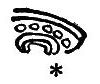
A close study of this element shows that it has two important points of resemblance to the superfix of the great-cycle glyph (see A4, fig. 60), which was shown to have the value 20: (1) Both elements have the same outline, roughly semicircular; (2) both elements have the same chain of dots around their edges.
Compare this element in A2, figure 60, with the superfixes in figure 61, a, b, bearing in mind that there is more than 275 years' difference in time between the carving of A2, figure 60, and a, figure 61, and more than 200 years between the former and figure 61, b. The writer believes both are variants of the same element, and consequently A2, figure 60, is probably composed of elements which signify 20 × 400 (20 × 20) × the cycle, which equals one great-great-great cycle, or term of the eighth place.
Thus on the basis of the glyphs themselves it seems possible to show that all belong to one and the same numerical series, which progresses according to the terms of a vigesimal system of numeration.
The several points supporting this conclusion may be summarized as follows:
1. The eight periods[84] in figure 60 are consecutive, their sequence being uninterrupted throughout. Consequently it seems probable that all belong to one and the same number.
2. It has been shown that the highest three period glyphs are composed of elements which multiply the cycle sign by 20, 400, and 8,000, respectively, which has to be the case if they are the sixth, seventh, and eighth terms, respectively, of the Maya vigesimal system of numeration.
3. The highest three glyphs have numerical coefficients, just like the five lower ones; this tends to show that all eight are terms of the same numerical series.
4. In the two texts which alone can furnish comparative data for this sixth term, the sixth-period glyph in each is identical with A4, figure 60, thus showing the existence of a sixth period in the inscriptions and a generally[85] accepted sign for it.
5. In the only other text which can furnish comparative data for the seventh term, the period glyph in its seventh place is identical with A3, figure 60; thus showing the existence of a seventh period in the inscriptions and a generally accepted sign for it.
6. The one term higher than the cycle in the Copan text, the two terms higher in the Palenque text, and the three terms higher in this text, are all built on the same basic element, the cycle, thus showing that in each case the higher term or terms is a continuation of the same number, not a Period-ending date, as suggested by Mr. Goodman for the Copan text.
7. The other two texts, showing series composed of more than five terms, have all their period glyphs in an unbroken sequence in each, like the text under discussion, thus showing that in each of these other two texts all the terms present probably belong to one and the same number.
8. Finally, the two occurrences of the cycle sign with a coefficient above 13, and the three occurrences of the great-cycle sign with a coefficient above 13, indicate that 20, not 13, was the unit of progression in the higher numbers in the inscriptions just as it was in the codices.
Before closing the discussion of this unique inscription, there is one other important point in connection with it which must be considered, because of its possible bearing on the meaning of the Initial-series introducing glyph.
The first five glyphs on the east side of Stela 10 at Tikal are not illustrated in figure 60. The sixth glyph is A1 in figure 60, and the remaining glyphs in this figure carry the text to the bottom of this side of the monument. The first of these five unfigured glyphs is very clearly an Initial-series introducing glyph. Of this there can be no doubt. The second resembles the day 8 Manik, though it is somewhat effaced. The remaining three are unknown. The next glyph, A1, figure 60, is very clearly another Initial-series introducing glyph, having all of the five elements common to that sign. Compare A1 with the forms for the Initial series introducing glyph in figure 24. This certainly would seem to indicate that an Initial Series is to follow. Moreover, the fourth glyph of the eight-term number following in A2-A9, inclusive (that is, A5), records "Cycle 9," the cycle in which practically all Initial-series dates fall. Indeed, if A2, A3, and A4 were omitted and A5, A6, A7, A8, and A9 were recorded immediately after A1, the record would be that of a regular Initial-series number (9.3.6.2.0). Can this be a matter of chance? If not, what effect can A2, A3, and A4 have on the Initial-series date in A1, A5-A9?
The writer believes that the only possible effect they could have would be to fix Cycle 9 of Maya chronology in a far more comprehensive and elaborate chronological conception, a conception which indeed staggers the imagination, dealing as it does with more than five million years.
If these eight terms all belong to one and the same numerical series, a fact the writer believes he has established in the foregoing pages, it means that Cycle 9, the first historic period of the Maya civilization, was Cycle 9 of Great Cycle 19 of Great-great Cycle 11 of Great-great-great Cycle 1. In other words, the starting point of Maya chronology, which we have seen was the date 4 Ahau 8 Cumhu, 9 cycles before the close of a Cycle 9, was in reality 1. 11. 19. 0. 0. 0. 0. 0. 4 Ahau 8 Cumhu, or simply a fixed point in a far vaster chronological conception.
Furthermore, it proves, as contended by the writer on page 113, that a great cycle came to an end on this date, 4 Ahau 8 Cumhu. This is true because on the above date (1. 11. 19. 0. 0. 0. 0. 0. 4 Ahau 8 Cumhu) all the five periods lower than the great cycle are at 0. It proves, furthermore, as the writer also contended, that the date 4 Ahau 8 Zotz, 13 cycles in advance of the date 4 Ahau 8 Cumhu, did not end a great cycle—
1.11.19.0.0.0.0.0.4 Ahau 8 Cumhu
13.0.0.0.0.
1.11.18.7.0.0.0.0.4 Ahau 8 Cumhu
but, on the contrary, was a Cycle 7 of Great Cycle 18, the end of which (19. 0. 0. 0. 0. 0. 4 Ahau 8 Cumhu) was the starting point of Maya chronology.
It seems to the writer that the above construction is the only one that can be put on this text if we admit that the eight periods in A2-A9, figure 60, all belong to one and the same numerical series.
Furthermore, it would show that the great cycle in which fell the first historic period of the Maya civilization (Cycle 9) was itself the closing great cycle of a great-great cycle, namely, Great-great Cycle 11:
1.11.19.0.0.0.0.0.
1.0.0.0.0.0.
1.12.0.0.0.0.0.0.
That is to say, that when Great Cycle 19 had completed itself, Great-great Cycle 12 would be ushered in.
We have seen on pages 108-113 that the names of the cycles followed one another in this sequence: Cycle 1, Cycle 2, Cycle 3, etc., to Cycle 13, which was followed by Cycle 1, and the sequence repeated itself. We saw, however, that these names probably had nothing to do with the positions of the cycles in the great cycle; that on the contrary these numbers were names and not positions in a higher term.
Now we have seen that Maya chronology began with a Cycle 1; that is, it was counted from the end of a Cycle 13. Therefore, the closing cycle of Great Cycle 19 of Great-great Cycle 11 of Great-great-great Cycle 1 was a Cycle 13, that is to say, 1. 11. 19. 0. 0. 0. 0. 0. 4 Ahau 13 Cumhu concluded a great cycle, the closing cycle of which was named Cycle 13. This large number, composed of one great-great-great cycle, eleven great-great cycles, and nineteen great cycles, contains exactly 12,780 cycles, as below:
1 great-great-great cycle = 1 × 20 × 20 × 20 cycles = 8,000 cycles
11 great-great cycles = 11 × 20 × 20 cycles = 4,400 cycles
19 great cycles = 19 × 20 cycles = 380 cycles
———
12,780 cycles
But the closing cycle of this number was named Cycle 13, and by deducting all the multiples of 13 possible (983) we can find the name of the first cycle of Great-great-great Cycle 1, the highest Maya time period of which we have any knowledge: 983 × 13 = 12,779. And deducting this from the number of cycles involved (12,780), we have—
12,780
12,779
———
1
This counted backward from Cycle 1, brings us again to a Cycle 13 as the name of the first cycle in the Maya conception of time. In other words, the Maya conceived time to have commenced, in so far as we can judge from the single record available, with a Cycle 13, not with the beginning of a Cycle 1, as they did their chronology.
We have still to explain A1, figure 60. This glyph is quite clearly a form of the Initial-series introducing glyph, as already explained, in which the five components of that glyph are present in usual form: (1) Trinal superfix; (2) pair of comb-like lateral appendages; (3) the tun sign; (4) the trinal subfix; (5) the variable central element, here represented by a grotesque head.
Of these, the first only claims our attention here. The trinal superfix in A1 (fig. 60), as its name signifies, is composed of three parts, but, unlike other forms of this element, the middle part seems to be nothing more nor less than a numerical dot or 1. The question at once arises, can the two flanking parts be merely ornamental and the whole element stand for the number 1? The introducing glyph at the beginning of this text (not figured here), so far as it can be made out, has a trinal superfix of exactly the same character—a dot with an ornamental scroll on each side. What can be the explanation of this element, and indeed of the whole glyph? Is it one great-great-great-great cycle—a period twenty times as great as the one recorded in A2, or is it not a term of the series in glyphs A2-A9? The writer believes that whatever it may be, it is at least not a member of this series, and in support of his belief he suggests that if it were, why should it alone be retained in recording all Initial-series dates, whereas the other three—the great-great-great cycle, the great-great cycle, and the great-cycle signs—have disappeared.
The following explanation, the writer believes, satisfactorily accounts for all of these points, though it is advanced here only by way of suggestion as a possible solution of the meaning of the Initial-series introducing glyph. It is suggested that in A1 we may have a sign representing "eternity," "this world," "time"; that is to say, a sign denoting the duration of the present world-epoch, the epoch of which the Maya civilization occupied only a small part. The middle dot of the upper element, being 1, denotes that this world-epoch is the first, or present, one, and the whole glyph itself might mean "the present world." The appropriateness of such a glyph ushering in every Initial-series date is apparent. It signified time in general, while the succeeding 7 glyphs denoted what particular day of time was designated in the inscription.
But why, even admitting the correctness of this interpretation of A1, should the great-great-great cycle, the great-great cycle, and the great cycle of their chronological scheme be omitted, and Initial-series dates always open with this glyph, which signifies time in general, followed by the current cycle? The answer to this question, the writer believes, is that the cycle was the greatest period with which the Maya could have had actual experience. It will be shown in Chapter V that there are a few Cycle-8 dates actually recorded, as well as a half a dozen Cycle-10 dates. That is, the cycle, which changed its coefficient every 400 years, was a period which they could not regard as never changing within the range of human experience. On the other hand, it was the shortest period of which they were uncertain, since the great cycle could change its coefficient only every 8,000 years—practically eternity so far as the Maya were concerned. Therefore it could be omitted as well as the two higher periods in a date without giving rise to confusion as to which great cycle was the current one. The cycle, on the contrary, had to be given, as its coefficient changed every 400 years, and the Maya are known to have recorded dates in at least three cycles—Nos. 8, 9, and 10. Hence, it was Great Cycle 19 for 8,000 years, Great-great Cycle 11 for 160,000, and Great-great-great Cycle 1 for 3,200,000 years, whereas it was Cycle 9 for only 400 years. This, not the fact that the Maya never had a period higher than the cycle, the writer believes was the reason why the three higher periods were omitted from Initial-series dates—they were unnecessary so far as accuracy was concerned, since there could never be any doubt concerning them.
It is not necessary to press this point further, though it is believed the foregoing conception of time had actually been worked out by the Maya. The archaic date recorded by Stela 10 at Tikal (9.3.6.2.0) makes this monument one of the very oldest in the Maya territory; indeed, there is only one other stela which has an earlier Initial Series, Stela 3 at Tikal. In the archaic period from which this monument dates the middle dot of the trinal superfix in the Initial-series introducing glyph may still have retained its numerical value, 1, but in later times this middle dot lost its numerical characteristics and frequently appears as a scroll itself.
The early date of Stela 10 makes it not unlikely that this process of glyph elaboration may not have set in at the time it was erected, and consequently that we have in this simplified trinal element the genesis of the later elaborated form; and, finally, that A1, figure 60, may have meant "the present world-epoch" or something similar.
In concluding the presentation of these three numbers the writer may express the opinion that a careful study of the period glyphs in figures 58-60 will lead to the following conclusions: (1) That the six periods recorded in the first, the seven in the second, and the eight or nine in the third, all belong to the same series in each case; and (2) that throughout the six terms of the first, the seven of the second, and the eight of the third, the series in each case conforms strictly to the vigesimal system of numeration given in Table VIII.
As mentioned on page 116 (footnote 2), in this method of recording the higher numbers the kin sign may sometimes be omitted without affecting the numerical value of the series wherein the omission occurs. In such cases the coefficient of the kin sign is usually prefixed to the uinal sign, the coefficient of the uinal itself standing above the uinal sign. In figure 58, for example, the uinal and the kin coefficients are both 0. In this case, however, the 0 on the left of the uinal sign is to be understood as belonging to the kin sign, which is omitted, while the 0 above the uinal sign is the uinal's own coefficient 0. Again in figure 59, the kin sign is omitted and the kin coefficient 1 is prefixed to the uinal sign, while the uinal's own coefficient 12 stands above the uinal sign. Similarly, the 12 uinals and 17 kins recorded in figure 56, d, might as well have been written as in o of the same figure, that is, with the kin sign omitted and its coefficient 17 prefixed to the uinal sign, while the uinal's own coefficient 12 appears above. Or again, the 9 uinals and 18 kins recorded in f also might have been written as in p, that is, with the kin sign omitted and the kin coefficient 18 prefixed to the uinal sign while the uinal's own coefficient 9 appears above.
In all the above examples the coefficients of the omitted kin signs are on the left of the uinal signs, while the uinal coefficients are above the uinal signs. Sometimes, however, these positions are reversed, and the uinal coefficient stands on the left of the uinal sign, while the kin coefficient stands above. This interchange in certain cases probably resulted from the needs of glyphic balance and symmetry. For example, in figure 62, a, had the kin coefficient 19 been placed on the left of the uinal sign, the uinal coefficient 4 would have been insufficient to fill the space above the period glyph, and consequently the corner of the glyph block would have appeared ragged. The use of the 19 above and the 4 to the left, on the other hand, properly fills this space, making a symmetrical glyph. Such cases, however, are unusual, and the customary position of the kin coefficient, when the kin sign is omitted, is on the left of the uinal sign, not above it. This practice, namely, omitting the kin sign in numerical series, seems to have prevailed extensively in connection with both Initial Series and Secondary Series; indeed, in the latter it is the rule to which there are but few exceptions.
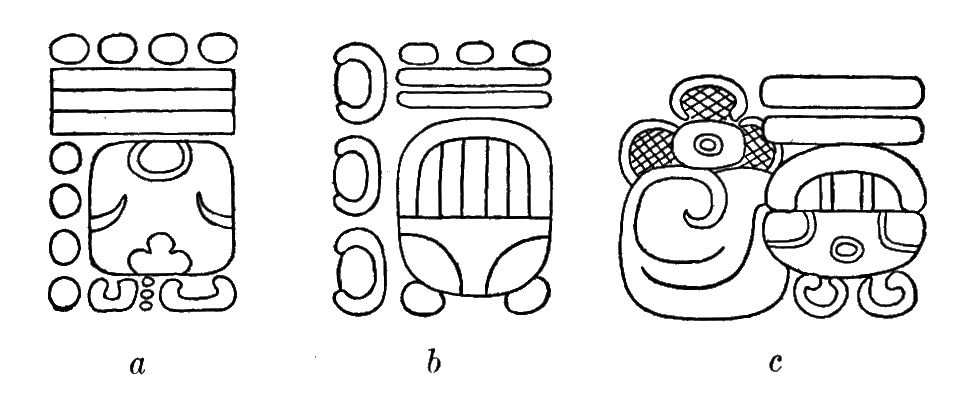
Fig. 62. Glyphs showing misplacement of the kin coefficient (a) or elimination of a period glyph (b, c): a, Stela E, Quirigua; b, Altar U, Copan; c, Stela J, Copan.
The omission of the kin sign, while by far the most common, is not the only example of glyph omission found in numerical series in the inscriptions. Sometimes, though very rarely, numbers occur in which periods other than the kin are wanting. A case in point is figure 62, b. Here a tun sign appears with the coefficient 13 above and 3 to the left. Since there are only two coefficients (13 and 3) and three time periods (tun, uinal, and kin), it is clear that the signs of both the lower periods have been omitted as well as the coefficient of one of them. In c of the last-mentioned figure a somewhat different practice was followed. Here, although three time periods are recorded—tuns, uinals and kins—one period (the uinal) and its coefficient have been omitted, and there is nothing between the 0 kins and 10 tuns. Such cases are exceedingly rare, however, and may be disregarded by the beginner.
We have seen that the order of the periods in the numbers in figure 56 was just the reverse of that in the numbers shown in figures 58 and 59; that in one place the kins stand at the top and in the other at the bottom; and finally, that this difference was not a vital one, since it had no effect on the values of the numbers. This is true, because in the first method of expressing the higher numbers, it matters not which end of the number comes first, the highest or the lowest period, so long as its several periods always stand in the same relation to each other. For example, in figure 56, q, 6 cycles, 17 katuns, 2 tuns, 10 uinals, and 0 kins represent exactly the same number as 0 kins, 10 uinals, 2 tuns, 17 katuns, and 6 cycles; that is, with the lowest term first.
It was explained on page 23 that the order in which the glyphs are to be read is from top to bottom and from left to right. Applying this rule to the inscriptions, the student will find that all Initial Series are descending series; that in reading from top to bottom and left to right, the cycles will be encountered first, the katuns next, the tuns next, the uinals, and the kins last. Moreover, it will be found also that the great majority of Secondary Series are ascending series, that is, in reading from top to bottom and left to right, the kins will be encountered first, the uinals next, the tuns next, the katuns next, and the cycles last. The reason why Initial Series always should be presented as descending series, and Secondary Series usually as ascending series is unknown; though as stated above, the order in either case might have been reversed without affecting in any way the numerical value of either series.
This concludes the discussion of the first method of expressing the higher numbers, the only method which has been found in the inscriptions.
Second Method of Numeration
The other method by means of which the Maya expressed their higher numbers (the second method given on p. 103) may be called "numeration by position," since in this method the numerical value of the symbols depended solely on position, just as in our own decimal system, in which the value of a figure depends on its distance from the decimal point, whole numbers being written to the left and fractions to the right. The ratio of increase, as the word "decimal" implies, is 10 throughout, and the numerical values of the consecutive positions increase as they recede from the decimal point in each direction, according to the terms of a geometrical progression. For example, in the number 8888.0, the second 8 from the decimal point, counting from right to left, has a value ten times greater than the first 8, since it stands for 8 tens (80); the third 8 from the decimal point similarly has a value ten times greater than the second 8, since it stands for 8 hundreds (800); finally, the fourth 8 has a value ten times greater than the third 8, since it stands for 8 thousands (8,000). Hence, although the figures used are the same in each case, each has a different numerical value, depending solely upon its position with reference to the decimal point.
In the second method of writing their numbers the Maya had devised a somewhat similar notation. Their ratio of increase was 20 in all positions except the third. The value of these positions increased with their distance from the bottom, according to the terms of the vigesimal system shown in Table VIII. This second method, or "numeration by position," as it may be called, was a distinct advance over the first, since it required for its expression only the signs for the numerals 0 to 19, inclusive, and did not involve the use of any period glyphs, as did the first method. To its greater brevity, no doubt, may be ascribed its use in the codices, where numerical calculations running into numbers of 5 and 6 terms form a large part of the subject matter. It should be remembered that in numeration by position only the normal forms of the numbers—bar and dot numerals—are used. This probably results from the fact that head-variant numerals never occur independently, but are always prefixed to some other glyph, as period, day, or month signs (see p. 104). Since no period glyphs are used in numeration by position, only normal-form numerals, that is, bar and dot numerals, can appear.
The numbers from 1 to 19, inclusive, are expressed in this method, as shown in figure 39, and the number 0 as shown in figure 46. As all of these numbers are below 20, they are expressed as units of the first place or order, and consequently each should be regarded as having been multiplied by 1, the numerical value of the first or lowest position.
The number 20 was expressed in two different ways: (1) By the sign shown in figure 45; and (2) by the numeral 0 in the bottom place and the numeral 1 in the next place above it, as in figure 63, a. The first of these had only a very restricted use in connection with the tonalamatl, wherein numeration by position was impossible, and therefore a special character for 20 (see fig. 45) was necessary. See Chapter VI.
The numbers from 21 to 359, inclusive, involved the use of two places—the kin place and the uinal place—which, according to Table VIII, we saw had numerical values of 1 and 20, respectively. For example, the number 37 was expressed as shown in figure 63, b. The 17 in the kin place has a value of 17 (17 × 1) and the 1 in the uinal, or second, place a value of 20 (1 (the numeral) × 20 (the fixed numerical value of the second place)). The sum of these two products equals 37. Again, 300 was written as in figure 63, c. The 0 in the kin place has the value 0 (0 × 1), and the 15 in the second place has the value of 300 (15 × 20), and the sum of these products equals 300.
To express the numbers 360 to 7,199, inclusive, three places or terms were necessary—kins, uinals, and tuns—of which the last had a numerical value of 360. (See Table VIII.) For example, the number 360 is shown in figure 63, d. The 0 in the lowest place indicates that 0 kins are involved, the 0 in the second place indicates that 0 uinals or 20's are involved, while the 1 in the third place shows that there is 1 tun, or 360, kins recorded (1 (the numeral) × 360 (the fixed numerical value of the third position)); the sum of these three products equals 360. Again, the number 7,113 is expressed as shown in figure 63, e. The 13 in the lowest place equals 13 (13 × 1); the 13 in the second place, 260 (13 × 20); and the 19 in the third place, 6,840 (19 × 360). The sum of these three products equals 7,113 (13 + 260 + 6,840),
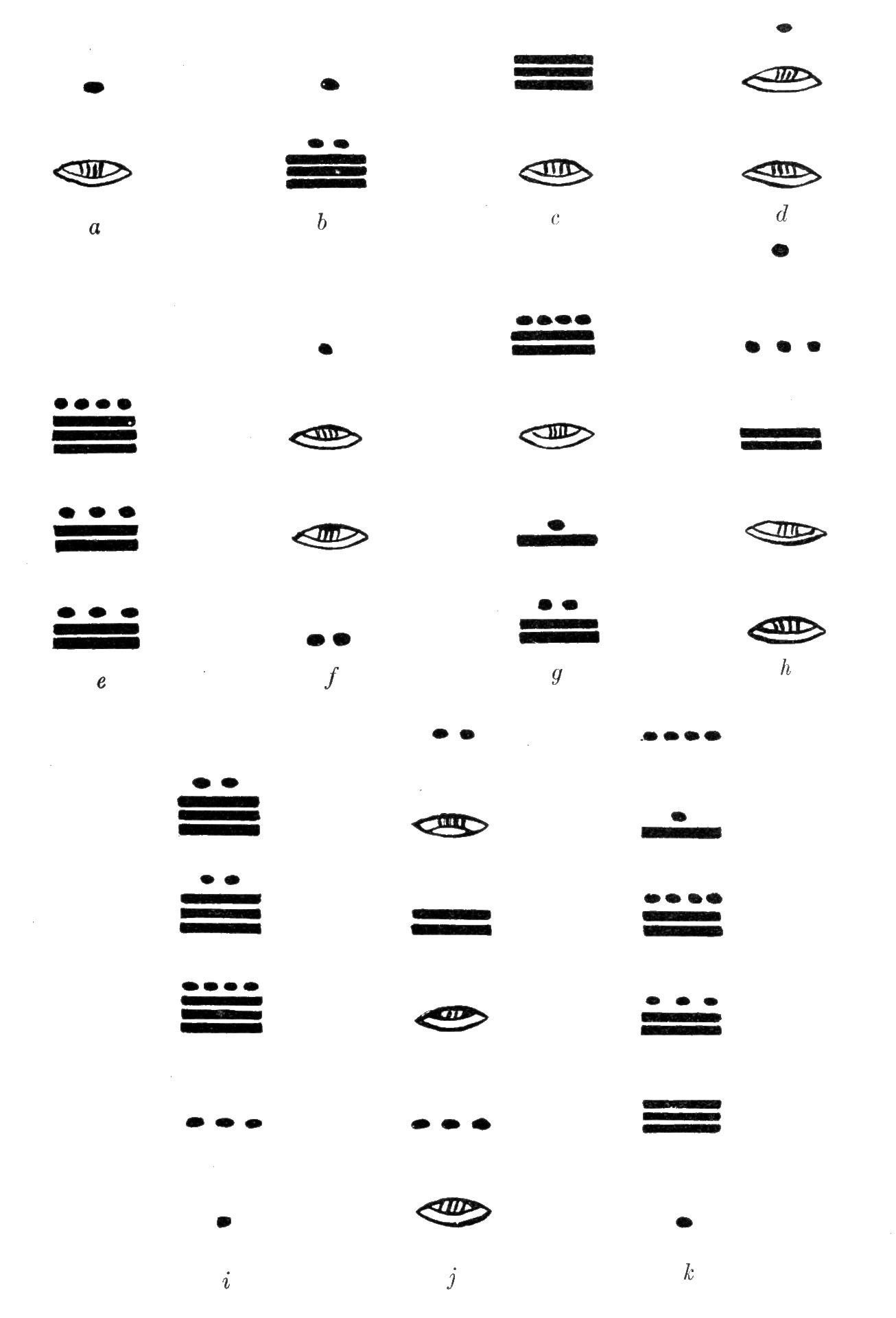
Fig. 63. Examples of the second method of numeration, used exclusively in the codices.
The numbers from 7,200 to 143,999, inclusive, involved the use of four places or terms—kins, uinals, tuns, and katuns—the last of which (the fourth place) had a numerical value of 7,200. (See Table VIII.) For example, the number 7,202 is recorded in figure 63, f. The 2 in the first place equals 2 (2×1); the 0 in the second place, 0 (0×20); the 0 in the third place, 0 (0×360); and the 1 in the fourth place, 7,200 (1×7,200). The sum of these four products equals 7,202 (2+0+0+7,200). Again, the number 100,932 is recorded in figure 63, g. Here the 12 in the first place equals 12 (12×1); the 6 in the second place, 120 (6×20); the 0 in the third place, 0 (0×360); and the 14 in the fourth place, 100,800 (14×7,200). The sum of these four products equals 100,932 (12+120+0+100,800).
The numbers from 144,000 to 2,879,999, inclusive, involved the use of five places or terms—kins, uinals, tuns, katuns, and cycles. The last of these (the fifth place) had a numerical value of 144,000. (See Table VIII.) For example, the number 169,200 is recorded in figure 63, h. The 0 in the first place equals 0 (0×1); the 0 in the second place, 0 (0×20); the 10 in the third place, 3,600 (10×360); the 3 in the fourth place, 21,600 (3×7,200); and the 1 in the fifth place, 144,000 (1×144,000). The sum of these five products equals 169,200 (0+0+3,600+21,600+144,000). Again, the number 2,577,301 is recorded in figure 63, i. The 1 in the first place equals 1 (1×1); the 3 in the second place, 60 (3×20); the 19 in the third place, 6,840 (19×360); the 17 in the fourth place, 122,400 (17×7,200); and the 17 in the fifth place, 2,448,000 (17x144,000). The sum of these five products equals 2,577,301 (1+60+6,480+122,400+2,448,000).
The writing of numbers above 2,880,000 up to and including 12,489,781 (the highest number found in the codices) involves the use of six places, or terms—kins, uinals, tuns, katuns, cycles, and great cycles—the last of which (the sixth place) has the numerical value 2,880,000. It will be remembered that some have held that the sixth place in the inscriptions contained only 13 units of the fifth place, or 1,872,000 units of the first place. In the codices, however, there are numerous calendric checks which prove conclusively that in so far as the codices are concerned the sixth place was composed of 20 units of the fifth place. For example, the number 5,832,060 is expressed as in figure 63, j. The 0 in the first place equals 0 (0×1); the 3 in the second place, 60 (3×20); the 0 in the third place, 0 (0×360); the 10 in the fourth place, 72,000 (10×7,200); the 0 in the fifth place, 0 (0×144,000); and the 2 in the sixth place, 5,760,000 (2×2,880,000). The sum of these six terms equals 5,832,060 (0+60+0+72,000+0+5,760,000). The highest number in the codices, as explained above, is 12,489,781, which is recorded on page 61 of the Dresden Codex. This number is expressed as in figure 63, k. The 1 in the first place equals 1 (1×1); the 15 in the second place, 300 (15×20); the 13 in the third place, 4,680 (13×360); the 14 in the fourth place, 100,800 (14×7,200); the 6 in the fifth place, 864,000 (6×144,000); and the 4 in the sixth place, 11,520,000 (4×2,880,000). The sum of these six products equals 12,489,781 (1+300+4,680+100,800+864,000+11,520,000).
It is clear that in numeration by position the order of the units could not be reversed as in the first method without seriously affecting their numerical values. This must be true, since in the second method the numerical values of the numerals depend entirely on their position—that is, on their distance above the bottom or first term. In the first method, the multiplicands—the period glyphs, each of which had a fixed numerical value—are always expressed[86] with their corresponding multipliers—the numerals 0 to 19, inclusive; in other words, the period glyphs themselves show whether the series is an ascending or a descending one. But in the second method the multiplicands are not expressed. Consequently, since there is nothing about a column of bar and dot numerals which in itself indicates whether the series is an ascending or a descending one, and since in numeration by position a fixed starting point is absolutely essential, in their second method the Maya were obliged not only to fix arbitrarily the direction of reading, as from bottom to top, but also to confine themselves exclusively to the presentation of one kind of series only—that is, ascending series. Only by means of these two arbitrary rules was confusion obviated in numeration by position.
However dissimilar these two methods of representing the numbers may appear at first sight, fundamentally they are the same, since both have as their basis the same vigesimal system of numeration. Indeed, it can not be too strongly emphasized that throughout the range of the Maya writings, codices, inscriptions, or Books of Chilam Balam[87] the several methods of counting time and recording events found in each are all derived from the same source, and all are expressions of the same numerical system.
That the student may better grasp the points of difference between the two methods they are here contrasted:
Table XII. COMPARISON OF THE TWO METHODS OF NUMERATION
FIRST METHOD SECOND METHOD
1. Use confined almost exclusively to the inscriptions. 1. Use confined exclusively to the codices.
2. Numerals represented by both normal forms and head variants. 2. Numerals represented by normal forms exclusively.
3. Numbers expressed by using the numerals 0 to 19, inclusive, as multipliers with the period glyphs as multiplicands. 3. Numbers expressed by using the numerals 0 to 19, inclusive, as multipliers in certain positions the fixed numerical values of which served as multiplicands.
4. Numbers presented as ascending or descending series. 4. Numbers presented as ascending series exclusively.
5. Direction of reading either from bottom to top, or vice versa. 5. Direction of reading from bottom to top exclusively.
We have seen in the foregoing pages (1) how the Maya wrote their 20 numerals, and (2) how these numerals were used to express the higher numbers. The next question which concerns us is, How did they use these numbers in their calculations; or in other words, how was their arithmetic applied to their calendar? It may be said at the very outset in answer to this question, that in so far as known, numbers appear to have had but one use throughout the Maya texts, namely, to express the time elapsing between dates.[88] In the codices and the inscriptions alike all the numbers whose use is understood have been found to deal exclusively with the counting of time.
This highly specialized use of the numbers in Maya texts has determined the first step to be taken in the process of deciphering them. Since the primary unit of the calendar was the day, all numbers should be reduced to terms of this unit, or in other words, to units of the first order, or place.[89] Hence, we may accept the following as the first step in ascertaining the meaning of any number:
First Step in Solving Maya Numbers
Reduce all the units of the higher orders to units of its first, or lowest, order, and then add the resulting quantities together.
The application of this rule to any Maya number, no matter of how many terms, will always give the actual number of primary units which it contains, and in this form it can be more conveniently utilized in connection with the calendar than if it were left as recorded, that is, in terms of its higher orders.
The reduction of units of the higher orders to units of the first order has been explained on pages 105-133, but in order to provide the student with this same information in a more condensed and accessible form, it is presented in the following tables, of which Table XIII is to be used for reducing numbers to their primary units in the inscriptions, and Table XIV for the same purpose in the codices.
Table XIII. VALUES OF HIGHER PERIODS IN TERMS OF LOWEST, IN INSCRIPTIONS
1 great cycle = [90]2,880,000
1 cycle 144,000
1 katun 7,200
1 tun 360
1 uinal 20
1 kin 1
Table XIV. VALUES OF HIGHER PERIODS IN TERMS OF LOWEST, IN CODICES
1 unit of the 6th place = 2,880,000
1 unit of the 5th place 144,000
1 unit of the 4th place 7,200
1 unit of the 3d place 360
1 unit of the 2d place 20
1 unit of the 1st place 1
It should be remembered, in using these tables, that each of the signs for the periods therein given has its own particular numerical value, and that this value in each case is a multiplicand which is to be multiplied by the numeral attached to it (not shown in Table XIII). For example, a 3 attached to the katun sign reduces to 21,600 units of the first order (3×7,200). Again, 5 attached to the uinal sign reduces to 100 units of the first order (5×20). In using Table XIV, however, it should be remembered that the position of a numeral multiplier determines at the same time that multiplier's multiplicand. Thus a 5 in the third place indicates that the 5's multiplicand is 360, the numerical value of the third place, and such a term reduces to 1,800 units of the first place (5×360=1,800). Again, a 10 in the fourth place indicates that the 10's multiplicand is 7,200, the numerical value corresponding to the fourth place, and such a term reduces to 72,000 units of the first place.
Having reduced all the terms of a number to units of the 1st order, the next step in finding out its meaning is to discover the date from which it is counted. This operation gives rise to the second step.
Second Step in Solving Maya Numbers
Find the date from which the number is counted:
This is not always an easy matter, since the dates from which Maya numbers are counted are frequently not expressed in the texts; consequently, it is clear that no single rule can be formulated which will cover all cases. There are, however, two general rules which will be found to apply to the great majority of numbers in the texts:
Rule 1. When the starting point or date is expressed, usually, though not invariably, it precedes[91] the number counted from it.
It should be noted, however, in connection with this rule, that the starting date hardly ever immediately precedes the number from which it is counted, but that several glyphs nearly always stand between.[92] Certain exceptions to the above rule are by no means rare, and the student must be continually on the lookout for such reversals of the regular order. These exceptions are cases in which the starting date (1) follows the number counted from it, and (2) stands elsewhere in the text, entirely disassociated from, and unattached to, the number counted from it.
The second of the above-mentioned general rules, covering the majority of cases, follows:
Rule 2. When the starting point or date is not expressed, if the number is an Initial Series the date from which it should be counted will be found to be 4 Ahau 8 Cumhu.[93]
This rule is particularly useful in deciphering numbers in the inscriptions. For example, when the student finds a number which he can identify as an Initial Series,[94] he may assume at once that such a number in all probability is counted from the date 4 Ahau 8 Cumhu, and proceed on this assumption. The exceptions to this rule, that is, cases in which the starting point is not expressed and the number is not an Initial Series, are not numerous. No rule can be given covering all such cases, and the starting points of such numbers can be determined only by means of the calculations given under the third and fourth steps, below.
Having determined the starting point or date from which a given number is to be counted (if this is possible), the next step is to find out which way the count runs; that is, whether it is forward from the starting point to some later date, or whether it is backward from the starting point to some earlier date. This process may be called the third step.
Third Step in Solving Maya Numbers
Ascertain whether the number is to be counted forward or backward from its starting point.
It may be said at the very outset in this connection that the overwhelming majority of Maya numbers are counted forward from their starting points and not backward. In other words, they proceed from earlier to later dates and not vice versa. Indeed, the preponderance of the former is so great, and the exceptions are so rare, that the student should always proceed on the postulate that the count is forward until proved definitely to be otherwise.
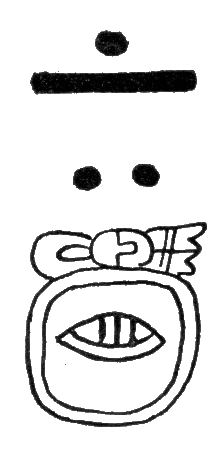
Fig. 64. Figure showing the use of the "minus" or "backward" sign in the codices.
In the codices, moreover, when the count is backward, or contrary to the general practice, the fact is clearly indicated[95] by a special character. This character, although attached only to the lowest term[96] of the number which is to be counted backward, is to be interpreted as applying to all the other terms as well, its effect extending to the number as a whole. This "backward sign" (shown in fig. 64) is a circle drawn in red around the lowest term of the number which it affects, and is surmounted by a knot of the same color. An example covering the use of this sign is given in figure 64. Although the "backward sign" in this figure surrounds only the numeral in the first place, 0, it is to be interpreted, as we have seen, as applying to the 2 in the second place and the 6 in the third place. This number, expressed as 6 tuns, 2 uinals, and 0 kins, reduces to 2,200 units of the first place, and in this form may be more readily handled (first step). Since the starting point usually precedes the number counted from it and since in figure 64 the number is expressed by the second method, its starting point will be found standing below it. This follows from the fact that in numeration by position the order is from bottom to top. Therefore the starting point from which the 2,200 recorded in figure 64 is counted will be found to be below it, that is, the date 4 Ahau 8 Cumhu[97] (second step). Finally, the red circle and knot surrounding the lowest (0) term of this 2,200 indicates that this number is to be counted backward from its starting point, not forward (third step).
On the other hand, in the inscriptions no special character seems to have been used with a number to indicate that it was to be counted backward; at least no such sign has yet been discovered. In the inscriptions, therefore, with the single exception[98] mentioned below, the student can only apply the general rule given on page 136, that in the great majority of cases the count is forward. This rule will be found to apply to at least nine out of every ten numbers. The exception above noted, that is, where the practice is so uniform as to render possible the formulation of an unfailing rule, has to do with Initial Series. This rule, to which there are no known exceptions, may be stated as follows:
Rule 1. In Initial Series the count is always forward, and, in general throughout the inscriptions. The very few cases in which the count is backward, are confined chiefly to Secondary Series, and it is in dealing with this kind of series that the student will find the greatest number of exceptions to the general rule.
Having determined the direction of the count, whether it is forward or backward, the next (fourth) step may be given.
Fourth Step in Solving Maya Numbers
To count the number from its starting point.
We have come now to a step that involves the consideration of actual arithmetical processes, which it is thought can be set forth much more clearly by the use of specific examples than by the statement of general rules. Hence, we will formulate our rules after the processes which they govern have been fully explained.
In counting any number, as 31,741, or 4.8.3.1 as it would be expressed in Maya notation,[99] from any date, as 4 Ahau 8 Cumhu, there are four unknown elements which have to be determined before we can write the date which the count reaches. These are:
1. The day coefficient, which must be one of the numerals 1 to 13, inclusive.
2. The day name, which must be one of the twenty given in Table I.
3. The position of the day in some division of the year, which must be one of the numerals 0 to 19, inclusive.
4. The name of the division of the year, which must be one of the nineteen given in Table III.
These four unknown elements all have to be determined from (1) the starting date, and (2) the number which is to be counted from it.
If the student will constantly bear in mind that all Maya sequences, whether the day coefficients, day signs, positions in the divisions of the year, or what not, are absolutely continuous, repeating themselves without any break or interruption whatsoever, he will better understand the calculations which follow.
It was explained in the text (see pp. 41-44) and also shown graphically in the tonalamatl wheel (pl. 5) that after the day coefficients had reached the number 13 they returned to 1, following each other indefinitely in this order without interruption. It is clear, therefore, that the highest multiple of 13 which the given number contains may be subtracted from it without affecting in any way the value of the day coefficient of the date which the number will reach when counted from the starting point. This is true, because no matter what the day coefficient of the starting point may be, any multiple of 13 will always bring the count back to the same day coefficient.
Taking up the number, 31,741, which we have chosen for our first example, let us deduct from it the highest multiple of 13 which it contains. This will be found by dividing the number by 13, and multiplying the whole-number part of the resulting quotient by 13: 31,741 ÷ 13 = 2,4418⁄13. Multiplying 2,441 by 13, we have 31,733, which is the highest multiple of 13 that 31,741 contains; consequently it may be deducted from 31,741 without affecting the value of the resulting day coefficient: 31,741 - 31,733 = 8. In the example under consideration, therefore, 8 is the number which, if counted from the day coefficient of the starting point, will give the day coefficient of the resulting date. In other words, after dividing by 13 the only part of the resulting quotient which is used in determining the new day coefficient is the numerator of the fractional part.[100] Hence the following rule for determining the first unknown on page 138 (the day coefficient):
Rule 1. To find the new day coefficient divide the given number by 13, and count forward the numerator of the fractional part of the resulting quotient from the starting point if the count is forward, and backward if the count is backward, deducting 13 in either case from the resulting number if it should exceed 13.
Applying this rule to 31,741, we have seen above that its division by 13 gives as the fractional part of the quotient 8⁄13. Assuming that the count is forward from the starting point, 4 Ahau 8 Cumhu, if 8 (the numerator of the fractional part of the quotient) be counted forward from 4, the day coefficient of the starting point (4 Ahau 8 Cumhu), the day coefficient of the resulting date will be 12 (4 + 8). Since this number is below 13, the last sentence of the above rule has no application in this case. In counting forward 31,741 from the date 4 Ahau 8 Cumhu, therefore, the day coefficient of the resulting date will be 12; thus we have determined our first unknown. Let us next find the second unknown, the day sign to which this 12 is prefixed.
It was explained on page 37 that the twenty day signs given in Table I succeed one another in endless rotation, the first following immediately the twentieth no matter which one of the twenty was chosen as the first. Consequently, it is clear that the highest multiple of 20 which the given number contains may be deducted from it without affecting in any way the name of the day sign of the date which the number will reach when counted from the starting point. This is true because, no matter what the day sign of the starting point may be, any multiple of 20 will always bring the count back to the same day sign.
Returning to the number 31,741, let us deduct from it the highest multiple of 20 which it contains, found by dividing the number by 20 and multiplying the whole number part of the resulting quotient by 20; 31,741 ÷ 20 = 1,5871⁄20. Multiplying 1,587 by 20, we have 31,740, which is the highest multiple of 20 that 31,741 contains, and which may be deducted from 31,741 without affecting the resulting day sign; 31,741 - 31,740 = 1. Therefore in the present example 1 is the number which, if counted forward from the day sign of the starting point in the sequence of the 20 day signs given in Table I, will reach the day sign of the resulting date. In other words, after dividing by 20 the only part of the resulting quotient which is used in determining the new day sign is the numerator of the fractional part. Thus we may formulate the rule for determining the second unknown on page 138 (the day sign):
Rule 2. To find the new day sign, divide the given number by 20, and count forward the numerator of the fractional part of the resulting quotient from the starting point in the sequence of the twenty day signs given in Table I, if the count is forward, and backward if the count is backward, and the sign reached will be the new day sign.
Applying this rule to 31,741, we have seen above that its division by 20 gives us as the fractional part of the quotient, 1⁄20. Since the count was forward from the starting point, if 1 (the numerator of the fractional part of the quotient) be counted forward in the sequence of the 20 day signs in Table I from the day sign of the starting point, Ahau (4 Ahau 8 Cumhu), the day sign reached will be the day sign of the resulting date. Counting forward 1 from Ahau in Table I, the day sign Imix is reached, and Imix, therefore, will be the new day sign. Thus our second unknown is determined.
By combining the above two values, the 12 for the first unknown and Imix for the second, we can now say that in counting forward 31,741 from the date 4 Ahau 8 Cumhu, the day reached will be 12 Imix. It remains to find what position this particular day occupied in the 365-day year, or haab, and thus to determine the third and fourth unknowns on page 138. Both of these may be found at one time by the same operation.
It was explained on pages 44-51 that the Maya year, at least in so far as the calendar was concerned, contained only 365 days, divided into 18 uinals of 20 days each, and the xma kaba kin of 5 days; and further, that when the last position in the last division of the year (4 Uayeb) was reached, it was followed without interruption by the first position of the first division of the next year (0 Pop); and, finally, that this sequence was continued indefinitely. Consequently it is clear that the highest multiple of 365 which the given number contains may be subtracted from it without affecting in any way the position in the year of the day which the number will reach when counted from the starting point. This is true, because no matter what position in the year the day of the starting point may occupy, any multiple of 365 will bring the count back again to the same position in the year.
Returning again to the number 31,741, let us deduct from it the highest multiple of 365 which it contains. This will be found by dividing the number by 365 and multiplying the whole number part of the resulting quotient by 365: 31,741 ÷ 365 = 86351⁄365. Multiplying 86 by 365, we have 31,390, which is the highest multiple that 31,741 contains. Hence it may be deducted from 31,741 without affecting the position in the year of the resulting day; 31,741 - 31,390 = 351. Therefore, in the present example, 351 is the number which, if counted forward from the year position of the starting date in the sequence of the 365 positions in the year, given in Table XV, will reach the position in the year of the day of the resulting date. This enables us to formulate the rule for determining the third and fourth unknowns on page 138 (the position in the year of the day of the resulting date):
Rule 3. To find the position in the year of the new day, divide the given number by 365 and count forward the numerator of the fractional part of the resulting quotient from the year position of the starting point in the sequence of the 365 positions of the year shown in Table XV, if the count is forward; and backward if the count is backward, and the position reached will be the position in the year which the day of the resulting date will occupy.
Table XV. THE 365 POSITIONS IN THE MAYA YEAR
Month P o p U o Z i p Z o t z T z e c X u l Y a x k i n M o l C h e n Y a x Z a c C e h M a c K a n k i n M u a n P a x K a y a b C u m h u U a y e b
Position 0 0 0 0 0 0 0 0 0 0 0 0 0 0 0 0 0 0 0
Do 1 1 1 1 1 1 1 1 1 1 1 1 1 1 1 1 1 1 1
Do 2 2 2 2 2 2 2 2 2 2 2 2 2 2 2 2 2 2 2
Do 3 3 3 3 3 3 3 3 3 3 3 3 3 3 3 3 3 3 3
Do 4 4 4 4 4 4 4 4 4 4 4 4 4 4 4 4 4 4 4
Do 5 5 5 5 5 5 5 5 5 5 5 5 5 5 5 5 5 5 ..
Do 6 6 6 6 6 6 6 6 6 6 6 6 6 6 6 6 6 6 ..
Do 7 7 7 7 7 7 7 7 7 7 7 7 7 7 7 7 7 7 ..
Do 8 8 8 8 8 8 8 8 8 8 8 8 8 8 8 8 8 8 ..
Do 9 9 9 9 9 9 9 9 9 9 9 9 9 9 9 9 9 9 ..
Do 10 10 10 10 10 10 10 10 10 10 10 10 10 10 10 10 10 10 ..
Do 11 11 11 11 11 11 11 11 11 11 11 11 11 11 11 11 11 11 ..
Do 12 12 12 12 12 12 12 12 12 12 12 12 12 12 12 12 12 12 ..
Do 13 13 13 13 13 13 13 13 13 13 13 13 13 13 13 13 13 13 ..
Do 14 14 14 14 14 14 14 14 14 14 14 14 14 14 14 14 14 14 ..
Do 15 15 15 15 15 15 15 15 15 15 15 15 15 15 15 15 15 15 ..
Do 16 16 16 16 16 16 16 16 16 16 16 16 16 16 16 16 16 16 ..
Do 17 17 17 17 17 17 17 17 17 17 17 17 17 17 17 17 17 17 ..
Do 18 18 18 18 18 18 18 18 18 18 18 18 18 18 18 18 18 18 ..
Do 19 19 19 19 19 19 19 19 19 19 19 19 19 19 19 19 19 19 ..
Applying this rule to the number 31,741, we have seen above that its division by 365 gives 351 as the numerator of the fractional part of its quotient. Assuming that the count is forward from the starting point, it will be necessary, therefore, to count 351 forward in Table XV from the position 8 Cumhu, the position of the day of the starting point, 4 Ahau 8 Cumhu.
A glance at the month of Cumhu in Table XV shows that after the position 8 Cumhu there are 11 positions in that month; adding to these the 5 in Uayeb, the last division of the year, there will be in all 16 more positions before the first of the next year. Subtracting these from 351, the total number to be counted forward, there remains the number 335 (351-16), which must be counted forward in Table XV from the beginning of the year. Since each of the months has 20 positions, it is clear that 16 months will be used before the month is reached in which will fall the 335th position from the beginning of the year. In other words, 320 positions of our 335 will exactly use up all the positions of the first 16 months, namely, Pop, Uo, Zip, Zotz, Tzec, Xul, Yaxkin, Mol, Chen, Yax, Zac, Ceh, Mac, Kankin, Muan, Pax, and will bring us to the beginning of the 17th month (Kayab) with still 15 more positions to count forward. If the student will refer to this month in Table XV he will see that 15 positions counted forward in this month will reach the position 14 Kayab, which is also the position reached by counting forward 31,741 positions from the starting position 8 Cumhu.
Having determined values for all of the unknowns on page 138, we can now say that if the number 31,741 be counted forward from the date 4 Ahau 8 Cumhu, the date 12 Imix 14 Kayab will be reached. To this latter date, i. e., the date reached by any count, the name "terminal date" has been given. The rules indicating the processes by means of which this terminal date is reached apply also to examples where the count is backward, not forward, from the starting point. In such cases, as the rules say, the only difference is that the numerators of the fractional parts of the quotients resulting from the different divisions are to be counted backward from the starting points, instead of forward as in the example above given.