Front matter (continued 3)
Reading edition
It is probable that when the meaning of the "introducing glyph" has been determined it will be found to be quite apart from the numerical side of the Initial Series, at least in so far as the distance of the terminal date from the starting point, 4 Ahau 8 Cumhu, is concerned.
While an Initial Series in the inscriptions, as has been previously explained, is invariably preceded by an "introducing glyph," the opposite does not always obtain. Some of the very earliest monuments at Copan, notably Stelæ 15, 7, and P, have "introducing glyphs" inscribed on two or three of their four sides, although but one Initial Series is recorded on each of these monuments. Examples of this use of the "introducing glyph," that is, other than as standing at the head of an Initial Series, are confined to a few of the earliest monuments at Copan, and are so rare that the beginner will do well to disregard them altogether and to follow this general rule: That in the inscriptions a glyph of the form shown in figure 24, a-e, will invariably be followed by an Initial Series.
Having reached the conclusion that the introducing glyph was not a sign for the period of the 6th order, let us next examine the signs for the remaining orders or periods of the chronological system (cycles, katuns, tuns, uinals, and kins), constantly bearing in mind that these five periods alone express the long numbers of an Initial Series.[46]
Each of the above periods has two entirely different glyphs which may express it. These have been called (1) The normal form; (2) The head variant. In the inscriptions examples of both these classes occur side by side in the same Initial Series, seemingly according to no fixed rule, some periods being expressed by their normal forms and others by their head variants. In the codices, on the other hand, no head-variant period glyphs have yet been identified, and although the normal forms of the period glyphs have been found, they do not occur as units in Initial Series.
As head variants also should be classified the so-called "full-figure glyphs," in which the periods given in Table VIII are represented by full figures instead of by heads. In these forms, however, only the heads of the figures are essential, since they alone present the determining characteristics, by means of which in each case identification is possible. Moreover, the head part of any full-figure variant is characterized by precisely the same essential elements as the corresponding head variant for the same period, or in other words, the addition of the body parts in full-figure glyphs in no way influences or changes their meanings. For this reason head-variant and full-figure forms have been treated together. These full-figure glyphs are exceedingly rare, having been found only in five Initial Series throughout the Maya area: (1) On Stela D at Copan; (2) on Zoömorph B at Quirigua; (3) on east side Stela D at Quirigua; (4) on west side Stela D at Quirigua; (5) on Hieroglyphic Stairway at Copan. A few full-figure glyphs have been found also on an oblong altar at Copan, though not as parts of an Initial Series, and on Stela 15 as a period glyph of an Initial Series.
THE CYCLE GLYPH
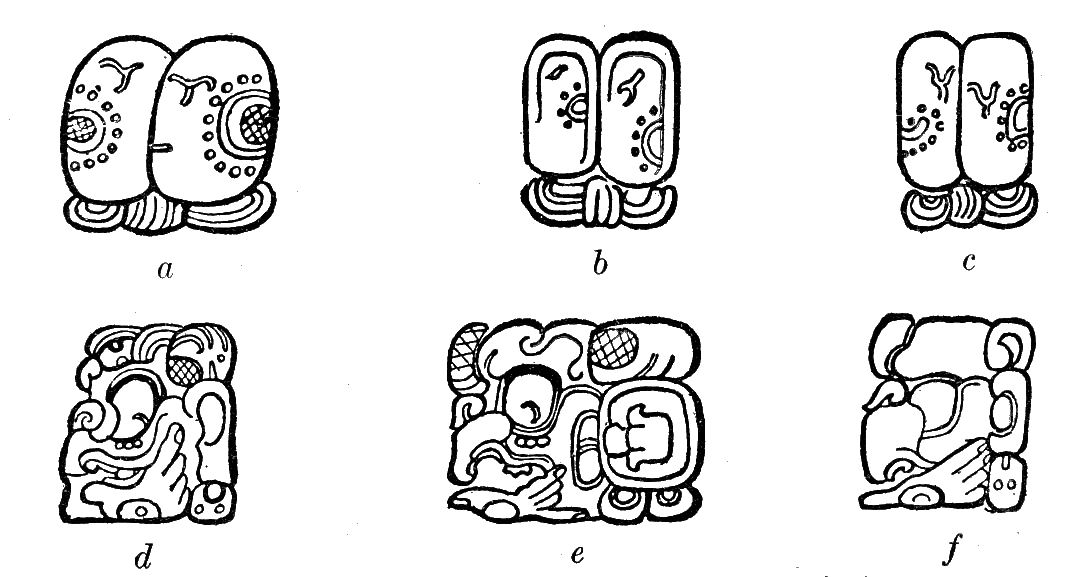
Fig. 25. Signs for the cycle: a-c, Normal forms; d-f, head variants.
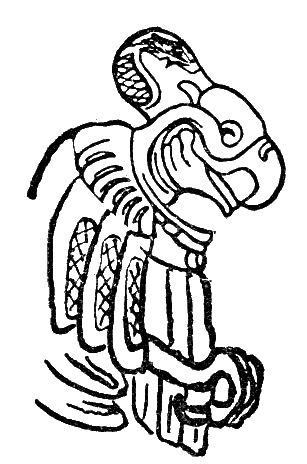
Fig. 26. Full-figure variant of cycle sign.
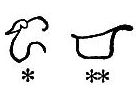
The Maya name for the period of the 5th order in Table VIII is unknown. It has been called "the cycle," however, by Maya students, and in default of its true designation, this name has been generally adopted. The normal form of the cycle glyph is shown in figure 25, a, b, c. It is composed of an element which appears twice over a knotted support. The repeated element occurs also in the signs for the months Chen, Yax, Zac, and Ceh (see figs. 19, o-v, 20, l-p). This has been called the Cauac element because it is similar to the sign for the day Cauac in the codices (fig. 17, b'), though on rather inadequate grounds the writer is inclined to believe. The head variant of the cycle glyph is shown in figure 25, d-f. The essential characteristic of this grotesque head with its long beak is the hand element (*), which forms the lower jaw, though in a very few instances even this is absent. In the full-figure forms this same head is joined to the body of a bird (see fig. 26). The bird intended is clearly a parrot, the feet, claws, and beak being portrayed in a very realistic manner. No glyph for the cycle has yet been found in the codices.

THE KATUN GLYPH
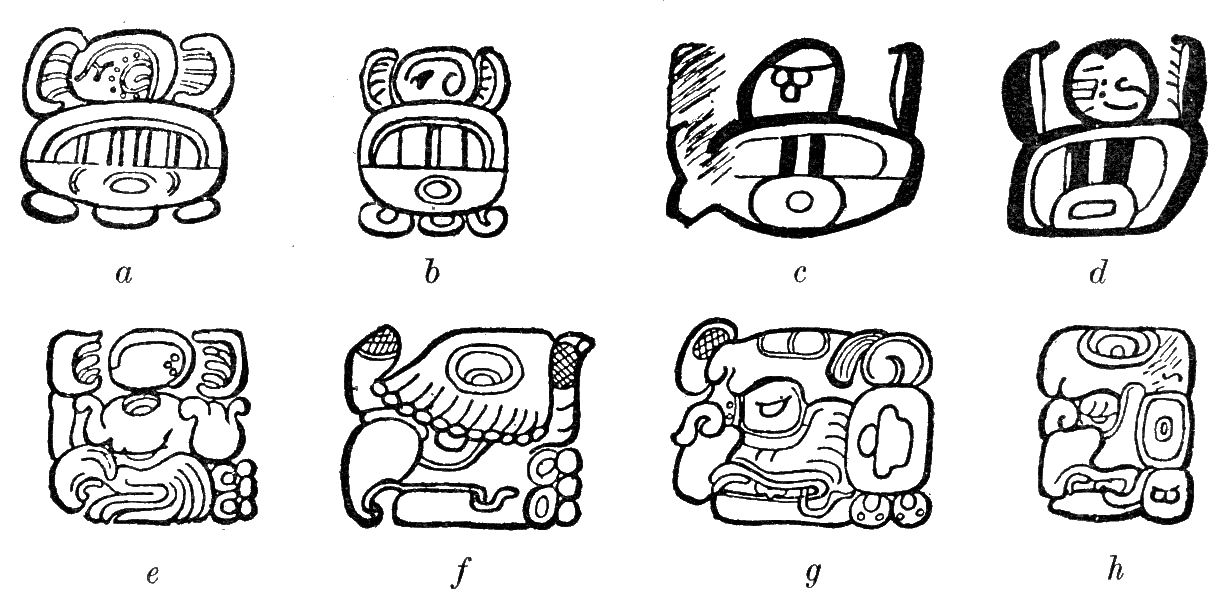
Fig. 27. Signs for the katun: a-d, Normal forms; e-h, head variants.
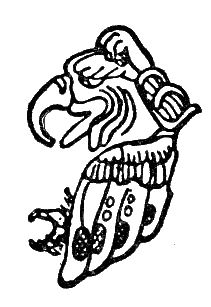
Fig. 28. Full-figure variant of katun sign.
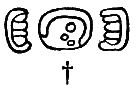
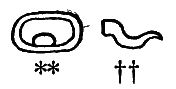
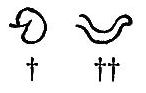
The period of the 4th place or order was called by the Maya the katun; that is to say, 20 tuns, since it contained 20 units of the 3d order (see Table VIII). The normal form of the katun glyph is shown in figure 27, a-d. It is composed of the normal form of the tun sign (fig. 29, a, b) surmounted by the pair of comblike appendages, which we have elsewhere seen meant 20, and which were probably derived from the representation of a fish. The whole glyph thus graphically portrays the concept 20 tuns, which according to Table VIII is equal to 1 katun. The normal form of the katun glyph in the codices (fig. 27, c, d) is identical with the normal form in the inscriptions (fig. 27, a, b). Several head variants are found. The most easily recognized, though not the most common, is shown in figure 27, e, in which the superfix is the same as in the normal form; that is, the element (†), which probably signifies 20 in this connection. To be logical, therefore, the head element should be the same as the head variant of the tun glyph, but this is not the case (see fig. 29, e-h). When this superfix is present, the identification of the head variant of the katun glyph is an easy matter, but when it is absent it is difficult to fix on any essential characteristic. The general shape of the head is like the head variant of the cycle glyph. Perhaps the oval (**) in the top of the head in figure 27, f-h, and the small curling fang (††) represented as protruding from the back part of the mouth are as constant as any of the other elements. The head of the full-figure variant in figure 28 presents the same lack of essential characteristics as the head variant, though in this form the small curling fang is also found. Again, the body attached to this head is that of a bird which has been identified as an eagle.
THE TUN GLYPH
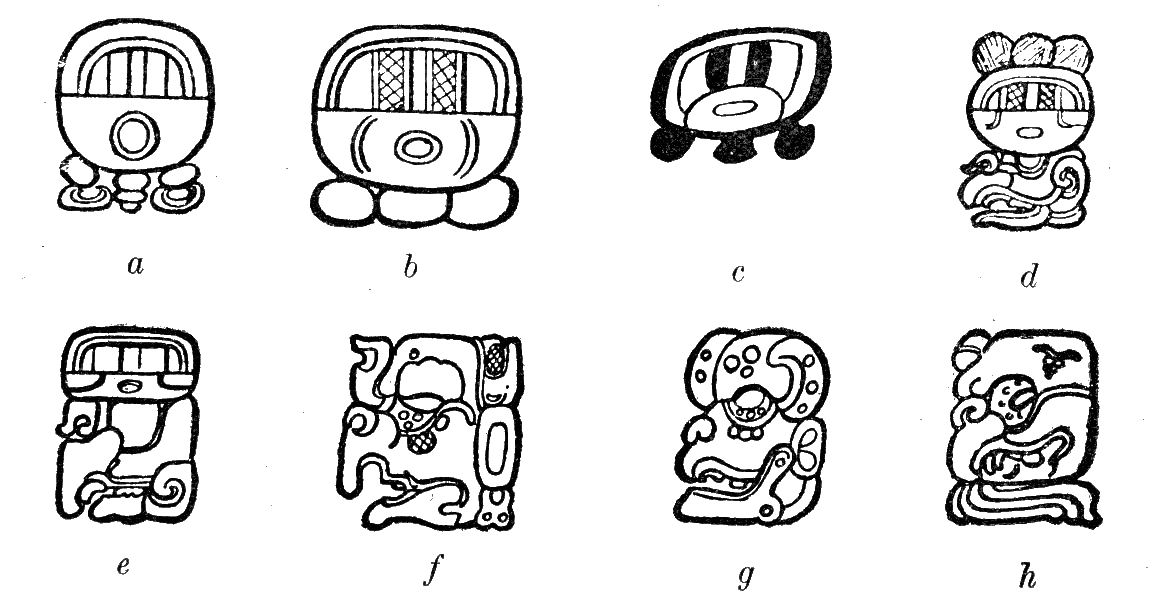
Fig. 29. Signs for the tun: a-d, Normal forms; e-h, head variants.
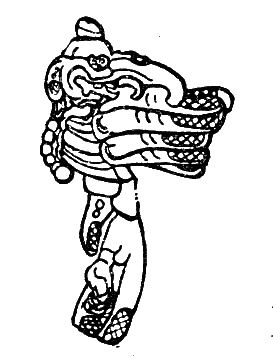
Fig. 30. Full-figure variant of tun sign.
The period of the 3d place or order was called by the Maya the tun, which means "stone," possibly because a stone was set up every 360 days or each tun or some multiple thereof. Compare so-called hotun or katun stones described on page 34. The normal sign for the tun in the inscriptions (see fig. 29, a, b) is identical with the form found in the codices (see fig. 29, c). The head variant, which bears a general resemblance to the head variant for the cycle and katun, has several forms. The one most readily recognized, because it has the normal sign for its superfix, is shown in figure 29, d, e. The determining characteristic of the head variant of the tun glyph, however, is the fleshless lower jaw (‡), as shown in figure 29 f, g, though even this is lacking in some few cases. The form shown in figure 29, h, is found at Palenque, where it seems to represent the tun period in several places. The head of the full-figure form (fig. 30) has the same fleshless lower jaw for its essential characteristic as the head-variant forms in figure 29. The body joined to this head is again that of a bird the identity of which has not yet been determined.
THE UINAL GLYPH
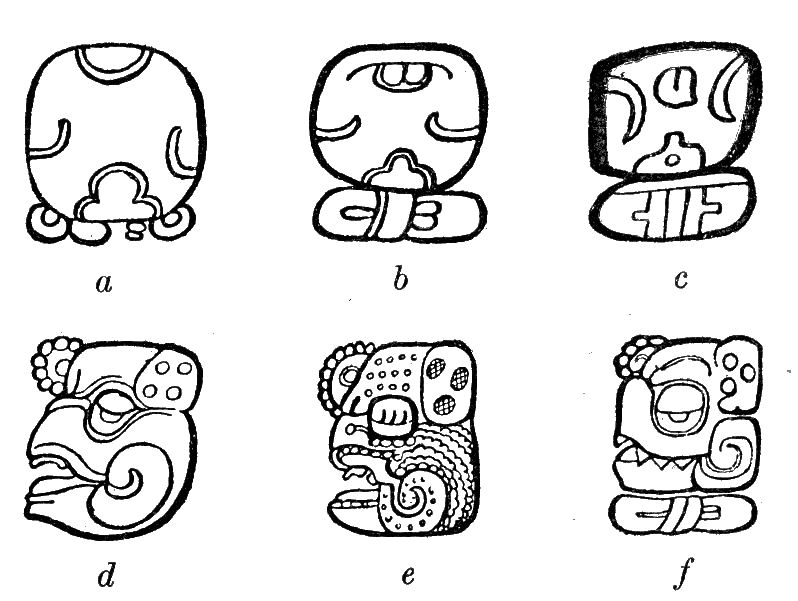
Fig. 31. Signs for the uinal: a-c, Normal forms; d-f, head variants.
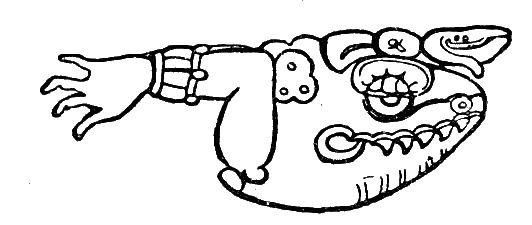
Fig. 32. Full-figure variant of uinal sign on Zoömorph B, Quirigua.
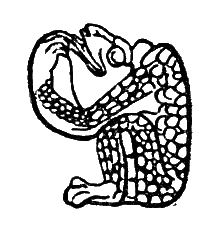
Fig. 33. Full-figure variant of uinal sign on Stela D, Copan.
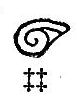
The period occupying the 2d place was called by the Maya uinal or u. This latter word means also "the moon" in Maya, and the fact that the moon is visible for just about 20 days in each lunation may account for the application of its name to the 20-day period. The normal form of the uinal glyph in the inscriptions (see fig. 31, a, b) is practically identical with the form in the codices (see fig. 31, c). Sometimes the subfixial element (‡‡) is omitted in the inscriptions, as in figure 31, a. The head variant of the uinal glyph (fig. 31, d-f) is the most constant of all of the head forms for the various periods. Its determining characteristic is the large curl emerging from the back part of the mouth. The sharp-pointed teeth in the upper jaw are also a fairly constant feature. In very rare cases both of these elements are wanting. In such cases the glyph seems to be without determining characteristics. The animal represented in the full-figure variants of the uinal is that of a frog (fig. 32,) the head of which presents precisely the same characteristics as the head variants of the uinal, just described. That the head variant of the uinal-period glyph was originally derived from the representation of a frog can hardly be denied in the face of such striking confirmatory evidence as that afforded by the full-figure form of the uinal in figure 33. Here the spotted body, flattened head, prominent mouth, and bulging eyes of the frog are so realistically portrayed that there is no doubt as to the identity of the figure intended. Mr. Bowditch (1910: p. 257) has pointed out in this connection an interesting phonetic coincidence, which can hardly be other than intentional. The Maya word for frog is uo, which is a fairly close phonetic approximation of u, the Maya word for "moon" or "month." Consequently, the Maya may have selected the figure of the frog on phonetic grounds to represent their 20-day period. If this point could be established it would indicate an unmistakable use of the rebus form of writing employed by the Aztec. That is, the figure of a frog in the uinal-period glyph would not recall the object which it pictures, but the sound of that object's name, uo, approximating the sound of u, which in turn expressed the intended idea, namely, the 20-day period. Mr. Bowditch has suggested also that the grotesque birds which stand for the cycle, katun, and tun periods in these full-figure forms may also have been chosen because of the phonetic similarity of their names to the names of these periods.

THE KIN GLYPH
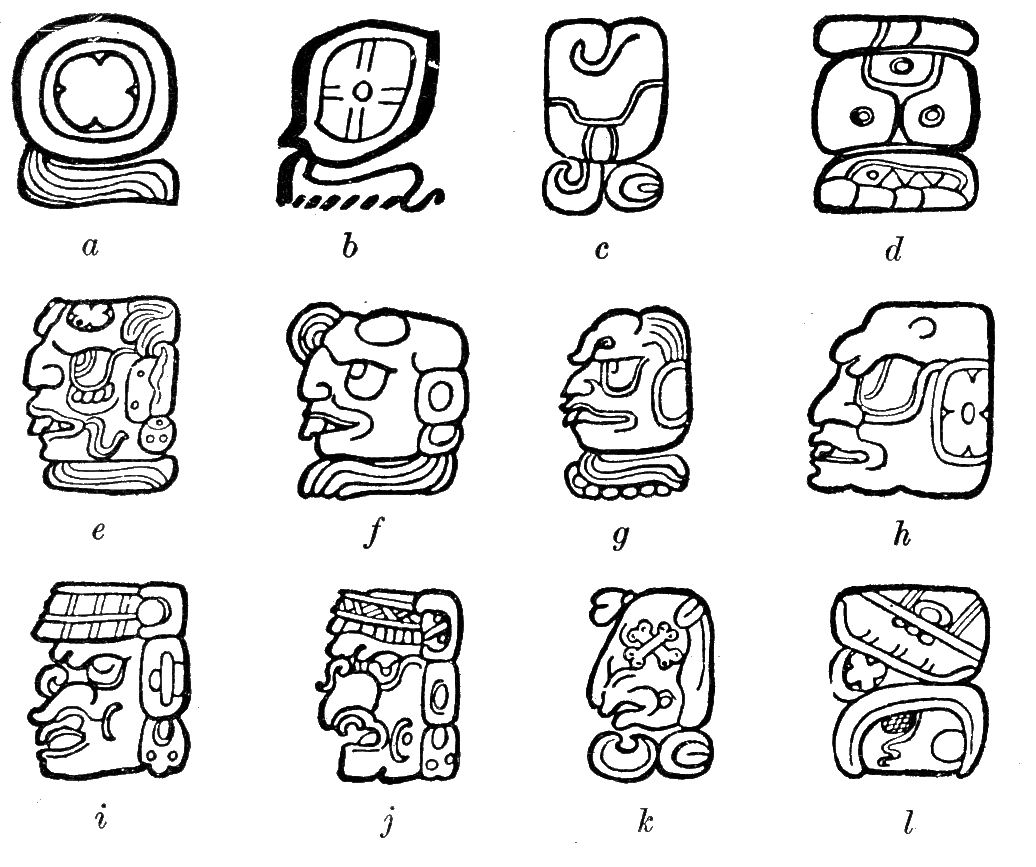
Fig. 34. Signs for the kin: a, b, Normal forms; c, d, miscellaneous; e-k, head variants.
The period of the 1st, or lowest, order was called by the Maya kin, which meant the "sun" and by association the "day." The kin, as has been explained, was the primary unit used by the Maya in counting time. The normal form of this period glyph in the inscriptions is shown in figure 34, a, which is practically identical with the form in the codices (fig. 34, b). In addition to the normal form of the kin sign, however, there are several other forms representing this period which can not be classified either as head variants or full-figure variants, as in figure 34, c, for example, which bears no resemblance whatever to the normal form of the kin sign. It is difficult to understand how two characters as dissimilar as those shown in a and c, figure 34, could ever be used to express the same idea, particularly since there seems to be no element common to both. Indeed, so dissimilar are they that one is almost forced to believe that they were derived from two entirely distinct glyphs. Still another and very unusual sign for the kin is shown in figure 34, d; indeed, the writer recalls but two places where it occurs: Stela 1 at Piedras Negras, and Stela C (north side) at Quirigua. It is composed of the normal form of the sign for the day Ahau (fig. 16, e') inverted and a subfixial element which varies in each of the two cases. These variants (fig. 34, c, d) are found only in the inscriptions. The head variants of the kin period differ from each other as much as the various normal forms above given. The form shown in figure 34, e, may be readily recognized by its subfixial element (*) and the element (†), both of which appear in the normal form, figure 34, a. In some cases, as in figure 34, f-h, this variant also has the square irid and the crooked, snag-like teeth projecting from the front of the mouth. Again, any one of these features, or even all, may be lacking. Another and usually more grotesque type of head (fig. 34, i, j) has as its essential element the banded headdress. A very unusual head variant is that shown in figure 34, k, the essential characteristic of which seems to be the crossbones in the eye. Mr. Bowditch has included also in his list of kin signs the form shown in figure 34, l, from an inscription at Tikal. While this glyph in fact does stand between two dates which are separated by one day from each other, that is, 6 Eb 0 Pop and 7 Ben 1 Pop, the writer believes, nevertheless, that only the element (‡)—an essential part of the normal form for the kin—here represents the period one day, and that the larger characters above and below have other meanings. In the full-figure variants of the kin sign the figure portrayed is that of a human being (fig. 35), the head of which is similar to the one in figure 34, i, j, having the same banded headdress.[47]
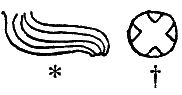

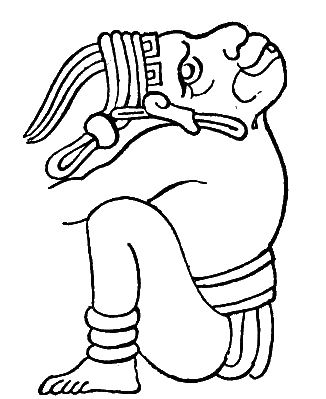
Fig. 35. Full-figure variant of kin sign.
This concludes the presentation of the various forms which stand for the several periods of Table VIII. After an exhaustive study of these as found in Maya texts the writer has reached the following generalizations concerning them:
1. Prevalence. The periods in Initial Series are expressed far more frequently by head variants than by normal forms. The preponderance of the former over the latter in all Initial Series known is in the proportion of about 80 per cent of the total[48] against 12 per cent, the periods in the remaining 8 per cent being expressed by these two forms used side by side. In other words, four-fifths of all the Initial Series known have their periods expressed by head-variant glyphs.
2. Antiquity. Head-variant period glyphs seem to have been used very much earlier than the normal forms. Indeed, the first use of the former preceded the first use of the latter by about 300 years, while in Initial Series normal-form period glyphs do not occur until nearly 100 years later, or about 400 years after the first use of head variants for the same purpose.
3. Variation. Throughout the range of time covered by the Initial Series the normal forms for any given time-period differ but little from one another, all following very closely one fixed type. Although nearly 200 years apart in point of time, the early form of the tun sign in figure 36, a, closely resembles the late form shown in b of the same figure, as to its essentials. Or again, although 375 years apart, the early form of the katun sign in figure 36, c, is practically identical with the form in figure 36, d. Instances of this kind could be multiplied indefinitely, but the foregoing are sufficient to demonstrate that in so far as the normal-form period glyphs are concerned but little variation occurred from first to last. Similarly, it may be said, the head variants for any given period, while differing greatly in appearance at different epochs, retained, nevertheless, the same essential characteristic throughout. For example, although the uinal sign in figure 36, e, precedes the one in figure 36, f, by some 800 years, the same essential element—the large mouth curl—appears in both. Again, although 300 years separate the cycle signs shown in g and h, figure 36, the essential characteristic of the early form (fig. 36, g), the hand, is still retained as the essential part of the late form (h).
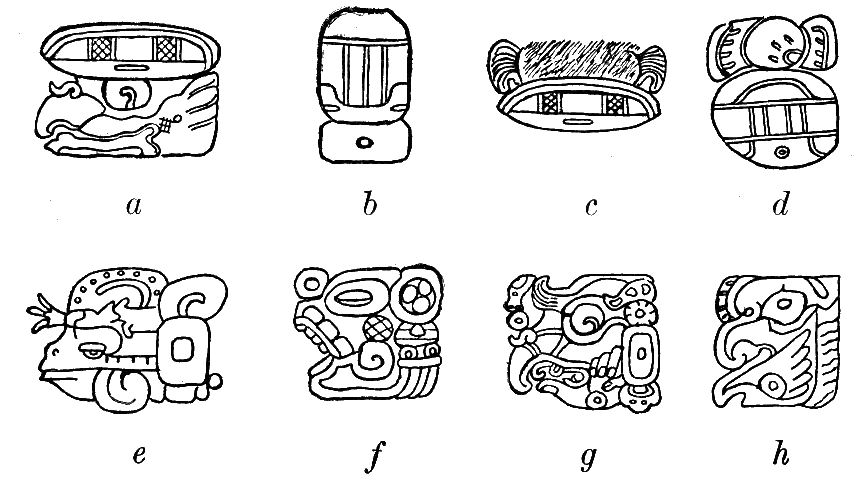
Fig. 36. Period glyphs, from widely separated sites and of different epochs, showing persistence of essential elements.
4. Derivation. We have seen that the full-figure glyphs probably show the original life-forms from which the head variants were developed. And since from (2), above, it seems probable that the head variants are older than the so-called normal forms, we may reasonably infer that the full-figure glyphs represent the life-forms whose names the Maya originally applied to their periods, and further that the first signs for those periods were the heads of these life-forms. This develops a contradiction in our nomenclature, for if the forms which we have called head variants are the older signs for the periods and are by far the most prevalent, they should have been called the normal forms and not variants, and vice versa. However, the use of the term "normal forms" is so general that it would be unwise at this time to attempt to introduce any change in nomenclature.
Secondary Series
The Initial Series method of recording dates, although absolutely accurate,[49] was nevertheless somewhat lengthy, since in order to express a single date by means of it eight distinct glyphs were required, namely: (1) The Introducing glyph; (2) the Cycle glyph; (3) the Katun glyph; (4) the Tun glyph; (5) the Uinal glyph; (6) the Kin glyph; (7) the Day glyph; (8) the Month glyph. Moreover, its use in any inscription which contained more than one date would have resulted in needless repetition. For example, if all the dates on any given monument were expressed by Initial Series, every one would show the long distance (more than 3,000 years) which separated it from the common starting point of Maya chronology. It would be just like writing the legal holidays of the current year in this way: February 22d, 1913, A. D., May 30th, 1913, A. D., July 4th, 1913, A. D., December 25th, 1913, A. D.; or in other words, repeating in each case the designation of time elapsed from the starting point of Christian chronology.
The Maya obviated this needless repetition by recording but one Initial Series date on a monument;[50] and from this date as a new point of departure they proceeded to reckon the number of days to the next date recorded; from this date the numbers of days to the next; and so on throughout that inscription. By this device the position of any date in the Long Count (its Initial Series) could be calculated, since it could be referred back to a date, the Initial Series of which was expressed. For example, the terminal day of the Initial Series given on page 64 is 7 Akbal 11 Cumhu, and its position in the Long Count is fixed by the statement in cycles, katuns, tuns, etc., that 1,461,463 days separate it from the starting point, 4 Ahau 8 Cumhu. Now let us suppose we have the date 10 Cimi 14 Cumhu, which is recorded as being 3 days later than the day 7 Akbal 11 Cumhu,[51] the Initial Series of which is known to be 1,461,463. It is clear that the Initial Series corresponding to the date 10 Cimi 14 Cumhu, although not actually expressed, will also be known since it must equal 1,461,463 (Initial Series of 7 Akbal 11 Cumhu) + 3 (distance from 7 Akbal 11 Cumhu to 10 Cimi 14 Cumhu), or 1,461,466. Therefore it matters not whether we count three days forward from 7 Akbal 11 Cumhu, or whether we count 1,461,466 days forward from the starting point of Maya chronology, 4 Ahau 8 Cumhu since in each case the date reached will be the same, namely, 10 Cimi 14 Cumhu. The former method, however, was used more frequently than all of the other methods of recording dates combined, since it insured all the accuracy of an Initial Series without repeating for each date so great a number of days.
Thus having one date on a monument the Initial Series of which was expressed, it was possible by referring subsequent dates to it, or to other dates which in turn had been referred to it, to fix accurately the positions of any number of dates in the Long Count without the use of their corresponding Initial Series. Dates thus recorded are known as "secondary dates," and the periods which express their distances from other dates of known position in the Long Count, as "distance numbers." A secondary date with its corresponding distance number has been designated a Secondary Series. In the example above given the distance number 3 kins and the date 10 Cimi 14 Cumhu would constitute a Secondary Series.
Here, then, in addition to the Initial Series is a second method, the Secondary Series, by means of which the Maya recorded their dates. The earliest use of a Secondary Series with which the writer is familiar (that on Stela 36 at Piedras Negras) does not occur until some 280 years after the first Initial Series. It seems to have been a later development, probably owing its origin to the desire to express more than one date on a single monument. Usually Secondary Series are to be counted from the dates next preceding them in the inscriptions in which they are found, though occasionally they are counted from other dates which may not even be expressed, and which can be ascertained only by counting backward the distance number from its corresponding terminal date. The accuracy of a Secondary series date depends entirely on the fact that it has been counted from an Initial Series, or at least from another Secondary series date, which in turn has been derived from an Initial Series. If either of these contingencies applies to any Secondary series date, it is as accurate a method of fixing a day in the Long Count as though its corresponding Initial Series were expressed in full. If, on the other hand, a Secondary series date can not be referred ultimately to an Initial Series or to a date the Initial Series of which is known though it may not be expressed, such a Secondary series date becomes only one of the 18,980 dates of the Calendar Round, and will recur at intervals of every 52 years. In other words, its position in the Long Count will be unknown.
Calendar-round Dates
Dates of the character just described may be called Calendar-round dates, since they are accurate only within the Calendar Round, or range of 52 years. While accurate enough for the purpose of distinguishing dates in the course of a single lifetime, this method breaks down when used to express dates covering a long period. Witness the chaotic condition of Aztec chronology. The Maya seem to have realized the limitations of this method of dating and did not employ it extensively. It was used chiefly at Yaxchilan on the Usamacintla River, and for this reason the chronology of that city is very much awry, and it is difficult to assign its various dates to their proper positions in the Long Count.
Period-ending Dates
The Maya made use of still another method of dating, which, although not so exact as the Initial Series or the Secondary Series, is, on the other hand, far more accurate than Calendar round dating. In this method a date was described as being at the end of some particular period in the Long Count; that is, closing a certain cycle, katun, or tun.[52] It is clear also that in this method only the name Ahau out of the 20 given in Table I can be recorded, since it alone can stand at the end of periods higher than the kin. This is true, since:
1. The higher periods, as the uinal, tun, katun, and cycle are exactly divisible by 20 in every case (see Table VIII), and—
2. They are all counted from a day, Ahau, that is, 4 Ahau 8 Cumhu. Consequently, all the periods of the Long Count, except the kin or primary unit, end with days the name parts of which are the sign Ahau.
This method of recording dates always involves the use of at least two factors, and usually three:
1. A particular period of the Long Count, as Cycle 9, or Katun 14, etc.
2. The date which ends the particular period recorded, as 8 Ahau 13 Ceh, or 6 Ahau 13 Muan, the closing dates respectively of Cycle 9 and Katun 14 of Cycle 9; and
3. A glyph or element which means "ending" or "is ended," or which indicates at least that the period to which it is attached has come to its close.
The first two of these factors are absolutely essential to this method of dating, while the third, the so-called "ending sign," is usually, though not invariably, present. The order in which these factors are usually found is first the date composed of the day glyph and month glyph, next the "ending sign," and last the glyph of the period whose closing day has just been recorded. Very rarely the period glyph and its ending sign precede the date.
The ending glyph has three distinct variants: (1) the element shown as the prefix or superfix in figure 37, a-h, t, all of which are forms of the same variant; (2) the flattened grotesque head appearing either as the prefix or superfix in i, r, u, v of the same figure; and (3) the hand, which appears as the main element in the forms shown in figure 37, j-q. The two first of these never stand by themselves but always modify some other sign. The first (fig. 37, a-h, t) is always attached to the sign of the period whose end is recorded either as a superfix (see fig. 37, a, whereby the end of Cycle 10 is indicated[53]), or as a prefix (see t, whereby the end of Katun 14 is recorded). The second form is seen as a prefix in u, whereby the end of Katun 12 is recorded, and in i, whereby the end of Katun 11 is shown. This latter sign is found also as a superfix in r.
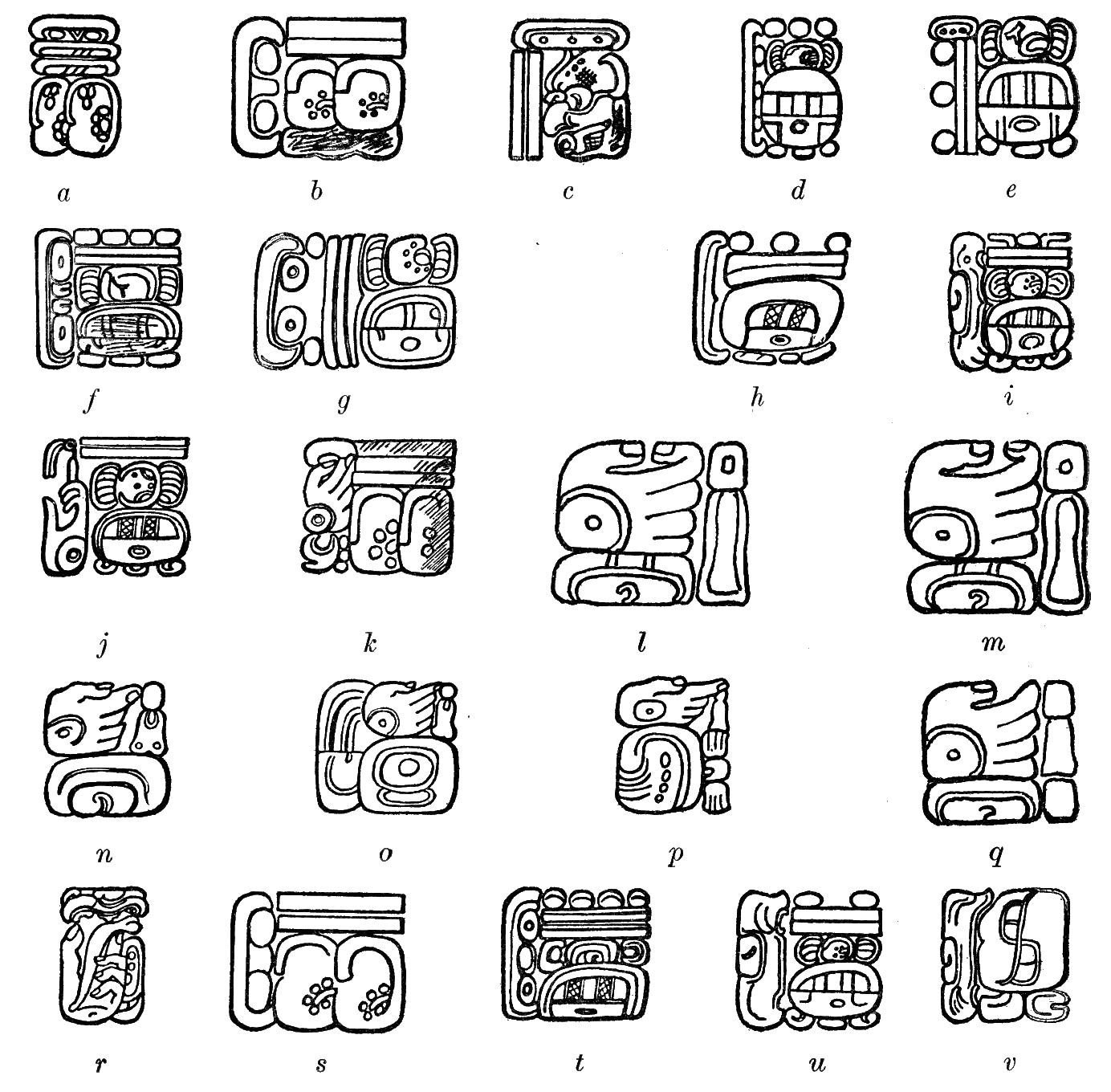
Fig. 37. Ending signs and elements.
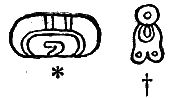
The hand-ending sign rarely appears as modifying period glyphs, although a few examples of such use have been found (see fig. 37, j, k). This ending sign usually appears as the main element in a separate glyph, which precedes the sign of the period whose end is recorded (see fig. 37, l-q). In these cases the subordinate elements differ somewhat, although the element (*) appears as the suffix in l, m, n, q, and the element (†) as a postfix therein, also in o and p. In a few cases the hand is combined with the other ending signs, sometimes with one and sometimes with the other.
The use of the hand as expressing the meaning "ending" is quite natural. The Aztec, we have seen, called their 52-year period the xiuhmolpilli, or "year bundle." This implies the concomitant idea of "tying up." As a period closed, metaphorically speaking, it was "tied up" or "bundled up." The Maya use of the hand to express the idea "ending" may be a graphic representation of the member by means of which this "tying up" was effected, the clasped hand indicating the closed period.
This method of describing a date may be called "dating by period endings." It was far less accurate than Initial-series or Secondary-series dating, since a date described as occurring at the end of a certain katun could recur after an interval of about 18,000 years in round numbers, as against 374,400 years in the other 2 methods. For all practical purposes, however, 18,000 years was as accurate as 374,400 years, since it far exceeds the range of time covered by the written records of mankind the world over.
Period-ending dates were not used much, and, as has been stated above, they are found only in connection with the larger periods—most frequently with the katun, next with the cycle, and but very rarely with the tun. Mr. Bowditch (1910: pp. 176 et seq.) has reviewed fully the use of ending signs, and students are referred to his work for further information on this subject.
U Kahlay Katunob
In addition to the foregoing methods of measuring time and recording dates, the Maya of Yucatan used still another, which, however, was probably derived directly from the application of Period-ending dating to the Long Count, and consequently introduces no new elements. This has been designated the Sequence of the Katuns, because in this method the katun, or 7,200-day period, was the unit used for measuring the passage of time. The Maya themselves called the Sequence of the Katuns u tzolan katun, "the series of the katuns"; or u kahlay uxocen katunob, "the record of the count of the katuns"; or even more simply, u kahlay katunob, "the record of the katuns." These names accurately describe this system, which is simply the record of the successive katuns, comprising in the aggregate the range of Maya chronology.
Each katun of the u kahlay katunob was named after the designation of its ending day, a practice derived no doubt from Period-ending dating, and the sequence of these ending days represented passed time, each ending day standing for the katun of which it was the close. The katun, as we have seen on page 77, always ended with some day Ahau, consequently this day-name is the only one of the twenty which appears in the u kahlay katunob. In this method the katuns were distinguished from one another, not by the positions which they occupied in the cycle, as Katun 14, for example, but by the different days Ahau with which they ended, as Katun 2 Ahau, Katun 13 Ahau, etc. See Table IX.
Table IX.—SEQUENCE OF KATUNS IN U KAHLAY KATUNOB
Katun 02 Ahau Katun 08 Ahau
Katun 13 Ahau Katun 06 Ahau
Katun 11 Ahau Katun 04 Ahau
Katun 09 Ahau Katun 02 Ahau
Katun 07 Ahau Katun 13 Ahau
Katun 05 Ahau Katun 11 Ahau
Katun 03 Ahau Katun 09 Ahau
Katun 01 Ahau Katun 07 Ahau
Katun 12 Ahau Katun 05 Ahau
Katun 10 Ahau Katun 03 Ahau, etc.
The peculiar retrograding sequence of the numerical coefficients in Table IX, decreasing by 2 from katun to katun, as 2, 13, 11, 9, 7, 5, 3, 1, 12, etc., results directly from the number of days which the katun contains. Since the 13 possible numerical coefficients, 1 to 13, inclusive, succeed each other in endless repetition, 1 following immediately after 13, it is clear that in counting forward any given number from any given numerical coefficient, the resulting numerical coefficient will not be affected if we first deduct all the 13s possible from the number to be counted forward. The mathematical demonstration of this fact follows. If we count forward 14 from any given coefficient, the same coefficient will be reached as if we had counted forward but 1. This is true because, (1) there are only 13 numerical coefficients, and (2) these follow each other without interruption, 1 following immediately after 13; hence, when 13 has been reached, the next coefficient is 1, not 14; therefore 13 or any multiple thereof may be counted forward or backward from any one of the 13 numerical coefficients without changing its value. This truth enables us to formulate the following rule for finding numerical coefficients: Deduct all the multiples of 13 possible from the number to be counted forward, and then count forward the remainder from the known coefficient, subtracting 13 if the resulting number is above 13, since 13 is the highest possible number which can be attached to a day sign. If we apply this rule to the sequence of the numerical coefficients in Table IX, we shall find that it accounts for the retrograding sequence there observed. The first katun in Table IX, Katun 2 Ahau, is named after its ending day, 2 Ahau. Now let us see whether the application of this rule will give us 13 Ahau as the ending day of the next katun. The number to be counted forward from 2 Ahau is 7,200, the number of days in one katun; therefore we must first deduct from 7,200 all the 13s possible. 7,200 ÷ 13 = 55311⁄13. In other words, after we have deducted all the 13's possible, that is, 553 of them, there is a remainder of 11. This the rule says is to be added (or counted forward) from the known coefficient (in this case 2) in order to reach the resulting coefficient. 2 + 11 = 13. Since this number is not above 13, 13 is not to be deducted from it; therefore the coefficient of the ending day of the second katun is 13, as shown in Table IX. Similarly we can prove that the coefficient of the ending day of the third katun in Table IX will be 11. Again, we have 7,200 to count forward from the known coefficient, in this case 13 (the coefficient of the ending day of the second katun). But we have seen above that if we deduct all the 13s possible from 7,200 there will be a remainder of 11; consequently this remainder 11 must be added to 13, the known coefficient. 13 + 11 = 24; but since this number is above 13, we must deduct 13 from it in order to find out the resulting coefficient. 24 - 13 = 11, and 11 is the coefficient of the ending day of the third katun in Table IX. By applying the above rule, all of the coefficients of the ending days of the katuns could be shown to follow the sequence indicated in Table IX. And since the ending days of the katuns determined their names, this same sequence is also that of the katuns themselves.
The above table enables us to establish a constant by means of which we can always find the name of the next katun. Since 7,200 is always the number of days in any katun, after deducting all the 13s possible the remainder will always be 11, which has to be added to the known coefficient to find the unknown. But since 13 has to be deducted from the resulting number when it is above 13, subtracting 2 will always give us exactly the same coefficient as adding 11; consequently we may formulate for determining the numerical coefficients of the ending days of katuns the following simple rule: Subtract 2 from the coefficient of the ending day of the preceding katun in every case. A glance at Table IX will demonstrate the truth of this rule.
In the names of the katuns given in Table IX it is noteworthy that the positions which the ending days occupied in the divisions of the haab, or 365-day year, are not mentioned. For example, the first katun was not called Katun 2 Ahau 8 Zac, but simply Katun 2 Ahau, the month part of the day, that is, its position in the year, was omitted. This omission of the month parts of the ending days of the katuns in the u kahlay katunob has rendered this method of dating far less accurate than any of the others previously described except Calendar-round Dating. For example, when a date was recorded as falling within a certain katun, as Katun 2 Ahau, it might occur anywhere within a period of 7,200 days, or nearly 20 years, and yet fulfill the given conditions. In other words, no matter how accurately this Katun 2 Ahau itself might be fixed in a long stretch of time, there was always the possibility of a maximum error of about 20 years in such dating, since the statement of the katun did not fix a date any closer than as occurring somewhere within a certain 20-year period. When greater accuracy was desired the particular tun in which the date occurred was also given, as Tun 13 of Katun 2 Ahau. This fixed a date as falling somewhere within a certain 360 days, which was accurately fixed in a much longer period of time. Very rarely, in the case of an extremely important event, the Calendar-round date was also given as 9 Imix 19 Zip of Tun 9 of Katun 13 Ahau. A date thus described satisfying all the given conditions could not recur until after the lapse of at least 7,000 years. The great majority of events, however, recorded by this method are described only as occurring in some particular katun, as Katun 2 Ahau, for example, no attempt being made to refer them to any particular division (tun) of this period. Such accuracy doubtless was sufficient for recording the events of tribal history, since in no case could an event be more than 20 years out of the way.
Aside from this initial error, the accuracy of this method of dating has been challenged on the ground that since there were only thirteen possible numerical coefficients, any given katun, as Katun 2 Ahau, for example, in Table IX would recur in the sequence after the lapse of thirteen katuns, or about 256 years, thus paving the way for much confusion. While admitting that every thirteenth katun in the sequence had the same name (see Table IX), the writer believes, nevertheless, that when the sequence of the katuns was carefully kept, and the record of each entered immediately after its completion, so that there could be no chance of confusing it with an earlier katun of the same name in the sequence, accuracy in dating could be secured for as long a period as the sequence remained unbroken. Indeed, the u kahlay katunob[54] from which the synopsis of Maya history given in Chapter I was compiled, accurately fixes the date of events, ignoring the possible initial inaccuracy of 20 years, within a period of more than 1,100 years, a remarkable feat for any primitive chronology.
How early this method of recording dates was developed is uncertain. It has not yet been found (surely) in the inscriptions in either the south or the north; on the other hand, it is so closely connected with the Long Count and Period-ending dating, which occurs repeatedly throughout the inscriptions, that it seems as though the u kahlay katunob must have been developed while this system was still in use.
There should be noted here a possible exception to the above statement, namely, that the u kahlay katunob has not been found in the inscriptions. Mr. Bowditch (1910: pp. 192 et seq.) has pointed out what seem to be traces of another method of dating. This consists of some day Ahau modified by one of the two elements shown in figure 38 (a-d and e-h, respectively). In such cases the month part is sometimes recorded, though as frequently the day Ahau stands by itself. It is to be noted that in the great majority of these cases the days Ahau thus modified are the ending days of katuns, which are either expressed or at least indicated in adjacent glyphs. In other words, the day Ahau thus modified is usually the ending day of the next even katun after the last date recorded. The writer believes that this modification of certain days Ahau by either of the two elements shown in figure 38 may indicate that such days were the katun ending days nearest to the time when the inscriptions presenting them were engraved. The snake variants shown in figure 38, a-d, are all from Palenque; the knot variants (e-h of the same figure) are found at both Copan and Quirigua.
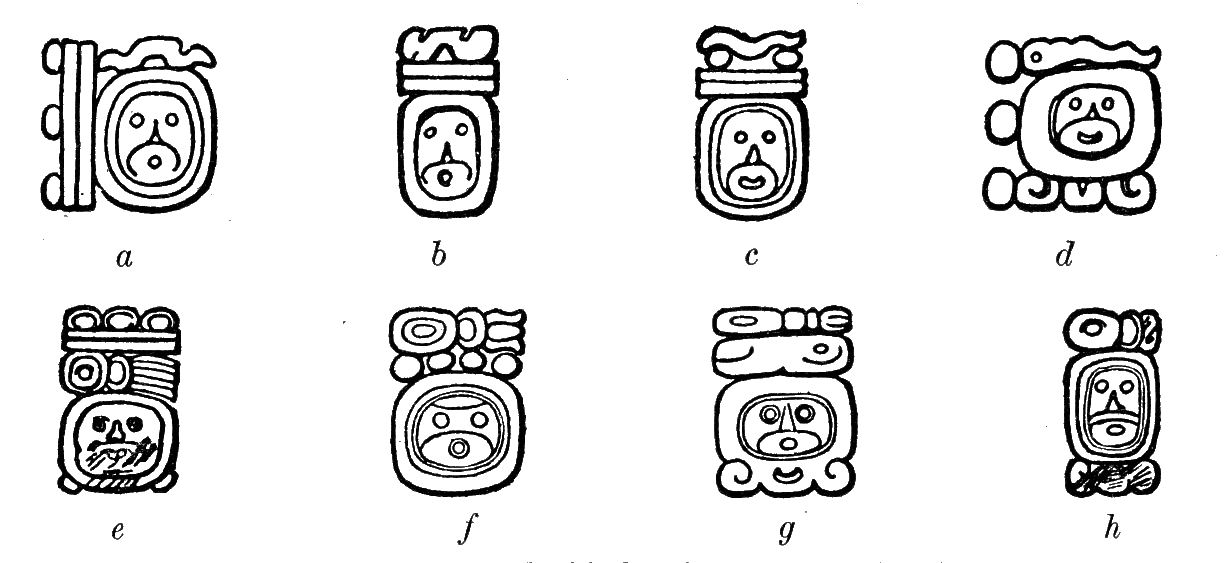
Fig. 38. "Snake" or "knot" element as used with day sign Ahau, possibly indicating presence of the u kahlay katunob in the inscriptions.
It may be objected that one katun ending day in each inscription is far different from a sequence of katun ending days as shown in Table IX, and that one katun ending day by itself can not be construed as an u kahlay katunob, or sequence of katuns. The difference here, however, is apparent rather than real, and results from the different character of the monuments and the native chronicles. The u kahlay katunob in Table IX is but a part of a much longer sequence of katuns, which is shown in a number of native chronicles written shortly after the Spanish Conquest, and which record the events of Maya history for more than 1,100 years. They are in fact chronological synopses of Maya history, and from their very nature they have to do with long periods. This is not true of the monuments,[55] which, as we have seen, were probably set up to mark the passage of certain periods, not exceeding a katun in length in any case. Consequently, each monument would have inscribed upon it only one or two katun ending days and the events which were connected more or less closely with it. In other words, the monuments were erected at short intervals[56] and probably recorded events contemporaneous with their erection, while the u kahlay katunob, on the other hand, were historical summaries reaching back to a remote time. The former were the periodicals of current events, the latter histories of the past. The former in the great majority of cases had no concern with the lapse of more than one or two katuns, while the latter measured centuries by the repetition of the same unit. The writer believes that from the very nature of the monuments—markers of current time—no u kahlay katunob will be found on them, but that the presence of the katun ending days above described indicates that the u kahlay katunob had been developed while the other system was still in use. If the foregoing be true, the signs in figure 38, a-h, would have this meaning: "On this day came to an end the katun in which fall the accompanying dates," or some similar significance.
If we exclude the foregoing as indicating the u kahlay katunob, we have but one aboriginal source, that is one antedating the Spanish Conquest, which probably records a count of this kind. It has been stated (p. 33) that the Codex Peresianus probably treats in part at least of historical matter. The basis for this assertion is that in this particular manuscript an u kahlay katunob is seemingly recorded; at least there is a sequence of the ending days of katuns shown, exactly like the one in Table IX, that is, 13 Ahau, 11 Ahau, 9 Ahau, etc.
At the time of the Spanish Conquest the Long Count seems to have been recorded entirely by the ending days of its katuns, that is, by the u kahlay katunob, and the use of Initial-series dating seems to have been discontinued, and perhaps even forgotten. Native as well as Spanish authorities state that at the time of the Conquest the Maya measured time by the passage of the katuns, and no mention is made of any system of dating which resembles in the least the Initial Series so prevalent in the southern and older cities. While the Spanish authorities do not mention the u kahlay katunob as do the native writers, they state very clearly that this was the system used in counting time. Says Bishop Landa (1864: p. 312) in this connection: "The Indians not only had a count by years and days ... but they had a certain method of counting time and their affairs by ages, which they made from twenty to twenty years ... these they call katunes." Cogolludo (1688: lib. iv, cap. v, p. 186) makes a similar statement: "They count their eras and ages, which they put in their books from twenty to twenty years ... [these] they call katun." Indeed, there can be but little doubt that the u kahlay katunob had entirely replaced the Initial Series in recording the Long Count centuries before the Spanish Conquest; and if the latter method of dating were known at all, the knowledge of it came only from half-forgotten records the understanding of which was gradually passing from the minds of men.
It is clear from the foregoing that an important change in recording the passage of time took place sometime between the epoch of the great southern cities and the much later period when the northern cities flourished. In the former, time was reckoned and dates were recorded by Initial Series; in the latter, in so far as we can judge from post-Conquest sources, the u kahlay katunob and Calendar-round dating were the only systems used. As to when this change took place, we are not entirely in the dark. It is certain that the use of the Initial Series extended to Yucatan, since monuments presenting this method of dating have been found at a few of the northern cities, namely, at Chichen Itza, Holactun, and Tuluum. On the other hand, it is equally certain that Initial Series could not have been used very extensively in the north, since they have been discovered in only these three cities in Yucatan up to the present time. Moreover, the latest, that is, the most recent of these three, was probably contemporaneous with the rise of the Triple Alliance, a fairly early event of Northern Maya history. Taking these two points into consideration, the limited use of Initial Series in the north and the early dates recorded in the few Initial Series known, it seems likely that Initial-series dating did not long survive the transplanting of the Maya civilization in Yucatan.
Why this change came about is uncertain. It could hardly have been due to the desire for greater accuracy, since the u kahlay katunob was far less exact than Initial-series dating; not only could dates satisfying all given conditions recur much more frequently in the u kahlay katunob, but, as generally used, this method fixed a date merely as occurring somewhere within a period of about 20 years.
The writer believes the change under consideration arose from a very different cause; that it was in fact the result of a tendency toward greater brevity, which was present in the glyphic writing from the very earliest times, and which is to be noted on some of the earliest monuments that have survived the ravages of the passing centuries. At first, when but a single date was recorded on a monument, an Initial Series was used. Later, however, when the need or desire had arisen to inscribe more than one date on the same monument, additional dates were not expressed as Initial Series, each of which, as we have seen, involves the use of 8 glyphs, but as a Secondary Series, which for the record of short periods necessitated the use of fewer glyphs than were employed in Initial Series. It would seem almost as though Secondary Series had been invented to avoid the use of Initial Series when more than one date had to be recorded on the same monument. But this tendency toward brevity in dating did not cease with the invention of Secondary Series. Somewhat later, dating by period-endings was introduced, obviating the necessity for the use of even one Initial Series on every monument, in order that one date might be fixed in the Long Count to which the others (Secondary Series) could be referred. For all practical purposes, as we have seen, Period-ending dating was as accurate as Initial-series dating for fixing dates in the Long Count, and its substitution for Initial-series dating resulted in a further saving of glyphs and a corresponding economy of space. Still later, probably after the Maya had colonized Yucatan, the u kahlay katunob, which was a direct application of Period-ending dating to the Long Count, came into general use. At this time a rich history lay behind the Maya people, and to have recorded all of its events by their corresponding Initial Series would have been far too cumbersome a practice. The u kahlay katunob offered a convenient and facile method by means of which long stretches of time could be recorded and events approximately dated; that is, within 20 years. This, together with the fact that the practice of setting up dated period-markers seems to have languished in the north, thus eliminating the greatest medium of all for the presentation of Initial Series, probably gave rise to the change from the one method of recording time to the other.
This concludes the discussion of the five methods by means of which the Maya reckoned time and recorded dates: (1) Initial-series dating; (2) Secondary-series dating; (3) Calendar-round dating; (4) Period-ending dating; (5) Katun-ending dating, or the u kahlay katunob. While apparently differing considerably from one another, in reality all are expressions of the same fundamental idea, the combination of the numbers 13 and 20 (that is, 260) with the solar year conceived as containing 365 days, and all were recorded by the same vigesimal system of numeration; that is:
1. All used precisely the same dates, the 18,980 dates of the Calendar Round;
2. All may be reduced to the same fundamental unit, the day; and
3. All used the same time counters, those shown in Table VIII.
In conclusion, the student is strongly urged constantly to bear in mind two vital characteristics of Maya chronology:
1. The absolute continuity of all sequences which had to do with the counting of time: The 13 numerical coefficients of the day names, the 20 day names, the 260 days of the tonalamatl, the 365 positions of the haab, the 18,980 dates of the Calendar Round, and the kins, uinals, tuns, katuns, and cycles of the vigesimal system of numeration. When the conclusion of any one of these sequences had been reached, the sequence began anew without the interruption or omission of a single unit and continued repeating itself for all time.
2. All Maya periods expressed not current time, but passed time, as in the case of our hours, minutes, and seconds.
On these two facts rests the whole Maya conception of time.
Chapter IV
MAYA ARITHMETIC
The present chapter will be devoted to the consideration of Maya arithmetic in its relation to the calendar. It will be shown how the Maya expressed their numbers and how they used their several time periods. In short, their arithmetical processes will be explained, and the calculations resulting from their application to the calendar will be set forth.
The Maya had two different ways of writing their numerals,[57] namely: (1) With normal forms, and (2) with head variants; that is, each of the numerals up to and including 19 had two distinct characters which stood for it, just as in the case of the time periods and more rarely, the days and months. The normal forms of the numerals may be compared to our Roman figures, since they are built up by the combination of certain elements which had a fixed numerical value, like the letters I, V, X, L, C, D, and M, which in Roman notation stand for the values 1, 5, 10, 50, 100, 500, and 1,000, respectively. The head-variant numerals, on the other hand, more closely resemble our Arabic figures, since there was a special head form for each number up to and including 13, just as there are special characters for the first nine figures and zero in Arabic notation. Moreover, this parallel between our Arabic figures and the Maya head-variant numerals extends to the formation of the higher numbers. Thus, the Maya formed the head-variant numerals for 14, 15, 16, 17, 18, and 19 by applying the essential characteristic of the head variant for 10 to the head variants for 4, 5, 6, 7, 8, and 9, respectively, just as the sign for 10—that is, one in the tens place and zero in the units place—is used in connection with the signs for the first nine figures in Arabic notation to form the numbers 11 to 19, inclusive. Both of these notations occur in the inscriptions, but with very few exceptions[58] no head-variant numerals have yet been found in the codices.
Bar and Dot Numerals
The Maya "Roman numerals"—that is, the normal-form numerals, up to and including 19—were expressed by varying combinations of two elements, the dot (), which represented the numeral, or numerical value, 1, and the bar, or line (), which represented the numeral, or numerical value, 5. By various combinations of these two elements alone the Maya expressed all the numerals from 1 to 19, inclusive. The normal forms of the numerals in the codices are shown in figure 39, in which one dot stands for 1, two dots for 2, three dots for 3, four dots for 4, one bar for 5, one bar and one dot for 6, one bar and two dots for 7, one bar and three dots for 8, one bar and four dots for 9, two bars for 10, and so on up to three bars and four dots for 19. The normal forms of the numerals, in the inscriptions (see fig. 40) are identical with those in the codices, excepting that they are more elaborate, the dots and bars both taking on various decorations. Some of the former contain a concentric circle (*) or cross-hatching (**); some appear as crescents (†) or curls (††), more rarely as (‡) or (‡‡). The bars show even a greater variety of treatment (see fig. 41). All these decorations, however, in no way affect the numerical value of the bar and the dot, which remain 5 and 1, respectively, throughout the Maya writing. Such embellishments as those just described are found only in the inscriptions, and their use was probably due to the desire to make the bar and dot serve a decorative as well as a numerical function.


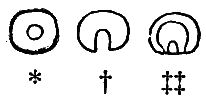
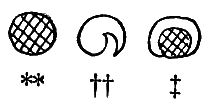
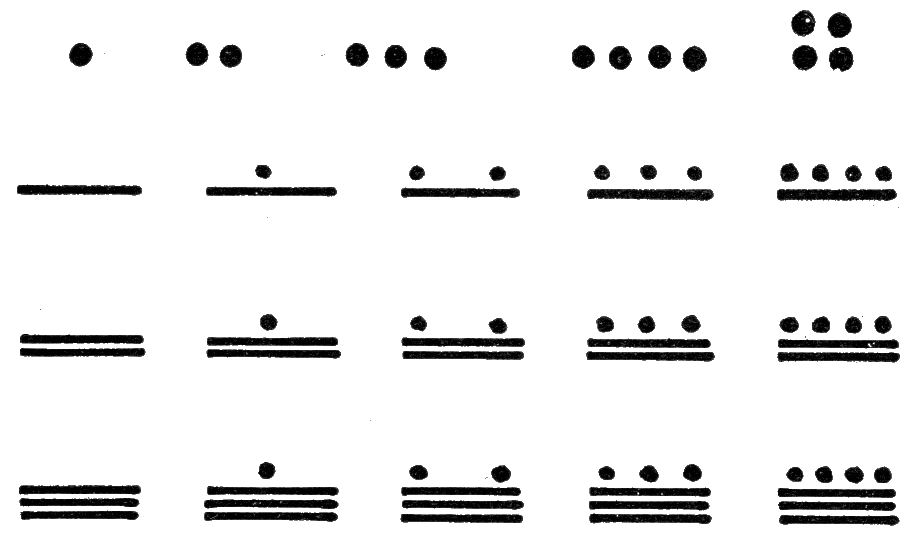
Fig. 39. Normal forms of numerals 1 to 19, inclusive, in the codices.
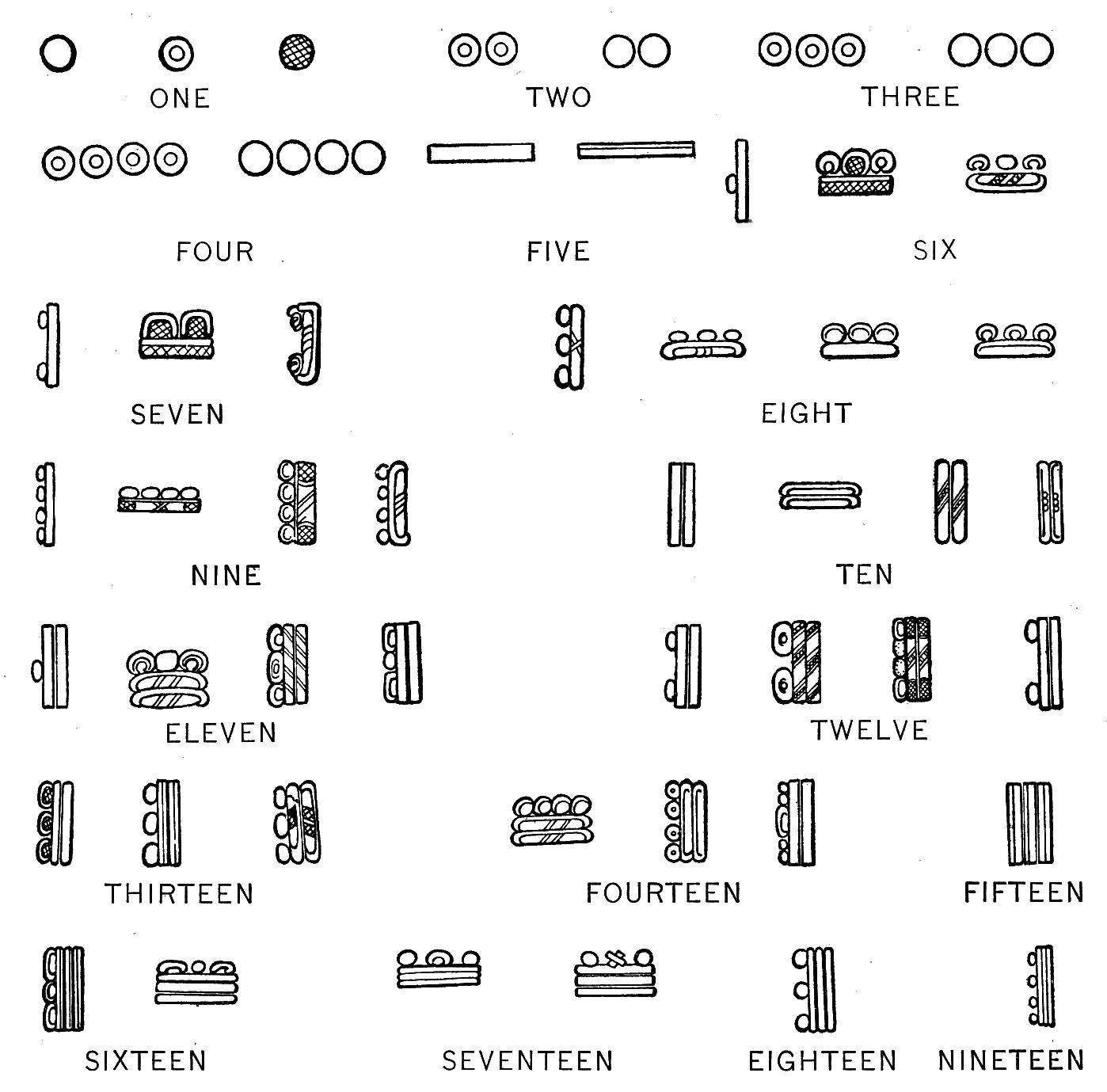
Fig. 40. Normal forms of numerals 1 to 19, inclusive, in the inscriptions.

Fig. 41. Examples of bar and dot numeral 5, showing the ornamentation which the bar underwent without affecting its numerical value.
An important exception to this statement should be noted here in connection with the normal forms for the numbers 1, 2, 6, 7, 11, 12, 16, and 17, that is, all which involve the use of one or two dots in their composition.[59] In the inscriptions, as we have seen in Chapter II, every glyph was a balanced picture, exactly fitting its allotted space, even at the cost of occasionally losing some of its elements. To have expressed the numbers 1, 2, 6, 7, 11, 12, 16, and 17 as in the codices, with just the proper number of bars and dots in each case, would have left unsightly gaps in the outlines of the glyph blocks (see fig. 42, a-h, where these numbers are shown as the coefficients of the katun sign). In a, c, e, and g of the same figure (the numbers 1, 6, 11, and 16, respectively) the single dot does not fill the space on the left-hand[60] side of the bar, or bars, as the case may be, and consequently the left-hand edge of the glyph block in each case is ragged. Similarly in b, d, f, and h, the numbers 2, 7, 12, and 17, respectively, the two dots at the left of the bar or bars are too far apart to fill in the left-hand edge of the glyph blocks neatly, and consequently in these cases also the left edge is ragged. The Maya were quick to note this discordant note in glyph design, and in the great majority of the places where these numbers (1, 2, 6, 7, 11, 12, 16, and 17) had to be recorded, other elements of a purely ornamental character were introduced to fill the empty spaces. In figure 43, a, c, e, g, the spaces on each side of the single dot have been filled with ornamental crescents about the size of the dot, and these give the glyph in each case a final touch of balance and harmony, which is lacking without them. In b, d, f, and h of the same figure a single crescent stands between the two numerical dots, and this again harmoniously fills in the glyph block. While the crescent (*) is the usual form taken by this purely decorative element, crossed lines (**) are found in places, as in (†); or, again, a pair of dotted elements (††), as in (‡). These variants, however, are of rare occurrence, the common form being the crescent shown in figure 43.
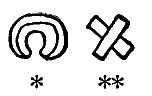
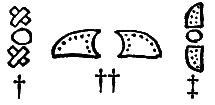
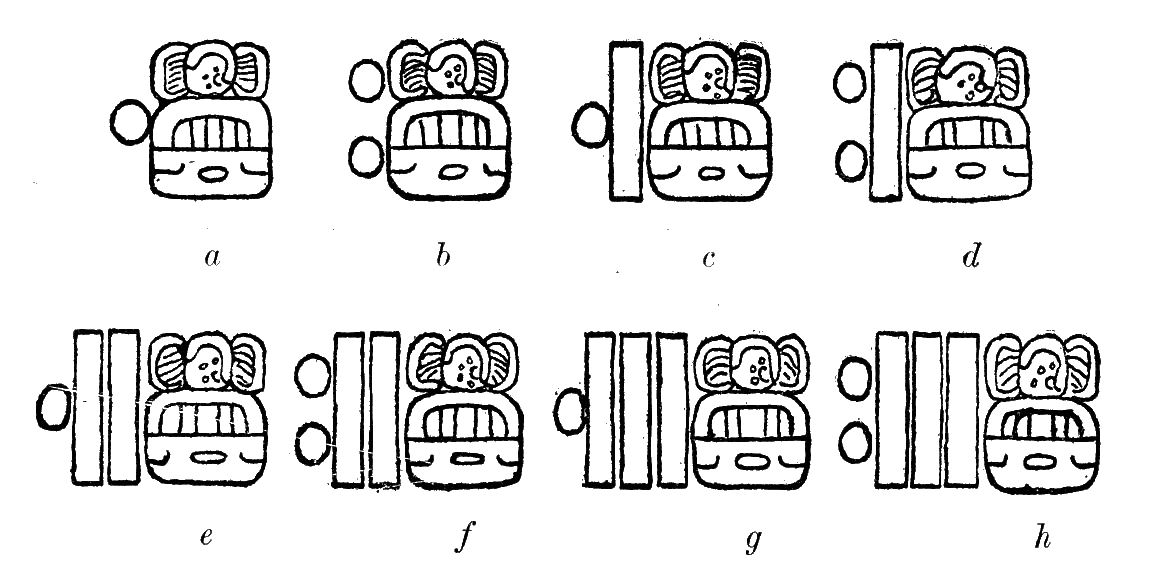
Fig. 42. Examples showing the way in which the numerals 1, 2, 6, 7, 11, 12, 16, and 17 are not used with period, day, or month signs.
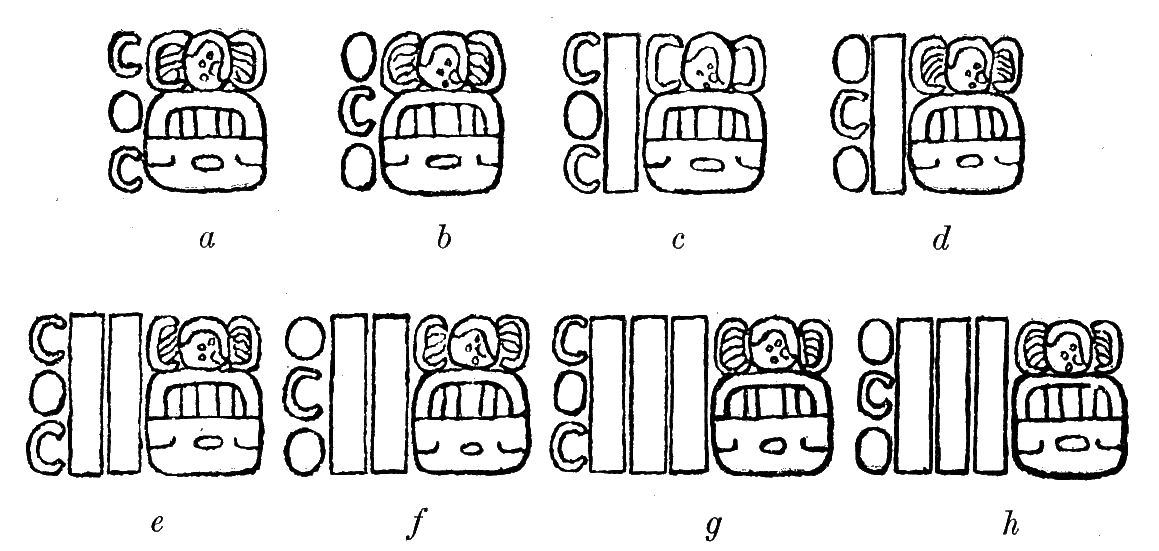
Fig. 43. Examples showing the way in which the numerals 1, 2, 6, 7, 11, 12, 16, and 17 are used with period, day, or month signs. Note the filling of the otherwise vacant spaces with ornamental elements.
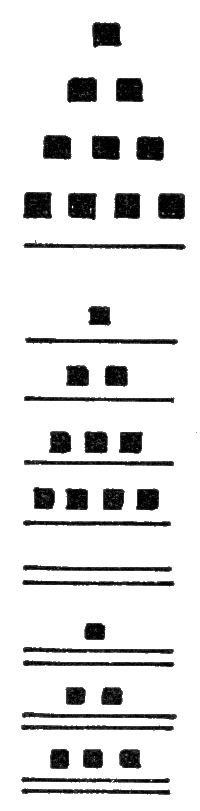
Fig. 44. Normal forms of numerals 1 to 13, inclusive, in the Books of Chilan Balam.
The use of these purely ornamental elements, to fill the empty spaces in the normal forms of the numerals 1, 2, 6, 7, 11, 12, 16, and 17, is a fruitful source of error to the student of the inscriptions. Slight weathering of an inscription is often sufficient to make ornamental crescents look exactly like numerical dots, and consequently the numerals 1, 2, 3 are frequently mistaken for one another, as are also 6, 7, and 8; 11, 12, and 13; and 16, 17, and 18. The student must exercise the greatest caution at all times in identifying these numerals in the inscriptions, or otherwise he will quickly find himself involved in a tangle from which there seems to be no egress. Probably more errors in reading the inscriptions have been made through the incorrect identification of these numerals than through any other one cause, and the student is urged to be continually on his guard if he would avoid making this capital blunder.
Although the early Spanish authorities make no mention of the fact that the Maya expressed their numbers by bars and dots, native testimony is not lacking on this point. Doctor Brinton (1882 b: p. 48) gives this extract, accompanied by the drawing shown in figure 44, from a native writer of the eighteenth century who clearly describes this system of writing numbers:
They [our ancestors] used [for numerals in their calendars] dots and lines [i. e., bars] back of them; one dot for one year, two dots for two years, three dots for three years, four dots for four, and so on; in addition to these they used a line; one line meant five years, two lines meant ten years; if one line and above it one dot, six years; if two dots above the line, seven years; if three dots above, eight years; if four dots above the line, nine; a dot above two lines, eleven; if two dots, twelve; if three dots, thirteen.
This description is so clear, and the values therein assigned to the several combinations of bars and dots have been verified so extensively throughout both the inscriptions and the codices, that we are justified in identifying the bar and dot as the signs for five and one, respectively, wherever they occur, whether they are found by themselves or in varying combinations.
In the codices, as will appear in Chapter VI, the bar and dot numerals were painted in two colors, black and red. These colors were used to distinguish one set of numerals from another, each of which has a different use. In such cases, however, bars of one color are never used with dots of the other color, each number being either all red or all black (see p. 93, footnote 1, for the single exception to this rule).
By the development of a special character to represent the number 5 the Maya had far surpassed the Aztec in the science of mathematics; indeed, the latter seem to have had but one numerical sign, the dot, and they were obliged to resort to the clumsy makeshift of repeating this in order to represent all numbers above 1. It is clearly seen that such a system of notation has very definite limitations, which must have seriously retarded mathematical progress among the Aztec.
In the Maya system of numeration, which was vigesimal, there was no need for a special character to represent the number 20,[61] because (1) as we have seen in Table VIII, 20 units of any order (except the 2d, in which only 18 were required) were equal to 1 unit of the order next higher, and consequently 20 could not be attached to any period-glyph, since this number of periods (with the above exception) was always recorded as 1 period of the order next higher; and (2) although there were 20 positions in each period except the uinal, as 20 kins in each uinal, 20 tuns in each katun, 20 katuns in each cycle, these positions were numbered not from 1 to 20, but on the contrary from 0 to 19, a system which eliminated the need for a character expressing 20.
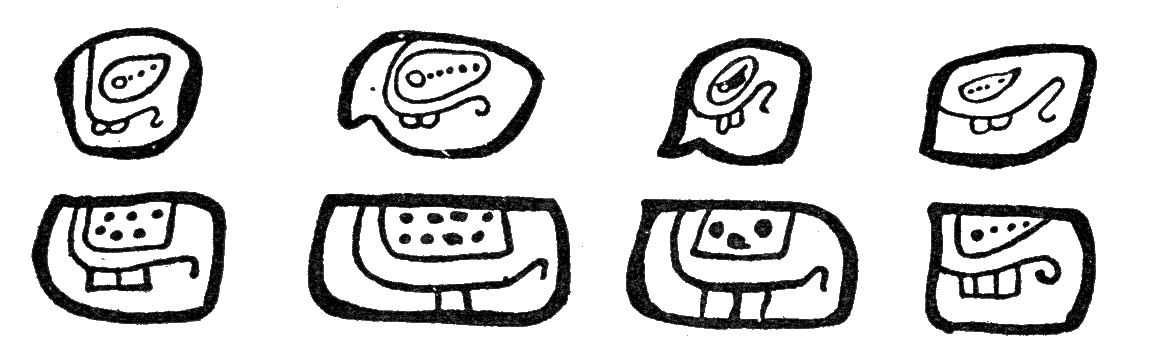
Fig. 45. Sign for 20 in the codices.
In spite of the foregoing fact, however, the number 20 has been found in the codices (see fig. 45). A peculiar condition there, however, accounts satisfactorily for its presence. In the codices the sign for 20 occurs only in connection with tonalamatls, which, as we shall see later, were usually portrayed in such a manner that the numbers of which they were composed could not be presented from bottom to top in the usual way, but had to be written horizontally from left to right. This destroyed the possibility of numeration by position,[62] according to the Maya point of view, and consequently some sign was necessary which should stand for 20 regardless of its position or relation to others. The sign shown in figure 45 was used for this purpose. It has not yet been found in the inscriptions, perhaps because, as was pointed out in Chapter II, the inscriptions generally do not appear to treat of tonalamatls.
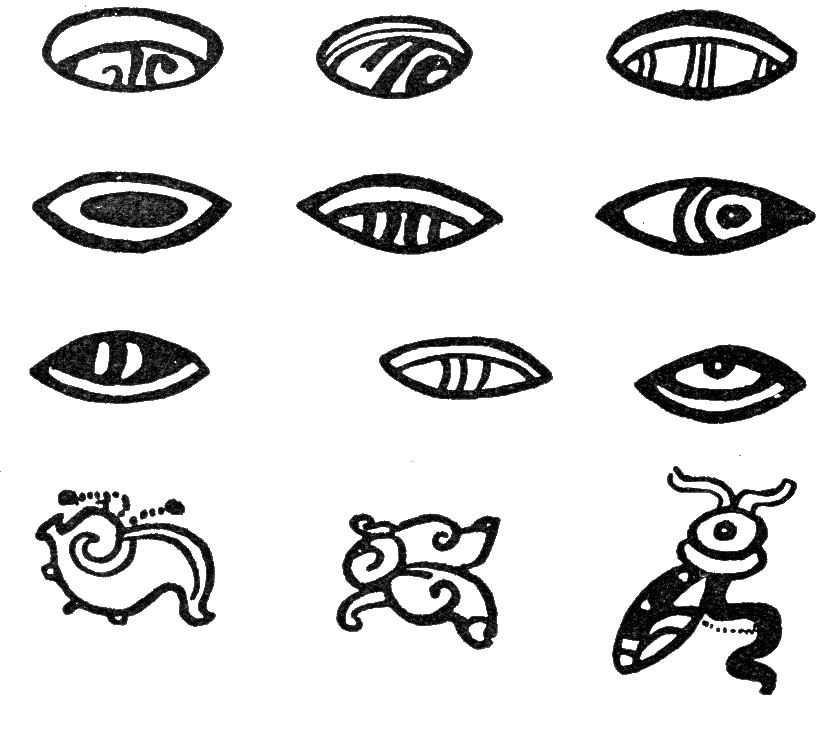
Fig. 46. Sign for 0 in the codices.
If the Maya numerical system had no vital need for a character to express the number 20, a sign to represent zero was absolutely indispensable. Indeed, any numerical system which rises to a second order of units requires a character which will signify, when the need arises, that no units of a certain order are involved; as zero units and zero tens, for example, in writing 100 in our own Arabic notation.
The character zero seems to have played an important part in Maya calculations, and signs for it have been found in both the codices and the inscriptions. The form found in the codices (fig. 46) is lenticular; it presents an interior decoration which does not follow any fixed scheme.[63] Only a very few variants occur. The last one in figure 46 has clearly as one of its elements the normal form (lenticular). The remaining two are different. It is noteworthy, however, that these last three forms all stand in the 2d, or uinal, place in the texts in which they occur, though whether this fact has influenced their variation is unknown.
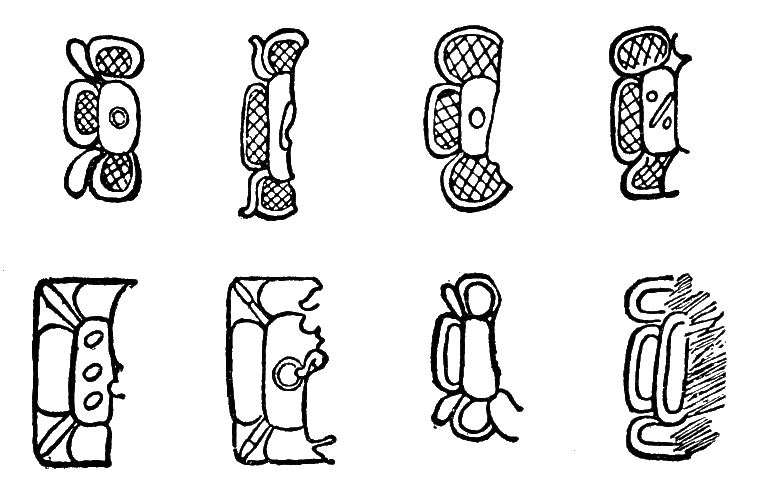
Fig. 47. Sign for 0 in the inscriptions.
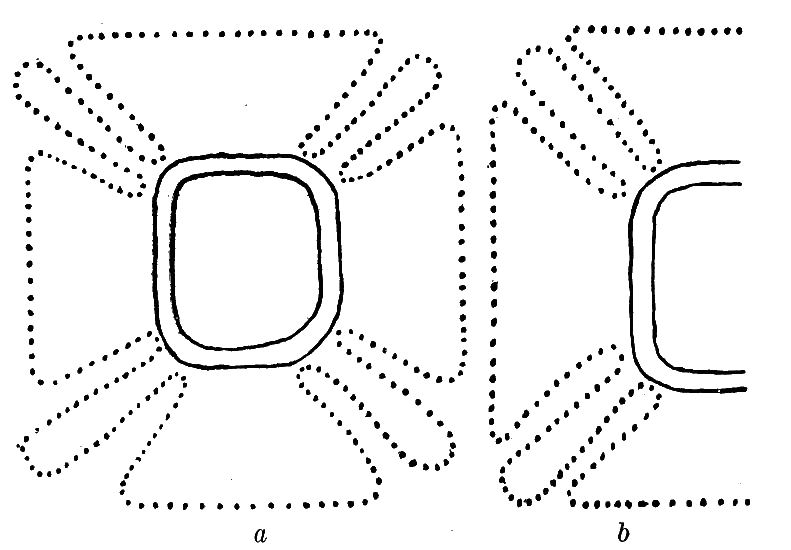
Fig. 48. Figure showing possible derivation of the sign for 0 in the inscriptions: a, Outline of the days of the tonalamatl as represented graphically in the Codex Tro-Cortesiano; b, half of same outline, which is also sign for 0 shown in fig. 47.
Both normal forms and head variants for zero, as indeed for all the numbers, have been found in the inscriptions. The normal forms for zero are shown in figure 47. They are common and are unmistakable. An interesting origin for this sign has been suggested by Mr. A. P. Maudslay. On pages 75 and 76 of the Codex Tro-Cortesiano[64] the 260 days of a tonalamatl are graphically represented as forming the outline shown in figure 48, a. Half of this (see fig. 48, b) is the sign which stands for zero (compare with fig. 47). The train of association by which half of the graphic representation of a tonalamatl could come to stand for zero is not clear. Perhaps a of figure 48 may have signified that a complete tonalamatl had passed with no additional days. From this the sign may have come to represent the idea of completeness as apart from the tonalamatl, and finally the general idea of completeness applicable to any period; for no period could be exactly complete without a fractional remainder unless all the lower periods were wanting; that is, represented by zero. Whether this explains the connection between the outline of the tonalamatl and the zero sign, or whether indeed there be any connection between the two, is of course a matter of conjecture.
There is still one more normal form for zero not included in the examples given above, which must be described. This form (fig. 49), which occurs throughout the inscriptions and in the Dresden Codex,[65] is chiefly interesting because of its highly specialized function. Indeed, it was used for one purpose only, namely, to express the first, or zero, position in each of the 19 divisions of the haab, or year, and for no other. In other words, it denotes the positions 0 Pop, 0 Uo, 0 Zip, etc., which, as we have seen (pp. 47, 48), corresponded with our first days of the months. The forms shown in figure 49, a-e, are from the inscriptions and those in f-h from the Dresden Codex. They are all similar. The general outline of the sign has suggested the name "the spectacle" glyph. Its essential characteristic seems to be the division into two roughly circular parts, one above the other, best seen in the Dresden Codex forms (fig. 49, f-h) and a roughly circular infix in each. The lower infix is quite regular in all of the forms, being a circle or ring. The upper infix, however, varies considerably. In figure 49, a, b, this ring has degenerated into a loop. In c and d of the same figure it has become elaborated into a head. A simpler form is that in f and g. Although comparatively rare, this glyph is so unusual in form that it can be readily recognized. Moreover, if the student will bear in mind the two following points concerning its use, he will never fail to identify it in the inscriptions: The "spectacle" sign (1) can be attached only to the glyphs for the 19 divisions of the haab, or year, that is, the 18 uinals and the xma kaba kin; in other words, it is found only with the glyphs shown in figures 19 and 20, the signs for the months in the inscriptions and codices, respectively.
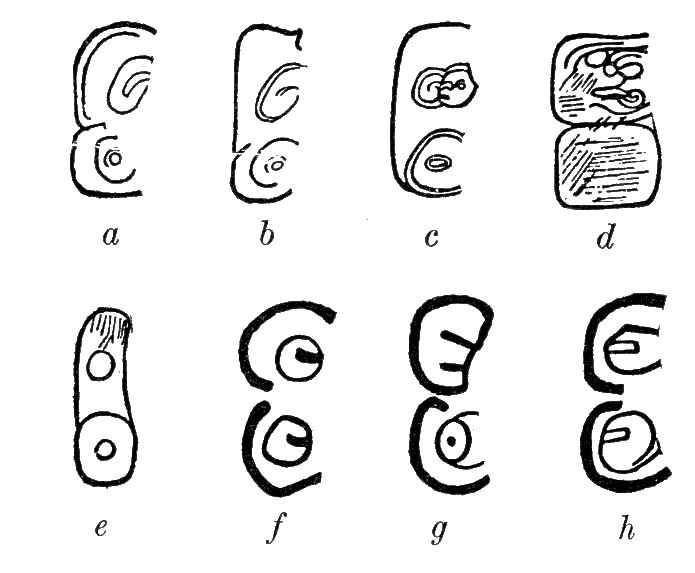
Fig. 49. Special sign for 0 used exclusively as a month coefficient.
(2) It can occur only in connection with one of the four day-signs, Ik, Manik, Eb, and Caban (see figs. 16, c, j, s, t, u, a', b', and 17, c, d, k, r, x, y, respectively), since these four alone, as appears in Table VII, can occupy the 0 (zero) positions in the several divisions of the haab.
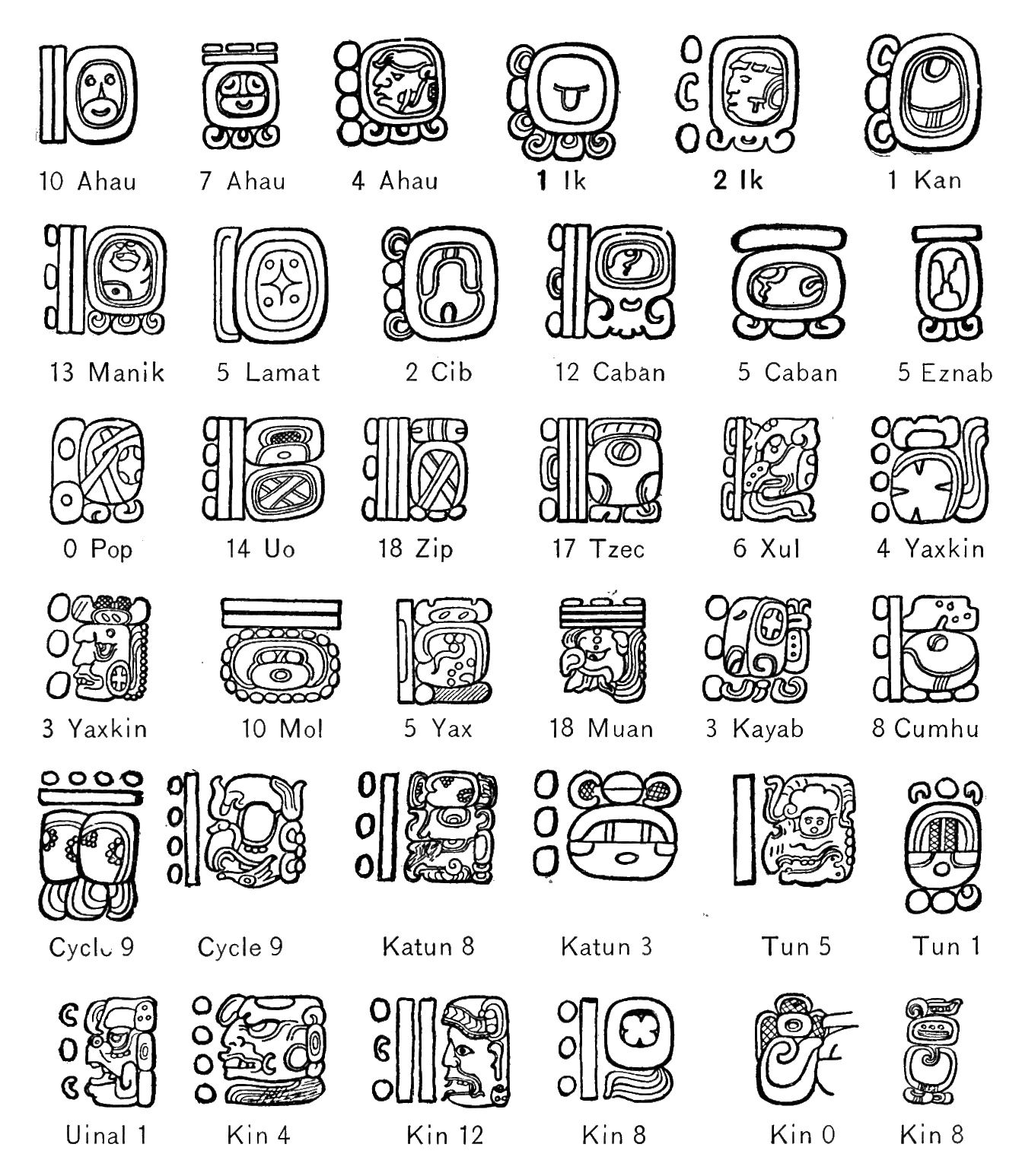
Fig. 50. Examples of the use of bar and dot numerals with period, day, or month signs. The translation of each glyph appears below it.
Examples of the normal-form numerals as used with the day, month, and period glyphs in both the inscriptions and the codices are shown in figure 50. Under each is given its meaning in English.[66] The student is advised to familiarize himself with these forms, since on his ability to recognize them will largely depend his progress in reading the inscriptions. This figure illustrates the use of all the foregoing forms except the sign for 20 in figure 45 and the sign for zero in figure 46. As these two forms never occur with day, month, or period glyphs, and as they have been found only in the codices, examples showing their use will not be given until Chapter VI is reached, which treats of the codices exclusively.
Head-variant Numerals
Let us next turn to the consideration of the Maya "Arabic notation," that is, the head-variant numerals, which, like all other known head variants, are practically restricted to the inscriptions.[67] It should be noted here before proceeding further that the full-figure numerals found in connection with full-figure period, day, and month glyphs in a few inscriptions, have been classified with the head-variant numerals. As explained on page 67, the body-parts of such glyphs have no function in determining their meanings, and it is only the head-parts which present in each case the determining characteristics of the form intended.
In the "head" notation each of the numerals, 0, 1, 2, 3, 4, 5, 6, 7, 8, 9, 10, 11, 12, 13[68] is expressed by a distinctive type of head; each type has its own essential characteristic, by means of which it can be distinguished from all of the others. Above 13 and up to but not including 20, the head numerals are expressed by the application of the essential characteristic of the head for 10 to the heads for 3 to 9, inclusive. No head forms for the numeral 20 have yet been discovered.
The identification of these head-variant numerals in some cases is not an easy matter, since their determining characteristics are not always presented clearly. Moreover, in the case of a few numerals, notably the heads for 2, 11, and 12, the essential elements have not yet been determined. Head forms for these numerals occur so rarely in the inscriptions that the comparative data are insufficient to enable us to fix on any particular element as the essential one. Another difficulty encountered in the identification of head-variant numerals is the apparent irregularity of the forms in the earlier inscriptions. The essential elements of these early head numerals in some cases seem to differ widely from those of the later forms, and consequently it is sometimes difficult, indeed even impossible, to determine their corresponding numerical values.
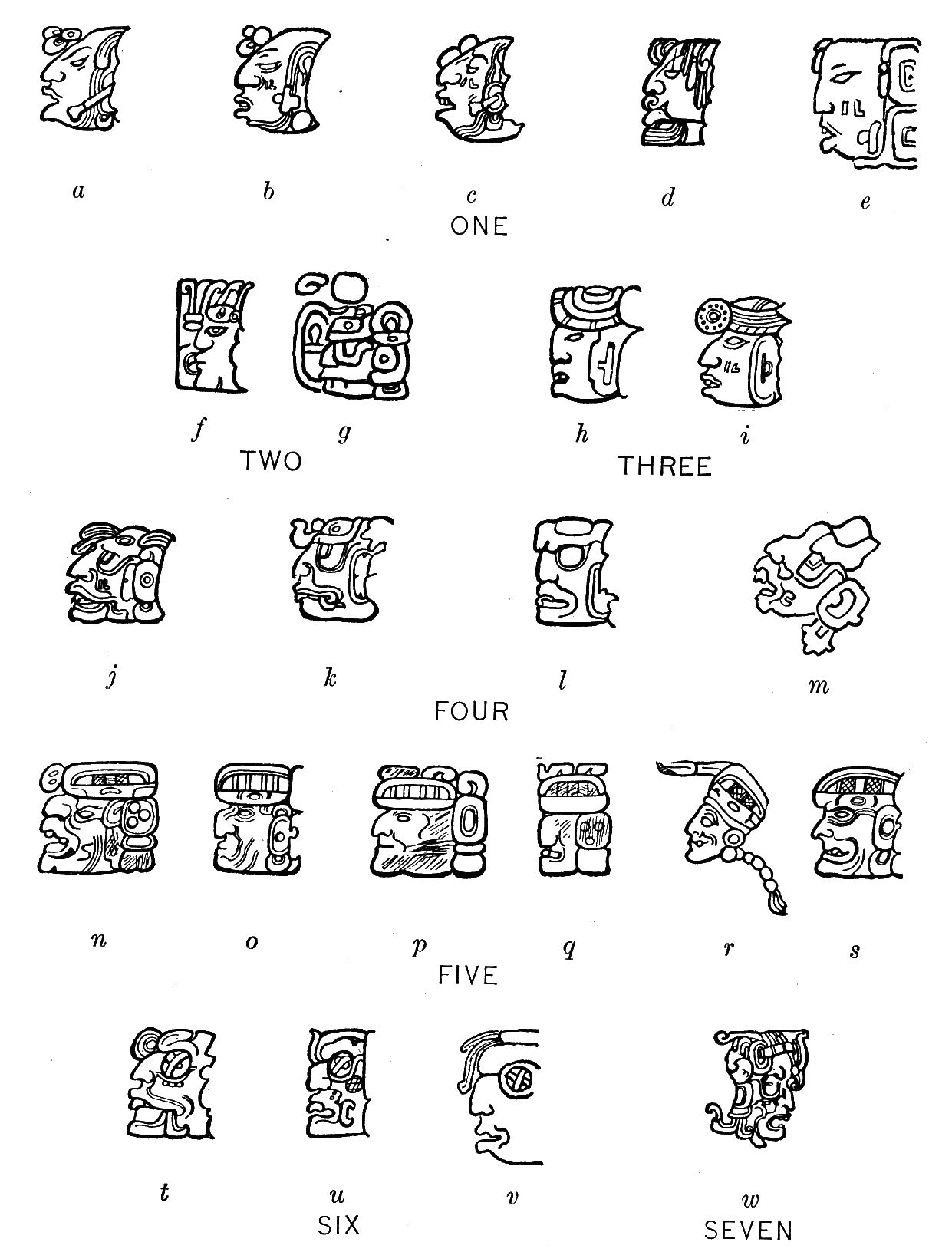
Fig. 51. Head-variant numerals 1 to 7, inclusive.
The head-variant numerals are shown in figures 51-53. Taking these up in their numerical order, let us commence with the head signifying 1; see figure 51, a-e. The essential element of this head is its forehead ornament, which, to signify the number 1, must be composed of more than one part (*), in order to distinguish it from the forehead ornament (**), which, as we shall see presently, is the essential element of the head for 8 (fig. 52, a-f). Except for their forehead ornaments the heads for 1 and 8 are almost identical, and great care must be exercised in order to avoid mistaking one for the other.


The head for 2 (fig. 51, f, g) has been found only twice in the inscriptions—on Lintel 2 at Piedras Negras and on the tablet in the Temple of the Initial Series at Holactun. The oval at the top of the head seems to be the only element these two forms have in common, and the writer therefore accepts this element as the essential characteristic of the head for 2, admitting at the same time that the evidence is insufficient.
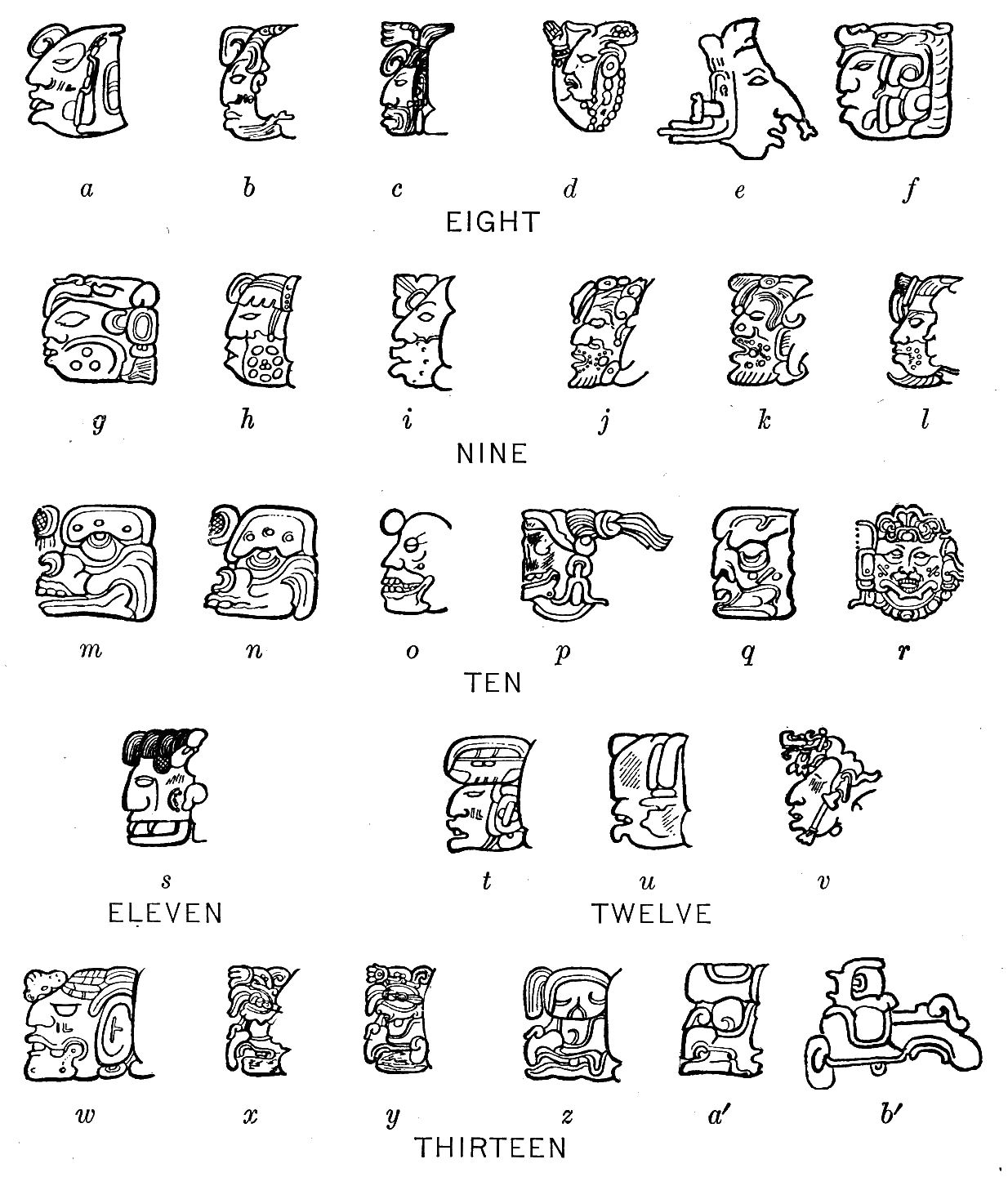
Fig. 52. Head-variant numerals 8 to 13, inclusive.
The head for 3 is shown in figure 51, h, i. Its determining characteristic is the fillet, or headdress.
The head for 4 is shown in figure 51, j-m. It is to be distinguished by its large prominent eye and square irid (*). (probably eroded in l), the snaglike front tooth, and the curling fang protruding from the back part of the mouth (**) (wanting in l and m).


The head for 5 (fig. 51, n-s) is always to be identified by its peculiar headdress (†), which is the normal form of the tun sign. Compare figure 29, a, b. The same element appears also in the head for 15 (see fig. 53, b-e). The head for 5 is one of the most constant of all the head numerals.
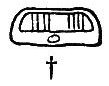
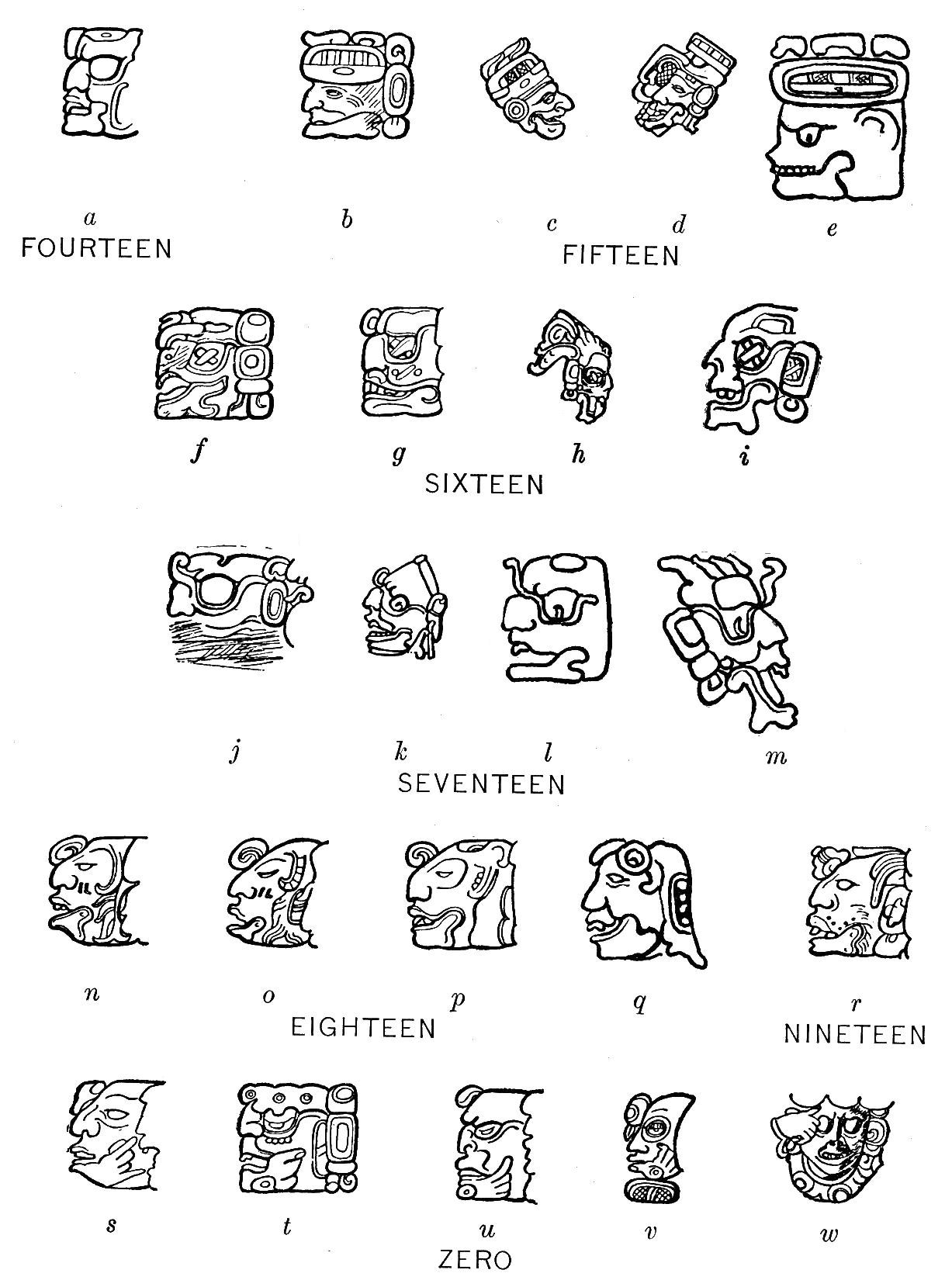
Fig. 53. Head-variant numerals 14 to 19, inclusive, and 0.
The head for 6 (fig. 51, t-v) is similarly unmistakable. It is always characterized by the so-called hatchet eye (††), which appears also in the head for 16 (fig. 53, f-i).

The head for 7 (fig. 51, w) is found only once in the inscriptions—on the east side of Stela D at Quirigua. Its essential characteristic, the large ornamental scroll passing under the eye and curling up in front of the forehead (‡), is better seen in the head for 17 (fig. 53, j-m).

The head for 8 is shown in figure 52, a-f. It is very similar to the head for 1, as previously explained (compare figs. 51, a-e and 52, a-f), and is to be distinguished from it only by the character of the forehead ornament, which is composed of but a single element (‡‡). In figure 52, a, b, this takes the form of a large curl. In c of the same figure a flaring element is added above the curl and in d and e this element replaces the curl. In f the tongue or tooth of a grotesque animal head forms the forehead ornament. The heads for 18 (fig. 53, n-q) follow the first variants (fig. 51, a, b), having the large curl, except q, which is similar to d in having a flaring element instead.
The head for 9 occurs more frequently than all of the others with the exception of the zero head, because the great majority of all Initial Series record dates which fell after the completion of Cycle 9, but before the completion of Cycle 10. Consequently, 9 is the coefficient attached to the cycle glyph in almost all Initial Series.[69] The head for 9 is shown in figure 52, g-l. It has for its essential characteristic the dots on the lower cheek or around the mouth (*). Sometimes these occur in a circle or again irregularly. Occasionally, as in j-l, the 9 head has a beard, though this is not a constant element as are the dots, which appear also in the head for 19. Compare figure 53, r.

The head for 10 (fig. 52, m-r) is extremely important since its essential element, the fleshless lower jaw (*), stands for the numerical value 10, in composition with the heads for 3, 4, 5, 6, 7, 8, and 9, to form the heads for 13, 14, 15, 16, 17, 18, and 19, respectively. The 10 head is clearly the fleshless skull, having the truncated nose and fleshless jaws (see fig. 52, m-p). The fleshless lower jaw is shown in profile in all cases but one—Zoömorph B at Quirigua (see r of the same figure). Here a full front view of a 10 head is shown in which the fleshless jaw extends clear across the lower part of the head, an interesting confirmation of the fact that this characteristic is the essential element of the head for 10.

The head for 11 (fig. 52, s) has been found only once in the inscriptions, namely, on Lintel 2 at Piedras Negras; hence comparative data are lacking for the determination of its essential element. This head has no fleshless lower jaw and consequently would seem, therefore, not to be built up of the heads for 1 and 10.
Similarly, the head for 12 (fig. 52, t-v) has no fleshless lower jaw, and consequently can not be composed of the heads for 10 and 2. It is to be noted, however, that all three of the faces are of the same type, even though their essential characteristic has not yet been determined.
The head for 13 is shown in figure 52, w-b'. Only the first of these forms, w, however, is built on the 10 + 3 basis. Here we see the characteristic 3 head with its banded headdress or fillet (compare h and i, fig. 51), to which has been added the essential element of the 10 head, the fleshless lower jaw, the combination of the two giving the head for 13. The other form for 13 seems to be a special character, and not a composition of the essential elements of the heads for 3 and 10, as in the preceding example. This form of the 13 head (fig. 52, x-b') is grotesque. It seems to be characterized by its long pendulous nose surmounted by a curl (*), its large bulging eye (**), and a curl (†) or fang (††) protruding from the back part of the mouth. Occurrences of the first type—the composite head—are very rare, there being only two examples of this kind known in all the inscriptions. The form given in w is from the Temple of the Cross at Palenque, and the other is on the Hieroglyphic Stairway at Copan. The individual type, having the pendulous nose, bulging eye, and mouth curl is by far the more frequent.
The head for 14 (fig. 53, a) is found but once—in the inscriptions on the west side of Stela F at Quirigua. It has the fleshless lower jaw denoting 10, while the rest of the head shows the characteristics of 4—the bulging eye and snaglike tooth (compare fig. 51, j-m). The curl protruding from the back part of the mouth is wanting because the whole lower part of the 4 head has been replaced by the fleshless lower jaw.
The head for 15 (fig. 53, b-e) is composed of the essential element of the 5 head (the tun sign; see fig. 51, n-s) and the fleshless lower jaw of the head for 10.
The head for 16 (fig. 53, f-i) is characterized by the fleshless lower jaw and the hatchet eye of the 6 head. Compare figures 51, t-v, and 52, m-r, which together form 16 (10 + 6).
The head for 17 (fig. 53, j-m) is composed of the essential element of the 7 head (the scroll projecting above the nose; see fig. 51, w) and the fleshless lower jaw of the head for 10.
The head for 18 (fig. 53, n-q) has the characteristic forehead ornament of the 8 head (compare fig. 52, a-f) and the fleshless lower jaw denoting 10.
Only one example (fig. 53, r) of the 19 head has been found in the inscriptions. This occurs on the Temple of the Cross at Palenque and seems to be formed regularly, both the dots of the 9 head and the fleshless lower jaw of the 10 head appearing.
The head for 0 (zero), figure 53, s-w, is always to be distinguished by the hand clasping the lower part of the face (*). In this sign for zero, the hand probably represents the idea "ending" or "closing," just as it seems to have done in the ending signs used with Period-ending dates. According to the Maya conception of time, when a period had ended or closed it was at zero, or at least no new period had commenced. Indeed, the normal form for zero in figure 47, the head variant for zero in figure 53, s-w, and the form for zero shown in figure 54 are used interchangeably in the same inscription to express the same idea—namely, that no periods thus modified are involved in the calculations and that consequently the end of some higher period is recorded; that is, no fractional parts of it are present.

That the hand in "ending signs" had exactly the same meaning as the hand in the head variants for zero (fig. 53, s-w) receives striking corroboration from the rather unusual sign for zero shown in figure 54, to which attention was called above. The essential elements of this sign are[70] (1) the clasped hand, identical with the hand in the head-variant forms for zero, and (2) the large element above it, containing a curling infix. This latter element also occurs though below the clasped hand, in the "ending signs" shown in figure 37, l, m, n, the first two of which accompany the closing date of Katun 14, and the last the closing date of Cycle 13. The resemblance of these three "ending signs" to the last three forms in figure 54 is so close that the conclusion is well-nigh inevitable that they represented one and the same idea. The writer is of the opinion that this meaning of the hand (ending or completion) will be found to explain its use throughout the inscriptions.
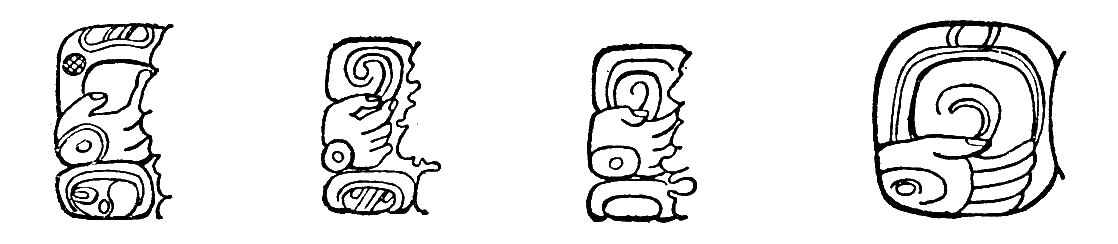
Fig. 54. A sign for 0, used also to express the idea "ending" or "end of" in Period-ending dates. (See figs. 47 and 53 s-w, for forms used interchangeably in the inscriptions to express the idea of 0 or of completion.)
In order to familiarize the student with the head-variant numerals, their several essential characteristics have been gathered together in Table X, where they may be readily consulted. Examples covering their use with period, day, and month glyphs are given in figure 55 with the corresponding English translations below.
Head-variant numerals do not occur as frequently as the bar and dot forms, and they seem to have been developed at a much later period. At least, the earliest Initial Series recorded with bar and dot numerals antedates by nearly two hundred years the earliest Initial Series the numbers of which are expressed by head variants. This long priority in the use of the former would doubtless be considerably diminished if it were possible to read the earliest Initial Series which have head-variant numerals; but that the earliest of these latter antedate the earnest bar and dot Initial Series may well be doubted.
Table X. CHARACTERISTICS OF HEAD-VARIANT NUMERALS 0 TO 19, INCLUSIVE
Forms Characteristics
Head for 0 Clasped hand across lower part of face.
Head for 1 Forehead ornament composed of more than one part.
Head for 2 Oval in upper part of head. (?)
Head for 3 Banded headdress or fillet.
Head for 4 Bulging eye with square irid, snaglike front tooth, curling fang from back of mouth.
Head for 5 Normal form of tun sign as headdress.
Head for 6 "Hatchet eye."
Head for 7 Large scroll passing under eye and curling up in front of forehead.
Head for 8 Forehead ornament composed of one part.
Head for 9 Dots on lower cheek or around mouth and in some cases beard.
Head for 10 Fleshless lower jaw and in some cases other death's-head characteristics, truncated nose, etc.
Head for 11 Undetermined.
Head for 12 Undetermined; type of head known, however.
Head for 13 (a) Long pendulous nose, bulging eye, and curling fang from back of mouth.
(b) Head for 3 with fleshless lower jaw of head for 10.
Head for 14 (b)Head for 4 with fleshless lower jaw of head for 10.
Head for 15 (b)Head for 5 with fleshless lower jaw of head for 10.
Head for 16 (b)Head for 6 with fleshless lower jaw of head for 10.
Head for 17 (b)Head for 7 with fleshless lower jaw of head for 10.
Head for 18 (b)Head for 8 with fleshless lower jaw of head for 10.
Head for 19 (b)Head for 9 with fleshless lower jaw of head for 10.
Mention should be made here of a numerical form which can not be classified either as a bar and dot numeral or a head variant. This is the thumb (*), which has a numerical value of one.
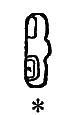
We have seen in the foregoing pages the different characters which stood for the numerals 0 to 19, inclusive. The next point claiming our attention is, how were the higher numbers written, numbers which in the codices are in excess of 12,000,000, and in the inscriptions, in excess of 1,400,000? In short, how were numbers so large expressed by the foregoing twenty (0 to 19, inclusive) characters?
The Maya expressed their higher numbers in two ways, in both of which the numbers rise by successive terms of the same vigesimal system:
1. By using the numbers 0 to 19, inclusive, as multipliers with the several periods of Table VIII (reduced in each case to units of the lowest order) as the multiplicands, and—
2. By using the same numbers[71] in certain relative positions, each of which had a fixed numerical value of its own, like the positions to the right and left of the decimal point in our own numerical notation.
The first of these methods is rarely found outside of the inscriptions, while the second is confined exclusively to the codices. Moreover, although the first made use of both normal-form and head-variant numerals, the second could be expressed by normal forms only, that is, bar and dot numerals. This enables us to draw a comparison between these two forms of Maya numerals:
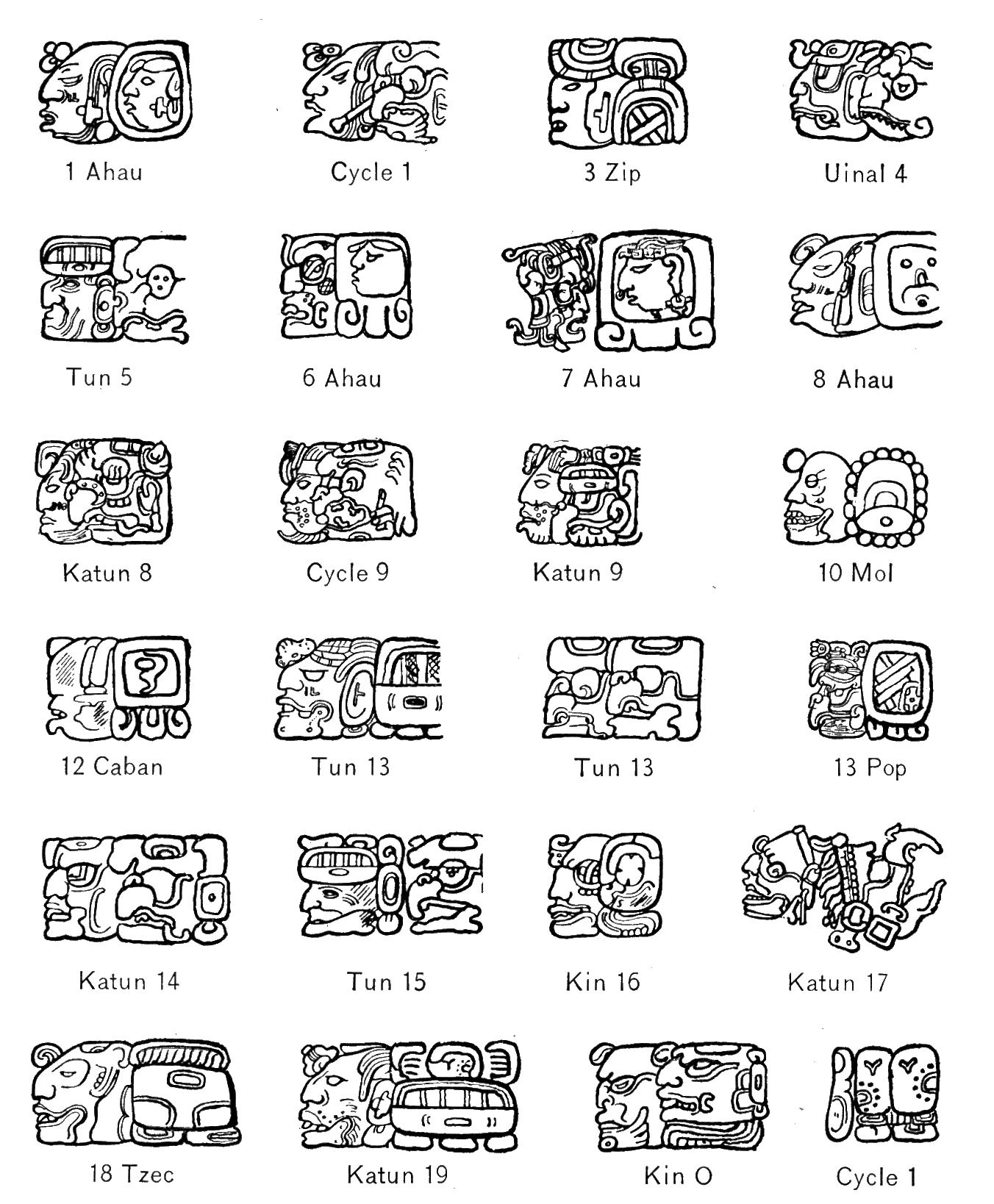
Fig. 55. Examples of the use of head-variant numerals with period, day, or month signs. The translation of each glyph appears below it.
Head-variant numerals never occur independently, but are always prefixed to some period, day, or month sign. Bar and dot numerals, on the other hand, frequently stand by themselves in the codices unattached to other signs. In such cases, however, some sign was to be supplied mentally with the bar and dot numeral.
First Method of Numeration
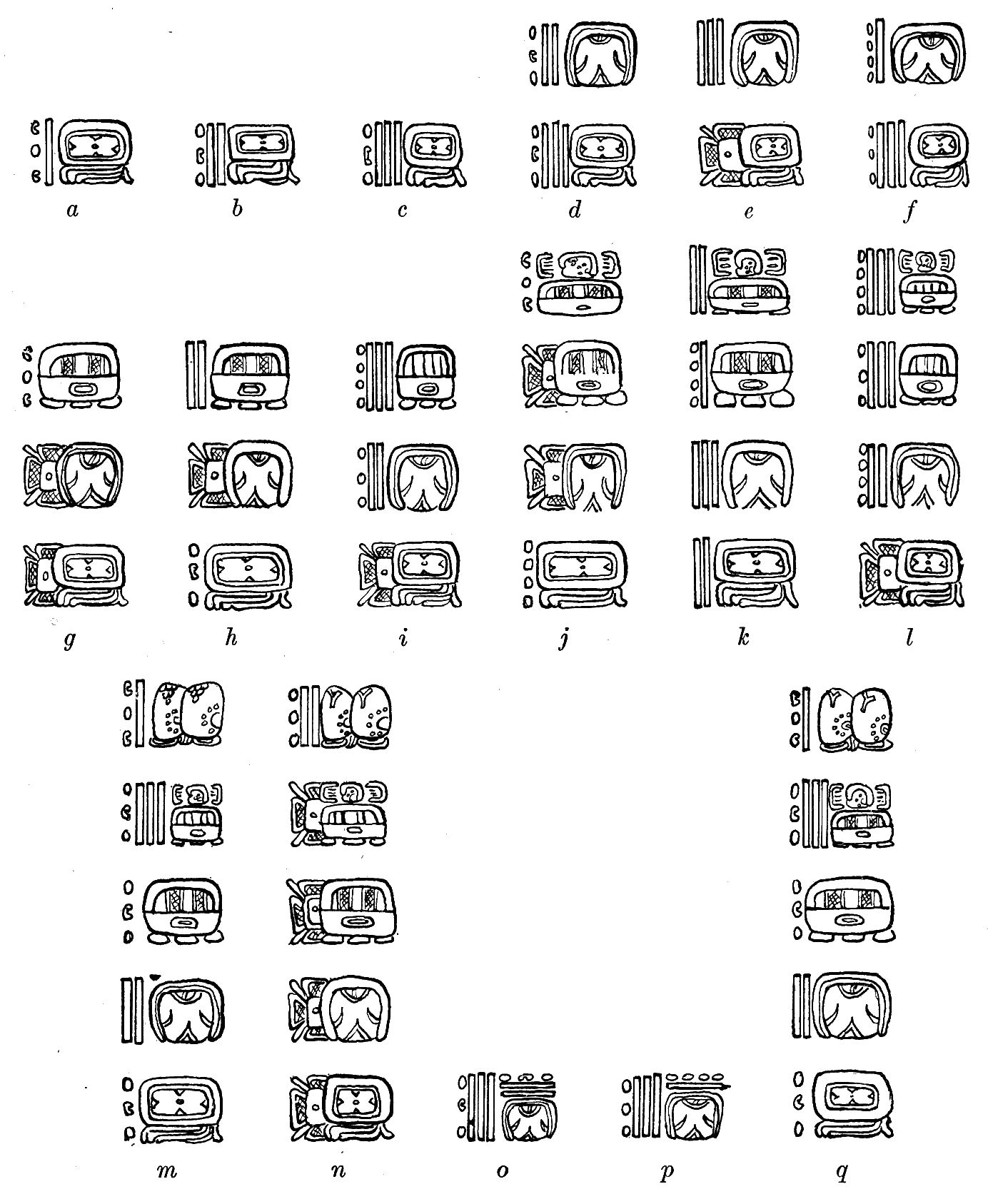
Fig. 56. Examples of the first method of numeration, used almost exclusively in the inscriptions.
In the first of the above methods the numbers 0 to 19, inclusive, were expressed by multiplying the kin sign by the numerals[72] 0 to 19 in turn. Thus, for example, 6 days was written as shown in figure 56, a, 12 days as shown in b, and 17 days as shown in c of the same figure. In other words, up to and including 19 the numbers were expressed by prefixing the sign for the number desired to the kin sign, that is, the sign for 1 day.[73]
The numbers 20 to 359, inclusive, were expressed by multiplying both the kin and uinal signs by the numerical forms 0 to 19, and adding together the resulting products. For example, the number 257 was written as shown in figure 56, d. We have seen in Table VIII that 1 uinal = 20 kins, consequently 12 uinals (the 12 being indicated by 2 bars and 2 dots) = 240 kins. However, as this number falls short of 257 by 17 kins, it is necessary to express these by 17 kins, which are written immediately below the 12 uinals. The sum of these two products = 257. Again, the number 300 is written as in figure 56, e. The 15 uinals (three bars attached to the uinal sign) = 15 × 20 = 300 kins, exactly the number expressed. However, since no kins are required to complete the number, it is necessary to show that none were involved, and consequently 0 kins, or "no kins" is written immediately below the 15 uinals, and 300 + 0 = 300. One more example will suffice to show how the numbers 20 to 359 were expressed. In figure 56, f, the number 198 is shown. The 9 uinals = 9 × 20 = 180 kins. But this number falls short of 198 by 18, which is therefore expressed by 18 kins written immediately below the 9 uinals: and the sum of these two products is 198, the number to be recorded.
The numbers 360 to 7,199, inclusive, are indicated by multiplying the kin, uinal, and tun signs by the numerals 0 to 19, and adding together the resulting products. For example, the number 360 is shown in figure 56, g. We have seen in Table VIII that 1 tun = 18 uinals; but 18 uinals = 360 kins (18 × 20 = 360); therefore 1 tun also = 360 kins. However, in order to show that no uinals and kins are involved in forming this number, it is necessary to record this fact, which was done by writing 0 uinals immediately below the 1 tun, and 0 kins immediately below the 0 uinals. The sum of these three products equals 360 (360 + 0 + 0 = 360). Again, the number 3,602 is shown in figure 56, h. The 10 tuns = 10 × 360 = 3,600 kins. This falls short of 3,602 by only 2 units of the first order (2 kins), therefore no uinals are involved in forming this number, a fact which is shown by the use of 0 uinals between the 10 tuns and 2 kins. The sum of these three products = 3,602 (3,600 + 0 + 2). Again, in figure 56, i, the number 7,100 is recorded. The 19 tuns = 19 × 360 = 6,840 kins, which falls short of 7,100 kins by 7,100 - 6,840 = 260 kins. But 260 kins = 13 uinals with no kins remaining. Consequently, the sum of these products equals 7,100 (6,840 + 260 + 0).
The numbers 7,200 to 143,999 were expressed by multiplying the kin, uinal, tun, and katun signs by the numerals 0 to 19, inclusive, and adding together the resulting products. For example, figure 56, j, shows the number 7,204. We have seen in Table VIII that 1 katun = 20 tuns, and we have seen that 20 tuns = 7,200 kins (20 × 360); therefore 1 katun = 7,200 kins. This number falls short of the number recorded by exactly 4 kins, or in other words, no tuns or uinals are involved in its composition, a fact shown by the 0 tuns and 0 uinals between the 1 katun and the 4 kins. The sum of these four products = 7,204 (7,200 + 0 + 0 + 4). The number 75,550 is shown in figure 56, k. The 10 katuns = 72,000; the 9 tuns, 3,240; the 15 uinals, 300; and the 10 kins, 10. The sum of these four products = 75,550 (72,000 + 3,240 + 300 + 10). Again, the number 143,567 is shown in figure 56, l. The 19 katuns = 136,800; the 18 tuns, 6,480; the 14 uinals, 280; and the 7 kins, 7. The sum of these four products = 143,567 (136,800 + 6,480 + 280 + 7).
The numbers 144,000 to 1,872,000 (the highest number, according to some authorities, which has been found[74] in the inscriptions) were expressed by multiplying the kin, uinal, tun, katun, and cycle signs by the numerals 0 to 19, inclusive, and adding together the resulting products. For example, the number 987,322 is shown in figure 56, m. We have seen in Table VIII that 1 cycle = 20 katuns, but 20 katuns = 144,000 kins; therefore 6 cycles = 864,000 kins; and 17 katuns = 122,400 kins; and 2 tuns, 720 kins; and 10 uinals, 200 kins; and the 2 kins, 2 kins. The sum of these five products equals the number recorded, 987,322 (864,000 + 122,400 + 720 + 200 + 2). The highest number in the inscriptions upon which all are agreed is 1,872,000, as shown in figure 56, n. It equals 13 cycles (13 × 144,000), and consequently all the periods below—the katun, tun, uinal, and kin—are indicated as being used 0 times.
Number of Cycles in a Great Cycle
This brings us to the consideration of an extremely important point concerning which Maya students entertain two widely different opinions; and although its presentation will entail a somewhat lengthy digression from the subject under consideration it is so pertinent to the general question of the higher numbers and their formation, that the writer has thought best to discuss it at this point.
In a vigesimal system of numeration the unit of increase is 20, and so far as the codices are concerned, as we shall presently see, this number was in fact the only unit of progression used, except in the 2d order, in which 18 instead of 20 units were required to make 1 unit of the 3d order. In other words, in the codices the Maya carried out their vigesimal system to six places without a break other than the one in the 2d place, just noted. See Table VIII.
In the inscriptions, however, there is some ground for believing that only 13 units of the 5th order (cycles), not 20, were required to make 1 unit of the 6th order, or 1 great cycle. Both Mr. Bowditch (1910: App. IX, 319-321) and Mr. Goodman (1897: p. 25) incline to this opinion, and the former, in Appendix IX of his book, presents the evidence at some length for and against this hypothesis.
This hypothesis rests mainly on the two following points:
1. That the cycles in the inscriptions are numbered from 1 to 13, inclusive, and not from 0 to 19, inclusive, as in the case of all the other periods except the uinal, which is numbered from 0 to 17, inclusive.
2. That the only two Initial Series which are not counted from the date 4 Ahau 8 Cumhu, the starting point of Maya chronology, are counted from a date 4 Ahau 8 Zotz, which is exactly 13 cycles in advance of the former date.
Let us examine the passages in the inscriptions upon which these points rest. In three places[75] in the inscriptions the date 4 Ahau 8 Cumhu is declared to have occurred at the end of a Cycle 13; that is, in these three places this date is accompanied by an "ending sign" and a Cycle 13. In another place in the inscriptions, although the starting point 4 Ahau 8 Cumhu is not itself expressed, the second cycle thereafter is declared to have been a Cycle 2, not a Cycle 15, as it would have been had the cycles been numbered from 0 to 19, inclusive, like all the other periods.[76] In still another place the ninth cycle after the starting point (that is, the end of a Cycle 13) is not a Cycle 2 in the following great cycle, as would be the case if the cycles were numbered from 0 to 19, inclusive, but a Cycle 9, as if the cycles were numbered from 1 to 13. Again, the end of the tenth cycle after the starting point is recorded in several places, but not as Cycle 3 of the following great cycle, as if the cycles were numbered from 0 to 19, inclusive, but as Cycle 10, as would be the case if the cycles were numbered from 1 to 13. The above examples leave little doubt that the cycles were numbered from 1 to 13, inclusive, and not from 0 to 19, as in the case of the other periods. Thus, there can be no question concerning the truth of the first of the two above points on which this hypothesis rests.