Front matter (continued 2)
Reading edition
This kind of writing Doctor Brinton has called ikonomatic, more familiarly known to us under the name of rebus, or puzzle writing. In such writing the characters do not indicate the ideas of the objects which they portray, but only the sounds of their names, and are used purely in a phonetic sense, like the letters of the alphabet. For example, the rebus in figure 14 reads as follows: "I believe Aunt Rose can well bear all for you." The picture of the eye recalls not the idea "eye" but the sound of the word denoting this object, which is also the sound of the word for the first person singular of the personal pronoun I. Again, the picture of a bee does not represent the idea of that insect, but stands for the sound of its name, which used with a leaf indicates the sound "beeleaf," or in other words, "believe."[20]
It has long been known that the Aztec employed ikonomatic characters in their writing to express the names of persons and places, though this practice does not seem to have been extended by them to the representation of abstract words. The Aztec codices contain many glyphs which are to be interpreted ikonomatically, that is, like our own rebus writing. For example in figure 15, a, is shown the Aztec hieroglyph for the town of Toltitlan, a name which means "near the place of the rushes." The word tollin means "place of the rushes," but only its first syllable tol appears in the word Toltitlan. This syllable is represented in a by several rushes. The word tetlan means "near something" and its second syllable tlan is found also in the word tlantli, meaning "teeth." In a therefore, the addition of the teeth to the rushes gives the word Toltitlan. Another example of this kind of writing is given in figure 15, b, where the hieroglyph for the town of Acatzinco is shown. This word means "the little reed grass," the diminutive being represented by the syllable tzinco. The reed grass (acatl) is shown by the pointed leaves or spears which emerge from the lower part of a human figure. This part of the body was called by the Aztecs tzinco, and as used here expresses merely the sound tzinco in the diminutive acatzinco, "the little reed grass," the letter l of acatl being lost in composition.
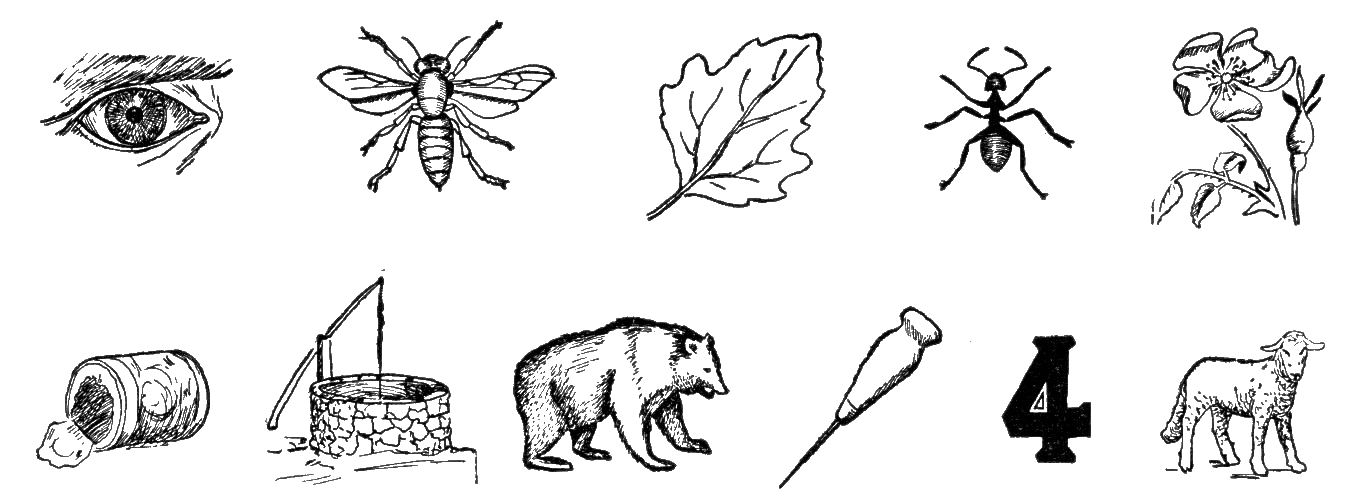
Fig. 14. A rebus. Aztec, and probably Maya, personal and place names were written in a corresponding manner.
The presence of undoubted phonetic elements in these Aztec glyphs expressing personal names and place names would seem to indicate that some similar usage probably prevailed among the Maya. While admitting this restricted use of phonetic composition by the Maya, Professor Seler refuses to recognize its further extension:
Certainly there existed in the Maya writing compound hieroglyphs giving the name of a deity, person, or a locality, whose elements united on the phonetic principle. But as yet it is not proved that they wrote texts. And without doubt the greater part of the Maya hieroglyphics were conventional symbols built up on the ideographic principle.
Doctor Förstemann also regards the use of phonetic elements as restricted to little more than the above when he says, "Finally the graphic system of the Maya ... never even achieved the expression of a phrase or even a verb."
On the other hand, Mr. Bowditch (1910: p. 255) considers the use of phonetic composition extended considerably beyond these limits:
As far as I am aware, the use of this kind of writing [rebus] was confined, among the Aztecs, to the names of persons and places, while the Mayas, if they used the rebus form at all, used it also for expressing common nouns and possibly abstract ideas. The Mayas surely used picture writing and the ideographic system, but I feel confident that a large part of their hieroglyphs will be found to be made up of rebus forms and that the true line of research will be found to lie in this direction.
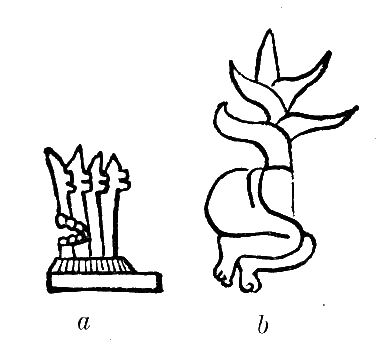
Fig. 15. Aztec place names: a, The sign for the town Toltitlan; b, the sign for the town Acatzinco.
Doctor Brinton (1894 b: p. 13) held an opinion between these two, perhaps inclining slightly toward the former: "The intermediate position which I have defended, is that while chiefly ideographic, they [the Maya glyphs] are occasionally phonetic, in the same manner as are confessedly the Aztec picture-writings."
These quotations from the most eminent authorities on the subject well illustrate their points of agreement and divergence. All admit the existence of phonetic elements in the glyphs, but disagree as to their extent. And here, indeed, is the crux of the whole phonetic question. Just how extensively do phonetic elements enter into the composition of the Maya glyphs? Without attempting to dispose of this point definitely one way or the other, the author may say that he believes that as the decipherment of Maya writing progresses, more and more phonetic elements will be identified, though the idea conveyed by a glyph will always be found to overshadow its phonetic value.
The various theories above described have not been presented for the reader's extended consideration, but only in order to acquaint him with the probable nature of the Maya glyphs. Success in deciphering, as we shall see, has not come through any of the above mentioned lines of research, which will not be pursued further in this work.
In taking up the question of the meaning of Maya writing, it must be admitted at the outset that in so far as they have been deciphered both the inscriptions and the codices have been found to deal primarily, if indeed not exclusively, with the counting of time in some form or other. Doctor Förstemann, the first successful interpreter of the codices, has shown that these writings have for their principal theme the passage of time in its varying relations to the Maya calendar, ritual, and astronomy. They deal in great part with the sacred year of 260 days, known to the Aztec also under the name of the tonalamatl, in connection with which various ceremonies, offerings, sacrifices, and domestic occupations are set forth. Doctor Förstemann believed that this 260-day period was employed by the priests in casting horoscopes and foretelling the future of individuals, classes, and tribes, as well as in predicting coming political events and natural phenomena; or in other words, that in so far as the 260-day period was concerned, the codices are nothing more nor less than books of prophecy and divination.
The prophetic character of some of these native books at least is clearly indicated in a passage from Bishop Landa's Relacion (p. 286). In describing a festival held in the month Uo, the Bishop relates that "the most learned priest opened a book, in which he examined the omens of the year, which he announced to all those who were present." Other early Spanish writers state that these books contain the ancient prophecies and indicate the times appointed for their fulfillment.
Doctor Thomas regarded the codices as religious calendars, or rituals for the guidance of the priests in the celebration of feasts, ceremonies, and other duties, seemingly a natural inference from the character of the scenes portrayed in connection with these 260-day periods.
Another very important function of the codices is the presentation of astronomical phenomena and calculations. The latter had for their immediate object in each case the determination of the lowest number which would exactly contain all the numbers of a certain group. These lowest numbers are in fact nothing more nor less than the least common multiple of changing combinations of numbers, each one of which represents the revolution of some heavenly body. In addition to these calculations deities are assigned to the several periods, and a host of mythological allusions are introduced, the significance of most of which is now lost.
The most striking proof of the astronomical character of the codices is to be seen in pages 46-50 of the Dresden Manuscript. Here, to begin with, a period of 2,920 days is represented, which exactly contains five Venus years of 584[21] days each (one on each page) as well as eight solar years of 365 days each. Each of the Venus years is divided into four parts, respectively, 236, 90, 250, and 8 days. The first and third of these constitute the periods when Venus was the morning and the evening star, respectively, and the second and fourth, the periods of invisibility after each of these manifestations. This Venus-solar period of 2,920 days was taken as the basis from which the number 37,960 was formed. This contains 13 Venus-solar periods, 65 Venus-years, 104 solar years, and 146 tonalamatls, or sacred years of 260 days each. Finally, the last number (37,960) with all the subdivisions above given was thrice repeated, so that these five pages of the manuscript record the passage of 113,880 days, or 312 solar years.
Again, on pages 51-58 of the same manuscript, 405 revolutions of the moon are set down; and so accurate are the calculations involved that although they cover a period of nearly 33 years the total number of days recorded (11,959) is only 89⁄100 of a day less than the true time computed by the best modern method[22]—certainly a remarkable achievement for the aboriginal mind. It is probable that the revolutions of the planets Jupiter, Mars, Mercury, and Saturn are similarly recorded in the same manuscript.
Toward the end of the Dresden Codex the numbers become greater and greater until, in the so-called "serpent numbers," a grand total of nearly twelve and a half million days (about thirty-four thousand years) is recorded again and again. In these well-nigh inconceivable periods all the smaller units may be regarded as coming at last to a more or less exact close. What matter a few score years one way or the other in this virtual eternity? Finally, on the last page of the manuscript, is depicted the Destruction of the World (see pl. 3), for which these highest numbers have paved the way. Here we see the rain serpent, stretching across the sky, belching forth torrents of water. Great streams of water gush from the sun and moon. The old goddess, she of the tiger claws and forbidding aspect, the malevolent patroness of floods and cloudbursts, overturns the bowl of the heavenly waters. The crossbones, dread emblem of death, decorate her skirt, and a writhing snake crowns her head. Below with downward-pointed spears, symbolic of the universal destruction, the black god stalks abroad, a screeching bird raging on his fearsome head. Here, indeed, is portrayed with graphic touch the final all-engulfing cataclysm.
According to the early writers, in addition to the astronomic, prophetic, and ritualistic material above described, the codices contained records of historical events. It is doubtful whether this is true of any of the three codices now extant, though there are grounds for believing that the Codex Peresianus may be in part at least of an historical nature.
BUREAU OF AMERICAN ETHNOLOGYBULLETIN 57 PLATE 3
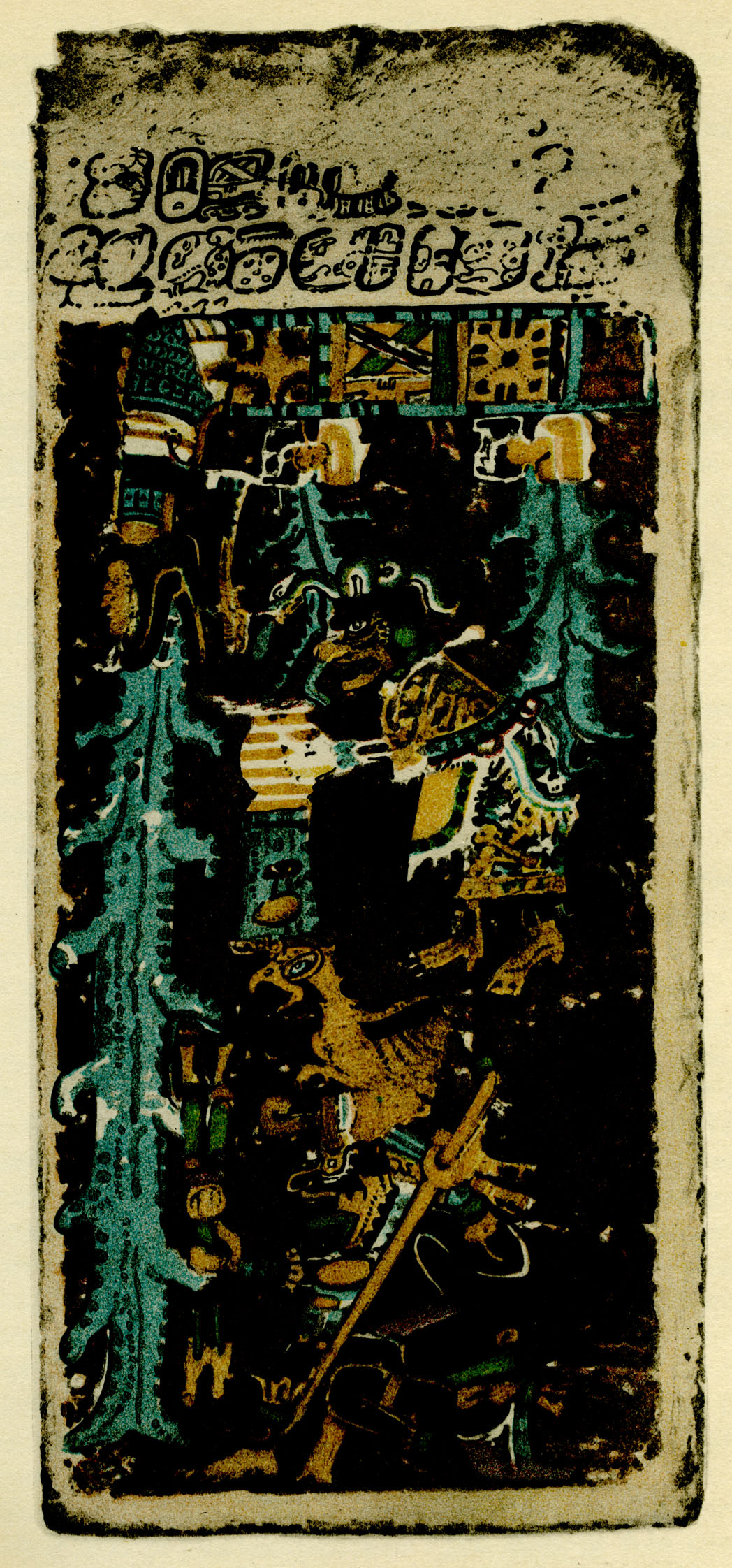
PAGE 74 OF THE DRESDEN CODEX, SHOWING THE END OF THE WORLD (ACCORDING TO FÖRSTEMANN)
Much less progress has been made toward discovering the meaning of the inscriptions. Doctor Brinton (1894 b: p.32) states:
My own conviction is that they [the inscriptions and codices] will prove to be much more astronomical than even the latter [Doctor Förstemann] believes; that they are primarily and essentially records of the motions of the heavenly bodies; and that both figures and characters are to be interpreted as referring in the first instance to the sun and moon, the planets, and those constellations which are most prominent in the nightly sky in the latitude of Yucatan.
Mr. Bowditch (1910: p. 199) has also brought forward very cogent points tending to show that in part at least the inscriptions treat of the intercalation of days necessary to bring the dated monuments, based on a 365-day year, into harmony with the true solar year of 365.2421 days.[23]
While admitting that the inscriptions may, and probably do, contain such astronomical matter as Doctor Brinton and Mr. Bowditch have suggested, the writer believes nevertheless that fundamentally they are historical; that the monuments upon which they are presented were erected and inscribed on or about the dates they severally record; and finally, that the great majority of these dates are those of contemporaneous events, and as such pertain to the subject-matter of history.
The reasons which have led him to this conclusion follow:
First. The monuments at most of the southern Maya sites show a certain periodicity in their sequence. This is most pronounced at Quirigua, where all of the large monuments fall into an orderly series, in which each monument is dated exactly 1,800 days later than the one immediately preceding it in the sequence. This is also true at Copan, where, in spite of the fact that there are many gaps in the sequence, enough monuments conforming to the plan remain to prove its former existence. The same may be said also of Naranjo, Seibal, and Piedras Negras, and in fact of almost all the other large cities which afford sufficient material for a chronological arrangement.
This interval of 1,800 days quite obviously was not determined by the recurrence of any natural phenomenon. It has no parallel in nature, but is, on the contrary, a highly artificial unit. Consequently, monuments the erection of which was regulated by the successive returns of this period could not depend in the least for the fact of their existence on any astronomical phenomenon other than that of the rising and setting of eighteen hundred successive suns, an arbitrary period.
The Maya of Yucatan had a similar method of marking time, though their unit of enumeration was 7,200 days, or four times the length of the one used for the same purpose in the older cities. The following quotations from early Spanish chroniclers explain this practice and indicate that the inscriptions presented on these time-markers were of an historical nature:
There were discovered in the plaza of that city [Mayapan] seven or eight stones each ten feet in length, round at the end, and well worked. These had some writings in the characters which they use, but were so worn by water that they could not be read. Moreover, they think them to be in memory of the foundation and destruction of that city. There are other similar ones, although higher, at Zilan, one of the coast towns. The natives when asked what these things were, replied that they were accustomed to erect one of these stones every twenty years, which is the number they use for counting their ages.[24]
The other is even more explicit:
Their lustras having reached five in number, which made twenty years, which they call a katun, they place a graven stone on another of the same kind laid in lime and sand in the walls of their temples and the houses of the priests, as one still sees to-day in the edifices in question, and in some ancient walls of our own convent at Merida, about which there are some cells. In a city named Tixhualatun, which signifies "place where one graven stone is placed upon another," they say are their archives, where everybody had recourse for events of all kinds, as we do to Simancas.[25]
It seems almost necessary to conclude from such a parallel that the inscriptions of the southern cities will also be found to treat of historical matters.
Second. When the monuments of the southern cities are arranged according to their art development, that is, in stylistic sequence, they are found to be arranged in their chronological order as well. This important discovery, due largely to the researches of Dr. H. J. Spinden, has enabled us to determine the relative ages of various monuments quite independent of their respective dates. From a stylistic consideration alone it has been possible not only to show that the monuments date from different periods, but also to establish the sequence of these periods and that of the monuments in them. Finally, it has demonstrated beyond all doubt that the great majority of the dates on Maya monuments refer to the time of their erection, so that the inscriptions which they present are historical in that they are the contemporaneous records of different epochs.
Third. The dates on the monuments are such as to constitute a strong antecedent probability of their historical character. Like the records of most ancient peoples, the Maya monuments, judging from their dates, were at first scattered and few. Later, as new cities were founded and the nation waxed stronger and stronger, the number of monuments increased, until at the flood tide of Maya prosperity they were, comparatively speaking, common. Finally, as decline set in, fewer and fewer monuments were erected, and eventually effort in this field ceased altogether. The increasing number of the monuments by ten-year periods is shown in plate 4, where the passage of time (i. e., the successive ten-year periods) is represented from left to right, and the number of dates in each ten-year period from bottom to top. Although other dated monuments will be found from time to time, which will necessarily change the details given in this diagram, such additional evidence in all probability will never controvert the following general conclusions, embodied in what has just been stated, which are deducible from it:
BUREAU OF AMERICAN ETHNOLOGYBULLETIN 57 PLATE 4
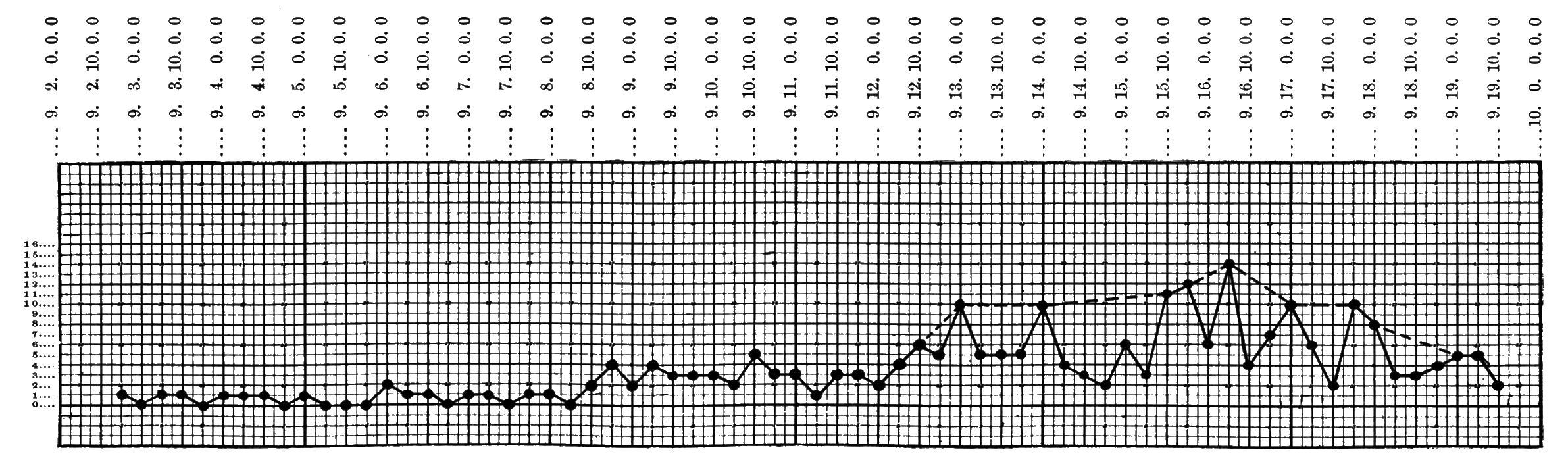
DIAGRAM SHOWING OCCURRENCE OF DATES RECORDED IN CYCLE 9
1. At first there was a long period of slow growth represented by few monuments, which, however, increased in number toward the end.
2. This was followed without interruption by a period of increased activity, the period from which the great majority of the monuments date.
3. Finally this period came to rather an abrupt end, indicated by the sudden cessation in the erection of dated monuments.
The consideration of these indisputable facts tends to establish the historical rather than the astronomical character of the monuments. For had the erection of the monuments depended on the successive recurrences of some astronomical phenomenon, there would be corresponding intervals between the dates of such monuments[26] the length of which would indicate the identity of the determining phenomenon; and they would hardly have presented the same logical increase due to the natural growth of a nation, which the accompanying diagram clearly sets forth.
Fourth. Although no historical codices[27] are known to have survived, history was undoubtedly recorded in these ancient Maya books. The statements of the early Spanish writers are very explicit on this point, as the following quotations from their works will show. Bishop Landa (here, as always, one of the most reliable authorities) says: "And the sciences which they [the priests] taught were the count of the years, months and days, the feasts and ceremonies, the administration of their sacraments, days, and fatal times, their methods of divination and prophecy, and foretelling events, and the remedies for the sick, and their antiquities" [p. 44]. And again, "they [the priests] attended the service of the temples and to the teaching of their sciences and how to write them in their books." And again, [p. 316], "This people also used certain characters or letters with which they wrote in their books their ancient matters and sciences."
Father Lizana says (see Landa, 1864: p. 352): "The history and authorities we can cite are certain ancient characters, scarcely understood by many and explained by some old Indians, sons of the priests of their gods, who alone knew how to read and expound them and who were believed in and revered as much as the gods themselves."
Father Ponce (tome LVIII, p. 392) who visited Yucatan as early as 1588, is equally clear: "The natives of Yucatan are among all the inhabitants of New Spain especially deserving of praise for three things. First that before the Spaniards came they made use of characters and letters with which they wrote out their histories, their ceremonies, the order of sacrifices to their idols and their calendars in books made of the bark of a certain tree."
Doctor Aguilar, who wrote but little later (1596), gives more details as to the kind of events which were recorded. "On these [the fiber books] they painted in color the reckoning of their years, wars, pestilences, hurricanes, inundations, famines and other events."
Finally, as late as 1697, some of these historical codices were in the possession of the last great independent Maya ruler, one Canek. Says Villagutierre (1701: lib. VI, cap. IV) in this connection: "Because their king [Canek] had read it in his analtehes [fiber-books or codices] they had knowledge of the provinces of Yucatan, and of the fact that their ancestors had formerly come from them; analtehes or histories being one and the same thing."
It is clear from the foregoing extracts, that the Maya of Yucatan recorded their history up to the time of the Spanish Conquest, in their hieroglyphic books, or codices. That fact is beyond dispute. It must be remembered also in this connection, that the Maya of Yucatan were the direct inheritors of that older Maya civilization in the south, which had produced the hieroglyphic monuments. For this latter reason the writer believes that the practice of recording history in the hieroglyphic writing had its origin, along with many another custom, in the southern area, and consequently that the inscriptions on the monuments of the southern cities are probably, in part at least, of an historical nature.
Whatever may be the meaning of the undeciphered glyphs, enough has been said in this chapter about those of known meaning to indicate the extreme importance of the element of time in Maya writing. The very great preponderance of astronomical, calendary, and numerical signs in both the codices and the inscriptions has determined, so far as the beginner is concerned, the best way to approach the study of the glyphs. First, it is essential to understand thoroughly the Maya system of counting time, in other words, their calendar and chronology. Second, in order to make use of this knowledge, as did the Maya, it is necessary to familiarize ourselves with their arithmetic and its signs and symbols. Third, and last, after this has been accomplished, we are ready to apply ourselves to the deciphering of the inscriptions and the codices. For this reason the next chapter will be devoted to the discussion of the Maya system of counting time.
Chapter III. HOW THE MAYA RECKONED TIME
Among all peoples and in all ages the most obvious unit for the measurement of time has been the day; and the never-failing reappearance of light after each interval of darkness has been the most constant natural phenomenon with which the mind of man has had to deal. From the earliest times successive returns of the sun have regulated the whole scheme of human existence. When it was light, man worked; when it was dark, he rested. Conformity to the operation of this natural law has been practically universal.
Indeed, as primitive man saw nature, day was the only division of time upon which he could absolutely rely. The waxing and waning of the moon, with its everchanging shape and occasional obscuration by clouds, as well as its periodic disappearances from the heavens all combined to render that luminary of little account in measuring the passage of time. The round of the seasons was even more unsatisfactory. A late spring or an early winter by hastening or retarding the return of a season caused the apparent lengths of succeeding years to vary greatly. Even where a 365-day year had been determined, the fractional loss, amounting to a day every four years, soon brought about a discrepancy between the calendar and the true year. The day, therefore, as the most obvious period in nature, as well as the most reliable, has been used the world over as the fundamental unit for the measurement of longer stretches of time.
Table I. THE TWENTY MAYA DAY NAMES
Imix Ik Akbal Kan Chicchan Cimi Manik Lamat Muluc Oc Chuen Eb Ben Ix Men Cib Caban Eznab Cauac Ahau
In conformity with the universal practice just mentioned the Maya made the day, which they called kin, the primary unit of their calendar. There were twenty such units, named as in Table I; these followed each other in the order there shown. When Ahau, the last day in the list, had been reached, the count began anew with Imix, and thus repeated itself again and again without interruption, throughout time. It is important that the student should fix this Maya conception of the rotation of days firmly in his mind at the outset, since all that is to follow depends upon the absolute continuity of this twenty-day sequence in endless repetition.
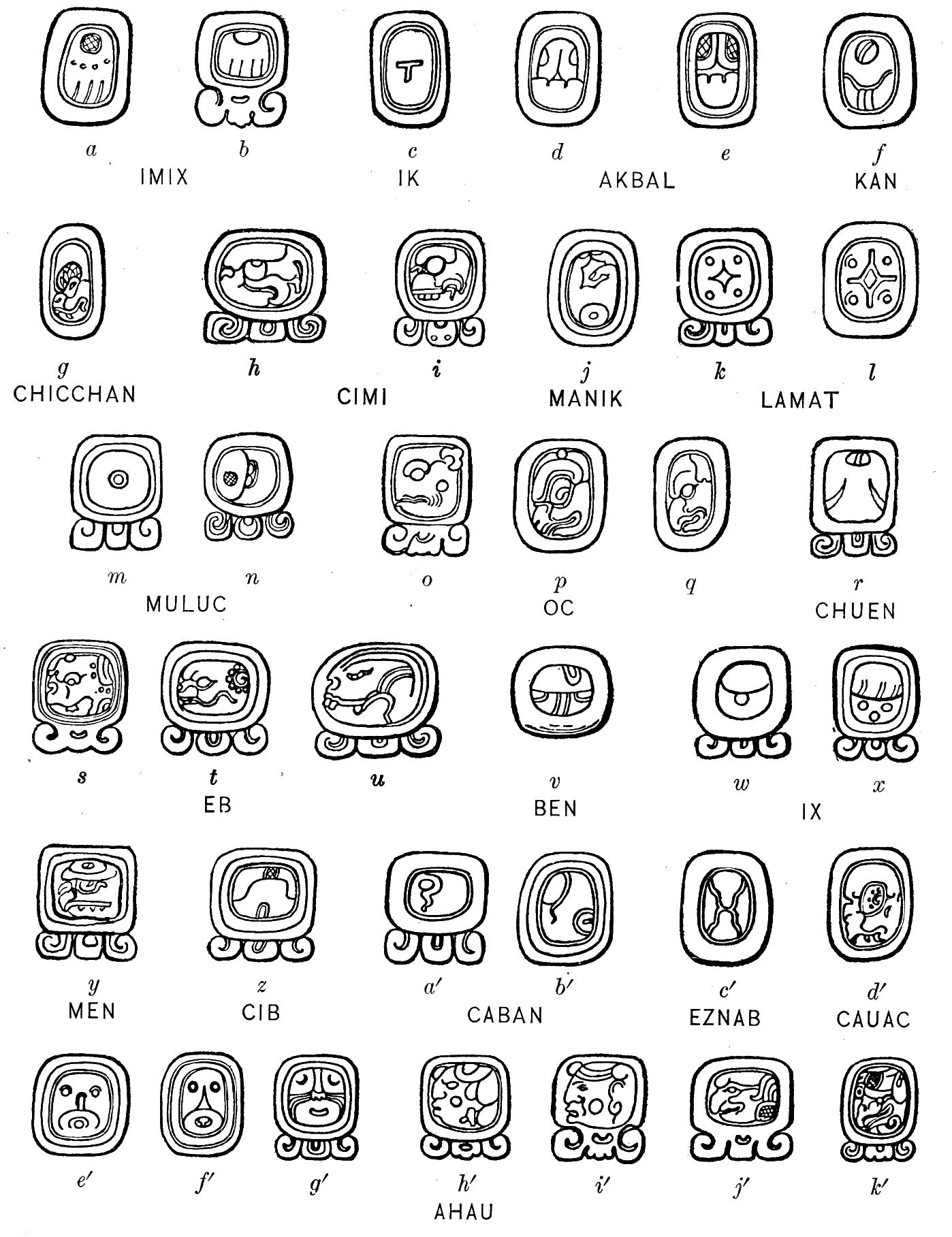
Fig. 16. The day signs in the inscriptions.
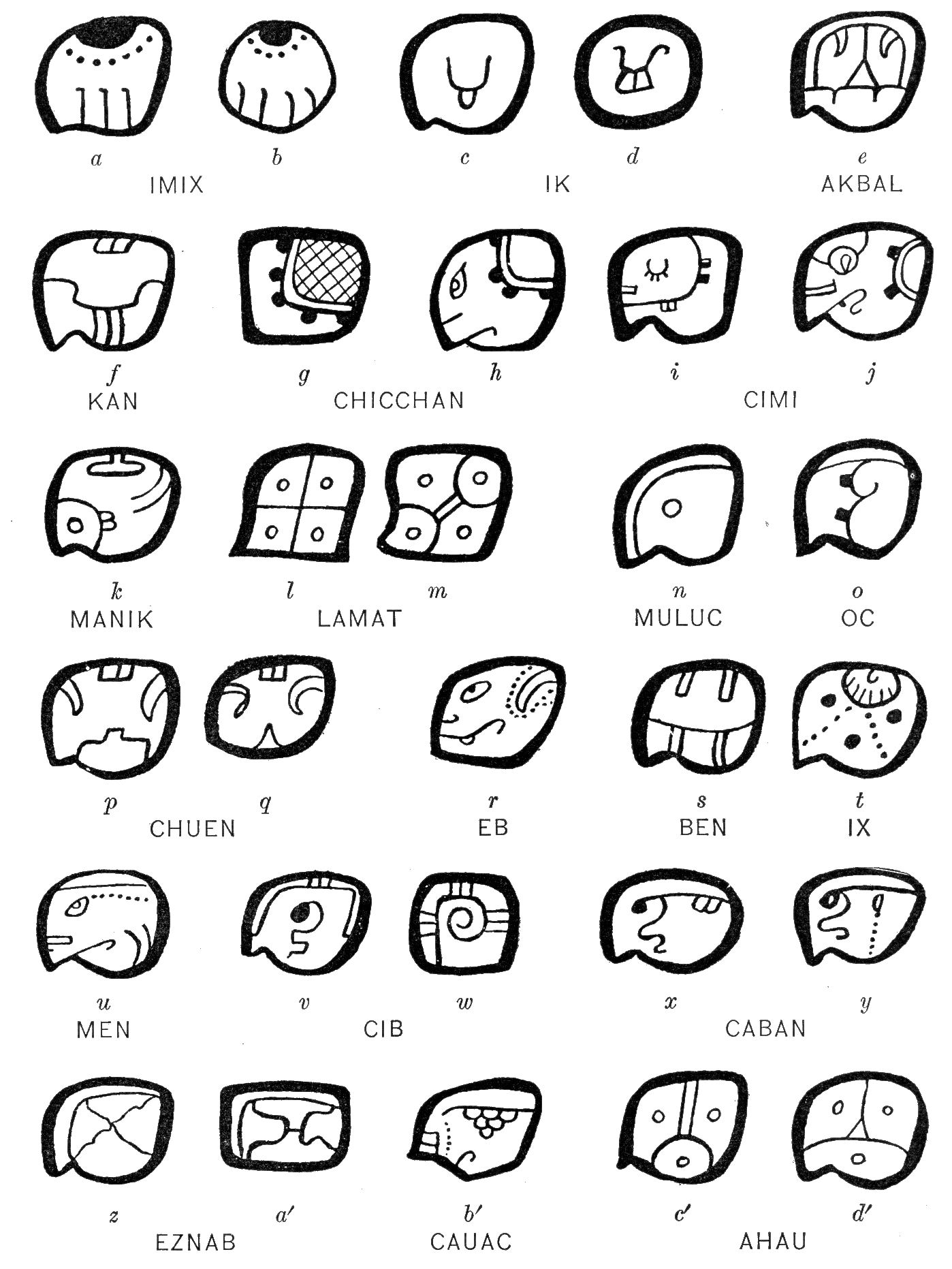
Fig. 17. The day signs in the codices.
The glyphs for these twenty days are shown in figures 16 and 17. The forms in figure 16 are from the inscriptions and those in figure 17 from the codices. In several cases variants are given to facilitate identification. A study of the glyphs in these two figures shows on the whole a fairly close similarity between the forms for the same day in each. The sign for the first day, Imix, is practically identical in both. Compare figure 16, a and b, with figure 17, a and b. The usual form for the day Ik in the inscriptions (see fig. 16, c), however, is unlike the glyph for the same day in the codices (fig. 17, c, d). The forms for Akbal and Kan are practically the same in each (see fig. 16, d, e, and f, and fig. 17, e and f, respectively). The day Chicchan, figure 16, g, occurs rarely in the inscriptions; when present, it takes the form of a grotesque head. In the codices the common form for this day is very different (fig. 17, g). The head variant, however (fig. 17, h), shows a slightly closer similarity to the form from the inscriptions. The forms in both figure 16, h, i, and figure 17, i, j, for the day Cimi show little resemblance to each other. Although figure 17, i, represents the common form in the codices, the variant in j more closely resembles the form in figure 16, h, i. The day Manik is practically the same in both (see figs. 16, j, and 17, k), as is also Lamat (figs. 16, k, l, and 17, l, m). The day Muluc occurs rarely in the inscriptions (fig. 16, m, n). Of these two variants m more closely resembles the form from the codices (fig. 17, n). The glyph for the day Oc (fig. 16, o, p, q) is not often found in the inscriptions. In the codices, on the other hand, this day is frequently represented as shown in figure 17, o. This form bears no resemblance to the forms in the inscriptions. There is, however, a head-variant form found very rarely in the codices that bears a slight resemblance to the forms in the inscriptions. The day Chuen occurs but once in the inscriptions where the form is clear enough to distinguish its characteristic (see fig. 16, r). This form bears a general resemblance to the glyph for this day in the codices (fig. 17, p, q). The forms for the day Eb in both figures 16, s, t, u, and 17, r, are grotesque heads showing but remote resemblance to one another. The essential element in both, however, is the same, that is, the element occupying the position of the ear. Although the day Ben occurs but rarely in the inscriptions, its form (fig. 16, v) is practically identical with that in the codices (see fig. 17, s). The day Ix in the inscriptions appears as in figure 16, w, x. The form in the codices is shown in figure 17, t. The essential element in each seems to be the three prominent dots or circles. The day Men occurs very rarely on the monuments. The form shown in figure 16, y, is a grotesque head not unlike the sign for this day in the codices (fig. 17, u). The signs for the day Cib in the inscriptions and the codices (figs. 16, z, and 17, v, w), respectively, are very dissimilar. Indeed, the form for Cib (fig. 17, v) in the codices resembles more closely the sign for the day Caban (fig. 16, a', b') than it does the form for Cib in the inscriptions (see fig. 16, z). The only element common to both is the line paralleling the upper part of the glyph (*) and the short vertical lines connecting it with the outline at the top. The glyphs for the day Caban in both figures 16, a', b', and 17, x, y, show a satisfactory resemblance to each other. The forms for the day Eznab are also practically identical (see figs. 16, c', and 17, z, a'). The forms for the day Cauac, on the other hand, are very dissimilar; compare figures 16, d', and 17, b'. The only point of resemblance between the two seems to be the element which appears in the eye of the former and at the lower left-hand side of the latter. The last of the twenty Maya days, and by far the most important, since it is found in both the codices and the inscriptions more frequently than all of the others combined, is Ahau (see figs. 16, e'-k', and 17, c', d'). The latter form is the only one found in the codices, and is identical with e', f', figure 16, the usual sign for this day in the inscriptions. The variants in figure 16, g'-k', appear on some of the monuments, and because of the great importance of this day Ahau it is necessary to keep all of them in mind.

These examples of the glyphs, which stand for the twenty Maya days, are in each case as typical as possible. The student must remember, however, that many variations occur, which often render the correct identification of a form difficult. As explained in the preceding chapter, such variations are due not only to individual peculiarities of style, careless drawing, and actual error, but also to the physical dissimilarities of materials on which they are portrayed, as the stone of the monuments and the fiber paper of the codices; consequently, such differences may be regarded as unessential. The ability to identify variants differing from those shown in figures 16 and 17 will come only through experience and familiarity with the glyphs themselves. The student should constantly bear in mind, however, that almost every Maya glyph, the signs for the days included, has an essential element peculiar to it, and the discovery of such elements will greatly facilitate his study of Maya writing.
Why the named days should have been limited to twenty is difficult to understand, as this number has no parallel period in nature. Some have conjectured that this number was chosen because it represents the number of man's digits, the twenty fingers and toes. Mr. Bowditch has pointed out in this connection that the Maya word for the period composed of these twenty named days is uinal, while the word for 'man' is uinik. The parallel is interesting and may possibly explain why the number twenty was selected as the basis of the Maya system of numeration, which, as we shall see later, was vigesimal, that is, increasing by twenties or multiples thereof.
The Tonalamatl, or 260-day Period
Merely calling a day by one of the twenty names given in Table I, however, did not sufficiently describe it according to the Maya notion. For instance, there was no day in the Maya calendar called merely Imix, Ik, or Akbal, or, in fact, by any of the other names given in Table I. Before the name of a day was complete it was necessary to prefix to it a number ranging from 1 to 13, inclusive, as 6 Imix or 13 Akbal. Then and only then did a Maya day receive its complete designation and find its proper place in the calendar.
The manner in which these thirteen numbers, 1 to 13, inclusive, were joined to the twenty names of Table I was as follows: Selecting any one of the twenty names[28] as a starting point, Kan for example, the number 1 was prefixed to it. See Table II, in which the names of Table I have been repeated with the numbers prefixed to them in a manner to be explained hereafter. The star opposite the name Kan indicates the starting point above chosen. The name Chicchan immediately following Kan in Table II was given the next number in order (2), namely, 2 Chicchan. The next name, Cimi, was given the next number (3), namely, 3 Cimi, and so on as follows: 4 Manik, 5 Lamat, 6 Muluc, 7 Oc, 8 Chuen, 9 Eb, 10 Ben, 11 Ix, 12 Men, 13 Cib.
Table II. SEQUENCE OF MAYA DAYS
*5 Imix *6 Ik *7 Akbal *1 Kan *2 Chicchan *3 Cimi *4 Manik *5 Lamat *6 Muluc *7 Oc 08 Chuen 09 Eb 10 Ben 11 Ix 12 Men 13 Cib 01 Caban 02 Eznab 03 Cauac 04 Ahau
Instead of giving to the next name in Table II (Caban) the number 14, the number 1 was prefixed; for, as previously stated, the numerical coefficients of the days did not rise above the number 13. Following the day 1 Caban, the sequence continued as before: 2 Eznab, 3 Cauac, 4 Ahau. After the day 4 Ahau, the last in Table II, the next number in order, in this case 5, was prefixed to the next name in order—that is, Imix, the first name in Table II—and the count continued without interruption: 5 Imix, 6 Ik, 7 Akbal, or back to the name Kan with which it started. There was no break in the sequence, however, even at this point (or at any other, for that matter). The next name in Table II, Kan, selected for the starting point, was given the number next in order, i. e., 8, and the day following 7 Akbal in Table II would be, therefore, 8 Kan, and the sequence would continue to be formed in the same way: 8 Kan, 9 Chicchan, 10 Cimi, 11 Manik, 12 Lamat, 13 Muluc, 1 Oc, 2 Chuen, 3 Eb, and so on. So far as the Maya conception of time was concerned, this sequence of days went on without interruption, forever.
While somewhat unusual at first sight, this sequence is in reality exceedingly simple, being governed by three easily remembered rules:
Rule 1. The sequence of the 20 day names repeats itself again and again without interruption.
BUREAU OF AMERICAN ETHNOLOGYBULLETIN 57 PLATE 5
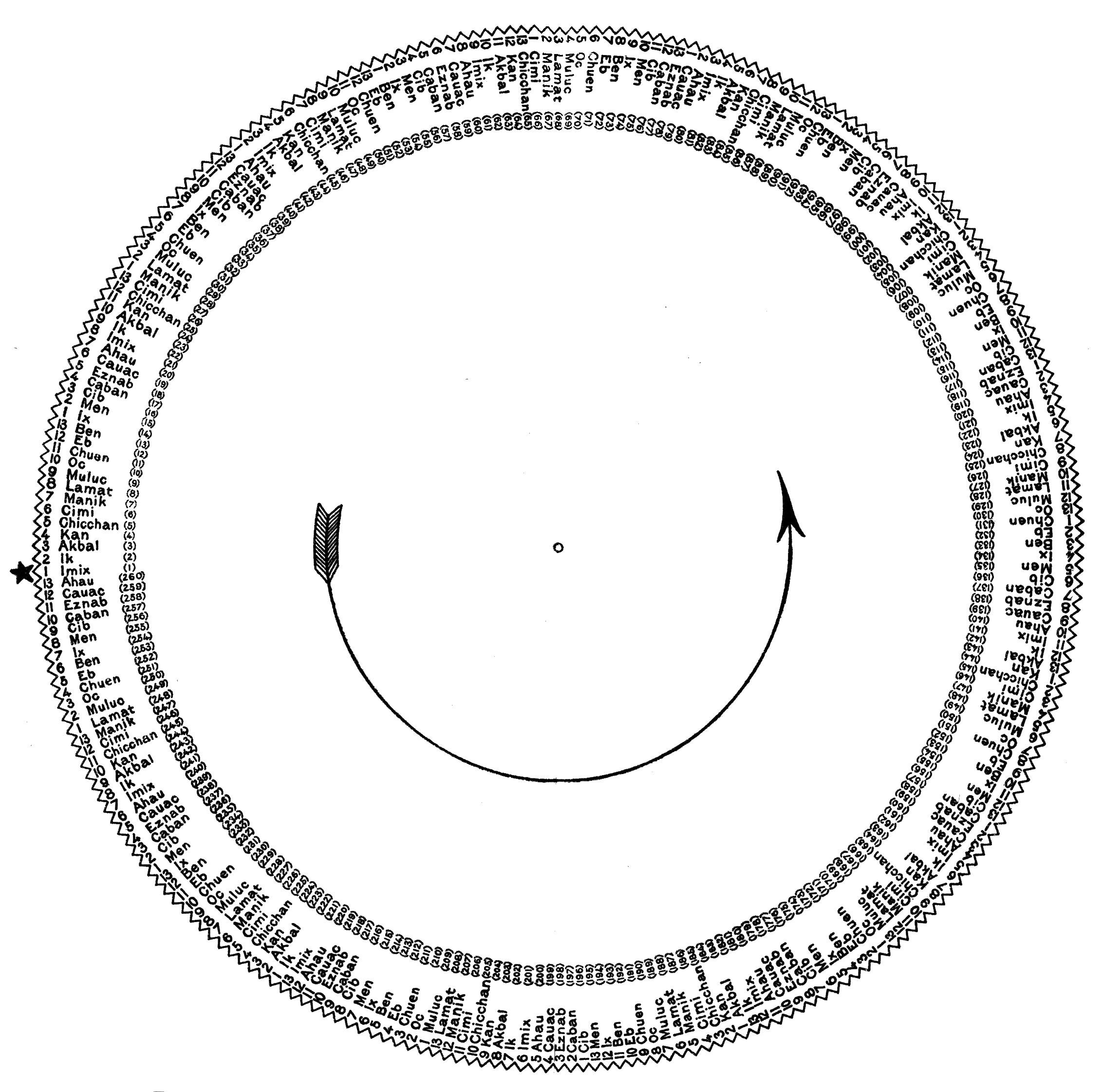
TONALAMATL WHEEL, SHOWING SEQUENCE OF THE 260 DIFFERENTLY NAMED DAYS
Rule 2. The sequence of the numerical coefficients 1 to 13, inclusive, repeats itself again and again without interruption, 1 following immediately 13.
Rule 3. The 13 numerical coefficients are attached to the 20 names, so that after a start has been made by prefixing any one of the 13 numbers to any one of the 20 names, the number next in order is given to the name next in order, and the sequence continues indefinitely in this manner.
It is a simple question of arithmetic to determine the number of days which must elapse before a day bearing the same designation as a previous one in the sequence can reappear. Since there are 13 numbers and 20 names, and since each of the 13 numbers must be attached in turn to each one of the 20 names before a given number can return to a given name, we must find the least common multiple of 13 and 20. As these two numbers, contain no common factor, their least common multiple is their product (260), which is the number sought. Therefore, any given day can not reappear in the sequence until after the 259 days immediately following it shall have elapsed. Or, in other words, the 261st day will have the same designation as the 1st, the 262d the same as the 2d, and so on.
This is graphically shown in the wheel figured in plate 5, where the sequence of the days, commencing with 1 Imix, which is indicated by a star, is represented as extending around the rim of the wheel. After the name of each day, its number in the sequence beginning with the starting point 1 Imix, is shown in parenthesis. Now, if the star opposite the day 1 Imix be conceived to be stationary and the wheel to revolve in a sinistral circuit, that is contra-clockwise, the days will pass the star in the order which they occupy in the 260-day sequence. It appears from this diagram also that the day 1 Imix can not recur until after 260 days shall have passed, and that it always follows the day 13 Ahau. This must be true since Ahau is the name immediately preceding Imix in the sequence of the day names and 13 is the number immediately preceding 1. After the day 13 Ahau (the 260th from the starting point) is reached, the day 1 Imix, the 261st, recurs and the sequence, having entered into itself again, begins anew as before.
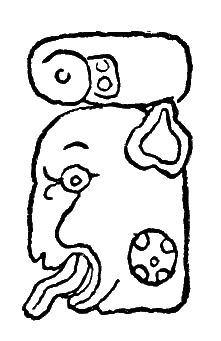
Fig. 18. Sign for the tonalamatl (according to Goodman).
This round of the 260 differently named days was called by the Aztec the tonalamatl, or "book of days." The Maya name for this period is unknown[29] and students have accepted the Aztec name for it. The tonalamatl is frequently represented in the Maya codices, there being more than 200 examples in the Codex Tro-Cortesiano alone. It was a very useful period for the calculations of the priests because of the different sets of factors into which it can be resolved, namely, 4×65, 5×52, 10×26, 13×20, and 2×130. Tonalamatls divided into 4, 5, and 10 equal parts of 65, 52, and 26 days, respectively, occur repeatedly throughout the codices.
It is all the more curious, therefore, that this period is rarely represented in the inscriptions. The writer recalls but one city (Copan) in which this period is recorded to any considerable extent. It might almost be inferred from this fact alone that the inscriptions do not treat of prophecy, divinations, or ritualistic and ceremonial matters, since these subjects in the codices are always found in connection with tonalamatls. If true this considerably restricts the field of which the inscriptions may treat.
Mr. Goodman has identified the glyph shown in figure 18 as the sign for the 260-day period, but on wholly insufficient evidence the writer believes. On the other hand, so important a period as the tonalamatl undoubtedly had its own particular glyph, but up to the present time all efforts to identify this sign have proved unsuccessful.
The Haab, or Year of 365 Days
Having explained the composition and nature of the tonalamatl, or so-called Sacred Year, let us turn to the consideration of the Solar Year, which was known as haab in the Maya language.
The Maya used in their calendar system a 365-day year, though they doubtless knew that the true length of the year exceeds this by 6 hours. Indeed, Bishop Landa very explicitly states that such knowledge was current among them. "They had," he says, "their perfect year, like ours, of 365 days and 6 hours;" and again, "The entire year had 18 of these [20-day periods] and besides 5 days and 6 hours." In spite of Landa's statements, however, it is equally clear that had the Maya attempted to take note of these 6 additional hours by inserting an extra day in their calendar every fourth year, their day sequence would have been disturbed at once. An examination of the tonalamatl, or round of days (see pl. 5), shows also that the interpolation of a single day at any point would have thrown into confusion the whole Maya calendar, not only interfering with the sequence but also destroying its power of reentering itself at the end of 260 days. The explanation of this statement is found in the fact that the Maya calendar had no elastic period corresponding to our month of February, which is increased in length whenever the accumulation of fractional days necessitates the addition of an extra day, in order to keep the calendar year from gaining on the true year.
If the student can be made to realize that all Maya periods, from the lowest to the highest known, are always in a continuous sequence, each returning into itself and beginning anew after completion, he will have grasped the most fundamental principle of Maya chronology—its absolute continuity throughout.
It may be taken for granted, therefore, in the discussion to follow that no interpolation of intercalary days was actually made. It is equally probable, however, that the priests, in whose hands such matters rested, corrected the calendar by additional calculations which showed just how many days the recorded year was ahead of the true year at any given time. Mr. Bowditch (1910: Chap. XI) has cited several cases in which such additional calculations exactly correct the inscriptions on the monument upon which they appear and bring their dates into harmony with the true solar year.
So far as the calendar is concerned, then, the year consisted of but 365 days. It was divided into 18 periods of 20 days each, designated in Maya uinal, and a closing period of 5 days known as the xma kaba kin, or "days without name." The sum of these (18×20+5) exactly made up the calendar year.
Table III. THE DIVISIONS OP THE MAYA YEAR
Pop Uo Zip Zotz Tzec Xul Yaxkin Mol Chen Yax Zac Ceh Mac Kankin Muan Pax Kayab Cumhu Uayeb
The names of these 19 divisions of the year are given in Table III in the order in which they follow one another; the twentieth day of one month was succeeded by the first day of the next month.
The first day of the Maya year was the first day of the month Pop, which, according to the early Spanish authorities, Bishop Landa (1864: p. 276) included, always fell on the 16th of July.[30] Uayeb, the last division of the year, contained only 5 days, the last day of Uayeb being at the same time the 365th day of the year. Consequently, when this day was completed, the next in order was the Maya New Year's Day, the first day of the month Pop, after which the sequence repeated itself as before.
The xma kaba kin, or "days without name," were regarded as especially unlucky and ill-omened. Says Pio Perez (see Landa, 1864: p. 384) in speaking of these closing days of the year: "Some call them u yail kin or u yail haab, which may be translated, the sorrowful and laborious days or part of the year; for they [the Maya] believed that in them occurred sudden deaths and pestilences, and that they were diseased by poisonous animals, or devoured by wild beasts, fearing that if they went out to the field to their labors, some tree would pierce them or some other kind of misfortune happen to them." The Aztec held the five closing days of the year in the same superstitious dread. Persons born in this unlucky period were held to be destined by this fact to wretchedness and poverty for life. These days were, moreover, prophetic in character; what occurred during them continued to happen ever afterward. Hence, quarreling was avoided during this period lest it should never cease.
Having learned the number, length, and names of the several periods into which the Maya divided their year, and the sequence in which these followed one another, the next subject which claims attention is the positions of the several days in these periods. In order properly to present this important subject, it is first necessary to consider briefly how we count and number our own units of time, since through an understanding of these practices we shall better comprehend those of the ancient Maya.
It is well known that our methods of counting time are inconsistent with each other. For example, in describing the time of day, that is, in counting hours, minutes, and seconds, we speak in terms of elapsed time. When we say it is 1 o'clock, in reality the first hour after noon, that is, the hour between 12 noon and 1 p. m., has passed and the second hour after noon is about to commence. When we say it is 2 o'clock, in reality the second hour after noon is finished and the third hour about to commence. In other words, we count the time of day by referring to passed periods and not current periods. This is the method used in reckoning astronomical time. During the passage of the first hour after midnight the hours are said to be zero, the time being counted by the number of minutes and seconds elapsed. Thus, half past 12 is written: 0hr. 30min. 0sec., and quarter of 1, 0hr. 45min. 0sec.. Indeed one hour can not be written until the first hour after midnight is completed, or until it is 1 o'clock, namely, 1hr. 0min. 0sec..
We use an entirely different method, however, in counting our days, years, and centuries, which are referred to as current periods of time. It is the 1st day of January immediately after midnight December 31. It was the first year of the Eleventh Century immediately after midnight December 31, 1000 A. D. And finally, it was the Twentieth Century immediately after midnight December 31, 1900 A. D. In this category should be included also the days of the week and the months, since the names of these periods also refer to present time. In other words when we speak of our days, months, years, and centuries, we do not have in mind, and do not refer to completed periods of time, but on the contrary to current periods.
It will be seen that in the first method of counting time, in speaking of 1 o'clock, 1 hour, 30 minutes, we use only the cardinal forms of our numbers; but in the second method we say the 1st of January, the Twentieth Century, using the ordinal forms, though even here we permit ourselves one inconsistency. In speaking of our years, which are reckoned by the second method, we say "nineteen hundred and twelve," when, to be consistent, we should say "nineteen hundred and twelfth," using the ordinal "twelfth" instead of the cardinal "twelve."
We may then summarize our methods of counting time as follows: (1) All periods less than the day, as hours, minutes, and seconds, are referred to in terms of past time; and (2) the day and all greater periods are referred to in terms of current time.
The Maya seem to have used only the former of these two methods in counting time; that is, all the different periods recorded in the codices and the inscriptions seemingly refer to elapsed time rather than to current time, to a day passed, rather than to a day present. Strange as this may appear to us, who speak of our calendar as current time, it is probably true nevertheless that the Maya, in so far as their writing is concerned, never designated a present day but always treated of a day gone by. The day recorded is yesterday because to-day can not be considered an entity until, like the hour of astronomical time, it completes itself and becomes a unit, that is, a yesterday.
This is well illustrated by the Maya method of numbering the positions of the days in the months, which, as we shall see, was identical with our own method of counting astronomical time. For example, the first day of the Maya month Pop was written Zero Pop, (0 Pop) for not until one whole day of Pop had passed could the day 1 Pop be written; by that time, however, the first day of the month had passed and the second day commenced. In other words, the second day of Pop was written 1 Pop; the third day, 2 Pop; the fourth day, 3 Pop; and so on through the 20 days of the Maya month. This method of numbering the positions of the days in the month led to calling the last day of a month 19 instead of 20. This appears in Table IV, in which the last 6 days of one year and the first 22 of the next year are referred to their corresponding positions in the divisions of the Maya year. It must be remembered in using this Table that the closing period of the Maya year, the xma kaba kin, or Uayeb, contained only 5 days, whereas all the other periods (the 18 uinals) had 20 days each.
Curiously enough no glyph for the haab, or year, has been identified as yet, in spite of the apparent importance of this period.[31] The glyphs which represent the 18 different uinals and the xma kaba kin, however, are shown in figures 19 and 20. The forms in figure 19 are taken from the inscriptions and those in figure 20 from the codices.
Table IV. POSITIONS OF DAYS AT THE END OF A YEAR
360th day of the year 19 Cumhu last day of the month Cumhu.
361st day of the year 00 Uayeb first day of Uayeb.
362dt day of the year 01 Uayeb
363dt day of the year 02 Uayeb
364th day of the year 03 Uayeb
365th day of the year 04 Uayeb last day of Uayeb and of the year.
01st day of next year 00 Pop first day of the month Pop, and of the next year.
02dt day of next year 01 Pop
03dt day of next year 02 Pop
04th day of next year 03 Pop
05th day of next year 04 Pop
06th day of next year 05 Pop
07th day of next year 06 Pop
08th day of next year 07 Pop
09th day of next year 08 Pop
10th day of next year 09 Pop
11th day of next year 10 Pop
12th day of next year 11 Pop
13th day of next year 12 Pop
14th day of next year 13 Pop
15th day of next year 14 Pop
16th day of next year 15 Pop
17th day of next year 16 Pop
18th day of next year 17 Pop
19th day of next year 18 Pop
20th day of next year 19 Pop last day of the month Pop.
21st day of next year 00 Uo first day of the month Uo.
22dt day of next year 01 Uo
00etc. 00etc.
The signs for the first four months, Pop, Uo, Zip, and Zotz, show a convincing similarity in both the inscriptions and the codices. The essential elements of Pop (figs. 19, a, and 20, a) are the crossed bands and the kin sign. The latter is found in both the forms figured, though only a part of the former appears in figure 20, a. Uo has two forms in the inscriptions (see fig. 19, b, c),[32] which are, however, very similar to each other as well as to the corresponding forms in the codices (fig. 20, b, c). The glyphs for the month Zip are identical in both figures 19, d, and 20, d. The grotesque heads for Zotz in figures 19, e, f,[33] and 20, e, are also similar to each other. The essential characteristic seems to be the prominent upturned and flaring nose. The forms for Tzec (figs. 19, g, h, and 20, f) show only a very general similarity, and those for Xul, the next month, are even more unlike. The only sign for Xul in the inscriptions (fig. 19, i, j) bears very little resemblance to the common form for this month in the codices (fig. 20, g), though it is not unlike the variant in h, figure 20. The essential characteristic seems to be the familiar ear and the small mouth, shown in the inscription as an oval and in the codices as a hook surrounded with dots.
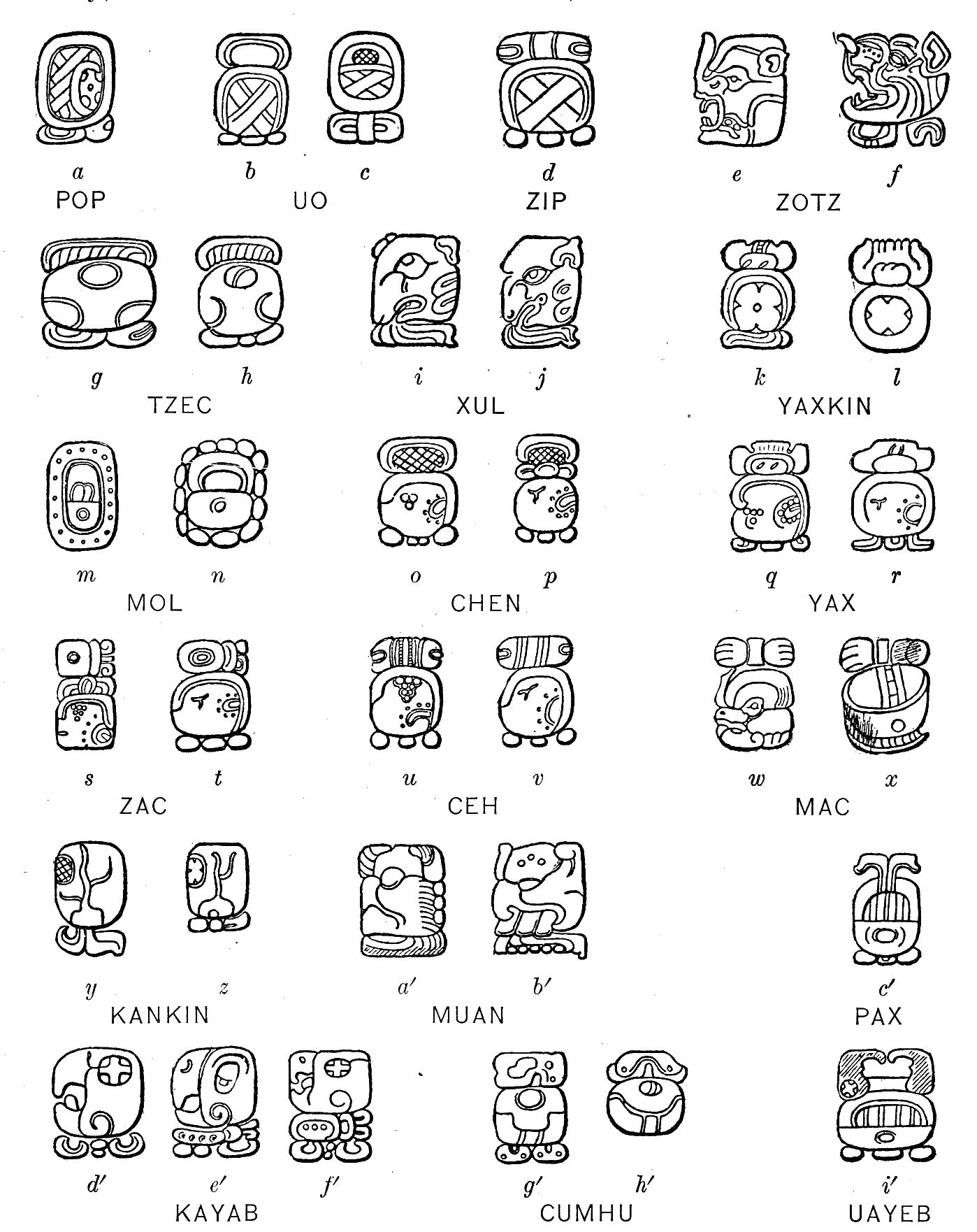
Fig. 19. The month signs in the inscriptions.
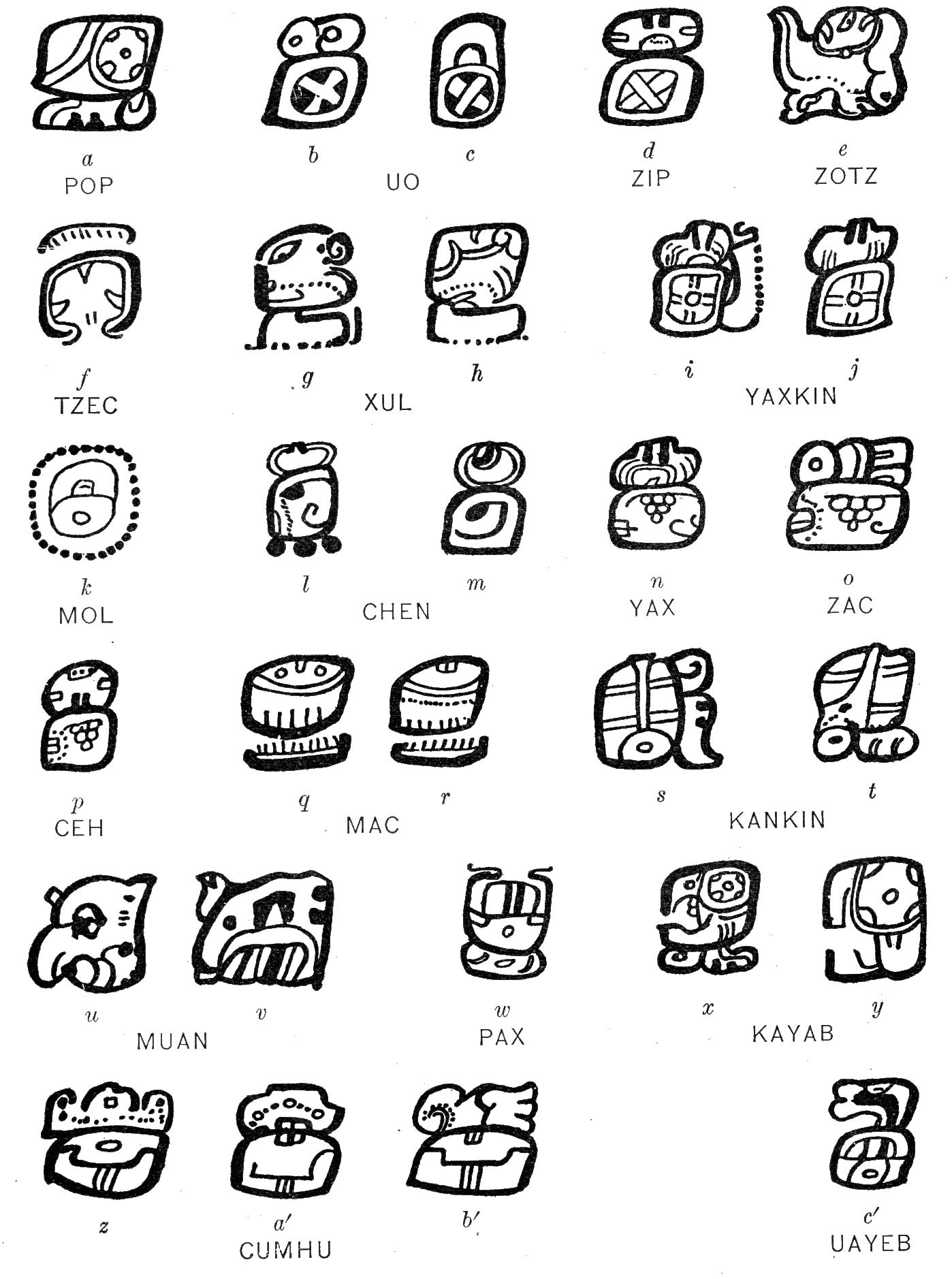
Fig. 20. The month signs in the codices.
The sign for the month Yaxkin is identical in both figures 19, k, l, and 20, i, j. The sign for the month Mol in figures 19, m, n, and 20, k exhibits the same close similarity. The forms for the month Chen in figures 19, o, p, and 20, l, m, on the other hand, bear only a slight resemblance to each other. The forms for the months Yax (figs. 19, q, r, and 20, n), Zac (figs. 19, s, t, and 20, o), and Ceh (figs. 19, u, v, and 20, p) are again identical in each case. The signs for the next month, Mac, however, are entirely dissimilar, the form commonly found in the inscriptions (fig. 19, w) bearing absolutely no resemblance to that shown in figure 20, q, r, the only form for this month in the codices. The very unusual variant (fig. 19, x), from Stela 25 at Piedras Negras is perhaps a trifle nearer the form found in the codices. The flattened oval in the main part of the variant is somewhat like the upper part of the glyph in figure 20, q. The essential element of the glyph for the month Mac, so far as the inscriptions are concerned, is the element (*) found as the superfix in both w and x, figure 19. The sign for the month Kankin (figs. 19, y, z, and 20, s, t) and the signs for the month Muan (figs. 19, a', b', and 20, u, v) show only a general similarity. The signs for the last three months of the year, Pax (figs. 19, c', and 20, w), Kayab (figs. 19, d'-f', and 20, x, y), and Cumhu (figs. 19, g', h', and 20, z, a', b') in the inscriptions and codices, respectively, are practically identical. The closing division of the year, the five days of the xma kaba kin, called Uayeb, is represented by essentially the same glyph in both the inscriptions and the codices. Compare figure 19, i', with figure 20, c'.

It will be seen from the foregoing comparison that on the whole the glyphs for the months in the inscriptions are similar to the corresponding forms in the codices, and that such variations as are found may readily be accounted for by the fact that the codices and the inscriptions probably not only emanate from different parts of the Maya territory but also date from different periods.
The student who wishes to decipher Maya writing is strongly urged to memorize the signs for the days and months given in figures 16, 17, 19, and 20, since his progress will depend largely on his ability to recognize these glyphs when he encounters them in the texts.
The Calendar Round, or 18980-day Period
Before taking up the study of the Calendar Round let us briefly summarize the principal points ascertained in the preceding pages concerning the Maya method of counting time. In the first place we learned from the tonalamatl (pl. 5) three things: (1) The number of differently named days; (2) the names of these days; (3) the order in which they invariably followed one another. And in the second place we learned in the discussion of the Maya year, or haab, just concluded, four other things: (1) The length of the year; (2) the number, length, and names of the several periods into which it was divided; (3) the order in which these periods invariably followed one another; (4) the positions of the days in these periods.
The proper combination of these two, the tonalamatl, or "round of days," and the haab, or year of uinals, and the xma kaba kin, formed the Calendar Round, to which the tonalamatl contributed the names of the days and the haab the positions of these days in the divisions of the year. The Calendar Round was the most important period in Maya chronology, and a comprehension of its nature and of the principles which governed its composition is therefore absolutely essential to the understanding of the Maya system of counting time.
It has been explained (see p. 41) that the complete designation or name of any day in the tonalamatl consisted of two equally essential parts: (1) The name glyph, and (2) the numerical coefficient. Disregarding the latter for the present, let us first see which of the twenty names in Table I, that is, the name parts of the days, can stand at the beginning of the Maya year.
In applying any sequence of names or numbers to another there are only three possibilities concerning the names or numbers which can stand at the head of the resulting sequence:
1. When the sums of the units in each of the two sequences contain no common factor, each one of the units in turn will stand at the head of the resulting sequence.
2. When the sum of the units in one of the two sequences is a multiple of the sum of the units in the other, only the first unit can stand at the head of the resulting sequence.
3. When the sums of the units in the two sequences contain a common factor (except in those cases which fall under (2), that is, in which one is a multiple of the other) only certain units can stand at the head of the sequence.
Now, since our two numbers (the 20 names in Table I and the 365 days of the year) contain a common factor, and since neither is a multiple of the other, it is clear that only the last of the three contingencies just mentioned concerns us here; and we may therefore dismiss the first two from further consideration.
The Maya year, then, could begin only with certain of the days in Table I, and the next task is to find out which of these twenty names invariably stood at the beginnings of the years.
When there is a sequence of 20 names in endless repetition, it is evident that the 361st will be the same as the 1st, since 360 = 20 × 18. Therefore the 362d will be the same as the 2d, the 363d as the 3d, the 364th as the 4th, and the 365 as the 5th. But the 365th, or 5th, name is the name of the last day of the year, consequently the 1st day of the following year (the 366th from the beginning) will have the 6th name in the sequence. Following out this same idea, it appears that the 361st day of the second year will have the same name as that with which it began, that is, the 6th name in the sequence, the 362d day the 7th name, the 363d the 8th, the 364th the 9th, and the 365th, or last day of the second year, the 10th name. Therefore the 1st day of the third year (the 731st from the beginning) will have the 11th name in the sequence. Similarly it could be shown that the third year, beginning with the 11th name, would necessarily end with the 15th name; and the fourth year, beginning with the 16th name (the 1096th from the beginning) would necessarily end with the 20th, or last name, in the sequence. It results, therefore, from the foregoing progression that the fifth year will have to begin with the 1st name (the 1461st from the beginning), or the same name with which the first year also began.
This is capable of mathematical proof, since the 1st day of the fifth year has the 1461st name from the beginning of the sequence, for 1461 = 4×365+1 = 73×20+1. The 1 in the second term of this equation indicates that the beginning day of the fifth year has been reached; and the 1 in the third term indicates that the name-part of this day is the 1st name in the sequence of twenty. In other words, every fifth year began with a day, the name part of which was the same, and consequently only four of the names in Table I could stand at the beginnings of the Maya years.
The four names which successively occupied this, the most important position of the year, were: Ik, Manik, Eb, and Caban (see Table V, in which these four names are shown in their relation to the sequence of twenty). Beginning with any one of these, Ik for example, the next in order, Manik, is 5 days distant, the next, Eb, another five days, the next, Caban, another 5 days, and the next, Ik, the name with which the Table started, another 5 days.
Table V. RELATIVE POSITIONS OF DAYS BEGINNING MAYA YEARS
IK Akbal Kan Chicchan Cimi MANIK Lamat Muluc Oc Chuen EB Ben Ix Men Cib CABAN Eznab Cauac Ahau Imix
Since one of the four names just given invariably began the Maya year, it follows that in any given year, all of its nineteen divisions, the 18 uinals and the xma kaba kin, also began with the same name, which was the name of the first day of the first uinal. This is necessarily true because these 19 divisions of the year, with the exception of the last, each contained 20 days, and consequently the name of the first day of the first division determined the names of the first days of all the succeeding divisions of that particular year. Furthermore, since the xma kaba kin, the closing division of the year, contained but 5 days, the name of the first day of the following year; as well as the names of the first days of all of its divisions, was shifted forward in the sequence another 5 days, as shown above.
This leads directly to another important conclusion: Since the first days of all the divisions of any given year always had the same name-part, it follows that the second days of all the divisions of that year had the same name, that is, the next succeeding in the sequence of twenty. The third days in each division of that year must have had the same name, the fourth days the same name, and so on, throughout the 20 days of the month. For example, if a year began with the day-name Ik, all of the divisions in that year also began with the same name, and the second days of all its divisions had the day-name Akbal, the third days the name Kan, the fourth days the name Chicchan, and so forth. This enables us to formulate the following—
Rule. The 20 day-names always occupy the same positions in all the divisions of any given year.
But since the year and its divisions must begin with one of four names, it is clear that the second positions also must be filled with one of another group of four names, and the third positions with one of another group of four names, and so on, through all the positions of the month. This enables us to formulate a second—
Rule. Only four of the twenty day-names can ever occupy any given position in the divisions of the years.
But since, in the years when Ik is the 1st name, Manik will be the 6th, Eb the 11th, and Caban the 16th, and in the years when Manik is the 1st, Eb will be the 6th, Caban the 11th, and Ik the 16th, and in the years when Eb is the 1st, Caban will be the 6th, Ik the 11th, and Manik the 16th, and in the years when Caban is the 1st, Ik will be the 6th, Manik the 11th, and Eb the 16th, it is clear that any one of this group which begins the year may occupy also three other positions in the divisions of the year, these positions being 5 days distant from each other. Consequently, it follows that Akbal, Lamat, Ben, and Eznab in Table V, the names which occupy the second positions in the divisions of the year, will fill the 7th, 12th, and 17th positions as well. Similarly Kan, Muluc, Ix, and Cauac will fill the 3d, 8th, 13th, and 18th positions, and so on. This enables us to formulate a third—
Rule. The 20 day-names are divided into five groups of four names each, any name in any group being five days distant from the name next preceding it in the same group, and furthermore, the names of any one group will occupy four different positions in the divisions of successive years, these positions being five days apart in each case. This is expressed in Table VI, in which these groups are shown as well as the positions in the divisions of the years which the names of each group may occupy. A comparison with Table V will demonstrate that this arrangement is inevitable.
Table VI. POSITIONS OF DAYS IN DIVISIONS OF MAYA YEAR
Positions held by days 1st, 6th, 11th, 16th 2d, 7th, 12th, 17th 3d, 8th, 13th, 18th 4th, 9th, 14th, 19th 5th, 10th, 15th, 20th

Names of days in each group Ik Manik Eb Caban Akbal Lamat Ben Eznab Kan Mulac Ix Cauac Chicchan Oc Men Ahau Cimi Chuen Cib Imix

But we have seen on page 47 and in Table IV that the Maya did not designate the first days of the several divisions of the years according to our system. It was shown there that the first day of Pop was not written 1 Pop, but 0 Pop, and similarly the second day of Pop was written not 2 Pop, but 1 Pop, and the last day, not 20 Pop, but 19 Pop. Consequently, before we can use the names in Table VI as the Maya used them, we must make this shift, keeping in mind, however, that Ik, Manik, Eb, and Caban (the only four of the twenty names which could begin the year and which were written 0 Pop, 5 Pop, 10 Pop, or 15 Pop) would be written in our notation 1st Pop, 6th Pop, 11th Pop, and 16th Pop, respectively. This difference, as has been previously explained, results from the Maya method of counting time by elapsed periods.
Table VII shows the positions of the days in the divisions of the year according to the Maya conception, that is, with the shift in the month coefficient made necessary by this practice of recording their days as elapsed time.
The student will find Table VII very useful in deciphering the texts, since it shows at a glance the only positions which any given day can occupy in the divisions of the year. Therefore when the sign for a day has been recognized in the texts, from Table VII can be ascertained the only four positions which this day can hold in the month, thus reducing the number of possible month coefficients for which search need be made, from twenty to four.
Table VII. POSITIONS OF DAYS IN DIVISIONS OF MAYA YEAR ACCORDING TO MAYA NOTATION
Positions held by days expressed in Mayan notation 0, 5, 10, 15 1, 6, 11, 16 2, 7, 12, 17 3, 8, 13, 18 4, 9, 14, 19

Names of days in each group Ik Manik Eb Caban Akbal Lamat Ben Eznab Kan Mulac Ix Cauac Chicchan Oc Men Ahau Cimi Chuen Cib Imix
Now let us summarize the points which we have successively established as resulting from the combination of the tonalamatl and haab, remembering always that as yet we have been dealing only with the name parts of the days and not their complete designations. Bearing this in mind, we may state the following facts concerning the 20 day-names and their positions in the divisions of the year:
1. The Maya year and its several divisions could begin only with one of these four day-names: Ik, Manik, Eb, and Caban.
2. Consequently, any particular position in the divisions of the year could be occupied only by one of four day-names.
3. Consequently, every fifth year any particular day-name returned to the same position in the divisions of the year.
4. Consequently, any particular day-name could occupy only one of four positions in the divisions of the year, each of which it held in successive years, returning to the same position every fifth year.
5. Consequently, the twenty day-names were divided into five groups of four day-names each, any day-name of any group being five days distant from the day-name of the same group next preceding it.
6. Finally, in any given year any particular day-name occupied the same relative position throughout the divisions of that year.
Up to this point, however, as above stated, we have not been dealing with the complete designations of the Maya days, but only their name parts or name glyphs, the positions of which in the several divisions of the year we have ascertained.
It now remains to join the tonalamatl, which gives the complete names of the 260 Maya days, to the haab, which gives the positions of the days in the divisions of the year, in such a way that any one of the days whose name-part is Ik, Manik, Eb, or Caban shall occupy the first position of the first division of the year; that is, 0 Pop, or, as we should write it, the first day of Pop. It matters little which one of these four name parts we choose first, since in four years each one of them in succession will have appeared in the position 0 Pop.
Perhaps the easiest way to visualize the combination of the tonalamatl and the haab is to conceive these two periods as two cogwheels revolving in contact with each other. Let us imagine that the first of these, A (fig. 21), has 260 teeth, or cogs, each one of which is named after one of the 260 days of the tonalamatl and follows the sequence shown in plate 5. The second wheel, B (fig. 21), is somewhat larger, having 365 cogs. Each of the spaces or sockets between these represents one of the 365 positions of the days in the divisions of the year, beginning with 0 Pop and ending with 4 Uayeb. See Table IV for the positions of the days at the end of one year and the commencement of the next. Finally, let us imagine that these two wheels are brought into contact with each other in such a way that the tooth or cog named 2 Ik in A shall fit into the socket named 0 Pop in B, after which both wheels start to revolve in the directions indicated by the arrows.
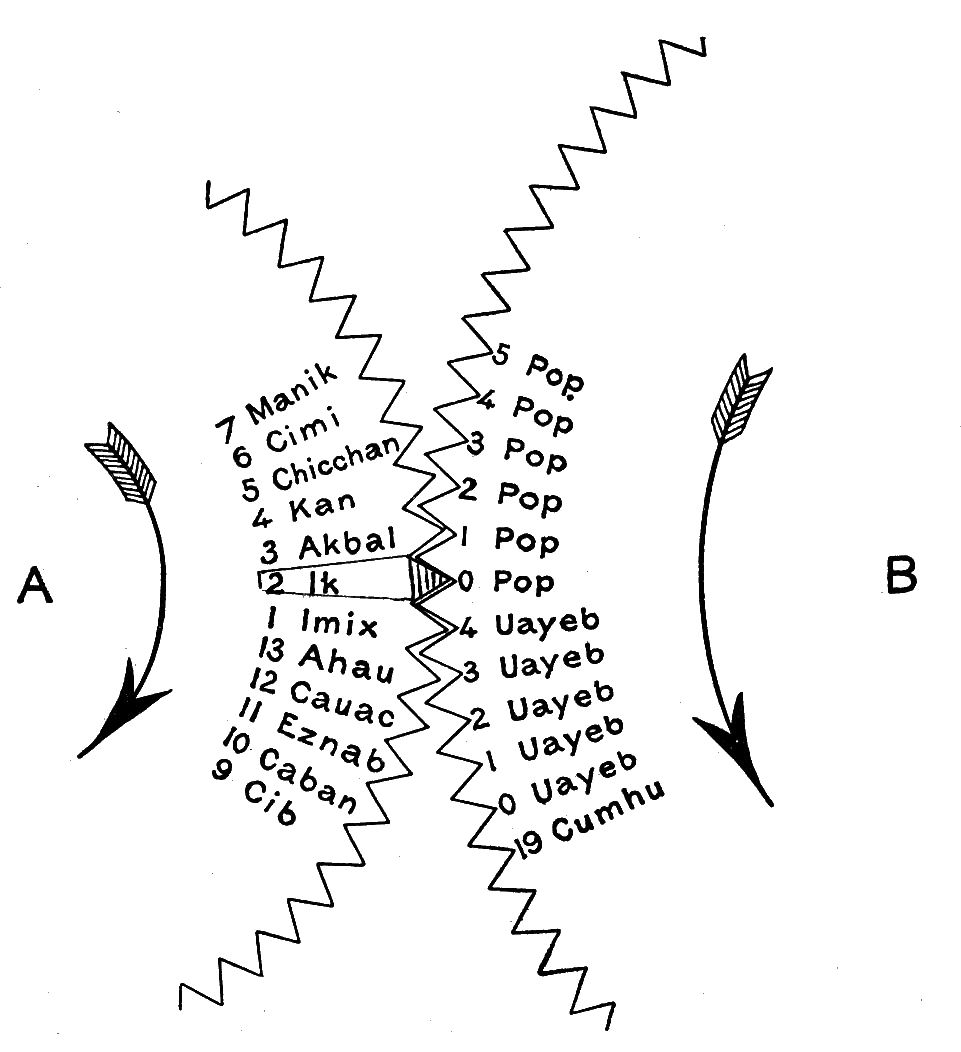
Fig. 21. Diagram showing engagement of tonalamatl wheel of 260 days (A), and haab wheel of 365 positions (B); the combination of the two giving the Calendar Round, or 52-year period.
The first day of the year whose beginning is shown at the point of contact of the two wheels in figure 21 is 2 Ik 0 Pop, that is, the day 2 Ik which occupies the first position in the month Pop. The next day in succession will be 3 Akbal 1 Pop, the next 4 Kan 2 Pop, the next 5 Chicchan 3 Pop, the next 6 Cimi 4 Pop, and so on. As the wheels revolve in the directions indicated, the days of the tonalamatl successively fall into their appropriate positions in the divisions of the year. Since the number of cogs in A is smaller than the number in B, it is clear that the former will have returned to its starting point, 2 Ik (that is, made one complete revolution), before the latter will have made one complete revolution; and, further, that when the latter (B) has returned to its starting point, 0 Pop, the corresponding cog in B will not be 2 Ik, but another day (3 Manik), since by that time the smaller wheel will have progressed 105 cogs, or days, farther, to the cog 3 Manik.
The question now arises, how many revolutions will each wheel have to make before the day 2 Ik will return to the position 0 Pop. The solution of this problem depends on the application of one sequence to another, and the possibilities concerning the numbers or names which stand at the head of the resulting sequence, a subject already discussed on page 52. In the present case the numbers in question, 260 and 365, contain a common factor, therefore our problem falls under the third contingency there presented. Consequently, only certain of the 260 days can occupy the position 0 Pop, or, in other words, cog 2 Ik in A will return to the position 0 Pop in B in fewer than 260 revolutions of A. The actual solution of the problem is a simple question of arithmetic. Since the day 2 Ik can not return to its original position in A until after 260 days shall have passed, and since the day 0 Pop can not return to its original position in B until after 365 days shall have passed, it is clear that the day 2 Ik 0 Pop can not recur until after a number of days shall have passed equal to the least common multiple of these numbers, which is (260/5)×(365/5)×5, or 52×73×5 = 18,980 days. But 18,980 days = 52×365 = 73×260; in other words the day 2 Ik 0 Pop can not recur until after 52 revolutions of B, or 52 years of 365 days each, and 73 revolutions of A, or 73 tonalamatls of 260 days each. The Maya name for this 52-year period is unknown; it has been called the Calendar Round by modern students because it was only after this interval of time had elapsed that any given day could return to the same position in the year. The Aztec name for this period was xiuhmolpilli or toxiuhmolpia.[34]
The Calendar Round was the real basis of Maya chronology, since its 18,980 dates included all the possible combinations of the 260 days with the 365 positions of the year. Although the Maya developed a much more elaborate system of counting time, wherein any date of the Calendar Round could be fixed with absolute certainty within a period of 374,400 years, this truly remarkable feat was accomplished only by using a sequence of Calendar Rounds, or 52-year periods, in endless repetition from a fixed point of departure.
In the development of their chronological system the Aztec probably never progressed beyond the Calendar Round. At least no greater period of time than the round of 52 years has been found in their texts. The failure of the Aztec to develop some device which would distinguish any given day in one Calendar Round from a day of the same name in another has led to hopeless confusion in regard to various events of their history. Since the same date occurred at intervals of every 52 years, it is often difficult to determine the particular Calendar Round to which any given date with its corresponding event is to be referred; consequently, the true sequence of events in Aztec history still remains uncertain.
Professor Seler says in this connection:[35]
Anyone who has ever taken the trouble to collect the dates in old Mexican history from the various sources must speedily have discovered that the chronology is very much awry, that it is almost hopeless to look for an exact chronology. The date of the fall of Mexico is definitely fixed according to both the Indian and the Christian chronology ... but in regard to all that precedes this date, even to events tolerably near the time of the Spanish conquest, the statements differ widely.
Such confusion indeed is only to be expected from a system of counting time and recording events which was so loose as to permit the occurrence of the same date twice, or even thrice, within the span of a single life; and when a system so inexact was used to regulate the lapse of any considerable number of years, the possibilities for error and misunderstanding are infinite. Thus it was with Aztec chronology.
On the other hand, by conceiving the Calendar Rounds to be in endless repetition from a fixed point of departure, and measuring time by an accurate system, the Maya were able to secure precision in dating their events which is not surpassed even by our own system of counting time.
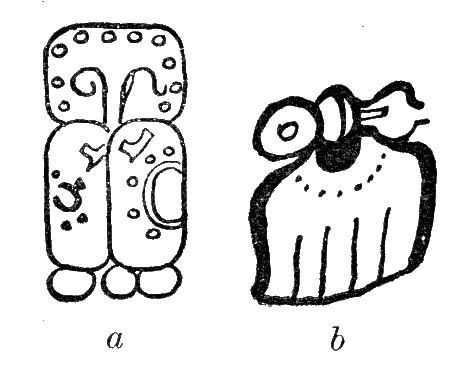
Fig. 22. Signs for the Calendar Round: a, According to Goodman; b, according to Förstemann.
The glyph which stood for the Calendar Round has not been determined with any degree of certainty. Mr. Goodman believes the form shown in figure 22, a, to be the sign for this period, while Professor Förstemann is equally sure that the form represented by b of this figure expressed the same idea. This difference of opinion between two authorities so eminent well illustrates the prevailing doubt as to just what glyph actually represented the 52-year period among the Maya. The sign in figure 22, a, as the writer will endeavor to show later, is in all probability the sign for the great cycle.
As will be seen in the discussion of the Long Count, the Maya, although they conceived time to be an endless succession of Calendar Rounds, did not reckon its passage by the lapse of successive Calendar Rounds; consequently, the need for a distinctive glyph which should represent this period was not acute. The contribution of the Calendar Round to Maya chronology was its 18,980 dates, and the glyphs which composed these are found repeatedly in both the codices and the inscriptions (see figs. 16, 17, 19, 20). No signs have been found as yet, however, for either the haab or the tonalamatl, probably because, like the Calendar Round, these periods were not used as units in recording long stretches of time.
It will greatly aid the student in his comprehension of the discussion to follow if he will constantly bear in mind the fact that one Calendar Round followed another without interruption or the interpolation of a single day; and further, that the Calendar Round may be likened to a large cogwheel having 18,980 teeth, each one of which represented one of the dates of this period, and that this wheel revolved forever, each cog passing a fixed point once every 52 years.
The Long Count
We have seen:
1. How the Maya distinguished 1 day from the 259 others in the tonalamatl;
2. How they distinguished the position of 1 day from the 364 others in the haab, or year; and, finally,
3. How by combining (1) and (2) they distinguished 1 day from the other 18,979 of the Calendar Round.
It remains to explain how the Maya insured absolute accuracy in fixing a day within a period of 374,400 years, as stated above, or how they distinguished 1 day from 136,655,999 others.
The Calendar Round, as we have seen, determined the position of a given day within a period of only 52 years. Consequently, in order to prevent confusion of days of the same name in successive Calendar Rounds or, in other words, to secure absolute accuracy in dating events, it was necessary to use additional data in the description of any date.
In nearly all systems of chronology that presume to deal with really long periods the reckoning of years proceeds from fixed starting points. Thus in Christian chronology the starting point is the Birth of Christ, and our years are reckoned as B. C. or A. D. according as they precede or follow this event. The Greeks reckoned time from the earliest Olympic Festival of which the winner's name was known, that is, the games held in 776 B. C., which were won by a certain Coroebus. The Romans took as their starting point the supposed date of the foundation of Rome, 753 B. C. The Babylonians counted time as beginning with the Era of Nabonassar, 747 B. C. The death of Alexander the Great, in 325 B. C., ushered in the Era of Alexander. With the occupation of Babylon in 311 B. C. by Seleucus Nicator began the so-called Era of Seleucidæ. The conquest of Spain by Augustus Cæsar in 38 B. C. marked the beginning of a chronology which endured for more than fourteen centuries. The Mohammedans selected as their starting point the flight of their prophet Mohammed from Mecca in 622 A. D., and events in this chronology are described as having occurred so many years after the Hegira (The Flight). The Persian Era began with the date 632 A. D., in which year Yezdegird III ascended the throne of Persia.
It will be noted that each of the above-named systems of chronology has for its starting point some actual historic event, the occurrence, if not the date of which, is indubitable. Some chronologies, however, commence with an event of an altogether different character, the date of which from its very nature must always remain hypothetical. In this class should be mentioned such chronologies as reckon time from the Creation of the World. For example, the Era of Constantinople, the chronological system used in the Greek Church, commences with that event, supposed to have occurred in 5509 B. C. The Jews reckoned the same event as having taken place in 3761 B. C. and begin the counting of time from this point. A more familiar chronology, having for its starting point the Creation of the World, is that of Archbishop Usher, in the Old Testament, which assigns this event to the year 4004 B. C.
In common with these other civilized peoples of antiquity the ancient Maya had realized in the development of their chronological system the need for a fixed starting point, from which all subsequent events could be reckoned, and for this purpose they selected one of the dates of their Calendar Round. This was a certain date, 4 Ahau 8 Cumhu,[36] that is, a day named 4 Ahau, which occupied the 9th position in the month Cumhu, the next to last division of the Maya year (see Table III).
While the nature of the event which took place on this date[37] is unknown, its selection as the point from which time was subsequently reckoned alone indicates that it must have been of exceedingly great importance to the native mind. In attempting to approximate its real character, however, we are not without some assistance from the codices and the inscriptions. For instance, it is clear that all Maya dates which it is possible to regard as contemporaneous[38] refer to a time fully 3,000 years later than the starting point (4 Ahau 8 Cumhu) from which each is reckoned. In other words, Maya history is a blank for more than 3,000 years after the initial date of the Maya chronological system, during which time no events were recorded.
This interesting condition strongly suggests that the starting point of Maya chronology was not an actual historical event, as the founding of Rome, the death of Alexander, the birth of Christ, or the flight of Mohammed from Mecca, but that on the contrary it was a purely hypothetical occurrence, as the Creation of the World or the birth of the gods; and further, that the date 4 Ahau 8 Cumhu was not chosen as the starting point until long after the time it designates. This, or some similar assumption, is necessary to account satisfactorily for the observed facts:
1. That, as stated, after the starting point of Maya chronology there is a silence of more than 3,000 years, unbroken by a single contemporaneous record, and
2. That after this long period had elapsed all the dated monuments[39] had their origin in the comparatively short period of four centuries.
Consequently, it is safe to conclude that no matter what the Maya may have believed took place on this date 4 Ahau 8 Cumhu, in reality when this day was present time they had not developed their distinctive civilization or even achieved a social organization.
It is clear from the foregoing that in addition to the Calendar Round, the Maya made use of a fixed starting point in describing their dates. The next question is, Did they record the lapse of more than 3,000 years simply by using so unwieldy a unit as the 52-year period or its multiples? A numerical system based on 52 as its primary unit immediately gives rise to exceedingly awkward numbers for its higher terms; that is, 52, 104, 156, 208, 260, 312, etc. Indeed, the expression of really large numbers in terms of 52 involves the use of comparatively large multipliers and hence of more or less intricate multiplications, since the unit of progression is not decimal or even a multiple thereof. The Maya were far too clever mathematicians to have been satisfied with a numerical system which employed units so inconvenient as 52 or its multiples, and which involved processes so clumsy, and we may therefore dismiss the possibility of its use without further consideration.
In order to keep an accurate account of the large numbers used in recording dates more than 3,000 years distant from the starting point, a numerical system was necessary whose terms could be easily handled, like the units, tens, hundreds, and thousands of our own decimal system. Whether the desire to measure accurately the passage of time actually gave rise to their numerical system, or vice versa, is not known, but the fact remains that the several periods of Maya chronology (except the tonalamatl, haab, and Calendar Round, previously discussed) are the exact terms of a vigesimal system of numeration, with but a single exception. (See Table VIII.)
Table VIII. THE MAYA TIME-PERIODS
1 kin = 1 days
20 kins = 1 uinal = 20 days
18 uinals = 1 tun = 360 days
20 tuns = 1 katun = 7,200 days
20 katuns = 1 cycle = 144,000 days
20[40] cycles = 1 great cycle = 2,880,000 days
Table VIII shows the several periods of Maya chronology by means of which the passage of time was measured. All are the exact terms of a vigesimal system of numeration, except in the 2d place (uinals), in which 18 units instead of 20 make 1 unit of the 3d place, or order next higher (tuns). The break in the regularity of the vigesimal progression in the 3d place was due probably to the desire to bring the unit of this order (the tun) into agreement with the solar year of 365 days, the number 360 being much closer to 365 than 400, the third term of a constant vigesimal progression. We have seen on page 45 that the 18 uinals of the haab were equivalent to 360 days or kins, precisely the number contained in the third term of the above table, the tun. The fact that the haab, or solar year, was composed of 5 days more than the tun, thus causing a discrepancy of 5 days as compared with the third place of the chronological system, may have given to these 5 closing days of the haab—that is, the xma kaba kin—the unlucky character they were reputed to possess.
The periods were numbered from 0 to 19, inclusive, 20 units of any order (except the 2d) always appearing as 1 unit of the order next higher. For example, a number involving the use of 20 kins was written 1 uinal instead.
We are now in possession of all the different factors which the Maya utilized in recording their dates and in counting time:
1. The names of their dates, of which there could be only 18,980 (the number of dates in the Calendar Round).
2. The date, or starting point, 4 Ahau 8 Cumhu, from which time was reckoned.
3. The counters, that is, the units, used in measuring the passage of time.
It remains to explain how these factors were combined to express the various dates of Maya chronology.
Initial Series
The usual manner in which dates are written in both the codices and the inscriptions is as follows: First, there is set down a number composed of five periods, that is, a certain number of cycles, katuns, tuns, uinals, and kins, which generally aggregate between 1,300,000 and 1,500,000 days; and this number is followed by one of the 18,980 dates of the Calendar Round. As we shall see in the next chapter, if this large number of days expressed as above be counted forward from the fixed starting point of Maya chronology, 4 Ahau 8 Cumhu, the date invariably[41] reached will be found to be the date written at the end of the long number. This method of dating has been called the Initial Series, because when inscribed on a monument it invariably stands at the head of the inscription.
The student will better comprehend this Initial-series method of dating if he will imagine the Calendar Round represented by a large cogwheel A, figure 23, having 18,980 teeth, each one of which is named after one of the dates of the calendar. Furthermore, let him suppose that the arrow B in the same figure points to the tooth, or cog, named 4 Ahau 8 Cumhu; and finally that from this as its original position the wheel commences to revolve in the direction indicated by the arrow in A.
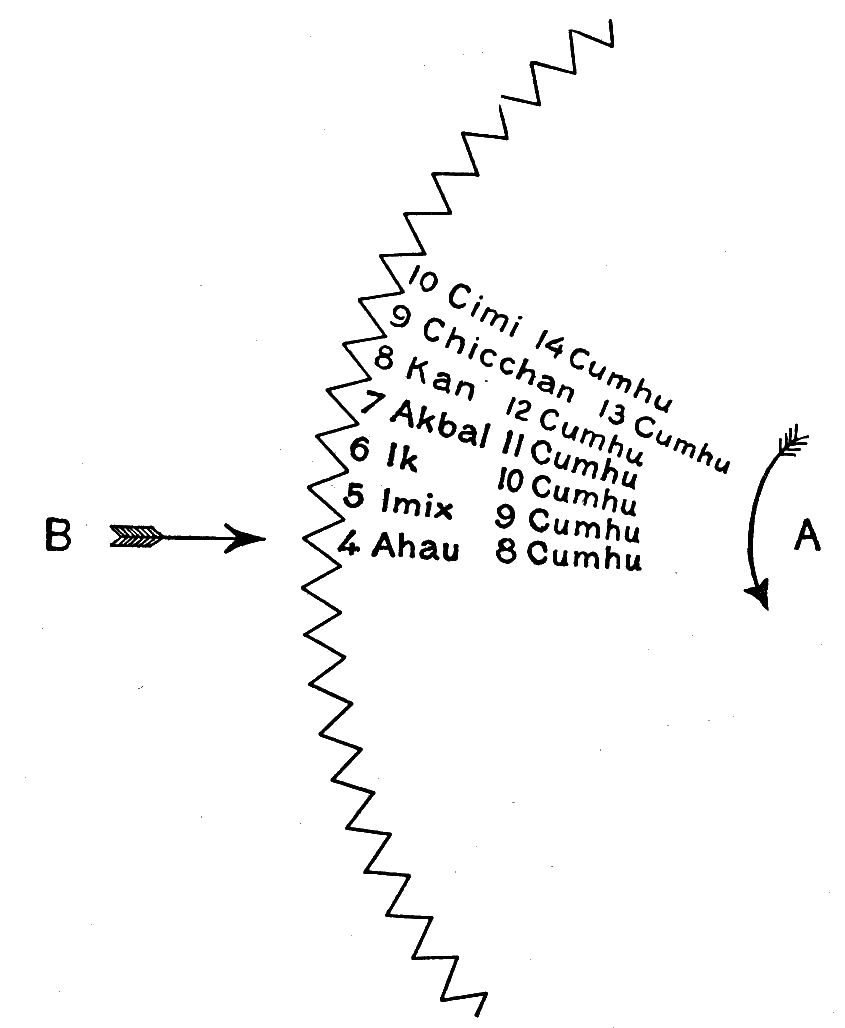
Fig. 23. Diagram showing section of Calendar-round wheel.
It is clear that after one complete revolution of A, 18,980 days will have passed the starting point B, and that after two revolutions 37,960 days will have passed, and after three, 56,940, and so on. Indeed, it is only a question of the number of revolutions of A until as many as 1,500,000, or any number of days in fact, will have passed the starting point B, or, in other words, will have elapsed since the initial date, 4 Ahau 8 Cumhu. This is actually what happened according to the Maya conception of time.
For example, let us imagine that a certain Initial Series expresses in terms of cycles, katuns, tuns, uinals, and kins, the number 1,461,463, and that the date recorded by this number of days is 7 Akbal 11 Cumhu. Referring to figure 23, it is evident that 77 revolutions of the cogwheel A, that is, 77 Calendar Rounds, will use up 1,461,460 of the 1,461,463 days, since 77×18,980 = 1,461,460. Consequently, when 77 Calendar Rounds shall have passed we shall still have left 3 days (1,461,463 - 1,461,460 = 3), which must be carried forward into the next Calendar Round. The 1,461,461st day will be 5 Imix 9 Cumhu, that is, the day following 4 Ahau 8 Cumhu (see fig. 23); the 1,461,462d day will be 6 Ik 10 Cumhu, and the 1,461,463d day, the last of the days in our Initial Series, 7 Akbal 11 Cumhu, the date recorded. Examples of this method of dating (by Initial Series) will be given in Chapter V, where this subject will be considered in greater detail.
THE INTRODUCING GLYPH
In the inscriptions an Initial Series is invariably preceded by the so-called "introducing glyph," the Maya name for which is unknown. Several examples of this glyph are shown in figure 24. This sign is composed of four constant elements:
1. The trinal superfix. 2. The pair of comblike lateral appendages. 3. The tun sign (see fig. 29, a, b). 4. The trinal subfix.
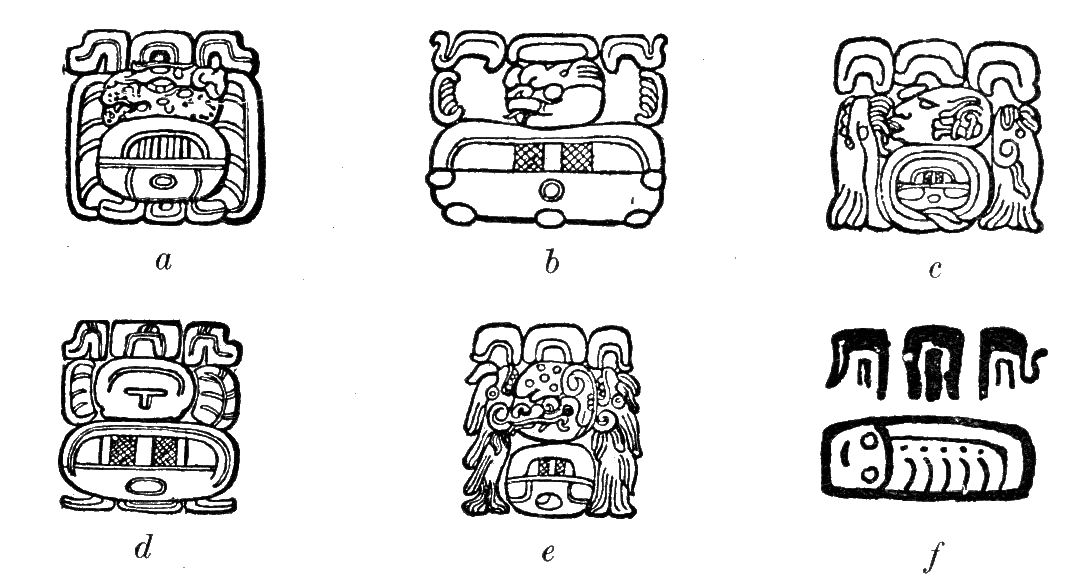
Fig. 24. Initial-series "introducing glyph."
In addition to these four constant elements there is one variable element which is always found between the pair of comblike lateral appendages. In figure 24, a, b, e, this is a grotesque head; in c, a natural head; and in d, one of the 20 day-signs, Ik. This element varies greatly throughout the inscriptions, and, judging from its central position in the "introducing glyph" (itself the most prominent character in every inscription in which it occurs), it must have had an exceedingly important meaning.[42] A variant of the comblike appendages is shown in figure 24, c, e, in which these elements are replaced by a pair of fishes. However, in such cases, all of which occur at Copan, the treatment of the fins and tail of the fish strongly suggests the elements they replace, and it is not improbable, therefore, that the comblike appendages of the "introducing glyph" are nothing more nor less than conventionalized fish fins or tails; in other words, that they are a kind of glyphic synecdoche in which a part (the fin) stands for the whole (the fish). That the original form of this element was the fish and not its conventionalized fin (*) seems to be indicated by several facts: (1) On Stela D at Copan, where only full-figure glyphs are presented,[43] the two comblike appendages of the "introducing glyph" appear unmistakably as two fishes. (2) In some of the earliest stelæ at Copan, as Stelæ 15 and P, while these elements are not fish forms, a head (fish?) appears with the conventionalized comb element in each case. The writer believes the interpretation of this phenomenon to be, that at the early epoch in which Stelæ 15 and P were erected the conventionalization of the element in question had not been entirely accomplished, and that the head was added to indicate the form from which the element was derived. (3) If the fish was the original form of the comblike element in the "introducing glyph," it was also the original form of the same element in the katun glyph. (Compare the comb elements (†) in figures 27, a, b, e, and 24, a, b, d with each other.) If this is true, a natural explanation for the use of the fish in the katun sign lies near at hand. As previously explained on page 28, the comblike element stands for the sound ca (c hard); while kal in Maya means 20. Also the element (**) stands for the sound tun. Therefore catun or katun means 20 tuns. But the Maya word for "fish," cay (c hard) is also a close phonetic approximation of the sound ca or kal. Consequently, the fish sign may have been the original element in the katun glyph, which expressed the concept 20, and which the conventionalization of glyphic forms gradually reduced to the element (††) without destroying, however, its phonetic value.


Without pressing this point further, it seems not unlikely that the comblike elements in the katun glyph, as well as in the "introducing glyph," may well have been derived from the fish sign.
Turning to the codices, it must be admitted that in spite of the fact that many Initial Series are found therein, the "introducing glyph" has not as yet been positively identified. It is possible, however, that the sign shown in figure 24, f, may be a form of the "introducing glyph"; at least it precedes an Initial Series in four places in the Dresden Codex (see pl. 32). It is composed of the trinal superfix and a conventionalized fish (?).
Mr. Goodman calls this glyph (fig. 24, a-e) the sign for the great cycle or unit of the 6th place (see Table VIII). He bases this identification on the fact that in the codices units of the 6th place stand immediately above[44] units of the 5th place (cycles), and consequently since this glyph stands immediately above the units of the 5th place in the inscriptions it must stand for the units of the 6th place. While admitting that the analogy here is close, the writer nevertheless is inclined to reject Mr. Goodman's identification on the following grounds: (1) This glyph never occurs with a numerical coefficient, while units of all the other orders—that is, cycles, katuns, tuns, uinals, and kins are never without them. (2) Units of the 6th order in the codices invariably have a numerical coefficient, as do all the other orders. (3) In the only three places in the inscriptions[45] in which six periods are seemingly recorded, though not as Initial Series, the 6th period has a numerical coefficient just as have the other five, and, moreover, the glyph in the 6th position is unlike the forms in figure 24. (4) Five periods, not six, in every Initial Series express the distance from the starting point, 4 Ahau 8 Cumhu, to the date recorded at the end of the long numbers.