Chapter II · CRITICAL ACCOUNT OF SOME PREVIOUS PHILOSOPHICAL THEORIES OF GEOMETRY.
Reading edition
But in a criticism of representative modern theories of Geometry, which is designed to be, not a history of the subject, but an introduction to, and defence of, the views of the author, it will not be necessary to discuss any more ancient theory than that of Kant. Kant's views on this subject, true or false, have so dominated subsequent thought, that whether they were accepted or rejected, they seemed equally potent in forming the opinions, and the manner of exposition, of almost all later writers.
Kant.
In the first place, what does Kant's doctrine mean for Geometry? Obviously not the aspect of the doctrine which has been attacked by psychologists, the "Kantian machine-shop" as James calls it—at any rate, if this can be clearly separated from the logical aspect. The question whether space is given in sensation, or whether, as Kant maintained, it is given by an intuition to which no external matter corresponds, may for the present be disregarded. If, indeed, we held the view which seems crudely to sum up the standpoint of the Critique, the view that all certain knowledge is self-knowledge, then we should be committed, if we had decided that Geometry was apodeictic, to the view that space is subjective. But even then, the psychological question could only arise when the epistemological question had been solved, and could not, therefore, be taken into account in our first investigation. The question before us is precisely the question whether, or how far, Geometry is apodeictic, and for the moment we have only to investigate this question, without fear of psychological consequences.
Every judgment—so modern logic contends—is both synthetic and analytic; it combines parts into a whole, and analyses a whole into parts[73]. If this be so, the distinction of analysis and synthesis, whatever may be its importance in pure Logic, can have no value in Epistemology. But such a doctrine, it must be observed, allows full scope to the principle of contradiction: this criterion, since all judgments, in one aspect at least, are analytic, is applicable to all judgments alike. On the other hand, the whole which is analysed must be supposed already given, before the parts can be mutually contradictory: for only by connection in a given whole can two parts or adjectives be incompatible. Thus the principle of contradiction remains barren until we already have some judgments, and even some inference: for the parts may be regarded, to some extent, as an inference from the whole, or vice versâ. When once the arch of knowledge is constructed, the parts support one another, and the principle of contradiction is the keystone: but until the arch is built, the keystone remains suspended, unsupported and unsupporting, in the empty air. In other words, knowledge once existent can be analysed, but knowledge which should have to win every inch of the way against a critical scepticism, could never begin, and could never attain that circular condition in which alone it can stand.
But Kant's doctrine, if true, is designed to restrain a critical scepticism even where it might be effective. Certain fundamental propositions, he says, are not deducible from logic, i.e. their contradictories are not self-contradictory; they combine a subject and predicate which cannot, in any purely logical way, be shewn to have any connection, and yet these judgments have apodeictic certainty. But concerning such judgments, Kant is generally careful not to rely upon the mere subjective conviction that they are undeniable: he proves, with every precaution, that without them experience would be impossible. Experience consists in the combination of terms which formal logic leaves apart, and presupposes, therefore, certain judgments by which a framework is made for bringing such terms together. Without these judgments—so Kant contends—all synthesis and all experience would be impossible. If, therefore, the detail of the Kantian reasoning be sound, his results may be obtained by the principle of contradiction plus the possibility of experience, as well as by his distinction of synthetic and analytic judgments.
Logic, at the present day, arrogates to itself at once a wider and a narrower sphere than Kant allowed to it. Wider, because it believes itself capable of condemning any false principle or postulate; narrower, because it believes that its law of contradiction, without a given whole or a given hypothesis, is powerless, and that two terms, per se, though they may be different, cannot be contradictories, but acquire this relation only by combination in a whole about which something is known, or by connection with a postulate which, for some reason, must be preserved. Thus no judgment, per se, is either analytic or synthetic, for the severance of a judgment from its context robs it of its vitality, and makes it not truly a judgment at all. But in its proper context it is neither purely synthetic nor purely analytic; for while it is the further determination of a given whole, and thus in so far analytic, it also involves the emergence of new relations within this whole, and is so far synthetic.
It is to be observed that this use of the term is at once more rationalistic and less precise than that of Kant. Kant would seem to have supposed himself immediately aware, by inspection, that some knowledge was apodeictic, and its subject-matter, therefore, à priori: but he did not always deduce its apriority from any further principle. Here, however, it is to be shown, before admitting apriority, that the falsehood of the judgment in question would not be effected by a mere change in the matter of experience, but only by a change which should render some branch of experience formally impossible, i.e. inaccessible to our methods of cognition. The above use is also less precise, for it varies according to the specialization of the experience we are assuming possible, and with every progress of knowledge some new connection is perceived, two previously isolated judgments are brought into logical relation, and the à priori may thus, at any moment, enlarge its sphere, as more is found deducible from fundamental postulates.
Moreover externality, to render the scope of the argument wholly logical, must not be left with a sensational or intuitional meaning, though it must be supposed given in sensation or intuition. It must mean, in this argument, the fact of Otherness[77], the fact of being different from some other thing: it must involve the distinction between different things, and must be that element, in a cognitive state, which leads us to discriminate constituent parts in its object. So much, then, would appear to result from Kant's argument, that experience of diverse but interrelated things demands, as a necessary prerequisite, some sensational or intuitional element, in perception, by which we are led to attribute complexity to objects of perception[78]; that this element, in its isolation may be called a form of externality; and that those properties of this form, if any such be found, which can be deduced from its mere function of rendering experience of interrelated diversity possible, are to be regarded as à priori. What these properties are, and how the various lines of argument here suggested converge to a single result, we shall see in Chapters III. and IV.
Riemann.
After this initial protest against Riemann's general philosophical position, let us proceed to examine, in detail, his use of the notion of a manifold.
We are thus brought back to the point from which we started, namely, the falsity of Riemann's initial disjunction, and the consequent fallacy in his proof of the empirical nature of the axioms. His philosophy is chiefly vitiated, to my mind, by this fallacy, and by the uncritical assumption that a metrical coordinate system can be set up independently of any axioms as to space-measurement[82]. Riemann has failed to observe, what I have endeavoured to prove in the next chapter, that, unless space had a strictly constant measure of curvature, Geometry would become impossible; also that the absence of constant measure of curvature involves absolute position, which is an absurdity. Hence he is led to the conclusion that all geometrical axioms are empirical, and may not hold in the infinitesimal, where observation is impossible. Thus he says (p. 267): "Now the empirical conceptions, on which spatial measurements are based, the conceptions of the rigid body and the light-ray, appear to lose their validity in the infinitesimal: it is therefore quite conceivable that the relations of spatial magnitudes in the infinitesimal do not correspond to the presuppositions of Geometry, and this would, in fact, have to be assumed, as soon as it would enable us to explain the phenomena more simply." From this conclusion I must entirely dissent. In very large spaces, there might be a departure from Euclid; for they depend upon the axiom of parallels, which is not contained in the axiom of Free Mobility; but in the infinitesimal, departures from Euclid could only be due to the absence of Free Mobility, which, as I hope my third chapter will show, is once for all impossible.
Helmholtz.
The principal topics, for a criticism of Helmholtz, are three: First, his criterion of the à priori; second, his discussion with Land as to the "imaginability" of non-Euclidean spaces; third—and this is by far the most important of the three—his theory of the dependence of Geometry on Mechanics. Let us discuss these three points successively.
Another and a better criterion, it is true, is also to be found in Helmholtz, and has also been adopted by Erdmann. Whatever might, by a different experience, have been rendered different—so this criterion contends—must itself be dependent on experience, and so empirical. This criterion seems perfectly sound, but Helmholtz's use of it is usually vitiated by his neglecting to prove the possibility of the different experience in question. He says, for example, that if our experience showed us only bodies which changed their shapes in motion, we should not arrive at the axiom of Congruence, which he pronounces accordingly to be empirical. But I shall endeavour to prove, in Chapter III., that without the axiom of Congruence, experience of spatial magnitude would be impossible. If my proof be correct, it follows that no experience can ever reveal spatial magnitudes which contradict this axiom—a possibility which Helmholtz nowhere discusses, in setting up his hypothetical experience. Thus this second criterion, though perfectly sound, requires always an accompanying transcendental argument, as to the conditions of possible experience. But this accompaniment is seldom to be found in Helmholtz.
Although I agree with Helmholtz in thinking the distinction between Euclidean and non-Euclidean spaces empirical, I cannot think his argument on the "imaginability" of the latter a very happy one. The validity of any proof must turn, obviously, on the definition of imaginability. The definition which Helmholtz gives in his answer to Land is as follows: Imaginability requires "die vollständige Vorstellbarkeit derjenigen Sinneseindrücke, welche das betreffende Object in uns nach den bekannten Gesetzen unserer Sinnesorgane unter allen denkbaren Bedingungen der Beobachtung erregen, und wodurch es sich von anderen ähnlichen Objecten unterscheiden würde" (Wiss. Abh. II. p. 644). This definition is not very clear, owing to the ambiguity of the word "Vorstellbarkeit." The following definition seems less ambiguous: "Wenn die Reihe der Sinneseindrücke vollständig und eindeutig angegeben werden kann, muss man m. E. die Sache für anschaulich vorstellbar erklären" (Vorträge und Reden, II. p. 234). This makes clear, what also appears from his manner of proof, that he regards things as imaginable which can be described in conceptual terms. Such, as Land remarks (Mind, Vol. II. p. 45), "is not the sense required for argumentation in this case." That Land's criticism is just, is shown by Helmholtz's proof for non-Euclidean spaces, for it consists only in an analogy to the volume inside a sphere, which is mathematically obtained thus: We take the symbols representing magnitudes in "pseudo-spherical" (hyperbolic) space, and give them a new Euclidean meaning; thus all our symbolic propositions become capable of two interpretations, one for pseudo-spherical space, and one for the volume inside a sphere. It is, however, sufficiently obvious that this procedure, though it enables us to describe our new space, does not enable us to imagine it, in the sense of calling up images of the way things would look in it. We really derive, from this analogy, no more knowledge than a man born blind may derive, as to light, from an analogy with heat. The dictum "Nihil est in intellectu quod non fuerit ante in sensu," would unquestionably be true, if for intellect we were to substitute imagination; it is vain, therefore, if our actual space be Euclidean, to hope for a power of imagining a non-Euclidean space. What Helmholtz might, I believe with perfect truth, have urged against Land, is that the image we actually have of space is not sufficiently accurate to exclude, in the actual space we know, all possibility of a slight departure from the Euclidean type. But in maintaining that we cannot imagine, though we can conceive and describe, a space different from that we actually have, Land is, in my opinion, unquestionably in the right. For a pure Kantian, who maintains, with Land, that none of the axioms can be proved, this question is of great importance. But if, as I have maintained, some of the axioms are susceptible of a transcendental proof, while the others can be verified empirically, the question is freed from psychological implications, and the imaginability or non-imaginability of metageometrical spaces becomes unimportant.
(1) It may be asserted that the actual meaning of the axiom of Free Mobility lies in the assertion of empirical rigid bodies, and that the two propositions are equivalent to one another. This is certainly false.
(2) The axiom of Free Mobility, it may be said, is logically distinguishable from the assertion of rigid bodies, and may even be not empirical; but it is barren, even for pure Geometry, without the aid of measures, which must themselves be empirical rigid bodies. This sense is more plausible than the first, but I believe we can show that, in this sense also, the proposition is false.
(3) For pure Geometry and the abstract study of space, it may be said, Free Mobility, as applied to an abstract geometrical matter, gives a sufficient possibility of quantitative comparison; but the moment we extend our results to mixed mathematics, and apply them to empirically given matter, we require also, as measures, empirically given rigid bodies, or bodies, at least, whose departures from rigidity are empirically known. In this sense, I admit, the proposition is correct[89].
In discussing these three meanings, I shall not confine myself strictly to the text of Helmholtz or Land: if I endeavoured to do so, I should be met by the difficulty that neither of them defines the à priori, and that each is too much inclined, in my opinion, to test it by psychological criteria. I shall, therefore, take the three meanings in turn, without laying stress on their historical adequacy to the views of Land or Helmholtz.
This argument may be summed up by the following disjunction: If bodies change their shapes in motion—and to some extent, since no body is perfectly rigid, they must all do so—then one of two cases must occur. Either the changes of shape, as bodies move from place to place, follow no geometrical law, are not, for instance, functions of the amount or direction of motion; in which case the law of causation requires that they should not be effects of the change of place, but of some simultaneous non-geometrical change, such as temperature. Or the changes are regular, and the shape S becomes, in a new position p, Sf(p). In this case, the law of concomitant variations leads us to attribute the change of shape to the mere motion, and shape thus becomes a function of absolute position. But this is absurd, for position means merely a relation or set of relations; it is impossible, therefore, that mere position should be able to effect changes in a body. Position is one term in a relation, not a thing per se; it cannot, therefore, act on a thing, nor exist by itself, apart from the other terms of the relation. Thus Helmholtz's view, that Congruence depends on the existence of rigid bodies, must, since it involves absolute position, be condemned as a logical fallacy. Congruence, in fact, as I shall prove more fully in Chapter III., is an à priori deduction from the relativity of position.
The reference to matter is necessitated by the homogeneity of empty space. For so long as we leave matter out of account, one position is perfectly indistinguishable from another, and a science of the relations of positions is impossible. Indeed, before spatial relations can arise at all, the homogeneity of empty space must be destroyed, and this destruction must be effected by matter. The blank page is useless to the geometer until he defaces its homogeneity by lines in ink or pencil. No spatial figures, in short, are conceivable, without a reference to a not purely spatial matter. Again, if Congruence is ever to be used, there must be motion: but a purely geometrical point, being defined solely by its spatial attributes, cannot be supposed to move without a contradiction in terms. What moves, therefore, must be matter. Hence, in order that motion may afford a test of equality, we must have some matter which is known to be unaffected throughout the motion, that is, we must have some rigid bodies. And the difficulty is, that these bodies must not only undergo no change due solely to the nature of space, but must, further, be unchanged by their changing relation to other bodies. And here we have a requisite which can no longer be fulfilled à priori: which, indeed, we know to be, in strictness, untrue. For the forces acting on a body depend upon its spatial relations to other bodies, and changing forces are liable to produce changing configuration. Hence, it would seem, actual measurement must be purely empirical, and must depend on the degree of rigidity to be obtained, during the process of measurement, in the bodies with which we are conversant.
This conclusion, I believe, is valid of all actual measurement. But the possibility of such empirical and approximate rigidity, I must insist, depends on the à priori law that mere motion, apart from the action of other matter, cannot effect a change of shape. For without this law, the effect of other matter would not be discoverable; the laws of motion would be absurd, and Physics would be impossible. Consider the second law, for example: How could we measure the change of motion, if motion itself produced a change in our measures? Or consider the law of gravitation: How could we establish the inverse square, unless we were able, independently of Dynamics, to measure distances? The whole science of Dynamics, in short, is fundamentally dependent on Geometry, and but for the independent possibility of measuring spatial magnitudes, none of the magnitudes of Dynamics could be measured. Time, force, and mass are alike measured by spatial correlates: these correlates are given, for time, by the first law, for force and mass, by the second and third. It is true, then, that an empirical element appears unavoidably in all actual measurement, inasmuch as we can only know empirically that a given piece of matter preserves its shape throughout the necessary change of dynamical relations to other matter involved in motion; but it is further true that, for Geometry—which regards matter simply as supplying the necessary breach in the homogeneity of space, and the necessary term for spatial relations, not as the bearer of forces which change the configuration of other material systems—for Geometry, which deals with this abstract and merely kinematical matter, rigidity is à priori, in so far as the only changes with which it is cognizant—changes of mere position, namely—are incapable of affecting the shapes of the imaginary and abstract bodies with which it deals. To use a scholastic distinction, we may say that matter is the causa essendi of space, but Geometry is the causa cognoscendi of Physics. Without a Geometry independent of Physics, Physics itself, which necessarily assumes the results of Geometry, could never arise; but when Geometry is used in Physics, it loses some of its à priori certainty, and acquires the empirical and approximate character which belongs to all accounts of actual phenomena.
To make quite plain the function of rigid bodies in Geometry, let us suppose a liquid geometer in a liquid world. We cannot suppose the liquid perfectly homogeneous and undifferentiated, in the first place because such a liquid would be indistinguishable from empty space, in the second place because our geometer's body—unless he be a disembodied spirit—will itself constitute a differentiation for him. We may therefore assume
"dim beams, Which amid the streams Weave a network of coloured light,"
and we may suppose this network to form the occasion for our geometer's reflections. Then he will be able to imagine a network in which the lines are straight, or circular, or parabolic, or any other shape, and he will be able to infer that such a network, if it can be woven in one part of the fluid, can be woven in another. This will form sufficient basis for his deductions. The superposition he is concerned with—since not actual equality, but only the formal conditions of equality, are the subject-matter of Geometry—is purely ideal, and is unaffected by the impossibility of congealing any actual network. But in order to apply his Geometry to the exigencies of life, he would need some standard of comparison between actual networks, and here, it is true, he would need either a rigid body, or a knowledge of the conditions under which similar networks arose. Moreover these conditions, being necessarily empirical, could hardly be known apart from previous measurement. Hence for applied, though not for pure Geometry, one rigid body at least seems essential.
Thus, to conclude: Geometry requires, if it is to be practically possible, some body or bodies which are either rigid (in the dynamical sense), or known to undergo some definite changes of shape according to some definite law. (These changes, we may suppose, are known by the laws of Physics, which have been experimentally established, and which throughout assume the truth of Geometry.) One or more such bodies are necessary to applied Geometry—but only in the sense in which rulers and compasses are necessary. They are necessary as, in making the Ordnance Survey, an elaborate apparatus was necessary for measuring the base line on Salisbury Plain. But for the theory of Geometry, geometrical rigidity suffices, and geometrical rigidity means only that a shape, which is possible in one part of space, is possible in any other. The empirical element in practice, arising from the purely empirical nature of physical rigidity, is comparable to the empirical inaccuracies arising from the failure to find straight lines or circles in the world—which no one but Mill has regarded as rendering Geometry itself empirical or inaccurate. But to make Geometry await the perfection of Physics, is to make Physics, which depends throughout on Geometry, forever impossible. As well might we leave the formation of numbers until we had counted the houses in Piccadilly.
Erdmann.
Erdmann agrees throughout with the conclusions of Riemann and Helmholtz, except on a few points of minor importance; and his views, as this agreement would lead one to expect, are ultra-empirical. Indeed his logic seems—though I say this with hesitation—to be incompatible with any system but that of Mill: there is apparently no distinction, to him, between the general and the universal, and consequently no concept not embodied in a series of instances. Such a theory of logic, to my mind, vitiates most of his work, as it vitiated Riemann's philosophy[93]. This general criticism will find abundant illustration in the course of our account of Erdmann's views.
A judgment of magnitude is always a judgment of comparison, and what is more, the comparison is never concerned with quality, but only with quantity. Quality, in the judgment of magnitude, is supposed identical, in the object whose magnitude is stated, and in the unit with which it is compared. But quality, except in pure number, and in pure quantity as dealt with by the Calculus, is always present, and is partly absorbed into quantity, partly untouched by the judgment of magnitude. As Bosanquet says (Logic, Vol. I. p. 124); "Quantitative comparison is not prima facie coordinate with qualitative, but rather stands in its place as the effect of comparison on quality, which so far as comparable becomes quantity, and so far as incomparable furnishes the distinction of parts essential to the quantitative whole" (italics in the original). Thus, if we are to regard space as a magnitude, we must be able to adduce all those series of instances of which Erdmann speaks, and which, for the conception of space, seemed irrelevant. But it remains to be proved that the comparison, which we can institute between various spaces, is capable of expression in a quantitative form. Rather it would seem that the difference of quality is such as to preclude quantitative comparison between different spaces, and therefore also to preclude all judgments of magnitude about space as a whole. Here an exception might seem to be demanded by non-Euclidean spaces, whose space-constants give a definite magnitude, inherent in space as a whole, and therefore, one might think, characterizing space as a magnitude. But this is a mistake. For the space-constant, in such spaces, is the ultimate unit, the fixed term in all quantitative comparison; it is itself, therefore, destitute of quantity, since there is no independently given magnitude with which to compare it. A non-Euclidean world, in which the space-constant and all lines and figures were suddenly multiplied in a constant ratio, would be wholly unchanged; the lines, as measured against the space-constant, would have the same magnitude as before, and the space-constant itself, having no outside standard of comparison, would be destitute of quantity, and therefore not subject to change of quantity. Such an enlargement of a non-Euclidean world, in other words, is unmeaning; and this proves how inapplicable is the notion of quantity to space as a whole.
It might be objected that this only proves the absence of quantitative difference between different spaces of positive space-constant, or between those of negative space-constant: the quantitative difference persists, it might be said, between those of positive curvature in general and those of negative curvature in general, or between both together and Euclidean space. This I entirely deny. There is no qualitatively similar unit, in the three kinds of space, by which quantitative comparison could be effected. The straight lines of one space cannot be put into the other: the two straight lines, in one space, whose product is the reciprocal of the measure of curvature, have no corresponding curves in the other space, and the measures of curvature cannot, therefore, be quantitatively compared with each other. That the one may be regarded as positive, the other negative, I admit, but their values are indeterminate, and the units in the two cases are qualitatively different. A debt of £300 may be represented as the asset of -£300, and the height of the Eiffel Tower is +300 metres; but it does not follow that the two are quantitatively comparable. So with space-constants: the space-constant is itself the unit for magnitudes in its own space, and differs qualitatively from the space-constant of another kind of space.
Again, to proceed to a more philosophical argument, two different spaces cannot co-exist in the same world: we may be unable to decide between the alternatives of the disjunction, but they remain, none the less, absolutely incompatible alternatives. Hence we cannot get that coexistence of two spaces which is essential to comparison. The fact seems to be that Erdmann, in his admiration for Riemann and Helmholtz, has fallen in with their mathematical bias, and assumed, as mathematicians naturally tend to assume, that quantity is everywhere and always applicable and adequate, and can deal with more than the mere comparison of things whose qualities are already known as similar[95].
Erdmann's conclusion, in the second chapter, is that Congruence is probable, but cannot be verified in the infinitesimal; that its truth involves the actual existence of rigid bodies (though, by the way, we know these to be, strictly speaking, non-existent), that rigid bodies are freely moveable, and do not alter their size in rotation (Helmholtz's Monodromy); that the axiom of three dimensions is certain, since small errors are impossible; and that the remaining axioms of Euclid—those of the straight line and of parallels—are approximately, if not accurately, true of our actual space (pp. 78, 83). He does not discuss how Congruence, on the above view, is compatible with the atomic theory, or even with the observed deformations of approximately rigid bodies; nor how, if space, as he assumes, is homogeneous, rigid bodies can fail to be freely moveable through space. The axioms are all lumped together as empirical, and it appears, in the following chapters, that Erdmann regards their empirical nature as sufficiently proved by their applicability to empirical material (cf. pp. 159, 165)—a strange criterion, which would prove the same conclusion, with equal facility, of Arithmetic and of the laws of thought.
Leaving this point aside, however, let us return to Erdmann. He distinguishes, within space, a form and a matter: the form is to contain the properties common to all extents, the matter the properties which distinguish space from other extents. This distinction, he says, is purely logical, and does not correspond with Kant's: matter and form, for Erdmann, are alike empirical. The axioms and definitions of Geometry, he says, deal exclusively with the matter of space. It seems a pity, having made this distinction, to put it to so little use: after a few pages, it is dropped, and no epistemological consequences are drawn from it. The reason is, I think, that Erdmann has not perceived how much can be deduced from his definition of an extent, as a manifold in which the dimensions are homogeneous and interchangeable. For this property suffices to prove the complete homogeneity of an extent, and hence—from the absence of qualitative differences among elements—the relativity of position and the axiom of Congruence. This deduction will be made at length in the sequel[99]; at present, I have only to observe that every extent, on this view, possesses all the properties (except the three dimensions) common to Euclidean and non-Euclidean spaces. The axioms which express these properties, therefore, apply to the form of space, and follow from homogeneity alone, which Erdmann allows (p. 171) as the principle of any theory of space. The above distinction of form and matter, therefore, corresponds, when its full consequences are deduced, to the distinction between the axioms which follow from the homogeneity of space and those which do not. Since, then, homogeneity is equivalent to the relativity of position, and the relativity of position is of the very essence of a form of externality, it would seem that his distinction of form and matter can also be made coextensive with the distinction of the à priori and empirical in Geometry. On this subject, I shall have more to say in Chapter III.
In the remainder of the chapter, Erdmann insists that the straight line, etc., though not abstracted from experience, which nowhere presents straight lines, must yet, as applicable to admittedly empirical sciences, be empirical (p. 159)—a criterion which he appears to employ only when all other grounds for an empirical opinion fail, and one which, obviously, can never refuse to do its work, since all elements of knowledge are susceptible of employment on some empirical material. He also defines the straight line (p. 155) as a line of constant curvature zero, as though curvature could be measured independently of the straight line. Even the arithmetical axioms are declared empirical (p. 165), since in a world where things were all hopelessly different from one another, these axioms could not be applied. After this reminder of Mill, we are not surprised, a few pages later (p. 172), at a vague appeal to "English logicians" as having proved Geometry to be an inductive science. Nevertheless, Erdmann declares, almost on the last page of his book (p. 173), that Geometry is distinguished from all other sciences by the homogeneity of its material: a principle of which no single application occurs throughout his book, and which, as we shall see in Chapter III., flatly contradicts the philosophical theories advocated throughout his preceding pages.
On the whole, then, it cannot be said that Erdmann has done much to strengthen the philosophical position of Riemann and Helmholtz. I have criticized him at length, because his book has the appearance of great thoroughness, and because it is undoubtedly the best defence extant of the position which it takes up. We shall now have the opposite task to perform, in defending Metageometry, on its mathematical side, from the attacks of Lotze and others, and in vindicating for it that measure of philosophical importance—far inferior, indeed, to the hopes of Erdmann—which it seems really to possess.
Lotze.
If space is only a subjective form—so Lotze opens his argument—other beings may have a different form. If this corresponds to a different world, the difference, he says, is uninteresting: for our world alone is relevant to any metaphysical discussion. But if this different space corresponds to the same world which we know under the Euclidean form, then, in his opinion, we get a question of genuine philosophic interest. And here he distinguishes two cases: either the relations between things, which are presented to these hypothetical beings under the form of some different space, are relations which do not appear to us, or at any rate do not appear spatial; or they are the same relations which appear to us as figures in Euclidean space (p. 235). The first possibility would be illustrated, he says, by beings to whom the tone or colour-manifolds appeared extended; but we cannot, in his opinion, imagine a manifold, such as is required for this case, to have its dimensions homogeneous and comparable inter se, and therefore the contents of the various presentations constituting such a manifold could not be combined into a single content containing them all. But the possibility of such a combination is of the essence of anything worth calling a space: therefore the first of the above possibilities is unmotived and uninteresting. Lotze's conclusion on this point, I think, is undeniable, but I doubt whether his argument is very cogent. However, as this possibility has no connection with that contemplated by non-Euclideans, it is not worth while to discuss it further.
The second possibility also, Lotze thinks, is not that of Metageometry, but in truth it comes nearer to it than any of the other possibilities discussed. If a non-Euclidean were at the same time a believer in the subjectivity of space, he would have to be an adherent of this view. Let us see more precisely what the view is. In Book II., Chapter I., Lotze has accepted the argument of the Transcendental Aesthetic, but rejected that of the mathematical antinomies: he has decided that space is, as Kant believed, subjective, but possesses nevertheless, what Kant denied it, an objective counterpart. The relation of presented space to its objective counterpart, as conceived by Lotze, is rather hard to understand. It seems scarcely to resemble the relation of sensation to its object—e.g. of light to ether-vibrations—for if it did, space would not be in any peculiar sense subjective. It seems rather to resemble the relation of a perceived bodily motion to the state of mind of the person willing the motion. However this may be, the objective counterpart of space is supposed to consist of certain immediate interactions of monads, who experience the interactions as modifications of their internal states. Such interactions, it is plain, do not form the subject-matter of Geometry, which deals only with our resulting perceptions of spatial figures. Now if Lotze's construction of space be correct, there seems certainly no reason why these resulting perceptions should not, for one and the same interaction between monads, be very different in beings differently constituted from ourselves. But if they were different, says Lotze, they would have to be utterly different—as different, for example, as the interval between two notes is from a straight line. The possibility is, therefore, in his opinion, one about which we can know nothing, and one which must remain always a mere empty idea. This seems to me to go too far: for whatever the objective counterpart may be, any argument which gives us information about it must, when reversed, give us information about any possible form of intuition in which this counterpart is presented. The argument which Lotze has used in his former chapter, for example, deducing, from the relativity of position, the merely relational nature of the objective counterpart, allows us, conversely, to infer, from this relational nature, the complete relativity of position in any possible space-intuition—unless, indeed, it bore a wholly deceitful relation to those interactions of monads which form its objective counterpart. But the complete relativity of position, as I shall endeavour to establish in Chapter III., suffices to prove that our Geometry must be Euclidean, elliptic, spherical or pseudo-spherical. We have, therefore, it would seem, very considerable knowledge, on Lotze's theory of space, of the manner in which what appears to us as space must appear to any beings with our laws of thought. We cannot know, it is true, what psychological theory of space-perception would apply to such beings: they might have a sense different from any of ours, and they might have no sense in any way resembling ours, but yet their Geometry would have points of resemblance to ours, as that of the blind coincides with that of the seeing. If space has any objective counterpart whatever, in short, and if any inference is possible, as Lotze holds it to be, from space to its counterpart, then a converse argument is also possible, though it may give some only of the qualities of Euclidean space, since some only of these qualities may be found to have a necessary analogue in the counterpart.
In the first place, there are some writers—notably Clifford—who, being naïve realists as regards space, hold that our evidence is wholly insufficient, as yet, to decide as to its nature in the infinite or in the infinitesimal (cf. Essays, Vol. I. p. 320): these writers are not concerned with any possibility of beings different from ourselves, but simply with the everyday space we know, which they investigate in the spirit of a chemist discussing whether hydrogen is a metal, or an astronomer discussing the nebular hypothesis.
But these are a minority: most, more cautious, admit that our space, so far as observation extends, is Euclidean, and if not accurately Euclidean, must be only slightly spherical or pseudo-spherical. Here again, it is the space of daily life which is under discussion, and here further the discussion is, I think, independent of any philosophical assumption as to the nature of our space-intuition. For even if this be purely subjective, the translation of an intuition into a conception can only be accomplished approximately, within the errors of observation incident to self-analysis; and until the intuition of space has become a conception, we get no scientific Geometry. The apodeictic certainty of the axiom of parallels shrinks to an unmotived subjective conviction, and vanishes altogether in those who entertain non-Euclidean doubts. To reinforce the Euclidean faith, reason must now be brought to the aid of intuition; but reason, unfortunately, abandons us, and we are left to the mercy of approximate observations of stellar triangles—a meagre support, indeed, for the cherished religion of our childhood.
But what is this possibility? A thing is possible, according to Bradley (Logic, p. 187), when it would follow from a certain number of conditions, some of which are known to be realized. Now the conditions to which a form of externality must conform, in order to be affirmed, are: first, of course, that it should be experienced, or legitimately inferred from something experienced; but secondly, that it should conform to certain logical conditions, detailed in Chapter III., which may be summed up in the relativity of position. Now what Metageometry has done, in any case, is to suggest the proof that the second of these conditions is fulfilled by non-Euclidean spaces. Euclid is affirmed, therefore, on the ground of immediate experience alone, and his truth, as unmediated by logical necessity, is merely assertorical, or, if we prefer it, empirical. This is the most important sense, it seems to me, in which non-Euclidean spaces are possible. They are, in short, a step in a philosophical argument, rather than in the investigation of fact: they throw light on the nature of the grounds for Euclid, rather than on the actual conformation of space[102]. This import of Metageometry is denied by Lotze, on the ground that non-Euclidean logic is faulty, a ground which he endeavours, by much detail and through many pages, to make good—with what success, we will now proceed to examine.
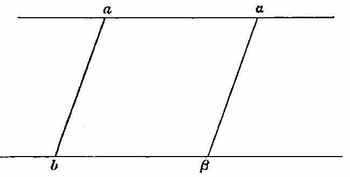
But to proceed to particulars: Lotze readily allows that the Flatlanders would set up Plane Geometry, as we know it, but refuses to admit that the Spherelanders could, without inferring the third dimension, set up a two-dimensional spherical Geometry which should be free from contradictions. I will endeavour to give a free rendering of Lotze's argument on this point.
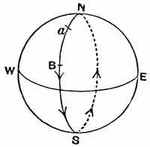
Suppose, he says, a north and south pole, N and S, arbitrarily fixed, and an equator EW. Suppose a being, B, capable of impressions only from things on the surface of the sphere, to move in a meridian NBS. Let B start from some point a, and finally, after describing a great circle, return to the same point a. If a is known only by the quality of the impression it makes on B, B may imagine he has not reached the same point a, but another similar point a′, bearing a relation to a similar to that of the octave in singing: he might even not arrange his impressions spatially at all. In order that this may occur, we require the further assumption, that every difference in the above-mentioned feelings (as he describes the meridian) may be presented as a spatial distance between two places. Even now, B may think he is describing a Euclidean straight line, containing similar points at certain intervals. Allowing, however, that he realizes the identity of a with his initial position, he will now seem, by motion in a straight line, to have returned to the point from which he started, for his motion cannot, without the third dimension, seem to him other than rectilinear.
Up to this point, there seems little ground for objection, except, perhaps, to the idea of a straight line with periodical similar points—if B were as philosophical as, in these discussions, we usually suppose him to be, he would probably object to this interpretation of his experiences, on the ground that it regards empty space as something independent of the objects in it. It is worth pointing out, also, that B would not need to describe the whole circle, in order suddenly to find himself home again with his old friends. Accurate measurements of small triangles would suffice to determine his space-constant, and show him the length of a great circle (or straight line, as he would call it). We must admit, also, that so hypothetical a being as B might form no space-intuition at all, but as he is introduced solely for the purposes of the analogy, it is convenient to allow him all possible qualifications for his post. But these points do not touch the kernel of the argument, which lies in the statement that such a straight line, returning into itself after a finite time, would appear to B as an "unendurable contradiction," and thus force him, for logical though not for sensational purposes, into the assumption of a third dimension. This assertion seems to me quite unwarranted: the whole of Metageometry is a solid array in disproof of it. Helmholtz's argument is, it must be remembered, only an analogy, and the contradiction would exist only for a Euclidean. A complete three-dimensional Geometry has, we have seen in Chapter I., been developed on the assumption that straight lines are of finite length. A constant value for the measure of curvature, as our discussion of Riemann showed, involves neither reference to the fourth dimension, nor any kind of internal contradiction. This fact disproves Lotze's contention, which arises solely from inability to divest his imagination of Euclidean ideas.
Lotze next attacks Helmholtz for the assertion that B would know nothing of parallel lines—parallel straight lines, as the context shows, he meant to say[104]. Lotze, however, takes him as meaning, apparently, mere curves of constant distance from a given straight line, which are part of the regular stock-in-trade of Metageometry. Parallels of latitude, in the geographical sense, would not—with the exception of the equator—appear to B as straight lines, but as circles. Great circles he would call straight, and this fact seems to have misled Lotze into thinking all circles were to be treated as straight lines. Parallels of latitude, therefore, though B might call them parallels, would not invalidate Helmholtz's contention, which applies only to straight lines.
The argument that such small circles would be parallel, which we have just disposed of, is only the preface to another proof that B would need a third dimension. Let us call two of these parallels of latitude ln and ls, and let them be equidistant from the equator, one in the northern, one in the southern hemisphere. Consecutive tangent planes, along these parallels, converge, in the one case northwards, in the other southwards. Either B could become aware of their difference, says Lotze, or he could not. In the former case, which he regards as the more probable, he easily proves that B would infer a third dimension. But this alternative is, I think, wholly inadmissible. Tangent planes, like Euclidean planes in general, would have no meaning to B; unless, indeed, he were a metageometrician, which, with all his metaphysical and mathematical subtlety, the argument supposes him not to be—and to such a supposition Lotze, surely, is the last person who has a right to object. Lotze's attempted proof that this is the right alternative rests, if I understand him aright, on a sheer error in ordinary spherical Geometry. B would observe, he says, that the meridians made smaller angles with his path towards the nearer than towards the further pole—as a matter of fact, they would be simply perpendicular to his path in both directions. What Lotze means is, perhaps, that all the meridians would meet sooner in one direction than in the other, and this, of course, is true. But the poles, in which the meridians meet, would appear to B as the centres of the respective parallels, while the parallels themselves would appear to be circles. Now I am at a loss to see what difficulty would arise, to B, in supposing two different circles to have different centres[105]. We must, therefore, take the first alternative, that B would have no sort of knowledge as to the direction in which the tangent planes converged. Here Lotze attempts, if I have not misunderstood him, to prove a reductio ad absurdum: B would think, he says, that he was describing two paths wholly the same in direction, and then he might regard both paths as circles in a plane. It may be observed that direction, when applied to a circle as a whole, is meaningless; indeed direction, in all Metageometry, can only mean, even when applied to straight lines, direction towards a point. To speak of two lines, which do not meet, as having the same direction, is a surreptitious introduction of the axiom of parallels. Apart from this, I cannot conceive any objection, on B's part, to such a view—one should say must, not might. The whole argumentation, therefore, unless its obscurity has led me astray, must be pronounced fruitless and inconclusive.
After a somewhat elephantine piece of humour, about socialistic whales in a four-dimensional sea of Fourrier's eau sucrée, Lotze proceeds to a proof, by logic, that every form of intuition, which embraces the whole system of ordered relations of a coexisting manifold, must have three dimensions. One might object, on à priori grounds, to any such attempt: what belongs to pure intuition could hardly, one would have thought, be determined by à priori reasoning[107]. I will not, however, develop this argument here, but endeavour to point out, as far as its obscurity will allow, the particular fallacy of the proof in question.
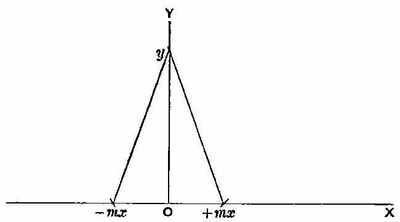
Lotze's argument is as follows. In this discussion, though our terminology is necessarily taken from space, we are really concerned with a much more general conception. We assume, in order to preserve the homogeneity of dimensions, that the difference (distance) between any two elements (points) of our manifold—to borrow Riemann's word—is of the same kind as, and commensurable with, the difference between any other two elements. Let us take a series of elements at successive distances x such that the distance between any two is the sum of the distances between intermediate elements. Such a series corresponds to a straight line, which is taken as the x-axis. Then a series OY is called perpendicular to the x-axis OX, when the distances of any element y, on OY, from +mx and -mx are equal. By our hypothesis, these distances are comparable with, and qualitatively similar to, x and y. So long as OY is defined only by relation to OX, it is conceptually unique. But now let us suppose the same relation as that between OX and OY, to be possible between OY and a new series OZ; we then get a third series OZ perpendicular to OY, and again conceptually unique, so long as it is defined by relation to OY alone. We might proceed, in the same way, to a fourth line OU perpendicular to OZ. But it is necessary, for our purposes, that OZ should be perpendicular to OX as well as OY. Without this condition, OZ might extend into another world, and have no corresponding relation to OX—this is a possibility only excluded by our unavoidable spatial images. At this point comes the crux of the argument. That OZ, says Lotze, which, besides being perpendicular to OY, is also perpendicular to OX, must be among the series of OY's, for these were defined only by perpendicularity to OX. Hence, he concludes, there can only be even a third dimension if OZ coincides with one, and—as soon as OX is considered fixed—with only one, of the many members of the OY series.
In this argument it is difficult—to me at any rate—to see any force at all. The only way I can account for it is, to suppose that Lotze has neglected the possibility of any but single infinities. On this interpretation, the argument might be stated thus: There is an infinite series of continuously varying OY's; to the common property of these, we add another property, which will divide their total number by infinity. The remaining OZ, therefore, must be uniquely determined. The same form of argument, however, would prove that two surfaces can only cut one another in a single point, and numberless other absurdities. The fact is, that infinities may be of different orders. For example, the number of points in a line may be taken as a single infinity, and so may the number of lines in a plane through any point; hence, by multiplication, the number of points in a plane is a double infinity, ∞2, and if we divide this number by a single infinity, we get still an infinite number left. Thus Lotze's argument assumes what he has to prove, that the number of lines perpendicular to a given line, through any point, is a single infinity, which is equivalent to the axiom of three dimensions. The whole passage is so obscure, that its meaning may have escaped me. It is obvious à priori, however, as I pointed out in the beginning, that any proof of the axiom must be fallacious somewhere, and the above interpretation of the argument is the only one I have been able to find.
In conclusion, Lotze expresses a hope that Philosophy, on this point, will not allow itself to be imposed upon by Mathematics. I must, instead, rejoice that Mathematics has not been imposed upon by Philosophy, but has developed freely an important and self-consistent system, which deserves, for its subtle analysis into logical and factual elements, the gratitude of all who seek for a philosophy of space.
I. Non-Euclidean spaces are not homogeneous; Metageometry therefore unduly reifies space.
II. They involve a reference to a fourth dimension.
III. They cannot be set up without an implicit reference to Euclidean space, or to the Euclidean straight line, on which they are therefore dependent.
IV. They are self-contradictory in one or more ways.
The reader who has followed me in regarding these four objections as fallacious, will have no difficulty in disposing of any other critic of Metageometry, as these are the only mathematical arguments, so far as I know, ever urged against non-Euclideans[108]. The logical validity of Metageometry, and the mathematical possibility of three-dimensional non-Euclidean spaces, will therefore be regarded, throughout the remainder of the work, as sufficiently established.
I. Space must be such as to allow of similarity, i.e. of the increase or diminution, in a constant ratio, of all the lines in a figure, without change of angles; whereas in non-Euclid, lines, like angles, have absolute magnitude.
II. Space must be infinite, whereas spherical and elliptic spaces are finite.
I will discuss the first objection in connection with Delbœuf's articles referred to above. The second, which has not, to my knowledge, been widely used in criticism, will be better deferred to Chapter III.
Delbœuf.
In discussing this question, it is important, to begin with, to distinguish clearly the sense in which absolute magnitude is required in non-Euclidean Geometry, from another sense, in which it would be absurd to regard any magnitude as absolute. Judgments of magnitude can only result from comparison, and if Metageometry required magnitudes which could be determined without comparison, it would certainly deserve condemnation. But this is not required. All we require is, that it shall be impossible, while the rest of space is unaffected, to alter the magnitude of any figure, as compared with other figures, while leaving the relative internal magnitudes of its parts unchanged. This construction, which is possible in Euclid, is impossible in Metageometry. We have to discuss whether such an impossibility renders non-Euclidean spaces logically faulty.
M. Delbœuf's position on this axiom—which he calls the postulate of homogeneity[110]—is, that all Geometry must presuppose it, and that Metageometry, consequently, though logically sound, is logically subsequent to Euclid, and can only make its constructions within a Euclidean "homogeneous" space (Rev. Phil. Vol. XXXVII., pp. 380–1). He would appear to think, nevertheless, that homogeneity (in his sense) is learnt from experience, though on this point he is not very explicit. (See Vol. XXXVIII., p. 129.) No à priori proof, at any rate, is offered in his articles. As a result of experience, every one would admit, similarity is known to be possible within the limits of observation; but the fact that this possibility extends to Ordnance maps, which deal with a spherical surface, should make us chary of inferring, from such a datum, the certainty of Euclid for large spaces. Moreover if homogeneity be empirical, Metageometry, which dispenses with it, is not necessarily in logical dependence upon Euclid, since homogeneity and isogeneity are logically separable. I shall assume, therefore, as the only contention which can be interesting to our argument, that homogeneity is regarded as à priori, and as logically essential to Geometry.
I do not believe that this is the case. For an undue reification of space would only arise, if we were no longer able to regard position as wholly relative, and as geometrically definable only by departure from other positions. But the relativity of position, as we have abundantly seen, is preserved by all spaces of constant curvature—in all of these, positions can only be defined, geometrically, by relations to fresh positions[111]. This series of definitions may lead to an infinite regress, but it may also, as in spherical space, form a vicious circle, and return again to the position from which it started. No reification of space, no independent existence of mere relations, seems involved in such a procedure. The whole of Metageometry, in short, is a proof that the relativity of position is compatible with absolute magnitude, in the only sense required by non-Euclidean spaces. We must conclude, therefore, that there is nothing incompatible, in a denial of homogeneity (in Delbœuf's sense), either with the relational nature of space, or with the comparative nature of magnitude. This last à priori objection to Metageometry, therefore, cannot be maintained, and the issue must be decided on empirical grounds alone.
Calinon, in an interesting article on the geometrical indeterminateness of the universe, maintains that any Geometry may be applied to the actual world by a suitable hypothesis as to the course of light-rays. For the earth only is known to us otherwise than by Optics, and the earth is an infinitesimal part of the universe. This line of argument has been already discussed in connection with Lotze, but Calinon adds a new suggestion, that the space-constant may perhaps vary with the time. This would involve a causal connection between space and other things, which seems hardly conceivable, and which, if regarded as possible, must surely destroy Geometry, since Geometry depends throughout on the irrelevance of Causation[112]. Moreover, in all operations of measurement, some time is spent; unless we knew that space was unchanging throughout the operation, it is hard to see how our results could be trustworthy, and how, consequently, a change in the parameter could be discovered. The same difficulties would arise, in fact, as those which result from supposing space not homogeneous.
Poincaré maintains that the question, whether Euclid or Metageometry should be accepted, is one of convenience and convention, not of truth; axioms are definitions in disguise, and the choice between definitions is arbitrary. This view has been discussed in Chapter I., in connection with Cayley's theory of distance, on which it depends.
Lechalas is a philosophical disciple of Calinon. He is a rationalist of the pre-Kantian type, but a believer in the validity of Metageometry. He holds that Geometry can dispense with all purely spatial postulates, and work with axioms of magnitude alone[113], which, in his opinion, are purely analytic. The principle of contradiction, to him, is the sole and only test of truth; we make long chains of reasoning from our premisses to see if contradictions will emerge. It might be objected that this view, though it saves general Geometry from being logically empirical, leaves it only empirically logical; this must, in fact, be the fate of every piece of à priori knowledge, if M. Lechalas's were the only test of truth. However, he concludes that general Geometry is apodeictic, while the space of our actual world, like all other phenomena, is contingent.
Delbœuf criticizes non-Euclidean space from an ultra-realist standpoint: he holds that real space is neither homogeneous nor isogeneous, but that conceived space, as abstracted from real space, has both these properties. He offers no justification for his real space, which seems to be maintained in the spirit of naïve realism, nor does he show how he has acquired his intimate knowledge of its constitution[114]. His arguments against Metageometry, in so far as they are not repetitions of Lotze, have been discussed above.
Renouvier, finally, is a pure Kantian, of the most orthodox type. His views as to the importance, for Geometry, of the distinction between synthetic and analytic judgments, have been discussed, in connection with Kant, at the beginning of the present Chapter[115].
We then discussed Riemann's attempt to identify the empirical element in Geometry with the element not deducible from ideas of magnitude, and we decided that this identification was due to a confusion as to the nature of magnitude. For judgments of magnitude, we said, require always some qualitative basis, which is not quantitatively expressible.
In criticizing Helmholtz, we decided that Mechanics logically presupposes Geometry, though space presupposes matter; but that the matter which space presupposes, and to which Geometry indirectly refers, is a more abstract matter than that of Mechanics, a matter destitute of force and of causal attributes, and possessed only of the purely spatial attributes required for the possibility of spatial figures. But we conceded that Geometry, when applied to mixed mathematics or to daily life, demands more than this, demands, in fact, some means of discovering, in the more concrete matter of Mechanics, either a rigid body, or a body whose departure from rigidity follows some empirically discoverable law. Actual measurement, therefore, we agreed to regard as empirical.
Our conclusions, as regards the empiricism of Riemann and Helmholtz, were reinforced by a criticism of Erdmann. We then had an opposite task to perform, in defending Metageometry against Lotze. Here we saw that there are two senses in which Metageometry is possible. The first concerns our actual space, and asserts that it may have a very small space-constant; the second concerns philosophical theories of space, and asserts a purely logical possibility, which leaves the decision to experience. We saw also that Lotze's mathematical strictures arose from insufficient knowledge of the subject, and could all be refuted by a better acquaintance with Metageometry.
Finally, we discussed the question of absolute magnitude, and found in it no logical obstacle to non-Euclidean spaces. Our conclusion, then, in so far as we are as yet entitled to a conclusion, is that all spaces with a space-constant are à priori justifiable, and that the decision between them must be the work of experience. Spaces without a space-constant, on the other hand, spaces, that is, which are not homogeneous throughout, we found logically unsound and impossible to know, and therefore to be condemned à priori. The constructive proof of this thesis will form the argument of the following chapter.
FOOTNOTES:
Andrade: "Les bases expérimentales de la géométrie euclidienne"; Rev. Phil. 1890, II., and 1891, I.
Bonnel: "Les hypothèses dans la géométrie"; Gauthier-Villars, 1897.
L'Abbé de Broglie: "La géométrie non-euclidienne," two articles; Annales de Phil. Chrét. 1890.
Calinon: "Les espaces géométriques"; Rev. Phil. 1889, I., and 1891, II. "Sur l'indétermination géométrique de l'univers"; ib. 1893, II.
Couturat: "L'Année Philosophique de F. Pillon," Rev. de Mét. et de Morale, Jan. 1893. "Note sur la géométrie non-euclidienne et la relativité de l'espace"; ib., May, 1893. "Études sur l'espace et le temps," ib. Sep. 1896.
Delbœuf: "L'ancienne et les nouvelles géométries," four articles; Rev. Phil. 1893–5.
Lechalas: "La géométrie générale"; Crit. Phil. 1889. "La géométrie générale et les jugements synthétiques à priori" and "Les bases expérimentales de la géométrie"; Rev. Phil. 1890, II. "M. Delbœuf et Le problème des mondes semblables"; ib. 1894, I. "Note sur la géométrie non-euclidienne et le principe de similitude"; Rev. de Mét. et de Morale, March, 1893. "La courbure et la distance en géométrie générale"; ib., March, 1896. "La géométrie générale et l'intuition"; Annales de Phil. Chrét., 1890. "Etude sur l'espace et le temps"; Paris, Alcan, 1896.
Liard: "Des définitions géométrie et des définitions empiriques," 2nd ed.; Paris, Alcan, 1888.
Mansion: "Premiers principes de la métagéométrie"; two articles in Rev. Néo-Scholastique, 1896. Separately published, Gauthier-Villars, 1896.
Milhaud: "La géométrie non-euclidienne et la théorie de la connaissance"; Rev. Phil. 1888, I.
Poincaré: "Non-Euclidian Geometry"; Nature, Vol. XLV., 1891–2. "L'espace et la géométrie"; Rev. de Mét. et de Morale, Nov. 1895. "Résponse à quelques critiques," ib. Jan. 1897.
Renouvier: "Philosophie de la règle et du compas"; Crit. Phil., 1889, and L'Année Phil., IIme année, 1891.
Sorel: "Sur la géométrie non-euclidienne"; Rev. Phil., 1891, I.
Tannery: "Théorie de la connaissance mathématique"; Rev. Phil., 1894, II.