Chapter III
Reading edition
Section A. THE AXIOMS OF PROJECTIVE GEOMETRY.
And this, we shall see, is actually the case. We have not distance, but we have the straight line; we have not quantitative anharmonic ratio, but we have the property, in any four points on a line, of being the intersections with the rays of a given pencil. And from this basis, we can build up a qualitative science of abstract externality, which is projective Geometry. How this happens, I shall now proceed to show.
"To project from a fixed point S (the centre of projection) a figure (ABCD ... abcd ...) composed of points and straight lines, is to construct the straight lines or projecting rays SA, SB, SC, SD, ... and the planes (projecting planes) Sa, Sb, Sc, Sd, ... We thus obtain a new figure composed of straight lines and planes which all pass through the centre S.
"To cut by a fixed plane σ (transversal plane) a figure (αβγδ ... abcd ...) made up of planes and straight lines, is to construct the straight lines or traces σα, σβ, σγ ... and the points or traces σa, σb, σc....[121] By this means we obtain a new figure composed of straight lines and points lying in the plane σ.
"To project from a fixed straight line s (the axis) a figure ABCD composed of points, is to construct the planes sA, sB, sC.... The figure thus obtained is composed of planes which all pass through the axis s.
"To cut by a fixed straight line s (a transversal) a figure αβγδ ... composed of planes, is to construct the points sα, sβ, sγ.... In this way a new figure is obtained, composed of points all lying on the fixed transversal s.
"If a figure is composed of straight lines a, b, c ... which all pass through a fixed point or centre S, it can be projected from a straight line or axis s passing through S; the result is a figure composed of planes sa, sb, sc....
"If a figure is composed of straight lines a, b, c ... all lying in a fixed plane, it may be cut by a straight line (transversal) s lying in the same plane; the figure which results is formed by the points sa, sb, sc...."
I shall endeavour to show, in what follows, first, in what sense figures obtained from each other by projective transformation are qualitatively alike; secondly, what axioms, or adjectives of space, are involved in the principle of projective transformation; and thirdly, that these adjectives must belong to any form of externality with more than one dimension, and are, therefore, à priori properties of any possible space.
For the sake of simplicity, I shall in general confine myself to two dimensions. In so doing, I shall introduce no important difference of principle, and shall greatly simplify the mathematics involved.
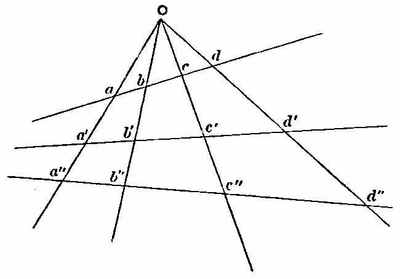
If we start from anharmonic ratio as ordinarily defined, we are met by the difficulty of its quantitative nature[122]. But among the properties deduced from this definition, many, if not most, are purely qualitative. The most fundamental of these is that, if through any four points in a straight line we draw four straight lines which meet in a point, and if we then draw a new straight line meeting these four, the four new points of intersection have the same anharmonic ratio as the four points we started with. Thus, in the figure, abcd, a′b′c′d′, a″b″c″d″, all have the same anharmonic ratio. The reciprocal relation holds for the anharmonic ratio of four straight lines. Here we have, plainly, the required basis for a qualitative definition. The definition must be as follows:
Two sets of four points each are defined as having the same anharmonic ratio, when (1) each set of four lies in one straight line, and (2) corresponding points of different sets lie two by two on four straight lines through a single point, or when both sets have this relation to any third set[123]. And reciprocally: Two sets of four straight lines are defined as having the same anharmonic ratio when (1) each set of four passes through a single point, and (2) corresponding lines of different sets pass, two by two, through four points in one straight line, or when both sets have this relation to any third set.
Two sets of points or of lines, which have the same anharmonic ratio, are treated by projective Geometry as equivalent: this qualitative equivalence replaces the quantitative equality of metrical Geometry, and is obviously included, by its definition, in the above account of projective transformations in general.

ab bc / ad dc = – 1 , 1 ab – 1 ac = 1 ac – 1 ad , and ab bc = ad cd .
But as they are all quantitative, they cannot be used for our present purpose. Nor are any definitions which involve bisection of lines or angles available. We must have a definition which proceeds entirely by the help of straight lines and points, without measurement of distances or angles. Now from the above definitions of a harmonic range, we see that a, b, c, d have the same anharmonic ratio as c, b, a, d. This gives us the property we require for our definition. For it shows that, in a harmonic range, we can find a projective transformation which will interchange a and c. This is a necessary and sufficient condition for a harmonic range, and the quadrilateral construction is the general method for giving effect to it.
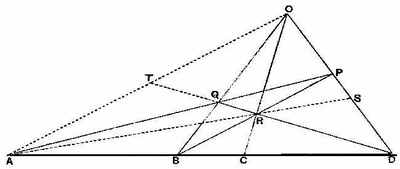
Given any three points A, B, D in one straight line, the quadrilateral construction finds the point C harmonic to A with respect to B, D by the following method: Take any point O outside the straight line ABD, and join it to B and D. Through A draw any straight line cutting OD, OB in P and Q. Join DQ, BP, and let them intersect in R. Join OR, and let OR meet ABD in C. Then C is the point required.
To prove this, let DRQ meet OA in T, and draw AR, meeting OD in S. Then a projective transformation of A, B, C, D from R on to OD gives the points S, P, O, D, which, projected from A on to DQ, give R, Q, T, D. But these again, projected from O on to ABD, give C, B, A, D. Hence A, B, C, D can be projectively transformed into C, B, A, D, and therefore form a harmonic range. From this point, the proof that the construction is unique and general follows simply[125].
The introduction of numbers, by this construction, offers no difficulties of principle—except, indeed, those which always attend the application of number to continua—and may be studied satisfactorily in Klein's Nicht-Euklid (I. p. 337 ff.). The principle of it is, to assign the numbers 0, 1, ∞ to A, B, D and therefore the number 2 to C, in order that the differences AB, AC, AD may be in harmonic progression. By taking B, C, D as a new triad corresponding to A, B, D, we find a point harmonic to B with respect to C, D and assign to it the number 3, and so on. In this way, we can obtain any number of points, and we are sure of having no number and no point twice over, so that our coordinates have the essential property of a unique correspondence with the points they denote, and vice versa.
To project the points A, B, C, D ... from a centre O, is to construct the straight lines OA, OB, OC, OD....
To cut a number of straight lines a, b, c, d ... by a transversal s, is to construct the points sa, sb, sc, sd....[126]
The successive application of these two operations, provided the original figure consisted of points on one straight line or of straight lines through one point, gives a figure projectively indistinguishable from the former figure; and hence, by extension, if any points in one straight line in the original figure lie in one straight line in the derived figure, and reciprocally for straight lines through points, the two operations have given projectively similar figures. This general principle may be regarded as consisting of two parts, according to the order of the operations: if we begin with projection and end with section, we transform a figure of points into another figure of points; by the converse order, we transform a figure of lines into another figure of lines.
Confining ourselves for the moment to two dimensions, the principle asserts, roughly speaking, that any theorem, dealing with lines through a point and points on a line, remains true if these two terms, wherever they occur, are interchanged. Thus: two points lie on one straight line which they completely determine; and two straight lines meet in one point, which they completely determine. The four points of intersection of a transversal with four lines through a point have an anharmonic ratio independent of the particular transversal; and the four lines joining four points on one straight line to a fifth point have an anharmonic ratio independent of that fifth point. So also our general principle of projective transformation has two sides: one in which points move along fixed lines, and one in which lines turn about fixed points.
This duality suggests that any definition of points must be effected by means of the straight line, and any definition of the straight line must be effected by means of points. When we take the third dimension into account, it is true, the duality is no longer so simple; we have now to take account also of the plane, but this only introduces a circle of three terms, which is scarcely preferable to a circle of two terms. We now say: Three points, or a line and a point, determine a plane: but conversely, three planes, or a line and plane, determine a point. We may regard the straight line as a relation between two of its points, but we may also regard the point as a relation between two straight lines through it. We may regard the plane as a relation between three points, or between a point and a line, but we may also regard the point as a relation between three planes, or between a line and a plane, which meet in it.
Thus the relativity of space, while it is the essence of the principle of duality, at the same time renders impossible the expression of that principle, or of any other principle of pure Geometry, in a manner which shall be free from contradictions. Nevertheless, if we are to advance at all with our analysis of geometrical reasoning and with our definitions of lines and points, we must, for a while, ignore this contradiction; we must argue as though it did not exist, so as to free our science from any contradictions which are not inevitable.
Neglecting, then, the fundamental contradiction in this definition, the rest of our definitions follow without difficulty. The straight line is the relation between two points, and the plane is the relation between three. These definitions will be argued and defended at length in section B of this Chapter[128], where we can discuss at the same time the alternative metrical definitions; for our present purpose, it is sufficient to observe that projective Geometry, from the first, regards the straight line as determined by two points, and the plane as determined by three, from which it follows, if we take points as possible terms for spatial relations, that the straight line and the plane may be regarded as relations between two and three points respectively. If we agree on these definitions, we can proceed to discuss the fundamental principle of projective Geometry, and to analyse the axioms implicated in its truth.
Points, to begin with, have been defined as nothing but the terms for spatial relations. They have, therefore, no intrinsic properties; but are distinguished solely by means of their relations. Now the relation between two points, we said, is the straight line on which they lie. This gives that identity of quality for all pairs of points on the same straight line, which is required both by our projective principle and by metrical Geometry. (For only where there is identity of quality can quantity be properly applied.) If only two points are given, they cannot, without the use of quantity, be distinguished from any two other points on the same straight line; for the qualitative relation between any two such points is the same as for the original pair, and only by a difference of relation can points be distinguished from one another.
But conversely, one straight line is nothing but the relation between two of its points, and all points are qualitatively alike. Hence there can be nothing to distinguish one straight line from another except the points through which it passes, and these are distinguished from other points only by the fact that it passes through them. Thus we get the reciprocal transformation: if we are given only one point, any pair of straight lines through that point is qualitatively indistinguishable from any other. This again is, on the one hand, the basis of the second part of our general projective principle, and on the other hand the condition of applying quantity, in the measurement of angles, to the departure of two intersecting straight lines.
The axioms which have been assumed in the above analysis, and which, it would seem, suffice to found projective Geometry, may be roughly stated as follows:
I. We can distinguish different parts of space, but all parts are qualitatively similar, and are distinguished only by the immediate fact that they lie outside one another.
II. Space is continuous and infinitely divisible; the result of infinite division, the zero of extension, is called a point[129].
III. Any two points determine a unique figure, called a straight line, any three in general determine a unique figure, the plane. Any four determine a corresponding figure of three dimensions, and for aught that appears to the contrary, the same may be true of any number of points. But this process comes to an end, sooner or later, with some number of points which determine the whole of space. For if this were not the case, no number of relations of a point to a collection of given points could ever determine its relation to fresh points, and Geometry would become impossible[130].
This statement of the axioms is not intended to have any exclusive precision: other statements equally valid could easily be made. For all these axioms, as we shall see hereafter, are philosophically interdependent, and may, therefore, be enunciated in many ways. The above statement, however, includes, if I am not mistaken, everything essential to projective Geometry, and everything required to prove the principle of projective transformation. Before discussing the apriority of these axioms, let us once more briefly recapitulate the ends which they are intended to attain.
This passivity and this independence involve the homogeneity of space, or its equivalent, the relativity of position. For if the internal properties of a figure are the same, whatever its external relations may be, it follows that all parts of space are qualitatively similar, since a change of external relation is a change in the part of space occupied. It follows, also, that all position is relative and extrinsic, i.e., that the position of a point, or the part of space occupied by a figure, is not, and has no effect upon, any intrinsic property of the point or figure, but is exclusively a relation to other points or figures in space, and remains without effect except where such relations are considered.
Let us observe, to begin with, that the distinction between Euclidean and non-Euclidean Geometries, so important in metrical investigations, disappears in projective Geometry proper. This suggests that projective Geometry, though originally invented as the science of Euclidean space, and subsequently of non-Euclidean spaces also, deals really with a wider conception, a conception which includes both, and neglects the attributes in which they differ. This conception I shall speak of as a form of externality.
From this point of view, the controversy between Kantians and anti-Kantians becomes wholly irrelevant, since the distinction between pure and mixed mathematics does not lie in the distinction between the subjective and the objective, but between the purely intellectual on the one hand, and everything else on the other. Now Kant had contended, with great emphasis, that space was not an intellectual construction, but a subjective intuition. Geometry, therefore, with Grassmann's distinction, belongs to mixed mathematics as much on Kant's view as on that of his opponents. And Grassmann's distinction, I contend, is the more important for Epistemology, and the one to be adopted in distinguishing the à priori from the empirical. For what is merely intuitional can change, without upsetting the laws of thought, without making knowledge formally impossible: but what is purely intellectual cannot change, unless the laws of thought should change, and all our knowledge simultaneously collapse. I shall therefore follow Grassmann's distinction in constructing an à priori and purely conceptual form of externality.
What we have to do here is, not to discuss whether there is a form of externality, but whether, if there be such a form, it must possess the properties embodied in the axioms of projective Geometry. Now first of all, what do we mean by such a form?
The same argument may also be stated as follows: If we abstract the conception of externality, and endeavour to deal with it per se, it is evident that we must obtain an object alike destitute of elements and of totality. For we have abstracted from the diverse matter which filled our form, while any element, or any whole, would retain some of the qualities of a matter. Either an element or a whole, in fact, would have to be a thing not external to itself, and would thus contain something not pure externality. Hence arise infinite divisibility, with the self-contradictory notion of the point, in the search for elements, and unbounded extension, with the contradiction of an infinite regress or a vicious circle, in the search for a completed whole. Thus again, our form contains neither elements nor totality, but only endless relations—the terms of these relations being excluded by our abstraction from the matter which fills our form.
Or we may deduce the same property from the relativity of position. For any quality in one position, by which it was marked out from another, would be necessarily more or less intrinsic, and would contradict the pure relativity. Hence all positions are qualitatively alike, i.e. the form is homogeneous throughout.
As this point is difficult and important, I will repeat, in somewhat greater detail, the explanation of the manner in which straight lines and planes come to be regarded as congeries of points. From the strictly projective standpoint, though all other figures are merely a collection of any required number of points, lines or planes, given by some projective construction, straight lines and planes themselves are given integrally, and are not to be considered as divisible or composed of parts. To say that a point lies on a straight line means, for projective Geometry proper, that the straight line is a relation between this and some other point. Here the points concerned, if our statement is to be freed from contradictions, must be regarded, if I may use such an expression, as real points—i.e. as unextended material centres[139]. Straight lines and planes are then relations between these material atoms. They are relations, however, which may undergo a metrical alteration while remaining projectively unchanged. When the projective relation between the two points A, B is the same as that between the two points A, C, while the metrical relation (distance) is different, the three points A, B, C are said to be collinear. Now the metrical manner of regarding spatial figures demands that they should be hypostatized, and no longer regarded as mere relations. For when we regard a quantity as extensive, i.e. as divisible into parts, we necessarily regard it as more than a mere relation or adjective, since no mere relation or adjective can be divided. For quantitative treatment, therefore, spatial relations must be hypostatized[140]. When this is done, we obtain, as we saw above, a homogeneous and infinitely divisible form of externality. We find now that distance, for example, may be continuously altered without changing the straight line on which it is measured. We thus obtain, on the straight line in question, a continuous series of points, which, since it is continuous, we regard as constituting our straight line. It is thus solely from the hypostatizing of relations, which metrical Geometry requires, that the view of straight lines and planes as composed of points arises, and it is from this hypostatizing that the difficulties of metrical Geometry spring.
In a one-dimensional form other than time, the same argument must hold. For something analogous to Causality would be necessary to experience, and the relativity of the form would still necessarily hold. Hence, since only these two properties of time have been assumed, the above contention would remain valid of any second form whose relations were correlated with those of the first, as the analogue of Causality would require them to be.
To prove this contention, consider of what nature the relations can be by which positions are defined. We have seen already that our form is purely relational and infinitely divisible, and that positions (points) are the self-contradictory outcome of the search for something other than relations. What we really mean, therefore, by the relations defining a position, is, when we undo our previous abstraction, the relations of externality by which some thing is related to other things. But how, when we remain in the abstract form, must such relations appear?
We may give the argument a more concrete, and perhaps a more convincing shape, by considering the matter arranged in our form. If two things are mutually external, they must since they belong to the same world, have some relation of externality; there is, therefore, a relation of externality between two things. But since our form is homogeneous, the same relation of externality may subsist in other parts of the form, i.e. while the two things considered alter their relations of externality to other things. The relation of externality between two things is, therefore, independent of other things. Hence, when we return to the abstract language of the form, two positions have a relation determined by those two positions alone, and independent of other positions.
Precisely the same argument applies to the relations of three positions, and in each case the relation must appear in the form as not a mere inference from the positions it relates. For relations, as we have seen, actually constitute a form of externality, and are not mere inferences from terms, which are nowhere to be found in the form[144].
To sum up: Since position is relative, two positions must have some relation to each other; and since our form of externality is homogeneous, this relation can be kept unchanged while the two positions change their relations to other positions. Hence their relation is intrinsic, and independent of other positions. Since the form is a mere complex of relations, the relation in question must, if the form is sensuous or intuitive, be itself sensuous or intuitive, and not a mere inference. In this case, a unique relation must be a unique figure—in spatial terms, the straight line joining the two points.
Section B. THE AXIOMS OF METRICAL GEOMETRY.
Metrical Geometry is, then, a necessary part of the science of space, and a part not included in descriptive Geometry. Its à priori element, nevertheless, so far as this is spatial and not arithmetical, is the same as the postulate of projective Geometry, namely, the homogeneity of space, or its equivalent, the relativity of position. We can see, in fact, that the à priori element in both is likely to be the same. For the à priori in metrical Geometry will be whatever is presupposed in the possibility of spatial measurement, i.e. of quantitative spatial comparison. But such comparison presupposes simply a known identity of quality, the determination of which is precisely the problem of projective Geometry. Hence the conditions for the possibility of measurement, in so far as they are not arithmetical, will be precisely the same as those for projective Geometry.
Let us now examine in detail the prerequisites of spatial measurement. We shall find three axioms, without which such measurement would be impossible, but with which it is adequate to decide, empirically and approximately, the Euclidean or non-Euclidean nature of our actual space. We shall find, further, that these three axioms can be deduced from the conception of a form of externality, and owe nothing to the evidence of intuition. They are, therefore, like their equivalents the axioms of projective Geometry, à priori, and deducible from the conditions of spatial experience. This experience, accordingly, can never disprove them, since its very existence presupposes them.
I. The Axiom of Free Mobility.
The above axiom is the axiom of Free Mobility[151]. I propose to prove (1) that the denial of this axiom would involve logical and philosophical absurdities, so that it must be classed as wholly à priori; (2) that metrical Geometry, if it refused this axiom, would be unable, without a logical absurdity, to establish the notion of spatial magnitude at all. The conclusion will be, that the axiom cannot be proved or disproved by experience, but is an à priori condition of metrical Geometry. As I shall thus be maintaining a position which has been much controverted, especially by Helmholtz and Erdmann, I shall have to enter into the arguments at some length.
Nevertheless, such an arbitrarily assumed law does, at first sight, give a mathematically possible Geometry. The fundamental proposition, that two magnitudes which can be superposed in any one position can be superposed in any other, still holds. For two infinitesimal arcs, whose lengths in the standard position are ds1 and ds2, would, in any other position p, have lengths f(p).ds1 and f(p).ds2, so that their ratio would be unaltered. From this constancy of ratio, as we know through Riemann and Helmholtz, the above proposition follows. Hence all that Geometry requires, it would seem, as a basis for measurement, is an axiom that the alteration of shapes during motion follows a definite known law, such as that assumed above.
Thus congruence helps to establish three-dimensional equality, though it cannot directly prove such equality; and the same philosophical principle, of the homogeneity of space, by which congruence was proved, comes to our rescue here. But how about right-handed and left-handed screws? Here we can no longer apply the Identity of Indiscernibles, for the two are very well discernible. But as with solids, so here, Free Mobility can help us much. It can enable us, by ordinary measurement, to show that the internal relations of both screws are the same, and that the difference lies only in their relation to other things in space. Knowing these internal relations, we can calculate, by the Geometry which Free Mobility has rendered possible, all the geometrical properties of these screws—radius, pitch, etc.—and can show them to be severally equal in both. But this is all we require. Mediate comparison is possible, though immediate comparison is not. Both can, for instance, be compared with the cylinder on which both would fit, and thus their equality can be proved. A precisely similar proof holds, of course, for the other cases, right and left hands, spherical triangles, etc. On the whole, these cases confirm my argument; for they show, as Kant intended them to show[158], the essential relativity of space.
Even if we waive this fundamental objection, however, others remain. To begin with, such judgments of equality are only very rough approximations, and cannot be applied to lines of more than a certain length, if only for the reason that such lines cannot well be seen together. Thus this method can only give us any security in our own immediate neighbourhood, and could in no wise warrant such operations as would be required for the construction of maps &c., much less the measurement of astronomical distances. They might just enable us to say that some lines were longer than others, but they would leave Geometry in a position no better than that of the Hedonical Calculus, in which we depend on a purely subjective measure. So inaccurate, in fact, is such a method acknowledged to be, that the foot-rule is as much a need of daily life as of science. Besides, no one would trust such immediate judgments, but for the fact that the stricter test of congruence to some extent confirms them; if we could not apply this test, we should have no ground for trusting them even as much as we do. Thus we should have, here, no real escape from our absolute dependence upon the axiom of Free Mobility.
II. The Axiom of Dimensions[163].
Geometry affords intrinsic evidence of the truth of my division of the axiom of dimensions into an à priori and empirical portion. For while the extension of the number of dimensions to four, or to n, alters nothing in plane and solid Geometry, but only adds a new branch which interferes in no way with the old, some definite number of dimensions is assumed in all Geometries, nor is it possible to conceive of a Geometry which should be free from this assumption[167].
III. The Axiom of Distance.
Now to begin with, two points must, if Geometry is to be possible, have some relation to each other, for we have seen that such relations alone constitute position or localization. But if two points have a relation to each other, this must be an intrinsic relation. For it follows, from the axiom of Free Mobility, that two points, forming a figure congruent with the given pair, can be constructed in any part of space. If this were not possible, we have seen that metrical Geometry could not exist. But both the figures may be regarded as composed of two points and their relation; if the two figures are congruent, therefore, it follows that the relation is quantitatively the same for both figures, since congruence is the test of spatial equality. Hence the two points have a quantitative relation, which is such that they can traverse all space in a combined motion without in any way altering that relation. But in such a general motion, any external relation of the two points, any relation involving other points or figures in space, must be altered[170]. Hence the relation between the two points, being unaltered, must be an intrinsic relation, a relation involving no other point or figure in space; and this intrinsic relation we call distance[171].
The answer to this, as to the corresponding question in the first section of this chapter, lies, I think, in the passivity of space, or the mutual independence of its parts. For it follows, from this independence, that any figure, or any assemblage of points, may be discussed without reference to other figures or points. This principle is the basis of infinite divisibility, of the use of quantity in Geometry, and of all possibility of isolating particular figures for discussion. It follows that two points cannot be dependent, as to their relation, on any other points or figures, for if they were so dependent, we should have to suppose some action of such points or figures on the two points considered, which would contradict the mutual independence of different positions. To illustrate by an example: the relation of two given points does not depend on the other points of the straight line on which the given points lie. For only through their relation, i.e. through the straight line which they determine, can the other points of the straight line be known to have any peculiar connection with the given pair.
In the first place, some curve joining the two points is involved in the above notion of a combined motion of the two points, or of two other points forming a figure congruent with the first two. For without some such curve, the two point-pairs cannot be known as congruent, nor can we have any test by which to discover when a point-pair is moving as a single figure[173]. Distance must be measured, therefore, by some line which joins the two points. But need this be a line which the two points completely determine?
Thus even in spherical space, we are greatly assisted by the axiom of the straight line; all linear measurement is effected by it, and exceptional cases can be treated, through its help, by the usual methods for limits. Spherical space, therefore, is not so adverse as it at first appeared to be to the à priori necessity of the axiom. Nevertheless we have, so far, not attacked the kernel of the objection which spherical space suggested. To this attack it is now our duty to proceed.
"Just as, in the field of quantity, the relation between two numbers is another number, so in the field of space the relations are facts of the same order with the facts they relate.... When we speak of the relation of direction of two points towards each other, we mean simply the sensation of the line that joins the two points together. The line is the relation.... The relation of position between the top and bottom points of a vertical line is that line, and nothing else."
If I had been willing to use this doctrine at the beginning, I might have avoided all discussion. A unique relation between two points must in this case, involve a unique line between them. But it seemed better to avoid a doctrine not universally accepted, the more so as I was approaching the question from the logical, not the psychological, side. After disposing of the objections, however, it is interesting to find this confirmation of the above theory from so different a standpoint. Indeed, I believe James's doctrine could be proved to be a logical necessity, as well as a psychological fact. For what sort of thing can a spatial relation between two distinct points be? It must be something spatial, and it must, since points are wholly constituted by their relations, be something at least as real and tangible as the points it relates. There seems nothing which can satisfy these requirements, except a line joining them. Hence, once more, a unique relation must involve a unique line. That is, linear magnitude is logically impossible, unless space allows of curves uniquely determined by any two of their points.
We saw, in section A § 119, that the figure formed by two points is projectively indistinguishable from that formed by any two other points in the same straight line; the figure, in both cases, is, from the projective standpoint, simply the straight line on which the two points lie. The difference of relation, in the two cases, is not qualitative, since projective Geometry cannot deal with it; nevertheless, there is some difference of relation. For instance, if one point be kept fixed, while the other moves, there is obviously some change of relation. This change, since all parts of the straight line are qualitatively alike, must be a change of quantity. If two points, therefore, determine a unique figure, there must exist, for the distinction between the various other points of this figure, a unique quantitative relation between the two determining points, and therefore, since these points are arbitrary, between only two points. This relation is distance, with which our argument began, and to which it at least returns.
Distance and the straight line, as relations uniquely determined by two points, are thus à priori necessary to metrical Geometry. But further, they are properties which must belong to any form of externality. Since their necessity for Geometry was deduced from homogeneity and the relativity of position, and since these are necessary properties of any form of externality, the same argument proves both conclusions. We thus obtain, as in the case of Free Mobility, a double apriority: The axiom of Distance, and its implication, the axiom of the Straight Line, are, on the one hand, presupposed in the possibility of spatial magnitude, and cannot, therefore, be contradicted by any experience resulting from the measurement of space; while they are consequences, on the other hand, of the necessary properties of any form of externality which is to render possible experience of an external world.
In the first place, a point's metrical coordinates constitute a complete quantitative definition of it; now a point can only be defined, as we have seen, by its relations to other points, and these relations can only be defined by means of the straight line. Consequently, any metrical system of coordinates must involve the straight line, as the basis of its definitions of points.
This à priori argument, however, though I believe it to be quite sound, is not likely to carry conviction to any one persuaded of the opposite. Let us, therefore, examine metrical coordinate systems in detail, and show, in each case, their dependence on the straight line.
We have already seen that the notion of distance is impossible without the straight line. We cannot, therefore, define our coordinates in any of the ordinary ways, as the distances from three planes, lines, points, spheres, or what not. Polar coordinates are impossible, since,—waiving the straightness of the radius vector—the length of the radius vector becomes unmeaning. Triangular coordinates involve not only angles, which must in the limit be rectilinear, but straight lines, or at any rate some well-defined curves. Now curves can only be metrically defined in two ways: Either by relation to the straight line, as, e.g., by the curvature at any point, or by purely analytical equations, which presuppose an intelligible system of metrical coordinates. What methods remain for assigning these arbitrary values to different points? Nay, how are we to get any estimate of the difference—to avoid the more special notion of distance—between two points? The very notion of a point has become illusory. When we have a coordinate system, we may define a point by its three coordinates; in the absence of such a system, we may define the notion of point in general as the intersection of three surfaces or of two curves. Here we take surfaces and curves as notions which intuition makes plain, but if we wish them to give us a precise numerical definition of particular points, we must specify the kind of surface or curve to be used. Now this, as we have seen, is only possible when we presuppose either the straight line, or a coordinate system. It follows that every coordinate system presupposes the straight line, and is logically impossible without it.
Measurement, we may say, is the application of number to continua, or, if we prefer it, the transformation of mere quantity into number of units. Using quantity to denote the vague more or less, and magnitude to denote the precise number of units, the problem of measurement may be defined as the transformation of quantity into magnitude.
Now a number, to begin with, is a whole consisting of smaller units, all of these units being qualitatively alike. In order, therefore, that a continuous quantity may be expressible as a number, it must, on the one hand, be itself a whole, and must, on the other hand, be divisible into qualitatively similar parts. In the aspect of a whole, the quantity is intensive; in the aspect of an aggregate of parts, it is extensive. A purely intensive quantity, therefore, is not numerable—a purely extensive quantity, if any such could be imagined, would not be a single quantity at all, since it would have to consist of wholly unsynthesized particulars. A measurable quantity, therefore, is a whole divisible into similar parts. But a continuous quantity, if divisible at all, must be infinitely divisible. For otherwise the points at which it could be divided would form natural barriers, and so destroy its continuity. But further, it is not sufficient that there should be a possibility of division into mutually external parts; while the parts, to be perceptible as parts, must be mutually external, they must also, to be knowable as equal parts, be capable of overcoming their mutual externality. For this, as we have seen, we require superposition, which involves Free Mobility and homogeneity—the absence of Free Mobility in time, where all other requisites of measurement are fulfilled, renders direct measurement of time impossible. Hence infinite divisibility, free mobility, and homogeneity are necessary for the possibility of measurement in any continuous manifold, and these, as we have seen, are equivalent to our three axioms. These axioms are necessary, therefore, not only for spatial measurement, but for all measurement. The only manifold given in experience, in which these conditions are satisfied, is space. All other exact measurement—as could be proved, I believe, for every separate case—is effected, as we saw in the case of time, by reduction to a spatial correlative. This explains the paramount importance, to exact science, of the mechanical view of nature, which reduces all phenomena to motions in time and space. For number is, of all conceptions, the easiest to operate with, and science seeks everywhere for an opportunity to apply it, but finds this opportunity only by means of spatial equivalents to phenomena[177].