Chapter I · A SHORT HISTORY OF METAGEOMETRY.
Reading edition
"First cut the liquefaction, what comes last, But Fichte's clever cut at God himself?"
So it has been with Geometry. The liquefaction of Euclidean orthodoxy is the axiom of parallels, and it was by the refusal to admit this axiom without proof that Metageometry began. The first effort in this direction, that of Legendre[5], was inspired by the hope of deducing this axiom from the others—a hope which, as we now know, was doomed to inevitable failure. Parallels are defined by Legendre as lines in the same plane, such that, if a third line cut them, it makes the sum of the interior and opposite angles equal to two right angles. He proves without difficulty that such lines would not meet, but is unable to prove that non-parallel lines in a plane must meet. Similarly he can prove that the sum of the angles of a triangle cannot exceed two right angles, and that if any one triangle has a sum equal to two right angles, all triangles have the same sum; but he is unable to prove the existence of this one triangle.
The second period, inaugurated by Riemann, had a much deeper import: it was largely philosophical in its aims and constructive in its methods. It aimed at no less than a logical analysis of all the essential axioms of Geometry, and regarded space as a particular case of the more general conception of a manifold. Taking its stand on the methods of analytical metrical Geometry, it established two non-Euclidean systems, the first that of Lobatchewsky, the second—in which the axiom of the straight line, in Euclid's form, was also denied—a new variety, by analogy called spherical. The leading conception in this period is the measure of curvature, a term invented by Gauss, but applied by him only to surfaces. Gauss had shown that free mobility on surfaces was only possible when the measure of curvature was constant; Riemann and Helmholtz extended this proposition to n dimensions, and made it the fundamental property of space.
In the third period, which begins with Cayley, the philosophical motive, which had moved the first pioneers, is less apparent, and is replaced by a more technical and mathematical spirit. This period is chiefly distinguished from the second, in a mathematical point of view, by its method, which is projective instead of metrical. The leading mathematical conception here is the Absolute (Grundgebild), a figure by relation to which all metrical properties become projective. Cayley's work, which was very brief, and attracted little attention, has been perfected and elaborated by F. Klein, and through him has found general acceptance. Klein has added to the two kinds of non-Euclidean Geometry already known, a third, which he calls elliptic; this third kind closely resembles Helmholtz's spherical Geometry, but is distinguished by the important difference that, in it, two straight lines meet in only one point[7]. The distinctive mark of the spaces represented by both is that, like the surface of a sphere, they are finite but unbounded. The reduction of metrical to projective properties, as will be proved hereafter, has only a technical importance; at the same time, projective Geometry is able to deal directly with those purely descriptive or qualitative properties of space which are common to Euclid and Metageometry alike. The third period has, therefore, great philosophical importance, while its method has, mathematically, much greater beauty and unity than that of the second; it is able to treat all kinds of space at once, so that every symbolic proposition is, according to the meaning given to the symbols, a proposition in whichever Geometry we choose. This has the advantage of proving that further research cannot lead to contradictions in non-Euclidean systems, unless it at the same moment reveals contradictions in Euclid. These systems, therefore, are logically as sound as that of Euclid himself.
After this brief sketch of the characteristics of the three periods, I will proceed to a more detailed account. It will be my aim to avoid, as far as possible, all technical mathematics, and bring into relief only those fundamental points in the mathematical development, which seem of logical or philosophical importance.
First Period.
It is important to remember, however, that Gauss's work on curvature, which was published, laid the foundation for the whole method of the second period, and was undertaken, according to Riemann and Helmholtz[10], with a view to an (unpublished) investigation of the foundations of Geometry. His work in this direction will, owing to its method, be better treated of under the second period, but it is interesting to observe that he stood, like many pioneers, at the head of two tendencies which afterwards diverged.
In the introduction to his little German book, Lobatchewsky laments the slight interest shown in his writings by his compatriots, and the inattention of mathematicians, since Legendre's abortive attempt, to the difficulties in the theory of parallels. The body of the work begins with the enunciation of several important propositions which hold good in the system proposed as well as in Euclid: of these, some are in any case independent of the axiom of parallels, while others are rendered so by substituting, for the word "parallel," the phrase "not intersecting, however far produced." Then follows a definition, intentionally framed so as to contradict Euclid's: With respect to a given straight line, all others in the same plane may be divided into two classes, those which cut the given straight line, and those which do not cut it; a line which is the limit between the two classes is called parallel to the given straight line. It follows that, from any external point, two parallels can be drawn, one in each direction. From this starting-point, by the Euclidean synthetic method, a series of propositions are deduced; the most important of these is, that in a triangle the sum of the angles is always less than, or always equal to two right angles, while in the latter case the whole system becomes orthodox. A certain analogy with spherical Geometry—whose meaning and extent will appear later—is also proved, consisting roughly in the substitution of hyperbolic for circular functions.
Second Period.
But to proceed with the mathematical development of Riemann's ideas. We have seen that he declared measurement to consist in a superposition of the magnitudes to be compared. But in order that this may be a possible means of determining magnitudes, he continues, these magnitudes must be independent of their position in the manifold (p. 259). This can occur, he says, in several ways, as the simplest of which, he assumes that the lengths of lines are independent of their position. One would be glad to know what other ways are possible: for my part, I am unable to imagine any other hypothesis on which magnitude would be independent of place. Setting this aside, however, the problem, owing to the fact that measurement consists in superposition, becomes identical with the determination of the most general manifold in which magnitudes are independent of place. This brings us to Riemann's other fundamental conception, which seems to me even more fruitful than that of a manifold.
Just as the notion of length was originally derived from the straight line, and extended to other curves by dividing them into infinitesimal straight lines, so the notion of curvature was derived from the circle, and extended to other curves by dividing them into infinitesimal circular arcs. Curvature may be regarded, originally, as a measure of the amount by which a curve departs from a straight line; in a circle, which is similar throughout, this amount is evidently constant, and is measured by the reciprocal of the radius. But in all other curves, the amount of curvature varies from point to point, so that it cannot be measured without infinitesimals. The measure which at once suggests itself is, the curvature of the circle most nearly coinciding with the curve at the point considered. Since a circle is determined by three points, this circle will pass through three consecutive points of the curve. We have thus defined the curvature of any curve, plane or tortuous; for, since any three points lie in a plane, such a circle can always be described.
If we now pass to a surface, what we want is, by analogy, a measure of its departure from a plane. The curvature, as above defined, has become indeterminate, for through any point of the surface we can draw an infinite number of arcs, which will not, in general, all have the same curvature. Let us, then, draw all the geodesics joining the point in question to neighbouring points of the surface in all directions. Since these arcs form a singly infinite manifold, there will be among them, if they have not all the same curvature, one arc of maximum, and one of minimum curvature[22]. The product of these maximum and minimum curvatures is called the measure of curvature of the surface at the point under consideration. To illustrate by a few simple examples: on a sphere, the curvatures of all such lines are equal to the reciprocal of the radius of the sphere, hence the measure of curvature everywhere is the square of the reciprocal of the radius of the sphere. On any surface, such as a cone or a cylinder, on which straight lines can be drawn, these have no curvature, so that the measure of curvature is everywhere zero—this is the case, in particular, with the plane. In general, however, the measure of curvature of a surface varies from point to point.
Gauss, the inventor of this conception[23], proved that, in order that two surfaces may be developable upon each other—i.e. may be such that one can be bent into the shape of the other without stretching or tearing—it is necessary that the two surfaces should have equal measures of curvature at corresponding points. When this is the case, every figure which is possible on the one is, in general, possible on the other, and the two have practically the same Geometry[24]. As a corollary, it follows that a necessary condition, for the free mobility of figures on any surface, is the constancy of the measure of curvature[25]. This condition was proved to be sufficient, as well as necessary, by Minding[26].
The method of determining the measure of curvature from within is, briefly, as follows: If any point on the surface be determined by two coordinates, u, v, then small arcs of the surface are given by the formula
ds2 = Edu2 + 2Fdu dv + Gdv2,
where E, F, G are, in general, functions of u, v.[27] From this formula alone, without reference to any space outside the surface, we can determine the measure of curvature at the point u, v, as a function of E, F, G and their differentials with respect to u and v. Thus we may regard the measure of curvature of a surface as an inherent property, and the above geometrical definition, which involved a reference to the third dimension, may be dropped. But at this point a caution is necessary. It will appear in Chap. III. (§ 176), that it is logically impossible to set up a precise coordinate system, in which the coordinates represent spatial magnitudes, without the axiom of Free Mobility, and this axiom, as we have just seen, holds on surfaces only when the measure of curvature is constant. Hence our definition of the measure of curvature will only be really free from reference to the third dimension, when we are dealing with a surface of constant measure of curvature—a point which Riemann entirely overlooks. This caution, however, applies only in space, and if we take the coordinate system as presupposed in the conception of a manifold, we may neglect the caution altogether—while remembering that the possibility of a coordinate system in space involves axioms to be investigated later. We can thus see how a meaning might be found, without reference to any higher dimension, for a constant measure of curvature of three-dimensional space, or for any measure of curvature of an n-dimensional manifold in general.
ds2 = Σ1n Σ1n aik dxi.dxk ,
where the coefficients aik are, in general, functions of the coordinates x1 x2 ... xn. [28] The question is: How are we to obtain a definition of the measure of curvature out of this formula? It is noticeable, in the first place, that, just as in a surface we found an infinite number of radii of curvature at a point, so in a manifold of three or more dimensions we must find an infinite number of measures of curvature at a point, one for every two-dimensional manifold passing through the point, and contained in the higher manifold. What we have first to do, therefore, is to define such two-dimensional manifolds. They must consist, as we saw on the surface, of a singly infinite series of geodesics through the point. Now a geodesic is completely determined by one point and its direction at that point, or by one point and the next consecutive point. Hence a geodesic through the point considered is determined by the ratios of the increments of coordinates, dx1 dx2 ... dxn. Suppose we have two such geodesics, in which the i′th increments are respectively d′xi and d″xi. Then all the geodesics given by
dxi = λ′d′xi + λ″d″xi
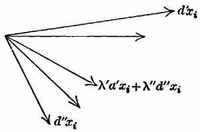
form a singly infinite series, since they contain one parameter, namely λ′: λ″. Such a series of geodesics, therefore, must form a two-dimensional manifold, with a measure of curvature in the ordinary Gaussian sense. This measure of curvature can be determined from the above formula for the elementary arc, by the help of Gauss's general formula alluded to above. We thus obtain an infinite number of measures of curvature at a point, but from n.(n – 1) 2 of these, the rest can be deduced (Riemann, Gesammelte Werke, p. 262). When all the measures of curvature at a point are constant, and equal to all the measures of curvature at any other point, we get what Riemann calls a manifold of constant curvature. In such a manifold free mobility is possible, and positions do not differ intrinsically from one another. If a be the measure of curvature, the formula for the arc becomes, in this case,
ds2 = Σdx2 / (1 + a 4 Σx2)2.
In this case only, as I pointed out above, can the term "measure of curvature" be properly applied to space without reference to a higher dimension, since free mobility is logically indispensable to the existence of quantitative or metrical Geometry.
(1) As regards continuity and dimensions. In a space of n dimensions, a point is uniquely determined by the measurement of n continuous variables (coordinates).
(2) As regards the existence of moveable rigid bodies. Between the 2n coordinates of any point-pair of a rigid body, there exists an equation which is the same for all congruent point-pairs. By considering a sufficient number of point-pairs, we get more equations than unknown quantities: this gives us a method of determining the form of these equations, so as to make it possible for them all to be satisfied.
(3) As regards free mobility. Every point can pass freely and continuously from one position to another. From (2) and (3) it follows, that if two systems A and B can be brought into congruence in any one position, this is also possible in every other position.
(4) As regards independence of rotation in rigid bodies (Monodromy). If (n – 1) points of a body remain fixed, so that every other point can only describe a certain curve, then that curve is closed.
These axioms, says Helmholtz, suffice to give, with the axiom of three dimensions, the Euclidean and non-Euclidean systems as the only alternatives. That they suffice, mathematically, cannot be denied, but they seem, in some respects, to go too far. In the first place, there is no necessity to make the axiom of Congruence apply to actual rigid bodies—on this subject I have enlarged in Chapter II.[29] Again, Free Mobility, as distinct from Congruence, hardly needs to be specially formulated: what barrier could empty space offer to a point's progress? The axiom is involved in the homogeneity of space, which is the same thing as the axiom of Congruence. Monodromy, also, has been severely criticized; not only is it evident that it might have been included in Congruence, but even from the purely analytical point of view, Sophus Lie has proved it to be superfluous[30]. Thus the axiom of Congruence, rightly formulated, includes Helmholtz's third and fourth axioms and part of his second axiom. All the four, or rather, as much of them as is relevant to Geometry, are consequences, as we shall see hereafter, of the one fundamental principle of the relativity of position.
The "Saggio di Interpretazione della Geometria non-Euclidea[32]," which is principally confined to two dimensions, interprets Lobatchewsky's results by the characteristic method of the second period. It shows, by a development of the work of Gauss and Minding[33], that all the propositions in plane Geometry, which Lobatchewsky had set forth, hold, within ordinary Euclidean space, on surfaces of constant negative curvature. It is strange, as Klein points out[34], that this interpretation, which was known to Riemann and perhaps even to Gauss, should have remained so long without explicit statement. This is the more strange, as Lobatchewsky's "Géométrie Imaginaire" had appeared in Crelle, Vol. XVII.[35], and Minding's article, from which the interpretation follows at once, had appeared in Crelle, Vol. XIX. Minding had shewn that the Geometry of surfaces of constant negative curvature, in particular as regards geodesic triangles, could be deduced from that of the sphere by giving the radius a purely imaginary value ia[36]. This result, as we have seen, had also been obtained by Lobatchewsky for his Geometry, and yet it took thirty years for the connection to be brought to general notice.
This work has less philosophical interest than the former, since it does little more than repeat, in a general form, the results which the Saggio had obtained for two dimensions—results which sink, when extended to n dimensions, to the level of mere mathematical constructions. Nevertheless, the paper is important, both as a restoration of negative curvature, which had been overlooked by Helmholtz, and as an analytical treatment of Lobatchewsky's results—a treatment which, together with the Saggio, at last restored to them the prominence they deserved.
Third Period.
Nevertheless, the fundamental difference between this period and the former must strike any one at once. Whereas Riemann and Helmholtz dealt with metrical ideas, and took, as their foundations, the measure of curvature and the formula for the linear element—both purely metrical—the new method is erected on the formulae for transformation of coordinates required to express a given collineation. It begins by reducing all so-called metrical notions—distance, angle, etc.—to projective forms, and obtains, from this reduction, a methodological unity and simplicity before impossible. This reduction depends, however, except where the space-constant is negative, upon imaginary figures—in Euclid, the circular points at infinity; it is moreover purely symbolic and analytical, and must be regarded as philosophically irrelevant. As the question concerning the import of this reduction is of fundamental importance to our theory of Geometry, and as Cayley, in his Presidential Address to the British Association in 1883, formally challenged philosophers to discuss the use of imaginaries, on which it depends, I will treat this question at some length. But first let us see how, as a matter of mathematics, the reduction is effected.
The projective formula for angles, in Euclidean Geometry, was first obtained by Laguerre, in 1853. This formula had, however, a perfectly Euclidean character, and it was left for Cayley to generalize it so as to include both angles and distances in Euclidean and non-Euclidean systems alike[38].
Cayley was, to the last, a staunch supporter of Euclidean space, though he believed that non-Euclidean Geometries could be applied, within Euclidean space, by a change in the definition of distance[39]. He has thus, in spite of his Euclidean orthodoxy, provided the believers in the possibility of non-Euclidean spaces with one of their most powerful weapons. In his "Sixth Memoir upon Quantics" (1859), he set himself the task of "establishing the notion of distance upon purely descriptive principles." He showed that, with the ordinary notion of distance, it can be rendered projective by reference to the circular points and the line at infinity, and that the same is true of angles[40]. Not content with this, he suggested a new definition of distance, as the inverse sine or cosine of a certain function of the coordinates; with this definition, the properties usually known as metrical become projective properties, having reference to a certain conic, called by Cayley the Absolute. (The circular points are, analytically, a degenerate conic, so that ordinary Geometry forms a particular case of the above.) He proves that, when the Absolute is an imaginary conic, the Geometry so obtained for two dimensions is spherical Geometry. The correspondence with Lobatchewsky, in the case where the Absolute is real, is not worked out: indeed there is, throughout, no evidence of acquaintance with non-Euclidean systems. The importance of the memoir, to Cayley, lies entirely in its proof that metrical is only a branch of descriptive Geometry.
Such a definition has been satisfactorily given by Klein[49], who appeals, for the purpose, to v. Staudt's quadrilateral construction[50]. By this construction, which I have reproduced in outline in Chapter III. Section A, § 112 ff., we obtain a purely descriptive definition of harmonic and anharmonic ratio, and, given a pair of points, we can obtain the harmonic conjugate to any third point on the same straight line. On this construction, the introduction of projective coordinates is based. Starting with any three points on a straight line, we assign to them arbitrarily the numbers 0, 1, ∞. We then find the harmonic conjugate to the first with respect to 1, ∞, and assign to it the number 2. The object of assigning this number rather than any other, is to obtain the value –1 for the anharmonic ratio of the four numbers corresponding to the four points[51]. We then find the harmonic conjugate to the point 1, with respect to 2, ∞, and assign to it the number 3; and so on. Klein has shown that by this construction, we can obtain any number of points, and can construct a point corresponding to any given number, fractional or negative. Moreover, when two sets of four points have the same anharmonic ratio, descriptively defined[52], the corresponding numbers also have the same anharmonic ratio. By introducing such a numerical system on two straight lines, or on three, we obtain the coordinates of any point in a plane, or in space. By this construction, which is of fundamental importance to projective Geometry, the logical error, upon which Sir R. Ball bases his criticism, is satisfactorily avoided. Our coordinates are introduced by a purely descriptive method, and involve no presupposition whatever as to the measurement of distance.
This confusion, I believe, has actually occurred, in the case of those who regard the question between Euclid and Metageometry as one of the definition of distance. Distance is a quantitative relation, and as such presupposes identity of quality. But projective Geometry deals only with quality—for which reason it is called descriptive—and cannot distinguish between two figures which are qualitatively alike. Now the meaning of qualitative likeness, in Geometry, is the possibility of mutual transformation by a collineation[53]. Any two pairs of points on the same straight line, therefore, are qualitatively alike; their only qualitative relation is the straight line, which both pairs have in common; and it is exactly the qualitative identity of the relations of the two pairs, which enables the difference of their relations to be exhaustively dealt with by quantity, as a difference of distance. But where quantity is excluded, any two pairs of points on the same straight line appear as alike, and even any two sets of three: for any three points on a straight line can be projectively transformed into any other three. It is only with four points in a line that we acquire a projective property distinguishing them from other sets of four, and this property is anharmonic ratio, descriptively defined. The projective Geometer, therefore, sees no reason to give a name to the relation between two points, in so far as this relation is anything over and above the unlimited straight line on which they lie; and when he introduces the notion of distance, he defines it, in the only way in which projective principles allow him to define it, as a relation between four points. As he nevertheless wishes the word to give him the power of distinguishing between different pairs of points, he agrees to take two out of the four points as fixed. In this way, the only variables in distance are the two remaining points, and distance appears, therefore, as a function of two variables, namely the coordinates of the two variable points. When we have further defined our function so that distance may be additive, we have a function with many of the properties of distance in the ordinary sense. This function, therefore, the projective Geometer regards as the only proper definition of distance.
We can see, in fact, from the manner in which our projective coordinates were introduced, that some function of these coordinates must express distance in the ordinary sense. For they were introduced serially, so that, as we proceeded from the zero-point towards the infinity-point, our coordinates continually grew. To every point, a definite coordinate corresponded: to the distance between two variable points, therefore, as a function dependent on no other variables, must correspond some definite function of the coordinates, since these are themselves functions of their points. The function discussed above, therefore, must certainly include distance in the ordinary sense.
But the arbitrary and conventional nature of distance, as maintained by Poincaré and Klein, arises from the fact that the two fixed points, required to determine our distance in the projective sense, may be arbitrarily chosen, and although, when our choice is once made, any two points have a definite distance, yet, according as we make that choice, distance will become a different function of the two variable points. The ambiguity thus introduced is unavoidable on projective principles; but are we to conclude, from this, that it is really unavoidable? Must we not rather conclude that projective Geometry cannot adequately deal with distance? If A, B, C, be three different points on a line, there must be some difference between the relation of A to B and of A to C, for otherwise, owing to the qualitative identity of all points, B and C could not be distinguished. But such a difference involves a relation, between A and B, which is independent of other points on the line; for unless we have such a relation, the other points cannot be distinguished as different. Before we can distinguish the two fixed points, therefore, from which the projective definition starts, we must already suppose some relation, between any two points on our line, in which they are independent of other points; and this relation is distance in the ordinary sense[54]. When we have measured this quantitative relation by the ordinary methods of metrical Geometry, we can proceed to decide what base-points must be chosen, on our line, in order that the projective function discussed above may have the same value as ordinary distance. But the choice of these base-points, when we are discussing distance in the ordinary sense, is not arbitrary, and their introduction is only a technical device. Distance, in the ordinary sense, remains a relation between two points, not between four; and it is the failure to perceive that the projective sense differs from, and cannot supersede, the ordinary sense, which has given rise to the views of Klein and Poincaré. The question is not one of convention, but of the irreducible metrical properties of space. To sum up: Quantities, as used in projective Geometry, do not stand for spatial magnitudes, but are conventional symbols for purely qualitative spatial relations. But distance, quâ quantity, presupposes identity of quality, as the condition of quantitative comparison. Distance in the ordinary sense is, in short, that quantitative relation, between two points on a line, by which their difference from other points can be defined. The projective definition, however, being unable to distinguish a collection of less than four points from any other on the same straight line, makes distance depend on two other points besides those whose relation it defines. No name remains, therefore, for distance in the ordinary sense, and many projective Geometers, having abolished the name, believe the thing to be abolished also, and are inclined to deny that two points have a unique relation at all. This confusion, in projective Geometry, shows the importance of a name, and should make us chary of allowing new meanings to obscure one of the fundamental properties of space.
The projective scheme of coordinates consists of a series of numbers, of which each represents a certain anharmonic ratio and denotes one and only one point, and which increase uniformly with the distance from a fixed origin, until they become infinite on reaching a certain point. Now Cayley showed that, in Euclidean Geometry, distance may be expressed as the limit of the logarithm of the anharmonic ratio of the two points and the (coincident) points at infinity on their straight line; while, if we assumed that the points at infinity were distinct, we obtained the formula for distance in hyperbolic or spherical Geometry, according as these points were real or imaginary. Hence it follows that, with the projective definition of distance, we shall obtain precisely the formulae of hyperbolic, parabolic or spherical Geometry, according as we choose the point, to which the value +∞ is assigned, at a finite, infinite or imaginary distance (in the ordinary sense) from the point to which we assign the value 0. Our straight line remains, all the while, an ordinary Euclidean straight line. But we have seen that the projective definition of distance fits with the true definition only when the two fixed points to which it refers are suitably chosen. Now the ordinary meaning of distance is required in non-Euclidean as in Euclidean Geometries—indeed, it is only in metrical properties that these Geometries differ. Hence our Euclidean straight line, though it may serve to illustrate other Geometries than Euclid's, can only be dealt with correctly by Euclid. Where we give a different definition of distance from Euclid's, we are still in the domain of purely projective properties, and derive no information as to the metrical properties of our straight line. But the importance, to Metageometry, of this new interpretation, lies in the fact that, having independently established the metrical formulae of non-Euclidean spaces, we find, as in Beltrami's Saggio, that these spaces can be related, by a homographic correspondence, with the points of Euclidean space; and that this can be effected in such a manner as to give, for the distance between two points of our non-Euclidean space, the hyperbolic or spherical measure of distance for the corresponding points of Euclidean space.
But Klein's method can only prove that elliptic Geometry holds of the ordinary Euclidean plane with elliptic measure of distance. Klein has made great endeavours to enforce the distinction between the spherical and elliptic Geometries[56], but it is not immediately evident that the latter, as distinct from the former, is valid.
In the first place, Klein's elliptic Geometry, which arises as one of the alternative metrical systems on a Euclidean plane or in a Euclidean space, does not by itself suffice, if the above discussion has been correct, to prove the possibility of an elliptic space, i.e. of a space having a point-to-point correspondence with the Euclidean space, and having as the ordinary distance between two of its points the elliptic definition of the distance between corresponding points of the Euclidean space. To prove this possibility, we must adopt the direct method of Newcomb (Crelle's Journal, Vol. 83). Now in the first place Newcomb has not proved that his postulates are self-consistent; he has only failed to prove that they are contradictory[57]. This would leave elliptic space in the same position in which Lobatchewsky and Bolyai left hyperbolic space. But further there seems to be, at first sight, in two-dimensional elliptic space, a positive contradiction. To explain this, however, some account of the peculiarities of the elliptic plane will be necessary.
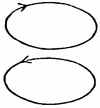
The elliptic plane, regarded as a figure in three-dimensional elliptic space, is what is called a double surface[58], i.e. as Newcomb says (loc. cit. p. 298): "The two sides of a complete plane are not distinct, as in a Euclidean surface.... If ... a being should travel to distance 2D, he would, on his return, find himself on the opposite surface to that on which he started, and would have to repeat his journey in order to return to his original position without leaving the surface." Now if we imagine a two-dimensional elliptic space, the distinction between the sides of a plane becomes unmeaning, since it only acquires significance by reference to the third dimension. Nevertheless, some such distinction would be forced upon us. Suppose, for example, that we took a small circle provided with an arrow, as in the figure, and moved this circle once round the universe. Then the sense of the arrow would be reversed. We should thus be forced, either to regard the new position as distinct from the former, which transforms our plane into a spherical plane, or to attribute the reversal of the arrow to the action of a motion which restores our circle to its original place. It is to be observed that nothing short of moving round the universe would suffice to reverse the sense of the arrow. This reversal seems like an action of empty space, which would force us to regard the points which, from a three-dimensional point of view, are coincident though opposite, as really distinct, and so reduce the elliptic to the spherical plane. But motion, not space, really causes the change, and the elliptic plane is therefore not proved to be impossible. The question is not, however, of any great philosophic importance.
In this address, Professor Cayley devoted most of his time to non-Euclidean systems. Non-Euclidean spaces, he declared, seemed to him mistaken à priori[59]; but non-Euclidean Geometries, here as in his mathematical works, were accepted as flowing from a change in the definition of distance. This view has been already discussed, and need not, therefore, be further criticised here. What I wish to speak about, is the question with which Cayley himself opened his address, namely, the geometrical use and meaning of imaginary quantities. From the manner in which he spoke of this question, it becomes imperative to treat it somewhat at length. For he said (pp. 8–9):
"... The notion which is the really fundamental one (and I cannot too strongly emphasize the assertion) underlying and pervading the whole notion of modern analysis and Geometry, [is] that of imaginary magnitude in analysis, and of imaginary space (or space as the locus in quo of imaginary points and figures) in Geometry: I use in each case the word imaginary as including real.... Say even the conclusion were that the notion belongs to mere technical mathematics, or has reference to nonentities in regard to which no science is possible, still it seems to me that (as a subject of philosophical discussion) the notion ought not to be thus ignored; it should at least be shown that there is a right to ignore it."
That the notion of imaginary points is of supreme importance in Geometry, will be seen by any one who reflects that the circular points are imaginary, and that the reduction of metrical to projective Geometry, which is one of Cayley's greatest achievements, depends on these points. But to discuss adequately their philosophical import is difficult to me, since I am unacquainted with any satisfactory philosophy of imaginaries in pure Algebra. I will therefore adopt the most favourable hypothesis, and assume that no objection can be successfully urged against this use. Even on this hypothesis, I think, no case can be made out for imaginary points in Geometry.
In the first place, we must exclude, from the imaginary points considered, those whose coordinates are only imaginary with certain special systems of coordinates. For example, if one of a point's coordinates be the tangent from it to a sphere, this coordinate will be imaginary for any point inside the sphere, and yet the point is perfectly real. A point, then, is only to be called imaginary, when, whatever real system of coordinates we adopt, one or more of the quantities expressing these coordinates remains imaginary. For this purpose, it is mathematically sufficient to suppose our coordinates Cartesian—a point whose Cartesian coordinates are imaginary, is a true imaginary point in the above sense.
To discuss the meaning of such a point, it is necessary to consider briefly the fundamental nature of the correspondence between a point and its coordinates. Assuming that elementary Geometry has proved—what I think it does satisfactorily prove—that spatial relations are susceptible of quantitative measurement, then a given point will have, with a suitable system of coordinates, in a space of n dimensions, n quantitative relations to the fixed spatial figure forming the axes of coordinates, and these n quantitative relations will, under certain reservations, be unique—i.e., no other point will have the same quantities assigned to it. (With many possible coordinate systems, this latter condition is not realized: but for that very reason they are inconvenient, and employed only in special problems.) Thus given a coordinate system, and given any set of quantities, these quantities, if they determine a point at all, determine it uniquely. But, by a natural extension of the method, the above reservation is dropped, and it is assumed that to every set of quantities some point must correspond. For this assumption there seems to me no vestige of evidence. As well might a postman assume that, because every house in a street is uniquely determined by its number, therefore there must be a house for every imaginable number. We must know, in fact, that a given set of quantities can be the coordinates of some point in space, before it is legitimate to give any spatial significance to these quantities: and this knowledge, obviously, cannot be derived from operations with coordinates alone, on pain of a vicious circle. We must, to return to the above analogy, know the number of houses in Piccadilly, before we know whether a given number has a corresponding house or not; and arithmetic alone, however subtly employed, will never give us this information.
Thus the distinction which is important is, not the distinction between real and imaginary quantities, but between quantities to which points correspond and quantities to which no points correspond. We can conventionally agree to denote real points by imaginary coordinates, as in the Gaussian method of denoting by the single quantity (a + √–1 b) the point whose ordinary coordinates are a, b. But this does not touch Cayley's meaning. Cayley means that it is of great utility in mathematics to regard, as points with a real existence in space, the assumed spatial correlates of quantities which, with the coordinate system employed, have no correlates in every-day space; and that this utility is supposed, by many mathematicians, to indicate the validity of so fruitful an assumption. To fix our ideas, let us consider Cartesian axes in three-dimensional Euclidean space. Then it appears, by inspection, that a point may be situated at any distance to right or left of any of the three coordinate planes; taking this distance as a coordinate, therefore, it appears that real points correspond to all quantities from -∞ to +∞. The same appears for the other two coordinates; and since elementary Geometry proves their variations mutually independent, we know that one and only one real point corresponds to any three real quantities. But we also know, from the exhaustive method pursued, that all space is covered by the range of these three variable quantities: a fresh set of quantities, therefore, such as is introduced by the use of imaginaries, possesses no spatial correlate, and can be supposed to possess one only by a convenient fiction.
Finally, then, only a knowledge of space, not a knowledge of Algebra, can assure us that any given set of quantities will have a spatial correlate, and in the absence of such a correlate, operations with these quantities have no geometrical import. This is the case with imaginaries in Cayley's sense, and their use in Geometry, great as are its technical advantages, and rigid as is its technical validity, is wholly destitute of philosophical importance.
The general definition of a group is as follows: If we have any number of independent variables x1 x2...xn, and any series of transformations of these into new variables—the transformations being defined by equations of specified forms, with parameters varying from one transformation to another—then the series of transformations form a group, if the successive application of any two is equivalent to a single member of the original series of transformations. The group is continuous, when we can pass, by infinitesimal gradations within the group, from any one of the transformations to any other.
Now, in Geometry, the result of two successive motions or collineations of a figure can always be obtained by a single motion or collineation, and any motion or collineation can be built up of a series of infinitesimal motions or collineations. Moreover the analytical expression of either is a certain transformation of the coordinates of all the points of the figure[61]. Hence the transformations determining a motion or a collineation are such as to form a continuous group. But the question of the projective equivalence of two figures, to which all projective Geometry is reducible, must always be dealt with by a collineation; and the question of the equality of two figures, to which all metrical Geometry is reducible, must always be decided by a motion such as to cause superposition; hence the whole subject of Geometry may be regarded as a theory of the continuous groups which define all possible collineations and motions.
Now Sophus Lie has developed, at great length, the purely analytical theory of groups; he has therefore, by this method of formulating the problem, a very powerful weapon ready for the attack. In two papers "On the foundations of Geometry[62]," undertaken at Klein's urgent request, he takes premisses which roughly correspond to those of Helmholtz, omitting Monodromy, and applies the theory of groups to the deduction of their consequences[63]. Helmholtz's work, he says, can hardly be looked upon as proving its conclusions, and indeed the more searching analysis of the group-theory reveals several possibilities unknown to Helmholtz. Nevertheless, as a pioneer, devoid of Lie's machinery, Helmholtz deserves, I think, more praise than Lie is willing to give him[64].
Lie's method is perfectly exhaustive; omitting the premiss of Monodromy, the others show that a body has six degrees of freedom, i.e. that the group giving all possible motions of a body will have six independent members; if we keep one point fixed, the number of independent members is reduced to three. He then, from his general theory, enumerates all the groups which satisfy this condition. In order that such a group should give possible motions, it is necessary, by Helmholtz's second axiom, that it should leave invariant some function of the coordinates of any two points. This eliminates several of the groups previously enumerated, each of which he discusses in turn. He is thus led to the following results:
I. In two dimensions, if free mobility is to hold universally, there are no groups satisfying Helmholtz's first three axioms, except those which give the ordinary Euclidean and non-Euclidean motions; but if it is to hold only within a certain region, there is also a possible group in which the curve described by any point in a rotation is not closed, but an equiangular spiral. To exclude this possibility, Helmholtz's axiom of Monodromy is required.
II. In three dimensions, the results go still more against Helmholtz. Assuming free mobility only within a certain region, we have to distinguish two cases: Either free mobility holds, within that region, absolutely without exception, i.e. when one point is held fast, every other point within the region can move freely over a surface: in this case the axiom of Monodromy is unnecessary, and the first three axioms suffice to define our group as that of Euclidean and non-Euclidean motions. Or free mobility, within the specified region, holds only of every point of general position, while the points of a certain line, when one point is fixed, are only able to move on that line, not on a surface: when this is the case, other groups are possible, and can only be excluded by Helmholtz's fourth axiom.
Having now stated the purely mathematical results of Lie's investigations, we may return to philosophical considerations, by which Helmholtz's work was mainly motived. It becomes obvious, not only that exceptions within a certain region, but also that limitation to a certain region, of the axiom of Free Mobility, are philosophically quite impossible and inconceivable. How can a certain line, or a certain surface, form an impassable barrier in space, or have any mobility different in kind from that of all other lines or surfaces? The notion cannot, in philosophy, be permitted for a moment, since it destroys that most fundamental of all the axioms, the homogeneity of space. We not only may, therefore, but must take Helmholtz's axiom of Free Mobility in its very strictest sense; the axiom of Monodromy thus becomes mathematically, as well as philosophically, superfluous. This is, from a philosophical standpoint, the most important of Lie's results.
Its second axiom states that space has a finite integral number of dimensions, i.e. in metrical terms, that the position of a point, relative to any other figure in space, is uniquely determined by a finite number of spatial magnitudes, called coordinates.
The third axiom of metrical Geometry may be called, to distinguish it from the corresponding projective axiom, the axiom of distance. There exists one relation, it says, between any two points, which can be preserved unaltered in a combined motion of both points, and which, in any motion of a system as one rigid body, is always unaltered. This relation we call distance.
The above statement of the three essential axioms of metrical Geometry is taken from Helmholtz as amended by Lie. Lie's own statement of the axioms, as quoted above, has been too much influenced by projective methods to give a historically correct rendering of the spirit of the second period; Helmholtz's statement, on the other hand, requires, as Lie has shewn, very considerable modifications. The above compromise may, therefore, I hope be taken as accepting Lie's corrections while retaining Helmholtz's spirit.
I. Space is continuous and infinitely divisible; the zero of extension, resulting from infinite division, is called a Point. All points are qualitatively similar, and distinguished by the mere fact that they lie outside one another.
II. Any two points determine a unique figure, the straight line; two straight lines, like two points, are qualitatively similar, and distinguished by the mere fact that they are mutually external.
III. Three points not in one straight line determine a unique figure, the plane, and four points not in one plane determine a figure of three dimensions. This process may, so far as can be seen à priori, be continued, without in any way interfering with the possibility of projective Geometry, to five or to n points. But projective Geometry requires, as an axiom, that the process should stop with some positive integral number of points, after which, any fresh point is contained in the figure determined by those already given. If the process stops with (n + 1) points, our space is said to have n dimensions.
These three axioms, it will be seen, are the equivalents of the three axioms of metrical Geometry[65], expressed without reference to quantity. We shall find them to be deducible, as before, from the homogeneity of space, or, more generally still, from the possibility of experiencing externality. They will therefore appear as à priori, as essential to the existence of any Geometry and to experience of an external world as such.