VII A NATION IN TRANSITION
Reading edition
In nearly all non-Christian lands the first impressions of western civilization have come from the aggressions of commerce.
The minister of a foreign government has preceded the missionary of the Cross.
The flag of a foreign nation has gone in advance of the banner of Christianity.
Both political and commercial relations may have been forced upon the people of the weaker nation. All this may have been in the best interests of the world at large; probably in the best interests of the people themselves, however slow they have been to realize it.
Were Christian nations always worthily represented commercial, diplomatic, and evangelistic efforts might cooperate for the uplifting of backward races. In the initial attempts to bring about the remolding of a nation, the restraining influence upon the natives, as exercised by the missionaries, is of inestimable importance. Missionaries in turn, need protection from fanatical and ignorant natives, so easily influenced by irresponsible characters, to desperate deeds.
New colonies invariably become a dumping ground for adventurers. Government officials, "transferred for cause," drift farther and farther towards the frontier. Because of a scarcity of trained men certain positions have been filled by persons morally unfit to represent a civilized people. So it transpires that civil law sometimes becomes civil lawlessness, which men in higher positions are powerless wholly to restrain. But sweeping charges that officials of whatever nation, in outlying colonies, are "profligate and tyrannical" do gross injustice to many noble men who are doing their utmost for the advancement of morality and justice. Burma has suffered as other colonies have suffered. But there is steady progress for the better. The various departments of government are becoming more thoroughly organized; competent and trustworthy men are in the ascendant. But throughout the period since the annexation of Burma by the British Indian government—impressions far from complimentary to a Christian nation have become indelibly fixed in the native mind.
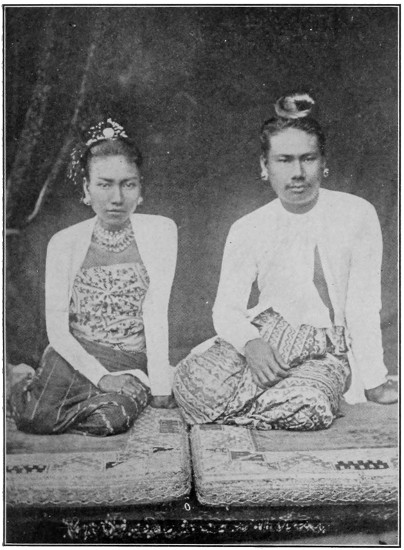
The Last King of Burma
Vice is always more conspicuous than virtue. Unscrupulous men have brought reproach upon a Christian nation; and created strong prejudice against Christianity itself, that many years of good government and evangelistic effort combined cannot efface. The innocent must suffer suspicion with the guilty. It is also true that natives are naturally suspicious of all foreigners, and apt to regard even necessary measures as oppressive. The old question "Is it lawful to give tribute to Cæsar?" crops out wherever tribute is exacted. Every son of Adam, the world over, holds the tax collector in contempt, and will evade payment if possible. "Publicans and sinners" are inseparably wedded, in the popular mind.
This deeply-grounded prejudice, whether with or without cause, constitutes a serious hindrance to the progress of evangelistic work.
Often the missionary must spend a whole day in a jungle village striving to win the confidence of the people, who are slow to discriminate between the missionary and the official. Suspicion as to his character and errand is a greater hindrance than their prejudice against Christianity as such.
At the same time there is reason for believing that could the Burmans throw off the British yoke, and reestablish a kingdom of their own, missionaries would not be permitted to propagate Christianity at all. In February, 1826, Adoniram Judson and Dr. Price, having been released from their long imprisonment at Ava and Aungbinle, were finally permitted to go down to the British camp, Mrs. Judson accompanying them. The release of these American missionaries, and the recovery of their property, of which the Burman officials had heartlessly robbed them, were due entirely to special efforts in their behalf on the part of the general commanding the British troops. Mrs. Judson thus recounted their experiences: "We now, for the first time, for more than a year and a half, felt that we were free, and no longer subject to the oppressive yoke of the Burmans. And with what sensation of delight, on the next morning, did I behold the masts of the steamboat, the sure presage of being within the bounds of civilized life. As soon as our boat reached the shore, Brigadier A—— and another officer came on board, congratulated us on our arrival, and invited us on board the steamboat where I passed the remainder of the day; while Mr. Judson went on to meet the general, who, with a detachment of the army, had encamped at Yandaboo, a few miles further down the river. Mr. Judson returned in the evening with an invitation from Sir Archibald to come immediately to his quarters, where I was the next morning introduced, and received with the greatest kindness by the general, who had a tent pitched for us near his own, took us to his own table, and treated us with the kindness of a father, rather than as strangers of another country. We feel that our obligations to General Campbell can never be cancelled. Our final release from Ava, and our recovering all the property that had there been taken, was owing entirely to his efforts.
"His subsequent hospitality, and kind attention to the accommodation for our passage to Rangoon, have left an impression on our minds, which can never be effaced. We daily received the congratulations of the British officers, whose conduct towards us formed a striking contrast to that of the Burmese. I presume to say that no persons on earth were ever happier than we were during the fortnight we passed at the English camp. For several days this single idea wholly occupied my mind,—that we were out of the power of the Burmese government, and once more under the protection of the English" (Memoir of Rev. Dr. Judson, by Wayland).
Such testimony as this is enough to arouse a sense of everlasting gratitude in the heart of every missionary whose privilege it is to conduct mission work under the protection of the British flag. Happily there has never been another occasion in the history of Burma missions to extend such kindnesses as Mr. and Mrs. Judson enjoyed at the hands of these English officers. But missionaries of all societies represented in Burma have always been able to number among their best friends noble men in some department of government service, civil or military.
Transitions are more readily effected in government than in religion. The "Powers that be," though recently come into their possessions, speak authoritatively. "Might makes right," and compels changes. A foreign religion speaks persuasively, having no authority, and desiring none, to compel its acceptance. When a foreign religion enters ground already preempted by twenty-five centuries of such a strongly organized religion as Buddhism, transitions may also be reckoned by centuries. The world may witness the evangelization of Burma "in this generation," but it cannot recall the three generations of Burmans that have gone out in the dark since Judson began his work in this land.
"Their idols are silver and gold, the work of men's hands."—"They that make them are like unto them: so every one that trusteth in them." The image of Gautama Buddha bears on its face an expression, or rather lack of expression intended to represent that, to him, change was forever past. The idol as truly represents Buddhism as it does the founder of Buddhism. There is no word in the Burman language of wider application than the word for "custom." On that word the Buddhist falls back for justification of every act, as sufficient reason for non-action, as a clincher to every argument. He attaches greater weight to ancestral custom than to the teachings of his "law" or to the dictates of his own judgment. When defeated at every point, in religious controversy he has been known to say, "If what you say is true, then my ancestors have gone to hell. I want to go wherever they have gone. If they have gone to hell, I want to go there too." Aged Buddhists have said: "Our children may become Christians, but we are too old to change. We will die in Buddhism, as we have lived." They are "like unto" their idols in that they seem to have no power to change. Having "changed the glory of the incorruptible God for the likeness of corruptible man"; "Exchanged the truth of God for a lie, and worshipped and served the creature (Gautama) rather than the creator," and "Refused to have God in their knowledge," they seem to have been given up to a "reprobate mind." They now declare that there is no God. If there is no God there can be no sin against God. Sins are against self only, in that they involve penalty. But penalty may be counter-balanced by meritorious works. Therefore all responsibility to God or man is repudiated. Each man must be his own saviour. His meritorious works are solely for his own advantage.
Self-centred, and self-sufficient,—the Christian doctrines of an Eternal God, atonement, pardon, regeneration and heaven are rejected as idle tales concerning things which they consider neither necessary nor desirable. The Apostles, or missionaries (sent-forth-ones) of the early church found that the Gentiles received the gospel much more readily than the Jews. The latter were steeped in bigotry, and imagined themselves a superior and specially favoured people. They were priest-ridden, and led astray by the "traditions of the elders." Any suggestion of change was deeply resented, especially by the religious teachers. History repeats itself in Burma. Non-Buddhist tribes receive the gospel far more readily than the Buddhist. Buddhists manifest the same Jewish spirit of haughty pride and arrogant bigotry. They are priest-ridden, and bound down by teachings and customs never dreamed of by the founder of their religious system. Pharisees decreed that if any man should confess Jesus to be the Christ, he should be put out of the synagogue. Where there were no Pharisees to agitate against the Christian missionaries the common people heard them gladly. While the Karens, as a nation, have already passed the transitional stage, the Burmans are still held back by their pharisaical priests, who never lack willing instruments for the execution of their malice against converts to Christianity. But in communities where there are no priests to hold the people in awe, native evangelists have little difficulty in securing a good hearing. This indicates the real spirit of the people when untrammelled by intimidating influences. Human nature is much the same the world over. Environment and inherited custom make men to differ. Results already achieved (to be discussed in another chapter) show that Burma is in a state of transition religiously as well as politically, though less conspicuously.

Government House, Rangoon
The sure promise of God that Christ shall have the nations for His inheritance; the uttermost parts of the earth for His possessions, has here substantial beginnings of fulfillment. Uhlhorn said of the Roman Empire in transition: "The most mighty of forces cannot change in a day the customs and institutions of an Empire more than a thousand years old." In Burma these forces are arrayed against customs and institutions that have developed during a period of twenty-five hundred years. Change of government effects outward changes in the life of a people; but more than mere change of government is required to work changes for the better in the soul of a people. Aping European customs may give an air of increased respectability, but the aping of European vices, always first in order, makes the man "Tenfold more a child of hell" than before. Much is expected from the government system of education. Education will furnish a supply of petty officials; raise the people to some extent, from their gross ignorance; and possibly do something towards undermining Buddhism,—though to undermine Buddhism is far from being the purpose or desire of the British Indian government. But something more than education is required to prepare a nation to be an inheritance of the King of Kings. The gospel, and only the gospel is the power of God unto the salvation of any nation.
In industry, skill, statesmanship, and all the qualities that go to make up a strong people, the Burmans are sadly lacking. To come to the front rank of progress, as the Japanese have done, is not in them, and never will be. But as a dependent nation, restrained by their conquerors from the almost continual warfare which marks their history; and transformed by the leavening influences of Christianity, they may yet take the front rank among Asiatic races as a Christian people.