III CUSTOMS OF THE BURMESE
Reading edition
The Burman is the proudest mortal on earth. Indeed, he is not of earth, according to his own belief, but has descended from fallen angels. Many ages ago certain Brahmas came down from the celestial regions to dwell on the earth. By adapting themselves to the habits of ordinary human beings, they themselves gradually became human. From these Brahmas or fallen angels, the whole Burman nation descended.
The Burman recognizes no superior. The superior advantages of a training in the Western world counts for nothing, because the Burman cannot appreciate such advantages. At one time when in conversation with a Burman official recognized as one of the ablest Burmans in the country, I dilated upon the extent, power, wealth, and resources of the United States, in answer to his many questions about my country.
Wishing to impress him, I made the figures as large as conscience would allow. At last he summed it all up in the self-satisfied expression—"About as big as Burma, isn't it?" A difference of about 70,000,000 in population was not comprehended. He could conceive of nothing bigger or more important than Burma. The Burman kings posed as the Head of Religion. The king was more than human. His subjects were his slaves, with no legal right to anything which he might crave for himself. He could compel them to perform any labour he saw fit to impose. His titles indicate his high estimate of himself: "His glorious and excellent Majesty, Lord of Elephants, Lord of gold, silver, rubies, amber, and the noble serpentine, Sovereign of the Empires of Thunapurtanta and Jambudipa, and other great Empires and countries, and of all the Umbrella-bearing chiefs, The supporter of Religion, Descendant of the Sun, Arbiter of Life, King of Righteousness, King of Kings, and Possessor of boundless dominion and supreme wisdom." That is all. It was well to be somewhat modest, as an example to the people.
The king was "Lord of the White Elephant," for short. That in itself ought to have satisfied a man of ordinary ambition, inasmuch as the white elephant was a sacred animal, and had the "power of making its possessor invincible." "The white umbrella was the emblem of sovereignty in Burma, and its use was limited to the king and the images of Gautama." The Buddhist priest must be content with a more modest title than "Pongyi," the name by which they are now known,—for pongyi means "Great Glory," and could be applied only to the king. But when the king fell into the hands of the English the title "Great Glory" went broadcast—to minister to the vanity of the thousands of priests and to be retained by them as a monopoly. Burman officials to this day are equally proud of their titles, from the highest in the land down to the Ywa-Thugyi, the village headman. To address any official by name instead of his title, would be a gross breach of etiquette. In the king's time official etiquette was scrupulously observed, even towards prisoners of the official class. Royal blood must never be shed, even in executions. A blow from a bludgeon on the back of the neck of the stooping victim,—or in the case of females, a blow on the front of the neck settled the account. Nor might royal victims be buried. The body, enshrouded in a red velvet sack, was taken in a boat to the middle of the river, and thrown in. It is said that this was sometimes done without the formality of an execution, a few stones in the sack answering the same purpose. Crucifixion was also common. It is claimed that in many instances the victim was first put to death and then the mutilated body bound to the bamboo cross and exhibited as a fearful warning to evil-doers. Dread of being crucified led thousands to migrate to British territory after the annexation of Pegu. The ugly terms "imprisonment," and "execution" were never used at the court of the king. There was a "keeping by" and a "clearing away," to suit the caprice of the king, scores and hundreds being massacred at once, on the merest suspicion of conspiracy. "Uneasy lies the head that wears a crown," was true of Burman kings, and they had a way of making all others of royal blood equally uneasy.
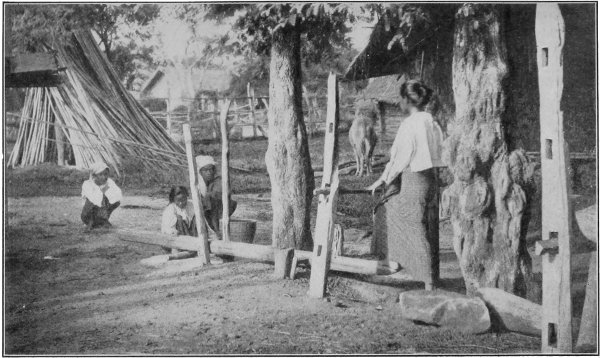
Pounding Rice
One of the causes leading to the last Burmese-English war, was the famous "Shoe question." According to the Burmese custom, sandals must be removed outside the entrance, whether of private residence or royal palace. When a subject of however exalted rank was admitted to the presence of the king, he must come in his bare feet, and approach in a crouching position so that his skirt would prevent his feet being seen by the fastidious eyes of the king. Heads have been lost for violation of less important rules of etiquette. Representatives of the British Government were compelled to follow this humiliating custom,—though they were graciously allowed to keep their stockings on,—and to sit on the floor at a respectful distance from His Majesty, Lord of the White Elephant, etc., etc. The Briton thought this inconsistent with proper respect for the government he represented, to say nothing of his own personal feelings. Diplomatic negotiations were delayed, for the haughty king would allow no deviation from this humiliating custom. Although the war was not declared on this issue, English officials who had been required to remove their shoes, found great satisfaction in requiring the king to remove his crown. The custom of taking off one's sandals when entering any house still prevails. Entering with sandals on could only be interpreted as a deliberate insult. When a European enters a monastery he is expected to take off his shoes, though the priest does not insist upon it—when informed that it is not European custom.
If twenty men come to see the missionary, the last man must step over nineteen pairs of sandals at the foot of the stairs. But when it comes to head-gear, the custom is reversed. While Europeans would take off their hats, the Burmans do not remove their gaung-baungs, or turbans. The gaung-baung is usually of gaudy silk, and worn at all times, even at worship, by both Buddhist and Christian.
When Saul had been informally proclaimed King of Israel, the people "despised him, and brought him no present." This would not have happened in Burma, as the attitude of men from whom presents would naturally be expected,—unless perchance they had ceased to value that portion of their bodies above the shoulders. Whether king, subordinate official, or private citizen, a present suited to the weight of the matter in hand was an essential preliminary to a hearing. Under British rule, Burman officials do not openly perpetuate this custom. They now content themselves with bribes quietly presented, usually through a third party, in place of the present once openly offered. But in social life the custom of making presents is a recognized matter of etiquette, even when visiting non-official superiors. It commonly takes the form of a tray of the choicest fruit procurable. But in the majority of instances it finally appears that some favour or other is being sought.
Poor people sometimes come with a bunch of plantains or a few oranges which they beg us graciously to accept as a token of their great esteem, and then hang around the place waiting for a return present of ten times the value of their own. The European soon becomes suspicious of presents as likely to prove more expensive than the regular Bazar rate.
A missionary to the Indians in British Columbia relates a story which, so far as motive is concerned, might have been matched in Burma. One day an Indian gave them two fat ducks. "What shall I pay for them?" "Oh, nothing, they are a present for the missionary." The Indian hung around, remained to dinner, ate one of the ducks, remained through the afternoon, ate the equivalent of the other duck, remained until bedtime, when the missionary hinted that perhaps he had better go home to see if his wigwam was where he left it. "I'm only waiting." "Waiting for what?" "Waiting for the present you are to give me for the present I gave you."
A peculiar custom that always impresses the newcomer, is that of doing obeisance, called "shikkoing." When the devout worshipper counts the beads on his rosary he repeats the formula with each bead "Lord, Law, Priest—the three precious things" or objects of his worship.
As a counterpart of this formula he goes through three prostrations, with palms together, bowing his face to the ground in honour of the three precious things of his creed. These prostrations are also gone through at confessional before the priest,—one of the "precious things" before mentioned. He does not enumerate his sins, but lumps them, declaring that for all the sins he has committed he prostrates himself three times, in honour of the three precious things, and hopes thereby to be freed from all punishments and calamities. In respect to both spirit and method this custom reminds one of a certain man who used to hang his clumsily written prayer to the bedpost, saying as he crawled into bed, "Lord, them's my sentiments." After his lump-sum confession he receives the priest's benediction, which is practically the same as absolution, and goes away, the self-complacent pharisee that he is.
What astonishes and shocks the missionary is to find a heathen Burman at his feet going through this seeming act of worship. He feels as horrified as did Paul and Barnabas at Lystra. But he afterwards learns when he comes to understand the Burman better,—that these prostrations before superiors are not intended as acts of real worship. He is merely showing his humble respect, as a preliminary to some appeal for favour.
English officials require from non-Christian natives the same tokens of respect that were in vogue prior to the annexation. Native Christians are exempt from all customs which savour of Buddhism.
The idol and the priest alike represent Gautama, the only god the Buddhist knows. The attitude of the Burman mind may be illustrated by what a Burman Christian boy told me of his experience when he visited his native village. In response to an invitation he went to see the old priest, who had known him as a child. The priest was held in honour both by virtue of office, and his advanced age. The young Christian went through the customary prostrations respectfully, and then said, "I do not shikko you as God, but because I do not know of any other way to show my respect." The heathen Burman is in the same difficulty when he appears in the presence of a foreigner whom he wishes to honour.
This Oriental mode of showing reverence, not necessarily worship, throws light on the word "worship," so often used by Matthew.
The Burman is a religious animal, both terms emphasized. He has many religious festivals, and every festival is a feast. The casual observer would see but little difference between the street processions of weddings and funerals. There are the same tom-toms, the same grotesque dancing, the same stuffing of insatiable stomachs. Among Chins and Kachins such occasions are scenes of drunkenness and disorder. Not so among the Burmans. Many have contracted the drink habit by contact with Europeans, but the use of intoxicants has not yet become a national vice. The Burman attends all feasts and festivals because it is unchangeable custom to do so; because everybody else will be there, and he enjoys being in a crowd; because it gives him an excuse for abstaining from work, which he does not enjoy; because he can array himself in his best silk skirt and gaung-baung, and will find all the ladies there similarly arrayed; and most of all because whatever the occasion, it will be a feast. During the rainy season, which coincides with "Buddhist Lent" no feasts or festivals are held.
Funerals cannot always be postponed, especially as there is much sickness in the rainy season, but weddings are prohibited. Courting may be indulged in on the sly, to shorten the process when Lent is over.
At the beginning of Lent there is a great festival, entered into with enthusiasm because it will be the last for several months. At the end of Lent there is another great festival, hilariously enjoyed because the dull rainy Lenton period with its round of Duty-days without the craved accompaniments is over at last. Even the priests enjoy it, for presents to the monasteries, which had fallen off during Lent, will now be renewed. The young are again free to pair. The whole town is illuminated. Fire-balloons are sent up, with reckless disregard to safety of their houses. All are bent on having a good time. It is a religious festival, to be sure, each separate observance being in honour of some nat or divinity—but there will be time enough to meditate on all that afterwards. For the present it is a round of picnic enjoyment.
The Burman era began in 639 a. d. The New Year begins in April.
The month is reckoned from midway between two full moons. Any Burman can readily give you the date, according to the Burman system, but very few have mastered the European calendar. The date is given as so many days before or after the full of the moon. The New Year is always celebrated by the "Water-feast." Offerings of pots of water are taken to the monasteries, the images of Gautama given their annual washing down, and then the show begins. Boisterous young men arm themselves with buckets or chatties of water, frolicsome damsels with cups, and the boys with bamboo squirt-guns, each and all bent on douching everybody else. By some means or other everybody gets his share. He would feel slighted if he did not receive a due share of liquid attention. The use of water at the beginning of the year has a religious significance,—but let the priest and the pious attend to that. The young folks are in for a jolly good time, and they get it. At the beginning of November there is another feast in honour of the time when Gautama Buddha made a visit to the celestial regions to preach to his mother. Then on the full moon of November another feast in honour of the time when Gautama became a Buddha under the bawdee-tree. Lesser feasts occur at intervals until Lent begins again. What with all the religious feasts, the weddings, ear-borings, funerals, etc., etc., the Burman suffers no lack of enjoyment. He manages to get some fun out of everything, the funeral being no exception. He will dance and sing on the way to the cemetery, and race bullock-carts on the way home. The funeral of a priest often resolves itself into a tug of war. Two stout ropes are attached to each end of the four-wheeled cart on which the casket has been placed. The crowd divides itself into two parties, the ropes are seized, and the struggle begins. Up the street the cart is dragged with a great hurrah, until reinforcements strengthen the opposing party, then the cart takes a lurch in the other direction, its lofty spire swaying in a threatening manner. Back and forth goes the cart, the exciting contest sometimes lasting for hours. Merit is gained by drawing the pongyis' remains to the funeral pyre. Of course the pyre-ward side must ultimately win, or there would be no cremation.
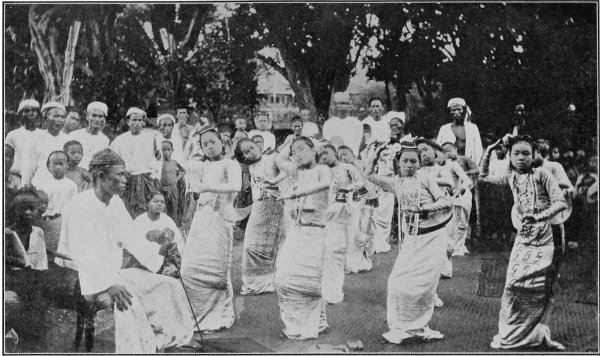
Dancing Girls
The rope-pull is sometimes resorted to in much the same manner to break a prolonged drought. Whether successful or not, as rain-makers, they have the sport. Is the Burman lazy? He certainly has that reputation, and I never heard it disputed by employers of Burman labour. His services would be better appreciated were he as punctual at the beginning of the day as he is at its close, and as diligent in the use of his tools as he is in keeping his cheroot lighted. He must have some credit for hard work to leave so many things undone. At "turning off work" he has no superior. He invariably turns off all the work he can,—and does the rest. And yet when one reflects that outside of the delta nearly all of the hard work of cultivation in the plains is done by Burmans one feels compelled to reconsider his verdict as to the Burman's capacity for work. No man can tell by a Burman's clothing whether he is rich or poor. All that a man hath will he give for a silk skirt. In "the good old times" when the king's will was law subordinate officials made demands for money wherever appearances indicated that money existed, to make up the amount of revenue called for. It was then good policy to dress below one's ability rather than above it, or one might find himself in an embarrassing situation. Moreover, certain material, style of cut, etc., was reserved for royal blood. But when the king fell, and the Burman found that the conqueror's method of raising revenue was by equitable taxation, royal customs went to the winds. Young men and maidens, and even the middle-aged blossomed out in gaudy array on festive occasions, though there might not be a pice of loose change to back it. Of all the races of Burma the Burmese are the cleanliest and dressiest. The costume of nearly all races, at its best, is fairly respectable and suited to their manner of life,—if they would only keep it clean and keep it on. When one is about to die the friends say, "Think not of friends or of property,—think only of God." This sounds hopeful, but it is well known that these spiritual advisers have in mind only the brazen image of Gautama, found in every village, the only god they know.
When a death occurs the pongyis are invited to the house, not to console the living, but to perform certain rites on behalf of the dead.
First a priest repeats a formula something like this, "He worships God; he worships the law; he worships the clergy," friends assuming the attitude of worship as substitutes for the deceased. The priest continues—"He kills not, steals not, commits no offense against his neighbour's wife; lies not; drinks not. He has all his life been careful about these things." The formula ended, one of the friends drops water from a gurglet or cocoanut shell into a glass, to accompany another formula by the priest, "May the deceased enjoy the food of the nats. May the nat of the earth bear witness." The person who pours out the water drawls in a loud voice, "Ah-mya-myo"—in great abundance and variety, the people responding, "Thah-doo, thah-doo"—it is well, it is well. At the grave, or in a zayat nearly the same ceremonies are repeated. The priests have already been feasted at the house, and now presents are given on behalf of the dead, that he may enjoy the same blessings in the abode of the nats. The priests do not usually accompany the procession, but go in advance to the zayats near the cemetery. At death a small coin is placed in the dead man's mouth to pay his ferry fare across the mystic river of death. Without the coin for the ferry he could not cross, but would have to return to this world to suffer—nobody knows what. The use of the coin is said to be dying out. The coffin is swung endwise over the grave seven times (sometimes docked to three) as a good-bye, and to give the deceased a good start towards the great Myin-Mo Mount, the abode of the nats.
Human nature is much the same the world over. Courtship and marriage are universal customs. Methods differ, but motives are the same.
The majority of marriages are for love, or for something that has been mistaken for that sentiment. When a Burmese young man and maiden fancy each other well enough to indulge in playful flirtations at pagoda feasts and other public occasions it is pretty sure to develop into something more serious. The young lady is not likely to let a good chance slip by. Old-maidhood is dreaded by all, except the comparatively few who become nuns, and many of them are said to have become nuns because disappointed in love. Lover-like attentions may not be given openly. Clandestine meetings would scandalize the whole community.
At about nine o'clock in the evening the young man, accompanied by his friends approaches the house of the maiden whose charms cause his heart to thump against his ribs. He finds her awaiting his coming. But they are not to enjoy a fond tête-à-tête by themselves. Several young lady friends are sitting on the open veranda with her,—and the old lady peeking through a chink in the bamboo wall. It is courtship under difficulties, but it means business just the same. The rules of propriety have been observed, the parents are satisfied. As for the rest, trust the young folks to find ways and means to enjoy themselves as lovers do the world over. Accepting presents of jewelry from a young man is generally recognized as an engagement. Many a maiden has allowed her fondness for jewelry to lead to complications from which she has difficulty in extricating herself. According to old Burmese law the sole right to select or reject suitors was vested in the parents. The daughter, until twenty years of age, was entirely under their control.
The Dhammathat says: "Amongst men there are only three ways of becoming man and wife, which are as follows: First, a man and woman given in marriage by their parents, who live and eat together. Second, a man and wife brought together by the intervention of a go-between, who live and eat together. Third, a man and woman who came together by mutual consent, who live and eat together." In question of property rights the most importance is attached to the first method. A marriage without the consent of the parents, if the girl is under twenty, may be cancelled by the parents, if action is promptly taken. The girl may reject the man to whom she has been betrothed by her parents, but her decision is recognized only after she has run away from him and been forcibly restored three times. In like manner a girl who has been taken in marriage without the consent of her parents must be restored to them three times. If she then returns again to her husband the parents' claim upon her is forfeited, because the "Owner of the daughter could not control her." Widows and divorced women are subject to no control. While all this is Buddhist law, the girl, as a matter of fact, does about as she pleases in the matter of accepting or rejecting, just as they do in other lands, whether she is under twenty or not. Neither Buddhist law nor established custom renders any kind of a marriage ceremony essential, nor is registration of the marriage necessary. "Living and eating together," constitute all desired evidence of marriage.
The first eating together is something done in the presence of witnesses and so becomes in itself a simple wedding ceremony. This happy-go-lucky custom makes it exceedingly difficult to settle any questions in law growing out of such a marriage. A couple may prove that they are, or are not husband and wife, as best suits their ends. In Christian lands the wife is sometimes taken home to live with her mother-in-law.
In Burma the situation is reversed, the young husband going to live with his wife's parents. By a generally accepted division of labour the wife is the burden-bearer, while the husband gets the glory for what is accomplished. Husband and wife are going into town to exchange a basket of rice for a supply of putrid fish and other necessaries of life.
The wife carries the basket, weighing seventy-five or one hundred pounds, on her head, the husband with only his kun-bag slung over his shoulder walking ahead at a gait which she finds it difficult to follow.
The load may now and then be rested on a convenient stump, or the considerate husband helps to lower it to the ground and raise it to her head again. So accustomed have they become to this arrangement that it never occurs to either party that the man might carry the load part of the time. Familiar as is this custom, it never fails to stir in my soul an indignant protest. But the "worm may turn," if pressed too hard.
A poor woman was going to the station to take a train. On her head was a heavy load, and on her hip a child. Tears were trickling down her cheeks. The husband, carrying nothing but his umbrella, was persistently tormenting her. At last she deposited load and child on the ground none too gently, and pitched into him with great fury, cuffing, scratching and screaming all at once, until he gave her a wide berth.
It was one of the most refreshing sights ever witnessed, in this land. According to Buddhism the male is far superior to the female. No woman can cherish the slightest hope of attaining to Naik-ban. Her highest hope and prayer is that in the next, or some future existence she may be born as man, and so take a fresh start. But in this life the Burmese woman holds a higher place than is enjoyed by her sisters in any other Oriental land. If divorced from her husband she can take away whatever property she brought when married, together with all she may have gained by her own exertions. She is by no means a silent partner in business affairs. Usually she has greater business acuteness than her husband, and does not hesitate to have a voice in all negotiations. The Bazar is almost wholly run by the women, each having her own stall and keeping her own accounts in her head, for she cannot read nor write. At this point women seem to be inferior, but it is because they were excluded from the monastic school, and never had a chance. Vastly better than her indolent husband or brother she knows how to make money and keep what she makes. While Mohammedan and Hindu women are shut up in harems and zenanas, the Burmese women walk the streets with head erect, puffing their huge cheroots without the slightest thought of being the "weaker vessel." The energy of the Burmese women saves the race from going to the wall.
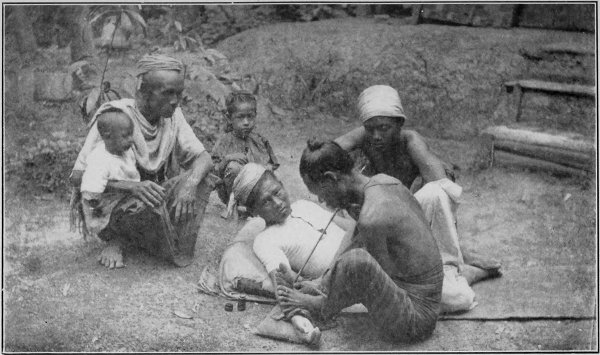
Tattooing
From courtship and marriage we pass by a natural transition to child-life in Burma. The crop of babies never fails. Parents would as soon think of failure of the rice harvest as of a failure to add annually to the population of the village, and the disappointment would be about the same. If nature did not defeat the barbarous methods of native midwives there would be no child-life to describe. But in spite of methods that would soon depopulate more civilized lands, every town and village is just romping full of children. Boys run naked until six or eight years of age, and girls until one or two. Many a time have I seen parents, wrapped in blankets, huddled around a fire in the cool season while their infants and small children had not the slightest protection. There is no intentional neglect, for the parents love their children, but it is "custom." This custom supplements the ignorance of the midwives, and adds to the number of shallow little graves in the adjacent jungle for the parish dogs to fight over. But baby has its cradle for its frequent naps. This is made of wood or wickerwork, and suspended from a bamboo in the floor or roof above. Sometimes this swinging cradle is a wide strip of cloth tied together at the ends, with the baby deposited in the loop. Baby has not long been in the world before it has a name. The name depends on the day of the week in which it was born. Certain letters of the alphabet are assigned to each day. The baby's name must begin with one of the letters assigned to its birthday. There is no family name, nothing to indicate to what particular family a child belongs. Each day of the week represents some planet, from which it takes its name. The planet assigned to a particular day will influence the life of a person born on that day, and determine his temperament. The naming is done when the baby is one month old. On the previous day invitations are sent around to the elders of the village, who by eating a pinch of pickled tea from a cup sent by the messenger,—accepts the invitation to be present at the ceremony, the parents make ready a supply of food, a feast being an essential part of every ceremony. Invited guests bring presents of money, precious stones, or jewels, which they cast into a large jar of water set there for the purpose. Some of the more valuable presents are merely lent for the occasion, but they help to make a show. When the guests have enjoyed their pickled tea, betel-nut, and cheroot, several of the elders proceed to bathe the baby in the vessel containing the presents. Another repeats a benediction calling for the continuous welfare of the child, but limits it to one hundred and twenty years. From the centre of a circle of coins on a dish of rice a cord of cotton thread is taken and bound around the child's wrist. One of the elders now announces the child's name,—previously decided on by the parents,—as if it were the happy result of his own meditations. This ceremony is to the Burman and Shan what a christening is to many in other lands, in its relation to a child's future. An interesting naming ceremony was held by two couples of native Christians, in my mission. The missionaries and native Christians were invited to a prayer-meeting. After the meeting a number of Old Testament names, written on slips of paper, were put in a hat borrowed from the missionary. The first fond father to put his hand into the hat drew for his offspring the name Daniel,—which he would pronounce Dan-ya-lah. The other father got Moses as a name for his son. Dan-ya-lah and Maw-shay they are to this day.
It is interesting to watch little children at their play. With sun-dried marbles, large seeds, or peculiarly-shaped sticks, plays have been improvised, which, in the course of years, have become national games for the youngsters. Boys and girls enjoy the sport together.
Before the English annexed the country the monasteries were the only schools. This is still the case in the majority of villages. But every Buddhist boy, whether he has the advantage of the English schools or not, must spend a few months in the monastery. Until he enters the monastery as a probationer he is not considered a human being in such a sense that it would count in future transmigrations. He now receives a new name, to be used so long as he remains in the monastery. If he finally becomes a priest he retains the religious name for life.
The novitiate-ceremony usually takes place when the boy is between ten and twelve years of age. If not already familiar with life in the monastery, he is taught how to address the priests, and conduct himself generally. As this is the most important event in a Burman boy's life, the ceremony is made on as grand a scale as the circumstances and credit of the boy's parents and friends will permit. Decked in gayest costume and covered with jewelry he is placed on a pony, or, in the towns, in the best vehicle obtainable, protected from the sun by a long-handled umbrella, and conducted to the homes of his relatives, to bid them farewell. Flashily dressed men and women, boys and girls make up the procession, some of the young men dancing and singing as they go. All this pomp and show, to celebrate renunciation of the world.
The farewells being said, the candidate is reconducted to his own home, where the feast has been prepared, and an elaborate bamboo tabernacle erected, extending from the house to the opposite side of the street. Here, in the presence of the priests, friends, and a host of gaudily-dressed spectators the actual ceremony is performed. The candidate's finery gives way to a strip of white cloth fastened around his loins, forming a very brief skirt. Then the barber is called in to deprive him of his long hair and shave his head. After a bath he dresses and presents himself before the priests, goes through the prescribed prostrations, repeats the memorized formula pledging himself as a novitiate, is duly clothed in the yellow robe of the order, the thabeit or begging-bowl is given him, and then he joins the other novitiates in their return to the monastery in which he is to live. How sad it seems to see a small boy thus shut out from the gay world, at just the time when he is fullest of fun and frolic,—but not half so sad as it seems.
Devout Buddhists may compel their sons to remain in the monastery three months, but to become a priest is not compulsory. In many places a week is the limit. Not infrequently a boy who has made the round of pathetic farewells, and gone through the whole ceremony of pledging himself to the Assembly, is back home again before night, having met all actual demands, and exchanged his fine head of hair for an interesting experience. And right glad he is to be back, for the feast is still on, and he comes in for a share of the dainties. Comparatively few give their lives to the priesthood. Some enter the priesthood later in life.
The longer the term—the greater the merit. The number of young men to remain in the monastery is steadily decreasing. The same is true of the number of men who thoroughly understand Buddhism. The festivities have not slackened, but with less and less religious significance in the minds of participants. Having been in the monastery the boy has become a human being. But whether before or after this ceremony he must receive the signs of manhood by being tattooed from his waist to his knees. If this is not done the boys and girls will poke fun at him and call him a woman. This tattooing may be done piece by piece, at intervals, to allow time for healing of the surface covered. The sessamum-oil lampblack used for ink, pricked into the skin on a large surface causes a great deal of swelling, and sometimes fever. The professional tattooer has his figure-patterns from which the boy or his parents may select.
The figures are usually animals, set off with an ornamental edging. Few boys have the nerve to endure the pricking very long. This is overcome by a dose of opium, deadening the sense of feeling, and dazing the mind, though not to such an extent as to keep him from puffing his cheroot while the operation is going on. Besides this tattooing of imitation breeches, there are many kinds of charms, done in vermilion on the upper parts of the body and arms, as desired by the superstitious.
Schoolboys have charms to protect them against the pain of whipping, young men have charms to make them successful in their wooing. Soldiers and dacoits have charms to protect them from bullets and dah-thrusts, and everybody has charms to render harmless all snake and insect bites. Besides the tattooed charms, certain objects are inserted under the skin, or carried about, according to the superstition of the individual, and representing about as high a type of intelligence as does the horseshoe over many a door in civilized lands.
The custom of tattooing is said to have originated many centuries ago, when the Burmans were subject to the Shan kings in Upper Burma. The Shans, who were themselves tattooed,—branded with tattoo-marks captives taken in war, as evidence of their servility. Instead of regarding this as humiliating, the Burmans were proud of their tattooing, as marks of the king. Moreover, the despised Chins, wild tribes in the north-western hills, did not tattoo. A non-tattooed Burman might be mistaken for a Chin, which would be humiliating indeed. Tattooing became popular, the custom spread rapidly, and now a full-grown Burman who is not the proud possessor of a pair of tattooed breeches that will last him a lifetime, is seldom found. In the jungle-villages nearly every boy is tattooed. In the towns the custom is rapidly dying out. Not five per cent. of Burman boys in the towns have submitted to this custom. Town boys are much more afraid of being taken for countrymen than of being made fun of for departing from the time-honoured custom. In fact, the town boy is as anxious to have it known that he is not tattooed as the unbreeched village boy would be to conceal it.
The fact that at the last census nine hundred and eighty six persons were returned as professional tattooers indicates that their business is still thriving, notwithstanding the disaffection of the town dudes.
The desire to ape English customs may have something to do with this backsliding. This is also noticeable in the habit, now popular among town boys, especially in the schools, of cutting the hair short. Only a few years ago a cropped head would have stamped one as a convict.
Girls are not tattooed except possibly an invisible love-charm,—but they furnish a companion-ceremony, when ear-boring time comes round.
It answers to the time when a girl in the home-land begins to think of getting out of short dresses, to be a child no longer.
When an ear-boring ceremony is announced everything else must take second place. The day and hour are fixed by the soothsayer, but he manages to make his divinations harmonize with the plans of the parents who engaged his services. In spite of the frightened girl's screams and struggles her ears are pierced with the gold or silver needle of the professional ear-borer, the tom-toms and horns of the band outside doing their best to drown her cries. The holes are kept open until they heal, and then they are gradually enlarged by wearing glass or metal tubes of increasing size, until finally a tube half an inch in diameter can be inserted. In the olden time the lobe of the ear was stretched much more than is now the fashion. I have seen old women with holes in their ears through which two fingers could be passed. Such ear-lobes furnished handy holders for their big cheroots. This stretching and elongating of the lobes of their ears formerly had a religious significance that is now being forgotten. All images of Gautama represent him with ear-lobes touching the shoulders, as a symbol of perfection.
Devout women,—and some of the men,—did their best to imitate his example. Ear jewelry may be inexpensive colored glass, or of gold elaborately designed and set with precious stones.
Once her ears are bored the girl puts an end to all street play with small-boy acquaintances, and poses as a young lady. Changes are observed in the style of dressing her hair; in her costume; in the use of cosmetics,—for every Burmese girl, though naturally brown, desires to be white; in her bearing as she walks the street; in every pose of her graceful body. She may not have so much freedom of action as she enjoyed before, but she knows it will not be long until some choice young man will want her, to adorn his household.
The one universal custom, common to all, both men and women, boys and girls alike, is the filthy habit of kun-chewing and smoking. The kun-chew is made up of part of a betel (areca) nut, chopped fine, and an astringent green leaf of a certain vine. A little lime-paste, usually coloured red, is spread on the leaf, then it is wadded up and jammed into the side of the mouth, with the betel nut. Saliva soon accumulates. To expectorate would be to lose some of the small pieces of the nut before the good had been extracted. Attempts at conversation are ridiculous and nauseating in the extreme. When the mouth can retain its load no longer its contents are discharged through a crack in the floor.
The white pony of a lady-missionary was once tethered under a native house for the night. What was the lady's disgust the next morning to find her beautiful pony all stained and bedaubed with vile red kun-juice. Smoking is begun before teething is finished. I myself have seen a mother take a lighted cheroot from her own mouth, and put it in the mouth of a wee child in her arms. Burmese ladies consider a cigar the finishing touch to their preparations for a dress-parade. But the Burman cigar contains but a small proportion of real tobacco leaf, otherwise the smoke-habit would soon kill off the race. They cannot both chew and smoke at the same time, but the twin habits keep them so busy that they accomplish little else. It is said that the Burman "smokes between chews, and chews between smokes."
It is simply marvellous how far a Burman can smell a rupee, and what methods he will employ to get it. Has the mission work to be done by carpenters, cartmen, etc., heathen Burmans are not wanting who will regularly attend chapel services, and pose as devout inquirers so long as the job lasts. I have known fortune-tellers, teachers, court-clerks, and common rice-cultivators to become pretended disciples with no other motive than to become preachers. They know that the native evangelists have regular salaries, and that the missionary takes a fatherly interest in their welfare, giving medicine when they are ill, advising when they are in difficulty. Though the salary is not large, it secures a fairly comfortable living, which is more than many a heathen is sure of the year round. So the wily heathen comes to our people, pretending to be deeply interested in Christianity, applies himself to learn all he can, attends worship, and finally asks for baptism, with every appearance of sincerity. One year we drew a prize, "Saya Tike" he was called. "Saya" because he had charge of a small private school. He was past middle age, of uncommon intelligence, and fine bearing. A more earnest and devout inquirer, to all appearances, we never met. After some months of waiting he was baptized and received into the church. Then began his tale of woe. In consequence of his becoming a Christian his school had been broken up. Persecutors had broken into his house and stolen his clothing. Friendless, penniless, and out of a situation, he appealed to the missionary for something to do. Being fairly handy as a carpenter he was given such work on the mission buildings. After about two weeks he suddenly disappeared. Some weeks passed before we could get any clue to his whereabouts. Then one day one of our preachers met him in a jungle-village wearing the yellow robe of a Buddhist priest. When asked why he had left the mission he complained that instead of being employed as a teacher he had only carpenter work to do. He preferred being a "pongyi," and have his food given him. Some months later he again turned up at the mission, professing repentance for his backsliding, and asking to be received back again. Our faith in him had been badly shaken, but we tried not to show it. If we would only give him citizen's clothing in place of his yellow robe he would gladly go to work again. Giving him the benefit of a doubt I arranged with my right-hand man to give him a longyi, such as the other men were wearing. No, he did not like a longyi, but must have the more stylish puhso. His taste not being gratified, back he went again to his heathenism. We soon learned that all his pathetic stories of persecution had been trumped up for the occasion, to excite our sympathy, and secure a position.
One day a strange Burman came to the mission. He said that he was a Christian from a mission fifty miles away. On the train he had been robbed of his clothing and the little money he had. All he wanted was to be kept over night, and money enough to pay his way home. The case was referred to me. I placed the required sum in the hands of my man "Friday" with instructions to give it to the applicant should he prove worthy. The next morning my man came to report, and to give back the money. I said to him, "Well, Ko Ngi, how did you find out that he was a humbug?" Replying in broken English, he said "Last night we have meeting (evening prayers). I think, you proper Christian, I make you pray. He no know anything. He can't pray proper. Then I say—Your Saya (missionary) how many chillen? He say 'Four little boy, so much big.' I know he Saya done got five chillen,—one so much girl," indicating with hand a full grown young lady. So he had sent the man away without the hand of fellowship, and returned the money.
Among non-Christian Burmans sin, of whatever sort, is sin only when discovered. "How could it be sin when nobody knew anything about it?" Deceit is practiced without a pang of conscience so long as the game can be worked.
The missionary is kind-hearted, supposed to have plenty of money, like other "Europeans," and is considered legitimate prey.