V BUDDHISM AS IT IS
Reading edition
Much has been written on Buddhism, besides the translation of the Buddhist's sacred books. Little, however, can be learned from books of Buddhism as one finds it expressed in the life of the people.
Riding one day with a missionary who had a wide acquaintance with the Burmans and their language, I asked him certain questions as to their real belief. His reply was, "No man can tell, until he finds a way to get into the Burman mind." The first business of the missionary seemed to be then to make every effort to get into the Burman mind; to study him; study his religious habits; ascertain if possible, his point of view; learn to see things from his point of view; to know what there is in him that must be eradicated and supplanted by the gospel of Jesus Christ. We see the country fairly alive;—no, dead with idols. We see the people kneeling before these idols, and, to every appearance praying. Are they praying? How can they be praying, inasmuch as Buddhism knows no God,—does not claim to have a God? Gautama himself whom all these images represent, never claimed to have any power to save others, or even to save himself. These worshippers know that he was only a man, that at the age of eighty years he died, that his death was due to an attack of indigestion (from eating too much fresh pork), as any other man might die. It is supposed that he was born near Benares, about six hundred years before Christ; that his father was a chief of an Aryan tribe called the Sakyas. From the sacred books they learn that Gautama's early life was spent in dissolute pleasure and luxury common to oriental princes; that after a time becoming dissatisfied with his own manner of life and the corrupt conditions around him, he yielded to another his princely prospects, abandoned his wife and child and gave himself up to a life of meditation and study under religious teachers; that failing in this to gain the longed-for peace of soul he for several years led a life of the most severe privation and affliction of the flesh, until by long continued meditation and self-concentration the light broke in upon him, and he became "the enlightened one,"—a Buddha. Did he not by this enlightenment become something more than man? Not at all. He had learned nothing of God, not even that such a being existed. He entertained no thought that he himself had acquired any supernatural character or power. And so he died. Even the common people of the jungle villages know all this, and yet they prostrate themselves before these images of brass, wood, or stone. Are they praying? Perchance their hopes are based on what Gautama became, after death. According to Buddhism, Gautama had now passed through all the necessary conditions and changes, and entered at once upon the final state, the highest goal of Buddhism, Nirvana, ("Neikban," in Burmese).
Had he now become a God? Not at all. No Buddhist entertains such a thought. What then is Neikban? "It means," they say, "the going out, like the flame of a candle." By a long-continued process of self-concentration Gautama is supposed to have become absolutely oblivious to the world around him, and ultimately to have become unconscious even of self. His death is believed to have been utter extinction of both physical and spiritual existence. Some deny that Neikban is equivalent to annihilation. The best that can be claimed for it is an impossible existence in which there is neither sensation nor conscious life.
Fittingly they describe it as "a flame which has been blown out."
According to Buddhist teachings and current belief Gautama has disappeared, body and soul. Brahmins may talk of being absorbed in the "One Supreme Soul," and Theosophists glibly repeat the form of words, but Buddhists claim nothing of the sort. There is no Supreme Soul to absorb them, and no human souls to be absorbed. It is not soul, or life that is perpetuated, but desire merely. Neikban, they declare, is the cessation of everything, a condition of unconsciousness, lifeless ease, they do not like to say annihilation. Then what are these worshippers doing here on their knees before images which represent no existing being? surely not praying, for they have "no hope, without God in the world"; no being higher than themselves to whom prayer could be addressed; no expectation of blessing of any sort from any supernatural source; absolutely nothing in their religious conceptions or experience corresponding to the communion between the Christian and his God.
There is no such thing as real prayer in the whole Buddhist system. What, then, are they doing? Here comes in the system of "merit" on which Buddhism is built. An instinctive sense of guilt and impending penalty is universal. Having no Saviour—man must save himself.
From what? Not from sin, as violation of the laws of a Holy Being, but from their train of evil consequences to himself.
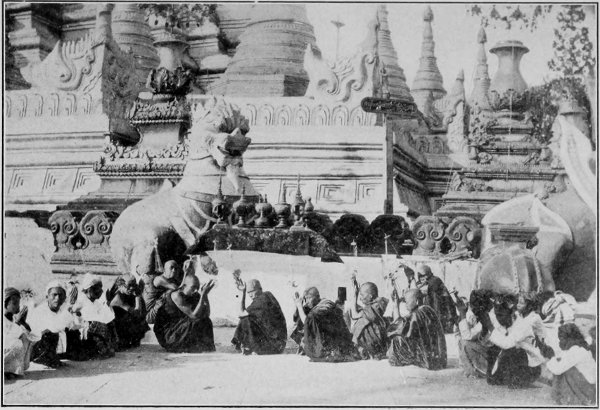
Worshipers
The chief tenets of Buddhism are: (1) Misery is the inevitable consequence of existence. (2) Misery has its source in desire. (3) Misery can be escaped only by the extinction of desire. (4) Desire can be extinguished only by becoming wholly unconscious of the world and of self. (5) He who attains to such unconsciousness attains to Neikban. (6) Evil actions constitute demerit. Good actions constitute merit.
In this deeply grounded belief as to merit and demerit lies the secret of much that we see in the life of the people. Now we know what these people are doing,—they are seeking to accumulate merit by repeating over and over again a certain formula, or portions of their "Law" with their faces towards the,—to them,—sacred pagoda or idol.
But no Buddhist expects to attain to Neikban at the end of this existence. He realizes that it is utterly hopeless for him to think of fulfilling the conditions. But he cherishes the groundless hope that in some future existence under more favourable conditions he may be able to accumulate sufficient merit, though he cannot now. This belief presupposes the doctrine of transmigration, or metempsychosis.
The Buddhist believes that he has passed through countless existences in the past,—whether as man, animal, or insect, or all many times over, he knows not; finally, birth into this world as man. He dies only to be reborn into this or another world,—whether as man, animal, or insect he knows not; then death again, and so through countless ages. Even Gautama himself is said to have passed through five hundred and fifty different phases of existence, including long ages in hell, before he finally entered this world as man, and became a Buddha.
Although Buddhism has no God, and no heaven, it has a very vivid conception of hell, yes,—eight of them, surrounded by over forty thousand lesser hells,—their terrors limited only by the limitations of the imagination. But no man can escape—the doctrine of Karma settles that. A man's own words and deeds pursue him relentlessly, and there is no city of refuge to which he may flee. "Not in the heavens, not in the midst of the sea, not if thou hidest thyself in the clefts of the mountains, will thou find a place where thou mayest escape the force of thy own evil actions." So say their scriptures, and so every Buddhist believes. Hell is the inevitable penalty of many deeds or accidents, such as the killing of the smallest insect under foot. Between the Buddhist and his hopeless hope of Neikban yawns this awful gulf of existences and sufferings.
"Whatsoever a man soweth, that shall he also reap," gives the gist of Buddhism. He is now reaping from past existences; he will reap in the next from his deeds in this. In the past each succeeding existence depended upon the last previous existence. In like manner, what the next existence shall be depends wholly upon the deeds of this life.
So the countless series of transmigrations may be, theoretically, in the ascending or descending scale. But when the awful penalties assigned to innumerable and unavoidable violations of the Buddhist law are taken into consideration all hope of future existences in the ascending scale vanishes. The poor fisherman, beginning at the very bottom of the lowest of the four chief hells must spend countless ages in each, before he can hope to be reborn as man.
The man who unwittingly puts his foot on the smallest insect and crushes out its life must atone for the deed by spending a long period in torment. Taking the life of any living thing, even to the killing of poisonous snakes, is held to be the worst of all sins. The priests, to avoid the possibility of destroying insect life, use a brass strainer finely perforated, to cleanse their drinking water, in blissful ignorance of the microbe theory. A native preacher once asked me to get him a microscope so that he might prove to the priests that notwithstanding their precautions they were drinking to themselves perdition.
His motive may have been in part, to convince them as to the futility of their hope, and in part to get even with them for their harsh criticisms of "animal-killing Christians."
A story told by one of our native preachers vividly illustrates this dread of future punishment. "I had been preaching for about two hours to a large company in a jungle-village. During all this time an old woman was sitting on a log near by, counting off her beads, and devoutly murmuring to herself the customary formula, 'Ah-nas-sa, Dok-ka, Ah-nat-ta; Paya, Taya, Thinga,—Radana Thón-ba'—'Transitoriness, Misery, Illusions; Lord, Law, Priest,—the three Jewels.' When I had finished I approached her saying: 'Why do you worship so devoutly?' 'To escape the penalty of hell,' she sadly replied. 'So you fear the future,—what is your notion of hell?' 'Oh, it is a terrible place. They say it is shaped like a great cauldron, and full of burning oil in which people suffer endlessly and are not consumed. And when they try to escape, the evil beings of the place thrust them back with sharp forks and spears. Oh, it is a terrible place!' she repeated, fairly trembling as she described its horrors. 'Yes,' I said. 'You seem to understand it very well. Now what are you doing to escape such an awful fate?' 'Oh, many, many years I have worshipped before the pagodas and idols; every day I count my beads over and over, repeating the formula, as Gautama directed. Do you think that after all I have done I must still go to hell?' 'Yes,' I said. 'If that is all you have done, you surely must.' 'Oh, then, tell me,' she said in great distress, 'what can I do to escape, for I greatly fear the terrors of that place.' Then sitting there on the log, with this poor old woman on the ground before me, I told the blessed gospel story over again, as Jesus Christ did with the woman of Samaria. And then I said: 'You must repent of your sins, and confess them to the eternal God. You must believe and trust the Lord Jesus Christ, who died to save you. If you do this He will forgive your sins, and save you.' Her wrinkled face brightened with hope as she exclaimed, 'If I do as you have said, and believe on Jesus Christ, will He save me?' 'Yes, He surely will, for He has said, "Him that Cometh unto me I will not cast out."' On her face was an almost heavenly light—as she replied: 'Then I do believe, and I want to go with you that you may tell me about Him until I die.' Her friends ridiculed her saying, 'Oho! Grandma wants to go off with the preacher. She is becoming foolish in her old age.' 'Oh, no,' she said. 'But the preacher has told me how I may escape the penalty of hell, and I am so glad.'"
It has often been asserted that Buddhism has a moral code rivaling, if not superior to that of Christianity. We had not been at our mission station a week before we heard the remark, "Buddhism is a beautiful religion,—why do the missionaries try to disturb them in their belief?" That there are noble precepts and commandments all must admit. But he who expects to see their "beauty" reflected in the lives of the people will be doomed to disappointment. Take the commandment already noticed—"Thou shalt not take the life of any living thing."
This commandment admits of no exceptions whatever, under any possible circumstances, not even in self-defense; and puts the taking of a human life and that of the smallest insect in the same category. But the Burmans, among whom Buddhism is found in its purest form, have been a more or less warlike race from their earliest history, often practicing the greatest cruelties. How do they reconcile this with the teachings of their law? We will suppose that one man has taken the life of another. According to his own belief and the law of the land, he is a murderer. To free himself from just and inevitable penalty he resorts to his doctrine of "merit," by which he may absolve himself from the demerit of his evil act. The building of a small pagoda of sun-dried brick, or the forming of an idol from a portion of his fire-wood log will balance the scales, square the account, restore him to his former prospects, and to future prospects as bright as though he had kept the whole law. By this convenient belief he may take his absolution into his own hands, and work it out to suit himself. But if he be a poor man, unable to perform an adequate work of merit, he must suffer to the full the consequences of his act.
A missionary found a man digging for huge beetles. When one was found it was impaled on a sharp stick along with the others, all to go into the curry for the morning meal. Then the following conversation took place: "Are you not afraid of punishment in hell for killing these creatures?" "I shall go there if I do not kill them." "Then you do this because there is no hope for you, whether you take animal life or not?" "It is all the same." Sins beyond his power to counterbalance by merit had already been committed, until hope had given way to despair.
One may shoot pigeons in the vicinity of a Buddhist monastery, and then divide with the priest, who anticipates a savoury meal without any compunctions of conscience on account of "aiding and abetting."
Young Burmans are eager to follow the man with the gun, showing him the likeliest place to find game, and when the animal is wounded, will rush in and dispatch it with their dahs.
The fisheries of Burma furnish a livelihood to hundreds of Burmans. Large sums are paid to government annually for the privilege of controlling certain specified sections of rivers or streams. The fisherman makes the taking of animal-life his business and daily occupation.
Theoretically he is ranked among the very lowest classes. In real life we find him enjoying the same social position that others of equal wealth enjoy. But I do not hesitate to say that this general belief that fearful penalties must be endured in future existences for taking animal-life in this, has a deeper hold on the Buddhist than any other commandment.
Take the commandment: "Thou shalt speak no false word,"—strikingly like the Christian's commandment, "Thou shalt not bear false witness," "Lie not one to another." One would naturally expect to find among the devotees of a system containing such a commandment some value placed upon one's word of honour. But if truthfulness has ever been discovered among non-Christian Burmans, the discovery has never been reported. But we have not far to search to find the secret of this general lack of any regard for truthfulness.
The same "Sacred Book" that sets forth the commandment, "Thou thalt speak no false word," gives this definition of falsehood: A statement constitutes a lie when discovered by the person to whom it is told, to be untrue! See what latitude such a definition gives. Deceit is at a premium. Children grow up with no higher standard of honour than a belief that the sin of falsehood and fraud lies entirely in its discovery. Is it any wonder that these people have become expert in the art. It is the common practice among themselves,—in business, in family life, in match-making, and most of all, in their dealings with foreigners. No European (after the first year) places the slightest reliance upon the most emphatic promise of a heathen Burman. In fact, the more emphatic the promise, the greater seems to be the temptation to do just the other thing. It may have been this inbred trait that led the schoolboy to translate "Judge not, that ye be not judged," by "Do no justice, lest justice be done to you."
When it is remembered that deceit and fraud are national vices, bred in the bone for centuries, it is not to be marvelled at that native Christians, only a step from heathenism, are sometimes found deficient in their sense of honour. Here is an illustration in point. A young Burman wanted to become a Christian. He became a regular attendant at chapel services, and finally asked for baptism. This greatly enraged his heathen wife, who proceeded to make his life most miserable. She tore around, screamed, pulled her own hair, and made things interesting generally. She got possession of his box containing his best clothing and other valuables, and would neither give it back to him nor live any longer with him unless he would promise to break with the Christians, and cease attending their worship. The young man appealed to his uncle. The uncle's advice was: "You go and tell your wife that you will have nothing more to do with the Christians. You cannot recover your property in any other way. When you have regained possession of your box, come back to us, and then we will baptize you." So far as he then knew, the end justified the means. Take the commandment: "Thou shalt commit no immoral act,"—an ideal precept in itself, but standing for little more than a joke when inscribed on the banner of any non-Christian people. The Burman is perhaps superior, morally, to some other races of this country, yet his moral sense is very low. Among middle-aged people marriage seems to be an actual institution, and family life well guarded. Separations are comparatively few. Conditions of life in the tropics are such that the young are subject to temptations sad to contemplate. Heathen parents freely discuss subjects in the presence of their children that never would be mentioned before them in a Christian home. Missionaries' children often startle their parents by repeating what never should have come to their ears. It seems a wonder that moral character exists at all among the young. That many do set a high value upon virtue no unprejudiced observer of native life can doubt. Jealousy plays a large part in early separations, and with sufficient cause. Both may find other partners of their joys on the day following.
Among all races there are certain laws and social customs that in large measure restrain evil practices. Even among the heathen a certain value is placed upon one's social standing in the community,—which has greater weight than the commandment against immorality, in his "law." An educated Burman once said to me—"Burmans do not take much account of sin, but they do not like to lose their respectability."
Other commandments, such as those directed against "love of the world," and "love of money," seem to be honoured more in the breach than in the observance. The Burmans are notoriously the proudest, gayest people on the face of the earth. They enjoy a good time and will have it, whatever the occasion. There is little of real religious significance in their so-called religious gatherings. A display of fine clothes, a few presents for the priests; some of the more devout, especially the elderly women, worshipping before the shrine. But a large majority will be found sitting in the "zayats" talking familiarly among themselves, painting the ground below red with kun-juice by spitting through cracks in the floor, and never going near the pagodas or idols at all. The Buddhists are proud of their "law," and lay great stress upon it for purposes of argument. But as we have seen, either from their low moral sense, or their dependence on works of merit, the "law" has little effect on the lives of the people.
We visited that most famous worship-place of the Buddhists, the Shwe Dagon pagoda, and for the first time saw heathenism as it is. We had read "The Light of Asia"; and heard theosophists talk glibly of "Mahatmas" whose wisdom is more ancient and profound than anything in the religious literature of the West.
But here we saw the yellow-robed, "Light of Asia" (more fittingly called the "Blight of Asia") and the graven image, both representing their annihilated Buddha, seemingly equal in intelligence, and sharing together the superstitious worship of the common people. Up the long ascent to the pagoda is a covered way, its brick or flagged steps hollowed out by the tramp, tramp of thousands on thousands of barefooted worshippers, extending over many, many years.
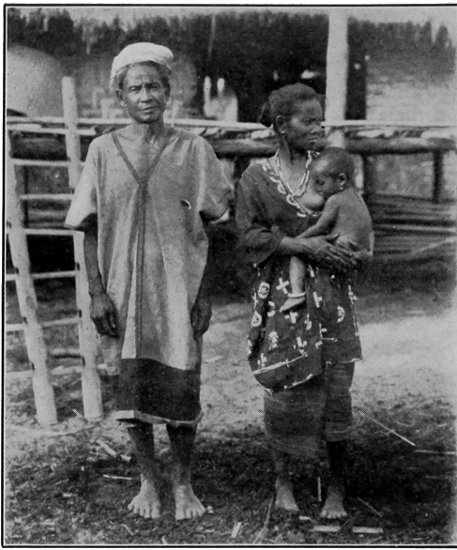
A Karen Family
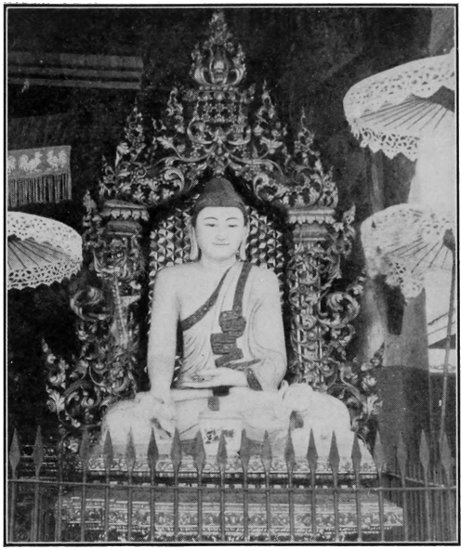
Buddhist Idol
Guarding the approach are two horrible griffins, the first suggestion of the superstitious mind of these benighted people. On either side of the stairway are sellers of artificial flowers, paper streamers, candles, and other things used as offerings, each worshipper stopping to invest in whatever he thinks will gain for him the greatest amount of merit at the least possible cost. This great pagoda itself 1,350 feet in circumference, tapering in graceful curves to a height of 328 feet, is entirely covered with gold leaf. It is said that the pagoda has been regilded several times, at fabulous cost. But this does not seem so wonderful when one recalls that the Parliament of Religions witnessed the regilding of the entire Buddhist system.
This lofty spire is surmounted by a htee or umbrella ornamented with gems and gold said to be valued at about $200,000. The htee has been renewed several times, by different kings, each striving to outdo all others. The present htee was placed there in 1871, by Mindon Min. The space around the base of the pagoda, protected by a parapet, and flagged with stone or cement, accommodates a large throng of worshippers. Hither pilgrimages are made every year from all parts of Burma. Besides the four large idols built into the base of the pagoda far out of sight, as in all pagodas, there are many auxiliary shrines deeply recessed into the base, dimly lighted by tiny candles, and containing gilded or alabaster images of Gautama. Still other shrines have been erected at the outer circumference of the floor space. Huge bells are suspended between posts, near the floor.
The largest, cast in 1842, is fourteen feet high, seven and a half in diameter, with sides fifteen inches in thickness, weighs 94,682 pounds. It is said that when this bell was cast, quantities of gold, silver and copper were thrown in as offerings. After the second Burmese war, the English undertook to carry this bell away as a curio, but by some accident it fell into the river. The Burmans afterwards recovered it and put it again in its place,—a marvellous feat, considering their rude appliances.
Intensely interesting is all this when seen for the first time; but inexpressibly saddening when one stops to reflect what it all stands for. One is forcibly reminded of its terrible significance by groups of worshippers kneeling before these shrines, mumbling hurriedly through their so-called prayers, prostrating themselves repeatedly to the ground. After going through his prayers and prostrations the worshipper goes to the bell and strikes it with the end of a heavy piece of wood, kept there for the purpose. The attention of gods and men must be called to the fact that he has performed a certain amount of merit-earning worship. "Thou shalt have no other gods before me. Thou shalt not make unto thee any graven image nor any likeness of anything that is in heaven above or that is in the earth beneath; thou shalt not bow down to them nor serve them." What new meaning that commandment had for us, as we saw it violated before our eyes! Idolatry seemed even darker than it had been painted.
Pagodas may be seen all over Burma, single or in groups; of all sizes from the less pretentious structure in the jungle-village, to the great Shwe Dagon in Rangoon, with its umbrella-top 328 feet in the air. These pagodas, modelled after the dagobas of Ceylon, are all of the same general shape, resembling the bottom half of a child's top, inverted. They occupy the most conspicuous places, on nearly every hilltop, on points jutting out into the rivers, and near the chief highways. The more important were built over some supposed relic of Gautama, such as a tooth or a hair. These pagodas are considered much more sacred than those that were built for merit only.
The Shwe Dagon pagoda, most famous of all Buddhist shrines, is said to have been built over relics of four Buddhas, including eight hairs of Gautama. The Shwe Hmaw Daw pagoda at Pegu, erected by the Talaings, claims a tooth of Gautama. The Shwe San Daw pagoda at Toungoo has a different history. A Burman prince, Tabin Shwe' Htee, when born had one long red hair standing out from the top of his head. This was a sure indication of an embryonic Buddha. In his honour the great pagoda was erected, and called the "Golden Hair Pagoda." The Maha Myat Moonee pagoda at Mandalay, commonly known as the "Arracan Pagoda" is second only to the Shwe Dagon, in the esteem of Upper Burmans. In a. d., 146, the King of Arracan cast a great brass image of Gautama, which became famous for its supposed miraculous powers. In a. d., 1784, the king of Burma, having conquered other parts of the country, and secured about everything he wanted, turned longing eyes towards Arracan and the far-famed image. This great image, twelve feet high, though cast in a sitting posture,—was brought over the mountains and deposited at the Arracan pagoda in a large building specially prepared for it, north of Amarapura. Not a smile disturbs the settled calm on its face as the visitor reads the inscription setting forth that the image was drawn here by the "charm of the king's piety." But from other sources we learn that his piety found expression in a war of conquest, of which this image was one of the coveted fruits. Its importation over the mountains was a wonderful feat. Little wonder that Burmans think it was accomplished by supernatural help.
A few miles north of Mandalay is the great Mingon pagoda, begun in 1790, and never finished. It is four hundred feet square at the base, and was to have been carried up to a height of five hundred feet, but work was suspended when it had reached about one third of its intended height, the country already having become seriously impoverished.
In 1839 an earthquake split it from top to bottom. No one mourned the seeming disaster, for no king could gain the "royal merit" by completing the work of another. As it is, this Mingon pagoda is said to be the largest pile of brick and mortar in the world.
The largest bell in Burma, weighing between eighty and ninety tons, and second in size to the great bell at Moscow, cast to match the immense pagoda, is still to be seen near the ruins. This bell is eighteen feet high, seventeen in diameter, and a foot and a half in thickness. It now rests on the ground, having long ago proved too heavy for its supports.
Pagodas are not temples. There is no open interior for a worship place. The worshipping is done in the open space around the pagoda, or in the idol-houses, the real temples.
The first pagoda was probably built at the close of the fourth century or even later; though Buddhists refer it to a much earlier date. The sacred books of Buddhism were brought to Burma about 397 a. d., according to the best authorities.
Before the introduction of Buddhism the Burmans and Talaings, like all other races around them, were spirit-worshippers. They knew no gods but nats, spirits with supernatural powers. The reigning king became a convert to the new religion, built a pagoda, and issued a royal decree that all his subjects should worship it, death being the penalty of refusal. The king's edict failing to accomplish its purpose, he cunningly commanded that a nat-sin or spirit-house be built near the pagoda. The transition from the worship of invisible nats to the worship of the more tangible pagoda was natural and inevitable.
"It was by a strange irony of fate," says Sir Monier Williams, "that the man who denied any God or any being higher than himself, and told his followers to look to themselves for salvation, should have been not only deified and worshipped, but represented by more images than any other being ever idolized in any part of the world."
Dharmapala, who represented Buddhism at the Parliament of Religions, said: "A system in which our whole being, past, and present, and to come, depends on ourselves, theoretically, leaves little room for the interference or even existence of a personal God." It really leaves no room at all, and its founder plainly said so. Buddhism is a worship of ancestors, of which Gautama holds a monopoly.
As we have seen, at the advent of Buddhism the worship of evil spirits, by propitiatory sacrifice, prevailed throughout Burma, among all races. It is not to be supposed that the adoption of Buddhism dispelled these superstitions. Spirit-worship is still the religion, if it can be called a religion,—of the non-Christian Karens, Chins, Kachins, and other non-Buddhist races. When Buddhism was adopted by the Talaings, Burmans, and Shans, bloody sacrifice involving the taking of animal-life, had to be abandoned. But to this day propitiatory offerings of rice, fruit, or flowers, are made to the spirits as before. "Animism supplies the solid constituents," says a recent writer, "that hold the faith together, Buddhism the superficial polish. The Burman has added to his Animism just so much of Buddhism as suits him, and with infantile inconsequence draws solace from each in turn." Spirit-worship is his every-day religion, Buddhism for special occasions. Two illustrations will suffice to show how strong a hold superstition still has upon the people. A harmless lunatic had wandered through the streets for years. No one seemed to know the cause, but his reason, what little he ever possessed, had been dethroned, leaving him to wander about homeless and friendless. For his living he had to compete with the pariah dogs in the common effort to exist on what the people chanced to cast into the street after finishing their meals. One of the priests, thinking to gain notoriety as well as more substantial favours, declared that this man was a case of demoniacal possession. This was nothing new, for it is the common belief that nats are responsible for disordered minds, sickness, and other calamities. But the priest further suggested that the nat that had taken up his abode in this man be exorcised by drowning him out. A company of Burmans assembled, secured the demoniac, and headed by the priest and tom-toms, proceeded to the river. The poor demoniac, filthy, naked and with matted hair,—a picture of abject helplessness,—was led by a rope to,—he knew not what. Several of the men took the poor creature in a boat to the middle of the river, and threw him overboard. When he tried to regain the boat they thrust him off with their bamboo poles. When he became exhausted and water-logged they would rescue him, only to throw him in again after a brief breathing spell. This was repeated for several days in the presence of the would-be wonder-worker, to the deafening sound of the tom-toms. It is needless to add that he continued to roam the streets, in the same condition as before. At one time when out on a tour among jungle-villages a native Christian called my attention to a large banyan-tree by the roadside. Up on one of the higher branches was a large gnarl, which, by a long stretch of the imagination slightly resembled a human face. The tree was standing there before the oldest inhabitant was born.
The gnarl was a peculiar growth of many years. One day a passer-by noticed a fancied resemblance to a human face, and spread the story that the tree was haunted,—that it was the abode of a nat. Of course the superstitious and gullible people believed it. A zayat was quickly built under the tree; many brought offerings of rice, fruit, and flowers, and all who passed by that tree bowed down to worship that big knot on the limb. The dread of evil spirits is the bane of existence. There is constant fear lest some real or fancied lack of respect paid to the nats will bring some kind of disaster.
Nagas are the most feared of all. There are several different kinds of nagas. Some live under water, others on land. They are dragon-like reptiles, "fearsome" and terribly dreaded by old and young. When a man is drowning it is because a naga is drawing him down. Does a man sink and not reappear, a naga has got him sure. On-lookers fear to go to the rescue. But there is one great naga, most dreaded of all, so long that it encircles the earth, which to the native mind, is as flat as a pancake. This monster is constantly moving forward, so that the position of its head is ever changing. But fortunately the astrologers have discovered that its progress in its orbit is regular, and the location of its head may be known, according to season of the year, a full year being required for the circuit. Every Burman knows in what direction is the awful naga's head at a given season. No love nor money will tempt them to travel through the jungle in that direction, in unfamiliar territory.
Naga-worship once prevailed in northern India. Whether imported into Burma, or also existing in Burma before the introduction of Indian influences in the north, is not known. But up to the eleventh century naga-worship was the most conspicuous feature in the observances of both spirit-worshippers and nominal Buddhists. Even now it is not uncommon to hear a Burman, suffering from some calamity or disease, lamenting that he has in some way brought disaster to himself by unwillingly offending the great naga. Once it was my good fortune to profit by their superstitious notions. Having rented a native house as temporary quarters, I learned soon after moving in, that it had the reputation of being haunted. Spirits of certain "dacoits" who came to a sudden death in a jail that formerly stood near by, were supposed to frequent the place. From that time on I could sleep in perfect security against all thought of prowling thieves. No fear that any native would come near that house after dark. Buddhism a "Beautiful Religion"? That it has many noble precepts no one will deny. The same is true of every system of philosophy ever formulated. But at its best it furnishes no incentive to righteous living, beyond one's own self-interest. It offers no help or hope whatever, beyond one's own unaided efforts. If man cannot save himself he must stay where he is, or be sinking lower, ever lower.
Buddhism, as seen in the life of the people, is rotten to the core. We have seen how its adherents craftily seek to evade the precepts and commandments of their "law," so far as possible; and then to balance their evil doings by works of merit. The priests prey upon the superstitions of their people, and grow fat. If offerings to the monastery do not come in so freely as desired the wily priest conveniently has a remarkable dream, in which a nat reveals to him that terrible calamities will befall the people if they do not increase their zeal.
This invariably has the desired effect. There is a general hustling throughout the jurisdiction of the monastery; and soon the greedy priests are fairly swamped with presents of plantains, rice, cocoanuts, etc.
At Kyankse there is a very steep hill, with several pagodas at the top. A missionary relates that he there "met an aged man who, to gain merit, climbs to the summit every day carrying two pots of water (about seventy pounds) for the use of the people who may come to worship there. He had a writing from the Buddhist priest, assuring him that a Buddha was about to appear, and if he continued in this meritorious work for seven years he would see the Buddha, and be rewarded."
The priest, in order to secure a regular supply of water, had deliberately duped this simple old man. And yet, as a work of merit, his daily task had a certain value, according to Buddhist teaching.
The utter powerlessness of Buddhism to meet the needs of the human heart forced itself upon me when first I witnessed one of their funerals.
A rich Burman jeweller, living near our chapel, died of old age. One of his sons occupied a high official position. Of course the funeral must be a grand affair. We reached the place just as the procession was forming. First, there were four men bearing a bamboo frame on which was an artificial tree, four feet high, its branches wound with bright coloured paper. From the ends of the branches silver coins wrapped in paper, were suspended. This money was to buy offerings for the pagodas. Fifty-six men in squads of four, carried bamboo frames on which were piled gifts for the priests, consisting of mats, rugs, chinaware, lacquered-ware, lamps, etc. There were fourteen of these frames, being one each for fourteen priests. Four coolies, each carrying on his shoulder a bamboo pole from which were suspended jackets and skirts to be given to the poor. A double line of men with slender strips of bamboo covered with showy paper, held upright like so many spears. Then came the procession proper, headed by one of the rich relations carrying a lacquer vessel filled with copper coin. Four coolies carrying two Burmese drums, suspended from bamboo poles. Two little boys fantastically dressed, danced before the drums, turning around in a solemn, but graceful manner, and at each turn striking the drums with their fists.
Then the mourners and friends, two daughters being dressed in white, with handkerchiefs tied round their heads as hair-bands. The coffin, covered with gold leaf, tinsel, and mirror glass, was elevated on a framework, about ten feet above the four-wheeled cart on which the framework rested. Above the coffin were several roof-like projections, one above another forming a pyramid, surmounted by a spire twenty feet high. Framework and spire were covered with showy paper and tinsel in artistic designs, and adorned with flags. The cart was drawn and pushed along by as many men as could get around it, long streamers of white cloth or ropes extending forward to the friends in front. Next to the bier was an ox-cart with the Burman band, or tom-toms. One man was blowing on an instrument resembling a large-mouthed flageolet, from which issued a tuneless succession of weird sounds,—music to their ears, no doubt,—but most melancholy to ours. Another was sitting inside of a low circular frame with small drums arranged in a semicircle, each producing a different sound. Behind the cart was a man with the cymbals, which he manipulated with marvellous skill, though the vibratory sounds and clangour were excruciating in the extreme to sensitive nerves. On another cart, under a canopy of red and white cloth was another coffin more elaborately decorated, but empty, merely for pomp and show, or to fool the evil spirits. If in the extra coffin the consequences of a man's evil deeds, together with desire, which constitutes the germ of the next existence, could also be buried, it would be the ne plus ultra of hope to the Buddhist.
Then followed several "gharries" with well-to-do acquaintances of the family. As the procession moved slowly along the man with the pot of copper coin now and then threw a handful forward into the crowd of poor children, and oh what a scramble! The priests had already gathered at the "zayat" in the cemetery to receive the expected offerings. Had they been present at the bedside to minister some hope to the dying man who was about to pass out into the awful dark? Not at all, for the priest is supposed to be passing through the process of crushing out all natural feeling. He must not show that he is influenced in the least by death-bed scenes. Did they minister consolation to the sorrowing ones? Not at all, for the priest is not supposed to feel the least sympathy with sorrow and distress. To "Rejoice with them that rejoice, and weep with them that weep" is not in all his thoughts. He came not to minister, but to be ministered unto,—a complete reversal of the Christian principle. So at the funeral he offers no consolation, but expects to be himself consoled, very substantially. At the cemetery he sits in the zayat on his elevated platform, chewing and spitting kun—the picture of indolence and indifference. After the burial the afflicted ones, sorrowing without hope, with hearts bleeding as even heathen hearts can bleed, come and prostrate themselves before the priests, worshipping them in their very despair. But the priests seem neither to see nor to hear. Their minds from which "love of the world" has been well-nigh extinguished (!) are intent upon the rich presents with which their monastery is being filled.
Doubtless there are priests, especially the aged, who are sincerely striving to keep the "law" in spirit as well as in letter. But the very spirit of the law is selfishness.
The Buddhist sacred books were a gradual but abnormal growth. They contain comparatively little of the actual teachings of Gautama, but a vast deal that Gautama would not have sanctioned. Marvellous stories have grown up around the memory of Gautama, whom the people of his time regarded as a "religious hero, rather than a god." The most absurdly extravagant statements as to time, dimensions, space, and numbers, are found in these stories. Imagination has run riot in fabricating accounts of impossible miracles performed by Gautama.
Modern geography, if seriously taken into account by Buddhists, would stampede the whole Buddhist system. And yet these millions, given over to "believe a lie," accept it all without a question.
The Buddhist scriptures are divided into three main divisions.
The first is addressed to the priests, and contains rules governing their life, duties and habits. The second is addressed to the laity; the third to the dewas and Brahmas in the worlds of nats.
It is claimed that the first council to settle the sacred canon was held in the year 543 b. c., in India; that the law was rehearsed from memory, but not committed to writing; that the second council was held in 443 b. c., when the law was again rehearsed, but not committed to writing; that the third and last council, held in 241 b. c., and continuing nine months, settled many questions in dispute; and furnished the stimulus of a great Buddhist missionary enterprise. Authorities differ as to the dates of these councils. Dr. Judson held that the Buddhist scriptures in their present form were not completed until four hundred and fifty-eight years after Gautama's death.
Were it possible for any human being to keep the law outlined in the sacred books of Buddhism, and thereby attain to its goal, Neikban, it might be said: "The gift of Gautama is eternal death." How different from the central truth in the Christian religion—
"The gift of God is eternal life." To make this known to the nations that sit in darkness, rests as a privilege and responsibility upon the Christian church.