IX "WITH PERSECUTIONS"
Reading edition
Amarapura had been the capital of Burma forty years when, in 1823, a great fire destroyed some of the royal buildings. Having decided that Amarapura was an unlucky place the capital was restored to Ava.
Judson's first visit to the capital occurred at this time. The king had requested him to open a mission at Ava, and offered land for the purpose. Then a war cloud on the western coast arose to darken his prospects. The British at Chittagong refused to deliver up certain Burmans who had taken refuge there.
In 1824 the Burman king declared war. Several Englishmen who were then at Ava, were seized and thrust into prison.
Judson and his associate, Dr. Price, suspected of being in league with the English, were also imprisoned.
The son of Bodawp'ra, known in history as Badawgyi, was then king.
The Burman kingdom, with the exception of Chittagong, was yet intact. The haughty king imagined himself to be the most powerful monarch on earth; and that his cities were impregnable, his armies invincible. Unable to discriminate between Americans and Englishmen, the king caused all white men to be thrown into prison together.
Eleven months at Ava and six months at Aungbinle Judson and Dr. Price suffered indescribable misery.
Bound with chains, crowded in with scores of natives, famishing from lack of suitable food, the whole place reeking in filth. Mental distress was almost equal to the physical, for Judson's beloved wife and child, whom he longed to see, were also suffering. In the providence of God their lives were spared, but they would feel the effects of such sufferings to the end of their days.
A school history of Burma contains this touching reference to the released missionaries and Europeans: "A sadder spectacle has seldom been presented to living human beings than that which was offered to the English camp by those liberated captives. They were covered with filthy rags, they were worn to skin and bones, and their haggard countenances, sunken, wandering eyes, told but too plainly the frightful story of their long suffering, their incessant alarms, and their apprehension of a doom worse than death." Such was the experience of the first missionary to Burma. The oft-repeated remark, "The days of missionary heroism are past," has done much to deaden interest in foreign missions. It is not my purpose to give a prominent place to the subject of missionary sacrifices.
A few illustrations, which might be multiplied, will serve to show to what extent the spirit of Burman Buddhists has changed since the time when they inflicted upon Judson such terrible tortures.
In 1842, a few years after Judson triumphantly held aloft the last leaf of the Bible translated into the Burman language, the first martyr laid down his life "for Christ's sake and the gospel's." His name was Klo Mai,—a converted Karen. A company of Burmans broke into his house, abused him cruelly, threatening his life if he would not recant.
His son Shwe Nyo, also a Christian, leaped to the ground and hid himself in the jungle, but not until he had been severely stabbed. Klo Mai was dragged from his house and crucified by his heartless tormentors. Bound to a hastily constructed bamboo cross, in the form of a letter X, he was left to die, and did die, rather than deny his Master.
His son Shwe Nyo, became an effective preacher of the gospel, stimulated to the greater earnestness by his father's faithful example.
Surely he "bore in his body the brand-marks of the Lord Jesus," for he carried with him until his death in 1892, the scar of that stab received in his youth.
Buddhism has been said to be the most tolerant of all non-Christian religions; and the Burmese the most tolerant of all Buddhist peoples. This may be true, up to a certain point. Judson gave as the reason why Portuguese Roman Catholics were left unmolested in Burma, that "very few Burmans entered that church, proselytism being the only thing in foreign religions to which Buddhists object." But to gain a convert from Buddhism he declared to be "like pulling the tooth of a tiger."
With the establishing of an elaborate police-system, by the British government, and the certainty that crime would be punished, missionaries and native converts no longer had reason to fear the more violent forms of persecution. But the Burman still found ways to persecute, without laying himself liable to the law of the land, when one of his people had the temerity to forsake the ancestral religion.
A case of this kind was very soon brought to our notice. Our personal teacher was a young convert. In his native village he had heard the gospel from a travelling evangelist; learned more from tracts that were given him; believed what he heard and read, and openly declared his belief to his people. This excited such anger and opposition that he was obliged to run away from home. His people followed him to the mission, threatening to kill him if he did not renounce Christianity, and return to his village. The young man again escaped from his persecutors, and remained in hiding until they returned to their homes. The missionary gave him the training he so earnestly desired, and he became an effective preacher. A few years later, in company with the missionary and others, he returned to his village and openly proclaimed Christ before them all. At our mission station a middle-aged man was led to Christ by this young man. The new convert's wife and others bitterly opposed his companying with the Christians, and attending their worship. When it became known that he was to be baptized, his mother followed him to the river and earnestly besought him to give up his crazy purpose. Failing in this she returned home and told his wife that her husband had actually been baptized before her eyes. This so enraged her that she snatched his clothing from its place, and would have cut it to bits had not the mother prevented her. For several days and nights the husband and father had to remain away from his family, waiting for the atmosphere to clear. At last the wife consented to live with him, but her continued opposition was a source of great unhappiness until, a few years later, he was called to "come up higher." At another mission station an old man became a convert, and felt it his duty to be baptized. At first he shrank from it, knowing what the consequences would be, but he felt that he should "obey God rather than man." His decision raised a terrible storm of opposition. His own grown-up children joined with the rest in calling him crazy. They tore around like fiends, slapped and pushed the poor old man, and twice knocked him to the ground, before the missionary could rescue him. It was a terrible test, but God was with him.
Encouraged by the missionary, he walked out of the village to the waterside, and without one of his relations to witness his "obedience of faith" he followed his Lord in baptism. Radiant with joy he returned to the village, though he knew that henceforth his foes would be "they of his own household."
Another missionary has given the following account of the conversion and baptism of a pupil in one of the mission schools.
"It gives me great joy to record the baptism of another of our pupils, the first Burman to be converted in our school, or in this town, so far as I know. He has come out amidst bitter opposition and persecution from all his friends.
"More than a year ago he asked his parents' consent to his baptism, but received nothing but curses from his mother, and tearful entreaties to postpone his baptism, from his father. After waiting a year he told them firmly that he had decided to obey God rather than man, and that if they still withheld their consent he must be baptized without it. So during a visit from Mr. —— last month he presented himself as a candidate for baptism. His sister came to the preliminary meeting, and attempted to prevent his being received. Failing in this she left in anger, threatening him with a beating when he returned home. He had scarcely left the riverside, when his mother appeared, and after much loud and abusive language ordered him home, renewing the sister's threat of a beating. He went obediently, saying as he left, 'This is a very hard day for me, but I can bear it with joy for Jesus' sake.'
"They did not use personal violence, but employed every other means to hurt and humiliate him. When he remained steadfast they called in all their relations and friends, a large and respectable company, for they are a family in good standing, and spent the evening in trying, some by gentle persuasion, some by threats and ridicule to make him renounce his Christian faith. But he only answered that he knew he had found the right way, and should never forsake it. He even dared to preach to them of the true God, until his father commanded him to stop.
"The following Sunday they took away his jacket, and threatened to come and curse us if he came to worship. Since they have given up the hope of winning him back to Buddhism, they simply ignore his presence in the house, and have informed him that he is at liberty to eat at home but will never receive another pice from them while he remains a Christian. His former friends have forsaken him, some even refuse to speak to him. Yet he has not wavered for a moment, and often says with a radiant face, 'This religion is a very happy religion.'"
In a distant village lived a young Christian Burman, with his heathen wife. He was the only Christian in the place, and for miles around. Unflinchingly he confessed Christ as his Saviour, in the face of much prejudice and opposition. One night men burst into his house and demanded his money and other valuables. Not securing so much as they expected, they began beating him with their clubs. He shouted with all his might, but not a soul stirred in the surrounding houses. With each blow they reviled him saying, "Can Jesus save you? Can Jesus Christ save you?" Having satisfied their brutal instincts, and being unable to secure more plunder they descended to the ground, dragging the young man with them. As they passed through the village they shouted threateningly, "Let no one follow us." There was little danger that any one would follow. There was not a light in the village, and not a head showed itself. Doubtless some of the villagers were in league with these villains, others were intimidated, supposing they were dacoits.
The young man, bruised and suffering, was forced to accompany his persecutors about a mile, where they released him. He worked his way back to the village, and on the following day persuaded two men to take him to the nearest railway station, six miles away.
Jungle roads were impassable, but he made the journey astride a buffalo. Reaching the mission station he was examined by the medical missionary, who found that he had sustained a green fracture of two ribs, besides a serious scalp wound and many bruises. Acting on information furnished by the missionary, the police traced and captured the whole band. They were sentenced to terms in the penitentiary, ranging from four to seven years.
Here is an extract from a missionary's account of a tour made in 1883 to a town in Upper Burma where now is a Christian church and school:
"Before going north Maung —— was warned not to use the same boldness of speech that he was accustomed to use in British Burma, lest they should kill him. But as far as I observed he was bolder than ever, denouncing idolatry in every form, and pleading the merits of Jesus Christ.
"A German who had declared that there was not a true conversion among the Burmans, was compelled to acknowledge that he had been mistaken, for no man (said he) could face what this one did who was not a Christian."
As has been said, there is little reason, at the present time, to fear for one's life. But such instances of persecution as here given are being repeated at every station where mission work among Buddhists is being carried on. Here we have enacted before our eyes a living commentary on these words of Christ: "Think not that I came to send peace on the earth. I came not to send peace, but a sword. For I came to set a man at variance against his father, and the daughter against her mother, and the daughter-in-law against her mother-in-law; and a man's foes shall be they of his own household. He that loveth father or mother more than me is not worthy of me; and he that loveth son or daughter more than me is not worthy of me." The doctrine that "There is no other name whereby we must be saved" inevitably would produce this very result, as every missionary witnesses.
It is my profound conviction that missionaries and native converts owe the safety of their lives, under God, to the strong arm of the British Indian government. Doubtless the majority of Burman Buddhists, if left to themselves, would tolerate any foreign religion in their midst.
But they are not left to themselves. The priest is the Pharisee of Buddhism; each idol-maker a modern Demetrius. The one says: "Only by our hold upon the superstitious reverence of the people we have sustenance." The other says: "Only by this business have we our wealth."
Both hate the Christian evangelist with a bitter hatred. Take away the strong arm of the law which, by many severe lessons, they have learned to respect, these emissaries of Satan would make the advent of a Christian evangelist an occasion of rioting rivalling that of Ephesus.
Judson's experiences would be repeated in the experience of many a missionary. As it is there are scores of Buddhists who secretly admit that Christianity is right, but dare not openly break away from the toils of this Buddhist hierarchy.
The reign of Badawgyi, the king that imprisoned Dr. Judson, extended to 1857. During the last years his authority was but nominal.
The humiliation of his defeat by the English; loss of territory; and from 1830, the degradation of being compelled to have a British resident in the royal city finally drove him insane. In that condition he remained until his death, in 1845. So ended the career of this cruel king under whom Dr. Judson suffered. At about this time the capital was again transferred to Amarapura, which remained the capital until the founding of Mandalay, in 1860.
Ava was left to fall to ruin. From the founding of Ava until it was finally abandoned, thirty kings had reigned there, for periods from a few months up to thirty-eight years, including temporary changes of the capital.
I visited the site of Ava in August, 1903, crossing the Irrawadi River, from Sagaing. The old city wall, from which much of the brickwork has been removed, still stretches along the bank of the river for two miles. The main entrance, through which Judson must have passed and repassed, is still intact, though the great gates have disappeared.
The city was built in the angle formed by the junction of the Irrawadi and Myitngi Rivers, and extended back along the Myitngi one and a half miles. A smaller inner wall enclosed the palace and other royal buildings. Only one building of the entire city is still standing.
This building is of brick, plastered on the outside with cement, and represents the best workmanship of which their imported Indian architects and masons were capable. It is about twenty-five feet square and seventy-five feet high, and is without doors or windows. There was a brick and plaster stairway on the outside, winding around the tower. From some unknown cause the tower long ago settled on one side, so that it leans fully six feet out of perpendicular. This settling threw down the massive brick stairway, which now lies in chaotic ruin.
This lofty building, standing within the royal quarters, was the watch-tower. From its top long views up and down the great river, and out over the open plains, could be obtained. Sentinels paced its top to give timely warning of the approach of an enemy. On a great gong they struck the hours by day and night. The sound, easily reaching far beyond the limits of the royal grounds, would be welcomed by Judson and his fellow sufferers to break the awful monotony of life in the miserable prison, which stood outside the inner wall. The prison was demolished many years ago, but within the memory of Burmans now living near by. Around a large tree, that must have been large enough in Judson's time to furnish partial shade from the fierce rays of the tropical sun, a circular platform of old brickwork still remains. Broken brick and roofing-tile cover the ground.
Much of the site of the old city is covered with tangled jungle-growth, through which chetahs and other animals sometimes prowl. A score of Burmans are slowly digging up the ground to the depth of about three feet over the entire area once covered by the royal buildings. Now and then their labours are rewarded by finds of jewelry or silver.
The finer earth below the layer of débris is washed for gold dust, from the many gold-decorated buildings that have marked the spot through the reign of many kings.
The sight of the Ava prison having been identified beyond a doubt, the Baptists of America would do well to place there a suitable monument to mark the spot where their first missionary suffered so much "for Christ's sake and the gospel's."
After suffering for eleven long months at Ava the prisoners were transferred to Aungbinle, a day's journey to the northeast. In company with the missionary at Mandalay I rode to the place, two days before my visit to Ava. Aungbinle is about five miles east of Mandalay, towards the hills. Among the public works of Bodawp'ra, who reigned from 1789 to 1819, was an artificial lake, formed by a raised embankment of earth enclosing about fifteen square miles of the nearly level plain.
This was filled by means of a canal connecting with a natural lake two or three miles farther north, fed by mountain streams.
In these two reservoirs abundance of water for irrigation could be stored for use through the many rainless months. This artificial lake was called "Aung-binle"—the conquered or shut-in sea.
At its southwest bend Aungbinle village still stands, though its thatch-and-bamboo houses have been renewed ten times over since Judson was brought there to be thrown into the death-prison.
The site of this prison also has been identified beyond a reasonable doubt. An aged Burman there pointed out the spot to missionaries who were investigating the matter several years ago.
A Burman official who had been there many years, and was familiar with land-titles, confirmed the old man's story. More recently an old brick pathway was discovered when ditching the road that passes the prison-site. This further corroborated the statement of the two Burmans that the police quarters were on the north side of this road, and the prison on the south. There is little room for doubt that the brick pathway connected the two. The prison itself was only a bamboo structure, of which nothing would now be left.
A Buddhist monastery erected later near the prison-site, was destroyed by fire a few years ago. There are two pagodas within a stone's throw, one of which may have stood there in Judson's time.
Except a few slender palms, the region must have been treeless, the heat indescribable. The location of Mrs. Judson's house is uncertain. Judging from the situation of the village, and the character of the land near by it must have been quite near the prison.
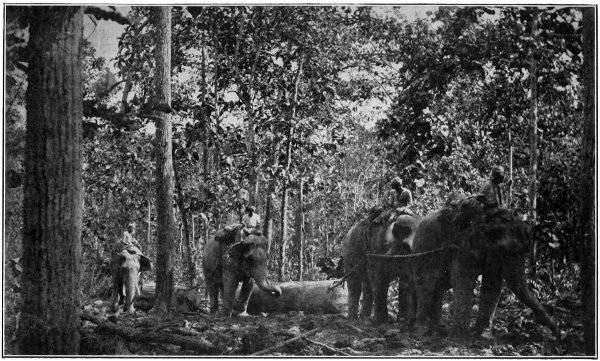
Elephants at Work
The Baptist mission has secured about two acres of land, including the prison-site. By the generous gift of two American Baptists who recently visited Aungbinle, a neat and substantial brick chapel has been erected on the prison-site, as nearly as can be determined. A little farther back, and to one side, is the Burman preacher's house, also included in the gift. The missionary, who frequently visits the village, has provided a miniature cottage of thatch-and-bamboo, in which to rest and find protection from the mid-day heat. As one attempts to realize the situation as it was,—Judson suffering untold agonies, aggravated by his heartless tormentors,—in the miserable prison; Mrs. Judson, in her isolation and friendlessness, suffering from privation, intolerable heat, disease, and the yet greater mental suffering on account of her husband who might at any moment be led to execution before her eyes,—the picture becomes more and more terrible. Then as we turn again to the chapel and preacher's house our thoughts rise in praise to Him who has wrought these changed conditions. On the very spot where the innocent and the guilty were together imprisoned and tortured, an earnest man of God, of the same race as the king by whose order these men suffered,—now proclaims Jesus Christ as the world's Saviour.
As I turned away from this spot, and again as I passed out through the old gateway at Ava, it was with an earnest prayer that a double portion of Judson's spirit might rest upon his successors in this heathen land.