SYSTEMATIC ACCOUNTS OF SPECIES AND SUBSPECIES
Reading edition
MUSTELA ERMINEA Linnaeus
Ermine
(Synonymy under subspecies)
Type.—Mustela erminea Linnaeus, Systema Naturae, 10th ed., p. 46, 1758.
Range.—From the British Isles and Atlantic Coast of Europe across Eurasia and North America including Greenland, from the northernmost land, south, in North America, to the lower margin of the Canadian Life-zone; geographically south to Connecticut, New York, Pennsylvania, northeastern Ohio, southern Michigan, Wisconsin, northern Iowa, Minnesota, North Dakota, in the Rocky Mountains to northern New Mexico, in the Sierra Nevada to Mono County, California, and on the Pacific Coast to the Golden Gate.
Characters for ready recognition.—Differs from Mustela rixosa in presence of black pencil on tail, tail-vertebrae more than a fourth of length of head and body, and in regions where the two species occur together, basilar length of skull more than 32.5 in males and more than 31.0 in females; from Mustela frenata, in regions where the two species occur together, by tail less than 44 per cent of length of head and body and by postglenoidal length of skull more than 46 per cent of condylobasal length in males and more than 48 per cent in females.
Characters of the species.—Size medium to small (total length 225 to 340 mm. in males and 190 to 290 mm. in females); tail 30 to 45 per cent of length of head and body, with distinct black pencil; caudal vertebrae 16 to 19; skull with long braincase and short precranial portion; postglenoidal length, when expressed as a percentage of the condylobasal length, more than 48 in females and ordinarily more than 46 in males; upper parts brown; underparts whitish, ordinarily continuous from chin to inguinal region but in subspecies in the humid region along the Pacific Coast interrupted in some individuals by brown of upper parts encircling body in the abdominal region. The soles of the feet in each of the subspecies are densely haired in winter and have only a relatively small area of the foot-pads exposed in summer, the intervening areas being well haired even at that season. The uniformity throughout the species as regards hairiness of the foot-soles and also the character of the vibrissae makes it unnecessary to describe these features in the accounts of the subspecies of erminea.
Geographic variation.—In the Old World 16 or more subspecies are currently recognized and there are 20 in North America. The features in which geographic variation is especially prominent are: First, size, as expressed by external measurements and weight, second, color pattern, depending on the extent, in relation to one another, of the dark-colored upper parts and light-colored underparts, and third, breadth and depth of the rostral region of the skull. Except in size, the variation in the skull is less than in M. frenata. Likewise in tone and shade of upper parts and hue or tint of underparts, erminea is less variable than frenata and has the face all of one color without the contrasting color-pattern of the face and head seen in many subspecies of frenata. M. erminea exceeds frenata as regards variation of the size of the area occupied by the light-colored underparts. At one extreme is the subspecies arctica in which the area of the light color extends well up on the sides of the body, down the insides of the legs, over the feet and far out on the lower side of the tail whereas at the other extreme are the races streatori and olympica in which the light-colored underparts are restricted to two areas, one on the chin, throat and chest, and the other on the inguinal region. These areas may or may not be connected by a thin line of white color along the midline of the underparts. In size of animal, erminea probably exhibits the maximum variation among American species of weasels; an average-sized male of the race arctica weighs 4 times as much as one of the race muricus, and in the species frenata I doubt that the difference is quite as great between individuals of the smallest race, effera, on the one hand, and either of the largest races, texensis or macrophonius, on the other hand although actual weights are not available for these races of frenata. As elsewhere indicated, the small-sized individuals of M. erminea are of the southern races and the large-sized individuals are of the northern races. This decrease in size southward occurs both in Asia and in America.
Natural History.—Habitat and numbers.—Along the International Boundary east of the Turtle Mountains, Soper (1946:136) found this species present only in timbered areas and absent from many untimbered areas. Of the same species to the westward he comments "so far as I know at present, there is no evidence to show that any short-tailed weasels inhabit a broad strip of treeless territory immediately north of the International Boundary in Canada from southwestern Alberta to southeastern Saskatchewan." The same author (1942) reports that in the general area of Wood Buffalo Park, Northwest Territory, south of Great Slave Lake, the ermine is uncommon on pine-grown sand ridge and rolling upland and common in lower spruce-aspen parklands, stream-side coniferous belts, and grassy, semi-wooded swamplands.
Nine ermines per square mile is the number that Soper (1919:46-47) estimated at Edmonton on the basis of the numbers that he trapped there in the winters of 1912-13 and 1913-14 and on the basis of the tracks of remaining ermines. From corresponding data he estimated the population in the winter of 1913 on the Hay River, north of Jasper Park, to be nine per square mile. In each of these instances he estimated ten weasels per square mile but he inclined to the view that one-tenth of the animals involved in his counts were long-tailed weasels (Mustela frenata). Osgood (1909B:30) and his field companion in the period July 31 to September 3, 1903, took a series of 42 specimens within a radius of 500 yards of their camp at the head of Seward Creek, Alaska, all caught in four traps, in one month. Of the 42 specimens, 28 are males and 14 are females.
Fluctuations of a multiannual nature are marked in this species. Bailey (1929:156) observes that in Sherburne County, Minnesota, when meadow mice are abundant for two or three years these weasels become abundant but that when the mice are scarce the weasels also become scarce. Manning (1943:56), on Southampton Island, noted "that the maximum and minimum points of the weasel cycle are much more sharply marked than those of the fox cycle and the increase and decrease are more rapid."
How far an ermine will travel in a given length of time has seldom been recorded but Hamilton (1933:293), on March 20, 1932, "followed the track of a small weasel, presumably a male cicognanii, for four miles in the fresh snow," and Ingles (1942) observed a diminutive ermine of the subspecies M. e. muricus, at Woods Lake, California, 286 yards from its den.
Behavior
As regards locomotion, Soper (1919:46), in reference to Mustela cicognanii, presumably in Ontario, Canada, writes that in the bounding gait the hind feet register almost, if not exactly, in the front-foot impressions, with the right front and hind feet lagging slightly behind. "The distance normally is about 19 inches, representing a regular rate of travel. . . . In traversing open spaces they resort to long, graceful leaps upwards of six feet in length. . . . I measured a record . . . of 8 feet, 2 inches."
Of M. e. arctica, Dice (1921:22) writes that when it runs "the tail is carried off the ground usually at an angle of about 45 degrees." Seton (1929 (2):598) states that "At Carberry [Manitoba] I have often seen this energetic little creature seeking for Mice in the deep, soft snow. Its actions are much like those of an Otter pursuing salmon. Sometimes it gallops along a log, or over an icy part of the drift; then plunges out of sight in a soft place, to reappear many yards away. . . ."
Little is recorded concerning swimming but on this score Seton (1929 (2):602) does quote J. W. Curran, who in July, 1899, at Lake Couchiching, Ontario, watched an ermine pursue a chipmunk into the water and for 100 yards before giving up the chase and wheeling around and making for shore. In swimming "The Weasel, I think, showed more of his body, and seemed to exert himself more" than the chipmunk.
As to voice, Dice (1921:22), at Tanana, Alaska, heard the ermine, when excited, bark somewhat like a mink but not so loud and Seton (1929 (2):606) quotes Manley Hardy to the effect that the species has a purring note.
Sense of smell was used by an M. e. muricus that Dixon (1931:72) watched as the ermine followed a three-fourths-grown pika. Concerning the ermine at Carberry, Manitoba, Seton (1929 (2):598-599) writes that "The smell of blood must be as far-reaching as it is attractive to these sanguinary little creatures. I have frequently hung new-killed Rabbits and partridges temporarily in trees, and, after an absence, in some cases of a few minutes only, have found an Ermine mauling the game, though there was no sign of such a visitor when the cache was made."
Enemies
George Measham, of Winnipeg, found sign in the snow indicating that a great snowy owl had killed an ermine and T. McIlwraith shot a bald eagle at Hamilton Bay which had the bleached skull of a weasel (probably of this species) clinging to the throat (Seton, 1929 (2):603).
A. B. Howell (1943:98) likens mustelid mammals to domestic cats in their manner of crossing roads and thinks that mustelids loiter at the side of the road until the stimulus of the approaching car causes them to make a dash whereupon they are caught by the wheels and killed. Three of four weasels seen to cross the road were killed, one even having apparently crossed the road before turning back and being killed under the car. One weasel killed was Mustela erminea cicognanii. Dalquest (1948:190) in writing of this species in the state of Washington, says "I have seen only one abroad in the daytime. It dashed from a roadside thicket . . . and was crushed beneath the wheels of a car."
Food
The killing of prey is described by Hamilton (1933:332) as follows: "A rapid dash, and the bird or mouse is grabbed over the back of the skull, the fore legs encircle the animal as though hugging it, and the hind legs are brought up to scratch wildly at the captive. . . . If [the prey is] a large animal, as a rat, the weasel usually lies on its side, while the diminishing struggles of the rodent continue, but if a mouse or a small bird [is the object of attack], the weasel is apt to crouch over its prey. Little time is lost over the first [mouse] . . . if two mice are present [;] a strong bite through the brain case . . . [is] sufficient. If only one animal is present, the weasel dawdles over its kill some time after life has departed."
Hamilton's (1933:333) study of the contents of the digestive tracts of bodies of ermines obtained from fur trappers and fur buyers in New York enabled him to publish the following "Frequency Indices of Mammal Genera in Fall and Winter Food of 191 Mustela cicognanii": Microtus, 35.7 per cent; mammals undetermined to genus but principally mice, 16.3; Blarina, 15.1; Peromyscus, 11.4; Sylvilagus, 9.0; Sorex, 4.9; Rattus, 4.4; Tamias, 3.6. Close correspondence is shown by the following data of Aldous and Manweiler (1942) for the ermine from Lake of the Woods, Minnesota: mice, 58.7 per cent by number and 54.5 by volume; shrews 22.5 and 21.8 per cent; birds, 2.7 and 5.0 per cent. Of the mice in stomachs, 40 per cent were microtines, 15 per cent were Peromyscus and 45 per cent were unidentified as to kind. Fragments of a small fish were found in one stomach. Summed up, the dominant winter foods were mice and shrews. Trapping of the mammal populations was done to see what the available food was and it was found that the small mammals were eaten in direct ratio to their relative abundance. Snowshoe rabbits and red squirrels were not eaten. The Minnesotan data were from 60 stomachs and 53 intestinal tracts recovered from 129 weasels trapped by use of scent (not bait) mostly from January 1 to February 7, 1939, although a few were trapped in 1938. Analyses of contents from stomachs gave approximately the same results as those from intestines. In 1939 at Lake of the Woods, weasels were concentrated where food was abundant but no such concentration was noted in the following winter.
Big short-tailed shrew (Blarina brevicauda).—In New York State, the ermine preys on Blarina as shown by Hamilton's (1933:330) seeing one being carried by a male ermine on May 6, 1931, and another being carried by a female on May 13, 1932. The same author (1928:249) found the remains of a Blarina in a small female from Malone, New York. Kirk (1921) observed, however, that the ermine (M. e. cicognanii) avoided the shrew, Blarina, caught in a trap and that Blarina avoided the weasel caught in a trap.
Chipmunk (genus Tamias).—Remains were found in a male ermine in New York on May 14, 1932 (Hamilton, 1933:330), and Seton (1929 (2):602) records a chipmunk at Lake Couchiching, Ontario, that was pursued into the water by an ermine.
Deer mice (genus Peromyscus).—As shown by Hamilton (1933:33) and Aldous and Manweiler (1942), Peromyscus was second only to microtines in numerical abundance among the food items of ermines in New York and Minnesota. Peromyscus and microtine rodents were brought to a den of the diminutive M. e. muricus in early August, in Fresno County, California, according to Ingles (1942). He observed that an Alpine chipmunk was active under and around the tree and that juncos reared young 40 feet from the den but that the chipmunk and juncos were unmolested by the ermines.
Lemming (genus Lemmus).—One was recovered from a female ermine (with milk in her glands) at Laurier Pass, British Columbia (Sheldon, 1932:201).
Red-backed mouse (genus Clethrionomys).—Criddle and Criddle (1925:146) record that on "May 31, 1921.—Saw a Bonaparte's weasel capture a Red-backed Vole after a long hunt during which the pursuer never once lost track of its victim."
Meadow mice (genus Microtus).—As shown by the data of Hamilton (1933:333) and Aldous and Manweiler (1942) recorded above, Microtus is the item of first importance in the diet of the ermine in New York and Minnesota. Criddle and Criddle (1925:146) write concerning the vicinity of Treesbank, Manitoba, that "October, 1918.—Following a severe outbreak of mice in 1916-17, Bonaparte's weasel increased enormously and very soon reduced the rodents to comparative rarity. This resulted in a scarcity of food for the weasels, which in their turn became greatly reduced in numbers."
Old World rat (Rattus).—Bishop (1923) found two headless rats near a nest of this species in Albany, New York.
Pika (Ochotona).—Dixon (1931:72) at Milner Pass, Colorado, on July 20, 1931, saw an ermine, of the subspecies muricus, following a three-fourths grown pika by scent and outrunning the pika. The pikas worked a relay system and the weasel abandoned the trail when the fourth pika became the object of the chase.
Cottontail (genus Sylvilagus).—Hamilton (1933:33), as noted above, found remains of cottontail in the digestive tracts of ermine that had been trapped for fur in winter. Possibly these remains were bait that had been placed at traps.
Snowshoe rabbit (Lepus americanus).—Morse (1939:210) in a study of predation on hares and grouse in the period of notable decimation of these two game species in 1935-1936 in the Cloquet Valley State Forest, in St. Louis County, Minnesota, found that "weasel predation on hares appeared to be of very low incidence or altogether lacking."
Wild birds (Class Aves).—Aldous and Manweiler (1942), as noted above, found that the remains of birds constituted five per cent by volume of the food of the ermine in winter in Minnesota.
Chicken (genus Gallus).—Criddle and Criddle (1925:145), who published relatively extensive data on the three species of weasels of Manitoba, write that: "We have no record of Bonaparte's weasel killing poultry, and we doubt whether it ever does so." However, Soper (1919:46) investigated the excited cackling of a hen brooding chicks at night and found a solitary ermine that had killed three chicks and that had the remainder under very active scrutiny.
Leopard frog (Rana pipiens).—One frog was found in a male ermine on November 20, 1931, in New York by Hamilton (1933:300).
Fish (Class Pisces).—Aldous and Manweiler (1942) found fragments of a small fish in one of 60 stomachs of ermine from Minnesota.
Earthworm (Phylum Annelida).—Osgood (1936:64), presumably at Rutland, Vermont, observed a pair of weasels from 2:15 P.M. to 5:00 P.M., in a barn and saw the female in that time make many trips for food for her young. Only earthworms were brought. Fifty traps in an adjacent, swampy field caught only one bull frog and no mice indicating that mice had been eliminated from the foraging territory of the ermine.
In handling food, Dice (1921:22) noted that the Alaskan ermine did not use the feet but only the mouth.
Reproduction
Litters of 4, 4, 7, 7, and 8, yielding an average of 6 young per litter have been recorded from the northeastern United States by Hamilton (1933:327). He (op. cit.:321-325) described animals one day old from New York State as being flesh-colored, having the long neck of the adult and a fine growth of white hair two milli meters in length, on the dorsal surface of the neck, that foreshadows the mane or pompadour that is prominent from the 14th to the 21st day of life. Six animals, when one day old averaged 1.7 grams in weight, which was three per cent of the weight of an adult female and one and one half per cent of the weight of an adult male. At two weeks of age the heavy brown mane stood out in marked contrast to the rest of the scantily, white-furred animal. The eyes opened on the thirty-fifth day of life.
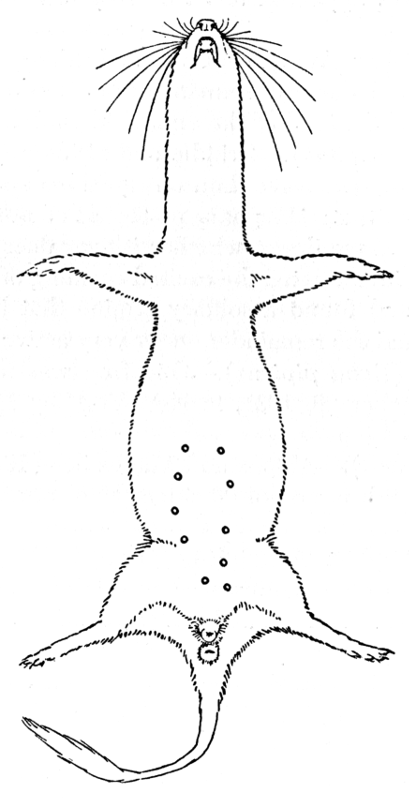
Fig. 24. Mustela erminea richardsonii, adult female, Catalogue Number 14866, U. S. Nat. Mus., Fort Chimo, Ungava. × 1/2.
Ventral view of body of a pregnant female to show details of mastology. Note the five pairs of mammae characteristic of weasels, and the uneven arrangement of mammae of the two sides which is also common among weasels.
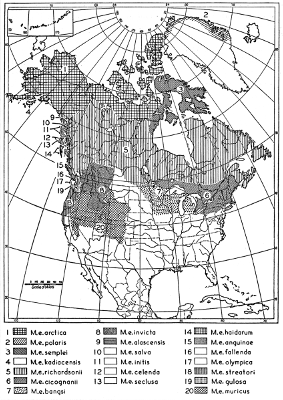
Fig. 25. Map showing geographic ranges of the subspecies of Mustela erminea in the New World.
For rearing their young, ermines live in burrows. Bishop (1923), in Albany, New York, found a burrow occupied by four young and a pair of adults. The burrow had many galleries and contained a nest constructed of rat fur, fine grass and fragments of leaves. At Woods Lake, Fresno County, California, in early August, Ingles observed (1942) some young and at least one adult at their den which was in a burrow beneath a hollow tree. The ermines used the hollow root and the hollow tree as well as the burrow beneath. Seton (1929 (2):591) quotes S. Eldon Percival, of Barretts Rapids, Ontario, as finding the living quarters of an ermine in unthreshed grain stacked in a barn and says (op. cit.:590) that John Burroughs dug out a nest, composed of leaves and the fur of mice and moles, two or three handfuls in bulk, from a cavity the size of a hat, arched over with a fine network of tree roots.
Four instances in which the male as well as the female was present at a den containing young are cited by Hamilton (1933:328) and he gives some evidence, although not at all conclusive, that "adults customarily pair, or at least run together, at times other than the breeding season." No other writers remark on this matter. I doubt that adult ermines are associated in pairs for most of the year but such may be the case.
Mustela erminea arctica (Merriam)
Ermine
Plates 2, 3, 4, 9, 10, 11 and 41
Putorius arcticus Merriam, N. Amer. Fauna, 11:15, pl. 2, figs. 1, 1a, and pl. 5, figs. 6, 6a, June 30, 1896.
Putorius (Gale) erminea, Coues, Fur-bearing animals, p. 109, 1877 (part).
Putorius richardsonii, Bangs, Proc. Biol. Soc. Washington, 10:16, pl. 1, figs. 3, 3a, pl. 2, figs. 3, 3a, and pl. 3, figs. 6, 6a, February 25, 1896 (part).
Putorius cicognanii alascensis, Osgood, N. Amer. Fauna, 19:43, October 6, 1900.
Putorius kadiacensis, Osgood, N. Amer. Fauna, 21:69, September 26, 1901.
Putorius audax Barrett-Hamilton, Ann. and Mag. Nat. Hist., 13(ser. 7):392, May, 1904, type from Discovery Bay, Ellesmere Island.
Putorius alascensis, Heller, Univ. California Publ. Zoöl., 5:345, March 5, 1910.
Mustela arctica arctica, Miller, U. S. Nat. Mus. Bull., 79:97, December 31, 1912; Dice, Journ. Mamm., 2:22, February 10, 1921.
Mustela arctica, Hall, Univ. California Publ. Zoöl., 30:420, March 19, 1929.
Mustela erminea arctica, Ognev, The mammals of U.S.S.R. and adjacent countries, 3:31, 1935; Hall, Proc. California Acad. Sci., 23:559, August 22, 1944; Hall, Journ. Mamm., 26:179, July 19, 1945.
Type.—Male, adult, skull and skin; no. 14062/23010, U. S. Nat. Mus.; Point Barrow, Alaska; July 16, 1883; obtained by John Murdock, original no. 1672.
The skull has a fracture, on the dorsal surface, extending from the anterior nares to the interorbital constriction and another fracture on the left margin of the nasal bone. The middle of the left zygomatic arch is broken away. Otherwise the skull is complete. Right incisor one, above and below, are missing. Otherwise the teeth are present and entire. The skin is in the brown summer pelage, well made, in a good state of preservation, and shows no obvious signs of fading.
Range.—Arctic regions of Alaska and western Canada from the Pacific Ocean to Smith Sound; from the northern limit of land south approximately to a line from Skagway through Ft. Goodhope, north shore of Great Bear Lake, south shore of Clinton Colden Lake, north shore of Baker Lake, west end of Wagner Bay to south end of Committee Bay. See figure 25 on page 95.
Characters for ready recognition.—Differs from M. e. polaris in darker upper parts (Raw Umber rather than Buckthorn Brown) and less intensely colored underparts that are Sulphur Yellow, Colonial Buff or Primrose Yellow rather than Buff Yellow; from M. e. semplei, in males, in that hind foot more than 44 and basilar length more than 41 and in that females average larger, the skulls of females being only about 11 per cent heavier; from M. e. kadiacensis in hind foot more than 33 in females, zygomatic breadth amounting to more, rather than less, than distance between last upper molar and jugular foramen irrespective of sex; from M. e. richardsonii, alascensis, salva and initis, both sexes so far as known, by proximal two-thirds of under side of tail colored same as underparts rather than same as upper parts, and by zygomatic breadth amounting to more, rather than less, than distance between last upper molar and jugular foramen.
Description.—Size.—Male: Six adults from Tanana, Alaska, yield average and extreme measurements as follows: Total length, 336 (310-350); length of tail, 93 (84-105); length of hind foot, 49 (45-51).
Female: Five adults, one each from Alatna River, mountains near Eagle, Kamarkak in Alaska, Arctic Red River and Baillie Island in Canada, yield average and extreme measurements as follows: Total length, 285 (272-304); length of tail, 77 (68-95); length of hind foot, 39 (34-43).
Weight of 5 subadult males from Tanana is 206 (163-248) grams; adults would be heavier.
Color.—Winter pelage all white except tip of tail. Summer pelage with upper parts uniform in color and Raw Umber or darker (16n) of Ridgway and about tones 2 to 3 of Chocolate of Oberthür and Dauthenay, pl. 343, but in autumn some specimens have more light red than tones 2 or 3. Underparts Sulphur Yellow, Colonial Buff, or Primrose Yellow, often white on chin and insides of forelegs; color of underparts extends narrowly over upper lips, distally on posterior sides of forelegs onto antipalmar surface of forefeet, onto proximal two-thirds or three-fourths of underside of tail as length of tail is measured along tail-vertebrae, on medial sides of hind legs to a point between knee and ankle but reappears on antiplantar faces of toes and in some individuals is narrowly continuous onto toes; rim of ear in some specimens with short, white or pale hairs giving ears distinct whitish border; least width of color of underparts averaging, in adult males from Alaska, 65 (46-93) per cent of greatest width of color of upper parts. Black tip of tail in 5 males in winter pelage from Tanana averaging 84 (70-93) mm. which is 91 (75-107) per cent of length of tail-vertebrae.
Skull.—Male (based on 5 adult topotypes): See measurements and plates 2-4. As described in Mustela erminea richardsonii except that: Weight, 3.5 (3.1-3.9) grams; basilar length 42.5 (41.8-43.3); length of tooth-rows more than length of tympanic bulla; breadth of rostrum measured across lacrimal processes averaging more than a third of basilar length; interorbital breadth more than distance between glenoid fossa and posterior border of external auditory meatus; zygomatic breadth more than distance between last upper molar and jugular foramen.
Female (based on 2 adult topotypes and 2 adults and 4 subadults from central Alaska): See measurements and plates 9-11. As described in Mustela erminea richardsonii except that: Weight, 1.5 (1.2-2.0) grams; basilar length, 35.7 (34.5-37.0); length of tooth-rows more than length of tympanic bulla; breadth of rostrum more than 30 per cent of basilar length; interorbital breadth more than distance between glenoid fossa and posterior border of external auditory meatus; zygomatic breadth more than distance between last upper molar and jugular foramen (except in specimens from Ellesmere Island where two distances are approximately equal).
Cranial differences from Mustela erminea kaneii (which occurs on the Asiatic side of Bering Strait), in both males and females, are: larger size relatively as well as actually, broader except in mastoidal region where relatively (to basilar length) the width is less; preorbital part of skull broader as well as longer.
From kadiacensis differences in the skull of the male are: size less; 13 per cent heavier, relatively (to basilar length) narrower across interorbital region and zygomatic arches; tympanic bullae relatively as well as actually narrower. Judging by the single available adult female of kadiacensis, the skull of female arctica is larger in all parts measured, a fourth heavier, has tympanic bullae of almost twice the volume and the interorbital and preorbital regions, relative to the braincase, are much reduced in whatever plane measured.
Differences from richardsonii, additional to those noted above in the formal description of the skull, between the males, are: larger in all parts measured except length of tympanic bulla which is about the same; 42 per cent heavier; relative to basilar length, skull broader with preorbital part longer as well as broader; tympanic bullae more inflated posteriorly. The same differences prevail between females except that the skull is 36 per cent heavier and in arctica the length of the bulla is actually more (although relative to the basilar length less) and its greater inflation posteriorly is hardly perceptible. Differences from alascensis, additional to those indicated in the formal descriptions of the skulls of the two, in males, are: larger in every part measured; 95 per cent heavier; relative to the basilar length, skull broader with preorbital part longer as well as broader; measured at a point opposite the foramen lacerum anterius, the width of the pterygoid space is more, rather than less, than 40 per cent of its length. Excepting this difference in width of interpterygoid space, the same differences prevail between females, those of arctica being 56 per cent heavier.
Comparison with semplei is made in the account of that subspecies.
Skull indistinguishable from that of polaris.
Remarks.—The person who studies specimens of this subspecies finds labels inscribed with the names of naturalists well known to all readers of literature on the Arctic. Sir John Franklin, R. McFarlane, R. Kennicott, E. W. Nelson and R. M. Anderson are names which appear commonly. Of Alaskan specimens prepared according to modern methods, a large share was obtained by O. J. Murie and L. R. Dice.
The ermine was observed in the far north by early explorers and was mentioned in the literature, almost always under the name then used for the ermine of northern Europe and Asia. In 1896 Bangs misapplied to it the name richardsonii but Merriam in the same year corrected the application of this name and proposed as new for this weasel the name arctica, the name in use today. For almost 50 years after Merriam and Bangs wrote about it, arctica was treated, nominally at least, as a species distinct from its other relatives in both the Old- and New-World. The subspecific status of arctica was emphasized in 1944 (555) by the present writer in reporting in detail upon the specimens, of Mustela erminea, from Eastern Asia which were made available on loan by Professor B. S. Vinogradov and the late Anatol I. Argyropulo of the Leningrad Academy of Sciences. Specimens of Mustela erminea kaneii from the Asiatic side of Bering Strait and Mustela erminea arctica from the American side are distinguishable by slight cranial characters but in coloration and external measurements I can detect no differences. Merriam's (1896:16) mention of more golden-colored upper parts and darker underparts in American specimens than in erminea was the result of his comparison of Alaskan and northern European specimens. When Old World specimens from eastern Siberia, instead of from Europe, are used the differences mentioned by Merriam do not apply. Incidentally, many Siberian specimens have the white border, on the ear, which Merriam (loc. cit.) noted as a distinguishing feature of arctica. When Merriam named arctica he said (1896:15, 16) "Putorius arcticus . . . has heretofore been confounded with erminea or richardsonii. . . . It is interesting to find in this country an Arctic circumpolar weasel which, though specifically distinct, is strictly the American representative of the Old World erminea." Bearing in mind that Merriam's concept of species and subspecies (see Merriam, 1919:6) differed from that of nearly all modern systematists it is clear from his statement quoted above that he correctly understood the zoölogical relationship obtaining between the ermines of the Old and New Worlds.
Ognev (1935:31) seems to have been the first to use the name combination Mustela erminea arctica for Alaskan specimens. Thereby he expresses the view adopted here, namely that the American ermine is subspecifically but not specifically distinct from the Old World animal. Whether actual intergradation (crossbreeding) ever takes place across the narrow Bering Strait I do not know. I doubt that crossbreeding occurs but considering the Diomedes (islands), that might serve as a half way stopping point, and remembering Mr. Charles Brower's oral statement to me that he had seen tracks of ermine as far as 10 miles from the northern shore of Alaska out on the ice, the possibility must be granted of an occasional individual crossing from one side to the other of Bering Strait on the ice in winter or of being carried across when the ice broke up and drifted. If transfers of this kind occurred often one would expect ermines to occur also on Saint Lawrence Island where apparently they do not. The one skin (U. S. Nat. Mus. no. 259046) seen as labeled from there, my friend, Otto William Geist ascertained was imported as a skin with other furs from Siberia.
Ognev (op. cit.) who used the name combination Mustela erminea arctica for Alaskan specimens, applied it also to animals from Kamchatka. At the same time he recognized the animal from the eastern mainland of Siberia (as opposed to the peninsula of Kamchatka) under the name Mustela erminea orientalis Ognev 1928. Hall (1944:556) applied the earlier proposed name Putorius kaneii Baird 1857, to the animal on the eastern mainland of Asia and proposed the new name Mustela erminea digna for the ermine of Kamchatka. In comparing material of these two Asiatic races with topotypes and other specimens of M. e. arctica from Alaska, it seemed to me that the degree of relationship, one with the other, was about the same. M. e. digna has a slightly larger preorbital region than M. e. kaneii, and the skull is longer. In both of these particulars digna approaches closer to arctica. M. e. kaneii has longer tympanic bullae and a wider skull than digna and therein approaches more towards arctica than toward digna. As nearly as I can make out, digna and kaneii show a nearly equal degree of resemblance to arctica. Also the degree of difference between digna and kaneii is about the same as between either one of them and arctica. In view of the above considerations the ermines of the New and Old worlds are here regarded as only subspecifically distinct.
In the original description of Putorius audax (here regarded as inseparable from Putorius arcticus Merriam) Barrett-Hamilton erroneously designated the type locality as "Discovery Bay, North Greenland" whereas he should have written Grinnell Land [= Ellesmere Island of modern terminology] in place of Greenland. As reference to Nares (1877 and 1878) will readily reveal, Discovery Bay is near 65° W and 81° 40´ N, across Robeson Channel, to the west, from Greenland. The label on the type specimen and the specimen register in the British Museum of Natural History each designates the locality for this specimen, the type of audax, as Discovery Bay without mention of Greenland. The published accounts of Feilden (1878) and Nares (1877 and 1878) state that specimens of ermine were obtained at Discovery Bay. Probably H. C. Hart is the collector of the specimen; he was the naturalist attached to H. M. S. Discovery which wintered at Discovery Bay while H. W. Feilden was the naturalist attached to H. M. S. Alert which wintered a few miles southeast of Cape Sheridan, also on the eastern coast of Ellesmere Island.
It is true that from these ships a trip was made into Greenland and an ermine (only one individual it seems) was obtained there, but this individual was the type specimen of Mustela erminea polaris, in the account of which race something of the history of this specimen is given.
With the material available—and it is not entirely adequate—I can detect no features by which animals from the type locality of audax can be distinguished from typical arctica which latter name has priority.
Intergradation with richardsonii probably occurs completely across the continent. Intergrades here referred to arctica include those from Fort Goodhope. The one defective specimen from Lake Lebarge, Yukon, is not certainly identified as arctica and how far west of Teslin Lake the boundary-line between arctica and richardsonii should be drawn remains to be ascertained. The one specimen available from Hinchenbrook Island, no. 912 Mus. Vert. Zoöl., an adult female, is doubtfully referred to arctica because the damaged tympanic bullae appear to be no larger than in alascensis, and the size of the skull is more as in alascensis although intermediate between that race and arctica. Shape of the skull is more as in arctica. Possibly more nearly adequate material would show the existence on Hinchenbrook Island of an insular race differing in about the same degree from arctica of the mainland as does the insular kadiacensis. Nevertheless, the males from farther south at Cape Yakataga are in all respects arctica and this argues against near relationship to alascensis of the animal on Hinchenbrook Island. The three animals seen from Yakutat Bay are so young as not to display clearly the cranial characters of the subspecies but the extension of the color of the underparts onto the underside of the tail in them and also in the skin without corresponding skull from Glacier Bay, Alaska, is as in arctica, the race to which they are referred, and gives substantial basis for showing the geographic range of arctica as extending this far south along the Pacific Coast.
Specimens examined.—Total number, 281, arranged alphabetically by Districts and from north to south in each District. Unless otherwise indicated, specimens are in the collection of the United States National Museum.
Alaska. Point Barrow, 22 (1[1], 1[2], 1[75], 4[1], 7[60], 6[74]); Flaxman Island, 3; Collinson Point, 1[77]; Salirochet River, 1[77]; Hulahula River, 1[2]; 69°20´ & 141°, 1; Rampart House, 1; Yukon River, mouth of Porcupine River, 18; Alatna River, 30 mi. from mouth, 1; Koyakuk Riv., 16 mi. below Bettles, 4; Shelton, 1[75]; Kruzamepa, 1[75]; Tanana, 6; Boulder Creek, Chena River, 3; Fort Reliance, 4; Yukon River, 20 miles above Circle, 2; Mts. near Eagle, 42 (1[60]); Snake River, Nome, 1[9]; Nulato, 3; No[e]wikakat Riv., 1; Kantishna, 3; Fairbanks, 5 (1 20 mi. E and 1 33 mi. E); Richardson, 1; N. Fk. Kuskokwim R. at base of Mt. Sischo, 1; N. Fk. Kuskokwim R. at Junction with McKinley Fk., 1; Nenana Riv., mouth of Maurice Cr., 1; Ober Cr., trib. of Jarvis Cr., Delta Riv. region, 1; head of Savage Riv., near Jennie Cr., 1; Wonder Lake, 1[74]; Bear Cr., 3; Unlakleet, 3; St. Michaels, 11; 125 mi. E and a little N of Knik, Cook Inlet, on S side Matanuska Range, 1[60]; Hope, Cook Inlet, 1; Iak Lake, 1[68]; head of Behring Riv., 1; Bethel, 2; Kenai Lake, 8; Kenai Peninsula, 13 (2[2]); He[i]nchenbrook Island, 1200 ft., 1[74]; Sunshine Point, Kaliekh River, Yakataga Dist., 1[8]; Cape Yakataga, 3[8]; Yakutat Bay, 3[74]; Seward, 7; Seldovia, 22 (4[2]); Homer, 1[2]; Cape Elizabeth, 18; Akchookuk Lake, 1; Lake Weelooluk, 1; Kokwok Riv., 80 mi. up, 4; Nushagak, 1; Nushagak Riv., 1; Kolukuk, 1; Egooshik River at mouth, 1; Glacier Bay, 1; Becharof Lake, between Portage Bay and Becharof Lake, 1; Ugashik Riv., 4; Chignik, 7; East base Frosty Peak, 1; Pavlov Bay, 1[100]; Mt. Pavlof, 1[75]; Unimak Island, 2 (1[75]).
District of Franklin. Cape Sheridan, 1[2]; Discovery Bay, Ellesmere Island, 1[7] (type specimen of Putorius audax Barrett-Hamilton); Axel Heiberg Island, 1[95]; Bache Peninsula, Ellesmere Island, 1[77]; Bedford Pims Island, 4[75]; Craig Harbor, 2[77]; Cape Kellett, Banks Island, 1[77]; Franklin Isthmus, 1[95]; King William Island, 2[95].
District of Keewatin. Ualiak, Ogden Bay, 2[95].
District of Mackenzie. Baillie Island, 1[75]; Franklin Bay, 1; Langton Bay, arm of Franklin Bay, 15 mi. S of, 1[2]; Cockburn Point, 69°N, 115°W, 2[77]; Dolphin and Union Strait, 1[77]; Bernard Harbor, 2[77]; Kent Peninsula, 4[95]; Horton Riv., near Fort Anderson, 1; Fort Anderson, 6; Anderson River, 3; Barry Island, Bathurst Inlet, 1[77]; Fort McPherson, 1; Peels River, 2; Arctic Red River, 8[75]; Fort Good Hope, 6; Clinton Colden, 1[2].
Yukon. Kamarkak, 1[77]; Herschel Island, 1[75]; Lapierres House, 2; Forty Mile, L. T. Coal Cr., 4[74]; head of Coal Cr., 1; Macmillan River, Forks, 1; 20 mi. W. Ft. Selkirk, 1; Slims River, near Kluane, 1[75]; head of Lake Lebarge, 1.
Mustela erminea polaris (Barrett-Hamilton)
Ermine
Putorius arcticus polaris Barrett-Hamilton, Ann. and Mag. Nat. Hist., 13 (ser. 7):393, May, 1904.
Mustela erminea, Manniche, Meddelelser om Grønland, 45:80-85, 1 fig., 1910.
Mustela arctica polaris, Miller, U. S. Nat. Mus. Bull., 79:97, December 31, 1912.
Mustela erminea polaris, Hall, Journ. Mamm., 26:179, July 19, 1945.
Type.—Probably female, skin only; no. 78. 6. 19. 11, Brit. Mus. Nat. Hist.; Gap Valley, 7-1/4 miles northeast Cape Brevoort, 82° N, 59° 20´ W, Northwestern Greenland; June 15 or 16, 1876; obtained by Lewis A. Beaumont.
The skin is in full, fresh summer pelage, fairly well stuffed except for the tail which is unstuffed; the whole is in a good state of preservation.
Range.—North coast, and east coast as far south as Turner Sound (between 69 and 70 degrees) of Greenland. See figure 25 on page 95.
Characters for ready recognition.—Differs from M. e. arctica in lighter upper parts (near [j] Buckthorn Brown rather than Raw Umber or darker) and more intensely-colored underparts that are Buff Yellow rather than Sulphur Yellow, Colonial Buff, or Primrose Yellow; from M. e. semplei in color in same fashion as from arctica and in larger size of skull.
Description.—Size.—Male: One subadult and two adults (one ad. from Scøresby Sound and other two from Ymer Island) measure as follows, the average being given first: Total length, 318 (301, 320, 315); length of tail, 72 (69, 70, 73); length of hind foot, 46.5 (44, 46, 47).
Female: No measurements taken in the flesh available but hind foot, measuring 33.5 in the dried state and therefore approximately 35 in life.
Color.—As described in Mustela erminea arctica except that upper parts in summer near (j) Buckthorn Brown and tone 4 of Dark Fawn of plate 307 to tone 1 of Raw Umber of plate 301 of Oberthür and Dauthenay. Underparts Buff-Yellow. Least width of color of underparts averaging, in 3 males, 66 (57-72) per cent of greatest width of color of upper parts. Black tip of tail in same males averaging 71 (70-72) mm. which is 99 (99-104) per cent of length of tail-vertebrae.
The lighter-colored upper parts and more intensely yellow underparts are the distinguishing features of the subspecies polaris in comparison with other races of American M. erminea.
Skull.—Male (based on 5 adults from eastern Greenland): See measurements. As described in Mustela erminea richardsonii except that: Weight more (not recorded); basilar length, 41.3 (39.0-42.4); length of tooth-rows more than length of tympanic bulla; breadth of rostrum measured across lacrimal processes averaging more than a third of basilar length; interorbital breadth more than distance between glenoid fossa and posterior border of external auditory meatus; zygomatic breadth more than distance between last upper molar and jugular foramen.
Female (based on 2 adults, Turner Sund and Kap Hoeg): See measurements. As described in Mustela erminea arctica except that basilar length 36.8 (35.9, 37.8), and length of tooth-rows not more than length of tympanic bulla. Skulls of females not in hand when this comparison is written; only the recorded measurements are available.
To me the skull of polaris is indistinguishable from that of arctica. Therefore the comparisons made of the skull of arctica with those of other subspecies will apply also for polaris.
Remarks.—In view of the heretofore erroneous assignment of the type locality of Mustela erminea audax to Greenland, pains were taken to verify the statement by Barrett-Hamilton (1904:393) relative to the type specimen of polaris. Taking pains thus seemed the more worthwhile because in the specimen register at the British Museum of Natural History, there is written to the right of catalogue numbers 78-6 = 19 nos. 1-11, "Discovery Bay Presented by Mr. Hart Arctic Collection." This refers to no. 78.6.19.1. There are no ditto marks below but by implication this data applies also to nos. 1-11, which include the holotype of polaris. A label attached to the specimen does however give the locality as "Hall Land" "N Greenland" and another label has on it "Ermine, procured by Mr. Beaumont Greenland Lat 89° Long W 59-20." The 89° is obviously a mistake (on the label or in my transcription of it) for 82°.
Reference to Nares (1877:385) reveals that Lieutenant Lewis A. Beaumont, under date of June 15 and 16, 1876, wrote in his field journal as follows: "I shot an ermine." In the daily accounts of his journey from Discovery Bay on Grinnell Land [= Ellesmere Island], across Robeson Channel and along the north coast of Greenland to the west base of Mount Farragut near 50° 30´ W he mentions the ermine only this once. For several other kinds of animals, Beaumont mentions individuals seen or shot, often with the notation that this is the second, or third seen. This mention of a kind of animal whenever seen was in accordance with orders. On page 39 of the Discovery Report (op. cit., 1877) in "General orders to sledging parties" by Captain G. S. Nares, Commanding the Expedition, we find ". . . note daily: IV State the animals seen and those shot." Reference to the map facing page 358 of the (op. cit.) report reveals that on the 15th and 16th, camps were made by Beaumont in Gap Valley, each 7-3/4 miles northeast of Cape Brevoort, one camp on either side of the 82° line, and separated from each other by a distance of only 2-1/4 air line miles or 4-1/2 miles march according to his journal.
These several data, then, are the bases for designating the type locality of M. e. polaris, in the way that I have stated it at the beginning of this account of the subspecies.
The light-colored upper parts and more intensely yellow underparts well differentiate this subspecies from arctica or semplei. Intergradation is suggested by a skin, no. 1462, Copenhagen Zoological Museum, from Axel Heibergs Land, the color of the underparts of which agrees with that of specimens from Greenland. Also the color of the upper parts is decidedly nearer that of animals from Greenland than to that of specimens from Ponds Inlet, Tulican and Gifford River. No other specimens west or south of Greenland suggest intergradation. In Greenland itself, one adult, a female from Turner Sund, East Greenland, has the underparts no more yellowish than in some specimens from Melville Peninsula. This female is darker on the back than any one of the other 10 specimens from Greenland in summer pelage examined at the same time, but even so is not so dark colored as animals from Baffin Island or other islands to the west of Greenland.
The final summation of information about this subspecies would have been more precise if I had been able to have actually in hand, at the time of writing, specimens preserved in the Copenhagen Zoological Museum. The war made it impractical to secure the loan of these as previously planned. Even so, the measurements and notes on color that I obtained from this material, in 1937, in Copenhagen, suffice to prove that the subspecies polaris is well set off in color from the other American subspecies of Mustela erminea.
The best material of this subspecies is in the University Zoological Museum at Copenhagen, Denmark.
Specimens examined.—Total number, 35, arranged by locality from the western end of the north coast of Greenland, eastward and then southward down the east coast. Unless otherwise indicated, specimens are in the Universitetets Zoologisk Museum, Købnhavn, Danmark.
Gap Valley, 7-1/4 mi. NE Cape Brevoort, 82° N, 59° 20´ W, 1 (British Mus.); Dragon Point, 1; Danmarks Havn (Fjeldene ved Baadskjeret, 1; lille Fjeld, 1; Lyservig, 1; harefjeldets, 4; Rypefjeldet, 1; Baadskjeret, 1; Danmarkshavn, 3) 12; Christians Havn, 1 (not found on map); Shannon Island, 4; Germania Havn, 2; Claveringoen, 1; Carls Havn, 1; Myggbukta, 2 (British Mus.); Ymer[s] Island, 2 (Mus. Comp. Zool.); Kap Hoegh, Jamesonsland, 1 (Berlin Zool. Mus.); Scoresby Sund, 3; Turner Sund, 4.
Mustela erminea semplei Sutton and Hamilton
Ermine
Plates 2, 3, 4, 9, 10 and 11
Mustela arctica semplei Sutton and Hamilton, Ann. Carnegie Mus., 21:79, February 13, 1932.
Mustela arctica labiata Degerbøl, Rept. 5th Thule Exped., 2 (no. 4):25, 1935, type from Malugsitaq, Melville Peninsula, Canada.
Mustela erminea semplei, Hall, Journ. Mamm., 26:179, July 19, 1945.
Type.—Male, subadult, skull and skin; no. 6470, Carnegie Mus.; Coral Inlet, South Bay, Southampton Island, Canada; October 8, 1929; obtained by George Miksch Sutton, original no. 3M.
The skull has two holes in it: one is immediately above the left canine, and the other (2 × 5.5 mm.) is 3 millimeters to the left of the median line at the juncture of the frontal and parietal bones. From this last mentioned hole a fracture extends back halfway to the lambdoidal crest. The tip of the left upper canine is broken off. Otherwise the skull is complete, and the teeth all are present and entire. The skin is well made and in fresh white winter pelage except for a trace of the old brown summer pelage on the back, on the tail, on the anterior borders of the ears, and in a spot 11 mm. long and 8 mm. wide on the nose.
Range.—Baffin and Southampton islands, Melville Peninsula and west side of Hudsons Bay as far south as Eskimo Point. See figure 25 on page 95.
Characters for ready recognition.—Differs from M. e. arctica, in that, in males, hind foot less than 44 and basilar length less than 41 and in that females average smaller, their skulls being only about 10 per cent lighter; from M. e. polaris in darker upper parts (Raw Umber rather than Buckthorn Brown) and less-intensely-colored underparts that are Sulphur Yellow, Colonial Buff or Primrose Yellow rather than Buff Yellow, and in lesser size in the same fashion as from arctica; from M. e. richardsonii, of both sexes, in that proximal two-thirds of under side of tail colored same as underparts rather than same as upper parts and by least interorbital breadth amounting to more, instead of less, than distance between glenoid fossa and posterior border of external auditory meatus.
Description.—Size.—Male: Ten adults and subadults, from Southampton Island, yield average and extreme measurements as follows: Total length, 282 (267-318); length of tail, 77 (59-87); length of hind foot, 40 (38-43).
Female: Four subadults from Southampton Island yield average and extreme measurements as follows: Total length, 271 (256-288); length of tail, 71 (69-74); length of hind foot, 35 (33-38).
Color.—As described in M. e. arctica except that least width of color of underparts averaging, in 7 males, 59 (45-81) per cent of greatest width of color of upper parts. Black tip of tail in 19 male topotypes averaging 72 (64-83) mm. which is 91 (75-122) per cent of length of tail-vertebrae.
Skull.—Male (based on 2 adults and 10 subadults from Southampton Island): See measurements and plates 2-4. As described in Mustela erminea richardsonii except that: Weight, 2.0 (in one subadult) grams; basilar length, 37.5 (35.7-39.9); length of tooth-rows more than length of tympanic bulla; breadth of rostrum more than a third of basilar length; interorbital breadth more than distance between glenoid fossa and posterior border of external auditory meatus; zygomatic breadth more than distance between last upper molar and jugular foramen.
Female (based on 1 adult and 4 subadults from Southampton Island): See measurements and plates 9-11. As described in Mustela erminea richardsonii except that: Weight, 1.35 (in one adult) grams; basilar length, 34.2; breadth of rostrum more than 30 per cent of basilar length; interorbital breadth more than distance between glenoid fossa and posterior border of external auditory meatus; zygomatic breadth more or less than (approximately same as) distance between last upper molar and jugular foramen.
In comparison with richardsonii, the skulls of males averaged smaller in every measurement taken except breadth of rostrum and interorbital breadth which are more, and zygomatic breadth and length of inner lobe of M1 which are approximately the same; skull about 20 per cent lighter; in relation to basilar length, preorbital region longer and broader in every part measured. Female averages larger, in every part measured; 23 per cent heavier; in relation to basilar length, every other measurement more. It is noteworthy that the skull of the male is smaller and the skull of the female larger than in richardsonii.
Differences from arctica are: Size less, in each sex; males about 40 per cent and females 10 per cent lighter; in males, skull more rounded in outline as viewed from above because zygomatic arches arise less abruptly from skull; in males tympanic bullae do not project so far ventrally from squamosal floor of braincase; with these exceptions, skull of semplei can be said to be a smaller edition of that of arctica.
From polaris, semplei differs, cranially, in the same way as from arctica.
Remarks.—There is a slight increase in size of ermines toward the north which probably is the result of intergradation between semplei and arctica. Specimens from the northern part of Baffin Island are larger than those from farther south. Specimens from the mainland west of Southampton Island may owe their smaller (than in arctica) size to intergradation with richardsonii almost as much as to intergradation with semplei.
Degerbøl's name Mustela arctica labiata was applied to specimens, which to me are indistinguishable from topotypes of Mustela arctica semplei, which latter name has three years priority. Degerbøl (1935:34) states that Malugsitaq, Melville Peninsula, is the type locality. He did not designate a type specimen. Reference to his account (op. cit.:26) shows that he lists five specimens from the type locality, or more precisely as "Malugsitaq, Lyon Inlet. 5 summer skins. ♂ ♂ June-July 1922. P. F., CN. 2262-2266." On labels attached to these specimens, "Lyon Inlet" is replaced with "Melville Peninsula." On July 28, 1937, Degerbøl and I together examined these specimens in his laboratory. Because no. 2262 is first mentioned I regard it as the type. It is a juvenal male, skull and skin, no. 2262 (20.5 1931.8), Univ. Zool. Mus. Copenhagen, obtained in June or July of 1922 by Peter Freuchen whose original number was / s 2324. The specimen is one of 5 males taken at the same locality by the same collector and they bear identical data as to date. They look to be of the same litter for all are roughly of the same size and each retains milk teeth.
Additional females, with external measurements carefully taken, are much needed from Southampton Island, because the available females are insufficient to show the degree of sexual dimorphism. If the meager data available be accepted, the difference in size between the two sexes is less than in other subspecies. My own feeling is that a better sample of females would show the secondary sexual difference in size to be more than available data indicate.
Specimens examined.—Total number, 183, arranged from north to south by islands, or regions attached to the mainland, and from north to south in each region or island. Unless otherwise indicated, specimens are in the Zoological Museum, University of Copenhagen, Denmark.
Baffin Island. Pond[s] Inlet, 8; (5[77]); Tulukan (sometimes spelled Tulukat), 6; Cape Eglinton, 1[7]; Gifford River, 2; Clyde, 3[86]; head of Cumberland Sound, 1[91]; Pangnirtung, 2[77]; Kingnait Fiord, 1[91]; Kikkulin Island, Cumberland Sound, 1[7]; Blacklead Island, Cumberland Gulf, 1; merely Cumberland Gulf, 1[7]; merely east Baffin Island, 34[7]; Cape Dorset, 2[2]; SW coast of Baffin Island, 1[75].
Melville Peninsula. Iglulik, 3; Pingerqalik, 2; Kingadjuaq, Amitsog, 3; Rae Isthmus, 3; Lyons Inlet, 13(9[2]); M[N?] alugsitaq, Lyon Inlet, 5; Itibdjeriang, 2; Repulse Bay, 27 (22[2], 2[19]); Drichetts Cove, Hurd Channel, 1[2]; Gore Bay, 1; Haviland Bay, 1; Cleveland Harbor, Frozen Strait, 1.
Southampton Island and adjacent islands. Danish Island, 11; Vansittart Island, 4. Southampton Island: Coral Inlet, 19 (1[77], 18[9]); Prairie Point, 1[9]; Munnimunnek Point, South Bay, 5[9]; Native Point, 1[9]; Ranger Rim, 1[9]; Koodloatok (not found on map), 1[77]; merely Southampton Island, 1[77]; Gore Bay, 1[2]; Fox Channel, 2[2].
Mainland to west of Southampton Island. Cape Fullerton, 3 (1[77], 2[2]); Chesterfield Inlet, 4 (1[77], 1[9]); Tavane, 1[77]; N of Wagner Inlet, 1; Eskimo Point, 1[86].
Mustela erminea kadiacensis (Merriam)
Ermine
Plates 2, 3, 4, 9, 10 and 11
[Putorius arcticus] subspecies kadiacensis Merriam, N. Amer. Fauna, 11:16, June 30, 1896.
Putorius kadiacensis, Preble, Proc. Biol. Soc. Washington, 12:169, August 10, 1898.
Mustela kadiacensis, Miller, U. S. Nat. Mus. Bull., 79:97, December 31, 1912.
Mustela erminea kadiacensis, Hall, Journ. Mamm., 26:179, July 19, 1945.
Type.—Male, subadult, skull and skin; no. 65290, U. S. Nat. Mus., Biol. Surv. Coll.; Kodiak Island, Alaska; April 25, 1894; obtained by B. J. Bretherton, original no. 304.
The skull lacks the basioccipital, part of the basiphenoid, the occipital region on the right side and the posterior part of the right tympanic bulla. The third, upper, left incisor is missing. Otherwise the teeth all are present and entire.
The white, winter skin is only moderately well stuffed but in a good state of preservation. The spring coat is appearing along the back. This coat is visible at only two places unless the hair be parted when the new brown pelage, which is coming in, can be seen all along the midline of the back.
Range.—Kodiak Island, Alaska. See figure 25 on page 95.
Characters for ready recognition.—Differs from M. e. arctica in hind foot less than 33 in females and in zygomatic breadth amounting to less, instead of more, than distance between last upper molar and jugular foramen irrespective of sex.
Description.—Size.—Male: One adult and 3 subadults yield average and extreme measurements as follows: Total length, 341 (318-360); length of tail, 93 (86-102); length of hind foot, 47 (44-49).
Female: An adult measures: Total length, 258; length of tail, 70; length of hind foot, 31.
Color.—As described in M. e. arctica, except that least width of color of underparts averaging 54 (40-83) per cent of greatest width of color of upper parts. Black tip of tail in 3 males in summer pelage averaging 80 (70-90) mm. which is 85 (69-96) per cent of length of tail-vertebrae.
Skull.—Male (based on 2 adults): See measurements and plates 2-4. As described in Mustela erminea richardsonii except that: Weight 3.1 grams; basilar length, 42.6 (42.1-43.2); length of tooth-rows more than length of tympanic bulla; breadth of rostrum measured across lacrimal processes averaging more than a third of basilar length; interorbital breadth more than distance between glenoid fossa and posterior border of external auditory meatus.
Female (based on one adult, no. 98042): See measurements and plates 9-11. As described in Mustela erminea richardsonii except that: Weight, 1.2 grams; basilar length, 33.0; length of tooth-rows more than length of tympanic bulla.
Comparison with arctica has been made in the account of that subspecies. Although richardsonii and kadiacensis are described as having the zygomatic breadth less than the distance between the last upper molar and jugular foramen, the zygomatic breadth is considerably more in kadiacensis than in richardsonii; consequently the two dimensions are more nearly equal than in richardsonii. Except for being slightly narrower, the skull of kadiacensis is only a slightly smaller edition of that of arctica.
Remarks.—When naming the weasel from the mainland of Alaska as new, under the name Putorius arcticus, Merriam (1896:16) wrote: "A small form of arcticus occurs on Kadiak Island. . . . It is probably worthy of recognition as subspecies kadiacensis." The informality of this description possibly was in part due to the describer's recognition of the fact that the degree of difference between arcticus and the insular kadiacensis was slight. Specimens collected after Merriam proposed the name for the weasel of Kodiak Island show the animal there to be less different from arctica of the adjacent mainland than he thought; small size is the most pro nounced distinction of kadiacensis and Merriam's male type specimen is smaller than any of the five additional males saved from Kodiak Island since that time. Even so the differences fully warrant subspecific recognition, in my opinion, although kadiacensis is not a strongly differentiated race. More adult females are needed to ascertain the norm of form and size for that sex. If the one female known is typical, the difference from arctica is more pronounced in females than in males. The lesser size of kadiacensis can hardly be credited entirely to the effect of insularity, for animals from the southern part of the mainland, on Kenai Peninsula for example, are smaller than those from central and northern Alaska and provide evidence of intergradation of a sort between kadiacensis and arctica.
Specimens examined.—Total number, 9, all from Kodiak Island, Alaska, and unless otherwise indicated in the U. S. National Museum.
Karluk, 1 (Stanford Univ.); Kodiak, 7; Kodiak Island, 1 (Field Mus. Nat. Hist.).
Mustela erminea richardsonii Bonaparte
Ermine
Plates 2, 3, 4, 9, 10 and 11
Mustela richardsonii Bonaparte, Charlesworth's Mag. Nat. Hist., 2:38, 1838.
Putorius cicognanii, Baird, Mamm. N. Amer., p. 161, 1858 (part).
Putorius richardsonii, Baird, Mamm. N. Amer., p. 164, 1858 (part-Halifax, N. S.).
Putorius (Gale) erminea, Coues, Fur-bearing animals, p. 109, 1877 (part).
Putorius richardsoni, Bangs, Proc. Biol. Soc. Washington, 10:16, February 25, 1896.
Putorius cicognani richardsoni, Merriam, N. Amer. Fauna, 11:11, June 30, 1896.
Putorius (Arctogale) cicognanii cicognanii, Bangs, Proc. New England Zoöl. Club, 1:18, February 28, 1899.
Putorius microtis Allen, Bull. Amer. Mus. Nat. Hist., 19:563, October 10, 1903. Type from Shesley, British Columbia.
Putorius arcticus imperii Barrett-Hamilton, Ann. and Mag. Nat. Hist., 13(ser. 7):392, May, 1904. Type from Fort Simpson, Mackenzie, Canada.
Putorius cicognanii richardsoni, Preble, N. Amer. Fauna, 27:231, October 26, 1908.
Mustela microtis, Miller, U. S. Nat. Mus. Bull., 79:96, December 31, 1912.
Mustela cicognanii mortigena Bangs, Bull. Mus. Comp. Zoöl., 54:511, July, 1913. Type from Bay St. George, Newfoundland.
Mustela cicognanii, Sheldon, Journ. Mamm., 13:201, August 9, 1932.
Mustela cicognanii richardsonii, Miller, U. S. Nat. Mus. Bull., 79:95, December 31, 1912; Hall, Univ. California Publ. Zoöl., 40:368, November 5, 1934.
Mustela cicognanii cicognanii, Hall, Canadian Field-Nat., 52:108, October, 1938.
Mustela erminea richardsonii, Hall, Journ. Mamm., 26:77, February 27, 1945; Hall, Journ. Mamm., 26:180, July 19, 1945.
Type.—Male, age unknown, skin; no. 43.3.3.4, British Museum of Natural History; probably from Fort Franklin, Canada; presented to British Museum on or before March 3, 1843; may be the type.
In September, 1937, when I searched in the British Museum for the skull, I found no trace of it nor mention of it in catalogues. The skin is in white, winter pelage, mounted on a pedestal. See under remarks for Mustela e. cicognanii for reasons for and reasons against regarding this specimen as the holotype.
Range.—Hudsonian and Canadian life-zones of the greater part of Canada from the Atlantic to the Pacific. See figure 25 on page 95.
Characters for ready recognition.—Differs from M. e. arctica, polaris, semplei and haidarum, in both sexes, by proximal two-thirds of under side of tail colored same as upper parts rather than same as underparts, and interorbital breadth less, rather than not less, than distance between glenoid fossa and posterior border of external auditory meatus; from M. e. bangsi, in that, in both sexes, least width of color of underparts averages two-fifths rather than about a third of greatest width of color of upper parts, and in that skulls of males are a fourth heavier, basilar length averaging more than 40; from M. e. cicognanii, in both sexes, in that least width of color of underparts averages two-fifths instead of less than a third of greatest width of color of upper parts, in females by 20 per cent heavier skull (1.1 versus 0.92), in males by skull more, rather than less, than 1.9 grams, and basilar length more, instead of less, than 38; from M. e. invicta, in males, by skull more, instead of less, than 1.9 grams; mastoid breadth more, instead of less, than 19.9 mm.; depth of skull at anterior margin of braincase more, instead of less, than 12.4 mm.; in females, by same measurement of depth more, instead of less, than 10.1, and weight of skull averaging more, instead of less, than one gram; from M. e. fallenda in both sexes upper lips white rather than brown, in males, hind foot more than 41, basilar length more than 38.3, in females hind foot more than 29, basilar length more than 31.4, and breadth of rostrum amounting to less, instead of more, than 30 per cent of basilar length; from M. e. alascensis in males in that black tip of tail more than 43, total length more than 320, tympanic bullae more than 14 and longer than tooth-row rather than less than 14 mm. and sometimes shorter than tooth-row, females not individually distinguishable.
Description.—Size.—Male: Four adults (Fort Franklin, Fort Simpson, Mts. W Fort Nelson, and Govt. Hay Camp, Wood Buffalo Park) yield average and respective measurements as follows: Total length, 331 average (340, 325, 330, 328); length of tail, 93 (102, 91, 93, 87); length of hind foot, 45 (48, 43, 45, 44). Weight of 4 adults from the Belcher Islands is 175 (135-180) grams. Of 10 subadults from Belcher Islands it is 119 (92-137) grams.
Female: Three adults from Great Slave Lake (Willow River, Fairchild Point, and Fort Resolution) yield average and respective measurements as follows: Total length, 252 (237, 238, 282); length of tail, 69 (63, 60, 85); length of hind foot, 32 (31, 32, 34). Corresponding, average measurements for three adults from Glacier Lake are 240, 60, 32 and for 3 adults from the Athabasca Delta, 243, 65, 30. Weight of 8 subadults from the Belcher Islands is 69 (64-78) grams. Weight of adults would be more.
Color.—Winter pelage all white except tip of tail. Summer pelage with upper parts uniform in color and darker (16n) than Raw Umber, and about tones 3 to 4 of Chocolate of Oberthür and Dauthenay, pl. 343. Underparts Sulphur Yellow, Colonial Buff, or Primrose Yellow, often nearly white on chin and insides of forelegs; color of underparts extends narrowly over upper lips, distally on posterior sides of forelegs onto antipalmar faces of toes and sometimes over most of antipalmar surfaces of forefeet, on medial sides of hind legs to a point between knee and ankle but reappears on antiplantar faces of toes and in some individuals is narrowly continuous onto toes. Least width of color of underparts averaging, in a series of 12 males from the Athabasca Lake Region, 40 (25-54) per cent of greatest width of color of upper parts. Black tip of tail averaging 56 (45-63) mm. in 5 adult males from same region and thus 60 (48-70) per cent of length of tail-vertebrae.
From arctica, polaris, semplei and kadiacensis, richardsonii differs in: Color darker; ventral side of tail same color as upper parts; light-colored underparts a fifth narrower; black tip of tail by actual measurement a fifth shorter and averaging less than two-thirds rather than more than four-fifths of length of tail-vertebrae. From cicognanii, richardsonii differs in that the underparts are a fourth wider and in some specimens more brightly colored. The width of the underparts is likewise a fourth more than in bangsi. In invicta the underparts are not so brightly colored as in some specimens of richardsonii. From fallenda, richardsonii differs in that the upper parts often are lighter colored, upper lips white rather than colored like upper parts, and underparts as wide again. In comparison with alascensis, the black tip of the tail averages three-fifths rather than a half of length of tail-vertebrae.
Skull.—Male (based on 6 adults from 3 miles south of Big Island, Great Slave Lake): See measurements and plates 2-4; weight, 2.5 (2.1-2.9) grams; basilar length, 40.9 (39.6-43.7); length of tooth-rows less than length of tympanic bulla; breadth of rostrum measured across lacrimal processes less than a third of basilar length; interorbital breadth less than distance between glenoid fossa and posterior border of external auditory meatus; zygomatic breadth less than distance between last upper molar and jugular foramen.
Female (based on 4 adults: from Willow River, 1; Fort Resolution, 1; Athabasca Delta, 2; and 2 subadults, one from 3 mi. S Big Island and one from 15 mi. above Smith Landing): See measurements and plates 9-11; weight, 1.1 (0.9-1.4) grams; basilar length, 33.1 (31.5-34.2); length of tooth-rows less than length of tympanic bulla; breadth of rostrum less than 30 per cent of basilar length; interorbital breadth less than distance between glenoid fossa and posterior border of external auditory meatus; zygomatic breadth less than distance between last upper molar and jugular foramen.
The skull of the female averages 56 per cent lighter than that of the male.
Comparison of the skull with that of arctica, polaris, semplei, kadiacensis, haidarum, cicognanii, bangsi, invicta, fallenda, and alascensis is made in the accounts of those subspecies.
Remarks.—M. e. richardsonii has the most extensive geographic range of any American race of erminea, is centrally located with respect to the other races, is more abundantly represented by study specimens in zoölogical collections than any other race, and is a sort of average for the species as a whole in most structural features. Therefore richardsonii is used as a standard of comparison and accordingly is more fully described than any one of the other races each of which by reference to richardsonii is described in comparative fashion. This comparative description has the virtue of more clearly indicating differences between subspecies and also makes for brevity.
John Richardson, Bernard R. Ross, and names of their companions, as written on the labels of the older specimens recall to the student's mind early explorations of the north country. Edward A. Preble obtained important specimens at several places and in recent years J. Kenneth Doutt and G. G. Goodwin have made the reviser's work easier by preparing specimens in series from areas not previously well represented.
The nomenclatural history of this subspecies begins with references in the literature that identify the animal as the Old World species, Mustela erminea—an identification which the study here reported upon shows to have been correct in the specific, although not in the subspecific, sense. Richardson, for example, in his "Fauna Boreali-Americana" published in 1829 so identified the animal. In 1838, Bonaparte, basing his description on Richardson's account of 1829, proposed the new name richardsonii. Richardson himself, the following year in the "Zoology of Beechey's Voyage," accepted Bonaparte's name and it has been applied to the animal in the central part of the northern timber-belt of North America ever since, except as authors used the name Mustela erminea in the belief that richardsonii was not distinct from erminea.
The north and south boundaries of the range assigned to richardsonii varied according to the notions of the particular writer who was employing the name. Until Merriam in 1896 named arctica as distinct, animals from the far north were generally included under the name richardsonii along with populations to which the latter name now is applied. Because richardsonii grades gradually into the smaller cicognanii of more southern occurrence the boundary between the two has been set farther north by one writer and farther south by another, depending probably upon what the writer felt was the halfway point in size. This point of course depended upon the samples selected as typical of richardsonii on the north and cicognanii on the south. Because Bangs, in 1896, took as representative of richardsonii the far northern and hence large-sized animals (now separated as M. e. arctica), his halfway point in size between them and the small cicognanii of New England naturally fell farther north than it would have had he used as representative of richardsonii specimens from places south of the range of arctica.
In 1903 J. A. Allen proposed the name Putorius microtis for a specimen from Shesley, northwestern British Columbia, a place approximately 50 miles northwest of Telegraph Creek. Considering the great disparity in size between this one specimen and the other larger specimens of normal size, from the general region, available to Allen at that time, it is not surprising that he thought two full species were represented. In 1943 when G. G. Goodwin called to my attention two males, as small as the type of microtis and taken by him approximately 300 miles east of Shesley, in the valley between the Musqwa and Prophet rivers, I for a second time examined all available specimens and data with the possibility in mind that microtis was a species or subspecies distinct from M. e. richardsonii, but again concluded that only one subspecies was involved because no character except size was found to distinguish the large from the small individuals of a given sex and there are, preserved from northern British Columbia, individuals of intermediate size. Putorius microtis Allen seems to have been based on an individual of M. e. richardsonii near the lower limit of size for that subspecies and microtis is regarded as a synonym.
Barrett-Hamilton in 1904 named the animal at "Fort Simpson, British Columbia" Putorius arcticus imperii. Preble (1908:232) pointed out that Fort Simpson on the Mackenzie undoubtedly was the place intended, and arranged imperii as a synonym of M. e. richardsonii. The type specimen of imperii was stated to have been received from B. M. Ross who is known to have collected specimens, including specimens of this species (now in U. S. Nat. Mus.), at Fort Simpson on the Mackenzie. I know of no Fort Simpson in British Columbia. If, as seems improbable, Port Simpson, British Columbia, was the place that Barrett-Hamilton intended to designate (where so far as I know Ross did not collect), the name imperii still would seem to be a synonym of richardsonii because richardsonii seems to be the race of weasel at Port Simpson. In proposing the name Putorius arcticus imperii, Barrett-Hamilton stressed that the weasel, which he was naming, was a subspecies of P. arcticus, gave characters which applied perfectly to richardsonii but made no reference to richardsonii. Barrett-Hamilton did not refer to richardsonii possibly because he relied on Merriam's classification of 1896 wherein richardsonii is treated as a species distinct from arctica. Merriam, it will be remembered, held that slight degree of morphological difference rather than intergradation was the criterion for subspecies. Although I have no record of having examined the type specimen of imperii I have but little hesitancy in treating it as a synonym, and would have no hesitancy at all in so doing if the type was certainly known to have been obtained at Fort Simpson on the Mackenzie.
The name Mustela cicognanii mortigena Bangs, 1913, proposed for the ermine of Newfoundland, is placed as a synonym of richardsonii only after repeated, detailed comparisons. In advance of study I supposed that the isolation of the ermine, in Newfoundland, had contributed to its differentiation, which, however, the original describer, Bangs, indicated was slight. Bangs was a careful worker and I am confident that the differences he described really existed between his specimens. Material more nearly adequate than he had from the mainland, shows the males, so far as my measurements and comparisons go, to be in nowise different from those in Newfoundland. Females in Newfoundland may have, on the average, slightly longer hind feet than on the opposite mainland but I am not certain that they do and even if there is a slight difference in this regard as suggested by available data, I think it insufficient basis, alone, for according subspecific status to the insular animal.
The name richardsonii was based by Bonaparte on Richardson's description which in turn was drawn from a specimen taken at Fort Franklin, that thus becomes the type locality. It is fortunate that Preble, in 1903, succeeded in taking specimens there because the place is near the belt of intergradation between arctica and richardsonii. Of Preble's two adult males (see Preble, 1908:232) I have examined no. 133847, which is in transitional pelage and therefore gives no clue in so far as coloration is concerned, as to affinities with arctica versus richardsonii. Specimens in the summer pelage are much to be desired from Fort Franklin. Regardless of what their coloration may be, specimen no. 133847, in external measurements and most certainly in cranial features is of the race to the south and not the race that Merriam named arctica. Because all specimens from localities to the south of Fort Franklin likewise differ from arctica of the barren grounds, considerable additional confidence is felt in allocating the name richardsonii to the animal which ranges from Fort Franklin southward rather than to the one, here designated arctica, that occurs to the northward of Fort Franklin.
Although in most structural features richardsonii is a sort of average for the American races of the species, it is the extreme in high degree of sexual dimorphism. The difference in size between the males and females is greater than in any other race except possibly M. e. kadiacensis in which so little is known of the female that the difference between the two sexes cannot be accurately judged. It will aid in understanding the high degree of secondary sexual difference in richardsonii to visualize two kinds of weasels distributed over the northern half of the continent, thinking now of the geographic area in America occupied by the whole species Mustela erminea of which the subspecies richardsonii is only a part. One of the two kinds of weasel is the male ermine and the other the female. The decrease in size of the male, as measured by the weight of the skull, is in the ratio of 7 in the north to 2 in the south. This decrease is gradual whereas the corresponding decrease from 3 to 1 in the female is not gradual; half of the decrease in the female occurs in the short north to south distance comprised in the belt of intergradation, along the northern boundary of richardsonii, between it and arctica. As a result richardsonii is composed of females with medium sized skulls and males with relatively large skulls, the ratio by weight being approximately 5 to 2. The disproportion in races of ermines both to the north and to the south is less. Actually in the north (arctica) the approximate ratio by weight is 2-1/3:1; in richardsonii, 2-1/2:1; in the south (muricus), 1-2/5:1. Indicated in still another way in richardsonii the skull of the female is 56 per cent lighter than that of the male and the skull of the male is 127 per cent heavier than that of the female. Intergradation with races whose ranges border on that of richardsonii is complete. On the northern boundary of the range of richardsonii along the western shore of Hudsons Bay for perhaps a hundred miles north of Eskimo Point, there are intergrades with arctica. As judged by their lesser size, individuals of this population are influenced by the semplei-stock. Otherwise, intergradation on the northern boundary, with arctica, is abrupt whereas intergradation at the south, between richardsonii and cicognanii, is gradual. Intergradation is similarly gradual between richardsonii on the one hand and bangsi and invicta on the other. By speaking of the intergradation as abrupt, it is intended, in this instance, to indicate that in a relatively narrow belt, between the geographic ranges of arctica and richardsonii, ermines intermediate in color-pattern, shape of skull, and size, bridge the gap between the ermine of the tundra (arctica) and that in the forest belt (richardsonii). It may be added that the degree of difference between the two subspecies just mentioned is approximately twice as much as between richardsonii and cicognanii. The intergradation between cicognanii and richardsonii is gradual. By gradual it is meant that the change from one kind to the other is achieved in a wider area where ermines from locality A do not differ appreciably from those taken at, say, locality B, 50 miles farther south, although ermines from A and those from a third locality, C, say, 130 miles south, clearly show differences indicative of geographic variation.
Specimens examined.—Total number, 1035, as follows. Arranged alphabetically by provinces and districts and from north to south in each province or district. Unless otherwise indicated, specimens are in the United States National Museum.
Alberta. 15 mi. above Smith Landing, 2; Fort Smith, 2 (1[77]); Smith Landing, 2; LaButte, Fitzgerald, 1[77]; Egg Lake, 15 mi. NW Ft. Chippewyan, 4 (2[75]); Lobstick Island, near Ft. Chippewyan, 1; Athabasca Delta, 9 mi. above mouth of main branch, 1; Athabasca Delta, Long Creek, 1 mi. W of main branch, 2; Ft. Chippewyan, 1; Peace Point, 1[75]; 18 mi. below Peace Point, 1; Embarass River, 7 (4[75]); Athabasca River, 1[2]; Ft. McMurray, 1; Athabasca River, Middle Rapid, 2; 60 mi. above Grand Rapids, 1; Boiler Rapid, 1; Entrance, 3[2]; St. Albert, 2.
British Columbia. Fort Halket, 1; Shesley, 1[2]; Dorothy Lake, Mts. W of Ft. Nelson, 4000 ft., 3[2]; valley between Musqwa and Prophet rivers, 3800 ft., SW of Ft. Nelson, 2[2]; Sikanni Chief Riv., 1; Telegraph Creek, 7 (6[2]); head of Bad River, 2350 ft., on lake, 1; Six Mile, 5[74]; Tuchodi Lake, 2[2]; Iskoot River, 2[14]; Level Mtn., 1[2]; head of Tatletuey Lake, 12 mi. W Thudade Lake, 2; Robb Lake District, 5[2]; Ft. Grahame, 12 (2[77]); Sustut Mts., on trib. Sustu Riv., 25 mi. SE Thudade Lake, 2; Laurier Pass, 1; Omineca Mts., 1[85]; Point Creek and Clearwater River, 2; Kispiox Valley, 23 mi. N Hazelton, 5[74]; Hazelton, 3[77]; NW arm Tacla Lake, 7; N end Babine Lake, 1; Pt. Simpson, 1; Metlakatla, 1; Stuart Lake, 27; S Fk. Salmon Riv., 1[77]; mouth Salmon Riv., 1[77]; Vanderhoof, 4[77]; Wistaria P. O., near Burns Lake, 1[77]; Kruger Lake, 9[74]; Indianpoint Lake, 23[74]; Quesnel, 1; Ahbau Lake, 3[74]; Isaacs Lake, 6[74]; Beaver Pass, 56[74]; Lightning Creek, 54[74]; LaFontaine, 16[74]; Barkerville, 1[74]; Barkerville District, 34[74]; Swift River, 27[74]; Cunningham Creek, 34[74]; Itcha Mts., 1[31]; Anahim Lake, 1[74]; Chezacut Lake, 8[31]; Kleena Kleene, 18[74]; 158 mi. House (Cariboo on labels), 3[60]; Rivers Inlet, 6 (5[94]; 1[77]); Horse Lake, 4[22]; Kingcome Inlet, 8[77]; Loughborough Inlet, 7[77]; McGillivary Creek, 1; Camel Back, Pemberton Meadows, 1[31]; Arrow Rapids, mainland opposite Stuart Island, 1[77]; Butte Inlet, 9[77]; Green Lake, 1[31]; Mt. Whistler, 1[86]; Alta Lake, 2 (1[31]; 1[21]); Mons, 1[31].
Keewatin. Foot of Baker Lake, 1.
Labrador. Okak, 3[75]; Nain, 22 (11[75]; 11[60]); Hopedale, 24[75]; Kippokak Bay, 7[75]; Ailik, 1; Makkovik, 26[75]; Labrador, 55° N, 3; Hamilton Inlet, 2[75]; NW River Post, interior Labrador, 5[1]; Cartwright, 5; Paradise, 12; Sandwich Bay (Muddy Bay, 6; North River, 6), 12; Battle Harbor, 1[7]; St. Marys River, 3[7]; Black Bay, 16 (15[75]; 1[76]); Lanceau Loup, 17 (1[75]).
Mackenzie. Ft. Franklin, 1[2]; Ft. Rae, 12; Fairchild Point, 6[9]; Fort Simpson, 10 (2[2]); Hot Springs (61°, 125°), 1[2]; Willow River, near Ft. Providence, 1; 35 mi. N Big Island, 7; Big Island, 9; 3 mi. S Big Island, 7; Ft. Resolution, 9; 100 mi. N Ft. Smith, 2; 75 mi. NW Ft. Smith, 1; Ft. Liard, 2; Sucker Creek, 4[77]; Govt. Hay Camp, Wood Buffalo Park, 2[77].
Manitoba. Egg Is., Rabbit Point, 1; Ft. Churchill, 1; Ft. York, W Hudsons Bay 57° N, 1[7]; Oxford House, 11; Gypsumville, 1[86]; Lake St. Martin.
New Brunswick. Restigouche County: Bird Bait, north Camp, 6 mi. NE Nictau Lake, 2[59]; Red Brook, Tobique River, 1[59]. Victoria County: Trousers Lake, 3[2]. Glouchester County: Youghall, 1[77]; Miramichi Road, 15 mi. from Bathurst, 13[77]. York County: Scotch Lake, 2.
Newfoundland. Nicholsville, 3[75]; Bay St. George, 48 (26[75]; 2[7]; 1[9]); Codroy, 9 (7[75]; 2[60]).
Nova Scotia. Victoria County: Cape North, 2[77]. Inverness County: Fizzleton, 3[77]. Richmond County: St. Peters, 1[77]. Pictou County: Glengary, 1[4]. Guysborough County: East Roman Valley, 5[77]. Kings County: Wolfville, 5 (3[74], 2[77]); near Wolfville, 1[77]. Halifax County: Hammond Plains, 1. Annapolis County: Annapolis Royal, 1. Digby County: Digby, 3. No locality more definite than Nova Scotia, 3.
Ontario. Severn River, 1[77]; R. C. Mission, Yellow Creek, near mouth of Albany, 2[86]; Ft. Albany, 4; Charlton Island, 1; Moose Factory, 10 (7[9]; 3[77]); Abitibi, 1[4].
Quebec. Fort Chimo, 10[77]; Ungava Forks, 1; Belcher Islands, Hudsons Bay (Tukarak Island, 29; Eskimo Harbor, 2; Innetalling Island, 1; S tip Gibson Peninsula, 2; Flaherty Island, 1), 35[9]; Cairn Island, Richmond Gulf, 2[9]; Manitounuk Sound, 4[9]; about 15 mi. S Great Whale River, 1[9]; Ft. George, 1[9]; Charlton Island, 1[9]; Waswonaby Post, 1[77]; Mistassinnay Post, 3[77]; Godbout, 36; Mt. Albert, 7 (4[78]; 3[2]); St. Anne River, 1500 ft., 1[77]; Ste. Anne des Monts, 3[2]; "Federal Mine," 1[77]; Berry Mountain Camp, 1[77]; Berry Mountain Brook, 1[2]; Cascapedia River (Middle Camp, 2; Tracadie, 2; Square Forks, 1), 5[2].
Saskatchewan. Poplar Point, Athabasca Lake, 1[75]; Fair Point, Athabasca Lake, 1[75]; Emma Lake, 1[74]; Harper Lake, 2[77]; Livelong, 3[55]; Fairholme, 2[74]; Touchwood Hills, 2[7]; Indian Head, 1[86].
Yukon. Hoole Canyon, 1; Teslin Lake (30 mi. N of, 1; Lake itself, 1; "near" the lake, 1; Mts. "near," 2; Snowden Mts., 2; Teslin Post, 2; Eagle Bay, 1; Morley Bay, 2; Nisutlin River, 1; Nisutlin Flats, 2; Wolf River, 1; Wolf Lake, 5), 21[77].
Mustela erminea cicognanii Bonaparte
Ermine
Plates 2, 3, 4, 9, 10 and 11
Mustela cigognanii [sic.] Bonaparte, Charlesworth's Mag. Nat. Hist., 2:37, 1838.
Putorius vulgaris, Emmons, Quadrupeds of Massachusetts, p. 44, 1840.
Mustela pusilla DeKay, Zool. of New York, Pt. 1, Mammalia, p. 34, pl. 14, fig. 1, 1842. Type from New York State.
Putorius pusillus, Audubon and Bachman, Vivip. Quadrupeds of N. Amer., 2:100, pl. 64, 1851 (pl. 1846) and erroneously labeled Mustela fusea, as pointed out on page 102 of text.
Putorius cicognanii, Baird, Mamm. N. Amer., p. 161, 1858.
Putorius richardsoni cicognani, Bangs, Proc. Biol. Soc. Washington, 10; 18, figs. 4, 4a of pls. 1 and 2, and pl. 3, figs. 2, 2a, February 25, 1896 (part).
Putorius cicognani, Merriam, N. Amer. Fauna, 11:10, pl. 2, figs. 3, 3a, 4, 4a and pl. 5, figs. 2, 2a, June 30, 1896.
Mustela cicognanii cicognanii, Miller, U. S. Nat. Mus. Bull., 79:95, December 31, 1912; Bishop, Journ. Mamm., 4:26, February 9, 1923.
Mustela cicognanii, Jackson, Journ. Mamm., 3:15, February 8, 1922.
Mustela erminea cicognanii, Hall, Journ. Mamm., 26:77, February 27, 1945; Hall, Journ. Mamm., 26:180, July 19, 1945.
Type.—No type specimen designated; type locality, eastern United States.
The restriction of the type locality from the general region of northeastern North America, as given by Merriam (1896:10) to the less inclusive area of the eastern United States as earlier given by Bangs (1896:18) is supported by Bonaparte's remarks in connection with the proposal of the name cicognanii. He says (1838:37-38) "During my stay in the United States, I only saw a small species of Mustela, very common throughout the Union . . . ." This animal constituted basis for the name cicognanii which name, he points out, is bestowed in order that the Americans ". . . should have constantly under their eye, this very common little animal, as the perpetual memorial . . ." to the Italian Governmental representative ". . . who, for upwards of fourteen years had served, in diplomatic and commercial concerns, . . . two countries, . . . so different . . . as the Roman and the United States. . . ." Clearly he had in mind principally, if not exclusively, the animal of the United States.
Range.—Transition and higher life-zones of northeastern United States south to Connecticut, central Pennsylvania and extreme northeastern Ohio; in Quebec and Ontario westward from the latitude of central Maine to Lake Nipigon and Lake of the Woods. See figure 25 on page 95.
Characters for ready recognition.—Differs from M. e. richardsonii of both sexes, in that least width of color of underparts averages less than a third rather than two-fifths of greatest width of color of upper parts, in males skull less, instead of more, than 1.9 grams and basilar length less than 38, in females by 16 per cent lighter skull (0.92 versus 1.1 grams); from M. e. bangsi, in males hind foot less instead of more than 40, linear measurements of skull averaging 11 per cent less (depth of skull at plane of molars 10.0 versus 11.4), in females averaging smaller, hind foot 30 versus 32 and depth of skull at plane of molars 8.6 versus 9.1.
Description.—Size.—Male. Seven adults and subadults from New York and Pennsylvania, yield average and extreme measurements as follows: Total length, 266 (240-295); length of tail, 74 (66-80); length of hind foot, 36 (33-39). Hamilton (1933:294) gives the weight of 31 adults from New York as 81 (66-105) grams.
Female: Twelve adults and subadults from Maine and the area south to central Pennsylvania, yield average and extreme measurements as follows: Total length, 243 (225-260); length of tail, 63 (55-72); length of hind foot, 29.8 (26-32). Hamilton (1933:294) gives the weight of 15 adults from New York as 54 (45-71) grams.
Color.—As described in Mustela erminea richardsonii except that underparts in summer Marguerite Yellow or even more whitish; least width of color of underparts averaging, in adult males from New York and Pennsylvania, 29 (27-32) per cent of greatest width of color of upper parts. Black tip of tail in same series averaging 42 (30-51) mm. which is 57 per cent of length of tail-vertebrae.
Skull.—Male (illustrated by 4 adults in table of cranial measurements, which see): See plates 2-4. As described in Mustela erminea richardsonii except that: Weight, 1.5 (1.2-1.7) grams; basilar length, 35.7 (33.8-37.6).
Female (illustrated by adult and subadults recorded in table of cranial measurements, which see): See plates 9-11. As described in Mustela erminea richardsonii except that: Weight of 2 subadults, 0.92 (0.86-0.98) grams; basilar length, 32.4 (31.4-33.3).
The skull of the male, in linear measurements, is approximately 13 (12-16) per cent smaller and 40 per cent lighter than in M. e. richardsonii. In relation to the basilar length, the skull averages slightly narrower, slightly shallower as measured in the vertical plane touching the posterior borders of the last upper molars, and the preorbital part is slightly longer. In skulls of females of cicognanii, linear measurements average 3 (0-6) per cent less, the weight is 16 per cent less and the teeth are 5 per cent shorter. In relation to the basilar length, measurements of the skull are approximately the same or slightly less in cicognanii.
In comparison with bangsi, the male sex in linear measurements of the skull and teeth averages 11 per cent less than in bangsi from Aitkin, Minn., and 6 per cent less than in bangsi from Elk River, but in relation to the basilar length the preorbital region is larger. The weight is approximately a fourth less. In females the measurements average less, some being the same, and in relation to the basilar length, the bullae are shorter and the skull is shallower. The weight is about the same.
Remarks.—In January, 1838, in Charlesworth's Magazine of Natural History, C. L. Bonaparte proposed for three kinds of American weasels the names Mustela cicognanii, Mustela richardsonii and Mustela longicauda.
In this paper Bonaparte indicates that he previously had written (for his Iconografia della Fauna Italica ...) an account of Mustela cicognanii using this same name. Fasciola XXII of the Iconogr. d. Fauna Italica, presenting his account of Mustela, like the English paper was published in the year 1838. In his article in Charlesworth's Magazine, Bonaparte refers to his book published [used the past tense] in Rome but whether it actually appeared first I am unable to determine and hence am uncertain which of the two constitutes the original description.
Reference to the Italian account suggests as basis for the name M. cicognanii, (1) specimens possibly seen in the United States by Bonaparte, or (2) Godman's published account of the animal.
In the English publication, however, Bonaparte actually says that (1) he saw the small species in the Union [= United States]. Also, he (2) mentions his earlier written Italian account, (3) mentions that "all the [American?] naturalists" used the name M. vulgaris for this animal, (4) incidentally mentions Godman's account, and (5) in naming two other American species cites accounts of them by Richardson. Also, Bonaparte in this English article makes clear that when he wrote [not necessarily published] his Italian paper he did not know of the existence of two of the three American species.
In the register of mammals at the British Museum of Natural History, there appears:
43.3.3.3 Mustela longicauda Bonap N Amer. presented by Dr. J. Richardson 4 Mustela Richardsonii Bonap " 5 " Cicognanii Bonap "
To the right of these entries there appears, in three lines, the notation: "The three specimens examined by Prince Canino on which he established the three species."
Every part of each of the above entries is in the hand writing of J. E. Gray, in charge of the collections from 1824 to 1840 and associated with them as Keeper until 1875. The three specimens are in good condition considering their age. The catalogue or register number shows, among other things, that they were entered in the register on March 3, 1843.
Questions which might occur to anyone are:
(1) Was there a type specimen of Mustela Cicognanii Bonaparte? If so is it no. 43.3.3.5?
(2) If there was no type specimen was there a type locality? If so what is it?
Among other things that may have bearing on these questions, are these: Bonaparte in Charlesworth's Magazine appears to base the two names Mustela Richardsonii and Mustela longicauda on Richardson's published account of Mustela erminea. At any rate immediately following each of the two names, Bonaparte writes "Nob. (M. erminea Rich. F. Bor. Amer.)." Bonaparte's other, first newly proposed name, Mustela Cicognanii, in Charlesworth's Magazine has following it only "Nob. North America," although in a paragraph above he did point out that this was the animal which all naturalists, at the time he was in America, considered as M. vulgaris.
Turning to Richardson's account (Fauna Boreali Americana, ... Quadrupeds, pp. 45-47. 1829) one finds that he recognized two species, M. vulgaris and M. erminea. Of the first he gives measurements "of an old female killed at Carlton House." Of the second species he distinguishes two varieties, the first represented by a specimen, of which he gives measurements, "killed at Fort Franklin, Great Bear Lake" and, the second variety "of a larger size, having a longer tail and longer fore-claws" he indicates the size of by giving measurements of a specimen taken "in the neighborhood of Carlton House."
The last variety is clearly the basis of Bonaparte's M. longicauda. The specimen from which Richardson took his measurements I have been unable to locate [no. 43.3.3.3 in the British Museum, appears to be another specimen, although of the same subspecies and provided by Richardson].
The first variety of Richardson's Mustela erminea, clearly is the basis of Bonaparte's M. Richardsonii. The specimen from which Richardson took his measurements may well be no. 43.3.3.4 now preserved in the British Museum of Natural History, but I could not be certain about this.
Richardson's M. vulgaris is accompanied by measurements of a female which I have ascertained to my full satisfaction is the identical specimen now bearing catalogue number 43.3.3.5 said by Gray to be the specimen on which Bonaparte based his name Mustela cicognanii.
Gray probably saw his guest, Bonaparte, at work on these weasels and Gray's own written indication perhaps should be accepted at its face value. I found only 4 Richardson specimens of North American weasel in the British Museum in 1937 and it is conceivable that Bonaparte, 100 years before, actually had at hand only one specimen each of two kinds and 2 specimens of the third. This I think is not an important consideration, though, for Gray says just which specimens did serve as basis for Bonaparte's names and there is only one specimen for each name according to Gray.
But I wonder if a type specimen can be made in this way? That is to say, after a name is published in a manner which makes it available, and if two or more specimens of the kind of animal involved, were, or may have been, available to the describer, can a person, even the author, himself, make a type specimen by saying that one particular specimen is beyond doubt the specimen on which a given name was established even though no particular specimen was designated in the original description? I incline to the view that a specimen so designated would at most be only a lectotype, unless it were a cotype.
However, if a holotype can be made by action such as Gray took, then (1) is no. 43.3.3.3 the type specimen of Mustela longicauda Bonaparte and, (2) is no. 43.3.3.4 the type specimen of Mustela Richardsonii Bonaparte?
Incidentally, Mustela longicauda Bonaparte whether based on no. 43.3.3.3 or on Richardson's account will continue in its present application. The same is true of Mustela richardsonii. If the basis of Mustela cicognanii Bonaparte [the diagnosis in the Iconografia d. Fauna Italica ... makes it clear that the name applies to the short-tailed species] was a weasel from the eastern United States or a description of a weasel or weasels from there, the name will continue in its present application. If, instead, the name is based on no. 43.3.3.3 (from Carlton House, Saskatchewan) or on Richardson's account of M. vulgaris, the name will apply to a different subspecies (now called richardsonii and richardsonii will fall as a synonym of cicognanii) and the ermine of the eastern United States will take the next available name. Bonaparte probably named (in manuscript at least) cicognanii before he ever saw the specimen in the British Museum. This is indicated by his statement in Charlesworth's Magazine (1838:37) that "I have now [Italics mine] found two [other] American species. . . ." Whereas the names richardsonii and longicauda are based on Richardson, the name cicognanii, even if it dates from the account in Charlesworth's Magazine, appears to have a composite basis composed at the very least of (1) animals seen by Bonaparte in the United States, and (2) those called vulgaris by some other authors. Conceivably the specimen no. 43.3.3.3 in the British Museum, was part of the basis. From the nature of the case it can be argued that there could be no type and that if someone should bring to light a specimen in, say, Philadelphia, bearing the notation "this is the specimen seen in the United States by Bonaparte" it would immediately become as important as the one in London. Any American weasel or weasels (then alive or preserved in a zoölogical collection) that Bonaparte saw in the United States probably were of the eastern United States. Bangs (1896:18-21), for one, previous to the present consideration of the name cicognanii, restricted it to the ermine of the eastern United States. Consequently, the name cicognanii, in the present account is applied to the ermine of the eastern United States. In my opinion there was and is no type. Almost certainly there was no type if the Fauna Italica appeared before the account in Charlesworth's Magazine did.