SYSTEMATIC ACCOUNTS OF SPECIES AND SUBSPECIES (continued 7)
Reading edition
Skull and teeth.—Male (based on 9 adults from Blaine, Tillamook Co., Oregon): See measurements and plates 19-21; weight, 4.4 (3.3-5.3) grams; basilar length, 45.6 (42.4-47.7); zygomatic breadth more or less (usually more) than distance between condylar foramen and M1 or than between anterior palatine foramen and anterior margin of tympanic bulla; mastoid breadth more or less (usually more) than postpalatal length; postorbital breadth less (except in some instances of malformations of frontal sinuses which result from infestation by parasites) than length of upper premolars and more or less than width of basioccipital measured from medial margin of one foramen lacerum posterior to its opposite; interorbital breadth more or less than distance between foramen opticum and anterior margin of tympanic bulla; breadth of rostrum less than length of tympanic bulla; least width of palate more or less than length of P4; anterior margin of tympanic bulla as far posterior to foramen ovale as width of 3 to 4 (including I3) upper incisors; height of tympanic bulla more than distance from its anterior margin to foramen ovale; length of tympanic bulla more than length of lower molar and premolar tooth-row and more or less than orbitonasal length; anterior margin of masseteric fossa directly below m2.
Female (based on 4 adults): See measurements and plates 34-36; weight, 2.2 (2.2-2.3) grams; basilar length, 38.1 (37.8-39.7); zygomatic breadth more or less (less in three of four specimens) than distance between condylar foramen and M1 or than between anterior palatine foramen and anterior margin of tympanic bulla; relation of postorbital breadth to other measurements in doubt because of malformation of frontal sinuses by parasites; least width of palate not less than greatest length of P4; tympanic bulla as far posterior to foramen ovale as width of 3-1/2 to 5-1/2 upper incisors; height of tympanic bulla more than distance from its anterior margin to foramen ovale; length of tympanic bulla more than length of lower molar and premolar tooth-row and longer or shorter than rostrum.
Compared with the skull of M. f. washingtoni that of each sex of altifrontalis averages slightly larger in every measurement taken, except measurements of teeth which are approximately the same, and is relatively deeper through the frontal region and through the braincase as measured at the anterior margin of the basioccipital. Skulls of females of altifrontalis have a relatively broader interorbital region. Skulls of males of altifrontalis further differ in having relatively, as well as actually, longer tympanic bullae, relatively lesser orbitonasal length and a greater relative breadth across the mastoids and across zygomata. Compared with M. f. nevadensis, the skull of the male of altifrontalis averages slightly larger and heavier although the skulls of females are of approximately the same size and weight. Relative to the basilar length, the skulls of both sexes are deeper through the braincase and narrower across the mastoids; the rostrum is broader, especially in males; the tooth-rows are shorter and the interorbital breadth less, especially in females. Comparison with the skull of oregonensis is made in the account of that subspecies.
Remarks.—Until the present study was begun, animals of this race have gone under the name Mustela saturata (Merriam). The United States National Museum has a juvenile taken, in 1858, by Wayne at Astoria, O. T.; the Samuel N. Rhoads collection contained one specimen taken in 1891, at Tacoma, Washington; one in the Bangs' collection was taken at Chilliwack, British Columbia, in 1895, and the Field Museum has one taken on the Olympic Peninsula in 1898. The best material is that collected by Alex Walker, at Tillamook, Oregon.
Intergradation with nevadensis is indicated by several specimens. The coloration of the one adult female, no. 90, Chas. R. Conner Mus., from Swamp Creek, Washington, has the color of the underparts extended down the hind legs over the feet, and over the proximal third of the ventral face of the tail as in nevadensis although the other two specimens from the same place have the color pattern of altifrontalis. Of the four specimens from British Columbia referred to this subspecies, only the specimen from Chilliwack is typical as regards color pattern. The one from Cultus Lake has the color pattern of nevadensis and might be referred to that race almost as well as to altifrontalis. The two specimens from Lihumption Park are intermediate between the two races in tone of color. Neither has the color of the underparts extended onto the tail or continuously over the hind feet as in nevadensis but each does have the color of the underparts less restricted and of lighter hue than in altifrontalis. Only one of the specimens, no. 7848 Canad. Nat. Mus., from Lihumption Park is adult and it has a skull which agrees with that of altifrontalis rather than nevadensis.
After writing the above, a good representation of the weasel population along the eastern side of Puget Sound was made available by friends in that area. Study of the weasels from there shows that their color is intermediate between that of altifrontalis and nevadensis. On the whole, they (specimens from Bellingham, for example) resemble one subspecies about as much as the other. In cranial characters some specimens, in certain features, approach nevadensis but most specimens agree with altifrontalis and all are more nearly like altifrontalis to which race all are referred.
The color of these animals is to me indistinguishable from that of washingtoni. The color of washingtoni is merely intermediate between that of nevadensis and altifrontalis. Nevertheless, the race washingtoni has cranial characters (long narrow skull) which set it off from both altifrontalis and nevadensis. This shape of skull is not found in the specimens from along the eastern side of Puget Sound; these animals have skulls like that of altifrontalis and when departures from this occur they are in the direction of nevadensis and not washingtoni.
The above, then, explains why specimens which are colored like those of washingtoni are not referred to that race but instead to the race altifrontalis.
Of 23 adult skulls examined, 19 have the frontal sinuses malformed as the result of infestation by parasites.
Specimens examined.—Total number, 80, arranged within states by counties from north to south. Unless otherwise indicated specimens are in the United States National Museum.
Oregon. Clatsop County: Old Fort Clatsop, 1[74]; Astoria, 1. Tillamook County: Tillamook, 12 (7[14], 2[74], 2[2], 1[46]); Netarts, 1[46]; Blaine, 16 (13[14], 1[93], 1[76], 1[59]). Lane County: Reed, 1; Mercer, 1[46]. Curry County: Langlois, 1[46].
Washington. Whatcom County: Nooksack River, 2000 ft., 14 mi. E Glacier, 1; Swamp Creek, 2050 ft., Nooksack River, 3[10]; Lookout, 4800 ft., Mt. Baker, 2[10]; Bellingham, 8[25]; 5 mi. S Bellingham, 1[49]. Skagit County: Rockport, 300 ft., 1. King County: Bothell, 2[94]; N Seattle 1[51]; Seattle, 1[49]; Tye, 1[51], 2 mi. E Skykomish, 1[51]; 7 mi. E Kent, 1[76]; Auburn, 3[94]. Pierce County: Tacoma, 1[1]. Clallam County: Sequim, 1[49]; Soleduc Riv., near [sic.] Sappho, 1[49]; Happy Lake, 1[60]; mouth of Boulder Creek, Elwha River, 560 ft., Olympic Mts., 1; Hume's Ranch, 1000 ft., Elwha River, 1; Bogachiel Riv., 1[49]. Mason County: Lake Cushman, 2; 4 mi. N Shelton, 1[51]. Thurston County: Olympia, 2[49]; Tenino, 1[51]. Pacific County: 2-1/2 mi. SE Chinook, 3[74].
Mustela frenata oregonensis (Merriam)
Long-tailed Weasel
Plates 19, 20, 21, 30, 34, 35 and 36
Putorius xanthogenys oregonensis Merriam, N. Amer. Fauna, 11:25, June 30, 1896; Bangs, Proc. New England Zoöl. Club, 1:57, June 9, 1899.
Mustela xanthogenys oregonensis, Miller, U. S. Nat. Mus. Bull., 79:99, December 31, 1912.
Mustela xanthogenys munda, Grinnell, Univ. California Publ. Zoöl., 40:102, September 26, 1933 (part).
Mustela frenata oregonensis, Hall, Carnegie Instit. Washington Publ. 473:107, November 20, 1936.
Type.—Male, subadult, skull and skin; no. 32019/43828, U. S. Nat. Mus., Biol. Surv. Coll.; Grants Pass, Rogue River Valley, Josephine County, Oregon; December 19, 1891; obtained by C. P. Streator; original no. 1404.
The skull (plates 19-21, 30) is complete and unbroken. P3 on the left side is missing. Otherwise the teeth all are present although worn probably as a result of gnawing at the trap which captured the specimen. The skin, in brown, winter pelage, is fairly well made.
Although the label on the skin and the label in the skull vial each give the sex of the specimen as female, and although Merriam (1896:25) regarded the specimen as a female, the present writer regards the specimen as a male.
It is as large as other undoubted males and larger than any known female of this subspecies. The labels with the skull and skin give the locality as "Rogue River Valley, Oregon." The listing here of the more restricted locality, Grants Pass, is made on the basis of Merriam's (1896:25) original description of the subspecies.
Range.—Transition and Canadian life-zones along coast of northern California and southern Oregon from Humboldt County, California, north through Curry County, Oregon, thence inland, west of the Cascades, north to the Columbia River. See figures 29 and 30 on pages 221 and 314.
Characters for ready recognition.—Differs from M. f. altifrontalis in presence of frontonasal white patch, lighter color above (tone 2 to 3 of Raw Umber, pl. 301, rather than tone 4 of Brownish Drab, pl. 302, Oberthür and Dauthenay), wider extent of light color of underparts which is extended distally beyond knee, and in females, longer tooth-row which amounts to more than 38 per cent of basilar length; from M. f. munda in shorter hind foot of males which is less than 50, and in both sexes, smaller, less rugose skull (see measurements and plates); from M. f. saturata in presence of frontonasal white patch, in having color of underparts extended uninterruptedly over ankle onto foot; from M. f. nevadensis in presence of frontonasal white patch, lack of light color of underparts on ventral face of tail, and longer skull, which relative to its length in males, is shallower through braincase; from M. f. effera in presence of frontonasal white patch, lack of light color of underparts on ventral face of tail, and larger skull with basilar length averaging more than 41.7 in males; from M. f. washingtoni in presence of frontonasal white patch, shorter skull in males, which in percentage of basilar length has, on the average, orbitonasal length amounting to less than 35, mastoid breadth more than 55, and zygomatic breadth more than 63; and in females larger skull with least width of palate more than length of P4, upper tooth-rows more than 38-1/2 per cent of basilar length, bullae larger and averaging more than 13.4 long.
Description.—Size.—Male: Five males (3 adults and 2 subadults from Eureka, Ferndale, and Carlotta, California) yield average and extreme measurements as follows: Total length, 392 (347-430); length of tail, 138 (110-160); length of hind foot, 46 (43-50). Tail averages 54 (46-61) per cent as long as head and body. Length of hind foot more or less than basal length. The type specimen, and an adult from Goldbeach measure, respectively, as follows: Total length, 412, 386; length of tail, 155, 137; length of hind foot, 44, 46.
Female: Three adults (2 from Fortuna and 1 from Carlotta, California) yield average and extreme measurements as follows: Total length, 367 (360-374); length of tail, 130 (123-134); length of hind foot, 40 (39-40). Tail averages 55 (52-57) per cent as long as head and body. Length of hind foot less than basal length. A subadult from Goldbeach, an adult from 13 mi. SW Grants Pass, and an adult from Medford, measure, respectively, as follows: Total length, 316, 344, 294; length of tail, 114, 120, 122; length of hind foot, 36, 40, 38.
The average differences in external measurements of the two sexes in the vicinity of Carlotta, are: Total length, 25; length of tail, 8; length of hind foot, 6. Corresponding differences, at Goldbeach, are: 70, 23, 10. Probably the females at Fortuna reflect the large size of munda more than do the males at Carlotta and the differences between the measurements of the two sexes probably, therefore, are actually more than are indicated by the figures above.
Externals.—Longest facial vibrissae black, brown or white (often all three colors in same specimen) and extending beyond ear; carpal vibrissae same color as underparts and extending to apical pad of fifth digit; hairiness of foot-soles, in summer pelage, as shown in figure 20.
Color.—Upper parts, in summer, near (16 l) Brussels Brown or tone 2 of Raw Umber of Oberthür and Dauthenay, pl. 301, to slightly darker than tone 3 of same plate. Darker on nose and top of head, usually with frontonasal white patch but lacking white bar in front of each ear, except in the type and 2 specimens from Salem. Chin, lower lips, angle of mouth, and usually posterior seventh of upper lip white. Remainder of underparts Pale Orange-Yellow. In winter usually lighter above with underparts Warm Buff to Straw Yellow. Tip of tail at all times black. Color of underparts extends distally on posterior sides of forelegs over toes onto antipalmar faces of feet and wrists, on medial side of hind leg, typically over ankle in extremely narrow line which widens out over distal phalanges of antiplantar faces of toes but sometimes interrupted at ankle. Least width of color of underparts averaging, in twenty available specimens, 39 (27-54) per cent of greatest width of color of upper parts. Black tip of tail in five adults averaging 50 (43-60) mm. long; thus averaging longer than hind foot and 33 per cent of length of tail-vertebrae.
Skull and teeth.—Male (based on 4 adults and subadults from Eureka, Requa, Goldbeach, and Grant Pass): See measurements and plates 19-21, 30. As described in Mustela frenata nevadensis except that: Weight, 3.5 (3.5-4.1) grams; basilar length, 42.9 (41.8-44.0); least width of palate more or less than medial length of P4.
Female (based on 2 adults, one from Carlotta and one from 13 mi. SW Grants Pass): See measurements and plates 34-36. As described in Mustela frenata nevadensis except that: Weight, 2.4 (2.2-2.6) grams; basilar length, 37.7 and 39.5; zygomatic breadth less than distance between condylar foramen and M1 and less than distance between anterior palatine foramen and anterior margin of tympanic bulla. See under "Remarks" for additional data on variation in size of skulls of females.
The skulls of the female averages 31 per cent lighter than that of the average male.
Because there is much geographic variation between specimens here referred to oregonensis, the person who is guided by the present account should keep in mind that results, here reported, of comparisons of the skull with those of other races, were obtained by employing specimens of oregonensis from Carlotta and Eureka, California. These specimens from California are judged to have more of the characters of the subspecies munda than do specimens of oregonensis from more northern localities.
Compared with that of M. f. washingtoni the skull of the male is shorter, especially in the preorbital region and is relatively broader across the mastoidal processes and zygomatic arches. The skull of the female is longer in the preorbital region, has a less cylindrical braincase and differs less from the male skull than is the case in M. f. washingtoni. Compared with M. f. effera, the skull of the male is smaller in every part measured and relative to the basilar length is broader across the mastoids and has relatively shorter tympanic bullae. From M. f. nevadensis the skull of the male differs in the same way except that size is about the same. The skull of the female oregonensis is more heavily ridged and is relatively broader across the mastoids than that of effera. From M. f. saturata, oregonensis is not surely known to differ in cranial characters. From M. f. munda, oregonensis differs in having the skull of both sexes smaller, and on the average, in all parts measured, has a less marked postorbital constriction, relatively narrower interorbital region and relatively more expanded zygomata. From M. f. altifrontalis, males of oregonensis differ on the average, in having larger teeth, and relative to the basilar length, a greater mastoid breadth and a shallower braincase as measured at the anterior margin of the basioccipital. Females of oregonensis differ in larger average size of skull, except for breadth of rostrum and interorbital breadth which, therefore, are relatively less in oregonensis, as also is the relative depth of the skull measured at the posterior borders of the upper molars and at the anterior margin of the basioccipital. However, skulls of females of oregonensis have relatively longer tooth-rows and are relatively broader across the zygomata and mastoidal processes.
Remarks.—In 1896, Merriam named oregonensis as a subspecies of the California bridled weasel on the basis of a single specimen taken by Clark P. Streator. Three additional specimens were acquired in later years, by workers of Dr. Merriam's bureau, from near the type locality and specimens from farther north in Oregon have been accumulated at the University of Oregon. The most satisfactory material is that saved from Humboldt County by the late H. E. Wilder, which, when brought together, is adequate to give some idea of the range of variation that can be expected in a given population.
Of two specimens from Goldbeach, one shows approach to altifrontalis in that the color of the underparts stops at the ankle, and in one, the angle of the mouth is dark colored. Specimens from Eugene and vicinity lack the white facial markings, and in this feature approach the adjoining washingtoni-effera-nevadensis stock. A specimen from 6 miles south of Medford shows approach to saturata in the interruption, on the ankle and lower tibial region, of the color of the underparts. One adult female, no. 1413, Univ. Oregon, from the Rogue River Valley, 13 miles southwest of Grants Pass, stands out prominently, among the other specimens from extreme southern Oregon and northwestern California, by reason of the near (18) Apricot Yellow color of the underparts, but this same color occurs in specimens from the more northerly localities of Buchanan, Eugene, Vida Fish Hatchery, and McKenzie Bridge, as well as in no. 2178, Univ. Oregon, from Cresent Lake. The last mentioned specimen is here referred to nevadensis.
Two females referred to oregonensis from southern Oregon differ so greatly in size of skull that they challenge one's imagination in any attempt to provide an explanation for so wide a range of variation in one subspecies. One of these, no. 244520, U. S. Nat. Mus., is an adult female from Medford. The other, no. 224034, U. S. Nat. Mus., is a subadult female (though labeled male) from 43 miles northeast of Grants Pass. The skull of the adult from Medford has a basilar length of 41.5, upper tooth-rows, 16.1 in length, and a weight of 2.75 grams, whereas corresponding figures for the subadult are only 33.8, 12.9, and 1.4. Two other adult females are intermediate in size: No. 1413, Univ. Oregon, from 13 miles southwest of Grants Pass, Oregon, approaches the specimen from Medford in size, and the second specimen, no. 34325, Mus. Vert. Zoöl., from Carlotta, California, is smaller.
Not only is there a difference in length between the skulls of the two extremes of the females but this difference extends to all other dimensions of their skulls, and is most pronounced in the preorbital region. The differences in breadth of the braincase and other parts of the skull are relatively less than the differences in length. Differences of the same nature, although of lesser degree than found in the females, are to be seen in two males. The skull of an adult no. 51590, Mus. Vert. Zoöl., from 6 miles south of Medford, has a basilar length of 46.4, upper tooth-rows, 17.6 mm. long, and a weight of 4.0 grams, whereas corresponding figures for the subadult type specimen from Grants Pass, are only 43.0, 16.2, and 3.3.
The wide range of variation in size of skull of both sexes, together with the considerable variation in color pattern of the specimens here referred to oregonensis raises the suspicion that we are using the name in a composite sense; nevertheless, to recognize more than one subspecies with the material now available would be unwise.
A subadult female, of abnormal color, no. 47149, Mus. Vert. Zoöl., taken by Mr. H. E. Wilder at Carlotta, California, on December 20, 1930, in a region where weasels do not turn white in winter, is white, except for the black tip of the tail, but has a suffusion of orange. This specimen, discussed at greater length on page 43, is instructive in that it suggests that there are separate determiners for the brown and red elements of the pelage. It is interesting also as suggesting how natural selection may tend to eliminate from the population a conspicuous color-variation of this kind. At any rate, Mr. Wilder (Ms.) states: "This specimen was picked up in a field, where it evidently had been dropped by a hawk or an owl." The braincase of the skull is crushed in three places as though by a raptor's beak. None of the several other weasels, all normally colored, saved by Mr. Wilder from this general locality gives evidence of having fallen a victim to a raptor.
Only 2 skulls of the 12 adults and subadults examined show malformation of the frontal sinuses such as results from the presence of parasites.
Specimens examined.—Total number, 29, arranged within states from north to south by counties. Unless otherwise indicated specimens are in the collection of the United States National Museum.
California. Del Norte County: Requa, 1[8]. Humholdt County: Eureka, 2 (1[74], 1[75]); Ferndale, 1[74]; Fortuna, 2[63]; Carlotta, 6 (3[74], 3[59]); 12 mi. E Bridgeville, 1[59]; 2 mi. W Bridgeville, 1[59].
Oregon. Washington County: Forest Grove, 1. Marion County: Salem, 2. Benton County: Buchanan, 1. Lane County: McKenzie Bridge, 1[101]; Vida Fish Hatchery, 1[101]; Eugene, 1[101]. Douglas County: Anchor, 1. Curry County: Gold Beach, 2[60]. Josephine County: Rogue River Valley (Grants Pass), 1; 13 mi. SW Grants Pass, 1[101]. Jackson County: Medford, 2; 6 mi. S Medford, 1[74].
Mustela frenata munda (Bangs)
Long-tailed Weasel
Plates 1, 19, 20, 21, 22, 23, 30, 34, 35, 36 and 40
Putorius xanthogenys mundus Bangs, Proc. New England Zoöl. Club, 1:56, June 9, 1899; Stephens, California mammals, p. 247, 1906.
Mustela frenata, Audubon and Bachman, Journ. Acad. Nat. Sci. Philadelphia, 8 (Pt. 2):291, 1842 (North California about 40° latitude).
Mustela xanthogenys munda, Miller, U. S. Nat. Mus. Bull., 79:99, December 31, 1912.
Mustela frenata munda, Hall, Carnegie Instit. Washington Publ. 473:107, November 20, 1936.
Type.—Male, adult, skull, os penis and skin; no. 5459, collection of E. A. and O. Bangs, but now in collection of Mus. Comp. Zoöl.; Point Reyes, Marin County, California; June 19, 1896; obtained by C. A. Allen; original no. 931. (See comments under "Remarks," below, on places in California to which the name Point Reyes has been applied.)
The skull (pls. 19-21, 30) is complete and unbroken. I1 on each side and right I2 are broken away; p2 and p3 on each side have been aborted and the only alveoli remaining are two for the right p3. Otherwise all teeth are present and entire. The skin is fairly well made and in good condition.
Cranially, the type is a "runt"; its small size and the circumstance that the tympanic bulla is longer than the lower molar and premolar tooth-row and longer than the rostrum are features which differentiate the type from any other specimen seen of this race.
Range.—Sea level to at least 6,000 feet (South Yolla Bolly Mountain, Trinity County, California); Upper Sonoran and Transition life-zones of the coast and Coast Range of northwestern California from the Golden Gate northward into southern Humboldt and Trinity counties. See figures 29 and 30 on pages 221 and 314.
Characters for ready recognition.—Differs from M. f. oregonensis in longer hind foot of males which is more than 50 mm., and in both sexes, larger, more prominently ridged skull (see measurements and plates); from M. f. saturata by presence of nasofrontal white spot, larger and relatively shallower skull of males and larger skull of female; from M. f. nevadensis by presence of well-developed, white, facial markings; absence of color of underparts on ventral face of proximal third of tail; and hind foot of males more than 50; from M. f. xanthogenys by near (l) Sudan Brown to near (l) Antique Brown rather than Buckthorn Brown colors of upper parts and greater size, and in adult male basilar length more than 45 and hind foot more than 47; from M. f. nigriauris by having inside of ears same color as back rather than much darker than back.
Description.—Size.—Male: Three adults and two young from Point Arena and Gualala, Mendocino County, yield average and extreme measurements as follows: Total length, 447 (434-470); length of tail, 167 (150-185); length of hind foot, 53 (50-60). Corresponding measurements of three adults from 5 and 6 miles west of Inverness, Marin County, are: 430 (420-440), 154 (141-160), 48 (48-49). Corresponding measurements of four individuals (3 adults and 1 young of large size) from South Yolla Bolly Mountain, Trinity County, are: 383 (374-400), 134 (130-138); 44 (43-44). The tail averages 60 per cent as long as the head and body in the series from Point Arena, 56 per cent in the series from Point Reyes, and 53 per cent in the series from South Yolla Bolly Mountain. In every specimen except two, length of hind foot less than basal length. The two exceptions are no. 19720, M.V.Z., male adult from Point Arena in which the hind foot is recorded as 60 (probably an error in measurement), and no. 19721, M.V.Z., from the same place, in which the skull has not yet attained its full growth.
Female: One adult from Point Arena measures as follows: Total length, 383; length of tail, 134; length of hind foot, 43. Corresponding measurements of an adult from seven miles north of Laytonville, Mendocino County, are: 336, 121, 33 (= 36 on dried skin). Corresponding measurements of an adult from South Yolla Bolly Mountain, Trinity County, are, 326, 113, 37. In these three specimens, the tail is, in the order given, 54, 56, and 53 per cent as long as the head and body. Length of hind foot more than basal length.
Differences in external measurements of the two sexes as indicated by the five males and one female from Point Arena, are: Total length, 64; length of tail, 33; length of hind foot, 10. Weights of 2 adult males are 265 and 221 grams and of one adult female 155 grams.
Externals.—As described in Mustela frenata nigriauris.
Color.—Spot between eyes, narrow band or spot confluent with color of underparts on each side of head anterior to each ear, chin, lower lips, and rarely posterior third or less of each upper lip white; dark spot posterior to each angle of mouth uniformly present and of large size; tip of tail black; remainder of upper parts near (14 l) Sudan Brown and tone 4 of Raw Umber of Oberthür and Dauthenay, pl. 301; occasionally, slightly darker brown on forehead, nose, and about eyes. Underparts near (a to c) Ochraceous-Buff and sometimes Orange-Buff. Color of underparts extends distally on posterior sides of forelegs over toes onto antipalmar faces of feet and wrists, on medial sides of hind limbs over antiplantar faces of toes. Least width of color of underparts averaging, in a series of 5 males from Mendocino County, 57 (46-67) per cent of greatest width of color of upper parts; 38 (35-40) in 3 males from Point Reyes, Marin County. Black tip of tail in Mendocino County series averaging 53 (46-60) mm., which is same length as hind foot and 32 per cent of length of tail. In Point Reyes males, black tip of tail averages 44 (34-52) mm., which is less than length of hind foot and 45 per cent as long as tail-vertebrae.
Several specimens of the smaller, inland variant (see under "Remarks") are near (l) Antique Brown rather than near (14 l) Sudan Brown above and hence do not differ in this respect from nigriauris.
Skull and teeth.—Male (based on 3 adults from Mendocino County): See measurements and plates 19-23, 30. As described in Mustela frenata nigriauris except that: Weight, 6.0 (5.4-6.3) grams; basilar length, 47.6 (46.5-48.2); length of tympanic bulla more than length of lower molar and premolar tooth-row.
Female (based on no. 19723, M.V.Z., from Point Arena): See measurements and plates 34-36, 40. As described in M. f. nigriauris except that: Weight, 3.0 grams; basilar length, 42.3.
The skull of the female is 50 per cent lighter than that of the average male.
Compared with the skull of the male of nevadensis that of munda averages larger in every part measured and specimens from Point Arena are nearly as heavy again, have relatively more expanded zygomata and mastoid processes but are relatively narrower anteriorly as shown by the breadth of the rostrum, interorbital breadth and postorbital breadth. Also the braincase is less inflated anteriorly, the tympanic bullae are lower and the skull is more angular. Females show the same differences although in different degree. Compared with the skull of the male of M. f. nigriauris, that of munda from Point Arena averages larger in every part measured except for the length of the upper tooth-rows. Relative to the basilar length, the skull of munda averages broader across the mastoids and across the zygomata, is deeper through the braincase at the anterior end of the basioccipital, and has a greater development of the lambdoidal crest.
Remarks.—The skin and part skull, no. 536/1849, U. S. Nat. Mus., taken by Lieutenant W. P. Trowbridge at San Pablo Bay, is the first specimen known to have been saved of this subspecies. Since 1899 when O. Bangs diagnosed munda as of small size, the weasel of the humid costal belt north of San Francisco Bay has been regarded as smaller than bridled weasels from farther south in the State. Actually, however, the weasel of the humid costal belt shares with M. f. pulchra the distinction of being one of the two largest weasels in California.
M. f. munda may be a composite subspecies, for the variation in facial markings, in coloration otherwise, in external measurements and in size and shape of skull is great. At one time in the course of the present study, manuscript accounts of two subspecies were prepared for the animals now all called munda and there is still much justification for recognizing two subspecies, one, along the coast proper, the larger, darker-colored animal with reduced white facial markings and large, wide, heavily ridged skull from Point Arena, and 6 miles south of Laytonville, Mendocino County, along with the specimens from 5 and 6 miles west of Inverness, Marin County, and the other, an inland race, which is a smaller, lighter-colored animal with more extensive white facial markings and a smaller, narrower, skull, known by specimens from Point Reyes [station?], Nicasio, 15 mi. north of San Rafael, Freestone, Vallejo, and Mount Sanhedrin. The differences between these two lots of specimens are of great degree. However, a female from Fort Bragg proves to be no larger than three females labeled as from Point Reyes. Also, a male from 2 miles south and one mile east of Stewarts Point on the coast has a skull no larger than the animal from Vallejo, whereas the skin alone of an adult female from 3 miles south of Stewarts Point is large and agrees with the specimens from Point Arena. Consequently, no logical ranges can be worked out for the two variants with the material now available.
Finally, the type specimen of munda is a "runt," smaller than any other male seen. This specimen, purchased by E. A. and O. Bangs from C. A. Allen, who collected and sold specimens widely, was labeled as from Point Reyes. So far as this place-name is concerned, it might refer to: (1) The point of land by that name which projects out into the Pacific Ocean, (2) an abandoned ranch house bearing that name at the head of Drakes Bay, 6 miles north and 3-3/4 miles east of the actual point, or (3) the railway station by the same name at the head of Tomales Bay, 12 miles east and 4-3/4 miles north of the actual point. Allen, himself, lived near San Geronimo (then Nicasio) about nine miles southeast of the Point Reyes railway station. All these places are in Marin County, but differ markedly as regards climate and flora. The first two are treeless, windswept and have much fog, whereas Point Reyes Station is more often sunny, and is situated in a shallow valley, inland, where the open grass-covered west-facing slopes meet the east-facing wooded ones. From which one of these three places the type specimen came, I do not know. The same may be said of the three female specimens labeled Point Reyes; two of these are in the United States National Museum and one in the Field Museum.
The specimens in the Museum of Vertebrate Zoölogy from 5 and 6 miles west of Inverness and those from near the same place in the collection of John Cushing come from within a couple of miles or less of the Point Reyes represented by the abandoned ranch house. These specimens, as remarked above, agree with those from Point Arena in large size, reduced facial markings and wide skull. These are points of difference from the smaller variant suspected of being a recognizable subspecies. It is the smaller variant which the type specimen approaches in size, and with which it agrees in relatively well-developed white facial markings. This suggests that the type specimen came from Point Reyes Station rather than from either of the two other places bearing the name "Point Reyes," from one of which, as just stated, the variant of large size is known. The three females labeled "Point Reyes" also have well-developed white facial markings and are of lesser size than the female of similar age from Point Arena, Mendocino County. The presumption is that these three females also came from Point Reyes Station.
The smaller, inland variant seems to agree in size, cranial characters, and coloration with M. f. nigriauris to the southward of San Francisco Bay, but lacks the black on the head which characterizes nigriauris. The larger variant, on which the description here used for munda is based, comprises animals which differ from nigriauris in larger size, darker color, reduced white facial markings, and larger, relatively wider skull. Both of the variants mentioned above are sharply distinct from nigriauris on the basis of coloration of the inside of the ear which is blackish in nigriauris like the dark facial markings, and in munda is colored like the back. M. f. munda lacks the dark facial markings; an occasional specimen has at most, a trace of the markings but this does not extend back so far as the ears. This difference, blackish versus non-blackish face, persists eastward of San Francisco Bay to at least as far as the Carquinez Straits, where a specimen of munda is available from 4 miles north of Vallejo and one of nigriauris from Glen Frazer Station on the south shore opposite Vallejo.
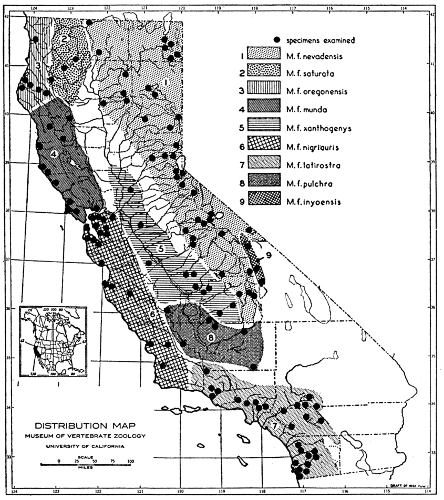
Fig. 30. Map showing the geographic distribution of subspecies of Mustela frenata in California
Intergradation with M. f. nevadensis and possibly with M. f. saturata is indicated by specimens from South Yolla Bolly Mountain, Trinity County. In them the external measurements and measurements of the skull are intermediate. Also the white frontal spot is much reduced in size. The white bars in front of the ears are absent in three specimens, and weakly developed in the other two. The relative proportions of the skulls as a whole are nearer those of nevadensis or saturata than munda. The skull of one of the three adult males and the skull of the adult female suggests M. f. oregonensis in certain features; for example, the dorsal outline of the skull in longitudinal axis is slightly convex as it is in oregonensis.
None of the specimens shows malformation of the frontal sinuses such as results from infestation by parasites.
Specimens examined.—Total number, 37, arranged by counties from north to south. Unless otherwise indicated specimens are in the Museum of Vertebrate Zoölogy.
California. Trinity County: S. Yolla Bolly Mt., 3[91]; 1/2 mi. S S. Yolla Bolly Mt., 1. Tehama County: 2 mi. S S. Yolla Bolly Mt., 1. Mendocino County: 6 mi. N Laytonville, 1; Mt. Sanhedrin, 1[87]; Ft. Bragg, 1; Gualala, 1; Point Arena, 5. Sonoma County: 2 mi. S and 1 mi. E Stewarts Point, 1; 3 mi. S Stewarts Point P. O., 1; Freestone, 1. Napa County: 6 mi. SSW, Napa, 1; 4 mi. N Vallejo, 1. County in question: San Pablo Bay, 1[91]. Marin County: 6 mi. W Inverness, 2; 5 mi. W Inverness, 2(1[28]); Point Reyes, 4 (2[91] 1[60], 1[75]); Nicasio, 2 (1[60], 1[75]); Kehoes Ranch, Pierce Point, 1[28]; Drakes Bay, 1[28]; Tomales Point, about 1/2 mi. SW White Gulch, 1; Point Reyes School, 3-3/4 mi. W Inverness, 1; 15 mi. (by road) N San Rafael, 1[52]; Hurley Ranch, 2 mi. W Tomales, 1. No locality more definite than California, 1[7].
Mustela frenata xanthogenys Gray
Long-tailed Weasel
Plates 21, 22, 23, 28, 30, 34, 35 and 36
Mustela xanthogenys Gray, Ann. and Mag. Nat. Hist., 11:118, 1843.
Putorius (Gale) brasiliensis frenatus, Coues, Fur-bearing animals, p. 142, 1877 (part).
Putorius xanthogenys, Merriam, N. Amer. Fauna, 11:25, June 30, 1896; Bangs, Proc. New England Zoöl. Club, 1:56, June 9, 1899.
Mustela xanthogenys xanthogenys, Miller, U. S. Nat. Mus. Bull., 79:99, December 31, 1912.
Mustela frenata xanthogenys, Hall, Carnegie Instit. Washington Publ. 473:107, November 20, 1936.
Type.—Male, adult, skull and skin; skull no. 197a-43.6.4.55, skin no. 234a-42.11.21.4, British Museum (Nat. Hist.); from the bank of Sacramento River below mouth of Feather River, or from north shore of San Francisco Bay, California; taken in "1837 or 1838"; presented by Captain Edward Belcher.
The skull (plate 28) lacks the occiput, the right mandible posterior to m1, and the right pterygoid; the right zygomatic arch is fractured. The teeth are not greatly worn. The skin was originally mounted for exhibition (R. I. Pocock in Litt.) but in 1937 when I saw the skin, it was prepared as a conventional study skin. The skin is in fairly good condition; some hair is missing on the hind quarters and the skin of the tail is torn at one place.
Range.—Altitudinally, less than 600 feet (Fair Oaks); Lower Sonoran and Upper Sonoran life-zones of all but southern end of the San Joaquin Valley, and probably Sacramento Valley, California. See figures 29 and 30 on pages 221 and 314.
Characters for ready recognition.—Differs from M. f. nevadensis by presence of light facial markings and Buckthorn Brown rather than near (14n to l) Brussels Brown color of upper parts; from M. f. munda by Buckthorn Brown rather than near (l) Sudan Brown, or near (l) Antique Brown color of upper parts and lesser size, in adult males basilar length less than 45 and hind foot less than 47; from M. f. nigriauris by lighter color in same way as from munda and also by having inside of ears same color as back rather than much darker than back; from M. f. pulchra in hind foot of males less than 46 and narrower skull, in males having breadth of rostrum less than 13.9 and mastoid breadth less than 26.0, see comparison of skulls in the account of pulchra.
Description.—Size.—Male: Three adults, from Fresno, Selma and Los Banos, measure, respectively as follows: Total length, 425, 417, 450; length of tail, 152, 154, 180; length of hind foot,—, 43, 44. Tail averages 61 per cent as long as head and body. Length of hind foot less than basal length.
Female: Adults from Selma, Los Banos, and 4 mi. SW Turlock, measure respectively as follows: Total length, 357, 365, 395; length of tail, 133, 132, 145; length of hind foot, 40, 38, 41. Tail averages 58 per cent as long as head and body. Length of hind foot less than basal length.
The average differences in external measurements between the two sexes, as represented by these six specimens, are: Total length, 65; length of tail, 25; length of hind foot, 3.5. One adult male weighs 274 grams and 2 adult females 182 and 214 grams.
Externals.—As described in Mustela frenata nigriauris.
Color.—Spot between eyes, band confluent with color of underparts on each side of head extending anterodorsally anterior to each ear, and posterior half to third of each upper lip white, or whitish tinged with some shade of yellowish; chin and lower lip white; dark spot posterior to each angle of mouth of varying size but uniformly present; tip of tail black; remainder of upper parts Buckthorn Brown of Ridgway or a trifle browner than tone 4 of Brown Pink of Oberthür and Dauthenay, pl. 297. Upper parts of uniform color except for slight darkening of head-markings anterior to ears. Underparts Ochraceous-Buff to Warm Buff. Color of underparts extends distally on posterior sides of forelegs over toes onto antipalmar faces of feet and wrists, on medial sides of hind limbs over antiplantar faces of toes and sometimes tarsal region. Least width of color of underparts averaging, in 9 specimens from Fresno, Selma and Los Banos, 54 (32-74) per cent of greatest width of color of upper parts. Black tip of tail in three males (one subadult and 3 adults) averages 55 (50-60) mm. long. Thus longer than hind foot and averaging 34 per cent of length of tail-vertebrae.
Skull and teeth.—Male (based on 2 adults from Fresno and one from Selma): See measurements and plates 21-23, 30. As described in M. f. nigriauris except that: Weight 3.8 grams; basilar length, 43.7 (43.4-43.9); least width of palate more or less than lateral length of P4; length of tympanic bulla more than length of lower molar and premolar tooth-rows.
Female (no. 2626 W. E. Snyder, from Selma): See measurements and plates 34-36. As described in M. f. nigriauris except that: Weight, 2.5 grams; basilar length, 39.4.
The skull of the female is 34 per cent lighter than the average for the three males.
Compared with skulls of nevadensis from the Sierra Nevada, those of the two adult males from Fresno differ as follows: M1 wider (transversely); tympanic bullae narrower; preorbital part of skull smaller. Comparison with pulchra is made in the account of that subspecies. Compared with skulls of adult males of nigriauris, from Santa Clara County, the two skulls from Fresno are generally smaller and in basilar length, length of tooth-rows and measurements of the teeth fall below the minimum for nigriauris. Relative proportions of the skulls are approximately the same. Comparison with munda reveals essentially the same differences as does comparison with nigriauris except that the difference in size is greater.
Remarks.—The name Mustela xanthogenys Gray was long applied to all the weasels of the interior valleys of California and of the coast of that state south of San Francisco Bay. Gray, when he named the species and when referring to it in later accounts, never defined the locality whence the specimen came more definitely than "California." In 1896, Merriam (1896:25) gave the type locality as "Southern California, probably vicinity of San Diego" and later writers have not contradicted him. The type specimen was obtained in the course of the voyage of the British ship Sulphur, under command of Sir Edward Belcher. Examination of Belcher's (1843, vol. 1, p. 129) narrative of the voyage indicates the following places in California at which the specimen of weasel, described by Gray, could have been obtained: Fort Ross, Bodega, vicinity of San Francisco Bay and up Sacramento River to the mouth of the Feather River, Monterey, Santa Barbara, Buenaventura, San Pedro, San Juan, and San Diego.
Reginald I. Pocock has kindly compared the type specimen in the British Museum with several specimens sent for that purpose. In the first place, comparison of skulls shows that the type specimen is a member of one of the races north of San Diego. In the second place, comparison of skins shows that the inside of the ears are not blackish but similar in color to the back. In fact, Pocock writes under date of February 12, 1929, regarding the type specimen, that "It is practically uniformly colored from the snout to the base of the tail, there being scarcely a trace of the darkening of the head, or muzzle, observable in your specimens [those sent for comparison]." This character of coloration of the ear excludes all the weasels of the Coast region of California from San Francisco Bay southward, namely, M. f. latirostra and M. f. nigriauris. My own examination of this type specimen at a date later than that on which Pocock compared it satisfies me as to the accuracy of his statement above.
Accordingly, the name xanthogenys would seem to apply to one of the two subspecies here called munda and xanthogenys. Perusal of Belcher's narrative of the voyage (loc. cit.) shows that little, if any, opportunity was afforded to obtain vertebrate specimens at Fort Ross or Bodega, both localities within the range of the subspecies here called munda. Furthermore, the type specimen is smaller than individuals of munda from 5 to 6 miles west of Inverness and from Point Arena with which the animals from Fort Ross and Bodega would be expected to agree in size. Weasels from along the north shore of San Francisco Bay are smaller than those on the coast north of the bay. Possibly the type specimen of xanthogenys came from the north side of San Francisco Bay but probably it came from the bank of the Sacramento River and almost certainly not farther up stream from San Francisco Bay than the junction of the Sacramento and Feather rivers. The statement of Belcher (1843, vol. 1, p. 129), regarding the trip up the Sacramento River as far as Point Victoria, lat. 38°46´47" north, and return to San Francisco Bay, that "Cuyote or jackal—fox, racoon, land otter, weasel, and squirrel were obtained" lends strong probability to the idea that this type specimen was taken along the Sacramento River, possibly in the vicinity of the existing city of Sacramento. Unfortunately no specimens are available from the Sacramento Valley. If some were available, a comparison of them and specimens of munda from along the north side of San Francisco Bay and Carquinez Straits with the type specimen of xanthogenys should determine the correct application of the name. For the present it seems best to retain the name munda and apply the name xanthogenys to the weasels inhabiting the northern part of the San Joaquin Valley and presumably the southern part of the Sacramento Valley.
Efforts to obtain specimens of weasels from the Sacramento Valley have been in vain. A juvenal specimen taken five miles south of Fair Oaks, Sacramento County, by Mr. John Fitzgerald, Jr., in December, 1927, was examined at his home and found to agree in coloration with specimens from farther south. Geographically, this specimen probably is more nearly a topotype than any other examined.
Most of the specimens examined are immature and adequate adult cranial material has not been seen. Two adults, one of each sex, from Los Banos have skulls of large size which agree with those of nigriauris. The same is true of one adult and one young female from 4 miles southwest of Turlock, which, unlike the animals from Los Banos, show a darkening of the head extending in reduced degree even to the inside of the ears, as in nigriauris. The slightly darker than average (for xanthogenys) color on the back may indicate intergradation with nevadensis. Intergradation with M. f. nevadensis is shown by specimens, from the southern part of the Sierra Nevada, mentioned in the account of nevadensis.
None of the skulls shows malformation of the frontal sinuses such as result from infestation by parasites.
Specimens examined.—Total number 30, arranged by counties from north to south.
California. Sacramento County: Bank of Sacramento River, 1[7]; 5 mi. S Fair Oaks, 1[29]. San Joaquin County: 4 mi. W Stockton, 1[74]. Merced County: Tegner School, 4 mi. SW Turlock, 2; Los Banos, 4 (2[74], 1[91] 1[87]). Fresno County: Mendota, 1[74]; Biola, 1[30]; Clovis, 1[55]; Fresno, 5 (1[74], 1[91], 2[55], 1[1]); 5 mi. W Fresno, 1[14]; Selma, 3 (2[50], 1[104]); 4 mi. NW Sanger, 1[55]; 5 mi. S Selma, 1[62]. Tulare County: Monson, 1[74]; 1-1/2 mi. N Goshen, 1[74]; Milo, 1[91]; 2 mi. N Tipton, 1[74]; Poplar, 2[53]. No locality more definite than California, 1[4].
Mustela frenata nigriauris Hall
Long-tailed Weasel
Plates 22, 23, 24, 34, 35, 36 and 41
Mustela frenata nigriauris Hall, Carnegie Instit. Washington Publ. 473:95, November 20, 1936.
Putorius xanthogenys, Baird, Mamm. N. Amer., 1858, p. 176 (part).
Mustela xanthogenys Gray, Ann. and Mag. Nat. Hist., 14(ser. 4):375, 1874 (part?).
Putorius (Gale) brasiliensis frenatus, Coues, Fur-bearing animals, p. 142, 1877 (part).
Putorius xanthogenys xanthogenys, Grinnel, Proc. California Acad. Sciences, fourth series, 3:292, August 28, 1913.
Mustela xanthogenys xanthogenys, Miller, U. S. Nat. Mus. Bull., 79:99, December 31, 1912; Grinnell, Univ. California Publ. Zoöl., 40:102, September 26, 1933.
Type.—Male, adult, skeleton and skin; no. 32820, Mus. Vert. Zoöl.; Half Moon Bay, San Mateo County, California; received at Museum of Vertebrate Zoölogy, May 4, 1922, through A. L. Hagedoorn, after having been in captivity a few days where death occurred owing to injuries received in trap; original no. 1590.
The skull has each of the zygomatic arches and the anterior end of the nasals broken through. The only part missing is the central two millimeters of the left zygomatic arch. The teeth all are present and entire. The skeleton appears to be complete except for the bones of the feet, which are preserved within the skin. The skin is well made and in good condition.
Range.—Altitudinally, sea level to more than 4000 feet; Sonoran and Transition life-zones of Coast Range and coast of California from San Francisco Bay south to Point Conception, Santa Barbara County, California. See figures 29 and 30 on pages 221 and 314.
Characters for ready recognition.—Differs from M. f. munda, xanthogenys, and pulchra by having inside of ears darker than back rather than same color as back, and from xanthogenys and pulchra in near (l) Antique Brown color of upper parts rather than Buckthorn Brown or near (16 j) Buckthorn Brown to near (h) Yellow Ocher respectively; from M. f. latirostra by postorbital breadth, of adult males and females, less, rather than more, than width of basioccipital measured from medial margin of one foramen lacerum posterior to its opposite.
Description.—Size.—Male: Five adults from Palo Alto, Santa Clara County, yield average and extreme measurements as follows: Total length, 447 (412-465); length of tail, 167 (147-175); length of hind foot, 46 (45-47). Corresponding measurements of four adults from San Francisco are: 412 (394-435); 153 (145-160); 43.5 (41-46). Corresponding measurements of five adults and subadults from Berkeley, Alameda County, are: 419 (390-448); 148 (135-160); 44 (42-47). Tail averages 59 per cent as long as head and body in series from Palo Alto and in one from San Francisco. The average of 55 for the Berkeley series probably reflects a lesser average age. Length of hind foot less than basal length. The type specimen measures, 415, 150, 43. It is smaller than the mean.
Female: A subadult from Palo Alto measures: Total length, 368; length of tail, 126; length of hind foot, 39. An adult and two subadults from Berkeley measure, respectively, as follows: Total length, 347, 365, 340; length of tail, 134, 123, 125; length of hind foot, 37, 38.4, 36.5. In these four females the tail averages 55 per cent as long as head and body. Length of hind foot less than basal length.
The average differences in external measurements of the two sexes, as represented by specimens from Berkeley, Alameda County, are: Total length, 68; length of tail, 21; length of hind foot, 7. Eight adult males weigh 249 (217-335) grams and one adult female 123 grams.
Externals.—Longest facial vibrissae brownish like dark color of head and extending beyond ear; carpal vibrissae mostly color of underparts and extending to apical pad of fifth digit; hairiness of foot-soles slightly more than shown in figure 20.
Color.—Spot between eyes, band, confluent with color of underparts, on each side of head extending anterodorsally anterior to ear, and posterior third of each upper lip tinged with color of underparts or, less often, pure white; chin and lower lips white; remainder of sides and top of head posteriorly to, or a little behind, a line connecting posterior margins of ears, blackish; inside of pinna of ear, and sometimes outside of pinna, blackish; dark spot posterior to each angle of mouth present on each side in three-fourths of specimens; tip of tail black; remainder of upper parts near (l) Antique Brown, and with more yellow than tone 3 of Raw Umber of Oberthür and Dauthenay, pl. 301. Often with more blackish and red in winter. Underparts near (a to c) Ochraceous-Buff or Ochraceous-Salmon. Ochraceous-Salmon in some juveniles. Color of underparts extends distally on posterior sides of forelegs over toes onto antipalmar faces of feet and wrists, and on medial sides of hind limbs over antiplantar faces of toes. Least width of color of underparts averaging, in 17 adult males (Berkeley, 5; San Francisco, 5; Palo Alto, 7), 55 (40-73) per cent of greatest width of color of upper parts. Black tip of tail in same series of males averaging 51 (35-60) mm., thus averaging longer than hind foot and 33 per cent of length of tail (Palo Alto and San Francisco, 31 per cent; Berkeley, 35 per cent). In 8 adult females, least color of underparts amounts to 55 (47-62) per cent of greatest width of color of upper parts. Black tip of tail averages 41.5 (28-50) mm., thus averaging longer than hind foot and 32 per cent of length of tail-vertebrae.
Skull and teeth.—Male (based on six adults from Stanford Univ. and vicinity): See measurements and plates 22-24; weight (four adults), 5.4 (5.0-5.9) grams; basilar length, 47 (46.1-48.1); zygomatic breadth more than distance between condylar foramen and M1, or than between anterior palatine foramen and anterior margin of tympanic bulla; mastoid breadth more than postpalatal length; postorbital breadth less than length of upper premolars (less than distance between posterior borders of P4 and P2) and less than width of basioccipital measured from medial margin of one foramen lacerum posterior to its opposite; interorbital breadth not greater than distance between foramen opticum and anterior margin of tympanic bulla; breadth of rostrum less than length of tympanic bulla; least width of palate less than lateral length of P4; anterior margin of tympanic bulla as far posterior to foramen ovale as width of 3 or 4 (including I3) upper incisors; height of tympanic bulla more than distance from its anterior margin to foramen ovale; length of tympanic bulla more or less than (about equal to) length of lower molar and premolar tooth-row and longer or shorter (usually shorter) than rostrum; anterior margin of masseteric fossa below anterior half of m2.
Female (based on three adults, Hayward, Palo Alto, and Morro): See measurements and plates 34-36; weight (no. 43574, from Morro) 2.7 grams; basilar length, 41.2 (40.2-42.2); zygomatic breadth more or less than distance between condylar foramen and M1 and more or less than distance between anterior palatine foramen and anterior margin of tympanic bulla; postorbital breadth less than length of upper premolars and less than width of basioccipital measured from medial margin of one foramen lacerum posterior to its opposite; least width of palate less than lateral length of P4; tympanic bulla as far posterior to foramen ovale as width of 3 (including I3) upper incisors; height of tympanic bulla more than distance from its anterior margin to foramen ovale; length of tympanic bulla more than length of lower molar and premolar tooth-row and longer or shorter than rostrum.
The skull of the female averages 50 per cent lighter than that of the average male.
Comparisons of the skull of the male with those of M. f. latirostra, pulchra, xanthogenys, and munda are made in the accounts of those subspecies.
Remarks.—Like M. f. latirostra, nigriauris long bore the name xanthogenys. The fairly adequate lot of specimens is divided between the collections of several institutions. The most satisfactory material in any one collection is in the Stanford University Natural History Museum where local specimens have been accumulated over a period of many years.
No actual intergrade between nigriauris and xanthogenys has been seen, although the specimens from Los Banos, referred to xanthogenys, have large skulls as in nigriauris. Intergradation with latirostra is shown by specimens, referred to latirostra, from the Los Angeles area. Also the one adult male from 5 miles southeast of Santa Margarita, San Luis Obispo County, is of small size and in this respect approaches latirostra. The range of nigriauris is separated from that of munda by San Francisco Bay, Carquinez Straits, and I suppose by the lower part of the San Joaquin River. On the basis of color of the inside of the pinna of the ear, the two subspecies are uniformly distinct. Intergradation is assumed to occur through the subspecies xanthogenys.
None of the 26 adult and subadult specimens examined for evidences of infestation of the frontal sinuses by parasites shows malformation of the sinuses.
Specimens examined.—Total number, 103, arranged by counties from north to south. Unless otherwise indicated specimens are in the Museum of Vertebrate Zoölogy.
California. Contra Costa County: Glen Frazer Station, 1; 2 mi. W Pinole, 1[13]; 1 mi. E Pinole, 1; Richmond, 1[13]; Lafayette, 1; 7 mi. E Clayton, 1; Moraga Valley, 1; Pinehurst, Redwood Canyon, 1; Concord, 1. Alameda County: Berkeley, 11; Oakland, 1; Piedmont, 1; Haywards, 2; near Haywards, 2; 10 mi. E Haywards, 1[91]; Redwood Canyon, 1; Calaveras Dam, 1. San Francisco County: San Francisco, 11 (5[8], 2[91], 1[60], 1[7]); Ocean View, 1[68]; Visitation Valley, 1. San Mateo County: Moss Beach, 1; Half Moon Bay, 1; Redwood City, 1[87]; Menlo Park, 9 (5[87], 2[68]); no locality more definite than county, 1[8]. Santa Clara County: 1/4 mi. N Milpitas, 1; 1/4 mi. S Milpitas, 1; Stanford University, 6 (4[68], 2[91]); Palo Alto, 11 (6[41], 2[60], 1[75], 1[87]). Santa Cruz County: 3 mi. E Santa Cruz, 1; 2-1/2 mi. E Santa Cruz, 1; Santa Cruz, 6 (2[91], 1[68], 1[4]). Monterey County: 1 mi. E mouth Salinas River, 10 ft., 1[37]; Pacific Grove, 1[8]; Monterey, 2 (1[7]); Carmel, 1[8]; Carmel Valley, 1[68]; Point Lobos, 1; Gonzales, 1. San Luis Obispo County: 5 mi. SE Santa Margarita, 1; Morro, 1[91]; 3-1/2 mi. S Oceano, 6. Santa Barbara County: Santa Maria, 1[87]; 5 mi. N Las Cruces, 1; 7 mi. W Gaviota, 1; Gaviota, 1.
Mustela frenata latirostra Hall
Long-tailed Weasel
Plates 1, 22, 23, 24, 34, 35 and 36
Mustela frenata latirostra Hall, Carnegie Instit. Washington Publ. 473:96, November 20, 1936.
Putorius xanthogenys, Baird, Mamm. N. Amer., p. 176, 1858 (part); Stephens, California mammals, p. 246, 1906; Merriam, N. Amer. Fauna, 11:25, June 30, 1896 (part).
Putorius (Gale) brasilianus frenatus, Coues, Fur-bearing animals, p. 142 (part).
Mustela xanthogenys xanthogenys, Miller, U. S. Nat. Mus. Bull., 79:99, December 31, 1912; Grinnell, Univ. California Publ. Zoöl., 40:102, September 26, 1933.
Mustela arizonensis, Grinnell and Swarth, Univ. California Publ. Zoöl. 10, 376, October 31, 1913.
Type.—Male, adult, skull and skin; no. 3257, Mus. Vert. Zoöl.; San Diego, San Diego County, California; May 20, 1907; obtained by Frank X. Holzner.
Right M1 is missing and the part of the jaw bearing this tooth is broken away. With this exception the skull is complete and unbroken and the teeth are all present and entire. The skin is fairly well made and in good condition except that it is slightly soiled.
Range.—Altitudinally sea level to 8000 feet (Tahquitz Valley, San Jacinto Mountains); Sonoran and Transition life-zones of coast and mountains west of Mohave and Imperial deserts of southern California from Point Conception and Cuyama Valley southward at least to Mexican boundary. See figures 29 and 30 on pages 221 and 314.
Characters for ready recognition.—Differs from M. f. nigriauris by having postorbital breadth of adult males and females, more, rather than less, than width of basioccipital measured from medial margin of one foramen lacerum posterior to its opposite; from M. f. pulchra by having tympanic bulla longer than rostrum (orbitonasal length) and by near (l) Antique Brown rather than near (16 j) Buckthorn Brown to near (h) Yellow Ocher color of upper parts.
Description.—Size.—Male: Six adults and subadults from San Diego yield average and extreme measurements as follows: Total length, 439 (428-449); length of tail, 153 (142-160); length of hind foot, 45 (40-47). Corresponding measurements for a series of eight adult males from the vicinity of Los Angeles are: 416 (394-428); 158 (151-166); 44 (40-47). In the series from San Diego the tail averages 54 per cent as long as head and body. In the series from Los Angeles the average is 61 per cent. Length of hind foot in each series, less than basal length. The type specimen measures, 435, 142, 42.
Female: No. 5070, adult, from San Diego, measures 367, 141, 38. Nos. 22 and 6748 from Santa Ysabel, measure: 359, 380; 130, 140; 39, 35. No. 7194 from Jamacha measures, 358, 125, 35. Three adult females from Los Angeles yield the following: Total length, 373, 345, 368; length of tail, 150, 122, 134; length of hind foot,—, 41, 41. In no. 5070 the tail is 62 per cent as long as the head and body and in the three from Los Angeles it averages 60 (55-67) per cent. Length of hind foot, in each case, less than basal length.
The average differences in external measurements of the two sexes as shown by the six males from San Diego and the four females from San Diego County are: Total length, 73; length of tail, 19; length of hind foot, 8. Corresponding differences shown by the eight males and three females from Los Angeles are: 54, 23, 3.
Externals.—Longest facial vibrissae brownish, like dark color of head and extending beyond ear; carpal vibrissae mostly color of underparts and extending to apical pad of fifth digit; hairiness of foot-soles slightly more than shown in figure 20.
Color.—Spot between eyes, band confluent with color of underparts on each side of head extending anterodorsally anterior to ear, and posterior third of each upper lip tinged with color of underparts or, less often, white; chin and lower lips white; remainder of sides and top of head posteriorly to near line connecting posterior margins of ears, blackish; inside of pinna of ear, and sometimes outside of pinna, blackish; dark spot posterior to each angle of mouth present on each side in three-fourths of specimens; tip of tail black; remainder of upper parts near (l) Antique Brown, and with more yellow than tone 3 of Raw Umber of Oberthür and Dauthenay, pl. 301. Underparts Ochraceous-Buff to Warm Buff and in some specimens from Los Angeles and Ventura counties Ochraceous-Orange, especially in young and juveniles. Color of underparts extends distally on posterior sides of forelegs over toes onto antipalmar faces of feet and wrists and on medial sides of hind limbs over antiplantar faces of toes. Least width of color of underparts averaging, in 15 adult and subadult males from San Diego County, 54 (35-75) per cent of greatest width of color of upper parts. Black tip of tail in same series of males averaging 54.5 (46-60) mm. long. Thus averaging longer than hind foot and 35 per cent of length of tail-vertebrae.
Skull and teeth.—Male (based on 6 adults from San Diego County). See measurements and plates 22-24. As described in M. f. nigriauris except that: Weight (4 specimens), 3.9 (3.8-4.0) grams; basilar length 43.8 (41.9-47.0); postorbital breadth more than width of basioccipital measured from medial margin of one foramen lacerum posterior to its opposite; interorbital breadth not less than distance between foramen opticum and anterior margin of tympanic bulla; anterior margin of tympanic bulla as far posterior to foramen ovale as width of 2 to 2-1/2 (including I3) upper incisors; length of tympanic bulla more than length of lower molar and premolar tooth-row and longer than rostrum; anterior margin of masseteric fossa below m2.
Female (based on 4 adults from San Diego County): See measurements. As described in M. f. nigriauris except that: Weight, 2.6 (2.2-2.8) grams; basilar length, 40.0 and 40.1; postorbital breadth more than width of basioccipital measured from medial margin of one foramen lacerum posterior to its opposite; length of tympanic bulla more than length of rostrum.
The skull of the female averages 34 per cent lighter than that of the average male.
The skull of the male of latirostra, compared with that of nigriauris, is by weight, more than one-fourth lighter, has a lesser basilar length, a lesser mastoid breadth, a lesser zygomatic breadth and a narrower M1. In these features no overlap has been observed between adults from the general vicinities of the type localities of the two forms. In adult males of latirostra the postorbital breadth, with one exception, is more than the combined length of P4 and P3 whereas the reverse is true in adult males of nigriauris. Both males and females of latirostra have a generally smaller skull with relatively broader interorbital and postorbital parts and the tympanic bullae are relatively larger, rounder and more inflated.
Compared with the skull of the male of pulchra that of latirostra is, by weight, more than one-fourth lighter, has a lesser basilar and orbitonasal length, lesser zygomatic and mastoid breadth and a more nearly flat braincase. In these features no overlap has been observed between adults from the general vicinities of the type localities of the two subspecies. Also, in latirostra the tympanic bulla is longer than the rostrum whereas the opposite is true in pulchra. The skull of latirostra is generally smaller and relatively, on the average, has the preorbital part of the skull deeper and broader with longer tooth-rows, although with shorter rostrum, while the zygomatic and mastoid breadths are less. Study of skulls of subadult females of pulchra indicate that females of latirostra and pulchra differ in the same fashion as do males.
Remarks.—This subspecies long has gone by the name M. xanthogenys and the type locality was generally supposed to be in the vicinity of San Diego. This supposition seems to have originated with Merriam's (1896:25) statement that the type locality was "Southern California, probably vicinity of San Diego." Nevertheless, as set forth in the account of M. f. xanthogenys the type specimen concerned now is thought to have come from much farther north.
Although 76 Recent specimens are available from southern California, additional adults are needed to understand the geographic variation there. M. f. latirostra may be a composite—made up of more than one geographic race. Specimens from San Diego County differ so much in relative length of the tail that at one stage in the present study it was thought that a difference in this respect existed between the coastal animals and those from farther inland. Material received later did not wholly substantiate this view and because of the uniformly small size of all of the skulls from that county, the animals were later regarded as of the same subspecies. Eventually, even this supposed common feature proved to be inconstant for an adult male from Jamacha, no. 7098, of the San Diego Society of Natural History, and another adult male from San Marcos, no. 8869, collection of Ralph Ellis, were later examined and found to have skulls as large as those of average-sized, adult males of nigriauris.
Despite these puzzling local variations, it is established that the long-tailed weasels of southern California are smaller than those from farther north. Also, the southern animal averages smaller in weight and size of skull, and the skull is differently proportioned. Specimens in series from Los Angeles County definitely are intermediate in size and shape of skull between latirostra from San Diego County and nigriauris from, say, Santa Clara County, but definitely more closely resemble latirostra from San Diego County than they do nigriauris. A skull of a young animal, not here identified to subspecies, from Potholes, in the Colorado River Valley, 10 miles northeast of Bard, Imperial County, California, may have closest relationship to M. f. latirostra. Additional comment on this specimen is offered in the account of M. f. neomexicana.
From the asphalt pits of Rancho La Brea, in Los Angeles County, a total of 57 skulls have been examined, more than half of which are reasonably complete. I have been unable to learn whether these came from pits regarded by students of the deposit as wholly Recent, from pits regarded as of Pleistocene age, or from both. Suffice to say that only two specimens were found which could be distinguished from skulls of the subspecies of weasel living in that area today.
These two specimens, lent to me by Professor Chester Stock, were with other skulls received from the Los Angeles Museum of History, Art and Science and bore identifying numbers as follows: 16/20-27, the anterior part of the skull of an adult, and 16, the skull posterior to the cribiform plate of a subadult or possibly young individual. The latter has a mastoid breadth of 28.0 millimeters, a tympanic bulla 16.1 long and other measurements in proportion. It is larger than any specimen of weasel, of any subspecies, seen from California and in the subgenus Mustela seems to be exceeded in size only by certain individuals of M. f. texensis. M. f. neomexicana attains relatively large size and comparisons were made with individuals of that subspecies. However, the young specimen from Rancho La Brea differs from neomexicana in that the tympanic bullae rise less steeply on the medial sides and the inferior lip of the external auditory meatus is less developed laterally. Age considered, the sagittal crest is less developed and the mastoid processes project more abruptly from the skull. The anterior part of the skull of the adult, no. 16/20-27 is larger than any specimen seen of M. f. latirostra or adjoining subspecies, and among California-taken specimens is equaled in size only by the largest males of M. f. munda from the northwest coastal district in Mendocino County. This adult from Rancho La Brea differs from neomexicana, sex and age taken into account, in greater postorbital breadth, lesser rostral width in comparison with the interorbital breadth, and in having the temporal ridges at the anterior end of the sagittal crest spread out into a Y-shaped, rather than a T-shaped, pattern. All these differences from neomexicana are features of agreement with the California bridled weasels of the subspecies latirostra, nigriauris, and munda. The same is true of the characters which set apart the young specimen from neomexicana. In summary: of 57 weasel skulls examined from the asphalt pits at Rancho La Brea, Los Angeles County, all but two are indistinguishable from the skulls of the Recent weasel living in that region today. These two skulls agree in qualitative characters with animals of the California coastal subspecies now living from Los Angeles northward to Humboldt County, but are larger. For the time being these two may be thought of as giants of the same type of animal inhabiting the Los Angeles region today.
Only one of 41 adult and subadult skulls examined for malformation of the frontal sinuses shows infestation by parasites.
Specimens examined.—Total number, 142, listed by counties from north to south. Unless otherwise indicated specimens are in the Museum of Vertebrate Zoölogy.
California. Santa Barbara County: Rincon Point, 1. Ventura County: Cuyama Valley, 2200 ft., 1[91]; Nordhoff, 3[59]; Santa Paula, 1[59]; Ventura, 7. Los Angeles County: near Owensmouth, 1[24]; Cahuenga, 1[91]; Llano, 10 mi. E Littlerock, 1; Flint Ridge, Pasadena, 1[59]; Pasadena, 3; Lankershim, 1[24]; 1 mi. S Lankershim, 1[24]; Duarte, 1[59]; Covina, 1[59]; Claremont, 1[91]; El Monte, 4 (2[75], 1[24]); Montebello, 1; Alhambra, 6 (5[2], 1[91]); El Nogal, 2[8]; Gardena, 1[26]; Palos Verdes Estate, 3; Rancho La Brea asphalt deposits, 57[70] and [92]. San Bernardino County: San Bernardino Valley, 1[75]; San Bernardino, 4 (2[20], 1[91]); Redlands, 2 (1[38]); Bluff Lake, 2 (1[59], 1[33]). Riverside County: West Riverside, 1; Arlington, 800 ft., 1[17]; 3-1/2 mi. E and 1/2 mi. N Beaumont, 2600 ft., 1; Banning, 1[91]; Cabazon, 1[91]; San Jacinto Plain, 1[20]; Tahquitz Valley, 8000 ft., 1; Elsinore, 1[1]. San Diego County: Twin Oaks, 1[91]; San Marcos, 2 (1[87], 1[41]); Escondido, 1; Witch Creek, 1[91]; Ballena, 1[20]; Santa Ysabel, 3 (2[20], 1[87]); Julián, 1; La Jolla, 1; Lakeside, 1[91]; El Cajon, 1[91]; El Vido (not found on map), 1[91]; San Diego, 9 (1[91], 1[20], 1[87], 1[32]); Jamacha, 2[87]; Chula Vista, 1[20].
Mustela frenata pulchra Hall
Long-tailed Weasel
Plates 22, 23 and 24
Mustela frenata pulchra Hall, Carnegie Instit. Washington Publ. 473:98, November 20, 1936.
Type.—Male, adult, skeleton and skin; no. 16668, Mus. Vert. Zoöl.; Buttonwillow, Kern County, California; April 30, 1912; obtained by J. Grinnell; original no. 1953.
The skull (plates 22-24) is complete and unbroken (a fracture in the right jugal has healed). All teeth are present and entire. The skeleton lacks the os penis, left fibula, shaft of left tibia and the distal three or four caudal vertebrae. Some of the bones of the feet distal to the radius and tibia are with the skeleton, and the remainder probably are in the skin. The skin is fairly well made and in good condition, except for the left hind leg which was torn when the animal was captured. A well-developed scrotal pouch shows the specimen to have been a male.
Range.—Altitudinally around 300 feet in San Joaquin Valley to 2500 feet at Isabella; Upper Sonoran and Lower Sonoran life-zones of southern end of San Joaquin Valley and in mountains at southern end of Valley, California. See figures 29 and 30 on pages 221 and 314.
Characters for ready recognition.—Differs from M. f. nevadensis in presence of light facial markings, and from M. f. nevadensis and M. f. inyoensis in near (16 j) Buckthorn Brown to near (h) Yellow Ocher rather than near (14 n to l) Brussels Brown color of upper parts, and greater size with hind foot more than 40 in females and basilar length averaging more than 46.0 in males; from M. f. latirostra in having rostrum (orbitonasal length) longer than tympanic bulla and from M. f. latirostra and M. f. nigriauris by color of upper parts as stated above rather than near (l) Antique Brown, and by having inside of ears same color as back rather than much darker than back; from M. f. xanthogenys in hind foot of males more than 46 and broader skull which in males has breadth of rostrum more than 13.9 and mastoid breadth more than 26.0.
Description.—Size.—Male: The type specimen and five other adults yield average and extreme measurements as follows: Total length, 454 (428-477); length of tail, 178 (153-184); length of hind foot, 50 (47-55). Tail averages 65 per cent as long as head and body. Length of hind foot approximately equal to basal length. The type specimen measures, 460, 184, 49.
Female: Three subadult topotypes yield average and extreme measurements as follows: Total length, 399 (383-411); length of tail, 154 (140-161); length of hind foot, 42 (41-42). Tail averages 63 per cent as long as head and body. Length of hind foot less than basal length.
The average differences in external measurements of the two sexes are: Total length, 55; length of tail, 24; length of hind foot, 8.
Externals.—As described in Mustela frenata nigriauris.
Color.—Spot between eyes, band confluent with color of underparts, on each side of head extending anterodorsally anterior to each ear, posterior third of each upper lip, lower lips and chin white or more often darker than Ochraceous-Buff and therefore same color as belly; dark spot posterior to each angle of mouth present but small; tip of tail black; remainder of upper parts near (16 j) Buckthorn Brown to near (h) Yellow Ocher and from tone 2 to 4 of Brown Pink of Oberthür and Dauthenay, pl. 297, but with a trifle more reddish brown. Upper parts of uniform color except for occasional slight darkening of nose, forehead, and areas around eyes. Underparts darker (a) than Ochraceous-Buff. Color of underparts extends distally on posterior sides of forelegs over toes, onto antipalmar faces of feet and wrists, on medial sides of hind limbs over antiplantar faces of toes, tarsal region and sometimes in diluted fashion on proximal third of underside of tail. Least width of color of underparts averaging, in 6 male topotypes, 55 (43-81) per cent of greatest width of color of upper parts. Black tip of tail in same series of males averaging 58 (53-63) mm. long; thus averaging longer than hind foot and 33 per cent of length of tail-vertebrae.
Skull and teeth.—Male (based on 6 ads., type and 5 topotypes): See measurements and plates 22-24. As described in M. f. nigriauris except that: Weight (6 ads.), 5.3 (4.5-6.1) grams; basilar length, 47.6 (46.0-48.6); (one skull, no. 335, with postorbital breadth more than distance between posterior borders of P4 and P2); interorbital breadth more or less than distance between foramen opticum and anterior margin of tympanic bulla; anterior margin of tympanic bulla as far posterior to foramen ovale as width of 2 to 3-1/2 (including I3) upper incisors; length of tympanic bulla more than length of lower molar and premolar tooth-row and shorter than rostrum.
Female: Adult skull of typical female not seen.
As compared with the skull of the type specimen of inyoensis, skulls of adult males of pulchra are larger throughout, relatively broader, especially in the preorbital part of the skull, have more inflated tympanic bullae, and are less convex in dorsal outline. Comparison of the skull with that of latirostra has been made in discussion of that subspecies. Comparison of skulls of adult males of nigriauris and pulchra shows that those of pulchra average larger in every measurement taken except those of m1, M1, P4, and depth of skull at posterior borders of upper molars. The basilar length is only slightly more and it follows that, relative to this length, other measurements of the skull are relatively, as well as actually, larger. In no one measurement is there an entire lack of overlap, but the skulls of adult males, and probably adult females, may be distinguished from those of nigriauris by the combination of the following mentioned, average differences: Tympanic bullae larger in each of three dimensions; preorbital and interorbital parts of skull broader and notably heavier; interorbital breadth greater; zygomatic arches more expanded laterally; mastoid processes more prominent. As compared with xanthogenys, differences of similar nature, but of greater degree, distinguish pulchra. As compared with those of nevadensis (represented by specimens from Mono Co., Calif.), skulls of adult males of pulchra average larger in every measurement taken and no overlap exists in basilar length, orbitonasal length, mastoid breadth, zygomatic breadth, length of tympanic bulla, or depth of skull at either the anterior margin of the basioccipital or at the posterior margins of the upper molars. Relatively, the preorbital portion is about the same size in the two forms.
Remarks.—The best material of this big weasel was obtained in 1910 and 1911 by John Wimmer and forwarded to the California Academy of Sciences through John R. Rowley, although in 1905, one specimen had been obtained by A. S. Bunnell for the collections of the United States Bureau of Biological Survey, another by J. Grinnell for the Museum of Vertebrate Zoölogy in 1912, and in 1933, another by L. M. Huey, for the San Diego Society of Natural History.
The males from the type locality are relatively uniform in size and shape of skull. The one exception is no. 137935, U. S. Nat. Mus., slightly younger than the others. Its skull is relatively more slender than any of the others and does not display several of the differential characters. The male, no. 127566, U. S. Nat. Mus., from Alila (= Earlimart) is intermediate in cranial features between pulchra and xanthogenys as known from specimens taken in the vicinity of Fresno. The skull of the female, no. 127565, from the same place, is too young to provide diagnostic characters. Since the skull of an adult female of topotypical pulchra is unknown, doubt attaches to the identification of the adult, female specimen, no. 115895, U. S. Nat. Mus., from Delano. It has a relatively broad skull in comparison with the adult female of xanthogenys from Los Banos. The adult female, no. 9998, San Diego Soc. Nat. Hist., from 2 mi. SW Simmler, shows approach to nigriauris in slightly reduced size. The skin alone from Coalinga, a male, taken on April 10, 1935, measures 462, 179, 47. The adult female, with crushed skull, from 4 miles east of Coalinga, measures 350, 129, 40. In size, these specimens agree better with pulchra than with xanthogenys. The skin alone from 3 miles south of Coalinga is unsexed and without external measurements. Skulls of adults from Coalinga are needed to permit of more positive identification of the subspecies found there. The female from 4 miles east of Coalinga, taken on February 21, 1936, is in process of molt on the underparts, and the longer hair which is near (20´) Naples Yellow contrasts strongly with the incoming shorter hair which is near (10 c) Salmon-Orange. The skin alone, no. 16270, Mus. Vert. Zoöl., from Isabella, was made up from a decayed animal and is of but little use. It is referred to pulchra purely because of geographic nearness of Isabella to the type locality of pulchra. The most that can be told from the specimen is that it is a relatively light-colored, bridled weasel. The fact that the color is slightly darker than in pulchra may or may not indicate intergradation with nevadensis. No. 54103/41042, U. S. Nat. Mus., consisting of crushed bits of skull and the skin of the head, is from Willow Spring, Kern County. This marginal locality is really in the Mojave Desert rather than in the San Joaquin Valley. The light color of the skin of the head suggests pulchra, but it is realized that a complete specimen might show the animal there to be unlike pulchra.
None of the skulls shows evidence of having had the frontal sinuses infested by parasites.
Specimens examined.—Total number, 18, listed by counties from north to south. Unless otherwise indicated, specimens are in the Museum of Vertebrate Zoölogy.
California. Fresno County: Coalinga, 1[23]; 4 mi. E Coalinga, 1; 3 mi. S Coalinga, 1[8]. Tulare County: Alila (= Earlimart), 2[91]. Kern County: Delano, 1[91]; Buttonwillow, 9 (6[8], 2[91]); Isabella, 1; Willow Spring, 1[91] San Luis Obispo County: 2 mi. SW Simmler, 1[87].
Mustela frenata inyoensis Hall
Long-tailed Weasel
Plates 22, 23 and 24
Mustela frenata inyoensis Hall, Carnegie Instit. Washington Publ. 473:99, November 20, 1936.
Putorius xanthogenys, Merriam, N. Amer. Fauna, 11:25, June 30, 1896 (part).
Mustela xanthogenys xanthogenys, Miller, U. S. Nat. Mus. Bull., 79:99, December 31, 1912.
Type.—Male, adult, skull (with skeleton) and skin; no. 25907, Mus. Vert. Zoöl.; Carl Walter's Ranch, 2 mi. N Independence, Inyo County, California; June 26, 1917; obtained by A. C. Shelton; original no. 3143.
The skull (plates 22-24) is complete and unbroken. All teeth are present and entire. The skin is well made and in good condition.
Range.—From 3700 feet (Lone Pine) to at least 4000 feet (Alvord); Lower Sonoran Life-zone of the floor of Owens Valley in Inyo County, California. See figures 29 and 30 on pages 221 and 314.
Characters for ready recognition.—Differs from M. f. nevadensis in presence of white facial markings; from M. f. pulchra in near (l) Brussels Brown rather than near (16 j) Buckthorn Brown to near (h) Yellow Ocher color of upper parts and basilar length of less than 45 in males; from M. f. latirostra in brownish rather than blackish color of inside of ear and orbitonasal length of more than 15.
Description.—Size.—Male: Two adults, the type specimen and no. 25392/32805, measure, respectively, as follows: Total length, 423 and 390; length of tail, 170 and 145; length of hind foot, 42 and 44. Tail is 67 and 59 per cent as long as head and body. Length of hind foot less than basal length.
Female: No. 12400, Field Mus. Nat. Hist., which is young, has the following measurements: Total length, 390; length of tail, 150; length of hind foot, 39. Tail is 63 per cent as long as head and body. Length of hind foot less than basal length.
The differences in external measurements between the two sexes, as represented by the male type specimen and by the young female, are: Total length, 33, length of tail, 20; length of hind foot, 3.
Externals.—Longest facial vibrissae black or dark brown and reaching beyond ear; carpal vibrissae same color as underparts and extending to apical pad of fifth digit; hairiness of foot-soles (in summer pelage) slightly less than shown in figure 19.
Color.—Large spot between eyes, band confluent with color of underparts, on each side of head extending anterodorsally anterior to each ear, upper throat, chin, lower lips and in some specimens part or all of upper lips white; patch between eyes and bars in front of ears tinged with some shade of yellowish in one specimen; dark spot posterior to each angle of mouth present in four of five specimens; tip of tail black; remainder of upper parts, in summer, near (l) Brussels Brown or tones 1 to 2 of Raw Umber of Oberthür and Dauthenay, pl. 301; slightly darker brown on forehead, nose and about eyes. In winter near (j) Snuff Brown or lighter than Brussels Brown with a smoked effect. Underparts Buff-Yellow, winter and summer. Color of underparts extends distally on posterior sides of forelegs over toes onto antipalmar faces of feet and wrists and on medial sides of hind legs over antiplantar faces of toes. Least width of color of underparts averaging, in 5 available specimens 34 (24-42) per cent of greatest width of color of upper parts. Black tip of tail, in two adult males, averaging 53 (45 and 60) mm. Thus longer than hind foot and averaging 34 per cent of length of tail-vertebrae.
Skull and teeth.—Male (based on the type): See measurements and plates 22-24. As described in M. f. nigriauris except that: Weight, 4.4 grams; basilar length, 44.7; postorbital breadth not less than width of basioccipital measured from medial margin of one foramen lacerum posterior to its opposite; length of tympanic bulla less than length of lower molar and premolar tooth-row.
Female: Adult unknown.
Compared with the skull of the male of nevadensis, no single difference not covered by individual variation in nevadensis has been detected. Selected differences of inyoensis in comparison with latirostra are larger size, less inflated tympanic bullae and relative narrowness of the postorbital, interorbital and preorbital parts of the skull. Comparison of the skull with that of M. f. pulchra is made in the account of that subspecies.
Remarks.—Although two specimens of this subspecies were taken during the Death Valley Survey conducted by Dr. C. Hart Merriam, only three additional individuals are known to have been saved as study specimens since that time.
M. f. inyoensis as now known may be thought of as closely similar to M. f. nevadensis except for the presence of well-developed white facial markings like those found in the weasels of the San Joaquin Valley and coastal region of California south of San Francisco Bay. The nonwhite areas of the head are almost the same color as the back and not distinctly blackish as in M. f. latirostra and M. f. nigriauris. The one specimen in the winter coat, no. 25392/32805, U. S. Nat. Mus., from Lone Pine, is brown rather than white. The brown has the pale smoke-tinge common in the winter pelage of subspecies whose members are either brown or white in winter. The range of this subspecies is thought to include the floor and lower elevations of Owens Valley although it may occur in limited numbers southwestward along the base of the Sierra Nevada and through the mountains in places of low elevation like Walker Pass its range may meet that of pulchra.
The type specimen was taken in an alfalfa field by ranch hands, who, according to A. C. Shelton (MS), stated that the species was common at the type locality. None of the five specimens shows infestation of the frontal sinuses by parasites.
Specimens examined.—Total number, 5, listed by localities from north to south.
California. Inyo County: Alvord, 4000 ft., 1 (U. S. Nat. Mus.); 2 mi. N Independence, 1 (Mus. Vert. Zoöl.); Lone Pine, 3 (2 in Field Mus. Nat. Hist. and 1 in U. S. Nat. Mus.).
Mustela frenata neomexicana (Barber and Cockerell)
Long-tailed Weasel
Plates 1, 22, 23, 24, 34, 35 and 36
Putorius frenatus neomexicanus Barber and Cockerell, Proc. Acad. Nat. Sci. Philadelphia, 1898:188; Lantz, Trans. Kansas Acad. Sci., 19:178, 1905.
Mustela frenata neomexicana, Miller, U. S. Nat. Mus. Bull., 79:100, December 31, 1912; Bailey, Animal Life of Carlsbad Cavern, p. 97, 1928; Hall, Carnegie Instit. Washington Publ. 473:108, November 20, 1936.
Mustela frenatus neomexicanus, Bailey, N. Amer. Fauna, 35:19, September 5, 1913.
Type.—Male, adult, skull and skin; no. 10475, Mus. Comp. Zoöl.; Armstrongs Lake, Mesilla Park, Dona Ana County, New Mexico; February 1, 1898; obtained by A. C. Tryson; original no. 58 of C. M. Barber.
The skull is imperfectly cleaned but unbroken. The right upper incisors, right P2 and left p3 are broken away. The skin is indifferently stuffed but in a good state of preservation except that the distal part of the tail is missing. The animal's coat is ragged, and this imperfect appearance is heightened by injury to the posterior part of the body, probably at the time of capture.
Range.—From 3800 feet (type locality) to 9000 feet (Cloudcroft, N. Mex.); Upper Sonoran and Lower Sonoran life-zones of northern México, southeastern Arizona, New Mexico and western Texas, panhandle of Oklahoma, southeastern Colorado and southwestern Kansas. See figure 29 on page 221.
Characters for ready recognition.—Differs from M. f. frenata and M. f. texensis by Buckthorn Brown rather than Brussels Brown color of upper parts, mastoid breadth of adult males ordinarily more, rather than less, than postpalatal length; from M. f. leucoparia by Buckthorn Brown rather than Argus Brown color of upper parts, distance from anterior margin of tympanic bulla to foramen ovale less, rather than more, than four-fifths height of tympanic bulla; from M. f. arizonensis and M. f. nevadensis by Buckthorn Brown, rather than near (14 n) Brussels Brown or, in winter, white color of upper parts, in presence of white frontal spot continuous with color of underparts, in basilar length of more than 46 mm. in males and 40 mm. in females; from M. f. longicauda by Buckthorn Brown rather than near (h) Clay Color of upper parts, by presence of white facial markings on Argus Brown head, and by length of tooth-rows amounting to less than 37 per cent of basilar length; from M. f. primulina by Buckthorn Brown rather than Brussels Brown color of upper parts, in presence of white frontal spot and broad white bands on side of head, in anteriorly truncate rather than anterolaterally rounded bullae and zygomatic breadth of more than 30 in males and 24 in females.
Description.—Size.—Male: The type specimen (see Barber and Cockerell, 1898:188) measured: Total length, 500; length of tail, 205; length of hind foot, 50. Tail 70 per cent as long as head and body. Length of hind foot less than basal length.
Female: No. 21779 from Tombstone, Arizona, measured: Total length, 419; length of tail, 165; length of hind foot from dried skin, 41 (probably 43 in flesh). Tail 65 per cent as long as head and body. Length of hind foot less than basal length.
The average differences in external measurements of the two sexes, as known from these two individuals, are: Total length, 81; length of tail, 40; length of hind foot, 7.
Compared with M. f. frenata, the size, proportions of parts and difference in size of the two sexes, appears to be about the same.
Externals.—Longest facial vibrissae colored like upper parts [in the type specimen some of the "long bristles of the upper lip" are white as pointed out by Barber and Cockerell (op. cit.: 188)] and extending beyond ear; carpal vibrissae colored like underparts and extending to apical pad of fifth digit; hairiness of foot-soles as shown in figure 20.
Color.—Broad white bands on sides of head, extending anterodorsally anterior to each ear, confluent with white spot between eyes and with color of underparts; posterior half or all of each upper lip edged with white; usually few white hairs on top of head between ears; remainder of top of head near Argus Brown of Ridgway and Chocolate, tone 4, of Oberthür and Dauthenay; dark spot posterior to each angle of mouth usually absent; tip of tail black; remainder of upper parts varying, in different specimens, from Buckthorn Brown to Dresden Brown of Ridgway, and Brown Pink (tones 3 to 4, pl. 297, of Oberthür and Dauthenay); underparts Antimony Yellow or near (c) Warm Buff of Ridgway, and Brown Pink (tone 1, pl. 297, of Oberthür and Dauthenay); color of underparts extends distally on legs over forefeet and hind feet. Least width of color of underparts averaging 46 (41-55) per cent of greatest width of color of upper parts; black tip of tail 35 to 45 mm. long in females; 43 to 68 mm. long in males and averaging 21 (20-36) per cent as long as tail-vertebrae.
No specimen of this subspecies in the white winter coat has been seen. Animals taken in midwinter are available from Mesilla Park, Willcox, and 10 miles east of Roswell.
From M. f. frenata, neomexicana differs in: upper parts and underparts much lighter colored; white facial markings more extensive; color of underparts more extended onto feet. From M. f. leucoparia, neomexicana differs as follows: above and below, much lighter colored, but white facial markings less extensive and color of underparts less extended onto feet and legs.
Skull and teeth.—Male (based on adults: the type; no. 131582 from Berino, New Mexico; and no. 1485 from Seward Co., Kansas): See measurements and plates 22-24. As described in Mustela frenata frenata except that: Weight, 6.2 (4.9 and 7.5); basilar length, 49.3 (48 and 50.5); mastoid breadth more than postpalatal length; least width of palate less than length of P4; anterior margin of masseteric fossa directly below m2 or heel of ml.
Female (based on three adults): See measurements and plates 34-36. As described in Mustela frenata frenata except that: Weight, 3.1 (2.6-3.5) grams; basilar length, 42.7 (40.8-45.5); zygomatic breadth less than distance between condylar foramen and M1 and more or less than distance between anterior palatine foramen and anterior margin of tympanic bulla.
The skull of the female averages 50 per cent lighter than that of the male.
As compared with the skull of the male of M. f. frenata, that of neomexicana is decidedly more angular and ridged. The postorbital constriction is narrower, the mastoid breadth greater (it is less than the postpalatal length in some subadult males), the sagittal crest much higher with impressions of the temporal and masseter muscles carried farther forward on the frontals, rostrum shorter and tympanic bullae wider and more inflated. Similar, though less marked, differences exist between the females. As compared with M. f. leucoparia and perotae, the same differences as noted above between frenata and neomexicana exist. In addition the tympanic bullae are so far removed from the foramen ovale that the distance from the anterior end of each bulla to the foramen ovale, instead of being less than the height of tympanic bullae, is in leucoparia more than four-fifths this height and in perotae more than the entire height. Also, in perotae, the squamosal, anterior to each tympanic bulla, is ventrally convex rather than ventrally concave as in neomexicana. Compared with M. f. longicauda, neomexicana is relatively narrower in the interorbital region, has relatively shorter tooth-rows, a V-shaped rather than a U-shaped interpterygoid space and in males has the interorbital region flat rather than convex and the sagittal crest is higher. The same differences are to be noted in comparison with nevadensis but here the difference in relative length of tooth-row is less. The same differences exist also in comparison with M. f. arizonensis except that its interorbital breadth, relative to the rest of the skull, is about the same. Difference in size is especially marked here; even females of neomexicana average larger than males of arizonensis.