SYSTEMATIC ACCOUNTS OF SPECIES AND SUBSPECIES (continued 2)
Reading edition
Specimens examined.—Total number, 172, arranged alphabetically by provinces and states, then (except where indication is given to the contrary) by counties from north to south within each state or province. Unless otherwise indicated, specimens are in the U. S. National Museum.
Connecticut. Windham County: S. Woodstock, Woodstock Lake, 1[2]. Hartford County: Windsor, 1[5]. New London County: Liberty Hill, 3[75].
Maine. Aroostook County: Quimby, 1[75]; Ashland 2[75]. Piscataquis County: tableland on top of Mt. Katahdin, 1; Chimney Pond, 3; T. 5, R. 13, 3[5]; "vicinity of Chesnucook," 1[5]; T. 4, R. 13, 1[5]; Moosehead Lake, 7[75]; Grenville, 10 [75]; Barnard, 3 (1[86]). Penobscot County: South Twin Lake, 1[2]; Lincoln, 11 (7[1], 2[14], 2[50]). Franklin County: Seven Pond Township, 7[75]. Oxford County: Umbago Lake, 1[75]; Upton, 4[86]; Bethel, 1[75]. Hancock County: Bucksport, 17[75]; Naskeag, 1. Lincoln County: Booth Bay, 1[5].
Massachusetts. Middlesex County: Wilmington, 2; Burlington, 6 (1[75]); Worcester County: Cambridge, 5 (1[5], 3[75]); Sterling, 1[5]. Plymouth County: Middleboro, 7 (1[75]).
New Hampshire. Carroll County: Ossipee, 5. Rockingham County: Greenland, 1[76]. Cheshire County: Dublin, 1.
New York. St. Lawrence County: Ogdensburg, 1[74]. Franklin County: Malone, 1[58]. Lewis County: Locust Grove, 1. Warren County: Lake George, 1. Montgomery County: Amsterdam, 1. Albany County: Albany, 1[80]. Rensselaer County: Berlin, 2[2]; Schoharie, 1[2]. Thompkins County: Cascadilla Creek, Ithaca, 1[58]. Allegany County: Ford Brook, Wellsville, 1[58]. Ontario County: Phelps, 1[50]. Cattaraugus County: Cattaraugus, 1[5].
Ontario (localities locally north to south, then west to east). Thunder Bay Dist.: Grand Bay, Lake Nipigon, 5[86]; Macdiarmid, 2[86]; Oscar, 2[14]; 20 mi. SW Fort Williams, 1[76]; Michipicoten Island, 3[102]. Algoma Dist.: Michipicoten, 1; Franz, 1[74]; Pancake Bay, 2[77]. Parry Sound Dist.: French River, Georgia Bay, 1[2]; Seguin Falls, Twp. Montieth, 1[86]. Sudbury Dist.: Casselman, Rathbun Twp., 1[86]. Nipissing Dist.: Smoky Falls, near Kapuskasing, 4[86]; Franks Bay, Lake Nipissing, 1[86]. Haliburton County: Gooderham, 1[60]. Simcoe County: Orillia, 1[2]; no locality more definite than county, 1[60]. Carleton County: Britannia, 5 mi. W Ottawa, 1[77]; Ottawa, 1[77]; Constant Bay, NE? of Ottawa, 1[77]. Wellington County: Mt. Forest, 2[75]; Guelph, 1[31]. Addington County: Buckshot Lake, Abinger Twp., 1[86]. Fontenac County: Clear Lake, Arden, 1[77].
Pennsylvania (by counties from west to east). Crawford County: North Shenango Township, Pymatuning Swamp, 2[9]; Linesville (3 mi. NW, 1; 3-1/2 mi. W, 2; 3 mi. W, 1; 2 mi. SW, 1; 7-1/2 mi. SW, 1) 6[9]. Potter County: Cherry Springs Farm, Abbott Township, 1; 3 mi. S Inez, South Fork Sinnamahoning Creek, 1[9]. Sullivan County: Lopez, 1[74]. Lackawanna County: Scranton, 1[1]. Wayne County: Waymart, 1.
Quebec (west to east). Labelle County: Kamika [= Kiamika] Lake, 2[77]; Lacoste, 2[77]; Trout Lake, probably in this county, 2[77]. Megantic County: Black Lake, 1[77].
Rhode Island. Newport County: Middletown, 2[5].
Vermont. Lamoille County: Mt. Mansfield, 1. Windsor County: Barnard, 1[5].
Mustela erminea bangsi Hall
Ermine
Plates 2, 3, 4, 9, 10 and 11
Mustela erminea bangsi Hall, Journ. Mamm., 26:176, July 19, 1945.
[Putorius] cicognani, Mearns, Bull. Amer. Mus. Nat. Hist., 3:235, June 5, 1891.
Putorius richardsoni cicognani, Bangs, Proc. Biol. Soc. Washington, 10:18, February 25, 1896 (part).
Putorius cicognanii, Cory, Mamm. Illinois and Wisconsin, p. 375, 1912.
Mustela cicognanii, Aldous and Manweiler, Journ. Mamm., 23:250, August 13, 1942.
Mustela cicognanii cicognanii, Bailey, N. Amer. Fauna, 49:169, January 8, 1927; Leraas, Journ. Mamm., 23:344, August 13, 1942.
Type.—Male, subadult, skull and skin; no. 11541, D. R. Dickey Coll.; Elk River, Sherburne County, Minnesota; November 1, 1925; obtained by Bernard Bailey, original no. A 606.
The skull is complete and the teeth all are present and entire. The skin is well made and in a good state of preservation.
Range.—Southern Manitoba, northeastern North Dakota, the whole of Minnesota, Wisconsin and Michigan and northern Iowa. See figure 25 on page 95.
Characters for ready recognition.—Differs from M. e. richardsonii, in that, in both sexes, least width of color of underparts averages about a third, instead of two-fifths, of greatest width of color of upper parts, and in that skulls of males are a fifth or more lighter, basilar length averaging less than 40; from M. e. cicognanii, in that hind foot more than 40 in males, averaging 32 versus 30 in females, and in larger skull, depth of skull at plane of molars being 11.4 versus 10.0 in males and 9.1 versus 8.6 in females.
Description.—Size.—Male: Twelve adult and subadult males from Aitkin, Minnesota, yield average and extreme measurements as follows: Total length, 316 (291-341); length of tail, 87 (70-101); length of hind foot, 43 (40-44). Two adults from Aitkin each weigh 170 grams.
Four adult and subadult females from Elk River and Fort Snelling, Minnesota, yield average and extreme measurements as follows: Total length, 249 (240-260); length of tail, 61 (55-65); length of hind foot, 32 (30-33).
Color.—As described in Mustela erminea richardsonii except that, least width of color of underparts averaging, in males from Minnesota, 32 (19-51) per cent of greatest width of color of upper parts. Black tip of tail in 12 male topotypes in white winter pelage averaging 52 (45-58) mm. which is 60 (53-66) per cent of length of tail-vertebrae.
Skull.—Male (based on adults from Aitkin): See measurements and plates 2-4. As described in Mustela erminea richardsonii except that: Weight of 2 adults from Aitkin, 2.2, 2.3 grams (9 subadults from T. 61 N, R. 26 W, average 1.95 grams); basilar length, 39.7 (38.5-40.7); length of tooth-rows rarely more (usually less) than length of tympanic bulla.
Female (based on adults from Minnesota as listed in table of cranial measurements, which see): See plates 9-11. As described in Mustela erminea richardsonii except that: Weight, of a subadult from T. 61 N, R. 26 W, 0.91 grams; basilar length, 32.8 (31.8-33.6); breadth of rostrum rarely equal to as much as 30 per cent of basilar length.
From richardsonii, topotypes of bangsi differ in that cranial measurements in males are approximately 7 (5-9) per cent less, linear measurements of teeth are 10 (9-11) per cent less and the skull is a fifth lighter. In relation to basilar length the tympanic bullae of bangsi are longer. Skulls of females are individually indistinguishable, those of bangsi averaging approximately 1 per cent less in linear measurements. Comparison with the smaller cicognanii is made in the account of that subspecies.
Remarks.—Before the subspecific name bangsi was proposed, individuals of this subspecies ordinarily were recorded in the literature as Mustela cicognanii. The best single lot of material is in the zoölogical collection of the University of Wisconsin. The late naturalist Albert Lano preserved a large share of the material from Minnesota. The large series from Elk River of that same state was mostly collected by Bernard Bailey although his Aunt, Anna (Bailey) Mills, and her brother the late Vernon Bailey, at an earlier time saved some specimens from Elk River. The name bangsi was proposed in recognition of the superior work done on American weasels by the late Outram Bangs.
From the range of M. e. invicta in the Rocky Mountains, that of bangsi is separated by the Great Plains from a large part of which region the species is unknown. M. e. bangsi differs from invicta in greater degree of sexual dimorphism in size, and in each sex by larger size, narrower light-colored underparts, and deeper braincase as measured at the anterior margin of the basioccipital. In bangsi the braincase is deeper relative to the length of the skull as well as, of course, actually deeper.
Of the two subspecies whose ranges do meet that of bangsi, it more closely resembles richardsonii than cicognanii. From richardsonii, especially from southeastern populations of the same in which the skull is of the same size as in bangsi, the latter differs in longer hind feet. This is an average difference and by one interpretation the animals here referred to bangsi might be lumped with some of the populations from the southeastern part of the range of richardsonii and the whole lot treated as intergrades between richardsonii and cicognanii. Nevertheless, the animals here referred to bangsi are not geographically intermediate between richardsonii and cicognanii and this consideration had much to do with the decision to recognize as a separate subspecies the animals here named bangsi.
Within the range of the subspecies there is some geographic variation; the hind feet of animals from Iowa average slightly shorter than those of animals from Minnesota and Wisconsin but are nowhere nearly so short as in cicognanii at the same latitude in the eastern United States.
It is noteworthy that the few specimens seen from Isle Royal have the long hind feet of bangsi and not the short hind feet of cicognanii which occurs all along the northern mainland.
Because an oft cited record of occurrence even though erroneous, has a way of being repeated in later works, attention is here called to the alleged occurrence of this ermine in northwestern Ohio at New Bremen. Henninger (1921:239) published the original account of the supposed occurrence but as I pointed out in 1937 (p. 304), the specimen concerned proved upon examination to be a female of Mustela frenata noveboracensis. Henninger was misled probably by the short tail; the end of the tail had been lost and healed over before the animal's death. The present study has revealed that M. erminea everywhere east of the Cascade Mountains assumes a white winter coat. Had this been known when Henninger obtained his specimen he probably would not have wrongly identified the animal from New Bremen which was in the brown, winter pelage.
Specimens examined.—Total number, 222, arranged alphabetically by provinces and states and, arranged from north to south, by counties in each state. Unless otherwise indicated, specimens are in the University of Wisconsin Museum of Zoölogy.
Iowa. Dickinson County: W side Lake Okobogie, 1[48]. Winnebago County: Lake Mills, 7[65]. Worth County: Northwood, 1[65]. Clay County: "Dewey's Pasture, near Ruthven," 1[76].
Michigan. Isle Royal: Tobin Harbor, 1[76]; Bell Isle, 1[76]; Washington Harbor, 3[76]. Ontonagon County: Ontonagon, 2 (1[76], 1[14]); T. 51N, R. 43W, S. 17, Porcupine Mts., 1[76]. Gogebic County: Little Girls Point, 5[76]; Ironwood, 1[76]. Iron County: no locality more definite than county, 1[76]. Luce County: Tahquamenon River Falls, 1[91]. Chippewa County: Sault Ste. Marie, 2[76]. Emmet County: Wilderness State Park, 2[76]. Cheboygan County: Univ. Mich. Biol. Station, 1[76]. Washtenaw County: Ann Arbor, 1[76].
Minnesota. Kittson County: no locality more definite than county, 1[2]. Roseau County: Deer Township, 1[14]; Falun Township, 2[14]. Marshall County?: Moose River, 5[93]; Warren, definitely in Marshall County, 1[93]. Cook County: Grand Marais, 3 (2[76], 1[14]). St. Louis County: 2 mi. E Babbitt, 14[93]; Burntside [= Burnside] Lake, 1[91]. Itasca County: T. 61N, R. 26W, 23. Clay County: Moorhead, 3[9]. Aitkin County: Aitkin, 13 (11[60], 1[7], 1[4]). Otter Tail County: Arthur, 3[60]; Ten Mile Lake, 1[76]; Parkers Prairie, 2[75]. Chisago County: North Branch, 1[60]. Sherburne County: Elk River, 42 (16[91], 5[14], 20[59], 1[74]). Hennepin County: Lake Minnetonka, 1[75]; Minneapolis, 1[91]; Fort Snelling, 5 (4[2], 1[60]).
North Dakota. Pembina County: Walhalla, 1[91]. Nelson County: Stump Lake, 1[91]. Eddy County: Brantford, 2[76].
Wisconsin. Douglas County: T. 44N, R. 13W, 1; Gordon, 1. Bayfield County: Brinks Camp, Washburn, 1[2]; "near Cable," 1. Ashland County: Bear Lake, 2. Iron County: Fisher Lake, 4; Mercer, 5. Vilas County: Mamie Lake, 16[91]; Ox Bow Lake, 1[91]. Oneida County: Tomahawk Lake, 1[60]. Langlade County: T. 34N, R. 11E, 3. Rush County: Ladysmith, 1. Dunn County: Colfax, 2. Door County: Mink River, Ellison Bay, 1[76]. Dodge County: Fox Lake, 1[50]; Beaver Dam, 12[50].
Mustela erminea invicta Hall
Ermine
Plates 2, 3, 4, 9, 10, 11 and 41
Mustela erminea invicta Hall, Journ. Mamm., 26:75, February 27, 1945; Hall, Journ. Mamm., 26:180, July 19, 1945.
Putorius cicognanii, Preble, N. Amer. Fauna, 27:230, October 26, 1908.
Type.—Male, subadult, skull and skin; no. 101122, Mus. Vert. Zoöl.; Benewah, Benewah County, Idaho; October 24, 1926; obtained by William T. Shaw.
The skull has a hole in the right squamosal bone on the floor of the braincase, and lacks the hamular process of the left pterygoid. The postmolar part of the right lower jaw is missing. The teeth all are present and entire. The skin is in white, winter pelage, well made, and in a good state of preservation.
Range.—Central Rocky Mountain region from Jasper Park south over Alberta, southeastern British Columbia, Washington east of the Cascades, and north and central Idaho and northwestern Montana. See figure 25 on page 95.
Characters for ready recognition.—Differs from M. e. richardsonii, in males, by skull lighter than 1.9 grams, mastoid breadth less than 19.9, depth of skull at anterior margin of basioccipital less than 12.4, in females by corresponding measurement of depth less than 10.1, and weight of skull less than one gram; from M. e. fallenda, in both sexes, by upper lips white (not brown), in males by skull averaging longer (37.0 versus 35.7), in females by breadth of rostrum less, instead of more, than 30 per cent of basilar length; from M. e. streatori, gulosa, and muricus by hind foot more than 36 and basilar length more than 35 in males and by hind foot more than 29.5 and basilar length more than 30.5 in females; further distinguished from streatori by white (not brown) upper lips and from gulosa by black tip of tail more than half length of tail-vertebrae.
Description.—Size.—Male: Ten adults and subadults from central Idaho County yield average and extreme measurements as follows: Total length, 291 (272-328); length of tail, 86 (75-100); length of hind foot, 39.9 (38-44).
Female: Five adults and subadults from the same locality yield average and extreme measurements as follows: Total length, 255 (245-270); length of tail, 71 (68-76); length of hind foot, 32.3 (32-33).
Color.—As described in Mustela erminea richardsonii except that underparts in summer Marguerite Yellow or more whitish; least width of color of underparts averaging, in four females from Idaho and Montana, 38 (33-43) per cent of greatest width of color of upper parts. Black tip of tail in same specimens 38 (31-42) mm. which is 57 (52-65) per cent of length of tail-vertebrae.
Skull.—Male (5 adults from Idaho County): See measurements and plates 2-4. As described in Mustela erminea richardsonii except that: Weight, 1.5 (1.4-1.7) grams; basilar length, 37.0 (35.8-39.8).
Female (illustrated by adult and 4 subadults in table of cranial measurements, which see): See plates 9-11. As described in Mustela erminea richardsonii except that: Weight, 0.72 (0.7-0.9) grams; basilar length, 32.2 (31.6-32.8).
From fallenda, invicta differs in that the skull of the male has a relatively narrower rostrum and relatively shallower braincase. Females show the same differences but the degree of difference is about as great again as in males. The teeth are almost exactly the same size in the two subspecies. The weight is the same in males but in females invicta is 18 per cent heavier.
From streatori, invicta differs in that males average larger in every measurement taken except that the anteroposterior diameter of the inner moiety of M1 is less; 36 per cent heavier; linear measurements of the skull are about 5 per cent larger and those of the teeth, with the one exception noted, about 6 per cent larger; relative to the basilar length the tympanic bullae are longer and the rostrum is relatively narrower. In females, measurements of the skull average 8 per cent more and those of the teeth 7 per cent more except that, as in males, the inner lobe of M1 is actually shorter. Females of invicta are 12 per cent heavier; relative to the basilar length the skull is narrower throughout and the tooth-rows are shorter than in streatori.
From gulosa, invicta differs in that males average larger (about 12 per cent) in every measurement taken, excepting the anteroposterior diameter of M1 which is the same; 50 per cent heavier; relative to the basilar length the length of the tooth-rows and interorbital breadth are less. In females the inner lobe of M1 is smaller but every other measurement taken of the skull and teeth is more, invicta averaging about 8 per cent larger and 22 per cent heavier; relative to the basilar length, the tooth-rows are shorter and the skull is narrower interorbitally, through the rostrum and across the zygomata.
From murica, invicta of corresponding sex differs in being larger in every measurement taken; males average 17 per cent larger in cranial measurements, 13 per cent larger in dental measurements and are 83 per cent heavier; corresponding percentages for females are 11, 9 and 20. Exception must again be made for the anteroposterior diameter of the inner lobe of the last upper molar which is less in females, and only slightly more in males. In males of invicta the tympanic bullae are longer in relation to the basilar length.
From the geographically remote cicognanii, skulls of both males and females of invicta are to me individually indistinguishable. There is, nevertheless, an average difference not apparent to the eye between skulls of males. If the length of the tooth-rows be taken as a standard (100 per cent), the rostrum, of invicta, as measured across the lacrimal processes is broader (89 rather than 84 per cent) but the width across the fourth upper premolars is less, 94 rather than 97 per cent of the length of the tooth-rows.
Since the skull of invicta closely resembles that of cicognanii, it follows that invicta differs from richardsonii and bangsi in about the manner described in the account of cicognanii.
Remarks.—Animals of this subspecies in advance of the present study generally were recorded in the literature under the name Mustela cicognanii. The difficulty in distinguishing individual specimens of invicta on morphological grounds from those of the geographically remote M. e. cicognanii should not be taken to indicate that the populations do not differ appreciably. Actually they differ in several characters although in no one of these is the degree of difference sufficient to allow of using it alone as a certain means of diagnosis. In invicta, as compared with cicognanii, the light-colored underparts are wider in relation to the dark-colored upper parts and the tail is longer by 4 per cent relative to the head and body. Given a population of each of the two subspecies, in which the skull is of the same mass, the hind feet are longer in invicta, there is more sexual dimorphism in size, and the anterior part of the skull differs in some particulars as just described in the comparison of the skull of invicta with other forms. Nevertheless, each of these differences is of an average sort. Therefore, and because overall size is about the same in the two subspecies concerned, one or a few specimens from, say, central Idaho, can be distinguished from animals from western Pennsylvania only with difficulty, if at all. The close resemblance of skulls of invicta and cicognanii may be a function of their living at approximately the same latitudinal position in a climate that has marked seasonal variation.
Intergradation with richardsonii is complete and gradual; in one sense invicta is but little more than a small richardsonii. Intergradation with fallenda is shown by several specimens. These two races differ in large degree in color, and in size and shape of the skull of females. Although the geographic area where intergradation in color occurs is fairly wide, the area in which intergradation in cranial characters in females occurs, appears, from the inadequate material available, to be much narrower. Intergradation occurs freely in Washington with streatori but with muricus so far as known only in the Bitterroot and nearby mountains of northwestern Montana. The Snake River Plains and low country along much of the Columbia River appears to be uninhabited by weasels of the species erminea and hence there is opportunity for intergradation only in the mentioned area of Montana.
Specimens examined.—Total number, 177, as follows. Arranged alphabetically by provinces and states then by localities from north to south in each province and by counties from north to south in each state. Unless otherwise indicated, specimens are in the United States National Museum.
Alberta. Jasper House, 4[77]; Shovel Pass, 2[77]; Jasper Park, 10[77]; head of Smoky River, 9; Henry House, 2 (1[77]); Blindman River, 1[2]; forks of Blindman River and Red Deer River, 2 (1[60], 1[75]); "near Red Deer, Red Deer River," 1[77]; Red Deer River, 2 (1[2], 1[60]); Red Deer, 2[60]; Rosebud, 2[77]; Prairie, 3000 ft., 1; Didsbury, Little Red Deer River, 1; Canadian Nat'l Park, 1[60]; Canmore, 1; Banff, 1[60]; High River, 1[86]; "Waterton Lake Park" in Alberta, 6[77].
British Columbia. Grand Forks of Fraser River, 1; Canoe River, 1[77]; Field, 1; Glacier, 1[58]; E side Beaverfoot Range, 4000-4500 ft., 6 mi. SE Fraser Creek, 8[74]; Wentworth Lake, 1[31]; Revelstoke, 2 (1[77], 1[60]); Spillimacheen[e]en River, 2[2]; Sicamous, 2; Albert River, 7000 ft., 1[2]; Lumby, Creighton Valley, 1[31]; Okanagan, 4 (2[75], 1[94], 1[2]); Kettle River Lake, Gold Range, 4000 ft., 1; Crows Nest Station, 1[74]; Yale District, 3; Fort Hope, 1; Chilliwack Lake, 1[77]; Skagit, 2 (1[77], 1[31]); Skagit Valley, 1[77]; Skagit Summit, 1[77]; Lightning Lakes, 2 mi. N International Boundary, 3; Osoyoos-Bridesville Summit, 2; Westbridge, 1[77]; Rossland, 5[77]; Creston, mouth Goat Creek, 3[77]; Yahk, 4[77].
Idaho. Bonner County: Coolin, 4. Benewah County: Benewah, 1[55]. Idaho County: "Pete Kings, Lochsa River," 1[97]; 2 mi. SSE Selway Falls, 1900 ft., 1[8]; 4 mi. SW Selway Falls, 5800 ft., 3[8]; Newsome Cr., 12 mi. above jct. with S Fk. Clearwater River, 2[74]; Iron Mt., to 14 mi. W thereof, 24[74]; Pilot Cr., 3/4 to 2-1/2 mi. above Newsome Cr., 4[74]; Sawmill Cr., 1-1/4 mi. W Newsome, 1[74]; between Selway River and S. Fk. Clearwater R., 4[74].
Montana. Teton County (of old arrangement of counties): Many Glacier, 4900 ft., 1[74]; Duck Lake, 6 mi. NE St. Marys Lake, 1; St. Marys, Glacier Park, 1[76]; Lower St. Marys Lake, 1[2]. Flathead County: Stanton Lake, 5. County in question: Bitter Root Mts., 1. Ravalli County: Tin Cup District, 1[74]; Bass Creek, 6800 ft., NW of Stevensville, 1; Capitan Peak, 7000 ft., 1; Darby, 2[74]; Girds Creek, 1[74]; Charlos Heights, 2[74].
Washington. Whatcom County: Twin Lakes, Winchester Mts., 3 (1[10]); Chilliwack River, 2600 ft., 2; Cooper Creek, near head, 4500 ft., Hannegan Pass, 1; Cooper Cr., 4300 ft., Hannegan Pass, 1[10]; Beaver Creek (2500 ft., and at McMillan Ranch, 1700 ft.), 2; Barron, Bornite Mine, 5000 ft., 1. Okanogan County: Tungsten Mine, 6800 ft., Bauerman Ridge, 4; Hidden Lakes, 4100 ft., 1; West Fork Pasayten River, 4700 ft., 1. Stevens County: Orin, 1[51]. Pend Oreille County: Ione, 2[51]. Chelan County: Lake Chelan, 1[46].
Mustela erminea alascensis (Merriam)
Ermine
Plates 2, 3, 4, 9, 10 and 11
Putorius richardsoni alascensis Merriam, N. Amer. Fauna, 11:12, pl. 2, figs. 2, 2a, June 30, 1896.
Putorius cicognanii alascensis, Miller, U. S. Nat. Mus. Bull., 79:96, December 31, 1912; Swarth, Univ. California Publ. Zoöl., 7:140, January 12, 1911.
Mustela erminea alascensis, Hall, Proc. Biol. Soc. Washington, 57:36, June 28, 1944; Hall, Journ. Mamm., 26:180, July 19, 1945.
Type.—Male, adult, skull and skin; no. 74423, U. S. Nat. Mus., Biol. Surv. Coll.; Juneau, Alaska; August 22, 1895; obtained by Clark P. Streator, original no. 4806.
The skull shows malformation of the frontal sinuses due to parasites and lacks osseous tissue where the parasitic infestation was localized. The left exoccipital condyle and adjacent region is less developed than the right and the posterior part of the skull is bent slightly to the left. Otherwise the skull is unbroken. The teeth all are present and entire. The skin is in the brown summer coat, fairly well made and in a good state of preservation. A few white hairs persist where the proximal line of the black hair of the tip of the tail meets the distal line of the brown hair.
Range.—Mainland of southeastern Alaska from Lynn Canal south to include Mitkof, Zarembo, Wrangel and Revillagigedo islands. See figures 25, 26 on pages 95 and 134.
Characters for ready recognition.—Differs from M. e. arctica and haidarum, in both sexes, by proximal two-thirds of under side of tail colored same as upper parts rather than same as underparts and interorbital breadth less, instead of more, than distance between glenoid fossa and posterior border of external auditory meatus; from M. e. salva, in males, by overall depth of braincase including tympanic bullae less than 89 per cent of orbitonasal length, females not individually distinguishable but averaging shallower through the braincase; from M. e. initis, celenda and seclusa by interorbital breadth less than distance between glenoid fossa and posterior border of external auditory meatus (females of initis, celenda and seclusa unknown); further from initis by total length less than 317 and black tip of tail less than 57 per cent of length of tail-vertebrae; further from celenda by chest white, not mostly covered by brown patch.
Description.—Size.—Male: Eight adults from Windham, Alaska, yield average and extreme measurements as follows: Total length, 298 (288-315); length of tail, 88 (84-94); length of hind foot, 41.3 (37-44).
Female: Two adults from Juneau and Helm Bay measure, respectively, as follows: Total length, 258, 258; length of tail,——, 76; length of hind foot, 32, 34.
Color.—As described in Mustela erminea richardsonii except that least width of color of underparts averaging, in five females, 42 (35-53) per cent of greatest width of color of upper parts. Black tip of tail in same specimens averaging 36 (30-40) mm. which is 49 (48-53) per cent of length of tail-vertebrae.
Skull.—Male (based on 8 adults from Windham): See measurements and plates, 2-4. As described in Mustela erminea richardsonii except that: Weight, 1.8 (1.5-2.6) grams; basilar length, 37.5 (36.5-38.9); length of tooth-rows more or less than (about same as) length of tympanic bulla.
Female (based on 5 adults, from localities listed in the table of cranial measurements): See measurements and plates 9-11. As described in Mustela erminea richardsonii except that: Weight, 0.96 (0.7-1.1) grams; basilar length, 32.7 (31.9-33.2); breadth of rostrum more or less than (about equal to) 30 per cent of basilar length.
From richardsonii, alascensis differs in that the skull of the male averages smaller in every measurement taken and is 28 per cent lighter. Relative to the basilar length, the orbitonasal length is more and the braincase is shallower as measured at the anterior end of the basioccipital. The four adult females seen of alascensis are more variable than those of richardsonii and average smaller in some measurements and larger in others but give no proof of any consistent difference.
From haidarum, alascensis differs in that the rostrum and entire preorbital part of the skull is actually as well as relatively much smaller in both sexes. In males of alascensis the length of the skull, and other cranial measurements of length, is more. In males, the mastoid breadth and zygomatic breadth are about the same as in haidarum, as also is the weight. M1 is larger but m1 and P4 are smaller. In females the anteroposterior extent of the inner moiety of M1 and length of tympanic bulla are about the same in the two subspecies but all other cranial and dental measurements in alascensis are less. It is 29 per cent lighter. The difference in the preorbital region is of about the same degree as in the males.
Comparisons of the skull with those of arctica, salva, initis, celenda, and seclusa are made in the accounts of those subspecies.
Remarks.—The relatively few specimens known of this race seem always to have been referred to in the literature by the name alascensis and the nomenclatural history is therefore simple. The original materials were obtained by the collector Clark P. Streator and the additional series of skeletons, one with skin, from Windham were procured by Stanton Price, a resident there.
The subspecies is well differentiated from both arctica and richardsonii. Although actual intergrades are lacking between alascensis and the two races just mentioned I have no doubt that intergradation occurs with richardsonii and think it probably does also with arctica.
The assignment of the three females from Mitkof Island, Zarembo Island, and Loring on Revillagigedo Island, is tentative because each is so young as not to show diagnostic cranial characters. The two other specimens from Revillagigedo Island (Carroll Inlet), labeled as males, are in white winter pelage. Only one, no. 136358, a subadult, is accompanied by a skull. The small size of each specimen, and its cranial characters which are intermediate between those of males and females of alascensis of the adjacent mainland, indicate the existence of a distinct race of weasel on Revillagigedo Island. On the chance that the one specimen with a skull is a dwarf, or is wrongly sexed as seems improbable, the population is tentatively referred to alascensis.
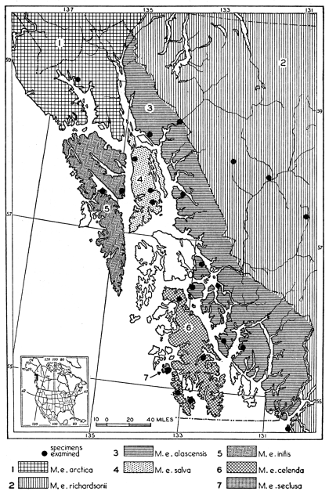
Fig. 26. Map showing known occurrences and probable geographic ranges of the subspecies of Mustela erminea in southeastern Alaska.
Specimens examined.—Total number, 24, arranged by localities from north to south. Unless otherwise indicated, specimens are in the Museum of Vertebrate Zoölogy, University of California.
Alaska. Juneau, 5[91]; Taku River, 1; Windham, 9; Mitkof Island, 1; St. John Harbor, Zarembo Island, 1; Wrangel, 1[91]; Helm Bay, Cleveland Peninsula, 1; Cleveland Peninsula, 2[91]; Revillagigedo Island, Carroll Inlet, 2[91]; Loring, 1[91].
Mustela erminea salva Hall
Ermine
Plates 2, 3, 4, 9, 10 and 11
Mustela erminea salva Hall, Proc. Biol. Soc. Washington, 57:35, June 28, 1944; Hall, Journ. Mamm., 26:180, July 19, 1945.
Type.—Male, adult, skull only; no. 74641, Mus. Vert. Zoöl.; Mole Harbor, Admiralty Island, Alaska, December 27, 1936; obtained by A. Hasselborg.
The skull (plates 2-4) shows malformation of the frontal sinuses owing to parasites and lacks osseous tissue where the parasitic infestation was localized. The skull is unbroken. The teeth all are present and entire.
Range.—Admiralty Island, Alaska. See figures 25, 26 on pages 95, 134.
Characters for ready recognition (known only from skulls).—Differs from males of M. e. alascensis in overall depth of braincase which is more than 89 per cent of orbitonasal length; from M. e. initis, in males, in that orbitonasal length and mastoid breadth total less than 35 mm., weight of skull and lower jaws less than 2.1 grams; from M. e. celenda, in males, in that breadth of rostrum measured across lacrimal processes less than a third of basilar length.
Description.—Size.—Male: An adult from Gambier Bay measures: Total length, 320; length of tail, 95; length of hind foot, 45 (41 in dry skin).
Female: A subadult from Hawk Inlet, measures: Total length, 250; length of tail, 70; length of hind foot, 33.
Color.—As described in Mustela erminea richardsonii except that least width of color of underparts in four individuals 40 (38-43) per cent of greatest width of color of upper parts. Black tip of tail, in two individuals for which external measurements are given, amounting to 50 and 40 mm. respectively which is 53 and 57 per cent of length of tail-vertebrae.
Skull.—Male (type and 4 adult topotypes): See measurements and plates 2-4. As described in Mustela erminea richardsonii except that: Weight, 1.7 (1.5-1.9) grams; basilar length, 37.8 (36.4-39.5, extremes are in subadults); length of tooth-rows more or less (usually more) than length of tympanic bulla; interorbital breadth rarely more than distance between glenoid fossa and posterior border of external auditory meatus.
Female (2 ad. and 1 ad.-sad. topotypes): See measurements, and plates 9-11. As described in Mustela erminea richardsonii except that: Weight, 0.9 (0.8-1.0) grams; basilar length, 33.0 (32.0-33.6); length of tooth rows approximately same as length of tympanic bulla; breadth of rostrum approximately 30 per cent of basilar length.
From alascensis, salva differs in that males have the preorbital region slightly wider in relation to the length of the tympanic bulla; also the braincase is smaller, actually as well as in comparison with the preorbital part of the skull. The tympanic bullae do not project so far below the squamosals and the braincase itself is shallower, in adults averaging only 11.5 mm. as against 12.5 mm. The overall depth of the braincase, including the tympanic bullae, when divided into the orbitonasal length gives an average of 93 (90-97) per cent whereas in alascensis the figure is only 85 (78-88) per cent. On this basis alone, everyone of the adult skulls of the two races can be distinguished. The females and subadult males show the same tendency to reduction in depth of braincase but not every individual among them can be surely distinguished. By weight the skull of salva of corresponding sex is only about 6 per cent smaller. Comparisons with initis and celenda are made in the accounts of those subspecies.
Remarks.—Most of the specimens seen were collected by Allen E. Hasselborg, resident on Admiralty Island. On the basis of skulls—few skins, and measurements taken in the flesh, are available—salva more closely resembles alascensis than does any other subspecies so far known from southeastern Alaska. The race on Admiralty Island is only slightly differentiated from alascensis of the adjacent mainland.
Specimens examined.—Total number, 26, all from Admiralty Island, Alaska, arranged in general by localities from north to south, and unless otherwise indicated in the Museum of Vertebrate Zoölogy, University of California.
Alaska. Admiralty Island: Hawk Inlet, 2; Seymour Canal, 4; Mole Harbor, 18 (skulls only); Gambier Bay, 1; no locality more definite than Admiralty Island, 4 (1 in U. S. Nat. Mus.).
Mustela erminea initis Hall
Ermine
Plates 4, 5 and 6
Mustela erminea initis Hall, Proc. Biol. Soc. Washington, 57:37, June 28, 1944; Hall, Journ. Mamm., 26:180, July 19, 1945.
Type.—Male, adult, skull and skin; no. 289, Mus. Vert. Zoöl.; Saook Bay, Baranof Island, Alaska; October 9, 1907; obtained by A. Hasselborg, original no. 4.
The top of the skull is fractured on the left side from the anterior nares posteriorly through the postorbital process to the posterior root of the zygomatic arch. On the left lower jaw the canine and three incisors are missing; otherwise the teeth all are present and entire.
The skin is in process of molt, approximately nine-tenths of the incoming white pelage being in place. The skin is well made and in a good state of preservation.
Range.—Chichagof and Baranof islands, Alaska. See figures 25, 26 on pages 95, 134.
Characters for ready recognition (only males known).—Differs from M. e. arctica, in that proximal two-thirds of under side of tail colored same as upper parts rather than same as underparts, zygomatic breadth less than distance between last upper molar and jugular foramen; from M. e. salva in that orbitonasal length and mastoid breadth total more than 35 mm., weight of skull and lower jaws more than 2.1 grams; from M. e. alascensis, by total length more than 317, black tip of tail more than 57 per cent of length of tail-vertebrae, interorbital breadth more than 10.3 and equal to, instead of less than, distance between glenoid fossa and posterior border of external auditory meatus; from M. e. celenda by chest white (not mostly covered by brown patch), breadth of rostrum measured across lacrimal processes less than a third of basilar length; from M. e. seclusa in zygomatic breadth more than distance between last upper molar and jugular foramen.
Description.—Size.—Male: The type and an adult topotype measure, respectively, as follows: Total length, 330, 320; length of tail, 95, 95; length of hind foot, 45, 45.
Female: No external measurements available.
Color.—As described in Mustela erminea richardsonii except that least width of color of underparts averages, in two young female topotypes, 50 (49, 50) per cent of greatest width of color of upper parts. Black tip of tail in three young female topotypes averaging 54 (52-55) mm. which is 67 (63-69) per cent of length of tail-vertebrae.
Skull.—Male (illustrated by type and 1 ad. topotype): See measurements and plates 4-6. As described in Mustela erminea richardsonii except that: Weight, 2.3 and 2.5 grams; basilar length, 39.6, and 40.5; interorbital breadth equal to distance between glenoid fossa and posterior border of external auditory meatus.
Female: No adults available.
From salva, initis differs in that skulls of males average larger in every measurement taken, being 41 per cent heavier. Relative to the basilar length, the interorbital and preorbital parts of the skull are larger; the relatively greater interorbital and mastoid breadths are particularly noticeable. Although the depth of the braincase, including the tympanic bullae, is both relatively as well as actually more than in salva, the depth is relatively less than in alascensis which otherwise differs from initis in about the same way that salva differs from initis. Whereas the interorbital breadth in initis is about equal to the distance between the glenoid fossa and the posterior border of the external auditory meatus, the interorbital breadth is uniformly less than this distance in both salva and alascensis. In comparison with seclusa the teeth are of the same size but all measurements of the skull are larger. The skull of initis is 25 per cent heavier. In relation to the basilar length, the interorbital and preorbital parts of the skull are much less in initis. The preorbital and interorbital regions in initis are relatively smaller in comparison also with arctica. The one measurement of interorbital breadth in initis is greater in relation to the basilar length than in kadiacensis but the rostral region, and all that part of the skull anterior to the braincase, is relatively smaller in initis.
Remarks.—The two adult males, nos. 286 and 289 from Saook Bay, provide convincing evidence of the existence of a distinct race of weasel on Baranof Island. Three other young specimens, almost subadult, from the same place are labeled as males although the basilar lengths of these skulls are only 35.5, 35.9 and 37.3 millimeters as against 39.6 and 40.5 in the two adult males. The difference in size is too great to be age-variation. The fact that 3 are definitely of one category and 2 of the other makes it doubtful that individual variation accounts for the differences. The small size of these 3 specimens and the fact that in each the anterior margin of the tympanic bulla is flush with the squamosal rather than protruded from the braincase, suggests that the three are females. If they are females, the amount of secondary sexual variation is rather less than would be expected by analogy with the amount obtaining in alascensis on the mainland and in salva on Admiralty Island. Another possibility that I can not disprove is that two stocks of weasels persist on Baranof Island, the two larger specimens being descendants of the stock which first became established on the island and the three smaller specimens being descendants of an individual ermine, or of ermines, that were rafted or otherwise transported to the island at a considerably later date. Assuming for the moment that there are two stocks, it must be admitted that each one differs from any stock known from elsewhere. Therefore, each stock would be presumed to have been long resident on the island. But—two stocks as closely related as the two in question would not be expected to persist for long in an area as small as that of Baranof Island because competition would give one the ascendancy. Therefore, the first suggestion, namely that the three smaller animals are really females, seems the more probable. The feasible way to clear up the present uncertainty is, of course, to obtain additional specimens, carefully labeled as to sex. Yet another reason why additional collecting is desirable in this area is to ascertain whether there is subspecific differentiation between the ermines of Baranof and Chichagof islands. The one specimen available from the latter island, although in general like the three smaller animals from Baranof Island, differs in the fuller (less scooped out) medial side of the tympanic bulla and to a slight degree in each of some other features. This specimen from Chichagof Island is labeled as a male also.
Specimens examined.—Total number, 6, arranged by localities from north to south, and in the Museum of Vertebrate Zoölogy, University of California.
Alaska. Chichagof Island, Freshwater Bay, 1. Baranof Island, Saook Bay, 5.
Mustela erminea celenda Hall
Ermine
Plates 5, 6 and 7
Mustela erminea celenda Hall, Proc. Biol. Soc. Washington, 57:38, June 28, 1944; Hall, Journ. Mamm., 26:181, July 19, 1945.
Type.—Male, adult, skull and skin; no. 130987, U. S. Nat. Mus., Biol. Surv. Coll.; Kasaan Bay, Prince of Wales Island, Alaska; June 16, 1903; obtained by Cyrus Catt; original no. 4407X.
The skull has a piece 1.5 mm. long broken out of the left zygomatic arch. P2 is absent on both sides. The right I1, and the left I1 and I2 are missing. The skin, in summer pelage, is fairly well made. A scrotal pouch attests to the correctness of the sex recorded on the label. The rostral part of the skull is smaller than in average-sized males of corresponding age.
Range.—Prince of Wales, Dall, and Long islands, Alaska. See figures 25, 26 on pages 95, 134.
Characters for ready recognition (only males known).—Differs from M. e. alascensis and initis in chest mostly covered by brown patch, not white, and breadth of rostrum measured across lacrimal processes more than a third of basilar length, which cranial character serves to distinguish also salva; from M. e. seclusa in zygomatic breadth less than distance between last upper molar and jugular foramen; from M. e. haidarum in chest white (not mostly covered by brown patch), proximal two-thirds of underside of tail colored like upper parts rather than underparts, basilar length more than 38.2 mm.
Description.—Size.—Male: Seven adults and subadults from Prince of Wales Island, yield average and extreme measurements as follows: Total length, 286 (277-304); length of tail, 77 (74-85); length of hind foot, 36 (35.5-40.5).
Female: No specimen available.
Color.—As described in Mustela erminea richardsonii except that upper parts about tone 3 of dark Chocolate Brown of Oberthür and Dauthenay, pl. 342; lower throat and chest covered by a large patch of same color as upper parts; color of underparts extending to toes but in interrupted fashion on both fore- and hind-feet; least width of color of underparts averaging, in four males from Prince of Wales Island, 41 (38-49) per cent of greatest width of color of upper parts. Black tip of tail averaging, in 8 males in winter pelage, 65 (59-78) mm. which is 84 (69-92) per cent of length of tail-vertebrae.
From its geographic neighbors alascensis and initis, celenda differs in darker color of upper parts, presence rather than absence of patch of dark color on lower throat and chest, and longer black tip on tail. From haidarum, celenda differs in darker color of upper parts, presence rather than absence of patch of dark color on lower throat and chest, narrower light-colored under parts, black tip of tail averaging less rather than more than nine-tenths of length of tail-vertebrae and ventral face of tail colored like upper parts rather than like underparts.
Skull.—Male (illustrated by 5 adults): See measurements and plates 5-7. As described in Mustela erminea richardsonii except that: Weight, 2.3 (2.2-2.5) grams; basilar length, 39.5 (38.9-40.7) mm.; length of tooth-rows more than length of tympanic bulla; breadth of rostrum measured across lacrimal processes more than a third of basilar length; interorbital breadth more than distance between glenoid fossa and posterior border of external auditory meatus; zygomatic breadth more or less than (about equal to) distance between last upper molar and jugular foramen.
Female.—Complete skull of adult unavailable.
Differences from richardsonii are indicated in the formal description just given. Additional to differences therein noted, celenda differs from initis in larger interorbital and preorbital parts of the skull although dimensions of other parts of the skull and the teeth are about the same or even less. From salva, celenda differs in larger average size in every measurement taken, except for the inner moiety of M1 which is about the same. The skull of celenda is 35 per cent heavier. In relation to the basilar length the skull of celenda is wider, especially in the interorbital and preorbital regions. In comparison with alascensis the tympanic bullae are of approximately the same length; otherwise essentially the same differences obtain as are noted in comparison with salva and the zygomatic breadth is relatively more in celenda. From seclusa, in which the teeth are of comparable size, celenda differs in that every cranial measurement is more and the skull is 28 per cent heavier. Because the skull of celenda is so much longer, its dimensions in other planes are less in relation to the length than in seclusa. M. e. celenda is larger in every part measured than haidarum, 21 per cent heavier, and in relation to the basilar length the interorbital, and preorbital, parts of the skull are smaller, the braincase is shallower, and the skull is relatively wider across the zygomata and mastoid processes. In comparison with kadiacensis, differences are: 26 per cent lighter, skull shorter; in relation to the basilar length, braincase shallower as measured at the anterior end of the basioccipital, tooth-rows shorter but orbitonasal length more. In comparison with arctica all parts measured of the teeth and skull of celenda are smaller and its skull is 34 per cent lighter. In relation to the basilar length, the interorbital breadth of celenda is only slightly less but its skull is narrower across the rostrum and zygomata, the tooth-rows are shorter, and the braincase is shallower.
Remarks.—The late George Willett in the course of his work in Alaska collected most of the known specimens of this strongly differentiated subspecies. In both coloration and cranial characters the distinguishing features are so well marked that the zoölogist could with reason accord full specific rank to celenda. Nevertheless it obviously is an ermine. Also, races from other islands of southeastern Alaska tend to bridge the gap, as regards cranial features, between celenda and the mainland ermine. The specimen from Dall Island agrees in all respects with topotypes. The specimen from Howkan on Long Island is in white winter pelage and the skull has suffered shrinkage from some chemical solution; the reference of this specimen to celenda is tentative.
Specimens examined.—Total number, 25, as follows: Arranged by localities from north to south. Unless otherwise indicated, in U. S. National Museum.
Alaska. Prince of Wales Island: Craig, 18 (10 in Mus. Vert. Zoöl., and 8 in Los Angeles Mus. Hist. Art and Sci.); Kasaan Bay, 2; no locality more definite than the Island itself, 3; Dall Island, Otter Harbor, 1 (Los Angeles Mus. Hist. Art and Sci.). Long Island, Howkan, 1 (Field Mus. Nat. Hist.).
Mustela erminea seclusa Hall
Ermine
Plates 5, 6 and 7
Mustela erminea seclusa Hall, Proc. Biol. Soc. Washington, 57:39, June 28, 1944; Hall, Journ. Mamm., 26:181, July 19, 1945.
Type.—Male, adult, skull alone; no. 31232, Mus. Vert. Zoöl.; Port Santa Cruz, Suemez Island, Alaska; March 24, 1920; obtained by George Willett.
The skull (plates 5-7) is complete and unbroken. Of the upper incisors only right I3 is present. Otherwise the teeth are present and unbroken.
Range.—Known only from the type locality. See figures 25, 26 on pages 95, 134.
Characters for ready recognition (only the male known).—Differs from M. e. celenda in basilar length less than 38.2, from M. e. salva, initis and haidarum in zygomatic breadth more than distance between last upper molar and jugular foramen.
Description.—Size and Color.—No external measurements or skins available.
Skull.—Male: See measurements and plates 5-7. As described in Mustela erminea richardsonii except that: Weight, 1.8 grams; basilar length, 34.3; length of tooth-rows about the same as length of tympanic bulla; breadth of rostrum measured across lacrimal processes more than a third of basilar length; interorbital breadth more than distance between glenoid fossa and posterior margin of external auditory meatus; zygomatic breadth more than distance between last upper molar and jugular foramen.
Female.—Skull not available.
From alascensis and salva, seclusa differs in larger teeth, shorter skull, much larger preorbital and interorbital regions, actually as well as in relation to basilar length. Excepting the teeth, which are of about the same size, the same general differences obtain in comparison with initis which, however, is 29 per cent heavier.
From celenda, seclusa differs in smaller skull in all parts measured, being 22 per cent lighter. The teeth are about the same size. In relation to its length the skull of seclusa is much broader and deeper. From haidarum, seclusa differs in: teeth larger; skull shorter and more convex in dorsal outline along median longitudinal axis; in relation to basilar length, skull broader, deeper and braincase relatively shorter.
Remarks.—The characters shown in the one available skull are far outside the limits of individual variation for other known subspecies. Other specimens are much to be desired to ascertain what the "average" individual is like and to learn the characters of the female.
Specimen examined.—One, the holotype.
Mustela erminea haidarum (Preble)
Ermine
Plates 5, 6, 7, 11, 12 and 13
Putorius haidarum Preble, Proc. Biol. Soc. Washington, 12:169, August 10, 1898.
Mustela haidarum, Miller, U. S. Nat. Mus. Bull., 79:97, December 31, 1912.
Mustela erminea haidarum, Hall, Proc. Biol. Soc. Washington, 57:38, June 28, 1944; Hall, Journ. Mamm., 26:181, July 19, 1945.
Type.—Male, adult, skull, skeleton and skin; no. 94430, U. S. Nat. Mus., Biol. Surv. Coll.; Massett, Queen Charlotte Islands, British Columbia; March 17, 1898; obtained by J. H. Keen; original no. 1800x.
The skull is unbroken and complete except for osseous tissue destroyed in the region of each postorbital process; this is the result of infestation of the frontal sinuses by parasites. The skeleton is complete down to the distal ends of the tibiae; the more distal bones are in the skin. The first, right, upper incisor is missing. Otherwise the teeth all are present and entire.
The skin is in the white, winter pelage but the new under fur is visible along the back and on the head although mostly covered with white hair.
Range.—Queen Charlotte Islands. See figure 25, page 95.
Characters for ready recognition.—Differs from M. e. celenda in chest white (not mostly covered by brown patch), proximal two-thirds of under side of tail colored like underparts instead of upper parts, in males basilar length less than 38.2; from M. e. seclusa, in male, in zygomatic breadth less than distance between last upper molar and jugular foramen; from M. e. richardsonii and alascensis, in both sexes, in proximal two-thirds of under side of tail colored like underparts instead of upper parts, interorbital breadth not less than distance from glenoid fossa to posterior margin of external auditory meatus; from M. e. anguinae and fallenda, in both sexes, in light-colored underparts more than half the width of dark-colored upper parts, proximal two-thirds of under surface of tail colored like underparts instead of upper parts, interorbital breadth equal to or more than distance between glenoid fossa and posterior margin of external auditory meatus.
Description.—Size.—Male: Two adults, U.S.N.M., no. 100622, from Cumsheva Inlet, and Amer. Mus. N. H., no. 37411, and the type, measure, respectively, as follows: Total length, 283, 290, 275; length of tail, 70, 75, 60; length of hind foot, 39, 40, 37.
Female: Corresponding measurements of an adult, no. 100624, and a young individual, no. 100623, each from Cumsheva Inlet, are: 252, 250; 63, 61; 31, 32.
Color.—As described in Mustela erminea richardsonii except that underparts not Sulphur Yellow but ranging from near (e) Colonial Buff through Marguerite Yellow to almost pure white; color of underparts extends distally on posterior sides of forelegs and onto toes but in many specimens interrupted at wrist by color of upper parts; color of underparts extends onto proximal three-fourths of under side of tail as length of tail is measured along tail-vertebrae; least width of color of underparts averaging, in 5 males, 79 (66-130) per cent of greatest width of color of upper parts. Black tip of tail in same males averaging 62 (60-70) mm. which is 92 (83-115) per cent of length of tail-vertebrae.
The close correspondence in color-pattern of this weasel with the Arctic races, arctica, polaris, semplei and kadiacensis is noteworthy, and distinguishes it from weasels on the adjacent mainland and adjoining islands to the north and south. The color of the upper parts is darker than in the four Arctic races named.
Skull.—Male (7 adults): See measurements and plates 5-7. As described in Mustela erminea richardsonii except that: Weight, 1.9 (1.7-2.0) grams; basilar length, 36.7 (35.6-37.5); length of tooth-rows more than length of tympanic bullae; breadth of rostrum measured across lacrimal processes more than a third of basilar length; interorbital breadth more than distance between glenoid fossa and posterior margin of external auditory meatus; zygomatic breadth barely less than distance between last upper molar and jugular foramen.
Female (2 adults): See measurements and plates 11-13. As described in Mustela erminea richardsonii except that: Weight, 1.3 and 1.4 grams; basilar length, 34.2; length of tooth-rows more or less than (about equal to) length of tympanic bulla; breadth of rostrum more than 30 per cent of basilar length; interorbital breadth not less than distance between glenoid fossa and posterior margin of external auditory meatus.
From richardsonii, haidarum differs in that skull of the male is actually larger in its anterior part (breadth of rostrum, interorbital breadth and orbitonasal length) but all measurements of other parts average less. In relation to the basilar length, the tympanic bulla is shorter but all other measurements are more. In the skull of the female, which is 23 per cent heavier, the width of the tympanic bulla and anteroposterior extent of the inner lobe of M1 are the same; in all other measurements the female of haidarum is larger, and in relation to the basilar length all measurements are more except the depth of the skull at the anterior margin of the basioccipital and the width of the tympanic bulla, which are less. By actual weight the skull of the male is 25 per cent lighter and the skull of the female 24 per cent heavier than in richardsonii. From fallenda and anguinae, haidarum differs in that measurements of the skulls of both sexes either average more, or are uniformly more, with two exceptions. These are the lesser length and breadth of the tympanic bulla, in comparison with males of fallenda, and the dimensions of M1 which are about the same in all three races concerned. The pre- and interorbital parts are larger in relation to the remainder of the skull. The postorbital breadth is actually a third more than in fallenda. In relation to the basilar length, the tympanic bulla is shorter and the braincase deeper than in males of anguinae. The skull of the male is 27 per cent heavier than that of fallenda and 58 per cent heavier than that of anguinae. The skull of the female is 59 and 50 per cent heavier than those of fallenda and anguinae, respectively. Comparison of the skull with those of alascensis, celenda and seclusa has been made in the accounts of those subspecies.
Remarks.—The available specimens of this ermine were obtained by J. H. Keen in 1898, Wilfred H. Osgood and E. A. Lewis in 1900, W. W. Brown in 1914, J. A. Munro in 1917 and 1918, and Allan Brooks in 1920. M. e. haidarum has more claim to full specific status than any other race of ermine because the diagnostic structural features are numerous and individually of relatively great degree. Indeed, individual variation appears not to bridge the gap between any population of haidarum and other subspecies and strong reasons could be advanced for according haidarum the status of a full species. It differs from the subspecies of erminea on the adjoining mainland and adjoining islands to the north and south and agrees with the Arctic races (arctica, polaris, semplei and kadiacensis) in great extent of the color of the underparts, extension of this color onto the underneath side of the tail, long black tip of the tail and general form of the skull including the relatively heavy preorbital region. The color although darker than in the Arctic subspecies, is lighter than in the insular races immediately to the north and south. In combination, the features mentioned could be taken as indication that haidarum is a relict population from a former glacial period. Assuming that it is a relict population, the color may have become slightly darker since that period but the main response appears to have been a decrease in size for this is a much smaller animal than the Arctic ermines. The size is about what would be expected if one were to judge by the slightly larger ermines on the islands of southeastern Alaska to the north and the smaller ermine on Vancouver Island to the south.
The ermines of the islands of southeastern Alaska, excepting possibly the incompletely known seclusa, have fewer characters of the Arctic races and more characters of the races of the adjoining mainland. Therefore, a possible inference is that the distinctive characters of ermines of the Alaskan islands developed with the aid of isolation from stocks which reached the islands after the glacial period. M. e. haidarum may have found its way to the Queen Charlotte Islands in the glacial period.
Specimens examined.—Total number, 17, as follows. Arranged by locality from north to south. Unless otherwise indicated, specimens are in the U. S. National Museum.
British Columbia. Queen Charlotte Islands. Masset, 7 (4[74], 1[2], 1[59]); Skidegate, 1; Graham Island, 5 (2[94], 1[77], 1[2]); Cumsheva Inlet, 3; no locality more definite than Queen Charlotte Islands, 1[2].
Mustela erminea anguinae Hall
Ermine
Plates 5, 6, 7, 11, 12 and 13
Mustela cicognanii anguinae Hall, Univ. California Publ. Zoöl., 38:417, November 8, 1932.
Putorius cicognanii, Baird, Mamm. N. Amer., p. 161, 1858 (part).
Putorius streatori, Swarth, Univ. California Publ. Zoöl., 10:102, February 13, 1912.
Mustela erminea anguinae Hall, Journ. Mamm., 26:79, February 27, 1945; Hall, Journ. Mamm., 26:181, July 19, 1945.
Type.—Male, adult, complete skeleton (no skin); no. 12482, Mus. Vert. Zoöl., French Creek, Vancouver Island, British Columbia; found as a desiccated carcass on May 1, 1910; obtained by Harry S. Swarth.
Range.—Vancouver Island, British Columbia. See figures 25, 27 pages 95, 149.
Characters for ready recognition.—Differs from M. e. haidarum, in both sexes, in light-colored underparts less than half the width of dark-colored upper parts, proximal two-thirds of under surface of tail colored like upper parts instead of underparts, interorbital breadth less than distance between glenoid fossa and posterior margin of external auditory meatus; from M. e. fallenda, in both sexes, anterior margin of tympanic bullae flush with squamosal rather than projecting from floor of braincase, in males by sagittal crest absent, in females by total length more than 238 and tooth-rows about same length as, instead of longer than, tympanic bulla; from M. e. streatori, in male, by sagittal crest absent and hind foot ordinarily more than 33.5, in female by hind foot more than 27.5, basilar length more than 30.2; from M. e. olympica, in males, by greater average size, hind foot ordinarily more than 33.4 and interorbital breadth ordinarily more than 8.5, in females by larger size, total length more than 235, tail more than 65, hind foot more than 27.5, basilar length more than 30.2.
Description.—Size.—Male: Sixteen adults and subadults yield average and extreme measurements as follows: Total length, 272 (261-284) mm.; length of tail, 81 (74-86); length of hind foot, 35.0 (33.5-36).
Female: Five adults and subadults have corresponding measurements as follows: 247 (241-257); 69 (66-73); 30.0 (28.0-32.0).
Color.—As described in Mustela erminea streatori except that: occasionally white in winter; upper parts about tone 2 of Dark Chocolate of Oberthür and Dauthenay; least width of color of underparts averaging, in 7 adult males, 6 (0-15) per cent of greatest width of color of upper parts. Black tip of tail in same series averaging 37 (26-46) mm. which is 46 (32-54) per cent of length of tail-vertebrae.
Skull.—Male (based on 13 adults): See measurements and plates 5-7. As described in Mustela erminea richardsonii except that: Weight, 1.2 (1.0-1.3) grams; basilar length, 34.0 (32.5-35.6); length of tooth-rows more or less (usually less) than length of tympanic bulla.
Female (based on 5 adults): See measurements and plates 11-13. As described in Mustela erminea richardsonii except that: Weight 0.9 (0.77-1.06) grams; basilar length, 31.5 (30.9-31.8) grams; length of tooth-rows more or less than (approximately same as) length of tympanic bulla; breadth of rostrum more than 30 per cent of basilar length.
The sexual dimorphism in the skull is slight, the skull of the male being only a third heavier than that of the female. In fallenda of the adjacent mainland to the east the male is three-fourths heavier than the female. In comparison with fallenda, males are smaller, averaging less in every cranial and dental measurement taken and by weight are a fifth lighter; sagittal crest absent rather than present; tympanic bullae flush with squamosal rather than projecting below floor of braincase; in relation to basilar length, tympanic bullae smaller, braincase deeper and broader, skull wider interorbitally and across zygomata. Females are larger than in fallenda, and with one exception average larger in every cranial and dental measurement taken, being 6 per cent heavier. The one exception mentioned is the lesser actual length of the tympanic bulla in anguinae, in which the length of the tooth-rows is about the same as, rather than less than, the length of the tympanic bulla. The postorbital breadth is greater than in fallenda and the anterior edges of the tympanic bullae are flush with the squamosals rather than projecting below the floor of braincase. In relation to the skull as a whole the preorbital and interorbital parts are larger.
In comparison with streatori, skulls of males are of about the same size, anguinae being only 9 per cent heavier. The length of the tooth-rows is ordinarily less than, rather than about equal to, the length of the tympanic bulla; sagittal crest wanting rather than present since in anguinae the temporal muscles meet usually only at the posterior end of the braincase instead of all along the midline on its top; tympanic bullae narrower and more nearly flush with squamosal (less protruded from braincase). Relative to the basilar length, the zygomatic breadth is more, the tympanic bullae are narrower, and the braincase is deeper at the anterior end of the basioccipital. The female is 41 per cent heavier than streatori, there being no overlap in most cranial and dental measurements. M1, however, is approximately the same size in each subspecies. The tooth-rows and tympanic bulla are of almost equal length whereas in streatori the length of the tooth-rows is less than that of the bulla.
Differences from olympica, in males, are: M1 shorter; all other measurements of teeth and parts of skull averaging larger; skull 20 per cent heavier; tooth-rows averaging shorter than tympanic bulla rather than about the same; relative to basilar length, braincase deeper at anterior end of basioccipital and tooth-rows shorter. The skull of the female is 64 per cent heavier, larger in every measurement taken without overlap; temporal ridges meeting, rather than separated, at lambdoidal crest; length of tooth-rows about equal to, rather than shorter than, tympanic bulla; in relation to basilar length, skull deeper, orbitonasal length more, mastoid and zygomatic breadths more, and tympanic bullae shorter.
Remarks.—References in the literature to this insular race mostly were under the name streatori until 1932 when in the course of the present study the name anguinae was proposed. A few specimens have been taken by nearly every student of small mammals who has collected on Vancouver Island. Arthur Peake and Herbert Laing have probably collected more specimens than any other two zoölogists.
M. c. anguinae is noteworthy for the slight secondary sexual variation in size; the disparity between the two sexes is less than in any other American subspecies of erminea. By linear measurement the body of the female is only 7 per cent shorter than in the male (178 versus 191 mm.). Linear measurements and weights of the skulls of the two sexes are further indicative of this approximation in size. By weight the skull of the female is only a fourth lighter than that of the male, or, stated in another way, the male's skull is only a third heavier (1.2 versus 0.9 grams).
No geographic variation has been detected between lots of specimens from different parts of Vancouver Island. The one specimen available from Salt Spring Island presents no obvious differences from selected individuals from Vancouver Island.
The winter pelage is more often brown than white. Of 17 specimens seen in winter pelage or in transition pelage, only 6 are white. These 6 are from Comox, Stamp River, Hilliers, Jeune Landing and Port Alice. Of the 34 specimens in brown pelage, 7 have the dark color of the upper parts meeting on the abdomen. Six of the 34 have brown color on the pectoral region. In two, this is a separate patch but in the other four the dark color is a continuation of the upper parts and extends in front of each foreleg over part of the pectoral region, but the two extensions, one from either side, do not meet on the underparts. The color of the lips was recorded in 22 individuals: one had both the upper and lower-lips white; 7 had the upper lips brown and the lower lips white; in 14 both the upper and lower-lips were brown.
Specimens examined.—Total number, 40, listed by localities from north to south as follows. Unless otherwise indicated, specimens are in the National Museum of Canada.
British Columbia. Vancouver Island: Cape Scott, 4; Shushartie, 1; Quatsino, 1[74]; Jeune Landing, 1[74]; Port Alice, 5[15]; Marble Creek, Quatsino Sound, 1[22]; Port Hardy, 5; Sayward, 2; Bear Lake, 4; Bear River, 1; Comox, 4(3[85]); Stamp River, Alberni, 1[31]; Errington, 1[74]; French Creek, 1[74]; Hilliers, 1[74]; Craigs Crossing, 1[74]; Nanaimo, 2[22]; Cowichan Lake, 1[22]; Duncan, 2[85]; Salt Spring Island, 1[85].
Mustela erminea fallenda Hall
Ermine
Plates 5, 6, 7, 11, 12 and 13
Mustela erminea fallenda Hall, Journ. Mamm., 26:79, February 27, 1945; Hall, Journ. Mamm., 26:181, July 19, 1945.
Putorius streatori Merriam, N. Amer. Fauna, 11:13, June 30, 1896 (part-Sumas).
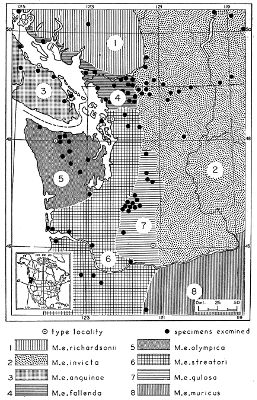
Fig. 27. Map showing known occurrences and probable geographic ranges of the subspecies of Mustela erminea in Washington and parts of British Columbia and Oregon.
Type.—Male, adult, skull and skin; no. 7096, Nat. Mus. Canada; Huntingdon, British Columbia; May 21, 1927; obtained by C. H. Young, original no. 317.
The brown summer skin is well made. The skull (plates 5-7) is complete. Right p2 has the crown broken away; otherwise the teeth all are present and entire.
Range.—On mainland in immediate vicinity of coast from probably opposite Texada Island, British Columbia, south to Lake Whatcom, Washington, and east to Mount Baker Range on International boundary. See figures 25, 27 on pages 95, 149.
Characters for ready recognition.—Differs from M. e. haidarum, in both sexes, in light-colored underparts less than half the width of dark-colored upper parts, proximal two-thirds of under surface of tail colored like upper parts instead of underparts, interorbital breadth less than distance between glenoid fossa and posterior margin of external auditory meatus; from M. e. richardsonii in both sexes, by upper lips brown rather than white, in males hind foot less than 41 and basilar length less than 38.3, in females hind foot less than 29, basilar length less than 31.4 and breadth of rostrum more, instead of less, than 30 per cent of basilar length; from M. e. invicta, in both sexes, by upper lips brown (not white); in males by skull averaging shorter (basilar length 35.7 versus 37.0); in females by breadth of rostrum more, instead of less, than 30 per cent of basilar length; from M. e. anguinae, in both sexes, by anterior margin of tympanic bulla projecting from floor of braincase rather than flush with squamosal (the difference is slight in females), in males by sagittal crest present, in females by total length less than 238 and tooth-rows longer than, instead of about same length as, tympanic bulla; from M. e. streatori, in both sexes, by black tip of tail more than half of length of tail-vertebrae, in males hind foot more than 33.7, tympanic bulla longer than, instead of about same length as, upper tooth-rows; weight of skull more than 1-1/4 grams, in females weight of skull more than 0.7 grams, length of lateral side of P4, 4 mm. or more; from M. e. olympica, in males, length of hind foot more than 33, black tip of tail more than 36.5 mm., weight of skull more than 1.2 grams, basilar length more than 33.5, in females length of hind foot more than 25.5, weight of skull more than 0.66 grams, basilar length more than 28.4; from M. e. gulosa, in both sexes, by anterior margin of tympanic bulla projecting below floor of braincase rather than flush with squamosal (the difference is slight in females), in males hind foot more than 33.5, weight of skull more than 1-1/4 grams, basilar length more than 33.9, in females by total length more than 222, hind foot longer than 26, weight of skull more than 0.7 grams, basilar length more than 29.
Description.—Size.—Male: Seven adult topotypes yield average and extreme measurements as follows: Total length, 278 (249-305); length of tail, 77 (69-81); length of hind foot, 36.5 (34-40). A male topotype of unknown age weighed 113 grams.
Female: Two adult topotypes, with actual measurements in parentheses, average as follows: Total length, 232 (228-236); length of tail, 60 (57-62); length of hind foot, 27 (27-27). An adult from Morovitz Guard Station, Wash., weighed 54 grams.
Color.—Winter pelage rarely white, brown pelage indistinguishable from summer pelage except for slightly more smoky tinge in winter in specimens from some localities; otherwise as described in Mustela erminea streatori except that least width of color of underparts averaging, in seven adult topotypes, 18 (0-37) per cent of greatest width of color of upper parts. Black tip of tail averaging, in same series, 45 (38-52) mm. which is 58 (53-65) per cent of length of tail-vertebrae.
In comparison with richardsonii and invicta, fallenda differs in darker color of upper parts and their extension at the expense of the light-colored underparts which are narrower by a half. In correlation with this restriction in area of the light-colored underparts, the upper lips are brown instead of white. In comparison with anguinae, olympica and streatori, the longer black tip on the tail is the principal difference in color. From gulosa, fallenda differs in slightly darker color of upper parts and in narrow underparts, the width of the same being only about a fifth instead of a third of the width of the dark-colored upper parts.
Skull.—Male (based on 7 adults): See measurements and plates 5-7. As described in Mustela erminea richardsonii except that: Weight, 1.5 (1.3-1.7) grams; basilar length, 35.7 (34.3-38.2).
Female (based on 6 ads.): See measurements and plates 11-13. As described in Mustela erminea richardsonii except that: Weight, 0.85 (0.73-1.0) grams; basilar length, 30.6 (29.4-31.7); breadth of rostrum more than 30 per cent of basilar length.
In comparison with richardsonii, skulls of males differ as follows: averaging smaller in every measurement taken with no overlap in several dimensions; 40 per cent lighter; in relation to basilar length, rostrum (orbitonasal length) longer and skull slightly broader interorbitally. Females average smaller in every cranial and dental measurement taken with no overlap in basilar length, length of tooth-rows and length of tympanic bulla; 22 per cent lighter; breadth of rostrum more, rather than less, than 30 per cent of basilar length; in relation to basilar length, pre- and interorbital parts of skull larger, and mastoid breadth more.
Differences from males of olympica are: size larger with no overlap in most measurements; 50 per cent heavier; tympanic bullae longer than upper tooth-rows rather than of about equal length; in relation to basilar length, rostrum shorter, braincase wider and deeper, zygomata more expanded. Females are larger with no overlap in most measurements; 35 per cent heavier; in relation to basilar length, pre- and interorbital regions narrower, braincase deeper and wider across mastoids.
Differences from streatori, in males, are: skull averaging larger in every cranial and dental measurement taken; 36 per cent heavier; tympanic bulla longer than, instead of about same length as, upper tooth-rows. In females the inner lobe of M1 is shorter anteroposteriorly; otherwise all measurements of fallenda average larger and it is 33 per cent heavier; rostrum and interorbital region broader in relation to remainder of skull.
In comparison with gulosa, skulls of males differ as follows: averaging larger in every measurement taken with no overlap in several dimensions; 50 per cent heavier; tympanic bullae with anterior margins projecting slightly below squamosals rather than flush with same; length of bulla more than, rather than about same as, that of upper tooth-rows. Considering the great difference in size, the relative proportions are remarkably alike. In females, length of inner lobe of M1 about the same; otherwise averaging larger in every measurement taken; 44 per cent lighter; relative to basilar length, tooth-rows longer, skull wider across zygomata and mastoids, rostrum and interorbital regions slightly narrower, skull shallower in plane of last upper molars.
Comparisons with haidarum, invicta and anguinae are made in accounts of those subspecies.
Remarks.—Until the name fallenda was proposed in the course of the present study, most of the specimens of this race were assigned to streatori.
Intergradation with streatori is complete as it is also with invicta and richardsonii, in other words with each of the subspecies whose ranges meet that of fallenda. In color and in size the difference is least between streatori and fallenda. As between fallenda and invicta the size is not greatly different and the intergradation in color is gradual. Between fallenda and richardsonii intergradation is somewhat different and to fully appreciate its nature we should remember that the color of fallenda resembles that of the saturate coastal races, streatori, anguinae and olympica although the black tip of the tail is longer. In this latter feature and in several cranial details, as well as in greater degree of secondary sexual variation in size, fallenda resembles richardsonii. Because the two differ more than do most subspecies of ermine whose ranges meet, some of the intergrades at first inspection appear to be widely different from either parent stock. For example, specimens from Alta Lake, British Columbia, may give this impression because the combination of large size and dark color suggests a kind of ermine different from either fallenda or richardsonii. In no instance, however, has there been found in these intergrades any character other than those occurring in one or the other of the two parent races.
Along the coast in the north part of the geographic range assigned to fallenda, some specimens nearly typical of richardsonii have been taken so near to the place where fairly typical fallenda was obtained that I have doubted whether there is intergradation in the usual fashion in this area; more specimens will have to be obtained from this coastal area to resolve the doubt one way or the other.
The winter pelage is brown in all specimens at most localities. The only white pelage seen was in each of three specimens from Glacier, Whatcom County, Washington. A fourth specimen from there is in brown winter pelage. At any one locality there is much variation in the degree to which the dark color of the upper parts encroaches on the area that in most other races is light-colored. An extreme degree of encroachment is shown by a specimen taken on December 1, 1935, by R. A. Cummings, at Vancouver, British Columbia, in which the light color occurs only in three restricted areas, the chin, the throat and the lower breast; otherwise the coat is brown. There are other specimens, for instance from the type locality, which differ mainly in having an additional white spot in the inguinal region. The opposite extreme, in a specimen also from the type locality, is where the least width of the light-colored underparts on the abdominal region is a third of the circumference of the body. The two extremes are connected by a dozen intermediate stages. Of 64 specimens in which the color of the lips was carefully examined, one, from Vancouver, has both the upper and lower-lips brown; 9 have both the upper and lower-lips white; and 54 have the upper lips brown and the lower lips white.
Specimens examined.—Total number, 72, arranged by localities from north to south. Unless otherwise indicated, specimens are in the National Museum of Canada.
British Columbia. Horseshoe Lake, Stillwater, 2; Vancouver, 1[74]; Point Grey, 1[31]; Port Moody, 5[91]; Chilliwack, 8 (2[75], 4[91], 1[60]); Sumas, 19 (18[75], 1[60]); Thurstons Ranch, 2; Cultus Lake, 2; Mt. Baker Range, 5[75]; Lihumption Park, 1; Huntingdon, 14; Tami Hy Creek, 1.
Washington. Whatcom County: Semiahmoo, 1[91]; New Whatcom, 1[68]; Lake Whatcom, 2[91]; 5 mi. W Glacier, 1[51]; Glacier (3 at 900 ft.), 4[91]; E Side Easton Glacier, Mt. Baker, 1[55]; Morovitz Guard Station, 831 ft., 1[55].
Mustela erminea olympica Hall
Ermine
Plates 5, 6, 7, 12, 13 and 14
Mustela erminea olympica Hall, Journ. Mamm., 26:81, February 27, 1945; Hall, Journ. Mamm., 26:181, July 19, 1945.
Mustela rixosa, Svihla and Svihla, Murrelet, 13:24, January, 1932.
Mustela rixosa rixosa, Svihla and Svihla, Murrelet, 14:39, May, 1933.
Type.—Male, adult, skull and skin; no. 90738, U. S. Nat. Mus., Biol. Surv. Coll.; near head of Soleduc River, 4500 ft., Olympic Mountains, Clallam County, Washington; April 28, 1897; obtained by Vernon Bailey, original no. 6213.
The skin is well prepared and in good condition. The skull (plates 5-7) is unbroken and the teeth all are present and entire.
Range.—Olympic Peninsula, Washington, south to Olympia. See figures 25, 27 on pages 95, 149.
Characters for ready recognition.—Differs from M. e. anguinae, in males, by lesser average size, hind foot ordinarily less than 33.4, and interorbital breadth ordinarily less than 8.5, in females by smaller size, total length less than 235, tail less than 65, hind foot less than 27.5, basilar length less than 30.2; from M. e. fallenda, in males, by length of hind foot less than 33, black tip of tail less than 36.5, weight of skull less than 1.2 grams, basilar length less than 33.5, in females length of hind foot less than 25.5, weight of skull less than 0.6 grams, basilar length less than 28.4; from M. e. streatori by smaller size, in males hind foot less than 33.0, basilar length ordinarily less than 32.5, in females by hind foot ordinarily not longer than 24, by breadth of rostrum less than 8.6, depth of braincase at posterior border of upper molars less than 7.6.
Description.—Size.—Male: Twelve individuals of adult proportions yield average and extreme measurements as follows: Total length, 243 (205-269); length of tail, 65 (60-74); length of hind foot, 31 (29-32).
Female: Corresponding measurements of six females are: 196 (188-208), 52 (45-60?), 23.4 (22.7-24.0). An adult weighs 30 grams.
Color.—As described in Mustela erminea streatori except that least width of color of underparts averaging, in 12 males of adult proportions, 5 (0-11) per cent of greatest width of color of upper parts. Black tip of tail averaging, in same series, 26 (20-35) mm., which is 40 (31-58) per cent (average the same as in streatori) of length of tail-vertebrae.
Skull.—Male (based on 5 adults): See measurements and plates 5-7. As described in Mustela erminea richardsonii except that: Weight, 1.0 (0.9-1.1) grams; basilar length, 31.8 (30.6-32.5); length of tooth-rows more or less than (about equal to) length of tympanic bulla.
Female (illustrated by 3 adults): See measurements and plates 12-14. As described in Mustela erminea richardsonii except that: Weight, 0.55 (0.52-0.58) grams; basilar length, 27.1 (26.7-27.5); breadth of rostrum more than 30 per cent of basilar length.
In comparison with streatori, skulls of corresponding sex average smaller in every measurement taken with no overlap in most of those of females. Exception is to be made for the inner lobe of M1 in males where the size is the same. By weight males are smaller by 10 per cent and females by 14 per cent. In relation to other parts of the skull the tympanic bullae are narrower and in females they are shorter as well. Comparison with anguinae and fallenda has been made in the accounts of those subspecies.
Remarks.—The smaller size, especially of females, is the principal feature distinguishing this race from streatori. On the basis of available data the female of olympica is smaller than that of any other race and hence is the smallest adult weasel of the species erminea, in either the Old World or in America.
Intergradation with streatori is indicated by specimens from the southern end of Puget Sound. These specimens are intermediate in size between typical examples of the two races concerned.
The color of the upper parts is uniform and the color pattern varies less than in geographically adjoining races. The white color of the underparts is restricted to a thin line on the abdominal region, but widens out posteriorly in the inguinal region and anteriorly over the pectoral region, throat, chin and lower lips. The upper lips are brown. The brown of the upper parts extends around in front of each foreleg, the two brown areas not quite meeting on the lower throat. The above description applies to each of the 19 specimens examined with regard to these details. Every specimen seen in the winter coat was brown, not white.
Specimens examined.—Total number, 20, arranged by counties from north to south. Unless otherwise indicated, specimens are in the U. S. National Museum.
Washington. Clallam County: Clallam Bay, 2 (1[74], 1[94]); Elwha, 2[10]; Johnsons Ranch, 1[60]; Happy Lake, 1[60]; Boulder Lake, 2[60]; near head of Soleduc River, 4500 ft., 1; 12 mi. S Port Angeles, 1[10]. Jefferson County: Hayes Cr., 2000 ft., Elwha River, 2; head N Fork Quinault River, 4000 ft., 1; Duckabush, 3; N Fork Skokomish River, 1. Mason County: Lake Cushman, 2[76]; 4 mi. S Olympia, 1.
Mustela erminea streatori (Merriam)
Ermine
Plates 5, 6, 7, 12, 13 and 14
Putorius streatori, Merriam, N. Amer. Fauna, 11:13, pl. 2, figs. 5, 5a, 6, 6a, June 30, 1896.
Putorius cicognanii, Baird, Mamm. N. Amer., p. 161, 1858 (part unless no. 2395 was a female of M. frenata).
Putorius pusillus, Baird, Mamm. N. Amer., p. 159, 1858 (part).
Putorius (Gale) vulgaris, Coues, Fur-bearing animals, p. 102, 1877 (part).
Mustela streatori streatori, Miller, U. S. Nat. Mus. Bull., 79:96, December 31, 1912; Grinnell, Univ. California Publ. Zoöl., 40:101, September 26, 1933.
Mustela cicognanii streatori, Hall, Murrelet, 12:22, January, 1931; Hall, Univ. California Publ. Zoöl., 38:417, November 8, 1932.
Mustela erminea streatori, Hall, Journ. Mamm., 26:77, February 27, 1945; Hall, Journ. Mamm., 26:181, July 19, 1945.
Mustela rixosa, Beer, Journ. Mamm., 29:296, August 31, 1948.
Type.—Male, adult, skull and skin; no. 76646, U. S. Nat. Mus., Biol. Surv. Coll.; Mount Vernon, Skagit Valley, Skagit County, Washington; February 29, 1896; obtained by D. R. Luckey, original no. 3.
The skull is unbroken and the teeth all are present and entire. The skin, in brown winter pelage, is stuffed and in good condition.
Range.—Western Washington along eastern side of Puget Sound, western Oregon from the Cascades to the coast, and northwestern California south in the humid coastal district nearly to the Golden Gate. See figures 25, 27 on pages 95, 149.
Characters for ready recognition.—Differs from M. e. anguinae, in male, by sagittal crest present and hind foot ordinarily less than 33.5, in female by hind foot less than 27.5, basilar length less than 30.2; from M. e. fallenda, in both sexes, by black tip of tail less than half of length of tail-vertebrae, in males hind foot less than 33.7, tympanic bulla about same length as, instead of longer than, upper tooth-rows; weight of skull less than 1-1/4 grams, in female weight of skull less than 0.7 grams, length of lateral side of P4 less than 4 mm.; from M. e. olympica, by larger size, in males hind foot more than 33.0, basilar length ordinarily more than 32.5, in females by hind foot ordinarily longer than 24, by breadth of rostrum more than 8.6, depth of braincase at posterior border of upper molars more than 7.6; from M. e. gulosa and muricus, in both sexes, by upper lips brown (not white), light color of underparts extending down hind leg no farther than knee, depth of skull at posterior border of upper molars more than 7.7 in females and ordinarily more than 9.6 in males, further from muricus by tail more than 62 in males and more than 49 in females; from M. e. invicta by upper lips white (not brown), in males hind foot more than 36 and basilar length more than 35, in females hind foot more than 29.5 and basilar length more than 30.5.
Description.—Size.—Male: Twelve adults from Blaine and Tillamook, Oregon, yield average and extreme measurements as follows: Total length, 255 (245-275); length of tail, 72 (64-80); length of hind foot, 31.5 (30.0-33.5).
Female: Seven adults from Blaine and Tillamook, Oregon, yield average and extreme measurements as follows: Total length, 214 (193-230); length of tail, 55 (50-63); length of hind foot, 25 (24-27).
Color.—Winter and summer pelages indistinguishable; upper parts uniform and ranging from Raw Umber to slightly darker (16n), and about tones 1 to 3 of Dark Chocolate of Oberthür and Dauthenay, pl. 342; underparts white, in summer rarely with a faint buffy suffusion in pectoral region; color of underparts extends from chin, and often lower lips, posteriorly to inguinal region, distally on posterior sides of forelegs onto antipalmar faces of toes (sometimes interrupted at and above wrist) and on medial sides of hind legs hardly to knee. Least width of color of underparts averaging, in twelve adults from Blaine and Tillamook, 10 (0-47) per cent of greatest width of color of upper parts. Black tip of tail, in same series, averaging 28 (24-33) mm. which is 40 (34-47) per cent of length of tail-vertebrae.
Skull.—Male (based on 12 adults): See measurements and plates 5-7. As described in Mustela erminea richardsonii except that: Weight, 1.1 (1.0-1.2) grams; basilar length, 33.2 (32.5-33.8); length of tooth-rows more or less than (about same as) length of tympanic bulla.
Female (based on 7 adults): See measurements and plates 12-14. As described in Mustela erminea richardsonii except that: Weight, 0.64 (0.60-0.67) grams; basilar length, 28.5 (27.6-29.5); breadth of rostrum more than 30 per cent of basilar length.
Comparison with anguinae, fallenda, olympica, gulosa and muricus is made in accounts of those subspecies.
Remarks.—This weasel is rare in collections and the best material of it was obtained by Alex Walker in Tillamook County, Oregon, where he resides. The almost ideal series of 30 specimens showed the range of secondary sexual, age, and individual variation expectable in the small ermines of the Pacific Coast of the United States and was the means of allowing satisfactory decision on questions of classification in the related subspecies in which individuals are of comparable size.
Intergradation with each of the geographically adjoining subspecies, olympica, fallenda, invicta, gulosa and muricus is shown by specimens examined. With the last mentioned subspecies, intergradation is shown by two specimens from as far south as Siskiyou County, California, assigned to muricus.
The application of the name streatori is difficult because it was based on a specimen from a place where two clines cross. The north-south cline is one of size which decreases to the south. The east-west cline is one of intensity of color, the westernmost (coastal) population being the most intensely colored. The type locality of streatori is at the place where two lines perpendicular to one another, and representing the two clines, cross. This intersection is near the place where the ranges of several subspecies meet. The nomenclatural question is, to which one of 6 subspecies should the name streatori apply. Specimens from barely within the geographic boundaries of four of these subspecies so closely resemble topotypes of streatori that a student with material at his disposal from only the area about Puget Sound naturally would apply the name streatori to all of his specimens, and knowing even of the arrangement adopted in the present account the student will have difficulty in identifying his specimens according to it. Not only will the student find the arrangement difficult, but probably unsatisfactory if he thinks of streatori as being the kind of animal represented by topotypes. I conceive of topotypes of streatori as being nontypical of the subspecies; they are intergrades with fallenda. My aim was initially to work out the geographic ranges of subspecies and only subsequently to apply names, according to which type localities fell within the previously determined geographic ranges. By this procedure no greater weight was given to a holotype and to topotypes than to specimens from any other locality.
Of the 40 specimens seen in winter pelage, only one is white. It is from Darrington in the Cascade Mountains of Washington. The 39 others are brown and I doubt that the white pelage ever occurs in the low coastal territory included within the geographic range of streatori. This subspecies resembles anguinae and olympica in the great extension of area of the dark-colored upper parts at the expense of the area of the light-colored underparts. The usual arrangement is one where the brown of the two sides nearly meets on the midventral line leaving a sizable, inguinal area of light color connected by a thin line to the sizable area of light color on the pectoral region. The light color of the pectoral area ordinarily is continuous with the light-colored area of the throat and chin but the dark color of the upper parts extends around in front of each foreleg. These extensions of dark color meet on the chest in only 2 of the 56 specimens examined in this regard. Across the abdomen the dark color is continuous in 4 of the 56 specimens. The lower lips are brown instead of white in only 3 individuals and in 2 of these the lip of one side is brown and its opposite is white. The variation in color-pattern is less than in anguinae or than in fallenda.
Specimens examined.—Total number, 63, arranged alphabetically by states, then by counties from north to south in each state. Unless otherwise indicated, specimens are in the U. S. National Museum.
California. Humboldt County: 10 mi. NE Carlotta, 1[74]. Mendocino County: Russian Gulch State Park, 1[74]. Sonoma County: Mouth of Gualala River, 1[74].
Oregon. Clatsop County: Astoria, 1. Tillamook County: Tillamook, 16 (14[14], 1[59]); Blaine, 12 (7[14], 2[59], 1[93], 2[76]). Washington County: Beaverton, 1[60]; Forest Grove, 1[36]. Clackamas County: Oregon City, 1[46]. Lincoln County: Newport, 1. Linn County: Sico, 1[46]. Lane County: Vida Fish Hatchery, 2[101]; McKenzie Bridge, 1[101]; Mercer, 1[75]. Klamath County: Deschutes River, 6 mi. E Crescent Lake, 1[101]. Douglas County: Gardiner, 1[60]. Curry County: Port Orford, 1; Gold Beach, 2[60].
Washington. Skagit County: N end Whidby Island opposite Deception Pass, 1; Hamilton, 4; Mt. Vernon, 3. Snohomish County: Oso, 550 ft., 1; Darrington, 600 ft., 1. Pacific County: Wallicut River, 2 mi. E Ilwaco, 1[74]. Wahkiakum County: 4 mi. E. Skamokawa, 3[74]. Cowlitz County: 4 mi. E mouth Kalama River, 2[74]; 6 mi. E mouth Kalama River, 1[74]. Skamania County: 15 mi. N Govt. Springs, 1300 ft., 1.
Mustela erminea gulosa Hall
Ermine
Plates 5, 6, 7, 12, 13 and 14
Mustela erminea gulosa Hall, Journ. Mamm., 26:84, February 27, 1945; Hall, Journ. Mamm., 26:181, July 19, 1945.
Putorius streatori Merriam, N. Amer. Fauna, 11:14, June 30, 1896.
Type.—Male, subadult, skull and skin; no. 81998, U. S. Nat. Mus., Biol. Surv. Coll.; Trout Lake, Klickitat County, Washington; February 3, 1897; obtained by P. Schmid, original no. 147.
The skin is in brown winter pelage, and appears to have been made up from a skin split along the midventral line from the anus to the forelegs. It probably was dried by a trapper, is well made, and lacks a patch of hair on the left flank but otherwise is in good condition. The skull lacks the central part of the left zygomatic arch and the posterior two-thirds of the right one. The right m2 is represented only by an abortive stump or the broken root, and i1 and i2 on each side are absent; otherwise, the teeth all are present and entire.
Range.—Cascades of Washington from northeastern King County south to Mount Adams. See figures 25, 27 on pages 95, 149.
Characters for ready recognition.—Differs from M. e. invicta and fallenda, in both sexes, by anterior margin of tympanic bulla flush with squamosal rather than projecting below floor of braincase (difference slight in females), in males hind foot less than 33.5, weight of skull less than 1-1/4 grams, basilar length less than 33.9, in females by total length less than 222, hind foot shorter than 26, weight of skull less than 0.7 grams, basilar length less than 29; from M. e. muricus, in both sexes, by upper parts darker, tone 4 of Chocolate or darker (see description of color), least width of light-colored underparts averaging one-third instead of approximately two-thirds of greatest width of dark-colored upper parts, in males, on the average, tail more than 65, weight of skull more than 0.90 grams, basilar length more than 30.8 mm.; from M. e. streatori, in both sexes, by upper lips white (not brown), light color of underparts extending down hind legs below knee, depth of skull at posterior border of upper molars less than 7.7 in females and ordinarily less than 9.6 in males.
Description.—Size.—Male: One adult and four subadults from Mount Rainier yield average and extreme measurements as follows: Total length, 253 (238-266); length of tail, 75 (70-83); length of hind foot, 31.5 (30-33). Corresponding measurements of 9 subadults from Trout Lake are: 257 (233-282); length of tail, 76 (56-83); length of hind foot, 30.2 (26-33).
Female: Of adults, 2 from Mount Rainier and 2 from Trout Lake measure as follows: Total length, 202, 203, 216, 210; length of tail, 54, 52, 57, 51; length of hind foot, 24, 24, 25, 24. The averages for these females are 208, 54, 24.3.
Color.—As described in Mustela erminea richardsonii except that color sometimes brown in winter (with more smoky tinge than summer coat); upper parts ranging from tone 2 through tones 3 and 4 of Dark Chocolate (pl. 342) into tone 4 of Chocolate (pl. 343) of Oberthür and Dauthenay; underparts (always white in winter) in summer Sulphur Yellow or more whitish; least width of color of underparts averaging, in 5 males from Mount Rainier, 31 (18-45) per cent of greatest width of color of upper parts. Black tip of tail, in same series, averaging 34 (29-40) mm., which is 45 (41-50) per cent of length of tail-vertebrae.
Skull.—Male (based on 2 ad. and 13 sad.): See measurements and plates 5-7. As described in Mustela erminea richardsonii except that: Weight, 1.0 (0.95-1.16) grams; basilar length, 32.3 (30.9-33.4); length of tooth-rows more or less than (about equal to) length of tympanic bulla.
Female (illustrated by 5 adults): See measurements and plates 12-14. As described in Mustela erminea richardsonii except that: Weight, 0.59 (0.53-0.65) grams; basilar length, 28.1 (27.8-28.4); breadth of rostrum ordinarily more than 30 per cent of basilar length.
In comparison with streatori, skulls of males and females average smaller in every cranial measurement taken. Teeth of about same size and males 9 per cent, and females 8 per cent, lighter. In relation to basilar length, skull of female shallower, tympanic bullae slightly shorter and, on the average, zygomata less expanded.
In comparison with muricus, males average larger in every measurement taken; 23 per cent heavier; in relation to other dimensions, braincase shallower at anterior end of basioccipital. Females are of about equal size; in relation to other dimensions, braincase shallower and mastoid and zygomatic breadths less.
Comparisons with invicta and fallenda have been made in the accounts of those subspecies.
Remarks.—This is not a strongly marked race and in most of the characters used for differentiating it from other races it resembles either streatori to the west or muricus to the southeast. Nevertheless, there is a geographic area, the southern Cascades of Washington, throughout which individual characters are combined in essentially the same way and there are a few features, for instance, smaller skull of the female, in which gulosa differs from either of its close relatives. In view of these circumstances and because the animals can not well be included in the subspecies streatori or muricus, gulosa is recognized as distinct. The races gulosa and olympica are what might be termed weakly differentiated subspecies in contrast to the strongly differentiated subspecies streatori and muricus.