SYSTEMATIC ACCOUNTS OF SPECIES AND SUBSPECIES (continued 3)
Reading edition
Of the 21 specimens in winter pelage, 17 are white and four are brown. The brown winter coat is distinctly paler, with more of a smoky tinge, than the brown summer pelage. The light-colored underparts are narrower than in the subspecies immediately to the east but are wider than in the coastal forms to the west. The dark color of the upper parts extends onto the chest in front of the forelegs, as in the coastal forms, in only one of the 13 specimens in summer pelage and in it on one side only. The black tip of the tail is short as in the coastal forms. One specimen is in transitional pelage. It has acquired approximately half of the white winter pelage and was taken on October 12, 1897, at Keechelus Lake.
Specimens examined.—Total number, 38, arranged by counties from north to south. Unless otherwise indicated, specimens are in the U. S. National Museum.
Washington. King County: 2 mi. E Skykomish, 2[51]. Kittitas County: Keechelus Lake, 3 (1[1]); Martin, 1[1]; Easton, 3. Pierce County: James Lake, 4370 ft., Mt. Rainier, 1; Glacier Basin, 5935 ft., Mt. Rainier, 1; Meslers Ranch, 2000 ft., 1 mi. W Rainier Park, 1. Lewis County: Mt. Rainier Nat'l Park, 5 (1 each from: Paradise Park, 5400 ft.; Reflection Lakes, 4900 ft.; Ohanapecosh [Hot] Springs, 2000 ft.; Tahoma Creek, 1[72]; Bear Prairie); also in Mt. Rainier Nat'l Park, Longmire, 3 (1[72], 1[94]). Skamania County: Mt. St. Helens, 6000 ft., 1. Klickitat County: Trout Lake, 18.
Mustela erminea muricus (Bangs)
Ermine
Plates 7, 8, 12, 13, 14 and 41
Putorius (Arctogale) muricus Bangs, Proc. New England Zoöl. Club, 1:71, July 31, 1899.
Putorius streatori leptus Merriam, Proc. Biol. Soc. Washington, 16:76, May 29, 1903. Type from Silverton, San Juan County, Colorado.
Putorius muricus, Stephens, California Mammals, p. 248, 1906.
Putorius cicognani, Taylor, Univ. California Publ. Zoöl., 7:298, June 24, 1911.
Mustela streatori leptus, Miller, U. S. Nat. Mus. Bull., 79:96, December 31, 1912; Bailey, N. Amer. Fauna, 35:48, September 5, 1913; Dixon, Journ. Mamm., 12:72, February 12, 1931; Whitlow and Hall, Univ. California Publ. Zoöl., 40:246, September 30, 1933.
Mustela muricus, Miller, U. S. Nat. Mus. Bull., 79:96, December 31, 1912; Kellogg, Univ. California Publ. Zoöl., 12:358, January 27, 1916.
Mustela cicognanii lepta, Dice, Journ. Mamm., 1:12, November 28, 1919; Hall, Mamm. Nevada, p. 184, July 1, 1946.
Mustela rixosa, Seton, Journ. Mamm., 14:70, February 14, 1933.
Mustela cicognanii leptus, Miller, Journ. Mamm., 14:368, November 13, 1933; Bailey, N. Amer. Fauna, 55:293, August 29, 1936.
Mustela erminea murica, Hall, Journ. Mamm., 26:84, February 27, 1945; Hall, Journ. Mamm., 26:181, July 19, 1945.
Type.—Male, young, skull and skin; no. 9146, collection of E. A. and O. Bangs in Mus. Comp. Zoöl.; Echo, 7500 ft., El Dorado County, California; July 15, 1897; obtained by W. W. Price and E. M. Nutting.
The skull has a fracture along the sagittal suture and fractures on the left side of the braincase but these have been glued, and no part of the skull is missing except in the region of the right P4 which part has been shot away. On the left side m2 never developed. Excepting this tooth and the right P4, all the teeth are present and entire. The skin is well made but has the soles of the hind feet turned up.
Range.—Near 5300 feet (Denver) to 11000 feet (Santa Fe Baldy); typically boreal but taken in Upper Sonoran Life-zone in winter at Denver; from central and southwestern Montana, southern Idaho, and Blue Mountains of southeastern Washington southward east of the Cascade Divide through the Salmon River Mountains and Sierra Nevada at least into Fresno County of California, in the Great Basin to central Nevada, in the Rocky Mountains into northern New Mexico; eastward to the Black Hills. See figure 25 on page 95.
Characters for ready recognition.—Differs from M. e. invicta by hind foot less than 36 and basilar length less than 35 in males and by hind foot less than 29.5 and basilar length less than 30.5 in females; from M. e. gulosa, in both sexes, by upper parts lighter, tone 2 of Chocolate or lighter (see description of color), least width of light-colored underparts averaging about two-thirds instead of one-third of greatest width of dark-colored upper parts, in males, on the average, tail less than 65, weight of skull less than 0.90 grams, basilar length less than 30.8 grams; from M. e. streatori, in both sexes, by upper lips white (not brown), light color of underparts extending down hind leg below knee, depth of skull at posterior border of upper molars less than 7.7 in females and ordinarily less than 9.6 in males, tail less than 62 in males and less than 49 in females.
Description.—Size.—Male: An adult from Black Butte, California, measures: Total length, 227; length of tail, 55; length of hind foot, 27. Corresponding measurements of another from Wheeler Peak, Nevada, are: 220, 56, 26. Two subadults from Colorado, one from Crested Butte and another from Coventry, measure, respectively, as follows: 238, 227; 66, 60; 30, 30. An adult from Wheeler Peak, Nevada, weighs 57.7 grams and another from 2 mi. W Black Butte, Calif., 54.5 grams.
Female: Two adults from Teton County, Wyoming, measure: Total length, 205, 200; length of tail 52,—; length of hind foot, 23, 23.7. A subadult from 9-1/2 mi. E Pocatello, Idaho, measures: 197, 50, 25. An adult from Wheeler Peak, Nevada, has corresponding measurements of 190, 42, 23, and weighs 33.8 grams.
Color.—As described in Mustela erminea richardsonii except that upper parts tone 2 or lighter of Chocolate of plate 343 of Oberthür and Dauthenay; underparts white, Pale Buff or with faint wash of Sulphur Yellow; least width of color of underparts in male from Black Butte and one from Wheeler Peak, amounting to 65 and 59 per cent of greatest width of color of upper parts. Black tip of tail, respectively, 28 and 33 mm., which amounts to 51 and 59 per cent of length of tail-vertebrae. In two adult females, one from Teton County, Wyoming, and one from Wheeler Peak, Nevada, the least width of the underparts amounts to 55 and 60 per cent of the greatest width of color of upper parts. Black tip of tail, respectively, 23 and 19 mm., which amounts to 44 and 45 per cent of length of tail-vertebrae.
From the other subspecies of small-sized weasels of more northwestern occurrence, namely anguinae, fallenda, olympica, streatori and gulosa, muricus differs in lighter color of upper parts, wider light-colored underparts and relatively longer black tip of tail.
Skull.—Male (illustrated by 5 adults in table of measurements, which see): See plate 7. As described in Mustela erminea richardsonii except that: Weight, 0.78 (Wheeler Peak) and 0.85 (Black Butte) grams; basilar length, 30.6 (29.8-31.2); length of tooth-rows more or less than (approximately equal to) length of tympanic bulla.
Female (illustrated by 6 adults in table of measurements, which see): See plates 12-14. As described in Mustela erminea richardsonii except that: Weight, 0.60 (0.575-0.645); basilar length, 28.0 (27.3-29.4); breadth of rostrum approximately 30 per cent of basilar length.
In comparison with streatori, males average smaller in every measurement taken with no overlap in most dimensions; 25 per cent lighter; anterior margin of tympanic bulla more nearly flush with squamosal, that is to say less protruded from braincase; in relation to other dimensions of skull, braincase shallower anteriorly (at plane of last molars) and deeper posteriorly (at anterior end of basioccipital). Females average smaller in every measurement taken except mastoid and zygomatic breadths which are actually more; 6 per cent lighter; in relation to other parts of skull, preorbital and interorbital parts slightly smaller; in relation to length of skull, braincase shallower. Comparison with invicta and gulosa is made in the accounts of those subspecies.
Remarks.—The smallest males of the entire species are of this subspecies and the females of it are barely larger than those of olympica and gulosa and hence are among the three smallest. The material now available consists only of one or a few specimens from each of several widely separated localities. If as many specimens per unit area were available as there are of the species M. erminea from southern British Columbia, geographic variation warranting the division of muricus into more than one subspecies might be revealed. Evidence pointing in this direction is comprised in the pale color and small size of the pair of adults from Wheeler Peak on the eastern border of Nevada; the suggestion is that there is a distinct pale race of small individuals in the isolated spots of boreal life-zone in the mountains of the desert. The color and size of the specimens from the Toyabe Mountains, and that from the Pine Forest Mountains, both places also in Nevada, nevertheless, lend no support to this suggestion. Comparison of specimens from the Rocky Mountains of Colorado with those from the Sierra Nevada of California gives no basis for recognizing more than one subspecies. Therefore, Putorius streatori leptus Merriam with type locality at Silverton, San Juan County, Colorado, falls as a synonym of the earlier named Putorius (Arctogale) muricus Bangs with type locality at Echo, El Dorado County, California. Furthermore, specimens from northern New Mexico, the southernmost known area of occurrence for the subspecies (and for the species), are as large as specimens from far north in the range of the subspecies, say, in northwestern Wyoming; there is therefore no evidence of progressive decrease in size to the southward as in advance of study I supposed existed in muricus. This erroneous supposition was held because I knew that there was a decrease in size to the southward in the species as a whole and also in each of the subspecies richardsonii and invicta directly to the north of muricus.
Intergradation with invicta is shown by specimens from southwestern Montana. Where the margins of the geographic ranges of invicta and muricus approach one another elsewhere, low-lying territory, zonally unsuited to the existence of the species, occurs along the Snake and Columbia rivers, and precludes any chance of intergradation except around the head of the Snake River Plains. Two specimens, here referred to muricus, from Siskiyou County, California, in both color and cranial characters, are intergrades with streatori and might be referred with almost equal propriety to streatori.
Specimens examined.—Total number, 52, arranged alphabetically by states, then by counties from north to south within each state. Unless otherwise indicated, specimens are in the Museum of Vertebrate Zoölogy, University of California at Berkeley.
California. Siskiyou County: head of Rush Creek, 6400 ft., 1; Castle Lake, 5434 ft., 1. Tehama County: 2 mi. W Black Butte, 6800 ft., 1. Placer County: ridge W of Tahoe Pines, Lake Tahoe, 1; Blackwood Creek, 6250 ft., near Tahoe Pines, 1. El Dorado County: Fallen Leaf Lake, 6500 ft., 1[33]; Echo, 1[75]. Tuolumne County: Ten Lakes, 9200 ft., Yosemite Park, 1. Mariposa County: Vogelsang Lake, 10350 ft., Yosemite Park, 1. Mono County: Mammoth, 1[59].
Colorado. Rio Blanco County: Marvine, 1. Boulder County: Camp Albion, 10600 ft., 1[60]; Boulder, 1[91]. Denver County: Denver, 1[57]. Park County: Jefferson, 1[57]. Gunnison County: near Placita in Gunnison County, 1[26]; Crested Butte, 9000 ft., 3 (1[91], 2[19]). El Paso County: Turkey Creek, SW Colorado Springs, 6000 ft., 1[19]. Chaffee County: Arbourville, 1[91]; Hancock, 1. Montrose County: Coventry, 6800 ft., 1[19]. San Juan County: Silverton, 1[91]; in San Juan County above timberline, 1[87].
Idaho. Bannock County: West Fork of Rapid Creek, 9-1/2 mi. E Pocatello, 1.
Montana. Meagher County: Camas Creek, Big Belt Mts., 4 mi. S Ft. Logan, 1[91]. Beaverhead County: Donovan, 1[91]. County in question: Yellowstone Park, 1[75].
Nevada. Humboldt County: Alder Creek, 6000 ft., Pine Forest Mts., 1. Ormsby County: 1/2 mi. S Marlette Lake, 8150 ft., 1. Nye County: South Twin River, Toyabe Mts., 1[91]. White Pine County: Baker Creek (8500 ft., 8675 ft., 11100 ft.), 3.
New Mexico. Taos County: Twining, 10700 ft., 1[91]. Sandoval County: 9 mi. E Cuba, 9000 ft., 1. Santa Fe County: Saddle S of Santa Fe Baldy, 11000 ft., Santa Fe Range, 1[1].
South Dakota. Pennington County: 4 mi. SE Hill City, 5300 ft., 2[76]; Pfander's Ranch, 3 mi. SSE Hill City, 5300 ft., 1[76]; Palmer Gulch, 3 mi. SE Hill City, 5300 ft., 1[76]; Spring Creek, 2 mi. W Oreville, 5500 ft., 1[76]. Custer County: 1/2 mi. E Sylvan Lake, 6250 ft., 1[76].
Washington. Columbia County: Butte Creek, 1; Stayawhile Spring, 5150 ft., 1.
Wyoming. Crook County: 5 mi. NW Sundance, 5900 ft., 1[93]. Teton County: Whetstone Creek, 2[76]; 1/4 mi. E Moran, 6700 ft., 1[93]. Sublette County: 1/2 mi. NE Pinedale, 7500 ft., 1[93]. Albany County: 30 mi. N and 10 mi. E Laramie, 6560 ft., 1[93]; 26 mi. N and 4-1/2 mi. E Laramie, 6960 ft., 1[93]. Carbon County: 8 mi. N and 19-1/2 mi. E Savery, 8800 ft., 2[93].
Mustela erminea? angustidens (Brown)
Plates 7, 12, 13 and 14
Putorius cicognanii angustidens Brown, Mem. Amer. Mus. Nat. Hist., 9 (pt 4):181, pl. 17, 1908.
Mustela cicognanii angustidens, Hay, Iowa Geol. Surv. Bull., 23:32, 1914; Hay, Carnegie Inst. Washington, Pub. no. 322A:252, October 15, 1924; Hay, ibid., Pub. no. 390 (vol. 2): 528, 1930; Hall, ibid., Pub. no. 473:111, 112, November 20, 1936.
Type.—Female, adult, skull and lower jaws lacking zygomata, right P2 and incisors, no. 12432, Amer. Mus. Nat. Hist.; from Conard Fissure, four miles west of Willcockson, Newton County, Arkansas; obtained sometime in the period 1903 to 1905 inclusive (see plates 8, 14).
Range.—Known only from the Pleistocene deposit in Conard Fissure, at the type locality in northern Arkansas.
Description.—Skull.—Male (based on nos. 12437, 12441 and 12444): See measurements and plates 7 and 8; weight, unknown; basilar length, 38.1 (36.6-39.2); length of tooth-rows more than length of tympanic bulla; breadth of rostrum measured across lacrimal processes less than a third of basilar length; interorbital breadth ordinarily equal to distance between glenoid fossa and posterior border of external auditory meatus; zygomatic breadth probably averaging approximately the same as distance between last upper molar and jugular foramen.
Female (based on nos. 11766 and 12435): See measurements and plates 8, 12-14; weight, unknown; basilar length, 34.0 (32.5-35.1); length of tooth-rows more than length of tympanic bulla; breadth of rostrum about equal to (more or less than) 30 per cent of basilar length; interorbital breadth less than distance between glenoid fossa and posterior border of external auditory meatus; zygomatic breadth probably less than distance between last upper molar and jugular foramen.
Comparison of the cranial description given above with those of the American races of erminea from the far north will show that many characters are held in common—more than with more southern subspecies of erminea.
Remarks.—The ten specimens studied by the writer fall into two groups of six larger individuals and four smaller. Upon comparing these with each sex of the three species of American Recent weasels, frenata, erminea and rixosa, it is seen that size, and to some degree shape, rule out of consideration both sexes of rixosa and also males of frenata. Thus we are left with females of frenata and males and females of erminea. So far as size is concerned, it can be assumed that the larger specimens are females of frenata and that the smaller are males of erminea. This assumption has in its favor also, the fact that the postglenoidal length of the skull accords with that in Recent specimens. The difference in this regard in Recent animals is that the postglenoidal length of the skull, expressed as a percentage of the total (condylobasal) length of the skull, amounts to:
in frenata in erminea
♂ ordinarily less than 46 ♂ ordinarily more than 46
♀ less than 47 ♀ more than 48
In the fossils the percentage for the larger skulls is 46; for the smaller skulls it is 48.
It may be that the ten fossil skulls are six female frenata and four male erminea but I think not. In the first place a skull of different shape, seemingly of the frenata stock, is known from the deposit and it is almost certain that two subspecies of the same species would not occur at the same place at the same time. It is possible, of course, that parts of the deposits were laid down at times so far apart that a shift in geographic range of two subspecies had occurred. This one skull, seemingly of the frenata stock, is the type of Putorius gracilis Brown (see p. 404) and was regarded as the only known specimen of gracilis. Regardless of the specific identity of this one specimen named gracilis, the chances of obtaining otherwise from a deposit, like that in Conard Fissure, six females of frenata and four males of erminea without a male frenata or a female of erminea coming to light are so slight as strongly to incline me to the view that the six larger specimens are males of the same species to which the 4 smaller specimens belong. By either this interpretation, or the one initially considered (of female frenata and male erminea), the animals from the fissure are at least subspecifically distinct from any American Recent weasel. Furthermore, by this latter interpretation each sex of this weasel, angustidens, is intermediate between the frenata and erminea stocks in the feature of postglenoidal length which feature, at any place where the two Recent species occur together, serves to distinguish one from the other. In the northernmost subspecies of erminea (arctica for example) the postglenoidal length in some males is no longer than in males of frenata. Considering general size, angustidens agrees better with erminea than with frenata and this circumstance has influenced me to place angustidens as a subspecies of erminea.
Today, erminea is not known to occur nearer Conard Fissure than northern Iowa, more than 400 miles to the northward. In comparison with the race there, bangsi, males of angustidens are of approximately the same size but in the shorter distance between the glenoid fossa and anterior margin of the tympanic bulla, and also in the lesser postglenoidal length of the skull, angustidens resembles the northernmost American subspecies of erminea. Females of angustidens differ more from any living weasel than the males do. The females are much larger than those of bangsi, and among living American races of erminea most closely resemble intergrades between arctica and richardsonii which intergrades are found approximately 1700 miles to the north of Conard Fissure. In females, the preorbital part of the skull in M. e. arctica is broader and in M. e. richardsonii narrower than in angustidens. If it seems strange that females of angustidens resemble one subspecies whereas males, in size, resemble another subspecies almost a thousand miles distant, it should be remembered that the degree of sexual dimorphism varies much from one subspecies to another in the Recent animals. An example is furnished by Mustela erminea fallenda and Mustela erminea invicta.
The assemblage of mammals from Conard Fissure includes several species of boreal predilections which, like Mustela erminea, now occur only much farther north than Arkansas. At one time the edge of the sheet of ice was only about 200 miles north of Arkansas. It may be significant that the cranial characters of the female ermine from the Fissure, and qualitative cranial characters of males from there, are most nearly approximated among Recent weasels by those which live along the southern edge of the frozen tundra.
In view of what has been said, the possibility should be considered that the distinctive cranial features of angustidens may be the result of evolutionary change in time as well as of geographic variation resulting from horizontal placement.
MUSTELA RIXOSA (Bangs)
Least Weasel
(Synonymy under subspecies)
Type.—Putorius rixosus Bangs, Proc. Biol. Soc. Washington, 10:21, February 25, 1896.
Range.—From Norway and Switzerland eastward through Siberia and all the way across North America, but unknown from Iceland, Greenland and the Arctic islands west of Greenland; in North America, from the Arctic Life-zone south to Central British Columbia, Montana and into parts of the Upper Austral Life-zone as in the eastern half of the continent.
The southern extension of range in the Appalachians (to North Carolina) is not duplicated in the Rocky Mountains of western North America probably because the region there suitable for rixosa south of Central British Columbia and Montana is occupied by the almost equally small Mustela erminea muricus and related subspecies which seem to fill the ecological role that rixosa plays where it occurs. The small size of females of M. erminea cicognanii in New England may similarly account for the absence of rixosa there.
Characters for ready recognition.—Differs from both Mustela erminea and Mustela frenata by tail a fourth or less of length of head and body and without a black tip (at most a few black hairs at extreme tip in rixosa), and from M. frenata and from M. erminea in regions where it and rixosa occur together, by basilar length of skull less than 32.5 in males and less than 31.0 in females.
Characters of the species.—Size small: Total length less than 250 in males and 225 in females; tail a fourth or less of length of head and body, and without a black pencil and at most with a few black hairs at extreme tip; caudal vertebrae 11 to 16, normally 15 in M. r. rixosa, and 11 in one M. r. eskimo examined; skull with long braincase and short precranial portion, thus essentially same shape as in M. erminea but the largest males of M. rixosa always with a lesser basilar length that even the smallest females of M. erminea or M. frenata of the same geographic area. In fact no specimens of M. frenata have skulls so small as the largest M. rixosa, and skulls of equal size of M. erminea and M. rixosa, for example, M. erminea muricus of Colorado and M. rixosa eskimo of Alaska, differ in that when the skulls are viewed from directly above those of rixosa have the mastoid processes more prominent, or the braincase is higher in relation to its width or both differences together prevail. Stated in another way, comparison of skulls of equal size of rixosa and erminea shows that in the latter the braincase is more nearly flat and is wider above and in front of the mastoid processes; therefore, the greatest breadth of the braincase equals or exceeds the mastoid breadth, whereas the reverse is ordinarily true of rixosa.
Geographic variation.—In the Old World four subspecies are currently recognized (see Allen, 1933:316) and the same number is here recognized in North America. Length of the tail, length of head and body and hind foot, breadth of the rostral part of the skull in relation to its length, and position on the side of the head of the line of demarcation between the dark color of the upper parts and the white underparts, are the features in which geographic variation has been detected. The general impression is that the amount of geographic variation is much less than in Mustela frenata and only slightly less than in Mustela erminea of the same geographic area.
Nomenclature.—It is exceptional for a species which occurs in both the Old- and New-World to take its specific name from New World material, especially if the name was proposed as recently as 1896; most circumboreal species take their names from descriptions of European specimens. Although the least weasel, Mustela rixosa (Bangs) 1896, seems now to be an exception, it may yet turn out that the first available name was based on European material. Zimmermann (1943) shows that the least weasel actually was named on the basis of European material long before 1896 and concludes that the name Putorius minutus Pomel, 1853, based on a specimen from France, is the first available name.
Because Putorius nowadays is relegated to subgeneric rank under the generic name Mustela, we have for consideration the name-combination Mustela minuta (Pomel). Unfortunately for Zimmermann's conclusion, Mustela minuta Pomel is not available because it is preoccupied by Mustela minuta Gervais [= Palaeogale minuta (Gervais), 1848-1852—see Simpson, 1946: 2, 12], a name applied to another species of small mustelid from the Oligocene or lower Miocene deposits of Europe.
Some other early names thought by Zimmermann (1943:290) to have been based on the dwarf weasel of Europe are judged to be nomina nuda and therefore are to be ignored.
The name Mustela minor Nilsson 1820 was thought by Miller (1912:402) to be a renaming, and hence a synonym, of Mustela nivalis Linnaeus. If that is the case the name does not apply to the dwarf weasel. If the name Mustela minor Nilsson was instead based on the dwarf weasel, the name might still be unavailable, depending on rulings on secondary homonyms, because the name might be preoccupied by [Lutra] minor Erxleben 1777 which is a synonym of [Mustela] lutreola Linnaeus 1766. Two names seemingly available for weasels, and in use for them today, which might replace rixosa as the name of the species, are, first, Mustela boccamela Bechstein, 1801, of Sardinia [= Mustela nivalis boccamela of Miller, 1912, 405] and second, Putorius numidicus Pucheran, 1855, of Morocco and Algeria [= Mustela numidica of Allen, G. M., 1939, 183]. As they stand in the current literature, Mustela numidica is a species distinct from the dwarf weasel and the other name, Mustela nivalis boccamela, is an insular subspecies of the mouse weasel. Zimmermann (1943:292), however, implies that M. numidica may belong to the dwarf weasel group when he says "Ob auch iberica Barr.-Ham. als Unterart zu minuta Pom. zu stellen ist, soll hier nicht untersucht werden, ebensowenig die von Cabrera vermutete Zugehörigkeit der grossen nordafrikanischen M. numidica Puch. zur 'iberica-Gruppe'." The answer to this problem requires a taxonomic, rather than a nomenclatural, decision. Whether either M. numidica or M. boccamela are conspecific with the dwarf weasel I cannot at this time ascertain for want of adequate specimens. Because these two names, M. boccamela, and M. numidica, are assigned to kinds of weasels which are currently regarded as specifically distinct from the dwarf weasel, and because all the other names which certainly have been assigned to Old World populations of the dwarf weasel before 1896, so far as I know, are nomina nuda or are preoccupied, the next available name, Mustela rixosa (Bangs, 1896), is here employed.
Remarks.—This species may have a wider geographic range in northeastern North America than is now known. Strong (1930:7) writes that the Naskapi Indians of the interior country of Labrador between Hamilton Inlet and Ungava Bay "have only one name for weasel, mé-tah-kwut, but they say there are three kinds in their territory, a large, an intermediate, and a very small weasel. The latter suggests the least weasel . . . which has not been recorded from northern Labrador."
In the northern part of the range of the species, the winter pelage is white and the summer pelage is brown. In the southern part of the range, that is in the range of the subspecies allegheniensis, the winter pelage is either brown or white and the time of the molt into winter pelage is irregular; each of eleven individuals from Pennsylvania, Michigan and Ohio, taken in December, January, February and March is mostly white but retains some considerable part of the brown pelage of the previous coat on top of the head and usually also along the midline of the entire dorsum. These eleven animals include individuals of each sex. Of each sex, some are adults and some are subadults. Therefore, the delayed or incomplete fall molt, at present, cannot be correlated with either sex or with any particular age. No wild-taken specimens of M. erminea or of M. frenata of the same region show this delayed or incomplete molt.
Possibly this delay or incompleteness of molt is the result of the same cause that lies behind the birth of some M. rixosa in midwinter. As listed below, several litters of young have been found in midwinter. In fact it appears that in the United States, young may be born in every month of the year although, according to existing information, more litters are produced in spring and in winter than in summer and autumn. Many juveniles and young of allegheniensis examined in study collections clearly were born in spring but about as many seem to have been born in midwinter as at any other time (in the light of present knowledge) and this is in contrast to what we know of the two other species of American weasels since their young, so far as known, are born in spring.
One instance is worthy of detailed comment. An adult female, no. 783 Ohio State Museum, taken on January 31, 1931, at Vinton, Meigs County, Ohio, bears the following notation on the attached label "nest plowed out of ground. Very small young escaped—marked like parent. ♀ was nursing." The enlarged mammae on the dried skin substantiate the statement that the female was nursing young. She has a brown mask continuous from one ear through the eye, across the forehead and through the other eye to the opposite ear. On each side of the body a stripe of brown 5 to 10 mm. wide extends from the upper part of the foreleg back to the thigh and base of the tail, uniting there with its opposite and covering the tail. There are a few spots of brown on the shoulders, and rump and one on the middle of the back. Otherwise the specimen is white. One implication of the statement on the label that the young which escaped were marked like the parent (presumably this female parent) is that this female is a partial albino. I am more inclined, however, to the view that there was an unseasonable activity of the particular glands of internal secretion the hormones of which promote embryonic growth and that these glands, or others controlled by them, were in some way responsible for an abnormal progress of molt, or for a reversal of molt in that one molt began before the previous molt had been completed.
Excepting this one specimen, no. 783 from Vinton, Ohio, all of those in transitional pelage indicate that the direction of the molt pattern is the same as in M. frenata and M. erminea. That is to say, the autumnal molt begins on the midventral line and the molt in spring begins on the mid-dorsal line. Furthermore, the normal progress of each molt appears to follow the same pattern that has been described above for Mustela frenata.
A possible explanation of unseasonal molt in the southeastern area of occurrence of the species Mustela rixosa, and a possible explanation of the abnormal molt of the female from Vinton, Ohio, is that the species has only relatively recently invaded the area, and has had insufficient time to adjust the physiology of its molting mechanism to the longer periods of daylight that obtain later in autumn and earlier in spring than farther north. In the other two species of American weasels, the change in length of periods of light, it will be recalled, is known to indirectly control both molt and some changes in the sexual cycle. Wright (1942B:109) has shown that molt in spring precedes by one or two months the birth of young in M. frenata, that the two phenomena are correlated in a way that is statistically significant, and recognizes that progressively longer periods of daylight may be the causal stimulus. The suggestion made above that M. rixosa does not live in New England or in the Rocky Mountains of the western United States because each of the two areas already is inhabited by weasels of almost equally small size, is in line with the idea that rixosa is a recent immigrant to America, or more precisely that rixosa arrived later than erminea.
Natural History.—Habitat and Numbers.—Soper (1946:136) recounts that near the junction of the Antler and Souris rivers, Manitoba, this species occurs "both in the river valleys and on the upper prairies," and later (1948:55), with reference to the Grand Prairie of the Peace River region of Alberta, writes that the least weasel "inhabits both parklands and mixed wood forest environments."
At most times, wherever found, the least weasel is regarded as rare. Not only mammalogists regard it as rare and as a desirable catch, but Indians likewise value it, probably because of its rarity. For example, Osgood (1901:69-70), who caught a female least weasel at Tyonek, Alaska, writes that: "The natives regard the capture of one of these rare animals as a piece of great good fortune. One old Indian who frequently visited our cabin told us that his brother who had caught one when a small boy had in consequence become a 'big chief'; and he assured me that since I had caught one I must surely be destined to become a man of great wealth and power."
Swenk's (1926:313-330) account of the species in Clay County, Nebraska, shows, however, that the animal was far more abundant in 1916 and 1917 than subsequently and inferentially than it was before 1916. Clearest proof of multiannual fluctuation is provided by P. O. Fryklund's (Swanson and Fryklund, 1935:120-126) receipt of weasels from Roseau County, Minnesota. From 1895 to 1932 he had approximately equal opportunity to receive least weasels each year. Those which came to his attention were distributed by years as follows: 1895-1927, 7 individuals in all; winter of 1927-28, 3 individuals; winter of 1928-29, 59 individuals; 1929-1930, 84 individuals; 1930-1935, 3 individuals. "These records indicate a very definite increase in the abundance of least weasels in the Roseau region [in] the two years from the autumn of 1928 to the spring of 1930. Mr. Fryklund has handled 166 least weasels in his 40 years in Roseau County, and of these, 143 were taken in the two years mentioned."
The maximum home range of the least weasel is two acres and a weasel seldom travels farther than ten rods from its burrow according to Polderboer (1942:146) who, in the period December 20, 1939, to January 2, 1940, studied four least weasels and one long-tailed weasel on a 144 acre farm in Butler County, Iowa.
Behavior
Of the voice, Llewellyn (1942:441) records that his captive specimen taken in Virginia uttered a shrill shriek when seizing prey or when teased. When excessively annoyed the weasel also emitted musk.
The sense of smell is used in hunting as was witnessed by George L. Fordyce; he observed a least weasel following the scent of a Peromyscus and saw the least weasel overtake and kill the mouse (Seton, 1929 (2):637).
At a nest in a clover stack, in Manitoba, Criddle (1947:69), on December 27, 1946, found the least weasel "to have been rather remiss in its sanitary habits as its pile of dung was almost, or quite, touching the nest and only just to the side of its entrance." There were 117 voids.
Enemies
The great-horned owl, barn owl and long-tailed weasel are to be counted as enemies since Nelson (1934:252) found the fur, skull and other fragments of the skeleton of a least weasel in one of 26 pellets of the great-horned owl in Wisconsin; Handley (1949:431) found the skull and other skeletal remains of a least weasel in one of 22 pellets of the barn owl in Virginia; and Polderboer, Kuhn and Hendrickson (1941), in Iowa, found the remains of a least weasel in the den and scats of a Mustela frenata. A domestic cat in Michigan killed a least weasel (Dearborn, 1932B:277).
Food
Mice are killed by the least weasel biting into the back of the head and neck according to Allen (1940:460) who reported upon the growth of five young, from Michigan, that he had in captivity. He further states that a weasel was able to kill a mouse in 30 seconds. One large Microtus introduced into the cage slept with a weasel for several days and ate parts of the mice that the weasel killed but then the weasel killed this mouse! Llewellyn (1942:440-441), in writing of a captive from Virginia, says: "When a live mouse was placed in the cage, the weasel sprang upon it almost instantly. Grasping the mouse by the back of the head, the weasel bit its victim through the skull several times in rapid succession and held on with its sharp teeth. The sound of the teeth piercing the bone was distinctly audible at a distance of several feet. During this interval the weasel hugged the mouse closely with its fore legs and pressed it firmly to its belly through a kicking motion of the hind legs. The hold on the back of the head was not relinquished until the mouse was dead. The killing took only a few seconds. Upon releasing the mouse the weasel usually came to the front of the cage and inspected the observer for an interval of several seconds after which it returned to its prey and began its meal at once. Sometimes the blood would be licked from the wound in the back of the head or perhaps an ear would be chewed a bit and the blood licked off, but never did the weasel 'cut the throat' of its prey and 'suck the blood.'
"The weasel ate the head and brain first, beginning at the back of the head and working forward. Just before reaching the nose the process was reversed and eating then proceeded from the base of the skull toward the tail of the mouse. The tip of the nose, maxilla with teeth, and the tail seemed to be the parts least preferred; they were not eaten when an abundance of food was present. At no time did the weasel place its front feet on the mouse in an attempt to hold it. A second or third mouse was killed immediately upon being placed in the cage even though the first one had not been consumed. The weasel, however, usually returned to the partially eaten mouse and finished it before starting on a new one. Upon completing a meal, especially if the meal had been particularly bloody, the weasel rubbed its chin on the bottom of the cage, scooting along and appearing more snakelike than normal. Whenever I attempted to remove a mouse, or partially eaten one, from the cage, the weasel hung to the mouse tenaciously, and often allowed itself to be lifted up in this manner.
"In the six days that the weasel was kept in captivity it was fed 10 house mice having a total weight of 118 grams. As no food was given on one day, the amount of food eaten is probably slightly below the actual capacity of the animal. Since the weasel weighed only about 32 grams, the average amount of food eaten a day was slightly in excess of one-half the weight of the animal."
Polderboer (1942:146-147) found in three dens, in Iowa, bits of Reithrodontomys (harvest mice) and Peromyscus maniculatus (deer mouse), and in the digestive tract of one least weasel there was a bone fragment and a few hairs of a deer mouse. In the account, given beyond, of a nest, Criddle (1947:69) records the Pennsylvania meadow mouse (Microtus pennsylvanicus drummondi) and the Gapper red-backed vole (Clethrionomys gapperi) as prey at Treesbank, Manitoba. The same author, concerning the same place, earlier (1926:199-200) wrote that in 1922 the meadow mouse, Microtus minor, "went into winter quarters in great numbers and its homes were well stocked with provisions . . . all went well until the middle of February, 1923. Then, within a few days, each was taken possession of by a least weasel (Mustela rixosa) and the inhabitants were quickly destroyed. One dwelling was occupied by one of these weasels for about two weeks during which time I observed that it had dragged several mice over the snow to its temporary home. This residence was examined in April, and in it were discovered six dead Microtus minor, one Evotomys, the head of another, and at least six or eight remnants of small rodents including Microtus drummondi, these last remains being chiefly indicated by the hair-lined nest of the weasel.
"The homes of 27 other vole communities examined at this time were all found to have been entered by weasels, the inhabitants having been killed and partly eaten. Moreover, the weasels had made the homes temporary centers from which they raided other rodent habitations in the vicinity. Thus from being an abundant animal this vole was reduced to insignificance in the course of a few weeks, while all other kinds of mice had suffered severely from the same enemy."
An instance of predation on Peromyscus, revealing some of the methods of capturing prey, is recounted by Seton (1929 (2):636-637) who quotes a letter to him from George L. Fordyce, of Youngstown, Ohio, as follows: "While out in the field this morning (Dec. 26), walking along the bank of a ravine at the edge of our golf course, I saw a Field-mouse run out of the bushes into the rough grass that is just outside of the fair-green of the course. In another instant, what I thought at first to be a white Mouse came out at the same place. The Mouse ran into a wheel track, and disappeared under the grass, coming out about 6 feet from where it went in. The white animal followed through the same course, and when it came out, I saw that it was a small Weasel, very little larger than the Mouse, and that it was following the trail of the Mouse by scent.
"For a time the Mouse ran in circles, and zigzagged about, often . . . within 4 or 5 feet of the Weasel; but the latter seemed so intent on the trail, that it did not notice the Mouse to one side. After a time the latter started toward the open golf course; and when the Weasel reached the point where the trail was straight, it sighted the prey, made a sudden dash forward, and, although 25 feet behind, overtook the Mouse while it was going 3 or 4 feet.
"For a few seconds, they seemed to fight, until the Weasel got the Mouse by the throat, and started for the bushes, dragging the body. When it came to within about three feet of me, I moved a little to see what it would do. It dropped its victim, and ran into the ravine. The Mouse had a drop of bright red blood in the center of its white throat. I waited near by for 15 or 20 minutes, thinking the Weasel might come back, but it did not show up again; even an hour later, the Mouse had not been disturbed."
There are two suggestions, but no proof that I know of, in the literature that the least weasel eats insects. Abbott (1884:27-32—1st ed., 1884) gives considerable information on the food (some insects included) of the "little weasel" which he describes (op. cit.; 27) as having "a little pointed tail of a uniform brown color." Although this suggests Mustela rixosa, Abbott mentions on the next page (page 28) that a specimen of the smaller weasel measured six and a half inches from the tip of the snout to the base of the tail and that the tail itself measured two and a fourth inches to the tip of the last caudal vertebra. These measurements indicate that Mustela erminea was involved. Because of the uncertainty as to the species of Mustela involved, Abbott's interesting data on food, nest and behavior are not recorded in the present work. Seton (1929 (2):636) says that of several least weasels brought to D. Nicholson at Morden, Manitoba, most of them decayed so quickly that they could not be saved as specimens. To Seton this indicated that insects were an important part of the food of the weasels.
In summary: Least weasels are known to eat harvest mice, deer mice, meadow mice and red-backed mice; it is suspected that they eat also insects.
Reproduction
Polderboer (1948:296) has taken six specimens in "northeastern Iowa [in] . . . January and December—all males in winter pelage. None of these males showed signs of sexual activity; in all, the testes were retracted and diminutive in size. . . . A male least weasel in brown pelage was taken November 17, 1945, at Marion, Iowa. This specimen had large testes that had descended into the scrotum. The testes, when removed, were about the size of medium-sized garden peas. Microscopic examination of the testes and the vasa deferentia showed mature sperms to be present. . . ."
On July 1, 1917, in Clay County, Nebraska, a nest with four young was found (Swenk, 1926:321). On July 29, 1939, an adult and five young were plowed out of the ground in Allegan County, Michigan; one of the two young males weighed 40.5 grams two days after capture (Allen, 1940:459-460). On August 12, 1932, ten young with the mother, were found in Roseau County, Minnesota (Swanson and Fryklund, 1935:125). September appears to have been the month of birth of a specimen, no. 8472 in the Carnegie Museum, taken on November 24 in Pittsburgh, Pennsylvania. In October, a young least weasel is recorded from Pennsylvania (Winecoff, 1930:313). Early December was the time of birth of a specimen, approximately 10 weeks old, no. 88077, University of Michigan, taken on February 21 in Allegan County. On December 25, 1927, in Washington County, Pennsylvania, "five full-sized, though young . . . animals were caught under the same pile of corn fodder" (Sutton, 1929:253). The first week of January seems to have been the time of birth of a juvenile, no. 88080, University of Michigan, taken in Livingston County, Michigan, on March 27, 1943, since the specimen is approximately seven weeks old. On January 15, 1929, in Washington County, Pennsylvania, four young with the eyes yet unopened were obtained from a nest (Sutton, 1929:254). On January 25, 1928, young, the eyes of which may not yet have been open, were taken from a den in Washington County, Pennsylvania, by Winecoff (1930:313), who records other young having been taken in the same month as well as in February. On March 10, a female from North Portal, Saskatchewan, gave birth to four young (Dunk, 1946:392). On April 18, 1916, four young, half grown, were taken in Nebraska (Swenk, 1926:317). On April 2, 1929, three young were found in Roseau County, Minnesota, according to Swanson and Fryklund (1935:125) who remark that: "The Pennsylvania and Minnesota records show that least weasels may be born any time from July to early February in the northern states." Now, with all of the above records available, it turns out that November, May and June are the only months in which young least weasels have not been reported. Of course some of the young, for which the ages were not specified, were born in preceding months. Even so, the data now available suggests that, in the United States, young least weasels may be born in every month of the year. The number per litter is 3, 4, 4, 4, 5, 5, and 10, yielding an average of 5.
The rate of growth of the young has not been studied enough to allow of judging if it differs significantly from that of other species of the genus. Allen (1940:459-460), however, tells us that of the three young females and two young males captured on July 29, 1939, in Allegan County, Michigan, one male that was killed on July 31, 1939, weighed 40.5 grams. The male remaining alive increased from 46 grams (August 5) to 62.5 grams on September 20, having eaten 63 mice while in captivity. The females in the period of August 5 to September 4 increased in weight as follows: 41 up to 49 grams; 44 to 50 grams; and 47 to 58 grams, having eaten, by September 26, 60, 64 and 65 mice.
Concerning a nest in which young were found, Sutton (1929:254) writes that on January 15, 1929, near Burgettstown, Washington County, Pennsylvania, an animal was seen to enter a small hole in a creek bank. After the observer dug in a distance of approximately six inches an adult, female least weasel was seen and obtained. Back of the animal, the hole, which turned sharply downward, was full of water. The weasel first seen was a female nursing young. A chamber, to the side of the hole, filled with dead grass, comprised a nest containing four young with the eyes yet unopened. Several nests occupied by adult least weasels or by least weasels that were old enough to shift for themselves have been found. Polderboer (1942:145-147) in the winter of 1939-40, on a 144 acre farm in Butler County, Iowa, found four least weasels living, singly, in burrows dug by moles and pocket gophers. The nests therein made by mice were used by the least weasels. Winecoff (1930:312-313) mentions one den in Pennsylvania that contained the remains of only mice, "and not a hint of a feather." Above, in the account of food of the least weasel, Criddle's (1926:199-200) account of the havoc wrought by least weasels among the meadow mice (Microtus ochrogaster minor) has been given. In this account he mentions the fur-lined nests of the weasels that had appropriated the homes of the Microtus. Criddle's (1947:69) later account of a nest at Treesbank, Manitoba, is as follows: "A Nest of the Least Weasel.—When a least weasel finds its way into a locality that has a large number of mice in it, it selects for its home one of their nests that has been made in a well concealed place. This it immediately starts to improve by lining it with hair plucked from its victims before eating them; and as long as sufficient numbers of mice remain in the district the weasel continues adding their hair to the nest, so that the thickness of its walls give one a good idea of the length of time it has been in use. The nest is not only used for sleeping in, as most of the food is consumed in it. Frozen mice are taken in to be thawed out and the weasel carries those it has recently killed in to prevent them getting frozen, or perhaps to have them warm for its next meal.
"On January 27, 1946, my son Percy called my attention to a nest that he had just uncovered in a clover stack that we were using. This nest had originally been made by a Drummond's vole, Microtus pennsylvanicus drummondii, and taken from it by the least weasel, Mustela rixosa, the tracks of which had been noticed about the stack yard since the first snow in early November.
"The nest had evidently been in use for at least three months and the continual additions made to its walls had been so great that they were nearly an inch thick of hair matted together so closely that it appeared to be felt. The hair alone weighed nearly 22 gm., so that with this for protection the weasel must have been warm and comfortable through the severest winter weather.
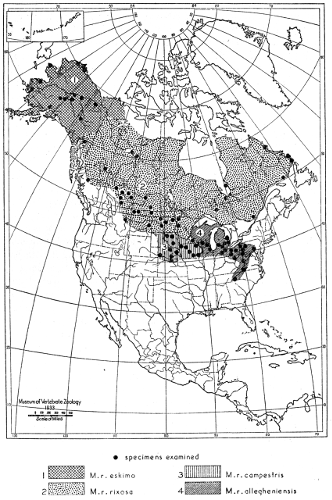
Fig. 28. Map showing occurrences and probable geographic ranges of the subspecies of Mustela rixosa in North America.
"In the nest were two red-backed mice, Clethrionomys gapperi, one of which had the base of its skull eaten out. No hair had been removed from either of them, but a Microtus lying in a side tunnel some feet away had the long hair plucked from its back and sides. In and close about the nest were found forty-three front parts of mice skulls which had evidently been discarded because of the sharp teeth in the maxillaries. Seven full stomachs and eleven hind feet of adult Microtus with parts of leg bones were disclosed in, or under, the weasel's bed and a few small bits of skin with hair attached were scattered among the plucked hair of the nest.
"This weasel seems to have been rather remiss in its sanitary habits as its pile of dung was almost, or quite, touching the nest and only just to the side of its entrance. It was composed of 117 voids all of which contained much hair and broken bone.
"Six other mouse nests found in the same stack, or others adjoining it, had been thinly lined with hair. One of these had two mice in it, a red-backed with its brain eaten out and a Microtus with some hair plucked from its neck. Another nest contained the front part of a skull with teeth and the hind feet and tail of a red-back. Besides the mice found in the nests seven others were discovered tucked away in side tunnels. One of these mice had most of the hair plucked from its back. Whether all these mice and nests belonged to the same weasel or not I am unable to say, but it is usual for them to have several nests in the area surrounding the one that is used as their headquarters or home."
Mustela rixosa eskimo (Stone)
Least Weasel
Plates 14 and 15
Putorius rixosus eskimo Stone, Proc. Acad. Nat. Sci. Philadelphia, 1900:44, March 24, 1900.
Putorius (Gale) vulgaris, Coues, Fur-bearing animals, p. 102, 1877 (part).
Putorius rixosus, Bangs, Proc. Biol. Soc. Washington, 10:21, February 25, 1896 (part); Merriam, N. Amer. Fauna, 11:14, June 30, 1896 (part).
Mustela rixosa eskimo, Miller, U. S. Nat. Mus. Bull., 79:96, December 31, 1912; Swenk, Journ. Mamm., 7:327, November 23, 1926; Hall, Univ. California Publ. Zoöl., 30:421, March 19, 1929.
Type.—Female, age in question, no. 848 in Acad. Nat. Sci. Philadelphia; Point Barrow, Alaska; July 25, 1898; obtained by E. A. McIlhenny. Type not seen by me.
Range.—Alaska and Yukon Territory. See figure 28 on page 180.
Characters for ready recognition.—Differs from M. r. pygmaea of eastern Asia in longer tail, averaging 11 rather than 16 per cent of length of head and body, and in study skins reaching only to heel instead of to point between heel and toes; from M. r. rixosa in shorter tail averaging 16 rather than 19 per cent of length of head and body and not extending beyond outstretched hind feet in study skins; white of underparts extending dorsally as a reëntrant angle from upper lip to behind eye, rather than delimited dorsally by a boundary between white and brown color that extends straight across cheeks from upper lip to side of body well below eye and ear; breadth of rostrum measured across lacrimal processes more, instead of less, than 85.5 per cent of orbitonasal length; from M. erminea of same region by basilar length of skull less than 32; tail less than 50 and lacking black pencil.
Description.—Size.—Male: The original describer lists measurements of topotypes as follows: Total length, 204, 230; length of tail, 28, 31; length of hind foot, 20, 22. Allowing 5 per cent for shrinkage, the hind feet of 5 topotypes yield an average measurement of 23 for the hind foot.
Female: Measurements of two topotypes are: Total length, 184, 180; length of tail, 25, 25; length of hind foot, 24, 18. In four other topotypes the hind feet, allowing 5 per cent for shrinkage, yield an average of 21.
Color.—Winter pelage all white, rarely with few white hairs in tip of tail but no black pencil; summer pelage with upper parts about Raw Umber and tone 3 of Chocolate pl. 343 of Oberthür and Dauthenay; underparts white, extending over upper lip, insides of limbs and over all four feet. Line of demarcation between underparts and upper parts extends from upper lip posterodorsally to behind eye down to base of ear, up behind ear for a third or more of its height, and back along side of body. Tail unicolor all around and same color as upper parts. Least width of color of underparts averaging 83 per cent of greatest width of color of upper parts.
Skull.—Based on topotypes; see measurements and plates 14 and 15; weight, 0.82 (0.74-0.93) grams in males, and 0.80 and 0.84 in two females; basilar length, 29.5 (27.6-30.1) in males and 27.8 (27.1-28.8) in females; otherwise as described in M. e. richardsonii.
Remarks.—Among the earliest specimens preserved was one by Edward W. Nelson in the course of his explorations of the Upper Yukon, and one in 1874 by L. T. Turner from St. Michaels, Alaska. Bangs, in 1896 (p. 22) mentioned the occurrence of the species in Alaska, but it was not until 1900 (p. 44) that Stone named the subspecies, and then principally on the basis of specimens obtained two years before by E. A. McIlhenny.
The large size, broad skull, light color and short tail are the distinguishing subspecific characters of the race eskimo, and the three characters first mentioned are distinguishing features also of the subspecies of Mustela erminea, namely arctica, which inhabits the same region. Possibly eskimo also will be found on Banks Island and the other Arctic islands between Alaska and Greenland, as is M. e. arctica; at the present time no specimens of Mustela rixosa are known from these islands although some race of rixosa would be expected to occur there.
Animals from southern Alaska average slightly smaller than those from northern Alaska, and this decrease in size toward the south probably represents intergradation with M. r. rixosa. Further evidence of intergradation is furnished by the short tail of the specimen from 15 miles east of Atlin; in other particulars this specimen agrees with the subspecies rixosa to which it is here referred. Nevertheless, the short tail, and color pattern, namely reëntrant angle of white behind the eye, is to be seen in all Alaskan specimens examined in the brown pelage, even in no. 107591, from Tyonek on Cook Inlet, which Osgood (1901:69) and Swenk (1926:323) thought might not differ from the subspecies M. r. rixosa.
Each of four male topotypes, hardly subadult in age, probably of a single litter, is much larger than any other specimen seen from Point Barrow. The basilar length, for example, is 31.9 as against 29.5, and the weight of the skull (with lower jaws) is as much as 1.5 grams, as against 0.93 in the heaviest of the other males. Initial examination of materials from Point Barrow raised the suspicion that two distinct species were represented—rixosa and a larger one possibly allied to M. nivalis of the Old World. Nevertheless, further study almost completely allayed the suspicion because the only difference discernible is one of size, and it is supposed that additional specimens will bridge the gap in size and show that M. r. eskimo at Point Barrow averages larger than the adult specimens now available indicate. The four large males of subadult age are nos. 42814-42816 and 42818 of the American Museum of Natural History.
Of the fourteen adult and subadult skulls examined, two display lesions resulting from infestation of the frontal sinuses by nematode parasites. None of the young skulls show such infestation.
Specimens examined.—Total number, 42 as follows. Arranged alphabetically by Territory and District and unless otherwise indicated in the United States National Museum.
Alaska. Barrow and Point Barrow, 19 (8[2], 7[74], 2[1], 1[50]); Wainwright, 1[57]; Mts. back of Icy Cape, 1[77]; west of Beechey Point, 1[2]; west edge of Colville River Delta, 1[2]; Koyukuk River, 16 mi. above Beetles, 1; upper Yukon, 1; Fort Yukon, 1; Stephens Village, 1; Wales, 1[57]; McDonald Creek, tributary of Salcha Slough, 1; near head of Toklat River, 1; head of Kantishna River, 1; St. Michael, 4 (2[74]); Tyonek [= Tyonek], 1; Bethel, 3; vic. Bristol Bay, 1.
Yukon. La Pierre's House, 1; Klotassin River, tributary of White River, 1.
Mustela rixosa rixosa (Bangs)
Least Weasel
Plates 14 and 15
Putorius rixosus Bangs, Proc. Biol. Soc. Washington, 10:21, pl. 1, fig. 6, pl. 2, fig. 6, pl. 3, fig. 4, February 25, 1896; Merriam, N. Amer. Fauna, 11:14, pl. 2, figs. 7, 7a, June 30, 1896.
Putorius pusillus, Baird, Mamm. N. Amer., p. 159, 1858.
Putorius (Gale) vulgaris, Coues, Fur-bearing animals, p. 102, 1877.
Mustela rixosa, Thomas, Proc. Zoöl. Soc. London, p. 168, March, 1911.
Mustela rixosa rixosa, Miller, U. S. Nat. Mus. Bull., 79:96, December 31, 1912; Swenk, Journ. Mamm., 7:327, November 23, 1926.
Type.—Female, adult, skin and skull; no. 642 Bangs Coll. in Mus. Comp. Zoöl.; Osler, Saskatchewan; July 15, 1893; obtained by W. C. Colt; original no. 79 according to describer.
The skull lacks the basioccipital, basisphenoid, and left zygomatic arch. The "crowns" of the lower canines are missing; otherwise the teeth are present and entire. The skin is fairly well made, with soles of hind feet up, in good condition and in summer pelage.
Range.—From northern British Columbia and Great Slave Lake south on the west side of the Rocky Mountains to Ootsa Lake, British Columbia, and on the east side of the Rocky Mountains, south to central Montana, North Dakota and Minnesota; eastward in Canada, entirely north of St. Lawrence River, to Atlantic Ocean. See figure 28 on page 180.
Characters for ready recognition.—Differs from M. r. eskimo in longer tail averaging 19 rather than 16 per cent of length of head and body and extending beyond outstretched hind feet in study skins, rather than to a point short of tips of toes; boundary between brown upper parts and white underparts extending straight across cheeks from upper lip to side of body well below eye and ear, rather than with reëntrant angle from upper lip carrying white upward to point behind eye, and with breadth of rostrum less, instead of more, than 85.5 per cent of orbitonasal length; from M. r. campestris by smaller size: hind foot less than 25 in males and ordinarily less than 22 in females; in males total length less than 216 and tail averaging less than 34, and in females total length averaging less than 182 and tail averaging less than 29; color said to average darker; from M. r. allegheniensis by three average differences, namely lighter color, longer tympanic bullae and larger size of males; from M. frenata and M. erminea of same region by basilar length of skull less than 32; tail less than 50, and lacking black pencil.
Description.—Size.—Male: Six adults and subadults from Shaunavon, Saskatchewan, yield average and extreme measurements as follows: Total length, 202 (188-208); length of tail, 32.5 (31.5-34.0); length of hind foot, 22.8 (21-24).
Female: One adult and 3 subadults from the same area yield average and extreme measurements as follows: Total length, 172 (162-190.5); length of tail, 27.4 (24-34); length of hind foot, 19.6 (17.5-22).
Color.—Winter pelage all white, rarely brown; as described in M. r. eskimo except that line of demarcation on side of head between upper parts and underparts passes almost straight back without the dorsally directed reëntrant area of white behind the eye and ear; least width of color of underparts averaging 52 per cent of greatest width of color of upper parts.
Skull (Based on those from Shaunavon, Sask.)—See measurements and plates 14 and 15; weight, 0.88 (0.70-0.98) grams in males and 0.55 (0.54-0.56) in females; basilar length, 29.5 (28.4-30.4) in males and 26.1 (24.7-27.0) in females; otherwise as described in M. e. richardsonii.
Remarks.—As early as 1858 (p. 159) Baird recognized an individual of this race from Pembina, Minnesota, as pertaining to a distinct species. Although he used for it the specific name pusillus originally proposed by DeKay for a small weasel from the state of New York, Baird wisely noted that the specimen he described "may be different from the New York species. . . ." After preparing this account, Baird included a second specimen, from Fort Steilacoom, Washington Territory, which he thought might be the same, but the differences that he was careful to point out, in the light of later knowledge, show it to be of the species Mustela erminea. Only a few other naturalists followed Baird in distinguishing the least weasel as a separate species until Bangs in 1896 (p. 21) clearly differentiated it and proposed for it the name Putorius rixosus, which continues in use today and applies to the species.
The accumulation at the National Museum of Canada, through the energy of Dr. R. M. Anderson, of a good series of specimens from Saskatchewan in the general vicinity of the type locality allows for the first time an adequate conception of the amount of secondary sexual variation and individual variation and permits recognition of subspecific characters to differentiate between M. r. rixosa and the subspecies eskimo and campestris. In comparison with the subspecies allegheniensis the basis for segregation is less clear and will remain somewhat in doubt until additional adults of allegheniensis from, say, Pennsylvania, become available with accurate external measurements taken in the flesh and especially with complete skulls.
Intergradation with the subspecies eskimo is suggested by the short tail of the specimen from fifteen miles east of Atlin, British Columbia; in other particulars that specimen, a skin-alone, agrees with the subspecies rixosa. Intergradation with campestris is indicated by increased size of some specimens from North Dakota, and is suggested with allegheniensis by the color of specimens from Wisconsin and Illinois. Three specimens from Winona County, in southeastern Minnesota, unfortunately are skulls-alone without external measurements. Also, two of these skulls are of young animals. The one adult, unsexed, is from Crystal Springs. Selected cranial measurements are: basilar length, 28.5; length of tympanic bulla, 10.9. These measurements accord with those of males of the subspecies rixosa to which the specimens from Winona County, therefore, are here assigned. The possibilities have not been excluded, however, that the adult is an unusually large female of the subspecies campestris or a male of allegheniensis that has tympanic bullae longer than average for that subspecies.
Some hesitation is felt in assigning the specimens, 8 in all, from eastern Canada to the subspecies rixosa. The skin-alone from Eagle River and the skin, with part of the skull, from St. Michael Bay, are in transitional pelage and are of no help in appraising subspecific characters. The one adult specimen which does have a complete skull is from an island south of the Comb Hills. This animal in all respects agrees with selected individuals of M. r. rixosa from Saskatchewan, but each of the five other skins in summer pelage has spots of dark brown color on the breast. Only about one specimen in three of rixosa from Saskatchewan is similarly marked. Furthermore, on some of the specimens from eastern Canada the spots are larger than on any of the animals from farther west. The greater frequency of brown spots on the breast, the larger average size of these spots, and the darker average coloration of the upper parts are suggestive of geographic variation, the existence of which has to be proved by additional and more complete specimens from eastern Canada. For the time being, specimens from there are tentatively assigned to the race rixosa.
Of 56 subadult and adult skulls only 3 (1 North Dakota; 1 Calgary, Alberta; and 1 Island S Comb Hills, Queb.) display lesions resulting from infestation of the frontal sinuses by nematode parasites. None of the young skulls shows such infestation.
Specimens examined.—Total number, 87 as follows. Arranged alphabetically by provinces and states and within each from north to south. Unless otherwise indicated, specimens are in the United States National Museum.
Alberta. Miette River, 1[77]; 5 mi. NW Camrose, 1[77]; Camrose, 2 (1[77], 1[31]); "near Camrose," 2[77]; Forks Blindman and Red Deer rivers, 1[60]; Innisfail, 1[86]; Veteran, 1[93]; Diddsbury [= Didsbury], 1; Calgary, 2 (1[93], 1[2]); Shepard, 1[86].
British Columbia. Clarks Ranch, Halfway River, Peace River Dist., 1[85]; 15 mi. E Atlin, 1[8]; Wistaria, P. O., 3 (2[77], 1[85]); Ootsa Lake, 1[85].
Labrador. Davis Inlet, 1[60]; 30 mi. upriver and 20 mi. toward Groswater Mts., Eagle River, 1; St. Michael Bay, 1.
Mackenzie. Old Fort Reliance, 1[2]; Fort Resolution, 2; Fort Smith, 1.
Minnesota. Roseau County: Cedarbend, 2[14]; Grimstad, 1[14]; America, 2 (1[14], 1[74]); Malung, 1[74]; Norland, 1[41]; Falun, 3 (1[14], 1[74], 1[41]); Palmville, 1[41]; Spruce, 1[74]; Stokes, 1[74]. No locality more definite than Marshall County, 1[14]. Clay County: Moorhead, 1[36]. Winona County: "near" Whitman, 1[34]; Altura, 1[98]; Crystal Springs, 1[98].
Montana. Sun River Valley, 1; Wibaux in Wibaux County, 1.
North Dakota. Walsh County: Grafton, 15 (3[60], 1[93], 5[2], 2[14], 1[74], 1[1], 1[76]). McHenry County: 4 and 4-1/2 mi. N Upham, 2. Wells County: 1[36]. Morton County: Mandan, 1[60].
Quebec. Island S of Comb Hills, James Bay, 1[9]. Saguenay County: Natashkwan, 1.
Saskatchewan. Osler, 1[75]; "near Regina," 1[77]; Dollard, 2[31]; Shaunavon (and "near" and 1 mi. NE), 9[77]; Klintowel P. O. (about 15 mi. N of Eastend), 1[77]; Eastend and "near" Eastend, 2[77].
Mustela rixosa allegheniensis (Rhoads)
Least Weasel
Plates 14, 15 and 41
Putorius allegheniensis Rhoads, Proc. Acad. Nat. Sci. Philadelphia, 1900:751, March 25, 1901.
Putorius rixosus allegheniensis, Cory, Mamm. Illinois and Wisconsin, p. 378, 1912.
Mustela allegheniensis, Miller, U. S. Nat. Mus. Bull., 79:96, December 31, 1912.
Mustela rixosa allegheniensis, Swenk, Journ. Mamm., 7:328, November 23, 1926.
Type.—Probably male adult, skin and skull, no. 6195, Acad. Nat. Sci. Philadelphia; near Beallsville, Washington Co., Pa.; about 1885 or 1886; obtained by Robert Hawkins.
Type not seen by me.
Range.—Wisconsin, northern Illinois, northern Indiana, Michigan, Ohio, Pennsylvania east to Dauphin County and south in the mountains to northwestern North Carolina. See figure 28 on page 180.
Characters for ready recognition.—Distinguished from M. r. rixosa by three average differences, namely, darker color, shorter tympanic bullae, and smaller size of males; from M. r. campestris in smaller size: hind foot less than 25 in males and less than 22 in females; in males total length less than 216 and tail averaging less than 34, color averaging darker; from M. frenata and M. erminea of same region by basilar length less than 31, tail less than 45, and lacking black pencil.
Description.—Size.—Male: An adult or subadult from Fair Oaks, Pa., a subadult from Finleyville, Pa., and an adult from Huttonsville, W. Va., measure, respectively as follows: Total length, 206, 194, 191 (average 197); length of tail, 37, 32, 28 (32); length of hind foot, 23 in each. An adult from Roanoke, Indiana, weighs 40.6 grams.
Female: Two young from Leasuresville, Pa., and Middle Paxton Twp., Pa., measure, respectively, as follows: Total length, 188, 172; length of tail, 33, 30; length of hind foot, 20.5, 21. An adult from Monroeville, Ohio, weighs 40.5 grams and a young individual from Middle Paxton Twp., Pa., 39.3 grams, and a subadult from Swan Creek Exp. Station, Allegan Co., Mich., weighs 49 grams.
Color.—Winter pelage either all white, or brown as in summer; upper parts about Raw Umber, or tone 2 of Carbo Brown of pl. 342 of Oberthür and Dauthenay. Underparts white at least on thoracic region; approximately three-fourths of specimens with brown rictal spot at angle of mouth or with this area covered by brown upper parts which extend down on each side and meet on the underparts in about one specimen out of three; upper lips and hind feet ordinarily brown; toes of forefeet ordinarily white (see under remarks for details of color pattern). Least width of color of underparts in the specimens in which the dark color of the upper parts does not encircle the body averages 60 per cent of greatest width of color of upper parts, or including all specimens the percentage is 42.
Skull (based on specimens from Pa. listed in table of cranial measurements, which see and plates 14 and 15).—Basilar length 29.7 and 28.6 in male and 28.0 in female; weights unavailable; otherwise as described in M. e. richardsonii. The length of the tympanic bullae seems to be actually less, and less in relation to the basilar length, than in other American subspecies of M. rixosa.
Remarks.—Robert Kennicott's mention in 1859 (p. 245) of what seems to be this subspecies is the earliest reference to it that I can identify in the literature. He used the specific name pusillus and it was not until 1900 that Samuel N. Rhoads proposed the name Putorius allegheniensis. Since 1900, several records of occurrence have been published which have made the geographic range of this race better known.
An adequate number of specimens has been gathered only from Ohio and from western Pennsylvania. Many from Ohio are without accurate external measurements taken in the flesh. The majority of the specimens from Pennsylvania owe their preservation to the willingness of local officials, who pay bounties on weasels, to save the skins of Mustela rixosa. These specimens ordinarily comprise the skin with locality but because the feet, external measurements in the flesh, and skulls are unavailable, the material is far from adequate and to give an accurate notion of the usual or average cranial characters of allegheniensis in Pennsylvania, skulls from there are especially desirable.
A smaller percentage of the specimens from Ohio than from Pennsylvania have the brown color of the upper parts meeting on the underparts. Also, more of the specimens from Ohio are lighter colored and this suggests intergradation with the subspecies campestris and rixosa to the westward.
From Pennsylvania 23 animals in brown pelage are available. In 5 there is a rictal spot at the angle of the mouth; in 5 the area is white and in 13 the brown color of the upper parts is continuous over the area in question. Only 2 of 23 have the upper lips white. Eight have the color of the upper parts meeting on the venter thus restricting the white of the underparts to the chin, throat, and pectoral region, and 6 of these have a white area in the inguinal region as well. The toes of the forefeet are white in 3 of 4 animals suitable for examination in this regard and the hind feet are marked with white in 3 of the 8 animals which have the hind feet preserved. Mustela rixosa in Pennsylvania parallels the species Mustela frenata in that in this relatively humid area of the northeastern United States the color of the upper parts is darker and the area of the dark-colored upper parts is increased at the expense of the area of the light-colored underparts. Also Mustela erminea in this same region (range of the subspecies Mustela cicognanii) shows the same tendency to darker color of upper parts and their extension in area at the expense of the area of the light-colored underparts, or was mentioned above.
It is difficult to account for the seeming absence of the species from New England and all that part of Canada and the United States south of the St. Lawrence River and northeastward from Pennsylvania. The size of females of M. erminea cicognanii in that territory is so little more than in rixosa that the latter possibly cannot successfully compete with the erminea stock which may already occupy the ecologic niche to which rixosa is adapted. It will be remembered that in western North America in territory seemingly climatically suitable for rixosa it occurs no farther southward than the line below which M. erminea has become reduced to a size comparable with that of M. rixosa.
Of 41 subadult and adult skulls assigned to this subspecies 24 have obvious lesions in the frontal sinuses evidently resulting from infestation by nematodes. More in detail, none of the specimens from Illinois (3 individuals), Pennsylvania (3 barely subadult), or West Virginia (2) displays lesions. From Wisconsin, Indiana, Virginia and North Carolina there is one specimen each and each specimen displays lesions. From Ohio, 17 of 23 specimens display lesions. From Michigan 3 of 8 specimens display lesions; 2 adults and one subadult have lesions and 5 subadults do not have lesions.
Specimens examined.—Total number, 102 as follows: Arranged alphabetically by states and within each state by counties from north to south. Unless otherwise indicated, specimens are in the United States National Museum.
Indiana. Huntington County: Roanoke, 1. Wells County: Harrison Township, 1[76].
Illinois. Lake County: Deerfield, 3[60]; no locality more definite than county, 1[60]. Cook County: Northfield, 1[60]; La Grange, 1[18].
Michigan. Tuscola County: 8 mi. N Caro, 1[76]. Santilac County: Deckerville, 1[76]. Allegan County: Swan Creek Exp. Station, 1[76]; Swan Creek Farm, 1[76]; T. 2N, R. 14W, 1[76]; Allegan, 1[76]. Livingston County: George Reserve, 1[76]; 1/2 mi. N Unadilla, 1. Oakland County: Rochester, 1[76]. Macomb County: Romeo, 1[76]. Washtenaw County: 5 mi. SW Ann Arbor, 1[76]. Branch County: vic. Coldwater, 1[76].
North Carolina. "near Marshall," 1.
Ohio. Northern part of state, 1[81]. Williams County: Stryker, 1[60]. Lucas County: Monclova, 1[60]. Erie County: Sandusky, 2[76]; marsh near Sandusky, 1[76]; Berlin Heights, 1[76]; no locality more definite than county, 1[2]. Wood County: 10 mi. NE Bowling Green, 1[76]; Bowling Green, 4[76]; 3 mi. E Bowling Green 1[76]; Plain Township, 1[2]; Portage Township, 1[60]. Loraine County: Wellington, 1[81]. Huron County: west of Monroeville, 1[76]. Summit County: Ira, 3[81]. Portage County: Suffield, 1[81]. Hancock County: Vanburen, 1[76]; Findlay, 1[81]; 9 mi. S Findlay, 1[76]; no locality more definite than county, 7 (2[76], 2[81], 3[2]). Mahoning County: Ellsworth, 1. Crawford County: "near Crestline," 1[81]. Delaware County: Sunbury, 1[2]; Lewis Center, 1[81]; no locality more definite than county, 1[81]. Licking County: Johnstown, 1[2]. Fairfield County: Baltimore, 1[81]; Violet Township, 1[81]. Meigs [= Gallia?] County: Vinton, 1[81].
Pennsylvania. Erie County: McKeen Twp. 1. Crawford County: Springboro, 1[1]; Pymatuning Swamp, between Hartstown and Shermansville, Sadsbury Twp., 3[9]. Mercer County: Shenango Twp., 1. Lawrence County: Little Beaver Twp., 1. Butler County: Leasuresville, 1[9]; Clearfield Twp., 1; Valencia, 1[9]. Armstrong County: Ford City, Burrell Twp., 1. Indiana County: Smicksburg, 1; N. Mahoning Twp., 2; White Twp., 1. Allegheny County: South Hills, Pittsburgh, 1[9]; "near Pittsburgh," 1[9]; Fair Oaks, 1[9]. Westmoreland County: Bolivar, 1. Dauphin County: Middle Paxton Twp., 1. Washington County: Finleyville, 1; Rea, 5; Beallsville, 1[1]; Claysville, 1. Green County: Deep Valley, 1; Waynesburg, 1; Jefferson, 1; Cumberland Twp., 1. Fayette County: Acme, 1[9]. Somerset County, 1. Lancaster County, 1.
West Virginia. Randolph County: Huttonsville, 1.
Wisconsin. Sauk County: Sumpter Twp., 1[60]. Dodge County: Beaver Dam, 1[50]. Dane County: Madison, 1; McFarland (= MacFarland), 1.
Mustela rixosa campestris Jackson
Least Weasel
Plates 14 and 15
Mustela campestris Jackson, Proc. Biol. Soc. Washington, 26:124, May 21, 1913.
Putorius pusillus, Aughey, Sketches of the physical geography and geology of Nebraska, p. 119, 1880, Omaha.
Mustela rixosa campestris, Swenk, Journ. Mamm., 7:329, Nov. 23, 1926.
Type.—Female, adult, skin and skull; no. 171490, U. S. Nat. Mus., Biol. Surv. Coll.; Beemer, Cuming County, Nebraska; April 18, 1911; obtained by G. Sharp; x catalogue no. 8440.
The skull is unbroken. On the left side, C1 and P2 are missing; the other teeth are present and entire. The skin is excellently made and in a good state of preservation.
Range.—South Dakota, Nebraska and Iowa. See figure 28 on page 180.
Characters for ready recognition.—Differs from M. r. rixosa and M. r. allegheniensis in larger size: Hind foot more than 25 in males and ordinarily more than 22 in females; in males total length more than 216 and tail averaging more than 34; color possibly slightly paler than in M. r. rixosa and averaging paler than in M. r. allegheniensis; from M. frenata and M. erminea of the same region by basilar length less than 32; tail less than 50, and lacking black pencil.
Description.—Size.—Male: Four adults from Nebraska yield average and extreme measurements as follows: Total length, 231 (225-237); length of tail, 36 (32-39); length of hind foot, 29 (28-31).
Female: Six adults from Nebraska yield average and extreme measurements as follows: Total length, 192 (184-225); length of tail, 35 (28-40); length of hind foot, 23 (20.5-26).
Color.—Winter pelage ordinarily white; as described in M. r. eskimo except possibly paler and certainly with line of demarcation on side of head between upper parts and underparts passing almost straight back without the dorsally directed reëntrant angles of white behind the eye and ear; least width of color of underparts in four specimens from Nebraska averaging 80 (49-89) per cent of greatest width of color of upper parts, but in a fifth animal in summer pelage the brown color of the upper parts encircles the body.
Skull.—See measurements in table and plate 15; weight 1.1 grams (male from Brown Co., S. D.); basilar length, 30.7 in male from Clay Co., Neb., and 28.8 in female from same county; otherwise as described in M. e. richardsonii.
Remarks.—In his revisionary treatment of the American races of Mustela rixosa, Myron H. Swenk (1926:313) credits Samuel Aughey with recording this animal, M. r. campestris, from Nebraska, as early as 1880, under the name Putorius pusillus. In 1908, Swenk recorded the animal from the same state under the name rixosus and in 1913 the race campestris was formally named by H. H. T. Jackson.
On the testimony of a friend who had previously obtained several specimens for him, Swenk (1926:321) records the least weasel from Oshkosh, Garden County, Nebraska, which is a marginal record of occurrence to the southwest for M. r. campestris.
At an early stage in the study of American weasels the writer examined the specimens from Nebraska saved by Mr. Myron H. Swenk and recorded measurements of them. However, at the time of writing this account the specimens were not available for examination and the account of coloration is accordingly incomplete.
The large size, particularly the large external measurements, comprises the principal distinguishing character of this subspecies of the least weasel.
Of the four adults examined from Iowa and South Dakota one exhibits lesions such as result from infestation of the frontal sinuses by nematodes.
Specimens examined.—Total number, 21 as follows. Arranged alphabetically by states and by counties, from north to south in each state. Unless otherwise indicated, specimens are in the United States National Museum.
Iowa. Howard County: Chester, 1[12]. Palo Alto County: Emmetsburg, 1[65]. Kassuth County: Algona, 1[65]. Clayton County: National, 1. Storey County: Nevada, 1[65]. Wapello County: Ottumwa, 1[65]. Henry County: Mount Pleasant, 1[66].
Nebraska. Holt County: Page, 1[35]. Madison County: Norfolk 1[35]. Cuming County: Beemer, 1. Hamilton County: Chapman, 1[35]. Clay County: Inland to 1 mi. east thereof, 7[35].
South Dakota. Brown County: shore of Sand Lake, S. 15 T. 126N, R. 62W, 1. Day County: Waubay Migratory Waterfowl Refuge, 1. McCook County: Salem, 1[102].
MUSTELA FRENATA Lichtenstein
Long-tailed Weasel
(Synonymy under subspecies)
Type.—Mustela frenata Lichtenstein, Darstellung neuer oder wenig bekannter Säugethiere, pl. 42 and corresponding text unpaged. 1832.
Range.—From southern Canada southward over all of the United States, México, Central America, Venezuela, and the republics of western South America to southern Perú and extreme northern Bolivia. All the life-zones from Alpine Arctic to Tropical are inhabited. In the extremely desert region of southeastern California and western Arizona the species is scarce or possibly absent although recovery of a skull (see under account of M. f. neomexicana) from near the center of this region at Potholes on the Colorado River, and a reported occurrence in the mountains of Baja California, México, indicate that a few individuals of the species live in favorable habitat even in this desert region.
Characters for ready recognition.—Differs from Mustela erminea, in regions where the two species occur together, by tail more than 44 per cent of length of head and body and by postglenoidal length of skull less than 46 per cent of condylobasal length in males and less than 48 per cent in females (see under characters of the species); from Mustela rixosa by presence of black pencil on tail, caudal vertebrae more than a fourth (2/5-3/4) of length of head and body, basilar length of skull more than 34 mm.; from Mustela africana by absence of thenar pad on forefoot, underparts without longitudinal, median, abdominal stripe of same color as upper parts, upper lips narrowly (rather than broadly) edged with color of underparts, longest facial vibrissae extending to or behind posterior margin of ear; presence of p2; more inflated (see pls. 23 and 30) tympanic bullae.
Characters of the species.—Size large: Total length 300 to 550 mm.; tail two-fifths to seven-tenths of length of head and body, with distinct black pencil at end; caudal vertebrae 19 to 23; skull with long precranial portion; postglenoidal length, expressed as a percentage of the condylobasal length, less than 47 in females and ordinarily less than 46 in males; upper parts brown; light-colored underparts, in summer pelage, tinged with buffy or yellowish and continuous from chin to inguinal region; some subspecies (southwestern United States, México, Central America, and Florida) with white or yellowish facial markings which do not occur in any other American species of the genus Mustela.
Geographic variation.—Forty-two subspecies are recognized, and the species is geographically more variable than any of the other 3 American species. Color, color-pattern especially on the head, relative proportions of the tail, hind feet, body including the head, and shape and size of the skull are the principal features in which geographic variation has been noted. The variation in the skull extends to the basicranial region (shape and size of tympanic bullae and related structures), interorbital region and preorbital region.
Natural History.—Habitat and Numbers.—As has already been remarked, the long-tailed weasel is absent from the extreme desert of the southwestern United States and northwestern México. Possibly the absence of water to drink is the limiting factor. In southern Nevada the finding of weasels only in places that were well watered, even though small rodents suitable as food for weasels were even more abundant in the surrounding desert, supports this possibility that the absence of water to drink is the limiting factor. Also at Berkeley, California, in early December of 1927 in the canyon at the head of Dwight Way and in the autumn and winter of 1928 in Strawberry Canyon on the campus of the University of California, I trapped extensively for this species in different habitats and obtained, in all, four individuals no one of which was farther than 10 feet from water. The lesser cruising range of the individual weasel than of, say, the coyote, probably explains why, in an arid region, for example Pahranagat Valley, Nevada, only the meadow mice and their riparian associates are preyed upon by the long-tailed weasel whereas the coyote preys upon these riparian rodents and also upon the kangaroo rats and other rodents which are so abundant in adjoining habitats that are devoid of water.
In areas where water is available every few hundred yards, no particular habitat seems to be avoided in summer providing there is food for the long-tailed weasel. In winter (January and March) there obviously was a choice of habitat, possibly occasioned by more abundant food or more satisfactory shelter, or both, in Centre County, Pennsylvania, where Glover (1943B) found the population density in the chestnut-oak habitat to be one weasel per 6.5 acres in areas of tree cuttings and slash and one weasel per 13.3 acres in the open forest. In the scrub oak-pitch pine forest type the population was one weasel per 26.4 acres in tree cuttings and slash and one weasel per 38.2 acres in the open forest. No weasel was found in an area of 9.6 acres comprising a wood lot, the edge of the forest, abandoned fence rows and an abandoned orchard. The two types of forest in which he did find weasels, 25 in all, comprised 381.6 acres. Glover's (op. cit.) data is the only precise information known to me on actual numbers of long-tailed weasels in a given area of any considerable size.
Fluctuations which I elsewhere (1946:57) have designated as multiannual fluctuations occur in this species but seemingly not in the degree that they do in Mustela erminea. This difference between the two species is to be expected because M. frenata does not range so far northward toward the polar regions as does M. erminea and populations of most kinds of animals in the polar, at least in the arctic, regions are subject to more extreme and more regular fluctuations than are kinds of animals in temperate or tropical regions. Indication of the means by which decrease in the weasel population is brought about is afforded by Osgood's (1935:156) observations around Rutland, Vermont. In the late winter of 1934, tracks indicated that weasels left their usual haunts and hunted cross lots, vainly trying to find food. Testing of the small mammal population in the spring and summer of 1934 showed that it was at low ebb. In the fall of 1934 mice and shrews were abundant again but weasels seemed to be entirely absent. The decrease in the population of weasels lagged behind the decrease in the population of the herbivorous prey as did the subsequent increase; this, of course, is the normal relation of carnivorous species of mammals and their prey, at least in and above the Transition Life-zone.
The average distance away from the central den which four weasels (sex unspecified) traveled in a single night at Ames, Iowa, was 312 feet; the maximum distance was 642 feet. These data were obtained in the winter of 1939 by Polderboer, Kuhn and Hendrickson (1941:115) who studied the tracks in the snow. In Manitoba, Criddle and Criddle (1925:143) noted that a female which lived in their basement often wandered more than half a mile away in search of food. In Michigan, Quick (1944:75) found the maximum distance traveled in one day (= night?) by a large male to be 3.43 miles although two miles was the average distance traveled by this individual. In 1942, from January 4 to March 4, in Centre County, Pennsylvania, Glover (1943B) studied tracks of 11 males and 10 females, in newly fallen snow, and ascertained that the distance traveled in a single night averaged 704 (60-2535) feet for the male and 346 (20-1420) feet for the female. The weasels in the open timber traveled farther per trip than those in the brushland and dense stands of trees.
Behavior
An adult female (now the holotype of Mustela frenata nevadensis) seen running across a field, and, I think, unaware of my presence, at every bound bent her back up so far that she reminded me of a measuring worm. For part of the time when running, the tail was held off the ground straight out behind, and then, for a while, inclined upward at an angle of about 45°. Another weasel that I saw in the daytime, and that I think was unaware of my presence, was bounding along among the Baccharis bushes on the south-facing slope of Dwight Way Canyon, Berkeley, California. This individual, at each bound, arched the back up so high as to remind me, again, of a measuring worm.
The long-tailed weasel is a land mammal and unlike its close relative, the mink, is seldom seen in the water. That it can swim, however, is attested by the capture of one while it was swimming across the Río Ramos in México (Davis, 1944:381). Also, Green (1936), in May, in Gratiot County, Michigan, saw a weasel, running with a Peromyscus in its mouth. The weasel dropped the mouse, entered the water and swam to a hole among stones.
More instances of climbing, than of swimming, have been reported in the literature for the long-tailed weasel. Seton (1929 (2):625) quotes William M. Graffius of Pennsylvania as having seen a weasel closely pursue a red squirrel nearly to the topmost branch of a large hemlock. When the squirrel loosed its hold and dropped into a stream, the weasel descended to the ground and caught and killed the squirrel when it emerged from the water. Pearce (1937:483), in central New York State, on July 29, 1931, watched a weasel chase a chipmunk up a black cherry tree ten inches in diameter, and noted that the first rush carried the weasel "straight up the trunk for approximately 10 feet, where it hesitated momentarily before continuing. Then, instead of climbing vertically, it made progress by traveling in short ascending spirals around the trunk, scarcely making 3 feet in height for each circuit of the tree. Upon reaching the limb by which the chipmunk escaped, the weasel followed out along this in the same spiral manner. This limb had a diameter of about 4 inches at its base and extended upward at an angle of perhaps 20 degrees above the horizontal . . . it made its way head first almost down to the ground, using the same spiral mode of progress, but at a leisurely pace. . . . While traveling down the side limb it appeared practically to wrap its sinuous body around the limb."
A male long-tailed weasel, from Colorado, which I kept captive was often fed freshly killed mice. These I thrust through one of the small openings in the wire mesh. The weasel quickly learned to seize any part of a mouse thus introduced and his tugging aided in getting the mouse into the cage. Occasionally a mouse too large to be got through the mesh had to be withdrawn. In such an instance, if the weasel had already had hold of the mouse, he would screech frightfully. I have heard no other vocal sounds from a weasel except a kind of purring.
The sense of smell apparently is well developed; at any rate it is keen enough to allow the weasel to follow the trail of an intended victim by the scent left by the latter. Murie's (1935:321-322) account, for example, of a weasel pursuing a snowshoe rabbit gives clear evidence that the weasel relied on scent in following the rabbit.
A captive male weasel obtained at Gainesville, Florida, stamped his hind feet when annoyed (Moore, 1945:259).
A male from Colorado that I kept for months in a cage at Lafayette, California, was several times found in a sleep so deep that he was awakened with difficulty. Seton (1929 (2):629-630) writes: "In my small menagerie, I have had half-a-dozen Weasels of the New York species. Their sleeping dens are arranged so as to be easily and silently opened. Several times I have lifted the lid to find the weasel in a deep sleep—a sleep so profound that I had to poke him vigorously with a stick before he awoke, looked up, and rushed forth with a little puff of wrath, and a little puff of smell."
Feces and urine were ordinarily deposited in one particular place by each of the captive weasels that I have observed. Hamilton (1933:294) records that a large male M. f. noveboracensis, in a week, averaged 10 evacuations every twenty-four hours, that urination immediately precedes defecation, and describes the feces as black or brown, long and narrow and often spiral-shaped owing "to the matted fur of some rodent that had been eaten." Quick (1944:77) writes, concerning four winter dens in Michigan, that "The latrines of weasels were in the entries of used dens and scats could be collected there by the handful." Polderboer, Kuhn and Hendrickson (1941:116) in the spring of 1939 at Ames, Iowa, gathered scats "from latrines found at the entrances of burrows and from latrine chambers found within burrows." Scats were found by them in the linings of some nests.
Courage of a high order might be credited to the long-tailed weasel because individuals have attacked animals much larger than the weasels. Actually, however, in few if any of these instances was the motive for attack known. That a hawk was attacked is suggested by Soper's (1919:45) account of Mustela frenata noveboracensis wherein he repeats a story told to him of a hawk observed in unsteady flight, and obviously in distress, which when it plummeted to earth was with a weasel which escaped from the observer. Charles Tatham, Jr., of Cambridge, Massachusetts, according to Seton (1929 (2): 630, 631) observed one that attacked his dog.
Persons and long-tailed weasels have figured in some rather strange encounters. For example, Oehler (1944:198) recounts that in the autumn of 1940 at Cincinnati, Ohio, an animal, mistakenly thought to be a chipmunk, was seen to dash into a hollow log whereupon pounding on the log brought out the weasel which bit and clung to the hand of one man whose companion was bitten when he attempted to free the man that was bitten first.