Front matter
Reading edition
W. H. BARTLETT. Handsigned: Yours truly W. H. Bartlett.
AMERICAN SCENERY;
OR,
LAND, LAKE, AND RIVER
ILLUSTRATIONS OF TRANSATLANTIC NATURE.
FROM DRAWINGS BY W. H. BARTLETT,
ENGRAVED IN THE FIRST STYLE OF THE ART,
BY
R. WALLIS, J. COUSEN, WILLMORE, BRANDARD, ADLARD, RICHARDSON, &c.
THE LITERARY DEPARTMENT
BY N. P. WILLIS, ESQ.
AUTHOR OF “PENCILLINGS BY THE WAY,” “INKLINGS OF ADVENTURE,” ETC.
VOL. I.
LONDON:
GEORGE VIRTUE, 26, IVY LANE.
MDCCCXL.
LONDON:
RICHARD CLAY, PRINTER. BREAD STREET HILL.
PREFACE.
Either Nature has wrought with a bolder hand in America, or the effect of long continued cultivation on scenery, as exemplified in Europe, is greater than is usually supposed. Certain it is that the rivers, the forests, the unshorn mountain-sides and unbridged chasms of that vast country, are of a character peculiar to America alone—a lavish and large-featured sublimity, (if we may so express it,) quite dissimilar to the picturesque of all other countries.
To compare the sublime of the Western Continent with the sublime of Switzerland—the vales and rivers, lakes and waterfalls, of the New World with those of the Old—to note their differences, and admire or appreciate each by contrast with the other, was a privilege hitherto confined to the far-wandering traveller. In the class of works, of which this is a specimen, however, that enviable enjoyment is brought to the fire-side of the home-keeping and secluded as well; and, sitting by the social hearth, those whose lot is domestic and retired, can, with small cost, lay side by side upon the evening table the wild scenery of America, and the bold passes of the Alps—the leafy Susquehanna with its rude raft, and the palace-gemmed Bosphorus with its slender caïque. So great a gratification is seldom enjoyed at so little cost and pains.
In the Letter-press, it has been the Writer’s aim to assemble as much as possible of that part of American story which history has not yet found leisure to put into form, and which romance and poetry have not yet appropriated—the legendary traditions and anecdotes, events of the trying times of the Revolution, Indian history, &c. &c. It is confidently hoped, that the attempt to assemble a mass of interesting matter under this design, has not failed; and that, in the value of the intellectual portion, as well as in the beauty and finish of the embellishments, the Work will be thought worthy of the patronage of the public.
CONTENTS AND LIST OF ENGRAVINGS
TO VOLUME I.
Ch.Page
Portrait of Mr. Bartlett. (Autographed)0
1Map of the North-Eastern Parts of the United States1
2Niagara Falls, from the Ferry4
3View from West Point6
4Trenton Falls, View down the Ravine8
5View from Mount Holyoke10
6The Outlet of Niagara River12
7The Palisades, Hudson River14
8The Rapids above the Falls of Niagara16
9Saratoga Lake18
10The Colonnade of Congress Hall, Saratoga Springs20
11Albany22
12Crow’s Nest, from Bull Hill, West Point24
13View below Table Rock26
14Lake Winipiseogee28
15Kosciusko’s Monument30
16The Horseshoe Falls at Niagara, with the Tower32
17The Narrows, at Staten Island34
18View of the Capitol at Washington36
19View of the Ruins of Fort Ticonderoga38
20View from Fort Putnam40
21View of State Street, Boston42
22Niagara Falls, from Clifton House45
23View from Hyde Park47
24Village of Sing-Sing49
25View from Ruggle’s House, Newburgh51
26Descent into the Valley of Wyoming53
27Boston, from Dorchester Heights55
28View of Faneuil Hall, Boston57
29New York Bay, from the Telegraph Station59
30Peekskill Landing61
31Lighthouse near Caldwell Landing63
32Harper’s Ferry, from the Potomac side65
33Caldwell, Lake George69
34Centre Harbour, Lake Winipiseogee71
35Yale College, at New Haven74
36Willey House—White Mountains76
37Battle Monument, Baltimore78
38Forest Scene on Lake Ontario80
39Viaduct on the Baltimore and Washington Rail-road82
40The Indian Falls near Coldspring85
41Columbia Bridge, over the Susquehanna87
42The Genessee Falls, Rochester89
43The Ferry at Brooklyn, New York91
44Rail-road to Utica, Little Falls93
45Utica96
46The Landing, on the American side, Falls of Niagara97
47View From Mount Washington99
48Mount Washington, and the White Hills101
49The Park and City Hall, New York103
50The Two Lakes, and the Mountain House on the Catskills105
51Trenton High Falls106
52The Valley of the Shenandoah, from Jefferson’s Rock108
53Lockport, Erie Canal110
54The Tomb of Washington, Mount Vernon113
55Black Mountain, Lake George115
56Valley of the Connecticut, from Mount Holyoke117
57View on the Erie Canal, near Little Falls119
58Hudson Highlands, from Bull Hill121
59Villa on the Hudson, near Weehawken123
60View of Meredith, New Hampshire125
61Ballston Springs128
62The Narrows, from Fort Hamilton130
63The Notch House, White Mountains132
64Wilkesbarre, Vale of Wyoming134
65Squawm Lake, New Hampshire136
66Sabbath-Day Point, Lake George138
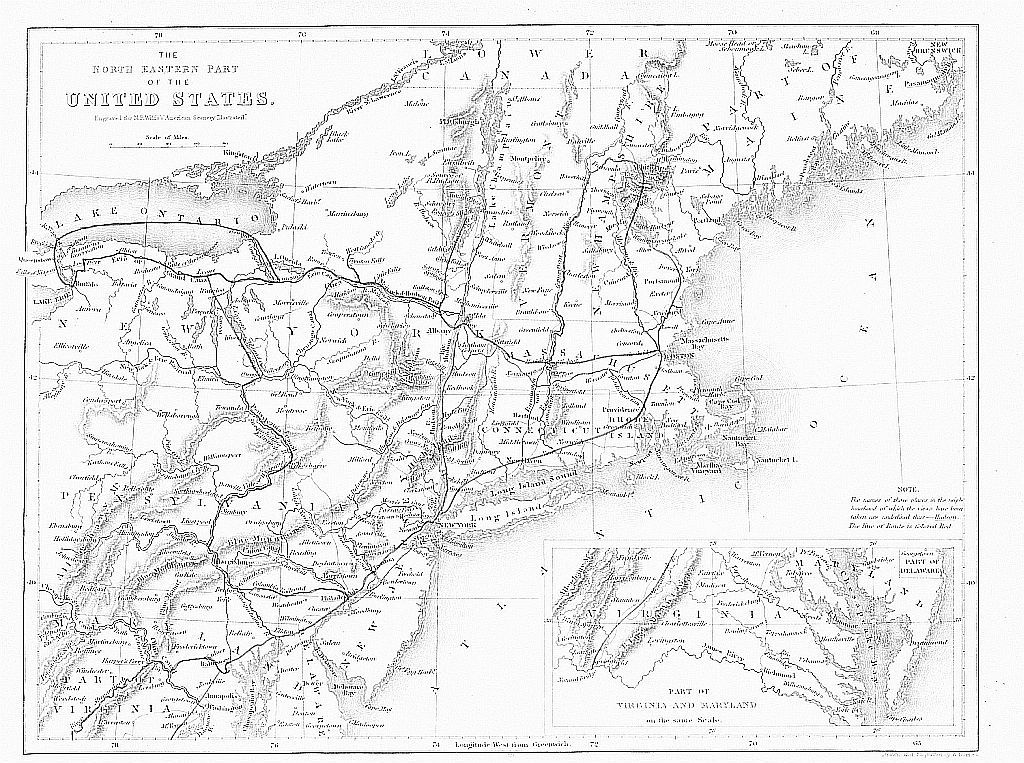
THE North Eastern Part OF THE UNITED STATES.
AMERICAN SCENERY.
It strikes the European traveller, at the first burst of the scenery of America on his eye, that the New World of Columbus is also a new world from the hand of the Creator. In comparison with the old countries of Europe, the vegetation is so wondrously lavish, the outlines and minor features struck out with so bold a freshness, and the lakes and rivers so even in their fulness and flow, yet so vast and powerful, that he may well imagine it an Eden newly sprung from the ocean. The Minerva-like birth of the republic of the United States, its sudden rise to independence, wealth, and power, and its continued and marvellous increase in population and prosperity, strike him with the same surprise, and leave the same impression of a new scale of existence, and a fresher and faster law of growth and accomplishment. The interest, with regard to both the natural and civilized features of America, has very much increased within a few years; and travellers, who have exhausted the unchanging countries of Europe, now turn their steps in great numbers to the novel scenery, and ever-shifting aspects of this.
The picturesque views of the United States suggest a train of thought directly opposite to that of similar objects of interest in other lands. There, the soul and centre of attraction in every picture is some ruin of the past. The wandering artist avoids every thing that is modern, and selects his point of view so as to bring prominently into his sketch, the castle, or the cathedral, which history or antiquity has hallowed. The traveller visits each spot in the same spirit—ridding himself, as far as possible, of common and present associations, to feed his mind on the historical and legendary. The objects and habits of reflection in both traveller and artist undergo in America a direct revolution. He who journeys here, if he would not have the eternal succession of lovely natural objects—
“Lie like a load on the weary eye,”
must feed his imagination on the future. The American does so. His mind, as he tracks the broad rivers of his own country, is perpetually reaching forward. Instead of looking through a valley, which has presented the same aspect for hundreds of years—in which live lords and tenants, whose hearths have been surrounded by the same names through ages of tranquil descent, and whose fields have never changed landmark or mode of culture since the memory of man, he sees a valley laden down like a harvest waggon with a virgin vegetation, untrodden and luxuriant; and his first thought is of the villages that will soon sparkle on the hill-sides, the axes that will ring from the woodlands, and the mills, bridges, canals, and rail-roads, that will span and border the stream that now runs through sedge and wild-flowers. The towns he passes through on his route are not recognizable by prints done by artists long ago dead, with houses of low-browed architecture, and immemorial trees; but a town which has perhaps doubled its inhabitants and dwellings since he last saw it, and will again double them before he returns. Instead of inquiring into its antiquity, he sits over the fire with his paper and pencil, and calculates what the population will be in ten years, how far they will spread, what the value of the neighbouring land will become, and whether the stock of some canal or rail-road that seems more visionary than Symmes’s expedition to the centre of the earth, will, in consequence, be a good investment. He looks upon all external objects as exponents of the future. In Europe they are only exponents of the past.
There is a field for the artist in this country (of which this publication reaps almost the first-fruits) which surpasses every other in richness of picturesque. The great difficulty at present is, where to choose. Every mile upon the rivers, every hollow in the landscape, every turn in the innumerable mountain streams, arrests the painter’s eye, and offers him some untouched and peculiar variety of an exhaustless nature. It is in river scenery, however, that America excels all other lands: and here the artist’s labour is not, as in Europe, to embellish and idealise the reality; he finds it difficult to come up to it. How represent the excessive richness of the foliage! How draw the vanishing lines which mark the swells in the forest-ground, the round heaps of the chestnut-tops, the greener belts through the wilderness which betray the wanderings of the water-courses! How give in so small a space the evasive swiftness of the rapid, the terrific plunge of the precipice, or the airy wheel of the eagle, as his diminished form shoots off from the sharp line of the summit, and cuts a circle on the sky!
The general architecture of the United States cannot pretend, of course, to vie with that of older countries; yet, taken in connexion with the beautiful position of the towns, no drawing will be found deficient in beauty, while many of the public buildings especially are, as works of art, well worthy the draughtman’s notice. The curiosity now generally excited with regard to this country, by its own progress, and by the late numerous books of travels, will throw a sufficient interest around every point that the pencil could present.
——“The green land of groves, the beautiful waste,
Nurse of full streams, and lifter up of proud
Sky-mingling mountains that o’erlook the cloud.
Erewhile, where yon gay spires their brightness rear,
Trees waved, and the brown hunter’s shouts were loud
Amid the forest; and the bounding deer
Fled at the glancing plume, and the gaunt wolf yell’d near.
“And where his willing waves yon bright blue bay
Sends up, to kiss his decorated brim,
And cradles, in his soft embrace, the gay
Young group of grassy islands born of him,
And, crowding nigh, or in the distance dim,
Lifts the white throng of sails, that bear or bring
The commerce of the world;—with tawny limb,
And belt and beads in sunlight glistening,
The savage urged his skiff like wild bird on the wing.
* * * * * * * * * *
“Look now abroad—another race has fill’d
These populous borders—wide the wood recedes,
And towns shoot up, and fertile realms are till’d;
The land is full of harvests and green meads;
Streams numberless, that many a fountain feeds,
Shine, disembower’d, and give to sun and breeze
Their virgin waters; the full region leads
New colonies forth, that toward the western seas
Spread, like a rapid flame, among the autumnal trees.
* * * * * * * * * *
“But thou, my country, thou shalt never fall,
But with thy children—thy maternal care,
Thy lavish love, thy blessing shower’d on all—
These are thy fetters—seas and stormy air
Are the wide barrier of thy borders, where
Among thy gallant sons that guard thee well,
Thou laugh’st at enemies: who shall then declare
The date of thy deep-founded strength, or tell
How happy, in thy lap, the sons of men shall dwell.”—Bryant.
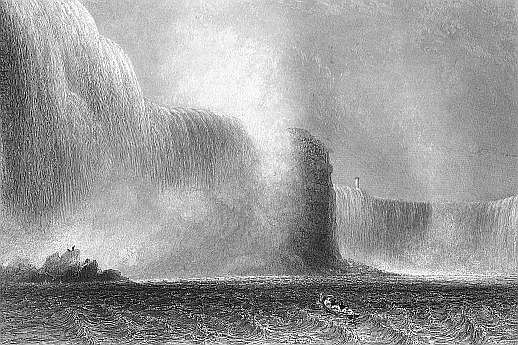
NIAGARA FALLS, FROM THE FERRY.
The best way to approach Niagara is to come up on the American shore, and cross at the ferry. The descent of about two hundred feet by the staircase, brings the traveller directly under the shoulder and edge of the American fall—the most imposing scene, for a single object, that he will ever have witnessed. The long column of sparkling water seems, as he stands near it, to descend to an immeasurable depth, and the bright sea-green curve above has the appearance of being let into the sky. The tremendous power of the Fall, as well as the height, realizes here his utmost expectations. He descends to the water’s edge, and embarks in a ferry-boat, which tosses like an egg-shell on the heaving and convulsed water; and in a minute or two he finds himself in the face of the vast line of the Falls, and sees with surprise that he has expended his fullest admiration and astonishment upon a mere thread of Niagara—the thousandth part of its wondrous volume and grandeur. From the point where he crosses, to Table Rock, the line of the Falls is measurable at three quarters of a mile; and it is this immense extent which, more than any other feature, takes the traveller by surprise. The tide at the Ferry sets very strongly down, and the athletic men who are employed here, keep the boat up against it with difficulty. Arrived near the opposite landing, however, there is a slight counter-current, and the large rocks near the shore serve as a breakwater, behind which the boat runs smoothly to her moorings.
It may be remarked, that the well-known stanzas on the “Fall of Terni,” in the fourth canto of “Childe Harold,” are, in many respects, singularly and powerfully descriptive of Niagara.
“The roar of waters!—from the headlong height
Velino cleaves the wave-worn precipice;
The fall of waters! rapid as the light
The flashing mass foams shaking the abyss;
The hell of waters! where they howl and hiss,
And boil in endless torture; while the sweat
Of their great agony, wrung out from this
Their Phlegethon, curls round the rocks of jet
That gird the gulf around, in pitiless horror set,
“And mounts in spray the skies, and thence again
Returns in an unceasing shower, which round,
With its unemptied cloud of gentle rain,
Is an eternal April to the ground,
Making it all one emerald:—how profound
The gulph! and how the giant element
From rock to rock leaps with delirious bound,
Crushing the cliffs, which, downward worn and rent
With his fierce footsteps, yield in chasms a fearful vent,
“To the broad column which rolls on, and shows
More like the fountain of an infant sea
Torn from the womb of mountains by the throes
Of a new world, than only thus to be
Parent of rivers, which flow gushingly,
With many windings through the vale:—Look back
Lo! where it comes like an eternity,
As if to sweep down all things in its track,
Charming the eye with dread,—a matchless cataract,
“Horribly beautiful! but on the verge,
From side to side, beneath the glittering morn,
An Iris sits, amidst the infernal surge,
Like Hope upon a death-bed, and, unworn
Its steady dyes, while all around is torn
By the distracted waters, bears serene
Its brilliant hues with all their beams unshorn:
Resembling, ’mid the torture of the scene,
Love watching Madness with unalterable mien.”—Byron.
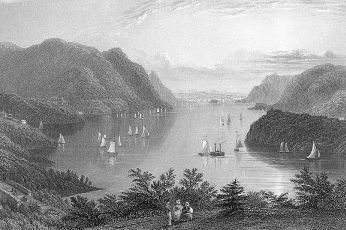
VIEW FROM WEST POINT.
Of the river scenery of America, the Hudson, at West Point, is doubtless the boldest and most beautiful. This powerful river writhes through the highlands in abrupt curves, reminding one, when the tide runs strongly down, of Laocoon in the enlacing folds of the serpent. The different spurs of mountain ranges which meet here, abut upon the river in bold precipices from five to fifteen hundred feet from the water’s edge; the foliage hangs to them, from base to summit, with the tenacity and bright verdure of moss; and the stream below, deprived of the slant lights which brighten its depths elsewhere, flows on with a sombre and dark green shadow in its bosom, as if frowning at the narrow gorge into which its broad-breasted waters are driven.
Back from the bluff of West Point extends a natural platform of near half a mile square, high, level, and beautifully amphitheatred with wood and rock. This is the site of the Military Academy, and a splendid natural parade. When the tents of the summer camp are shining on the field—the flag, with its blood-bright stripes, waving against the foliage of the hills—the trumpet echoing from bluff to bluff, and the compact batallion cutting its trim line across the greensward—there are few more fairy spots in this working-day world.
On the extreme edge of the summit, overlooking the river, stands a marble shaft, pointing like a bright finger to glory, the tomb of the soldier and patriot Kosciusko. The military colleges and other buildings skirt the parade on the side of the mountain; and forward, toward the river, on the western edge, stands a spacious hotel, from the verandahs of which the traveller gets a view through the highlands, that he remembers till he dies. Right up before him, with the smooth curve of an eagle’s ascent, rises the “old cro’ nest” of the culprit Fay, a bright green mountain, that thrusts its topmost pine into the sky; the Donderbarrak, or (if it is not sacrilege to translate so fine a name for a mountain,) the Thunder-chamber, heaves its round shoulder beyond; back from the opposite shore, as if it recoiled from these, leans the bold cliff of Breknock; and then looking out, as if from a cavern, into the sunlight, the eye drops beyond upon a sheet of wide-spreading water, with an emerald island in its bosom; the white buildings of Newburgh creeping back to the plains beyond, and in the far, far distance, the wavy and blue line of the Kattskills, as if it were the dim-seen edge of an outer horizon.
The passage through the highlands at West Point still bears the old name of Wey-gat, or Wind-gate; and one of the prettiest moving dioramas conceivable, is the working through the gorge of the myriad sailing-craft of the river. The sloops which ply upon the Hudson, by the way, are remarkable for their picturesque beauty, and for the enormous quantity of sail they carry on in all weathers; and nothing is more beautiful than the little fleets of from six to a dozen, all tacking or scudding together, like so many white sea-birds on the wing. Up they come, with a dashing breeze, under Anthony’s Nose, and the Sugar-Loaf, and giving the rocky toe of West Point a wide berth, all down helm, and round into the bay; when—just as the peak of Crow Nest slides its shadow over the mainsail—slap comes the wind aback, and the whole fleet is in a flutter. The channel is narrow and serpentine, the wind baffling, and small room to beat; but the little craft are worked merrily and well; and dodging about, as if to escape some invisible imp in the air, they gain point after point, till at last they get the Donderbarrak behind them, and fall once more into the regular current of the wind.
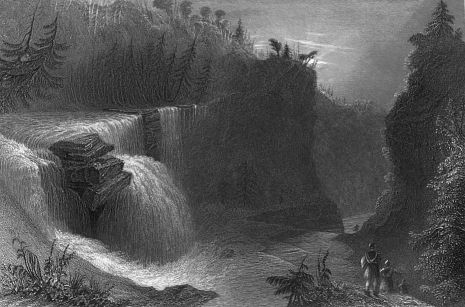
TRENTON FALLS.
(VIEW DOWN THE RAVINE.)
Trenton Falls (called Cayoharie by the Indians) are formed by the descent of a considerable stream, known by the name of West Canada Creek, through a mountainous ravine of singular formation and beauty. The Creek, which is swollen to a tremendous torrent by rains in the mountains, or by the spring thaws, has evidently worn through the strata which now enclose it, and runs at present over a succession of flat platforms, descending by leaps of forty or fifty feet from one to the other, and forming the most lovely chain of cascades for a length of three or four hundred miles. The walls that shut it in are either perpendicular, or overhanging it in broad table ledges; the wild vegetation of the forest above, leaning over the chasm with an effect like foliage of a bright translucent green, painted on the sky.
Although but fourteen miles distant from a town containing twelve or fourteen thousand inhabitants, Trenton Falls were unknown till within a very few years. They were discovered by an artist in search of the picturesque, and are now visited, like Niagara and Terni. A quiet but excellent inn, which contrasts strongly, by its respectful service, and its neat and secluded air, with the noisy and carelessly kept hotels of the country, stands on the edge of the pine forest, a little back from the brink of the chasm; and being off the business line of travel, and requiring a little time and expense to reach, it is frequented principally by the better class of travellers, and forms a most agreeable loitering-place, either for the invalid, or the lover of quiet leisure.
In company with the artist to whom the public is indebted for these admirable drawings, I lately visited the ravine by moonlight. We had passed the day in rambling up and down the creek, (a term, by the way, that, differing from its use in England, describes usually in America the finer class of streams;) and I had already made myself familiar by many visits in former years with every turn and phase of its matchless waters, as seen by the light of day. The moon rose about ten, and lifted her perfect orb, without a mist or a cloud, over the shoulder of the mountain which turns the outlet of the ravine. The fine and majestic wood, through which winds the narrow footpath to the Falls, let in the white light in silvery and broken masses—sometimes sliding a long argent line down the dark body of a pine, sometimes pouring in upon the horizontal branches of the hemlock, like an open hand sprinkled with snow; and here and there lighting up a broad circle upon the carpet of tassels and dead leaves, which, in contrast with the heavy shadows of the surrounding wood, looked illuminated with the special brightness of a fairy ring.
We descended the long ladder leading into the ravine, and were soon below the reach of the moonlight, which came slant as yet, and only rimmed the black wall above us with a long strip of white, which, where the wavy line of moss and creepers ran into it, resembled the edging of lace upon a velvet coat in a dark old Flemish picture. The water in this part of the gulf quite fills up the chasm, and rolls, even by day-light, in a black and sullen stream between the bare cliffs which frown over it. The only path here is a giddy ledge, half way up the precipice, which is passed with the aid of a chain run along the rock; and, as we stood on this, looking over into the uncertain darkness below, with the murmur of the far-down and invisible current ascending faintly to our ears, and the light of heaven ceasing so far above us, it seemed to us not an inapt image of the infernal river. We crept on till we came to the foot of the principal Fall, and sat down on the platform below, to wait the gradual descent of the moon.
The mist over the Fall began to show like a film of gauze waving in the air; the sharp angles and crevices in the precipice caught the light one by one, and soon the whole upper ravine was illuminated, while through the gorge below the stream still made its way darkly and solemnly to the outlet.
No pencil, no language, can describe the splendour with which the moon drew her light across the face of the Fall. The other objects in the ravine drank her beams soberly, and gave back only their own calm outlines to the eye; but, from this wall of waters, every spray-drop gave back a diamond—every column of the descending element, a pillar of silver. If there were gates to fairy-land opening from this world of ours, and times when they are visible and recognizable by the chance passing eye of man, I should have believed that we had fallen on the hour, and that some inner and slowly opening portal was letting the brightness of a fairy world through these curtains of crystal.
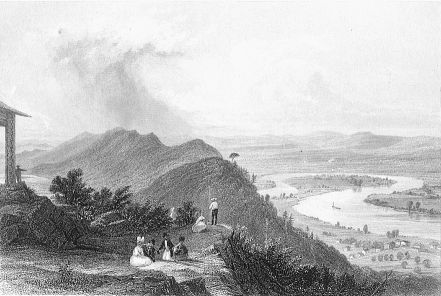
VIEW FROM MOUNT HOLYOKE.
Probably the richest view in America, in point of cultivation and fertile beauty, is that from Mount Holyoke. The bald face of this mountain, which is turned towards Northampton, is about one thousand one hundred feet above the level of the Connecticut river, (or Quonnecticut, as pronounced by the Indians,) and commands a radius of about sixty miles. The ascent at the side is easy; and it is a fashionable climb for tourists, whose patronage of ginger-beer and sunrises maintains a shanty and a hermit on the top, and keeps in repair a series of scrambling but convenient ladders at the difficult points of the enterprise. The view immediately below presents a singular phase of the scenery of the river, which seems here to possess a soul for beauty, and loiters, enamoured and unwilling to flow on, in the bosom of a meadow which has no parallel in New England for loveliness and fertility. Four times the amorous stream turns to the west, and thrice to the east, threading its silver tide through the tender verdure as capriciously as a vein in the neck of beauty, and cheating twelve miles of direct course into twenty-four of coil and current. The meadow is almost entirely unfenced, and the river is fringed in all its windings with weeping elms, wild flowers and shrubs, while up toward the town the fields rise in slightly swelling terraces—forming a foreground to one of the most sunny and cheerful villages in Massachusetts.
The more extended view embraces a great variety of mountain range—Monadhoe in the north-east, Saddle Mountain in the north-west, Mount Tom (between which and Mount Holyoke the Connecticut seems to have broken with the outlet waters of an immense lake) close on the south-west, and spurs of the Green Mountains advancing and receding in the course of the Connecticut in the north. Geologists speculate extensively on the lakes that once existed in the bosoms formed by these mountains—but we have not time to go back to the deluge.
There is a small hamlet at the foot of Mount Holyoke, on the eastern side of the river, called by the Indian name Hoccanum, and another at the foot of Mount Tom, on the western side, called Pascommuc, both of which were burnt by the savages in the early settlement of the country, and the inhabitants killed or taken captive. The early history of all these towns on the Connecticut river is filled with events of Indian warfare. Northampton, by its rich alluvial land allured the first settlers of Massachusetts long before most of the country between it and the sea-coast possessed an inhabitant. These adventurous pilgrims seated themselves in the midst of an unprotected wilderness, and surrounded by populous Indian tribes; and, first purchasing the land at the Indians’ valuation, they defended themselves afterwards as they might from the aggressions of these and others. The township of Northampton (called Nonotuc by the aborigines) was first bought in 1653. It was conveyed to John Pyncheon for the planters by Wawdillowa, Nenessahalant, Nassicochee, and four others (one of whom was a married woman), who were styled the “chief and proper owners.” The price was “one hundred fathom of wampum by tale, and ten coats,” to which was added an agreement to plough for the Indians, in the ensuing summer, sixteen acres of land on the east side of Quonnecticut River. These “all bargained for themselves, or the other owners by their consent.” All the aborigines of this country, observes a correct writer on this subject, are owners of the lands on which they dwell—men and women alike. This property in lands, held by the Indian women, is a singular fact in the history of the savage nations.
Three years after, a rich interval near Northampton, called Capawanke, and containing eight or nine hundred acres, was sold to these same planters by an Indian, named Lampancho, for fifty shillings, at two payments, “to his entire satisfaction.”
These two purchases give a very fair idea of the Indian purchases made by our forefathers. In the former, ninety square miles were sold for a hundred fathom of wampum and ten coats! Within this tract were near five thousand acres of interval land, worth at the present time perhaps eight or nine hundred thousand dollars. Unjust as the transaction seems, however, the price was ample to the Indian, who could not have got so much by keeping it, and for whom there was no other purchaser.
The settlers of Nonotuc lived in comparative harmony with the tribe about them; but in the subsequent Indian wars they lived in perpetual fear and agitation. The town was surrounded with palisades, “the meeting-house” was fortified, as were most of the private houses, and several forts were built within the town. Still their dwellings were often burnt, their women and children carried into captivity, and their time was divided between war and agriculture.
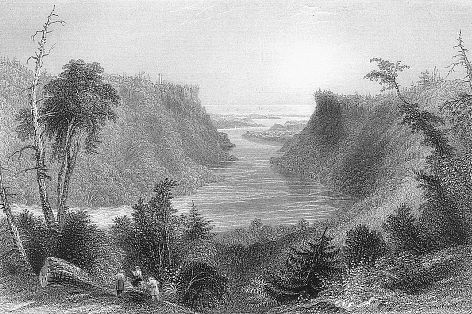
OUTLET OF NIAGARA RIVER.
This view is taken from the American side, and presents the debouchure of the waters of Niagara into Lake Ontario, from a point of great advantage. The vastness of the lake beyond, the tremendous agony which the still foaming waters have just escaped at Niagara, and the remoter journey of three thousand miles by which they have sought the sea from their fountains in the west, form a back-ground of imagination to this view, which, realised on the spot, give it a very thrilling interest. It is in itself, however, a landscape of unusually bold character; and the lofty and curving banks of the river are in keeping with its powerful flow, and the immense volume it pours into the lake.
Fort Niagara, on the opposite side, was erected by the French so late as 1751, and was looked upon by them as the key to all these inland seas. They had possession of it about eight years. In the beginning of July, 1759, General Prideaux, with his troops, reinforced by the Indian auxiliaries under Sir William Johnson, advanced to Niagara without the least hinderance—the enemy here not being in sufficient force to throw any impediments in the way. About the middle of July he commenced the siege, which he carried on with great vigour till the twentieth, when he was killed in the trenches. Sir William Johnson, who succeeded him, pressed the siege with great vigour. The enemy, alarmed with the apprehension of losing a place of such importance, resolved to make a last effort for its relief. For this purpose, they assembled about twelve hundred men, drawn from Venango, Presque Isle, and Detroit; and these, with some Indian auxiliaries, were detached, under the command of M. d’Aubry, on an attempt to reinforce the garrison. Sir William Johnson having received intelligence of their design, made a disposition to intercept them in their march. He accordingly detached a considerable body of troops for this service, who, falling in with the enemy very near the lines of the besiegers, a battle was fought, which resulted in the entire defeat of the French, with the capture of their commander, and most of his officers. This battle happened the twenty-fourth of July, and was fought in sight of the French garrison at Niagara. Sir William Johnson immediately after sent Major Harvey to the commandant of the fort, with an order, exhorting him to surrender, which being complied with, the garrison, consisting of about six hundred men, surrendered prisoners of war.”
The following letter from Sir William Johnson, reporting his victory, is preserved in the Historical Journal kept by Captain Knox, and printed at the time:—
“I have the honour to acquaint you, by Lieutenant Moncrief, that Niagara surrendered to his Majesty’s arms, on the twenty-fifth instant. A detachment of twelve hundred men, with a number of Indians, under the command of Messieurs Aubry and Signery, collected from Detroit, Venango, and Presqu’Isle, made an attempt to reinforce the garrison, the twenty-fourth in the morning; but as I had intelligence of them, I made a disposition to intercept them. The evening before, I ordered the light infantry and piquets to take post on the road upon our left, leading from Niagara Falls to the fort; in the morning, I reinforced these with two companies of grenadiers, and part of the forty-sixth regiment. The action began about half an hour after nine; but they were so well received by the troops in front, and the Indians on their flank, that, in an hour’s time, the whole was completely ruined, and all their officers made prisoners, among whom are M. d’Aubry, de Signery, Marin, Repentini, to the number of seventeen. I cannot ascertain the number killed, they are so dispersed among the woods; but their loss is great. As this happened under the eyes of the garrison, I thought proper to send my last summons to the commanding officer, for his surrendering, which he listened to. I inclose you the capitulation: M. Moncrief will inform you of the state of our ammunition and provisions; I hope care will be taken to forward an immediate supply of both to Oswego. As the troops that were defeated yesterday were drawn from those posts which lie in General Stanwig’s route, I am in hopes it will be of the utmost consequence to the success of his expedition. The public stores of the garrison, that can be saved from the Indians, I shall order the Assistant Quarter-Master General, and the Clerk of the stores, to take an account of, as soon as possible. As all my attention at present is taken up with the Indians, that the capitulation I have agreed to may be observed, your Excellency will excuse my not being more particular. Permit me to assure you, in the whole progress of the siege, which was severe and painful, the officers and men behaved with the utmost cheerfulness and bravery. I have only to regret the loss of General Prideaux and Colonel Johnson; I endeavoured to pursue the late General’s vigorous measures, the good effects of which he deserved to enjoy.”
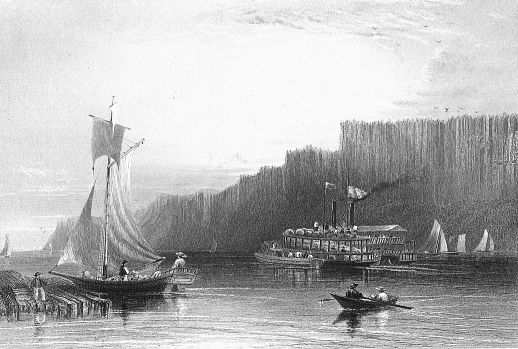
THE PALISADES—HUDSON RIVER.
The first feature of the celebrated banks of the Hudson, which arrests the eye of the traveller after leaving New York, is this singular wall of rock, extending as far onward as he can see, and forming a bold barricade against the river on the side of New Jersey. This singular precipice varies in height from fifty to two hundred feet, and presents a naked front of columnar strata, which gives it its descriptive name. The small sloops which lie along under the shore, loading with building stone from its base, and an occasional shed, diminished to the size of a dog-kennel, across the breadth of the river, are the only marks of life and habitation it presents to the traveller’s eye.
With most persons, to mention the Palisades is to recall only the confusion of a steamer’s deck, just off from the wharf, with a freight of seven or eight hundred souls hoping to “take tea” in Albany. The scene is one of inextricable confusion, and it is not till the twenty miles of the Palisades are well passed, that the bewildered passenger knows rightly whether his wife, child, or baggage, whichever may be his tender care, is not being left behind at the rate of fifteen miles in the hour.
I have often, when travelling alone, (for “reflection with folded arms” consorts only with the childless and baggageless bachelor), I have often flung my valise into a corner, and sure that the whole of my person and personal effects was under way, watched the maniform embarrassments and troubles that beset the uninitiated voyager on the Hudson. Fifteen minutes before the starting of the boat, there is not a passenger on board; “time is moving,” and the American counting it as part of the expense, determines to pay only “on demand.” He arrives on the narrow pier at the same instant with seven hundred men, ladies, and children, besides lapdogs, crammed baskets, uncut novels, and baggage for the whole. No commissioner in the world would guarantee to get all this freight on board in the given time, and yet it is done, to the daily astonishment of newspaper hawkers, orange-women, and penny-a-liners watching for dreadful accidents. The plank is drawn in, the wheels begin to paw like foaming steeds impatient to be off, the bell rings as if it was letting down the steps of the last hackney-coach, and away darts the boat, like half a town suddenly slipping off and taking a walk on the water. The “hands,” (who follow their nomenclature literally, and have neither eyes nor bowels) trip up all the little children and astonished maids, in coiling up the hawser; the black head-waiter rings a hand-bell as if he were crazy, exhorting “them passengers as hasn’t settled to step to the Cap’n’s office, and settle,” and angry people who have lost sight of their portmanteaus, and selfish people who will not get up to let the young gentleman see if his penny trumpet is not under them, play in a real-life farce better than Keeley or Liston. A painted notice and a very fat black woman in the door-way, inform the gentleman who has not seen his wife since the boat started, and is not at all sure that she is on board, that “no gentleman is permitted to enter the ladies’ cabin,” and spite of his dreadful uncertainty, he is obliged to trust to this dark Hebe to find her, among three hundred ladies, by description, and amuses all the listeners with his inventory of her dress, features, and general appearance. The negress disappears, is called twenty ways in twenty seconds, and an hour after, the patient husband sees the faithless messenger pass with a glass of lemonade, having utterly forgotten him and the lady in the black bonnet and grey eyes, who may be, for ought he knows to the contrary, wringing her hands at that moment on the wharf at New York. By this time, the young ladies are tired of looking at the Palisades, and have taken out their novels, the old gentlemen are poring over their damp newspapers, and the captain has received his fourteen hundred or two thousand dollars, locked up his office, and gone up to smoke with the black funnel and the engineer. The broad waters of the Tappan Sea open before the flying cut-water; those who have never been up the river before, think of poor André as they pass Tappan and Parrytown, and those who love gentle worth and true genius begin to look out for Sleepy Hollow, and the house of Washington Irving. It is a quiet little spot, buried in trees, and marked with an old Dutch vane. May his latter days, when they shall come, find there the reverence and repose which are his due!
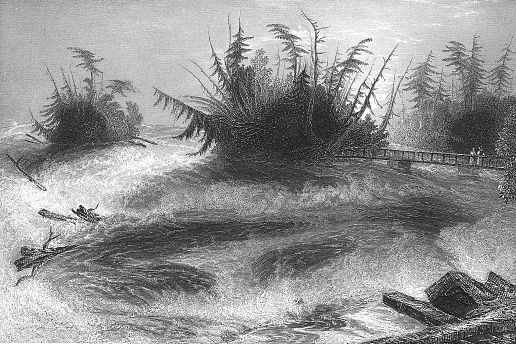
THE RAPIDS ABOVE THE FALLS OF NIAGARA.
During the last Canadian war, General Putnam, the famous partisan soldier, made the first descent upon Goat Island. A wager had been laid, that no man in the army would dare to cross the Rapids from the American side; and with the personal daring for which he was remarkable, above all the men of that trying period, he undertook the feat. Selecting the four stoutest and most resolute men in his corps, he embarked in a batteau just above the island, and with a rope attached to the ring-bolt, which was held by as many muscular fellows on the shore, he succeeded by desperate rowing in reaching his mark. He most easily towed back, and the feat has since been rendered unnecessary by the construction of the bridge from which the accompanying view is taken.
Many years since, a Tonemanta chief, after a violent quarrel with his squaw, lay down to sleep in his canoe. The little bark was moored just out of the tide of Niagara river, at the inlet to the creek which takes its name from his tribe, and the half-drunken chief, with his bottle of rum in his bosom, was soon fast asleep among the sedges. The enraged squaw, finding, after several attempts, that she could not get possession of the bottle without waking him, unmoored the canoe, and swimming out of the creek, pushed it before her into the swift tide of the river. She then turned its head toward the Falls and regained the shore. The canoe floated down very tranquilly till it struck the first ridge of the rapids. Nearly upset by the shock, she was flung from side to side by the contending waters, and the chief started from his slumbers. The first glance convinced him that effort would be vain; and keeping the canoe upright with instinctive skill, he drew his bottle from his bosom, and put it to his lips. The draught lasted him till he reached the turn of the cataract; and, as the canoe shot over the glassy curve, he was seen sitting upright, with his head thrown back, and both hands pressed to the bottle.
Not long ago it was advertised that, on a certain day, a large vessel, freighted with two or three menageries of wild beasts, and some domestic animals, would be sent down the Rapids. The announcement drew together an immense concourse of people from every part of the country, and, at the time specified, the vessel was towed into the stream and abandoned, with the animals loose on her deck. She kept her way very gallantly till she got to the Rapids, when, after a tremendous pitching for a few minutes, she stuck fast in the cleft of a rock. The bears and monkeys were seen in the rigging, but the other animals, not being climbers, were invisible from the shore. To the great disappointment of many thousands, she went over the Falls in the night, and of her whole crew the sole survivor was a goose, who was picked up the next day with no damage but a broken wing, and has since been exhibited as a curiosity.
The Rapids are far from being the least interesting feature of Niagara. There is a violence and a power in their foaming career, which is seen in no other phenomenon of the same class. Standing on the bridge which connects Goat Island with the Main, and looking up towards Lake Erie, the leaping crests of the rapids form the horizon, and it seems like a battle-charge of tempestuous waves, animated and infuriated, against the sky. No one who has not seen this spectacle of turbulent grandeur can conceive with what force the swift and overwhelming waters are flung upwards. The rocks, whose soaring points show above the surface, seem tormented with some supernatural agony, and fling off the wild and hurried waters, as if with the force of a giant’s arm. Nearer the plunge of the Fall, the Rapids become still more agitated; and it is almost impossible for the spectator to rid himself of the idea, that they are conscious of the abyss to which they are hurrying, and struggle back in the very extremity of horror. This propensity to invest Niagara with a soul and human feelings is a common effect upon the minds of visitors, in every part of its wonderful phenomena. The torture of the Rapids, the clinging curves with which they embrace the small rocky islands that live amid the surge, the sudden calmness at the brow of the cataract, and the infernal writhe and whiteness with which they reappear, powerless from the depths of the abyss, all seem, to the excited imagination of the gazer, like the natural effects of impending ruin, desperate resolution, and fearful agony, on the minds and frames of mortals.
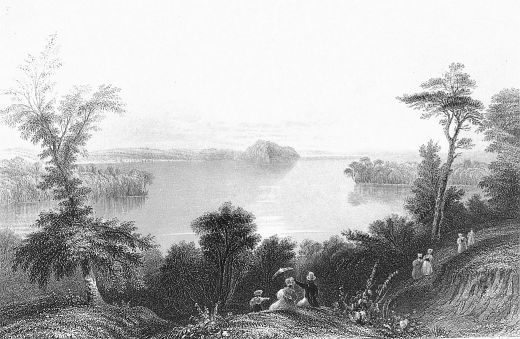
SARATOGA LAKE.
A singular feature of American scenery is the great number and beauty of its small fresh-water lakes, from one mile to twenty in circumference, fed universally by subjacent and living springs, with outlet rivers which carry off all that is superfluous, and with shores always richly fringed with foliage, and oftenest hilly and picturesque. They lie in the midst of the wild forests, like silver mirrors, tranquil and lovely, mingling a refinement and an elegance with the bold character of the scenery, which contrasts, like Una, with the couchant Lion. Most of them are feeders to the great lakes and rivers. There are counted fifteen which send their waters into Lake Ontario, from the side of New York alone,—a fact which gives a fair idea of their numbers, while it shows the resources, so difficult to conceive, of those vast plains of water.
Saratoga Lake must depend for celebrity on the campaigns of General Burgoyne, and its fish dinners. Of the first, the history has been written and read. Of the last, the traditions are oral; but while appetite returns, and trout venture to the angler’s hook, the memory will be renewed. The Springs are distant only three miles; and hither drive the more luxurious visitors of Saratoga, to dine in parties,—those coming early who prefer sympathy with the catastrophe of the fish, and broiling themselves, during the morning, in a flat-bottomed boat among the trout-catchers.
There was a gay party on this lake some six or eight years since, fishing and airing their wit, under the auspices of a belle of some fame and authority. The boat had been pulled into water of five or six feet depth, on the eastern side, and the ladies sat at the ends of their rods, about forty yards from the shore, watching their floats, which lay on the surface of the glassy water like sleeping flies, but, as the old fisherman in the bow could have told them, laughing loud enough to fright even the eels from their appetites. After several hours’ bobbing, without bite or nibble, the belle above mentioned discovered that her hook was caught at the bottom. She rose in the stern, to draw it up more easily, and, all the party leaning over at the same time, she lost her balance, and, in falling overboard, upset the boat. For the first minute it was a scene of some terror. The gentlemen were very near drowning the ladies, and the ladies the gentlemen; but the old fisherman, a tall fellow who knew the ground, and was just within his depth, quietly walked about, picking them up one by one, and giving them a hold of the inverted gunwale, and so pushed them safely to shore, suspended round the boat, like herrings on a hoop. Nobody caught cold; other people had caught fish; they dined merrily, and the principal actor in the scene has since been known by the sobriquet of the diving belle.
There is an Indian superstition attached to this lake, which probably had its source in its remarkable loneliness and tranquillity. The Mohawks believed that its stillness was sacred to the Great Spirit, and that, if a human voice uttered a sound upon its waters, the canoe of the offender would instantly sink. A story is told of an Englishwoman, in the early days of the first settlers, who had occasion to cross this lake with a party of Indians, who, before embarking, warned her most impressively of the spell. It was a silent, breathless day, and the canoe shot over the smooth surface of the lake like a shadow. About a mile from the shore, near the centre of the lake, the woman, willing to convince the savages of the weakness of their superstition, uttered a loud cry. The countenances of the Indians fell instantly to the deepest gloom. After a moment’s pause, however, they redoubled their exertions, and, in frowning silence, drove the light bark like an arrow over the waters. They reached the shore in safety, and drew up the canoe, and the woman rallied the chief on his credulity. “The Great Spirit is merciful,” answered the scornful Mohawk; “He knows that a white woman cannot hold her tongue.”
Saratoga Lake is eight miles in length, and a little over two miles broad. It is about eight miles west of Hudson River, which receives its outlet waters under the name of Fish Creek. The same stream, before its entrance into the lake, is called by the sesquipedalian title of Kayaderosseras River. With its pretty maiden name it loses its beauty, and flows forth from its union with the lake, in a dull and murky stream, and so drops sluggishly into the Hudson. Ah! many an edifying homily has been read from a blinder text.
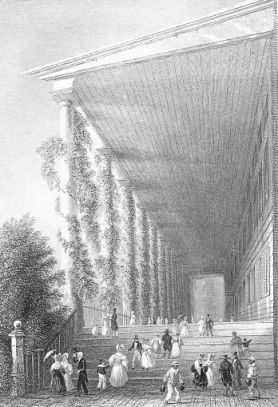
THE COLONNADE OF CONGRESS HALL.
(SARATOGA SPRINGS.)
Congress Hall has for many years held the palm of fashion among the rival Hotels of Saratoga. It is an immense wooden caravanserai, with no pretensions to architecture beyond what is seen in the drawing, and built with the sole view of affording the average accommodations of packed herrings to an indefinite number of persons. The roominess and liberal proportions of the Colonnade are one of those lies of architecture common to the hotels of this country. The traveller passes from the magnificent promise of the outside, to a chamber ten feet by four, situated in a remote gallery, visited once a day by the “boots” and chambermaid. His bed, chair, and wash-stand, resemble those articles as seen in penitentiaries; and if he chance to be ill at night, he might die like a Pagan, “without bell or candle.” The arrangements of the house are, of necessity, entirely gregarious. A bell rings at half-past seven in the morning, at which every body who intends to breakfast, must get up; another bell at eight, to the call of which, if he prefers hot omelette to cold, he must be punctual. Dinner and tea exact the same promptitude; and the latter, which in other countries is a thing of no circumstance or importance, becomes, where you dine at two, a meal not willingly missed. “Tea” is at six or half past, and consists of cold meats, hot rolls, Indian cakes, all other kinds of cakes, all kinds of berries, pies, sweetmeats, and jellies, coffee and tea. This is not a matter to be slighted after a fast of four hours; and home hurry beaux and belles from their abbreviated drives, with a loss of sentiment and sunset, and with profit to the keepers of stables, who let their horses “by the afternoon.”
After tea, the gentlemen who dressed for dinner and “undressed” for their drive, dress once more for the evening, and the spacious Colonnade is thronged with the five hundred guests of the house, who pace to and fro for an hour, or, if it is a ball night, till the black band have made an orchestra of the tables in the dining-room, and struck up “Hail, Columbia!” A hoop, bound with evergreens, and stuck full of candles, hangs in the centre of the hall (ci-devant dining-room); an audience of all the negroes in the establishment sweetens the breath of heaven as it steals in at the windows; and, as the triumphant music returns a second time to the refrain, the lady Patroness enters on the arm of the gentleman who has the most stock in the Bank, followed in couples by all the gentlemen and ladies who intend to dance or play wall-flower. The black musicians “vex their instruments,” and keep time with their heads and heels, as if all their extremities had been hired; the beaux who were interrupted in their declarations by the last chassé, (if they wish to go on with it,) lead out their partners to take the air and a cold,—perhaps a heart,—on the Colonnade; and at eleven, champagne goes round for the ladies, and the gentlemen take “summat to drink” at “the bar;” after which the candles burn brighter, and every body is much more agreeable.
Congress Hall is built very near the principal Spring, which lies in the westerly edge of a swamp. It was first discovered by the tracks of the deer, who frequented it so much as to wear paths to it from the surrounding woods. The mineral water is highly medicinal, and is not unpleasant to the taste. It formerly rose in the bed of a small brook, but it is now hid under the floor of an open colonnade, and discharges nearly a gallon a minute. The disengaged gas breaks through in limpid globules, giving to the surface the appearance of an active simmer. Here, before breakfast, creep the few who come to Saratoga for health; and here, before dinner, saunter those who are in need of a walk, or who wish a tonic for the coming meal. A busy varlet, with a capital of a hooked stick and two tin tumblers, drives a thriving trade here, fishing up the sparkling waters at a cent a glass, for all comers. When the gentleman has swallowed his muriate and four carbonates[1] in proper quantity, a smooth serpentine walk leads to the summit of a prettily wooded hill, where he may either grind himself round a circular rail-road in a self-moving chair, or ramble off to the shade, for a little meditation.
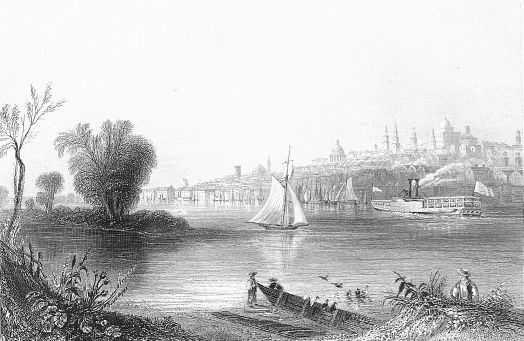
ALBANY.
Albany is the second city in the State of New York, in population, wealth, and commerce. It stands on the west bank of the Hudson, and about one hundred and forty-five miles from New York by the river, and near the head of sloop navigation. It is built just over the pitch of an extensive plain, lying between the Mohawk and the Hudson, and has very much the look of a city sliding down hill.
The history of Albany is not very definite, touching its first settlement. The probability seems, that, in 1614, the Dutch erected a fort and trading-house on an island just below the city; and also, in nine years after, a fort, which they called Fort Orange, on the present site. It would appear to have been canonically christened, and has been called at different periods Auralia, Beverwyck, and Williamstadt. “All this time,” says the historian, “it was known also by the name of ‘The Fuyck.’ ” The Indian appellation in which it rejoiced was Schaunaugh-ta-da, or Once the pine plains.
Albany is the residence of several of the oldest and wealthiest families in the State; but except this, it is a mere centre of transit—the channel through which passes the vast tide of commerce and travel to the north and west. The Erie and Champlain canals here meet the Hudson; and that which is passed up by this long arm from the sea, is handed over to the great lakes by the other two,—as if old Enceladus had been turned into a “worky,” and stood with his long arms between salt water and fresh.
The association most people have with Albany, is that of having lost a portmanteau there. The north-river steam-boats land you with from three to seven hundred passengers upon a narrow pier, in the dusk of the evening, where you find from three to seven hundred individuals (more or less), each of whom seems to have no other object in life, than to persuade you, at that particular instant, to go by a certain conveyance, or to stop at a certain hotel. Upon setting your foot on shore, you find yourself among five or six infuriated gentlemen, two or three of whom walk backward before you, and all talking at the pitch which is necessary to drown the deepening hiss of the escape-valve and each other’s voices. If you attempt to reason, you have no sooner satisfied the aforesaid six, that your route, your baggage, and your choice of an hotel, are matters in which they cannot be of the slightest assistance to you, than six more take their places, who must be satisfied as well; and so on in the same order. If you resolutely shut your lips, silence is taken for consent; your baggage is seized, and disappears before you have recovered from your amazement; and your only course is to follow the most importunate of your remaining five persecutors to an hotel; advertise in the next morning’s paper for your portmanteau; and wait in Albany till it returns from Canada or Lake Erie, or till you are reconciled to its loss.
One of the most amusing scenes in the world, if it were not so distressing, is to see a large family of rather respectable emigrants landed by the steamer in Albany. It is their first step inland; and with all the confidence of those who are accustomed to countries where a man’s person and property are outwardly respected, they yield their children and baggage to the persuasive gentlemen who assure them that all is right; and if a passing wonder crosses the mind of the sufferer, that his route should be so immediately comprehended by a perfect stranger, it is chased away the next moment by his surprise at the scene of bustle and confusion. At the end of five minutes the crowd thins a little, and he looks about for his family and effects. A stage coach is dashing off at top-speed in one direction, with his eldest daughter stretching out of the window, and crying in vain that there is some mistake; his two youngest are on board a steam-boat just off from the pier, and bound eight miles further up the river: the respectable part of his baggage has entirely disappeared; and nothing but his decrepit grandmother and the paternal bedstead (both indebted for their escape to being deaf, and not portable,) remain of his family and chattels. For his comfort, the gentry around inform him that his children may be got back in a day or two, and he may find his baggage somewhere on his route to the west—offering, for a consideration not very trifling, to send off an express for either one or the other.
Albany is the seat of government, and has a State House, of which the historian of New York remarks: “In the structure of this edifice, the rules of architecture, whether Egyptian, Hindoo, Chinese, Grecian, Roman, Saracenic, Gothic, or Composite, have been violated.” Lately, however, a taste for a better style of architecture seems to prevail; and in North Pearl-street we lately noticed a façade (we think, of a new church,) in a very pure and beautiful style. The private houses of Albany are built, many of them, very expensively; and the city is remarkable for its hospitality.
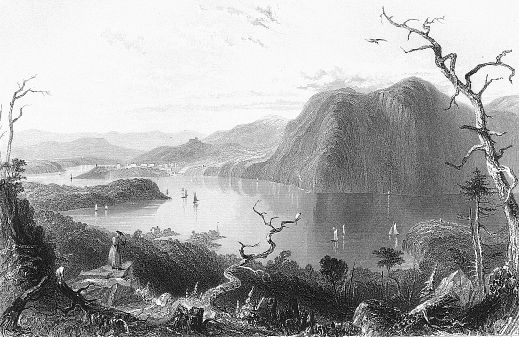
CROW NEST, FROM BULL HILL, WEST POINT.
It is true of the Hudson, as of all other rivers, that, to be seen to advantage, it should form the middle, not the foreground of the picture. Those who go to Albany by steam have something the same idea of the scenery of West Point, that an inside passenger may have of the effect of the Brighton coach at top-speed. It is astonishing how much foreground goes for in landscape; and there are few passes of scenery where it is more naturally beautiful than those of the Hudson. In the accompanying drawing, the picturesque neighbourhood of Undercliff, the seat of Colonel Morris, lies between the river and the artist, and directly opposite stands the peak of Crow Nest, mentioned in the description of West Point.
Crow Nest is one of the most beautiful mountains of America for shape, verdure, and position; and when the water is unruffled, and the moon sits on his summit, he looks like a monarch crowned with a single pearl. This is the scene of the first piece-work of fancy which has come from the practical brain of America,—the poem of The Culprit Fay. The opening is so descriptive of the spot, that it is quite in place here; and to those who have not seen the poem (as most European readers have not) it will convey an idea of a production which, in my opinion, treads close on the heels of the Midsummer Night’s Dream:—
“’Tis the middle watch of a summer’s night,—
The earth is dark, but the heavens are bright;
Nought is seen in the vault on high,
But the moon, and the stars, and the cloudless sky,
And the flood which rolls its milky hue,—
A river of light on the welkin blue.
The moon looks down on old Crow Nest,
She mellows the shades on his shaggy breast
And seems his huge grey form to throw
In a silver cone on the wave below;
His sides are broken by spots of shade,
By the walnut boughs and the cedar made,
And through their clustering branches dark
Glimmers and dies the firefly’s spark,—
Like starry twinkles that momently break
Through the rifts of the gathering tempest rack.
The stars are on the moving stream,
And fling, as its ripples gently flow,
A burnish’d length of wavy beam,
In an eel-like, spiral line below.
The winds are whist, and the owl is still,
The bat in the shelvy rock is hid;
And nought is heard on the lonely hill
But the cricket’s chirp and the answer shrill
Of the gauze-wing’d raty-did;
And the plaints of the mourning whip-poor-will,
Who mourns unseen, and ceaseless sings
Ever a note of wail and wo,
Till morning spreads her rosy wings,
And earth and skies in her glances glow.
’Tis the hour of fairy ban and spell:
The wood-tick has kept the minutes well;
He has counted them all with click and stroke
Deep in the heart of the mountain-oak;
And he has awakened the sentry-elve,
Who sleeps with him in the haunted tree,
To bid him ring the hour of twelve,
And call the fays to their revelry.
* * * * * * * * * *
They come from beds of lichen green,
They creep from the mullen’s velvet screen;
Some on the backs of beetles fly
From the silver tops of moon-touch’d trees,
Where they swing in their cob-web hammocks high,
And rock’d about in the evening breeze;
Some from the hum-bird’s downy nest,
They had driven him out by elfin power,
And pillow’d on plumes of his rainbow breast,
Had slumber’d there till the charmed hour;
Some had lain in a scarp of the rock,
With glittering rising-stars inlaid,
And some had open’d the four-o’clock,
And stolen within its purple shade:
And now they throng the moonlight glade,
Above—below—on every side,
Their little minion forms arrayed
In the tricksy pomp of fairy pride.’
The general assembly of the fairies is at last complete, and they proceed to the trial of the culprit fay, who has extinguished his elfin lamp and paralyzed his wings by a love for a mortal maid. He is condemned to penances, which are most exquisitely described, and constitute the greater part of the poem; and he finally expiates his sins, and is forgiven. There is a fineness of description, and a knowledge of the peculiarities of American nature, in birds, fishes, flowers, and the phenomena of this particular region, which constitute this little poem a book of valuable information as well as an exquisite work of fancy.
Just under Crow Nest, buried in the heavy leaves of a ravine, springs a waterfall like a Naiad from the depths of the forest, and plunges down into the river. The rambles in and about its neighbourhood are cool and retired; and it is a favourite place for lovers from New York, who run up in the steamer in three hours, and find the honeymoon goes swimmingly off there,—the excellent hotel within half a mile supplying the real, without which the ideal is found to be very trumpery. The marble tomb of a cadet, who was killed by the bursting of a gun, forms a picturesque object, and gives a story to the spot.
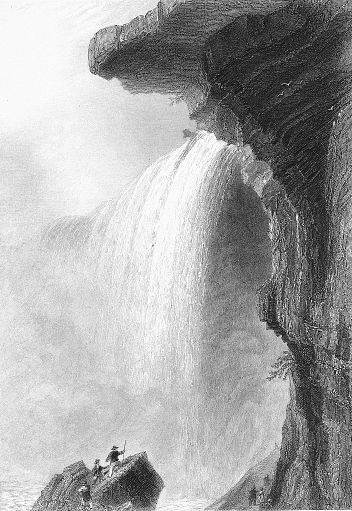
VIEW BELOW TABLE ROCK.
The interest of the view under this impending cliff is somewhat heightened by the probability that it will fall into the abyss sometime within the next six months. Since the fall of the most projecting part of it, two or three winters since, a large and very deep crack has widened around the remaining area of the platform above, and it is thought that it will scarce survive the next frost. At present, spite of the threat, troops of ladies and gentlemen crowd its broad summit at all hours, walking, drawing, gazing, and philandering, in the fullest confidence that rocks have bases. And so it will go on, probably, till the “one (thunder) too many” hammers through its crack of doom.
The path leading behind the sheet of Horse Shoe Fall, runs close under the cliff of Table Rock; and between the spray and the small rivulets that trickle over the sharp edge, or find their way out of the numerous crevices on the face of the precipice, it is as wet as the lawn blessed with “perpetual rain” by the Witch of Atlas. We were of a considerable party that visited this Naiad’s palace in the close of the last summer. A small shanty stands at the head of the staircase, kept by a very civil Englishman, who, with the assistance of his daughter and two sons, keeps a reading-room and registry, vends curious walking-sticks cut at Niagara, minerals, spars, and stuffed scorpions, besides officiating as guide under the Falls, and selling brandy and water to those who survive the expedition.
The ladies of the party were taken into a small apartment to change their dresses preparatory to their descent; and the two smart lads of our conductor soon metamorphosed their cavaliers into as brigand-looking a set of tatterdemallions as could be found in the Abruzzi. Rough duck trowsers, long jackets of green painted cloth, oil-skin hats, and flannel shirts,—the whole turn-out very much like the clothes of the drowned exhibited for recognition at the Moague in Paris,—constituted our habiliments. The difference of the female costume consisted in the substitution of a coarse petticoat for the trowsers, and a string tied over the broad-brimmed hat;—and, flattery aside, our friends would have looked at home in Billingsgate. Quite the most formidable part of the expedition, to them, was passing in review before some twenty curious persons collected on the way.
The guide went before, and we followed close under the cliff. A cold clammy wind blew strong in our faces from the moment we left the shelter of the staircase; and a few steps brought us into a pelting, fine rain, that penetrated every opening of our dresses, and made our foothold very slippery and difficult. We were not yet near the sheet of water we were to walk through; but one or two of the party gave out and returned, declaring it was impossible to breathe; and the rest, imitating the guide, bent nearly double to keep the beating spray from their nostrils, and pushed on, with enough to do to keep sight of his heels. We arrived near the difficult point of our progress; and in the midst of a confusion of blinding gusts, half deafened, and more than half drowned, the guide stopped to give us a hold of his skirts and a little counsel. All that could be heard amid the thunder of the cataract beside us was an injunction to push on when it got to the worst, as it was shorter to get beyond the sheet than to go back; and with this pleasant statement of our dilemma, we faced about with the longest breath we could draw, and encountered the enemy. It may be supposed that every person who has been draped through the column of water which obstructs the entrance to the cavern behind this cataract, has a very tolerable idea of the pains of drowning. What is wanting in the density of the element is more than made up by the force of the contending winds, which rush into the mouth, eyes, and nostrils, as if flying from a water-fiend. The “courage of worse behind” alone persuades the gasping sufferer to take one desperate step more.
It is difficult enough to breathe within; but with a little self-control and management, the nostrils may be guarded from the watery particles in the atmosphere, and then an impression is made upon the mind by the extraordinary pavilion above and around, which never loses its vividness. The natural bend of the falling cataract, and the backward shelve of the precipice, form an immense area like the interior of a tent, but so pervaded by discharges of mist and spray, that it is impossible to see far inward. Outward the light struggles brokenly through the crystal wall of the cataract; and when the sun shines directly on its face, it is a scene of unimaginable glory. The footing is rather unsteadfast, a small shelf composed of loose and slippery stones; and the abyss below boils like—it is difficult to find a comparison. On the whole, this undertaking is rather pleasanter to remember than to achieve.
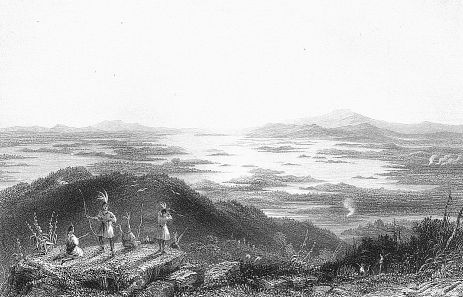
LAKE WINIPISEOGEE,
(THE BEAUTIFUL LAKE OF THE INDIANS,)
NEW HAMPSHIRE.
The Indian fights of the celebrated Captain Lovewell, which took place near the borders of this lake, were not the only feats of courage the early inhabitants of this part of the country were called upon to display. Bears, wolves, and catamounts, were enemies as constantly found in their path as the unfriendly Indian, and were almost as dangerous. The descriptions contained in the grave historical records of the State, of encounters, with bears more particularly, are sometimes sufficiently amusing; and, indeed, whatever the peril to the man, there is a conventional drollery about the bear which throws a spice of fun into all his contests with mankind. This animal, in the early days of New Hampshire, often destroyed the husbandman’s hopes by his depredations on the green maize, of the milky ear of which he is especially fond. Sweet fruits, honey, and other simple but “toothsome” productions of the orchard and farm, suited bruin equally well, and he had never recourse to animal food while these were to be procured. The kind of bear most mischievous in this way was the small American bear, with a long and pointed nose, remarkable for his alertness in ascending and descending trees. They were often found in hollow trunks, and in clefts of rocks, and were considered delicious meat by the hunters. Among the adventures with this class of their enemies recorded of the first settlers of the State, is an encounter of a Mr. Annis with a bear.
“One day, late in March,” says the narrator, “the snow being deep, he mounted his snow-shoes, and in company with Abner Watkins and their dogs, set off towards the Mink Hills for a hunt, armed with an axe and gun. In the neighbourhood of the hills, the dogs were perceived to be very much excited with something in a ledge of rocks. Annis left his companion, Watkins, and ascended a crag twenty or thirty feet to where the dogs were, having no other weapon with him but his staff, which was pointed with iron. After exploring a little, he concluded there was no game there of more consequence than a hedge-hog or some other small animal, and being fatigued laid down in the snow on his back to rest, reclining his head upon the place he had been examining; he had but just laid down when he heard a snuffling under his ear; he started up, and turning round, found an old bear pressing her head up through the old leaves and snow which filled the mouth of her den; he thrust his spear-pointed staff at the bear’s briskets, and thus held the bear which was pressing towards him at his staff’s length distance, and called to his companion Watkins to come up with the axe and kill the bear, which, after some little time, was effected. After the action was over, Annis complained of Watkins’ dilatoriness, but Watkins excused himself by saying he could not get his gun off, that he had snapt, snapt, snapt several times. Where did you take sight? said Annis, knowing that he was directly between him and the bear; I took sight between your legs, said Watkins.”
Many years ago a cub bear was caught by a stout lad near the borders of Lake Winipiseogee, carried into town, and after proper drilling, became the playfellow of the boys of the village, and often accompanied them to the school-house. After passing a few months in civilized society, he made his escape to the woods, and after a few years was almost forgotten. The school-house meantime had fallen from the schoolmaster’s to the schoolmistress’s hands, and in the room of large boys and girls learning to write and cipher, small boys and girls were taught in the same place knitting and spelling. One winter’s day, after a mild fall of snow, the door had been left ajar by some urchin going out, when to the unutterable horror of the spectacled dame and her fourscore hopeful abecedarians, an enormous bear walked in, in the most familiar manner in the world, and took a seat by the fire. Huddling over the benches with what expedition they might, the children crowded about their schoolmistress, who had fled to the farthest corner of the room, and stood crying and pushing to escape the horror of being eaten first. The bear sat snuffing and warming himself by the fire, however, exhibiting great signs of satisfaction, but deferring his meal till he had warmed himself thoroughly. The screams of the children continued, but the school-house was far from any other habitation, and the bear did not seem at all embarrassed by the outcry. After sitting and turning himself about for some time, Bruin got up on his hind legs, and shoving to the door, began to take down, one by one, the hats, bonnets, and satchels, that hung on several rows of pegs behind it. His memory had not deceived him, for they contained, as of old, the children’s dinners, and he had arrived before the recess. Having satisfied himself with their cheese, bread, pies, dough-nuts, and apples, Bruin smelt a little at the mistress’s desk, but finding it locked, gave himself a shake of resignation, opened the door and disappeared. The alarm was given, and the amiable creature was pursued and killed,—very much to the regret of the townspeople, when it was discovered by some marks on his body that it was their old friend and playfellow.
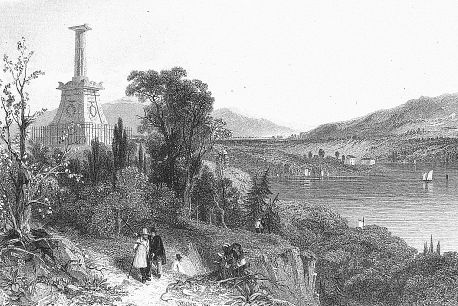
KOSCIUSKO’S MONUMENT.
A pretty marble shaft stands on the edge of the broad highland esplanade of West Point, overlooking the most beautiful scene on the most beautiful river of our country. It commemorates the virtues of Kosciusko, who, during his second sojourn in America, lived at West Point, and cultivated his little garden, near the site of this tribute to his memory. Kosciusko’s first laurels were gained in this country under Washington. He was educated in the military school at Warsaw, whence he was sent, as one of four, to complete his education at Paris. On his return to Poland, he had a commission given him, but, being refused promotion, he determined to come to America, and join the colonies in their struggle for independence. With letters from Dr. Franklin to General Washington, he presented himself to the great patriot, and was immediately appointed his aid-de-camp, and later he received the appointment to the engineers, with the rank of colonel. At the close of the war, having distinguished himself by his courage and skill, he returned to Poland, was appointed major-general in the army of the diet, and served as general of division under the younger Poniatowski. Finding, however, his efforts for freedom paralysed by the weakness or treachery of others, he gave in his resignation, and went into retirement at Leipsic. He was still there in 1793, when the Polish army and people gave signs of being in readiness for insurrection. All eyes were turned towards Kosciusko, who was at once chosen for their leader, and messengers were sent to him from Warsaw to acquaint him with the schemes and wishes of his compatriots. In compliance with the invitation, he proceeded towards the frontiers of Poland; but apprehensive of compromising the safety of those with whom he acted, he was about to defer his enterprise, and set off for Italy. He was fortunately persuaded to return, and, arriving at Cracow at the very time when the Polish garrison had expelled the Russian troops, he was chosen generalissimo, with all the power of a Roman dictator. He immediately published an act, authorizing insurrection against the foreign authorities, and proceeded to support Colonel Madalinski, who was pursued by the Russians. Having joined that officer, they gained their first victory, defeating the enemy with inferior numbers. His army now increased to nine thousand men, the insurrection extended to Warsaw, and in a few days the Russians were driven from that palatinate. He obtained some advantage over the enemy in one more contest, but the king of Prussia arriving to the assistance of the Russians, he was exposed to great personal danger, and suffered a defeat. From this period he waged a disadvantageous warfare against superior force, and at last at Maczienice (or Maniejornice), fifty miles from Warsaw, an overwhelming Russian force completely defeated Kosciusko. He fell from his horse wounded, saying Finis Poloniæ, and was made prisoner.
Kosciusko was sent to Russia, and confined in a fortress near St. Petersburgh, where he was kept till the accession of Paul I. This monarch, through real or affected admiration for the character of the great man, released him, and presented him with his sword: “I have no longer occasion for a sword, since I have no longer a country,” answered Kosciusko.
In 1797 he once more took his departure for the United States, where he was received with honour and warm welcome by the grateful people whose liberty he had aided to achieve. He was granted a pension by the government, and elected to the society of the Cincinnati. He returned to Europe the following year, bought an estate near Fontainebleau, and lived there till 1814. He removed again to Switzerland, and established himself at Soleure, where he died, in consequence of a fall with his horse over a precipice near Vevay. Among the last acts of his life, were the emancipation of the slaves on his own estate in Poland, and a bequest for the emancipation and education of slaves in Virginia.
Kosciusko was never married. His body was removed to Cracow, and deposited with great state in the tomb of the kings beneath the cathedral. The oldest officers were his bearers; two beautiful young girls with wreathes of oak leaves and cypress followed, and then came a long procession of the general staff, senate, clergy, and people. Count Wodsiki delivered a funeral oration on the hill of Wavel, and a prelate delivered an eloquent address in the church. The senate decreed that a lofty mound should be erected on the heights of Bronislawad. For three years men of every age and class toiled gratuitously at this work, and at last the Mogila Kosziuszki, the mound of Kosciusko, was raised to the height of 3000 feet! A serpentine path leads to the top, from which there is a noble view of the Vistula, and of the ancient city of the Polish kings. The small monument at West Point has less pretension, but it is the exponent of as deep a debt of gratitude, and of as grateful and universal honour to his memory.
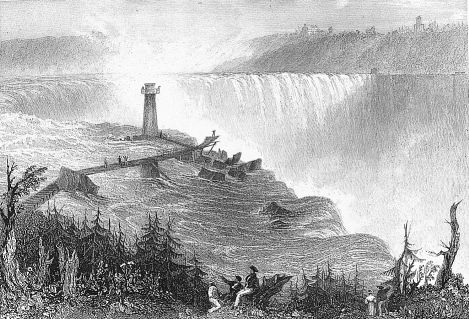
HORSESHOE FALLS, AT NIAGARA.
(SEEN FROM GOAT ISLAND.)
Niagara is the outlet of several bodies of water, covering, it is estimated, 150,000 square miles! Dr. Dwight considers the Falls as part of the St. Lawrence, following that river back to the sources near the Mississippi; and, doing away with the intermediate names of St. Marie, Detroit, St. Clair, Iroquois, and Cataraqui, he traces its course through the lakes Superior, Huron, Erie, and Ontario, as the Rhone is followed through the Lake of Geneva, and the Rhine through Lake Constance. In this view the St. Lawrence is doubtless the first river in the world. It meets the tide of the sea four hundred miles from its mouth, which is ninety-five miles broad; and to this height fleets of men of war may ascend and find ample room for an engagement. Merchantmen of all sizes go up to Montreal, which is six hundred miles from the sea; and its navigation for three thousand miles is only interrupted in three places,—Niagara Falls, the rapids of the Iroquois, and the part called the river St. Marie. The St. Marie is navigable for boats, though not for larger vessels; a portage of ten miles (soon to be superseded by a ship canal) conveys merchandise around the Falls of Niagara, and the rapids of the Iroquois present so slight a hinderance, that goods are brought from Montreal to Queenston for nearly the same price as they would pay by unobstructed navigation.
It is necessary to remember the extent of the waters which feed Niagara, to conceive, when standing for an hour only on the projecting rocks, how this almighty wonder can go on so long. Even then,—that these inland seas lie above, tranquil and unexhausted, scarce varying their high-water mark perceptibly, from year to year, yet supplying, for every hour, the “ninety millions of tons,” which, it is estimated, plunge over the cataract,—it affords you a standard for the extent of those lakes, to which the utmost stretch of the mind seems scarcely competent.
The accompanying view from Goat Island is of course only partial, as the American fall is entirely left out of the picture. The Horseshoe Falls, as a single object, however, is unquestionably the sublimest thing in nature. To know that the angle of the cataract, from the British shore to the tower, is near half a mile in length; that it falls so many feet with so many tons of water a minute; or even to see it, as here, admirably represented by the pencil; conveys no idea to the reader of the impression produced on the spectator. One of the most remarkable things about Niagara is entirely lost in the drawing—its motion. The visitor to Niagara should devote one day exclusively to the observation of this astonishing feature. The broad flood glides out of Lake Erie with a confiding tranquillity that seems to you, when you know its impending destiny, like that of a human creature advancing irresistibly, but unconsciously, to his death. He embraces the bright islands that part his arms for a caress; takes into his bosom the calm tribute of the Tonewanta and Unnekuqua—small streams that come drowsing through the wilderness—and flows on, till he has left Lake Erie far behind, bathing the curving sides of his green shores with a surface which only the summer wind ruffles. The channel begins to descend; the still unsuspecting waters fall back into curling eddies along the banks, but the current in the centre flows smoothly still. Suddenly the powerful stream is flung with accumulated swiftness among broken rocks; and, as you watch it from below, it seems tossed with the first shock into the very sky. It descends in foam, and from this moment its agony commences. For three miles it tosses and resists, and, racked at every step by sharper rocks and increased rapidity, its unwilling and choked waves fly back, to be again precipitated onward, and at last reach the glossy curve, convulsed with supernatural horror. They touch the emerald arch, and in that instant, like the calm that follows the conviction of inevitable doom, the agitation ceases,—the waters pause,—the foam and resistance subside into a transparent stillness,—and slowly and solemnly the vexed and tormented sufferer drops into the abyss. Every spectator, every child, is struck with the singular deliberation, the unnatural slowness, with which the waters of Niagara take their plunge. The laws of gravitation seem suspended, and the sublimity of the tremendous gulf below seems to check the descending victim on the verge, as if it paused in awe.
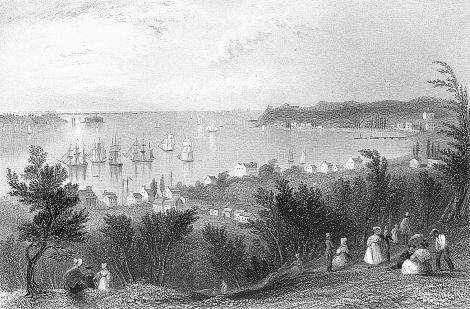
THE NARROWS, AT STATEN ISLAND.
Almost any land looks beautiful after a long voyage; and it would not be surprising if the Narrows, oftenest seen and described by those who have just come off the passage of the Atlantic, should have this reputation. It does not require an eye long deprived of verdure, however, to relish the bold shores, the bright green banks, the clustering woods, and tasteful villas, which make up the charms of this lovely strait.
Busier waters than the Narrows could scarcely be found; and it is difficult to imagine, amid so much bustle and civilisation, the scene that presented itself to Hendrick Hudson, when the little Halve-Mane stole in on her voyage of discovery two hundred years ago. Hoofden, or the Highlands, as he then named the hills in this neighbourhood, “were covered with grass and wild-flowers, and the air was filled with fragrance.” Groups of friendly natives, clothed in elk skins, stood on the beach, singing, and offering him welcome, and, anchoring his little bark, he explored with his boats the channel and inlets, and penetrated to the mouth of the river which was destined to bear his name. It appears, however, that the Indians on the Long Island side were less friendly; and in one of the excursions into the Bay of Manhattan, his boat was attacked by a party of twenty-nine savages of a ferocious tribe, and an English sailor, named Colman, was killed by an arrow-shot in the shoulder. Other unfriendly demonstrations from the same tribe, induced Hudson to leave his anchorage at Sandy Hook, and he drew in to the Bay of New York, which he found most safe and commodious, and where he still continued his intercourse with the Indians of Staten Island, receiving them on board his vessel, dressing them, to their extravagant delight, in red coats, and purchasing from them fish and fruits in abundance.
At this day there stands a villa on every picturesque point; a thriving town lies on the left shore; hospitals and private sanitary establishments extend their white edifices in the neighbourhood of the quarantine-ground; and between the little fleets of merchantmen, lying with the yellow flag at their peak, fly rapidly and skilfully a constant succession of steam-boats, gaily painted and beautifully modelled, bearing on their airy decks the population of one of the first cities of the world. Yet of Manhattan Island, on which New York is built, Hudson writes, only two hundred years ago, that “it was wild and rough; a thick forest covered the parts where anything would grow; its beach was broken and sandy, and full of inlets; its interior presented hills of stony and sandy alluvion, masses of rock, ponds, swamps, and marshes.”
The gay description which an American would probably give of the Narrows,—the first spot of his native land seen after a tedious voyage,—would probably be in strong contrast with the impression it produces on the emigrant, who sees in it only the scene of his first difficult step in a land of exile. I remember noting this contrast with some emotion, on board the packet-ship in which I was not long ago a passenger from England. Among the crowd of emigrants in the steerage, was the family of a respectable and well-educated man, who had failed as a merchant in some small town in England, and was coming, with the wreck of his fortune, to try the back-woods of America. He had a wife, and eight or ten very fine children, the eldest of whom, a delicate and pretty girl of eighteen, had contributed to sustain the family under their misfortunes at home, by keeping a village school. The confinement had been too much for her, and she was struck with consumption—a disease which is peculiarly fatal in America. Soon after leaving the British Channel, the physician on board reported her to the captain as exceedingly ill, and suffering painfully from the close air of the steerage; and by the general consent of the cabin passengers, a bed was made up for her in the deck-house, where she received the kindest attention from the ladies on board; and with her gentle manners and grateful expressions of pleasure, soon made an interest in all hearts. As we made the land, the air became very close and hot; and our patient, perhaps from sympathy with the general excitement about her, grew feverish and worse, hourly. Her father, and a younger sister, sat by her, holding her hands and fanning her; and when we entered the Narrows with a fair wind, and every one on board, forgetting her in their admiration of the lovely scene, mounted to the upper deck, she was raised to the window, and stood with the bright red spot deepening on her cheek, watching the fresh green land without the slightest expression of pleasure. We dropped anchor, the boats were lowered, and as the steerage passengers were submitted to a quarantine, we attempted to take leave of her before going on shore. A fit of the most passionate tears, the paroxysms of which seemed almost to suffocate her, prevented her replying to us; and we left that poor girl surrounded with her weeping family, trying in vain to comfort her. Hers were feelings, probably, which are often associated with a remembrance of the Narrows.
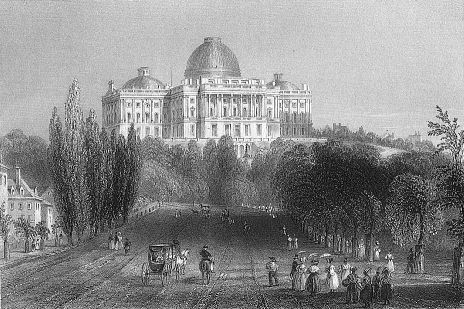
VIEW OF THE CAPITOL AT WASHINGTON.
There are many favourable points of view for this fine structure, standing, as it does, higher than the general level of the country. Besides those presented in the different drawings in this work, there are views from the distant eminences, which are particularly fine, in which the broad bosom of the Potomac forms the back-ground. The effect of the building is also remarkably imposing when the snow is on the ground, and the whole structure, rising from a field of snow, with its dazzling whiteness, looks like some admirable creation of the frost. All architecture, however, is very much improved by the presence of a multitude of people, and the Capitol looks its best on the day of inauguration. The following description, written after viewing the ceremony of Mr. Van Buren’s induction into office, will give an idea of the effect of this solemnity on the architecture:—
“The sun shone out of heaven without a cloud on the inaugural morning. The air was cold, but clear and life-giving, and the broad avenues of Washington for once seemed not too large for the thronging population. The crowds who had been pouring in from every direction for several days before, ransacking the town for but a shelter from the night, were apparent on the spacious side walks, and the old campaigners of the winter seemed but a thin sprinkling among the thousands of new and strange faces. The sun shone alike on the friends and opponents of the new administration; and, as far as one might observe in a walk to the Capitol, all were made cheerful alike by its brightness. It was another augury, perhaps, and may foretell a more extended fusion under the light of the luminary new-risen. In a whole day, passed in a crowd composed of all classes and parties, I heard no remark that the president would have been unwilling to hear.
“I was at the Capitol a half-hour before the procession arrived, and had leisure to study a scene for which I was not at all prepared. The noble staircase of the east front of the building leaps over three arches; under one of which carriages pass to the basement door; and, as you approach from the gate, the eye cuts the ascent at right angles, and the sky, broken by a small spire at a short distance, is visible beneath. Broad stairs occur at equal distances, with corresponding projections, and from the upper platform rise the outer columns of the portico, with ranges of columns three deep extending back to the pilasters. I had often admired this front, with its many graceful columns and its superb flight of stairs, as one of the finest things I had seen in the world. Like the effect of the assembled population of Rome waiting to receive the blessing before the front of St. Peter’s, however, the assembled crowd on the steps and at the base of the Capitol, heightened inconceivably the grandeur of the design. They were piled up like the people on the temples of Babylon in one of Martin’s sublime pictures—every projection covered, and an inexpressible soul and character given by their presence to the architecture. Boys climbed about the bases of the columns, single figures stood on the posts of the surrounding railings in the boldest relief against the sky, and the whole thing was exactly what Paul Veronese would have delighted to draw.
“I was in the crowd thronging the opposite side of the court, and lost sight of the principal actors in this imposing drama till they returned from the Senate Chamber. A temporary platform had been laid and railed in on the broad stair which supports the portico, and, for all preparation for one of the most important and most meaning and solemn ceremonies on earth—for the inauguration of a chief magistrate over a republic of fifteen millions of freemen—the whole addition to the open air and the presence of the people, was a volume of Holy Writ. In comparing the impressive simplicity of this consummation of the wishes of a mighty people, with the ceremonial and hollow show which embarrass a corresponding event in other lands, it was impossible not to feel that the moral sublime was here—that a transaction so important, and of such extended and weighty import, could borrow nothing from drapery or decoration, and that the simple presence of the sacred volume, consecrating the act, spoke more thrillingly to the heart than the trumpets of a thousand heralds.
“The crowd of diplomatists and senators in the rear of the columns made way, and the ex-President and Mr. Van Buren advanced with uncovered heads. A murmur of feeling rose up from the moving mass below, and the infirm old man, emerged from a sick chamber which his physician had thought it impossible he should leave, bowed to the people, and, still uncovered in the cold air, took his seat beneath the portico. Mr. Van Buren then advanced, and with a voice remarkably distinct, and with great dignity, read his address to the people.
“When the address was closed, the Chief Justice advanced and administered the oath. As the book touched the lips of the new President, there arose a general shout, an expression of feeling common enough in other countries, but drawn with difficulty from an American assemblage. The sons and immediate friends of Mr. Van Buren then closed around him, the ex-President and others gave him the hand in congratulation, and the ceremony was over.”
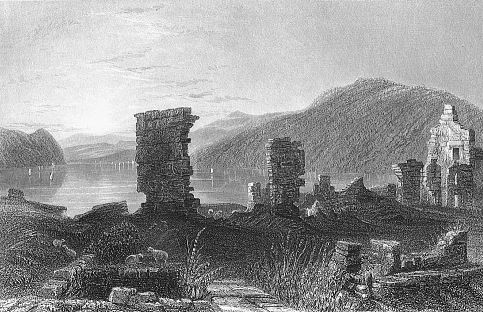
VIEW OF THE RUINS OF FORT TICONDEROGA.
Three weeks before the first battle of the revolution at Lexington, an emissary was sent to Canada by the Committee of Correspondence in Boston, to ascertain the feelings of the people, and to make such reports as his observations might suggest. His first advice was that Ticonderoga should be seized as quickly as possible.
The “Green Mountain Boys” were at this time fresh from their resistance to the new grants, and were immediately fixed upon as the best force to achieve this object. The little army, already organized under the famous Ethan Allen, assembled at Castleton, and the main body, consisting of one hundred and forty men, marched directly to the shore of the lake, opposite Ticonderoga. It was important to have a guide who was acquainted with the ground around the fortress and the places of access. Allen made inquiries as to these points of Mr. Beman, a farmer residing near the lake, who answered that he seldom crossed the Ticonderoga, and was little acquainted with the particulars of its situation; but that his son, Nathan, a young lad, passed much of his time there in company with the boys of the garrison.