Front matter (continued 4)
Reading edition
One of the most interesting associations with the tomb of Washington, is La Fayette’s visit to it, as related by Levasseur:—
“After a voyage of two hours, the guns of Fort Washington announced that we were approaching the last abode of the father of his country. At this solemn signal, to which the military band accompanying us responded by plaintive strains, we went on deck, and the venerable soil of Mount Vernon was before us. At this view, an involuntary and spontaneous movement made us kneel. We landed in boats, and trod upon the ground so often trod by the feet of Washington. A carriage received General Lafayette; and the other visitors silently ascended the precipitous path which conducted to the solitary habitation of Mount Vernon. In re-entering beneath this hospitable roof, which had sheltered him when the reign of terror tore him violently from his country and family, George Lafayette felt his heart sink within him, at no more finding him whose paternal care had softened his misfortunes; while his father sought with emotion for every thing which reminded him of the companion of his glorious toils.
“Three nephews of General Washington took Lafayette, his son, and myself, to conduct us to the tomb of their uncle: our numerous companions remained in the house. In a few minutes the cannon, thundering anew, announced that Lafayette rendered homage to the ashes of Washington. Simple and modest as he was during life, the tomb of the citizen hero is scarcely perceived among the sombre cypresses by which it is surrounded. A vault, slightly elevated and dodded over—a wooden door without inscriptions—some withered and green garlands, indicate to the traveller who visits the spot, where rest in peace the puissant arms which broke the chains of his country. As we approached, the door was opened. Lafayette descended alone into the vault, and a few minutes after re-appeared, with his eyes overflowing with tears. He took his son and me by the hand, and led us into the tomb, where, by a sign, he indicated the coffin. We knelt reverentially, and rising, threw ourselves into the arms of Lafayette, and mingled our tears with his.”
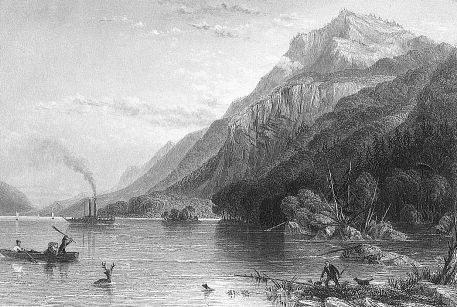
BLACK MOUNTAIN—LAKE GEORGE.
The mountains on the shore of this exquisite lake consist of two great ranges, bordering it from north to south. The western range passes westward of the north-west bay, at the head of which a vast spar, shooting towards the south-east, forms the whole of the peninsula between that bay and the lake. Both these ranges alternately approach the lake, so as to constitute a considerable part of its shores, and recede from it again to the distance sometimes of two or three miles.
The summits of these mountains are of almost every figure, from the arch, to the bold, bluff, and sharp cone. In some instances, the loftier ones are bald, solemn, and forbidding; in others, they are clothed and crowned with verdure. It is the peculiarity of Lake George, that, while all the world agrees to speak only of its loveliness, it is surrounded by features of the highest grandeur and sublimity. The Black Mountain is one of these; and there is every variety of chasm, crag, promontory, and peak, which a painter would require for the noblest composition of mountain scenery. The atmospheric changes here, too, are almost always violent; and storms are so frequent, that there is scarce a traveller to Lake George in the summer who has not seen it in a thunder-storm.
It was remarked to me on this lake by a foreigner, that, with all the luxuriance of the vegetation, the trees seemed small; and it is a remark that is frequently made by Englishmen, who compare the common trees in the woods on the roadside with the oaks left to flourish for centuries in venerating and venerable England. The best answer to this remark is contained in a letter, addressed to a friend in England, by an able writer of this country:—
“The soil of New England is naturally quite as rich and productive as that of England: of this the thrifty growth and ultimate size of our forest-trees is ample proof. Few of them, indeed, can now be found of this size: almost all the original forests of this country having been long since cut down. I have seen many of these trees, and have compared them with the accounts given of forests in many parts of the globe, and am assured that they will very rarely suffer by such comparison. It may seem strange to you, accustomed as you are to see forest-trees planted in great numbers, and preserved with great care, that the inhabitants of this country should, so soon after its colonization, have cut down their forests in this extensive manner. This is one of the ten thousand subjects, presented to the mind by the existing state of things here, about which a foreigner must necessarily misconceive. Should he travel through New England he would naturally conclude that the forest-trees failed of arriving at the size which they attain in Europe. He would, indeed, see that they were tall, and apparently very thrifty, but small in the girth. I do not mean that they are universally so; but that this is extensively the fact throughout the southern division. For the reason of it he would be at a loss, and most probably would attribute it, notwithstanding the thrifty appearance of the trees, to sterility of soil, or, in the mystic language of Buffon, to ‘a deficiency of matter.’ Should he be informed that the real cause was the age of the trees, almost all of which are young, his perplexity would be increased. On the one hand he would be astonished at the folly of destroying forests in this wanton manner, without any apparent reason; and, on the other, would be unable to comprehend how these forests renewed themselves without the aid of planting. All this is, however, easily explicable. The wood of this country is its fuel. An Englishman who sees the various fires of his own country sustained by peat and coal only, cannot easily form a conception of the quantity of wood, or, if you please, of forest which is necessary for this purpose. To this quantity must be added the timber for the uses of building, in a country where almost all buildings are formed merely of timber; of fencing, furniture, and commerce; and a prodigious mass annually destroyed in the recent settlements for the mere purpose of clearing the ground. With these facts before him, he will cease to wonder that forests are very extensively felled in New England. All these forests renew themselves. The seeds of the forest-trees spring more readily and successfully when left on the surface than when buried in the ground, even at a very small depth. They will not, however, germinate upon a sward: they demand a soil loose and light. In this state the soil is always kept in forested ground by the leaves deposited on the earth. These also supply the necessary moisture for germination, and effectually shelter the seeds, particularly the nuts and acorns, from the ravages of animals. In this manner, and by a process totally superior to any contrived by the human mind, forests are furnished by the Author of nature with the means of perpetual self-restoration.
“But this is not the only mode, nor the most expeditious, nor that which is principally relied on in this country. When a field of wood is, in the language of our farmers, cut clean—i.e. when every tree is cut down, so far as any progress is made, vigorous shoots sprout from every stump; and having their nourishment supplied by the roots of the former tree, grow with a thrift and rapidity never seen in stems derived from the seed. Good grounds will thus yield a growth amply sufficient for fuel, once in fourteen years. A multitude of farmers, therefore, cut their wood in this manner; although, it must be confessed, there are different opinions and practices concerning the subject. In these two modes the forests in New England become, in a sense, ever-living, and supply plentifully the wants of the inhabitants.”
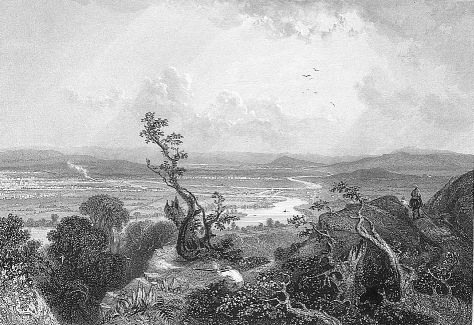
CONNECTICUT VALLEY, FROM MOUNT HOLYOKE.
The broad open lands, or intervals, as they are called in this country, which border upon the Connecticut, contain some of the most sunny and fertile pictures of cultivation to be found on our continent. From the mouth of the river up to its rise beyond the White Mountains, it is gemmed with beautiful rural towns, many of them among the first in our country for prosperity, neatness, and cultivated society.
The history of these towns presents some of the bloodiest traits marked on the early settlements of New England. The event which gave the name to Bloody Brook, a small village near the southern extremity of Dresfield, is among many sanguinary records of the difficulties and dangers of the first settlers in this valley.
For a considerable number of years the inhabitants of the valley had lived in as perfect harmony with the Indians among whom they had settled, as was possible, with the great difference between their characters, principles, and pursuits. They had purchased their lands at an equitable price, and in all their transactions with them had observed the strictest equity and humanity. This state of tranquillity was only disturbed by the wide-spreading intrigues of the bold sachem, Philip, whose discernment, comprehensiveness of views, and admirable address, entitle him to the first rank of superiority among the aborigines known in our history. By means of emissaries, and personal solicitation, and eloquence, this renowned warrior succeeded in uniting all the numerous tribes of Indians within the territories colonized by the whites, in one extensive conspiracy of extermination. Though divided into many tribes, hostile to each other and perpetually at war, they joined in this common cause, and a general war broke out at once in every part of the country.
The first symptom in the Valley of the Connecticut, was an abandonment by the Indians of their fortresses and houses. They were pursued by a party of settlers, and overtaken about eight miles above Hatfield; where a skirmish ensued, in which nine or ten whites were killed, and about twenty-six Indians.
Several attacks upon the settlements in the valley immediately followed, repelled always with loss of life; and on the 30th of May, 1676, a body of six or seven hundred attacked Hatfield again. The men were abroad in the fields, but, reinforced by a small band from Hadley, they broke through the Indians, and joined the families who had fled to the fortified houses for protection. After a prolonged contest, they succeeded in driving the Indians from the settlement, which was never again attacked.
The village of Deerfield was among those which had suffered most from the first incursions of the Indians, the houses having been burnt, and the town evacuated in consequence. Their harvest had been cut about two months before, and having been stacked in the fields, escaped the conflagration. About eighty men from the settlements below came up to protect the harvesters in carting it in, and about three thousand bushels of wheat were thrashed, loaded upon the waggons, and had been drawn as far as the brook before mentioned without molestation. The settlers stopped here to gather grasses, and while thus occupied, were suddenly and furiously attacked by a body of eight hundred Indians. Captain Lathrop, the leader of the party, ordered his men to fight the Indians in their own manner, availing themselves of the protection of the trees; but the natives, trained to run from tree to tree, and to conceal themselves in this sort of warfare with unexampled address and caution, fought at great advantage, and soon decided the battle in their own favour. Lathrop was killed at the commencement of the attack; and of the whole number of reapers and armed men, ninety were killed on the spot.
Captain Mosely, who was at Deerfield when the enterprise was undertaken, marched immediately with a small band to the relief of Lathrop; but, when he arrived, the contest was over, and the savages, flushed with success, were pillaging the dead. Forming his men into a close column, and commanding them to keep their ranks, he charged the Indians with the greatest intrepidity. Spite of their numbers, he drove them into a swamp, and forced his way through the whole body. They then attempted to hang upon his rear, but with great presence of mind he wheeled and broke through them again. In this manner the fight was continued for five hours. He drove them several miles, and, with only two men killed, and five or six wounded, succeeded in killing ninety-six of their number, and returned, unmolested, on his way to Deerfield.
The next morning, the little band went out to bury the dead, and found the savages again stripping the bodies on the field of battle. Mosely drove them once more before him, and then, having performed his melancholy task, heaped a monument of loose stones over the victims, and returned. The name of the stream, Bloody Brook, is, at present, the only memorial of the catastrophe.
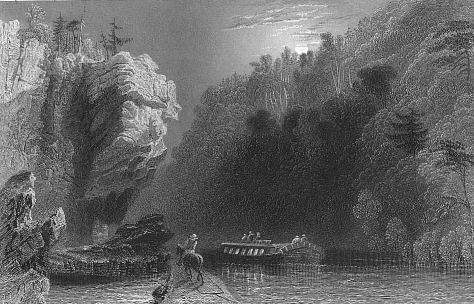
VIEW ON THE ERIE CANAL, NEAR LITTLE FALLS.
The passage of the Canal, under the lofty bluff which springs at this place from the edge of the Mohawk, is one of the most beautiful of the many beautiful features disclosed to the voyager on this great outlet of the West. No traveller sees a greater variety of fine objects within the same distance than the follower of the Canal from Schenectady to Buffalo; and certainly none sees them with more ease and comfort to himself. The packet-boats are long drawing-rooms, where he dines, sleeps, reads, lolls, or looks out of the window; and if in want of exercise, he may at any time get a quick walk on the tow-path, and all this without perceptible motion, jar, or smell of steam. Of all the modes of travelling in America, the least popular and the most delightful, to our thinking, is travelling on the Canal.
One of the descriptions of scenery through which the Canal passes, and one which is, we believe, peculiar to our country, is what are called openings. When one of these plains is seen at a little distance, a traveller emerging from the forest naturally concludes that it is the commencement of a settled country; and as he advances towards it, is instinctively led to cast his eye forward to find the town or village of which it is the outskirt. From this impression he will be unable to free himself; for though given up, the thought will recur again, spite of his conviction, that he is in the heart of a wilderness. At the same time a sense of stillness and solitude, a feeling of absolute retirement from the world, deeper and more affecting than any he has ever felt before, will be forced upon him while roving in these sequestered regions. No passage out of them is presented to his eye. Yet, though the tract around him is seemingly bounded every where, the boundary is every where obscure, being formed of trees, thinly dispersed, and retired beyond each other at such distances, that, while they actually limit the view, they appear rather to border dim, indistinct openings into other tracts of country. Thus he always feels the limit to be uncertain, and until he is actually leaving one of these plains, will continually expect to find a part of the expansion still spreading beyond the reach of his eye. On every side, a multitude of chasms conduct his eye beyond the labyrinth by which he is surrounded, and present an imaginary passage back into the world from which he is withdrawn, bewildering him with expectation continually awakened to be continually disappointed. Thus, in a kind of romantic rapture, he wanders over these plains with emotions similar to those with which, when a child, he roamed through the wildernesses created in Arabian tales.
The origin of the peculiar appearance of these grounds, Dr. Dwight supposes, is probably this. The Indians annually, and sometimes oftener, burned such parts of the North American forests as they found sufficiently dry. In every such case, the fuel consists chiefly of the fallen leaves, which are rarely dry enough for an extensive combustion, except on uplands; and on these only when covered with a dry soil. Of this nature were always the oak and yellow pine grounds, which were therefore usually subjected to an annual conflagration. The beech and maple grounds were commonly too wet to be burned. Hence, on these grounds, the vegetable mould is from six inches to a foot in depth, having been rarely or never consumed by fire; while on the oak and pine grounds, it often does not exceed an inch. That this is the effect of fire only, and not of any diversity in the nature of the trees, is evident from the fact, that, in moist soils, where the fire cannot penetrate, the mould is as deep on the oak as on the maple grounds. This mould is combustible, and by an intense fire is wholly consumed.
The object of these conflagrations was to produce fresh and sweet pasture, for the purpose of alluring the deer to the spots on which they had been kindled. Immediately after the fires, a species of grass springs up, sometimes called fire-grass, because it usually succeeds a conflagration. Either from its nature, or from the efficacy of the fire, it is remarkably sweet, and eagerly sought by the deer. All the underwood is at the same time consumed, so that these animals are easily discovered at considerable distances—a thing impracticable where the forests have not been burned. To supply himself with timber for a wigwam, and with wood for fuel, was the only use which the Indian could make of the forest; and the earth furnished him with nothing but a place for his residence, his garden, and his game. While, therefore, he destroyed both the forest and the soil, he converted them to uses most profitable for himself.
When these grounds had been often burned, the seeds and nuts whence future trees would have germinated, were, of course, destroyed by fire. The small number scattered over these plains, or openings, grew on spots which were less ravaged by fire, because they were moist, or because they were less covered with leaves.
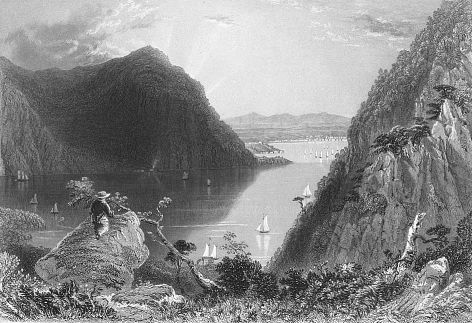
HUDSON HIGHLANDS, FROM BULL HILL.
This view out from the gorge of the highlands presents a foreground of cliff and shadow, with their reflections almost folded across in the bosom of the river, and a middle ground of the village of Newburgh and the gently-undulating country in the rear. The blue and far-off line of the Kaatskills shuts in the horizon.
There is some very romantic scenery hidden among the undulations just mentioned, embracing several small rivers, and a romantic stream, called Murderer’s Creek, a tributary of the Hudson. Mr. Poulding, in his “New Mirror for Travellers,” gives the following interesting legend in explanation of the name:—
“Little more than a century ago, the beautiful region watered by this stream was possessed by a small tribe of Indians, which has long since become extinct, or been incorporated with some other savage nation of the West. Three or four hundred yards from where the stream discharges itself into the Hudson, a white family, of the name of Stacey, had established itself in a log-house, by tacit permission of the tribe, to whom Stacey had made himself useful by his skill in a variety of little arts highly estimated by the savages. In particular, a friendship existed between him and an old Indian, called Naoman, who often came to his house and partook of his hospitality. The Indians never forgive injuries or forget benefits. The family consisted of Stacey, his wife, and two children, a boy and girl, the former five, the latter three years old.”
The legend goes on to say, that Naoman, in grateful friendship, gave the wife of Stacey a secret warning, that a massacre of the whites was resolved on, exacting from her a solemn pledge of secrecy, and advising instant escape across the river.
“The daily visits of old Naoman, and his more than ordinary gravity, had excited suspicion in some of the tribe, who had accordingly paid particular attention to the movements of Stacey. One of the young Indians, who had kept on the watch, seeing the whole family about to take their boat, ran to the little Indian village, about a mile off, and gave the alarm. Five Indians collected, ran down to the river side, where their canoes were moored, jumped in, and paddled after Stacey, who by this time had got some distance out into the stream. They gained on him so fast, that twice he dropped his paddle, and took up his gun. But his wife prevented his shooting, by telling him, that if he fired, and they were afterwards overtaken, they would meet no mercy from the Indians. He accordingly refrained, and plied his paddle, till the sweat rolled in big drops down his forehead. All would not do; they were overtaken within a hundred yards of the shore, and carried back with shouts of yelling triumph.
“When they got ashore, the Indians set fire to Stacey’s house, and dragged himself, his wife, and children, to their village. Here the principal old men, and Naoman among the rest, assembled to deliberate on the affair. The chief among them stated that some one of the tribe had undoubtedly been guilty of treason, in apprising Stacey, the white man, of the designs of the tribe, whereby they took the alarm, and had well nigh escaped. He proposed to examine the prisoners as to who gave the information. The old men assented to this, and Naoman among the rest. Stacey was first interrogated by one of the old men, who spoke English, and interpreted to the others. Stacey refused to betray his informant. His wife was then questioned, while at the same moment two Indians stood threatening the two children with tomahawks in case she did not confess. She attempted to evade the truth, by declaring she had a dream the night before which had alarmed her, and that she had persuaded her husband to fly. ‘The Great Spirit never deigns to talk in dreams to a white face,’ said the old Indian: ‘woman! thou hast two tongues and two faces: speak the truth, or thy children shall surely die.’ The little boy and girl were then brought close to her, and the two savages stood over them, ready to execute their bloody orders.
“ ‘Wilt thou name,’ said the old Indian, ‘the red man who betrayed his tribe? I will ask thee three times.’ The mother answered not. ‘Wilt thou name the traitor? This is the second time.’ The poor mother looked at her husband, and then at her children, and stole a glance at Naoman, who sat smoking his pipe with invincible gravity. She wrung her hands and wept, but remained silent. ‘Wilt thou name the traitor? ’Tis the third and last time.’ The agony of the mother waxed more bitter; again she sought the eye of Naoman, but it was cold and motionless. A pause of a moment awaited her reply, and the next moment the tomahawks were raised over the heads of the children, who besought their mother not to let them be murdered.
“ ‘Stop!’ cried Naoman. All eyes were turned upon him. ‘Stop!’ repeated he in a tone of authority. ‘White woman, thou hast kept thy word with me to the last moment. I am the traitor. I have eaten of the salt, warmed myself at the fire, shared the kindness of these christian white people, and it was I that told them of their danger. I am a withered, leafless, branchless trunk; cut me down if you will. I am ready.’ A yell of indignation sounded on all sides. Naoman descended from the little bank where he sat, shrouded his face with his mantle of skins, and submitted to his fate. He fell dead at the feet of the white woman by a blow of the tomahawk.”
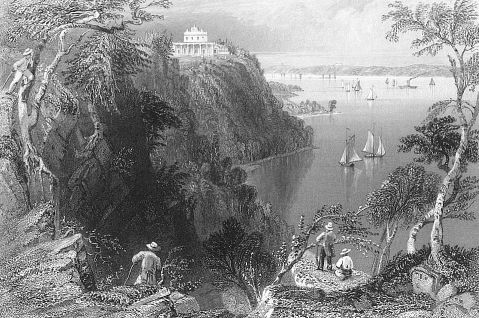
VILLA ON THE HUDSON, NEAR WEEHAWKEN.
From this admirably chosen spot, the Bay of New York appears with every accessory of beauty. The city itself comes into the left of the picture to an advantage seen from no other point of view, the flocks of river-craft scud past in all directions, men-of-war, merchantmen, steamers, and ferry-boats, fill up the moving elements of the panorama; and far away beyond stretches the broad harbour, with its glassy or disturbed waters, in all the varieties of ever-changing sea-view. It was on this side that Hudson, who had felt the hostility of the Manhattan Indians, found a friendlier tribe, and made his first amicable visit on shore. The Indian tradition, springing from that visit,[2] and describing the first intoxication they had ever experienced, is extremely amusing.
“A long time ago, before men with a white skin had ever been seen, some Indians, fishing at a place where the sea widens, espied something at a distance moving upon the water. They hurried ashore, collected their neighbours, who together returned and viewed intensely this astonishing phenomenon. What it could be, baffled all conjecture. Some supposed it to be a large fish or animal, others that it was a very big house, floating on the sea. Perceiving it moving towards land, the spectators concluded that it would be proper to send runners in different directions to carry the news to their scattered chiefs, that they might send off for the immediate attendance of their warriors. These arriving in numbers to behold the sight, and perceiving that it was actually moving towards them (i.e. coming into the river or bay), they conjectured that it must be a remarkably large house, in which the Manitto (or Great Spirit), was coming to visit them. They were much afraid, and yet under no apprehension that the Great Spirit would injure them. They worshipped him. The chiefs now assembled at York Island, and consulted in what manner they should receive their Manitto: meat was prepared for a sacrifice; the women were directed to prepare the best of victuals; idols or images were examined and put in order; a grand dance they thought would be pleasing, and, in addition to the sacrifice, might appease him, if angry. The conjurers were also set to work, to determine what this phenomenon portended, and what the result would be. To these, men, women, and children, looked up for advice and protection. Utterly at a loss what to do, and distracted alternately by hope and fear, in this confusion a grand dance commenced. Meantime fresh runners arrived, declaring it to be a great house, of various colours, and full of living creatures. It now appeared certain that it was their Manitto, probably bringing some new kind of game. Others arriving, declared it positively to be full of people, of different colour and dress from theirs, and that one, in particular, appeared altogether red. This then must be the Manitto. They were lost in admiration; could not imagine what the vessel was, whence it came, or what all this portended. They are now hailed from the vessel in a language they could not understand; they answer by a shout or yell in their way. The house (or large canoe, as some render it) stops. A smaller canoe comes on shore, with the red man in it; some stay by his canoe, to guard it. The chiefs and wise men form a circle, into which the red man and two attendants approach. He salutes them with friendly countenance, and they return the salute after their manner. They are amazed at their colour and dress, particularly with him who, glittering in red, wore something (perhaps lace, or buttons) they could not comprehend. He must be the great Manitto, they thought; but why should he have a white skin? A large elegant hockhack (gourd, i.e. bottle, decanter, &c.) is brought by one of the supposed Manitto’s servants, from which a substance is poured into a small cup or glass, and handed to the Manitto. He drinks, has the glass refilled, and handed to the chief near him; he takes it, smells it, and passes it to the next, who does the same. The glass in this manner is passed round the circle, and is about to be returned to the red-clothed man, when one of them, a great warrior, harangues them on the impropriety of returning the cup unemptied. It was handed to them, he said, by the Manitto, to drink out of as he had; to follow his example would please him—to reject it might provoke his wrath; and if no one else would, he would drink it himself, let what would follow; for it was better for one even to die, than a whole nation to be destroyed. He then took the glass, smelled at it, again addressed them, bidding adieu, and drank the contents. All eyes were now fixed (on the first Indian in New York who had tasted the poison which has since affected so signal a revolution in the condition of the native Americans). He soon began to stagger; the women cried, supposing him in fits; he rolled on the ground; they bemoan his fate; they thought him dying. He fell asleep. They at first thought he had expired, but soon perceived he still breathed. He awoke, jumped up, and declared he never felt more happy; he asked for more; and the whole assembly imitating him, became intoxicated.”
In descending the river, after he had penetrated to Albany, Hudson ran his little craft ashore at Weehawken; but the ground was a soft ooze, and she was got off without damage, and proceeded to sea.
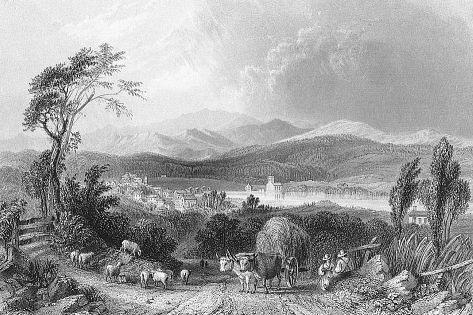
VIEW OF MEREDITH, NEW HAMPSHIRE.
This beautiful town stands between the two lakes Winipiseogee and Sullivan and is deeply surrounded on every side with the most luxuriant rural beauty. The neighbourhood of these exquisite lakes, studded throughout with small green islands, burdened with foliage,—the lofty mountains, near and distant,—the fertility of the soil, and the healthiness of the spot, form a nucleus of attraction which gives Meredith great preference over other towns in New Hampshire. The Winipiseogee communicates, by the river of the same name, with the Merrimack River, and is near five hundred feet above the level of the sea.
This is the only part of New England, as far as we are aware, in which Indians were regularly hunted by parties who went out for the purpose, and received a bounty for their scalps. We have alluded elsewhere to Captain Lovewell, who surprised and killed a large party of sleeping Indians, and was killed himself afterwards, in the famous “Lovewell fight.” The following tragedy, which took place on the Merrimack, in what was, in those days, the neighbourhood of Meredith, shows the provocation to this apparent inhumanity.
In the year 1697, a party of Indians, arrayed in their war dresses, approached the house of Mr. Dustan. This man was abroad at his usual labour. Upon the first alarm, he flew to the house, with a hope of hurrying to a place of safety his family, consisting of his wife, who had been confined a week only in child-bed; her nurse, a Mrs. Mary Jeff, a widow from the neighbourhood; and eight children. Seven of his children he ordered to flee, with the utmost expedition, in the course opposite to that in which the danger was approaching; and went himself to assist his wife. Before she could leave her bed, the savages were upon them. Her husband, despairing of rendering her any service, flew to the door, mounted his horse, and determined to snatch up the child with which he was unable to part, when he should overtake the little flock. When he came up to them, about two hundred yards from his house, he was unable to make a choice, or to leave any one of the number. He therefore determined to take his lot with them, and to defend them from their murderers, or die by their side. A body of the Indians pursued, and came up with him; and from near distances fired at him and his little company. He returned the fire, and retreated, alternately. For more than a mile he kept so resolute a face to his enemy, retiring in the rear of his charge, returned the fire of the savages so often, and with so good success, and sheltered so effectually his terrified companions, that he finally lodged them all safe from the pursuing butchers, in a distant house. When it is remembered how numerous his assailants were, how bold when an overmatch for their enemies, how active, and what excellent marksmen, a devout mind will consider the hand of Providence as unusually visible in the preservation of this family. Another party of the Indians entered the house, immediately after Mr. Dustan had quitted it, and found Mrs. Dustan, and her nurse, who was attempting to fly with the infant in her arms. Mrs. Dustan they ordered to rise instantly; and before she could completely dress herself, obliged her and her companion to quit the house, after they had plundered it and set it on fire. In company with several other captives, they began their march into the wilderness; she feeble, sick, terrified beyond measure, partially clad, one of her feet bare, and the season utterly unfit for comfortable travelling. The air was chilly and keen, and the earth covered, alternately, with snow and deep mud. Her conductors were unfeeling, insolent, and revengeful: murder was their glory, and torture their sport. Her infant was in her nurse’s arms; and infants were the customary victims of savage barbarity. The company had proceeded but a short distance, when an Indian, thinking it an incumbrance, took the child out of the nurse’s arms, and dashed its head against a tree. Such of the other captives as began to be weary, and lag, the Indians tomahawked. The slaughter was not an act of revenge or of cruelty; it was a mere convenience; an effort so familiar as not even to excite an emotion. Feeble as Mrs. Dustan was, both she and her nurse sustained, without yielding, the fatigue of the journey. Their intense distress for the death of the child, and of their companions, anxiety for those whom they had left behind, and unceasing terror for themselves, raised these unhappy women to such a degree of vigour, that notwithstanding their fatigue, their exposure to cold, their sufferance from hunger, and their sleeping on damp ground, under an inclement sky, they finished an expedition of about one hundred and fifty miles, without losing their spirits, or injuring their health. The weekwarm to which they were conducted, and which belonged to the savage who had claimed them as his property, was inhabited by twelve persons. In the month of April this family set out, with their captives, for an Indian settlement still more remote; and informed them, that when they arrived at the settlement, they must be stripped, scourged, and run the gauntlet, naked, between two files of Indians, containing the whole number found in the settlement; for such, they declared, was the standing custom of their nation. This information made a deep impression on the minds of the captive women, and led them irresistibly to devise all the possible means of escape. On the 31st of the same month, very early in the morning, Mrs. Dustan, while the Indians were asleep, having awaked her nurse, and a fellow-prisoner (a youth taken some time before, from Worcester), despatched, with the assistance of her companions, ten of the twelve Indians; the other two escaped. With the scalps of these savages, they returned through the wilderness; and, having arrived safely at Haverhill, and afterwards at Boston, received a handsome reward for their intrepid conduct, from the legislature.”
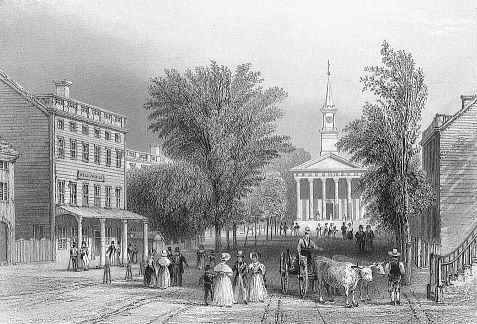
BALLSTON SPRINGS.
These celebrated springs rise in a valley formed by a branch of the Kayaderosseras Creek. In this valley, and on its acclivities, is built the village called Ballston Spa. The medicinal character of the waters was discovered (as was said of Saratoga) by the beaten track of the deer to the springs at certain seasons. Ballston is now a populous village during the summer, and, since the rail-road has connected it with Saratoga, these two resorts have become like one, and, together, assemble, during certain months, the greater proportion of the moving population of the country. A description of the kind of life led at these springs accompanies another drawing in this Series.
At the time of the breaking out of the revolutionary war this part of the country was very thinly settled. The inhabitants for the most part took the continental side; but at the battle of Hoosac, a few miles from Ballston, a man was taken prisoner by the Americans, whose history exhibits some fine traits of character. He was a plain farmer from this neighbourhood, named Richard Jackson, and had conscientiously taken the British side in the contest. Feeling himself bound of course to employ himself in the service of his sovereign, he no sooner heard that Colonel Baum was advancing, than he saddled his horse and rode to Hoosac, intending to attach himself to this corps. Here he was taken, in such circumstances as proved his intention beyond every reasonable doubt. He was, besides, too honest to deny it. Accordingly he was transmitted to Great Barrington, then the shire-town of Berkshire, and placed in the hands of General Fellows, high sheriff of the county, who immediately confined him in the county gaol. This building was at that time so infirm, that without a guard no prisoner could be kept in it who wished to make his escape. To escape, however, was in no degree consonant with Richard’s idea of right; and he thought no more seriously of making an attempt of this nature, than he would have done had he been in his own house. After he had lain quietly in gaol a few days, he told the sheriff that he was losing his time, and earning nothing, and wished that he would permit him to go out and work in the day time, promising to return regularly at evening to his quarters in the prison. The sheriff had become acquainted with his character, and readily acceded to his proposal. Accordingly Richard went out regularly during the remaining part of the autumn, and the following winter and spring, until the beginning of May, and every night returned at the proper hour to the gaol. In this manner he performed a day’s work every day, with scarcely any exception beside the Sabbath, through the whole period.
In the month of May he was to be tried for high treason. The sheriff accordingly made preparations to conduct him to Springfield, where his trial was to be held; but he told the sheriff that it was not worth his while to take this trouble, for he could just as well go alone, and it would save both the expense and inconvenience of the sheriff’s journey. The sheriff, after a little reflection, assented to his proposal, and Richard commenced his journey; the only one, it is believed, which was ever undertaken in the same manner for the same object. In the woods of Tyringham he was overtaken by the Hon. T. Edwards, from whom I had this story.—“Whither are you going?” said Mr. Edwards. “To Springfield, Sir,” answered Richard, “to be tried for my life.” Accordingly he proceeded directly to Springfield, surrendered himself to the sheriff of Hampshire, was tried, found guilty, and condemned to die.
The council of Massachusets was at this time the supreme executive of the State. Application was made to this board for a pardon. The facts were stated, the evidence by which they were supported, and the sentence grounded on them. The question was then put by the president, “Shall a pardon be granted to Richard Jackson?” The gentleman who spoke first observed that the case was perfectly clear; the act alleged against Jackson was unquestionably high treason; and the proof was complete. If a pardon should be granted in this case, he saw no reason why it should not be granted in every other. In the same manner answered those who followed him. When it came to the turn of Mr. Edwards, he told this story with those little circumstances of particularity, which, though they are easily lost from the memory, and have escaped mine, give light and shade, a living reality, and a picturesque impressiveness, to every tale which is fitted to enforce conviction, or to touch the heart. At the same time he recited it without enhancement, without expatiating, without any attempt to be pathetic. As is always the case, this simplicity gave the narration its full force. The council began to hesitate. One of the members at length observed—“Certainly such a man as this ought not to be sent to the gallows.” To his opinion the members unanimously assented. A pardon was immediately made out and transmitted to Springfield, and Richard returned to his family.
Never was a stronger proof exhibited, that honesty is wisdom.
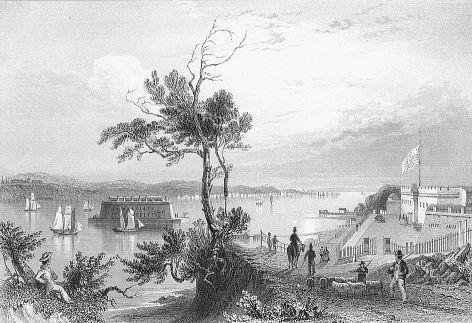
THE NARROWS, FROM FORT HAMILTON.
Not quite one hundred years after Verrazzano’s discovery of the Bay of New York, during all which period we have no account of its having been visited by an European vessel, Hudson made the Capes of Virginia on his third cruise in search of the north-west passage. Standing still on a northward course, he arrived in sight of the Narrows, distinguishing from a great distance the Highlands of Never Sink, which his mate, Robert Juet, describes in the journal he kept as a “very good land to fall with, and a pleasant land to see.”
The most interesting peculiarity of our country to a European observer, is the freshness of its early history, and the strong contrast it presents of most of the features of a highly civilized land, with the youth and recent adventure of a newly discovered one. The details of these first discoveries are becoming every day more interesting: and to accompany a drawing of the Narrows, or entrance to the Bay of New York, the most fit illustration is that part of the journal of the great navigator which relates to his first view of them. The following extracts describe the Narrows as they were two hundred years ago: the drawing presents them as they are.
“At three of the clock in the afternoone we came to three great rivers. So we stood along to the northernmost, thinking to have gone into it, but we found it to have a very shoald barre before it, for we had but ten foot water. Then we cast about to the southward, and found two fathoms, three fathoms, and three and a quarter, till we came to the souther side of them, then we had five or six fathoms, and anchored. So we sent in our boat to sound, and they found no less water than foure, five, six, and seven fathoms, and returned in an hour and a halfe. So we weighed and went in, and rode in five fathoms, ose ground, and saw many salmons, and mullets, and rayes very great.
“The fourth, in the morning, as soone as the day was light, we saw that it was good riding farther up. So we sent our boate to sound, and found that it was a very good harbour; then we weighed and went in with our ship. Then our boat went on land with our net to fish, and caught ten great mullets, of a foot and a half long apeece, and a ray as great as foure men could hale into the ship. So we trimmed our boat, and rode still all day. At night the wind blew hard at the north-west, and our anchor came home, and we drove on shore, but took no hurt, thanked bee God, for the ground is soft sand and ose. This day the people of the country came aboard of us, seeming very glad of our comming, and brought greene tobacco, and gave us of it for knives and beads. They go in deere skins loose, well dressed. They have yellow copper. They desire cloathes, and are very civill. They have great store of maise, or Indian wheate, whereof they make good bread. The country is full of great and tall oaks.
“The fifth, in the morning, as soone as the day was light, the wind ceased; so we sent our boate in to sound the bay. Our men went on land there and saw great store of men, women, and children, who gave them tobacco at their coming on land. So they went up into the woods, and saw great store of very goodly oakes, and some currants.
“The sixth, in the morning, was faire weather, and our master sent John Colman with foure other men in our boate over to the north side, to sound the other river,” (the Narrows.) “They found very good riding for ships, and a narrow river to the westward,” (probably what is now called the Kells, or the passage between Bergen-Neck and Staten Island,) “between two islands. The lands, they told us, were as pleasant, with grasse and flowers, and goodly trees, as ever they had seen, and very sweet smells came from them. So they went in two leagues and saw an open sea, and returned; and as they came backe they were set upon by two canoes, the one having twelve, the other fourteen men. The night came on, and it began to raine, so that their match went out; and they had one man slain in the fight, which was an Englishman, named John Colman, with an arrow shot into his throat, and two more hurt. It grew so dark that they could not find the shippe that night, but laboured to and fro on their oares.
“The seventh was fair, and they returned aboard the ship, and brought our dead man with them, whom we carried on land and buried.”
On the eighth, Hudson lay still, to be more sure of the disposition of the natives before venturing farther in. Several came on board, but no disturbance occurred, and on the ninth he got under weigh, passed the Narrows, and proceeded by slow degrees up the river destined to bear his name.
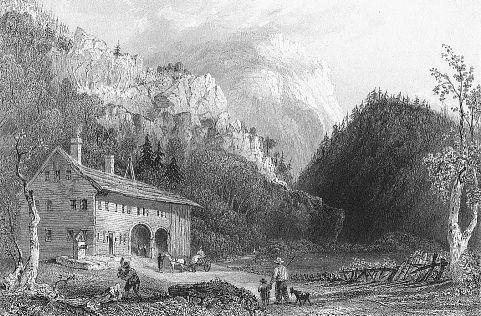
THE NOTCH HOUSE—WHITE MOUNTAINS.
A considerable tract of land in New Hampshire was granted to two individuals of the names of Nash and Sawyer, for the discovery of “the Notch.” This pass, the only one by which the inhabitants of a large extent of country, north-westward of these mountains, can, without a great circuit, make their way to the eastern shore, was known to the savages, who used to conduct their prisoners, taken on the coast, through this gap to Canada. By the people of New Hampshire, it was either unknown, or had been forgotten. Nash discovered it; but Sawyer persuaded Nash to admit him to an equal share of the benefits resulting from the discovery. It was, however, little advantage to either. They were both hunters, and with the thoughtlessness of men devoted to that employment, squandered the property soon after it was granted.
The Notch-house is inhabited by a family of the name of Crawford, who have the reputation, given them by travellers to the Notch, of being giants in size and strength. Ethan, one of the brothers living a mile or two further up, is called the “Keeper of the Mountains.” A manuscript journal of a pedestrian excursion to Mount Washington lies before us, in which the writer (a friend of ours, who is a small Titan himself, and whose estimate of thewe and sinew is to be taken with a grain of allowance) rather sneers at the proportions of the mountain-keeper. After walking from thirty to thirty-four miles a day, mostly up hill, our friend and his companion arrive at the Notch-house.
“About one o’clock,” says the journal, “we reached the house of T. G. Crawford, where we must remain till we can ascend Mount Washington. These Crawfords are not such giants as I had been led to suppose. We have not, however, seen Ethan, the most celebrated of the race.
“Last night we had a thunder shower, with sharp lightning. The thunder sounds heavy, and rumbles or echoes among the mountains with a very impressive effect. Just at evening we visited a beautiful cataract called the Flume, about half a mile from the house, and took the finest shower-bath I ever enjoyed. To-day the weather is doubtful, and we shall not attempt the ascent till to-morrow. There is enough in this immediate neighbourhood to occupy a week. The variety and magnificence of the scenery in every direction would satisfy the most ardent lover of the picturesque. Crawford is a fine fellow: his house is excellent, his trout delicious, and his neighbours perfectly quiet! The album kept here is an amusing omniana of nonsense and astonishment, sentiment and piety.
“After dinner walked over to Ethan Crawford’s, and saw the celebrated ‘Keeper of the White Mountains.’ Expected to find him a giant, but were disappointed: he is a large man, and strong in muscle, but I have seen fifty larger and stronger in my own town. There is nothing remarkable in his manners or conversation. His voice is stentorian, and his style is marked by a rude bluntness and an apparent consciousness that something original is expected of him. On our return had a fine view of Mount Washington and his fellow-peaks. The monarch’s head was capp’d with clouds, while all the others stood bare, as if uncovered for respect.”
Another traveller thus speaks of the scenery of this spot:—“We rode six miles farther, and came to a farm occupied by a man named Crawford. Here the mountains assumed the form of an immense amphitheatre, elliptical in its figure, from twelve to fifteen miles in length, from two to four in breadth, and crowned with summits of vast height and amazing grandeur. Compared with this scene all human works of this nature, that of Titus particularly, so splendidly described by Gibbon, are diminished into toys and gewgaws. Here more millions could sit than hundreds there; every one of whom could look down with a full view on the valley beneath.
“The south-eastern extremity of this form was, some years since, the scene of a melancholy circumstance. A young woman, who had been employed at Jefferson, in the service of Colonel Whipple, had fallen deeply in love with a young man in the service of the same gentleman. At the close of autumn they agreed to go together to Portsmouth. On some occasion or other she was induced, before the time fixed for their departure, to go over to Lancaster. When she returned, she found him unexpectedly gone, and determined to follow him. December was already advanced, the snow had fallen deep, and there was not a house for thirty miles on the road. She set out on foot, and walked twenty-three miles from the house she had left, and then, overcome probably with fatigue, wrapped herself in her cloak, and lay down under a bush, where she was found a month afterwards, stiffened with frost.”
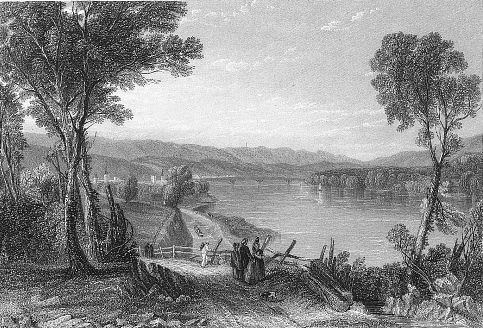
WILKESBARRE—VALE OF WYOMING.
This beautiful town is situated on the eastern bank of the Susquehanna, opposite the village of Wyoming, celebrated in the “Gertrude” of Campbell. Like all the towns in this picturesque valley, it possesses fine points of picturesque beauty, and exhibits the thrift and agricultural prosperity which, all over the United States, contrast so strongly with the recent and unforgotten tales of the primitive wilderness.
There is a book, of which many copies do not now exist, entitled, “Observations made by John Bartram, in his Travels through Pennsylvania to the Lake Ontario,” which presents a very wild picture of this part of the country in 1743. His companions were Mr. Weisar, a Mr. Evans, and a Delaware chief, called Shickalamy, and the object of their journey was to reconcile some differences between the English and the different Indian nations on that frontier. The dignity of their character as envoys from the English procured for them a kind reception, and the sight of many ceremonies not commonly seen by travellers. On their arrival on the banks of the Susquehanna, they were entertained by a hunting party of Indians, who served them up a roasted bear. Apropos to this, he describes the following superstition:—
“As soon as the bear is killed, the hunter places the small end of his pipe in its mouth, and, by blowing in the bowl, fills the mouth and throat full of smoke. He then conjures the departed spirit of the bear not to resent the injury done his body, nor to thwart his future sport in hunting. As he receives no answer to this, in order to know if his prayers have prevailed, he cuts the ligament under the bear’s tongue. If these ligaments contract and shrivel up when cast into the fire, which is done with invocations and great solemnity, then it is esteemed a certain mark that the manes are appeased.”
On the next day’s journey, still following the winding bank of the east branch of the Susquehanna, they arrived at an Indian village, where the natives welcomed them by beating a rude drum. Assisting them to unsaddle their horses, they invited them into the principal wigwam, and cut long grass, and laid it on the floor for them to sit upon. The chiefs then came in with their pipes, (one of which, he says, was six feet long, with a stone head and a reed stem;) and immediately after they were regaled with roast venison, of which the morsel of honour was the neck, given to them for their share, to Mr. Bartram’s great dissatisfaction. A superstitious ceremony took place here, the description of which is rather curious.
“They cut a parcel of poles, which they stick in the ground in a circle of about five feet diameter, and then bring them together at the top, and tie them in the form of an oven. In this the conjuror placeth himself, and his assistants cover his cage over with blankets. To make it still more suffocating, hot stones are rolled in. The conjuror then cries aloud, and agitates his body in the most violent manner; and when nature has lost almost all her faculties, the stubborn spirit becomes visible to him, generally in the shape of some bird. There is usually a stake driven into the ground about four feet high, and painted, for the airy visitant to perch upon while he reveals what the invocant wisheth to know. Sometimes there is a bowl of water, into which they often look when nearly exhausted, to see whether the spirit is ready to answer their demands.”
The next day he encounters another superstition:—“On our left, as we journeyed, we perceived a hill, where the Indians told us that corn, tobacco, and squashes were found on the following occasion. An Indian of a distant tribe, whose wife had eloped, came hither to hunt, intending, with his skins, to purchase another wife. Coming to this hill, he espied a young squaw, sitting alone. Going to her and inquiring whence she came, she answered that she came from heaven to provide sustenance for poor Indians, and if he came to that place twelve months after, he should find food there. He came accordingly and found corn, squashes, and tobacco, which were propagated from thence, and spread through the country; and this silly story is religiously held for truth among them.”
He kept on up the valley of the Susquehanna, through woods, where, as he describes it, “the tops of the trees for miles together were so close to one another that there is no seeing which way the clouds drive, nor knowing which way the wind sets; and it seems as if the sun had never shone on the ground beneath since the creation.” It is a description of a complete wilderness, till he reaches the borders of Lake Ontario—a tract of country that, in ninety years from the time he wrote, is seamed with rail-roads and canals, and teeming with towns, improvement and speculation.
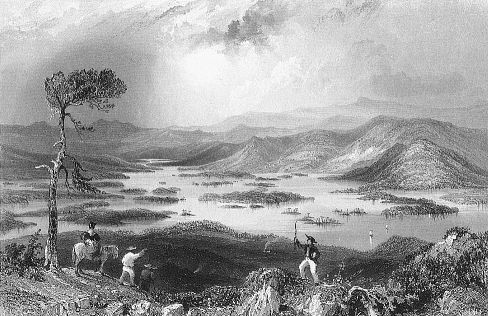
SQUAWM LAKE.
The Indianesque, but not very pretty name, in which this lovely body of waters rejoices, has been once or twice changed, but the force of usage has uniformly triumphed. Dr. Dwight called it Sullivan’s Lake, after Major-General Sullivan, formerly governor of the State; and the adjoining waters of Winipiseogee, he named Lake Wentworth, after another governor; but both have fallen into disuse, and the original names have reverted.
The great defect in American Lakes, generally, is the vast, unrelieved expanse of water, without islands and promontories, producing a fatigue on the eye similar to that of the sea. Squawm and Winipiseogee Lakes are exceptions to this observation. They are connected by so narrow an isthmus that five hundred dollars, it is said, would pay the expense of uniting them: and their islands together amount, it is said also, to exactly three hundred and sixty-five. As this singular coincidence has been remarked of several other lakes, however, the assertion seems rather apocryphal.
Some of the very loveliest scenery in the world lies about these two lakes, yet they are seldom visited. The country around is fertile, and sufficiently cultivated to soften the appearance of wilderness, which it might receive from the prevalency of forest, and the luxuriance of vegetation; but the mountains, which form its back-ground from every point, shutting it in like an amphitheatre, seem to seclude it from the flow of population.
Nature is a capricious beauty, and, like most other beauties, has her best looks, and her favourable times, to be seen to advantage. Beautiful as she is at Squawm Lake in the first plenitude of spring, she is more beautiful in the first flush over her face of the bright colours of autumn. The autumnal tints of our forests are peculiar to America, but there are some parts of the country where, for various reasons, this phenomenon is much more beautiful than at others. The moisture of the land about these lakes, the extreme luxuriance of the sap in consequence, and the liability of the whole of this region to sudden changes of temperature, contribute to its brilliancy. The sharp frost of a single night effects a change very often that seems almost miraculous, and the multiplication of these gawdy colours in the mirror of the surrounding waters, the bright golden, crimson, and purple islands, and the gorgeous hill-sides, all reflected and redoubled, make it a scene which the imagination never could pre-conceive. From a late publication we extract a description of this phenomenon, made from observation, and finished with some care.
“The first severe frost had come, and the miraculous change had passed upon the leaves which is known only in America. The blood-red sugar maple, with a leaf brighter and more delicate than a Circassian lip, stood here and there in the forest like the sultan’s standard in a host—the solitary and far-seen aristocrat of the wilderness; the birch, with its spirit-like and amber leaves, ghosts of the departed summer, turned out along the edges of the woods like a lining of the palest gold; the broad sycamore and the fan-like catalpa flaunted their saffron foliage in the sun, spotted with gold like the wings of a lady-bird; the kingly oak, with its summit shaken bare, still hid its majestic trunk in a drapery of sumptuous dyes, like a stricken monarch, gathering his robes of state about him, to die royally in his purple; the tall poplar, with its minaret of silver leaves, stood blanched like a coward in the dying forest, burthening every breeze with its complainings; the hickory paled through its enduring green; the bright berries of the mountain-ash, flushed with a more sanguine glory in the unobstructed sun; the gaudy tulip-tree, the sybarite of vegetation, stripped of its golden cups, still drank the intoxicating light of noon-day in leaves than which the lip of an Indian shell was never more delicately tinted; the still deeper-dyed vines of the lavish wilderness, perishing with the noble things whose summer they had shared, outshone them in their decline, as woman in her death is heavenlier than the being on whom in life she leaned; and alone and unsympathizing in this universal decay, outlaws from nature, stood the fir and the hemlock; their frowning and sombre heads darker and less lovely than ever, in contrast with the death-struck glory of their companions.
“The dull colours of English autumnal foliage give you no conception of this marvellous phenomenon. The change here is gradual; in America it is the work of a night—of a single frost!
“Oh, to have seen the sun set on hills bright in the still green and lingering summer, and to awake in the morning to a spectacle like this!
“It is as if a myriad of rainbows were laced through the tree-tops—as if the sunsets of a summer—gold, purple, and crimson—had been fused in the alembic of the west, and poured back in a new deluge of light and colour over the wilderness. It is as if every leaf in these countless trees had been painted to outflush the tulip—as if, by some electric miracle, the dyes of the earth’s heart had struck upward, and her crystals and ores, her sapphires, hyacinths, and rubies, had let forth their imprisoned colours to mount through the roots of the forests, and, like the angels that in olden time entered the bodies of the dying, re-animate the perishing leaves, and revel an hour in their bravery.”
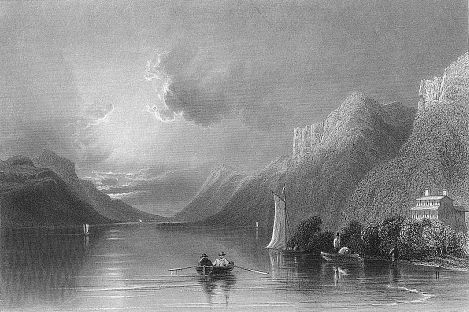
SABBATH-DAY POINT, LAKE GEORGE.
The lovely waters of Lake George are known to the Catholics by the prettier and more appropriate name of Lake Sacrament. Its singular transparency, surpassing that of all other lakes in the world, probably suggested some tradition of its sacredness; and its water was carried to great distances to supply the consecrated fonts. The singular seclusion of its position, far aside from the general current of population, has assisted to preserve its character.
Loch Katrine, at the Trosachs, is a miniature-likeness of Lake George. It is the only lake in Europe that has at all the same style or degree of beauty. The small green islands, with their abrupt shores,—the emerald depths of the water, overshadowed and tinted by the tenderest moss and foliage,—the lofty mountains in the back-ground,—and the tranquil character of the lake, over which the wind is arrested and rendered powerless by the peaks of the hills and the lofty island-summits,—are all points of singular resemblance. Loch Katrine can scarce be called picturesque, except at the Trosachs, however; while Lake George, throughout all the mazes of its three hundred and sixty-five islands (there are said to be just this number), preserves the same wild and racy character of beauty. Varying in size, from a mile in length to the circumference of a tea-table, these little islets present the most multiplied changes of surface and aspect—upon some only moss and flowers, upon others a miniature forest, with its outer trees leaning over to the pellucid bosom of the lake, as if drawn downwards by the reflection of their own luxuriant beauty.
The forests on the shores of Lake George were formerly stocked plentifully with deer, who were hunted in rather a peculiar manner. The huntsmen were divided into two parties, one of which started them from their thickets on the edge of the lake. Upon hearing the approach of the dogs, they invariably took to the water and crossed to the opposite shore, from which a boat, directed by a boy stationed in a high tree, put out to meet them. A few blows with an oar conquered them easily, and they were towed ashore, or taken alive into the boat. Bears are hunted in the same manner, except that, being more inconvenient to close with, they are usually shot from the boat without ceremony.
The race of settlers who were to be found in these neighbourhoods not many years ago—half hunters, half farmers—has disappeared, or gone westward with the game. The celebrated theologian, Dr. Dwight, gives a graphic account of one of this class, whom he met in a first visit to Lake George, somewhere about the year 1800. Landing on a point to dine, in his passage up the lake, he found a huntsman, with a buck lying beside him. “Before our departure,” he says, “we heard the hounds advancing near to us. Our new companion instantly took fire at the sound. His eye kindled; his voice assumed a loftier tone; his stride became haughty; his style swelled into pomp, and his sentiments were changed rapidly from mildness to ardour, to vehemence, and to rage. I was forcibly struck with the sameness of the emotions produced by hunting and by war. The ardour of battle, the glitter of arms, and the shock of conflict, could scarcely have produced in a single moment more violent or fierce agitations than were roused in this man by the approach of the hounds, the confident expectation of a victim, and the brilliant prospect of a venatory triumph. To him who has been a witness of both objects, it will cease to be a wonder that the savage should make the chase a substitute for war, and a source of glory second only to that acquired in battle. Our hunter was not exempted, however, from the common lot of man. His partner came up with the hounds, but without a deer! The magnificence of our companion dwindled in a moment. The fire vanished from his eye; his voice fell to its natural key; and the hero shrank into a plain farmer.”
No one, it has been well said, understands the character of the aboriginal tenants of America, who has seen them only as vitiated by contact with the settlers. I say vitiated; for, if they are not made better by proper protection and cultivation, they become much worse; as human nature, left to itself, is more susceptible of the contagion of vice, than of improvement in virtue. The Indian, thrown into temptation, easily takes the vices of the white man; and, in such exposure, his race melts away like the snow before a summer’s sun.
The wild Indian, however, whose contact with the European race has not been enough to vitiate his habits, or subdue his self-importance—who still prowls the forest in the pride of his independence—who looks upon all nations and tribes, but his own, as unworthy of the contemptuous glance of his eye—whose dreams of importance become to him a constant reality, and actually have the same influence in the formation of his character as if they were all they seem to him—he regards himself as the centre of a world made purposely for him. Such a being (and the wild Indian is much more than this) who is not a creature of the imagination, but a living actor in the scenes of the earth, becomes at least an interesting object, if not, also, a problem yet to be solved in both moral philosophy and politics, and in the nature and character of man as a social being. His bearing may be imagined from the following description of the war-dance:—
“A hundred warriors now advance,
All dressed and painted for the dance;
And sounding club and hollow skin,
A slow and measured time begin.
With rigid limb and sliding foot,
And murmurs low the time to suit,
For ever varying with the sound,
The circling band moves round and round.
Now slowly rise the swelling notes,
And every crest more lively floats.
Now tossed on high with gesture proud
Then lowly ’mid the circle bowed;
While clanging arms grow louder still,
And every voice becomes more shrill,
Till fierce and strong the clamour grows,
And the wild war-whoop bids it close,
Then starts Skuntonga forth, whose band
Came far from Huron’s storm-beat strand,
And loud recounts his hunting feats,
Whilst his dark club the measure beats.”—Ontwa.
Sabbath-day Point presents one of the most beautiful of the many views upon the lake. It received its name from Lord Amherst, who landed there with his suite to breakfast on a Sunday morning. It is about twenty-five miles from the head of the lake.
END OF VOL. I.
PRINTED BY R. CLAY, BREAD-STREET-HILL.