Front matter (continued 2)
Reading edition
The boy was called, and appeared by his answers to be familiar with every nook in the fort, and every passage and by-path by which it could be approached. In the eye of Allen, he was the very person to thread out the best avenue; and by the consent of the father, and a little persuasion, he was engaged to be the guide of the party.
The next step was to procure boats, which were very deficient in number. Eighty-three men only had crossed when the day began to dawn; and while the boats were sent back for the rear division, Allen resolved to move immediately against the fort.
He drew up his men in three ranks, addressed them in a short harangue, and, placing himself at the head of the centre file, led them silently, but with a quick step, up the heights of the fortress. Before the sun rose, he had entered the gate, and formed his men on the parade between the barracks. As Allen passed the gate, a sentinel snapped his fusee at him, and then retreated under a covered way. Another sentinel made a thrust at an officer with his bayonet, and slightly wounded him, but Allen cut him over the head with his sword, and he threw down his musket and asked for quarter. Standing on the parade-ground they gave three huzzas and aroused the sleepers. Allen inquired the way to the commandant’s apartment, hastily ascended the stairs, and called out with his stentorian voice at the door, ordering the astonished captain instantly to appear. Startled at so strange and unexpected a summons, he sprang from his bed and opened the door, when the first salutation of his boisterous and unseasonable visitor was an order immediately to surrender the fort. Rubbing his eyes, and trying to collect his scattered senses, the Frenchman asked by what authority he presumed to make such a demand. “In the name of the Great Jehovah and the Continental Congress!” replied Allen.
Not accustomed to hear much of the Continental Congress in this remote corner, nor to respect its authority when he did, the commandant began to speak; but Allen cat shore the thread of his discourse by lifting his sword over his head, and reiterating the demand for an instant surrender. Having neither permission to argue, nor power to resist, Captain De la Place submitted, ordering his men to parade without arms, and the garrison was given up to the victors.
This surprise was effected about four o’clock in the morning on the 10th of May. The remainder of the troops arrived after the fort was taken, and the prisoners, consisting of a captain, a lieutenant, and forty-eight subalterns and privates, were sent on to Hartford under an escort.
As soon as the bustle was over, Allen sent off a detachment to take Crown Point, a small fortress higher up the lake. Strong head winds drove back the boats, and the party returned the same evening. The attempt was renewed a day or two afterwards, and the garrison, consisting of a serjeant and eleven men, were brought in prisoners.
The principal advantage of these captures, besides the possession of the posts, was the acquisition, at Ticonderoga, of one hundred and twenty pieces of cannon, some swivels, mortars, and small arms; and at Crown Point, of sixty-one cannon and some small stores.
The Green Mountain Boys were at this time under sentence of outlawry from the Provincial Government; but after the good service they had done at Ticonderoga, they were formed into a separate regiment, and permitted to nominate their own officers. Their services to the cause of Independence are well known.
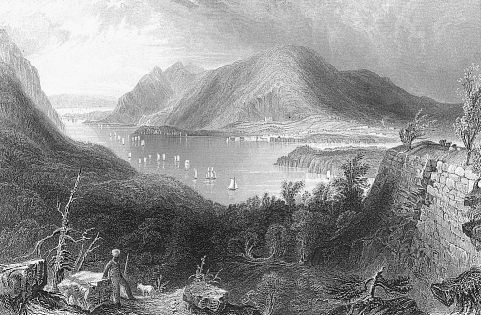
VIEW FROM FORT PUTNAM.
This fort, which commands the military position of West Point, and which was considered so important during the revolutionary war, is now in ruins, and is visited by all travellers for the superb view which it affords of the sublime pass of the Highlands. This was the great key which Arnold’s treachery intended to give into the hands of the English; and, associated with the memory of the unfortunate André, and with other painful events of the conspiracy, it possesses an interest which is wanting to other objects of the same description in our country.
Washington’s visit of inspection to Fort Putnam, and the other redoubts on this side the river, was made only two or three hours before his discovery of the treason of Arnold, at that moment as he supposed in command at West Point. The commander-in-chief was expected to arrive the evening before, and had he done so, Arnold would probably never have escaped. Having accidentally met the French minister, M. de Lucerne, at Fishkill, however (eight miles above), he was induced to pass the night there for the purpose of some conference, and set off early in the morning on horseback, sending on a messenger to Mrs. Arnold that himself and suite would be with her to breakfast. Arriving opposite West Point, near a small redoubt called Fort Constitution, Washington turned his horse from the road. Lafayette, who was then in his suite, called out, “General, you are going in the wrong direction; you know Mrs. Arnold is waiting breakfast for us.” “Ah,” answered Washington, “I know you young men are all in love with Mrs. Arnold, and wish to get where she is as soon as possible. Go and take your breakfast with her, and tell her not to wait for me: I must ride down and examine the redoubts on this side the river.” Two of the aides rode on, found breakfast waiting, and sat down at once with General Arnold and his family. While they were at table, a messenger came in with a letter for Arnold, which announced the capture of André, and the failure and betrayal, of course, of the whole conspiracy. Showing little or no emotion, though his life hung upon a thread, he merely said to one of his aides that his presence was required at West Point; and, leaving word for General Washington that he was called over the river, but would return immediately, he ordered a horse and sent for Mrs. Arnold to her chamber. He then informed her abruptly that they must part, possibly for ever, and that his life depended on his reaching the enemy’s lines without delay. Struck with horror at this intelligence, she swooned and fell senseless. In that state he left her, hurried down stairs, mounted a horse belonging to one of his aides that stood saddled at the door, and rode with all speed to the bank of the river. A boat with six men was in waiting; and, pretending that he was going with a flag of truce, he pulled down the stream, and arrived safe on board the Vulture sloop of war, lying some miles below.
Having finished his inspection of the redoubt, Washington arrived at Arnold’s house, received the message, and concluded to cross immediately and meet Arnold at West Point. As the whole party were seated in the barge moving smoothly over the water, with the majestic scenery of the highlands about them, Washington said, “Well, gentlemen, I am glad, on the whole, that General Arnold has gone before us, for we shall now have a salute; and the roaring of the cannon will have a fine effect among these mountains.” The boat drew near to the beach, but no cannon were heard, and there was no appearance of preparation to receive them. “What!” said Washington, “do they not intend to salute us!” At this moment an officer was seen making his way down the hill to meet them, who seemed confused at their arrival, and apologized for not being prepared to receive such distinguished visitors. “How is this, Sir,” said Washington, “is not General Arnold here?” “No, Sir,” replied the officer, “he has not been here these two days, nor have I heard from him within that time.” “This is extraordinary,” said Washington; “we were told he had crossed the river, and that we should find him here. However, our visit must not be in vain. Since we have come, we must look round a little, and see in what state things are with you.” He then ascended the hill, examined Fort Putnam and the other fortifications, and returned to Arnold’s house, where the treason was at once revealed. This had occupied two or three hours, however, and Arnold was beyond pursuit. Washington retained his usual calmness, though Arnold was one of his favourite officers, and had been placed at West Point by his own personal influence with Congress. He called Lafayette and Knox, showed them the proofs, and only said to the former, “Whom can we trust now!”
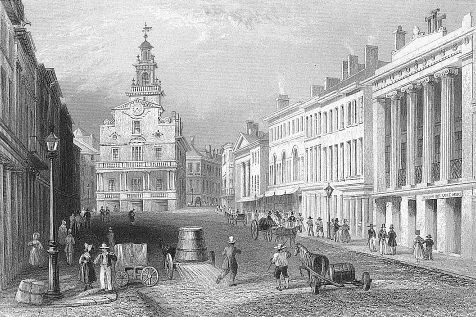
VIEW OF STATE STREET, BOSTON.
Boston is situated at the head of Massachusetts bay, on a peninsula about four miles in circumference, and is about three miles in length, and one mile and twenty-five rods, where widest, in breadth, and is connected with the main land at the south end by a narrow isthmus, called the Neck, leading to Roxbury. The town is built in an irregular circular form round the harbour, which is studded with about forty small islands, many of which afford excellent pasture; and are frequented in summer by numerous parties of pleasure. The harbour is formed by Nahant Point on the north, and Point Alderton on the south, and is so capacious as to allow five hundred vessels to ride at anchor in a good depth of water, while the entrance is so narrow as scarcely to admit two ships abreast. The entrance is defended by Fort Independence, belonging to the United States, on Castle Island, and by Fort Warren, on Governor’s Island. There is another fort, called Fort Strong, on Noddle’s Island.
Alterations and additions have of late years greatly improved the appearance of Boston. The streets, which were formerly almost without an exception narrow and crooked, have been in a great degree rendered wide and commodious; the old wooden structures have in the greater part of the city been replaced by handsome buildings of stone or brick. In the western part, particularly, there is much neatness and elegance. The splendour of the private buildings here, is not equalled in any other part of the Union.
The literary institutions of this city are of the first order. The public libraries contain 70,000 volumes. The Boston Athenæum is the finest establishment of its kind in the United States; its library contains above 25,000 volumes, and a reading-room, in which the most esteemed periodicals, from all parts of the world, may be found. If we add to these the library of Harvard College, in the neighbourhood, of 40,000 volumes, making the number of books within the reach of the citizens 110,000, it must be allowed that Boston offers to the scholar a more advantageous residence than any other spot in the western world.
State Street, called King Street in the days of Stamp-acts and “the Regulars,” is the main artery of the heart of New England. The old State House, which stands at the head of it, was called the Town House, and was first erected in 1660. It is honourably mentioned in a book of travels, written in a pleasant vein, by “John Josselyn, Gent.” who visited the colonies in 1663. “There is also a Town House,” he says, “built upon pillars, where the merchants may confer. In the chambers above they hold their monthly courts. Here is the dwelling of the Governor (Bellingham). On the south there is a small but pleasant common, where the gallants, a little before sunset, walk with their marmalet madams, as we do in Moorfields, till the nine o’clock bell rings them home to their respective habitations; when presently, the constables walk the rounds to see good order kept, and to take up loose people.” The State House has been twice burnt, and rebuilt. A council chamber, ornamented with full-length portraits of Charles II. and James II. formerly occupied the east end; and it was in this chamber that James Otis declared before a court of admiralty, that “taxation without representation is tyranny,”—a phrase which became, before long, a slogan in the mouths of the people. “Then and there,” writes President Adams, “was the first scene of the first act of opposition to the arbitrary claims of Great Britain. Then and there, the child Independence was born.” It was upon a trial of the question of “Writs for Assistance,” a power which was required by the Board of Trade to enforce some new and rigorous Acts of Parliament touching trade; and Otis opposed the Attorney-General. “As soon as he had concluded,” says the historian, “Otis burst forth as with a flame of fire, with a promptitude of classical allusion, a depth of research, a rapid summary of historical events, a profusion of legal authorities, a prophetic glance into futurity, and a torrent of impetuous eloquence, which carried all before him.” This was the preparation for the resistance to the Stamp Act, and the Revolution soon followed.
State Street has been the scene of most of the events of a very public nature, which are recorded in the annals of Boston. The balcony of the State House is the popular pulpit, and hence was read the Declaration of Independence, and from hence declaimed Colonel David Crockett, who “could lick his weight in wild-cats.” In 1770 the “Boston massacre” took place in State Street. For several days preceding the event, there had been disturbances between the king’s soldiers and the townspeople, which had put the officers on the alert. The soldiers were collected into the barracks before night, and sentinels were placed around them at all hours to prevent difficulty. One of these sentinels was stationed in a narrow alley, and was striking fire against the walls with his sword, for amusement, when two or three young men attempted to pass him. Having orders to let no one pass, a struggle ensued, and one of the young men received a wound on the head. The noise of the rencontre drew together a considerable crowd, and as but few could enter the narrow scene of action, the remainder listened to an inflammatory speech from “a tall man, with a red cloak, and a white wig,” in the adjacent square. At the close of the oration there was a general cry “To the main guard!” and the crowd rushed tumultuously toward its station in State Street. On their way they passed the Custom House, before the door of which stood a single sentinel. Alarmed at their approach, he retreated up the steps, and, the people collecting around, he sent word to the barracks, near by, that he was attacked, and a company in a few moments arrived to his assistance, and formed a half circle round the steps. The captain of the day, named Preston, followed immediately, and the Custom House, which stood at the corner of State and Exchange Streets, was soon thronged by a considerable multitude. The soldiers were soon pressed upon very closely by the mob, who were mostly armed with clubs; and those at a distance soon began to throw snowballs, followed by fragments of ice, stones and sticks, while from every side came the cry, “Fire, if you dare!” The soldiers soon heard, or thought they heard, the order, and they fired in quick succession from right to left. Two or three of the guns flashed, but the rest were fatal. Three persons were killed on the spot, two received wounds of which they died next day, and others were more slightly injured. The people immediately dispersed, leaving the dead bodies in the street, but returned in a few minutes; when the soldiers aimed once more at them, but the commanding officer struck up the guns with his sword. The drum was beat to arms, and several of the officers, on their way to join the guard, were knocked down, and their swords taken from them. Order was soon restored, and Captain Preston delivered himself up for trial. The dead were buried with some pomp, and when the excitement had subsided a little, Preston was tried and acquitted.
State Street is at present a street of banks, insurance offices, and similar institutions; and its side walk serves for the merchants’ exchange. The buildings are of granite, and some of them, particularly a new bank, lately erected near Kilby Street, present very creditable specimens of city architecture.
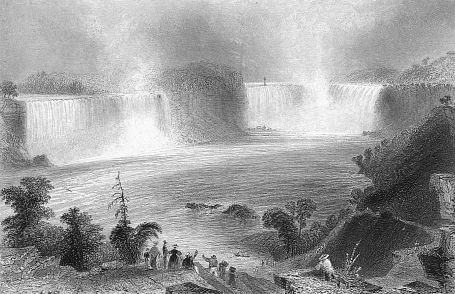
NIAGARA FALLS, FROM CLIFTON HOUSE.
The most comprehensive view of Niagara is, no doubt, that from the galleries of this hotel; but it is, at the same time, for a first view, one of the most unfavourable. Clifton House stands nearly opposite the centre of the irregular crescent formed by the Falls; but it is so far back from the line of the arc, that the height and grandeur of the two cataracts, to an eye unacquainted with the scene, are deceptively diminished. After once making the tour of the points of view, however, the distance and elevation of the hotel are allowed for by the eye, and the situation seems most advantageous. This is the only house at Niagara where a traveller, on his second visit, would be content to live.
Clifton House is kept in the best style of hotels in this country; but the usual routine of such places, going on in the very eye of Niagara, weaves in very whimsically with the eternal presence and power of the cataract. We must eat, drink, and sleep, it is true, at Niagara as elsewhere; and indeed, what with the exhaustion of mind and fatigue of body, we require at the Falls perhaps more than usual of these three “blessed inventions.” The leaf that is caught away by the Rapids, however, is not more entirely possessed by this wonder of nature, than is the mind and imagination of the traveller; and the arrest of that leaf by the touch of the overhanging tree, or the point of a rock amid the breakers, is scarce more momentary than the interruption to the traveller’s enchantment by the circumstances of daily life. He falls asleep with its surging thunders in his ear, and wakes—to wonder, for an instant, if his yesterday’s astonishment was a dream. With the succeeding thought, his mind refills, like a mountain channel, whose torrent has been suspended by the frost, and he is overwhelmed with sensations that are almost painful, from the suddenness of their return. He rises and throws up his window, and there it flashes, and thunders, and agonizes—the same almighty miracle of grandeur for ever going on; and he turns and wonders—What the deuce can have become of his stockings! He slips on his dressing-gown, and commences his toilet. The glass stands in the window, and with his beard half achieved, he gets a glimpse of the foam-cloud rising majestically over the top of the mahogany frame. Almost persuaded, like Queen Christina at the fountains of St. Peter’s, that a spectacle of such splendour is not intended to last, he drops his razor, and with the soap drying unheeded on his chin, he leans on his elbows, and watches the yeasty writhe in the abysm, and the solemn pillars of crystal eternally falling, like the fragments of some palace-crested star, descending through interminable space. The white field of the iris forms over the brow of the cataract, exhibits its radiant bow, and sails away in a vanishing cloud of vapour upon the wind; the tortured and convulsed surface of the caldron below shoots out its frothy and seething circles in perpetual torment; the thunders are heaped upon each other, the earth trembles, and—the bell rings for breakfast! A vision of cold rolls, clammy omelettes, and tepid tea, succeeds these sublime images, and the traveller completes his toilet. Breakfast over, he resorts to the colonnade, to contemplate untiringly the scene before him, and in the midst of a calculation of the progress of the Fall towards Lake Erie,—with the perspiration standing on his forehead, while he struggles to conceive the junction of its waters with Lake Ontario,—the rocks rent, the hills swept away, forests prostrated, and the islands uprooted in the mighty conflux,—some one’s child escapes from its nurse, and seizing him by the legs, cries out “Da-da.”
The ennui attendant upon public-houses can never be felt at Clifton House. The most common mind finds the spectacle from its balconies a sufficient and untiring occupation. The loneliness of uninhabited parlours, the discord of baby-thrummed pianos, the dreariness of great staircases, long entries, and bar-rooms filled with strangers, are pains and penalties of travel never felt at Niagara. If there is a vacant half-hour to dinner, or if indisposition to sleep create that sickening yearning for society, which sometimes comes upon a stranger in a strange land, like the calenture of a fever,—the eternal marvel going on without is more engrossing than friend or conversation, more beguiling from sad thought than the Corso in carnival-time. To lean over the balustrade and watch the flying of the ferry-boat below, with its terrified freight of adventurers, one moment gliding swiftly down the stream in the round of an eddy, the next, lifted up by a boiling wave, as if it were tossed up from the scoop of a giant’s hand beneath the water; to gaze hour after hour into the face of the cataract, to trace the rainbows, delight like a child in the shooting spray-clouds, and calculate fruitlessly and endlessly by the force, weight, speed, and change of the tremendous waters,—is amusement and occupation enough to draw the mind from any thing,—to cure madness or create it.
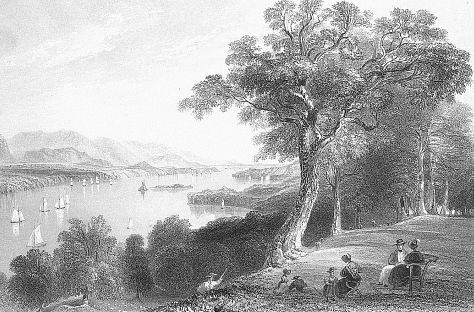
VIEW FROM HYDE PARK.
The Hudson at Hyde Park is a broad, tranquil, and noble river, of about the same character as the Bosphorus above Roumeli-bissar, or the Dardanelles at Abydos. The shores are cultivated to the water’s edge, and lean up in graceful, rather than bold elevations; the eminences around are crested with the villas of the wealthy inhabitants of the metropolis at the river’s mouth; summer-houses, belvideres, and water-steps, give an air of enjoyment and refreshment to the banks, and, without any thing like the degree of the picturesque which makes the river so remarkable thirty or forty miles below, it is, perhaps, a more tempting character of scenery to build and live among.
All along, in this part of the river, occur the “landings,” which are either considerable towns in themselves, or indicate a thickly settled country in the rear. The immense steamers that ply on the Hudson leave and receive passengers at all these points, and, to a person making the passage for the first time, the manner and expedition of this operation is rather startling. In the summer time, the principal steam boats average from five to seven hundred passengers, and there is usually a considerable number to go ashore and come off at each place. A mile or two before reaching the spot, a negro makes the tour of the boat, with a large hand-bell, and, in an amusing speech, full of the idioms of his own race, announces the approach, and requests those who are going ashore to select their baggage. This done, the steamer, gliding over the smooth water at the rate of fifteen or twenty miles in the hour, sheers in toward the shore, and the small boat is lowered, with the captain in her at the helm; the passengers are put on board, and away she shoots at the end of a line gradually loosened, but still kept tight enough to send her, like an arrow to her mark. The moment she touches the pier, the loose line is let out from the steamer, which still keeps on her way, and between that moment and the exhaustion of the line, perhaps thirty seconds, the baggage is thrown out, and taken in, passengers jump ashore, and embark, and away shoots the little boat again, her bow rising clear over the crest of her own foam, with the added velocity of the steamer at full speed, and the rapid hauling in of the crew. I never have failed to observe a look of astonishment on the part of the subjects of this hurried transfer, however used to it by frequent repetition; and a long sigh of relief, as they look about on the broad and steady deck, or tread the ground beneath them if they have gone ashore, follows as invariably. As the boat is hauled up again, the negro crier reappears with his bell, and, looking the newly arrived group close in the face, cries out, as if they were a mile off, “All pas’ng’rs as hasn’t paid their passage, please walk to the cap’n’s office and settle-e-e!!”—the whole sentence recited in the most monotonous tone till the last syllable, which rises suddenly to a ludicrous scream, prolonged as long as his breath will continue it.
Many fatal accidents occurred formerly from this practice; but there is now more care and time taken about it, and the accidents, if any, are rather ludicrous than serious. I was going to Albany, some years ago, on board a very crowded boat, and among the passengers were a German and his wife, emigrants of the lower class. They had been down stairs at dinner, and the husband came up in search of his wife, who had preceded him, just as a crowded boatful were going ashore at Poughkeepsie. Either fancying it the end of his journey, or misunderstanding the man who was busy with the baggage, he threw in his bundle, and was peeping through the crowd of ladies on the stern for his wife; when one of the men, impatient of his delay, drew him in, and away he flew to the pier. He sprang ashore with the rest, his bundle was thrown after him, and, as the steamer sped away, we saw him darting about in the crowd to find his vrouw, who by this time had missed him, and was running from side to side, in quite as great embarrassment on board. The poor woman’s distress was quite pitiable, and when, at last, one of the passengers, who had observed them together, pointed out to her her husband, in his flat cap and foreign bleuse, standing on the receding pier, with his hands stretched out after the boat, her agony could no longer be controlled. She was put ashore at the next landing to return by the “down boat;” but as another boat up the river arrived soon after at Poughkeepsie, the probability was, that he would embark again to follow her, and they would thus cross each other by the way; with scarce a word of English, and probably very little money, they may be hunting each other to this day.
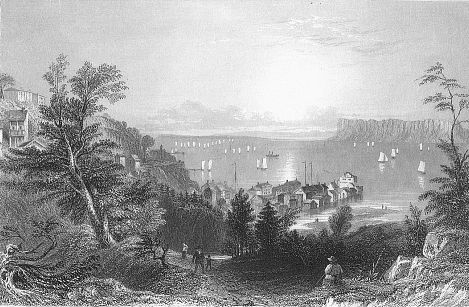
VILLAGE OF SING-SING.
Sing-Sing is famous for its marble, of which there is an extensive quarry near by; for its State prison, of which the discipline is of the most salutary character; and for its academy, which has a high reputation. It may be said, altogether, to do the State some service.
The county of West Chester, of which this is the principal village on the Hudson, has been made the scene of, perhaps, the best historical novel of our country, and, more than any other part of the United States, suffered from the evils of war. The character and depredations of the “cow-boys” and “skinners,” whose fields of action were on the skirts of this neutral ground, are familiar to all who have read “the Essay” of Mr. Cooper. A distinguished clergyman gives the following very graphic picture of West Chester county in those days:—
“In the autumn of 1777, I resided for some time in this county. The lines of the British were then in the neighbourhood of Kingsbridge, and those of the Americans at Byram river. The unhappy inhabitants were, therefore, exposed to the depredations of both. Often they were actually plundered, and always were liable to this calamity. They feared every body whom they saw, and loved nobody. It was a curious fact to a philosopher, and a melancholy one to hear their conversation. To every question they gave such an answer as would please the inquirer; or, if they despaired of pleasing, such a one as would not provoke him. Fear was, apparently, the only passion by which they were animated. The power of volition seemed to have deserted them. They were not civil, but obsequious; not obliging, but subservient. They yielded with a kind of apathy, and very quietly, what you asked, and what they supposed it impossible for them to retain. If you treated them kindly, they received it coldly; not as a kindness, but as a compensation for injuries done them by others. When you spoke to them, they answered you without either good or ill nature, and without any appearance of reluctance or hesitation; but they subjoined neither questions nor remarks of their own; proving to your full conviction that they felt no interest either in the conversation or yourself. Both their countenances and their motions had lost every trace of animation and of feeling. Their features were smoothed, not into serenity, but apathy; and, instead of being settled in the attitude of quiet thinking, strongly indicated, that all thought beyond what was merely instinctive, had fled their minds for ever.
“Their houses, meantime, were, in a great measure, scenes of desolation. Their furniture was extensively plundered, or broken to pieces. The walls, floors, and windows were injured both by violence and decay, and were not repaired, because they had not the means to repair them, and because they were exposed to the repetition of the same injuries. Their cattle were gone. Their enclosures were burnt, where they were capable of becoming fuel; and in many cases thrown down where they were not. Their fields were covered with a rank growth of weeds and wild grass.
“Amid all this appearance of desolation, nothing struck my eye more forcibly than the sight of the high road. Where I had heretofore seen a continual succession of horses and carriages, life and bustle lending a sprightliness to all the environing objects, not a single, solitary traveller was seen, from week to week, or from month to month. The world was motionless and silent, except when one of these unhappy people ventured upon a rare and lonely excursion to the house of a neighbour no less unhappy, or a scouting party, traversing the country in quest of enemies, alarmed the inhabitants with expectations of new injuries and sufferings. The very tracks of the carriages were grown over, and obliterated; and where they were discernible, resembled the faint impressions of chariot wheels, said to be left on the pavements of Herculaneum. The grass was of full height for the scythe, and strongly realized to my own mind, for the first time, the proper import of that picturesque declaration in the Song of Deborah: ‘In the days of Shamgar, the son of Anath, in the days of Jael, the highways were unoccupied, and the travellers walked through by-paths. The inhabitants of the villages ceased: they ceased in Israel.’ ”
West Chester is a rough county in natural surface, but since the days when the above description was true, its vicinity to New York, and the ready market for produce, have changed its character to a thriving agricultural district. It is better watered with springs, brooks, and mill-streams, than many other parts of New York, and, among other advantages, enjoys, along the Hudson, a succession of brilliant and noble scenery.
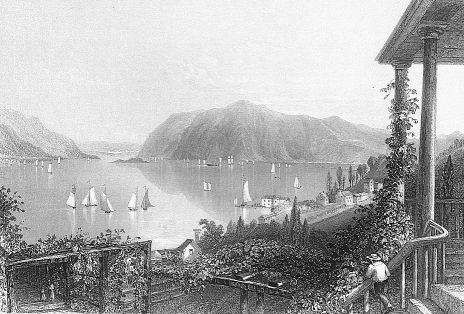
VIEW FROM RUGGLE’S HOUSE, NEWBURGH, HUDSON RIVER.
Newburgh stands upon a pretty acclivity, rising with a sharp ascent from the east bank of the Hudson; and, in point of trade and consequence, it is one of the first towns on the river. In point of scenery, Newburgh is as felicitously placed, perhaps, as any other spot in the world, having in its immediate neighbourhood every element of natural loveliness; and, just below, the sublime and promising Pass of the Highlands. From the summit of the acclivity, the view over Wateaman and Fishkill is full of beauty; the deep flow of the Hudson lying between, and the pretty villages just named, sparkling with their white buildings and cheerful steeples, beyond.
Newburgh has a considerable trade with the back country, and supports two or three steam-boats, running daily and exclusively between its pier and New York. If there were wanting an index of the wondrous advance of enterprise and invention in our country, we need not seek farther than this simple fact—a small intermediate town, on one river, supporting such an amount of expensive navigation. Only thirty years ago Fulton made his first experiment in steam on the Hudson, amid the unbelief and derision of the whole country. Let any one stand for one hour on the pier at Newburgh, and see those superb and swift palaces of motion shoot past, one after the other, like gay and chasing meteors; and then read poor Fulton’s account of his first experiment—and never again throw discouragement on the kindling fire of genius.
“When I was building my first steam-boat,” said he to Judge Story, “the project was viewed by the public at New York either with indifference or contempt, as a visionary scheme. My friends, indeed, were civil, but they were shy. They listened with patience to my explanations, but with a settled cast of incredulity on their countenances. I felt the full force of the lamentation of the Poet:—
‘Truths would you teach, to save a sinking land,
All shun, none aid you, and few understand.’
As I had occasion to pass daily to and from the building-yard while my boat was in progress, I have often loitered, unknown, near the idle groups of strangers gathering in little circles, and heard various inquiries as to the object of this new vehicle. The language was uniformly that of scorn, sneer, or ridicule. The loud laugh rose at my expense; the dry jest, the wise calculation of losses and expenditure; the dull but endless repetition of “the Fulton folly.” Never did a single encouraging remark, a bright hope, or a warm wish, cross my path.
“At length the day arrived when the experiment was to be made. To me it was a most trying and interesting occasion. I wanted many friends to go on board to witness the first successful trip. Many of them did me the favour to attend, as a matter of personal respect; but it was manifest they did it with reluctance, feigning to be partners of my mortification, and not of my triumph. I was well aware that, in my case, there were many reasons to doubt of my own success. The machinery was new, and ill-made; and many parts of it were constructed by mechanics unacquainted with such work; and unexpected difficulties might reasonably be presumed to present themselves from other causes. The moment arrived in which the word was to be given for the vessel to move. My friends were in groups on the deck. There was anxiety mixed with fear among them. They were silent, sad, and weary. I read in their looks nothing but disaster, and almost repented of my efforts. The signal was given, and the boat moved on a short distance, and then stopped, and became immovable. To the silence of the preceding moment, now succeeded murmurs of discontent and agitation, and whispers and shrugs. I could hear distinctly repeated, “I told you so,—it is a foolish scheme.—I wish we were well out of it.” I elevated myself on a platform, and stated that I knew not what was the matter; but if they would be quiet, and indulge me for half an hour, I would either go on or abandon the voyage. I went below, and discovered that a slight maladjustment was the cause. It was obviated. The boat went on; we left New York; we passed through the Highlands; we reached Albany!—Yet even then, imagination superseded the force of fact. It was doubted if it could be done again, or if it could be made, in any case, of any great value.”
What an affecting picture of the struggles of a great mind, and what a vivid lesson of encouragement to genius, is contained in this simple narration!
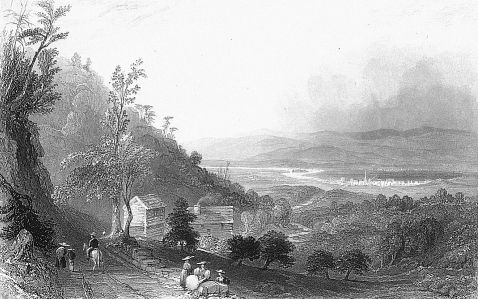
DESCENT INTO THE VALLEY OF WYOMING.
In looking down on this lovely scene, made memorable by savage barbarity, and famous by the poet’s wand of enchantment, it is natural to indulge in resentful feelings towards the sanguinary race whose atrocities make up its page in story. It is a pity, however, that they too, had not a poet and a partial chronicler. Leaving entirely out of view the ten thousand wrongs done by the white man to the Indian, in the corruption, robbery, and rapid extinction of his race, there are personal atrocities, on our own records, exercised toward that fated people, which, in impartial history hereafter, will redeem them from all charge except that of irresistible retaliation. The brief story of the famous Cornstalk, Sachem of the Shawanees, and King of the Northern Confederacy, is sermon enough on this text.
The north-western corner of Virginia, and that part of Pennsylvania contiguous, on the south, to the valley represented in the drawing, was the scene of some of the bloodiest events of Indian warfare. Distinguished over all the other red men of this region, was Cornstalk. He was equally a terror to the men of his own tribe, (whom he did not hesitate to hew down with his tomahawk if they showed any cowardice in fight,) and a formidable opponent to our troops, from his military talents and personal daring. He was, at the same time, more than all the other chiefs of the confederacy, a friend to the whites; and, energetic as he was when once engaged in battle, never took up arms willingly against them. After the bloody contest at Point Pleasant, in which Cornstalk had displayed his generalship and bravery, to the admiration of his foes, he came in to the camp of Lord Dunmore, to make negotiations for peace. Colonel Wilson, one of the staff, thus describes his oratory:—“When he arose, he was in no wise confused or daunted, but spoke in a distinct and audible voice, without stammering or repetition, and with peculiar emphasis. His looks, while addressing Dunmore, were truly grand and majestic, yet graceful and attractive. I have heard many celebrated orators, but never one whose powers of delivery surpassed those of Cornstalk on this occasion.”
In the spring of 1777, it was known that an extensive coalition was forming among the tribes, and that it only waited the consent and powerful aid of the Shawanees, to commence war upon the whites. At this critical time, Cornstalk, accompanied by Red Hawk, came on a friendly visit to the Fort at Point Pleasant, communicated the intentions of the tribes, and expressed his sorrow that the tide set so strongly against the colonists, that he must go with it, in spite of all his endeavours.
Upon receiving this information, given by the noble savage in the spirit of a generous enemy, the commander of the garrison seized upon Cornstalk and his companion as hostages for the peaceful conduct of his nation, and set about availing himself of the advantage he had gained by his suggestions. During his captivity, Cornstalk held frequent conversations with the officers, and took pleasure in describing to them the geography of the west, then little known. One afternoon, while he was engaged in drawing on the floor a map of the Missouri territory, with its water-courses and mountains, a halloo was heard from the forest, which he recognised as the voice of his son Ellinipsico, a young warrior, whose courage and address was almost as celebrated as his own. Ellinipsico entered the fort, and embraced his father most affectionately, having been uneasy at his long absence, and come hither in search of him.
The day after his arrival, a soldier went out from the fort on a hunting excursion, and was shot by Indians. His infuriated companions instantly resolved to sacrifice Cornstalk and his son. They charged upon Ellinipsico that the offenders were in his company, but he declared that he had come alone, and with the sole object of seeking his father. When the soldiers came within hearing, the young warrior appeared agitated. Cornstalk encouraged him to meet hits fate composedly, and said to him, “My son, the Great Spirit has sent you here that we may die together!” He turned to meet his murderers the next instant, and receiving seven bullets in his body, expired without a groan.
When Cornstalk had fallen, Ellinipsico continued still and passive, not even raising himself from his seat. He met death in that position with the utmost calmness. “The other Indian,” says the chronicle, “was murdered piecemeal, and with all those circumstances of cruelty with which the savage wreaks his vengeance on his enemy.”
The day before his death, Cornstalk had been present at a council of the officers, and had spoken to them on the subject of the war, with his own peculiar eloquence. In the course of his remarks, he expressed something like a presentiment of his fate. “When I was young,” he said, “and went out to war, I often thought each would be my last adventure, and I should return no more. I still lived. Now I am in the midst of you, and, if you choose, you may kill me. I can die but once. It is alike to me whether now or hereafter!”
His atrocious murder was dearly expiated. The Shawanees, the most warlike tribe of the West, became thenceforward the most deadly and implacable foes to the white man.
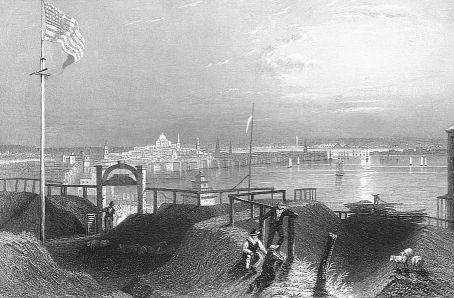
BOSTON, FROM DORCHESTER HEIGHTS.
The pretty peninsula of Dorchester Heights, which seems to throw its arm protectingly around the southern bay of Boston, was settled by a company of pilgrims who came out to New England during the administration of Governor Winthrop, in Massachusetts. The party consisted of two Puritan clergymen, “with many godly families and people” from Devonshire and Somersetshire, who embarked in the “Mary John,” in the spring of 1630. The historian states that they had some difficulty in the passage with the master of the vessel, Captain Squibb, “who, like a merciless man, put them and their goods ashore on Nantasket Point, notwithstanding his engagement was to bring them up Charles river.” They obtained a boat, however, and, having laden her with goods, and manned her with able men (“not more than ten, well armed, under Captain Southcot, a brave Low-country soldier,”) they followed the river for about ten miles. After landing their goods on a steep bank, they were alarmed by the information that there was encamped near them a body of three hundred savages. Fortunately they had been joined by an old planter, who knew enough of the Indian tongue and disposition to persuade the chiefs not to attack the party till morning. At day-break, some of the savages made their appearance, but stood awhile at a distance. At last one of them held out a bass, and the pilgrims sent a man with a biscuit to exchange for it, and thus a friendly intercourse was established. Not liking the neighbourhood, however, they descended the river again, and an exploring party having discovered some good pasture at Mattapau (present Dorchester) they settled there.
The neighbouring peninsula of Shawmut (now Boston) was destined to be the principal settlement, and Dorchester is at this day a rural suburb of the capital of New England. The fort which crowns its summit (from which this view is taken) is the scene of an important chapter in the history of the Revolution.
Boston had been occupied for some time by the British army under General Gage, who sailed for England in October 1776, leaving General Howe in command. After the battle of Bunker’s Hill, both armies remained quiet for several months; General Washington occupying both sides of the Charles river with about fourteen thousand men; and the English, besieged in their quarters within the town, amusing themselves with private theatricals in Faneuiel Hall, varied occasionally with feats of horsemanship from a squadron of cavalry, who had turned the old South Church into a circus. As the cold became severe, the North “meeting-house,” an immense wooden building, was torn down and consumed for fuel, and the soldiers had made a holiday of felling a gigantic Liberty-tree for the same purpose.
Washington became impatient of this inactive situation; and as soon as the ice in the bay and river became firm enough to allow the passage of troops, he called a council of war, and proposed an attack on Boston. The opinion against the measure was unanimous, and he reluctantly abandoned it. He soon after determined to take possession of Dorchester Heights, which command both harbour and town,—a step which he knew must bring on a general action, during which he intended to cross over to Cambridge with a few chosen men, and force an entrance into the town. During the two or three preceding nights, he bombarded the town heavily from his camp, to divert the attention of the garrison; and on the night of the 4th of March, a large detachment took possession of Dorchester Heights, and immediately commenced throwing up an intrenchment. The night was mild, but the ground was frozen almost impenetrably hard; and it was with excessive labour that a sufficient bulwark was presented by day-light, to cover them from the shot of the enemy.
The morning broke,—and a thin haze, which magnified the size of the works, overspread the landscape. The astonishment of General Howe, at discerning this phantom fortification looming up through the mist, upon heights which had been bare and desolate at sunset, was without bounds. The position was so commanding that the town could not be held unless the Americans were dislodged; but this seemed, from the advantages of the ground in favour of the Provincials, next to impossible. The British commander undertook it with great spirit, and two thousand troops were embarked on the same day to cross the harbour to the attack. The transports fell down to the Castle, a small island just below the town; but a tremendous storm suspended their operations. The next day a council of war was held, and it was thought advisable to evacuate the town immediately. The provincials went on completing their fortifications, undisturbed; and in a few days General Howe embarked with all his forces, accompanied by those Americans who adhered to the royal cause. The embarkation commenced at four in the morning of the 17th of March, and at ten in the forenoon General Washington entered the city at the head of his army. The English fleet sailed for Halifax. They were ten thousand strong, including the marines; and left stores to the value of 30,000l. with several pieces of cannon, mortars, &c. &c.
The view of Boston from these heights is very commanding. The bay, with its fortified islands, stretches away to the right, beautiful from its shape and from the brightness of its water; the city, clustering upon its heights, rises in graceful lines to the pinnacled State House; and the country to the left is all that is lovely in cultivation, sprinkled here and there with gay and thrifty-looking villages. The calenture of speculation is just now at its height in America; and Dorchester, like other places, is laid out in lots, and busy with the builders of fancy cottages and hotels. If calculation has not overreached itself, the suburbs of Boston will soon sparkle with villas on every hill side within the horizon.
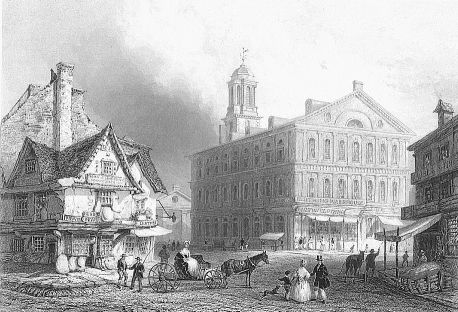
VIEW OF FANEUIL HALL, AND ADJACENT BUILDINGS, BOSTON.
There are very few remaining of the many covered, gable-ended, top-heavy, old houses which constituted the compact centre of Boston in the days of English governors. The finest specimens long stood in the neighbourhood of Faneuiel Hall; but, with one exception, we believe, their picturesque heaps of triangles have dropped beneath the merciless hand of speculation and improvement. Boston has not grown so thriftily, or rather so miraculously, as the capitols of other States, through which the flood of emigration rolls more directly; but it is certainly the handsomest town in the United States, and probably its prosperity is more permanent and solid. Its granite houses and fine public buildings are in strong contrast with the description given of it by John Josselyn, Gent. who visited it in 1638, and afterwards favoured the world with his observations under the title of “New England Rarities.” “Having refreshed myself for a day or two on an island in the bay,” he says, “I crossed the harbour in a small boat to Boston, which was then rather a village than a town, there not being more than above twenty or thirty houses: and presented my respects to Mr. Muthrop the governor, and to Mr. Cotton the teacher of Boston Church, to whom I delivered from Mr. Francis Quarles, the poet, the translation of several Psalms in English metre for his approbation.”
A facetious bookseller, John Dunton, visited Boston some fifty years afterwards; and, in a book upon his “Life and Errors,” gives a humorous account of its inhabitants in his time. The passage, which is now commonly made in from sixteen to twenty-five or thirty days, occupied the unfortunate bibliopole four months; and he was reduced, at the latter part of it, to one bottle of water for four days.
“When we came within view of Boston,” he writes, “we were all overjoyed, being just upon the point of starving; we put off to land in the long boat, and came ashore near the Castle, which stands about a mile from Boston. The country appeared at first a barren waste, but we found humanity enough when we came among the inhabitants. We lodged the first night at the Castle, and next morning we found our way to Boston Bay over the ice, which was but cold comfort to us after we had been stowed up so many months in a cabin. The air of New England was sharper than at London; which, with the temptation of fresh provisions, made me eat like a second Mariot of Gray’s Inn. The first person that welcomed me to Boston was Mr. Burroughs. He heaped upon me more civilities than I can reckon up, offered to lend me moneys, and made me his bedfellow till I had provided lodgings.”
Dunton’s book would have sold merrily in our scandal-loving days. Its personalities are delightful. The following list of his acquaintance is as good as a portrait gallery.
“Mr. Phillips, my old correspondent.—He treated me with a noble dinner, and (if I may trust my eyes) is blest with a pretty, obliging wife. I’ll say that for Sam (after dealing with him for some hundred pounds), he is very just, and (as an effect of that) very thriving. I shall add to his character, that he is young and witty, and the most beautiful man in the town of Boston.
“The next was Mr. King.—Love was the cause of this gentleman’s long ramble hither. Sure his mistress was made of stone, for King had a voice would have charmed the spheres; he sang “All hail to the Myrtle Shades” with a matchless grace.
“Another acquaintance was Mr. York. He had his soft minutes as well as other men; and when he unbent his bow, (for he was very industrious,) he treated the fair sex with so much courtship and address, as if loving had been all his trade.
“I pass to my good friend Dr. Bullivant—both a gentleman and a physician. As a gentleman, he came of noble family, but his good qualities exceed his birth. He never practises new experiments on his patients, except in dangerous cases, where death must be expelled by death. This is also praiseworthy in him, that to the poor he always prescribes cheap medicines; not curing them of a consumption in their bodies and sending it into their purses, nor yet directing them to the East Indies for drugs, when they may have better out of their own gardens.
“I proceed in the next place to Mr. Gouge, a linen-draper from London. He is owner of a deal of wit; his brain is a quiver of smart jests. He pretends to live a bachelor, but is no enemy to a pretty woman.”
Dunton winds up his list with an apostrophe to Mrs. Comfort, the married daughter of his landlady. “You may well take it amiss,” he says, “if I should forget your favours to me in your father’s house, your pleasant company to Ipswich, your assistance when I was ill, and the noble looking-glass you sent my dear, and all with a world of innocence.”
“Kind Boston, adieu! part we must, though ’tis pity,
But I’m made for mankind: the world is my city.
Look how on the shore they whoop and they holloa,
Not for joy I am gone, but for grief they can’t follow.”
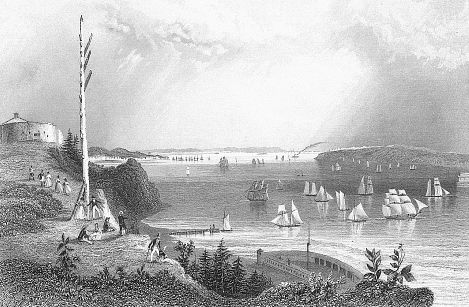
VIEW FROM THE TELEGRAPH SIGNAL, NEW YORK BAY.
The first visitor to the Bay of New York, and the writer of the first description on record, was John de Verrazzano, a Florentine, in the service of Francis the First. This bold navigator had been for some time in command of four ships, cruising against the Spaniards. But his little fleet being separated in a storm, Verrazzano determined, with one of them, the Dauphin, to take a voyage in search of new countries. He arrived on the American coast, somewhere near North Carolina, and first proceeded south as far as “the region of palm-trees,” probably Florida. He then turned, and proceeded north till he entered a harbour, which he describes thus, in a passage of a letter addressed by him to his Royal master:—
“This land is situated in the paralele of Rome, in forty-one degrees and two terces; but somewhat more colde by accidentall causes. The mouth of the haven lieth open to the south, half a league broad; and being entred within it, between the east and the north, it stretcheth twelve leagues, where it wareth broader and broader, and maketh a gulfe about twenty leagues in compass, wherein are five small islands, very fruitfull and pleasant, full of hie and broad trees, among the which islands any great navie may ride safe without any feare of tempest or other danger.”
In this harbour Verrazzano appears to have remained about fifteen days. He and his men frequently went on shore to obtain supplies and see the country. He says in another part of his letter—“Sometimes our men stayed two or three daies on a little island neere the ship for divers necessaries. We were oftentimes within the land five or six leagues, which we found as pleasant as is possible to declare, very apt for any kind of husbandry, of corne, wine, and ayle. We entered afterwards into the woods, which we found so thicke that any army, were it never so great, might have hid itself therein; the trees whereof are okes, cypresse-trees, and other sortes unknown in Europe.”
These were probably the first European feet that ever trod on any part of the territory now included in the State of New York. Verrazzano and his crew seem to have had considerable intercourse with the natives, and generally to have been treated well, though by his own account he did not always deserve it. Speaking of an excursion made by his men somewhere on the coast, he says:—“They saw only one old woman, with a young maid of eighteen or twenty yeeres old, which, seeing our companie, hid themselves in the grasse for feare. The old woman carried two infants on her shoulders, and the young woman was laden with as many. As soone as they saw us, to quiet them and win their favours, our men gave them victuals to eate, which the old woman received thankfully, but the young woman threw them disdainfully on the ground. They took a child from the old woman to bring into France; and going about to take the young woman, which was very beautiful, and of tall stature, they could not possibly, for the great outcries that she made, bring her to the sea; and especially having great woods to pass thorow, and being far from the ship, we proposed to leave her behind, bearing away the child only.”
In a subsequent part of his narrative, Verrazzano presents a very favourable picture, not only of the amenity, but of the discretion of the aborigines. “They came in great companies of their small boats unto the ship, with their faces all bepainted with divers colours, and bringing their wives with them, whereof they were very jealous; they themselves entring aboard the ship, and staying there a good space, but causing their wives to stay in their boats; and for all the entreatie that we could make, offering to give them divers things, we could never obtaine that they would suffer them to come aboard the ship. And oftentimes one of the two Kings comming with his Queene, and many gentlemen for their pleasure to see us, they all stayed on shore 200 paces from us, sending us a small boat to give us intelligence of their comming; and as soon as they had answere from us they came immediately, and wondered at hearing the cries and noyses of the mariners. The Queene and her maids staied in a very light boat at an island a quarter of a league off, while the King abode a long space in our ship, uttering divers conceits with gestures, viewing with great admiration the furniture of the shippe. And sometimes our men staying one or two days on a little island near the ship, he returned with seven or eight of his gentlemen to see what we did; then the King drawing his bow, and running up and down with his gentlemen, made much sport to gratify our men.”
The sail-studded bay of New York at this day presents another scene; and one of these same “gentlemen” is now almost as much a curiosity here as was John de Verrazano, only three centuries ago, to the rightful lords of this fair land and water.
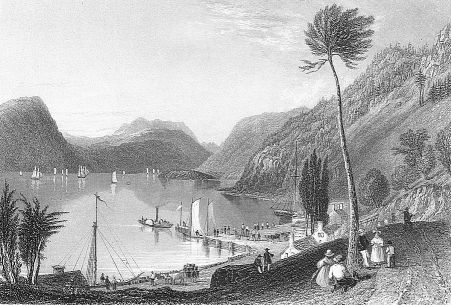
PEEKSKILL LANDING.
Like most of the landings on the Hudson, Peekskill is a sort of outstretched hand from the interior of the country. It is about eighty miles from New York, and the produce from the country behind is here handed over to the trading sloops, who return, into the waiting palm, the equivalent in goods from the city. A sort of town naturally springs up at such a spot, and, as a river-side is a great provocative of idleness, all the Dolph Heyligers of the country about seem to be collected at the landing.
The neighbourhood of this spot is interesting from its association with the history of the Revolution. The head-quarters of General Washington were just below, at Verplank’s Point; and the town of Peekskill, half a mile back from the river, was the depôt of military stores, which were burnt by General Home in 1777. “On my return southward in 1782,” says the translator of Chastellux, who has not given his name, “I spent a day or two at the American camp at Verplank’s Point, where I had the honour of dining with General Washington. I had suffered severely from an ague, which I could not get quit of, though I had taken the exercise of a hard-trotting horse, and got thus far to the north in the month of October. The General observing it, told me he was sure I had not met with a good glass of wine for some time,—an article then very rare,—but that my disorder must be frightened away. He make me drink three or four of his silver camp cups of excellent Madeira at noon, and recommended to me to take a generous glass of claret after dinner; a prescription by no means repugnant to my feelings, and which I most religiously followed. I mounted my horse the next morning, and continued my journey to Massachusetts, without ever experiencing the slightest return of my disorder.
“The American camp here presented the most beautiful and picturesque appearance. It extended along the plain, on the neck of land formed by the winding of the Hudson, and had a view of this river to the south. Behind it, the lofty mountains, covered with wood, formed the most sublime back-ground that painting could express. In the front of the tents was a regular continued portico, formed by the boughs of the trees in full verdure, decorated with much taste and fancy. Opposite the camp, and on distinct eminences, stood the tents of some of the general officers, over which towered predominant that of Washington. I had seen all the camps in England, from many of which drawings and engravings have been taken; but this was truly a subject worthy the pencil of the first artist. The French camp, during their stay in Baltimore, was decorated in the same manner. At the camp at Verplank’s Point we distinctly heard the morning and evening gun of the British at Knightsbridge.”
The curiosity seizes with avidity upon any accidental information which fills up the bare outline of history. The personal history of Washington more particularly, wherever it has been traced by those who were in contact with him, is full of interest. Some of the sketches given by the Marquis of Chastellux, who passed this point of the Hudson on his way to Washington’s head-quarters below, are very graphic.
“The weather being fair on the 26th,” he says, “I got on horseback, after breakfasting with the General. He was so attentive as to give me the horse I rode on the day of my arrival. I found him as good as he is handsome; but, above all, perfectly well broke and well trained, having a good mouth, easy in hand, and stopping short in a gallop without bearing the bit. I mention these minute particulars, because it is the General himself who breaks all his own horses. He is an excellent and bold horseman, leaping the highest fences, and going extremely quick without standing upon his stirrups, bearing on the bridle, or letting his horse run wild; circumstances which our young men look upon as so essential a part of English horsemanship, that they would rather break a leg or an arm than renounce them.”
After passing some days at head-quarters, this young nobleman thus admirably sums up his observations on Washington:—
“The strongest characteristic of this great man is the perfect union which reigns between his physical and moral qualities. Brave without temerity, laborious without ambition, generous without prodigality, noble without pride, virtuous without severity; he seems always to have confined himself within those limits beyond which the virtues, by clothing themselves in more lively but more changeable colours, may be mistaken for faults. It will be said of him hereafter, that at the end of a long civil war he had nothing with which he could reproach himself. His stature is noble and lofty, he is well made and exactly proportioned; his physiognomy mild and agreeable, but such as to render it impossible to speak particularly of any of his features; so that on quitting him, you have only the recollection of a fine face. He has neither a grave nor a familiar air; his brow is sometimes marked with thought, but never with inquietude; in inspiring respect he inspires confidence, and his smile is always the smile of benevolence.”
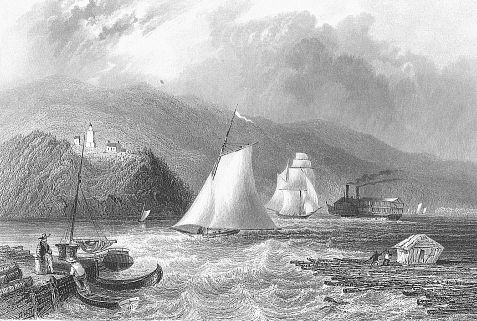
LIGHTHOUSE NEAR CALDWELL’S LANDING.
This picturesque object is seen to great effect by the passenger in the evening boat from New York to Newburgh. Leaving the city at five in the summer afternoon, she makes the intervening forty miles between that hour and twilight; and while the last tints of the sunset are still in the sky, the stars just beginning to twinkle through the glow of the west, the bright light of this lofty beacon rises up over the prow of the boat, shining apparently on the very face of the new-starred heaven. As he approaches, across the smooth and still purpled mirror of the silent river is drawn a long and slender line of light, broken at the foot of the beacon by the mild shrubbery of the rock on which it stands; and as he rounds the point, and passes it, the light brightens and looks clearer against the darker sky of the east, while the same cheering line of reflection follows him on his way, and is lost to sight as he disappears among the mountains.
The waters of the river at this point were the scene of the brief and tragic drama enacted so fatally by poor André. Four or five miles below stands Smith’s house, where he had his principal interview with Arnold, and where the latter communicated to him his plans for the delivery of West Point into the hands of the English, and gave him the fatal papers which proved his ruin.
At Smith’s house Mrs. Arnold passed a night, on her way to join her husband at West Point, soon after he had taken command. The sufferings of this lady have excited the sympathy of the world, as the first paroxysms of her distress moved the kind but firm heart of Washington. There seems to have arisen a doubt, however, whether her long and well-known correspondence with André had not so far undermined her patriotism, that she was rather inclined to further than impede the treason of Arnold; and consequently could have suffered but little after Washington generously made every arrangement for her to follow him. In the “Life of Aaron Burr,” lately published, are some statements which seem authentic on the subject. It is well known that Washington found Mrs. Arnold apparently frantic with distress at the communication her husband had made to her the moment before his flight. Lafayette, and the other officers in the suite of the commander-in-chief, were alive with the most poignant sympathy; and a passport was given her by Washington, with which she immediately left West Point to join Arnold in New York. On her way she stopped at the house of Mrs. Prevost, the wife of a British officer, who subsequently married Colonel Burr. Here “the frantic scenes of West Point were renewed,” says the narrative of Burr’s biographer, “and continued so long as strangers were present. As soon as she and Mrs. Prevost were left alone, however, Mrs. Arnold became tranquillized, and assured Mrs. Prevost that she was heartily sick of the theatrics she was exhibiting. She stated that she had corresponded with the British commander; that she was disgusted with the American cause, and those who had the management of public affairs; and that, through great persuasion and unceasing perseverance, she had ultimately brought the General into an arrangement to surrender West Point to the British. Mrs. Arnold was a gay, accomplished, artful, and extravagant woman. There is no doubt, therefore, that, for the purpose of acquiring the means of gratifying her vanity, she contributed greatly to the utter ruin of her husband, and thus doomed to everlasting infamy and disgrace all the fame he had acquired as a gallant soldier, at the sacrifice of his blood.”
It is not easy to pass and repass the now peaceful and beautiful waters of this part of the Hudson, without recalling to mind the scenes and actors in the great drama of the revolution, which they not long ago bore on their bosom. The busy mind fancies the armed guard-boats, slowly pulling along the shore; the light pinnace of the Vulture plying to and fro on its errands of conspiracy; and not the least vivid picture to the imagination, is the boat containing the accomplished, the gallant André and his guard, on his way to his death. It is probable that he first admitted to his own mind the possibility of a fatal result, while passing the very spot presented in the drawing. A late biographer of Arnold gives the particulars of a conversation between André and Major Tallmadge, the officer who had him in custody, and who brought him from West Point down the river to Tuppau, the place of his subsequent execution.
“Before we reached the Clove” (a landing just below the beacon represented in the drawing,) “Major André became very inquisitive to know my opinion as to the result of his capture. When I could no longer evade his importunity, I remarked to him as follows:—‘I had a much-loved classmate in Yale College, by the name of Hale, who entered the army in 1775. Immediately after the battle of Long Island, Washington wanted information respecting the strength of the enemy. Hale tendered his services, went over to Brooklyn, and was taken, just as he was passing the outposts of the enemy on his return.’ Said I, with emphasis, ‘Do you remember the sequel of this story?’ ‘Yes,’ said André, ‘he was hanged as a spy. But you surely do not consider his case and mine alike?’ I replied, ‘Yes, precisely similar, and similar will be your fate.’ He endeavoured to answer my remarks, but it was manifest he was more troubled in spirit than I had ever seen him before.’
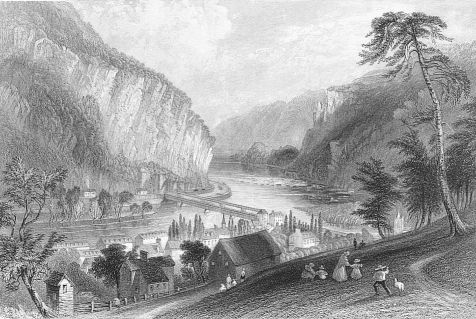
HARPER’S FERRY.
(FROM THE POTOMAC SIDE.)
Perhaps it will not be uninteresting to the reader, to vary a little the monotony of description which is entailed upon us by the character of the work, and give some account of the varieties of sporting on the Potomac.
This noble river abounds in fish, of which the principal are the white shad, the herring, and the sturgeon. The latter is taken in a way that, as far as we know, is entirely peculiar to this part of the country. The sturgeon is a noble denizen of the waters, weighing from seventy-five to one hundred and fifty pounds. His enormous leaps out of the water, and his alacrity at mounting a cascade, are accomplishments for which he is, as the advertisements phrase it, “favourably known.” He has a habit, however, of scratching himself against any stationary object he finds in the river, which has been detected by the Potomac fishers, and employed, very successfully, to his detriment. A stout line, with a weight attached to it, is lowered from a boat, and a large hook, of peculiar contrivance, but without a bait, fastened to the extremity. The rubbing of the sturgeon against the line informs the fisherman of his neighbourhood, and, with a little skill, he succeeds in hooking him under the belly. The fish makes off with prodigious speed; the fisherman pays out line, and casts loose his painter; and away flies the boat with a speed and suddenness that seems like magic. A mile or so of this hard work is enough for the sturgeon, who gives out exhausted, and is easily drawn in. Some years ago, a negro, celebrated for his skill in this fishery, incautiously tied the line to his leg. The sudden jerk of the hooked fish pulled him overboard, and away he went down the stream, sometimes above, and sometimes under water, to the extreme astonishment of some people accidentally passing on the shore. He was an expert swimmer, however, and a heavy-limbed athletic fellow, and by remarkable coolness and courage he succeeded in bringing the sturgeon ashore. It is a singular fact, that this fish is only good in certain rivers: those of the Delaware, for example, being considered unfit to eat; and those of the rivers on either side of it, the Hudson and the Potomac, considered a great delicacy. It is recorded, by the way, that one of these enormous fish descended from an aerial leap into a ferry-boat, during the revolutionary war, and falling into the lap of an officer, seated on the gunwale, broke his thigh. Every passenger up this fine river has seen the sturgeon leaps; and an ascent of eight or ten feet above the water is not uncommon.
The shad and herring are taken by thousands, in nets, very much in the usual way.
The wild birds that frequent the bosom and shores of the Potomac, are very numerous. Among them are the swan, the wild goose, the red-head shoveler, the black-head shoveler, the duck and mallard, the black duck, the blue-winged teal, the green-winged teal, the widgeon, and, last not least, the far-celebrated canvass-back. This duck, which we believe is unrivalled in the world for richness of flavour, is one of a class called drift fowl, from their habit of floating in the middle of the river when at rest. The two species of shoveler have the same habit, and are scarcely inferior in flavour. The canvass-back breeds, it is supposed, on the borders of the northern lakes, or on the shores of Hudson’s Bay; and in their migrations confine their pasture almost exclusively to the Chesapeake and Potomac. They feed, it is well ascertained, on the bulbous root of a grass which grows on the flats in these rivers, and which is commonly known as wild celery. It is said, that during a hard winter, some forty years ago, a strong wind blew so much of the water off the flats of James river, that the remainder froze to the bottom, enclosing the long tops of this grass so closely in the ice, that when it broke up, and was floated off in the spring, it tore whole fields of it up by the roots, and destroyed the pasture. Since that time, the canvass-back has never been seen on the river.
The bald duck feeds very frequently among these water-fowl; and not having the power to dive entirely under water in search of food, he watches for the rising of the canvass-back, and, by his superior quickness on the wing, seizes on the celery the moment it appears above the surface, and escapes with it to the shore.
The canvass-back is often shot from behind blinds of brush, which conceal the sportsman, in the midst of their feeding ground. There is a practice, however, of tolling them in, as it is called, by shaking a coloured handkerchief tied to the branch of a decayed tree. On what propensity of the bird the success of this manœuvre is founded, it would be difficult to say. There is no doubt of the fact, however, that they are thus decoyed within gun-shot; and it is related of an old sportsman on the Potomac, that a long queue of red hair, which he wore in a brush, and shook over his shoulder, served the purpose admirably well. Perhaps we have yet to discover that birds have curiosity.
Among the many varieties of wild fowl found on the Potomac, below Harper’s Ferry, is the wild swan. The young bird is considered a great delicacy; while the old one is hard and without flavour. In a book on the District of Columbia, by Mr. Elliott, there are some curious particulars respecting their habits, and the manner of taking them.
“This noble bird,” says the author, “is seen floating near the shores, in flocks of some two or three hundred, white as the driven snow, and from time to time emitting fine sonorous, and occasionally melodious songs; so loud, that they might be heard, on a still evening, two or three miles. There are two kinds, so called from their respective notes—the one the trumpeter, and the other the hooper; the trumpeter is the largest, and when at full size will measure from five to six feet from the bill to the point of the toe, and from seven to eight feet from the tip of one wing to the tip of the other, when stretched and expanded. They are sagacious and wary, and depend more on the sight than on the sense of smell. On a neck nearly three feet in length, they are enabled to elevate their heads so as to see and distinguish, with a quick and penetrating eye, objects at a great distance; and by means of this same length of neck they feed in slack tides, by immersing, as is their habit, nearly all of the body, and throwing only their feet and tails out in three or four feet water, and on the flatty shores they frequent, generally beyond gun-shot; the sportsman availing himself, however, of a peculiar propensity (of which we shall presently speak more particularly) prevailing with them, and some of the other water fowl, often toll them within reach of their fire. The swans remain here the whole winter, only shifting their ground in severe weather, from the frozen to the open part of the river, and dropping down into the salts, where it is rarely frozen. They get into good condition soon after their arrival in autumn, and remain fat until toward spring, when, a few weeks before their departure (about the first of March), they gradually become thinner in flesh; and in the latter part of their sojourn here, are found so poor and light, that when shot the gunner gets nothing fit for use but the feathers. Whether this circumstance be owing to their having exhausted the means of subsistence at their feeding-places, or that they are taught by Him who rules the universe, in small as well as great things, thus by abstaining, to prepare themselves for the long aerial voyages they are about to undertake, we pretend not to determine with certainty; there is nothing more wonderful in this, than in the fact, which is notorious, that they, by exercise, regularly and assiduously fit themselves for this continuous effort, to bear themselves through the air to the distance of perhaps a thousand miles or leagues. Large flocks are seen every day rising from the river, and taking a high position, flying out of sight, and apparently moving in a circuit to a considerable distance, again returning to or near the same place, during the last two or three weeks of their stay.
“The swan is tolled by a dog, that is taught to play about within easy call of his master, at the edge of the water; the hunter contrives to place himself behind a log, or some other cover well concealed, before he begins his operations, taking care to observe that the direction of the wind is not unfavourable to him, and that the flock he means to toll is near enough to distinguish such objects on the shore, and under no alarm at the time. By what motive these fowls are influenced, we have not heard satisfactorily explained; but certain it is, they are very commonly brought in from some hundreds of yards’ distance, in this way, to within point-blank shot. It is said, and perhaps truly, in the case of the dog, that they fancy themselves in pursuit of some animal, as the fag, or mink, by which their young are annoyed at their breeding-places.
“The wild goose is yet more wary and vigilant to keep out of harm’s way than the swan. He too is sharp-sighted, but depends much on his sense of smell for protection: this is so well known to the huntsman, that he never attempts, however he may be concealed from this bird, to approach it from the direction of the wind; since he would assuredly be scented before he could get within gun-shot, and left to lament his error, by the sudden flight of the whole flock. These geese, towards spring, often alight on the land, and feed on the herbage in fields; and sometimes in such numbers as to do great injury to the wheat fields on the borders of the river. When so employed they are difficult of approach, always taking a position at a distance from cover of any kind, and marching in a single and extended rank, flanked by a watch goose at each extremity; which, while all the others are busily feeding, and advancing with their heads down among the herbage, moves erect, keeping pace with his comrades,—his eyes and nose in a position so as to give him the earliest intelligence of the presence of an enemy, though at a great distance; and the moment such is perceived, it is communicated to the whole company by certain tones used for alarm; and immediately is responded to by a halt, and the lifting of heads; and an instant flight, or a deliberate return to feeding, takes place, according as the nature of the danger, after the examination, may be considered.”
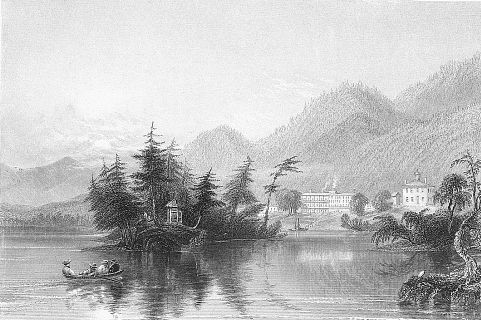
CALDWELL, LAKE GEORGE.
In the future poetry of America, Lake George will hold the place of Loch Katrine in Scotland. The best idea that can be given of it, indeed, to a person who has seen Loch Katrine, is to say, that it is the Trosachs on a little larger scale. There is the same remarkably clear water in both,—the same jutting and bold shores, small green islands, and bright vegetation; and the same profusion of nooks and bays. It struck me at Loch Katrine, that the waters seemed to have overflowed the dells of an undulating country, and left nothing visible but the small green hill-tops loaded with vegetation. The impression was owing, no doubt, to the reach of the shrubs and grass to the very edge of the water; and the same thing produces the same effect at Lake George. When the bosom of the lake is tranquil, the small islands, with their reflections below, look like globes of heaped-up leaves suspended in the air.
The extraordinary purity of the waters of Lake George procured for it the name of Lake Sacrament; and every stranger is struck with their singular transparency. It is singular, that the waters on every side of it,—those of Lake Champlain, for example, of the Hudson, and of the whole region between the Green Mountains and the Mississippi,—are more or less impregnated with lime, while Lake George alone is pellucid and pure. It receives its waters, probably, from subjacent springs.
The surface of this lake is said to be one hundred feet higher than Lake Champlain. Another, and probably a more correct estimate, makes the difference three hundred. There are three steps to the falls, which form the outlet into the latter lake; and the lower one, when the snow is melting in spring, is a cataract of uncommon beauty. Lake George is frozen over from three to four months; and it is remarked of it, that the ice does not sink, as in Lake Champlain, but gradually dissolves.
Before it became a part of the fashionable tour, this lake was a solitude, appropriated more particularly by the deer and the eagle. Both have nearly disappeared. The echo of the steam-boat, that has now taken the place of the noiseless canoe,—and the peppering of fancy sportsmen, that have followed the far-between but more effectual shots of the borderer’s rifle,—have drawn from its shores these and other circumstances of romance. The only poetry of scene which can take the place of that of nature, is historical and legendary; and ages must lapse, and generations pass away, and many changes come over the land, before that time. We are in the interregnum, now, least favourable for poetry.
Caldwell is a flourishing town, built at the end of the lake, and remarkable for nothing, in itself, but a famous hotel, where scenery-hunters dine. We turn from this too succulent theme, to give an extract from the works of a grave and eminent divine; proving, by its glowing enthusiasm, the effect of this lovely scenery even on minds of the most serious bent.
“The whole scenery of this lake is greatly enhanced in beauty and splendour, by the progressive change which the traveller sailing on its bosom perpetually finds in his position, and by the unceasing variegations of light and shade which attend his progress. The gradual and the sudden openings of scoops and basins, of islands and points, of promontories and summits—the continual change of their forms, and their equally gradual and sudden disappearance,—impart to every object a brilliancy, life, and motion, scarcely inferior to that which is seen in the images formed by the camera-obscura, and in strength and distinctness greatly superior. Light and shade are here not only far more diversified, but are much more obvious, intense, and flowing, than in smooth, open countries. Every thing, whether on the land or water, was here affected by the changes of the day; and the eye, without forecast, found itself, however disposed on ordinary occasions to inattention, instinctively engaged, and fastened with emotions approximating to rapture. The shadows of the mountains, particularly on the west, floating slowly over the bosom of the lake, and then softly ascending that of the mountains on the east, presented to us, in a wide expanse, the uncommon and most pleasing image of one vast range of mountains slowly moving up the ascent of another.
“On the evening of Friday, the 1st of October, while we were returning from Ticonderoga, we were presented with a prospect superior to any which I ever beheld. An opening lay before us, between the mountains on the west and those on the east, gilded by the departing sunbeams. The lake, alternately glassy and gently rippled, of a light and exquisite sapphire, gay and brilliant with the tremulous lustre already mentioned floating upon its surface, stretched in prospect to a vast distance, through a great variety of larger and smaller apertures. In the chasm, formed by the mountains, lay a multitude of islands, differing in size, shape, and umbrage, and clothed in deeply-shaded green. Beyond them, and often partly hidden behind the tall and variously-figured trees with which they were tufted, rose, in the west and south-west, a long range of distant mountains, tinged with a deep misty azure, and crowned with an immense succession of lofty pines. Above the mountains, and above each other, were extended in great numbers long streaming clouds, of the happiest forms, and painted with red and orange light, in all their diversities of tincture.
“To complete the scenery of this lake, the efforts of cultivation are obviously wanting. The hand of the husbandman has already begun to clear these grounds, and will, at no great distance of time, adorn them with all the smiling scenes of agriculture. It does not demand the gift of prophecy to foresee, that the villas of opulence and refinement will, within half a century, add here all the elegances of art to the beauty and majesty of nature.”
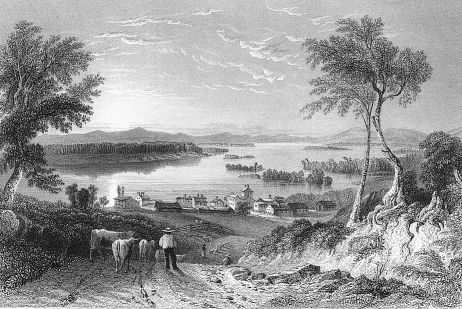
CENTRE HARBOUR, LAKE WINIPISEOGEE.
There are several considerable promontories which intrude into Lake Winipiseogee, and on one of them is built the town of Centre Harbour. The lake is near the middle of the state of New Hampshire, of a very irregular form, and at the western end is divided into three large bays. There are nine townships on its borders, of which Centre Harbour, the largest, is on the north-west side. The waters of the lake in some places are unfathomable, but abound with fish. It will still be some years, probably, before the navigation of this body of water will become of much importance.
Beside the beauty of nature, which is prodigal on the borders of this lovely lake, there is little of interest beyond what is found in the recollections of the Indian wars. Penhallow’s History, which till lately has been a rare book, has rescued New Hampshire from the obscurity in which some of the other states remain, on these curious and interesting subjects. One wonders, in reading of the critical adventures of the early settlers, what offset the country could give them against such a frail tenure of life. “At one time,” says the journal, “the people of Dunstable were advised of a party of two hundred and seventy Indians that were coming upon them. Their first descent was on the 3d of July, when they fell on a garrison that had twenty troopers in it, who, by their negligence, keeping no watch, suffered them to enter, which tended to the destruction of half their number. After that, a small party attacked Daniel Galusha’s house, who held them in play for some time, till the old man’s courage failed; when, on surrendering himself, he informed them of the state of the garrison; how that one man was killed, and only two men and a boy left; which caused them to rally anew, and with greater courage than before. Upon which, one with the boy got out on the back side, leaving only Jacob to fight the battle, who, for some time, defended himself with much bravery; but overpowered with force, and finding none to assist him, was obliged to quit it, and make his escape as well as he could: but before he got far, the enemy laid hold of him once and again; and yet, by much struggling, he rescued himself. Upon this, they burnt the house; and next day about forty more fell on Amesbury, where they killed eight: two, at the same time, who were at work in a field, hearing an outcry, hastened to their relief, but being pursued, ran to a deserted house, in which were two flankers, where each of them found an old gun, but neither of them fit for service; and if they were, had neither powder nor shot to load with: however, each took a flanker, and made the best appearance they could, by thrusting the muzzles of their guns outside the port-holes, crying aloud, ‘Here they are, but do not fire till they come nearer;’ which put the enemy into such a fright, that they instantly drew off.”—Penhallow.
“From thence they went to Kingstown, where they killed and wounded several cattle. About the same time, Joseph English, who was a friend Indian, going from Dunstable to Chelmsford, with a man and his wife on horseback, was shot dead; the woman taken, but the man made his escape. On the 8th of July, five Indians, a little before night, fell on an out-house in Reading, where they surprised a woman with eight children: the former, with the three youngest, were instantly despatched, and the others they carried captive; but one of the children, unable to travel, they knocked on the head, and left in the swamp, concluding it was dead; but awhile after, it was found alive. The neighbourhood being alarmed, got ready by the morning, and coming on their track, pursued them so near that they recovered three of the children, and put the enemy in such a terror, that they not only quitted their plunder and blankets, but the other captive also: several strokes were afterwards made on Chelmsford, Sudbury, and Groton, where three soldiers, as they were going to public worship, were waylaid by a small party, who killed two, and made the other prisoner.
“At Exeter, a company of French Mohawks, who some time kept lurking about Captain Hilton’s garrison, took a view of all that went in and out; and observing some to go with their scythes to mow, lay in ambush till they laid by their arms, and while at work, rushed on at once, and by intercepting them from their arms, killed four, wounded one, and carried three captive; so that out of ten, two only escaped. A while after, two of those that were taken, viz. Mr. Edward Hall and Samuel Myals, made their escape; but the fatigue and difficulty that they went through (besides the terror and fear they were under of being taken) were almost incredible; for in three weeks together, they had nothing to subsist on except a few lily roots, and the rinds of trees.
“It would be an endless task to enumerate the various sufferings that many groaned under, by long marching with heavy burdens through heat and cold; and when ready to faint for want of food, they were frequently knocked on the head: teeming women, in cold blood, have been ript open; others fastened to stakes and burnt alive; and yet the finger of God did eminently appear in several instances, of which I shall mention the following:—
“Of Rebekah Taylor, who after her return from captivity, gave me the following account:—That when she was going to Canada, on the back of Montreal river, she was violently insulted by Sampson, her bloody master, who without any provocation was resolved to hang her; and for want of a rope, made use of his girdle, which when he had fastened about her neck, he attempted to hoist her up on the limb of a tree (that hung in the nature of a gibbet), but in hoisting her, the weight of her body broke it asunder; which so exasperated the cruel tyrant that he made a second attempt, resolving if he failed in that, to knock her on the head; but before he had power to effect it, Bomaseen came along, and seeing the tragedy on foot, prevented the fatal stroke.”
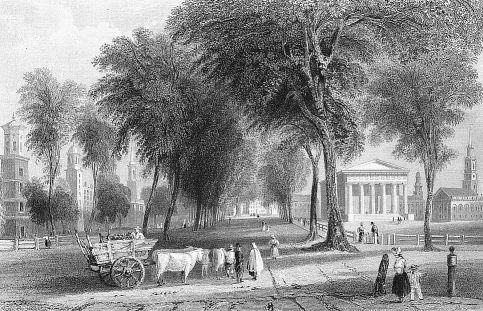
YALE COLLEGE AT NEWHAVEN.
Yale College was founded in the year 1700, sixty-five years after the erection of the first house in the Colony of Connecticut. Ten of the principal ministers, nominated by general consent of the clergy, met at New Haven, and formed themselves into a society, the object of which was to found a college in the colony. At their next meeting each brought a number of books, and presented them for the library, and the following year the Legislature granted them a charter, constituting them “Trustees of a Collegiate School in his Majesty’s Colony of Connecticut.”
The principal benefactor of the infant institution was the Hon. Elihu Yale, of London, Governor of the East India Company. This gentleman was descended from a family in Wales, which for many generations held the manor of Plas Grannow, near Rexon. His father, Thomas Yale, Esq., came from England with the first colonists of New Haven. In this town, Elihu, the subsequent benefactor of the College, was born, and at ten years of age he was sent to England. Thence he went to Hindostan, and after twenty years’ residence, was made Governor of Madras. He returned to London with an immense fortune, was chosen Governor of the East India Company, and died at Rexon in 1721. “This gentleman,” says the College historian, “sent, in several donations, to the Collegiate School, five hundred pounds sterling; and a little before his death, ordered goods to be sent out to the value of five hundred pounds more; but they were never received. In gratitude for this munificence, the Trustees, by a solemn act, named their seminary Yale College; a name which, it is believed, will convey the memory of his good works to distant generations.”
Among other benefactors to this institution was the Rev. Dr. Berkeley, Dean of Derry, in Ireland, and afterwards Bishop of Cloyne. This distinguished divine came to America in 1732, for the purpose of establishing a college in the island of Bermuda; a purpose to which he sacrificed considerable time, property and labour. He had been promised twenty thousand pounds by the ministry for the completion of this work, but the sum was never paid, and the project failed. Dr. Berkeley then bought a farm in Newport, Rhode Island, and while residing there, became acquainted with the circumstances of Yale College, and ultimately made the institution a present of his farm, and sent the Trustees from England “the finest collection of books that ever came at one time to America.”