Front matter (continued 3)
Reading edition
Since this period Yale College has continued to thrive in means and usefulness, and it is now, in the numbers of its students, and in its practical advantages, we believe, the first College in the United States. That of Harvard, (founded sixty or seventy years earlier,) is better endowed, but more expensive and less frequented. It is a curious fact, in the early history of nations, by the way, that the Act to incorporate Harvard College was passed, and the College in operation, ten years after the first settlement of the Colony.
The whole amount of fees of tuition at Yale College is about thirty-five dollars a year, near seven pounds sterling. Board and every expense included, it is thought in New England that three hundred dollars (60l.) a year is a sufficient allowance for the education of a boy at this institution. The course of study embraces four years, and the discipline is impartial and severe. Instances occur annually of degrees refused, and degradations of standing in consequence of failures in examination; and over the morals of the students, particularly, the vigilance of the faculty is untiring and effective.
Perhaps one of the best, and certainly one of the peculiar advantages of Yale College, is the extent and excellence of the society in New Haven, and its accessibility to the students. The town contains near ten thousand inhabitants, most of them people of education, connected in some way with the College; or opulent families drawn thither by the extreme beauty of the town, and its air of refinement and repose. The upper classes of students mingle freely in this simple and pure society, which, it is not too much to say, is one of the most elegant and highly cultivated in the world. Polished manners and the usages of social life are thus insensibly gained with improvement of mind; and in a country like this, where those advantages are not attainable by all in early life, the privilege is inestimable.
The college buildings of New Haven are more remarkable for their utility than for the beauty of their architecture; but, buried in trees, and standing on the ridge of a sloping green, they have altogether a beautiful effect, and an air of elegant and studious repose. Few strangers ever pass through New Haven without expressing a wish to take up their abode, and pass their days, among its picturesque avenues and gardens.
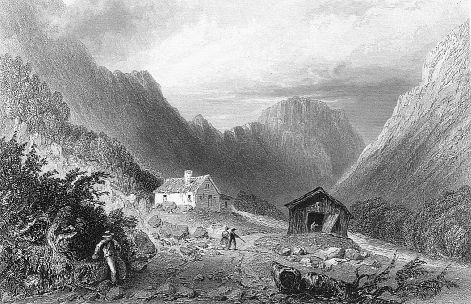
THE WILLEY-HOUSE—WHITE MOUNTAINS.
The particulars of what is called the Willey Tragedy are well known to all readers of newspapers. This family lived in the Notch of the White Mountains, under the western range, and consisted of nine persons. They had retired at night, when a very unusual noise in the mountains roused them from their beds, and, in terror at its increasing thunders, they unfortunately abandoned the house, and sought refuge in flight. A vast mass of earth and rocks, disengaged from the precipices above them, suddenly rushed down the side of the mountain, and sweeping every thing before it, divided in the rear of the house, reunited again, leaving it unharmed, and thundered down to the valley, overwhelming the fugitive family in its career. The manuscript journal of a friend, who had made two excursions to the spot, gives us an account of its present aspect.
“In a short time we came to the well-known house of the Willey family, which of course we paused to examine. Nothing can be conceived more lonely than this wild place. The mountains tower on both sides of the valley to the height of four or five hundred feet, with deep channels worn into their sides by the winter torrents; and in many places the rocks are left bare for acres by the slides of avalanches that have rushed into the valley. The house in which the unfortunate family dwelt stands under the western range of mountains, and the avalanche came down nearly from the summit. We remained gazing on the scene for some time. The sky above was clear, and spanned the interval between the mountains, seeming to rest on their summits, while a swift breeze drove over the hills below, in swift succession, a few thin and fleecy clouds. The wind entered the outer door of the desolate dwelling, which had been left open, with a broken chair set against it; and as it surged back and forth, violently shut and opened the inner doors, with a noise that seemed the voice of the very spirit of desolation. The effect was startling and dismal.”
This is, we believe, the most disastrous avalanche on record in this country, and the only one of any importance, which was merely a descent of earth and rocks. What is called a cloud-burst is not uncommon in the mountainous regions of the north; and there are several striking examples recorded.
In the autumn of 1784, in the latter part of the night, a deluge of water descended from Saddle Mountain, in Massachusetts. A family, which lived in a house at some distance from the foot of the mountain, not far from a brook, were suddenly awakened out of their sleep by the united roaring of the wind and the torrent. In their flight they hastily dressed themselves, and escaped from the house, the ground-floor of which was by this time six inches under water. When they returned in the morning, they found the house so completely swept away, that no part of it was left. The brook, through the channel of which this flood discharged itself, had never before, even in the highest freshets, approached the house by a considerable distance.
Subsequent examination of the mountain disclosed that the descent of water commenced not far from the summit; for two or three rods above the spot where the ground first began to be broken, the trees and shrubs appear to have been swept away by the violence of the deluge. The broken ground is, at first, not more than six feet wide, but rapidly becomes wider as it descends; so that within one hundred and fifty feet it is about three rods in breadth, and in the widest place five or six. Towards the lower limit its breadth gradually diminishes, until it terminates in a gutter, which in some places is five or six feet deep; this continues several rods, and then branches into other channels, which, though covered with leaves and moss, are discernible quite down to the brook at the foot of the mountain. The whole length of the broken ground is about one hundred and thirty rods. Towards the bottom there were standing the stumps of large trees, whose tops were broken off by the deluge; and above they were entirely swept away, not leaving a trace. By what means a mass of water, sufficient for these phenomena, is collected and suspended over the mountains, or what occasioned the disruption of the mass of earth and rock which overwhelmed the family in the White Mountains, are points not easily settled.
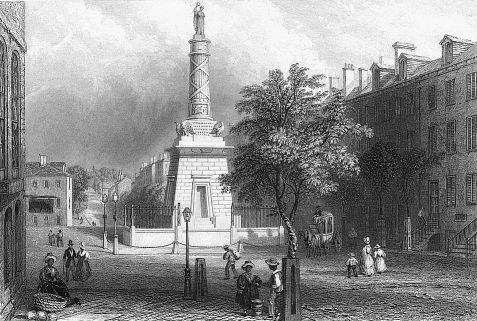
BATTLE MONUMENT, BALTIMORE.
This monument stands on the summit of a rising ground, in the centre of one of the best built squares of Baltimore, and is a very considerable ornament to the town. It is intended to commemorate the name and fame of those citizens of Baltimore who fell in its defence in 1814. An Egyptian base, raised to the height of about four feet from the pavement of the street, is surmounted by a column, representing fasces, upon the bands of which are placed in bronze letters the names of the thirty-nine citizens. On each angle of the base are griffins, and the lower part of the column is ornamented with bassi relievi, representing scenes of the contest. The whole is crowned by a statue personifying the city, with the eagle at her side, holding a laurel wreath. The entire height of the monument is fifty-two feet.
The defence of Baltimore was one of the most spirited of the many gallant actions on our sea-board and frontier during the late war; and it occurred more opportunely, as it followed so closely upon the defeat at Bladensburgh, which, though inevitable from the superior numbers of the enemy, was still accompanied with the mortification inseparable from such disaster.
After the embarkation of the troops under General Ross, (who had bought his victory at Bladensburgh with the loss of nearly a thousand men,) Admiral Cochrane concentrated his fleet, and made preparations for the attack on Baltimore. The whole squadron, amounting to forty vessels, sailed soon after for the Patapsco, and arriving near North Point, twelve miles from the city, the ships of the line anchored across the channel, and commenced the debarkation of troops. By the morning of the 12th of September about 8,000 soldiers, sailors, and marines, were in readiness to march upon the town, and sixteen bomb vessels and frigates proceeded up the river, and anchored within two miles and a half of Fort McHenry.
This garrison, which was mainly relied on for the protection of the city, was defended by about 5,000 men, and a detachment of about 3,000 was sent on by the North Point road to annoy or engage the enemy at his approach. Intelligence soon came in, that a light corps was advancing; and two companies of infantry, with a few riflemen, and ten artillerists with a single four-pounder, proceeded half a mile, and met and engaged the main body. The situation of the ground would not admit of the cooperation of the artillery and cavalry; and the infantry and riflemen sustained the whole action with great gallantry. The advance of the enemy was checked, and Major-General Ross and several other British officers killed.
The detachment now fell back upon the main line of the American force, and after some skirmishing with rockets and artillery at a distance, the whole force of the enemy pushed forward, and attacked the two regiments on the left with great impetuosity. These being thrown into confusion, a general fire was opened upon the British line, and a vigorous action followed, which lasted till four o’clock. At that hour the American force amounting to but about 1,400, and the British to about 7,000, General Stucker fell back upon the reserve regiment, and was joined by some other companies, who took position with him within half a mile of the entrenchments.
Early the following morning the Admiral made signals to the British officer in command on shore, that the frigates, bomb-ships, and flotilla of barges, would take their stations to bombard the town and fort in the course of the morning. The land forces accordingly moved forward, and took up a position two miles eastward of the entrenchments. The day was chiefly passed in manœuvring; but Colonel Brooke, after a vain attempt to make a detour through the country, concentrated the English force directly in front of the American line, drove in the outposts, and made preparations for an attack in the night.
The night was stormy; and in the morning it was discovered that the enemy had abandoned his position. The troops were re-embarked, and a bombardment commenced, which lasted till the following morning, during which a fleet of barges attempted to storm Fort Covington, but were repulsed with great loss. With the failure of this attempt the undertaking was abandoned altogether, and the fleet stood down the river.
When the bombardment commenced, the fort opened its batteries upon the ships; but, the shot falling short, the little garrison were compelled to keep their post without retaliation. There were four killed and twenty-four wounded in the entrenchments, and among the former were two very gallant young men, Lieutenants Clagett and Clem, volunteer officers.
The entire loss of the British could not be ascertained. That of the Americans on the field was about 150, which, added to those in the fort, makes a total of 178.
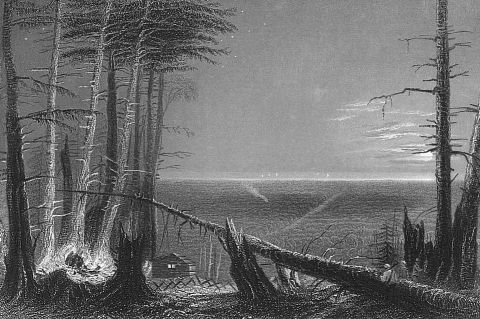
A FOREST, ON LAKE ONTARIO.
The view over this immense forest was taken in the Tuscarora reservation, from an Indian cabin, which serves as a sort of halting-place for travellers to Niagara. We arrived here about noon, emerging from a tract of deep woods which had darkened the road for several miles, and glancing off to the right, discovered that we were following a high ridge, from which extended, with a radius of forty miles, one unbroken sea of foliage. A thin silver line on the very rim of the horizon looked brighter than the sky, and we found on inquiry that it was Lake Ontario, which, with its thread of bright light, forms a limit to what, else, were an object as boundless as the sea.
An Indian woman of about forty, dressed very neatly, came out to offer for sale specimens of Indian workmanship, such as moccasins, pouches, &c.; and, among other things, a beautiful little model of a bark canoe. De Kalm, who travelled in this country in 1749, gives a very detailed account of the making of a canoe. He was going to Canada under the escort of a party of Indians, who, on coming to a portage of forty miles, between the Hudson and Lake Champlain, (now superseded by a canal,) were compelled to leave their canoe and build another.
“The making of the canoe,” he says, “took up half yesterday and all this day. To make such a boat, they pick out a thick, tall elm, with a smooth bark, and with as few branches as possible. This tree is cut down, and great care is taken to prevent the bark from being hurt by falling against other trees, or against the ground. With this view some do not fell the trees, but climb to the top of them, split the bark, and strip it off; which was the method our boat-builder took. The bark is split on one side, in a straight line along the tree, as long as the boat is intended to be; at the same time the bark is carefully cut from the stem a little way on both sides of the slit, that it may more easily separate. The bark is then peeled off very carefully, and particular care is taken not to make any holes in it; this is easy when the sap is in the trees; and at other seasons the tree is heated by the fire for that purpose.
“The bark thus stripped off is spread on the ground, in a smooth place, turning the inside downwards, and the rough outside upwards; and to stretch it better, some logs of wood or stones are carefully put on it, which press it down. Then the sides of the bark are gently bent upwards, in order to form the sides of the boat. Some sticks are then fixed into the ground at the distance of three or four feet from each other, in the curve line in which the sides of the boat are intended to be, supporting the bark intended for the sides. The sides of the bark are then bent in the form which the boat is to have, and according to that, the sticks are either put near or further off.
“The ribs of the canoe are made of thick branches of hickory, they being tough and pliable. They are cut into several flat pieces, about an inch thick, and bent into the form which the ribs require, according to their places in the broader or narrower part of the boat. The upper edge on each side is made of two thin poles, of the length of the boat, which are put close together on the side, being flat where they are joined. The edge of the bark is put between these two poles, and sewed up with threads of the mouse-wood, or other tough bark, or with roots.
“After this is done, the poles are sewed together, and being bent properly, both ends join at each end of the boat, where they are tied together with ropes. To prevent the widening of the boat at the top, three or four transverse bands are put across it, from one edge to the other, at the distance of thirty or forty inches from each other, made of hickory.
“As the bark at the two ends of the boat cannot be put so close together as to keep out the water, the crevices are stopped up with the crushed or pounded bark of the red elm, which in that state looks like oakum. Some pieces of bark are put on the ribs of the boat, without which the foot would easily pierce the thin and weak bottom. The side of the bark which runs next the wood thus becomes the outside of the boat, because it is smooth and slippery, and cuts the water with less difficulty than the other.
“The building of these boats is not always quick; for sometimes it happens that after peeling the bark off an elm, and carefully examining it, it is found pierced with holes and slits, or is too thin to venture one’s life in. That which we made was big enough to bear four persons, with our baggage, which weighed somewhat more than a man.
“All possible precautions must be taken in rowing on rivers with bark canoes; for when rowing fast, a broken branch under water would carry half the boat away. To get into it also requires great care, for the heels may very easily pierce through the bottom.”
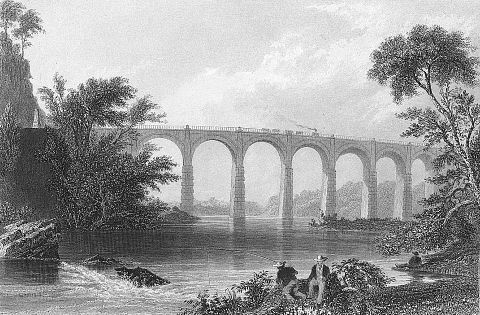
VIADUCT ON THE BALTIMORE AND WASHINGTON RAIL-ROAD.
The Patuxent, which is leaped over so lightly at this place by the arches of the Viaduct, becomes, ere long, a stream which is not only respectable in size, but most respectable in story. It will ever be associated with the name and fame of the gallant Barney, who, though his exertions could not prevent ultimate defeat, did much to sustain his country’s honour, and has made his own imperishable.
While the British squadron was blockading the eastern coast during the summer of 1814, Commodore Barney sailed from Baltimore in command of a flotilla consisting of a cutter, two gun-boats, a galley, and nine large barges, for the protection of the inlets and harbours in the several parts of the bay. On the 1st of June, being at the mouth of the Patuxent, he discovered two schooners, one of which carried eighteen guns; and immediately gave chase. The schooners were joined, however, by a large ship, which despatched a number of barges to their assistance; and the commodore sailed up the Patuxent to avoid being cut off from the Potomac. The schooners and barges following him, he engaged and drove them back, and then anchored within three miles of the seventy-four. In the course of a few days, the enemy was reinforced by a rasee and a sloop of war; and joining the barges of these vessels, they followed the flotilla into St. Leonard’s Creek, across which Commodore Barney formed his boats in line of battle. A sharp engagement ensued, the enemy gave way, and the flotilla pursued them to within a short distance of their shipping. In the afternoon, the enemy made another attempt with twenty barges and two schooners. After a warm action, the barges were driven back upon the eighteen-gun schooner, which, in attempting to beat out, was so severely handled, that her crew ran her aground and abandoned her. On the 26th, a corps of artillery arrived from Washington to the commodore’s assistance, and a combined attack was made on the whole squadron. The action continued two hours; at the end of which the enemy’s ships were driven from their anchorage, and stood down the river.
The cessation of hostilities in Europe, enabled the British government to send out powerful reinforcements to their fleets and armies in America; and Sir Alexander Cochrane soon arrived with thirty sail, having on board several thousand men, under command of Major General Ross. This force entered the Chesapeake, and a plan of attack on Washington, Alexandria, and Baltimore, was adopted. Admiral Cochrane very honourably informed the Secretary of State that he had orders to lay waste all the accessible towns on the coast; and the fleet, in two divisions, soon after approached the capital by the Potomac and the Patuxent.
In obedience to orders, Commodore Barney blew up his flotilla in the Patuxent, and with his seamen and marines, joined the army under General Winder. General Ross landed six thousand men at the head of frigate navigation, and, with five thousand, General Winder met him at Bladensburg. The action commenced at mid-day. Commodore Barney had been placed with his battery in the main road by which the enemy advanced; and after two or three vain attempts were made to pass him, the main column fell back in disorder, and it was found necessary to flank his right. The British were gaining ground, however, in every other part of the line; and Commodore Barney was soon left with his small force standing alone.
General Ross had now nearly complete command of the field; the ammunition waggons had been driven off in the disorder, and the commodore was reduced to a single round of cartridge. He had besides received a severe wound in the thigh. Thus situated, he gave reluctant orders for retreat; and after being carried a short distance, he fell, exhausted with loss of blood. He was soon after taken prisoner, and removed to the enemy’s hospital, where he was treated, by the orders of General Ross, with the greatest kindness; and, on his recovery, released on his parole.
After his victory at Bladensburgh, General Ross marched directly to the capital, and proceeded immediately to burn all the public buildings, library, &c. Then, as now, Washington was merely a diplomatic capital, very thinly populated; and the few inhabitants were unable to make any show of resistance. No comment is necessary on an act which the English nation itself was the first to condemn.
The division of the enemy’s fleet which sailed up the Potomac, consisting of eight sail, was directed to attack Alexandria. That small town surrendered, and obtained a stipulation, upon very ungenerous conditions, that their houses should not be entered or destroyed. Captain Gordon, who was in command, sailed soon after down the river with a fleet of prize vessels taken from the town, and a great amount of property. He received some damage from the batteries lower down, but joined the rest of the squadron in the Chesapeake, and accompanied them in their less successful attacks on Baltimore.
We think the “City of Monuments,” as the last-mentioned town is called, should erect a monument to the memory of Barney.
“A TRIBUTE TO THE BRAVE.
“Though furled be the banner of blood on the plain,
And rusted the sabre once crimsoned with gore;
Though hushed be the ravens that croaked o’er the slain,
And calmed into silence the battle’s loud roar;
Though Peace with her rosy smile gladden the vales,
And Commerce unshackled dance over the wave;
Though Music and Song may enliven the gales,
And Joy crown with roses and myrtle the brave;
Like spirits that start from the sleep of the dead,
Our heroes shall rouse when the ’larum shall blow;
Then Freedom’s broad flag on the wind shall be spread,
And Valour’s sword flash in the face of the foe.
Our Eagle shall rise ’mid the whirlwinds of war,
And dart through the dun cloud of battle his eye—
Shall spread his wide wings on the tempest afar,
O’er spirits of valour that conquer or die.
And ne’er shall the rage of the conflict be o’er,
And ne’er shall the warm blood of life cease to flow,
And still ’mid the smoke of the battle shall roam
Our Eagle—till scattered and fled be the foe.
When Peace shall disarm War’s dark brow of its frown,
And roses shall bloom on the soldier’s rude grave—
Then Honour shall weave of the laurel a crown,
That Beauty shall bind on the brow of the brave.”—Percival.
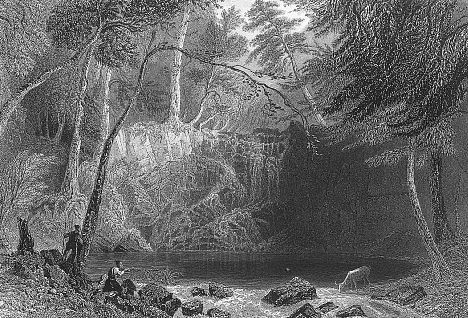
INDIAN FALLS,
OPPOSITE WEST POINT.
This is a secluded and delicious bit of nature, hidden amid rocks and woods, on the shore of the Hudson, but possessing a refinement and an elegance in its wildness which would almost give one the idea that it was an object of beauty in some royal park. One of the most secret streams that feed this finest of our rivers, finds its way down through a winding and almost trackless channel; and after fretting over rocks, and loitering in dark and limpid pools for several miles, suddenly bursts out over a precipice of fifty feet, and fills with its clear waters the sheltered basin seen in the drawing. Immense trees overhang it on every side, and follow the stream still on in its course; and, in the depth of summer, the foaming current scarcely catches a ray of the sun from its source to its outlet. The floor of the basin below the Falls is pebbly, the water is clear and cool, the spot secluded, and, in all respects, Nature has formed it for a bath. A fair and famous lady, residing a summer or two since at West Point, was its first known Musidora, and the limpid and bright basin is already called after her name.
A large party visiting at a hospitable house, where the artist and his travelling companion were entertained during the heat of the last summer, proposed to accompany him on his visit to the Indian Falls. Excursions on the banks of the Hudson are usually made in boats; but it was necessary to see some points of view from the hills between, and we walked out to the stables to see what could be done for vehicles and cattle. A farm waggon, with its tail up in the air, built after an old Dutch fashion, which still prevails in New York,—a sort of loosely jointed, long, lumbering vehicle, which was meant to go over any rock smaller than a beer-barrel without upsetting—was the only “consarn,” as the “help” called it, which would hold the party. With straw in the bottom, and straps put across from peg to peg, it would carry eleven, and the driver.
Horses were the next consideration; and here we were rather staggered. A vicious old mare, that kept a wheelwright and a surgeon in constant employ,—and a powerful young colt, half broken,—were the only steeds in stable. However either might be made to go alone, they had never been tried together; and the double waggon harness was the worse for service. The “help” suggested very sensibly that the load would be too heavy to run away with, and that if the mare kicked, or the colt bolted—or, in short, if any thing happened, except backing over a precipice, we had only to sit still and let them do their “darndest.”
We cobbled the harness in its weak spots, shook down the straw for the ladies, nailed up the tail-board, which had lost its rods, got the cattle in, and brought up quietly to the door. The ladies and the champagne were put in, and the colt was led off by the bit, shaking his head, and catching up his hind leg; while the demure old mare drew off tamely and steadily, “never wicked,” as the ploughman said, “till you got her dander up with a tough hill.” The driver had a chain with a list bottom, and, having had some practice in Charing Cross and Fleet Street, fingered his reins and flourished his maple whip through the village, evidently not thinking himself or his driving de la petite bière.
The road, which followed the ridges of the superb hills skirting the river opposite West Point, was, in some places, scarce fit even for a bridle-path; and, at every few paces, came a rock, which we believed passable when we had surged over it—not before. The two ill-matched animals drew to a wonder; and the ladies and the champagne had escaped all damage, till, as the enemy of mankind would have it, our ambitious whip saw stretching out before him a fair quarter of a mile of more even road. A slight touch of the whip sent off the colt in a jump, carrying away the off trace with the first spring; the old mare struck into a gallop, and, with the broken trace striking against the colt’s heels, and the whippletree parallel with the pole, away they went as nearly in a tandem as the remaining part of the harness would allow. The tail-board soon flew off, and let out two unsuspecting gentlemen, who had placed their backs and their reliance upon it; and the screams of the ladies added what was wanting to raise the “dander” of the old mare to its most unpleasant climax. The straps gave way, the ladies rolled together in the straw, the driver tossed about on his list-bottomed chain, the champagne corks flew,—and presently, as if we were driven by a battering-ram against a wall, we brought up with a tremendous crash, and stood still. We had come to a sharp turn in the road; and the horses, unable to turn, had leaped a low stone wall, and breaking clear of every thing, left us on one side, while they thrashed the ripe wheat with the whippletrees on the other.
The ladies were undamaged, fortunately; and, with one champagne bottle saved from the wreck, we completed the excursion to the Falls on foot, and were too happy to return by water.
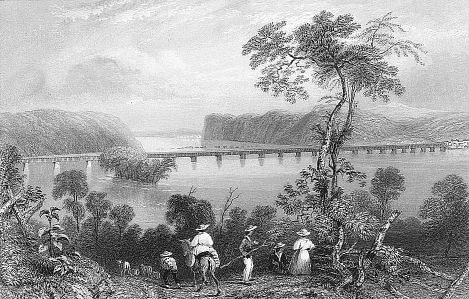
COLUMBIA BRIDGE, OVER THE SUSQUEHANNA.
This fine bridge is a mile and a half in length, and forms a beautiful span over the broad waters of the river at this place. The many windings of the Susquehanna make its shallowness and incapacity for navigation less a disadvantage than would have been felt on a more direct water-course; and the ingenuity and enterprise of the country in the construction of canals, bridges, and rail-roads, have left nothing to desire in the matter of facilities for travel. It is always a reasonable query to any, except a business traveller, whether the saving of time and fatigue in the wonderful improvements in locomotion is an equivalent for the loss of rough adventure and knowledge of the detail of a country acquired by hardship and delay. Contrast the journey over a rail-road at a pace of fifteen miles in the hour, through the rough, the picturesque valley of the Susquehanna, with a journey over the same ground ninety years ago, as presented in the travels of Peter Kalm. He was on horseback, with Indian guides.
“About sunset it cleared up, and we encamped on the east branch of the Susquehanna. In the night it thundered and rained very fast, and took us at a disadvantage; for we had made no shelter to keep off the rain, neither could we see it till just over our heads, and it began to fall.
“One of our Indians cut four sticks, five feet long, and stuck both ends in the ground, at two feet distance one from another; over these he spread his watch-coat, and crept through them, and then fell to singing. In the mean time, we were setting poles slantwise in the ground, tying others across them; over which we spread our blanket, and crept close under it, with a fire before us, and fell fast asleep. I waked a little after midnight and found our fire almost out; so I got the hatchet and felled a few saplings, which I laid on, and made a rousing fire, though it rained stoutly; and lying down once more, I slept sound all night.
“In the morning, when we had dried our blankets, we kept along the side of a hill, and looked about us, not having had such an opportunity for two days, on account of the forest. The valley differed from all I had ever seen before, in its easy and fruitful ascent and descent,—in its great width, everywhere crowned with noble and lofty woods,—but above all, in being entirely free from naked rocks and sharp precipices.”
A night or two after, our traveller fell in with a variety of Indian character I never have seen noticed elsewhere:—
“Soon after we were laid down to sleep, and our fire almost burnt out, we were entertained by a comical fellow, disguised in as odd a dress as Indian folly could invent. He had on a clumsy vizard of wood, coloured black, with a nose four or five inches long, a grinning mouth set awry, and furnished with long teeth; round the eyes were circles of bright brass, surrounded by a larger circle of white paint. From his forehead hung long tresses of buffalo’s hair; and from the catch part of his head (his tuft) hung ropes, made of the plaited husks of Indian corn.
“I cannot recollect the whole of his dress, but that it was equally uncouth. He carried in one hand a large staff, in the other a calabash, with small stones in it for a rattle; and this he rubbed up and down with his staff. He came in at the further end of the wigwam, and, holding up his head, made a noise like the braying of an ass. I asked Weisar, who, as well as myself, lay next the alley, what noise that was. Shickalamy, the chief, who thought I was scared, called out, ‘Lie still, John!’ I never heard him speak so much English before.
“The jack-pudding presently came up to us, and an Indian boy came with him and kindled our fire, that we might see his glittering eyes and antic postures, as he hobbled round the fire. Sometimes he would turn the buffalo’s hair on one side, that we might take a better view of his ill-favoured phiz. When he had tired himself, (which was some time after he had well tired us,) the boy that attended him struck two or three smart blows on the floor, at which the hobgoblin seemed surprised; and, on repeating them, he jumped fairly out of doors and disappeared.
“I suppose this was to divert us, and get some tobacco; for, as he danced about, he would hold out his hand to receive this gratification, for which, as often as he received it, he would return an awkward compliment. After this farce, we endeavoured to compose ourselves to sleep, but towards morning were again disturbed by a drunken squaw coming into the cabin, frequently complimenting us and singing.”
We doubt if any traveller’s journal on the Mauch Chunk rail-road can show as diverting a page. There are no incidents now-a-days short of a boiler bursting.
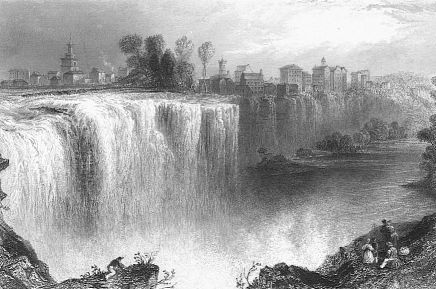
GENESSEE FALLS, ROCHESTER.
In the three thousand miles between the Atlantic and the Rocky Mountains, there may be said to be three water-steps formed by the different levels of Lake Ontario, Lake Erie, and Lake Superior. Niagara and the Genessee river fall over the middle step, the edge of which is formed by the brow of a bed of limestone, computed to be four hundred and ten feet above the level of Lake Ontario. Saint Lawrence may thus be said to take but three leaps from the Rocky Mountains to the ocean—an agility which, one would suppose, might have saved the holy martyr from his gridiron.
The ledge over which these two celebrated falls are precipitated, comes out of Canada from an immense distance, and keeps its course along the shore of Lake Ontario, in a direction nearly due east. At the Genessee Falls, as at Niagara, the descent to the lake is between the walls of a tremendous ravine, the grandeur of which seems to have had no terror for the souls of manufacturers. The thriving village of Rochester stands round the lip of the fall; and if you talk to the inhabitants of the beauty of the cascade, they stop your mouth, and strike calculation dumb, with the number of sledge-hammers, nail-cutters, mill-stones, and cotton-jennies, it carries; the product per diem; the corresponding increase of population, et cetera et cetera—the only instance in the known world of a cataract turned, without the loss of a drop, through the pockets of speculators.
The Genessee river rises in the Alleghany Mountains, and it is not for want of poetical names on its banks that it is not a poetical river. Its source is ten miles below Nunda, between the head waters of the Owago and the Cawanisque rivers; and it runs one hundred and fifty miles, receiving tribute from the Canassaraga and Angelica creeks, and the Canesus and Honcoye outlets. It has a great reputation for fertility; and along its valley lies the celebrated farm of Mr. Wadsworth, the agriculturist, who holds in this country the place occupied in England by Mr. Coke of Holkham—now Earl of Leicester.
The Rapids of the Genessee commence a mile above the Fall at Rochester, and descend, when there is much water, with great swiftness and beauty. The first pitch of the stream is ninety-seven perpendicular feet; after which it goes sullenly on down the ravine—black, where it is not covered with foam—till, forty rods below, it takes another leap of one hundred and six feet, at a place called Carthage. We suggested to the landlord that the fall at Carthage should be called after Marius, but he did not see the propriety of it very clearly.
The Genessee Fall, like Niagara, is gradually backing up. It is computed that the latter wears back a rood every three years—the former much less, of course. There is little doubt among the geologists, that the Genessee at one time ran directly into Lake Ontario without much of a cascade, but that, on the retreat of the lake, the surface of which has perceptibly lowered, the stream began to wear back with the attrition of the fall, and they are now three miles asunder. An aqueduct of the great Erie canal runs close across the head of the Fall at Rochester, and is built in full confidence that the cascade will continue the sobriety and order it has hitherto preserved in its retreat. If it were to take a long step up stream of a sudden, that great vein of the west would breathe more freely than is provided for by the “weirs and feeders.” This aqueduct at Rochester is a work of some pretension. It is seven hundred and fifty feet in length, and has twelve piers and eleven arches, two of which are over Mill-races. A path is railed off on the side of the canal, and it forms a picturesque promenade across the bed of the river.
The country about the Falls of the Genessee was a wilderness in 1812. Now it contains nearly twenty thousand inhabitants, and is one of the most flourishing towns in the world. In 1830, it supported one daily, two semi-weekly, and three weekly newspapers; and in the single year of 1826, (an age ago, by the Rochester reckoning,) it exported two hundred and two thousand nine hundred barrels of flour. It seems to grow visibly before your eyes; the eternal hammering and clipping of bricks, and heaps of rubbish, remind the traveller so pertinaciously that it is in a state of transition only. The hotels are excellent, and the inhabitants famed for their public spirit, hospitality, and enterprise—the latter, of course.
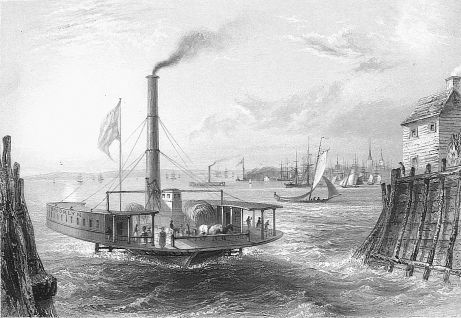
VIEW OF THE FERRY AT BROOKLYN, NEW YORK
Brooklyn is as much a part of New York, for all purposes of residence and communication, as “the Borough” is of London. The steam ferry-boats cross the half-mile between it and the city every five minutes; and in less time than it usually takes to thread the press of vehicles on London Bridge, the elegant equipages of the wealthy cross to Long Island for the afternoon drive; morning visits are interchanged between the residents in both places—and, indeed, the east river is hardly more of a separation than the same distance in a street.
Brooklyn is the shire-town of King’s County, and by this time, probably, is second in population only to New York. Land there, has risen in value to an enormous extent within the last few years; and it has become the fashion for business-men of New York to build and live on the fine and healthy heights above the river, where they are nearer their business, and much better situated than in the outskirts of the city itself. The town of Brooklyn is built on the summit and sides of an elevation springing directly from the bank of the river, and commanding some of the finest views in America. The prospect embraces a large part of East River, crowded with shipping, and tracked by an endless variety of steamers, flying through the channel in quick succession; of the city of New York, extending, as far as the eye can see, in closely piled masses of architecture; of the Hudson, and the shore of Jersey, beyond; of the bay and its bright islands, and of a considerable part of Long and Staten Islands, and the Highlands of Neversink. A more comprehensive, lively, and interesting view is nowhere to be found.
Historically, Brooklyn will long be remembered for the battle fought in its neighbourhood between the British and Hessians under the command of General Howe, and the Americans under the immediate command of Generals Putnam and Sullivan. It was a contest of a body of ill-disciplined militia against twice their number of regular troops, and ended in defeat; but the retreat conducted by General Washington saved the army, and relieved a little the dark fortunes of the day.
The American forces were composed of militia and raw recruits, and without even dragoons to serve as videts. They were stationed on a chain of eminences running from Yellow Hook towards Hempstead; and the British, from the Ferry between Staten and Long Islands, through the level country to the village of Flatland. From the last-mentioned place, a strong column, led by General Clinton and Lord Percy, marched into the Jamaica Road, through an unoccupied pass in this chain of hills on the right, and turned the left of the American army. General Grant at the same time attacked the right of the Americans under the command of Lord Sterling, posted near the Ferry; while the fleet commenced a powerful cannonade upon a battery at Red Hook, to draw off the attention of the Americans from the main attack directed by Sir Henry Clinton.
As soon as the Americans perceived that the enemy had gained the rear, they were thrown into confusion, and attacks were made on the centre, commanded by General Sullivan, and the right, commanded by Lord Stirling, and both divisions completely routed. A gallant attempt was made by the latter officer, which, though unavailing, facilitated the retreat of part of the troops under his command. He was himself taken prisoner, as were also Generals Sullivan and Woodhull. The number of Americans killed is estimated at four hundred, and the wounded and prisoners at a thousand.
General Washington, who had passed over from New York to Brooklyn during the heat of the action, perceived that nothing could be done to turn the fortune of the day, and that the only thing to be accomplished was a retreat. The British were only waiting for a wind to move their shipping into the East River, and the next morning might find the ferry in their possession. The British were encamped within six hundred yards of him; and the wind, until eleven o’clock, was unfavourable. At that hour it lulled, and a thick fog covered the bosom of the river. The army commenced their embarkation under this fortunate protection; and the whole of the forces, with their ammunition, provision, horses, waggons, &c. crossed undisturbed. The retreat was discovered by the British half an hour after the evacuation. The sound of their pickaxes was distinctly heard within the American lines during the embarkation.
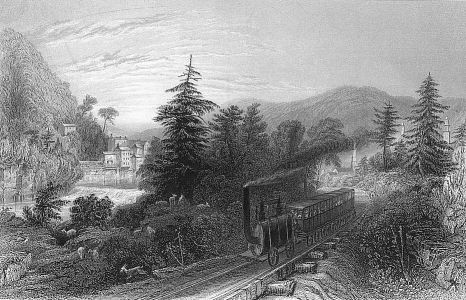
VIEW OF THE RAIL-ROAD TO UTICA,
TAKEN AT LITTLE FALLS.
Before the completion of the Rail-road, when travellers to the West were contented with the philosophic pace of the canal-boat, one might take up a novel at Little Falls, and come fairly to the sequel by the time the steersman cried out “Bridge!” at Utica. There were fifteen miles between them in those days; but now (to a man of indistinct ideas of geography, at least, and a traveller on the Rail-road) they are as nearly run together as two drops on the window-pane. The intermediate distance is, by all the usual measurements of wear and time, annihilated.
All this is very pleasant to people in a hurry; and as most people in our busy country come under that category, it is a very pleasant thing for the white man altogether. There is a class of inhabitants of the long valley of the Mohawk, however, of whose sufferings, by the advance of the white man’s enterprise, this is not the first, though it may be the least, and last. The poor half-naked Oneida, who ran by the side of the once crowded canal-boat for charity, has not time, while the rail-car passes, even to hold out his hand!
The Oneidas have not long been beggars by the road side. They were one of the five tribes confederated under the name of the Iroquois, who gloried in having fought their way into the country of the Mohawks, and kept their place and possessions in the midst of them; the latter tribe enjoying the undisputed honour of being an original people on the soil. Though merged in a confederacy, however, the Oneidas had their own chiefs; and a mythology of their own, which is not a little curious. It will not be mal-apropos, accompanying drawings of the towns that have usurped their ancient seat, to give some account of their ideas upon the origin of the earth and the human race.
According to the Oneida, an unlimited expanse of water once filled the space now occupied by the world which we inhabit. At this time the human family dwelt in a country situated in the upper regions of the air, abounding in every thing conducive to the comfort and pleasure of life. The inhabitants were strangers to death, and its harbingers, pain and disease; whilst their minds were free from the corroding passions of jealousy, hatred, and revenge.
At length, however, an event occurred which interrupted their tranquillity, and introduced care and anxiety, until then unknown. A certain youth was noticed to withdraw himself from the circle of their social amusements: the solitary recesses of the grove became his favourite walks. Care and chagrin were depicted in his countenance, and his body, from long abstinence, presented to the view of his friends the mere skeleton of a man. Anxious solicitude in vain explored the cause of his grief; until, at length, debilitated both in body and mind, he yielded to the importunity of his associates, and promised to disclose the cause of his trouble on condition that they would dig up by the roots a certain white pine-tree, lay him in his blanket by the margin of the hole, and seat his wife by his side. In a moment all hands were ready. The fatal tree was taken up by the roots; in doing which, the earth was perforated, and a passage opened into the abyss below. The blanket was spread by the hole, the youth laid upon it, and his wife, then in a state of pregnancy, took her seat by his side. The multitude, eager to learn the cause of such strange and unusual conduct, pressed around; when, on a sudden, to their horror and astonishment, he seized upon the woman, and precipitated her headlong into the regions of darkness below; then, rising from the ground, he informed the assembly, that he had for some time suspected the chastity of his wife, and that, having now disposed of the cause of his trouble, he should soon recover his usual health and vivacity.
All those amphibious animals which now inhabit this world then roamed through the watery waste to which the woman, in her fall, was hastening. The Loon first discovered her coming, and called a council in haste to prepare for her reception; observing, that the animal which approached was a human being, and that earth was indispensably necessary for its accommodation. The first subject of deliberation was, who should support the burden.
The sea-bear first presented himself for a trial of his strength. Instantly the other animals gathered round and scrambled on his back; while the bear, unable to support the weight, sank beneath the surface of the water, and was, by the whole assembly, judged unequal to the task of supporting the earth. Several others in succession presented themselves as candidates for the honour, with similar success. Last of all the turtle modestly advanced, tendering his broad shell as the basis of the earth now about to be formed. The beasts then made a trial of his strength to bear, heaping themselves on his back; and finding their united pressure unable to sink him below the surface, adjudged to him the honour of supporting the world.
A foundation being thus provided, the next subject of deliberation was, how to procure earth. Several of the most expert divers plunged to the bottom of the sea, and came up dead; but the mink, at last, though he shared the fate of the others, brought up in his claws a small quantity of earth. This was placed on the back of the turtle.
In the mean time, the woman continued falling, and, at length, alighted on the turtle’s back. The earth had already grown to the size of a man’s foot, where she stood, with one foot covering the other. Shortly, she had room for both feet, and was soon able to sit down. The earth continued to expand; and when its plain was covered with verdure, and traced with streams, which poured into the ocean, she erected her habitation on the sea-shore.
Not long after, she was delivered of a daughter, and was supported by the spontaneous productions of the earth, till the child arrived to womanhood. She was then solicited in marriage by several animals, changed into the forms of young men; but they were rejected successively by the mother, until the turtle offered himself as a suitor, and was received. After she had laid herself down to sleep, the turtle placed two arrows on her body, in the form of a cross—one headed with flint, the other with the rough bark of a tree. In due time she was delivered of two sons, but died in child-birth.
The grandmother, enraged at her daughter’s death, resolved to destroy them, and threw them into the sea. Scarcely had she reached her wigwam, when the children overtook her at the door. She then concluded to let them live; and, dividing the corpse of her daughter in two parts, she threw them up towards the heavens, where one became the sun, the other the moon. Then first began the succession of day and night. The children speedily became men, and expert archers. The elder had the arrow of the turtle which was pointed with flint; the younger had the arrow headed with bark. The former was, by his malignant disposition, and his skill and success in hunting, a favourite with his grandmother. They lived in the midst of plenty, but would not permit the younger brother, whose arrow was insufficient to kill any thing larger than birds, to share in their abundance.
As this young man was wandering one day along the shore, he saw a bird perched on a bough, projecting over the water. He attempted to kill it; but his arrow, till that time unerring, flew wide of the mark, and sank in the sea. He determined to recover it, and plunged to the bottom. Here, to his astonishment, he found himself in a small cottage. A venerable old man, sitting there, received him with a smile, and thus addressed him:—“My son, I welcome you to the habitation of your father! To obtain this interview, I directed all the circumstances which have conspired to bring you hither. Here is your arrow, and here is an ear of corn. I have watched the unkindness of your brother, and command you to take his life. When you return home, collect all the flints you can find, and hang up all the bucks’-horns. These are the only things which will make an impression on his body, which is made of flint.”
Having received these instructions, the young man took his leave, and, in a quarrel with his brother, drove him to a distant region, far beyond the Savannahs, in the south-west, where he killed him, and left his huge form of flint on the earth. The great enemy to the race of the turtle being thus destroyed, they sprang from the ground in human form, and multiplied in peace.
The grandmother, roused to furious resentment for the loss of her favourite son, resolved to be revenged. For many days successively she caused the rain to descend from the clouds in torrents, until the whole surface of the earth, and even the highest mountains, were covered. The inhabitants escaped by fleeing to their canoes. She then covered the earth with snow; but they betook themselves to their snow-shoes. She then gave up the hope of destroying them at once, and has ever since employed herself in inflicting lesser evils on the world, while her younger son displays his benevolence by showering blessings on his race.
The reader will have traced the analogy between this and the Scripture account of the deluge, &c.
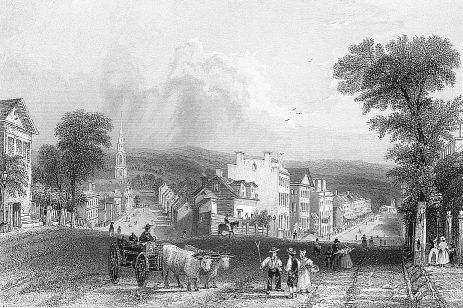
UTICA.
This long tradition has left us little room for Utica, which truly is among those spots (said to be the happiest in the world) with no striking events in its history. It is a pretty and thriving town, half way between Lake Ontario and the Susquehanna, and on the great routes by canal, road, and rail-road, to the west; and in the centre of these radii of communication is fast becoming a focus of wealth and refinement. A high reputation for the latter, however, its society has long and deservedly enjoyed.
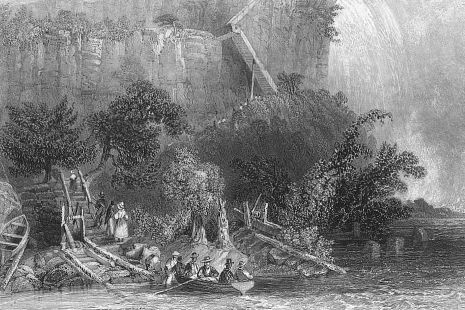
THE LANDING ON THE AMERICAN SIDE.
(FALLS OF NIAGARA.)
The cliff and staircase at this Landing would be considered highly picturesque any where but at the side of Niagara. The hundred stairs clinging to the rock, the wild vines overgrowing the temporary shed under which travellers take shelter from the spray, the descending and ascending figures, and the athletic boatmen, whose occupation of pulling across this troubled ferry requires herculean strength and proportions, all form a subject for the painter, which could only be disregarded amid the engrossing scenes of Niagara.
There is another staircase extending down the precipitous front of Goat Island, between the two cataracts, which is less picturesque in itself, but much more daring in its position. One marvels at first how it ever was constructed; but a story told in an old book of travels, published in London in 1750, shows that human feet have stood on the isolated and quaking cliff below, and returned again to the summit without the aid of mechanical science. The narrator is a Mr. Peter Kalm, a Swedish gentleman, then on his travels in America:—
“It was formerly thought impossible for any body living to come at the island that is in the middle of the Fall; but an accident that happened twelve years ago made it appear otherwise. The history is this:—Two Indians of the Six Nations went out from Niagara Fort to hunt upon an island that is in the middle of the river, or strait, some miles above the great Fall, on which there used to be abundance of deer. They took some French brandy with them from the fort, which they tasted several times as they were carrying their canoe around the Fall; and when they were in the canoe, they now and then took a dram, and so went along up the strait toward the island where they proposed to hunt; but growing sleepy, they laid themselves down in the canoe, which getting loose, drove back with the stream farther and farther down, till it came nigh that island that is in the middle of the Fall. Here, one of them, awakened by the noise, cries out to the other that they were gone!—yet they tried if possible to save life. This island between the Falls was nighest, and with much working they got there. At first, they were glad; but when they had considered every thing, they thought themselves hardly in a better state than if they had gone down the Fall, since they had now no other choice than either to throw themselves down the same, or to perish with hunger: but hard necessity put them on invention. At the lower end of the island the rock is perpendicular, and there is a break in the fall. The island having plenty of wood, they went to work directly and made a ladder, or shrouds, of the bark of linden tree, which is very tough and strong, so long, that it would reach to the edge of the water below. One end of this bark ladder they tied fast to a great tree that grew at the side of the rock above the Fall, and let the other end down to the water.
“So they went down their new-invented stairs; and when they came to the bottom in the middle of the Fall, they rested a little; and as the water next below the Fall is not rapid, they threw themselves out into it, thinking to swim on shore. Hardly had the Indians began to swim, before the waves of the eddy threw them with violence against the rock from whence they started. They tried it several times, but at last were weary, and being often thrown against the rock they were much bruised, and the skin of their bodies torn in many places. So they were obliged to climb up their stairs again to the island, not knowing what to do. After some time they perceived Indians on the opposite shore, to whom they cried out. These two pitied them, but gave them little hopes of help; yet they made haste down to the fort, and told the French commander where two of their brethren were. He persuaded them to try all possible means of relieving the two poor Indians; and it was done in this manner. The water that runs on the east side of the island is shallow, and breaks in rapids over the rocks. The commandant caused poles to be made and pointed with iron: two Indians determined to walk to this island by the help of these poles to save the others, or perish. They took leave of their friends as if they were going to death. Each had two such poles in his hands to set against the bottom of the stream to keep them steady: so they went and got to the island, and having given poles to the poor Indians there, they all returned safely to the main. The unfortunate creatures had been nine days on the island, and were almost starved to death.”
A bridge is now thrown across where these adventurous Indians made their passage. If the story be true, it is one of the most gallant feats on record.
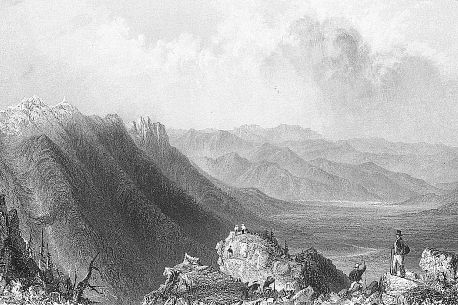
VIEW FROM MOUNT WASHINGTON.
Of two attempts to obtain a view from the summit of Mount Washington, the MS. Journal from which we have already made extracts, gives an interesting account of one which the weather rendered unsuccessful.
“The morning opened with every symptom of a fine day for the ascent. We had an early breakfast, and started a little before six, with the intention of first ascending Mount Clinton, and afterwards Mount Washington. Before we came to the peak of Clinton, however, a thick mist had swept over the mountains, which grew heavier and heavier. At the beginning of the granite pile that caps Mount Washington, a heavy wind with violent rain came on, and, as we climbed upwards, the storm increased, and the cold became every moment more intense. In four hours we reached the summit, thoroughly drenched, and stiff as icicles. The rain beat across the peak with tremendous force, and it was with difficulty we could stand. Below us was a sea of mist, around us a howling tempest, and our only resource was to seek the shelter of a rock, and seek consolation in the guide’s knapsack. Though my hands were so benumbed with cold, and my limbs so heavy with the water which had been driven into every thread of my dress that I could hardly raise the food to my lips, I contrived to cut the cork of a bottle of champagne, and its sparkling contents sent a momentary and grateful thrill through my veins: when it had passed, however, I was colder than ever.
“We found so few attractions on the mountain that we soon began our descent towards Ethan Crawford’s, but were so blinded by the tempest that the guide could not at once discover the way. Half an hour we wandered about in absolute uncertainty whether we should get down the mountain, or bide the peltings of the storm through the night. We hit at last upon the path, and after some sharp scrambling reached the wood, the friendly shelter of which afforded us a most welcome protection from the rain. The path was execrable, owing to the heavy rain, and the trampling of the horses of another party who had gone up before us; but at four we arrived at our destination, tired, cold, wet, and hungry. A change of dress, a roaring fire, and a substantial dinner, soon put us in better condition and humour.”
From a more successful attempt by the same gentleman, we take the following description of the view from Mount Washington.
“The light streamed down through breaks in the clouds on the scenery below in such masses, and in such a manner, as to bring out fully and distinctly all the leading points in the immeasurable panorama. In our immediate neighbourhood, but far below us, lay on one side, Mounts Clinton, Pleasant, Monroe, and Franklin; on the other, Jefferson, Adams, and Madison. On the east and west, openings were visible, through which several rivers, taking their rise in the mountains, wound their way and widened their valleys toward the lowlands. Far in the distance, chains of hills and mountains, distinct in outline and beautiful in form, arose on all sides; and these were still overtopped by others beyond, whose blue summits mingled with the sky, and shut in the overpowering scene. Far to the south, the bright sheet of Lake Winipiseogee met the eye, and with its calm and gem-like beauty, set, as it were, in a frame-work of distant hills, relieved and contrasted the bewildering and boundless majesty which encircled the mountain. On the west the green mountains of Vermont, and on the east the mountains of Maine, skirted the horizon, and seemed to support the heavens. Occasionally, a cloud would rest for a few moments on some distant or neighbouring summit, but during the whole of our visit the awful head of Mount Washington was surrounded by a pure atmosphere and the clearest light.”
Mount Washington was ascended by several scientific gentlemen in July, 1784. The historian of the expedition records that one of the company had taken a thermometer from his bosom, when it stood at fever heat, and it fell to 44°; and that, during the time he was adjusting a barometer and thermometer, the cold nearly deprived him of the use of his fingers.
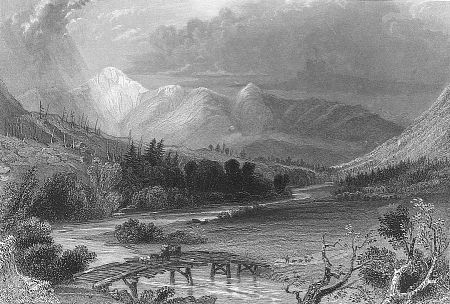
MOUNT WASHINGTON AND THE WHITE HILLS.
(FROM NEAR CRAWFORD’S.)
The White Hills have a double claim to their title—one founded upon the fact, that, for nine, ten, and sometimes eleven months in the year, they are covered with snow; and the other, that, in all clear days, (the only times in which they can be distinctly seen,) white fleecy clouds resting upon them, give them a white aspect. When viewed from a neighbouring position, they are always, except where snow lies, or the rocks are naked, shrouded in misty azure.
The height of these mountains has been a subject of much dispute. A scientific gentleman, whose remarks on physical subjects merit consideration and respect, supposes the summit of Mount Washington to be about seven thousand eight hundred feet above the level of the ocean; seventy-two feet below the point, which, in the latitude of 44° 15´ (that of these mountains) is the estimated point of perpetual congelation on the eastern continent. This point, he says, from the greater coldness of the American climate, cannot exceed, but must rather fall short, of what it is in the European climate. The climates of America are indeed colder than those of Europe in the same latitude during the winter, but in the summer they are generally much hotter. Nor are the mountains in any part of New England of sufficient height and extent to lessen materially the degree of heat generally prevailing. The air on the summit of Mount Washington, therefore, must continually be rendered less cold by the ascent of the intensely heated atmosphere from the subjacent regions. As the whole country partakes of this heat, the ascending volume, whencesoever derived, must be heated to nearly the same temperature. It seems scarcely credible, therefore, that the temperature of the atmosphere around the single point of Mount Washington should not, during the summer, be sensibly raised by the general heat of the country: for we are to remember that this is the only height in the United States which approximates near to the region of perpetual frost.
The following observations of Dr. Cutler exhibit the state of vegetation on these mountains:—
“At the base of the summit of Mount Washington, the limits of vegetation may with propriety be fixed. There are indeed, on some of the rocks, even to their apices, scattered specks of a mossy appearance; but I conceive them to be extraneous substances accidentally adhering to the rocks, for I could not discover, with my botanical microscope, any part of that plant regularly formed. The limits of vegetation at the base of this summit are as well defined as that between the woods and the bald and mossy part. So striking is the appearance, that, at a considerable distance, the mind is impressed with the idea that vegetation extends no farther than a line, as well defined as the penumbra and shadow in a lunar eclipse. The stones that I have by me from the summit have not the smallest appearance of moss upon them.
“There is evidently the appearance of three zones—the woods, the bald, mossy part, and the part above vegetation. The same appearance has been observed on the Alps, and all other high mountains.
“I recollect no grass on the plain. The spaces between the rocks in the second zone and on the plain are filled with spruce and fir, which, perhaps, have been growing ever since the deluge; and yet many of them have not attained a greater height than three or four inches; but their spreading tops are so thick and strong as to support the weight of a man without yielding in the slightest degree. In many places on the sides we could get glades of this growth some rods in extent, when we could, by sitting down on our feet, slide the whole length. The tops of the growth of wood were so thick and firm as to bear us currently a considerable distance before we arrived at the utmost boundaries, which were almost as well defined as the water on the shore of a pond. The tops of the wood had the appearance of having been shorn off, exhibiting a smooth surface from their upper limits to a great distance down the mountains.”
On the summit of Mount Washington there is usually little or no snow. That which is so long visible in the regions below is blown from the summit, and the north-western side, and lies only on the southern and south-eastern, where it is defended from every cold wind by the precipice above, and exposed through June, July, and sometimes a part of August, to the full strength of the sun.
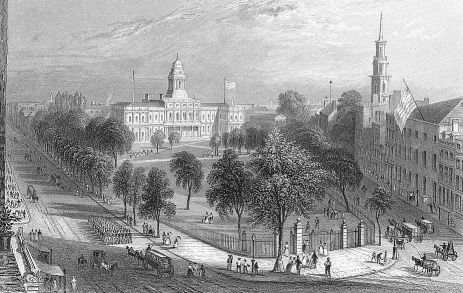
THE PARK AND CITY HALL, NEW YORK.
The first Stadt Huys in this city was constructed of stone, and stood originally at the head of Coenties Slip, facing on Pearl Street, towards the East river. It was built as early in the Dutch dynasty as 1642, and became so weakened and impaired in half a century afterwards, that the court sitting there recommended it to be sold, and another to be constructed. In 1699, they sold the old building for nine hundred and twenty pounds, “reserving only the bell, the king’s arms, and iron works (fetters) belonging to the prison.” By the agreement, leave was granted “that the cage, pillory, and stocks, before the same, be removed any time within one year, and the prisoners in the city hall to remain one month.” “In front of all these, on the river, was placed the Rondeal, or Half-Moon Fort, where it probably assisted the party sheltered in the City Hall, while the civil war prevailed.”
The new building must have been finished in 1700. It stood at the head of Broad Street, fronting on Wall Street; and its lower story formed an open arcade over the foot pavement. It was also the proper prison of the city, and had before it, on Broad Street, a whipping-post, pillory, &c. There were also held the sessions of the Provincial Assembly, the Supreme Court, and the Mayor and Admiralty Courts. It was finally altered to suit the Congress; and at that time the prisoners were moved to the new jail in the park; but the Congress removing to Philadelphia, it was again altered to receive the courts and the State Assembly.
“It was in the gallery of the old City Hall, on Wall Street,” says Watson in his Annals, “that General Washington was inaugurated the first President of the United States. The oath of office was taken in the open gallery in front of the Senate Chamber, in the view of an immense concourse of citizens. There this nobleman of nature, with his noble height and port, in a suit of dark silk velvet of the old cut, steel-hilted small sword by his side, hair in bag and full powdered, in black silk hose, and shoes with silver buckles, made his pledge on a quarto Bible, still preserved in St. John’s Lodge. How uprightly, intelligently, and disinterestedly, he executed his task, history will never cease to tell to his fame and glory.”
The present City Hall was erected in 1803, at an expense of half a million of dollars. The front and sides are constructed of white marble, and the remainder of red sandstone. It is a beautiful edifice, and only wants elevation. When the trees of the park are in full leaf, it is difficult to get an entire view of it.
The park is the centre of New York, and its two most thronged and finest avenues form the two sides of it. Broadway, the much crowded and much praised Broadway, the Corso, the Toledo, the Regent Street, of New York, pours its tide of population past the western side of the verdant triangle, and, just at the park, its crowd and its bustle are thickest. Broadway is a noble street, and on its broad side-walks may be seen every thing that walks the world in the shape of a foreigner, or a fashion—beauties by the score, and men of business by the thousand; but, besides every possible ingredient of continental crowds, there are to be seen in Broadway two additional classes of peripatetics seen never on foreign pavés but in rare specimens—coloured dandies, and belligerent pigs. The former take the wall of you, and the latter, when the question of passing on one side or the other becomes embarrassing, escape with great dexterity between your legs.
It would be difficult in one day to describe the prevailing style of dress in Broadway, for fashions have become unfashionable, and each man and woman dresses as Fortune pleases. But here is a picture of dresses in Broadway a century ago:—
“Men wore three-square, or cocked hats, and wigs; coats with large cuffs, and big skirts lined and stiffened with buckram. The coat of a beau had three or four large plaits in the skirts, and wadding, like a coverlet, to keep them smooth. The cuffs were very large, up to the elbows, open below, and loaded with lead to keep them down. The cape was thin and low, so as readily to expose the close-plaited neck-stock of fine linen cambric, and the large silver stock-buckle on the back of the neck. The shirts were worn with hand-ruffles, and sleeve-buttons were worn at the wrist, of precious stones, or gold. The little boys wore wigs, like their elders, and their dresses generally were similar to those of the men. Coats of red plush were very fashionable, and the breeches were commonly made of this material.”
We refer the reader to Watson’s Annals for many curious particulars touching the apparel and habits of the New Yorkers in the early part of the last century.
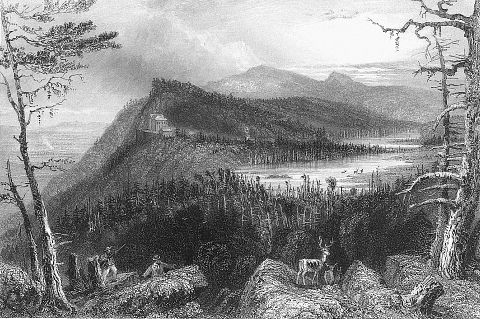
THE TWO LAKES AND THE MOUNTAIN HOUSE ON THE CATSKILLS.
At this elevation, you may wear woollen and sleep under blankets in midsummer; and that is a pleasant temperature where much hard work is to be done in the way of pleasure-hunting. No place so agreeable as Catskill, after one has been parboiled in the city. New York is at the other end of that long thread of a river, running away south from the base of the mountain; and you may change your climate in so brief a transit, that the most enslaved broker in Wall Street may have half his home on Catskill. The cool woods, the small silver lakes, the falls, the mountain-tops, are all delicious haunts for the idler-away of the hot months; and, to the credit of our taste, it may be said they are fully improved—Catskill is a “resort.”
From the Mountain-House, the busy and all-glorious Hudson is seen winding half its silver length—towns, villas, and white spires, sparkling on the shores, and snowy sails and gaily-painted steamers, specking its bosom. It is a constant diorama of the most lively beauty; and the traveller, as he looks down upon it, sighs to make it a home. Yet a smaller and less-frequented stream would best fulfil desires born of a sigh. There is either no seclusion on the Hudson, or there is so much that the conveniences of life are difficult to obtain. Where the steamers come to shore, (twenty a day, with each from one to seven hundred passengers,) it is certainly far from secluded enough; yet, away from the landing-places, servants find your house too lonely, and your table, without unreasonable expense and trouble, is precarious and poor. These mean and menus plaisirs reach, after all, the very citadel of philosophy. Who can live without a cook or a chambermaid, and dine seven days in the week on veal, consoling himself with the beauties of a river-side?
On the smaller rivers these evils are somewhat ameliorated; for in the rural and uncorrupt villages of the interior, you may find servants born on the spot, and content to live in the neighbourhood. The market is better, too, and the society less exposed to the evils that result from too easy an access to the metropolis. No place can be rural, in all the virtues of the phrase, where a steamer will take the villager to the city between noon and night, and bring him back between midnight and morning. There is a suburban look and character about all the villages on the Hudson which seems out of place among such scenery. They are suburbs; in fact, steam has destroyed the distance between them and the city.
The Mountain-House on the Catskill, it should be remarked, is a luxurious hotel. How the proprietor can have dragged up, and keeps dragging up, so many superfluities from the river level to that eagle’s nest, excites your wonder. It is the more strange, because in climbing a mountain the feeling is natural that you leave such enervating indulgences below. The mountain-top is too near heaven. It should be a monastery to lodge in so high—a St. Gothard, or a Vallambrosa. But here you may choose between Hermitages, “white” or “red,” Burgundies, Madeiras, French dishes, and French dances, as if you had descended upon Capua.
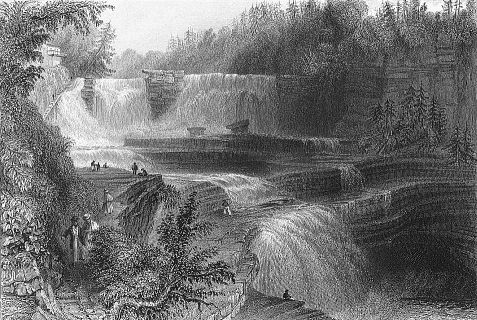
TRENTON HIGH FALLS.
Those who visit these Falls in the pleasantest season for travelling, (the time at which the drawing was taken by Mr. Bartlett,) see them when there is the least water; consequently, when they are (as falls) at their lesser phase of grandeur. It is like seeing a race-horse in the stall, or a line-of-battle-ship in port, with sails furled. It is possible that after one of the tremendous thunder-storms which burst upon this climate sometimes in summer, the glory of the cataract may, for a few hours, renew, and so unite the splendour of full foliage with the flashing of mighty waters: but this is a chance which the traveller for pleasure will scarce hit or wait for. It should be remembered, however, in looking on the drawing, that it is one of a sleeping lion. The frowning walls on either side, driven asunder by the plunges of the torrent in more “yeasty moods,” present a sufficient scale by which to measure its slumbering power. Those who live in climes where snow seldom falls, and more seldom lies through one sunny day unmelted, can have but a faint idea of a spring freshet in America. After the first heavy snow in December, each successive fall adds solidity to the heap upon the earth’s bosom, and the alternate thawing and freezing consolidates the bottom into ice, and cuts off the heat of the soil from the flakes added almost daily to the surface. Till the middle of March, perhaps, or later, the sleighing (Anglicè sledging) is hard and crisp. Then the sun draws towards the line, and with the equinox come soft southern winds, with sharp changes to the north, pouring sleet and rain upon the crusty covering of nature; and, first of all, the small streams begin to trickle under the ice, smothered and faint; the roads across the hard-frozen rivers crack and grow treacherous; and the horse, as they phrase it here, slumps through in travelling on the highway. As the days grow longer, the snow gets clammy and heavy, and drops to the ground, (undermined by the water,) an acre at a time, clicking like a troop of morris-dancers. If you “sit upon a rail” at noon-day, and send a dog to run over an untrodden field, his weight will break it down in large tablets, like the giving way of a marble floor. Then comes the spring thaw. Instead of one rivulet to half a mile, every hill-side sends down a hundred streams, every road is a brook, every hollow in the fields an overflowing pond. The benevolent societies which thrive more by the “widows’ mites” than the rich man’s gift, have learned the secret of these “small contributions.” Down they pour, in troops of legions, to the beds of the larger water-courses, “drowning the springs,” overflowing the banks, and laying every low plain under water. The ice crashes and loosens in the large rivers, and with the loosening of their frost-bound chains, the merry dance is led off to the ocean. If you would see waterfalls, it should be then; though the foliage is not around them, nor the sky or the moon-light so genial above. Niagara alone, of all the cataracts, remains unchanged. He rolls on in his calm sublimity, spring and autumn, summer and winter, the same. His floods seem never to increase by the melting of snow, nor to be drunk up by the fervour of the sun. If changes he has, they are imperceptible, or seen only in the crumbling of rock beneath him, mountains at a convulsion, and at intervals of years.
Trenton is in a wild and not very accessible part of the country, else it were worth the while of the traveller to see these fine Falls during the spring. I am very sure that a series of sketches upon the same ground—the same scenes by the same artist, done when the waters are at the flood, would not be recognised as at all resembling. The attempt would be curious to the artist, at least.
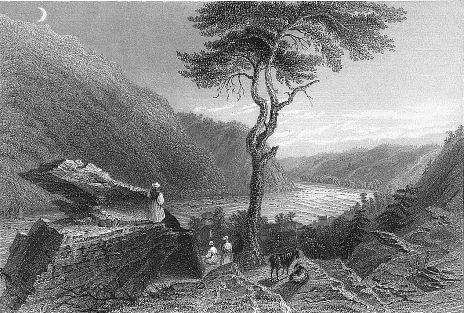
VALLEY OF THE SHENANDOAH,
FROM JEFFERSON’S ROCK.
This is one of the most harmonious combinations of mountain, vale, and river, to be found in America; we know not whether to call it more beautiful or grand. Fine as is all the scenery of this neighbourhood, however, it is not till very lately that the current of travel has turned thither, and but partially yet. Harper’s Ferry will soon be a resort for admirers of nature from all nations, and it may well share the honours of pilgrimage with Trenton Falls and Niagara. Steam navigation across the Atlantic will make our New World lions as tame as the Pyramids.
It is difficult, at least for me, to stand on any eminence commanding a landscape, wild, yet formed for a blest human residence, without seeing in it the forfeited inheritance of the red man. The unpicturesque new village of the white man, his mill, or his factory, does not convey to my imagination an image of happiness; and I regret the primitive rover of the wild, who neither blackened nature with smoke, nor violated her harmony with brick and shingle. The tide of sympathy seems turning of late against these oppressed tribes, and it is not amiss sometimes to remember our own atrocities as well as theirs. What will be thought hereafter of the massacre of the poor Conestogoes, as related in the history of these middle regions of our territory!
“On the first arrival of the English,” says the chronicler, “messengers from this tribe entered into a treaty of friendship with the first proprietary, William Penn, which was to last as long as the sun should shine, or the waters run in the rivers.
“This treaty has been since frequently renewed, and the chain brightened, as they express it, from time to time. It has never been violated on their part, or ours, till now. As their lands by degrees were mostly purchased, and the settlement of the white people began to surround them, the proprietor assigned them lands on the manor of Conestogoe, which they might not part with; there they have lived many years in friendship with their white neighbours, who loved them for their peaceable inoffensive behaviour.
“It has always been observed, that Indians, settled in the neighbourhood of white people, do not increase, but diminish continually. This tribe accordingly went on diminishing, till there remained in their town on the manor but twenty persons, namely, seven men, five women, and eight children, boys and girls.
“Of these, Shehaes was a very old man, having assisted at the second treaty held with them by Mr. Penn, in 1701, and ever since continued a faithful friend to the English; he is said to have been an exceeding good man, considering his education, being naturally of a kind, benevolent temper.
“This little society continued the custom they had begun, when more numerous, of addressing every new governor, and every descendant of the first proprietary, welcoming him to the province, assuring him of their fidelity, and praying a continuance of that favour and protection which they had hitherto experienced. They had accordingly sent up an address of this kind to our present governor (John Penn, Esq.) on his arrival; but the same was scarcely delivered, when the unfortunate catastrophe happened which we are about to relate. On Wednesday, the 14th December, 1763, fifty-seven men from some of our frontier townships, who had projected the destruction of this little commonwealth, came all well mounted, and armed with firelocks, hangers, and hatchets, having travelled through the country in the night to Conestogoe manor. There they surrounded the small village of Indian huts, and just at break of day broke in upon them all at once. Only three men, two women, and a young boy, were found at home; the rest being out among the neighbouring white people—some to sell the baskets, brooms, and bowls, they manufactured, and others on other occasions. These poor defenceless creatures were immediately fired upon, stabbed, and hatcheted to death! the good Shehaes among the rest cut to pieces in his bed!—all of them were scalped, and otherwise horribly mangled. Then their huts were set on fire, and most of them burned down. The magistrates of Lancaster sent out to collect the remaining Indians, brought them into the town for their better security against any further attempt, and, it is said, condoled with them on the misfortune that had happened, took them by the hand, and promised them protection. They were put into the workhouse, a strong building, as the place of greatest safety. These cruel men again assembled themselves; and hearing that the remaining fourteen Indians were in the workhouse at Lancaster, they suddenly appeared before that town on the 27th December. Fifty of them, armed as before, dismounting, went directly to the workhouse, and, by violence, broke open the door, and entered with the utmost fury in their countenances. When the poor wretches saw they had no protection nigh, nor could possibly escape, and being without the least weapon of defence, they divided their little families, the children clinging to their parents; they fell on their faces, protested their innocence, declared their love to the English, and that, in their whole lives, they had never done them injury; and in this posture they all received the hatchet! Men, women, and children, were every one inhumanly murdered in cold blood!”
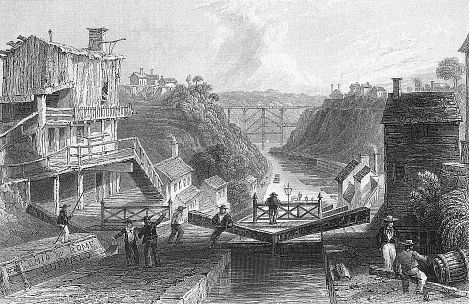
LOCKPORT—ERIE CANAL.
This town, so suddenly sprung into existence, is about thirty miles from Lake Erie, and exhibits one of those wonders of enterprise which astonish calculation. The waters of Lake Erie, which have come thus far without much descent, are here let down sixty feet by five double locks, and thence pursue a perfectly level course, sixty-five miles, to Rochester. The remarkable thing at Lockport, however, is a deep cut from here to the Torenanta Creek, seven miles in length, and partly through solid rock, at an average depth of twenty feet. The canal boat glides through this flinty bed, with jagged precipices on each side; and the whole route has very much the effect of passing through an immense cavern.
This tract of country is very interesting to the antiquarian, from the remains of fortifications, and other probable traces of a race who existed, and whose arts perished before the occupation of the country by the tribes who lately possessed it. On Seneca river, on the south side of Lake Erie, in many different parts of the State of New York, and in a long chain extending west through the valley of the Ohio, down that of the Mississippi, and so westward through Mexico, are traces of a people who were settled in towns defended by forts, and altogether far more advanced in civilization than the Iroquois found here by Europeans. The region in the neighbourhood of Lockport and Torenanta was visited with reference to these remains by the Rev. Mr. Kirkland, missionary to the Iroquois confederacy, in 1778. His account is very curious. At a deserted Indian village, near the old Indian town of Kanawageas, he discovered an ancient fort. It enclosed about six acres, and had six gates. The ditch appeared to be eight feet wide, and in some places six feet deep, and drawn in a circular form on three sides. The fourth side was defended by nature with a high bank, at the foot of which is a fine stream of water. The bank had probably been secured by a stockade, as there appeared to have been a deep covered way in the middle of it down to the water. Some of the trees on the bank and in the ditch appeared to Mr. Kirkland to have been at the age of two hundred years. About half a mile south of this, and upon a greater eminence, he traced the ruins of another old fortified town, of less dimensions than the other, but with a deeper ditch, and in a situation more lofty and defensible. Having examined these fortifications, Mr. Kirkland returned to Kanawageas, and thence renewed his tour westward, until he encamped for the night at a place called Joàika, (i.e. Racoon,) on the river Tanawànde, about twenty-six miles from Kanawangeas. Six miles from this place of encampment, he rode to the open fields, and arrived at a place called by the Senecas Tegatàinèáaghgwe, which imports a double-fortified town, or a town with a fort at each end. Here he walked about half a mile with one of the Seneca chiefs, to view one of the vestiges of this double-fortified town: they were the remains of two forts. The first which he visited, as above, contained about four acres of ground: the other to which he proceeded, distant from this about two miles, and situated at the other extremity of the ancient town, enclosed twice that quantity of ground. The ditch around the former, which he particularly examined, was about five or six feet deep. A small stream of water and a high bank circumscribed nearly one-third of the enclosed ground. There were the traces of six gates, or avenues, round the ditch; and near the centre a way was dug to the water. The ground on the opposite side of the water was in some places nearly as high as that on which the fort was built, which might render this covered way to the water necessary. A considerable number of large thrifty oaks had grown up within the enclosed ground, both in and upon the ditch; some of them appeared to be at least two hundred years old, or more. The ground is of a hard gravelly kind, intermixed with loam, and more plentifully at the brow of the hill. In some places, at the bottom of the ditch, Mr. Kirkland ran his cane a foot or more into the ground, from which circumstance he concluded that the ditch was much deeper in its original state than it then appeared to him. Near the northern fortification, which was situated on high ground, he found the remains of a funeral pile, where the slain were buried, in a great battle, which will be spoken of hereafter. The earth was raised about six feet above the common surface, and betwixt twenty and thirty feet diameter. The bones appeared on the whole surface of the raised earth, and struck out in many places on the sides. Pursuing his course towards Buffalo Creek, (his ultimate destination,) Mr. Kirkland discovered the vestiges of another ancient fortified town. He does not in his manuscript delineate them, but, from the course he described, they might be easily ascertained. “Upon these heights, near the ancient fortified town, the roads part; we left the path leading to Niagara on our right, and went a course nearly south-west for Buffalo Creek. After leaving these heights, which afforded an extensive prospect, we travelled over a fine tract of land for about six or seven miles; then came to a barren white oak-shrub plain, and one very remarkable spot of near two hundred acres, and passed a steep hill on our right, in some places near fifty feet perpendicular, at the bottom of which is a small lake, affording another instance of pagan superstition. The old Indians affirm that, formerly, a demon, in the form of a dragon, resided in this lake, and had frequently been seen to disgorge balls of liquid fire; and that, to appease his wrath, many a sacrifice of tobacco had been made at that lake by the fathers. The barren spot above mentioned is covered with small white stone, that appears like lime and clay; in some spots, for a considerable distance, there is no appearance of earth. Notwithstanding its extreme poverty, there are many trees of moderate size. At the extremity of this barren plain, we came again to the Tanawande river, and forded it about two miles above the Indian town called by that name. This village contains fourteen houses, or huts; their chief is called Gashagaàle, nicknamed the black chief. On the south side of the Tanawande Creek, at a small distance, are to be seen the vestiges of another ancient fortified town.” Mr. Kirkland further remarks, that there are vestiges of ancient fortified towns in various parts throughout the extensive territory of the Six Nations, and, by Indian report, in various other parts; particularly one on a branch of the Delaware river, which, from the size and age of some of the trees that have grown upon the banks and in the ditches, appears to have existed nearly one thousand years.
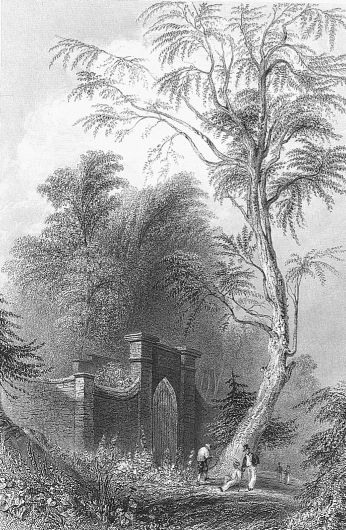
THE TOMB OF WASHINGTON.
MOUNT VERNON.
The current of life seems to be too rapid in America to allow time for reflection upon any thing which can possibly be deferred. The monuments are left unfinished on our battle-fields; the tombs of great men become indistinguishable before marked with a stone; and the sacred places where patriotism has dwelt, are rated by the value of their material, and left to decay. It is difficult to visit Mount Vernon, and feel, from any mark of care or respect visible about it, that America owes any thing to the sacred ashes it entombs.
The family tomb at Mount Vernon has once been robbed by a sacrilegious ruffian, whose ignorance alone preserved for us the remains of Washington. It has been proposed to Congress to buy Mount Vernon, and establish a guard over relics so hallowed. Why should not this be done, and a sufficient sum be appropriated to enclose and keep in order the whole estate, improve the execrable road leading to it from Alexandria, and employ persons to conduct strangers over the place?
The vault in which the ashes of Washington repose, is at the distance of, perhaps, thirty rods from the house, immediately upon the bank of the river. A more romantic and picturesque site for a tomb can scarcely be imagined. Between it and the Potomac is a curtain of forest-trees, covering the steep declivity to the water’s edge, breaking the glare of the prospect, and yet affording glimpses of the river, where the foliage is thickest. The tomb is surrounded by several large native oaks, which are venerable by their years, and which annually strew the sepulchre with autumnal leaves, furnishing the most appropriate drapery for the place, and giving a still deeper impression to the memento mori. Interspersed among the oaks, and overhanging the tomb, is a copse of red cedar, whose evergreen boughs present a fine contrast to the hoary and leafless branches of the oak; and while the deciduous foliage of the latter indicates the decay of the body, the eternal verdure of the former furnishes a fitting emblem of the immortal spirit. The sacred and symbolic cassia was familiar to Washington, and, perhaps, led to the selection of a spot where the evergreen flourished.