CHAPTER 6 MINIATURE HOUSE AND GREENHOUSE PLANTS
Reading edition
My gardening friends certainly vary as to ability, inclination, talent, and aptitude. At one extreme there is Aunt Minnie, whose green thumb injects magic into every pot and for whom every plant grows to buxom, blooming perfection. At the other end of the scale there is the poor soul who tries so hard but can’t keep a plant alive no matter what she does. Why do some plant-lovers never fail, while others never seem to win? There are a number of reasons, including a difference in growing conditions, variations in the types of plants, and even the amount of practical experience or common sense Aunt Minnie is blessed with.
The truth is that there is no single, incontrovertible secret to success, but rather a combination of many factors of equal, or nearly equal, importance. The best soil in the world won’t make plants flower unless temperature and sunlight are right. The frequency with which you water plants should be affected by indoor temperature, humidity, and pot size. And don’t think it is Aunt Minnie’s favorite brand of fertilizer alone that keep her plants in good health.
In our house, and in countless others, it is not possible to make growing conditions as perfect as a plant might wish; but we try to come as close as we can, and find most plants are willing and able to make concessions. One more thing we do. We learn all about each plant’s natural home—desert, steamy jungle, Mexican mountainside—so we’ll know what combination of conditions it likes best.
CARE OF HOUSE AND GREENHOUSE PLANTS
Light and Sunlight
Plants need daylight to make energy; they can’t grow without it, or its equivalent in artificial light. They need some sunlight to set buds, and can’t flower without it or a substitute. Intensity and duration of light should vary according to each plant’s preferences.
No plant of ours is left to waste its life away on the fireplace mantel, where the light is too dim to read the printing on a book of matches. Granted, we might set it there for a day or so as a decoration, but we would return it to its bright window sill before it began to stretch out weakly in search of light. These are the signs of insufficient light—weak, lopsided growth; leaves that feel limp and look pale; new leaves, if any, growing progressively smaller and smaller; long leaf stems and long internodes.
Our window greenhouse, which faces south, is reserved for flowering plants that need all the light and sun we can give them, particularly in winter. This is Connecticut, remember; the winter sun seldom gets very hot or stays bright very long. And there are days on end when the sun simply does not show its face. California’s “shade plants”—begonias and fuchsias, for example—require full sun during a Northern winter.
For plants that are not quite so greedy for sunshine, we have the east-facing playroom picture window, which is lightly shaded by a high-branched deciduous tree in summer. For foliage plants, and a few others that will thrive on little or no sun, there are several other windows around the house where there is plentiful daylight, but the sun is seldom seen.
Your situation may be entirely different—perhaps a glassed-in porch that’s brighter than our window sills ever will be; or a contemporary-style glassed-in entry that lets sun stream in all winter long. Keep in mind that various plants have varying needs for light and sunlight; and the only sun that benefits a plant is that which falls directly on it. A south window may actually be shady in summer, and this is truer the farther south you go.
Temperature
Some plants grow their healthiest when the thermometer reads 50 to 55 degrees at night and 5 to 10 degrees higher during the day; some tender tropical émigrés suffer a chill when the mercury dips under 60 degrees at night. But the greatest number will tolerate a fairly wide range, and are quite content with whatever the house has to offer. This again assumes that other conditions, such as humidity, are kept up to the plants’ requirements.
Temperature tolerances are directly affected by the humidity in the air. Many plants will accept a temperature that is higher than average if the air is moist. Some will accept a temperature that is below average if the air is not too moist. In air that’s too hot and dry, leaf edges will often turn brown and crisp; when it is too cool, a plant may stop growing temporarily; when it is both too cool and too moist, there may be danger of rot. Don’t trust the thermostat that governs your house heating system to tell you whether the temperature is right for a plant; measure it on the very spot where the plant is growing.
Humidity
This is often a more crucial factor than temperature, and one that is more troublesome to change. Relative humidity is a measure of the amount of moisture in the air as compared with the maximum amount of moisture the air can hold at a given temperature. It is expressed in percentage figures.
Most plants find it difficult to breathe in dry air; they need some moisture around, on, and in their leaves. (People are better off when they have it, too.) Alone, or teamed up with unsuitable temperature, low humidity can cause leaves to wither, buds to drop before they open, and even an invasion of mites or some other pest.
A humidity gauge is not nearly so familiar a household item as a thermometer, but it is equally useful, usually better looking, and not much more costly. And it can come up with some eye-opening information. The humidity gauge will tell you very quickly, for example, when an air-conditioning system is missing its recommended mark of 50 per cent relative humidity. It will stop you from overwatering in muggy weather. It will show you that humidity can be dangerously low in the window where your plants are growing, even though it is perfectly acceptable three feet away. (Perhaps there is a radiator beneath the window.)
What you do to increase humidity depends on how low it is, and on what type of plant you are growing. At our house we have three systems for the humidity problem—the lazy, the halfway, and the necessary nuisance. The lazy way works fine for dry-air-type plants such as most cacti and other succulents. We simply grow them where the hot blasts from the radiator are strongest. They don’t wither, and when on sunny days we water them, we also mist them with a fine water spray. (For an easy misting device, we have an old Windex bottle with a spraying attachment in the cap. It does a fine job. Of course, there are other commercial products with built-in sprayers. Perhaps you have one in your kitchen.)
To go “halfway,” you set up some simple humidifying device. The containers which you fill with water and hang behind the radiators are effective to some extent. But don’t forget to keep them filled. Pans of water on top of the radiator also help. A steam kettle, such as you use when the kiddies have a chest cold, can be used for a few hours. But remember, that steam is hot, so be careful not to get it too close to your plants. Just keep it in the general vicinity; please, not too close! Here is something else we often use—put some gravel, sand, perlite, or vermiculite in a plate or platter, pour in some water, and put your flower pot in it. The water will evaporate and moisten the air around your plant. If you have a number of plants, get a metal or plastic tray. If you have a decorative garden, you might want to have a tray made to order, to fit your space. Paint it a pleasing color. I have seen such trays decorated with decals, but personally, I’d rather rely on my plants for the necessary decoration. In having a tray made—we’ve had several made by our tinsmith—the larger the tray, the better.
The “nuisance” system is usually necessary only for very delicate tropical plants that flourish in highly humid jungles and rain forests. They will need the platter, or tray of moist sand, plus some enclosure to hold in the moist air. For a single small plant, this can be an inverted bell jar, or a tent made from a polyethylene bag (the sort vegetables are often packed in) and propped over the jar and plant. A larger bag can be used to protect several plants. You can even use kitchen-type plastics such as Saran Wrap. A collection of tropicals almost calls for an indoor greenhouse, like the oldtime Wardian case. In our window greenhouse we can close the inside sash and, with the aid of pans of water, keep the humidity just about where we want it. On cold nights the electric-coil heater isn’t always adequate, so we open the sash to get the benefit of the heat of the room.
The plants that need this extra humidification are definitely in the minority; most are content with simple measures, or none at all.
Soil
When I first became interested in a wide variety of indoor plants, I prepared soil mixtures with the care and precision I had used in making the formulas for our children. It involved trips to the woods for leaf mold, sifting and mixing ingredients, and sterilizing the ordinary soil which we used in order to kill the seeds that are found in almost all soils. In our Long Island home we had an extra stove in the basement which we used for canning and other secondary purposes. I’d fill the oven with old baking pans and other receptacles which contained my potting soil, and light the burner. Frankly, it “reeked” and the reek was all over the house. It was as though we were burning feathers in the fireplace. Now that I am less energetic, and somewhat wiser, I buy prepared soil.
I find that for a reasonable number of plants the prepared soil is not costly and saves a lot of time and preparation. Of course, if you are a professional you may have your own ideas about soil, and your own formulas for a mixture. I’ll admit I do a little mixing on my own, but that is because I grow many different kinds of plants in pots, and each has individual preferences. Most cacti and succulents need something sandy that doesn’t hold moisture too long, as is natural in their desert homes. Tropical plants need a light, porous medium that is rich in moisture-holding humus, like decayed leaves on the jungle floor. Some plants get nourishment only from acid soil, some need alkaline soil, some like soil nearly neutral. I’ve found Michigan peat moss a good starting base regardless of requirements of individual plants.
I like to dish it right out of the bag. When done, I always pull the plastic inner liner together to keep it moist. In extra dry weather I often wet a sponge and put it on top of the mixture. Potting is a pleasure, because Michigan peat feels so soft, silky, and clean. At repotting time I discover well-developed, healthy root systems.
For plants that require better-than-average drainage—mostly succulents—I mix peat moss with builders’ sand. (Want to know where I got my last batch of builders’ sand?—from a contractor who was building a house down the road. He and his wife happen to be begonia lovers and he was charmed to know about my book All About Begonias.) The formula for the mixture is two-thirds soil and one-third sand. For even greater aeration, I may throw in a moderate ration of crushed charcoal.
On the other hand, some of my plants insist that their soil always be moist. For them I add coarse vermiculite, perlite, or Pelonex, and in a similar ratio. These soil conditioners have the ability to hold moisture without making the soil muddy or soggy.
There is another item on my potting-soil shelf—a jar of horticultural lime. This is for plants that dislike acidity. I either add it to the potting soil—a scant teaspoon per three-inch pot—or mix it with water, to be applied later. With or without these added ingredients, I feel that a good potting soil has sufficient nutrients for almost any plant for several months; so I seldom mix in fertilizer of any kind.
Potting
When and how to repot a plant should be the least of a gardener’s problems. Here is a case where hovering, pampering, and fussing usually does more harm than good. Plants are often better repotted mañana than today.
I know many of my plants have benefited from the fact that I have been too busy to repot them whenever the impulse came over me. I hate to think how many I have killed with kindness in my less active years.
Remember my Aunt Minnie? She embarked on a big repotting spree every spring, but not very often in between. Some of her most handsome specimens have lived in coffee tins and large juice cans for years. Instinctively she knows when a plant should be repotted. Don’t ask me how she knows it. And when that time comes, she goes about it in a firm, no-nonsense manner, firmly but tenderly.
There is one sure way to tell whether a plant needs a new pot. Turn the old pot upside down, tap the contents loose, and examine the soil ball. If it is completely covered with a network of roots, get busy with a larger pot. If not, don’t repot, just slip it back where it was before and give it a loving pat. If you happen to have a seedling you have great hopes of raising to a beautiful maturity, it will have to be repotted more often.
The kind of pot is a matter of personal choice. Plastics are lighter in weight, easier to clean, and capable of keeping soil moist for a longer period of time. This makes them suitable for moisture-loving plants, or for gardeners who have a tendency to forget the watering pot. Clay pots are porous, and because they let air seep into plants, they dry out faster. This makes them best for dry-growing plants, and for overwaterers (like me).
Actually, the size of the pot is more important than the type. It takes an expert to know how to water a plant when it is overpotted. You are not doing your plant a favor by housing it in a pot several sizes too large; in fact, you may even be signing its death certificate. As a rule, the new pot should be only one size larger than the previous one, thus leaving just enough room around the roots for some fresh soil. Pack the new soil firmly with your finger tips, a pencil, or a slim piece of wood. Be sure there are no empty air-pockets. Water it thoroughly and set it in a light, but not sunny, spot, for about a week. This will give it time to recover from any transplanting “shock.”
This discussion about overpotting applies to plants in general, but it is even more important with miniatures. Smaller pots will keep them down to natural, miniature size.
Fertilizing
Many people who have fewer plants than I—and more time—tend to make a fetish of fertilizing. I am afraid my methods are haphazard, and not to be recommended. Anyway, I will tell you what I do. Follow it if you like, but quite possibly you may have a better method which you prefer.
I keep two kinds of house-plant fertilizer on hand—a reliable brand of soluble commercial chemical plant food (it dissolves in water and has the note “trace elements added” on the label) and an organic food. This organic food is either manure water or fish emulsion. The fish emulsion comes bottled and is diluted with water. As an amusing sidelight, our tomcat goes slightly out of his mind when around a potted plant that has had fish emulsion for its dinner. The cat just can’t find the source of that aroma. Manure water, on the other hand, has no such fascination. It is easy to prepare. Simply wrap a portion of well-rotted manure in a section of cheesecloth or burlap, and steep it in the watering pot long enough to produce a “tea” fluid. Better do this out of doors, in the garage, or in the tool shed. It is usually “olfactorily offensive.”
Once a month I make a solution of the chemical fertilizer, at half the strength recommended on the label of the package, and feed plants as I water them. Two weeks later, and once a week after that if they need it, I feed with the organic solution. This, I think, constitutes a “balanced diet” for most types of plants.
Like overpotting, overfertilizing can lead to lost plants. It is my observation that an underfed plant usually doesn’t die quickly. It simply slows down until you have time to feed it. It is particularly important not to fertilize plants that have been repotted recently, plants that are unhealthy or are plagued by insects or disease, plants that are resting right after flowering, plants that are dormant or semidormant, as some of them are at certain times of the year. Do fertilize plants that are in active growth, setting buds, or in full bloom, plants that are aglow with good health, plants whose roots have filled, or nearly filled, their pots.
Watering
My children, who are learning to care for plants rather early, have been grounded in one fundamental fact—feel the soil in the pot to see if the plant needs water. If the soil is dry, fetch the watering pot (succulents can be an exception). I have been told my kiddies have had arguments at school about watering the plants which cluster on the sunny window sills. The usual procedure in our Redding school is to assign the care of the plants to a different child each day. He, or she, floods everything with water and then retires to his, or her, desk with the feeling of having done his, or her, good deed for the day. Plants, alas, are not like goldfish. They don’t care for swimming.
This brings up a question I am frequently asked about house plants: “How often should they be watered?” Even an IBM calculator with a thousand cards feeding through its maw couldn’t come up with a better answer than this simple statement: “Water them when they need it.”
At the risk of repeating myself, I will sum up my thoughts on this problem, and then go on to other subjects. Test the soil with your fingers, if it is dry, you can most likely water with impunity. If moist, more water is inviting root rot. When you water, make sure the entire soil ball is so saturated that excess water runs out the drainage hole in the bottom of the pot. Miniature plants are likely to require more frequent watering, because their pots are small and they are small. Frequency of watering: Here we get into an awful lot of tangibles, and some intangibles. There are such things to consider as the type of plant and its moisture needs, size of the plant and its pot, what sort of soil is in the pot, is the plant root-bound or not, is it in active growth or dormant, what is the weather like out of doors—is it warm or blustery, clear and sunny, dark and humid, or just another day. Remember, on hot dry days the moisture is going to slip away into the atmosphere. On cloudy days it will hang around longer; humidity will take care of that. If you feel your plant needs water and you are afraid of flooding it, you might try another device. Put some moist peat in a larger pot—or you can use vermiculite or perlite—and set the plant and its pot inside this larger pot.
Right now you may be wondering about hanging baskets and those plants that are wrapped in osmunda and mounted on slabs of wood. Give them a good dunking in the kitchen sink but let the excess water drain off before you hang them again, out of deference to your carpeting and furniture. Actually, the plants don’t care whether they spot your furnishings or not.
If all of this is confusing, may I sum it up in a phrase: “Just use your common sense” (horse sense may be a better term). I know I have written a few books about plants and gardening, and countless magazine articles, but here is a very candid confession. Until a very few years ago I knew practically nothing about the subject. What I know I learned by reading books and magazine articles, and “doing.” I know I killed a few plants out of ignorance, but I killed more with kindness. Every time a plant withered and died I felt badly. But I considered it a lesson in what to do, or not to do. I tried to find the cause for the demise. Today I have the satisfaction of having raised thousands of plants to beautiful bloomhood, and largely because of the sacrifice of some obscure begonia, or petunia, a few years back. I have been acclaimed as having a “green thumb.” Actually I do not have a green thumb. No one has. I thoroughly dislike the term. I dislike the implication that a person has a God-given quality which makes plants grow. Making plants grow and prosper is largely the mastering of a few rules, and the use of a lot of common sense. I’ll grant you, much of your common sense comes the “hard way.” But it is fun. I bow most respectfully to those plants which I killed with ignorance and kindness.
Grooming
This is the “beauty-parlor” treatment for your plants. Fading flowers and dying leaves are as unattractive on a plant as those unruly ringlets in a woman’s coiffure. In fact, they are even worse. They take strength from a plant and are unsanitary. Remove them as regularly as you can. You’ll be adding to the welfare of your plant. If the plant is of a type that needs to be pruned or pinched to keep it comely and compact, perform the operation before the branches get that gangly, middle-aged spread. Pinching out the new growing tips, either with sharp fingernails or sharper scissors, usually produces two new branches. If you pinch out the tips of these, you will most likely get four new branches and your plant will become pleasingly plump. The exception is the plant that blooms from the ends of new growth. Stop your pinching before the bud-setting season.
Not many miniatures need staking to keep them upright. If stake you must, do it as inconspicuously as possible and tie the stems neatly in their natural growing manner. Train miniature creepers in the direction you want them to grow, and miniature climbers up their supports. Rinse foliage with a fine spray (use that discarded Windex bottle I described earlier) as often as you can to wash away dust and dirt. Please, may I throw in a plea right here—recently I saw a commercial product which some people use to make their plants more green. It is a spray for foliage. For the moment it makes plants look green with its sheen. But it also clogs the pores on the plant and its leaves. For the moment it is beautiful; for permanency it is harmful. Decide, do you want your plant to live for the moment only?
Insects and Disease
Not long ago, when visiting a friend, I was taken out to her sun room to see her plants. She was proud, but I was shocked. What I saw was the most amazingly bug-ridden collection of fuchsias and geraniums I have seen in many a moon, plus a few poor distorted other flowers which were trying to survive. My poor hostess, honestly, I think she had no idea of her problems and the future of her plants. In fact, they had little future. I thought over that problem for a spell, and then told her the facts of life. Fortunately, she was able to save much of her greenery.
That poor gardener was on one end of the spectrum. On the other end are the overanxious ones who treat their plants with so many sprays and dusts that the leaves never get a chance to breathe pure air. Fortunately, in between there are the sane, sensible growers who are able to cope with the insects and diseases which beset house plants. As for myself, I have been at both extremes.
I now find prevention is the best protection. That is an old saw, but the best one I know. I keep plants and pots clean, remove dead flowers and foliage before they decay, and use germ-free potting soil. People often give me plants. I accept them most politely, and gratefully; but I am cautious about mingling them with my other residents of the greenhouse and window garden. I keep them in a quarantine section for a few weeks. No use asking for trouble, and I trust my friends understand.
For immediate and reliable treatment, I rely on an “all-purpose” house-plant spray or a dip. As long as I am careful to keep it up, I seem to have no great problems. When I get careless, as humans are wont to do, I regret it.
It is very convenient to rely on the new aerosol bombs—those that are specifically marked for house plants, and not those for household insects. There are several reliable brands, each listing on the label what they are to be used for. If there happens to be an added fungicide, so much to the good. That will cover just about everything.
A few words of caution about the use of aerosol bombs. Follow the instructions on the label to the letter. Hold the bomb at least eighteen inches away from your plant, maybe more. Some of those fluids come out of the can at a very low temperature and have the same effect as a blowtorch on foliage. Try to make sure the spray hits all parts of the plant. Remember, leaves also have an underside. Don’t let bugs use that underside as a hide-out.
There was a word of caution on each aerosol container I have seen: “Do not throw into an open flame when empty.” My husband wondered what would happen if he did. He tossed an empty can into the trash burner and got behind a tree. The explosion sounded like a hand grenade left over from World War II and he had to get a new lid for the burner. Please take my word for it and don’t take that chance. Let him be crazy if he likes, but not you. I don’t like to lose readers so early in my book.
I know I take precautions, but in spite of everything my plants become infected at times. When that happens it’s helpful if you can recognize the symptoms, diagnose the ailment, and apply the cure. With your interests in mind, I have put together a list of sorts which includes the most prevalent house-plant insects and diseases, the telltale signs of their arrival, and the insecticides and fungicides which will send them to their happier hunting grounds. If I have skipped anything, my apologies. If you are having special problems, phone your local county agricultural agent. He is a good man to know anyhow. But please, unless you have something that is out of hand, don’t bedevil the man. He is probably concerned with ticks on sheep, ringworm, hog cholera, breachy cows, grubworms, and forty people who want to know why their hollyhocks didn’t bloom.
PROPAGATING HOUSE PLANTS
It’s hard to tell which provides the warmest pleasure, to give a friend or visitor a rooted, potted cutting of some plant she has admired, or to come home with a gift cutting of a new plant you have admired and coveted. There is a thrill also in adding a new plant to your collection by growing seed from a seed house. And I always have another thrill when the church or the school asks me to contribute plants for the annual bazaars. Fortunately, I usually am able to anticipate these requests far enough in advance to have a supply ready and waiting.
PESTS AND TREATMENT
Symptoms Treatment
Aphids (Nasty plant lice) Little louse-like insects. Green in color in our area. Clustered on new leaves, on flowers, and around stems This is an easy one to get rid of, but likely to return if you don’t watch out. Use a solution of Black Leaf 40 (nicotine sulfate) in a combination spray with lindane or pyrethrum and malathion. Or you can use any of them alone
Mealybugs (Don’t let them frighten you) Little white dabs of cotton clinging to tender joints, stems, and the underside of leaves Dip an artist’s paint brush or a cotton-wrapped toothpick in a solution of malathion. Remove the pests one by one
Mites Buds and new leaves are puckered and distorted. The underside of the leaves may show fine, white silky webs Dip plants in a solution of malathion, Kelthane, or Tedion according to the directions on the label
Mildew Silvery dust disfigures the leaves, most likely in dark, muggy summer weather Dust plants with sulfur, or spray with one of the new fungicides like captan, zineb, etc. Give plants more space and increase air circulation
Scale Hard brown, or green, scales irregularly on the underside of leaves Dip plant in a solution of malathion. Repeat according to directions
Slugs Slimy villains, like shell-less snails, which hide in soil or under pots by day and come out to chew holes in leaves at night Use special slug-bait containing metaldehyde according to package directions
Thrips Brownish blotches under leaves. Disfigured flowers Dip or spray with malathion all-purpose mixture containing lindane, pyrethrum
White Fly Minute flies swarm in the air about the plant when disturbed Spray or dip in malathion, or an all-purpose mixture
Since I fashioned my first crude propagating box—a square cake-tin with a rickety frame covered with kitchen plastic—I’ve always had some sort of similar device in operation. They have been of many sizes and shapes, and have included an aquarium vacated by the children’s goldfish, and a fruit crate from the grocery with cut-to-measure glass sides and top (I use masking tape to hold the corners). The one thing common to all of these boxes is the three-inch layer of some moist propagating medium, ready to receive seeds and cuttings.
The latest and most attractive box I’ve used is the Gro-Master—a ready-made plug-in propagator with an electric coil in the bottom to provide gentle bottom heat. Several similar devices are also available. With something like this one can hardly miss germinating even the most difficult house-plant seeds, or rooting even the most delicate cuttings.
The choice of a propagating medium is all yours. I’ve used vermiculite, perlite, and Pelonex with unqualified success. I tried sharp sand but discovered that it dried out too fast for anything but succulents. Peat alone, or mixed with sand, tends to pack and rots rather quickly. I tried a blend of equal parts of peat, vermiculite, and perlite. It held up rather well, but I seldom bother to mix it. Regardless of what you prefer to use, have the medium moist when you use it, and water just enough to keep it barely moist during the rooting process.
Of course, with many types of plants, you can root “slips” in a glass of water on your kitchen window sill. But in any kind of propagating box, where the air is kept humid and the delicate plants are protected from drafts and drying-out, you have a better chance.
House Plants from Seed
African violets and other gesneriads, all types of begonias and geraniums, and many other indoor plants can be grown quite easily from seed. I like to plant each variety in its own small plastic refrigerator dish with a half-inch or so of soil (moist, sterilized soil that is) in the bottom of the dish. Sometimes I use plastic ice-cube trays. When planting powder-fine seeds, I usually add a thin layer of moist, finely-milled sphagnum moss and make it very smooth. Dust the tiny seeds over this surface, but don’t cover them with soil. Larger seeds should be covered with soil or more moss. Next, cover the container tightly and set it in a warm spot. That is when you will appreciate a propagating box. If the moss and soil begins to dry out, moisten it by gently running drops of water down the sides of the container. Please be gentle and tender. Tiny seeds and seedlings should not be disturbed.
When the seedlings have developed one or two true leaves of fairly substantial size, pick them out very gently and transplant them to another “community” container, or to individual thumb pots. Keep them humid and protected until they are big enough to need transplanting again. After that, they should be nearly ready to become adjusted to grown-up growing conditions in a window, or some other indoor garden.
One of the neatest tricks of the year is the Water ‘N’ Watch indoor garden developed and sold by Peggie Schulz, an attractive plastic planter complete with soil and planted with fourteen types of seeds. You simply follow her instructions, add water, and watch the seedlings germinate and grow. Gradually you remove the plastic dome when the plants are large enough. At transplanting time, remove the seedlings to separate pots, or leave a few to mature in the planter. This device is just about as work-free a method of growing house plants as there is.
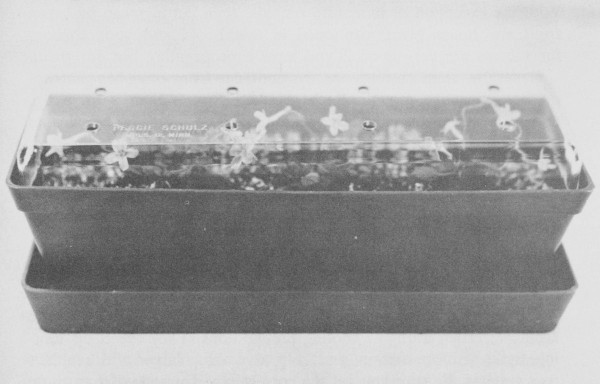
Propagation box developed by Peggie Schulz, author and garden columnist
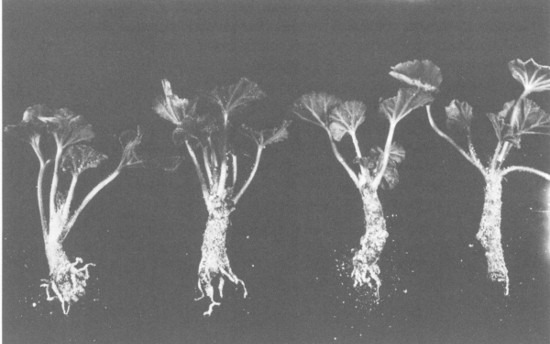
Sprouted stem cuttings of dwarf geraniums
Stem Cuttings
This is the most familiar way to propagate house plants, and the method that works best for most kinds of plants. With the exception of miniature orchids, stem cuttings can be taken from any house plant mentioned in this book, and your chances for success are very good if you have a propagating box for them.
Generally, stem cuttings are the ends cut from branches that are in healthy, active growth. Each should be more than a mere tip, and have at least two nodes, or “joints.” The large, bottom leaves are stripped off very gently and the cut end of the stem is inserted, to about half of its length, in the propagating medium. When you see evidences of new growth, or when roots have developed, dig under it with a spoon and remove it for potting. (Here is the test to determine if roots have developed: Pull on the cutting, very gently of course. If you feel resistance you know it has roots which are holding it down.) Pot your new plant very carefully in soil that is suitable for it; and please, don’t add fertilizer to this soil.
For stem cuttings, and most other methods of propagation, there are now certain hormone rooting preparations. They speed up rooting, make it more certain, and help to develop larger and healthier root systems. Be sure you get the correct type for softwood cuttings, or indoor plants. In using these new hormones, follow the directions on the package carefully.
Leaf Cuttings
It is a well-known fact that African violets will reproduce themselves from a single leaf. However, it is not so well known that there are dozens of other plants that will do the same. For example, more than once I have taken a succulent leaf, laid it out flat on moist sand, and had it grow roots and a small new plant. Leaves of peperomias, and many other plants, can be cut, with or without a piece of stem, and will grow bushy new plantlets. Some kinds of begonias will send out roots from the end of the stem, or new plants from the point above where stem and leaf join.
Except for some succulents, leaf cuttings are usually inserted with their stem ends in a moist propagating medium, with their leaves standing nearly upright above. (Again, you are safer if you have a propagating box, even though it be a crude one.) When they are well rooted and the new plants are of fair size, the cuttings are potted with the old leaves intact. The parent leaf is removed only when the new plant is strong enough to grow on its own. Of course, in the case of African violets, where more than one plant is produced at the end of the stem, the babies must be separated and each put into its own pot.
Root and Rhizome Cuttings
Sections of roots are sometimes cut to propagate house and greenhouse plants, but the practice is more common with hardy garden plants. But pieces of thickened, stemlike, or rootlike rhizomes can be taken from many types of indoor plants. Rhizomatous begonias, and rex begonias of rhizomatous habit, are familiar examples. Each piece of rhizome should have at least two, but preferably three, “eyes,” or scars from which leafstems have grown. The piece is placed half in and half out of the moist medium in the propagating box. Roots grow from the bottom down into the medium; stems and leaves shoot up from the eyes on top.
Layering
There are two general methods of layering, and in each case the plant is completely rooted before it is cut away from the parent. In “air layering” a thick stem, or cane, is slit, wrapped with moist sphagnum moss, and enclosed in plastic until roots are produced. This method is usually practiced on large, overgrown plants such as dieffenbachias, and truthfully is not necessary, or practical, for most miniatures.
But ground layering is a safe and sure way to propagate almost any plant with lax stems, and is particularly useful on temperamental plants such as some miniature ivies, which are reluctant to strike roots on stem cuttings. It is very simple. Just pin down the stem, not too far from the growing tip, in the soil beside the mature plant. If you like, you can put it in a pot of its own and thus be one jump ahead by having the roots where you want them. I usually steal a hairpin out of my “bun,” but a section of wire bent into a U will do. When the stem has rooted, cut it off on the side next to the parent plant. Unless it is already rooted in a pot, dig it out and plant it.
Division of Crowns and Roots
One African-violet plant may grow several crowns, or main stems complete with rosettes. Since single-crown plants usually are more shapely and bloom more abundantly, the extra crowns can be cut off and rooted like ordinary stem cuttings. This is one of the more popular methods of dividing an old plant and getting several new ones from it.
Some plants will eventually make such dense, bushy growth that they not only look obese and unattractive, but are prey to all sorts of rot. Root division not only gives these plants a new lease on life, but also provides several new plants. Remove the overgrown plant from its pot, and very gently, try to split the matted roots and stems into separate sections. Do this with your fingers and not a metal instrument. If you work slowly and with care, several will most likely pull free. If you can’t do it with your fingers, you may have to resort to a clean sharp knife, in which case cut down past the stems and through the roots, making several separate sections. Discard any damaged leaves. Pot up the divisions, and keep them shaded and protected for a week or so until they recover from the shock.
Runners, Stolons, and Offsets
Many plants are continually propagating themselves by producing new plants in clusters around the old ones, sometimes at the ends of underground stolons or above-ground runners. Saxifraga sarmentosa was named “Strawberry begonia” because it continually produces new plants on runners, strawberry-style. Episcias and chlorophytums are other examples.
Any of these offsets make new plants easily. Pin them down in soil, give them time to root, and then cut them off and insert them in a propagating box. Next, you pot them. Sometimes you’ll find the roots have already formed and the new plant is ready for potting and you didn’t even suspect it.
DESCRIPTION OF HOUSE PLANTS
Some pages back I told you that the question asked of me most frequently is “How often should I water plants?” A close runner-up is the question, “Where can I get out-of-the-ordinary plants?” Believe it or not, that question is easier to answer. Local florists and greenhouse people often have plants tucked away—something exotic and special. Most of the people in the industry cherish these plants and are hesitant to part with them to run-of-the-mine customers. But if the person is a genuine plant-lover, a sale can usually be made, even though it is a reluctant sale. Just demonstrate that you are vitally interested and you will be surprised at what you can buy. Try it.
I have a number of catalogues from mail-order suppliers in all parts of the country who carry unusual plants, and in a variety that increases year by year. Do you know where I came upon their names?—from small advertisements in horticultural magazines. Read those small ads. Often the advertiser is so small, and so specialized, that he can’t afford too much space. But he has the treasures you want.
Mail-order plants are naturally young and small. Large plants are too difficult to pack and ship for any distance. Plants that are small usually cost less, and you have an extra dividend in the pleasure of seeing them grow to maturity. You would be amazed at the progress that has been made in packing and shipping in the past few years. Plants that I have ordered recently have come through the mails in from excellent to perfect condition—even plants from the Pacific Northwest. You simply unpack them—carefully, I’ll admit—water them if necessary, and keep them out of hot, bright sun and draft for a few days until they are acclimated to their new surroundings. Should any plant seem weak or mildly injured, pop it into the propagating box and usually it will be back on its feet again in a few days. If the damage is too serious, report it to the post office, the express company, or the shipper. I have yet to register one of these complaints.
I have been general in the preceding pages of this chapter. Now I will be more specific and offer a list of plants and their growing requirements. All of the following plants can be grown in the greenhouse. But given proper light, humidity, and/or other special care, they can be grown in the house where you live—even the most delicate types. The information on culture is abbreviated, but consistent use of the same terms, I feel is justified. The following are used in the sections on care under each plant.
Full sun
The sun actually falls on the plant for most of the day.
Partial sun
The sun touches the plants for only a few hours in the early morning or late afternoon in summer, but for longer periods in winter (tropical areas excepted).
Little or no sun
Bright daylight is sufficient to keep some plants healthy.
Temperature
Any figures that are quoted are for daytime. Night temperatures can usually drop about five degrees. (Cool is 40 to 60 degrees; moderate, 50 to 70 degrees; warm, 60 to 80 degrees.)
Humidity
This is noted if the plant needs more than average humidity (50 per cent).
Soil
The plant may prefer a potting mixture that is humusy, extra-rich in organic matter; average, like the potting soil I have described on other pages; sandy, with an extra ration of sand, or a similar substitute. Or it may be epiphytic and grow in some suitable medium such as osmunda fiber or sphagnum moss.
Dry
Let the soil dry thoroughly before watering.
Moist
Water when the soil in the top of the pot feels dry to the touch.
Wet
Never allow the soil to dry out.
Methods of propagation are also summarized and, if possible, listed in order of preference. The terms are the same as those used in the sections on propagating house and greenhouse plants.
For most plants, there are short notations on special uses for which they are especially suited, i.e., growing under artificial lights, dish gardens, model landscapes, terrariums and other gardens under glass. Included also are some small tropical trees and shrubs for the small greenhouse. Among the precious miniatures described in Chapter 17, varieties suitable for forcing are so noted. Forcing procedures are also covered.
Abutilon hybridum savitzi Malvaceae Flowering Maple
Delicate tropical shrubs with thin, soft, maple-shaped, dove-gray leaves lavishly splashed with creamy white, and sometimes white all over. (I’ve never seen it produce the typical dangling lantern flowers.) It grows slowly, keeps plump and bushy, and is content with a small pot for several years.
CARE. Full sun, moderate temperature, and average soil kept constantly moist.
SPECIAL USES. Artificial light, dish gardens, model landscapes, terrariums.
Achimenes Gesneriaceae
A large group of utterly charming plants related to, and grown like, African violets—except that their scaly rhizomes (like minuscule pine cones) are completely dormant in winter. Most have velvet-soft leaves and all produce an overwhelming display of tubular flowers flaring wide-open at the end. None grow to great size. A single rhizome would probably be happy in a two-inch pot; several are usually planted together for a bigger show. The following are among the smallest varieties, upright unless otherwise noted.
‘Charm’—Luscious pink flowers, gold in the center.
coccinea coccinea—Trailer with notched, oval leaves and plentiful flowers of deepest scarlet, half the size of a dime.
‘François Cardinaux’—Flowers in two tones of blue.
‘Little Beauty’—Similar to ‘Charm,’ but in another glowing shade of pink.
‘Masterpiece’—Flowers royal, reddish purple.
‘Miniata’—Ruffled flowers in changeable violet tones.
‘Misera’—Many small white flowers spotted with drops of wine, yellow in the throat.
‘Patens Major’—Orange throat blending into rich plum petals.
‘Peach Blossom’—New dwarf with peach-pink flowers.
‘Violacea Semi-Plena’—The only semidouble-flowering variety in deep, glowing purple.
CARE. Partial sun, warmth, humusy soil kept moist. In late winter, or early spring, pre-root the tiny rhizomes in a light, porous mixture such as vermiculite and peat, barely moist and over bottom heat, or in warmth (65 to 70 degrees). When new growth is about two inches high, pot in light soil enriched with leaf mold or some similiar organic material. Pinch out any growing tips or trailers once or twice to encourage branching. In early fall, after flowering has ended, let the pot and soil dry out gradually. Clean the rhizomes, and store them in a polyethylene bag filled with dry peat at a temperature of 50 to 60 degrees. Check the little fellows occasionally. You may be amazed, but sometimes they’ll send out new sprouts in this dark, dry storage, and want to be rooted and begin growth again.
PROPAGATION. Rhizomes will multiply spontaneously. Also use stem cuttings, leaf cuttings, seeds.
SPECIAL USES. Artificial light.
Acorus gramineus variegatus Araceae
Neat, sweet little water-lover, like a miniature grass, with flat fans of slender, four-inch leaves striped lengthwise with sparkling white. It spreads eagerly.
CARE. Partial sun, cool, average soil kept wet.
PROPAGATION. Division of creeping roots.
SPECIAL USES. Artificial light, dish gardens, terrariums. Pretty bog plant for the miniature garden pool.
Adiantum bellum Polypodiaceae Bermuda Maidenhair Fern
Elfin version of the maidenhair fern with ruffly leaflets like upside-down wedges, the points attached to the dark, wiry six-inch stems. The foliage is surprisingly dense for such a delicate, airy effect.
CARE. Little or no sun. Warmth, humidity, humusy soil (lime if acid), kept moist, and wet in winter. The plant seems to rest in summer.
SPECIAL USES. Artificial light, terrariums.
Allophyton mexicanum Scrophulariaceae Mexican Foxglove
Perky combination of oval, dark-green five-inch leaves beneath upstanding stems bearing several long-tubed, flaring half-inch flowers of pastel lavender blending into white, violet in the throat. Blooms in spurts throughout the year.
CARE. Partial sun, moderate warmth, humidity, average soil kept moist.
PROPAGATION. Seeds.
SPECIAL USES. Artificial light, dish gardens.
Alternanthera Amaranthaceae Joseph’s Coat
Enthusiastically branching, bushy plants with leaves of many colors, and convolutions, like small, contorted coleus. They’re often kept dwarfed by regular shearing, so the white flowers seldom form.
amoena—Bushlet with crisp, oval leaves haphazardly daubed with bright shades of red and orange. It seldom tops four inches.
bettzickiana—Tongue-shaped leaves blotched with cream, yellow, salmon, and red. This is the one that’s used for formal carpet bedding. Its green-and-gold variety, aurea nana, makes a round three-inch mound.
versicolor—A gnome with gnarled, wrinkled leaves. It is basically green but brightened with shocking pink and white. It can grow six inches high, but stays lower if pinched regularly.
CARE. Full sun (for best color), warmth, average soil kept moist.
PROPAGATION. Stem cuttings, division of roots.
SPECIAL USES. Artificial light, dish gardens, model landscapes, terrariums.
Anthurium scherzerianum Araceae Flamingo Flower
This is a baby in a family predominantly of giants, but it won’t outgrow a three-inch pot for years. This exotic tropical plant has leaves like varnished green shields and flowers like a golden Jack preaching from a flamingo-pink pulpit.
CARE. Little or no sun, warmth, humidity, humusy soil kept moist, or even wet.
PROPAGATION. Division of suckers and seeds.
SPECIAL USES. Artificial lights.
Babiana stricta Iridaceae
Winter-flowering, South African bulb for forcing in the greenhouse. Grown outdoors only in frost-free climates. Clusters of red or lavender fuchsia-like eight-inch stems above fuzzy, slender leaves indented at the veins. A dwarf variety, ‘Blue Gem,’ has deep-blue blooms.
CARE. Full sun, moderate warmth, average soil kept moist. Plant in fall for winter flowering.
Begonia Begoniaceae
There are enough miniatures in this big happy family of plants to make a sizable collection, and enough variations to keep the collector fascinated. Botanically, begonias are divided into three classes—fibrous-rooted, rhizomatous, and tuberous-rooted. Among the tuberous types, the best-known are the summer-flowering garden beauties—not available, as far as I know, in miniature. Each of the other classes contains miniatures that divide naturally into two general types of begonias with separate personalities, habits, and cultures. You could almost consider each type a completely distinctive group of plants, only technically related to the others.
SEMPERFLORENS BEGONIAS
Fondly known as “wax begonias,” and often called “America’s favorite house plant.” These are bustling, buxom, freely branching plants with watery stems and crisp, nearly round leaves gleaming with a high polish. They cover themselves with continual bursts of white, pink, or red flowers. The furiously flowering singles are the oldest, best-known, and toughest, often used for edging semishady garden beds. The semidoubles (crested or thimble type) have a raspberry-shaped center extending out from a circle of petals. The doubles (rosebud or camellia-flowered) are fluttery, full-petaled spheres. Foliage may be clean green, bronzy, or mahogany.
‘Adeline’ (‘Improved Darling’)—Free-blooming soft, single pink; green leaves.
‘Andy’—Deeper, more luminous pink flowers; green leaves.
‘Little Gem’—Double, rosy-pink flowers; very dark red leaves; small, slow-growing.
‘Pied Piper’—Baby pink, semidouble flowers, the crest sometimes touched with gold; bronzy leaves.
‘Snowdrop’—Smallest I’ve ever seen, has never topped three inches for me, just grows bushier and bushier. Double white flowers like minute snowballs; dark-red foliage.
tausendschoen (‘Thousand Beauties’)—A group of green-leaved, single-flowering dwarfs available in red, pink, or white. Easily grown from seed.
‘Winkie’—Fully double, old rose flowers; masses of dark leaves.
CARE. Partial sun, moderate warmth, average soil kept on the dry side.
PROPAGATION. Stem cuttings (best taken with a branch, so the plants will be self-branching), seeds (singles), division of root and crown.
MISCELLANEOUS FIBROUS-ROOTED BEGONIAS
Some miniatures are of the angel-wing, cane-stemmed type; some are from the hirsute, hairy-leaved group; some can’t be categorized.
albo-picta—Small angel wing with low, arched branches; silver-spotted, sharp-pointed slender leaves; clusters of off-white flowers.
bartonea (‘Winter Jewel’)—This one’s a flirt, flaunting its leaves and tiny pink-tinged flowers one wintry day, collapsing completely the next. It can’t bear dry air or chills but will grow up again cheerfully from the roots. The foliage is finely scalloped on the edges, washed with russet in the center and along the veins, and completely overlaid with silver sheen.
‘Dainty Spray’—Impudent dwarf with little angel-wing leaves, bouquets of face-powder-pink flowers dripping from the drooping stems.
dregei—Maple-leaf begonia with sharply cut, thumbnail-sized leaves bronzy with purple veins, white flowers. This is a semituberous type, the main stem swelling to look like a bulb above the soil at the base. Pinching regularly keeps it fairly small. May be dormant in winter. The variety macbethi has smaller leaves completely green, white flowers.
‘Dwarf Houghtoni’—For me, this stays under six inches high and covers itself with pointed leaves upholstered with sheer, tawny-pink velvet. The clusters of large white flowers with pink whiskers are almost too heavy for the branches to hold.
‘Medora’—Miniature angel wing with two-inch, flat silver-spotted leaves and white flowers. Also available as ‘Green Medora,’ with plain green leaves and watermelon-pink flowers.
richardsiana—Another semituberous maple-leaf type, the leaves smallest of all and deeply cut almost into lace. Flowers are faint pink.
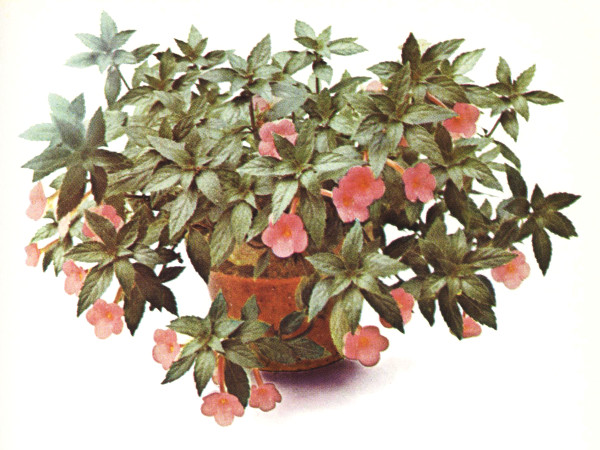
Achimenes, one of the most beautiful gesneriads.
CARE. Partial sun, moderate warmth, average soil kept on the dry side. The semituberous types take more moisture during the active growing season.
PROPAGATION. Seeds (for some species), stem cuttings, division of root and crown.
RHIZOMATOUS BEGONIAS
Here’s where the hybridists are creating the most intriguing new varieties, because they have more miniature parent species to work with. The leaf and flower stems grow straight up or out from the rhizome, a swollen, scarred rootstock that creeps over the top of the soil, usually sending down roots as it goes. Sprays of trembling flowers stand well above the foliage in late winter or early spring.
aridicaulis—Mounds of tiny, sharp-pointed, lettuce-green leaves seldom over three or four inches high. Small, white, two-petaled flowers like fairy pocketbooks.
boweri—Better known as the “eyelash begonia” because of the black stitching around the edge of the lettuce-green leaves, marked with bristly black hairs. Flowers are small, baby-pink, and plentiful. This is the seed parent of a whole group of popular namesakes; star-leaved ‘Bow-Arriola,’ chocolate-stitched ‘Bow Chance,’ dark-complexioned ‘Bow-Joe,’ bronzy ‘Bow-Nigra.’ All have the eyelash edging and pink flowers, and are happy plants for the window garden or greenhouse.
hydrocotylifolia—“Miniature pond-lily begonia” for the terrarium or shallow basket or pot. Shiny, penny-like leaves overcast with bronze, dark along the veins; pink flowers on six-inch stems.
‘Maphil’ (‘Cleopatra’)—Most famous boweri offspring, more dwarf than miniature, just right for small window gardens and baskets. The starlike leaves are satiny, irregularly marked chocolate on chartreuse; the flowers, rich pink.
mazae—Bronzy, half-dollar leaves with light veins that meet at the stem end to make a white eye, wine-red beneath. Pale-pink, red-spotted flowers.
rotundifolia—Very similar to hydrocotylifolia except for the bronzy cast and dark veins. May be the smallest of all.
‘Spaulding’—Extra-bushy dwarf with medium-green leaves shading to dark green, edged with whiskers, and oxblood beneath. Showers of pink flowers.
‘Virbob’—Reddish star leaves with yellow-green leaves, bright red beneath. Short stems hold the leaves close to the pot.
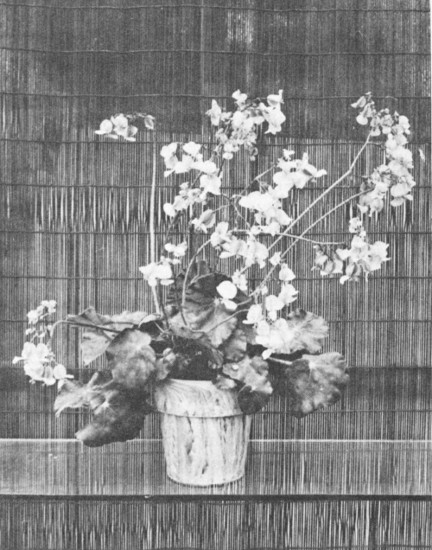
‘Spaulding,’ an extra-bushy dwarf begonia
In the past few years, Mrs. H. E. Dillard of Tropical Paradise Greenhouse has introduced a number of delightful new dwarfs and miniatures. Among them:
‘Baby Perfection’—Star leaves splotched mahogany on green.
‘Black Falcon’—Darkest red-brown star leaves, silvery along the veins, whiskery along the edge.
‘Chantilly Lace’—One of my favorites, with cupped, chartreuse leaves stitched with black around the edge.
‘China Doll’—Pointed yellow-green leaves striped brown along the veins.
‘Kathy Diane’—Pointed oval leaves brown splotched with chartreuse.
‘Midget’—Nearly black star leaves silvery green along the veins.
‘Oriental Music’—Dwarf with pebbly apple-green leaves.
‘Persian Brocade’—Green star leaves intricately laced with black along the edge.
‘Raspberry Parfait’—Pointed, velvety, olive-green leaves lighter along the veins; new leaves flushed with bright pink.
CARE. Partial sun, moderate warmth, humusy soil kept moist.
PROPAGATION. Rhizome cuttings, leaf cuttings (slow), seeds (for some species).
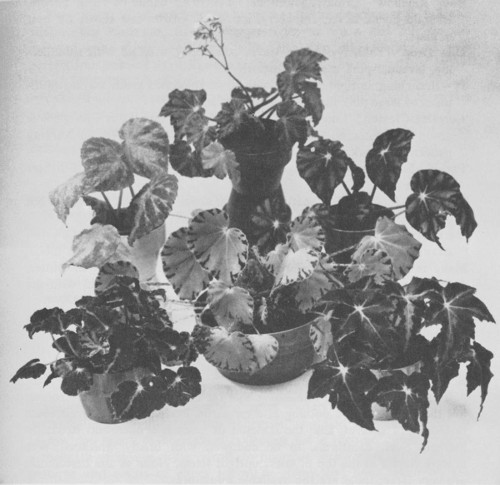
Group of dwarf begonias: lower left, ‘China Doll’; upper left, ‘Silver Jewel’; upper center, ‘Bow-Chance’; upper right, ‘Bow-Arriola’; lower right, ‘Bow-Nigra’; center, ‘Chantilly Lace.’
MINIATURE REX BEGONIAS
These begonias are also rhizomatous, but the brilliant patterns of their leaves put them in a class by themselves. Few other foliage plants have such startling combinations of peacock colors.
‘Baby Rainbow’—Crinkly, jewel-like leaves with bands of royal purple, emerald green, silver, raspberry, amethyst. Grows and shows off best in glass.
‘Dew Drop’—Thin, ivy-shaped leaves completely overlaid with shimmering, lavender-pink mother-of-pearl.
‘It’—Branching, upright rex type with silver-splotched green leaves, multitudes of large pink flowers. Likes some sunlight.
‘Lorraine Closson,’ ‘Louise Closson,’ ‘Lucille Closson,’ ‘Lucy Closson’—A group of aristocratic dwarfs with taffeta-textured leaves in varying patterns of black, purple, red, pink, silvery green.
‘Pansy’—Small, pointed, deep-green leaves with sharp zone of lighter metallic green.
‘Peacock’—Jet-black and scarlet leaves on short stems. Stays small if fed sparingly.
‘Red Berry’—Sheer, shimmering satin leaves of unrelieved claret.
CARE. Little or no sun, warmth, humidity, humusy soil kept moist. Many rex begonias may go partially or completely dormant in winter, dropping some or all of their leaves. Simply keep them warm, with the soil slightly dry, until signs of new growth appear.
PROPAGATION. Rhizome cuttings, leaf cuttings. Seeds will produce an unpredictable mixture, seldom like the parent plant.
Bertolonia Melastomaceae
The slowly spreading stems look like fat little top-of-the-soil rhizomes; but the foliage is like nothing else on earth. Perfect pointed ovals seem fashioned of sheerest silk; the skeleton of veins is sunken and strikingly marked. Such daintiness, to be endowed with bristly whiskers! Wee flowers cluster at the top of short upright stems. None of the bertolonias are very large; these are the available miniatures.
maculata—Sheer leaves deep green shading to light, pencilings of silver along the lengthwise veins, wine red beneath.
pubescens—Many veins pucker the leaves like small-scale seersucker. Colors are copper over green, plum purple down the center.
CARE. Partial sun, warmth, humidity, humusy soil kept moist.
PROPAGATION. Stem cuttings (in warmth), seeds.
SPECIAL USES. Artificial light, terrariums.
Boea hygroscopica Gesneriaceae
Six-inch tropical gesneriad with fresh green, quilted leaves and clusters of violet-like flowers campanula-blue, with yellow centers, on willow stems.
CARE. Partial sun, moderate warmth, humidity, humusy soil kept moist.
PROPAGATION. Division of crown, seeds.
Bouvardia longiflora humboldti Rubiaceae
Two-foot tropical shrub to perfume the dream greenhouse in fall and winter. The luxuriant, glossy, evergreen leaves are a fine foil for the celestial white flowers—trumpets with long, slim tubes flaring out into perfect four-pointed stars. Florists grow the larger-flowered variety, ‘Albatross,’ for cutting.
CARE. Full sun, moderate warmth, humidity, humusy soil kept wet except when the plant is resting after bloom.
PROPAGATION. Stem cuttings of new wood with heel (in warmth), root cuttings in early summer.
SPECIAL USES. Greenhouse shrub.
Buxus microphylla japonica Buxaceae Box, Boxwood
Slow-growing boxwood with small, prim, shiny green leaves filling out the plump shrub shape. It is hardy outdoors, but nice in pots and frequently found at plant counters in variety stores.
CARE. Full sun, cool temperatures, average soil mixture kept moist.
PROPAGATION. Stem cuttings of half-ripe wood.
SPECIAL USES. Artificial light, dish gardens, model landscapes, terrariums, indoor bonsai.
CACTI AND SIMILAR SUCCULENTS
Generally, I prefer to grow a spicy variety of plants. But I am certainly in sympathy with the hobbyists who find enough stimulation in this one group to keep them collecting for a lifetime. Such a weird assortment of shapes, from barrels to humping inchworms. Such unusual patterns and colors of either leaves or stems that have taken on the shapes and functions of leaves. And such flowers! Some like daisies or water lilies, in incredible neon-bright colors, sometimes three times the size of the plant.
Among cacti and similar succulents are some of our smallest plants, plus plenty more that grow so slowly they’re miniature for many years. Here are selected samples, only a small portion of the number available from specialist-growers and other sources.
CARE. Most succulents need full sun, moderate warmth, a sandy soil mixture (not pure sand) kept on the dry side. They need more water and warmth in summer, less in winter when they are resting. If soil is very acid, neutralize with lime.
PROPAGATION. Stem cuttings, leaf cuttings, division of root or crown, seeds.
SPECIAL USES. Dish gardens, model landscapes (with other dry-growing plants), a few for indoor bonsai.
Aeonium caespitosum spathulatum Crassulaceae
Clump-forming succulent with rosettes of leaves like the hen-and-chicks, silvery green sparsely spotted with darker green.
Agave victoriae-reginae Amaryllidaceae
Miniature “century plant” with a stiff rosette of thick, sharp-pointed dull-green leaves with white piping along the edge and streaked with white between. Mature size, six inches.
Aichryson (Aeonium) domesticum variegatum Crassulaceae
I’m not quite sure how high and wide this pretty succulent will grow if left to its own devices. Mine has stayed in a two-inch pot for more than a year, and filled itself out with thin, round green leaves edged with creamy white, blushing faint pink in warm sun. The leaves huddle in tight, overlapping rosettes all around the branching stems.
Aloe Liliaceae
Symmetrical clusters of thick, heavy, sharp-spiny leaves; fall and winter flowers held aloft like a torch. One of the smaller species is A. brevifolia, with leaf rosettes about three inches across. A. variegata can eventually reach a foot high, but very slowly; and its white-marbled leaves are striking in the meantime.
Aptenia cordifolia (Mesembryanthemum cordifolium) Aizoaceae
Creeping, clustering succulent with thinnish, round-pointed, gray-green leaves in pairs along the stems; brilliant fuchsia-purple daisy-shaped flowers. The variety variegata is embellished with creamy-white leaf edgings.
Astrophytum Cactaceae Star Cactus
Thick stem-bodies divided neatly into five sections but still attached together, growing very slowly to four inches across. Outlandishly large, flat, daisy flowers in summer. Try A. myriostigma, bishop’s cap, or A. asterias, sand dollar, both spineless; or silver-dotted A. ornatum, with swirling lines and tufts of curved spines.
Cephalocereus senilis Cactaceae Old Man Cactus
A good bet for beginning collectors. This is a columnar cactus covered with a shaggy coat of snow-white hairs, growing up to forty feet high in the desert, but approaching that height at a snail’s pace indoors. Flowers are rosy-pink, about two inches across.
Chamaecereus silvestri Cactaceae Peanut Cactus
Gay ground-hugger, sending out in all directions thick green two-inch joints with soft white spines, and keeping its miniature proportions except when it’s top-heavy with long-tubed orange-scarlet flowers.
Conophytum Aizoaceae
Very tiny succulents with clusters of plump bodies that are, actually, two leaves joined completely except at the tip. The plant barely reaches one inch high and is content in a three-inch pot for years. Ridiculously large and brilliant flowers pop out through small slits in early fall. Then the leaves look like little dumplings sitting under a daisy. Of the several species available from specialists, C. ornianum is light green with darker freckles, lavender-rose flowers; C. aureum has gold flowers.
Coryphantha vivipara Cactaceae
Symmetrical two-inch sphere covered with evenly spaced bumps, each like a miniature sun with white rays and a spine sticking up from the center. The fringed rosy or carmine flowers pop out on top, in June; bright-red berries appear in fall. Native to, and hardy in, Manitoba, down to Texas. In time it will form clustered mounds.
Crassula Crassulaceae
An oddly assorted group of succulents including many roguish miniatures of fascinating form. C. cooperi has tufts of small, pointed leaves with black blotches, little clusters of pale-pink flowers. C. lycopodioides mimics the club moss of the woodlands, with slim stems encircled with little needle-like leaves. ‘Morgan’s Pink’ is a variety of dense clusters of spear-shaped leaves, crinkled like gray seersucker, coral flowers. C. schmidti makes a three-inch mat of pointed, pinkish leaves, with generous glowing pink flowers.
Echeveria Crassulaceae
Perfect rosettes of succulent leaves in many lustrous colors, some silk-velvety or contrastingly trimmed on the edge. Clusters of brilliant tubular flowers top short stems. The following grow low, with four-inch rosettes.
derenbergi—painted lady—Translucent green leaves with silvery sheen, touched with red at the tip, yellow-orange flowers.
elegans—Mexican snowball—Light blue-green leaves frosted with white, pure white on the edge, coral-pink flowers.
pulvinata—chenille plant—Dusty-green leaves of sheer velvet, trimmed with brick red on the edge, scarlet flowers.
Echinocereus melanocentrus Cactaceae Hedgehog Cactus
Small, spiny globes with brilliant carmine flowers from the side of the ball. At its three-inch maturity, the flowers are still larger than the plant.
Echinopsis Cactaceae Easter Lily Cactus
Small, round plants with thick ribs and formidable spines, the lily-like flowers usually opening in the evening. A popular species is E. kermesiana, with glowing red flowers. E. grandiflora is described as only two or three inches across, with five-inch rose-pink flowers.
Euphorbia Euphorbiaceae
Two small relatives of the poinsettia that show little family resemblance.
caput-medusae—Medusa’s head—Sneaky, snaky-looking plant with tangles of twisted, gray-green branches, occasionally tipped with small leaves.
splendens bojeri—dwarf crown of thorns—Compared to the sprawly species that grows four feet tall or more, this is really a midget. Mine has kept its six-inch bushy contours for nearly two years. The upright grayish branches are fairly well supplied with roundish, dark-green leaves; the scarlet flower-like bracts are plentiful at intervals all summer and fall.
Faucaria Aizoaceae Tiger Jaws
Low, crowded succulents with thick, triangular leaves toothed with spiny hairs, unmistakably resembling an animal’s mouth. In late summer or early fall, golden daisy-like flowers pop up and make fun of the plant’s ferocious appearance.
tigrina—Silvery green leaves flecked with white, two-inch yellow flowers.
tuberculosa—Darker green leaves with little white knobs.
Fenestraria Aizoaceae Baby Toes
Clusters of cylindrical leaves, larger at the top, like little flat-tipped baseball bats. The nearly colorless tops feature tiny transparent “windows.”
aurantiaca—Three-inch orange daisy flowers more than twice as wide as the clustered leaf-colony.
rhopalophylla—Leaves more blunt, smaller white flowers.
Gymnocalycium mihanovichi Cactaceae Chin Cactus
Just one of many available miniature, globe-shaped cacti with spines on regular shelves, or “chins.” This one produces chartreuse flowers bigger than its body, starts to bloom while quite young.
Haworthia Liliaceae
Tight pinwheels of thick, pointed leaves intricately studded with varied patterns of pearly pinheads. The whitish flowers are not a main feature.
fasciata—Zebra-striped succulent often seen in dish gardens.
margaritifera—Slightly larger, dark green with a more scattered pattern of white dots.
Kalanchoe Crassulaceae
Among these congenial succulents are several that grow to considerable size in their native homes, but keep pleasantly small in pots or dish gardens. The leaves are fleshy, with indentations along the edge. Lantern-shaped flowers appear in winter.
blossfeldiana—Well-branched bush with overlapping, fresh green leaves, flowering in winter when days are short and nights are long. ‘Tom Thumb’ is a dwarf variety that smothers itself with scarlet blooms for Christmas. Greenhouses grow it from seeds sown in spring, and so can you.
marmorata—penwiper plant—Leaves fold in around the stem and are spattered on both sides with purple blotches.
pumila—Leaves like a doll’s spoon, notched on the edge and sugar-frosted; plum-colored pitcher flowers.
tomentosa—panda plant—Fat leaves covered with white felt, distinctly marked with chocolate at the teeth on the edge.
(Kitchingia) uniflora—Miniature creeper or dangler for small hanging baskets, with round green leaves marching up and down the stem and rosy or red urn-flowers hanging from thin, short threads.
Kleinia Compositae
Curious even among succulents, each of these oddly shaped or strangely decorated plants has a personality of its own and no need for daisy-like flower heads to make it interesting.
pendula—inchworm plant—Weird, round, leafless stems snake up and down over the soil; flowers brilliant red.
repens—Low and somewhat trailing, with thick leaves like long canoes, unbelievable blue.
tomentosa—Cylindrical cocoon-like leaves tapered to sharp points and covered with pure-white down; gold or orange flowers.
Lobivia aurea Cactaceae Golden Easter Lily
Squat, round, prickly cactus like a small echinopsis, except that this one opens its friendly water-lily flowers in the daytime. Dozens of different species and varieties are available.
Mammillaria Cactaceae Pincushion Cactus
There are many mighty midgets in this group, and in fascinating variety. They’re mostly round, from squat to columnar, but all are primly neat. The spines may be soft or not, but are always arranged in a perfect pattern. The flowers are not overlarge, but are arranged in a crown and ripen into attractive, berry-like fruit.
bocasana—powder puff—Soft, white-woolly globes, only one and a half inches across when mature; beige flowers.
elongata—golden lace—Small branching pillar, nicknamed for its tatted pattern of bright-yellow spines.
hahniana—old lady—Fond name for a small, white-haired cushion.
Notocactus Cactaceae Ball Cactus
Plump balls with prettily colored spines and large, showy flowers in late spring.
apricus—sun cup—Golden-yellow flowers, Oxford-gray spines.
graessneri—Butter-yellow spines and flowers.
ottonis—Indian head—Reddish spines.
rutilans—Rosy flowers.
Opuntia Cactaceae
This is a “crazy, mixed-up” group of cacti. They come in so many sizes, shapes, and forms that any generalized description is impossible. Many optunias are hardy even in Northern gardens.
mamillata—boxing gloves—Resembles a little tree whose branches turn into cockscombs at the tip.
microdasys—bunny ears—Flat, long-oval pads with tiny tufts of soft yellow hairs.
Parodia Cactaceae
Fat little balls covered with glistening spines and sending out unbelievably large flowers although the plant measures only an inch across the middle. Even in old age, they’re never larger than three inches.
aureispina—Tom Thumb cactus—Gold spines, orange flowers.
mutabilis—Shining yellow flowers.
Portulacaria afra variegata Portulacaceae Rainbow Bush
After planting this little tree-like succulent in a dish garden when it was only three inches tall, and finding it less than half an inch taller nearly a year later, I was mildly amazed to learn that it is a version of the twelve-foot elephant bush, or purslane tree, of desert gardens. It’s difficult to imagine the fat red stems and fleshy, cream-splashed, red-rimmed leaves ever adorning a plant of such monstrous proportions.
Rebutia Cactaceae Crown Cactus
Flat, fat balls with whiskery spines, spreading out into clusters. Each ball, when mature, is circled by large, wide-eyed flowers coming up from the base, often as large as the four-inch plant.
minuscula—Best-known species, with fiery red flowers.
senilis—Orange flowers with turned-back petals.
violaciflora—Rose-pink flowers.
Sedum Crassulaceae
Tender relations of the hardy garden sedums, not so numerous but equally varied.
adolphi—Rosettes of fat, yellow-green leaves, white flowers.
hintoni—Oval, grassy-green leaves covered with prickly white hairs, like clumps of tiny porcupine tails; white flowers.
lineare—Many branching, trailing stems covered thickly with needle-shaped leaves. The variety variegatum is a gem, each leaf more creamy-white than green.
multiceps—little Joshua tree—Unbelievable bonsai-like plant with trunk, branches, and tufts of needly dark-green leaves like the smallest conifer imaginable.
pachyphyllum—jelly beans—Fat, juicy, berry-like leaves clustering close to the branching stems; yellow flowers in spring.
rubrotinctum (guatemalense)—Christmas cheer—Thick layers of small, green, drumstick-shaped leaves turning holiday red in full sun; yellow flowers.
stahli—coral beads, Boston beans—Faintly hairy, beady, reddish leaves strung closely together on branching stems; yellow flowers in summer and fall.
Titanopsis Aizoaceae
Stone-mimicking succulents with thickly clustered leaves lavishly spotted with white, wart-like tubercles, and short-lived daisy flowers in fall or winter.
calcarea—jewel plant—Lustrous gray-green leaves sparkling with white spots, gleaming gold flowers. Leaf rosette only two inches in any direction.
schwantesi—Even smaller cluster of blue-gray, liver-spotted leaves, lemon-yellow flowers.
Trichodiadema densum Aizoaceae Desert Rose
Picture a bunch of tiny, smooth green pickles, each tipped with a triple crown of ridiculously long, bristly, white hairs. Now, smother this leaf colony under two-inch red daisy flowers. A really outlandish plant!
SUCCULENTS
Caladium Araceae Elephant Ears
Bicolor Varieties. Gorgeous arrow-leaved foliage plants for small gardens in the South or sheltered areas where summer temperatures are not likely to drop below 60 degrees for long. The patterns, colors, and contours of the leaves get fancier every year. Many are hybridized for larger and larger size, but specialists also offer a good selection of dwarfs that will stay under eight inches. Among them:
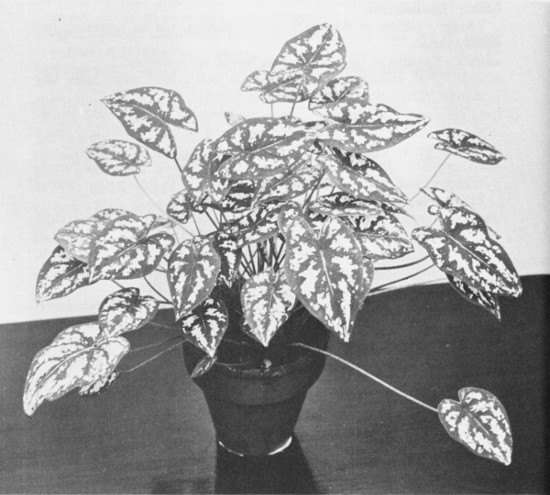
Caladium humboldti—one of the most striking members of the family
‘Candidum, Jr.’—Bushy low version of the standard favorite with green-netted, white leaves.
humboldti—A gemlike species for the connoisseur with willowy stems topped by diminutive deep-green leaves splotched with silvery transparent white between the center veins and the edge. Needs more humidity than the bicolor hybrids.
‘Little Rascal’—Leaf more lance-shaped, wine-red.
‘Miss Marveen’—Pearly-white tinged and blotched with pink over heavy drab green.
‘Mrs. Arno Nehrling’—Bronzy-green, red veins.
‘Pink Radiance’—Small and bushy, leaves centered and veined with shades of pink, pink-flecked on the edge.
‘Sea Gull’—White at the midvein and frosted all over.
‘Twilight’—Glowing flame-pink leaf finely netted with green.
CARE. Partial sun; if in a greenhouse shade against burn. Temperature: warm (75 degrees). Humid. Soil: rich, acid (azalea type). Keep moist. Fertilizer: feed liquid manure on alternate weeks.
PROPAGATION. Seeds.
SPECIAL USES. Terrariums, window boxes, specimens.
Calathea (Maranta) Marantaceae
There’s only one available true miniature in this group of richly colored and patterned tropical foliage plants, but many other species will stay small in a three-inch pot for years. The fact that they’re suitable for lush but restrained effects in far Southern gardens is my other excuse for including them.
These plants are maranta-like, the leaf tufts with markings a peacock could crow about, silky-velvet or iridescent sheens that outshine the gowns at a coronation ball. They are reluctant to flower but nobody cares. The following is only a sampling of the available riches:
argyraea—Low and compact, the blotched green leaves overlaid with silver and horizontally level.
insignis—Narrow, permanently waved leaves perfectly patterned with chartreuse, wine red underneath.
louisae—Leaves perpendicular and perky, feather-marked with yellow-green.
micans—Miniature with oval leaves about an inch long (four inches in the tropics), lustrous deep green banded with silver at the center, paler underneath.
picturata vandenheckei—Satiny dark green banded with silver white in center. Wine red on the underside. A new form, ‘Wendlinger,’ is even more startling. The centers are sterling silver, edged with deep green.
CARE. Provide warmth, humidity. Soil: loam, leaf mold, and sand. Feed heavily for best colors. Shade from direct sun.
PROPAGATION. Divide crowns; tubers and spring cuttings.
SPECIAL USES. Tropical gardens, pots, terrariums, dish gardens.
Callopsis volkensi Araceae
This is a perfectly proportioned miniature “calla lily” only four inches high, the white porcelain flowers centered with a gold, spear-like spadix, and substantial but small heart-shaped green leaves quaintly crinkled. It grows from an underground rhizome. It branches freely but compactly and is winter-blooming.
CARE. Shade, humidity, humusy soil kept evenly moist.
PROPAGATION. Rhizomes.
SPECIAL USES. Terrariums, dish gardens.
Carex elegantissima (Morrowi variegata) Cyperaceae
Lady-like little grass with airy tufts of slimmest leaves, bright green with a white stripe along each edge.
CARE. Loamy garden soil, filtered sun, wet. Intermediate temperature.
PROPAGATION. Seeds.
SPECIAL USES. Terrariums, dish gardens.
Carissa grandiflora nana compacta Apocynaceae Natal Plum
When is a dwarf not really a dwarf? In the two years or more I’ve had this plant it has grown so slowly I have no idea what ultimate height it has in mind, or when it will reach it. It is still about six inches tall, with round, green, overlapping leaves with the shiniest glassy polish of any leaves I have ever seen. Off and on during the year it gives sensual delight with richly fragrant china-white flowers, none of which, so far, have been replaced by scarlet plums. This form is blessedly without spines, always refreshing, and particularly appropriate for Oriental planters and miniature indoor gardens.
CARE. Almost any soil, warmth, light shade, moist, spray leaves. Resents repotting.
PROPAGATION. Cuttings, layers.
SPECIAL USES. Bonsai, planters.
Ceropegia Asclepiadaceae
Among the few hanging or climbing vines of suitable size and form for truly miniature baskets, or supports—succulent and easy to grow to boot! Their effect is always dainty, never bold; thin wiry stems may grow long, but never the leaves; waxy tube-like flowers inspire close inspection, but are never showy. Here are four of the daintiest species:
barkleyi—umbrella flower—A climber with pointed wing-shaped leaves feathered with a network of silver; purple-veined greenish flowers like parasols.
caffrorum—Pairs of green heart-leaves march down the threadlike stems; greenish flowers intricately marked with plum.
debilis—Green needle-like leaves penciled silver along the center; green-and-purple flowers.
woodi—rosary vine, string of hearts, hearts entangled—Matching pairs of thick silvery valentines every inch or so along the dangling stem, identically traced with a precisely patterned design. The little pink-lavender flowers are shaped like pixie pipes or urns.
CARE. Soil: loam, leaf mold, sandy and humusy. Intermediate temperature, filtered sun. Moist in summer, on the dry side in winter.
PROPAGATION. Cuttings in spring; tubers, seeds.
SPECIAL USES. Hanging baskets.
Chaenostoma fastigiatum Scrophulariaceae Little Stars
Cheerful little tropical herb which keeps its compact contour by branching freely, and covers its stems with myriads of half-inch fragrant leaves. All year it twinkles with a sprinkling of starry white flowers, outdoes itself in the summer months.
CARE. Loamy garden soil, bright light, moist.
PROPAGATION. Seeds, cuttings.
SPECIAL USES. Edgings.
Chamaedorea elegans bella Palmaceae
Slow-growing dwarf palm tree, so slow it can be a granddaddy in a six-inch pot and takes eons to top two feet. The reedy green stems cluster in a rosette and curve gracefully at the ends. Leaves are thin, fresh green, airily divided.
CARE. Warm, loamy garden soil, moist, shade.
PROPAGATION. Seeds.
SPECIAL USES. House plant, dish gardens.
Chamaeranthemum Acanthaceae
A choice, exclusive threesome of tender tropical creepers with small supine leaves embroidered with dainty patterns.
gaudichaudi—Forest-green, long oval leaves of sheer velvet, silver feathers down the center and out along the veins.
(Stenandrium) lindeni—A bolder, golden feather marks the larger, perhaps even sheerer, leaves.
venosum—Symmetrical, oval leaves more broad than slender, dark powder-blue with thin leaves of silver on the network of veins.
CARE. Warm, humid, loamy garden soil, filtered sun, moist.
PROPAGATION. Cuttings.
SPECIAL USES. Terrariums, dish gardens.
Chlorophytum bicheti Liliaceae
Spidery little pot plant with tapering, grassy-looking leaves about six inches long, arching somewhat stiffly, with cream-white tidy stripes along the edge and sometimes down the middle. Always looks prim and precise.
CARE. Intermediate temperature, needs fresh air, loamy soil, filtered sun, moist.
PROPAGATION. Division.
SPECIAL USES. Indoor gardens, artificial light.
Cissus striata Vitaceae Miniature Grape Ivy
This lacy little climber looks less like grape ivy, more like woodbine, but it certainly does look and act like a miniature. The reddish stems turn and twist at angles, trying to touch the tiny tendrils to a support they can curl around. The one-and-a-half-inch leaves are like five fat separate fingers delicately joined in the center, scalloped or toothed near the rounded tip, burnished green and lined with wine beneath.
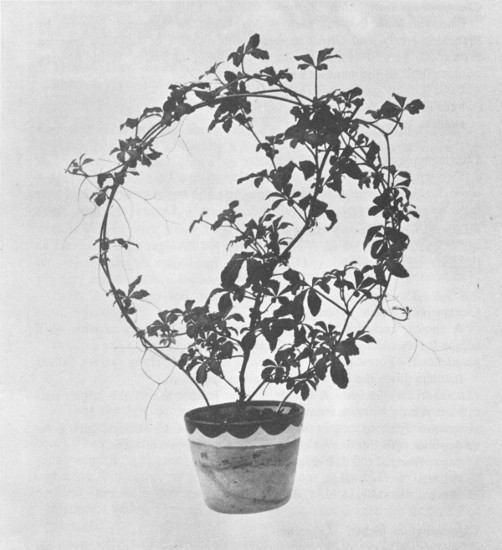
Cissus striata—a genuine miniature climber not unlike woodbine
CARE. Intermediate temperature, humid, loamy garden soil, filtered sun, moisture in the pots.
PROPAGATION. Roots and cuttings.
SPECIAL USES. House plant, miniature gardens, artificial light.
Citrus Rutaceae
These are true miniature citrus trees, varieties that are naturally dwarf, or grow so slowly they’ll flower and fruit in smallish pots indoors.
aurantifolia—lime—Spiny little tree with small leaves, small tartly acid, thin-skinned, green fruit. The Persian lime is a variety called “one of the most beautiful of all citrus trees.”
limonia ‘ponderosa’—ponderosa lemon—Oblong, glassy, evergreen leaves; stiff sharp spines; large waxy, fragrant flowers; heavy (to two and a half pounds) pear-shaped (to five inches long) lemons at intervals through the year, beginning when the tree may not be much more than a foot tall. Supposedly, one lemon “gives enough juice to make a pie.”
mitis—calamondin—Bushy little tree, not prickly, dense with glassy green leaves; flowers fragrant, small and white. May bear fruit all year but usually in winter it produces bright oranges, about one and a half inches in diameter, thin-skinned and somewhat flattened on the end. The lime-like flavor of the juice is reportedly pleasant, but my tree looked so pretty I didn’t pick the fruit. A calamondin can, and often will, fruit in a two-and-a-half-inch pot—a mighty midget.
nobilis deliciosa—tangerine, mandarin orange—Small, nearly thornless tree with willowy leaves; sweet fruit, with loose skin that peels off like a kid glove and segments that separate freely.
taitensis—otaheite orange—Neat little bush for pots, with plenty of two-inch, wavy-edged leaves, few if any spines, and fragrant pink-tinged flowers in January. By Christmas, even if the tree is only eight inches high, the oranges are ripe. They are the size of a plum, shaped like a lemon, tartly flavored like a lime.
CARE. Intermediate temperature, needs fresh air, loamy soil, bright sun, keep on the dry side. For fruit, pollinate. Humidity, not too much fertilizer, not too much water. Sudden temperature changes causes leaves to drop.
PROPAGATION. Seeds, grafting, cuttings (for pot varieties).
SPECIAL USES. Seedlings for miniature gardens and greenhouses.
Columnea microphylla Gesneriaceae
Velvety trailer, suitable for small hanging baskets, with soft little mouse-ear leaves. But wow! the fiery-red flowers never heard of the word miniature. Their long slender tubes stand straight up from the dangling stems, flare out to a wide mouth through which you can look to see the yellow throat inside.
CARE. Warm, humid, humusy soil, filtered sun, moist.
PROPAGATION. Seeds, stem and leaf cuttings.
SPECIAL USES. Hanging baskets.
Cryptanthus Bromeliaceae Earth Stars
Not many bromeliads can rightly be called miniatures, and grow either in air or in soil to boot. These are low flat rosettes of stiff painted leaves, often with prickles on the edge and always unusually colored. From the heart, wee white flowers peep out, usually in summer. Some suppliers offer a grab-bag selection of hybrids, “no two alike.” Or you can buy these smaller species if you wish.
acaulis—Thin gray fuzz over rather mottled green leaves.
bahianus—These leaves are slimmer, curving at the tip and wavy on the edge, flushed or margined brick red, more upright than flat.
beuckeri—Asymmetrical arrangement of ladle-like leaves tapered to a sharp point, dark green marbled over light.
bivittatus minor (roseus pictus)—Faintly banded dark-green leaves completely flushed bronzy pink or salmon.
bromelioides tricolor—Slim, pointed leaves with bands of rich cream and green, shaded cherry pink along the edge and in the heart.
lacerdae—‘Silver Star’—Definitely star-shaped and definitely silvery; the only green is in the two stripes down each side of the center.
CARE. Warm, humus, filtered sun, dry side, good drainage.
PROPAGATION. Offsets or cuttings. Peel off one or two basal leaves from stem; pot and root for two to three weeks.
SPECIAL USES. House plant.
Cryptbergia meadi Bromeliaceae
Everything said about the cryptanthus applies here. This is the result of crossing a billbergia with a cryptanthus. The leaves are slim spear-shaped and sharply pointed, upright in the center and arching out around the side. The basic green is rather drab. Made more appealing by a bronzy sheen and faint dark mottlings.
Cyanotis Commelinaceae
Succulent creeping or trailing cousins of the inch plants, with similar botanical characteristics, but each an individual in its own right:
kewensis—teddy-bear plant—Brown-woolly all over the stem and the tiny pointed-ear leaves.
somaliensis—pussy ears—The fresh green leaves are bent into boat shape, clasping tight to the stem and covered with velvety white fuzz.
veldhoutiana (Tradescantia villosa) (Tradescantia pexata) (Tradescantia sillamontana), and known in the trade as tradescantia ‘White Velvet’ and also ‘White Gossamer’—This tiny plant, more trailing than creeping, has lettuce-green leaves, and stems clothed in long silky silvery-white hairs. It has so many names I fear it would be lost to view if all of its labels were placed around it. I quote all of them in order to avoid confusion and controversy. But according to the Institute de Biologia in Mexico, the correct name is Tradescantia sillamontana.
CARE. Intermediate temperature, needs fresh air, loamy soil, bright light, dry side.
PROPAGATION. Cuttings.
SPECIAL USES. Miniature tropical gardens, greenhouses.
Dionaea muscipula Droseraceae Venus Fly Trap
Never let anyone tell you this little bug-eater will “trap flies on your window sill.” Don’t poke at it to see it close its trap. Avoid disturbing it; let it feed itself naturally. And now that the negatives are covered, do try this braggart elf (give it conditions in which it can grow), for the pleasure in its intricately devised mechanism, one of nature’s wonders. Basically, there’s a five-inch-wide rosette of wide flat stems, a two-part leaf at the end of each making a flat burnished bronze oval with a fringe of thick whiskers. When an insect steps onto this dance floor, the hinges in the center fold the two halves together fast, and that is the end of the bug. White flowers top the tallish stems in spring.
CARE. Cool, humid, sun, soil rich in humus with sphagnum, wet. Dormant in February and March before flowering. Most vigorous growth in spring and summer.
PROPAGATION. By roots or seeds. If seeds are used, start them under a bell jar.
SPECIAL USES. Terrariums.
Dracaena godseffiana Liliaceae
Small tropical foliage shrub, slow-growing and bushy, with glassy, leathery leaves haphazardly splotched with white. The named variety ‘Florida Beauty’ is even more dwarf, takes years to fit a four-inch pot, and boasts golden-yellow splotches.
CARE. Warm, loamy garden soil, filtered sun (more light for color), moist to wet.
PROPAGATION. Pieces of stem with several joints; tip cuttings; air layering.
SPECIAL USES. Miniature gardens.
Drosera rotundifolia Droseraceae Sundew
The whole plant can often hide under a half-dollar—the smallest of all the insect-eaters. Flat stems radiate out from a central crown, expand at the ends, become flat spoon-shaped blades covered with reddish hairs that are tipped with drops of glue. Any insect landing on the surface gets his feet stuck while longer hairs on the edge act like tentacles to entangle him even more. Spring flowers top stems that grow straight up in the center.
CARE. Cool, humid, humusy soil made acid with peat moss if necessary, moist but not soggy, good drainage, room temperature is adequate with some direct sunlight but not enough to raise temperature in terrarium to a dangerous level. Transplanting or shipping may retard growth several weeks; don’t get soil on leaves. May go dormant after flowering. Do not try to grow in ordinary room without glass cover or a plastic bag. Small amount of plant food (such as Vigoro). Rain water preferred.
PROPAGATION. As in Dionaea muscipula.
SPECIAL USES. Terrariums.
Dyckia Bromeliaceae
Small, stiff fountains or sprays of spiny-edged leaves, spikes of orange or yellow flowers like a miniature version of the pineapple in various sizes and shapes. Some are not very dwarf. The dwarfs, to the best of my knowledge, are:
altissima—Light-green, tapering leaves armed with brown spines and yellow flowers.
fosteriana—Dense circle of sugary gray leaves with purplish sheen.
rariflora—Slim, sharp-pointed six-inch leaves with minute silver scales, spines soft and black.
CARE. Intermediate temperature, humusy soil, filtered sun, dry side.
PROPAGATION. Easiest from offshoots when suckers are large enough to handle. Root in sphagnum peat. Seeds, germinate on tissue napkins in a shallow tray covered with glass. Keep in light at 65 to 70 degrees.
SPECIAL USES. House plant.
Episcia dianthiflora Gesneriaceae
Although none of the episcias grow very high, they do spread out to make wide, handsome pot or hanging-basket plants. This is the only species that can reasonably be called dwarf. Its leaves are the size and shape of my little fingernail, olive green and softly velvet, reddish along the center vein, first forming a tidy rosette. Soon the branches start stretching, rather stiff and woody for an episcia, with new leaf rosettes forming as the branches grow. The silky tube-flowers are pure white and fringed on the edges.
CARE. Warm, humid, humusy soil, filtered sun, moist.
PROPAGATION. Seeds and cuttings.
Exacum affine Gentianaceae
This is a compact, free-flowering plant of the gentian family. The flowers are blue with golden stamens and very fragrant. A herbaceous biennial, it can be treated in a greenhouse as a perennial. It has bushy green leaves, ovate and tiny. A dark-lavender form is the variety atrocaeruleum.
CARE. Warm, humid, humusy soil, filtered sun, moist.
PROPAGATION. Seeds. Can be planted any month, but a February planting will produce flowering plants for autumn and winter.
SPECIAL USES. Window gardens and greenhouses.
Ficus Moraceae Creeping Fig
Here are two delightful foliage creepers that keep their miniature proportions, although the large-leaved form of the first often covers large walls in the South.
pumila minima—Tiny valentine leaves patterned and crinkled with a network of sunken veins, deep green and refreshing.
radicans variegata—Much larger, slim pointed leaves basically silvery green, but marked with creamy white, starting at the edge and blending off irregularly. Like many variegated plants, it’s not very vigorous and thus is suitable for terrariums, where it will get the humidity it needs.
CARE. Warm, needs fresh air, loamy soil, filtered sun, moist.
PROPAGATION. Division of the rooting stems.
SPECIAL USES. Terrariums, hanging baskets, outdoors in the South.
Fittonia verschaffelti Acanthaceae Nerve or Mosaic Plant
Flat-creeping tropical plants with jewel-like foliage netted with veins of contrasting color. The oval or rounded paper-thin leaves may be large—up to two inches long—but the plants grow slowly and seldom exceed dwarf proportions, particularly if there are any slugs within miles. Fittonias are one of the critters’ favorite foods.
You have a choice of three color schemes: The species is dark green with carmine veins; its variety argyroneura is emerald with silver; the variety pearcei, light green with pink.
CARE. Warm, humid, loamy soil, filtered sun, moist.
PROPAGATION. Stem cuttings.
SPECIAL USES. Foliage plants in greenhouses.
Fortunella Rutaceae Kumquat
Smallest, and hardiest, of the evergreen citrus trees or shrubs, with typical glassy, leathery leaves and flowers at intervals during the year, sometimes coincidental with the thin-skinned fruit. The species vary in size, habit, and fruit, some taking a lifetime to reach ten feet. But before they achieve that altitude, they can long pass as dwarfs or miniatures. Who wants to wait a lifetime to watch a kumquat outgrow a three-inch pot?
hindsi—Small spiny tree with small (less than one inch) pea-shaped fruit.
japonica—marumi kumquat—Small tree, well branched and shapely, with perfectly round, somewhat sweet fruit nearly one and a half inches in diameter.
margarita—nagami kumquat—Most frost-resistant and dwarf. Nearly thornless, with sour-sweet, egg-shaped fruit.
CARE. Intermediate temperature (any sudden changes in temperature may cause the leaves to drop), soil on the dry side (not too much fertilizer), bright sun, pollinate if you wish fruit, maintain humidity.
PROPAGATION. Seeds, grafting, cuttings.
SPECIAL USES. Potted plants, seedlings for miniature gardens.
Fuchsia magellanica Onagraceae
This “hardy” fuchsia, when given a chance to develop, can hardly be called a miniature. It can cover a wall twenty feet high, I have been told. However, in a climate like that near Philadelphia, it is only “root-hardy” and even then has to have a protective winter mulch. In the spring it has to start new growth all over again. Then it assumes miniature proportions. I’ve seen it in a small hanging basket, the leaves less than one-third the size of the typical hybrid fuchsias, the stems thin and wiry, the red-and-purple flowers quite small. Even more like a miniature is the slower-growing variety variegata, with creamy blotches and streaks on the leaf edges. Then there is the slender, more airy and lax variety, gracilis, also available in variegated form.
CARE. Cool, needs fresh air, loamy soil, shade, moist.
PROPAGATION. Cuttings of soft green wood.
SPECIAL USES. House plants, hanging baskets.
Hebe buxifola variegata Scrophulariaceae
This is a charming little plant I have grown in my greenhouse. Although it has some larger relatives, my specimens have been delightfully small. The leaves are about one-half inch long, waxy green with creamy white edges which overlap into a nice pattern. I love the small white flowers which appear frequently.
CARE. Little sun, humusy soil, moderate warmth, moist.
PROPAGATION. Stem cuttings.
SPECIAL USES. House plants.
Hedera helix Araliaceas English Ivy
As long as I’ve grown house plants I’ve always had ivies, sometimes only a few pots of my favorite varieties (when my growing space was limited) but more often a collection of a dozen or more. Once when preparing a magazine article, I had thirty-seven scrambling around the greenhouse! The foliage always is fresh green and glossy, delightful the year round; the climbing or trailing stems are graceful and willing to be trained in just about any pattern. In the tiny-leaved miniatures there is a particular fascination in the intricate formations of lobes and points, edges which are waved or crinkled, and the markings, which may be dainty, pert, or bold.
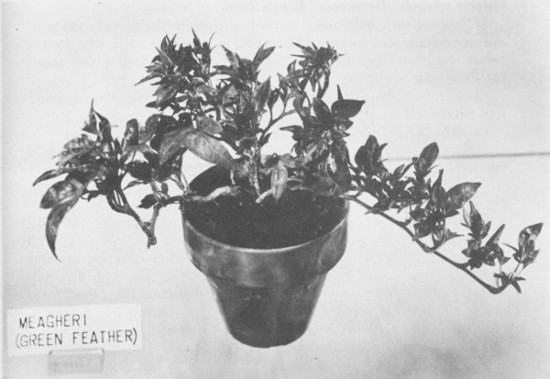
(MEAGHERI GREEN FEATHER)
Hedera helix meagheri—a fine small specimen
These variations (actually mutations) of the ubiquitous evergreen ground or wall cover, are less hardy than the species from which they have sprung. Their outdoor use is best limited to moderate or mild climates—but never where it is hot and dry. Some slow creeping types like the variety conglomerata are delightful in not-too-hot rock gardens. Indoors, of course, you can have any or all of them, and you have many to choose from. Here is a representative selection to tempt you:
‘Goldheart’—Deepest green leaves centered with a heart of gold.
‘Itsy Bitsy’—Lacy leaves half the size of a fingernail.
‘Ivalace’—Fresh green with a crocheted edge.
‘Jubilee’—Gray-green spattered with white.
‘Needlepoint’—So sharply cut there’s nearly no leaf at all.
‘Shell’—Waved and crinkled on the veins.
‘Tear Drop’—A baby’s tear at that.
‘Telecurl’—Tight as a brand-new “permanent.”
CARE. Cool, needs fresh air, loamy soil, shade or semishade, moist.
PROPAGATION. Cuttings, layering, seed. (Seeds may take as long as two years to germinate.)
SPECIAL USES. House plants, ground cover, rock gardens, miniature gardens.
Helxine soleiroli Urticaceae Baby’s Tears
Millions of tiny, button-like leaves hug close to the thready stems of this wee creeper that covers soil, or a pot, in incredible haste. The growth twines and intertwines thickly as if it were weaving a fresh green carpet for a doll’s house.
CARE. Intermediate temperature, needs fresh air, humidity, humusy soil, filtered sun, moist.
PROPAGATION. Cuttings of rooting stems.
SPECIAL USES. Ground cover, rocks and walls. (Outdoors only in mild climates.)
Hoya bella Asclepiadaceae Wax Plant
Definitely a dwarf, as wax plants grow, and not climbing, as most others are, little H. bella has arching, rather than woody, stems with thick, heavy somber green leaves on either side and clusters of incredible flowers at the tips, porcelain-white, waxy, and fragrant, with a wheel-shaped purple “crown” in the center. Best in a basket because the flowers droop, and the view is prettiest from below.
CARE. Warm, needs fresh air, loamy soil, bright light, dry side.
PROPAGATION. Cuttings in spring.
SPECIAL USES. Good house plant.
Impatiens repens Balsaminaceae
This precious creeper bears so little superficial resemblance to the popular “patient Lucy” it’s hard to believe it’s a close kin. I loved it when I first saw it at the Montreal Botanical Gardens, and was delighted when it became available to us here. It is a creeper with red stems, plump button-shaped leaves, and yellow flowers.
CARE. Intermediate temperature, needs fresh air, humusy soil, bright light, moist.
PROPAGATION. Seeds, cuttings.
SPECIAL USES. Good house plant, miniature gardens.
Koellikeria erinoides Gesneriaceae
This one is a gem—clusters of pert green-velvet leaves with indented veins and sprinkled with silvery star dust; on short stems, tiny two-lipped bell flowers of creamy white and red, in summer.
CARE. Warm, humid, humusy soil, filtered sun, moist.
PROPAGATION. Seeds.
SPECIAL USES. House plant.
Lantana camara Verbenaceae
Here is a plant I have long enjoyed around the greenhouse. It is a small hairy shrub with angled branches and rough bristly leaves and is sometimes prickly.
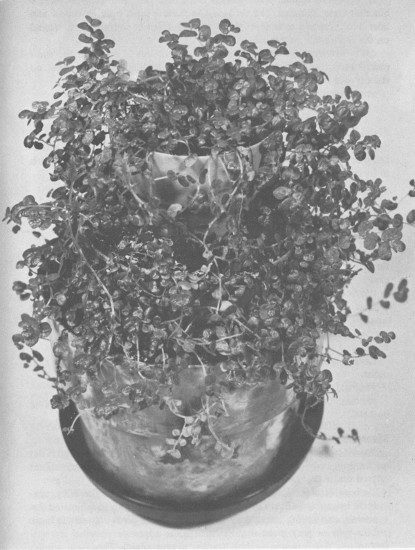
Helxine soleiroli, baby’s tears—a delightful little crawler
Its blooming habits have always delighted me, and it is a prolific bloomer come summer. The verbena-like flowers open pink or yellow and later darken to red or orange. Often several different shades will be found on the same plant at the same time.
CARE. Moderate greenhouse temperatures, or out of doors in the summer. Needs fresh air, loamy garden soil, bright light, and does best on the dry side.