CHAPTER 6 MINIATURE HOUSE AND GREENHOUSE PLANTS (continued 2)
Reading edition
PROPAGATION. Cuttings and seed.
SPECIAL USES. House plant, pots, and containers.
Malpighia coccigera Malpighiaceae Miniature Holly
Small glossy leaves sharply toothed like holly, and adorable as a foliage plant, but in addition provides the sweetest white-pink blooms which in its native West Indies produce red, edible fruit rich in vitamin C.
CARE. Partial sun, warmth, humusy soil, moist.
PROPAGATION. Stem cuttings.
SPECIAL USES. House plant, indoor bonsai.
Manettia bicolor Rubiaceae Firecracker Vine
Small, sharp-pointed leaves, tube-flowers only a half-inch long, fine thready twining stems—everything about this tropical vine is miniature except the height to which it will climb in the greenhouse, or outdoors in the South. Although its inclination is to climb, it is sold most often as a plant for hanging baskets. Perhaps the lack of a support helps keep it small. The leaves cluster thickly around the intertwining stems, making a massed background for the impertinent flowers, yellow at the tips, fire-engine red at the base.
CARE. Cool greenhouse, needs fresh air, humid, loamy soil, filtered sun, moist.
PROPAGATION. Cuttings over heat, of young growth. Seeds.
SPECIAL USES. Trellis and rafter vines for the greenhouse, hanging baskets.
Maranta Marantaceae
Exotic tropical foliage plants, laying their large oval leaves almost flat on the soil, only technically different from the calatheas, and sometimes offered under that name.
(Calathea) bicolor—Really should be “tricolor,” I think. The silky, six-inch leaves are silvery in the center, feathering out to points at intervals, and fading into a dark-green zone which gives way to the basic blue-gray or gray-green that extends to the edge.
leuconeura kerchoveana—rabbit tracks, prayer plant—There’s a similar grayish feather in the center of the leaf, a lighter silver green to the margin; but in between, mahogany blotches where a “hippity-hopper” might have planted his paws. The leaves fold up in prayer at night.
leuconeura massangeana—A picture is a more vivid description than any word I can call on. The center is silver, the thin curvy lines silvery pink. The basic color is mahogany near the middle, blending into blue-green. The leaves are tissue-thin with a silky sheen and lined with plum beneath.
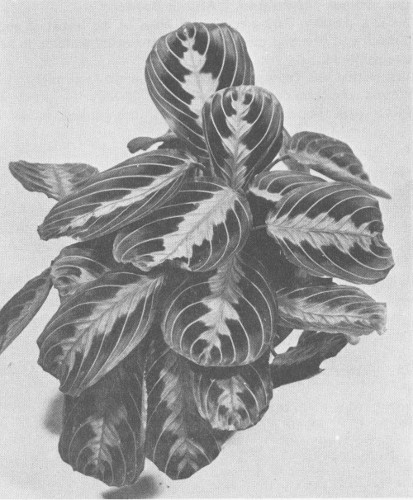
Leuconeura massangeana—a most beautiful foliage plant with a silver center and basic mahogany blending into blue-green
CARE. Warmth, minimum night temperature of 60 degrees; humid, and use mist spray; rich soil; use liquid manure (except in winter). Filtered sun (plant will scorch in too direct sunshine), moist. Partial rest in winter, dry out between waterings. Repot in spring, with the crown high in the center; use charcoal in pot.
PROPAGATION. Divide crown.
SPECIAL USES. Foliage plant, artificial light. This plant is prettiest when young. Markings may disappear in older plants.
Myrsine africana Myrsinaceae African Boxwood
This is a shrubby, dark-green-leaved plant of the boxwood sort. It is small, neat, and trim and may be shaped into many patterns to resemble the true boxwood.
CARE. Partial sun, moderate temperature, humusy soil, moist.
PROPAGATION. Stem cuttings.
SPECIAL USES. Formal miniature gardens, dish gardens, indoor bonsai.
Myrtus communis Myrtaceae Greek Myrtle
This is a fragrant close-leaved evergreen shrub native to the Mediterranean region but raised in most of Europe and this country as a potted plant. It grows out-of-doors in the South. Fragrant white flowers and purple-black berries. In size, Greek Myrtle ranges from dwarfs to ten and fifteen feet in height.
communis microphylla—dwarf myrtle—This compact form, with brown twigs and needle-like dark-green leaves, is a favorite for bridal bouquets, corsages, and decorations. It has a lovely white flower of pleasing fragrance. This sentimental association with the marriage ceremony makes it a favorite house plant.
CARE. Partial sun, cool to moderate temperatures, average soil, keep moist.
PROPAGATION. Stem cuttings.
SPECIAL USES. House plant, indoor bonsai.
Oxalis Oxalidaceae
Although most of the familiar varieties with clover-type leaves and fine-petaled buttercup-like flowers stay within our allotted limits for height, they are not miniatures as far as spreading width is concerned. But here are two small indispensables for terrariums and dish gardens.
hedysaroides rubra—firefern—Correctly, a tropical shrublet, but slow-growing and willing to be kept down by pinching. The silky thin leaves are deep wine colored and shrink from your touch. The little flowers, like golden twinkling stars, are frequent and fairly plentiful.
herrerae (henrei)—Curious, densely branching succulent for small hanging containers. The sturdy stems are gray-green and swollen, tipped with three thick leaflets. Small yellow flowers in clusters on long stems.
martiana aureo-reticulata—Shamrock leaves of emerald green thickly traced with interlacing veins of gold, easy flowers in loose clusters.
CARE. Cool, loamy garden soil, needs fresh air, bright light, dry side. (O. hedysariodes rubra requires more warmth and semishade.)
PROPAGATION. Bulbs, division of roots, seeds.
SPECIAL USES. House plants, hanging containers.
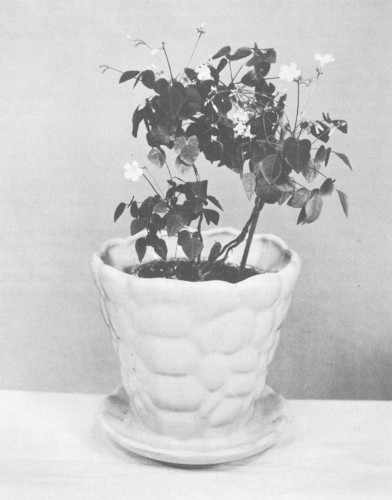
Oxalis hedysaroides rubra
Parochetus communis Leguminosae Shamrock Pea, Blue Oxalis
It’s neither a shamrock nor an oxalis, although it has three-part leaves resembling both and is marked with a mahogany quarter-moon in the center. But, the blooms are pea-like, all right, with ocean blue blending into pink on the two side petals. It’s a tender tropical trailer never more than three inches tall with creeping stems rooting over the soil.
CARE. Sun, intermediate temperature, average soil.
PROPAGATION. Seeds in March and April. Division in March.
SPECIAL USES. Rock gardens in mild climate, baskets, miniature gardens, edging.
Pelargonium hortorum Geraniaceae Geranium
How minute is a miniature? How small is a dwarf? Here is one case where I really don’t care. However you classify them, these small-scale geraniums are bewitching. And actually, their stature depends largely on how you grow them.
Their leaves may be as small as your thumbnail, but they are shaped, edged, veined, zoned, and often variegated like their larger relatives. In most varieties the size of the flowers has been cut down proportionately, but sometimes a cluster is as large as the entire plant. With age the stems may become gnarled and twisted, almost bonsai-like.
As a sort of yardstick, if you are very much concerned about height, miniatures are from two to three inches. Anything above that is a semidwarf, usually up to six or seven inches. There are many varieties within these limits, and by the time you read this there will most likely be dozens more. For the moment, here are some varieties you can start on your window sill; they will stay small and meanwhile bloom their heads off.
‘Black Vesuvius’—Single, orange-scarlet.
‘Dopey’—Large rose-red with white center. Free-blooming. Semidwarf.
‘Elf’—Dark leaves, zoned red and black, yellow on edge, single.
‘Epsilon’—Large flowers light pink with dark-pink phlox eye, semidwarf.
‘Fairyland’—Dull-green leaves with cream on the edge, single, touched with rose-red.
‘Fairy Tales’—Flouncy white with lilac at the center.
‘Fleurette’—Strong robust free-blooming dark salmon. Semidwarf.
‘Goblin’—Outstanding blooms bright red. Free-blooming, dark zoned.
‘Imp’—Very miniature salmon-pink. Dark foliage.
‘Kleiner Liebling’ (‘Little Darling’)—Variegated, single, pink.
‘Minx’—Purple-crimson blend, pretty blackish ruffled leaves.
‘Mischief’—Orange-red curled and twisted poinsettia-type petals.
‘Perky’—Single, red with bright white center.
‘Polaris’—Free-blooming white with pink edge. Single.
‘Pride’—Very large full rounded salmon. Robust semidwarf.
‘Prince Valiant’—Purple-crimson with orange flush. Semidwarf.
‘Robin Hood’—Semidwarf, strong growing, dark red. Good for outdoor planting. Double.
‘Rosy Dawn’—A different shade of salmon-orange-red. Dark foliage.
‘Ruffles’—Semidouble, small, ruffled, light salmon. Very miniature.
‘Salmon Comet’—Somewhat shaggy, single, salmon.
‘Saturn’—Bright scarlet, good bloomer, dark foliage.
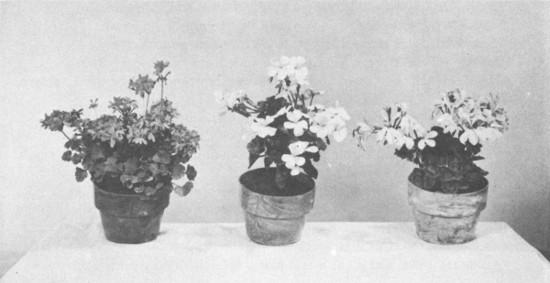
Three dwarf geraniums: ‘Salmon Comet,’ ‘Pride,’ and ‘Pygmy’
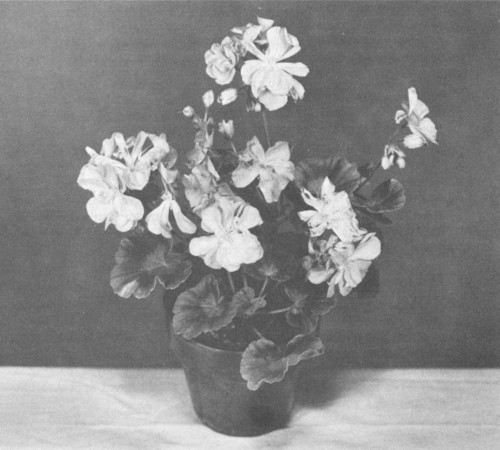
Dwarf geranium, ‘Robin Hood’
‘Small Fortune’—Double, pure white, blushing pink in center.
‘Sneezy’—Large bright scarlet with white center. Semidwarf.
‘Snow-White’—A pure-white single that blooms and blooms.
‘Sparkle’—Free-blooming bright rose-red. Semidwarf, dark foliage.
‘Sprite’—Small silvery-and-white leaves sometimes pink-tinged, single, salmon.
‘Tiny Tim’—Pink or red, tiny blooms. Miniature foliage.
‘Twinkle’—Bright rose-pink, double. Dark foliage, semidwarf.
‘Variegated Kleiner Liebling’—Small green-and-white leaves. Small single pink blooms.
CARE. Sun (in winter artificial light), fresh air (air-conditioning if possible), cool greenhouse or cool part of dwelling-house, garden soil (lime if soil is extra acid), on the dry side.
PROPAGATION. Cuttings, seeds.
SPECIAL USES. Excellent house plant, artificial-light gardens.
Pellaea rotundifolia Polypodiaceae Button Fern
Take a piece of wiry brown yarn and string it with shiny, dark-green, leathery polka dots on either side and you’ll have a model of a frond of this tropical fern. The fuzzy stems arch gently but stay close to the soil as the small rhizomes slowly creep around. It’s all very un-fernlike but exceedingly sweet.
CARE. Intermediate temperature, humid, loamy soil, shade, moist.
Pellionia Urticaceae
Two delicate tropical creepers with attractively colored and patterned leaves lined up and lying flat along the thickish stems. No one cares whether they produce their drab clusters of small greenish flowers or not.
pulchra—Precise oval leaves are dusty blue-gray, with broad lines of black over the network of nerves, violet underneath. Juicy stems look lavender-pink.
repens (daveauana)—Young leaves nearly egg-shaped, metallic copper-green, nearly chartreuse on both sides of the center nerve. Leaves of the mature plants become slimmer and pointed on the end, with more green in the center zone and less copper along the edge.
CARE. Filtered sun, warm and humid, loamy soil, moist.
PROPAGATION. Cuttings, division of rooted stems.
SPECIAL USES. Terrariums, artificial light, hanging baskets.
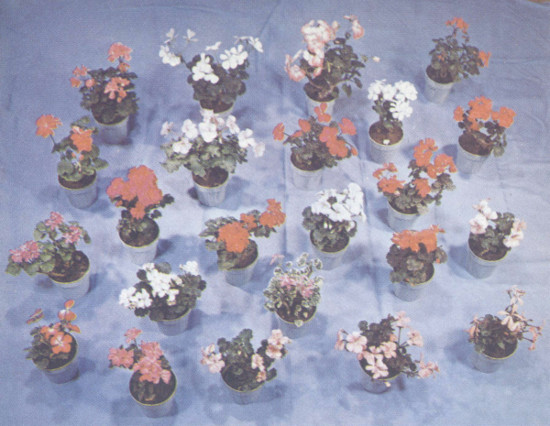
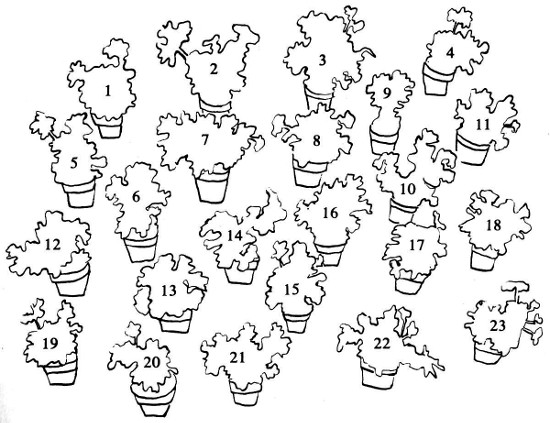
Twenty-three varieties of Pelargonium hortorum, miniature and dwarf: 1. Fleurette 2. Snow White 3. Dopey 4. Mischief 5. Robin Hood 6. Minx 7. Epsilon 8. Prince Valiant 9. Polaris 10. Saturn 11. Sparkle 12. Kleiner Liebling 13. Small Fortune 14. Goblin 15. Variegated Kleiner Liebling 16. Fairy Tales 17. Rosy Dawn 18. Pride 19. Sneezy 20. Twinkle 21. Ruffled 22. Imp 23. Salmon Comet
Peperomia Piperaceae
Since almost all of these succulents, with their “catkin-like” flower spikes, fit within our miniature measurements, I’ve enjoyed picking a few to serve as a sample of their modest but much varied appeal. I like them, and hope you will also.
‘Astrid’—Layer upon layer of glossy green, pointed oval leaves creased down the center by the main vein, making a dense, symmetrical cone-shaped mound. In fact, there are so many tight branches that the leaves can’t always find room to fill out to full size. Then ‘Astrid’ turns into a version called ‘Pixie.’ To reverse the cycle, root a single stem of ‘Pixie’ and see how it returns to being ‘Astrid’ again.
‘Caperata’ (‘Little Fantasy’)—One perfect little heart leaf, its end pointing down, perched at the top of a sturdy stem. The entire leaf is so deeply wrinkled and crinkled that the basic Kelly-green looks almost black in the indentations, and silvery on the edges. Its big brother, ‘Emerald Ripple,’ is half again as large but otherwise identical.
‘Mamorata’ (‘Silver Heart’)—These heart-leaves taper to a sharper point and are rippled in a much more modest way. There is so much silver on the surface they look plated.
metallica—Upright and branching with slim-oval leaves pointed at both ends and colored chocolate with a coffee luster. There is a wide green stripe straight down the middle.
ornata—Handsome and stately despite its small stature. The cupped, pointed-oval leaves are somber green on top and enlivened with lines of light green along the curved veins. Underneath, the veins become raised ribs and are wine red.
prostrata—Personally, I have my suspicions about this sprightly creeper. When it is young, discontented, or ailing, its fat little button-leaves along the thready stems are a plain light green. It looks so much like the species rotundiflora (nummularifolia) that you can’t tell the two apart. But when prostrata is happy and romping around in its favorite environment, the leaves turn blue-green and wear an ornate embroidery of silver over the veins. Botanically, I’m probably wrong. See what happens when you grow it.
rubella—Rosettes of tiny oval moss-green leaves stand out at intervals up and down the straight stems and all the branches. The undersurface is gaudy red, and so are the stems. Pinch often to keep it bushy.
CARE. Warm, loamy garden soil, filtered sun, dry side. Water with care. Drainage to prevent rot.
PROPAGATION. Leaf cuttings, stem cuttings, division of the plant or rooting stem (roots at joints), seeds.
SPECIAL USES. Excellent house plant, dish gardens.
Pilea Urticaceae
With one exception, this is a genus of creepers, crisp, fleshy—spreaders, and bushlets for dozens of decorative uses indoors (and outdoors in tropical climates). Their common characteristics are much-branched stems bearing a full measure of variously colored, patterned, and shaped foliage, and very greenish flowers in flat clusters at the branch tips.
cadieri minima—Dwarf form of the popular aluminium plant, or watermelon pilea, eagerly branching into a plump bush. The quilted deep-green leaves are splotched with aluminium-silver. And the splotches are faintly reminiscent of watermelon markings.
depressa—Crowded stems spill over the pot, bearing round sea-green leaves neatly toothed on the edge. Stems root where they touch the soil.
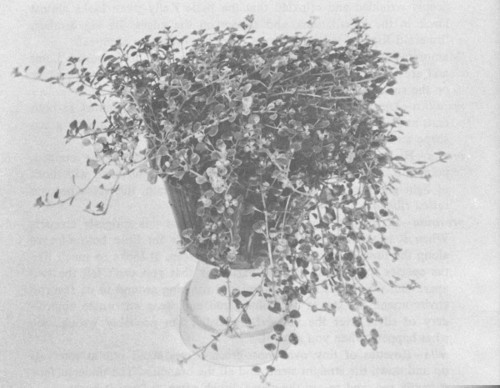
Pilea depressa—a creeping, dish-garden favorite
involucrata—panamiga—Fuzzy pointed oval leaves deeply quilted by a tight network of veins, piled pair on pair along branching stems. Foliage colors darkest green in shade, tinges of bronze in bright light. Flowers pinkish, nestled close to the last pair of leaves.
microphylla (serpyllifolia)—artillery plant—Tiny, pointed fresh-green leaves on spreading, somewhat upright branches. The male flowers explode their clouds of pollen when dry.
nummulariaefolia—creeping Charlie—Stem-rooting creeper with crinkled round, or broad heart-shaped, leaves, pale green and fuzzy.
pubescens (‘Silver Panamiga’)—Oval leaves overlaid with silvery blue, grayish beneath, the veins indented sharply.
repens—blackleaf panamiga—Prostrate and creeping, the branches spreading and bearing nearly round, thin, bronzy leaves lined with violet beneath. This one holds its beady flowers atop tall stems.
seripillacea—Habit like a perfectly proportioned shrub but in most miniature proportions. Small round leaves and plentiful branches, light green and succulent. Flower clusters held out from the foliage by stems.
‘Silver Tree’—Copyrighted name for a species with brown-green leaves marked with a broad silver zone on each side of the center vein, corrugated by indented veins.
CARE. Easy, warm, humid, loamy soil with humus, filtered sun, moist.
PROPAGATION. Cuttings, use sharp sand, 65 degrees.
SPECIAL USES. Dish gardens, terrariums.
Polyscias (Aralia) fruticosa Araliaceae
Tropical shrub or tree (eight feet or less) better known in Northern greenhouses for its intricately cut, lacy foliage, and growing so slowly it is nearly permanent (and unquestionably picturesque) in a planter or dish garden. The elegant horticultural variety ‘Elegans’ has leaves cut as fine as a feathery plume. I covet the newly named variety ‘Parsley’ because it is ruffled, to boot, and because its habit is so restrained, and its form so compact and plump.
CARE. Warm, needs fresh air, loamy soil, bright light, moist.
PROPAGATION. Cuttings of firm wood, eye-cuttings (over bottom heat).
SPECIAL USES. Dish gardens.
Polystichum tsus-simense Polypodiaceae
Definitely a dwarf fern, keeping its size moderate in a three-inch pot but not always a subject for terrariums unless they are a larger-than-usual size. It has a tidy habit, always looks clean and refreshing. The small fronds are substantial and taper to a needle-sharp point.
CARE. No sun, cool, humid, loamy soil, moist.
PROPAGATION. Divisions, buds, or offsets.
SPECIAL USES. Hanging baskets. Terrariums.
Sansevieria Liliaceae Snake Plant
Here we have some of the most fortuitous “sports” in the history of plants. The tall, stiff, ungainly but omnipresent snake plant has produced spontaneously mutant growth that turned into neat, low, bird’s-nest miniatures that are really most attractive. First came the variety named ‘Hahni,’ a flat spiral of broad leaves tapering to a sharp point, dull green marked crosswise with splashy bands of lighter green. Another sport, ‘Silver Hahni,’ abandoned most of the crossbands and plated its green with pewter. Even more striking is ‘Golden Hahni,’ with lavish bands of creamy yellow running lengthwise of the leaf on either side of a center stripe of mottled green. And to top it all, these picturesque plants are just as easy to grow as the rugged species from which they sprang. Flowers, whitish or yellowish. Slow-growing.
CARE. Filtered sun, warm, loamy soil, slightly moist.
PROPAGATION. Division of clumps. Leaf cuttings (three-inch piece in sand, shade, and 65-degree temperature). Makes stolon-like buds that form the new plants.
SPECIAL USES. Dish gardens. Good house plant.
Sarcococca ruscifolia Buxaceae Sweet Box
Sweet box is a small, free-branching evergreen with attractive leathery leaves, broad at the stem but coming to a point. Has tiny fragrant white flowers.
CARE. Intermediate temperature, fresh air, loamy soil, filtered sun, moist.
PROPAGATION. Cuttings.
SPECIAL USES. Dish gardens, indoor bonsai.
Saxifraga sarmentosa Saxifragaceae Strawberry Begonia or Geranium
One of the few hardy perennials that will thrive indoors the year round. Round, hairy silver-veined leaves grow in a rosette from the crown, which also sends out slender red stems, strawberry style, with new little plants that root and grow wherever they touch soil. In late spring the fall stems are topped by cloudlike soft clusters of small white flowers. ‘Maroon Beauty’ is slightly darker, and larger.
More miniature, and more tricky, is the variety tricolor, sometimes called ‘Magic Carpet,’ with smaller, basically gray-green leaves, red-rimmed and variegated with wide areas of creamy white, purple underneath. In cool air and sun, the cream is strongly tinted pink.
CARE. Humid, cool, poor soil, dry.
PROPAGATION. Runners.
SPECIAL USES. Dish and sink gardens.
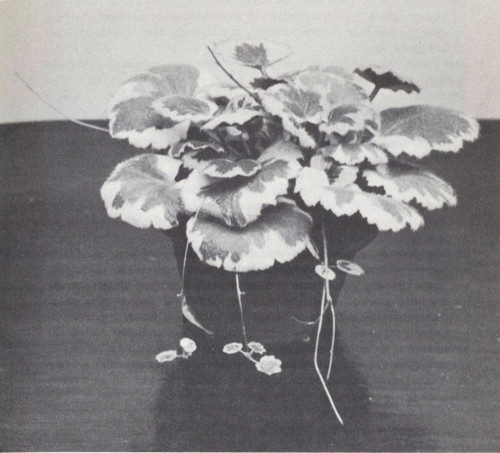
Saxifraga sarmentosa—a hardy perennial good for indoor miniature gardens
Schizocentron (Heeria, Heterocentron) elegans Melastomaceae Spanish Shawl
Mexican creeping perennial with thickly branched stems rooting at the joints, making a plush carpet of tiny, teardrop leaves. In summer the one-inch open-faced, royal-purple flowers seem unbelievably large and rich. This one is very nice in a small hanging basket, but its natural inclination is to creep and it really goes to town when it can cover soil or some sort of porous support such as a moss totem pole. It should be spectacular covering a hanging ball filled with sphagnum moss.
CARE. Intermediate temperature, humid, loamy soil with humus, filtered sun, moist.
PROPAGATION. Cuttings, division of rooted stems.
SPECIAL USES. Small baskets, miniature gardens, ground cover.
Selaginella Selaginellaceae
Soft, fluffy foliage plants in all shades of green, including metallic, and with all kinds of growth, low and creepy, upright, even climbing. They bear more resemblance to each other than they do to their cousins the ferns.
emmeliana—sweat plant—As the nickname hints, this ferny plant languishes unless it is “perspiring” in high heat and humidity. In fact, once the fine-lace fronds turn dry and brown, they won’t be fresh and green again.
kraussiana browni—Scotch moss—Soft, symmetrical cushions of bright-green leaves, slowly spreading into larger mounds.
kraussiana (denticulata)—spreading club moss—Branching, rooting, creeping stems thickly set with needlepoint leaves.
lepidophylla—resurrection plant—Antithesis of the sweat plant. When the fan-shaped branches have dried out and curled into a ball, immerse them in water and they will come back fresh and green as ever.
martensi—Young branches stand upright, may drop or creep with age. The variety variegata has eye-catching white splashes, splotches, or tips and supports itself on stiff aerial roots from stems to soil.
plumosa—Foamy creeper with short, branching stems overlapped by foliage of fresh woodsy green.
uncinata—Foliage sparse but shimmering peacock-blue in shade. The running, branching stems have a ludicrous way of sending down stilt-like roots into the soil, so they seem to be running above the soil, not in it.
CARE. Fern culture; warm, humid, humus, shade, moist.
PROPAGATION. Cuttings in pots (several pieces per pot), in spring. Put on top of medium and cover with glass at 70 degrees until roots form at joints. Spores, division of rooted stems.
SPECIAL USES. Terrariums, greenhouses, ground cover.
Serissa foetida (japonica) Rubiaceae
A boxwood-like plant with tiny white-margined leaves clustered on branchlets. White funnelform flowers to one-half inch long.
CARE. Partial sun, average soil, moderately moist.
PROPAGATION. Cuttings.
SPECIAL USES. Artificial light, dish gardens, indoor bonsai.
Sinningia pusilla Gesneriaceae
If ever a plant was a miniature, this is it. The tuber is hardly as large as a grain of wheat. The soft round leaves, not even a quarter-inch across, make a flat rosette on the soil in a thimble, or any tiny pot. From the crown arise the thread-thin stems, to the great height of one inch. And from the tip of each stem stands a slim flaring, tube-like flower, pale orchid with violet veins and lemon in the throat. This plant is quite obviously close kin to the familiar gloxinia (G. speciosa hybrids), but you almost need a magnifying glass to compare the characteristics.
CARE. Warm, humid, humusy soil, filtered sun, slightly moist.
PROPAGATION. As for the gesneriads (Gesneriaceae).
SPECIAL USES. Terrariums, miniature gardens.
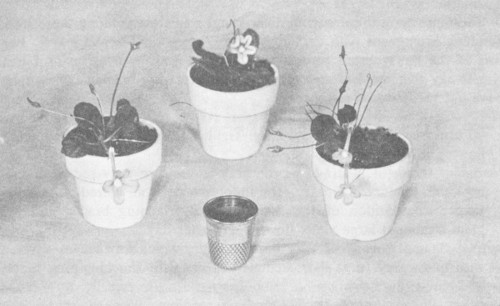
Miniature of miniatures, delightful Sinningia pusilla
Streptocarpus Gesneriaceae
When limited growing space frustrates the hobbyist who admires the great, glorious gloxinias (sinningias), here’s a selection of pleasing and precious substitutes. In general these plants are distinguished by the fact that the flower stems grow out from the base of the leaf where it joins its own stem (axil). The flowers are typical gesneriad trumpets, usually nodding; the leaves are mostly rather round and velvety. The following are fibrous-rooted:
hybridus—Botanical name for groups of hybrids called “as complex as the garden geranium,” with quilted light-green leaves and a wide selection of flower colors. One strain of particularly attractive low plants, the German Weismoor hybrids, has fringed and crested flowers up to four inches across, often contrastingly veined or blotched.
rexi—Long-oval, velvety leaves lie very flat. Six-inch stems hold two-inch funnel-flowers, pale orchid with purple throat.
saxorum—Leafy-stemmed species, the stems branching continually, making dense mounds of plump, one-inch oval leaves curled under on the edge and covered with soft silk-velvet. The lavender-flushed white flowers stand out at the end of wiry three-inch stems.
CARE. Cool, humid, loamy soil with humus, filtered sun.
PROPAGATION. Seeds (plant in early spring for flowers fall and winter), leaf cuttings, some offsets.
SPECIAL USES. Artificial light.
Tillandsia Bromeliaceae
There are several entrancing dwarfs and miniatures among these tree-perching bromeliads with curved, leathery, often quill-tipped leaves. For two of the newly listed species (T. argentea and T. tricolepsis) I can simply say that the leaf rosettes resemble airy, long-bristled cones; they have not yet flowered for me.
circinnata—The silvery leaves, broader at the base, overlap and form an urn-shaped, tuber-like swelling. Tight, flat spikes of glowing-orchid flowers in late winter.
ionantha—Three-inch tuft of pewter-gray leaves turn fiery red at flowering time, January-February. The inflorescence is an incredible paddle-shaped composition of fat, flat, tightly overlapping bracts, and the plant sends out large violet flowers day after day.
stricta—Shaggy “head” of very narrow, every-which-way leaves silvered with finest gray fuzz; short-stemmed spikes with shocking-pink bracts and blue-violet flowers.
CARE. Warm, humid, orchid-growing medium, wire to board with orchid peat. Moist during spring and summer. Dry in dark winter months, when plant is semidormant.
PROPAGATION. Offshoots.
SPECIAL USES. “Log” gardens, tree slabs.
Tradescantia Commelinaceae Spiderwort, Inch Plant, Wandering Jew
Most varieties of the inch plants that cheerfully romp all over indoor gardens are, of course, too rambunctious to be called miniature. But there are two species of much more modest proportions and habit.
multiflora—Unmistakably an inch plant, but with stems more threadlike than succulent; small, slim (even quite thin) leaves plain dark green, tinted purple beneath; and clusters of tiny white winking flowers. The effect is, believe it or not, delicate and “ferny.”
navicularis—China plant—Curious succulent creeper with very thick stems threaded through widely spaced pairs of clasping leaves folded tightly down the center; rose-purple flowers.
CARE. Easy culture, intermediate temperature, needs fresh air, loamy soil, filtered sun, dry side.
PROPAGATION. Cuttings of growing shoots, seeds, division.
SPECIAL USES. Baskets.