CHAPTER 15 MINIATURE PERENNIALS AND ROCK PLANTS
Reading edition
Our odd piece of Connecticut countryside is shaped rather like the blade of a paring knife. We cleared the point to make a wild-flower garden. At the blunt end, on one side, a tree-lined bank dips down to the road. On the other, there is an old, low rock wall that’s not particularly beautiful, nor is it suitable for dry-wall planting. When we finally whipped the central lawn into shape, we realized that a flowering border would be nice against the wall—a low, narrow border with colorful bloom all summer long.
To be in proportion and harmony with the setting, the border had to be completely in miniature—following accepted principles for selecting and arranging plants, but executed in small scale. Finding the proper plants has been a challenge; arranging them has been a trial-and-error proposition, because many varieties are entirely new to us. But last summer, the little border began to look the way we had visualized it—taller specimens in the background, ground-hugging cushions facing them down in front, small groups of straight spires for accent at strategic intervals. It will probably take another season or two to perfect the blending and contrast of flowers and foliage, and to get the most colorful and constant succession of bloom.
This is not, of course, our first acquaintance with miniature perennials; and it couldn’t possibly be our last. They combine beautifully with small shrubs, show off to advantage in small rock gardens, add an artistic finishing touch to garden pools, birdbaths, and other ornaments. They’re at their very best in outdoor planters and raised beds on patios and terraces, and in ribbon edgings along walks and walls.
Although they’re precious in flower, many varieties—candytuft, lavender, sempervivum, thyme, plumbago, to name a few—are equally decorative without bloom. This is a valued advantage when planting space is limited. Gardeners with limited time use perennials lavishly because, once established, they’re mostly permanent, and they require a minimum of care. Somehow, I sympathize with a writer who found more pleasure in spring’s tufts of fresh new growth than in the full bloom of summer. Nostalgically, one welcomes the return of an old friend; practically, one knows it will tend to its business of growing and flowering with very little personal attention.
This leads us to the question, “How perennial is a perennial?” and to the obvious answer, “It depends....” To begin with, it should live at least three years in your garden. After that, some varieties need to be lifted and divided into smaller plants with fresh new vigor; some may need to be replaced completely; some few may grow on indefinitely without renewal, or may replace themselves with seedlings that are often of doubtful value.
In the language of the catalogues, a “hardy” perennial is one that can withstand fairly severe winter cold, and may not be hardy in Southern gardens where it is not frozen into dormancy. Most hardy perennials are “herbaceous”—the stems usually die back to the ground each winter; some few have stems that may or may not be somewhat woody and persistent. A “tender” perennial is likely to be killed by cold weather, and is grown as an annual in the North, if it is grown at all.
The life cycle of a biennial extends over two years. It is grown from seed, may or may not need special protection to carry it over a cold winter, produces flowers and seeds the second year, then dies. Some biennials sow themselves with such faithfulness they’re regarded as perennial. The comparatively few biennials among flowering plants are grown much like perennials; miniature varieties are covered in this chapter.
Originally, I was firmly resolved to admit as miniatures only those perennials that grow less than eight inches high. But I couldn’t resist stretching the limits an inch or so to allow for a ten-inch flower stem above a small, flat rosette of leaves; and I found that the height limitation allowed free entry to some rambunctious spreaders that could quickly ruin a miniature garden. So I finally settled on biennials and perennials that are miniature in general appearance and habit, without strict measurements, and with flowers and foliage in suitable proportion for miniature gardens.
For the first year or so, locating some of the small perennials we wanted was rather like a treasure hunt; we never knew where we’d find a clue. Occasionally, we’d spy a prize on a visit to a local nursery. Frequently an advertisement or a tip from another gardener would give us the name of a promising mail-order supplier. Those who specialized in rock-garden plants proved to be particularly fruitful prospects. Often, we started our plants from seeds and discovered later that mature plants were available, had we known it. Now, we have quite a list of sources for miniature perennials which we happily share with you, beginning on page 259.
In selecting suitable varieties, decorative effect is naturally the first consideration—size, habit, and blooming season; color and texture of flowers and foliage; how the plants fit into your design and planting plan. Equally important is hardiness; not only ability to survive a cold winter, but also adaptability to other climatic conditions. Some perennials simply will not grow where summers are hot and dry; others will live but can’t mature enough to flower where nights are cool or growing seasons are short.
Like other types of plants, perennials should be selected according to their cultural needs, and should be planted only where they can get the amount of sunlight and moisture they need, and where the soil is suitable or can be made so. An acid-loving plant in neutral or alkaline soil is a poor, short-lived thing; a moisture-lover withers pitiably where it’s dry as a desert most of the time; a “hardy” perennial won’t be hardy unless its environment is to its liking.
PLANTING AND CARE
Unless it’s utterly impossible, we do all our planting in the spring, so there is plenty of time for plants to develop vigorous root systems before a mean Connecticut winter comes along. This is particularly important to shallow-rooted perennials, and to any that are planted in windy, exposed sites. But for us, it also includes spring-flowering varieties. In spring we’ve planted dormant roots with or without mere nubbins of new growth, and plants that were fully leaved out and bursting with buds, with very little loss. But fall planting has proved to be a gamble; and if we’re forced into it, we’re more likely to find room in the cold frame for the new arrivals until spring.
Of course, this is not usually necessary in more temperate sections where plants set out in late summer and early fall have plenty of time to become acclimated before heavy frost. And it can be all wrong for Southern gardens, where planting during deepest dormancy is often recommended.
Even if you’re planting only three little pinks in a nook the size of a lady’s handkerchief, soil should be dug deeply and be suitably conditioned or enriched, drainage should be made perfect, roots should be spread out carefully, and watering should be as thorough as if you were planting a priceless miniature tree or shrub. To prevent a serious setback from wilting, put up some sort of temporary protection against sun and wind—an encircling screen of leafy branches, even a tent of newspaper or old sheeting.
Soil
There are few soils that can’t be improved by the addition of organic matter such as leaf mold, manure, or compost; and few plants that won’t grow better for it. It helps hold moisture in sandy soil, improves texture and increases drainage in clay-like soil, enriches ordinary garden loam. Mix it thoroughly with the soil before you place the plants. Also before planting, add lime to acid soil for plants that need it, acid peat for acid-loving varieties if your soil is neutral or alkaline. Above all, don’t plant anything (except for a few bog inhabitants) where water stands in puddles. Poor drainage has killed more perennials than Old Man Winter himself.
Watering and Mulching
Most miniature perennials naturally have rather shallow root systems, so they suffer quickly from drought. Don’t let them dry out seriously (particularly after transplanting); water often and deeply enough that the soil below the roots is wet. Thorough watering in late fall, just before the ground freezes, often makes the difference between winter-survival and winter-kill.
Mulching with any available, airy material—buckwheat hulls or crushed sugar cane, for example—will help keep soil moist and will also discourage germination of weed seeds, thereby saving you a bit of work.
Fertilizing
Most miniature plants don’t like or need a heavy diet. A light top-dressing of balanced fertilizer, in early spring, is usually enough to nourish them without forcing soft and straggly growth. Reluctant bloomers may need a small ration of superphosphate or a booster drink of liquid-manure “tea” as flowering time approaches.
Pruning and Grooming
To keep them compact and attractive, some varieties should have growing tips pinched out once or twice in spring and early summer; others may have a few long, straggly stems to be removed; some carpeting types should be sheared off after flowering. Always pick off faded flowers unless you have reason to want the seeds.
In fall, when foliage is frostbitten, cut back the old stems and take them away, along with any fallen leaves or other debris, to be burned. Many diseases and insects winter over in decaying vegetable matter.
Insects and Disease
Our trusty duster or sprayer, filled with an all-purpose insecticide-fungicide formula, gives all our garden plants a preventive treatment several times a season. So far, this has been enough to keep problems and pests away. For some special infestations or epidemics, we keep a few specific remedies on hand—sulfur for powdery mildew, and Aramite for mites, for example.
Winter Protection
In our area we never know whether winter will bless us with a constant covering of snow, or the ground will be bare and exposed to alternate freezing and thawing that “heaves” tender roots up out of their beds. After the ground is frozen two or three inches deep, we cover sleeping perennials with a light blanket of salt hay or, sometimes, evergreen boughs. Crowns that stay evergreen are surrounded by a collar of sharp sand. Questionably hardy varieties are lifted and moved to the cold frame.
In spring, as the weather begins to warm up, we remove the protective mulch a bit at a time. There’s a fine line between taking it off prematurely, thus exposing new growth to a late freeze, and leaving it so long that the soil underneath gets soggy and the roots rot. But, rot can be fatal, and frozen tips of new growth are not, so we remove the winter covering as fast as we dare.
PROPAGATING MINIATURE PERENNIALS
One item in our Connecticut landscape that’s completely out of scale with its surroundings is the monstrous cold frame near the back boundary line. The cement-block wall goes down below the frost line, and up high enough to make room for winter storage of fairly good-sized plants. The discarded storm windows are hinged across the back and completely removable in summer, when they are replaced by light wooden frames of the same size with laths nailed a lath-width apart. The construction slants toward the south, to make the most of all winter sunshine; light shading is necessary in summer to protect tender seedlings and rooting cuttings.
The cold frame serves dozens of purposes and has more than paid for itself with plants it has protected or produced. When we plant perennial seeds in the cold frame, we throw a piece of burlap across the top and keep it moist until they germinate. Tender seedlings spend their first winter within its walls, and so do newly rooted cuttings. Questionably hardy perennials or any that we acquire in fall are held over until spring. Every year, it seems as if we take more out of the cold frame than we put into it!
Other, smaller, portable devices are equally useful for all kinds of summer propagating. Low square or rectangular wooden frames can be set over an area of prepared soil and the top covered with glass or polyethylene to keep the soil from drying out. An empty fruit crate from the grocer can be equipped with a glass or plastic top. A few cuttings can be rooted in soil in some shady spot with a clear glass jar inverted over them. There are many devices that keep soil moist and air humid while seeds germinate or cuttings root. How large or elaborate yours should be depends on how much propagating you want to do.
Seeds
Many hard-to-find miniature perennials can be easily grown from a twenty-cent packet of seed. You can also harvest seeds from your own plants; but only natural species will “come true.” Complicated hybrids will have unpredictable offspring, most of them not particularly desirable.
We plant seeds of most biennials and perennials in June, when the soil is comfortably warm and the seedlings will have the whole summer to grow large and lusty. Some of our own seeds that ripen in midsummer are planted as soon as we can harvest them; those that mature later are usually stored on a cool shelf in the cellar in plastic boxes or little pill bottles that keep them dry.
Soil for the seed bed is sifted to remove pebbles and debris, and mixed with equal quantities of sharp sand and peat or sieved leaf mold. To prevent “damp-off,” a fungus that chokes off stems at the soil line, soil should be sterilized if at all possible. Small quantities may be baked in the oven. Special easy-to-use fungicides are also available; follow label directions.
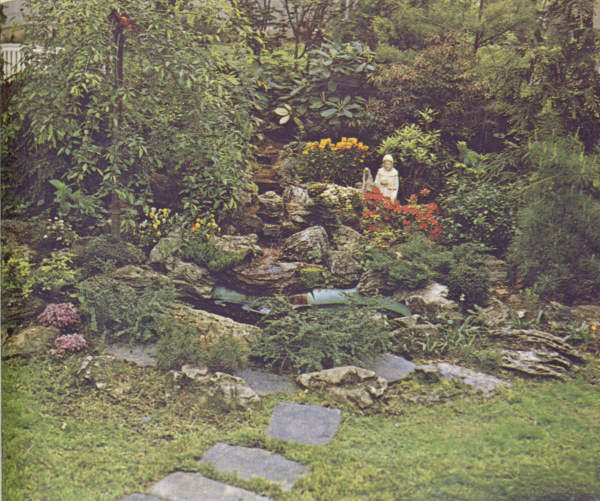
Rocks, water, and planting—an effective combination of all the elements of a rock garden. (Mr. and Mrs. Norman Cherry)
Most seeds are covered to the depth of their diameter; very fine seeds are merely firmed down into the soil. Seeds with hard coats may be gently nicked with a knife or soaked in water for a day or so. Some seeds, like primroses, need to be treated as if they had wintered outdoors before they will germinate. You can put them in moist sand in a small, tight container and alternate freezing in the ice compartment and thawing in the warmer part of the refrigerator for several days. Or you can plant these seeds in a small box or flat of their own and leave them outdoors, in a protected spot, where winter will supply its own natural conditions.
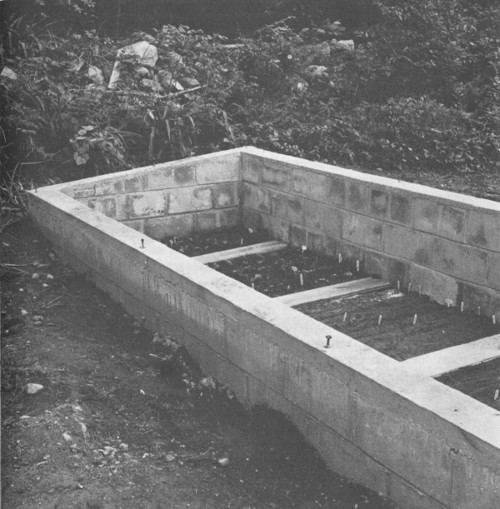
Cold frame planted and ready for top made from discarded storm windows
Some seeds germinate faster in the dark, some with light; some like cooler temperatures than others; some come up in seven days, some take months or even a year. Seed packets usually supply pertinent information.
Seeds will not germinate in dry soil, or if allowed to dry out even temporarily during the critical period. To avoid washing out fine seeds, water gently with a fine mist, or set the flat or other container in water up to the level of the soil inside. When the soil surface looks shiny and moist, remove the container and set it aside to drain.
When the first “true” leaves are of fair size, transplant the seedlings to peat pots, or flats, or rows in a prepared bed or cold frame. Shade against sun and wind until they resume growth.
Stem Cuttings
Many perennials can be propagated easily and in quantity by rooting softwood cuttings like those of trees and shrubs. Tip cuttings three or four inches long are usually best, with all the flower buds and the lower leaves removed. Some types, such as dianthus and lavender, root faster and more surely if the cutting is taken with a heel.
For spring-flowering varieties, take stem cuttings after flowering has finished and up until midsummer; for those that bloom later, take cuttings in May or June.
Division
This is a wonderful way not only to increase perennials, but also to keep them young and vigorous. How often you divide them depends on each plant’s individual performance. When growth is so thick it seems to be choking itself, when there’s little healthy new growth and a poor show of bloom, when a clump or crown becomes tough and hard in the center, it’s usually time to refresh the plant by division. Some plants need it almost every other year, some not for many years.
How you divide a plant depends upon how it grows. If there is a central crown of leaves, it can be cut cleanly into two or three sections, each with its own share of roots. Or there may be new, young crowns clustered around its edge that can be pulled or cut off. If the plant simply has a crowded colony of stems and fibrous roots, you can often pull it apart gently into several pieces. Or if it’s the type that sends out rooting runners, you can sever these and replant them. Generally, the old, tired center of the plant is discarded.
In cold climates, even spring-flowering perennials are most safely divided very early in the season, when new growth is beginning. Cool, moist spring weather favors rapid recovery from the operation, and there is plenty of time for the new plants to mature before fall. Summer-flowering and fall-flowering types are also divided in earliest spring. In humid climates the spring-bloomers can be divided in August or early September.
Layering
Almost any perennial with low or low-hanging branches can be propagated by pinning a stem to the soil, several inches from the growing tip. When new growth appears, cut off the rooted stem and transplant it. This propagating method may not produce great numbers of new plants at one time; but it is surely one of the easiest and least troublesome practices—and particularly safe because the new plant is supported by the parent until it is well rooted.
I’ve been intrigued with one good gardener’s method of creating a low hedge from one plant of dwarf lavender. She layered one stem at each side of the original plant. When these two new plants were fairly mature (but not cut away from the old plant), she layered one stem of each. By repeating the process, and locating each new layer in a straight line with the last one, she can extend her hedge as far as she wishes and plant it as she goes, along any lines.
ROCK GARDEN PERENNIALS
Achillea Compositae Yarrow, Hilfoil
Resembling the field yarrow, but dainty, mottled, and tufted. The leaves, some finely cut and ferny, wear thick wool coats. The saucy flowers are in heads, some flat-topped and not unlike daisies.
ageratifolia aizoon (Anthemis aizoon)—Six-inch mat of silver-haired, uncut leaves topped with bright white flowers in May and June.
clavennae—Tufts of hoary, fine-cut leaves less than a foot high, tight round white flower heads three-fourths of an inch across in May and June.
tomentosa—Best-known little species, quickly makes a thick mat of semi-evergreen gray-green leaves six inches tall. It has sunny yellow flowers from June to midsummer. The variety aurea has more golden flowers and blooms earlier; nana is a true midget and makes a thick carpet studded with many white flowers. Five-inch ‘Moonlight’ has flowers of sulfur yellow, and greener foliage.
umbellata—Four-inch mounds of fuzzy, silvery, ferny leaves. It has cream-white flowers in June and is evergreen in temperate areas.
CARE. Any soil, even sandy or poor. Dryish to moist. Sun or very light shade. Easy to grow.
PROPAGATION. Division in spring or fall, seeds (flowers the second year).
SPECIAL USES. Rock plantings, dry-wall planting, edging, ground cover, pavements.
Aethionema Cruciferae Stone-Cress, Persian Candytuft
This is a heathery little shrub-like perennial with slim leaves and steely-blue needles, cheerful clusters of flowers at the stem tips in May and June. It is often compared to a minuscule daphne.
armenum—Neat tufts of short, sharp leaves and petite pink flowers in June. It is never over four inches high.
iberideum—Low, crowded, and cushiony-minute with gray-green leaves and large white flowers in short clusters. This one is earlier than other varieties, blooming even in April if the weather is favorable. (Needs gritty soil with some lime.)
schistosum—By comparison this one is a giant growing to eight or ten inches, with two-inch leaves and fragrant pink flowers.
CARE. Soil light, sandy, well-drained, and gravelly; dry; sun. Hardy in southern New England. Give protection in severe winters.
PROPAGATION. Cuttings in summer, division and seeds in spring.
SPECIAL USES. Rock gardens, dry-wall planting, edging, borders.
Ajuga Labiatae Bugle
This is a low, creeping or spreading perennial with pinwheels of rather coarse leaves and small blue flowers which come in May and June. It is of miniature height and should only be planted where you can control it, or want it to spread. Some of the better-known varieties are:
genevensis—Oval toothed leaves, light green. Flowers deep blue.
pyramidalis—Less likely to spread and stays neat and small. Flowers blue and slightly larger than those of other varieties.
reptans—Also known as carpet bugle, it is nearly supine, with stems that root as they creep. Flowers blue or purplish. Variety alba has white flowers; variegata, foliage marked with cream and pink. Rubra pink flowers.
‘Silver Beauty’—Compact and ground-hugging. White markings on leaves give a silvery appearance. Blue flowers.
CARE. Ordinary soil, even poor; sun or part shade; dry. Plant in fall or spring six inches apart. Easy to grow.
PROPAGATION. Seeds in spring, division.
SPECIAL USES. Rock gardens, dry-wall planting, ground cover, edging.
Alyssum Cruciferae Madwort
Plushy, mat-forming, like a silver-gray rug with flecks of white or golden flowers in spring and summer. The grayish leaves are small, the flowers in thick clusters. Popular forms are:
alpestre (serpyllifolium)—Three-inch gray carpet with bright-yellow flowers through June.
montanum—Fragrant gold flowers in June; about eight inches high.
mulfenianum—Smaller (four-inch) version with balls of yellow flowers from May to June.
saxatile—basket of gold—Blooms in May; nine inches high; spreads thickly. Variety compactum is more compact and shorter; about eight inches. Variety citrinum has lemon-yellow flowers.
spinosum—Dense growth, shrubby and spiny, about eight inches high. White flowers sometimes tinged with pink, in June and July.
CARE. Any ordinary soil with drainage. Sunny, open location. Plant in spring or fall six to eight inches apart.
PROPAGATION. Seeds in fall, division of roots in spring.
SPECIAL USES. Rock gardens, borders, dry walls, pavements, edging, carpet for bulbs, ground cover.
Anemone Ranunculaceae Windflower
One of the earliest to bloom in the spring, it has lacy leaves and colorful flowering saucers not made up of petals but of sepals (leaves that encircle the flowers at the base).
apennina—Tuberous species six or seven inches high with deeply cut leaves; arrives in March with bright, sky-blue flowers. Variety alba has white flowers; purpurea, rich lavender-rose.
blanda—Resembles apennina but is slightly larger and has darker flowers.
nemorosa—European wood anemone—Similiar to American forms. Variety alleni has lavender flowers. Variety rosea, pink.
palmata—Six-inch dwarf with whorls of leathery leaves, golden-white flowers in May or June. The flowers of the variety albida are heavenly white with gold centers.
pulsatilla—pasque flower—A more robust alpine growing to eight inches tall. Hardy even in Maine rock gardens. Flowers are purple-blue bells that come early and last as long as the weather is cool. Its finely cut leaves are softened with silky hairs. Other varieties are alba, white; rubra, plum red; and camla, silvery lilac surrounded by white.
CARE. Rich sandy loam with leaf mold. Part shade for some varieties.
PROPAGATION. Seed in late fall, root division in early spring.
SPECIAL USES. Wild gardens, rock gardens, forcing, flower beds.
Antennaria Compositae Pussy-Toes
This is a furry little creeper with flat, silvery, spoon-shaped leaves and bristly flowers sometimes dried as everlastings.
dioica—Fast-creeping carpet with pink-tipped flowers in spring.
microphylla (parvifolia)—Western native, slower growing, with white flowers.
neodioica—Eastern native that makes a low mat of silver-hairy leaves and sends up pink-tipped white flowers in early summer.
CARE. Sandy, even poor, soil; full sun; dry. Cut off leaves after flowering to make neater plants.
PROPAGATION. Seeds and division.
SPECIAL USES. Rock walls and pavement.
Aquilegia Ranunculaceae Columbine
Hardy little perennials with two-or three-part leaves like clover but often cut or indented on the edge, and drooping or noddling flowers with flaring sepals and spurs of different sizes and shapes.
akitensis—Six-inch Japanese doll with stemless blue-green leaves and large lavender-blue flowers with yellow at the center. June flowers.
discolor—Alpine with glowing blue flowers, white inside and frosty-green leaves. Five inches tall.
flabellata nana-alba—fan columbine—Three divided leaves like blue-green fans, lustrous white flowers in May.
jonesi—Diminutive, two to three inches tall. Small leaves in small mounds, flowers upturned and deep blue in June.
saximontana—Alpine with two-inch tufts of crisp leaves; aquamarine flowers with yellowish sepals on four-inch stems in April.
CARE. Soil light and sandy, with leaf mold; drainage; shade or semishade. Hardy. Plant in fall.
PROPAGATION. Seeds in the spring (flowers the following year), division in the spring.
SPECIAL USES. Rock and wall planting, wild-flower gardens, beds.
Arabis Cruciferae Rock Cress
Mat-forming perennials with blankets of hairy leaves under spreads of flowers rather like stocks or candytuft. They flower in spring or summer and are often fragrant.
albida—Unless the form is marked “compact” the species may top ten inches. Leaves green and woolly, flowers white (in April and May). Variety flora plena is about six inches tall with double white flowers; rosea, orchid pink and single; variegata, white-marked leaves. ‘Pink Charm’ is single with bright-pink flowers.
blepharophylla—Clusters of deep-green leaves with eyelashes on the edge; pink-purple flowers in April. Height, four inches.
procurrens—Matting plant with creeping stolons, white flowers in May. Dwarf variety, stari, spreads slowly and stays under four inches.
CARE. Medium, even poor, soil; warm and sandy. Not too moist. Sun or light shade. After flowering cut back straggly stems.
PROPAGATION. Division (in spring or fall), seeds, cuttings.
SPECIAL USES. Rock gardens, wall planting, ground cover, edging.
Aster alpinus Compositae Rock Aster
Small leaves mat closely to make a mound four inches high. The flat lilac daisy-like flowers come in June and July on eight-inch stems. The variety superbus is slightly larger; albus has white flowers. ‘Goliath’ is a variety with flowers ranging from yellow-centered lavender to near-purple. ‘Spring Charm’ is a midget with lavender-pinkish flowers.
CARE. Any good soil, full sun.
PROPAGATION. Seeds in the spring (flowers the next year).
SPECIAL USES. Rock gardens, borders, edging.
Bellis Compositae Daisy
Miniature daisies of cheerful charm, some varieties barely six inches tall.
perennis—English daisy—Nests of green leaves sprinkled in spring and summer with flowers of white, rose, or red. Several new strains are now being offered in singles, doubles (some have quilted petals), and varied colors.
rotundiafolia caerulescens—alpine daisy—Soft-blue flowers all summer long.
CARE. Fertile soil; moist, but good drainage; sun or semisun. A cool summer produces larger flowers. Not suitable for hot climates.
PROPAGATION. Seeds (flowers following year), division in cool weather.
SPECIAL USES. Rock gardens, edging, ground cover.
Campanula Campanulaceae Harebell, Bell Flower
These are the beloved bell flowers which should be included in all gardens. Included on page 264 are varieties that are easy to get and grow.
CARE. Light loamy soil, slightly on limy side; drainage. Sun, except dwarfs, which take light shade. Remove dead flowers. Shelter with evergreen boughs in severe winter.
PROPAGATION. Division in early spring or fall, seeds (plant as soon as ripe), cuttings.
SPECIAL USES. Rock gardens, walls, borders, edging, pots, and baskets.
Cerastium Caryophyllaceae
Perennial creepers and carpeters with slim silk-hairy leaves and showers of white flowers with an over-all effect of soft fuzzy wool. Maximum height six inches, but most plants less.
alpinum lanatum—Smallest downy leaves, white flowers in clusters in June and July.
bierbersteini—Longer leaves, flowers one month earlier.
tomentosum—snow in summer—This, the most popular species; quickly forms a large mat like a silver carpet under starry white flowers in May and June. It is said it will grow in pure sand.
CARE. Ordinary soil, sun, dry. Easy to grow.
PROPAGATION. Seeds (plant in fall or spring), division, cuttings after flowering.
SPECIAL USES. Rock gardens, edging, flower beds, ground cover.
VARIETIES OF HAREBELL, BELL FLOWERS
Leaves Flowers Blooming season
carpatica mats 4″ tall blue saucers June to Oct.
carpatica alba mats 4″ tall white June to Oct.
carpatica ‘Wedgwood’ cushions violet-blue cups June to Oct.
carpatica ‘White Wedgwood’ cushions white June to Oct.
carpatica turbinata low mass large, flat, violet June to Aug.
cochlearifolia shell-shaped mass blue bells May and June
cochlearifolia alba shell-shaped mass white May and June
cochlearifolia ‘Mironda’ shell-shaped mass silver-blue June to Aug.
collina fuzzy clumps purple bells June
elatines dense 3″ mass stars, white center June and July
elatines alba plena double white ‘Star of Bethlehem’ for baskets and pots
garganica may be woolly blue June and July
portenschlagiana (muralis) roundish, toothed crinkled tufts violet bells June and July
saxifraga broadened upturned violet bells spring
Ceratostigma plumbaginoides Plumbaginaceae Leadwort
Shrubby little perennial “bushes” about eight inches high and spreading into clumps twice as wide, with hairy-edged leaves which are green with bronze overtones. It turns to a brickish color in autumn. In August the plants cover themselves with blue phlox-like flowers and continue to bloom until heavy frost.
CARE. Most any soil with drainage. Will grow in sand. Full sun best but semishade is acceptable. Don’t plant in moist location. In winter give protection.
PROPAGATION. Seeds in the spring, division at time of new growth in spring, cuttings.
SPECIAL USES. Borders, edging, rock gardens, ground cover.
Coreopsis auriculata nana Compositae
Neat little plant with tufts of divided, or lobed, leaves; golden-orange daisy-like flowers on three-to six-inch stems, from June through August.
CARE. Light sandy soil. Shade in extremely hot climate. Cut faded flowers.
PROPAGATION. Sow seeds in fall for flowering next year; division of clumps.
SPECIAL USES. Rock gardens, edging.
Corydalis Fumariaceae Fumitory
Ferny-leaved herbaceous perennials with spurred flowers like bleeding heart but more colorful and blooming in the spring. Some types are tuberous-rooted, or partly so, but are grown more like other perennials.
cava (bulbosa)—Tuberous type, about eight inches tall, with gaudy clusters of purple flowers in April.
cheilanthifolia—Perennial with thickened roots, finely dissected eight-inch leaves, sprays of yellow flowers from May to frost. Requires shade from hot sun. Striking for its foliage alone.
halleri (densifolia)—March bloomer, tuberous. Not many leaves but plenty of clusters of rosy, or purple, flowers; six to eight inches.
lutea—Eight-inch clump-makers with lacy blue-green leaves. Yellow flowers appear in June and repeat later. Likes to keep cool in the shade, or have its roots under a rock. Won’t grow in extreme heat.
nobilis—Tuberous type, upright to eight inches, with leaflets both wedge-shaped and deep-toothed. It may have as many as twenty spurred white flowers per cluster, tipped with yellow and spotted with purple.
rupestris—Ferny-leaved eight-inch perennial with short-spurred yellow flowers. Nontuberous.
CARE. Any garden soil with drainage. Partial or light shade, or sun. Plant tuberous types in fall.
PROPAGATION. Division, seeds.
SPECIAL USES. Borders, rock gardens, wall plantings, edging.
Dianthus Caryophyllaceae Pink
There are some very special treasures for every garden in this big family of spicy-scented plants with flowers that seem to have been fringed with pinking shears. There are impermanent perennials that flower the first year like annuals, biennials like sweet William that often self-sow, longer lived types that tuft or spread out to make low flowering mounds or mats, elusive alpines for the rock-garden connoisseur, pixies with tiny half-inch flowers, and great garden carnations. Every year new hybrids make the list longer.
Make your selection, of course, according to size, scent, growing habits, and the color scheme of your little garden. For the miniature rock garden, the rose-colored species D. alpinus stays under three inches; D. neglectus combines pink and buff, and there are many more. The Allwoodi hybrid varieties are sturdy, lasting, and flower freely for most of the summer. The cheddar pinks (D. casius varieties) are clumpy; the maiden pinks make mats; the cottage or grass pinks are tufted; sweet William (D. barbatas) is one of the clusterheads; the “annuals” (usually forms of D. chinensis) will flower early when seed is started indoors, repeat the performance if cut back after the first flowering, and may even live to bloom once more the second year.
For the most miniature, look for these newcomers: double pink, three-inch ‘Pixie’; rose-red ‘Tiny Rubies’; four-inch ‘Wee Willie’ (sweet William’s son), not reliably perennial but behaves beautifully as an annual; deep-red ‘Little Joe.’ One seed house offers a perennial ‘Midget Double’ sweet William under four inches high and like a button-size carnation.
CARE. Warm sandy soil, not too rich. Lime, dryish, drainage. Full sun, cool temperature. Cut off faded flowers.
PROPAGATION. Division, layers, cuttings, seeds.
SPECIAL USES. Flower beds, rock gardens, edging.
Geranium Geraniaceae Cranesbill
This is not the popular potted plant (pelargonium) or the wild geranium of the Eastern woods (G. maculatum). These are lacy-leaved perennials with a delicate look but a tough constitution. Here are some of the smallest available types, flowering mostly in the spring but often repeating in spurts throughout the summer.
farreri—A little three-inch doll from China, the many-fingered leaves making a low nest under the astonishingly large, black-anthered, blush-pink-on-white flowers.
macrorrhizum—The species is largish and makes a buxom six-inch bush with light sprays of pink flowers. The foliage is aromatic and turns beautifully bronzy in fall.
pylzowianum—Eager spreader, two to three inches high, with finely divided leaves and rosy flowers in May and June.
CARE. Gravelly soil with drainage, dryish. Sun or light shade. Mostly hardy.
PROPAGATION. Seeds; root division in spring or fall.
SPECIAL USES. Border and dry-wall planting.
Gypsophila Caryophyllaceae Baby’s Breath
Here is something for every rock garden, the beginner’s or the connoisseur’s. Over a soft cushion of tiny leaves the foamy flowers are heart-tuggingly romantic and delicate. The plants are hardy, eagerly branching and spreading, and veiled in bloom for most of the summer.
cerastioides—Four-inch creeper with gray-velvet mouse-ear leaves, sprays of white flowers with pink veins. Soil should be alkaline, sandy or gritty, and perfectly drained.
muralis—An unusual “annual” about six inches high, with narrow leaves and warm rosy flowers. Looks and grows best when crowded.
repens—Midget trailer with slim, silvery blue-green leaves and white or pinkish flowers only a few inches above them. Available varieties include, white-flowering alba, compact double pink bodgeri, and single rose-pink rosea.
CARE. Not too rich soil, dryish, with drainage. Full sun or light shade. Usually hardy. Don’t thin too much.
PROPAGATION. Seeds (sow where you want the plant), division.
SPECIAL USES. Rock gardens, wall plantings, pavements, ground cover.
Iberis Cruciferae Perennial Candytuft
Extremely decorative and useful evergreen with durable, fresh-looking foliage and clusters of sparkling white or pale-tinted flowers in spring. The plants spread, but not enough to be troublesome in small gardens.
saxatalis—Miniature even among miniatures, with two-inch clumps of hairy-edged leaves and flat clusters of white flowers in May. Needs gravelly, limy soil.
sempervirens—The better-known named varieties are offspring of this stalwart, nearly shrub-like perennial with blunt-tipped narrow leaves and flowers forming an umbrella-shaped cluster on six-to eight-inch stems. One plant can spread out to several feet across. Among the dwarfs are ‘Autumn Snow,’ seven inches high and often blooming again in September; ‘Little Gem,’ compact mounds four to six inches high; ‘Purity,’ the purest of white; and ‘Snowflake,’ a little later (June) and a little larger (eight inches).
Iris Iridaceae
Basically, iris are of two types—bulbous and rhizomatous—each with miniature species, varieties, and hybrids. Leaves may be broad and flat, or slim and grass-like. Stems may bear one or several flowers, the earliest in March and the latest in June. Natural colors include white, yellow, and all shades of lavender and purple; hybrids widen the range to many other tints.
There are many miniature species, some with several varieties, and also hybrids, of their own. By far the largest group is the ‘Dwarf Bearded Iris,’ so classified by the American Iris Society according to the height of the flower stalk, and further divided into two series: miniature dwarfs (four to ten inches) and standard dwarfs, Lilliputs (ten to fifteen inches). These are rhizomatous, of course, like the tall bearded giants of the garden, and bloom midway between the earlier species and the big ones.
bakeriana—Bulbous, about six inches high, with round leaves and early, fragrant, blue-purple flowers.
cristata—Crested iris with rhizomes and spreading by stolons to make wide mats. About six inches high with one or two white-crested, lilac, fragrant flowers in mid-May. There is an all-white variety. It likes light shade or dappled shade and cool moisture for its roots.
flavissima—Rhizomatous, spreading by stolons to make open clumps under six inches high. It has narrow leaves and several bearded, brown-marked yellow flowers per stem when it blooms in April and May. It needs gritty or sandy soil, only slightly acid.
histroides—Bulbous, about four inches high, with pale-blue flowers which appear early before the leaves. Various colors available.
innominata—Rhizomatous West Coast dwarf with long grassy leaves and flowers varying between yellow and orange, and between lavender and purple. Blooms in May and June. Takes light shade and neutral, or even slightly acid, soil.
orchioides—Bulbous, with sword-shaped leaves to nine inches long; has several purple-blotched yellow flowers per stem.
reticulata—Bulb covered with netted membrane. Reedy stems about eight inches long disappearing in June. Crested flowers on six-inch stems with a fragrance like fresh violets. Gold-marked on deep purple. Blooms very early in March, even in snow.
tenuifolia—Rhizomatous, about six inches high, blue-purple flowers in June.
vartani—Bulbous, flowering in late winter in mild areas, stemless slate-blue or violet flowers.
voina—Native rhizomatous species which spreads by stolons; four to six inches tall. Has tufts of narrow leaves and beardless flowers which are lilac, or velvet marked yellow, on three-inch stems; blooms in May. Provide light shade and acid soil.
CARE. For bulbous type: sandy or gritty soil with humus; drainage; sun, except the hottest. For dwarf bearded type: loamy alkaline soil, and drainage. Moist. More sun for best flowering.
PROPAGATION. Bulbous: divide bulbs in summer and replant in summer. Rhizomatous: divide in summer.
SPECIAL USES. Rock gardens, forcing, flower beds.
Lavandula officinalis Labiate Lavender
Here is one that deserves a place in every garden, and for many reasons: Its aromatic foliage and flowers, its nostalgic charm, and the pleasant sight of it against evergreen with its gray-felt leaves and dark-lavender flowers. It usually stops growing just under the height of one foot and can be clipped lower if you wish. The leaves are lacy, slim, and dainty, especially with their pure-white fur when young.
Among the varieties available are the Munstead strain, dwarf, plump, and bearing pink flowers; ‘Hidcate Blue,’ very hardy; compacta (nana compacta), earlier flowering and only a few inches high; and atropurpurea, with dark purple flowers.
CARE. Poor soil so plants will not grow too vigorously and winter-kill. Drainage, sun, winter protection. Dryish. Lime for maximum fragrance. Prune almost any time; mulch.
PROPAGATION. Seeds, division, cuttings in late fall or early spring on this year’s growth with heel of older wood.
SPECIAL USES. Edging, rock gardens, ground cover.
Myosotis Boraginaceae Forget-Me-Not
Sentiment, compelling as it is, is not the only reason for having this delightful little plant in one’s rock garden. Small though it is, it has its own quiet charm in its delicate foliage and transparent cloud of tiny blue flowers. The intensity of color of those blooms catches your eye and draws you to it. You look at it and understand the reason for its name. Here are a few members of the family:
scorpioides (palustris)—Light, low, and sprawling; light-blue flowers touched with gold at the center during the spring. (They last much longer if you have the dwarf variety semperflorens.) The fact that these perennials are often listed as “half-hardy annuals” indicates their need for winter protection, but they will self-seed. (Water-lily specialists offer an aquatic variety that grows in bogs.)
sylvatica (alpestris)—Self-sowing biennial (also offered as an annual) that has blue flowers with touches of pink, sometimes entirely pink. May flowers.
CARE. Ordinary soil, cool, moist, part shade.
PROPAGATION. Seeds (flowers the second year), division of clumps in late summer.
SPECIAL USES. Rock gardens, edge of pools.
Nepeta hederacea (glechoma) Labiatae Ground Ivy
This is a ground cover, one that can get out of hand unless checked, but it has its uses in shady spots where other covers do not flourish. About the best-liked variety is variegata, which has round leaves neatly scalloped on the edge and embroidered with white. In the spring it has spires of blue flowers.
CARE. Ordinary or sandy soil. Drainage, either sun or shade. Cut off faded flowers.
PROPAGATION. Seeds, division.
SPECIAL USES. Ground cover, containers, baskets, house and greenhouse plantings, rock gardens.
Oenothera Onagraceae Evening Primrose, Sundrop
The sundrops bloom by day; the evening primroses stay open at night and play host to the moths of the garden. There is a miniature of each type for the small garden. Each has the common characteristic of large yellow poppy-like flowers which are short-lived but are quickly replaced by others for most of the summer.
missouriensis—Evening primrose from the West, six inches high. The leaves are long and oval, covered with ash-gray hairs. The nocturnal flowers, poppy-like, can measure six inches across and are yellow.
perennis (pumila)—sundrop—This is the daytime bloomer, often with one-inch blooms on a plant only three inches tall. The silk-hairy leaves make a lush-looking mound.
CARE. Medium sandy soil, dry, with drainage (heavy dampness is fatal). Lime and manure. Sun. Remove seed pods to promote more flowers. Plant has long taproot which must not be broken when transplanting.
PROPAGATION. Seeds, division (in early fall or spring), cuttings (in late summer).
SPECIAL USES. Rock gardens and wall plantings.
Phlox Polemoniaceae
There are so many varieties of this furiously spring-flowering plant, and all with many admirers, that the trick is to find the ones which appeal to you personally. You will be guided by the colors you want and the amount of space available. Many of them, after the blooming season, make lush, plushy, green foliage mats.
amoena (procumbens)—Neat, not rampant, cushions of two-inch oval leaves with flat clusters of fragrant pinkish, or purplish, flowers on six-inch stems in May and June.
bifida—sand phlox—A native of the Midwest with low, tufted, and slightly hairy foliage and starry blue flowers (early, in April and May).
divaricata (canadensis)—wild sweet William—This slow creeper is a little tall—about twelve inches—but may fit your planting scheme. It has two-inch oval leaves and clusters of lavender-blue flowers at daffodil time.
douglasi—alpine phlox—Three-inch Western native with half-inch knife-like evergreen leaves and half-inch white or pastel flowers (in June).
rigida—sandhill phlox—Western alpine, similar to douglasi except for thinner, more sharply pointed leaves and white flowers blending to blue and purple. The more acid the soil, the deeper the colors.
stolonifera—creeping phlox—Partly or fully evergreen creeper with four-inch stems, oval, hairy leaves, and full clusters of light or dark lavender flowers in May and June.
subulata—ground moss, or mountain pink—In April and May the six-inch mats of evergreen leaves are almost invisible under the profuse cover of one-inch, fragrant flowers. They may be purple, purplish-pink, or white, and some varieties are red or blue.
CARE. Fertile soil, acid or alkaline according to the variety. Moist. Most are hardy, again according to the variety.
PROPAGATION. Seeds (do not always come true), cuttings in July and August, division of roots.
SPECIAL USES. Rock gardens, edging, ground cover.
Primula Primulaceae Primrose Official “Sections,” by common cultural requirements.
Auricula Section. P. auricula and other European alpines and their hybrids; usually evergreen; flower in early spring. Stony, drained, rich loamy soil lightened by leaf mold and sand; will stand more sun than most, but not hot midday sun; likes its roots under stones; mulch with stone chips.
Candelabra Section from Asia. Flowers in tiers, one whorl above another, open-faced; most tall with big leaves. Needs moist soil, part shade. Flowers in late spring and early summer. Disappear over winter.
Capitatae Section from the Himalayas. Biennial here, perennial where snow covers all winter and on the West Coast. Flowers late (July). Flat rosettes of delicately toothed leaves, twelve-inch silver stems; flat silvery heads of slightly drooping flowers. Disappears over winter.
Cortusoides Section from Asia. Woodsy-rich humusy soil. Decorative leaves usually soft hairy. Flowers in spring. Disappears over winter.
Denticulata Section. Small group from the Himalayas. Easy perennial. Be careful about dampness in winter. Among the earliest to flower in spring.
Farinosae Section. Huge group from many lands. Moisture, drainage, part shade. Stand more sun if moist. Small bud, usually white at surface, shows in winter.
Nivalis Section from Asia. Biennial here. Long narrow leaves. Flowers in tiers closer than candelabra and more drooping. Cool, rich, moist soil, part shade. Flowers in early spring; disappears in winter.
Sikkimensis Section from Asia. Belled primulas, with hanging heads of bell-shaped flowers. Biennial here; perennial in both colder and warmer climates. Most tall with heads of fragrant flowers held well above large toothed leaves. Flowers in late spring; disappears in winter.
Vernales Section includes all the easiest-to-grow and best-known primulas. Requires part shade, rich soil, moisture; should never be completely dry. Evergreen. Includes: P. vulgaris (acaulis), single flower per stem; P. polyantha with many varieties, and stalked umbrella of flowers above the leaves; P. juliae hybrids. Among P. polyantha there are some dwarf hybrids (not miniature).
CARE. Some shade for hottest part of the day. Woodsy soil rich in humus, neutral or slightly acid. Mulch with manure if possible, around and between plants; don’t cover crown. Keep moist. Provide winter protection of salt hay, evergreen boughs, or excelsior, which results in gradual thawing of the ground around the plants in spring, and also prevents premature blooming during unseasonably warm winter days. Fertilize in spring, and in summer for next year’s flowers. No nitrogen in summer fertilizer. Watch plants for signs of slugs and red spider. Divide when plants get too crowded, preferably after flowering. Hearty seeders.
PROPAGATION. Seeds when ripe (others must be frozen first and thawed), division after flowering.
SPECIAL USES. Carpet under shrubs and under early-flowering trees. Naturalize by streams and beside pools. Wall planting, rock gardens, borders, wild gardens.
Saxifraga Saxifragaceae Rockfoil
There are so many species and hybrids of this popular plant it is difficult to know all of them. Generally, they are characterized by flattish clusters of leaves around the crown, and airy sprays of flowers on top of taller stems. But from this point the variations take many forms and sizes. The leaves may be the size of a nickel or five times that size; flowers may be minute, or large and open-faced; there may be creeping stems or runners, or not.
For most gardeners it is not necessary to know how botanists classify these plants. If you plan to delve deeply into rock gardening there are a number of excellent books on rock plants, some of which are listed in the appendix.
Following are a few of the better-known, and easier grown, saxifraga, including several that have a place in flower borders and other garden spots.
aizoon—Arctic native with rosettes of evergreen, stiff, gray-blue leaves edged with a thin “crust” of limy deposit, and purple-spotted white flowers on tall stems (in May or June). There are a number of varieties, including yellow-flowering lutea, pink rosea, and tiny baldensis with leaf clusters only a quarter-inch across. (Drainage, moist, with northwest exposure. Shade from noon sun; provide limy soil with leaf mold.
cuscutaeformis—Thick, hairy, roundish leaves tinged with copper and marked with a network of white veins; spreads by reddish runners that produce new plants at their tips.
decipiens rosacea—Mossy mats of finely cut leaves and large cupped white flowers on six-inch stems (in May and June). Drainage; gritty sandy soil with leaf mold and humus. Moist, shade from sun. Also pink-and red-flowering varieties.
sarmentosa—strawberry begonia—Favorite pot and basket plant, hardy in nearly every garden. Spreads by strawberry-like runners with plantlets at the ends. Makes mats of round, white-veined leaves and tall airy sprays of white or purplish flowers in June. Requires shade, and moist acid soil.
umbrosa—London pride—Makes a carpet of three-inch-high rosettes of leathery leaves; spires of pink flowers in early summer. Needs moist, rich soil and shade or semishade. The small-scale variety primuloides is daintier.
virginiensis—Slender, oval three-inch leaves in flat clusters, green tinged, but bronze in the fall; small white flowers on ten-inch stems in May. Native of our Northeast. Nice in wild gardens.
CARE. Soil varies with the species (lime for the encrusted ones, which also tolerate more sun). Semishade, moist, but perfect drainage. A hot dry climate is bad for the alpines. Mossy varieties need heavier shade, richer soil, and are best moist.
PROPAGATION. Divisions of sets, cuttings, seeds (most varieties).
SPECIAL USES. Baskets, pots, dry-wall planting, containers, borders.
Silene Caryophyllaceae Campion, Catchfly
The perennials of this genus include some of our most colorful native plants (the flaming fire pink S. virginica, for example), all related to the garden pinks but each one having its own characteristics.
acaulis—cushion pink, moss campion—Dainty two-inch mossy tufts of needle-like leaves slowly increasing to clumps and having half-inch purple-red flowers all summer. (Provide gritty, limed soil.)
caroliniana (pennsylvanica)—wild pink—Sticky-fuzzy plant with slim four-inch evergreen leaves and pink flowers on six-inch stems (April-June). Native to Northeastern woods. Good in rocky spots. Has deep taproot so handle with care. Dig deep when dormant.
maritima—Sea campion—Slim, gray-blue leaves on trailing stems, making a mat four inches high with clusters of white flowers in June.
saxifraga—Tufts of knife-shaped leaves under summer flowers which are white inside, tinted green or red outside, on six-inch stems.
schafta—moss campion—Spreading mounds of silky-hairy leaves covered in August with rose or purple flowers on six-inch stems.
CARE. Good soil, gritty for some varieties with lime for some. Top-dress yearly with mixture of soil and cow manure. Drainage.
PROPAGATION. Seeds, division, cuttings (of young growth).
SPECIAL USES. Rock planting, borders, walls, wild gardens.
Thymus Labiatae Thyme
These are actually tiny shrubs with tangling, woody stems and masses of little leaves that are evergreen in all but the coldest and most exposed locations. Some creep flatly; some make three-inch mounds. You can choose from varying fragrances, leaf textures and colors, and colors of early summer flowers. In fact, there is a much wider variety available than most gardeners realize.
herba-barona—caraway thyme—Ground-hugging creeper with fresh green caraway-scented leaves, and tight clusters of rose-purple flowers. It does not seed and is propagated by division of roots. Hardy.
lanicaulis—Four-inch carpet with half-inch leaves slim as needles at the base and broadening higher on the short stems. Stems feature a woolly coat of hairs as long as they are thick. Tight clover-like flowers are rosy pink.
nitidus—French thyme—Six-to eight-inch shrub with shiny, oval, gray-green leaves, and lavender flowers. Older clumps resent being disturbed, so start young plants from cuttings.
serpyllum—mother-of-thyme, creeping thyme—Perennially popular stem-rooting creeper, less than four inches high with half-inch oval green leaves and purple flowers loved by bees. There are many varieties: white-flowered albus, silver-marked argenteus, gold variegated aureus, larger, red-flowering coccineus, bright-pink roseus, robust, romping, red-flowering splendens. Almost in a class by themselves—and often listed as separate species—are lanuguinosus, woolly thyme (completely covered with silvery fuzz), and the variety vulgaris (citriodorus), lemon thyme with citrus-scented leaves.
vulgaris—common thyme—Kitchen herb, spreads by underground stems. The erect stalks are covered with fine white hair and set with half-inch oval leaves; there are deep-lilac flowers in May and June. It spreads so fast it has been accused of being a weed.
CARE. Ordinary soil, or rich and sandy loam (gritty for some plants). Drainage. Fairly sunny. Protect lightly where winters are severe.
PROPAGATION. Division, layers in spring, cuttings in early summer, seeds (not all varieties have seed, and seeds do not always come true).
SPECIAL USES. Pavements (plants not damaged), border planting, herb gardens, ground cover, edging, dry-wall planting, cover for bulbs.
Veronica Scrophulariaceae Speedwell
Most of the smaller veronicas are matmakers; some are clumpy, and a few are even woody or shrub-like. Also there is a fairly wide variation in the foliage. But the flowers are always arranged in spires; a few are white, purple, or pinkish, but mainly there is a wide choice of true blues from baby blue to royal blue. Here are a few varieties:
allioni—Carpet of little leathery leaves, violet flowers in July.
armena—Ferny, furry tufts of finely cut leaves on trailing stems, five-inch spikes of vivid blue flowers (from May to July). Provide drainage, filtered sun, or half shade.
filiformis—An idiosyncratic creeper that delights some gardeners and drives others crazy. It has been described as “pernicious” and a weed. Actually it’s rather pretty, with small rounded leaves and galaxies of starry-blue flowers in late spring. Grows in either sun or light shade.
fruticans (saxatilis)—Woody stems tightly clothed in dark evergreen leaves making a shrubby plant under six inches. In June and July sapphire flowers open their eyes with pinkish lids.
fruticulosa—Shrubby and semi-evergreen, about four inches high with half-inch leaves and pinkish-blue flowers in June.
gentianoides—This species has clusters of gleaming leaves close to the ground. And in June the flowers are very large, a luscious Wedgwood blue. But there are alarming reports that it has topped twenty inches in height. To play safe, try the miniature version nana, which has the same characteristics but is much less than half that high.
repens—This is a precious pet, a massy creeper with tiny teardrop leaves. It sparkles in May or June with baby-blue flowers. It is all of two inches tall at maturity.
spicata nana—The midget reproduction of the better-known species, slowly swelling to low, leafy clumps and topped with three-inch spikes of blue-purple flowers in July. A white-flowering form has smaller leaves but taller flower stems.
CARE. Any good soil. Moist but with drainage. Sun or light shade depending on the variety (see notations in plant descriptions). Cut back faded flowers. Trailers start best if plants were grown in pots. Divide occasionally.
PROPAGATION. Seeds in spring, division in fall or spring, cuttings early in the summer.
SPECIAL USES. Rock gardens, ground cover, dry-wall planting, pavements, steps, stepping stones.
Viola Violaceae Viola, Violet
Thanks to the viola, gardens of all sorts are richer and more pleasant places in which to work, visit, or spend a pleasant afternoon. Here are some of the viola’s gifts to gardening:
cornuta—Tufted pansies.
odorata—sweet violets—Fragrant violets, once strictly a specialty of florist shops but now widely grown in home gardens.
rosina—Pink flowers with intense fragrance.
semperflorens—Mats of fresh green leaves with purple flowers that last much of the summer.
tricolor—Commonly known as Johnny-jump-up, an all-summer-long bloomer with small purple and gold flowers.
tricolor hortensis—Pansies which grow in many colors and color combinations.
CARE. Rich garden soil, partial shade, moisture, light winter protection.
PROPAGATION. Seeds (sown in flats and exposed to freezing weather over winter for spring germination), division, layering of runners of those varieties that produce them.
SPECIAL USES. Cut flowers, beds, edging, rock gardens.