Seventh Sub-Kingdom: PROTOZOA (One-celled Animals).
J. R. (James Richard) Ainsworth Davis translation
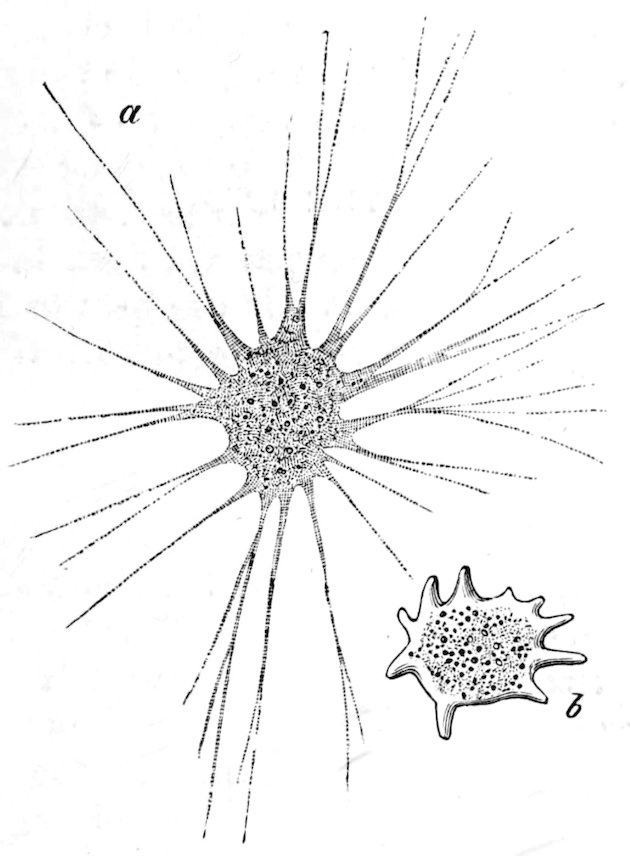
Fig. 149.—Two species of Proteus Animalcule (Amœba), one with protoplasmic processes, slender and branched; the other with short blunt processes. Highly magnified.
This sub-kingdom includes animals which are mostly microscopic, or at any rate small, and live in the sea, fresh water, or damp places. They are unicellular, and consist of a soft viscous substance (protoplasm or sarcode) of contractile nature, and therefore capable of altering its shape. They may or may not be enclosed by a firm wall. Many secrete siliceous 256structures or calcareous shells. They are of no agricultural importance. Here belong: Infusoria, common in putrid solutions; and Rhizopods, such as Amœba, the Proteus Animalcule (Fig. 149), so called because its shape is constantly altering.
THE END.
PRINTED BY WILLIAM CLOWES AND SONS, LIMITED, LONDON AND BECCLES.
OTHER WORKS BY PROF. AINSWORTH DAVIS.
Published by CHAS. GRIFFIN & CO., Exeter Street, Strand.

A TEXT-BOOK OF BIOLOGY. Second Edition. Part I., Botany, 8s. 6d. Part II., Zoology, 10s. 6d.
“Furnishes a clear and comprehensive exposition of the subject in a systematic form.”—Saturday Review.
“It is certainly the best ‘biology’ with which we are acquainted, and it owes its pre-eminence to the fact above stated, that it is an excellent attempt to present biology to the student as a correlated and complete science.”—British Medical Journal.
“As a reference book ... one cannot speak too highly of this text-book, and as a treatise in theoretical biology it occupies a place not filled by any other English publication.”—Science.
THE FLOWERING PLANT, as Illustrating the First Principles of Botany. Second Edition. 3s. 6d.
“It would be hard to find a text-book which would better guide the student to an accurate knowledge of modern discoveries in Botany.... The SCIENTIFIC ACCURACY of statement, and the concise exposition of FIRST PRINCIPLES make it valuable for educational purposes. In the chapter on the Physiology of Flowers an admirable résumé is given, drawn from Darwin, Hermann Müller, Kerner, and Lubbock, of what is known of the Fertilization of Flowers.”—Journal of the Linnean Society.
A ZOOLOGICAL POCKET-BOOK; or, Synopsis of Animal Classification. By Dr. Emil Selenka, Professor in the University of Erlangen. Authorized English translation from the Third German Edition. In Small Post 8vo, interleaved for the use of Students. Limp Covers, 4s.
“Dr. Selenka’s Manual will be found useful by all Students of Zoology. It is a COMPREHENSIVE and SUCCESSFUL attempt to present us with a scheme of the natural arrangement of the animal world.”—Edin. Med. Journal.
“Will prove very serviceable to those who are attending Biology Lectures.... The translation is accurate and clear.”—Lancet.
WORKS ON ORNITHOLOGY, Etc.
W. H. HUDSON, C.M.Z.S.
BIRDS IN A VILLAGE. Square crown 8vo, 7s. 6d.
IDLE DAYS IN PATAGONIA. With numerous Illustrations by J. Smit and A. Hartley. Demy 8vo, 14s.
THE NATURALIST IN LA PLATA. With numerous Illustrations by J. Smit. Second Edition. Demy 8vo, 16s.
CHARLES DIXON.
THE NESTS AND EGGS OF NON-INDIGENOUS BRITISH BIRDS.
[In Press.
THE NESTS AND EGGS OF BRITISH BIRDS: When and Where to Find Them. Being a Handbook to the Oology of the British Islands. Crown 8vo, 6s. Also large paper Edition, containing 157 Coloured Illustrations of Eggs. Large demy 8vo, 15s.
JOTTINGS ABOUT BIRDS. With Coloured Frontispiece by J. Smit. Crown 8vo, 6s.
THE GAME BIRDS AND WILD FOWL OF THE BRITISH ISLANDS. Illustrated by A. T. Elwes. Demy 8vo, 18s.
THE MIGRATION OF BIRDS: An Attempt to Reduce the Avian Season-flight to Law. Crown 8vo, 6s.
THE BIRDS OF OUR RAMBLES: A Companion for the Country. With Illustrations by A. T. Elwes. Large crown 8vo, 7s. 6d.
IDLE HOURS WITH NATURE. With Frontispiece. Crown 8vo, 6s.
ANNALS OF BIRD LIFE: A Year-Book of British Ornithology. With Illustrations. Crown 8vo, 7s. 6d.
CHAPMAN & HALL, Ld., LONDON.
FARMING FOR PLEASURE AND PROFIT. By Arthur Roland. Edited by William Ablett. 8 vols. Crown 8vo, 5s. each.
DAIRY-FARMING, MANAGEMENT OF COWS, etc.
POULTRY-KEEPING.
TREE-PLANTING, FOR ORNAMENTATION OR PROFIT.
STOCK-KEEPING AND CATTLE-REARING.
DRAINAGE OF LAND, IRRIGATION, MANURES, etc.
ROOT-GROWING, HOPS, etc.
MANAGEMENT OF GRASS-LANDS, LAYING DOWN GRASS, ARTIFICIAL GRASSES, etc.
MARKET GARDENING, HUSBANDRY FOR FARMERS AND GENERAL CULTIVATORS.
UNIFORM WITH THE ABOVE.
BRITISH BEE-FARMING: Its Profits and Pleasures. By James F. Robinson. Large crown 8vo, 5s.
JAMES LONG.
BRITISH DAIRY-FARMING, to which is added a Description of the Chief Continental Systems. By James Long. With Numerous Illustrations. Crown 8vo, 9s.
From the Mark Lane Express.
“A new book on dairy-farming could scarcely have been issued at a more seasonable period than the present time, when that branch of agriculture is, for the first time, receiving the attention it deserves and requires; and Mr. James Long’s ‘British Dairy-Farming,’ published by Messrs. Chapman & Hall, is likely to have a wide circulation. As 178 out of 491 pages are devoted to foreign systems of dairying, besides numerous references in the rest of the work, and as a book is always known by its short title, it is a pity that the more comprehensive title was not chosen, especially as the foreign portion of the work is by no means the least valuable. The collection of facts, including prices, and various other statistics in the chapters on milk, butter, and cheese, is very useful, and must have cost a great deal of labour. The illustrated description of dairy utensils and appliances, again, is very complete, and the details given about cream-separators, to which Mr. Long has devoted special study, are worthy of careful attention. In our opinion, however, the most valuable portion of the work is that devoted to descriptions of Continental systems of dairying.... The instructions as to the making of the most famous fancy cheeses of France, Italy, and Switzerland are especially worthy of study, with a view to the manufacture of similar cheeses in this country. Very full details of the practices of the best makers of these cheeses, with numerous illustrations and records of quantities and prices, are supplied. Indeed, it is marvellous that so many trade secrets should have been divulged by the foreign dairy-farmers. The descriptions of butter-making in France and Denmark are also worthy of careful attention. On the whole, we sincerely congratulate Mr. Long upon the notable addition which he has made to the literature of dairy-farming.”
CHAPMAN & HALL, Ld., LONDON.
PROFESSOR J. WRIGHTSON’S WORKS.

THE PRINCIPLES OF AGRICULTURAL PRACTICE AS AN INSTRUCTIONAL SUBJECT. By Professor J. Wrightson, M.R.A.C., F.C.S., etc.; Examiner in Agriculture to the Science and Art Department; Professor of Agriculture in the Normal School of Science and Royal School of Mines; President of the College of Agriculture, Downton, near Salisbury; etc., etc. With Geological Map. Second Edition. Crown 8vo, 5s.
From the St. James’s Gazette.
“Professor Wrightson is a practical farmer as well as a man of science; and he is, as far as our memory serves us, the only man living who combines these qualities with the actual function of teaching. The conjunction is as valuable as it is rare.... Every teacher of elementary agriculture should study these pages. It is a safe and judicious guide to what lies further on.”
From the Academy.
“Besides stating lucidly the theory of modern agriculture, the author every here and there descends to practical advice. Most farmers are amusingly distrustful of the man who writes; but the sound sense here concentrated, and the teachings necessary for these times of sorrow and trial to agriculture, will at once disarm suspicion, if the cautious reader perseveres and weighs the value of Professor Wrightson’s advice.”
From Bell’s Weekly Messenger.
“Professor Wrightson has given us a very interesting and instructive book, and he treats on many subjects with a precision and definiteness which can only be achieved by those who have had actual experience in carrying out the work connected with them, and watching the results.... A book which will be found of much use to a young farmer, as well as to the teachers for whom he particularly wrote it. It is in reality a book on farming, and it has more actual farming in it than any book we know of the same size.”
From the Times.
“As a practical text-book of farming there is no work that we have read that can surpass this handy little volume, and it should have a good number of readers among those actually engaged in tilling the soil. But this is not its chief value. This comes from its being a model of the way in which agriculture, as an art, can be intelligently and popularly taught.”
From the Morning Post.
“An important work, ‘The Principles of Agricultural Practice,’ has just been published by Messrs. Chapman & Hall. It comes from the pen of the most experienced teacher of agriculture in this country, Professor J. Wrightson. The author deplores the tendency, which has become accentuated in recent years, of presenting agriculture as a patchwork of half a dozen different sciences, and endeavours to show that it is a great subject in itself, and one which may be treated independently. The result is a very successful and acceptable treatise. Professor Wrightson possesses the advantage of being himself a successful farmer and breeder, and he is able therefore to clothe his ideas in words that appeal forcibly to practical agriculturalists.... The work embraces a full and exhaustive study of the soil, and deals also with methods of cultivation, cropping, fertilizers, laying land down to grass, and cognate subjects. The volume is one which can be confidently recommended to the perusal of all who are interested in the great subject with which it deals.”
UNIFORM WITH THE ABOVE.
FALLOW AND FODDER CROPS. Crown 8vo, 5s.
CHAPMAN & HALL, Ld., LONDON.
TRANSCRIBER’S NOTES
Typos fixed; non-standard spelling and dialect retained.