Second Sub-Kingdom: ARTHROPODA (Jointed-limbed Animals).
J. R. (James Richard) Ainsworth Davis translation
83
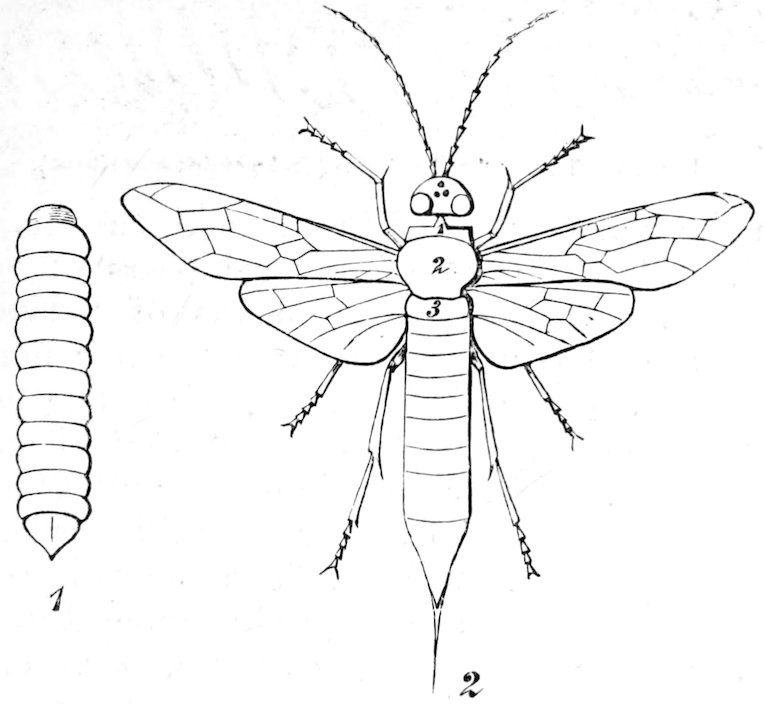
Fig. 54.—Wood-borer (Sirex); 1, larva; 2, adult insect.
84
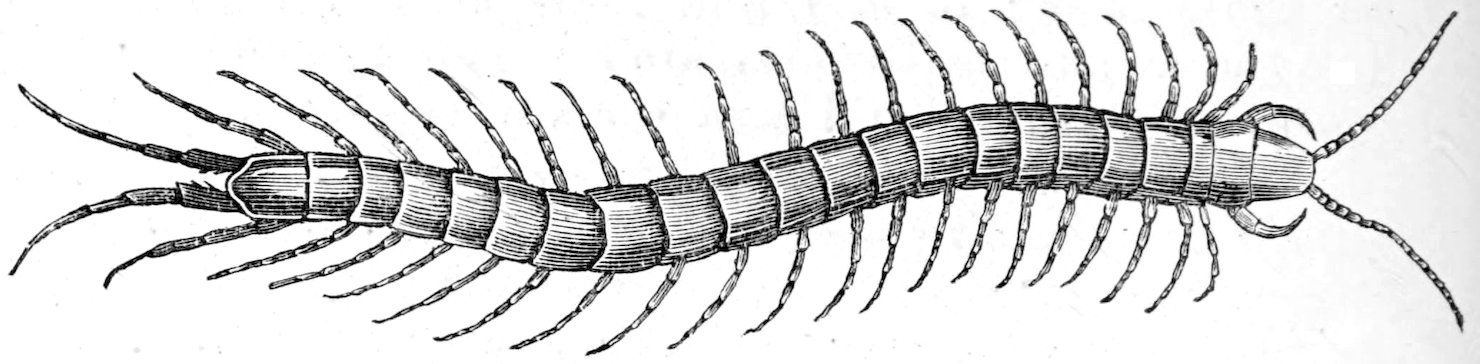
Fig. 55.—The Large Centipede (Scolopendra morsitans).
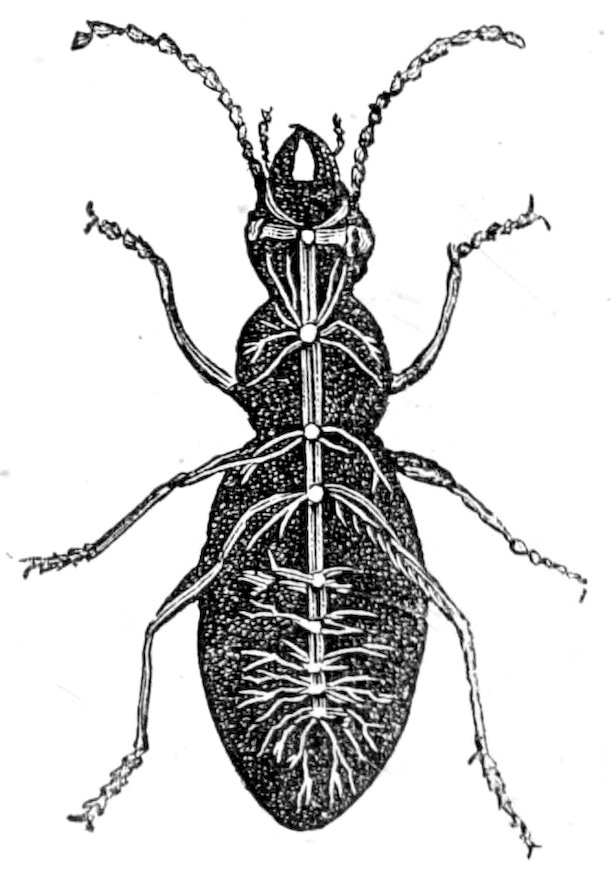
Fig. 56.—Ground Beetle, with nervous system drawn in white.
The body of an Arthropod is bilaterally symmetrical (cp. p. 16), and consists of a number of joints (Fig. 55), not equally numerous in all members of the sub-kingdom. These joints or segments lie one behind the other, and are at first alike; but as in the course of further development they become adapted to various functions, the difference between them becomes greater. Compare the Wood-borer represented in Fig. 54, 2, with the young form of the same animal (Fig. 54, 1). The segments often fuse together, which brings about the formation of a smaller number of subdivisions to the body; or even all the segments may become united (mites). In the last case the Arthropod characters are only to be seen in the jointing of the limbs. Segmented animals (e.g. the common earthworm) are also found among the worms (Sub-kingdom III. of the Animal Kingdom); but these worms have either no limbs, or only small unjointed foot-stumps, never jointed limbs as in the Arthropods. These last are limbless or with unjointed foot-stumps only when young; when adult they always have jointed limbs. The head of Arthropods bears several successive pairs of jaws, which move to and fro from one side towards the other. The covering of the body consists of hard protective pieces; it is only in the young condition that the skin of several species is soft. Arthropods have no internal skeleton; the muscles are attached to the skin. The central part of the nervous system (p. 10), which consists in Vertebrates of brain and spinal cord, lies in Arthropods almost entirely on the ventral side. In the head is situated the cerebral ganglion, a large nervous mass resting on the gullet, and giving off nerves to the eyes and feelers. Besides this, there is a ventral nervecord on the ventral side of the animal, running below the gut, and made up of several pairs of ganglia, united with one another by means of nerve fibres. The ganglia of the ventral cord send their nerves to the jaws, limbs, muscles, viscera, etc. The cerebral ganglion is connected with the first ventral ganglion by means of a cord on each side of the gullet (Fig. 56), so that a ring-like structure is formed. The breathing organs are gills in some Arthropods (the Crustacea, e.g. crayfish, crabs); insects and centipedes breathe by air-tubes or tracheæ, while the respiratory organs of spider-like animals, when these do not breathe entirely by means of the skin, are more or less strongly modified tracheæ. The structure of the tracheal system is generally as follows: on each side of the body there is a row of breathing-holes, or stigmata, through which the air can enter the tracheæ; these are very much branched, so that they finally become very fine tubes investing the various organs, 85which in this way obtain the requisite amount of oxygen. The stigmata on one side of a caterpillar are clearly shown in Fig. 60, and those of a hornet larva in Fig. 61.
Four classes belong to this sub-kingdom: Insecta (Insects), Myriapoda (centipedes, etc.), Arachnoidea (spiders, scorpions, etc.), Crustacea (crayfish, crabs, lobsters, etc.).
CLASS I.: INSECTA (INSECTS).
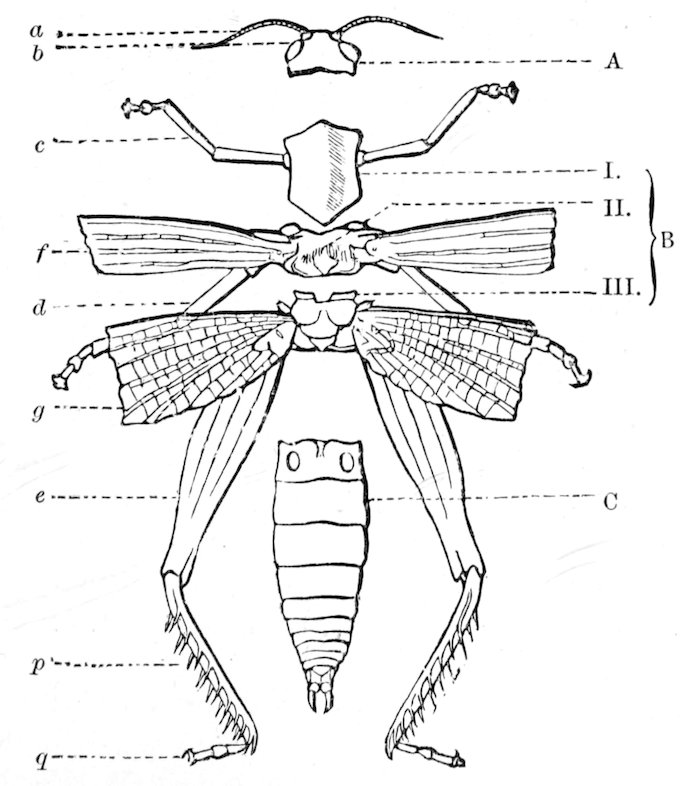
Fig. 57.—A Grasshopper, with the different regions of the body separated from one another. A, head; B, thorax: I., prothorax; II., mesothorax; III., metathorax; C, abdomen; a, antennæ; b, eyes; c, d, e, legs; f, g, wings; p, shank; q, foot.
Breathe by tracheæ (cp. p. 84). The segments fuse into three body regions (Fig. 57). These are—(1) 86the Head, bearing the eyes, feelers (antennæ), and jaws; (2) the Thorax, composed of three fused segments, of which the first (prothorax) bears a pair of legs, while the second (mesothorax) and third (metathorax) not only bear a pair of legs each, but also sometimes a pair of wings in addition; (3) the Abdomen, which possesses no limbs, and of which the number of segments is not always the same. These three regions of the body perform different functions; the head is concerned with sensation and the taking up of food, the thorax with movement, while the abdomen contains the organs of digestion and reproduction. I will now deal somewhat more fully with the different body regions of an insect.
Head.—Almost all insects have in the adult state a compound eye, i.e. an eye made up of a large number (up to ten thousand) of smaller eyes. In many insects one finds in addition to this a few simple eyes on the top of the head. The feelers are very unlike in different insects; they serve as organs of touch, and perhaps also help some other sense. The mouth-parts consist of three pairs of jaws, of which the first (the mandibles) and the second pair (maxillæ) are freely movable from side to side, while the third consists of two jaws immovably fused together (lower lip, or labium). A downward projection of the skin of the head (the upper lip, or labrum) overhangs the three pairs of jaws (Fig. 58). In insects which feed on solid matters, tearing or chewing them, the jaws are short and sharp-edged (biting mouth-parts); in those which take up fluid food (blood, the juices of plants, etc.) they are elongated, and adapted for licking, sucking, or piercing.
87
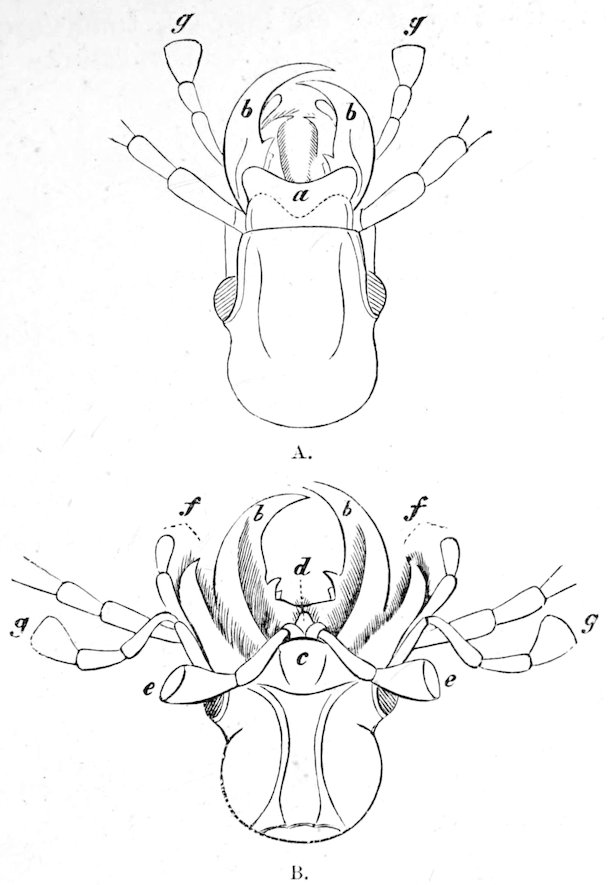
Fig. 58.—Head and Mouth-parts of a Ground Beetle, enlarged four times. A, from above; B, from below. a, labrum; b, mandible; f, maxilla with palpi (g); c, labium with palp (e).
Thorax.—The names of the parts of the legs are for the most part those used in the case of mammalian limbs; though the similarity between the limbs of Mammals and Insects is quite superficial. The following parts are distinguished in the leg of an insect: (1) the generally spherical hip (coxa) (Fig. 59, a); (2) the very short trochanter (b); (3) the elongated thigh (femur) (c); (4) the shank (tibia) provided with movable spines at its tip (d); (5) the three- to five-jointed foot (tarsus) (e), whose last joint ends in claws, and often also in flap-like outgrowths. The Wings are expansions of the skin, which consist of two layers. There are tracheæ between the upper and lower lamellæ. At first (in the pupa) the wings are folded 88up; but the forcing of air into the tracheæ quickly causes them to unfold. A firm substance is now deposited in the larger tracheæ, which are thus converted into veins or ribs giving support to the wings. In beetles the fore wings are quite hard and horny, and serve for protecting the delicate hind wings and soft back rather than for flight; they are therefore named “wing-covers” (elytra). In many insects the fore wings (wasps) or the hind wings (beetles, grasshoppers) are folded when at rest.
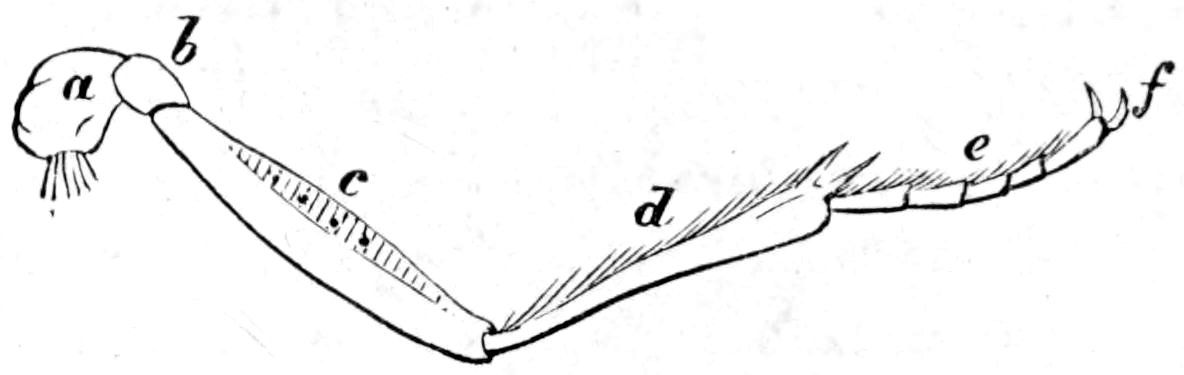
Fig. 59.—Leg of a Ground Beetle (× 2).
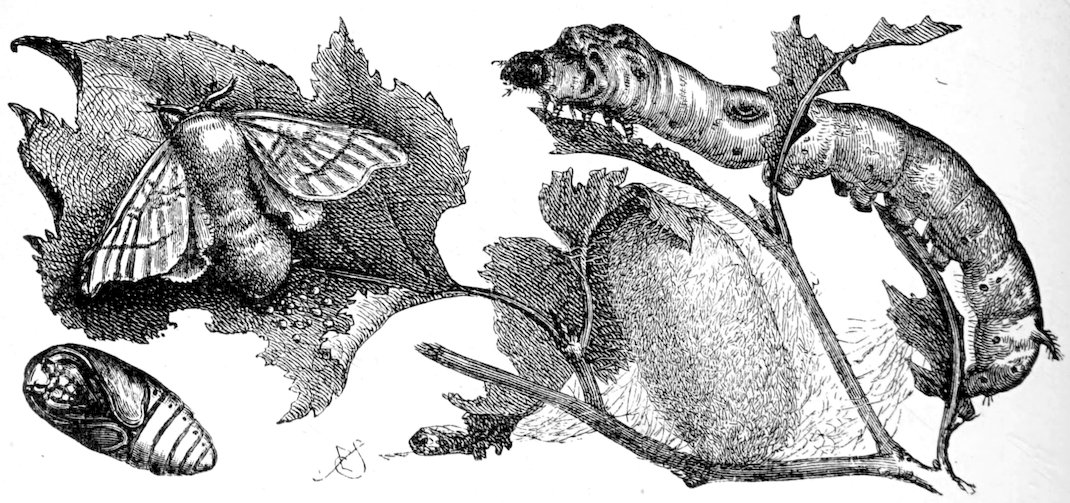
Fig. 60.—Silkworm Moth (Bombyx mori). Female moth, caterpillar, pupa and cocoon.
The abdomen only bears organs of movement in caterpillars (Fig. 60) and a few other insects in the young condition, and in these cases they are not jointed like the true legs or “thoracic feet,” but unjointed pro-legs or “abdominal feet.” In the adult 89insect the abdomen may have thread-like (mole-cricket) or pincer-like (earwig) appendages; or appendages used in egg-laying (ovipositors, e.g. Locust).
Most insects have great powers of reproduction. A few bring forth living young, but most insects lay eggs. It is only in a few (e.g. lice) that animals exactly like their parents are hatched from the eggs; the large majority of insects pass through a change, or metamorphosis.
A distinction is drawn between complete and incomplete metamorphosis. It is said to be complete when the insect passes through a stage in which it takes up no food, and, as a rule, moves but little. In this condition of almost complete rest the insect is called a “pupa” (Figs. 60, 61, 65). The metamorphosis is called incomplete when the insect does not pass through a pupa stage, and therefore feeds and moves during all the periods of its development, merely altering its form somewhat during its various moults (Fig. 62).
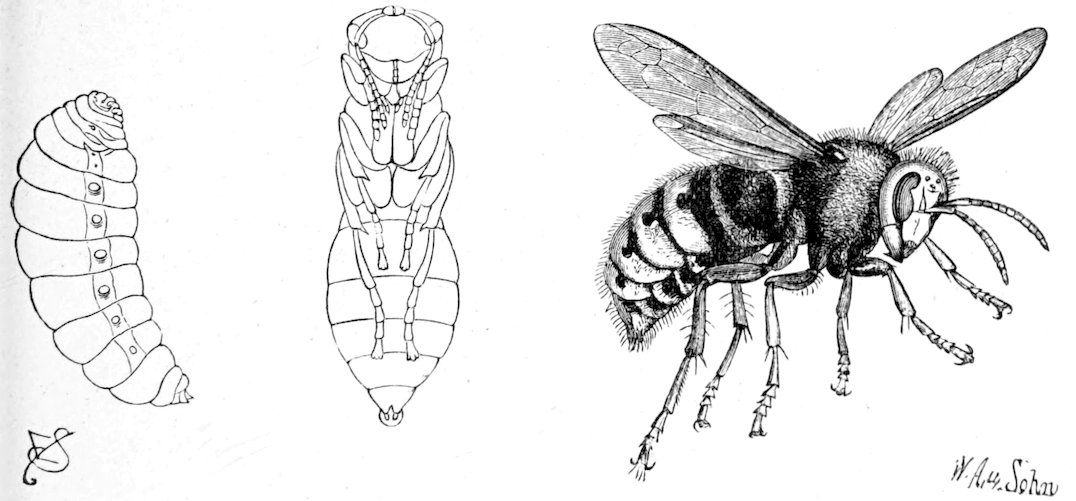
Fig. 61.—The Hornet (Vespa crabro), with larva and pupa.
The word “moult” must here be explained. The covering of the skin of Arthropods consists of hard 90parts incapable of being stretched. At the end of a definite period of time this firm covering is stripped off and replaced by a new investment, soft at first, but afterwards becoming hard. In this way growth can be effected in spite of the hard integument. Everyone must have noticed at some time or other the moulting of caterpillars.
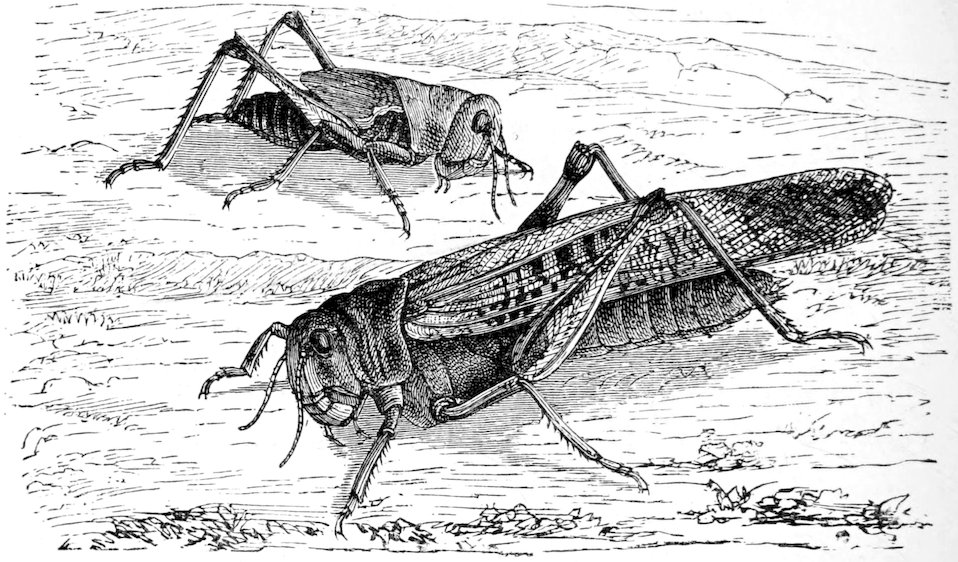
Fig. 62.—The Migratory Grasshopper (Acrydium migratorium). Larva and adult female.
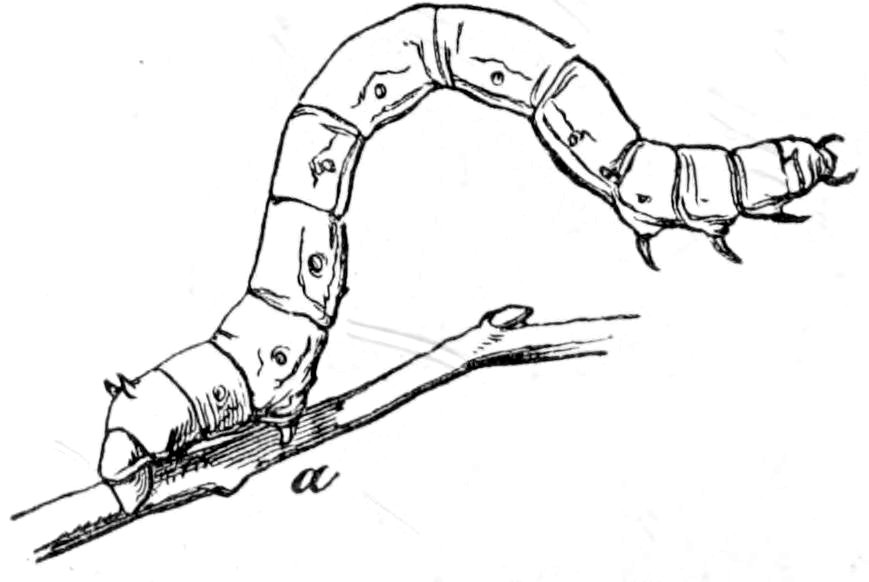
Fig. 63.—Looper Caterpillar.
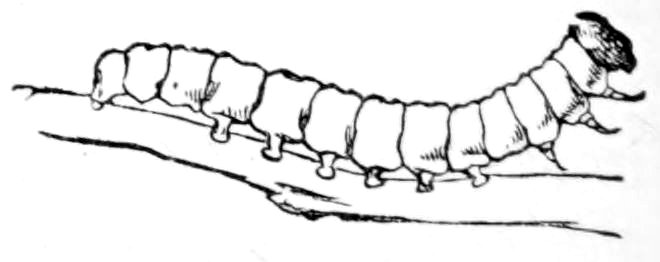
Fig. 64.—False Caterpillar.
In insects with incomplete metamorphosis the form of the animal alters a little at every moult, becoming more and more like that of the adult insect. In the last moult but one small imperfect wings appear 91(Fig. 62, left), and fully developed wings are only present after the last moult. The ovipositors of female insects, in those cases where the metamorphosis is incomplete, first appear as fully developed organs in the perfect condition of the animal, but begin to develop in the preceding stage. In cases of this kind of metamorphosis the young insect (“larva”) closely resembles the adult in form even in the first stage of development. In insects undergoing complete metamorphosis the difference between larva and adult insect (imago) is much greater (Figs. 60, 61, 65).
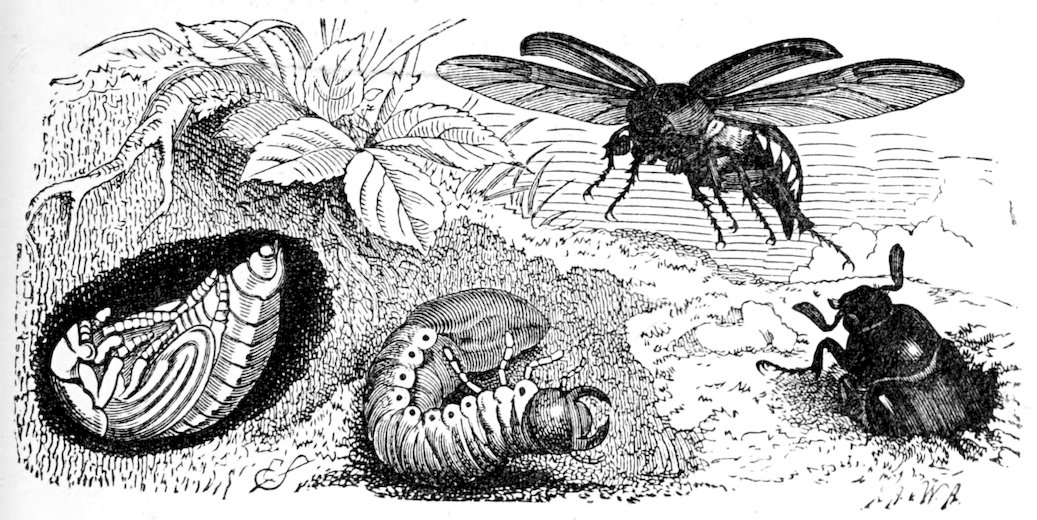
Fig. 65.—The Common Cockchafer (Melolontha vulgaris). Larva, pupa, female flying, and male creeping out of the earth.
The time passed in the pupa state by insects with complete metamorphosis is by no means always of the same length. For example, there are two generations annually of the cabbage white butterfly; one lives through the winter in the pupa state, the pupæ of the other are found in summer. So that while an insect of the winter generation lives about half a year in the pupa state, this condition lasts only about a month in the summer generation. A higher temperature hastens the development.
Although the insect in the pupa state takes no 92food, it nevertheless breathes, and therefore continually uses up body substance. This using up only takes place to a small extent however, since the animal moves but little. From whence, then, does the pupa get the material to cover the loss of body substance? In the larval condition the insect takes far more food than it requires for the development of its body, and from this excess it builds up reserve stuffs, which are deposited in the so-called “fat-bodies” of the larva. These reserve materials are re-absorbed during the pupa state, and serve to maintain the breathing. Consequently a pupa that has just been formed moves more than another one just about to become a butterfly.
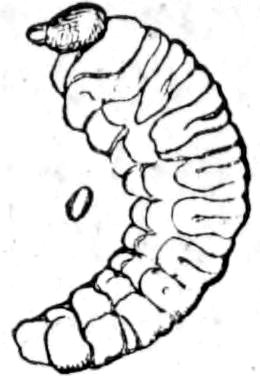
Fig. 66.—Larva of a Weevil.
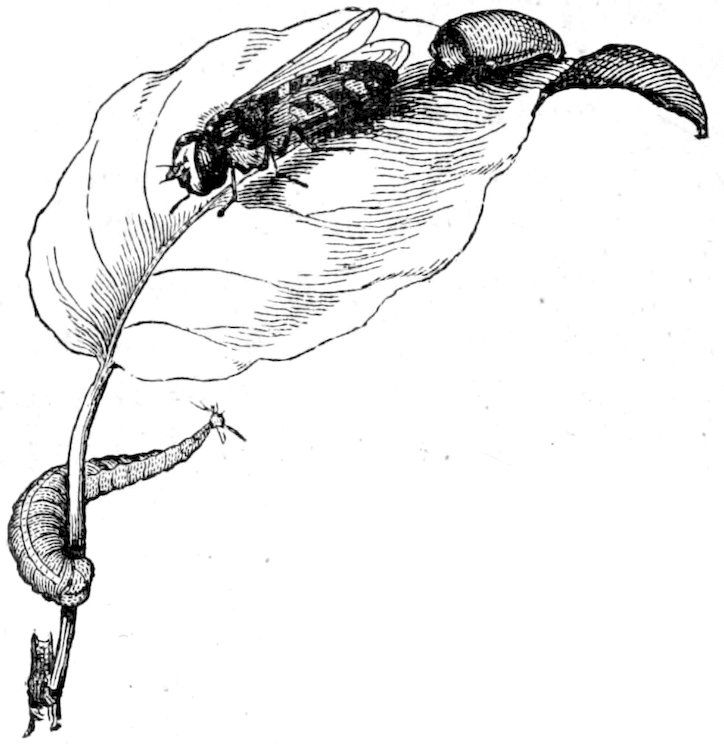
Fig. 67.—A Hover Fly (Syrphus pyrasti). Fly, maggot, and pupa case.
The larvæ and pupæ of the different kinds of insects which undergo a complete metamorphosis have not the same shape of body. Among the larvæ may be distinguished caterpillars, grubs, and maggots. The caterpillars (Fig. 60) have a clearly marked head with hard covering, three pairs of jointed thoracic legs, and a varying number of unjointed pro-legs. They are usually variegated or green in colour, and are divided into true caterpillars and false caterpillars (Figs. 60, 63, and 64). The first, after the resting pupa stage, become butterflies or moths; the latter saw-flies. The true caterpillars have two to five pairs of pro-legs, the false caterpillars six to eight pairs. Reckoning in the thoracic legs, therefore, the true caterpillars have altogether five to eight, the false 93caterpillars nine to eleven pairs. The head of the latter is more rounded, while that of the former is more flattened. The way in which caterpillars walk depends upon the number of their legs. If this is fairly large so that most of the segments of the body are provided with legs, the whole body remains tolerably extended during progression. But if the number is small—as in the looper caterpillars, where there are three pairs of thoracic legs at the anterior end, and at the posterior end only a terminal pair of legs (the caudal pro-legs) and another pair in front of them—the middle legless region is strongly bent during locomotion (Fig. 63). Hence the name “looper.” The loopers often bend their bodies in a characteristic way. When at rest the hinder part is coiled up spirally; but as soon as the animals are alarmed they throw the hinder part of the body upwards and forwards and even over the head. The grubs (Figs. 66 and 69, left) have indeed, like the caterpillars, a clearly visible hard head, but no characteristic abdominal legs, or at most a pair of sucker feet at the end of the body (wireworms). Thoracic legs are present in several grubs (cockchafer larvæ, wireworms, leaf beetles); in others (larvæ of weevils and fleas) they are entirely absent. Maggots are those entirely footless insect larvæ which do not possess a head clearly marked off from the rest of the body, and the head-end of which is only to be recognized by the presence of the mouth and mouth-parts. Pupæ are enclosed in a case which either only faintly indicates the outline of the various parts of the adult insect, or else closely surrounds every part of the body—wings, legs, antennæ, and even the mouth-parts and eyes. Pupæ of the first kind are termed obtectate (Fig. 60); those of the second, free (Figs. 61, 65).
Many pupæ are naked, others are surrounded by a web (cocoon) spun by the larva (Fig. 60). There are 94also pupæ distinguished by the peculiarity that when the insect has lived through the maggot-stage it does not strip off its integument, but turns into a pupa inside the shrivelled maggot-skin, from which the perfect insect later on breaks out (Fig. 67).
The class of insects can be divided into eleven orders: (1) Coleoptera (Beetles); (2) Orthoptera (Grasshoppers, Locusts); (3) Neuroptera (Dragon-flies); (4) Hymenoptera (Bees, Ants, Saw-flies); (5) Lepidoptera (Butterflies and Moths); (6) Hemiptera (Aphides, Bugs); (7) Physopoda (Thrips); (8) Diptera (Flies with two wings); (9) Aphaniptera (Fleas); (10) Pediculina (Lice); (11) Collembola (Spring-tails and Tassel-tails).
Order I.: Coleoptera (Beetles).
Beetles (Fig. 65) are insects with biting mouth-parts, and strongly developed prothorax united with the mesothorax so as to permit free movement. The fore wings are in the form of hard covers, leaving exposed only the head, neck-shield (i.e. the dorsal side of the prothorax), a three-cornered bit of the mesothorax (scutellum), and sometimes the tip of the abdomen. Flight is effected by the hind wings alone, which in a state of rest are drawn back under the wing-covers. The metamorphosis is complete; the larvæ are legless, or with thoracic legs only, and have a hard head with biting mouth-parts; change into free pupæ (p. 93).
Family: Carabidæ (Ground Beetles).
Usually elongated, slender; with long slender legs, five-jointed tarsi, eleven-jointed antennæ, powerful jaws (Figs. 68, 69). Run rapidly; usually keep on the ground; hide themselves during the day, but are very active at night; with very few exceptions feed 95entirely on other insects; when touched squirt an acrid stinking fluid out of the abdomen. Larvæ longish, six-legged, with short antennæ and sharp jaws, with a few exceptions live exclusively on other insects and lower animals.
Several species are of service, both in the adult and larval conditions, since they destroy injurious insects, e.g. surface caterpillars, wireworms, cockchafers, grubs, crane-fly larvæ. The following do good in cultivated fields: Golden Ground Beetle (Carabus auratus), Garden Ground Beetle (C. hortensis), Granulated Ground Beetle (C. granulatus), Cross-barred Ground Beetle (C. cancellatus), Field Ground Beetle (C. nemoralis), Large-headed Ground Beetle (Cephalotes vulgaris), species of Harpalus, Pterostichus, etc.
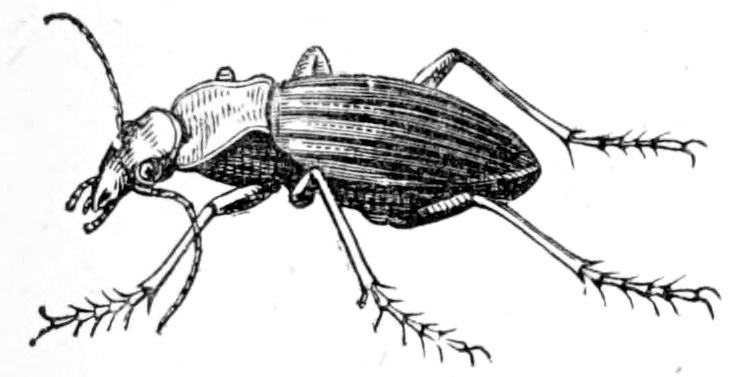
Fig. 68.—A Ground Beetle (Carabus auronitens).
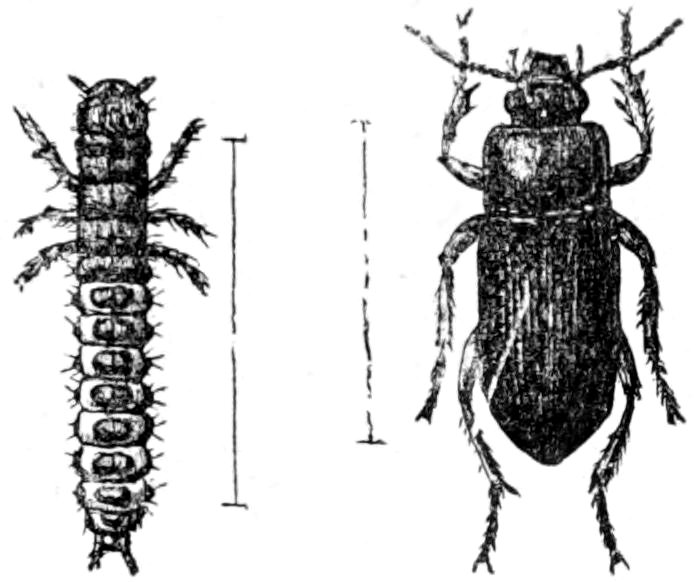
Fig. 69.—Corn Ground Beetle (Zabrus gibbus) and larva.
The only destructive form is the Corn Ground Beetle (Zabrus gibbus, Fig. 69); short, thick-set; back black; belly, legs, and antennæ dark brown. Larva cylindrical, slightly hairy, brown, with yellowish white belly; head broad and flattened, black. The beetles (June, July) usually remain hidden in the soil during the day, climbing up the stalks of barley, wheat, and rye during the evening and in dull weather, and eating the grain in the ear. The larvæ remain during the day in vertical holes which they dig out; but at night and during dull weather they devour the overground parts of the grain-plants 96mentioned above, especially the hearts of young plants. They are destructive both in autumn and spring, damaging winter and summer grain. The larval condition is maintained for three years, the animal then turning into a pupa during July. Its ravages are limited to special years. Remedy: Sowing oats, peas, or vetches, or planting potatoes in fields infested by the beetles or their larvæ; collecting the beetles in the evening when they are in the ears.
Family: Staphylinidæ (Rove Beetles).
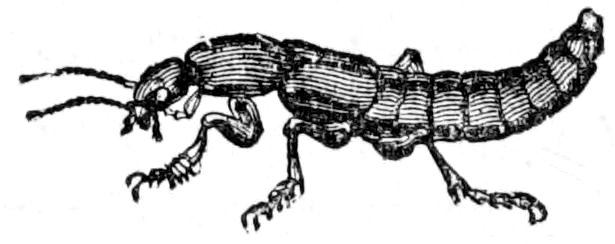
Fig. 70.—Rove Beetle (Staphylinus erythropterus).
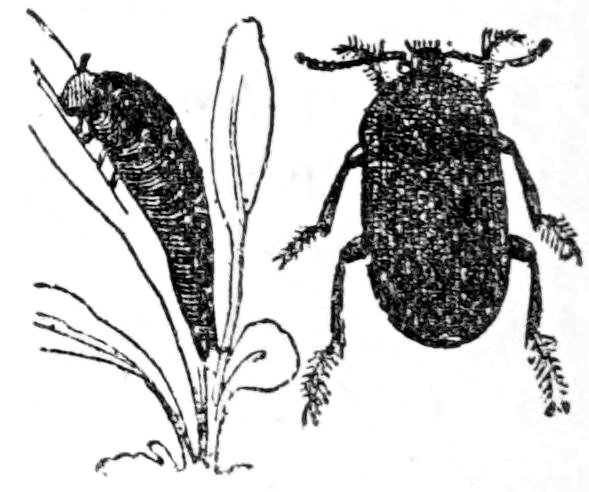
Fig. 71.—The Black Burying Beetle (Silpha atrata) and larva.
Usually elongated, small (Fig. 70). The short truncated wing-covers leave the whole of the abdomen exposed. The rove beetles resemble the earwigs in their appearance and in a way they have of frequently lifting up the hinder end of the body and turning it forwards. Tarsi five-jointed, jaws strongly developed. The six-legged larvæ resemble those of the ground beetles, but have a relatively large head. The beetles live through the winter; the metamorphosis takes place in autumn. Live on the ground under fallen leaves, also under the bark of trees; in carcases. Some chiefly eat insects living in the soil and noxious insects; others, dung and decomposing matter. (Species of Staphylinus, and of Ocypus, e.g. O. olens, the Devil’s Coach Horse.) Several are of 97service. A few devour the parts of plants. Anthobium torquatum is found in large numbers in the flowers of rape, devouring the petals, stamens, and pollen.
Family: Silphidæ (Burying, or Sexton Beetles).
The antennæ either thicken gradually or have only the end-joints larger; body flat; head projecting; tarsi five-jointed. The burying beetles and their larvæ feed on dead animals. A few (sp. of Necrophorus) bury the whole animal in the earth, and lay their eggs in it. Failing carrion, some of them can live on vegetable food; these sometimes do harm. Others prefer living insects and snails. They are of service in the economy of nature by doing away with stinking bodies. The following are sometimes harmful: Black Burying Beetle (Silpha atrata, Fig. 71), the larvæ of which often do much damage in fields of beetroot; Silpha opaca (Beet Carrion Beetle), and S. reticulata, which, in the adult condition, may do harm to several kinds of plants. Remedies need not be considered, as it is only rarely they increase so largely as to make the supply of carrion insufficient, and consequently attack plants.
Family: Nitidulidæ (Shine Beetles).
Small. Antennæ club-shaped, eleven-jointed. Tarsi five-jointed. A few species live on carrion and on fungi, others under the bark of trees, a few in flowers. To these last belongs the Turnip Flower Beetle (Meligethes æneus); somewhat convex, elongated oval; shining metallic greenish black, finely dotted. Occurs in the inflorescences of turnip, rape, and allied species; also in the flowers of mustard, charlock, and similar crucifers, and species of buttercup (Ranunculus). At the beginning of spring, the turnip-flower beetle bores into the buds of turnip, rape, etc., and, later on, 98attacks the flowers. It perforates the petals, devours the stamens and pollen, and, lastly, the pistil. The infested flowers wither. Three to four beetles are often found in a single flower. The female soon lays her eggs, separately, in the ovary of the flower. One to two weeks later the larvæ may be found in the flowers, one or more in each. The larvæ, one-fiftieth of an inch long to begin with, are, when ready to become pupæ, about one-fifth of an inch long, cylindrical, yellowish white with blackish brown head; they have three pairs of short thoracic legs, as well as a pair of caudal pro-legs. Each segment of the body has two dark blotches on its upper side. On an average, the larvæ reach their full size in four to five weeks. They are first found at the bottom of the flower, where they gnaw the stamens and ovary. They then wander from flower to flower, until ready to become pupæ. If there are no more flowers in the neighbourhood they attack the developing pods, first gnaw the green husk, then bore through it and devour the young seeds. Become pupæ in the soil. The beetle emerges after a fourteen days’ pupa rest. At least two, usually three, sometimes four generations. Remedy: Rooting out charlock and the species of buttercup. Selection of strongly growing varieties of turnip, rape, etc., which blossom late (and therefore soon finish blooming). Drill-culture.
Family: Cryptophagidæ (Secret-eating Beetles).
Very minute. Antennæ composed of eleven joints, of which the three last form a club. Legs wide apart; tarsi five-jointed. Live in flowers, fungi, dead parts of plants, under bark, in the earth, in humblebees’ and ants’ nests, etc. The Beet Beetle (Atomaria linearis) is harmful: longish, egg-shaped, strongly convex; neck-shield as long as broad. Brownish black or dark brown. In fields where beet is cultivated 99for several years in succession, the beetles often increase in a prodigious way. They attack the seedlings, and devour the base of the stalk just below the surface of the soil, sometimes biting it half through. The attacked seedlings often die even before the cotyledons appear above the surface of the soil. Looking, therefore, in spring at fields infested by the beet beetle, the seedlings will appear quite normally developed in some few places, while in some other places there may be no plants at all: in many spots, again, small plants will be seen bearing only seed-leaves, withered and yellow. These cannot be pulled out of the ground, for they break off at the place gnawed by the beetle. It is often necessary to give two or three successive sowings, as the young crop is attacked again and again. The larva of the beet beetle is still unknown, though this undoubtedly develops in the beet-fields. Remedy: Suitable rotation. When the conditions will not permit this, the seed must be sown thickly, so that as many seedlings as possible may remain sound, should the beetles exert their destructive influence in the spring.
Family: Lamellicornia (Chafers).
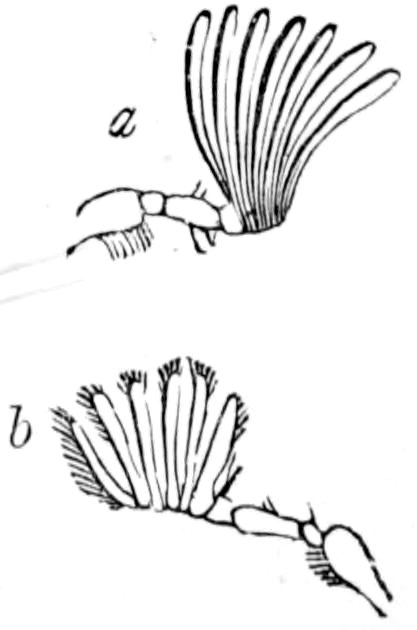
Fig. 72.—a, Antennæ of male; b, of female Cockchafer.
Body strong, stout (Fig. 65). The first joints of the antennæ have the usual shape; the last, three to seven, are very short, but broadened out on the inner side into leaf-like appendages, so that the end of the antennæ is fan-shaped (Fig. 72). The little leaves are laid together when at rest, so as to form a club-shaped thickened end; in flight, and when the attention of the beetle is excited, they are spread out like a fan. Legs strong; feet five-jointed. Flight rapid, somewhat awkward. Larvæ thick; body cylindrical, but 100curved; head hard, brown; rest of the body thin-skinned and yellowish white. The first three segments of the body bear legs. The curved larvæ can move about in the soil, but not on the surface. The beetles and larvæ devour vegetable substances; a comparatively small number of species feed on dung.
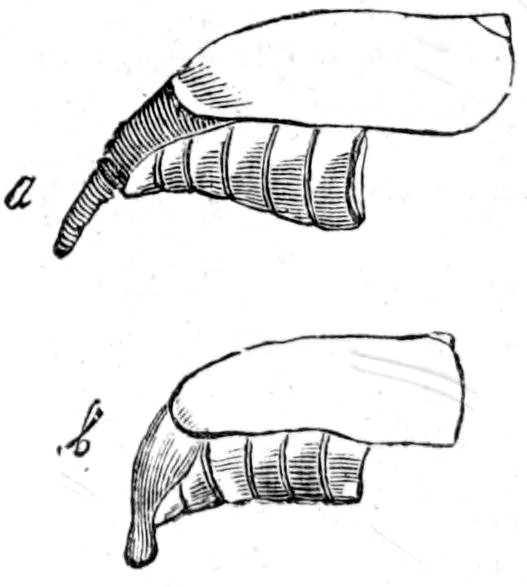
Fig. 73.—a, abdomen of Common; b, of Horse-chestnut Cockchafer.
The Common Cockchafer (Melolontha vulgaris) will serve as a type of the lamellicorns (Fig. 65). The last segment of the body forms a gradually tapering process. The club of the antennæ with seven large leaflets in the male, and six smaller leaflets in the female (Fig. 72). Head, neck-shield, entire ventral surface, and legs, black; although these parts, with the exception of the head, may be reddish brown. Many specimens are thickly clothed with numerous white hairs; others are almost hairless. The beetles usually appear during May, but sometimes by mid April, and sometimes not till the beginning of June. In the evening they leave the soil and seek the neighbouring trees. They devour the leaves and especially the buds of oak, horse-chestnut, beech, poplar, willow, cherry, and other forest and fruit trees, but spare the lime and generally the morel cherry. Of coniferous trees it only devours the needles of larch and the young shoots of pine. Among cabbage-like plants it only devours rape. In “chafer years” the cockchafer becomes a veritable scourge to the farmer. For the purpose of laying her eggs (about forty in number), the female selects by preference a fertile soil rich in humus, but will also put up with a dry sandy soil. The grubs devour the grass and clover-roots in meadows, and, in cultivated fields, the roots of grain-plants, peas, and beans, rape, cabbage, etc., also turnips and potatoes; in gardens the roots of many vegetables 101and flowers, and, in particular, the underground parts of strawberry plants. If, on poor sandy soil, they can get nothing else, they devour the bark of oak and fir. Cockchafers take three to four years for their development: four in England, North Germany, and Central Germany; three in South France, Switzerland, the Rhine district, and Holland. In regions where the insect is abundant, every third or fourth year is a “chaferyear,” when the beetles appear in millions, while scarcely a cockchafer can be found in the intervening years. In districts less infested there is not the same marked distinction. It therefore appears that cockchafers and their larvæ are to be reckoned as injurious insects: their occurrence, however, is local. Natural enemies: moles, shrews, bats, foxes, crow-like birds, starlings, sparrows, owls, and the large species of ground-beetle. Winter floods do no harm to the grubs, which are then deep in the ground,—but this is not the case with floods occurring in summer, when they are near the surface eating the roots of the plants. Remedies: Collecting the grubs turned up during ploughing. Catching the cockchafers; this is very expensive, since it has to be done very energetically if most of them have left the pupastage. A part of the expense may, however, be recouped by using the cockchafers as manure.
The Horse-chestnut Cockchafer (Melolontha hippocastani) has a short slender caudal process, somewhat broader at the tip (Fig. 73). Its habits are in no way different from those of the preceding species.
The Buckwheat Beetle (Phyllopertha horticola), one-third to one-fifth of an inch long, without a caudal process. Shining blackish green, with yellowish brown elytra. Dark-coloured specimens are also found. The beetles appear in June; in some years they occur, like cockchafers, in large numbers. Habits of the beetle and of the small grub not markedly different from those of the cockchafer.
102The Rye Chafer (Anisoplia fruticola), somewhat larger than the buckwheat beetle, in other respects very like it, but with a snout-like projection of the thickened skin of the head. Dark bronzy green, whitish on the under side. Wing-covers yellowish brown. On poor sandy soil, on the flowering ears of rye. The beetles gnaw the flowers.
[The Garden Chafer (Anisoplia horticola) is closely related to the preceding. The grub is very harmful to pastures.]
Family: Elateridæ (Click Beetles).
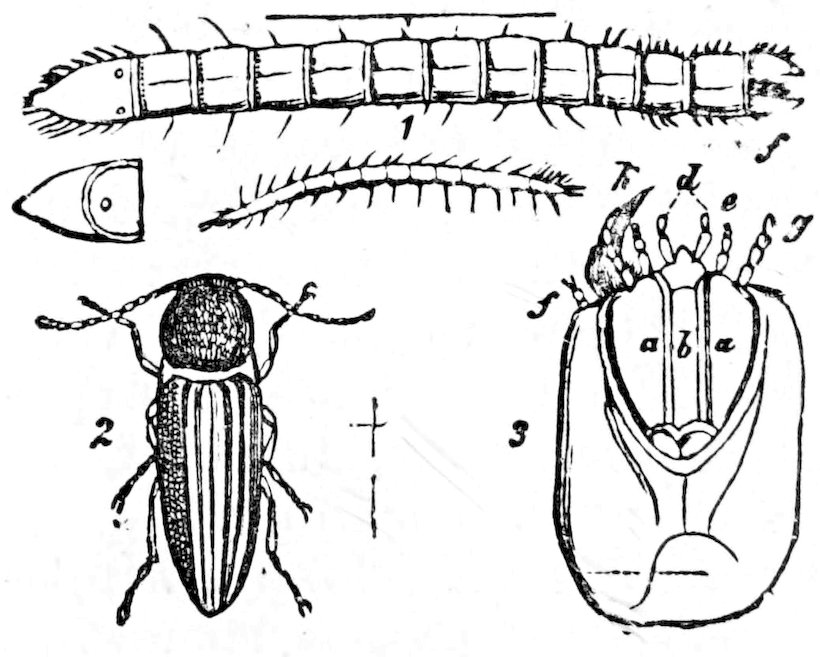
Fig. 74.—The Skipjack (Agriotes lineatus): 1, magnified larva, below it the under side of the tip of the abdomen and the larva, natural size; 2, the beetle; 3, under side of the head of the larva, strongly magnified. a, maxilla; b, lower lip; d, labial palp; e, k, inner and outer maxillary palps; f, antennæ.
The Click Beetles (Fig. 74) are longish, of equal breadth all along, tolerably blunt at the hind end. Neck-shield strongly developed. Antennæ “serrated,” i.e. made up of three-cornered joints. Feet five-jointed. Looking at the under side a spine may be seen on the hinder margin of the prothorax (Fig. 75, b), and on the mesothorax (c) a furrow which receives the spine when the body is extended, but the spine is drawn out of it if the prothorax and mesothorax are lifted up from anything they happen to rest on (Fig. 75). A skipjack that has fallen upon its back first draws its antennæ and legs close to its body, and then bends this in such a way that the head and prothorax make an angle with the rest of the thorax 103and the abdomen. In this way the junction of the prothorax and mesothorax is lifted up, and the spine drawn as far as possible out of the furrow. As soon as the beetle has taken up this attitude, it can spring back into its usual position by lifting the two ends of the body and pressing the spine forcibly back into the furrow, whereby it is jerked against the ground with such a shock that its elasticity makes it spring into the air, where it turns round and comes down again ventral side below. The larvæ (“wireworms,” Fig. 74, 1) are like meal-worms, elongated, always flattened on the ventral side, and sometimes on the dorsal side as well. The head is dark brown, the twelve remaining segments of the body yellow to yellowish brown; the first three segments of the body bear three pairs of very small legs; the last segment has a pair of caudal pro-legs.
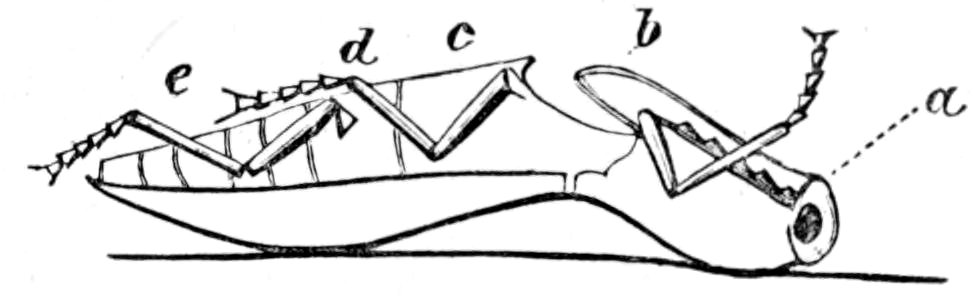
Fig. 75.—A Skipjack lying on its back and about to spring up. a, head; b, spine of the prothorax; c, mesothorax; d, metathorax; e, abdomen.
104
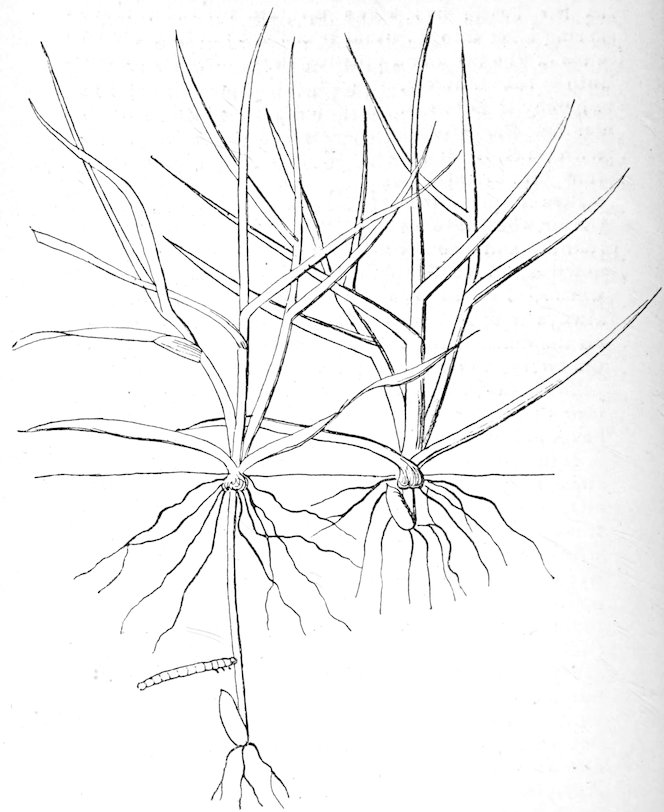
Fig. 76.—Grain-plants sown deep and shallow; a wireworm is devouring the underground part of the stem of the first.
Many species of click beetle are quite harmless, since they only devour decaying vegetable matter, either in humus or in the rotting substance of dying trees. There are also species, however, the larvæ of which feed on the living roots of plants. The wireworms of Lacon murinus, which are tolerably thick and have a flattened tip to the abdomen, devour the roots of fruit trees, rose-bushes, various vegetables (lettuce, cabbage, onions, turnips) and flowers; they are principally to be found in garden soils rich in humus. The relatively small hairless wireworms which do great damage, especially to grain-plants, but also to potatoes, carrots, turnips, rape, hops, and almost all the plants of our arable land, belong to Agriotes lineatus or A. obscurus; the larger and more hairy wireworms destructive in cultivated land almost all belong to Athous hæmorrhoidalis or a related species. The species named above also do 105much damage in meadows and grass land. Those fields are most infested which bore grass or clover the preceding year. Wireworms are usually more destructive in dry soil than in wet. They devour all underground parts, but specially prefer fleshy organs (potatoes, turnips), as well as the underground stem-parts of grain-plants, working themselves up from the soil into the inside of the lower part of the haulm, where they destroy the plant by gnawing its base. They also often destroy, in young grain-plants, the region of the stem which extends from the remains of the seed to the surface (Fig. 76, left). In both cases the plant is killed by the wireworms; the injuring of the roots is less fatal. It is obvious that in shallow sowing only a small piece of underground stem is exposed to the attacks of wireworms, in deep sowing a much larger piece; besides this, a plant which has been sown shallow develops earlier a strong mass of roots, and in its young state can therefore offer a greater resistance to the destructive influence. Since wireworms require four or five years for their development, the same field is infested by them the whole year. The greatest damage is done in spring and autumn. When wireworms have gnawed into the lower part of the haulm, the lower leaves first turn yellow, and the death of the whole plant soon follows. Remedies: Repeated ploughing of fields infested by wireworms, so that rooks, starlings, wagtails, gulls, etc., can devour them. Perhaps, too, many larvæ are frozen. Sowing the seed as shallow as possible on infested fields (Fig. 76). Waste potatoes may be used as a means of drawing them from the crop.
Family: Curculionidæ (Weevils).
Most species are small. Head lengthened into a proboscis (Fig. 79, 3); the jaws are found at the front end of the proboscis, the eyes at its base. The antennæ, 106which in most species are bent like a knee, and are always thickened at the tip, are attached to the front end, middle, or hinder end of the proboscis. The wing-covers usually extend to the tip of the abdomen, and clasp it in several species. Feet four-jointed. Weevils are mostly sluggish; many kinds do not fly at all; others only during the breeding season. When disturbed they let themselves fall to the ground as if dead. Almost without exception the females lay their eggs within plants, boring a hole by means of their proboscis, and shoving in the egg. The whitish larvæ (Fig. 66) are more or less curved and limbless, with hard brownish heads.
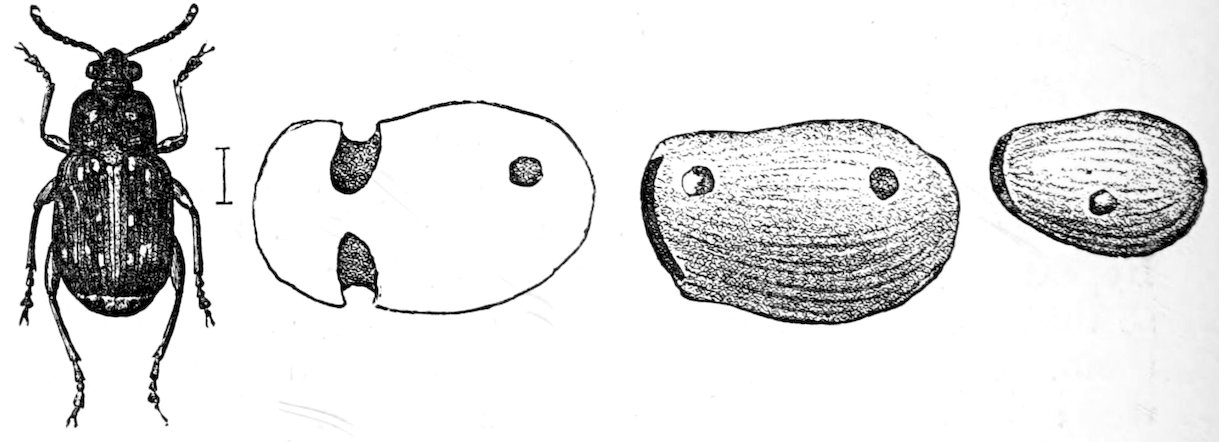
Fig. 77.—The Bean Beetle (Bruchus rufimanus) and beans gnawed by it.
The Seed Beetles (Bruchus) have a very short snout. Body short, thick-set, almost four-cornered. The wing-covers leave the hinder part of the body exposed. The female lays her eggs in the seeds of leguminous plants. The larva hollows out one or several, becoming a pupa in the one last inhabited. Here belong the Pea Beetle (B. pisi), the two Bean Beetles (B. rufimanus and B. granarius), of which the last-named also lives in vetches and chickling peas, and the Lentil Beetle (B. lentis). The Pea Beetle (B. pisi) is black, with brown hairy covering flecked with white. Like all other species of seed beetle, it becomes a pupa in the last seed inhabited by the larva, and the pupa changes 107into a beetle in autumn. A pea inhabited by such an insect can be recognized by a black translucent patch, since the beetle has become a pupa immediately under the seed-coat. Late the following spring the beetle crawls out. As the beetles are usually still in the peas at the time of sowing, the process brings them into the fields. Later on, when the beetles crawl out, they lay their eggs in the ovaries of the flowers of the pea-plants, which have meanwhile developed. The remedies are, consequently,—late sowing of the peas, or killing the beetles in them by exposure (for two minutes) to a temperature of 122° Fahr., or for ten minutes to sulphur dioxide fumes in a closed space. The remaining three species of Bruchus have the same habits as the bean beetle, but the insect often creeps out much earlier, so that the seeds do not require treatment.
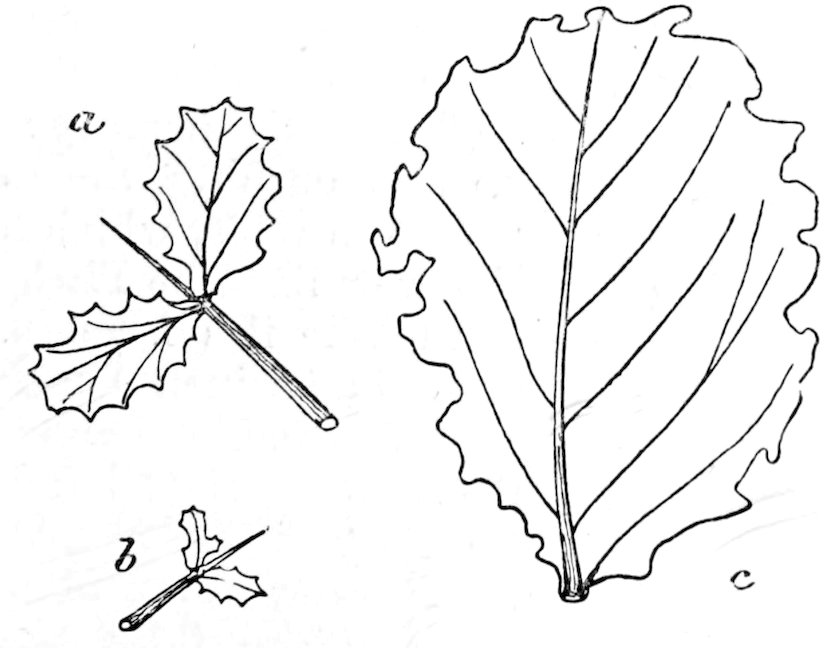
Fig. 78.—Attacks of Pea Weevil: a, b, on pea leaves; c, on a bean leaflet.
The Pea Weevil (Sitones lineatus). Longish, with grey scales on a black background. Neck-shield with three longitudinal streaks, wing-covers with dotted lines. These weevils appear at the first beginning of spring on peas, field and garden beans, clover, and vetches. They gnaw the leaf-margins of 108the tender plants, and always in such a way as to present a toothed appearance (Fig. 78). It often happens that in a large field one can scarcely find a pea-leaf with uninjured margin. When the plants are somewhat grown the damage done by the weevils is of no further importance; but if the plants, when still very young, are prevented from growing rapidly by reason of rough cold weather or unfavourable conditions of soil, while at the same time the weevils continue their attacks, the small leaves will be completely destroyed, and the plants will perish. The larvæ gnaw the roots of the plants infested by the weevils. Remedy: rational rotation.
The Mouse-tooth Weevils (Baris, or Baridius). Small, tolerably elongated weevils with fairly long neck-shield (Fig. 79). Develop in cruciferous plants. The Rape Mouse-tooth Weevil (B. chloris). Shining green. Leaves in spring its hiding-place in the soil; the female then lays her eggs in the leaf-axils or stem of rape or turnip. The larva eats out passages in the stem and branches; in July it becomes a pupa in the inside of the stem; in late summer the beetle appears, and quickly creeps into the soil. Remedy: Pulling up and burning the rape and turnip stubble, which harbours the weevil. The Pitchy Mouse-tooth Weevil (B. picina), one-sixth of an inch long, shining black. Similar habits to the previous species; but lives exclusively in headed cabbage and cauliflower, never in rape and turnip. The Cress Mouse-tooth Weevil (B. lepidii), black with blue or greenish-blue back, one-eighth of an inch long. Lives in the stems of cauliflower and garden cress.
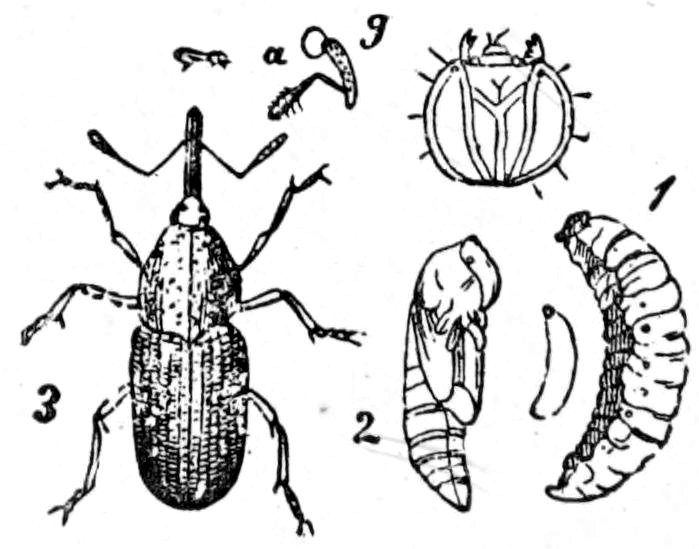
Fig. 79.—Mouse-tooth Weevil (Baridius chloris). 1, larva; drawn on the left, natural size,—above, the magnified head: 2, pupa, magnified: 3, beetle; drawn of the natural size above: a., eye; g, antennary groove with antenna not drawn back.
109
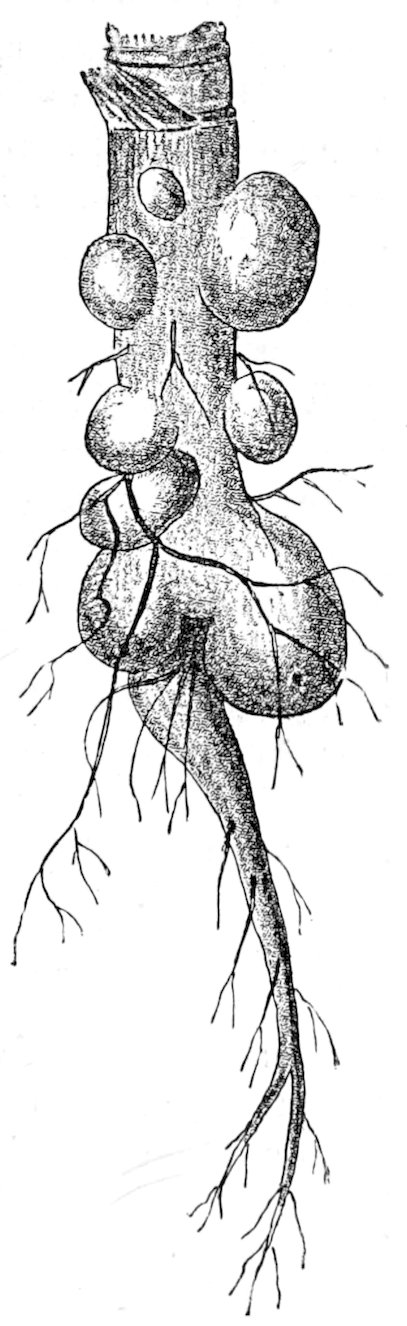
Fig. 80.—Turnip Gall Weevil (Ceutorhynchus sulcicollis).
The Gall Weevils (Ceutorhynchus) are very small beetles with thick-set bodies. In a state of rest the proboscis is folded back into a ventral furrow, situated between the fore-hips. They are black, and thickly covered with grey hairs. Live on cruciferous plants. The Turnip Gall Weevil (Ceutorhynchus sulcicollis), one-eighth of an inch long, dull black, with many grey hairs on the ventral side and few on the dorsal side. The deeply pitted neck-shield has in its centre a well-marked longitudinal furrow. Wing-covers deeply furrowed. The beetle appears in April, and gnaws the flowers and shoots, but can scarcely be considered as harmful. In late summer or autumn, after the sprouting of the winter rape, the female bites into the root immediately under the surface of the soil, or into the lower parts of the stem, so as to form a hole in which she lays one or two eggs. As the larva begins to develop, the surrounding parts of the stem or root grow into a gall-like swelling (Fig. 80). At the beginning of spring the developed larvæ creep out, and become pupæ in the soil; in April the beetle appears. If the Ceutorhynchus galls are only present in small numbers they damage the rape plants only to a small extent, but when ten to twelve are found in one plant the roots grow crooked, and remain short, and consequently the growth of the overground parts is detrimentally affected. Ceutorhynchus galls are 110found, not only on rape, but also on the different kinds of cabbage, and on turnip plants. In the last case they often occur in such numbers that the turnips do not develop at all, and the overground parts also remain small. There is a similar form (C. assimilis), as large as the preceding species, but somewhat slimmer, and, on account of greater hairiness, greyer. Appears in spring on flowering rape and several kinds of cabbage, as well as on similar cruciferous plants. It is harmful because the beetles gnaw the buds and flowers, and the larvæ feed on the seeds within the pods. The attacked pods ripen early, and open so that the larvæ fall to the ground, where they become pupæ. Usually only a single larva is found in each pod. The Rape Gall Weevil (C. napi), somewhat larger than the two preceding species, has a neck-shield which projects strongly forward like a collar, and is marked by a median longitudinal furrow. It is covered with yellowish-grey hairs. At the time when rape blooms it appears upon the flowers. The female lays her eggs singly in a hole previously bored in the stalk by her proboscis; during spring and early summer the larva eats out the stem, which turns brown inside, and becomes diseased or even dies.
Family: Chrysomelidæ (Leaf Beetles).
111
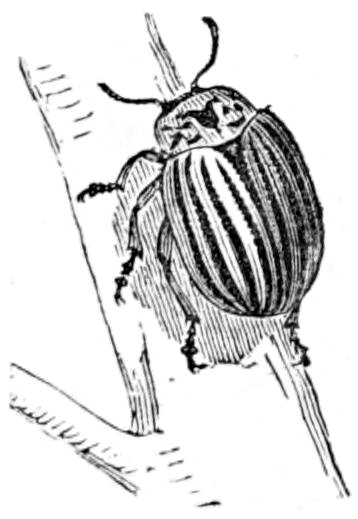
Fig. 81.—Potato Beetle (Chrysomela decemlineata).
Small, generally thick-set beetles, arched on the upper side, with eleven-jointed antennæ thickening somewhat towards their tips, and four-jointed feet. The first joints of the feet are covered with felt-like hairs on their under sides (Fig. 81). The larvæ have three pairs of thoracic feet, and, in addition to this, there are in most species a pair of caudal pro-legs. Live in the inside parts of plants (stems, leaves), and are usually elongated and yellowish white; those which live on the outside of plants are more convex, shorter, and thicker, more or less hairy, often of a striking colour, and always with dark spots. The beetles eat leaves; the larvæ feed upon parts of the same plants, sometimes living outside upon the leaves, or it may be excavating channels in the inside of a leaf or of the stem. Most leaf beetles lay many eggs, and in many species there are several generations annually. The plants attacked by them are often stripped quite bare. Here belongs the blue Alder Leaf Beetle (Galeruca alni), the Poplar Beetles (Chrysomeli populi and C. tremulæ), the Asparagus Beetles (Crioceris merdigera and C. duodecimpunctata), etc. Of species injurious agriculturally, I will first mention the Colorado or Potato Beetle (Chrysomela decemlineata). This beetle originally lived in the west of the United States on wild solanaceous plants; but as soon as potato culture extended to the west the beetles also attacked potato plants. As soon as the insects had spread to this plant they began to appear in great numbers owing to their very great powers of reproduction; and they quickly spread from one field to another, always going further and further east. 1859 was the first year when they became notorious as pests, and, since they first appeared as such in the State of Colorado, the insect received the name “Colorado Beetle.” In a short time the beetles spread to the east, especially to places where potato culture was carried on; in 1865 they crossed the Mississippi, and in 1870 they were already spread over the states of Indiana, Ohio, Pennsylvania, Massachusetts, and New York. They were soon found in all the eastern states, and European farmers began to be alarmed. In most of the countries of Europe police regulations were made for the purpose of preventing the introduction of the unbidden guests. Colorado beetles have indeed been brought several times to 112Germany on board ship, but in almost all cases the pests so introduced have been recognized and caught. Twice during 1877 they were able to increase (Mulheim, Schildau), and the same thing has happened once at a more recent date (Torgau); but the vigorous action of the authorities quickly exterminated the beetles.
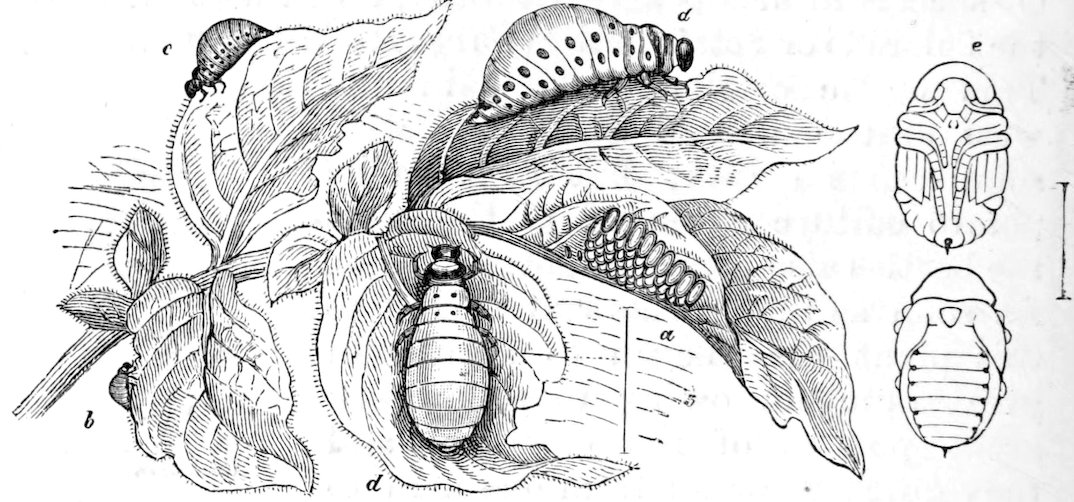
Fig. 82.—Colorado Beetles: a, eggs; b, c, d, younger and older larvæ; e, pupæ seen from the ventral side and from the dorsal side.
Beetle (Fig. 81), half an inch long, dusky yellow, with five longitudinal black streaks on each wing-cover, and black markings on the neck-shield. Larva (Fig. 82), half an inch long, thick, fleshy; legs short and weak. Orange-yellow, with shining black head, and with black spots on the body segments. The younger larvæ are darker, almost blood red. When the young potato plants come up, the beetles which have survived the winter creep out of the soil and devour the margins of the young leaves. The female lays her yellow eggs (700 to 1200?) in heaps on the leaves (Fig. 82, a). After a week the larvæ appear, and carry on the work of the beetles. They attain their full development in seventeen to twenty days, become pupæ in the soil, and the beetles of the second generation make their appearance in the middle of June. Still a third generation may appear the same 113year. Since a considerable time elapses between the laying of the first and second batches of eggs, one usually sees eggs, larvæ, pupæ, and beetles at the same time. Entire potato fields are eaten bare by the beetles and their larvæ, the formation of the potatoes being quite prevented. Remedies: Energetic measures must be taken on the first appearance of the beetle in any district. Where possible, all the beetles and larvæ must be collected, the plants being dug up and destroyed with the beetles, pupæ, larvæ, and eggs adhering to them. Petroleum must then be poured over the whole field and set on fire, so as to destroy any insects which may be hidden in the soil. Spraying the attacked plants with Schweinfurt green.
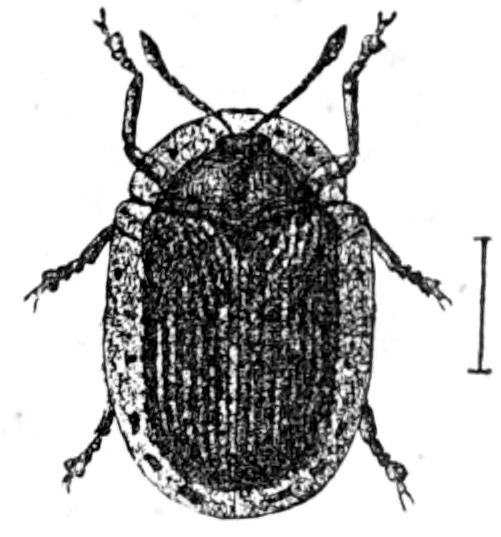
Fig. 83.—The Cloudy Tortoise Beetle (Cassida nebulosa).
The Cloudy Tortoise Beetle (Cassida nebulosa)—Fig. 83. One-fifth to one-fourth of an inch long; the broad neck-shield projects in front over the small head. The wing-covers, too, are much broader than the body of the animal; they are longitudinally ribbed. Dorsal side reddish brown, in young individuals greenish; always with black spots. Ventral side black. Larva elongated oval, yellowish green. Segments of the body beset with thorn-like structures bearing lateral branches; the last segment possesses a “tail-fork,” which the larva usually carries bent over its back and on which it heaps up its dung. The beetles which have survived the winter usually attack in spring only wild goose-foot and orach plants, on which they lay their eggs in heaps. The larvæ quickly appear, and to begin with chiefly keep to the under sides of the leaves. They are sluggish, grow quickly, and devour the leaf substance; when fully developed they cement themselves to a leaf and become pupæ. In June the beetles of the second generation appear, which again lay their eggs on the 114leaves. In favourable weather there may be even a third generation. In many it happens that the beetles of the second generation migrate to beet or mangold plants, sometimes damaging them to a very great extent. Remedy: Rooting out species of goose-foot or orach.
The Earth Fleas, or Flea Beetles, are all small leaf beetles with the power of springing, and therefore provided with thick thighs. Here belong:—
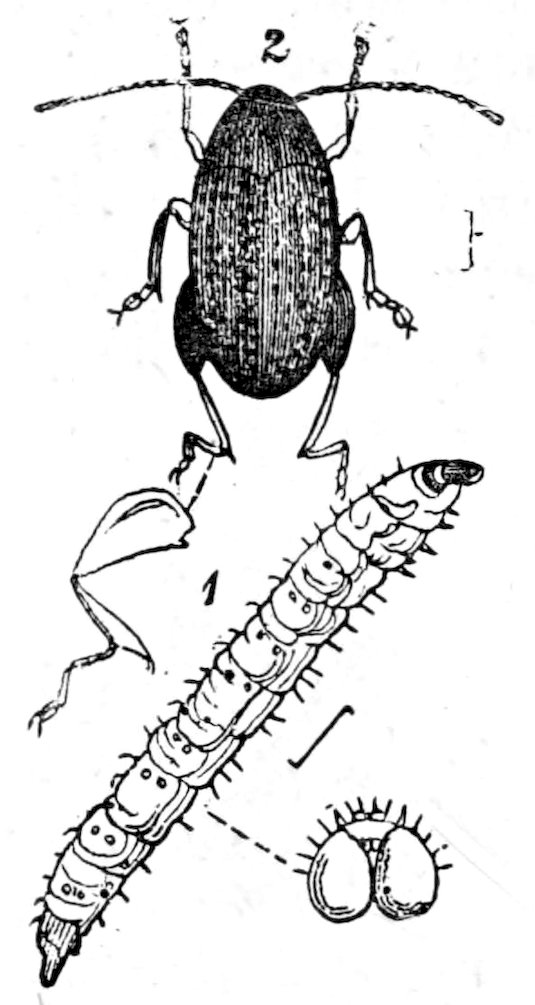
Fig. 84.—The Rape Flea Beetle (2) with hind-leg of the same; larva (1) and its head.
The Rape Flea Beetle (Psylliodes chrysocephalus)—Fig. 84. Egg-shaped. Hind feet not inserted at the ends of the shanks, but higher up. The first joint of the foot is as long as the others put together. The rest of the hind foot is bent in a knee-like way on the first long joint. Shining blackish brown or blackish green, rarely brownish. Larva one-fifth to one-fourth of an inch, dusky white; head, neck-shield, and last segment of the body blackish brown. In spring and during the entire summer the beetles are found upon the plants of winter rape. Although they gnaw the leaves and the immature shoot the damage caused is small. In late summer or autumn the female beetles lay their eggs separately at the bases of the leaf-stalks of the young winter rape plants. The larvæ which emerge bore into the leaf-stalk, and eat it completely out during autumn, winter, and spring, so that the leaf dies. Since the eggs are laid separately the larvæ do not all develop at the same time in the spring. In spring many larvæ eat their way from the leaf-stalks into the still very short stem, which consequently ceases to develop. It often happens that 115most, or even all, of the plants in a rape field are withered; on poor soil the whole crop must be at once ploughed up; but on fertile soil the plants often develop much better than one would believe. Plants whose stem has been killed in the winter while still short may develop a few (3 to 5) branches from buds situated near its base, but these usually remain small, and do not yield a large crop. The beetles, appearing in spring, lay their eggs on the lower leaf-stalks of the rape, either on the old plants of winter rape or young plants of summer rape. In the latter case the summer rape is quite spoilt in the same way as the winter rape during the previous winter. In the former case the larvæ eat out the lower part of the leaf-stalks, and make their way into the stem, hollowing it out at a definite spot in such a way that it is no longer able to hold itself up, especially when the shoots and seeds develop. The stems bend and become kneed, sometimes to such an extent that the rape field looks as if persons or cattle had been running about in it in all directions, and treading everything down. Meanwhile the larvæ bore their way out of the stem, and become pupæ in the soil. In late summer the beetles appear, and once more lay their eggs on the leaf-stalks of the winter rape. There are, therefore, two generations annually. Remedies: Never sow summer rape after winter rape which has been destroyed by the beetle and ploughed up. Temporary limitation of rape culture.
The Cabbage Flea Beetle (Haltica oleracea), one-fifth to one-sixth of an inch long, longish oval, dark green, metallic sheen. The hind legs do not possess the peculiar features of the rape flea beetle (p. 114). Larva one-fifth to one-fourth of an inch long, greyish black, with bristly hairs, and with two rows of shining black warts. The beetles attack, in the spring, chiefly cabbage, rape, radishes, horseradish; but do not spare other plants (e.g. peas and beets) as well. Seedlings 116are chiefly attacked, and in all cases only young plants are devoured. Since both seed-leaves and terminal buds are eaten, much damage is done, especially during continuously dry weather. It must often happen that the beetles wander away, to find other species of plants for the purpose of egg-laying; so that it is exceptional to find the larvæ upon species of cabbage. These larvæ are much less injurious than the beetles, since they usually only prey upon mature plants. In their youngest condition they are found in groups, feeding upon the leaves; this results from the eggs being laid in little heaps. Later on, they wander away from one another. In favourable weather they are fully grown in six weeks, and several generations may succeed one another in the same year. Remedies: Destruction of the weeds which attract the beetles (charlock, shepherd’s purse, yellow rocket, treacle mustard, etc.) Good preparation of the soil, suitable manuring and drill culture, since these bring about a more rapid growth of the plants. Thick sowing (but not too thick), so that, even after the destruction of many seedlings, a sufficient number may remain. Moistening the fields by means of water-carts or sprayers. In garden-beds twigs are laid down, by which the seeds are protected against birds and the seedlings against flea beetles. “Flea-beetle machines,” consisting of a board smeared with tar, which is drawn across the field, so that the frightened beetles spring up, and remain hanging in the sticky substance. After rain, or when dew is still clinging to the plants, they should be strewed with powdered fowls’ dung, pigeons’ dung, or horse dung, wood-ashes, road-dust, powdered lime, coal-ashes; or the plan of sprinkling with a decoction of wormwood may be adopted.
The Turnip Flea Beetle, or Turnip Fly (Haltica nemorum), one-tenth to one-eighth of an inch long, egg-shaped, black, with longitudinal streaks of a 117sulphur yellow colour on the thickly pitted wing-covers. Larva one-fifth of an inch long, yellowish white, with dark brown head, neck-shield, and last body segment. The adult beetles have the same habits as in the preceding species; they also do damage in the same way, and attack the same plants, especially in the seedling condition. The female, however, does not lay her eggs in heaps, but separately on the leaves, and always on the under side. The larva bores into the leaf, and digs a passage, which, like the animal inhabiting it, is at first small, but gets gradually larger. In fine weather the larva is fully developed in a week. It then pierces the skin covering the under side of the leaf, falls to the ground, and becomes a pupa. Several generations may appear every year, if the weather is favourable (dry). This species is quite as harmful as the preceding, chiefly in the mature condition. Remedies: Compare the preceding species.
Family: Coccinellidæ (Lady-birds).
Hemispherical; upper side convex; under side flattened. Head small, retractile. Antennæ, eleven-jointed, thickened at their tips. Legs short; feet apparently three-jointed—in reality four-jointed, the second joint, however, being very small. Colour, usually variegated; many species black with red, or red with black spots. When grasped, they let a yellowish, unpleasant-smelling fluid escape from the abdomen. The blunt, four-cornered, usually variegated pupæ hang on the leaves. The fully developed larvæ are longer than the beetles. They closely resemble those of the leaf beetles, but are not so thick-set, and their longer legs stick out more laterally. They are covered with warts and little spines (Fig. 85). The larvæ and beetles of most species feed chiefly on aphides and shield-lice; they are therefore of use, and this is especially true of the exceedingly 118ravenous larvæ. The larvæ of the Seven-spotted and Two-spotted Lady-birds, in particular (Coccinella septempunctata and C. bipunctata), are found in large numbers among aphis colonies. The yellow eggs are laid in heaps.
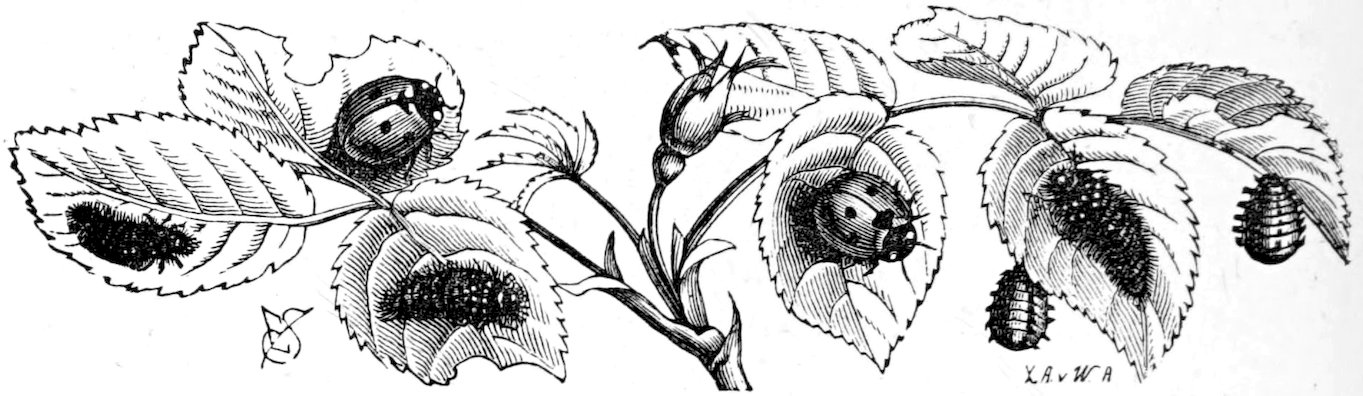
Fig. 85.—The Seven-spotted Lady-bird (Coccinella septempunctata): larvæ, pupæ, beetles; all natural size.
Second Order: Orthoptera (Straight-winged Insects).
Insects with biting mouth-parts and incomplete metamorphosis (p. 89). Four wings, of which the anterior are usually harder than the posterior; hind wings membranous, broader than the fore wings, and folded like a fan. The Orthoptera feed entirely, or almost so, upon vegetable substances. To this order belong:—the Earwigs (Forficulariæ), which feed on sweet fruits and flowers, and are sometimes very injurious; the Cockroaches (Blattariæ), which do much damage to provisions in kitchens, stores, and on board ship; the Grasshoppers (Acrydites), to which, besides the Migratory Grasshopper (Acrydium migratorium) Fig. 62, various species of meadow grasshoppers belong, which are quite harmless; the Locusts (Locustidæ), to which the well-known Green Locust (Locusta viridissima) belongs; and the Crickets (Gryllidæ), to which belong, among others, the House Cricket (Gryllus domesticus), the quite harmless Field Cricket (Gryllus campestris), and the Mole Cricket (Gryllotalpa vulgaris).
119 The Migratory Grasshopper (Acrydium migratorium).
1⅗ to 2⅗ inches long; spread of the wing, on the average, 2½ inches. Greenish grey. Under side flesh colour. Wing-covers brownish, darkly flecked. Colour very variable (Fig. 62). Excessive multiplication and migrations of this insect often take place in South Russia and Turkey; but they may also appear in Central Europe. In North Germany, for example, the following years of this century were “grasshopper years:” 1803, 1825–27, 1853, 1875–76. In many cases the appearance of swarms of grasshoppers in Central Europe is due to migration from Russia and Hungary; but it also often happens that the insects which appear in such large numbers have been bred in the places where they are found. Since the female lays, on the average, 150 eggs, excessive increase may take place in any country to which they are indigenous—and therefore in Central Europe. It appears, however, that a large number of grasshoppers are usually killed by their natural enemies, such as cold and damp weather. Excessive increase may, however, take place in exceptionally favourable years; and since the larvæ, which are incapable of flight, devour everything available, the mature insects developed from them are forced to migrate. Where they descend they destroy everything they find in the fields. Remedies: Destruction of the longish eggs, which are laid in heaps in the earth of fallow ground and meadows. In all those places where dead insects are found in large numbers on the ground many eggs will also be discovered, for the insects keep on laying till they sink down dead in the place where the last heap of eggs was deposited. Such places should be dug or ploughed, and the eggs, which are present in thousands, either collected or else searched out by pigs, ducks, geese, and fowls, which have been driven to the spot. Destruction of the young animals while 120still incapable of flight. Working the soil with harrows, rollers, and cultivators will be effective here. The adult grasshoppers must for the most part be destroyed with fire. [Heaps of straw and brushwood are soaked with paraffin and then set on fire.]
The Mole Cricket (Gryllotalpa vulgaris).
Body stout and flattened. Antennæ, palps, and tail-filaments very long. Fore legs broad, modified into true “digging legs,” superficially resembling the feet of a mole. Fore wings broad, but short, leathery. In a state of rest, the hind wings lie on the back, like a couple of tails. Colour dark brown. Principally occurs on peaty soils mixed with sand or clay, also on all soils which have become of firm consistency by the application of much manure. Their presence is therefore local. Very early in the year the mole-cricket leaves its winter hiding-place, and begins to make its passages near the surface. Where the female makes her nest the passage turns downward a little. The nest is 1⅗ of an inch in diameter, and its walls are compacted by the pressure of the hard body. The number of eggs is from 200 to 250; they are laid in lots with a few intermediate spaces. The young creep out in the spring, and are wingless. To begin with, they are white, but quickly become brown. The mother guards her young very carefully. These grow tolerably fast, and first begin to lead an independent life after the second moult. In October and November they undergo a third moult. Then, still in a wingless condition, they hide themselves, and do not moult again till April or May, when the wing-cases appear; while after the fifth moult (May, June) the mole-cricket becomes an adult insect, capable of reproducing. This insect is found in cornfields, gardens, grassland, and meadows, also in orchards and woods. It gnaws the roots of all kinds of plants, and often effects great 121damage in this way. The mole-cricket is also harmful on account of its passages, which are dug close to the surface. In this way it lifts young plants out of the soil; while older plants are killed, both by its gnawing and by its digging. Such plants can often be pulled up by grasping the leaves. All the plants wither in the place where the nest is found. Dry, cold winters kill almost all the mole-crickets; much drought in summer and also continuous wet are unfavourable to them. Enemies: moles, rooks, etc., butcher-birds, starlings, and the larger ground beetles. Remedies: Destruction of the nests, in June, to begin with, but also to be continued later. In those parts of a field where the plants are yellow or withered in a large circular patch (some 39 inches in diameter) the nest is felt for with the finger, and carefully lifted up, so that the eggs do not fall out. Mole-crickets can also be caught by means of flower-pots. The apertures in the bottoms of these are stopped with corks, and they are then sunk in the soil with their mouths on a level with the mole-cricket passages; they thus serve as pitfalls, from which the insects cannot escape. If during winter little heaps of horse dung are placed on the ground, the insects creep into them for the sake of the warmth, and can thus be collected and killed.
Third Order: Neuroptera (Net-winged Insects).
Insects with biting mouth-parts and four similar membranous wings, with numerous veins arranged in a net-like manner. The metamorphosis is either incomplete (p. 89: dragon flies, may flies, book lice), or complete (p. 89: ant lions, lace flies, snake flies, scorpion flies, caddis flies). The indigenous forms, with the single exception of book lice, feed upon animal food, usually on the juices of other insects. Several of them are tolerably useful in this way.
122The Dragon Flies (Libellulidæ) fly about incessantly from place to place on bright warm days, and catch a large number of insects, especially butterflies and flies, among which are many that are harmful. The larvæ live in water, and feed on insects and such small deer, which, however, are of no importance to forestry or agriculture. They also devour fish-spawn, and may therefore be injurious in that way.
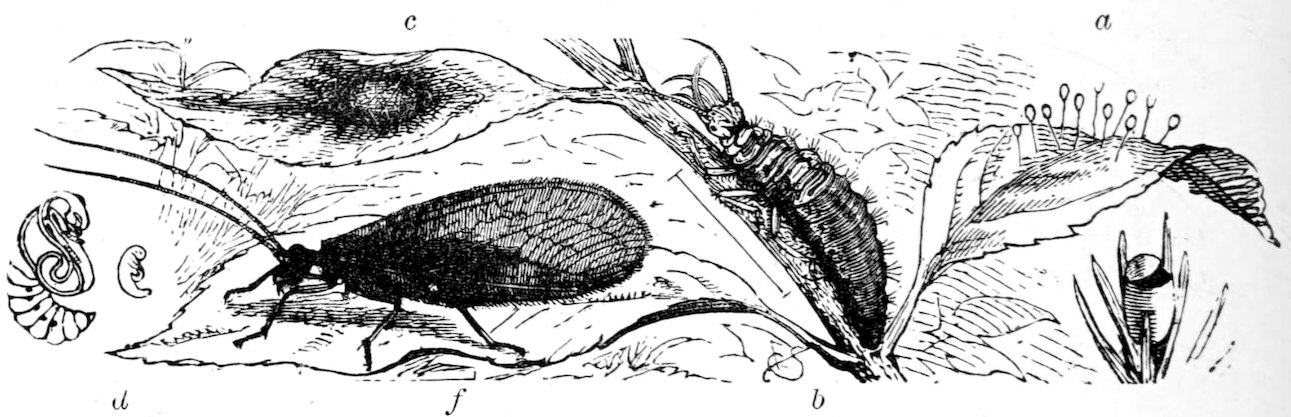
Fig. 86.—The Common Lace Fly (Chrysopa vulgaris): a, eggs; b, the larva; c, cocoon; d, pupa contained in the same; e, open cocoon; f, adult insect; a, c, e, natural size; d, enlarged and natural size; b and f enlarged.
The Lace Flies (Hemerobidæ) when at rest are covered as with a roof by their fore and hind wings, which are almost alike, clear as glass, and finely veined. Head tolerably large, eyes large, abdomen elongated and slender. The extremely rapacious larvæ (Fig. 86, b) feed on the juices of the bodies of other insects, which they suck up by means of a pincer-like organ situated on either side of the mouth. The two pincers are perforated, and the tubes open on each side into the gullet; the body juices of the insects attacked thus flow into the gut of the larva. This is strongly built, and always much thicker and larger than the adult insect. Metamorphosis complete. Three genera belong to the lace flies:—
1. The delicate greenish, or greenish yellow, illsmelling Gold-eyed Lace Flies (Chrysopa), the larvæ of which chiefly feed on plant lice (a few species on caterpillars, also, and other small insect larvæ).
2. The Aphis Lions (Hemerobius: H. hirtus, with 123hairy veins on the fore wings; H. dipterus, with hind wings almost entirely absent), the larvæ of which also feed on aphides, and make a case from their sucked-out skins.
3. The Ant Lions (Myrmeleon), of which the fat, thick-set larvæ, which have a large head and strong grasping pincers, dig out in the sand funnel-shaped holes, at the bottom of which they hide, lying in wait for ants and the like, which step on the edge, when the sand gives way and causes them to fall in. The species of the first two genera are of service as destroyers of aphides; the ant lions are of no importance.
The Scorpion Flies (Panorpatæ) have attached to the head a kind of proboscis, the upper side of which is formed by a prolongation of the forehead, and the under side by the maxillæ and lower lip, while the upper lip and mandibles are hinged on at its tip. Here belongs the slender-bodied Scorpion Fly (Panorpa communis), an insect found in May, and again in July or August, on the leaves of trees and shrubs, when it is sunny. While the abdomen of the female ends in an ovipositor, it bends upwards in the male, and terminates in a pincer-like organ; hence the name “scorpion fly.” Wings flecked with brown. Scorpion flies catch on the wing a very large number of butterflies and moths, and are therefore useful to some extent.
Fourth Order: Hymenoptera (Membranous-winged Insects).
Upper lip and mandibles short; the latter used for biting. Maxillæ loose-jointed, so that they can be stretched out considerably; elongated in those which lick the juices of flowers. In the last-named forms the larva’s lips are still more elongated, and may even form a tongue or proboscis-like organ, which may bear lateral appendages (“secondary tongues”). 124Wings, four, all membranous, with relatively few veins (Figs. 61, 90). Metamorphosis complete; larvæ very various; pupæ free (p. 93). The female usually possesses an ovipositor, the structure of which varies a great deal, and which serves in many species, not only for egg-laying, but also for protection (digging wasps); in others exclusively for offence or defence (“stings” of bees and wasps), while the same opening serves for the passage both of eggs and excrement. The abdominal glands, secreting a sticky substance by which the eggs are attached, are modified into poison-glands in those Hymenoptera which possess a sting. In those forms where the ovipositor is not modified into a sting, it is used for piercing, biting, or sawing. The Hymenoptera with saw-like ovipositor first make an opening in wood or in a leaf by means of the saw-teeth in its edge, and then lay an egg in this hole.
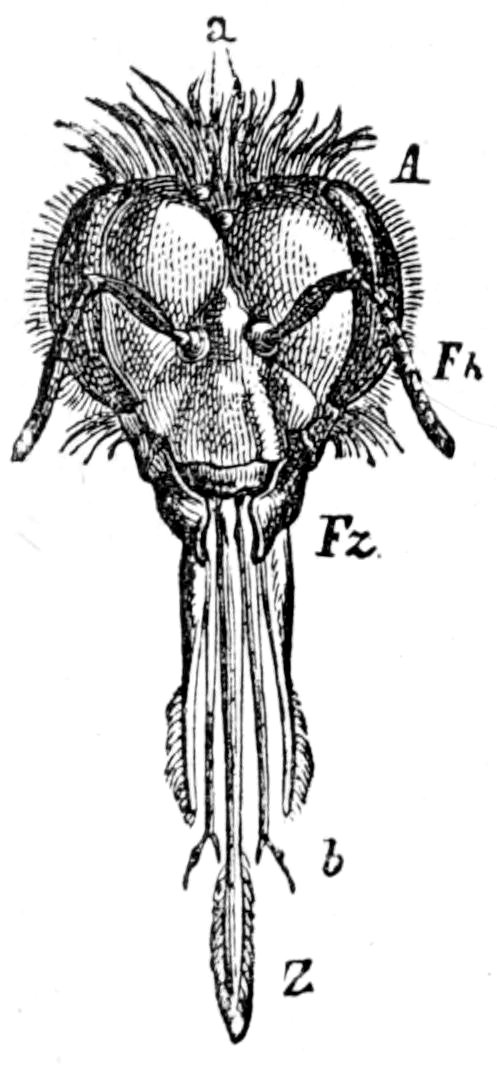
Fig. 87.—Head of Honey Bee. A, compound eyes; a, simple eyes; Fh, antennæ; Z, tongue (under lip); b, labial palps; Fz, elongated maxillæ; the mandibles and upper lip remain short.
Many Hymenoptera (all digging wasps, gold wasps, ichneumon flies, and gall flies—several true bees and wasps) live alone, or in pairs. Others form colonies, in which division of labour is always so far carried out that there are reproductive individuals and workers. The former (males and females; in colonies of bees—“drones” and “queen”) are only present in small numbers in any particular colony. They live merely for the perpetuation of the species. At most the males seek their own food, while the females are usually fed by the workers. Workers, on the other hand, are individuals in which the (female) reproductive organs remain in a low state of development, so that they are sterile. They seek food for the 125larvæ, and usually for the adult reproductive individuals as well. They also wage war against strange intruders.
Family: Apidæ (Bees).
The bees, by means of their very much elongated mouth-parts (maxillæ and lower lip or “tongue”), collect honey from many different kinds of flowers. Body somewhat unwieldy, usually hairy. The fore wings are not, as in wasps, folded together longitudinally when in a state of rest. Eyes round. The legless, almost maggot-like larvæ are fed with pollen or with a mixture of pollen and honey.
Most bees are colonial, and in these we find, besides the reproductive individuals, workers which prepare the nest. This is for the most part made up of “cells,” in the construction of which the most various substances are used according to the species, e.g. wax, sand grains, chewed wood, fragments of leaf. In each nest there is at the same time only one queen, who lays her eggs in the cells; the larvæ are therefore developed in these cells, other cells serve for the storage of pollen or honey. In the non-colonial bees there are no workers; in a few of these species (parasitic bees, cuckoo bees) the female lays her eggs in the cells of other species, which, like foster parents, undertake the care of the strange larvæ. These species are naturally devoid of the apparatus for securing and carrying pollen. In several bees (honey bees, humblebees) this end is attained by the much-broadened shanks and first, very large foot-joints of the hind legs. Other bees (Megachile) carry pollen on the under side of the abdomen.
Bees play a very important part in the pollination (fertilization) of many cultivated plants.
The Honey Bee (Apis mellifica) cannot be spoken of here; reference must be made to works on apiculture.
126The Humblebees (Bombus) are tolerably large, stout, thick-set, and hairy. They construct nests below the surface of the soil (often in peaty places), made up of oval or irregular waxen cells the size of a hazel-nut. They fly rapidly, always making a humming sound. Many species are black, with yellow and white, or red transverse stripes.
Honey-producing flowers in which the corolla is so long that even the proboscis of humblebees cannot reach the honey hidden at the bottom of the flower, (tobacco, field and garden beans) are gnawed at their base by the sharp mandibles of the bees, so that a hole is made in the calyx and corolla through which the tongue can be put. In this way the ovary is sometimes wounded, and the normal development of the fruit rendered impossible. Perhaps a certain amount of damage, always however inconsiderable, may thus be effected.
Family: Vespidæ (Wasps).
Mouth-parts as in bees. Also with stings. Slender, and either hairless or only slightly hairy. Eyes kidney shaped. Fore wings folded together longitudinally when at rest (Figs. 61 and 88).
A distinction is made between solitary and social wasps; the latter possess males, females, and workers. Only the fertilized queens survive the winter. In the spring each of these begins to construct a nest (Fig. 88). In the wasp’s nest each comb consists only of a single layer of cells, the openings of which are turned downwards. In a single nest several of these horizontally placed combs are usually found one over another, and are connected together by means of vertical pillars. Some nests are built in hollow trees, others in holes in the ground; others hang freely from trees, in which case they are covered by several layers of a papery substance. The combs and cells are also made of paper, to prepare which the insect 127gnaws and crushes decaying wood, and especially bark, with its mandibles, mixing the crushed material with saliva. In this way a pulp is made which is used in the construction of the nest, and dries into a kind of paper. The opening of the nest is in its under side (Fig. 88).
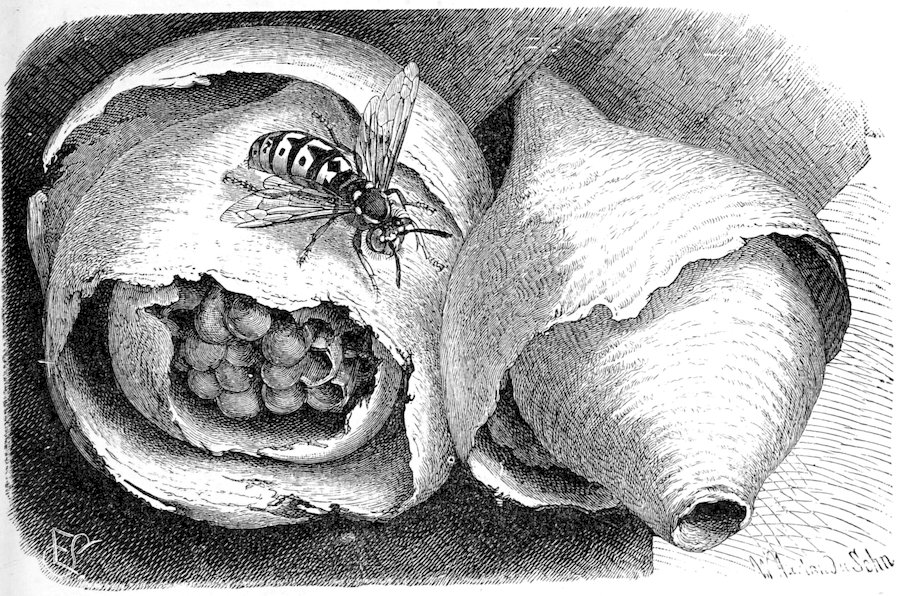
Fig. 88.—The Common Wasp (Vespa vulgaris) and its nest.
During spring and summer the queen, or “wasp-mother,” lays only eggs from which workers are hatched, which undertake the work of nest-construction and care of larvæ, so that the queen can devote herself exclusively to the function of reproduction. Towards autumn males, and females capable of being fertilized, are also hatched; these last afterwards live over the winter in the fertilized condition.
During summer the larvæ are fed by the workers with finely chewed insects or with honey. They do not, however, suck the honey from flowers, but steal it 128from several species of bee, or else form it in their stomachs from sugary materials drawn from sweet fruits.
Wasps are harmful or troublesome in three ways: (1) by gnawing the bark of trees; (2) by feeding on sweet fruits; (3) by the painful stings which they inflict. These are most dangerous in hot summer days. If a nest situated in the soil is destroyed during ploughing the alarmed insects attack both men and horses, cases being known where their stings have proved fatal. The pain is chiefly caused by the poison introduced into the wound. On this account if the sting remains sticking in the skin it must not be drawn out simply with the fingers, but carefully, by means of the nails, lest the poison-bag is pressed and thus still more poison brought into the wound. Remedies: Cooling substances, e.g. ground carrots, apples or pears, cabbage leaves, damp sand. Rubbing in ammonia. If there is acute inflammation, a compress with sugar of lead.
Family: Fossores (Digging Wasps).
Several species of this group resemble the wasps in their habits, as well as through their black and yellow-tinged abdomens; but they are always distinguished from these by their fore wings, which are not folded together in a state of rest, and by their eyes, which are not kidney shaped. The shanks and feet possess thorns serviceable for digging. The sting of the female has no barbs, so that it is not torn off and left behind in the wound. The digging wasps are not social. They are lively and active; in summer the female often flies busily about near the ground in order to find a place for bringing up her young. She digs a hole in the earth in which she lays an egg. Then she buries an insect to serve as food for the young when hatched. Lest the insect to be buried 129should decompose, while, on the other hand, a living animal would not allow itself to be buried, the wasp first brings the insect into a condition in which it cannot make any voluntary movements. For this purpose most species sting the captured prey several times in the body, and thus often injure the ventral ganglia (p. 84); by this treatment the insect is not killed, but reduced to a condition of apparent death. Most digging wasps are useful, since they chiefly bury destructive kinds of insects. The Common Sand Wasp (Ammophila sabulosa, Fig. 89), buries caterpillars; the Path Wasp (Pompilius viaticus), spiders; the Weevil-killing Sand Wasp (Cerceris arenaria) and the Fly-killing Sand Wasp (Mellinus arvensis) respectively bury weevils and flies.
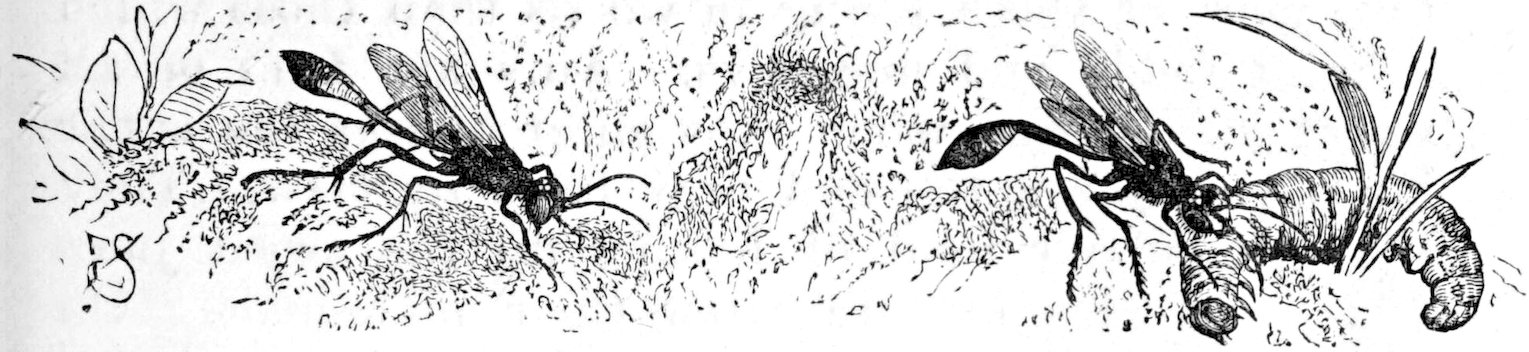
Fig. 89.—The Common Sand Wasp (Ammophila sabulosa); natural size.
Family: Formicidæ (Ants).
Large strong mandibles adapted for biting; maxillæ and lower lip not prolonged like a proboscis. Workers wingless; the males and reproductive females have weakly veined wings. In correspondence with these facts, the mesothorax which bears the larger wings is most strongly developed in the last, but the prothorax in the workers. Abdomen united with the thorax by a one- (Formica) or two-jointed (Myrmica) stalk. All female ants, and naturally workers too, possess poison-glands, the secretion of which accumulates in a poison-bladder; but the sting is lacking in all species of Formica. The stingless ants (e.g. 130the Red Wood Ant, F. rufa) inflict a wound with their strong mandibles, and then, bending the abdomen forwards under the thorax, squirt the contents of the poison-bladder into the wound. Ants form colonies, always of large size, and consisting of reproductive and sterile individuals. Their food is both of animal and vegetable nature, but chiefly consists of insects and similar small animals. They mostly devour caterpillars, but also dead or wounded beetles (e.g. cockchafers), mammals, birds, and reptiles. As destroyers of caterpillars they are of use, but this is true more of those living in woods than those which inhabit fields and meadows. Ants are fond of all sweet substances; when they enter houses the sugar jar is very often the end they have in view. They are particularly fond of licking up the sweet juice which aphides excrete from their abdomens. On plants infested with aphides many ants are found which greedily sip up all the drops hanging from the abdomens of the aphides; they may even promote the shedding of the juice by stroking the abdomens of the little animals with their antennæ. There are, indeed, species of ants which carry the aphides to the plant parts on which they thrive best, and again, when these are sucked dry, transport them to other uninjured parts. Sometimes aphides are kept in the overground or underground nests of the ants. The common yellow meadow ants shelter aphides in their subterranean nests, where they live on the roots of grasses and other plants. In order to get, when necessary, fresh food for these “milch kine,” they occasionally enlarge the nest, so that new plant roots are laid bare, and they then carry the aphides to these.
During the greater part of the year only workers, larvæ, and pupæ are found in an ants’ nest, but reproductive individuals appear in summer, disappearing again before the cold weather comes on. As 131soon as there is a sunshiny day they fly out, usually in large numbers. After pairing, the females let themselves fall to the ground; they then either tear off their own wings or this is done for them by the workers, which search them out and take them to the nest, where the laying of eggs quickly begins. The legless larvæ have feebly developed mouth-parts, and are fed by the workers on food broken down by them. The pupæ vary; in the sting-bearing ants (Myrmica) they are naked, in the stingless ants (Formica), on the other hand, they are invested in a cocoon. The latter kind of pupæ, known by the incorrect name of “ants’ eggs,” are collected and used as food for insect-eating birds. The nests are made either out of pine-needles and small branches heaped together (Red Wood Ant = Formica rufa), or they eat out passages and cell-like spaces in sound tree trunks (the larger Wood Ants, e.g. F. herculeana and F. ligniperda) or in decayed tree trunks (Small Wood Ant = F. fuliginosa); others (Yellow Wood Ants = F. flava, etc.) make passages and cavities in the ground, throwing up the earth into ant-hills. Damage: Several species do harm by excavating the soil, either in meadows and cornfields, by which the plants are killed and harvesting rendered difficult, or under summer-houses and dwelling-rooms. Others destroy tree stems. They are indirectly harmful on account of the way in which they care for aphides, causing these pests to increase to a greater extent than would otherwise be the case. Remedies: If ants have got into a room the nest must be found if possible, and the insects there destroyed with paraffin or boiling water. If it proves to be too difficult to find and destroy the nest, all the openings by which the ants can enter must be stopped up with lime to which some extract of colocynth has been added. The nests found in fields and gardens may sometimes be destroyed by quickly digging them up, pouring paraffin over them, and 132then igniting it. It is also a good plan to frequently tread or roll down the ant-hills which are thrown up, as in this way they will be dispersed in the end. Ants are of service in forestry, but scarcely in agriculture.
Family: Ichneumonidæ (Ichneumon Flies).
The species of ichneumon flies deviate in many ways from one another, but they all have similar habits and play a similar part in nature. They all have a longer or shorter ovipositor, always surrounded by two flaps, and serving for laying eggs in other animals. Those which seek their prey in branches and leaves generally possess a very short ovipositor not obvious on cursory examination; those which lay their eggs in insects inhabiting crevices, e.g. wood insects, are often provided with a very long ovipositor. No colonies and, consequently, no workers.
The female ichneumon fly generally lays her eggs in the body of an insect larva, on which the ichneumon larvæ developed from these eggs feed, using up the reserve matter stored up in the fat body (p. 92). Caterpillars are most infested; then follow false caterpillars, and then the larvæ of weevils and leaf beetles. The eggs of a few kinds are laid in pupæ, or even in the eggs of moths and butterflies. They always select for this purpose those insects which possess reserve material. The large kinds of ichneumon fly lay only a single egg in one host, especially if the latter is not of large size; many of the smaller ichneumons, on the other hand, lay many eggs (Fig. 90) in one host, even up to a hundred or more. A caterpillar containing ichneumon eggs does not at first appear different from other caterpillars, except that a dark spot or patch usually indicates where its body was pierced by the ovipositor of the ichneumon fly. The parasite breathes while in the 133host by bringing the tip of its abdomen (where the main stem of the air-tube system opens) into connection with one of the host’s spiracles. Since the larva feeds altogether upon perfectly digestible substances an anus is superfluous and is absent. Many ichneumon larvæ are ready to become pupæ when the host is about to pass into the same condition; the larva then bores through the skin of the latter, which quickly dies. Other species do not attack the organs of the host so soon, but allow it to become a pupa in peace, and then themselves become pupæ inside it; later on, one or several ichneumon flies come out of this pupa instead of a moth or butterfly. It is obvious that ichneumon flies are very serviceable by destroying a large number of harmful insects. They cannot, indeed, prevent the increase of any particular noxious insect, but, when this takes place, they themselves increase to a greater extent, and finally appear in such numbers as to make an end of the pest.
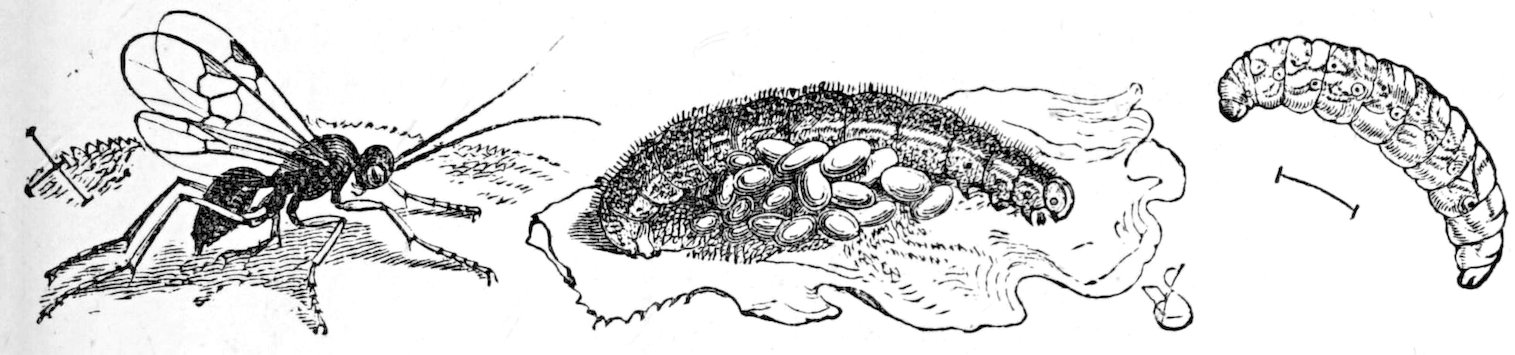
Fig. 90.—The Yellow-legged Ichneumon Fly (Microgaster glomeratus) of the Cabbage Caterpillar. Left, the adult insect; right, the larva (both enlarged). In the middle, Cabbage Caterpillar and a heap of Microgaster pupæ.
I shall not enumerate here all the various ichneumon flies which benefit agriculture, but simply mention the Small Cabbage Caterpillar Ichneumon Fly (Microgaster glomeratus), depicted in Fig. 90, which, like its host (the large cabbage white), appears in two generations. The larvæ of the ichneumon fly live in large numbers in the large cabbage caterpillar, and at their last moult acquire minute teeth, with which they bite through the skin of their host; they then 134leave it to die, and surround themselves with a cocoon close to its dead body. There are, besides, a few small and also some large ichneumon flies which lay their eggs in the pupæ of the cabbage white, so that, e.g., in winter many of its angular pupæ, occurring on tree stems and hedges, are found with many small or several large white ichneumon larvæ within them.
Family: Tenthredinidæ (Saw-flies).
Body thick-set. Abdomen never very long, and united by a broad base to the thorax (Fig. 91). Saw-shaped ovipositor (p. 89), drawn in when not in use, and only protruded during egg-laying. Mandibles strong, the remaining mouth-parts not so well developed. The larvæ are false caterpillars (p. 92); they can usually be recognized by their characteristic attitude, for many of them bend the abdomen very much upwards and forwards, especially when frightened, and when at rest the hinder part of the body is spirally coiled (Fig. 91). The fully developed larva spins a cocoon in which it still remains for a long time in the larval condition, even during the whole winter. It becomes a pupa two or three weeks before the appearance of the perfect insect. There are many larvæ of this kind destructive to woods, but only a few which interest the farmer. Here is included—
The Turnip Saw-fly (Athalia spinarum).
Adult: Female one-third of an inch long, stretch of wing over two-thirds of an inch; male somewhat smaller. Bright orange or reddish yellow. Head black, thorax and legs with black markings. Wings large. Larva: Length may be rather more than two-thirds of an inch. The just-hatched larvæ are almost colourless, but the skin quickly becomes bright 135green, and after the first moult, dark green to black. Ventral side slate grey. Head shining black. Twelve broad body segments, upon which are many wrinkles of the skin.
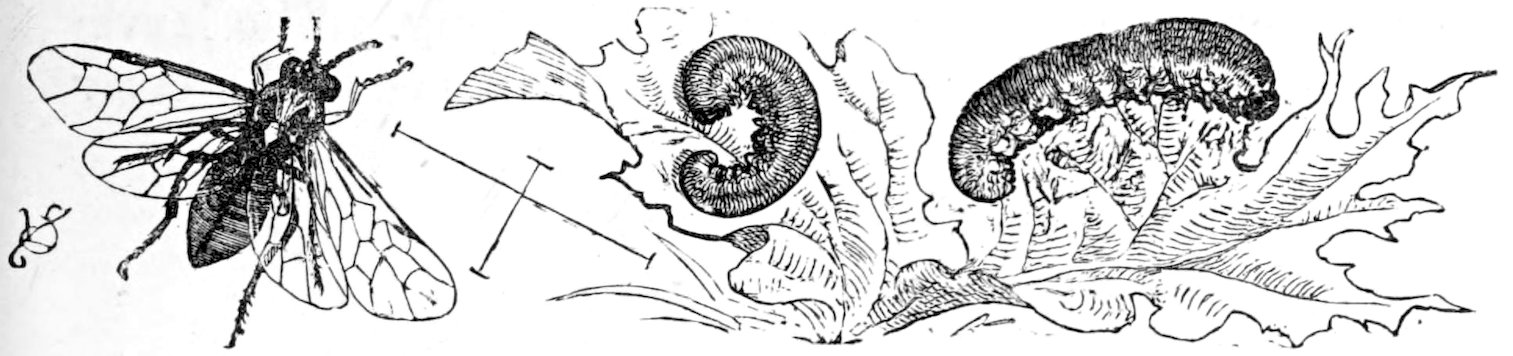
Fig. 91.—The Turnip Saw-fly (Athalia spinarum): adult female and two caterpillars.
The sluggish adult is found, during May or August, upon kohl rabi and turnips, mustard and charlock, with its wings folded together. The female, by means of her ovipositor, saws small holes in the margin or under side of the leaf, and lays her eggs in these. The larvæ are hatched in from four to six days, and they undergo four moults. The presence of the larvæ can be detected by their cast skins, which remain sticking to the leaves even when the animals themselves, which are often found rolled up on the under sides of the leaves, cannot be seen. The enemy is also known by its way of feeding, for the larvæ keep on the surfaces of the leaves (upper or under surface) and eat out longish holes. As soon as these have reached a certain size, other parts of the leaves or other leaves are attacked. When the larvæ are numerous the holes continually increase in number until only the leaf-ribs are left. The mature larvæ creep into the soil to a depth of from two-fifths to four-fifths of an inch, and spin a small cocoon. The saw-fly emerges either the same or the following year. These insects may therefore appear in May or in August, but in many cases they are seen at only one of these times, either the summer or autumn turnips being attacked, as the case may be. Remedies: Fowls and ducks willingly eat the larvæ, and, provided they 136are not able to do any damage, can therefore be brought into the fields. Strewing with soot has a good effect. It pays to pick off the larvæ from young plants.
Order 5: Lepidoptera (Butterflies and Moths).
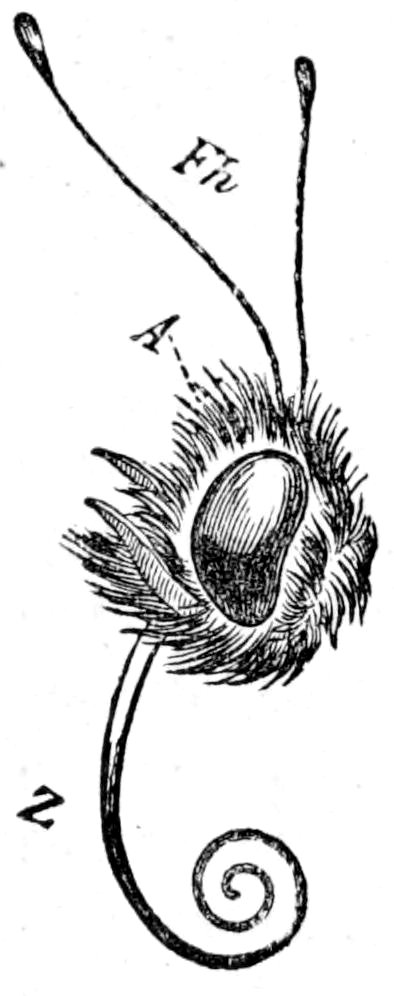
Fig. 92.—Head of a Butterfly. A, eye; Fh, antennæ; Z, proboscis.
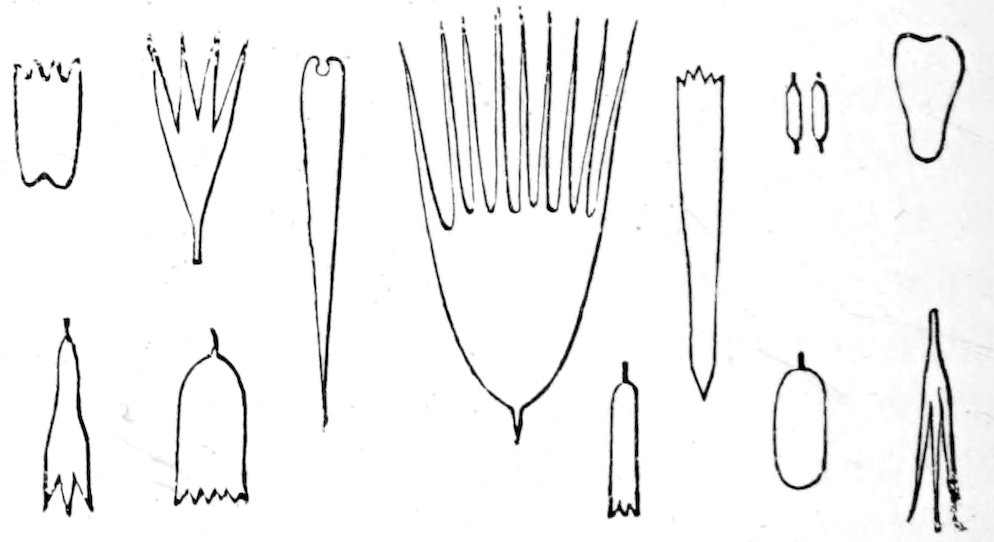
Fig. 93.—Scales from a Butterfly’s Wing (strongly magnified).
Sucking mouth-parts, forming a “proboscis” made up of the two very long maxillæ, spirally rolled up under the head when not in use (Fig. 92), and adapted for sucking honey. There are some forms which take no food in the adult condition, and in which the proboscis is short; in a few species of hawk-moths, this organ is even longer than the body. The larvæ (“caterpillars”) have biting mouth-parts. The body of a butterfly or moth is covered with hair-like structures developed by the skin; in the wings these are broader, have a characteristic appearance (Fig. 93), and partially overlap one another. These scales cause the colours of the wing. They can easily be wiped off, leaving the corresponding part of the wing 137transparent and clear as glass. In many species (all hawk-moths, many owlet moths) there is a wing-hooklet, i.e. the hind wing has a spine or a thick brush which grasps a band-like area of the fore wing. In this way the two pairs of wings are held together. The females of a few species of spinner and looper moths are wingless, or only possess short flap-like wings useless for flight. The metamorphosis is complete (p. 89); the larvæ are true caterpillars; the pupæ are obtectate (p. 93). Many caterpillars creep into the ground to become pupæ, and spin no investment at all (e.g. hawk-moths). Others make a cocoon, which may consist of threads loosely woven together or may be of firm texture (Fig. 60). The cocoon consists chiefly of silk, a substance secreted in a spinning gland, and exuding to the exterior on the lower lip; but minute particles of sand or earth, and fragments of wood gnawed off by the caterpillar, may be stuck in the cocoon. The pupæ of butterflies are naked, without cocoon, but are fixed by threads to leaves, tree stems, walls, hedges, etc. A distinction is drawn between girdled and suspended pupæ; the first are fixed by a silk band, which surrounds them, and the head is directed upwards, while the latter are suspended by the tip of the abdomen (Fig. 94). The time required for the development of the perfect insect from the pupa is not always the same, depending not only upon the species, but also upon the time of year. The summer generation of the large white spends scarcely fourteen days in the pupa stage, the winter generation eight months.
Family: Diurna (Butterflies).
Body relatively weak and thin; wings very broad, not very long relatively. No wing-hooklet (see above). Wings folded together above in a state of rest, so that their upper sides touch. Antennæ thickened in 138a club-like way at the tip. The caterpillars possess five pairs of pro-legs; they are usually almost devoid of hair. There are, however, a few (e.g. the caterpillar of the peacock butterfly, Fig. 94) which possess hard, spine-like, much-branched bristles. The naked pupæ are sharp cornered; some are girdled, others suspended (p. 137).
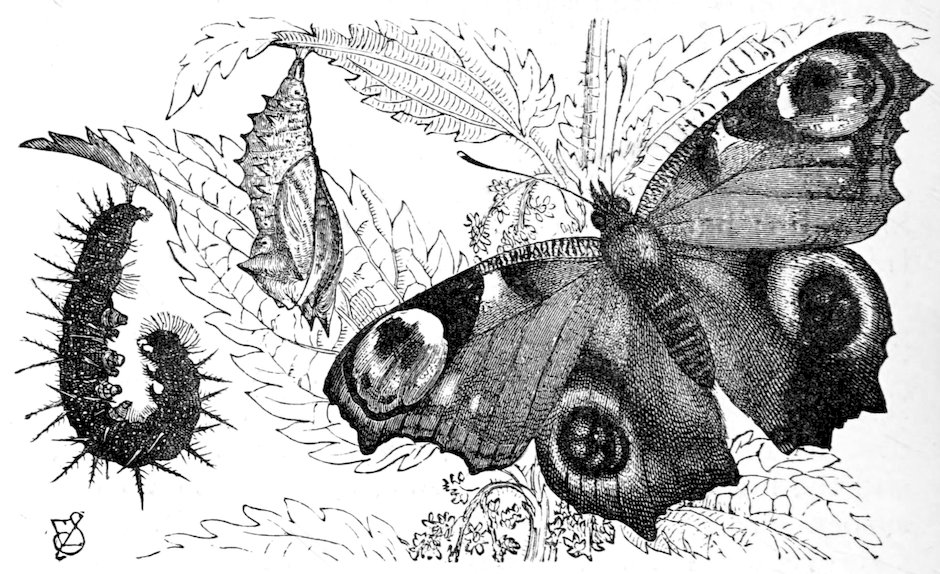
Fig. 94.—The Peacock Butterfly (Vanessa io), with pupa, and larva suspended before passing into the pupa state.
Among butterflies with larvæ that become suspended pupæ are the Red Admiral (Vanessa atalanta), the Peacock (Vanessa io, Fig. 94), the Fritillaries (Argynnis), the Meadow Browns (Hipparchia), etc.; and among those with girdled pupæ the Swallow Tail (Papilio machaon), the Whites (Pieris), etc.
The Cabbage White, or Large White (Pieris Brassicæ).
Butterfly: Length a little over an inch, span of wing 2½ inches. Both fore and hind wings milky white, the former black at the root, on the front edge, and the outer angle; also a black patch on the inner margin of the fore wing, passing on to the front 139margin of the hind wing. The female possesses, in addition, two round black patches on the middle of each fore wing. Under side of the fore wings milky white, yellow at the tip, blackish at the root; under side of the hind wings yellow, with black dots. Caterpillar (Fig. 95): As much as 1⅓ inch long; greenish, or sulphur yellow, with black dots. Head and dorsal side of last segment of the body grey with black spots. Young specimens are of a very bright green with black wartlets closely crowded together.
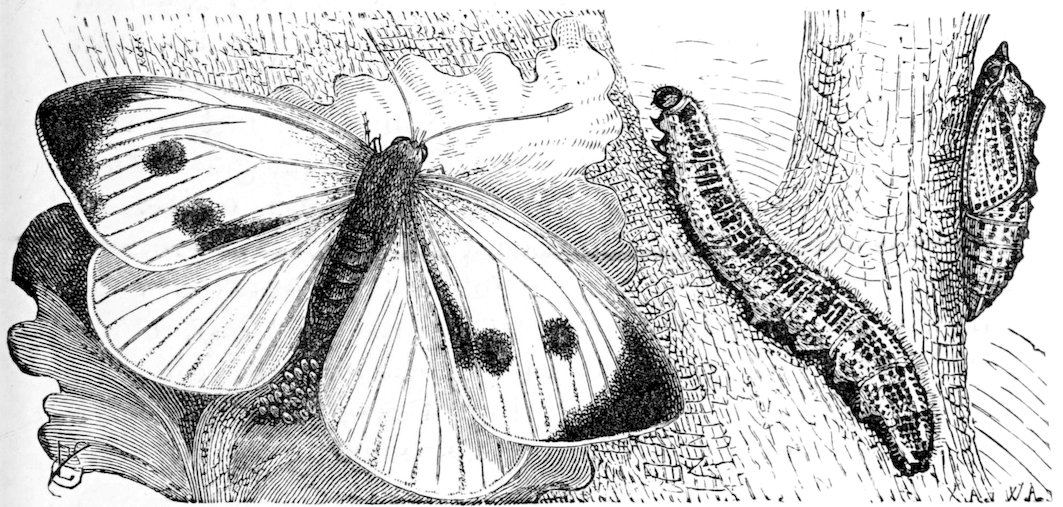
Fig. 95.—The Cabbage White (Pieris brassicæ) female laying her eggs; caterpillar, and pupa.
From the pupæ which have lived through the winter butterflies emerge in May, and lay their golden yellow eggs in small heaps on the under sides of the leaves of rape, mustard, and cress, also on charlock and such-like cruciferous weeds. The caterpillars of this first generation are hatched in fourteen days, and rarely do any harm, since they only appear in small numbers. They develop rapidly, and during the last days of June become pupæ on the branches and leaves of the plants they live on; the butterflies appear in July. Owing to their rapid development the caterpillars and pupæ of this first generation are but little exposed to the attacks of enemies 140(ichneumons, birds, etc.). Only a few of them die, therefore, if the weather is favourable. As a result of this, the July butterflies and the eggs laid by them are relatively numerous, so that the number of caterpillars appearing in late summer may be very large. These caterpillars, however, live almost exclusively on the various kinds of cabbage and kohl rabi, and it is this second generation which in many years is so harmful. At the beginning of August the caterpillars are ready to become pupæ, and for this purpose they seek tree stems, hedges, walls, etc. The pupæ now formed live as such through the winter. During this period, however, they are exposed to many dangers (damp, cold, sudden alternation between very low and very high temperatures; ichneumons, birds), and most of them perish, so that only a few butterflies come out the following spring, and lay but a few eggs. It is therefore obvious that the first generation of caterpillars (May, June) is much less numerous than the second generation occurring from late summer to autumn. Under exceptionally favourable conditions even a third generation may appear, since caterpillars of the second generation are able to become pupæ at the beginning of August; and these pupæ, instead of remaining as such over winter, become butterflies the same month. These, again, lay eggs from which the caterpillars of the third generation are hatched, which, however, are not always fully developed before the advent of the cold weather, and in this case perish. It is clear that, in the case of pupæ which develop into butterflies during August in about fourteen days, the unfavourable influences have either no effect (unfavourable weather) or but little (ichneumons, birds), so that the butterflies appear in flocks, which wander into other regions, since they have themselves, when larvæ, devoured the cabbage and turnip plants. In reference to the damage effected by the caterpillar, it may be observed 141that only the chief veins of the leaf are left, and the margins are not spared. Remedies: Collection of the little heaps of yellow eggs and the young caterpillars, which are blackish and live together in small companies; the planting of a few small hemp plants in the cabbage fields to be protected, by which the butterflies will be kept away.
The Garden White, or Small White (Pieris rapæ).
Fig. 96.—The Garden White (Pieris rapæ), male.
Fig. 97.—The Garden White (Pieris rapæ), female, caterpillar.
Butterfly (Figs. 96 and 97): Length rather less than an inch, span of wing two inches; very much like the cabbage white. Base and tip of the fore wing not of such a deep black colour; the black patch in the inner margin of the fore wing is usually absent in the female. The male, however, very often has a black patch in the upper side of the fore wing. Caterpillar: Just over an inch long. Dull green; a longitudinal yellow line on the back; also the black stigmata are connected by a yellow line. Habits as in the preceding species; the female, however, lays her yellow eggs separately, and not in heaps, and the second generation of caterpillars usually become pupæ somewhat later in the year. Collecting is more 142difficult than in the preceding species, since the young caterpillars live independently, and their colour makes it difficult to recognize them on the green cabbage leaves.
The Green-veined White (Pieris napi).
Butterfly (Fig. 98): As large or somewhat smaller than the preceding species. Wings milky white on their upper side; fore wings dusted with black on their front margin, tips, and ends of the ribs. Two spots on the middle of the fore wing in the female, one or none in the male. Under side of the hind wings yellow; under side of the veins dusted with greenish grey. Caterpillar: A little over an inch. Dull bluish-green, with minute blackish tubercles above, and whitish ones below. A yellow longitudinal line on each side connecting the black spiracles, which are bordered by reddish yellow. Very like the preceding species in the larval condition. Habits as in the preceding species, but this is less common.
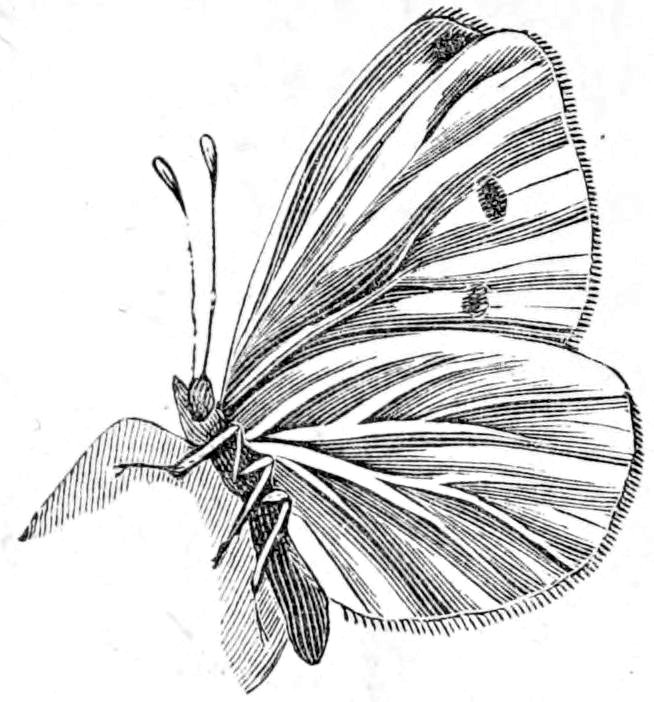
Fig. 98.—The Green-veined White (Pieris napi).
Family: Noctuidæ (Owlet Moths).
Night-flying moths, of medium size and dull colour, with smooth-haired bodies. Antennæ long and thin, thread like,—comb-shaped only in the males of a few species; wings powerful, lie in a roof-like way when at rest; almost always a wing-hooklet. Caterpillars usually hairless; mostly with five pairs of pro-legs, a few with four or three pairs. The owlets pair at night; they also fly about during the day, even in bright sunshine. Flight strong and rapid, but always in fits and starts. Almost all species lay their eggs 143separately, and on herbs, only a few species on trees. The caterpillars are very much scattered, and the damage caused by them is never great, except in spots here and there,—on the contrary, when they increase to a great extent they spread over a wider area. Several species are harmful to agriculture.
The Surface Caterpillars (Species of Agrotis)
are stout caterpillars, 1⅕ to 2 inches long, with five pairs of pro-legs, and shining transparent external skin. They remain in the ground during the day, feeding above ground at night, and also in the daytime when the sky is much overcast. When touched they bend themselves into the form of a C. There are in Britain several species of surface caterpillars which have these habits, but I will only describe here, to begin with, the commonest kind:—
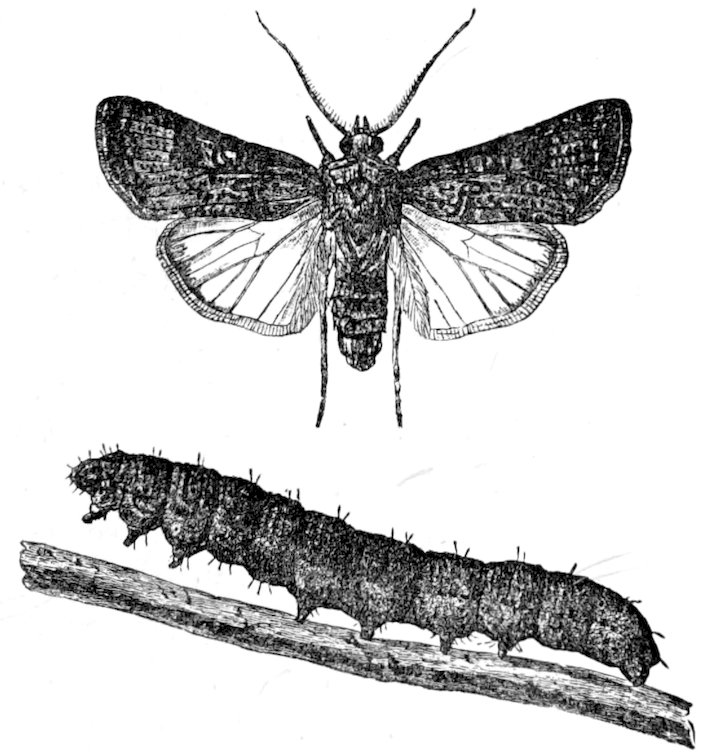
Fig. 99.—The Common Dart or Turnip Moth (Agrotis segetum) with Caterpillar.
The Common Dart or Turnip Moth (Agrotis segetum or A. clavis).—Moth (Fig. 99): Length almost ⅘ of an inch. Span of wing about 1⅘ inch. Fore wings small, ash-grey or brownish, with many dark patches and 144similar markings. Hind wings in the male, bright grey to snowy white; in the female, brownish grey. Caterpillar (Fig. 99): Up to two inches, earthy grey, occasionally somewhat greenish. Head and prothorax darker. The time taken by the caterpillars to complete their development differs according to the plants attacked, and it is therefore easy to understand why the moths should be seen flying about from the first half of May right on into the autumn, without having recourse to the improbable hypothesis of two successive generations. The eggs are consequently laid at very different times, and are always deposited singly in the soil in the neighbourhood of plant roots, or else in the low-lying leaves and stems of various herbs. The caterpillars hatched from these are destructive earlier or later, according to the time of egg-laying. Most specimens are half grown in winter; these continue their destructive work the following spring. In autumn they attack the roots of winter grain (rye and wheat), rape, and species of cabbage; they also bore readily into turnips and potatoes. In spring, after the winter rest, they continue to attack the roots of winter grain, winter rape, etc., or fleshy underground parts (turnips, potatoes) developed in the interim, or the roots of summer plants (summer grain, buckwheat, summer rape, vegetables, etc.). On clear days the caterpillars always remain hidden in the soil; and those which have bored into juicy underground parts of plants (turnips, carrots), do not leave their abode during the day, but the others, both during the night and on cloudy days, come above ground to attack the leaves and stems of young plants. In exceptional cases the caterpillar is mature by the beginning of winter, in which case it hybernates in the soil as a brown pupa. The moths escaping from such pupæ naturally appear earlier than others. As a rule, the caterpillars do most damage to the winter crop in autumn, wandering about a great deal; in many cases 145they gnaw through the main root, thus quickly killing the plant attacked, from which they proceed to another. Remedies: When the caterpillars have done much damage in late summer, it is recommended to leave the field alone till October, then to plough it up and sow the winter grain. By putting off the seed-time in this way, the caterpillars will have lost their activity when the corn germinates, and the winter crop will thus escape them. Besides this, the preceding ploughing will bring many caterpillars to the surface, where they will become the prey of birds, or, if not, can be collected. Warm soils, especially those manured with horse dung, are most infested by the caterpillars; and the use of warm kinds of manure should, therefore, be avoided in regions which have much to fear from these insects. Where everything has been destroyed, a thorough ploughing is desirable. Swine may also be driven in during autumn, and will grub up and devour the caterpillars. In this case, sowing will take place the following spring.