"A Voyage among the Tree-Tops" (continued 5)
Reading edition
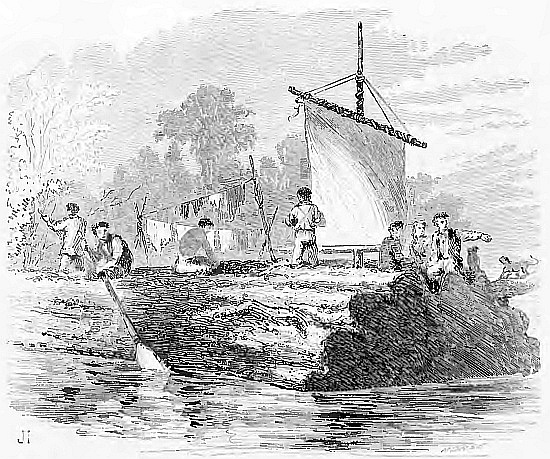
The cloud that had shadowed them for days was quite dispelled. With such a raft, there was every expectation of getting out of the Gapo. It might not be in a day, or even in a week. But time was of little consequence, so long as there was a prospect of ultimate release from the labyrinth of flooded forests. The charqui, if economised, would feed all hands for a fortnight, at least; and unless they should again get stranded among the tree-tops they could scarcely be all that time before reaching dry land.
Their progress was sadly slow. Their craft has been described as “walking the water like a thing of life.” But this is rather a poetical exaggeration. Its motion was that of a true dead-wood, heavily weighted with the water that for weeks had been saturating its sides. It barely yielded to the sail; and had they been forced to depend upon the paddles, it would have been a hopeless affair. A mile an hour was the most they were able to make; and this only when the breeze was at its freshest. At other times, when it unfortunately lulled, the log lay upon the water with no more motion than they caused as they stepped over it.
Towards noon their progress became slower; and when at length the meridian hour arrived the ceiba stood still. The sail had lost the power of propelling it on. The breeze had died away, and there was now a dead calm. The shoulder-blades of the peixe-boi were now resorted to, but neither these, nor the best pair of oars that ever pulled a man-o’-war’s boat, could have propelled that tree-trunk through the water faster than half a knot to the hour, and the improvised paddles were soon laid aside.
There was one comfort in the delay. The hour of dinner had now arrived, and the crew were not unprepared for the midday meal; for in their hurry at setting out, and the solicitude arising from their uncertainty about their craft, they had breakfasted scantily. Their dinner was to consist of but one dish, a cross between fish and flesh,—a cross between fresh and dried,—for the peixe-boi was still but half converted into charqui.
The Indian had carefully guarded the fire, the kindling of which had cost him so much trouble and ingenuity. A few sparks still smouldered where they had been nursed; and, with some decayed pieces of the ceiba itself, a big blaze was once more established. Over this the choicest tit-bits were suspended until their browned surface proclaimed them “done to a turn.” Their keen appetites furnished both sauce and seasoning; and when the meal was over, all were ready to declare that they had never dined more sumptuously in their lives. Hunger is the best appetiser; scarcity comes next.
They sat after dinner conversing upon different themes, and doing the best they could to while away the time,—the only thing that at all discommoded them being the beams of the sun, which fell upon their crowns like sparks of fire showered from a burning sky. Tom’s idea was that the heat of the sun could be endured with greater ease in the water than upon the log; and, to satisfy himself, he once more girdled on the cincture of shells, and slipped over the side. His example was followed by the patron himself, his son and nephew.
Little Rosa did not need to retreat overboard in this ignominious manner. She was in the shade, under a tiny toldo of broad leaves of a Pothos plant, which, growing parasitically upon one of the trees, had been plucked the day before, and spread between two buttresses of the dead-wood. Her cousin had constructed this miniature arbour, and proud did he appear to see his little sylph reclining under its shade.
The tapuyo, accustomed to an Amazonian sun, did not require to keep cool by submerging himself; and as for the negro, he would scarce have been discommoded by an atmosphere indicated by the highest figure on the thermometer. These two men, though born on opposite sides of the Atlantic Ocean, were alike types of a tropical existence, and equally disregarded the fervour of a tropic sun.
Suddenly the four, who had fallen a little astern, were seen making towards the log; and by the terror depicted on their countenances, as well as their quick, irregular strokes, it was evident something in the water had caused them serious alarm. What could it all mean? It was of no use to ask the swimmers themselves. They were as ignorant of what was alarming them as their companions upon the log; they only knew that something was biting them about the legs and feet; but what it was they had not the slightest idea. It might be an insect,—it might be a water-snake, or other amphibious reptile; but whatever it was, they could tell that its teeth were sharp as needles, and scored their flesh like fish-hooks.
It was not till they had gained footing upon the log, and their legs were seen covered with lacerations, and streaming with fresh blood, that they ascertained the sort of enemy that had been attacking them. Had the water been clear, they might have discovered it long before; but discoloured as it was, they could not see beneath the surface far enough to make out the character of their secret assailants. But the tapuyo well understood the signs, and, as soon as his eye rested upon them, his perplexity disappeared; and, with an exclamation that rather betokened relief, he pronounced the simple phrase, “Only piranhas!”
Chapter Seventy Three.
The Piranhas.
The companions of the tapuyo were no wiser for his words, until piranhas was explained to them to mean “biting fish,” for such were the unseen enemies that assailed them.
They belong to the great tribe of the Salmonidae, of which there are many varieties in the different Amazonian rivers, all very voracious, and ready to bite at anything that may be thrown into the water. They often attack bathers, putting them to flight; and a swimmer who should unfortunately be surrounded by them, when far from the shore or a boat, would have the greatest difficulty to escape the fearful late of being eaten up alive. Most of the species are fish of small size, and it is their numbers that the swimmer has chiefly to dread.
As it was, our adventurers were more scared than hurt. The commotion which they had made in the water, by their plunging and kicking, had kept the piranhas at a distance, and it was only an odd one that had been able to get a tooth into them.
For any injury they had sustained, the Mundurucú promised them not only a speedy revenge, but indemnification of a more consolatory kind. He knew that the piranhas, having tasted blood, would not willingly wander away, at least for a length of time. Although he could not see the little fish through the turbid water, he was sure they were still in the neighbourhood of the log, no doubt in search of the prey that had so mysteriously escaped them. As the dead-wood scarcely stirred, or drifted only slightly, the piranhas could keep alongside, and see everything that occurred without being seen themselves. This the tapuyo concluded they were doing. He knew their reckless voracity,—how they will suddenly spring at anything thrown into the water, and swallow without staying to examine it.
Aware of this habit, he had no difficulty in determining what to do. There was plenty of bait in the shape of half-dried charqui, but not a fish-hook to be found. A pair of pins, however, supplied the deficiency, and a piece of string was just right for a line. This was fastened at one end to the pashuba spear, to the pin-hook at the other; and then, the latter being baited with a piece of peixe-boi, the fishing commenced.
Perhaps never with such rude tackle was there more successful angling. Almost as soon as the bait sank under the water, it was seized by a piranha, which was instantly jerked out of its native element, and landed on the log. Another and another and another, till a score of the creatures lay upon the top of the dead-wood, and Tipperary Tom gave them the finishing touch, as they were caught, with a cruel eagerness that might to some extent have been due to the smarting of his shins.
How long the “catch” might have continued it is difficult to say. The little fish were hooked as fast as fresh bait could be adjusted, and it seemed as if the line of succession was never to end. It did end, however, in an altogether unexpected way, by one of the piranhas dropping back again into the water, and taking, not only the bait, but the hook and a portion of the line along with it, the string having given away at a weak part near the end of the rod.
Munday, who knew that the little fish were excellent to eat, would have continued to take them so long as they were willing to be taken, and for this purpose the dress of Rosita was despoiled of two more pins, and a fresh piece of string made out of the skin of the cow-fish.
When the new tackle was tried, however, he discovered to his disappointment that the piranhas would no longer bite; not so much as a nibble could be felt at the end of the string. They had had time for reflection, perhaps had held counsel among themselves, and come to the conclusion that the game they had been hitherto playing was “snapdragon” of a dangerous kind, and that it was high time to desist from it.
The little incident, at first producing chagrin, was soon viewed rather with satisfaction. The wounds received were so slight as scarce to be regarded, and the terror of the thing was over as soon as it became known what tiny creatures had inflicted them. Had it been snakes, alligators, or any animals of the reptile order, it might have been otherwise. But a school of handsome little fishes,—who could suppose that there had been any danger in their attack?
There had been, nevertheless, as the tapuyo assured them,—backing up his assurance by the narrative of several narrow escapes he had himself had from being torn to pieces by their sharp triangular teeth, further confirming his statements by the account of an Indian, one of his own tribe, who had been eaten piecemeal by piranhas.
It was in the river Tapajos, where this species of fish is found in great plenty. The man had been in pursuit of a peixe-boi, which he had harpooned near the middle of the river, after attaching his weapon by its cord to the bow of his montaria. The fish being a strong one, and not wounded in a vital part, had made a rush to get off, carrying the canoe along with it. The harpooner, standing badly balanced in his craft, lost his balance and fell overboard. While swimming to overtake the canoe, he was attacked by a swarm of piranhas ravenous for prey, made so perhaps by the blood of the peixe-boi left along the water. The Indian was unable to reach the canoe; and notwithstanding the most desperate efforts to escape, he was ultimately compelled to yield to his myriad assailants.
His friends on shore saw all, without being able to render the slightest assistance. They saw his helpless struggles, and heard his last despairing shriek, as he sank below the surface of the water. Hastening to their canoes, they paddled, rapidly out to the spot where their comrade had disappeared. All they could discern was a skeleton lying along the sand at the bottom of the river, clean picked as if it had been prepared for an anatomical museum, while the school of piranhas was disporting itself alone, as if engaged in dancing some mazy minuet in honour of the catastrophe they had occasioned.
Chapter Seventy Four.
A Stowaway.
The new-caught fishes looked too temptingly fresh to be long untasted; and although it was but an hour since our adventurers had eaten their dinner, one and all were inclined for an afternoon meal upon piranha. The Mundurucú set the fire freshly astir, and half a dozen piranhas were soon browned in the blaze and distributed among the party, who one and all endorsed the tapuyo, by pronouncing them a delicacy.
After the second dinner they were more gay than ever. The sun sinking westward indicated the quarters of the compass; and already a few puffs of wind promised them an evening breeze. They saw that it was still blowing in the same direction, and therefore favourable to the navigation of their craft, whose thick sail, spread broadly athwart ships, seemed eager to catch it.
Little dreamt they at that moment that, as it were, a volcano was slumbering under their feet; that separated from them by only a few inches of half-decayed wood was a creature of such monstrous size and hideous shape as to have impressed with a perpetual fear every Indian upon the Amazon, from Pará to Peru, from the head waters of the Purus to the sources of the Japura! At that moment, when they were chatting gaily, even laughingly, in confidence of a speedy deliverance from the gloomy Gapo,—at that very moment the great Mai d’Agoa, the “Mother of the Waters,” was writhing restlessly beneath them, preparing to issue forth from the cavern that concealed her.
The tapuyo was sitting near the fire, picking the bones of a piranha, which he had just taken from the spit, when all at once the half-burned embers were seen to sink out of sight, dropping down into the log, as cinders into the ash-pit of a dilapidated grate. “Ugh!” exclaimed the Indian, giving a slight start, but soon composing himself; “the dead-wood hollow at the heart! Only a thin shell outside, which the fire has burnt through. I wondered why it floated so lightly,—wet as it was!”
“Wasn’t it there the tocandeiras had their nest?” inquired Trevannion.
“No, patron. The hole they had chosen for their hive is different. It was a cavity in one of the branches. This is a hollow along the main trunk. Its entrance will be found somewhere in the butt,—under the water, I should think, as the log lies now.”
Just then no one was curious enough to crawl up to the thick end and see. What signified it whether the entrance to the hollow, which had been laid open by the falling in of the fire, was under water or above it, so long as the log itself kept afloat? There was no danger to be apprehended, and the circumstance would have been speedily dismissed from their minds, but for the behaviour of the coaita, which now attracted their attention.
It had been all the time sitting upon the highest point which the dead-wood offered for a perch. Not upon the rudely rigged mast, nor yet the yard that carried the sail; but on a spar that projected several feet beyond the thick end, still recognisable as the remains of a root. Its air and attitude had undergone a sudden change. It stood at full length upon all fours, uttering a series of screams, with chatterings between, and shivering throughout its whole frame, as if some dread danger was in sight, and threatening it with instant destruction.
It was immediately after the falling in of the fagots that this began; but there was nothing to show that it was connected with that. The place where the fire had been burning was far away from its perch; and it had not even turned its eyes in that direction. On the contrary, it was looking below; not directly below where it stood, but towards the butt-end of the ceiba, which could not be seen by those upon the log. Whatever was frightening it should be there. There was something about the excited actions of the animal,—something so heart-rending in its cries,—that it was impossible to believe them inspired by any ordinary object of dread; and the spectators were convinced that some startling terror was under its eyes.
Tipperary Tom was the first to attempt a solution of the mystery. The piteous appeals of his pet could not be resisted. Scrambling along the log he reached the projecting point, and peeped over. Almost in the same instant he recoiled with a shriek; and, calling on his patron saint, retreated to the place where he had left his companions. On his retreat Munday set out to explore the place whence he had fled, and, on reaching it, craned his neck over the end of the dead-wood, and looked below. A single glance seemed to satisfy him; and, drawing back with as much fear as the man who had preceded him, he exclaimed in a terrified shriek, “Santos Dios! ’tis the Spirit of the Waters!”
Chapter Seventy Five.
The Spirit of the Waters.
“The Mai d’Agoa! the Spirit of the Waters!” exclaimed Trevannion, while the rest stood speechless with astonishment, gazing alternately upon the Indian and the Irishman, who trembled with affright. “What do you mean? Is it something to be feared?”
Munday gave an emphatic nod, but said no word, being partly awed into silence and partly lost in meditating some plan of escape from this new peril.
“What did you see, Tom?” continued Trevannion, addressing himself to the Irishman, in hopes of receiving some explanation from that quarter.
“Be Sant Pathrick! yer honour, I can’t tell yez what it was. It was something like a head with a round shinin’ neck to it, just peepin’ up out av the wather. I saw a pair av eyes,—I didn’t stay for any more, for them eyes was enough to scare the sowl out av me. They were glittherin’ like two burnin’ coals! Munday calls it the spirit av the wathers. It looks more like the spirit av darkness!”
“The Mai d’Agoa, uncle,” interposed the young Paraense, speaking in a suppressed voice. “The Mother of the Waters! It’s only an Indian superstition, founded on the great water serpent,—the anaconda. No doubt it’s one of these he and Tom have seen swimming about under the butt-end of the log. If it be still there I shall have a look at it myself.”
The youth was proceeding towards the spot so hastily vacated by Munday and Tom, when the former, seizing him by the arm, arrested his progress. “For your life, young master, don’t go there! Stay where you are. It may not come forth, or may not crawl up to this place. I tell you it is the Spirit of the Waters!”
“Nonsense, Munday; there’s no such thing as a spirit of the waters. If there were, it would be of no use our trying to hide from it. What you’ve seen is an anaconda. I know these water-boas well enough,—have seen them scores of times among the islands at the mouth of the Amazon. I have no fear of them. Their bite is not poisonous, and, unless this is a very large one, there’s not much danger. Let me have a look!”
The Indian, by this time half persuaded that he had made a mistake,—his confidence also restored by this courageous behaviour,—permitted Richard to pass on to the end of the log. On reaching it he looked over; but recoiled with a cry, as did the others, while the ape uttered a shrill scream, sprang down from its perch, and scampered off to the opposite extremity of the dead-wood.
“It is an anaconda!” muttered the Paraense, as he made his way “amidships,” where the rest were awaiting him; “the largest I have ever seen. No wonder, Munday, you should mistake it for the Mai d’Agoa. ’Tis a fearful-looking creature, but I hope we shall be able to destroy it before it can do any of us an injury. But it is very large, and we have no arms! What’s to be done, Munday?”
“Be quiet,—make no noise!” entreated the Indian, who was now himself again. “May be it will keep its place till I can get the spear through its neck, and then—Too late! The sucuruju is coming upon the log!”
And now, just rising through a forked projection of the roots, was seen the horrid creature, causing the most courageous to tremble as they beheld it. There was no mistaking it for anything else than the head of a serpent; but such a head as not even the far-travelled tapuyo had ever seen before. In size it equalled that of an otter, while the lurid light that gleamed from a pair of scintillating orbs, and still more the long, forked tongue, at intervals projected like a double jet of flame, gave it an altogether demoniac appearance.
The water out of which it had just risen, still adhering to its scaly crown, caused it to shine with the brightness of burnished steel; and, as it loomed up between their eyes and the sun, it exhibited the coruscation of fire. Under any circumstances it would have been fearful to look at; but as it slowly and silently glided forth, hanging out its forked red tongue, it was a sight to freeze the blood of the bravest.
When it had raised its eyes fairly above the log, so that it could see what was upon it, it paused as if to reconnoitre. The frightened men, having retreated towards the opposite end of the dead-wood, stood as still as death, all fearing to make the slightest motion, lest they should tempt the monster on.
They stood about twenty paces from the serpent, Munday nearest, with the pashuba spear in hand ready raised, and standing as guard over the others. Richard, armed with Munday’s knife, was immediately behind him. For more than a minute the hideous head remained motionless. There was no speech nor sound of any kind. Even the coaita, screened by its friends, had for the time ceased to utter its alarm. Only the slightest ripple on the water, as it struck against the sides of the ceiba, disturbed the tranquillity of the scene, and any one viewing the tableau might have supposed it set as for the taking of a photograph.
But it was only the momentary calm that precedes the tempest. In an instant a commotion took place among the statue-like figures,—all retreating as they saw the serpent rise higher, and, after vibrating its head several times, lie flat along, evidently with the design of advancing towards them. In another instant the monster was advancing,—not rapidly, but with a slow, regular motion, as if it felt sure of its victims, and did not see the necessity for haste in securing them.
Chapter Seventy Six.
An Unexpected Escape.
The great reptile had already displayed more than a third of its hideous body, that kept constantly thickening as it rose over the butt-end of the log; and still the tapuyo appeared irresolute. In a whisper, Trevannion suggested their taking to the water.
“No, patron; anything but that. It would just be what the sucuruju would like. In the water it would be at home, and we should not. We should there be entirely at his mercy.”
“But are we not now?”
“Not yet,—not yet,—stay!” From the fresh confidence with which he spoke, it was evident some plan had suggested itself. “Hand me over that monkey!” he said; and when he took the ape in his arms, and advanced some paces along the log, they guessed for what the pet was destined,—to distract the attention of the anaconda, by securing for it a meal!
Under other circumstances, Tom might have interfered to prevent the sacrifice. As it was, he could only regard it with a sigh, knowing it was necessary to his own salvation.
As Munday, acting in the capacity of a sort of high-priest, advanced along the log, the demon to whom the oblation was to be made, and which he still fancied might be the Spirit of the Waters, paused in its approach, and, raising its head, gave out a horrible hiss.
In another instant the coaita was hurled through the air, and fell right before it. Rapidly drawing back its head, and opening wide its serrated jaws, the serpent struck out with the design of seizing the offering. But the ape, with characteristic quickness, perceived the danger; and, before a tooth could be inserted into its skin, it sprang away, and, scampering up the mast, left Munday face to face with the anaconda, that now advanced rapidly upon him who had endeavoured to make use of such a substitute.
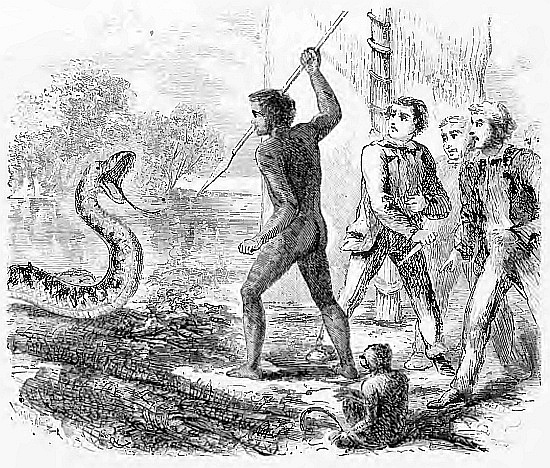
Chagrined at the failure of his stratagem, and dismayed by the threatening danger, the tapuyo retreated backwards. In his confusion he trod upon the still smouldering fire, his scorched feet scattering the fagots as he danced through them, while the serpent, once more in motion, came resolutely on.
His companions were now more frightened than ever, for they now saw that he was, like themselves, a prey to fear. For again had he become a believer in the Spirit of the Waters. As he stood poising his spear, it was with the air of a man not likely to use it with effect. The young Paraense, with his knife, was more likely to prove a protector. But what could either do to arrest the progress of such a powerful monster as that, which, with only two thirds of its length displayed, extended full twenty feet along the log? Some one of the party must become a victim, and who was to be the first?
The young Paraense seemed determined to take precedence, and, with the generous design of protecting his friends,—perhaps only little Rosa was in his thoughts,—he had thrown himself in front of the others, even the spearman standing behind him. It appeared that his time was come. He had not confidence that it was not. What could he do with a knife-blade against such an enemy? He stood there but to do his duty, and die.
And both would quickly have been accomplished,—the duty and the death,—but that the Omnipotent Hand that had preserved them through so many perils was still stretched over them, and in its own way extricated them from this new danger. To one unacquainted with the cause, it might have been a matter of surprise to see the reptile, hitherto determined upon making an attack, all at once turn away from its intended victims; and, without even showing its tail upon the log, retreat precipitately into the water, and swim off over the lagoa, as if the ceiba was something to be shunned beyond everything else that might be encountered in the Gapo!
Chapter Seventy Seven.
History of the Anaconda.
Though it may be a mystery to the reader why it had retreated, it was none to our adventurers, who had seen it crawl over the scattered fagots; they had heard the hissing, sputtering sound, as the live coals came in contact with its wet skin; they had witnessed its dismay and flight at a phenomenon so unexpected. They were therefore well aware that it was the scorching hot cinders that had caused the sucuruju to forsake the dead-wood in such a sudden and apparently mysterious manner.
It was some time before they were entirely relieved of their fears. Notwithstanding its precipitate retreat, they could not tell but that the anaconda might change its mind and come back again. They could see it swimming for some time in a tortuous track, its head and part of its neck erect above the water; then it took a direct course, as if determined upon leaving the lagoa. It was, therefore, with no ordinary feeling of relief that they saw it finally disappearing from view in the far distance.
The mystery of its presence upon the dead monguba was soon cleared up. The log was hollow inside, the heart-wood being entirely decayed and gone. In the cavity the serpent had perhaps sought a sleeping-place secure from intrusion during some protracted slumber that had succeeded the swallowing of a gigantic prey,—deer, paca, or capivain. Here it had lain for days,—perhaps weeks; and the log, carried away by the rising of the floods, had done nothing to disturb its repose. Its first intimation that there was any change in the situation of its sleeping-place was when the fire fell in through the burnt shell, and the hot cinders came in contact with its tail, causing it to come forth from its concealment, and make the observation that resulted in its attacking the intruders. The hollow that had contained the colony of tocandeiras was altogether a different affair. It was a cavity of a similar kind, but unconnected with that in the heart of the tree; and it was evident that the little insects and the great reptile, although dwelling in such close proximity,—under the same roof, it may be said,—were entirely unacquainted with each other.
When the serpent was quite out of sight, our adventurers once more recovered their spirits, and conversed gayly about the strange incident. The breeze, having freshened, carried their raft with considerable rapidity through the water, in the right direction, and they began to scan the horizon before them in the hope of seeing, if not land, at least the tree-tops ahead. These, however, did not show themselves on that day, and before the sun went down the forest behind them sank out of sight. The night overtook them, surrounded by a smooth surface of open water, spotless and apparently as limitless as the great ocean itself.
They did not “lay to,” as on the night before. The breeze continued favourable throughout the night; and, as they were also favoured with a clear sky, and had the stars to pilot them, they kept under sail till the morning. Before retiring to rest they had supped upon roast charqui and fish broiled over the coals; and, after supper, talk commenced, as usual, the chief topic being the anaconda. On this subject the tapuyo had much to say, for of all the animals that inhabit the water wilderness of the Amazon there is none that inspires the Indian with greater interest than the sucuruju. It is the theme of frequent discourse, and of scores of legends;—some real and true, while others have had their origin in the imagination of the ignorant aboriginal; some even having proceeded from the excited fancy of the colonists themselves, both Spanish and Portuguese, who could boast of a higher intelligence and better education.
The fanciful say that there are anacondas in the waters of the Amazon full thirty yards in length, and of a thickness equalling the dimensions of a horse! This has been stated repeatedly,—stated and believed in, not only by the ignorant Indian, but by his instructors, the monks of the missions. The only fanciful part of the statement is what regards the size, which must be merely an exaggeration. What is real and true is of itself sufficiently surprising. It is true that in the South American rivers there are anacondas, or “water-boas,” as they are sometimes called, over thirty feet in length and of proportionate thickness; that these monstrous creatures can swallow such quadrupeds as capivains, deer, and even large-sized animals of the horse and cattle kind; that they are not venomous, but kill their prey by constriction,—that is, by coiling themselves around it, and crushing it by a strong muscular pressure; and that, once gorged, they retire to some safe hiding-place,—of which there is no scarcity in the impenetrable forests of Amazonia,—go to sleep, and remain for a time in a sort of torpid condition. Hence they are much more rarely seen than those animals which require to be all the time on the alert for their daily food.
Of these great snakes of Tropical America there are several species; and these again are to be classified, according to their habits, into two groups markedly distinct,—the “boas,” properly so called, and the “water-boas,” or anacondas. The former are terrestrial in their mode of living, and are to be found upon the dry road; the latter, though not strictly living in the water or under it, are never met with except where it is abundant; that is to say, on the banks of rivers and lagoons, or in the submerged forests of the Gapo. They swim under water, or upon the surface, with equal facility; and they are also arboreal, their powers of constriction enabling them to make their way to the tops of the highest trees. It is these that are more properly called sucurujus,—a name belonging to the common language spoken upon the Amazon, a mixture of Portuguese with the ancient tongue of the Supinampas, known as the lingua geral. No doubt, also, it is from some unusually large specimen of sucuruju, seen occasionally by the Indian hunters and fishermen, that these simple people have been led into a belief in the existence of the wonderful Mai d’Agoa, or “Mother of the Waters.”
Chapter Seventy Eight.
A Snake “Yarn.”
Cheered by the thought that the breeze was bearing them in the right direction, our adventurers sat up till a late hour. When they at length resolved upon going to sleep, it was arranged that two should sit up,—one to mind the sail, the other to ply a paddle, and keep the craft steadily to her course, as well as could be done with such a rudder. The old sea-cook still had charge of the sheets and halyards, while Tipperary, notwithstanding that he had already proved himself such an indifferent helmsman, was intrusted with the steering.
After the many perils through which they had passed, and under the apprehension of the many more through which they might yet have to pass, Tom’s mismanagement,—the original cause of all their misfortunes,—if not forgotten, was not remembered against him with resentment. It had been only an error of judgment,—a fault of the head, and not of the heart.
Even the negro, whose race appears, almost by instinct, to inherit an antipathy to the countrymen of Tom, and who, previous to the catastrophe, was not always on the best of terms with the Irishman, no longer showed signs of spite: rather had the two become friends. Their friendship sprung from the ties of a common misfortune, and any little difference that now displayed itself was in a rivalry as to which should make himself most useful to the floating community.
On this particular night they sat together as white and black brothers; Mozey attending to the sipo that served for a sheet to the sail, and Tom steering the craft by a star that had been pointed out to him as that towards which he was to keep her head.
Both African and Irishman were not a little vain of being thus left to themselves. Up to that time both had been playing a very subordinate part; the Indian taking upon himself almost the sole management of affairs, and treating them as nobodies. From the night on which they had made their unfortunate mistake by straying into the Gapo, every movement had been made by his counsel and direction: moreover, both had suffered humiliation by his having saved their lives from drowning. Although they were not ungrateful for that, they were nevertheless chagrined to think that they should be so looked upon.
On this night, Munday, worn out by his long-continued exertions, was urged by Trevannion to desist, and recruit his energies by good repose. As there was no particular reason why he should remain awake, he had consented to do so; and, with his back against one of the buttresses, he reposed, silent as the Sphinx.
Neither the man of Mozambique, nor he of Tipperary, was given to habits of silence; and they continued to converse long after the others had sunk into slumber. After what had that day occurred, it was natural that the theme should be snakes. “Yez have got some in your counthry,—haven’t yer, Mozey?” inquired Tom.
“Dar you’se ’bout right, Masser Tum. Haven’t we got um! Snakes ob de biggest kind.”
“But none so big as the wun we saw the day?”
“Buf! you call dat a big snake. He not more den ten yard long. I’ve hab some on de coass of Africa, down dere by Mozabeek, dat measure more den a mile,—ticker round de body den dis ere log we sittin’ on.”
“More than a mile long!” rejoined Tipperary. “And thicker than this tree! Yez don’t mane to say ye iver saw wan ov that size yerself?”
“Well, I’s not say it war a whole mile. It mout be less, an’ it mout a been more dan a mile. Ob one ting I’s sartin shoo: it wa’n’t less den three quarters ob a mile. Youz may b’lieve um or not; jess as you pleeze ’bout dat, Massa Tipprary. All I’b got to say is, dat de snake I ’peak ’bout war long nuf to go clar roun’ de kraal, and twice roun’ too.”
“A kraal! what moight that be? I know what a kreel is. Miny’s the wan I’ve carried on me back, full ov turf at that, in the bogs of Tipperary. Yez don’t mane a kreel, div ye?”
“Kreel! no. I’m ’peakin’ ’bout de place we niggers live in,—village, you white folk call ’um.”
“A village! that is a town av people,—men, weemen, and childher.”
“Jess so. Da be men, woman, and chillen in de kraal,—sartin to be plenty of boaf de last,—an’ dar am dogs, and sheeps, and goats, and sometime big cattle. Dat’s zactly what we brack folks ob de African coass call de kraal. Some am bigger dan oders; but de one I ’peak ’bout, dat war surrounded by de snake, war a kraal ob de mod’rate size. It had ’bout a hundred houses, and, ob coorse, it contain zackly hundred families, excludin’ de piccaninnies.”
“A snake to extind round a hundherd houses! Whin was that?”
“When dis chile was a piccaninny hisself. If you like, Massa Tipprary, I tell you all ’bout it. Ye see, dat de kraal I ’peak ’bout war my native place, wha dis chile fust saw de shinin’ ob de sun. I ’pose I war ’bout ten year ole jess at dat time when de sacumstance ’curred ob which I go tell you. Near de village dar war a big foress. It wa’ filled with all sorts ob dangerous beasts. Da wa’ buffaloes and elephants, an’ de rhinoceros, an’ hipperpotamusses, an’ dar war big monkeys ob de baboon ’pecies. These lass war partickler dangerous, ’pecially to de women ob de place, for if any ob de nigga gals strayed too fur into de foress, den de baboons carried dem up into de tops ob de highest trees, an’ dere kep’ dem prisoner fo’ eber. But de wussest ting in dat wood war de snakes. Da war ob all sorts an’ sizes. Dere war de cobera, berry benemous, dat killed you wif him bite, an’ de spit snake dat fo’ pizen beat de cobera all holler, as it kud kill ye by jess spittin’ upon yer from among de branches ob a tree. An’ da war de whip-snake, dat lashed folks to deaph wif him tail; an’ de rock-boa dat twisted itself roun’ you body an’ crushed you to de jelly. But none ob dese kud hold a candle to de great big snake ob all,—de one I tell you ’bout. Munday, he call dat we see, de spirit ob de waters. Our big snake we nigga of Mozabeek call de debbil ob de woods. Nebba mind ’bout de name. He come one fine mornin’, dis debbil come, while de people ob de kraal war all ’sleep, dat is ’fore anybody get up to go ’bout dar bisness. He surroun’ the village twice.”
“You mane that he crawled twice round it?”
“Not a bit ob dat;—he may hab crawled twenty time roun’ it: nobody know. De people all ’sleep when he come. What dis chile mean is, dat when de people get out ob dar beads, an’ come to de door, de debbil ob de woods, he hab him body all roun’ de place in two great coil, one on top ob de odder, like de cable ’board ship,—de two makin’ a fence roun’ do kraal, more’n ten feet high.”
“Saint Pathrick prasarve us!”
“Ah, Masser Tom, I tink I hear you say dat de San Parfick you ’peak ’bout was a great snake-killer in yur country. I wish he had been in de island of Mozabeek on dat same mornin’. Pahps dis nigger might still hab a fadder an’ a modder. He loss dem boaf on de occasion we now ’peak ob. You see de snake, after enclosin’ de kraal twice roun’ wif him body, left enuf ob de neck to reach all ober de place; den stretchin’ out him mouf, dat war wide nuf to swaller a man ’ithout chewin’ him, he went from house to house, pickin’ out de people, till der want one lef’, neider man, woman, nor chile. He eat up de chief ob de kraal jess de same as de commonest scum ob de village. As fo’ de piccaninnies, he swallow dem eight or ten at a time, jess de same as we see de ant-eater do wif de ants. Boaf de men an’ de women an’ de chillen try to ’scape out ob de place. ’Twa’n’t no manner ob use. When dey tried to climb ober de body ob de snake, de ole debbil gub hisself a shake, an’ down dey slipped from him sides, as if him skin had been coated from de slush cask. Ob course da wa’ soon all destroyed.”
“But yerself, Mozey; how did yez manage to ’scape?”
“Ah, how! dat wor de bess joke ob de whole. As I’s been tellin’ you, I war at de time only a piccaninny, ’bout ten years ob de age. I war considered ’bove de common for dat age, an’ wa’ employed in de house ob de chief which war called de palace. Well, jess when I see dat great big mouf sarchin’ from place to place an’ swallerin’ up ebberybody, I know it wan’t no use to hide down dar among de houses. Now dar war a big pole dat stood righ’ in front ob de palace, wif a flag floatin’ on de top. When de odder folk war runnin’ about ebbery wha else, I climbed up de pole, an’ when I got to de top, I drawed de flag roun’ me, so as to hide de whole ob my body. When dat ’ere debbil ob de woods had finished off wif de oder people, and cleared out de kraal complete, he nebber thought ’bout lookin’ up de pole, or ’spectin’ whether tha wa’ anybody wrop up in de flag at de top. Dis chile kep’ up dar till he see de snake ’tretch out him long body, an’ go back to de big foress. Den I slip down from de tree, an’ make my way to de nearest place wha da war people. As boaf my fadder and modder had been eat up ’long wi’ de ress, I atterwards left home an’ tuk to de sea. Dat’s why dis nigger hab wandered all de way fom dat ’ere island ob Mozabeek. Buf! de snake we see here, de spirit ob de water, a’n’t no more to de debbil ob de woods dan a tadpole am to de biggest alligator in all de waters ob de Amazum.”
Chapter Seventy Nine.
Saint Patrick’s Performance.
Notwithstanding the serious air with which Mozey told his very improbable story, Tom did not appear to give implicit credence to it. He evidently suspected that the rogue had been cheating him; and, after several exclamations of wonder, but without betraying incredulity, he sat in silence, apparently cogitating some scheme for repaying him. It was not long before an opportunity offered, his companion unintentionally furnishing him with a cue.
“I’s hab heer, Massa Tum, dat dar am no snake in de country wha you come from. Dat ’ere de troof?”
“Yis. Nayther snake nor toad in owld Oireland,—nayther could live for a single hour, if ye plants them thare. The green island wudn’t contain thim bekase they’re condimned to die the moment they sit fut on the sod.”
“But what condemn dem?”
“Saint Pathrick, to be shure. Trath, thare’s a story about that. May be yez wud loike to be afther hearin’ it, Mozey?”
“Like um berry much, Massy Tum.”
“Will, thin, I’ll till it to yer. It isn’t such a wondherful story as yours; but it had a betther indin’, as yer’ll see when ye’ve heerd it. Instid av the snakes killin’ all the people exciptin’ wan, the riptiles got killed thimsilves, all but wan,—that was the father of ivry sirpint in the world. He’s livin’ yit, an’ must now be about five thousand years uv age. So the praste sez.
“A long toime ago, owld Oireland was very badly infisted wid thim craythers. They wur so thick all over the swate island, that yez cudn’t sit your fut down widout triddin’ on wan av their tails; an’ to kape out av their way the people had to build a great scaffoldin’ that extinded all over the counthry, and slape on the threes, just as we’ve been doin’ over the gyapo.
“Whiniver they wanted anythin’ to ate, such as purtaties, an’ the loike, they were compilled to git it up from the ground wid long forks; and whin they wur in need to dhrink, they had to dip it up in buckets, as if they were drawin’ it out av a well.
“Av coorse this was moighty inconvanient, an’ cudn’t last long no how. The worst ov it was, that the snakes, instid ov gettin’ thinned off, were ivery year growin’ thicker, by razin ov their large families ov young wuns. Will, it got so bad at last that ther’ wusn’t a spot av groun’ bigger than the bunch ov your hand that warn’t occupoyed by a snake, an’ in some places they were two deep. The people up on the platform that I towld yez about, they cursed an’ swore, an’ raged, an’ raved, an’ at last prayed to be delivered from the inimy.”
Here Tom paused to note the effect of his speech on his sable listener.
“But dey war delibbered,—wur dey?”
“Trath, wur they. If they hadn’t, is it at all loikely that yer wud see me here? Will, the people prayed. Not as your countrymen prays, to a stick or a stone, or beloike to the sarpints themselves, that could do them no benefit; but to a lady, that was able to protect them. We, in owld Oireland, call her the Virgin Mary. She was the mother av Him that came down from the siventh heaven to save us poor sinners. But what’s the use of my tryin’ to explain all that to an ignorant haythen, loike you?”
“No use, Massa Tum, no use,” rejoined the African, in a tone of resignation.
“Never moind, Mozey. The lady heerd their prayer, and that was an ind to it.”
“She killed da snakes!”
“Arrah now; did yez think the Virgin Mary—a raal lady as she was—ud be afther doin’ such dhirty work as slaughter a whole island full of venomous sarpents? Not a bit av that same. It’s true they were desthroyed; but not by her own swate hands. She sinds a man to do the work for her. She sint Sant Pathrick.”
“O, I’s heerd ye ’peak ob dat man, many’s de time, Massa Tum. ’Twur him dat kill de serpents, wur it?”
“Trath was it.”
“But how’d he do it? It muss hab take um a berry long time to destroy um all.”
“There ye are intirely asthray, nager. It only occupied him wan day, an’ not all the day nayther, for he had done the work a thrifle ov a hour or so afther dinner-time.”
“Gollys! how’d he do all dat?”
“Will! ye see, he invited all the snakes to a grand banquit. He had such a charmin’ way wid him that they wun an’ all agreed to come. The place was on the top of a high mountain,—called the Hill of Howth,—far hoigher than any in the Andays we saw when crossin’ thare. The faste he had provided for them was a colliction of toads, includin’ every wun ov thim that inhabited the island. The toads he had invited too; an’ the stupid craythers, not suspictin’ anythin’, come willingly to the place.
“Now yez must undherstand, nager, that the snakes are moighty fond of toads, and frogs too; but Saint Pathrick had no ill-will against the frogs, an’ they wur exchused from comin’. As it was, the toads wur axed at an earlier hour than the snakes, an’ got first to the top of the hill; an’ while they were waitin’ there to see what was to be done, the sarpints came glidin’ up, and bein’ tould that their dinner was spread before them, they fell to, an’ swallowed up every toad upon the hill, which was every wun there was in all Oireland.”
The narrator made a long pause, either to draw breath after such a declamation, or to give time for his companion to indulge his astonishment.
“Gora!” exclaimed the latter, impatient for further explanation. “How ’bout de snakes demselves? Surely dey didn’t swallow one anodder?”
“Trath! an’ that’s jest what they did do,—every mother’s son of thim.”
“But dat ’ere doan’ ’tan’ to reezun, unless dey hab a fight one wif de odder? Splain yourself, Massa Tum.”
“Will, yez have guessed it exactly widout my sayin’ a word. They did have a foight, that went all roun’ through the whole crowd, like a shindy in Donnybrook fair. Yez would loike to hear how it begun. Will, I’ll tell ye. There was two kinds av the riptile. Wan they called ‘Ribbon snakes,’ an’ the tother ‘Orange snakes,’ by razon av their colour, both in politics and religion. They had a king over both that lived moighty foine at their expinse. But he couldn’t manage to keep thim continted with payin’ him taxes, unless by sittin’ the wan agaynst the tother. An’ this he did to the full av his satisfacshin. Now the bad blood that was betwane thim showed itself at that great gatherin’ worse than iver it had done afore. Thare wasn’t toads enough to give them all a full male; and by way of dissart they thought they’d turn to an’ ate wun another. Av course that was just what Sant Pathrick wanted; for he wasn’t plazed at their having two sorts of religion. So the ould praste hugged thim on in the quarrel, till it come to blows, an’ inded in both kinds killin’ an’ atin’ wun another till there was nothing lift av ayther exceptin’ the tails.”
“Golly! what becomed of de tails?”
“O, thim? The people jumped down from the scaffolds and gathered thim up into a hape, and thin made a great bonfire av thim, and aftherwardt spred the ashes over the groun’; and that’s what makes ould Oireland the greenest gim av the oshin.”
“But, Massa Tum, you hab say dat one ob de snakes ’scape from the genr’l congregation?”
“Trath did I say it. Wun did escape, an’ ’s livin’ to make mischief in ould Oireland to this very day.”
“Which one was he?”
“Their king.”
“De king. How you call um, Massa Tipprary?”
“The Divvel.”
Chapter Eighty.
Lights Ahead.
The expression of incredulity had now floated from the countenance of the Irishman to that of the African, who in turn suspected himself imposed upon. The leer in Tom’s eye plainly declared that he considered himself “quits” with his companion; and the two remained for some moments without further exchange of speech. When the conversation was resumed, it related to a theme altogether different. It was no longer on the subject of snakes, but stars.
The pilot perceived that the one hitherto guiding him was going out of sight,—not by sinking below the horizon, but because the sky was becoming overcast by thick clouds. In ten minutes more there was not a star visible; and, so far as direction went, the helm might as well have been abandoned. Tom, however, stuck to his paddle, for the purpose of steadying the craft; and the breeze, as before, carried them on in a direct course. In about an hour after, this gave token of forsaking them; and, at a still later period, the log lay becalmed upon the bosom of the lagoa.
What, next? Should they awake the others and communicate the unpleasant intelligence? Tom was of opinion that they should, while the negro thought it would be of no use. “Better let dem lie ’till,” argued he, “and hab a good night ress. Can do no good wake um up. De ole craff muss lay to all de same, till dar come anodder whif ob de wind!”
While they were disputing the points, or rather after they had done disputing, and each held his tongue, a sound reached their ears that at once attracted the attention of both. It was rather a chorus of sounds, not uttered at intervals, but continued all the time they were listening. It bore some resemblance to a distant waterfall; but now and then, mingling with the hoarser roaring of the torrent, were voices as of birds, beasts, and reptiles. None of them were very distinct. They appeared to come from some point at a great distance off. Still, they were loud enough to be distinguished, as sounds that could not proceed out of the now tranquil bosom of the lagoa.
Perhaps they might sooner have attracted the notice of the two men, but for the sighing of the breeze against the sail, and the rippling of the water as it rushed along the sides of the ceiba. When these sounds had ceased, the conversation that ensued produced the same effect; and it was only after the dispute came to a close that the disputants were made aware that something besides their own voices was disturbing the tranquillity of the night.
“What is it, I wondher?” was the remark of Tipperary Tom. “Can yez tell, Mozey?”
“It hab berry much de soun’ ob a big forress!”
“The sound av a forest? What div yez mane by that?”
“Wha’ shud I mean, but de voices ob de animal dat lib in de forress. De birds an’ de beast, an’ de tree frogs, an’ dem ’ere crickets dat chirps ’mong de trees. Dat’s what dis nigger mean.”
“I b’lieve ye’re right, nager. It’s just that same. It can’t be the wather, for that’s did calm; an’ it can’t purceed from the sky, for it don’t come in that direction. In trath it’s from the forest, as ye say.”
“In dat case, den, we muss be near de odder side ob de lagoa, as de Indyun call um,—jess wha we want to go.”
“Sowl, thin, that’s good news! Will we wake up the masther an’ till him av it? What do yez think?”
“Dis nigga tink better not. Let um all sleep till de broke ob day. Dat can’t be far off by dis time. I hab an idee dat I see de furs light ob mornin’ jess showin’ out yonner, at de bottom ob de sky. Gora! what’s yon? Dar, dar! ’trait afore de head. By golly! dar’s a fire out yonner, or someting dat hab de shine ob one. Doan ye see it, Massa Tum?”
“Trath, yis; I do see somethin’ shinin’. It a’n’t them fire-flies, div yez think?”
“No! ’ta’n’t de fire-fly. Dem ere flits about. Yon ting am steady, an’ keeps in de same place.”
“There’s a raal fire yandher, or else it’s the willy-wisp. See! be me troth thare’s two av thim. Div yez see two?”
“Dar am two.”
“That can’t be the willy-wisp. He’s niver seen in couples,—at laste, niver in the bogs av Oireland. What can it be?”
“What can which be?” asked Trevannion, who, at this moment awaking, heard the question put by Tom to the negro.
“Och, look yandher! Don’t yez see a fire?”
“Certainly; I see something very like one,—or rather two of them.”
“Yis, yis; there’s two. Mozey and meself have just discovered thim.”
“And what does Mozey think they are?”
“Trath, he’s perplixed the same as meself. We can’t make hid or tail av thim. If there had been but wan, I’d a sayed it was a willy-wisp.”
“Will-o’-the-wisp! No, it can scarce be that,—the two being together. Ah! I hear sounds.”
“Yes, masther, we’ve heerd thim long ago.”
“Why didn’t you awake us? We must have drifted nearly across the lagoa. Those sounds, I should say, come out of the forest, and that, whatever it is, must be among the trees. Munday! Munday!”
“Hola!” answered the Indian, as he started up from his squatting attitude: “what is it, patron? Anything gone wrong?”
“No: on the contrary, we appear to have got very near to the other side of the lagoa.”
“Yes, yes!” interrupted the Indian as soon as the forest noises fell upon his ear; “that humming you hear must come thence. Pa terra! lights among the trees!”
“Yes, we have just discovered them. What can they be?”
“Fires,” answered the Indian.
“You think it is not fire-flies?”
“No; the loengos do not show that way. They are real fires. There must be people there.”
“Then there is land, and we have at last reached terra firma.”
“The Lord be praised for that,” reverently exclaimed the Irishman. “Our throubles will soon be over.”
“May be not, may be not,” answered the Mundurucú, in a voice that betrayed both doubt and apprehension.
“Why not, Munday?” asked Trevannion. “If it be fires we see, surely they are on the shore; and kindled by men. There should be some settlement where we can obtain assistance?”
“Ah, patron! nothing of all that need follow from their being fires; only that there must be men. The fires need only be on the shore, and as for the men who made them, instead of showing hospitality, just as like they make take a fancy to eat us.”
“Eat us! you mean that they may be cannibals?”
“Just so, patron. Likely as not. It’s good luck,” pursued the tapuyo, looking around, “the wind went down, else we might have been carried too close. I must swim towards yon lights, and see what they are, before we go any nearer. Will you go with me, young master?”
“O, certainly!” replied Richard, to whom the question was addressed.
“Well, then,” continued the tapuyo, speaking to the others, “you must not make any loud noise while we are gone. We are not so very distant from those fires,—a mile or thereabout; and the water carries the sound a long ways. If it be enemies, and they should hear us, there would be no chance of escaping from them. Come, young master, there’s not a minute to spare. It must be very near morning. If we discover danger, we shall have but little time to got out of its way in the darkness; and that would be our only hope. Come! follow me!”
As the Indian ceased speaking, he slipped gently down into the water, and swam off to the two lights whose gleam appeared every moment more conspicuous.
“Don’t be afraid, Rosetta,” said Richard, as he parted from his cousin. “I warrant it’ll turn out to be some plantation on the bank, with a house with lights shining through the windows, and white people inside, where we’ll all be kindly received, and get a new craft to carry us down to Pará. Good by for the present! We’ll soon be back again with good news.”
So saying, he leaped into the water and swam off in the wake of the tapuyo.
Chapter Eighty One.
An Aerial Village.
The swimmers had not made many hundred yards when they saw beyond doubt that the forest was not far off. It was even nearer than they had at first imagined, the darkness having deceived them; and perhaps the log may have drifted nearer while they were under the impression that they lay becalmed.
At all events, they were now scarcely a quarter of a mile from the forest, which they knew stretched along the horizon as far as they could have seen had it been daylight. They could only just distinguish a dark belt or line rising above the surface of the water before them; but that this extended right and left to a far distance could be told from the sounds that came from it. There was the hum of tree-crickets and cicadas, the gluck of toads and frogs, the screams of aquatic birds, the hooting of owls, and the strange plaintive calls of the goat-suckers, of which several species inhabit the Gapo forests; the whip-poor-will and the “willy-come-go” all the night long giving utterance to their monotonous melody. Harsher still were the cries proceeding from the throats of howling monkeys, with now and then the melancholy moaning of the aï, as it moved slowly through the branches of the embaüba (cecropia-tree). All these sounds, and a score of other kinds,—some produced by insects and reptiles of unknown species,—were blended in that great choir of nature which fills the tropical forest with its midnight music.
The two swimmers, however, paid no attention to this fact; their whole thoughts being occupied by the lights, that, as they advanced, grew every moment more conspicuous. There was no longer any doubt about these being the blaze of fires. It was simply a question of where the fires were burning, and who had kindled them.
The young Paraense supposed them to be upon the shore of the lagoa. About this, however, his companion expressed a doubt. They did not seem to burn steadily, their discs appearing now larger and now less. Sometimes one would go out altogether, then blaze up afresh, while another was as suddenly extinguished. The younger of the two swimmers expressed astonishment at this intermittence, which his companion easily explained. The fires, he said, were placed at some distance from the edge of the forest, among the trees, and it was by some tree-trunk now and then intervening that the illusion was caused.
Silently the swimmers approached, and in due time they glided in under the shadow of the thick foliage, and saw the fires more distinctly. To the astonishment of Richard—for the tapuyo did not seem at all astonished—they did not appear to be on the ground, but up in the air! The Paraense at first supposed them to have been kindled upon the top of some eminence; but, on scanning them more closely, he saw that this could not be the case. Their gleaming red light fell upon water shining beneath, over which, it was clear, they were in some way suspended.
As their eyes became accustomed to the glare, the swimmers could make out that the fires were upon a sort of scaffold raised several feet above the water, and supported by the trunks of the trees. Other similar scaffolds could be seen, on which no fires had been kindled,—from the fact, no doubt, that their occupants were not yet astir.
By the blaze human figures were moving to and fro, and others were on the platforms near by, which were more dimly illuminated; some entering, some coming forth from “toldos,” or sheds, that stood upon them. Hammocks could be seen suspended from free to tree, some empty, and some still holding a sleeper.
All this was seen at a single glance, while at the same time were heard voices, that had been hitherto drowned by the forest choir, but could now be distinguished as the voices of men, women, and children,—such as might be heard in some rural hamlet, whose inhabitants were about bestirring themselves for their daily avocations.
The tapuyo, gliding close up to the Paraense, whispered in his ear, “A malocca!”
“An Indian village!” Richard rejoined. “We’ve reached tierra firme, then?”
“Not a bit of it, young master. If the dry land had been near, those fires wouldn’t be burning among the tree-tops.”
“At all events, we are fortunate in falling in with this curious malocca, suspended between heaven and earth. Are we not so?”
“That depends on who they are that inhabit it. It may be that we’ve chanced upon a tribe of cannibals.”
“Cannibals! Do you think there are such in the Gapo?”
“There are savages in the Gapo who would torture before killing,—you, more especially, whose skins are white, remember, with bitterness, what first drove them to make their home in the midst of the water-forests,—the white slave-hunters. They have reason to remember it; for the cruel chase is still kept up. If this be a malocca of Muras, the sooner we get away, the safer. They would show you whites no mercy, and less than mercy to me, a red man like themselves. We Mundurucús are their deadliest enemies. Now, you lie still, and listen. Let me hear what they are saying. I know the Mura tongue. If I can catch a word it will be sufficient. Hush!”
Not long had they been listening, when the Indian started, an expression of anxiety suddenly overspreading his features, as his companion could perceive by the faint light of the distant fires.
“As I expected,” said he, “they are Muras. We must be gone, without a moment’s loss of time. It will be as much as we can do to paddle the log out of sight before day breaks. If we don’t succeed in doing so, we are all lost. Once seen, their canoes would be too quick for us. Back, back to the monguba!”
Chapter Eighty Two.
A Slow Retreat: in the Arcade.
Their report spread consternation among the crew. Trevannion, incredulous of the existence of such bloodthirsty savages as Munday represented the Muras to be, was disposed to treat it as an exaggeration. The young Paraense, who, when in his father’s house, had met many of the up-river traders, and heard them conversing on this very theme, was able to endorse what the Mundurucú said. It was well-known to the traders that there were tribes of wild Indians inhabiting the Gapo lands, who during the season of the inundation made their home among the tree-tops,—that some of these were cannibals, and all of them savages of a most ferocious type, with whom an encounter in their native wilds, by any party not strong enough to resist them, might prove both dangerous and deadly.
There was no time to argue; and without further opposition the ex-miner himself sprang to one of the paddles, the tapuyo taking the other. They had no idea of going back across the lagoa. To have proceeded in that direction would have been to court discovery. With such slow progress as theirs, a mile would be about all they could make before daybreak; and, out on the open water, their craft would be distinguishable at three times that distance. The course counselled by the tapuyo was to keep at first parallel to the line of the trees; and then enter among these as soon as the dawn began.
As the party retreated, not two, but ten fires were seen gleaming among the trees, filling the forest with their bright coruscation. The tapuyo explained that each new light denoted the uprising of a fresh family, until the whole malocca was astir. The fires were kindled to cook the breakfast of the Indians. Notwithstanding this domestic design, our adventurers looked back upon them with feelings of apprehension; for they were not without fears that, roasted over those very fires, they might furnish the savages with the material for a cannibal repast!
To all appearance never did the ceiba go slower,—never lie so dull upon the water. Despite the vigorous straining of strong arms, it scarcely seemed to move. The sail was of no service, as there was not a breath of air, but was rather an obstruction; and, seeing this, Mozey let loose the halyards and gently lowered it.
They had hardly made half a mile from the point of starting, when they saw the dawn just appearing above the tops of the trees. They were upon the equator itself, where between dawn and daylight there is but a short interval of time. Knowing this, the craft was turned half round, and pulled towards a place of concealment. As they moved on to make it, they could see the sunlight stealing over the surface of the water, and the fires becoming paler at its approach. In ten minutes more, daylight would be upon them!
It was now a struggle against time,—a trial of speed between the ceiba and the sun,—both slowly approaching a critical point in their course. Trevannion and the tapuyo plied the paddles as men rowing for their lives and the lives of others dear to them. They almost felt as if the sun favoured them; for he not only seemed to suspend his rising, but to sink back in his course. Perhaps it was only the shadow of the trees, under which they had now entered. At all events, they were in the midst of obscurity, propelling the dead-wood into the embouchure of an igarápe, overshadowed with drooping trees, that, like a dark cavern, promised them a hiding-place.
At the moment of entering, it was so dark they could not tell how far the opening extended. In this uncertainty they suspended the stroke of their paddles, and suffered the ceiba to come to a standstill. As yet they had no other light than that afforded by the fire-flies that flitted under about the trees. But these were of the large species, known as Cocuyos (Elater noctilucus), one of which, when held over the page of a printed book, enables a person to read; and as there were many of them wandering about, their united sparkle enabled our adventurers to make out that the creek was of very limited extent.
Gradually, as the sun rose higher, his light fell gently glimmering through the leaves, and showed that the arcade was a cul de sac, extending only about a hundred yards into the labyrinth of branches and parasitical plants. They had entered, so to speak, a court through which there was no thoroughfare; and there they must remain. They could only get out of it by taking to the tree-tops, or else by returning to the open lagoa. But they had had enough of travelling through the tree-tops, while to abandon the craft that had carried them so comfortably, and that might still avail them, was not to be thought of.
As to returning to the open water, that would be like delivering themselves into the very jaws of the danger they were desirous to avoid; for, once seen by the savages, there would not be the slightest chance of escape. They were provided with canoes moored among the tree-trunks that formed the supports of their aerial habitations. Clumsy structures enough; but, no matter how clumsy or slow, they were swifter than the dead-wood; and in the event of a chase the latter would be easily overhauled and captured. Only one course offered any prospect of safety,—to remain all day in the arcade, trusting that none of the savages might have any business near the place. At night they could steal out again, and by an industrious use of their paddles put a safer distance between themselves and the dangerous denizens of the malocca.
Having determined on this, they drew their craft into the darkest corner, and, making it fast to a tree, prepared to pass the time in the pleasantest possible manner.
There was not much pleasure sitting in that silent, sombre shadow; especially as they were in dread that its silence might be disturbed by the wild shout of a savage. They had taken every precaution to escape discovery. The little fire left burning upon the log had been extinguished by Munday, immediately on seeing the two lights first described. They would fain have rekindled it, to cook a breakfast; but fearing that the smoke might be seen, they chose that morning to eat the charqui raw.
After breakfast they could do nothing but keep their seats, and await, with such patience as they might command, the development of events. It was not all darkness around them. As the little creek penetrated the trees in a straight line, they commanded a view of a portion of the lagoa. Their situation was very similar to that of a person inside a grotto or cavern on the sea-shore, which commands a view of the ocean stretching away from its mouth, the bright space gradually widening as it recedes in the distance. Though themselves seated in the midst of obscurity, they could see brightness beyond the opening of the bay,—the sun shining with a golden gleam upon the water.
On this their eyes were kept,—not in the hope of seeing anything there that might give them gratification, but rather desiring that nothing should be seen. Notwithstanding the obscurity that surrounded them, they could not divest themselves of the idea that one passing the entrance of the creek could see them distinctly enough; and this kept them in constant apprehension.
They had no need to keep watch in any other direction. Behind them, and on each side, extended the unbroken wall of tree-tops, shaded with llianas, worked and woven together into a network that appeared impenetrable even to the wild animals of the forest. Who would have looked for an enemy in human shape to come that way?
Up to noon no incident occurred to disturb the tranquillity of the place or in any way add to their apprehensions. Now and then a bird appeared, winging its way over the bright band illumined by the sun, or poising itself for a moment and then plunging downward upon some prey it had detected in the water. All these appearances only increased their confidence; as the presence of the birds, undisturbed at their ordinary avocations, indicated the absence of human beings.
The same conclusion was drawn from the behaviour of a brace of large fish-cows, at some distance outside, directly in front of the arcade. When first noticed, they were engaged in some sort of rude gambol, at which they continued for a full half-hour. After that, one of them swam off, while the other, laying itself along the water, appeared to go to sleep.
It was a tantalising sight to the eyes of the old tapuyo; and it was just as much as he could do to restrain himself from swimming out and attacking the sleeper, either with his knife or the pashuba spear. The danger, however, would have been too great, not from a conflict with the cow, but of being seen by the sharp-eyed savages.
In view of this, the Mundurucú resisted the temptation, and consented, though not without reluctance, to let the peixe-boi continue its slumbers uninterrupted.
Chapter Eighty Three.
Following the Float.
Unfortunately for our adventurers, as well as for the cow-fish itself, other eyes than those of the tapuyo had been watching the gambols of the two cetaceans, and had paid particular attention to the one now taking its siesta on the surface. Neither Munday nor his companions had any suspicion of this; for, excepting the peixe-boi itself, no living creature was in sight. Having observed it for a considerable length of time, still reclining in its attitude of repose, they had almost ceased to think of it; when all at once it was seen to spring clear out of the water, and, after making two or three grotesque plunges, sink suddenly below the surface!
The action was too violent and unnatural to be voluntary. The peixe-boi had evidently been assailed in its sleep by some enemy, from which it was but too eager to retreat.
But what could this enemy be? The tapuyo knew of nothing under the water that was likely to have made the attack. There are no sharks nor swordfish in the Gapo, and an alligator would scarcely dare to meddle with a creature of such enormous dimensions. Much less could an enemy have come from the air. There is no bird in South America, not even the great condor itself, that would think of swooping down upon a peixe-boi.
Some of the party said that they had seen something glancing towards the cow-fish at the moment it made the leap,—something that looked like a flash of lightning! What could that be? There was no cloud in the sky, no thunder. It could not have been lightning.
“Pa terra!” exclaimed the tapuyo, in evident alarm. “I know what it was. Keep quiet or we are lost!”
“What was it?”
“A harpoon,—look yonder, patron! Don’t you see the water in motion where the juarouá went down?”
“Certainly I do. That’s very natural. The waves are caused by the plunging of the animal.”
“The waves! not that; look again. You see a thin ripple. There’s a cord making it. Yonder’s the float! and close behind that you will see something more. There, there he is!”
Sure enough, there was a rippling line caused by a cord drawn rapidly along the surface; at the end of this a small buoy of wood dragged rapidly after, and close behind a canoe, with an Indian in it, the Indian in a bent attitude, plying his paddle, and evidently in pursuit of the wounded cow-fish. The log was a “float,” the line drawing it along was at its other end attached to a harpoon, and that harpoon had its barbs buried in the body of the peixe-boi!
Such a specimen of a human being, even for a savage, none of the spectators—the tapuyo perhaps excepted—had ever beheld. He was as naked as if he had never been outside the Garden of Eden; and this very nakedness displayed a form that, but for the absence of a hairy covering, more resembled that of a monkey than a man. A body extremely attenuated, yet pot-bellied, too; a pair of long, thin arms, with legs to match, the latter knotted at the knees, the former balled at the elbows; a huge head, seemingly larger from its mop of matted hair; a face with high cheeks and sunken eyes,—gave him an appearance more demoniac than human. No wonder that little Rosa screamed as he came in sight, and that dismay exhibited itself on the features of several others of the party.
“Hush!” whispered Munday. “Silence all! Not a word, or we shall be seen, and then not he, but perhaps a hundred of his tribe—Hush!”
Fortunately the scream of Rosita had been only slight; and the savage, in eager pursuit of the peixe-boi, had not heard it, for he continued the chase without pause.
He had no difficulty in discovering the whereabouts of his game. The float guided him; for, no matter where the cow went, the tether was still attached to her, and the movement of the log along the surface betrayed to the eye of her pursuer every change of direction.
Two or three times, the savage, dropping his paddle, was enabled to lay hold of the line and commence hauling in; but the great strength of the juarouá, as yet unexhausted, proved too much for him, and he was compelled to let go or be pulled out of his craft.
The latter was but a frail concern, of the smallest and rudest kind,—consisting of a shell of bark, gathered up at both ends and tied by sipos, so as to give it somewhat the shape of an ordinary canoe. Even when paddling with all his strength, its owner could make no great speed; but great speed was not required in the chase of a peixe-boi with a barbed spear sticking through its skin and rankling between its ribs. It only required patience, until the huge creature should become exhausted with its struggles and enfeebled by the loss of blood. Then might the conquest be completed without either difficulty or danger.
For twenty minutes or more the chase continued; the float being dragged hither and thither, until it had crossed the water in almost every direction. Sometimes both log and canoe were in sight, sometimes only one of them, and sometimes neither,—at such times the cow-fish having passed far beyond the limits of clear water visible to the spectators.
On the last of these occasions, several minutes had elapsed before the chase came again in sight. Our adventurers were in hopes they would see no more of either fish, float, or follower. The interest they might otherwise have taken in such a curious spectacle was destroyed by the thought of the danger that would result in their being discovered.
Just as they had begun to congratulate themselves that they were to be spared this misfortune, the float once more came before their eyes, still being dragged along the surface, but with much less rapidity than when last seen. The manatee was coming into the arcade, the canoe following close after, with the hideous savage eagerly plying his paddle, while, with outstretched neck and wild, scintillating orbs, he peered inquiringly into the darkness before him!
There was no chance to escape discovery.
Chapter Eighty Four.
A Cannibal Captured.
The fears of those standing upon the ceiba could not have been greater than that of the savage himself, as his canoe came bumping against the dead-wood, and he saw standing above him a crowd of human forms. A wild cry escaping from his lips expressed his terror and astonishment. Then a second, in louder tone, was intended to give the alarm to his kindred, who might possibly hear it.
With an Indian, as with the wild animals, presence of mind is rather an instinct than an act of reason. Instead of being disconcerted by what he saw, and losing time to recover himself, the Mura at once plunged his paddle into the water, and commenced beating backward, assisted by the recoil of the canoe, which, on striking the dead-wood, had rebounded from it by the violence of the collision.
In a moment he had sculled himself almost clear of the arcade; he was already within a few feet of its mouth, and would soon be back upon the open lagoa, when he would undoubtedly make for the malocca, and bring the whole tribe of cannibals upon them. None of the party thought of pursuing him. There was an attempt made to seize the canoe at the moment of its closing upon the log, but the craft had recoiled so suddenly after the collision, and been paddled so rapidly out of reach, that it all ended in Tipperary Tom getting soused in the water, and nearly drowned before he could be dragged out again. The attempt at seizure might have had a different result had Munday been among those who made it. But he was not.
He was nowhere to be seen upon the log, nor anywhere else! What had become of him? None of them could say. Little Rosa was the only one who could give any explanation of his absence. She thought she had seen him slip off at the back of the log, while the canoe was coming on in front. She was not sure, it was so dark upon that side; and she had been too much engaged in regarding the approach of the savage.
Had he made off to conceal himself among the tree-tops? Had he gone to secure his own safety, and abandoned his friends to their fate? They could not think this. Such a cowardly act would have been contrary to all they knew of the brave Mundurucú, whose faithfulness had so many times been put to the severest test. No one could account for it.
Just at that critical moment when the canoe had reached the mouth of the arcade, a dark round thing, like a human head, rose up in the water some six feet before it, and then another dark thing, wonderfully like a human hand, shot up beside the head, followed by a long and sinewy arm. The hand was seen to strike upward and clutch the canoe close by the stem; and then the craft went down, one end under water, while the other flew up into the air; then there was a capsize,—the savage, with a shriek and a loud plash, falling out; and then there was a struggle,—now under water, now above the surface,—accompanied by strange choking noises, as if two enormous alligators were engaged in a conflict of life and death.
As the astonished spectators continued to gaze upon the scene,—still but imperfectly comprehended by them,—they saw that the combatants were coming nearer, as if the struggle was being carried on towards the end of the arcade, and was likely to terminate where they stood.
And there it did end, immediately after, by the missing tapuyo making his appearance alongside the log, and dragging beside him the man who had made that involuntary “header” from the canoe.
The latter no longer resisted. The knife-blade glittering between Munday’s teeth—a taste of whose quality the savage had already experienced—hindered him from offering any further resistance; and as they came up to the log, the two were swimming side by side peaceably, only that the action of one was evidently involuntary, while the other was directing it.
It was more like the companionship of a policeman and a thief, than that of two swimmers who chanced to be going the same way. One arm of the Mura was clutched by the Mundurucú, as if the captive was partly supported while being dragged along.
“Reach out there, patron, and pull him up!” cried Munday, as he conducted his captive alongside the log. “I don’t want to kill the animal, though that might be the safest way in the end.”
“No, no, don’t do that!” returned Trevannion, who now, along with all the others, had arrived at a full comprehension of the affair. “We can keep him secure enough; and, if his shouts have not been heard, we need not fear having him along with us.” As the patron spoke, he reached down, and, laying hold of the captive, drew him close to the side of the dead-wood. Then, assisted by Munday in the water and Mozey upon the log, the Mura was hoisted aboard.
Once upon the dead-wood, a more abject wretch than the captive Mura could not have been found. He trembled from head to foot,—evidently believing that he was about to be killed, and perhaps eaten. He had only consented to be taken in the knowledge—which Munday had in some way conveyed to him—that resistance could but end in instant death; and there are few, even amongst the most reckless of savages, who will not yield to this.
As he stood dripping upon the dead-wood, a red stream, trickling down his wet skin from a knife-wound in the shoulder, explained how the tapuyo had made known to him the idleness of resistance. It was a first stab, and not dangerous; but it had given a foretaste of what was to follow, had the struggle been kept up. After receiving this hint, the Mura had surrendered; and the after commotion was caused by his being towed through the water by a captor who was required to use all his strength and energy in supporting him.
While the canoe-man was advancing up the arcade, the Mundurucú, instead of waiting till he came near, had dropped quietly into the water, and swum in an outward direction, as if intending to meet the manatee-hunter, face to face. This he actually did,—met and passed him, but without being seen. The darkness favoured him, as did also the commotion already caused by the wounded cow-fish, which in its passage up the creek had left large waves upon the water. These, striking against the trunks of the trees, created a still further disturbance, amidst which the swimmer’s dark face and long swarthy locks could not have been easily distinguished.
Supporting himself by a branch, he awaited the return of the savage,—knowing that as soon as the latter set eyes upon the others he would instantly beat a retreat. All turned out just as the tapuyo had anticipated; and just as he had designed did he deal with the canoe-man.
In all this, the only thing that appeared singular was the tapuyo’s taking so much pains to go out near the entrance, instead of boldly laying hold of the canoe as it passed him on its way inwards, or indeed of waiting for it upon the log,—where any one of the others, had he been a strong swimmer and armed with a knife, might have effected the capture.
Munday, however, had good reasons for acting as he had done. While the canoe was approaching, who could tell that it would come close up? It had done so, even to striking the dead-wood with its bow; but Munday could not rely upon such a chance as that. Had the savage discovered their presence a little sooner, he would have turned and sculled off, before any swimmer could have come up with him.
A similar reason was given for gliding stealthily past, and getting on the other side. Had the Mundurucú acted otherwise, he might have been perceived before he could seize the canoe, and so give time for the manatee-hunter to make off. As this last would have been a terrible contingency, rendering their discovery almost a certainty, the cunning old man knew how important it was that no mismanagement should occur in the carrying out of his design.
“If that rascal’s shout has been heard,” said Trevannion, “there will be but little chance of our escaping capture. From what you saw, I suppose there are hundreds of these hideous creatures. And we, without weapons, without the means either of attack or defence, what could we do? There would be nothing for it but to surrender ourselves as prisoners.”
The Mundurucú was not able to offer a word of encouragement. To have attempted defence against a whole tribe of savages, armed, no doubt, with spears and poisoned arrows, would have been to rush madly on death.
“It is fortunate,” continued the ex-miner, “that you have not killed him.”
“Why, patron?” demanded the tapuyo, apparently in some surprise.
“It would have made them revengeful; and if we have the ill-luck to be taken, they would have been the more certain to destroy us.”
“No, no,” answered the Indian,—“not a bit more certain to do that. If, as you say, we have the bad luck to become their captives, we shall be killed all the same. Their old revenge will be strong enough for that; and if not their revenge, they have an appetite that will insure our destruction. You understand, patron?”
This conversation was carried on in a low tone, and only between Trevannion and the tapuyo.
“O Heaven!” groaned the ex-miner, turning his eyes upon his children. “It would be a fearful fate for—for all of us.”
“The more reason for doing all we can to avoid falling into their hands.”
“But what can we do? Nothing! If they discover our hiding-place before nightfall, then we shall surely be taken.”
“Admit that, master; but if they do not—”
“If they do not, you think there would be some hope of our getting away from them?”
“A good hope,—a good hope.”
“On the raft?”
“Better than that, patron.”
“You have some plan?”
“I’ve been thinking of one; but it’s no use to speak of it, so long as we are in doubt this way. If we are left unmolested until night, then, patron, it will be time to declare it. Could you but promise me that this screecher hasn’t been heard, I think I could promise you that by midnight we should not only be beyond the reach of his bloodthirsty fellows, but in a fair way of getting out of our troubles altogether. Ha! yonder’s something must be looked to; I forgot that.”
“What?”
“The igarité. How near it was to betraying us! Its course must be stopped this instant.” And he once more slipped down into the water and swam away.
The canoe, out of which the Mura had been so unceremoniously spilled, and which was now bottom upwards, was drifting outward. It was already within a few feet of the entrance, and in another minute would have been caught by the breeze stirring beyond the branches of the trees. Once outside, it would soon have made way into the open lagoa, and would have formed a conspicuous mark for the eyes of the malocca.
Munday swam silently, but with all his strength, towards it. It must be reached before it could drift outside; and for some time there was apprehension in the minds of the spectators that this might not be done. The only one of them that would have been gratified by a failure was the captive Mura. But the wretch showed no sign of his desire, knowing that there would be danger in his doing so. He was held fast in the strong arms of the negro; while Tipperary Tom stood near, ready to run him through with the spear in case of his making any attempt to escape.
Their apprehensions soon came to an end. The tapuyo overtook it before it had cleared the screening of tree-tops; and, laying hold of a piece of cord which was attached to its stem, took it in tow. In less than five minutes after, it might have been seen right side up, lying like a tender alongside the grand monguba.
Chapter Eighty Five.
A Day Spent in Shadow.
All day long did our adventurers abide in silence, keeping close in their shadowy retreat. Now and then only the Mundurucú swam to the entrance of the arcade; and, screened by the trees, took a survey of the open water outside. He saw only a canoe, larger than that he had captured, with three men in it, out upon the lagoa, about two hundred yards from the edge, and opposite the malocca, which could not itself be seen, as it was some distance back among the trees; but, from the bearings he had taken on the night previous, the tapuyo knew where it lay.
He watched the canoe so long as it remained in sight. The gestures of the savages who were in it showed that they were occupied in fishing, though what sort of fish they might be taking in the flooded lake Munday could not guess. They stayed about an hour; and then, paddling their craft back among the trees, were seen no more.
This gratified the tapuyo and those to whom he made his report. It was evidence that the harpooner had come out alone, and that, while striking the cow-fish, he had not been observed by any of his people. Had that incident been witnessed, every canoe in possession of the tribe would have instantly repaired to the spot.
Since the killing of a juarouá is an event of rare occurrence in the season of the vasanté, when it does transpire it causes the same joyful excitement in a malocca of Amazonian Indians as the capture of a great walrus would in a winter village of Esquimaux. It was, therefore, quite clear to our adventurers, that no suspicion had been aroused as to the cause of the harpooner’s absence from the malocca, and so they were enabled to endure their imprisonment with calmer confidence, and higher hopes of finally effecting their escape.