"A Voyage among the Tree-Tops" (continued 3)
Reading edition
While Trevannion was reflecting on this strange theme, the Mundurucú had shaped a long spindle from a slender branch which he had cut from some hard wood growing near; and, whirling it between the palms of his hands, in less than ten minutes, as he had promised, sparks appeared in the hollowed stick of the cecropia. Dry leaves, twigs, and bark had been already collected, and with these a flame was produced, ending in a fire, that soon burned brightly in one of the forks of the seringa. Over this the young macaws, supported on spits, were soon done brown; and a supper of roast arara, with parched sapucaya nuts, proved anything but a despicable meal to the party who partook of it.
Chapter Thirty Five.
Once More in the Water.
Our adventurers passed a tolerable night among the sipos of the seringa. They might have slept more soundly but for apprehensions about the future that intruded even into their dreams. Morning brought no relief, for then reality itself appeared ruder than the visions of fancy in their slumbers. They had cold macaw for breakfast,—remains of the preceding night’s roast, which had been kept up as long as the fire was alight, and carefully preserved, to serve for a future occasion. It was just sunrise, and as soon as the meal was over, they consulted seriously how to extricate themselves from their unpleasant and perilous position,—how to work a deliverance from the jaws of the Gapo. Whereabouts in this strange region were they? How far had they entered it? They could not even frame a guess of the distance traversed by the galatea before she had come to grief in the fork of the sapucaya. It might be twenty miles, it might be fifty; who could tell? They only knew that the ill-fated vessel had been drifting away from the Solimoës, and deep into the solitudes of the Gapo. They knew they must be many miles from the banks of the Solimoës, and, from his hydrographic knowledge, already tested, the old tapuyo could tell its direction. But it was no longer a question of getting back to the channel of the great river. On the contrary, the object now was to reach solid land. It would be worse than idle to seek the Solimoës without the means of navigating it; for, even should the stream be reached, it would be one chance in a thousand to get within hail of a passing vessel. Almost as well might such be looked for in the middle of the Atlantic Ocean. They were now bent on discovering the shortest route to the mainland that bordered this inundated region. This should be found in the direction opposite to that in which the river lay. It might not, but the probabilities were in favour of that hypothesis. They had but little difficulty in determining the way to take. The index already pointed out by the Indian was still to be depended upon.
The echente was still going on. The current was from the river, if not with absolute directness, yet with enough to point out the bearing of the Solimoës. The land might be many miles distant,—farther than the river itself,—but there was no alternative but to reach it or die. But how reach it? That was the question. They could hardly hope to swim the whole distance, for it must be great. A raft? This too was talked of. But how was a raft to be constructed? Among the tops of those water-loving trees there could scarce be found a stick light enough to have floated itself, let alone the carrying of a ponderous cargo. Out of such heavy timber there would be but little chance of their constructing a raft, and the idea was abandoned almost as soon as broached. But Munday’s proposal met the approbation of all. The water arcade chanced to continue in the direction they should take. Why not once more make use of the swimming-belts, that had already done such good service, and effect a further exploration of the flooded forest? The proposition was too reasonable to be rejected. It was unanimously accepted; and, without more ado, our adventurers descended from the siphonia, and began to traverse the strait. The macaw and monkey kept their company as before, but no longer needed to make themselves a burden to their protectors, since both could travel through the tree-tops as the swimmers passed below.
Chapter Thirty Six.
The Igarápe.
They needed no pilot to point out their course. There could be no danger of straying from it. The strait they were following was of that kind known as an igarápe, which, in the language of the Amazonian Indian, means literally “the path of the canoe,”—igarité being the name of the craft most used in the navigation of the Gapo. The strait itself might have been likened to a canal, running through a thicket, which formed on both sides a colossal hedge, laced together by an impenetrable network of parasitical plants. Unlike a canal, however, it was not of uniform breadth, here and there widening into little openings that resembled lakes, and again narrowing until the tree-tops stretching from each side touched one another, forming underneath a cool, shadowy arcade.
Up this singular waterway our adventurers advanced, under the guidance of the bordering line of verdure. Their progress was necessarily slow, as the two who could swim well were compelled to assist the others; but all were aided by a circumstance that chanced to be in their favour,—the current of the Gapo, which was going in the same direction with themselves. Herein they were greatly favoured, for the flow of the flood corresponded very nearly with the course of the igarápe; and, as they advanced, they might have fancied themselves drifting down the channel of some gently flowing stream. The current, however, was just perceptible; and though it carried them along, it could not be counted on for any great speed. With it and their own exertions they were enabled to make about a mile an hour; and although this rate might seem intolerably slow, they were not discontented, since they believed themselves to be going in the right direction. Had they been castaways in mid-ocean, the case would have been different. Such tardy travelling would have been hopeless; but it was otherwise in the forest sea that surrounded them. On one side or the other they could not be more than fifty miles from real dry land, and perhaps much less. By going right, they might reasonably hope to reach it, though detained upon the way. It was of the utmost importance, however, that the direction should be known and followed. A route transverse to it might take them a thousand miles, either way, through a flooded forest,—westward almost to the foot of the Andes,—eastward to the mouth of the Amazon! The experienced tapuyo, knowing all this, was extremely cautious in choosing the course they were now pursuing. He did not exactly keep in the line indicated by the flow of the flood. Although the echente was still going on, he knew that its current could not be at right angles to that of the river, but rather obliqued to it; and in swimming onward he made allowance for this oblique, the igarápe fortunately trending at a similar inclination.
Several hours were spent in slowly wending along their watery way, the swimmers occasionally taking a rest, stretched along the surface of the water, supported by hanging llianas or the drooping branches of the trees. At noon, however, a longer halt was proposed by the guide, to which his followers gladly gave consent. All were influenced by a double desire,—to refresh themselves not only by a good rest, but by making a meal on the cold roast macaws, several of which were strapped upon the shoulders of the tapuyo. A tree with broad, spreading branches offered a convenient place, and, climbing into it, they took their seats to await the distribution of the dinner, which was committed to the care of the ex-steward, Mozey.
Chapter Thirty Seven.
About Humming-Birds.
Previous to ascending their dining-tree, the swimmers had been more than six hours in the water, and, as nearly as they could guess, had made about that number of miles. They congratulated themselves on having met with no hostile inhabitants of the Gapo, for the jararáca and jacaré, with the perils encountered while in the presence of these two dangerous reptiles, were fresh enough in their remembrance to inspire them with continual fear. All along the way, the Indian had been constantly upon the alert. Nothing had occurred to cause them alarm, though many strange sounds had been heard, and strange creatures had been seen. Most of these, however, were of a character to cheer rather than affright them. The sounds were mostly musical,—the voices of birds,—while the creatures seen were the birds themselves, many of beautiful forms and bright plumage, perched upon the tree-tops, or winging their way overhead. Conspicuous among them were the tiny winged creatures called humming-birds, with which the Gapo abounded. During their swim they had seen several distinct species of these lovely little sprites, flashing like meteors over the surface of the water, or darting about through the tree-tops like sparks of glistening light. They appeared to be the gnomes and elves of the place.
While eating dinner, our adventurers were favoured with an excellent opportunity of observing the habits of these graceful and almost microscopic creatures. A tree stood near, whose top was surmounted by a parasite,—a species of bignonia,—in full blossom, that with its array of sweet-scented flowers completely covered the tree, almost concealing the green foliage underneath. Over this flowery spot hundreds of humming-birds were hovering, now darting from point to point, anon poised upon swiftly whirring wings in front of an open flower, their tiny beak inserted into the corolla, therefrom to extract the savoury honey. There were several species of them, though none of them of large size, and all looking more like insects than birds. But for the swiftness of their motions, they might have passed for a swarm of wild bees (meliponae) disporting themselves among the flowers. Ralph and Rosa were delighted with the spectacle, though it was not new to them, for the warmer valleys of the Andes, through which they had passed in approaching the headwaters of the Amazon, were the favourite habitat of the humming-birds, and there a greater number of species exist than in Amazonia itself. What was new to them, however, and to the rest of the party as well, was some information imparted by the tapuyo while they sat conversing after dinner. He said that there were two kinds of these birds, which, although alike in size, beauty, bright plumage, and many other respects, were altogether distinct in their habits and ways of life. By two kinds he did not mean two species, for there were many, but two sets of species, or groups, as the Indian would have called them, had he been a student of ornithology. One set, he said,—and the several species then before their eyes belonged to it,—lived upon the juice of the flowers, and this was their only food. These frequented such open campos as those on the southern side of the Solimoës, and along the rivers running into it from that direction. They were also common in plantations, and other places where clearings had been made, or where the forest was thin and scattering, because there only could they find a sufficiency of flowers. It was only at times that they made excursions into the great water-forest, when some of the sipo plants were in blossom, just as the one before them was at that time. The species they saw did not belong to the Gapo. They had only strayed there upon a roving excursion, and would soon return to the mainland,—the treeless regions. The kinds that frequented the great forest never went out of it, and cared nothing about flowers. If seen hovering around a tree in blossom, it was only because they were in pursuit of insects, which had been attracted thither in search of the sweet juices. Upon these the forest humming-birds regularly preyed, making their exclusive diet upon flies, which they caught as much among the foliage as the flowers, darting upon the insects whenever they perched upon the leaves, and snapping them up either from the upper or under side. They built their nests upon the tips of the palm-leaves, choosing the side that was inward towards the tree, from which they suspended them. They were purse-shaped, and composed of fibres closely woven together with a thick lining of a fine, soft silk-cotton, taken from the fruit of a tree called samaüma. They did not come much into the sun, like the other kinds, but kept more in the shade, and might be often met whirring about in the aisles of the forest. Sometimes they would poise themselves in the air, right in front of a person passing through among the tree-trunks, and, after remaining till the intruder’s face would be within a few feet of them, would fly on in advance of him, and again come to a pause in the same way, repeating the manoeuvre several times in succession. All these things, averred the observant Indian, made the humming-birds that kept constantly to the forest very different from those that only visited it upon occasions, and therefore, in his opinion, they were of two distinct kinds. And his opinion was the correct one, founded on observations already made by the ornithologist, and which have resulted in the classification of the humming-birds into two great groups, the Trochilinae and Phaethorninae.
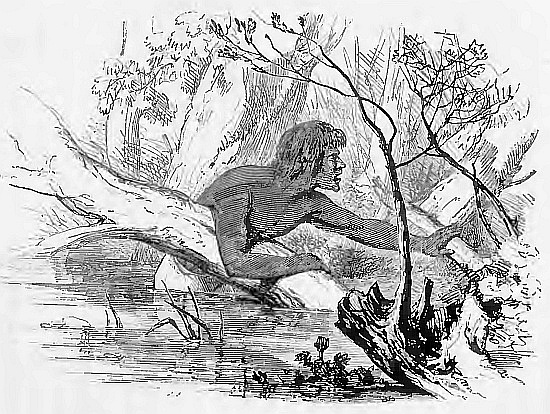
Chapter Thirty Eight.
A Cul-de-Sac.
Notwithstanding the pleasant theme that formed the subject of their after-dinner discourse, it was not long continued. Both those who took part in it and those who listened were too anxious about their situation to enjoy even the most interesting conversation. As soon, therefore, as they felt sufficiently recruited by the rest, they resumed their aquatic journey. For several hours they continued to advance at the same slow rate, without encountering any incident worthy of record. The igarápe still trended in a straight line, with only here and there a slight turning to one side or the other, preserving, however, the same general direction, which was northward. This they had discovered on the night before, not by observing the polar star, which is at no time visible at the equator, nor until you have travelled several degrees to the north of it. Even when this well-known star should be seen from the low latitudes of the torrid zone, it is usually obscured by the hazy film extending along the horizon. Sirius and other northern, constellations had guided them. As the sun had been shining throughout the whole of that day as well as the preceding one, you may suppose there could be no difficulty in discovering the quarter, within a point or two of the compass, at any hour of the day. This might be true to any one travelling in a high latitude, northern or southern, or at certain seasons of the year, anywhere outside the tropics. Even within the tropics it might be done by skilful observation, if the observer knew the exact time of the year. Trevannion knew the time. He knew, moreover, that it was close upon the vernal equinox, when the sun was crossing the equatorial line, near to which they were wandering. For this reason, in the meridian hours the great orb was right over their heads, and no one—not even a skilled astronomer—could have told north from south, or cast from west.
Supposing that the igarápe should not be trending in the same direction, but imperceptibly departing from it? In that case, during the mid-hours of the day they could have had no guidance from the sky, and must have suspended their journey till the sun should begin to sink towards the west, and once more make known the points of the compass. Fortunately they needed not to make this delay. As already observed, the flow of the flood was the pilot to which they looked for keeping them in their course; and, as this still ran with a slight obliquity in the same direction as the igarápe, the latter could not have departed from the right line upon which, they had been advancing. The current had been compared with the points of the compass that morning before setting out. It was a little to the east of north. Northward, then, was the course of the swimmers.
They had drawn further inference from the direction in which the flood was setting. It proved that they had strayed from the Solimoës by its left or northern bank, and must now be somewhere among the mouths of the great river Japura. It was no consolation to discover this, but the contrary. The old tapuyo only looked graver on arriving at the conviction that such was the case. He knew that in that direction, in the vast delta formed by the unnumbered branches of the Japura, the Gapo was of great width, extending far back from the banks of this remarkable river, and dry land in that direction might be at the greatest distance. There was no alternative but to keep on, and, by deviating from the course as little as possible, they might in due time reach the limits of the flood. Actuated by this impulse and its attendant hopes, they continued their toilsome journey along “the path of the canoe.”
We have said that for several hours they encountered no incident worthy of note. It was not destined, however, for that day’s sun to set before one should arise, whose record is not a matter of choice, but necessity, since it exerted such an influence on the proceedings of the travellers as to cause a complete change in their mode of progression. What they encountered was not exactly an incident, but an obstruction. In other words, their swim was suddenly brought to an end by the ending of the igarápe!
They had arrived at the termination of this curious canal, which all at once came to a cul-de-sac, the trees closing in on both sides, and presenting an impenetrable front, that forbade farther progress. The way was equally obstructed in every other direction; for on neither side of the igarápe, throughout its whole length, had any opening been observed. At first they fancied that the water might open again beyond the obstruction, but Munday, after penetrating a short distance among the tree-trunks, returned to declare his conviction that the igarápe was at an end. Nor did it terminate by any gradual convergence of the two lines of trees. On the contrary, they came together in an abrupt circular sweep,—one of colossal size, that rose high above its fellows and spread far out, standing in the centre, like some Titanic guardian of the forest, and seeming to say to the igarápe, “Hitherto shalt thou come, but no farther!”
It was of no use remaining longer in the water for that day. Even had the obstruction not arisen, it was time to have suspended their exertions. The sun was sinking towards the tree-tops, and by the time they could get themselves snugly stowed away, and something ready for supper, it would be night. Leaving other cares for the morrow, and the morrow to take care of itself, they at once proceeded to select their sleeping-place for the night. The colossal tree that had come so unpleasantly across their track seemed to offer the very quarters they were in search of; and, without more ado, they accepted the hospitality of its wide-spreading branches.
Chapter Thirty Nine.
The Brazil-Nuts.
The tree upon which they had made their roost was one of a species of which they had observed many during the day. It was the true Brazil-nut (Bertholletia excelsa), own cousin to the sapucaya; for both are of the same family,—the Lecythis,—of which there are many distinct members. Like the sapucaya, it is a denizen of the low lands and flooded forests, growing to a stupendous height. It produces large, showy flowers, which are succeeded by huge capsule-like pericarps, each enclosing a score or more of Brazil-nuts. But though the flowers are followed by the fruits, these do not all come together; and, like the orange and other tropical trees, bud, blossom, and fruit may all be observed upon the same branch, in various stages of development.
It need not be said that the nuts of the Bertholletia form one of the commercial staples of Amazonia. They are too well-known to need further description; for there are few dwelling-houses in either Europe or America where they have not been submitted to the squeeze of the nut-crackers. In the forest, where they are no man’s property, they are collected by whoever chooses to take the trouble, but chiefly by the Indians and half-breeds who dwell on the borders of the Gapo. The time to gather the Brazil-nuts is the vasante, or dry season, though there are certain tribes of savages that go nutting in their canoes during the season of the echente. But the real nut harvest is after the floods have subsided, and the trees once more stand upon dry land. Then the whole malocca of Indians, or the inhabitants of a village, proceed in a body to the places where the fruits are to be found, scattered around the stems of the tall trees that have produced them.
In gathering their crop the gleaners require to observe certain precautions, those who go under the trees covering their heads with a thick wooden cap, resembling a helmet, lest the dropping of the heavy capsules—big as a cannon-ball, and almost as heavy—might crack a skull! For this reason the monkeys of the Amazon forest, though crazy for sapucaya and Brazil-nuts, always give the Bertholletia a wide berth, never going under, but around it, in a circle whose circumference lies outside the tips of the branches. Strange to say, these creatures have no fear of the sapucaya, although its pericarps are as large and heavy as those of the Brazil-nuts. But the former do not fall to the ground, or when they do, it is only after the lid has sprung open, and the huge cup has scattered its contents, leaving it a light and empty shell. It is for this reason, as much as anything else, that the nuts of the sapucaya are scarce in the market, and command a higher price. Having escaped spontaneously from their shell, they are at the mercy of all comers, birds, quadrupeds, and monkeys; whereas the Brazil-nuts, protected by their thick woody pericarps, are not so easily accessible. Even the monkeys cannot get at them, until some animal with teeth better adapted for chiselling performs for them the service of laying open the box, and giving them a chance at the treasures contained within. This is done by several species of rodents, among which the cutia and paca are conspicuous; and one of the most comical spectacles to be seen in a South American forest is that of a group of monkeys, watching from a distance the proceedings of a paca thus employed, and then springing forward to take forcible possession of the pericarp after it has been sufficiently opened.
It was a bit of good fortune that our adventurers found lodgings upon the Bertholletia. Though more hospitality may usually be met with in an inn, it provided them with at least a portion of their supper,—the bread-stuff. They had still left a brace of the macaw squabs that had not been roasted; but Munday, as before, soon produced sufficient fire to give them a scorching, and keen appetites supplied salt, pepper, and sauce.
Chapter Forty.
A Travelling Party of Guaribas.
Supper over, our adventurers only awaited the sunset to signal them to their repose. They had already selected their beds, or what was to serve for such,—the spaces of horizontal network formed by the intertwining of luxuriant llianas. At the best, it was no better than sleeping upon a raked hurdle; but they had been already somewhat inured to an uneasy couch on the galatea, and they were every day becoming less sensitive to necessities and hardships. They were all tired with the severe exertions they had made; for although their journey had been but about six miles, it was enough to equal sixty made upon land. They felt as if they could go to sleep astride of a limb, or suspended from a branch.
It was not decreed by fate that they should find rest before being made the witnesses of a spectacle so curious, that, had they been ever so much inclined for sleep, would have kept them awake against their will.
A noise heard afar off in the forest attracted their attention. There was nothing in it to alarm them, though had they not heard it before, or something similar to it, their fears might have been excited to the utmost pitch of terror. What they heard was the lugubrious chant of a band of howling monkeys. Of all the voices of Nature that awake the echoes of the Amazonian forest, there is perhaps none so awe-inspiring as this. It is a combination of sounds, that embrace the various tones of shrieking, screaming, chattering, growling, and howling, mingled with an occasional crash, and a rattle, such as might proceed from the throat of a dying maniac. And yet all this is often the product of a single mycetes, or howling monkey, whose hollow hyoidal bone enables him to—send forth every species of sound, from the rolling of a bass drum to the sharp squeak of a penny-whistle.
“Guaribas!” quietly remarked the Mundurucú, as the distant noise was first heard.
“Howling monkeys you mean?” interrogatively rejoined Trevannion.
“Yes, patron, and the loudest howlers of the whole tribe. You’ll hear them presently. They are coming this way.”
“They’re not far off now, I should say, if one may judge by the loudness of their cries.”
“All of a mile yet, patron. It proves that the forest stretches more than a mile in that direction, else the guaribas could not be there. If there be open water between us and them, they won’t come this way. If not, we’ll have them here in ten minutes’ time. I wish we could only travel among the tree-tops as they can. We shouldn’t stay long in the Gapo.”
“Just as the Mundurucú expected,” continued the tapuyo, after a pause. “The guaribas are coming towards us. I can hear the swishing of the leaves as they pass among them. We’ll soon see them.”
The howling of the guaribas had for some time ceased, but the rustling of leaves, with the occasional snapping of a twig, to which the Indian had directed the attention of his companions, told that the troop was travelling through the tree-tops, otherwise observing a profound silence.
Soon they appeared in sight, suddenly presenting themselves upon a tall tree that stood by the side of the igarápe, about a cable’s length from that occupied by our adventurers. For some minutes the branches of the tree were seen oscillating up and down, as each black guariba sprang into it: and this continued until not less than a hundred had found lodgement upon the limbs. As the leader of the band, who was evidently chief of the tribe, caught sight of the igarápe, he was seen to pause in an abrupt and ambiguous manner, at the same moment giving utterance to a cry, easily intelligible as a word of command. It had the effect of causing those immediately behind him to come to a halt, as also the others, as they sprang successively into the tree. There could be no question as to what had caused the halt. It was the igarápe crossing the track which the guaribas were going. With them the only question was, how they were to get over it.
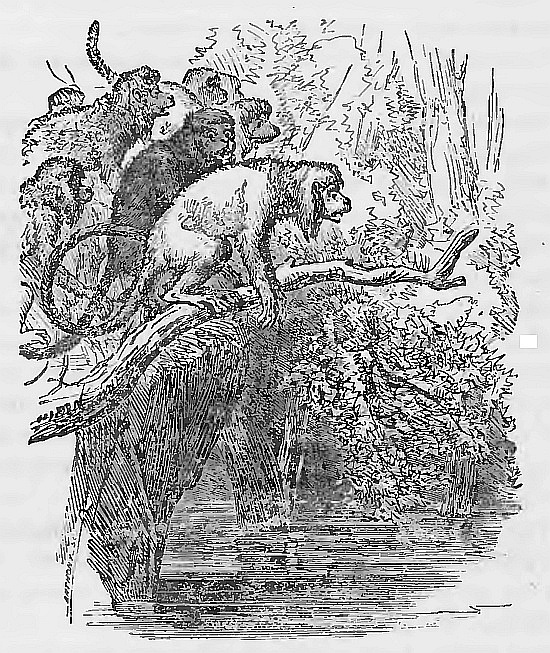
At the point where the howlers had clustered together, the strait was narrower than elsewhere within sight. Between the branches, extending horizontally from the opposite sides of the igarápe, there was a clear space of about twenty feet; and to the spectators it appeared improbable that any animal without wings could leap from tree to tree. The monkeys, however, did not seem to be of this opinion, but were plainly contemplating the leap; and it was evident that some of them were only restrained from taking it by an authoritative command from their chief, which held them in check. For several minutes there was a profound silence among them, undisturbed until the stragglers had all arrived in the tree, and squatted on the branches.
It was now observed that among these last were several mothers, each carrying a child upon her back, or embraced between her bare arms; the youngster with face upturned, clinging, not with teeth and toe-nail, but with hands and tail, to the neck of its maternal parent. To these the attention of the whole tribe appeared to be directed; and it was evident that they were the sole cause of the difficulty,—the impedimenta that had interrupted the onward march of the troop.
There had been confusion, accompanied by some chattering, after first coming up; but a sign from the leader had put an end to all noise, and then succeeded the silence already mentioned. During its continuance the guariba chief slowly ascended the tree, until he had attained a position elevated above all his followers. Then squatting down, with his hams firmly planted upon a branch, his long tail carefully coiled around another, he commenced his harangue with as much ceremony as if he had been chairman of a Guild-Hall dinner. Perhaps there was quite as much sense and eloquence in his speech; at all events, there was more noise: for during the ten minutes taken up by it—it had the advantage of brevity—no other sound could have been heard over the Gapo within the circuit of a mile.
His address being ended, the chief, by a series of detached speeches, seemed to invite a reply from his followers, coaxing their assent, or daring them to contradiction. There appeared to be no dissent, not one voice. The chattering that responded to the speech was delivered in a tone that spoke unanimous compliance with the proposal—whatever it was—which their chief had offered to their consideration.
Then ensued another interval of silence, much shorter than before, and again interrupted by the leader of the troop. This time, however, his words were few and to the purpose. They were pronounced in a tone of command, that called for prompt obedience, which was yielded instantaneously and without protest.
One of the strongest of the guaribas ran out upon the limb overhanging the igarápe, and, stopping at its extremity, braced himself for the leap. In another instant it was made, and the monkey was seen rushing up into the tree on the other side of the igarápe. A comrade followed, placing his four hands in the same spot, his body in a similar attitude, and making the leap so exactly like the guariba that had preceded him, that it seemed the same monkey repeating the performance. Then went another, and another, so close following, that the creatures appeared more like the links of some colossal but quick-moving chain, pulled by supernatural power across the igarápe, than a series of individual and animated beings.
Chapter Forty One.
The Monkey Mother.
Our adventurers sat in silent wonder watching the movements of the monkeys. It was certainly a spectacle of the most interesting character to see these creatures making the passage of the igarápe. Perhaps the most singular thing was the similarity of their leaps,—all planting their feet upon the same spot of the branch from which the leader sprang, springing exactly in the same way, and alighting on the opposite side in apparently the same spot and attitude, proving that each and all must have been actuated by the same thought or instinct at the precise moment of passing from one tree to the other. Another singular point was, that during its continuance the intervals between each two were almost as regular as the ticking of a clock. As soon as one launched itself out from the branch, another sprang into its place, and was ready to follow so quickly that the air was never for a moment without a monkey; and any one looking straight down the opening between the trees, without glancing to either side, might almost have fancied that it was a single guariba suspended in mid-air!
All the males of the tribe had succeeded in making the leap in safety; and all the females, too,—those carrying their “piccaninnies” along with the rest,—except one. This was a mother with a very young child on her back,—in fact a mere infant,—perhaps not nine days old. Notwithstanding its extreme youth, it appeared to comprehend the situation, as well as those of more mature age, clinging with its infantile fingers to the shaggy hide of its mother, while its tiny tail was twisted around the root of hers, in a loop that appeared tight as a sailor’s knot.
But the mother, enfeebled by some sickness,—for monkeys are subject to sickness as well as men,—appeared doubtful of her ability to accomplish the leap; and, after all the others had crossed, she stood upon the branch evidently only half determined about following them. At this crisis occurred a curious incident,—the first of a series. One of those that had crossed, a man-monkey, was seen to separate from the crowd, that had by this time ascended to the top of the tree. Returning along the limb to which they had just leaped, he placed himself opposite to the hesitating female and began to chatter, intending to encourage her, as his gestures showed. The mother of the infant made reply; but although the sounds were unintelligible to the human spectators, they might be translated as saying, “It’s not a bit of use, my trying; I shall only get a ducking for my pains, and the infant too. It may be drowned.”
Her reply was delivered in a tone of appeal; and, as if affected by it, the male monkey—evidently the father of the child—made no more remonstrance, but bounded back across the open water. It was but the work of six seconds for him to transfer the juvenile to his own shoulders; and in as many more both he and it were on the right side of the igarápe. Relieved of her charge and encouraged by the cries of those already across, the mother sprang out from the branch. The effort was too great for her strength. With her forefinger she caught the twigs on the opposite side and succeeded in clutching them; but before she could lap the branch with her tail,—a more trustworthy means of prehension,—she had sunk below its level, and, the twigs giving way, she plunged into the water.
A universal scream came from the top of the tree, and a score or more of guaribas leaped down upon the limb from which the unfortunate had fallen. There was a scene of confusion,—just as there would have been had the catastrophe happened among human beings,—as when a boat upsets or some one breaks through the ice, and spectators stand speechless, or hurry to and fro, no one knowing exactly what to do,—what order to give, or whom to obey.
Very like was the scene of surprise, terror, and lamentation among the monkeys,—except that it did not last quite so long. In this respect animal instinct, as it is called, has the advantage of bewildered reason; and, while a crowd upon the sea-beach or the river-bank would have spent ten minutes before taking action to rescue the drowning individual, scarcely so many seconds were allowed to elapse before the guaribas had picked up and safely deposited her trembling person on the fork of a tree.
The mode in which this had been accomplished was something to astonish the spectators, and yet it was performed in a very efficient manner. As soon as the screaming would permit, the voice of the guariba chieftain was heard, in a chattering so loud and serious in tone as to indicate command; and some half-score of the number, in obedience, glided out on the limb of the tree under which the female was in imminent danger of being drowned. A bucket could not have descended into a well, or a pulley-tackle come down from warehouse or mill, more promptly and speedily than did that string of monkeys, hooked neck and tail to one another, like the links of a long chain,—the lowest upon the swinging series being the husband of the half-drowned mother, who had hastily deposited his baby in one of the forkings of the tree. Neither could the water-bucket have been filled, nor the wheat-sack hooked on, with half the speed and agility with which she was picked up and restored.
Once more shouldering her “chickabiddy,” she took her place in the troop, which, without further delay, moved on amid the tree-tops, keeping in a direct line of march, as if bent upon a journey that was to terminate at some spot already known to them. For a long time their track could be traced by their continuous howling, which then was heard only at intervals, and at length receded to such a distance as to become inaudible.
Chapter Forty Two.
The Mundurucú Discourses of Monkeys.
The sun was just setting as the guaribas disappeared; and from this circumstance it was conjectured that they were on their return to some favourite resting-place. Trevannion supposed that they might be on their way to dry land; and, if so, the route they had taken might serve himself and party for a direction. He mentioned this to the Mundurucú, who shook his head, not doubtfully, but as a simple negative.
“You think it would be of no use our taking the direction in which they have gone?” said the miner interrogatively.
“No, patron; not a bit of good in that. They are as like to be going from terra firma as towards it. It’s all the same to them whether they sleep over land, or water, so long as they have the trees to cling to. They are now trooping to some roost they have a fancy for,—perhaps some very big tree,—which they use at all times for their night-rendezvous, and where others of the same tribe will be likely to meet them. These have been off to some favourite feeding-ground, where the fruit may be more plenty than in the neighbourhood of their regular dwelling-place; or they may have been upon some ramble for amusement.”
“What! do monkeys make such excursions?” inquired young Ralph.
“O yes,” replied the Mundurucú. “I’ve often met them trooping about among the trees, where nuts and fruits were in plenty; and have watched them, for hours at a time, without seeing them pluck a single one;—only chattering and screeching and laughing and playing tricks upon each other, as if they had nothing else to do. Neither have they when certain sorts of fruit are ripe, especially soft fruits, such as berries and the pulpy nuts of several kinds of palms, as the pupunha and assai. It is a little different at other seasons, when they have to live on the Brazil-nuts and sapucayas; then they have something to do to get at the kernels inside the thick shells, and at this they employ a good deal of their time.”
“Do they sleep perched on the trees, or have they nests among the branches in which they can lie down at their ease?”
“They have nests, but not for that. The females only use them when about to bring forth their young. As to sleeping at their ease, they can do that on the very slenderest of branches. It’s no hardship to them, as it is to us. Not a bit.”
“But do they not sometimes fall off in their sleep?”
“How could they do that, young master, when they have their tails to hold on by? Before going to sleep they take a turn or two of their long tail round a branch, not always the one their body is on, but more commonly a branch a little above it. For that matter they don’t need any branch to rest upon. They can go to sleep, and often do, hanging by the tail,—for that is the position in which they are most at ease; just as you would be reclining in a hammock. I’ve seen them scores of times asleep that way. To prove that they feel most at home when hanging by the tail, they take to it whenever any alarm comes suddenly upon them; and they want to be in readiness for retreat, in case of its proving to be an enemy.”
“What singular creatures!” said Ralph, half in soliloquy.
“You speak truth, young master. They have many an odd way, that would lead one to believe that they had as much sense as some kinds of men. You have seen how they picked up the old one that fell into the water; but I’ve seen them do a still stranger thing than that. It is but the commonest of their contrivances, put in practice every time they want to pluck a nut, or some fruit that grows near the end of a branch too slender to carry their weight. If there’s a stronger limb above, they go out upon it; and then, clinging together as you saw them do, they let themselves down till the last in the string can lay hold of the fruit. Sometimes there is no branch right over the spot; but that don’t hinder them from getting what they have coveted, if they can find a stout limb anyways near. Then they make their string all the same; and, by setting it in motion, they swing back and forward, until the lowest of the party is tossed out within reach of the fruit. I’ve seen them try this, and find that their string was just a few inches too short, when another monkey would glide down upon the others, and add his length to complete it. Then I’ve seen them make a bridge, young master.”
“Make a bridge! Are you in earnest? How could they?”
“Well, just in the same way as they get within reach of the nuts.”
“But for what purpose?”
“To get across some bit of water, as a fast-running stream, where they would be drowned if they fell in.”
“But how do they accomplish it? To make a bridge requires a skilled engineer among men; are there such among monkeys?”
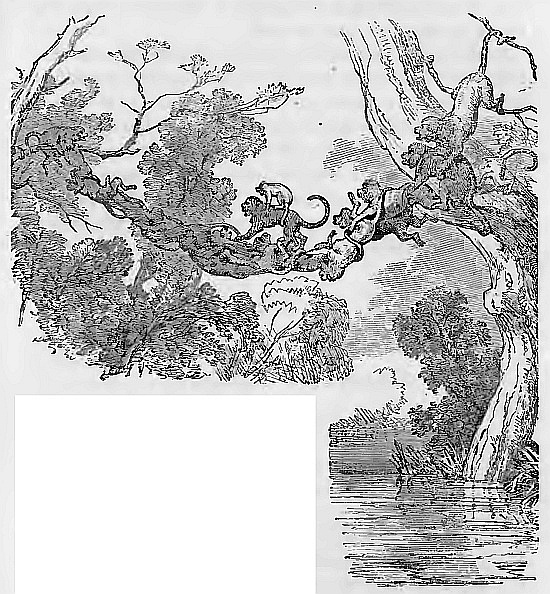
“Well, young master, I won’t call it such skill; but it’s very like it. When on their grand journeyings they come to a stream, or even an igarápe like this, and find they can’t leap from the trees on one side to those growing on the other, it is then necessary for them to make the bridge. They go up or down the bank till they find two tall trees opposite each other. They climb to a high branch on the one, and then, linking together, as you’ve seen them, they set their string in motion, and swing backward and forward, till one at the end can clutch a branch of the tree, on the opposite side. This done the bridge is made, and all the troop, the old ones that are too stiff to take a great leap, and the young ones that are too weak, run across upon the bodies of their stouter comrades. When all have passed over, the monkey at the other end of the string lets go his hold upon the branch; and if he should be flung into water it don’t endanger him, as he instantly climbs up the bodies of those above him, the next doing the same, and the next also, until all have got safe into the trees.”
“Be japers,” exclaimed Tipperary Tom, “it’s wonderful how the craythers can do it! But, Misther Munday, have yez iver seen them fall from a tree-top?”
“No, never, but I’ve known one to leap from the top of a tree full a hundred feet in height.”
“Shure it was kilt dead then?”
“If it was it acted very oddly for a dead animal, as it had scarce touched the ground when it sprang back up another tree of equal height, and scampered to the top branches nearly as quick as it came down.”
“Ah!” sighed Trevannion, “if we had only the activity of these creatures, how soon we might escape from this unfortunate dilemma. Who knows what is before us? Let us pray before going to rest for the night. Let us hope that He, in whose hands we are, may listen to our supplications, and sooner or later relieve us from our misery.” And so saying, the ex-miner repeated a well-remembered prayer, in the response to which not only the young people, but the Indian, the African, and the Irishman fervently joined.
Chapter Forty Three.
Two Slumberers Ducked.
It was somewhere among the mid-hours of the night, and all appeared to be as sound asleep as if reclining upon couches of eider-down. Not a voice was heard among the branches of the Brazil-nut,—not a sound of any kind, if we except the snore that proceeded from the spread nostrils of the negro, and that of a somewhat sharper tone from the nasal organ of the Irishman. Sometimes they snored together, and for several successive trumpetings this simultaneity would be kept up. Gradually, however, one would get a little ahead, and then the two snorers would be heard separately, as if the two sleepers were responding to each other in a kind of dialogue carried on by their noses. All at once this nasal duet was interrupted by a rustling among the boughs upon which rested Tipperary Tom. The rustling was succeeded by a cry, quickly followed by a plunge.
The cry and the plunge woke everybody upon the tree; and while several inquired the cause of the disturbance, a second shout, and a second plunge, instead of affording a clue to the cause of alarm, only rendered the matter more mysterious. There was a second volley of interrogatories, but among the inquiring voices two were missing,—those of Mozey and the Irishman. Both, however, could now be heard below; not very articulate, but as if their owners were choking. At the same time there was a plashing and a plunging under the tree, as if the two were engaged in a struggle for life.
“What is it? Is it you, Tom? Is it you, Mozey?” were the questions that came thick and fast from those still upon the tree.
“Och! ach!—I’m chokin’!—I’m—ach—drown—ach—drownin’!—Help! help!” cried a voice, distinguishable as the Irishman’s, while Mozey’s was exerted in a similar declaration.
All knew that Tom could not swim a stroke. With the Mozambique it was different. He might sustain himself above water long enough to render his rescue certain. With Tom no time was to be lost, if he was to be saved from a watery grave; and, almost with his cry for help, Richard Trevannion and the Mundurucú plunged in after him.
For a time, Trevannion himself and his two children could hear, underneath them, only a confused medley of sounds,—the splashing of water mingled with human voices, some speaking, or rather shouting, in accents of terror, others in encouragement. The night was dark; but had it been ever so clear, even had the full moon been shining above, her beams could not have penetrated through the spreading branches of the Brazil-nut, melted and lined as they were with thorns and leafy llianas.
It would seem an easy task for two such swimmers as the Indian and Paraense to rescue Tipperary Tom from his peril. But it was not quite so easy. They had got hold of him, one on each side, as soon as the darkness allowed them to discern him. But this was not till they had groped for some time; and then he was found in such a state of exhaustion that it required all the strength of both to keep his chin above the surface.
Mozey was fast becoming as helpless as Tom, being more than half paralysed by the fright he had got from being precipitated into the water while still sound asleep. Such a singular awaking was sufficient to have confused a cranium of higher intellectual development than that of the Mozambique.
After having discovered their half-drowned companions, neither Richard nor the Mundurucú knew exactly what to do with them. Their first thought was to drag them towards the trunk of the tree, under which they had been immersed. This they succeeded in doing; but once alongside the stem, they found themselves in no better position for getting out of the water. There was not a branch within reach by which to raise themselves, and the bark was as smooth as glass, and slippery with slime.
When first ascending into the great tree, they had made use of some hanging parasite, which now in the darkness they were unable to find. Even the two swimmers began to despond. If not their own lives, those of their comrades might be lost in that gloomy aisle, whose pavement was the subtle, deceitful flood. At this crisis an idea occurred to the young Paraense that promised to rescue them from their perilous position, and he called out, “The swimming-belts! fling down the swimming-belts!” His uncle and cousin, by this time having a clearer comprehension of what had occurred, at once obeyed the command. Richard and the Indian were not slow to avail themselves of this timely assistance; and in a trice the two half-drowned men were buoyed up beyond further danger.
On getting back into the Bertholletia, there was a general explanation. Tipperary Tom was the cause of the awkward incident. Having gone to sleep without taking proper precautions, his limbs, relaxed by slumber, had lost their prehensile power, and, sliding through the llianas, he had fallen plump into the water below, a distance of more than a dozen feet. His cries, and the consequent plunge, had startled the negro so abruptly that he too had lost his equilibrium, and had soused down the instant after.
The Mundurucú was by no means satisfied with the occurrence. It had not only interrupted his repose, but given him a wet shirt in which to continue it. He was determined, however, that a similar incident should not, for that night, occur,—at least not with the same individuals,—and before returning to his roost he bound both of them to theirs with sipos strong enough to resist any start that might be caused by the most terrible of dreams.
Chapter Forty Four.
Open Water.
The next day was spent in explorations. These did not extend more than four hundred yards from their sleeping-place; but, short as was the distance, it cost more trouble to traverse it than if it had been twenty miles on land, across an open country.
It was a thicket through which the explorers had to pass, but such a thicket as one acquainted only with the ordinary woods of Northern countries can have no conception of. It was a matted tangle of trees and parasitical plants, many of the latter—such as the climbing jacitara palms, the huge cane-briers, and bromelias—thickly set with sharp spines, that rendered it dangerous to come in contact with them. Even had there been firm footing, it would have been no easy task to make way through such a network; but, considering that it was necessary to traverse the wood by passing from tree to tree, all the time keeping in their tops, it will not be wondered at that a few hundred yards of such progress was accounted a day’s journey.
You must not suppose that all the party of our adventurers went even thus far. In fact, all of them remained in the Brazil-nut, except the two who had acted as explorers on the former occasion,—Richard and the Mundurucú. It would have been worse than idle for any other to have accompanied them.
It was near sunset when they returned with their report, which to Trevannion and his party seemed anything but encouraging. The explorers had penetrated through the forest, finding it flooded in every direction. Not an inch of dry land had they discovered; and the Indian knew, from certain signs well understood by him, that none was near. The rapid drift of the current, which he had observed several times during the day, was one of these indications. It could not, he declared, be running in that way, if dry land were in the vicinity. So far, therefore, as reaching the shore was concerned, they might make up their minds for a long journey; and how this was to be performed was the question of the hour.
One point the explorers had definitely determined. The igarápe terminated at their sleeping-place. There was no sign of it beyond. Instead, however, they had come upon an opening of a very different character. A vast expanse of water, without any trees, had been found, its nearest edge being the limit of their day’s excursion. This open water did not extend quite to the horizon. Around it, on all sides, trees could be seen, or rather the tops of trees; for it was evident that the thicket-like bordering was but the “lop and top” of a submerged forest. On returning to the “roost,” Munday urged their going towards the open water.
“For what purpose?” inquired the patron, who failed to perceive any good reason for it. “We can’t cross it, there being no sort of craft to carry us. We cannot make a raft out of these green branches, full of sap as they are. What’s the use of our going that way? You say there’s open water almost as far as you can see,—so much the worse, I should think.”
“No, patron,” replied the Indian, still addressing Trevannion as respectfully as when acting as his hired tapuyo. “So much the better, if you give me leave to differ with you. Our only hope is to find open water.”
“Why, we have been all along coming from it. Isn’t there plenty of it behind us?”
“True, patron; but it’s not running in the right direction. If we launched upon it, the current would be against us. Remember, master, ’tis the echenté. We couldn’t go that way. If we could, it would only bring us back to the river-channel, where, without some sort of a vessel, we should soon go to the bottom. Now the open Gapo we’ve seen to-day is landward, though the land may be a good way off. Still, by crossing it, we shall be getting nearer to firm ground, and that’s something.”
“By crossing it? But how?”
“We must swim across it.”
“Why, you’ve just said that it stretches almost to the edge of the horizon. It must be ten miles or more. Do you mean to say we can swim so far?”
“What’s to hinder us, master? You have, the monkey-pots; they will keep you above water. If not enough for all, we can get more. Plenty of the sapucaya-trees here.”
“But what would be the object of our crossing this expanse of water? You say there is no dry land on the other side; in that case, we’ll be no better off than here.”
“There is land on the other side, though I think not near. But we must keep on towards it, else we shall never escape from the Gapo. If we stay here, we must starve, or suffer greatly. We might search the forest for months, and not find another nesting-place of the araras, or good food of any kind. Take my advice, patron. Soon as comes the light of to-morrow, let us cross to the open water. Then you can see for yourself what is best for us to do.”
As the perilous circumstances in which they were placed had altogether changed the relationship between Trevannion and his tapuyo, the latter being now the real “patron,” of course the ex-miner willingly gave way to him in everything; and on the morning of the next day the party of adventurers forsook the Brazil-nut, and proceeded towards the open Gapo.
Chapter Forty Five.
The Jacanas.
It will be asked how they proceeded. To swim to the open water would have been next to impossible, even with the assistance of the floats. Not only would the thick tree-trunks and drooping llianas have hindered them from making way in any direction; but there would have been nothing to guide them through the shadowy water, and they must soon lose themselves in a labyrinth of gloom. No sign of the sky could have availed them in the deep darkness below; and there were no landmarks to which to trust. The answer is, that they made their way along much as did the monkeys which had passed them the day before, only that their pace was a hundred times slower, and their exertions a thousand times more laborious. In fact, they travelled among the tree-tops, and followed the same track which their explorers had already taken, and which Munday, on his return, had taken the precaution to “blaze” by breaking a number of twigs and branches.
Their progress was of the slowest kind,—slower than the crawl of a cripple; but by dint of perseverance, and the performance of many feats in climbing and clinging and balancing, and general gymnastics, they succeeded at length in reaching the edge of the forest, and gaining a view of the wide watery expanse. It was a relief to their eyes, so long strained to no purpose amidst the shadowy foliage that had enveloped them.
“Now, Munday,” asked Trevannion, as soon as he had recovered breath, after such laborious exertion, “we are here on the edge of the open water. You talk of our being able to swim across it. Tell us how.”
“Just as we swam the igarápe.”
“Impossible, as you’ve admitted it can’t be less than ten miles to the other side. The tree-tops yonder are scarce discernible.”
“We came nearly as far along the canoe-path.”
“True; but then we had a chance to rest every few minutes, and that gave us strength to go on. It will be different if we attempt to cross this great sea, where there is no resting-place of any kind. We should be a whole day on the water, perhaps more.”
“Perhaps so, patron. But remember, if we do not try to get out of the Gapo, we may be three, four, five, or six months among these tree-tops. We may get no food but a few nuts and fruits,—scarcely enough to keep us alive. We may lose strength, and be no longer able to stay among the branches; we may grow faint and fall, one by one, into the water, to go down to the bottom of the Gapo or drop into the jaws of the jacarés.”
The alternative thus brought in terrible detail vividly before them produced a strong impression; and Trevannion offered no objection to any plan which the Mundurucú should propose. He only requested a fuller account of the feasibility of that now suggested,—in other words, an explanation as to how they were to swim a stretch of ten miles without stopping to rest.
Munday made no mystery of the matter. He had no other plan than that already tried with success,—the swimming-belts; only that two additional sets would now be needed,—one for himself, the other for the young Paraense. On the short passage from the sapucaya to the forest, and along the canoe-path, these bold swimmers had disdained the use of that apparatus; but in a pull of ten miles, even they must have recourse to such aid.
No further progress was to be made on that day, as the fatigue of their arboreal journey required a long rest; and shortly after their arrival upon the edge of the forest, they set about arranging for the night, having chosen the best tree that could be found. Unfortunately, their larder was lower than it had ever been, since the going down of the galatea. Of the squab macaws there were no longer any left; and some sapucaya nuts gathered by the way, and brought along by Munday, formed the substance of their scanty supper.
As soon as it was eaten, the Mundurucú, assisted by Richard, busied himself in manufacturing the required swimming-belts; and long before the sun disappeared behind the forest spray, everything was ready for their embarkation, which was to take place at the earliest moment of its reappearance.
As usual, there was conversation,—partly to kill time, and partly to keep off the shadows that surrounded, and ever threatened to reduce them to despair. Trevannion took pains to keep it up, and make it as cheerful as the circumstances would permit, his object being less to satisfy himself than to provide gratification for his children. At times he even attempted to jest; but generally the conversation turned upon topics suggested by the scene, when the Indian, otherwise taciturn, was expected to do the talking. The open water became the subject on this particular occasion.
“It appears like a lake,” remarked the ex-miner. “I can see a line of trees or tree-tops all around it, with no signs of a break or channel.”
“It is one,” rejoined the tapuyo. “A real lagoa. Water in it at all seasons,—both echenté and vasanté,—only ’tis fallen now from the flood. There are no campos in this part of the country; and if it wasn’t a lagoa, there would be trees standing out of it. But I see a surer sign,—the piosocas.”
The speaker pointed to two dark objects at some distance off, that had not hitherto been observed by any of the party. On more careful scrutiny, they proved to be birds,—large, but of slender shape, and bearing some resemblance to a brace of cranes or curlews. They were of dark colour, rufous on the wings, with a green iridescence that glistened brightly under the beams of the setting sun.
They were near enough to enable the spectators to distinguish several peculiarities in their structure; among others a singular leathery appendage at the base of the beak, stout, spinous processes or “spurs” on the wing shoulders, very long, slender legs, and tarsi of immense length, radiating outward from their shank, like four pointed stare, spread horizontally on the surface of the water.
What struck the spectators, not only with surprise, but appeared unaccountable, was the fact that these birds seen upon the water were not seated as if swimming or afloat; but standing erect upon their long tarsi and toes, which apparently spread upon the surface, as if upon ice!
Stranger still, while they were being watched, both were seen to forsake their statue-like attitude, and move first toward each other, and then apart again, running to and fro as if upon a solid fooling! What could it all mean? Munday was asked for the explanation. Were they walking upon the water?
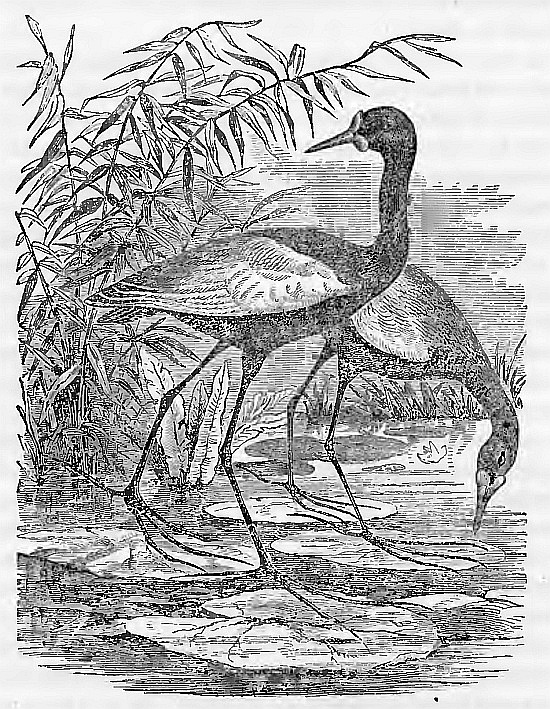
No. There was a water plant under their feet—a big lily, with a leaf several feet in diameter, that floated on the surface—sufficient to carry the weight of the biggest bird. That was what was supporting the piosocas.
On scanning the surface more carefully, they could distinguish the big lily, and its leaf with a turned-up edge resembling the rim of a Chinese gong, or a huge frying-pan. They became acquainted for the first time with that gigantic lily, which has been entitled “the Royal Victoria,” and the discoverer of which was knighted for his flattery.
“’Tis the furno de piosoca,” said Munday, continuing his explanation. “It is called so, because, as you see, it’s like the oven on which we bake our Cassava; and because it is the favourite roost of the piosoca.”
By “piosoca” the Indian meant the singular jacana of the family Palamedeidae, of which there are species both in Africa and America.
The birds had fortunately made their appearance at a crisis when the spectators required something to abstract their thoughts from the cares that encompassed them, and so much were they engrossed by the curious spectacle, that they did not perceive the tapuyo, as he let himself gently down into the water, and swam off under the drooping branches of the trees, pausing at a point opposite to where the piosocas were at play.
From this point they could not have perceived him, as he had dived under water, and did not come up again until the slender shanks of a jacana, enveloped in the lily’s soft leaf, were clutched by his sinewy fingers, and the bird with a shrill scream was seen fluttering on the water, while its terrified mate soared shrieking into the air.
The party in the tree-tops were at first amazed. They saw a dark, round object close to the struggling jacana, that resembled the head of a human being, whose body was under water! It was not till it had come nearer, the bird still keeping it close company, that they identified the head, with its copper-coloured face, now turned towards them, as belonging to their guide and companion,—Munday. A fire was soon blazing in the branches, and instead of going to sleep upon a supper of raw sapucayas, our adventurers sought repose after a hearty meal made upon roast jacana!
Chapter Forty Six.
A Companion Left Behind.
By daybreak they were once more in the water, each provided with a complete set of swimming-shells. As the voyage was more extensive, and altogether more perilous, the greatest pains was taken to have the swimming apparatus as perfect as possible. Any flaw, such as a weak place in the waist-belts or shoulder-straps, or the smallest crevice that would admit water into one of the shells, might be followed by serious consequences, perhaps even drowning. Besides making the new belts, therefore, Munday had mended the old ones, giving all the shells an additional coating of caoutchouc, and strengthening the sipos that attached them to one another.
Just as the sun’s disk was seen above the tree-tops that skirted the lagoa on the east, our adventurers embarked on their aquatic expedition. But it could not be said that they started in high spirits. They knew not what was to be the sequel of their singular undertaking. Where their journey was to end, or whether its end might not be for some of their number—if not all of them—the bottom of the Gapo.
Indeed, the Indian, to whom they all looked for encouragement as well as guidance, was himself not very sanguine of success. He did not say so, but for all that Trevannion, who had kept interrogating him at intervals while they were preparing to start, had become impressed with this belief. As the Mundurucú persisted in counselling the expedition, he did not urge any further opposition, and under the auspices of a glorious tropical sunrise they committed themselves to the open waters of the lagoa.
At the very start there occurred a somewhat ominous accident. As the coaita would have been a cumbersome companion for any of the swimmers to carry, it was decided that the creature should be left behind. Unpleasant as it was to part with a pet so long in the company of the galatea’s crew, there was no alternative but to abandon it.
Tipperary Tom, notwithstanding his attachment toward it, or rather its attachment toward him, was but too willing to assent to the separation. He had a vivid recollection of his former entanglement, and the risk he had run of being either drowned in the Gapo, or strangled by the coaita’s tail; and with this remembrance still fresh before his fancy, he had taken the precaution at this new start to steal silently off from the trees, among the foremost of the swimmers. Everybody in fact had got off, before the coaita was aware of their intention to abandon it, and to such a distance that by no leap could it alight upon anybody’s shoulders. On perceiving that it was left behind, it set up a series of cries, painfully plaintive, but loud enough to have been heard almost to the limits of the lagoa.
A similar desertion of the macaw was evidently intended, to which no one had given a thought, although it was Rosa’s pet. The ouistiti had been provided with a free passage upon the shoulders of the young Paraense. But the huge parrot was not to be left behind in this free and easy fashion. It was not so helpless as the coaita. It possessed a pair of strong wings, which, when strongly and boldly spread, could carry it clear across the lagoa. Conscious of this superior power, it did not stay long upon the trees, to mingle its chattering with the screams of the coaita. Before the swimmers had made a hundred strokes, the macaw mounted into the air, flew for a while hoveringly above them, as if selecting its perch, and then dropped upon the negro’s head, burying its claws in his tangled hair.
Chapter Forty Seven.
The Guide Abandoned.
As the swimmers proceeded, their hopes grew brighter. They saw that they were able to make good headway through the water; and in less than an hour they were a full mile distant from their point of departure. At this rate they should be on the other side of the lagoon before sunset, if their strength would only hold out. The voyage promised to be prosperous; and joy sat upon their countenances.
Shortly after there came a change. A cloud was seen stealing over the brow of the Mundurucú, which was the cue for every other to exhibit a similar shadowing. Trevannion kept scanning the countenance of the tapuyo to ascertain the cause of his disquietude. He made no enquiry; but he could tell by the behaviour of the Indian that there, was trouble on his mind. At intervals he elevated his head above the water, and looked back over his shoulder, as if seeking behind him for the cause of his anxiety. As they swam on farther, Munday’s countenance lost nothing of its anxious cast, while his turnings and backward glances became more frequent. Trevannion also looked back, though only to ascertain the meaning of the tapuyo’s manoeuvres. He could see nothing to account for it,—nothing but the tree-tops from which they had parted, and these every moment becoming less conspicuous. Though the patron did not perceive it, this was just what was causing the tapuyo’s apprehensive looks. The sinking of the trees was the very thing that was producing his despondency.
Stimulated less by curiosity than alarm, Trevannion could keep silent no longer. “Why do you look back, Munday?” he inquired. “Is there any danger in that direction? Have you a fear that we shall be followed? I can see nothing except the tree-tops, and them scarcely at this moment.”
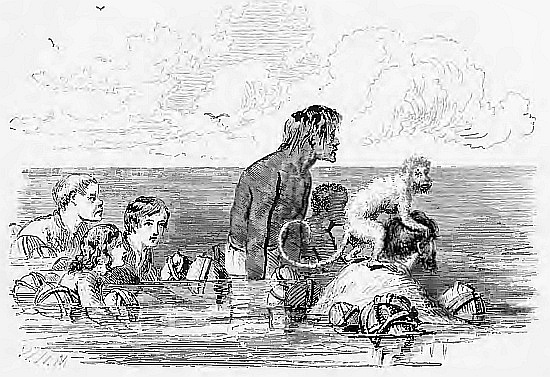
“That’s the danger. We shall soon lose sight of them altogether; and then—”
“What then?”
“Then—I confess, patron, I am puzzled. I did not think of it before we took to the water.”
“O, I see what you mean. You’ve been hitherto guiding our course by the trees from which we parted. When they are no longer in view we shall have nothing to steer by?”
“It is true. The Great Spirit only can guide us then!” The Mundurucú evidently felt more than chagrin that he had expressed himself so confidently about their being able to cross the lagoon. He had only taken into consideration the circumstance of their being able to swim, without ever thinking of the chance of their losing the way. The trees sinking gradually to the horizon first admonished him; and as he continued to swim farther into the clear water, he became convinced that such mischance was not only possible, but too probable. With a sort of despairing effort he kept on with even more energy than before, as if trying how far he could follow a straight line without depending on any object to pilot him.
After proceeding thus for two or three hundred yards, he once more raised his chin to his shoulder and looked back. The tree-tops were barely visible; but he was satisfied on perceiving that the one from which they had started rose up directly opposite to him, thus proving that in his trial stretch he had gone in a straight line, inspiring him with the hope of being able to continue it to the opposite side. With renewed confidence he kept on, after uttering a few phrases of cheer to the others.
Another stretch of about three hundred yards was passed through in silence, and without any incident to interrupt the progress of the swimmers. Then all came to a pause, seeing their conductor, as before, suspend his stroke, and again make a rearward reconnoissance. This time he did not appear so well satisfied, until he had raised his head high over the surface, which he accomplished by standing erect, and beating the water with his palms downward, when his confidence was again refreshed, and he started forward once more.
At the next stopping-place, instead of raising himself once into the standing poise, he did so several times in succession, each time sinking down again with an exclamation of disappointment. He could not see the trees, even at the utmost stretch of his neck. With a grunt that seemed to signify his assent to the abandoning of their guidance, he again laid himself along the water, and continued in the direction he had been already following; but not before assuring himself that he was on the right course, which fortunately he was still able to do by noting the relative positions of the others.
At starting away from this, which he intended should be their last stopping-place, he delivered a series of admonitions intended for every swimmer. They were to keep their places, that is, their relative positions to him and one another, as nearly as might be; they were to swim gently and slowly, according to the example he should set them, so that they might not become fatigued and require to pause for rest; and, above all, they were not to bother him by putting questions, but were, in short, to proceed in perfect silence. He did not condescend to explain these strange injunctions further than by telling them that, if they were not followed, and to the letter, neither he nor they might ever climb into another tree-top!
It is needless to say that, after such an intimation, his orders received implicit obedience; and those to whom he had given them swam onward after him as silently as so many fishes. The only sound heard was the monotonous sighing of the water, seething against the hollow sapucaya-shells, now and then varied by the scream of the caracara eagle, as it poised itself for a second over their heads, in surprise at the singular cohort of aquatic creatures moving so mysteriously through the lagoons.
Chapter Forty Eight.
Round and Round.
For a full hour our adventurers preserved, not only their relative positions, but also the silence that had been enjoined upon them. None of them spoke, even when a dead guariba—that had been drowned, perhaps, by attempting a leap too great for its strength and agility—came drifting along among them. Not one of them took any notice of it except the ouistiti upon the shoulders of Richard Trevannion. This diminutive quadrumanous specimen, on recognising the body of one of its big kinsmen, entered upon a series of chatterings and squeakings, trembling all the while as if suddenly awakened to the consciousness that it was itself in danger of terminating its existence in a similar manner.
Its cries were not heeded. Munday’s admonition had been delivered in a tone too serious to be disregarded; and the ouistiti was permitted to utter its plaint, without a single word being addressed to it, either of chiding or consolation. Tranquillity was at length restored, for the little ape, seeing that no notice was taken of it, desisted from its noisy demonstrations, and once more the swimmers proceeded in silence.
Half an hour or so might have elapsed before this silence received a second interruption. It again came in the voice of the ouistiti; which, rearing itself on its tiny hind-legs, having the shoulders of the Paraense for a support, craning its head outward over the water, commenced repeating its cries of alarm. In seeking for an explanation of this conduct, they contented themselves with watching the movements of the alarmist, and by turning their eyes towards the object which appeared to attract the ouistiti and cause it such evident alarm. Each buoyed himself up to get a good view; and each, as he did so, saw scarce ten paces ahead of him the carcass of a guariba! It was drifting towards them in the same manner as the one they had already met; and before any of them thought of exchanging speech, it was bobbing about in their midst.
The reflection that occurred to the swimmers was, that there had been a general drowning among the guaribas somewhere on the shores of the lagoon: perhaps a tribe had got into some isolated tree, where their retreat had been cut off by the inundation. Had the tapuyo not been of the party, this theory might have satisfied all hands, and the journey would have been continued, instead of being suddenly interrupted by the tapuyo himself. He was not so easily deceived. On passing the first guariba, although he had said nothing, he had carefully noted the peculiarities of the carcass; and as soon as he swam within distinguishing distance of the second guariba, he saw that the pair were identical. In other words, our adventurers had for the second time encountered the same unfortunate ape.
There could be but one conclusion. The carcass could not have changed its course, unless by the shifting of the wind, or the current of the water. But neither would have explained that second rencontre. It was only intelligible upon the supposition that the swimmers had been going round and round and returning on their own track!
Chapter Forty Nine.
Going by Guess.
Although their guide was the first to discover it, he did not attempt to conceal the dilemma into which he had been instrumental in leading them. “’Tis true, patron!” he said, addressing himself to Trevannion, and no longer requiring compliance with his former regulations. “We have gone astray. That’s the same monkey we met before; so you see we’re back where we were a half-hour ago. Pa terra! It’s crooked luck, patron; but I suppose the Great Spirit wills it so!”
Trevannion, confounded, made scarcely any reply.
“We mustn’t remain here anyhow,” pursued the Indian. “We must try to get to the trees somewhere,—no matter where.”
“Surely,” said the ex-miner, “we can accomplish that?”
“I hope so,” was the reply of the tapuyo, given with no great confidence.
Trevannion reflected that they had been swimming in a circle. Should this occur again,—and there was every possibility of such a thing,—the desired end might not be so easy of accomplishment.
For some minutes speculation was suspended. The guide was engaged in action. Like a water-spaniel in search of a winged wild-duck, he repeatedly reared himself above the surface, casting glances of interrogation to every quarter of the compass. Like the same spaniel, when convinced that the wounded bird has escaped him, he at length desisted from these idle efforts; and, laying his body along the water, prepared to swim disappointedly to the shore.
With something more than disappointment—something more than chagrin—did Munday commence retreating from the lagoon. As he called upon his companions to follow him, there was a tremor in his voice, and an irresolution in his stroke perceptible to the least observant of them; and the fact of his having shouldered the dead guariba, after first making inspection to see that it was fit for food, was proof of his entertaining some suspicion that their voyage might be a long one. No one questioned him; for notwithstanding the failure of his promise to guide them straight across the lagoon, they still relied upon him. On whom or what else could they rely?
After proceeding a considerable distance, he came to a pause, once more stood up in the water, and, turning as upon a pivot, scanned the circle of the horizon. Satisfied that there was not a tree-top within view, he swam onward as before. Could he have ensured keeping a straight course, no great danger need have been apprehended. The lagoon might be ten miles wide; or, if twenty, it could not so materially affect the result. Swim as slowly as they might, a score of hours would see them on its shore,—whether this was the spray of another submerged forest, or the true terra firma. There was no danger of their going to the bottom, for their swimming-belts secured them against that. There was no danger of their suffering from thirst,—the contingency most dreaded by the castaway at sea, and the strayed traveller in the desert,—of fresh water they had a surfeit. Nor did hunger dismay them. Since eating the jacana, they had set forth upon a breakfast of Brazil-nuts,—a food which, from its oily nature, may be said to combine both animal and vegetable substance. Moreover, they were now no longer unprovided against a future emergency: since their guide carried upon his shoulders the carcass of the guariba.
Their real danger lay in their deviating from a right line: for who could swim straight, with his eyes on a level with the surface of the water, and nothing to direct his course, neither tree, nor rock, nor star, nor signal of any kind? The tapuyo knew this. So did they all. Even the children could tell that they were no longer guided, but going by guess-work. It was no longer a question of getting across the lagoon, but out of it. The unsteady movements of their guide, instead of allaying their fears, produced the contrary effect, and the disconsolate expression on his countenance was evidence that he was under much apprehension.
For over an hour this uncertainty continued. The swimmers, one and all, were beginning to give way to serious alarm. To say nothing of reaching land, they might never more set eyes upon the submerged forest. They might swim round and round, as in the vortex of Charybdis, until sheer exhaustion should reduce them utterly. In due time hunger must overtake them; and a lingering death by starvation might be their destiny. When faint from want of food and unable to defend themselves, they would be attacked by predatory creatures dwelling in the water, while birds of prey would assail them from the air. Already could they fancy that the cry of the caracara sounded more spiteful than was its wont; and exultingly, as if the base bird foreboded for them a tragical ending.
More than twenty times had the tapuyo repeated his inspection of the horizon, without seeing aught to cheer him. They had been many hours in the water, and supposed it to be about noon. They could only conjecture as to the time, for the sun was not visible. At an early hour in the morning—almost as they started—the sky had become overcast with a sheet of leaden grey, concealing the sun’s disk from their sight. This circumstance had caused some discouragement; but for it they might long since have escaped from their dilemma, as the golden luminary, while low down, would have served them as a guide.
Strange to say, at that hour when it was no longer of any concern to them, the sky became suddenly clear, and the sun shone forth with burning brilliance. But his orb was now in the zenith, and of no service to point out the quarter of the compass. Within the equatorial zone, north, south, east, and west were all alike to him at that season of the year and that hour of the day. If they could but have the direction of one of these points, all would have been well. But the sun gave no sign.
For all that, the Indian hailed his appearance with a grunt of satisfaction, while a change came over his countenance that could scarce be caused by the mere brightening of the sky. Something more than cheerfulness declared itself in his dark features,—an expression of renewed hope.
“If the sun keep on to show,” said he, in answer to the questioning of Trevannion, “it will be all right for us. Now it’s no good. In an hour from now he’ll make some shadow. Then we shall swim as straight as can be, never fear, patron! we shall get out of this scrape before night,—never fear!”
These cheering words were welcome, and produced universal joy where but the moment before all was gloom.
“I think, patron,” continued the tapuyo. “We may as well stop swimming for a while, till we see which way the sun goes. Then we can make a fresh start. If we keep on now, we may be only making way in the wrong direction.”
The tired swimmers were only too ready to yield compliance to this bit of advice. The Mundurucú made one more endeavour to catch sight of the tree-tops, and, being still unsuccessful, resigned himself to inactivity, and along with the rest lay motionless upon the water.
Chapter Fifty.
Guided by a Shadow.
In this way about an hour was spent; though by no means in solemn silence. Perfectly at ease, so far as physical comfort was concerned, upon their liquid couch the swimmers could converse, as if stretched upon a carpet of meadow-grass; and they passed their time in discussing the chances of their ultimate escape from that cruel situation, to which an unlucky accident had consigned them. They were not altogether relieved from apprehension as to their present predicament. If the sky should become again overcast, they would be worse off than ever, since there was the loss of time to be considered. All were constantly turning their eyes upwards, and scanning the firmament, to see if there were any signs of fresh clouds.
Munday looked towards the zenith with a different design. He was watching for the sun to decline. In due time his watchfulness was rewarded; not so much by observation of the sun itself, as by a contrivance which declared the course of the luminary, long before it could have been detected by the eye.
Having cautioned the others to keep still, so that there should be no disturbance in the water,—otherwise perfectly tranquil,—he held his knife in such a way that the blade stood up straight above the surface. Taking care to keep it in the exact perpendicular, he watched with earnest eye, as a philosopher watches the effect of some chemical combination. In a short time he was gratified by observing a shadow. The blade, well balanced, cast an oblique reflection on the water; at first, slight, but gradually becoming more elongated, as the experiment proceeded.
Becoming at length convinced that he knew west from east, the tapuyo restored his knife to its place, and, calling to his companions to follow him, he struck off in the direction pointed out to him by the shadow of the steel. This would take the swimmers in an easterly direction; but it mattered not what direction so long as it carried them out of the lagoon. As they proceeded onward, the guide occasionally assured himself of keeping the same course, by repeating the experiment with his knife; but after a time he no longer needed to consult his queer sun-dial, having discovered a surer guide in the spray of the forest, which at length loomed up along the line of the horizon.
It was close upon sunset when they swam in among the drooping branches, and once more, with dripping skins, climbed up into the tops of the trees. Had it not been that they were glad to get to any port, they might have felt chagrin on discovering that chance had directed them to the very same roost where they had perched on the preceding night.
The drowned guariba which Munday had carried from the middle of the lagoon was roasted, and furnished their evening meal; and the epicure who would turn up his nose at such a viand has never tasted food under the shadow of an Amazonian forest.
Chapter Fifty One.
Around the Edge.
Discouraged by their failure, our adventurers remained upon their perch till nearly noon of the next day, in listless lassitude. The exertions of the preceding day had produced a weariness that required more than a night’s rest, for not only their bodies, but their spirits were under the influence of their long toil, until their state of mind bordered upon despondency. As the hours wore on, and their fatigue was gradually relieved by rest, their spirits rose in like proportion; and before the sun had reached its meridian, the instinctive desire of life sprang up within their bosoms, and once more they began to consider what steps should be taken to prolong it.
Should they make another attempt to cross the lagoon by swimming? What chance would there be of steering in the right course, any more than upon the day before? They were just as likely to go astray a second time, and perhaps with a less fortunate finale. If again lost amidst the waste of waters, they might not be able to get sight of the tree-tops, but swim on in circles or crooked turnings, until death, arising from sheer exhaustion, or want of food, should complete their misery.
Even the Mundurucú no longer urged the course in which he had formerly expressed such confidence; and for some time he declined giving any advice whatever,—his silence and his gloomy looks showing that he felt humiliated by the failure of his plan. No one thought of reproaching him; for although their faith in his power was not quite so strong as it had hitherto been, there was yet confidence in his superior skill. Had they been castaways from a ship, escaping in an open boat, or on some raft or spar, in the middle of the great ocean, their cook would doubtless have disputed his right to remain master. But in the midst of that strange inland sea, whose shores and islands consisted only of tree-tops, the Mozambique acknowledged himself to be no more than a novice.
Trevannion himself took the lead in suggesting the next plan. It was not intended to give up the idea of crossing the lagoon. It was a general belief that on the other side there must be land; and therefore to reach it became the paramount thought of the party. To go around it, by keeping upon the trees, was clearly out of the question. Even had these continued all the way with interlacing branches, still the journey would have been one that apes alone could perform. It would have occupied days, weeks, perhaps a month; and what certainty was there of finding food for such a length of time? Still, if they could not travel upon the tree-tops, what was to hinder them from going under them? Why should they not use the forest to steer by,—swimming along the edge of the trees, and making use of them at intervals for rest, and for a sleeping-place during the night?
The idea was excellent, and, coming from Trevannion himself, was of course approved without one opposing voice. Even the Indian acknowledged that it was a sagacious design, and superior to his own. Fortunately it required but slight preparation for trial, and as the sun shone down from the zenith they forsook their resting-place, and once more betook themselves to the water, with their swimming-belts carefully adjusted again about them.
Chapter Fifty Two.
The Massaranduba.
They advanced at the rate of about a mile an hour. Could they have kept on steadily, this would have given them ten or twelve miles a day, and two or three days might have brought them to the other side of the lagoon. It was necessary, however, that they should stop at intervals to obtain rest; and their progress was further impeded by the piosoca plants,—the huge water-lilies already described,—whose broad, circular leaves, lying along the surface like gigantic frying-pans, came directly in their course. Here and there they had to traverse a tract of these lilies several acres in extent, where the rims of the rounded leaves almost touched each other; and the thick succulent stalks formed a tangle underneath, through which it was very difficult for a swimmer to make way. More than once they were compelled to go around these watery gardens for a distance of many hundreds of yards, but thus shortening the journey made in the right direction.
On account of such impediments they had not gone more than three miles from their point of starting, when the Mundurucú recommended a halt for the night, although it could not have been later than six o’clock, as could be told by the sun, still high up in the heavens.
“I am hungry, patron,” said the Indian at last; “so are you all. We must have some supper, else how can we go on?”
“Supper!” echoed Trevannion. “Yes, sure enough, we are hungry. I knew that an hour ago. But upon what do you propose to sup? I see nothing but trees with plenty of leaves, but no fruit. We cannot live upon leaves like the sloth. We must be starving before we take to that.”
“We shall sup upon milk, master, if you don’t object to our making a camping-place close by.”
“Milk!” exclaimed Tom. “What div yez say, Misther Munday? Div yez mane milk? Och! don’t be after temptin’ wan’s stomach with a dilicacy that can’t be obtained in this land av wather! Shure now we’re not only a hundred modes from the tail av a cow, but a thousand, may be, from that same.”
“You may be wrong there,” interrupted the Paraense. “There are cows in the Gapo, as well as upon land. You have seen them yourself as we came down the river?”
“Troth, yis,—if yez mane the fish-cow,” (the Irishman alluded to the Vaca marina, or manatee,—the peixe-boi or fish-cow of the Portuguese, several species of which inhabit the Amazon waters). “But shure the great brute could not be milked, if we did cotch wan av them; an’ if we did we should not take the throuble, when by sthrippin’ the skin av her carcass we’d get somethin’ far betther for our suppers, in the shape av a fat steak.”
“Yonder is what the Mundurucú means!” said the guide. “Yonder stands the cow that can supply us with milk for our supper,—ay, and with bread too to go along with it; don’t you see the Massaranduba?”
At first they could see nothing that particularly claimed attention. But by following the instructions of the guide, and raising their heads a little, they at length caught sight of a tree, standing at some distance from the forest edge, and so far overtopping the others as to appear like a giant among pygmies. It was in reality a vegetable giant,—the great massaranduba of the Amazon,—one of the most remarkable trees to be found even in a forest where more strange species abound than in any other part of the world. To Tom and some others of the party the words of the Mundurucú were still a mystery. How was a tree to supply them with a supper of bread and milk?