"A Voyage among the Tree-Tops" (continued 2)
Reading edition
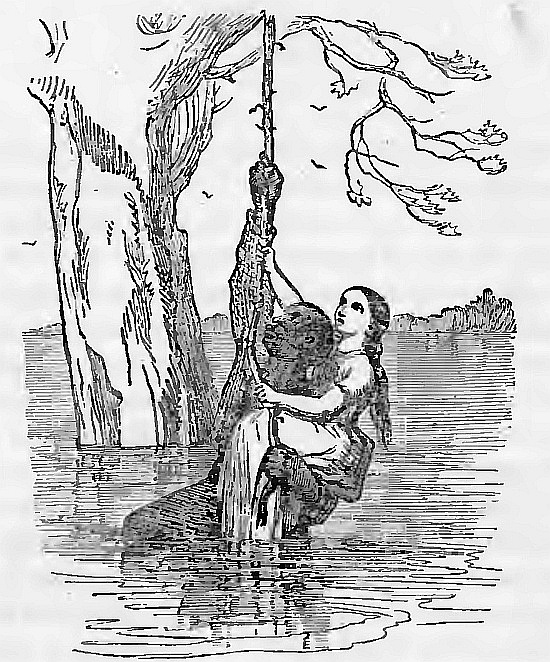
Meanwhile Mozey,—making as much noise as a young whale, blowing like a porpoise, spurting and spitting like an angry cat,—still carrying the child safe on his shoulders, had arrived under the limb, and, with strokes somewhat irregularly given and quickly repeated, was doing his very best to keep himself and her above water. It was evident to all, that the over-weighted swimmer was wellnigh exhausted; and had not the end of the long lliana plumped down in the nick of time, the Mozambique must indubitably have gone to the bottom, taking his charge with him. Just in time, however, the tree-cable came within his clutch, and, seizing it with all his remaining strength, Rosa relieved him of her weight by laying hold herself, and the two were drawn up into the tree amidst cries of “Hold on! hold on!” ending in general congratulation.
Chapter Seventeen.
The Paroquet.
Alas! there was one circumstance that hindered their triumph from being complete. The jararáca was still in the tree. So long as this terrible tenant shared their abode, there could be neither confidence nor comfort. There it lay coiled upon its scaly self, snugly ensconced in the fork below, with skin glittering brightly, and eyes gleaming fiercely in the golden sunlight that now fell slantingly against the tree. How long would the monster remain in this tranquil attitude, was the question that presented itself to the minds of all, as soon as the first transport of their joy had subsided. It was evident it had no intention of taking to the water, though it could have done so without fear. No doubt the sapucaya was its habitual haunt; and it was not likely to forsake it just to accommodate some half-score of strange creatures who had chosen to intrude. Surely some time or other it would re-ascend the tree, and then—?
But all speculations on this point were soon interrupted. The little paroquet, which had shown such excitement on first discovering the snake, had been quiet while all were engaged in the salvage of Mozey and the child. Now that a certain quietness had been restored, the bird was seen returning to the jararáca for the supposed purpose of renewing its impotent attack. For some minutes it kept fluttering over the serpent, now alighting upon a branch, anon springing off again, and descending to one lower and nearer to the jararáca, until it had almost reached its head. Strange to say, there appeared no hostility in the bird’s movements; its actions betrayed rather the semblance of fear, confirmed by the tremulous quivering of its frame whenever it came to rest upon a perch. The spectators’ suspicion was further strengthened by the little creature’s continued cries. It was not the angry chattering by which these birds usually convey their hostility, but a sort of plaintive screaming that betokened terror. At each flight it approached closer to the serpent’s forked tongue, and then retreated, as if vacillating and irresolute.
The reptile meanwhile exhibited itself in a hideous attitude; yet a deep interest enchained the spectators. Its head had broadened, or flattened out to twice the natural dimensions; the eyes seemed to shoot forth twin jets of fire, while the extensile tongue, projected from a double row of white, angular teeth, appeared to shine with phosphorescent flame. The bird was being charmed, and was already under the serpent’s fascination.
How could the pretty pet be saved? Young Ralph, noticing the despair upon his sister’s face, was half inclined to rush down the tree, and give battle to the jararáca; and Tipperary Tom—whose general hostility to snakes and reptiles had a national and hereditary origin—purposed doing something to avert the paroquet’s fast-approaching fate. Trevannion, however, was too prudent to permit any interference, while the negro appeared only anxious that the magic spectacle should reach its termination. It was not cruelty on his part. Mozey had his motives, which were soon after revealed, proving that the brain of the African is at times capable of conception equal, if not superior, to his boasted Caucasian brother. There was no interruption. The end was not far off. By slow degrees, the bird appeared to grow exhausted, until its wings could no longer sustain it. Then, as if paralysed by a final despair, it pitched itself right into the mouth of the reptile, whose jaws had been suddenly extended to receive it! There was a slight flutter of the wings, a tremulous motion of the body, and the self-immolated creature appeared to be dead. The serpent, half uncoiling itself, turned its head towards the tree, and, once more opening its jaws, permitted the now lifeless paroquet to escape from their clasp, and drop quietly into the crotch formed by the forking of the stem.
Chapter Eighteen.
The Lliana Unloosed.
The spectators of this little tragedy of animal life had hitherto prudently refrained from taking part in it. Curiosity now exerted an equal effect in preventing their interference; and without speech or motion they sat on their respective perches to observe the finale of the drama, which evidently had not ended with the death of the paroquet. That was but the beginning of the end, for the prey was yet to be devoured. Though provided with a double row of teeth, it is well-known that animals of the reptile kind do not masticate their food. These teeth, set trenchantly, as is commonly the case, are intended only to capture the living prey, which enters the stomach afterwards by a process termed deglutition. At the spectacle of just such a process, with all its preliminary preparations, were the group in the sapucaya now to be present,—the principal performer being apparently unconscious of, or at all events unconcerned at, their presence.
Having deposited the dead bird in the fork of the tree, the serpent changed its coiled attitude into one that would give it a chance of filling its belly with less inconvenience. There was not room for it to extend itself fully; and, in default of this, the tail was allowed to drop down along the stem of the tree, at least two thirds of the body remaining in a horizontal position. Having arranged itself apparently to its satisfaction, it now directed its attention to the paroquet. Once more taking the dead bird between its teeth, it turned it over and over until the head lay opposite to its own, the body aligned in a longitudinal direction. The jaws of the snake were now widely extended, while the tongue, loaded with saliva, was protruded and retracted with great rapidity. The serpent continued this licking process until the short feathers covering the head of the bird, as also its neck and shoulders, seemed to be saturated with a substance resembling soap or starch. When a sufficient coating had been laid on to satisfy the instincts of the serpent, the creature once more opened its jaws, and, making a sudden gulp, took in the head of the paroquet, with the neck and shoulders. For a time no further action was perceptible. Yet a movement was going on: and it was to assure himself of this that the Mozambique was so attentive.
We have said that he had a motive for permitting the pet to be sacrificed, which was now on the eve of being revealed to his companions. They all saw that there was something upon his mind, and eagerly anticipated the revelation. Just as the jararáca had succeeded in bolting the anterior portion of the paroquet,—that is, the head, neck, and shoulders,—Mozey rose from his seat, stole towards the stem of the tree, and let himself down toward the fork, without saying a word. His purpose, however, was manifest the moment after, for he stretched out his right hand, clutched the jararáca around the small of the neck, and flung the serpent—no longer capable of defending itself—far out into the waters of the Gapo! The monster, with its feathered morsel still in its mouth, sank instantly, to be seen no more; so thought Mozey and his associates in the sapucaya.
But, as the event proved, they had hastened to an erroneous conclusion. Scarce had their triumphant cheer echoed across the silent bosom of the Gapo, when the paroquet was observed floating upon the water; and the snake, having ejected the half-swallowed pill, was once more upon the surface, swimming with sinuous but brisk rendings of its body in rapid return to the tree. The situation seemed more alarming than ever. The fiend himself could hardly have shown a more implacable determination.
To all appearance the jararáca was now returning to take revenge for the insult and disappointment to which it had been subjected. Mozey, losing confidence in his own cunning, retreated up the tree. He perceived, now that it was too late, the imprudence of which he had been guilty. He should have permitted the snake to proceed a step further in the process of deglutition, until the disgorging of the paroquet, against the grain of its feathers, should have become impossible. He had been too hasty, and must now answer the consequences. Sure enough, the serpent returned to the sapucaya and commenced reascending, availing itself of the lliana, by which all of its enemies had effected their ascent. In a few seconds it had mounted into the fork, and, still adhering to the parasite, was continuing its upward way.
“O heavens!” ejaculated Trevannion, “one of us must become the prey of this pitiless monster! What can be done to destroy it?”
“Dar’s a chance yet, Mass’r,” cried Mozey, who had suddenly conceived a splendid thought. “Dar’s a chance yet. All ob you lay hold on de creepin’ vine, an’ pull um out from de tree. We chuck de varmint back into the water. Now den,—all togedder! Pull like good uns!”
As the negro spoke, he seized the lliana, by which the serpent was making its spiral ascent, and put out all his strength to detach it from the trunk of the sapucaya. The others instantly understood his design, and grasping the parasite, with a simultaneous effort tried to tear it off. A quick jerk broke the lliana loose; and the jararáca, shaken from its hold, was sent whirling and writhing through the air, till it fell with a plunging noise upon the water below. Once more a triumphant cheer went up through the sapucaya branches, once more to be stifled ere it had received the answer of its own echoes; for the jararáca was again seen upon the surface, as before, determinedly approaching the tree.
It was a sight for despair. There was something supernatural in the behaviour of the snake. It was a monster not to be conquered by human strength, nor circumvented by human cunning. Was there any use in continuing the attempt to subdue it? Mozey, a fatalist, felt half disposed to submit to a destiny that could not be averted; and even Tipperary Tom began to despair of the power of his prayers to Saint Patrick. The ex-miner, however, as well acquainted with the subterraneous regions as with upper earth, had no superstition to hinder him from action, and, instead of desponding he at once adopted the proper course. Catching hold of the creeper, that had already been loosened from the trunk, and calling upon the others to assist him, he tore the creeper entirely from the tree, flinging its severed stem far out upon the water. In a moment after, the snake came up, intending to climb into the sapucaya, as no doubt it had often done before. We wonder what were its feelings on finding that the ladder had been removed, and that an ascent of the smooth trunk of the sapucaya was no longer possible, even to a tree snake! After swimming round and round, and trying a variety of places, the discomfited jararáca turned away in apparent disgust; and, launching out on the bosom of the Gapo, swam off in the direction of the thicket,—on the identical track that had been taken by Richard and the Mundurucú.
Chapter Nineteen.
Serpent Fascination.
It was some time before Trevannion and his companions in misfortune could recover from the excitement and awe of their adventure. They began to believe that the strange tales told them of the Gapo and its denizens had more than a substratum of truth; for the protracted and implacable hostility shown by the snake, and its mysterious power over the bird, seemed surely supernatural. Trevannion reflected on the singular behaviour of the jararáca. That a reptile of such contemptible dimensions should exhibit so much cunning and courage as to return to the attack after being repeatedly foiled, and by an enemy so far its superior in strength and numbers, together with its hideous aspect, could not fail to impress him with a feeling akin to horror, in which all those around him shared. The very monkeys and birds must have felt it; for when in the presence of snakes, they had never before exhibited such trepidation and excitement. Long after the serpent had been pitched for the second time into the water, the coaita kept up its terrified gibbering, the macaw screamed, and the tiny ouistiti, returning to Rosa’s protection,—no longer to be shared with its late rival,—sat trembling in her lap, as if the dreaded reptile were still within dangerous proximity.
This feeling was but temporary, however. Trevannion was a man of strong intellect, trained and cultivated by experience and education; and after a rational review of the circumstances, he became convinced that there was nothing very extraordinary, certainly nothing supernatural, in what transpired. The jararáca—as he had heard, and as everybody living on the Amazon knew—was one of the most venomous of serpents, if not the most venomous of all. Even the birds and beasts were acquainted with this common fact, and dreaded the reptile accordingly, not from mere instinct, but from actual knowledge possessed and communicated in some mysterious way to one another. This would account for the wild terror just exhibited, which in the case of the paroquet had come to a fatal end. There was a mystery about this for which Trevannion could not account. The power which the serpent appeared to have obtained over the bird, controlling its movements without any apparent action of its own, was beyond comprehension. Whether or not it be entitled to the name given it,—fascination, certainly it is a fact,—one that has been repeatedly observed, and to which not only birds, but quadrupeds, have been the victims; and not only by ordinary observers, but by men skilled in the knowledge of nature, who have been equally at a loss to account for it by natural causes. But this link in the chain of incidents, though mysterious, was not new nor peculiar to this situation. It had been known to occur in all countries and climes, and so soon ceased to excite any weird influence on the mind of Trevannion.
For the other circumstances that had occurred there was an explanation still more natural. The jararáca, peculiarly an inhabitant of the Gapo lands, had simply been sunning itself upon the sapucaya. It may have been prowling about in the water when overtaken by the tornado; and, not wishing to be carried away from its haunt, had sought a temporary shelter in the tree, to which an unlucky chance had guided the galatea. Its descent was due to the behaviour of the birds, which, after having for a time tantalised it,—provoking its spite, and in all likelihood its hungry appetite,—had temporarily suspended their attack, returning down the tree with Ralph and the negro. It was in pursuit of them, therefore, it had forsaken its original perch. The commotion caused by its descent, but more especially the ducking it had received, and the presence of the two human forms in the water below, had induced it to halt in the forking of the tree, where shortly after its natural prey again presented itself,—ending in an episode that was to it an ordinary occurrence. The choking it had received in the hands of the negro, and its unexpected immersion, had caused the involuntary rejection of the half-swallowed morsel. In the opaque water it had lost sight of the bird, and was returning to the sapucaya either in search of its food, or to reoccupy its resting-place.
It is well-known that the jararáca has no fear of man, but will attack him whenever he intrudes upon its domain. The Indians assert that it will even go out of its way for this purpose, unlike the rattlesnake and other venomous reptiles, which rarely exert their dangerous power except in self-defence. So this jararáca reascended the sapucaya undismayed by the human enemies it saw there, one or more of whom might have become its victims but for the timely removal of the lliana ladder.
On this review of facts and fancies, the equanimity of our adventurers was nearly restored. At all events, they were relieved from the horrible thoughts of the supernatural, that for a time held ascendancy over them. Their hunger and thirst again manifested themselves, though little Rosa and her preserver no longer suffered from the last. In their short excursion both had been repeatedly under water, and had swallowed enough to last them for that day at least. Yet they were in want of food, and Ralph once more climbed the tree to obtain it. He soon possessed himself of half a dozen of the huge nut capsules, which were tossed into the hands of those below, and, water being drawn up in one of the emptied shells, a meal was made, which if not hearty, was satisfactory. The group could do no more than await the return of their absent companions; and with eyes fixed intently and anxiously upon the dark water, and beneath the close-growing trees, they watched for the first ripple that might betoken their coming.
Chapter Twenty.
The Water Arcade.
We must leave for a time the castaways in the tree-top, and follow the fortunes of the two swimmers on their exploring expedition.
On reaching the edge of the submerged forest, their first thought was to clutch the nearest branch, and rest themselves by clinging to it. They were no longer in doubt as to the character of the scene that surrounded them, for their experience enabled them to comprehend it.
“The Gapo!” muttered Munday, as they glided in under the shadows. “No dry land here, young master,” he added, clutching hold of a lliana. “We may as well look out for a roost, and rest ourselves. It’s full ten fathoms deep. The Mundurucú can tell that by the sort of trees rising over it.”
“I didn’t expect anything else,” rejoined young Trevannion, imitating his companion by taking hold of a branch and climbing up. “My only hope is that we may find some float timber to ferry the others across. Not that there’s much in it if we do. How we’re to find our way out of this mess is more than either you or I can tell.”
“The Mundurucú never despairs,—not even in the middle of the Gapo,” was the Indian’s proud reply.
“You have hope, then? You think we shall find timber enough for a raft to carry us clear of the inundation.”
“No!” answered the Indian. “We have got too far from the channel of the big river. We shall see no floating trees here,—nothing to make a raft that would carry us.”
“Why then did we come here, if not for the purpose of finding dead timber for that object?”
“Dead timber? No! If that was our errand, we might go back as we’ve come,—empty-handed. We shall float all the people over here without that. Follow me, young master. We must go farther into the Gapo. Let old Munday show you how to construct a raft without trees, only making use of their fruit.”
“Lead on!” cried the Paraense. “I’m ready to assist you; though I haven’t the slightest conception of what you mean to do.”
“You shall see presently, young master,” rejoined Munday, once more spreading himself to swim. “Come on! follow me! If I’m not mistaken, we’ll soon find the materials for a raft,—or something that will answer as well for the present. Come along, there! Come!”—and he launched himself into the water.
Trevannion followed his example, and, once more consigning himself to the flood, he swam on in the Indian’s wake. Through aisles dimmed with a twilight like that of approaching night, along arcades covered with foliage so luxuriant as to be scarce penetrable by the rays of a tropic sun, the two swimmers, the Indian ever in advance, held their way.
To Richard Trevannion the Mundurucú was comparatively a stranger, known only as a tapuyo employed by his uncle in the management of the galatea. He knew the tribe by rumours even more than sinister. They were reputed in Pará to be the most bloodthirsty of savages, who took delight not only in the destruction of their enemies, but in keeping up a ghastly souvenir of hostility by preserving their heads. In the company of a Mundurucú, especially in such a place,—swimming under the sombre shadows of a submerged forest,—it can scarce be wondered at that the youth felt suspicion, if not actual fear. But Richard Trevannion was a boy of bold heart, and bravely awaited the dénouement of the dismal journey.
Their swim terminated at length, and the Indian, pointing to a tree, cried out: “Yonder—yonder is the very thing of which I was in search. Hoo-hoo! Covered with sipos too,—another thing we stand in need of,—cord and pitch both growing together. The Great Spirit is kind to us, young master.”
“What is it?” demanded Richard. “I see a great tree, loaded with climbers as you say. But what of that? It is green, and growing. The wood is full of sap, and would scarce float itself; you can’t construct a raft out of that. The sipos might serve well enough for rope; but the timber won’t do, even if we had an axe to cut it down.”
“The Mundurucú needs no axe, nor yet timber to construct his raft. All he wants here is the sap of that tree, and some of the sipos clinging to its branches. The timber we shall find on the sapucaya, after we go back. Look at the tree, young master! Do you not know it?”
The Paraense, thus appealed to, turned his eyes toward the tree, and scanned it more carefully. Festooned by many kinds of climbing plants, it was not so easy to distinguish its foliage from that of the parasites it upheld; enough of the leaves, however, appeared conspicuous to enable him to recognise the tree as one of the best known and most valuable to the inhabitants, not only of his native Pará, but of all the Amazonian region, “Certainly,” he replied, “I see what sort of tree it is. It’s the Seringa,—the tree from which they obtain caoutchouc. But what do you want with that? You can’t make a raft out of India-rubber, can you?”
“You shall see, young master; you shall see!”
During this conversation the Mundurucú had mounted among the branches of the seringa, calling upon his companion to come after him, who hastily responded to the call.
Chapter Twenty One.
The Syringe-Tree.
The tree into whose top the swimmers had ascended was, as Richard had rightly stated, that from which the caoutchouc, or India-rubber, is obtained. It was the Siphonia elastica, of the order Euphorbiaceae, of the Amazonian valley. Not that the Siphonia is the only tree which produces the world-renowned substance, which has of late years effected almost a revolution in many arts, manufactures, and domestic economies of civilised life. There are numerous other trees, both in the Old and New World, most of them belonging to the famed family of the figs, which in some degree afford the caoutchouc of commerce. Of all, however, that yielded by the Siphonia elastica is the best, and commands the highest price among dealers. The young Paraense called it Seringa, and this is the name he had been accustomed to hear given to it. Seringa is simply the Portuguese for syringe, and the name has attached itself to the tree, because the use which the aborigines were first observed to make of the elastic tubes of the caoutchouc was that of squirts or syringes, the idea being suggested by their noticing the natural tubes formed by the sap around twigs, when flowing spontaneously from the tree. For syringes it is employed extensively to this day by Brazilians of all classes, who construct them by moulding the sap, while in its fluid state, into pear-shaped bottles, and inserting a piece of cane in the long neck.
The caoutchouc is collected in the simplest way, which affords a regular business to many Amazonians, chiefly native Indians, who dispose of it to the Portuguese or Brazilian traders. The time is in August, when the subsidence of the annual inundation permits approach to the trees; for the Seringa is one of those species that prefer the low flooded lands, though it is not altogether peculiar to the Gapo. It grows throughout the whole region of the Amazon, wherever the soil is alluvial and marshy. The India-rubber harvest, if we may use the term, continues throughout the dry months, during which time very large quantities of the sap are collected, and carried over to the export market of Pará. A number of trees growing within a prescribed circle are allotted to each individual, whose business it is—man, woman, or boy—to attend to the assigned set of trees; and this is the routine of their day’s duty.
In the evening the trees are tapped; that is, a gash or incision is made in the bark,—each evening in a fresh place,—and under each is carefully placed a little clay cup, or else the shell of an Ampullasia, to catch the milky sap that oozes from the wound. After sunrise in the morning, the “milkers” again revisit the scene of operations, and empty all the cups into a large vessel, which is carried to one common receptacle. By this time the sap, which is still of a white colour, is of the consistency of cream, and ready for moulding. The collectors have already provided themselves with moulds of many kinds, according to the shape they wish the caoutchouc to assume, such as shoes, round balls, bottles with long necks, and the like. These are dipped into the liquid, a thin stratum of which adheres to them, to be made thicker by repeated immersions, until the proper dimensions are obtained. After the last coat has been laid on, lines and ornamental tracings are made upon the surface, while still in a soft state; and a rich brown colour is obtained by passing the articles repeatedly through a thick black smoke, given out by a fire of palm-wood,—several species of these trees being specially employed for this purpose. As the moulds are usually solid substances, and the shoes, balls, and bottles are cast on, and not in them, it may be wondered how the latter can be taken off, or the former got out. King George would have been as badly puzzled about this, as he was in regard to the apples in the pudding. The idea of the Amazonian aboriginal, though far more ingenious, is equally easy of explanation. His bottle-moulds are no better than balls of dried mud, or clay; and so too, the lasts upon which he fashions the India-rubber shoes. Half an hour’s immersion in water is sufficient to restore them to their original condition of soft mud; when a little scraping and washing completes the manufacture, and leaves the commodity in readiness for the merchant and the market.
The Seringa is not a tree of very distinguished appearance, and but for its valuable sap might be passed in a forest of Amazonia, where so many magnificent trees meet the eye, without eliciting a remark. Both in the colour of its bark and the outline of its leaves it bears a considerable resemblance to the European ash,—only that it grows to a far greater size, and with a stem that is branchless, often to the height of thirty or forty feet above the ground. The trunk of that on which the Mundurucú and his companion had climbed was under water to that depth, else they could not so easily have ascended. It was growing in its favourite situation,—the Gapo,—its top festooned, as we have said, with scores of parasitical plants, of many different species, forming a complete labyrinth of limbs, leaves, fruits, and flowers.
Chapter Twenty Two.
A Battle with Birds.
Scarce had the Paraense succeeded in establishing himself on the tree, when an exclamation from his companion, higher up among the branches, caused him to look aloft. “Hoo-hoo!” was the cry that came from the lips of the Mundurucú, in a tone of gratification.
“What is it, Munday?”
“Something good to eat, master?”
“I’m glad to hear it. I feel hungry enough in all conscience; and these sapucaya nuts don’t quite satisfy me. I’d like a little fish or flesh meat along with them.”
“It’s neither,” rejoined the Indian. “Something as good, though. It’s fowl! I’ve found an arara’s nest.”
“O, a macaw! But where is the bird? You haven’t caught it yet?”
“Haven’t I?” responded the Mundurucú, plunging his arm elbow-deep into a cavity in the tree-trunk; and dragging forth a half-fledged bird, nearly as big as a chicken. “Ah, a nest! young ones! Fat as butter too!”
“All right. We must take them back with us. Our friends in the sapucaya are hungry as we, and will be right glad to see such an addition to the larder.”
But Richard’s reply was unheard; for, from the moment that the Mundurucú had pulled the young macaw out of its nest, the creature set up such a screaming and flopping of its half-fledged wings, as to fill all the woods around. The discordant ululation was taken up and repeated by a companion within the cavity; and then, to the astonishment of the twain, half a score of similar screaming voices were heard issuing from different places higher up in the tree, where it was evident there were several other cavities, each containing a nest full of young araras.
“A regular breeding-place, a macaw-cot,” cried Richard, laughing as he spoke. “We’ll get squabs enough to keep us all for a week!”
The words had scarce passed his lips, when a loud clangour reverberated upon the air. It was a confused mixture of noises,—a screaming and chattering,—that bore some resemblance to the human voice; as if half a score of Punches were quarrelling with as many Judys at the same time. The sounds, when first heard, were at some distance; but before twenty could have been counted, they were uttered close to the ears of the Mundurucú, who was highest up, while the sun became partially obscured by the outspread wings of a score of great birds, hovering in hurried flight around the top of the seringa. There was no mystery about the matter. The new-comers were the parents of the young macaws—the owners of the nests—returning from a search for provender for their pets, whose piercing cries had summoned them in all haste to their home. As yet, neither the Indian nor his young companion conceived any cause for alarm. Foolish indeed to be frightened by a flock of birds! They were not allowed to indulge long in this comfortable equanimity; for, almost on the moment of their arrival above the tree, the united parentage of araras plunged down among the branches, and, with wing, beak, and talons, began an instant and simultaneous attack upon the intruders. The Indian was the first to receive their onset. Made in such a united and irresistible manner, it had the effect of causing him to let go the chick, which fell with a plunge into the water below. In its descent it was accompanied by half a dozen of the other birds,—its own parents, perhaps, and their more immediate friends,—and these, for the first time espying a second enemy farther down, directed their attack upon him. The force of the assailants was thus divided; the larger number continued their onslaught upon the Indian, though the young Paraense at the same time found his hands quite full enough in defending himself, considering that he carried nothing in the shape of a weapon, and that his body, like that of his comrade, was altogether unprotected by vestments. To be sure, the Mundurucú was armed with a sharp knife, which he had brought along with him in his girdle; but this was of very little use against his winged enemies; and although he succeeded in striking down one or two of them, it was done rather by a blow of the fist than by the blade.
In a dozen seconds both had received almost as many scratches from the beaks and talons of the birds, which still continued the combat with a fury that showed no signs of relaxation or abatement. The Paraense did not stay either to take counsel or imitate the example of his more sage companion, but, hastily bending down upon the limb whereon he had been maintaining the unequal contest, he plunged headforemost into the water. Of course a “header” from such a height carried him under the surface; and his assailants, for the moment missing him, flew back into the tree-top, and joined in the assault on Munday. The latter, who had by this become rather sick of the contest, thinking of no better plan, followed his comrade’s example. Hastily he flung himself into the flood, and, first diving below the surface, came up beside the Paraense, and the two swam away side by side in silence, each leaving behind him a tiny string of red; for the blood was flowing freely from the scratches received in their strange encounter.
Chapter Twenty Three.
A Contest with Cudgels.
Our discomfited adventurers did not swim far from the seringa, for the birds did not follow them. Satisfied with seeing the burglars fairly beyond the boundaries of their domicile, the tenants of the tree returned to their nests, as if to ascertain what amount of damage had been done. In a short time the commotion had almost subsided, though there was heard an occasional scream,—the wail of the bereaved parents; for the helpless squab, after struggling a while on the surface of the water, had gone suddenly out of sight. There was no danger, therefore, of further molestation from their late assailants, so long as they should be left in quiet possession of the seringa, and therefore there was no further necessity for the two swimmers to retreat. A new intention had shaped itself in Munday’s mind by this time, and he expressed his determination to return, to the surprise of the youth, who asked his purpose.
“Partly the purpose for which we first climbed it, and partly,” added he, with an angry roll of his almond-shaped eyes, “to obtain revenge. A Mundurucú is not to be bled in this fashion, even by birds, without drawing blood in return. I don’t go out from this igarápe till I’ve killed every arara, old as well as young, in that accursed tree, or chased the last of them out of it. Follow, and I’ll show you how.”
The Indian turned his face towards the thicket of tree-tops forming one side of the water arcade, and with a stroke or two brought himself within reach of some hanging parasites, and climbed up, bidding Richard follow. Once more they were shut in among the tops of what appeared to be a gigantic mimosa. “It will do,” muttered the Mundurucú drawing his knife and cutting a stout branch, which he soon converted into a cudgel of about two feet in length. This he handed to his companion, and then, selecting a second branch of still stouter proportions, fashioned a similar club for himself.
“Now,” said he, after having pruned the sticks to his satisfaction, “we’re both armed, and ready to give battle to the araras, with a better chance of coming off victorious. Let us lose no time. We have other work to occupy us, and your friends will be impatient for our return.” Saying this, he let himself down into the water, and turned towards the seringa. His protégé made no protest, but followed instantly after. Tightly clutching their cudgels, both reascended the seringa, and renewed the battle with the birds. The numbers were even more unequal than before; but this time the advantage was on the side of the intruders.
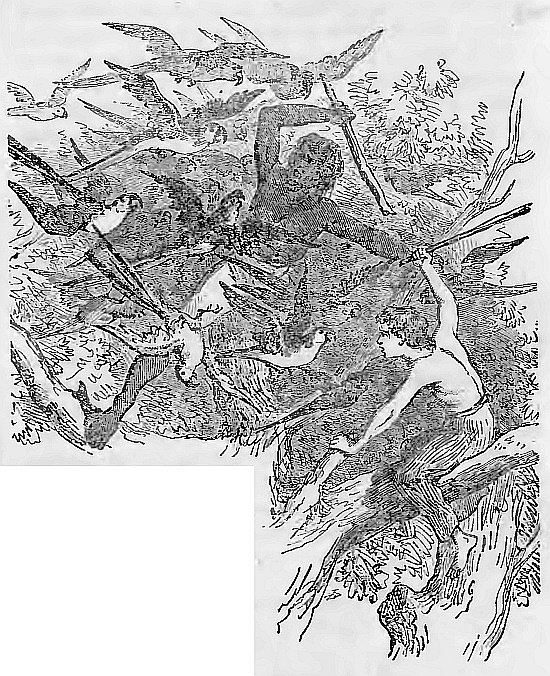
Striking with their clubs of heavy acacia-wood, the birds fell at every blow, until not one arara fluttered among the foliage. Most of these had fallen wounded upon the water; a few only, seeing certain destruction before them, took flight into the far recesses of the flooded forest. The Mundurucú, true to his promise, did not leave a living bird upon the tree.
One after another, he hauled the half-fledged chicks from their nests; one after another, twisted their necks; and then, tying their legs together with a sipo, he separated the bunch into two equally-balanced parts, hanging it over a limb of the tree. “They can stay there till ee come back, which will be soon. And now let us accomplish the purpose for which we came here!” Laying aside the club that had made such havoc among the macaws, he drew the knife from his girdle. Selecting a spot on one of the larger limbs of the seringa, he made an incision in the bark, from which the milky juice immediately flowed.
He had made provision against any loss of the precious fluid in the shape of a pair of huge monkey-pots, taken from a sapucaya while on the way, and which had been all the while lying in their place of deposit in a network of parasites. One of these he gave Richard, to hold under the tap while he made a second incision upon a longer limb of the seringa. Both nutshells were quickly filled with the glutinous juice, which soon began to thicken and coagulate like rich cream. The lids were restored to their places, and tied on with sipos, and then a large quantity of this natural cordage was collected and made up into a portable shape. This accomplished, the Mundurucú signified his intention of returning to the castaways; and, after apportioning part of the spoil to his companion, set out on the way they had come. The young Paraense swam close in his wake, and in ten minutes they had re-traversed the igarápe, and saw before them the bright sun gilding the Gapo at its embouchure, that appeared like the mouth of some subterraneous cavern.
Chapter Twenty Four.
Chased by a Jacaré.
A few more strokes would have carried the swimmers clear of the water arcade. Richard was already congratulating himself on the prospect of escaping from the gloomy shadow, when all at once his companion started, raised his head high above the surface, and gazed backward along the dark arcade. As he did so, an exclamation escaped him, which only could be one of alarm. “A monster!” cried the Mundurucú.
“A monster! What sort? where?”
“Yonder,—just by the edge of the igarápe,—close in to the trees,—his body half hid under the hanging branches.”
“I see something like the trunk of a dead tree, afloat upon the water. A monster you say, Munday? What do you make it out to be?”
“The body of a big reptile,—big enough to swallow us both. It’s the Jacaré-uassú. I heard its plunge. Did not you?”
“I heard nothing like a plunge, except that made by ourselves in swimming.”
“No matter. There was such a noise but a moment ago. See! the monster is again in motion. He is after us!”
The dark body Richard had taken for the drifting trunk of a tree was now in motion, and evidently making direct for himself and his companion. The waves, undulating horizontally behind it, proclaimed the strokes of its strong, vertically flattened tail, by which it was propelled through the water.
“The jacaré-uassú!” once more exclaimed the Mundurucú, signifying that the reptile was the great alligator of the Amazon.
It was one of the largest size, its body showing full seven yards above the water, while its projecting jaws, occasionally opened in menace or for breath, appeared of sufficient extent to swallow either of the swimmers.
It was idle for them to think of escaping through the water. At ease as they both were in this element, they would have proved but clumsy competitors with a cayman, especially one of such strength and natatory skill as belong to the huge reptile in pursuit of them. Such a swimming-match was not to be thought of, and neither entertained the idea of it.
“We must take to the trees!” cried the Indian, convinced that the alligator was after them. “The Great Spirit is good to make them grow so near. It’s the only chance we have for saving our lives. To the trees, young master,—to the trees!”
As he spoke, the Mundurucú faced towards the forest; and, with quick, energetic strokes, they glided under the hanging branches. Most nimbly they climbed the nearest, and, once lodged upon a limb, were safe; and on one of the lowest they “squatted,” to await the approach of the jacaré. In about three seconds the huge saurian came up, pausing as it approached the spot where the two intended victims had ascended out of its reach. It seemed more than surprised,—in fact, supremely astonished; and for some moments lay tranquil, as if paralysed by its disappointment. This quietude, however, was of short duration; for soon after, as if conscious of having been tricked, it commenced quartering the water in short diagonal lines, which every instant was lashed into foam by a stroke of its powerful tail.
“Let us be grateful to the Great Spirit!” said the Indian, looking down from his perch upon the tree. “We may well thank him for affording us a safe refuge here. It’s the jacaré-uassú, as I said. The monster is hungry, because it’s the time of flood, and he can’t get food so easily. The fish upon which he feeds are scattered through the Gapo, and he can only catch them by a rare chance. Besides, he has tasted our blood. Did you not see him sup at it as he came up the igarápe? He’s mad now, and won’t be satisfied till he obtains a victim,—a man if he can, for I can tell by his looks he’s a man-eater.”
“A man-eater! What mean you by that?”
“Only that this jacaré has eaten men, or women as likely.”
“But how can you tell that?”
“Thus, young master. His bigness tells me of his great age. He has lived long, and in his time visited many places. But what makes me suspect him to be a man-eater is the eagerness with which he pursued us, and the disappointment he shows at not getting hold of us. Look at him now!”
Certainly there was something peculiar both in the appearance and movements of the jacaré. Young Trevannion had never seen such a monster before, though alligators were plenteous around Pará, and were no rare sight to him. This one, however, was larger than any he had ever seen, more gaunt or skeleton-like in frame, with a more disgusting leer in its deep-sunken eyes, and altogether more unearthly in its aspect. The sight of the hidden saurian went far to convince him that there was some truth in the stories of which he had hitherto been sceptical. After all, the Gapo might contain creatures fairly entitled to the appellation of “monsters.”
Chapter Twenty Five.
A Saurian Digression.
It would be difficult to conceive a more hideous monster than this upon which Richard Trevannion and his comrade gazed. In fact, there is no form in nature—scarce even in the imagination—more unpleasing to the eye than that of the lizard, the serpent’s shape not excepted. The sight of the latter may produce a sensation disagreeable and akin to fear; but the curving and graceful configuration, either at rest or in motion, and the smooth, shining skin, often brilliantly coloured in beautiful patterns, tend to prevent it from approaching the bounds of horror. With the saurian shape it is different. In it we behold the type of the horrible, without anything to relieve the unpleasant impression. The positive, though distant, resemblance to the human form itself, instead of making the creature more seemly, only intensities the feeling of dread with which we behold it. The most beautiful colouring of the skin, and the gentlest habits, are alike inefficacious to remove that feeling. You may look upon the tree-lizard, clothed in a livery of the most vivid green; the Anolidae, in the bright blue of turquoise, in lemon and orange; you may gaze on the chameleon when it assumes its most brilliant hues,—but not without an instinctive sense of repugnance. True, there are those who deny this, who profess not to feel it, and who can fondle such pets in their hands, or permit them to play around their necks and over their bosoms. This, however, is due to habit, and long, familiar acquaintance.
Since this is so with the smaller species of the lizard tribe, even with those of gay hues and harmless habits, what must it be with those huge saurians that constitute the family of the Crocodilidae, all of which, in form, colour, habits, and character, approach the very extreme of hideousness. Of these gigantic reptiles there is a far greater variety of species than is generally believed,—greater than is known even to naturalists. Until lately, some three or four distinct kinds, inhabiting Asia, Africa, and America, were all that were supposed to exist. Recent exploration reveals a very different condition, and has added many new members to the family of the Crocodilidae.
It would be safe to hazard a conjecture, that, when the world of nature becomes better known, the number of species of these ugly amphibia, under the various names of gavials, crocodiles, caymans, and alligators, all brothers or first-cousins, will amount to two score. It is the very close resemblance in appearance and general habits that has hitherto hindered these different kinds from being distinguished. Their species are many; and, if you follow the naturalists of the anatomic school, so too are the genera; for it pleases these sapient theorists to found a genus on almost any species,—thus confounding and rendering more difficult the study it is their design to simplify. In the case of the Crocodilidae such subdivision is absolutely absurd; and a single genus—certainly two at the most—would suffice for all purposes, practical or theoretical. The habits of the whole family—gavials and alligators, crocodiles, caymans, and jacarés—are so much alike, that it seems a cruelty to separate them. It is true the different species attain to very different sizes; some, as the curúa, are scarce two feet in length, while the big brothers of the family, among the gavials, crocodiles, and alligators, are often ten times as long.
It is impossible to say how many species of Crocodilidae inhabit the waters of the South American continent. There are three in the Amazon alone; but it is quite probable that in some of its more remote tributaries there exist other distinct species, since the three above mentioned do not all dwell in the same portion of this mighty stream. The Amazonian Indians speak of many more species, and believe in their existence. No doubt the Indians are right.
In the other systems of South American waters, as those of the La Plata, the Orinoco, and the Magdalena, species exist that are not known to the Amazon. Even in the isolated water deposits of Lake Valencia Humboldt discovered the bava, a curious little crocodile not noted elsewhere. The three Amazonian reptiles, though having a strong resemblance in general aspect, are quite distinct as regards the species. In the curious and useful dialect of that region, understood alike by Indians and Portuguese, they are all called “Jacarés,” though they are specifically distinguished as the Jacaré-uassú the Jacaré-tinga, and the Jacaré-curúa. Of the first kind was that which had pursued the two swimmers, and it was one of the largest of its species, full twenty-five feet from the point of its bony snout to the tip of its serrated tail. No wonder they got out of its way!
Chapter Twenty Six.
Treed by an Alligator.
For a time the two refugees were without fear or care. They knew they were out of reach, and, so long as they kept to their perch, were in no danger. Had it been a jaguar instead of a jacaré, it would have been another thing; but the amphibious animal could not crawl up the trunk of a tree, nor yet ascend by the hanging limbs or llianas. Their only feeling was that of chagrin at being stopped on their way back to their companions in the sapucaya, knowing that their return would be impatiently expected. They could by shouting have made themselves heard, but not with sufficient distinctness to be understood. The matted tree-tops intervening would have prevented this. They thought it better to be silent, lest their shouts might cause alarm. Richard hoped that the alligator would soon glide back to the haunt whence it had sallied, and leave them at liberty to continue their journey, but the Mundurucú was not so sanguine.
There was something in the behaviour of the jacaré he did not like, especially when he saw it quartering the water as if in search of the creatures that had disappeared so mysteriously.
“Surely it won’t lie in wait for us?” was the first question put by his companion. “You don’t think it will?”
“I do, young master, I do. That is just what troubles the Mundurucú. He may keep us here for hours,—perhaps till the sun goes down.”
“That would be anything but pleasant,—perhaps more so to those who are waiting for us than to ourselves. What can we do?”
“Nothing at present. We must have patience, master.”
“For my part, I shall try,” replied the Paraense; “but it’s very provoking to be besieged in this fashion,—separated by only a few hundred yards from one’s friends, and yet unable to rejoin or communicate with them.”
“Ah! I wish the Curupira had him. I fear the brute is going to prove troublesome. The Mundurucú can read evil in his eye. Look! he has come to a stand. He sees us! No knowing now when he will grow tired of our company.”
“But has it sense enough for that?”
“Sense! Ah! cunning, master may call it, when he talks of the jacaré. Surely, young master, you know that,—you who are a Paraense born and bred? You must know that these reptiles will lie in wait for a whole week by a bathing-place, watching for a victim,—some helpless child, or even a grown man, who has been drinking too much cashaca. Ah yes! many’s the man the jacaré has closed his deadly jaws upon.”
“Well, I hope this one won’t have that opportunity with us. We mustn’t give it.”
“Not if we can help it,” rejoined the Indian. “But we must be quiet, young master, if we expect to get out of this fix in any reasonable time. The jacaré has sharp ears, small though they look. He can hear every word we are saying; ay, and if one were to judge by the leer in his ugly eye, he understands us.”
“At all events, it appears to be listening.”
So the conversation sank to silence, broken only by an occasional whisper, and no gesture even made communication, for they saw the leering look of the reptile fixed steadily upon them. Almost two hours passed in this tantalising and irksome fashion.
The sun had now crossed the meridian line, and was declining westward. The jacaré had not stirred from the spot. It lay like a log upon the water, its lurid eyes alone proclaiming its animation. For more than an hour it had made no visible movement, and their situation was becoming insupportable.
“But what can we do?” asked Richard, despairingly.
“We must try to travel through the tree-tops, and get to the other side. If we can steal out of his sight and hearing, all will be well. The Mundurucú is angry with himself; he didn’t think of this before. He was fool enough to hope the jacaré would get tired first. He might have known better, since the beast has tasted blood. That or hunger makes him such a stanch sentinel. Come, young master!” added the Indian, rising from his seat, and laying hold of a branch. “We must make a journey through the tree-tops. Not a word,—not a broken bough if you can help it. Keep close after me; watch what I do, and do you exactly the same.”
“All right, Munday,” muttered the Paraense. “Lead on, old boy! I’ll do my best to follow you.”
Chapter Twenty Seven.
An Aqua-Arboreal Journey.
It may appear strange, incredible, absurd, that such a journey, for however short a distance, should have been attempted by human beings. No doubt to many it will appear so, and be set down as ludicrously improbable. Twenty minutes passed in the shadowy gloom of a South American forest would strip the idea of travelling among the tree-tops of much of its improbability. In many places such a feat is quite possible, and comparatively easy,—perhaps not so “easy as rolling off a log,” but almost as much so as climbing to the top of one. In the great montaña of the Amazon there are stretches of forest, miles in extent, where the trees are so matted and interlaced as to form one continuous “arbour,” each united to its immediate neighbours by natural stays and cables, to which the meshes formed by the rigging of a ship are as an open network in comparison. In the midst of this magnificent luxuriance of vegetable life, there are birds, beasts, and insects that never set foot upon the ground;—birds in a vast variety of genera and species; beasts—I mean quadrupeds—of many different kinds; insects of countless orders; quadrumana that never touched terra firma with any of their four hands; and, I had almost added, man. He, too, if not exclusively confining himself to the tops of these forest-trees, may make them habitually his home, as shall be seen in the sequel.
It was no great feat, then, for the Mundurucú and his acolyte to make a short excursion across the “spray” of the forest, since this is the very timber that is so tied together. There was even less of danger than in a tract of woods growing upon the highlands or “Campos.” A fall into the Gapo could only entail a ducking, with a brief interruption of the journey.
It does not follow that their progress must be either swift or direct. That would depend upon the character of the trees and their parasites,—whether the former grew close together, and whether the latter were numerous and luxuriant, or of scanty growth. To all appearance, Nature in that spot had been beneficent, and poured forth her vegetable treasures profusely.
The Indian, glancing through the branches, believed there would be no more difficulty in getting to the other side of the belt of timber that separated them from the open water, than in traversing a thicket of similar extent. With this confidence he set forth, followed by his less experienced companion. Both began and continued their monkey-like march in the most profound silence.
They knew that it was possible and easy for the alligator to bear them company; for although they were forced to pass through an almost impervious thicket, down on the water it was altogether different. There was nothing to impede the progress of the saurian, huge as it was, except the trunks of the trees.
To tell the truth, it was a toilsome trip, and both the travellers were weary of it long before coming within sight of the open water on the opposite side. Often were they compelled to carry their own weight on the strength of their arms, by hoisting themselves from tree to tree. Many a détour had they to make, sometimes on account of the impenetrable network of creepers, and sometimes because of open water, that, in pools, interrupted their route.
The distance to be traversed was not over two hundred yards. At starting they knew not how far, but it proved about this measure. If they had made their calculation according to time, they might have estimated it at half a score of miles. They were a good hour and a half on the journey; but the delay, with all its kindred regrets, was forgotten, when they saw the open water before them, and soon after found themselves on the selvage of the submerged forest.
Chapter Twenty Eight.
A Timely Warning.
On arriving among the outside frees, our explorers, homeward bound, saw something to cheer them,—something besides the bright sun and the shining waters of the Gapo. It was the sapucaya, still bearing its stupendous fruit, the friends they had left behind them. The Paraense appeared to be counting them, as if to make sure that all were still safe upon the tree. Perhaps he was only intent on the discovery of one, or, having discovered, was feeding his eyes upon her form, slender and graceful in the distance. He would have shouted to apprise them of the safety of himself and companion, had not a sign from the latter, accompanied by a few muttered words, counselled him to hold his peace.
“Why not, Munday?”
“Not a word, young master. We are not yet out of the woods; the jacaré may hear us.”
“We left it far behind in the igarápe.”
“Ah, true! Who knows where he may be now? Not the Mundurucú. The monster may have followed us. Who knows? He may be at this moment within twenty yards, waiting for us to come back into the water.”
As he spoke, the Indian looked anxiously behind him. He could discover no cause of alarm. All was still under the shadow of the trees. Not even a ripple could be seen upon the sombre surface of the water.
“I think we’ve given it the slip,” remarked Richard.
“It looks so,” responded the Indian. “The Mundurucú hears no sound, sees no sign. The jacaré should still be in the igarápe.”
“Why should we delay any longer? Several hours have elapsed since we left the sapucaya. My uncle and everybody else will be out of all patience. They will be distracted with sheer anxiety. They look as if they were. Though we have a good view of them, I don’t suppose they see us. If they did, they would be hailing us, that’s certain. Let us take to the water, and rejoin them.”
The Mundurucú, after looking once more to the rear, and listening for a few moments, replied, “I think we may venture.”
This was the cue for young Trevannion, and, lowering himself from the limb on which he was supported, the two almost at the same instant committed themselves to the flood. Scarce had they touched the water when their ears were assailed by a shout that came pealing across the Gapo. It neither startled nor surprised them, for they could not fail to comprehend its meaning. It was a cheer sent forth from the sapucaya, announcing their reappearance to the eyes of their anxious companions. Stimulated by the joyous tones, the two swimmers struck boldly out into the open water.
Richard no longer thought of looking behind him. In a hasty glance directed towards the sapucaya, as he rose after his first plunge upon the water, he had seen something to lure him on, at the same time absorbing all his reflections. He had seen a young girl, standing erect within the fork of the tree, throw up her arms as if actuated by some sudden transport of joy. What could have caused it but the sight of him?
The mind of the Mundurucú was far differently employed. His thoughts were retrospective, not prospective. So, too, were his glances. Instead of looking forward to inquire what was going on among the branches of the sapucaya, he carried his beardless chin upon his shoulder, keeping his eyes and ears keenly intent to any sight or sound that might appear suspicious behind him. His caution, as was soon proved, was neither unnatural nor superfluous, nor yet the counsel given to his companion to swim as if some swift and terrible pursuer were after him; for although the Indian spoke from mere conjecture, his words were but too true.
The swimmers had traversed about half the space of open water that lay between the sapucaya and the submerged forest. The Indian had purposely permitted himself to fall into the wake of his companion, in order that his backward view might be unobstructed. So far, no alligator showed itself behind them, no enemy of any kind; and in proportion as his confidence increased, he relaxed his vigilance. It seemed certain the jacaré had given up the chase. It could not have marked their movements among the tree-tops, and in all likelihood the monster was still keeping guard near the opening of the igarápe. Too happy to arrive at this conclusion, the Indian ceased to think of a pursuit, and, after making an effort, overtook the young Paraense, the two continuing to swim abreast. As there no longer appeared any reason for extraordinary speed, the swimmers simultaneously suspended the violent exertions they had been hitherto making, and with relaxed stroke kept on towards the sapucaya.
It was fortunate for both that other eyes than their own were turned upon that stretch of open water. Had it not been so, the silent swimmer, far swifter than they, coming rapidly up in their rear, might have overtaken them long before reaching the tree. The shout sent forth from the sapucaya, in which every voice bore a part, warned them of some dread danger threatening near. But for late experience, they might not have known on which side to look for it; but, guided by this, they instinctively looked back. The jacaré, close behind, was coming on as fast as his powerful tail, rapidly oscillating from side to side, could propel him. It was fortunate for the two swimmers they had heard that warning cry in time. A score of seconds made all the difference in their favour, all the difference between life and death. It was their destiny to live, and not die then in the jaws of the jacaré. Before the ugly reptile, making all the speed in its power, could come up with either of them, both, assisted by willing hands, had climbed beyond its reach, and could look upon it without fear from among the branches of the sapucaya.
Chapter Twenty Nine.
Improvised Swimming-Belts.
The huge saurian swam on to the tree,—to the very spot where Richard and the Mundurucú had climbed up, at the forking of the stem. On perceiving that its prey had for a second time got clear, its fury seemed to break all bounds. It lashed the water with its tail, closed its jaws, with a loud clattering, and gave utterance to a series of sounds, that could only be compared to a cross between the bellowing of a bull and the grunting of a hog.
Out in the open light of the sun, and swimming conspicuously upon the surface of the water, a good view of the reptile could now be obtained; but this did not improve the opinion of it already formed by Richard. It looked, if possible, uglier than when seen in shadow; for in the light the fixed leer of its lurid eye, and the ghastly blood-coloured inside of the jaws, at intervals opened, and showing a triple row of terrible teeth, were more conspicuous and disgusting. Its immense bulk made it still more formidable to look upon. Its body was full eight yards in length, and of proportionate thickness,—measuring around the middle not less than a fathom and a half; while the lozenge-like protuberances along its spine rose in pointed pyramids to the height of several inches.
No wonder that little Rosa uttered a shriek of terror on first beholding it; no wonder that brave young Ralph trembled at the sight. Even Trevannion himself, with the negro and Tipperary Tom, regarded the reptile with fear. It was some time before they felt sure that it could not crawl up to them. It seemed for a time as if it meant to do so, rubbing its bony snout against the bark, and endeavouring to clasp the trunk with its short human-like arms. After several efforts to ascend, it apparently became satisfied that this feat was not to be performed, and reluctantly gave up the attempt; then, retreating a short distance, began swimming in irregular circles around the tree, all the while keeping its eye fixed upon the branches.
After a time, the castaways only bent their gaze upon the monster at intervals, when some new manoeuvre attracted their notice. There was no immediate danger to be dreaded from it; and although its proximity was anything but pleasant, there were other thoughts equally disagreeable, and more important, to occupy their time and attention. They could not remain all their lives in the sapucaya; and although they knew not what fortune awaited them in the forest, beyond, they were all anxious to get there.
Whether it was altogether a flooded forest, or whether there might not be some dry land in it, no one could tell. In the Mundurucú’s opinion it was the former: and in the face of this belief, there was not much hope of their finding a foot of dry land. In any case, the forest must be reached, and all were anxious to quit their quarters on the sapucaya, under the belief that they would find others more comfortable. At all events, a change could not well be for the worse.
Munday had promised them the means of transport, but how this was to be provided none of them as yet knew. The time, however, had arrived for him to declare his intentions, and this he proceeded to do; not in words, but by deeds that soon made manifest his design.
It will be remembered that, after killing the macaws, he had tapped the seringa, and “drawn” two cups full of the sap,—that he had bottled it up in the pots, carefully closing the lids against leakage. It will also be remembered, that he had provided himself with a quantity of creepers, which he had folded into a portable bundle. These were of a peculiar sort,—the true sipos of the South American forest, which serve for all purposes of cordage, ropes ready made by the hand of Nature. On parting from the seringa, he had brought these articles along with him, his companion carrying a share of the load. Though chased by the jacaré, and close run too, neither had abandoned his bundle,—tied by sipos around the neck,—and both the bottled caoutchouc and the cordage were now in the sapucaya. What they were intended for no one could guess, until it pleased the Indian to reveal his secret; and this he at length did, by collecting a large number of nuts from the sapucaya,—Ralph and Richard acting as his aides,—emptying them of their three-cornered kernels, restoring the lids, and then making them “water-proof” by a coating of the caoutchouc.
Soon all became acquainted with his plans, when they saw him bind the hollow shells into bunches, three or four in each, held together by sipos, and then with a stronger piece of the same parasite attach the bunches two and two together, leaving about three feet of the twisted sipos between.
“Swimming-belts!” cried Ralph, now for the first time comprehending the scheme. Ralph was right. That was just what the Mundurucú had manufactured,—a set of swimming-belts.
Chapter Thirty.
Alligator Lore.
For an hour the castaways remained in the tree, chafing with impatience and chagrin that their awful enemy still kept his savage watch for them in the Gapo below, gliding lazily to and fro, but ever watching them with eager, evil eye. But there was no help for it; and by way of possessing their souls in more patience, and making time pass quicker, they fell to conversing on a subject appropriate to the occasion, for it was the jacaré itself, or rather alligators in general. Most of the questions were put by Trevannion, while the answers were given by the Mundurucú, whose memory, age, and experience made him a comprehensive cyclopaedia of alligator lore.
The Indian, according to his own account, was acquainted with live or six different kinds of jacaré. They were not all found in one place, though he knew parts of the country where two or three kinds might be found dwelling in the same waters; as, for instance, the jacaré-uassú (great alligator), the same as was then besieging them, and which is sometimes called the black jacaré, might often be seen in the same pool with the jacaré-tinga, or little alligator. Little jacaré was not an appropriate name for this last species. It was four feet long when full grown, and he knew of others, as the jacaré-curúa, that never grew above two. These kinds frequented small creeks, and were less known than the others, as it was only in certain places they were found. The jacarés were most abundant in the dry season. He did not suppose they were really more numerous, only that they were then collected together in the permanent lakes and pools. Besides, the rivers were then lower, and as there was less surface for them to spread over, they were more likely to be seen. As soon as the echente commenced, they forsook the channels of the rivers, as also the standing lakes, and wandered all over the Gapo. As there was then a thousand times the quantity of water, of course the creatures were more scattered, and less likely to be encountered. In the vasante he had seen half-dried lakes swarming with jacarés, as many as there would be tadpoles in a frog-pond. At such times he had seen them crowded together, and had heard their scales rattling, as they jostled one another, at the distance of half a mile or more. In the countries on the lower part of the Solimoës, where many of the inland lakes become dry during the vasante, many jacarés at that season buried themselves in the mud, and went to sleep. They remained asleep, encased in dry, solid earth, till the flood once more softened the mud around them, when they came out again as ugly as ever. He didn’t think that they followed this fashion everywhere; only where the lakes in which they chanced to be became dry, and they found their retreat to the river cut off. They made their nests on dry land, covering the eggs over with a great conical pile of rotten leaves and mud.
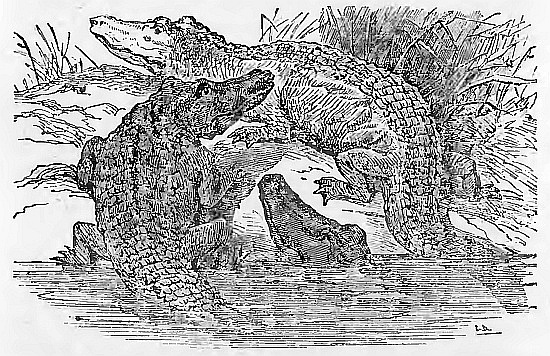
The eggs of the jacaré-uassú were as large as cocoa-nuts, and of an oval shape. They had a thick, rough shell, which made a loud noise when rubbed against any hard substance. If the female were near the nest, and you wished to find her, you had only to rub two of the eggs together, and she would come waddling towards you the moment she heard the noise. They fed mostly on fish, but that was because fish was plentiest, and most readily obtained. They would eat flesh or fowl,—anything that chanced in their way. Fling them a bone, and they would swallow it at a gulp, seizing it in their great jaws before it could reach the water, just as a dog would do. If a morsel got into their mouth that wouldn’t readily go down, they would pitch it out, and catch it while in the air, so as to get it between their jaws in a more convenient manner.
Sometimes they had terrific combats with the jaguars; but these animals were wary about attacking the larger ones, and only preyed upon the young of these, or the jacaré-tingas. They themselves made war on every creature they could catch, and above all on the young turtles, thousands of which were every year devoured by them. They even devoured their own children,—that is, the old males did, whenever the mai (mother) was not in the way to protect them. They had an especial preference for dogs,—that is, as food,—and if they should hear a dog barking in the forest, they would go a long way over land to get hold of him. They lie in wait for fish, sometimes hiding themselves in the weeds and grass till the latter come near. They seized them, if convenient, between their jaws, or killed them with a stroke of the tail, making a great commotion in the water. The fish got confused with fright, and didn’t know which way to swim out of the reptile’s reach. Along with their other food they ate stones, for he had often found stones in their stomach. The Indian said it was done that the weight might enable them to go under the water more easily.
The Capilearas were large animals that furnished many a meal to the jacarés; although the quadrupeds could swim very fast, they were no match for the alligator, who can make head with rapidity against the strongest current. If they could only turn short, they would be far more dangerous than they are; but their neck was stiff, and it took them a long while to get round, which was to their enemies’ advantage. Sometimes they made journeys upon land. Generally they travelled very slowly, but they could go much faster when attacked, or pursuing their prey. Their tail was to be especially dreaded. With a blow of that they could knock the breath out of a man’s body, or break his leg bone. They liked to bask in the sun, lying along the sand-banks by the edge of the river, several of them together, with their tails laid one on the other. They would remain motionless for hours, as if asleep, but all the while with their mouths wide open. Some said that they did this to entrap the flies and insects that alighted upon their tongue and teeth, but he (the Mundurucú) didn’t believe it, because no quantity of flies would fill the stomach of the great jacaré. While lying thus, or even at rest upon the water, birds often perched upon their backs and heads,—cranes, ibises, and other kinds. They even walked about over their bodies without seeming to disturb them. In that way the jacarés could not get at them, if they wished it ever so much.
There were some jacarés more to be dreaded than others. These were the man-eaters, such as had once tasted human flesh. There were many of them,—too many,—since not a year passed without several people falling victims to the voracity of these reptiles. People were used to seeing them every day, and grew careless. The jacarés lay in wait in the bathing-places close to villages and houses, and stole upon the bathers that had ventured into deep water. Women, going to fetch water, and children, were especially subject to their attack. He had known men, who had gone into the water in a state of intoxication, killed and devoured by the jacaré, with scores of people looking helplessly on from the bank, not twenty yards away. When an event of this kind happened, the people armed themselves en masse, got into their montarias (canoes), gave chase, and usually killed the reptile. At other times it was left unmolested for months, and allowed to lie in wait for a victim.
The brute was muy ladim (very cunning). That was evident enough to his listeners. They had only to look down into the water, and watch the movements of the monster there. Notwithstanding its ferocity, it was at bottom a great coward, but it knew well when it was master of the situation. The one under the sapucaya believed itself to be in that position. It might be mistaken. If it did not very soon take its departure, he, the Mundurucú, should make trial of its courage, and then would be seen who was master. Big as it was, it would not be so difficult to subdue for one who knew how. The jacaré was not easily killed, for it would not die outright till it was cut to pieces. But it could be rendered harmless. Neither bullet nor arrow would penetrate its body, but there were places where its life could be reached,—the throat, the eyes, and the hollow places just behind the eyes, in front of the shoulders. If stabbed in any of these tender places, it must go under. He knew a plan better than that; and if the brute did not soon raise the siege, he would put it in practice. He was getting to be an old man. Twenty summers ago he would not have put up with such insolence from an alligator. He was not decrepit yet. If the jacaré consulted its own safety, it would do well to look out.
Chapter Thirty One.
A Hide upon a Reptile.
After thus concluding his long lecture upon alligators, the Indian grew restless, and fidgeted from side to side. It was plain to all, that the presence of the jacaré was provoking him to fast-culminating excitement. As another hour passed, and the monster showed no signs of retiring, his excitement grew to auger so intense, as to be no longer withheld from seeking relief in action. So the Mundurucú hastily uprose, flinging aside the swimming-belts hitherto held in his hands. Everything was put by except his knife, and this, drawn from his tanga, was now held tightly in his grasp.
“What mean you, Munday?” inquired Trevannion, observing with some anxiety the actions of the Indian. “Surely you are not going to attack the monster? With such a poor weapon you would have no chance, even supposing you could get within striking distance before being swallowed up. Don’t think of such a thing!”
“Not with this weapon, patron,” replied the Indian, holding up the knife; “though even with it the Mundurucú would not fear to fight the jacaré, and kill him, too. Then the brute would go to the bottom of the Gapo, taking me along. I don’t want a ducking like that, to say nothing of the chances of being drowned. I must settle the account on the surface.”
“My brave fellow, don’t be imprudent! It is too great a risk. Let us stay here till morning. Night will bring a change, and the reptile will go off.”
“Patron! the Mundurucú thinks differently. That jacaré is a man-eater, strayed from some of the villages, perhaps Coary, that we have lately left. It has tasted man’s blood,—even ours, that of your son, your own. It sees men in the tree. It will not retire till it has gratified its ravenous desires. We may stay in this tree till we starve, and from feebleness drop, one by one, from the branches.”
“Let us try it for one night?”
“No, patron,” responded the Indian, his eyes kindling with a revengeful fire, “not for one hour. The Mundurucú was willing to obey you in what related to the duty for which you hired him. He is no longer a tapuyo. The galatea is lost, the contract is at an end, and now he is free to do what he may please with his life. Patron!” continued the old man, with an energy that resembled returning youth, “my tribe would spurn me from the malocca if I bore it any longer. Either I or the jacaré must die!”
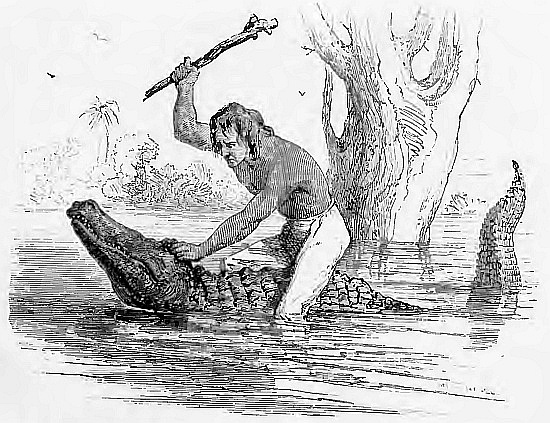
Silenced by the singularity of the Indian’s sentiment and speech, Trevannion forbore further opposition. No one knew exactly what his purpose was, though his attitude and actions led all to believe that he meant to attack the jacaré. With his knife? No. He had negatived this question himself. How then? There appeared to be no other weapon within reach. But there was, and his companions soon saw there was, as they sat silently watching his movements. The knife was only used as the means of procuring that weapon, which soon made its appearance in the form of a macana, or club, cut from one of the llianas,—a bauhinia of heaviest wood, shaped something after the fashion of a “life-preserver,” with a heavy knob of the creeper forming its head, and a shank about two feet long, tapering towards the handle. Armed with this weapon, and restoring the knife to his tango, the Indian came down and glided out along the horizontal limb already known to our story. To attract the reptile thither was not difficult. His presence would have been a sufficient lure, but some broken twigs cast upon the water served to hasten its approach to the spot. In confidence the jacaré came on, believing that by some imprudence, or misadventure, at least one of those it had marked for its victims was about to drop into its hungry maw. One did drop,—not into its maw, or its jaws, but upon its back, close up to the swell of its shoulders. Looking down from the tree, his companions saw the Mundurucú astride upon the alligator, with one hand, the left, apparently inserted into the hollow socket of the reptile’s eye, the other raised aloft, grasping the macana, that threatened to descend upon the skull of the jacaré. It did descend,—crack!—crash!—crackle! After that there was not much to record. The Mundurucú was compelled to slide off his seat. The huge saurian, with its fractured skull, yielded to a simple physical law, turned over, showing its belly of yellowish white,—an aspect not a whit more lovely than that presented in its dark dorsal posterior. If not dead, there could be no doubt that the jacaré was no longer dangerous; and as its conqueror returned to the tree, he was received with a storm of “Vivas” to which Tipperary Tom added his enthusiastic Irish “Hoor-raa!”
Chapter Thirty Two.
Taking to the Water.
The Mundurucú merited congratulation, and his companions could not restrain their admiration and wonder. They knew that the alligator was only assailable by ordinary weapons—as gun, spear, or harpoon—in three places; in the throat, unprotected, except by a thin, soft integument; in the hollow in front of the shoulders, and immediately behind the bony socket of the eyes; and in the eyes themselves,—the latter being the most vulnerable of all. Why had the Indian, armed with a knife, not chosen one of these three places to inflict a mortal cut or stab?
“Patron,” said the Indian, as soon as he had recovered his breath, “you wonder why the Mundurucú took all that trouble for a macana, while he might have killed the jacaré without it. True, the knife was weapon enough. Pa terra! Yes. But it would not cause instant death. The rascal could dive with both eyes scooped out of their sockets, and live for hours afterwards. Ay, it could have carried me twenty miles through the Gapo, half the distance under water. Where would old Munday have been then? Drowned and dead, long before the jacaré itself. Ah, patron, a good knock on the hollow of its head is the best way to settle scores with a jacaré.”
And as if all scores had been now settled with this fellow, the huge saurian, to all appearance dead, passed unheeded out of sight, the current of the Gapo drifting it slowly away. They did not wait for its total disappearance, and while its hideous body, turned belly upward, with its human-like hands stiffly thrust above the surface, was yet in sight, they resumed their preparations for vacating a tenement of which all were heartily tired, with that hopeful expectancy which springs from a knowledge that the future cannot be worse than the present. Richard had reported many curious trees, some bearing fruits that appeared to be eatable, strung with llianas, here and there forming a network that made it easy to find comfort among their branches. If there had been nothing else to cheer them, the prospect of escaping from their irksome attitudes was of itself sufficient; and influenced by this, they eagerly prepared for departure.
As almost everything had been already arranged for ferrying the party, very little remained to be done. From the hermetically closed monkey-cups the Mundurucú had manufactured five swimming-belts,—this number being all that was necessary, for he and the young Paraense could swim ten times the distance without any adventitious aid. The others had their share of empty shells meted out according to their weight and need of help. Rosa’s transport required particular attention. The others could make way themselves, but Rosa was to be carried across under the safe conduct of the Indian.
So when every contingency had been provided for, one after another slipped down from the fork, and quietly departed from a tree that, however uncomfortable as a residence, had yet provided them with a refuge in the hour of danger.
Chapter Thirty Three.
A Half-Choked Swimmer.
Munday led off, towing little Rosa after him by a sipo, one end fastened to his girdle, and the other around her waist. Trevannion followed close behind, Ralph a little farther off, with Richard keeping abreast of his cousin and helping him along. Mozey swam next; Tipperary Tom, who was last to leave the tree, brought up the rear. The ouistiti had found a berth on the shoulders of young Ralph, who, buoyed up by a good supply of air-vessels, swam with his back above water. As for the macaw and coaita, the desperate circumstances in which our adventurers were placed rendered it not only inconvenient, but out of the question, to trouble themselves with such pets; and it had been agreed that they must be abandoned. Both, therefore, were left upon the tree. With the macaw it was a matter of choice whether it should stay there. By simply spreading out its great hyacinthine wings it could keep pace with its ci-devant protectors; and they had hardly left the tree, when the bird, giving a loud scream, sprang from its perch, hovered a moment in the air, and then, flying down, alighted on Mozey’s wool-covered cranium, making him hide his astonished head quickly under water. The arara, affrighted at having wetted its feet, instantly essayed to soar up again; but its curving talons, that had clutched too eagerly in the descent, had become fixed, and all its attempts to detach them were in vain. The more it struggled, the tighter became the tangle; while its screams, united with the cries of the negro, pealed over the water, awaking far echoes in the forest. It was sometime before Mozey succeeded in untwisting the snarl that the arara had spun around its legs, and not until he had sacrificed several of his curls was the bird free to trust once more to its wings.
We have said, that by some mystic influence the big monkey had become attached to Tipperary Tom, and the attachment was mutual. Tom had not taken his departure from the tree without casting more than one look of regret back among the branches, and under any other circumstances he would not have left the coaita behind him. It was only in obedience to the inexorable law of self-preservation that he had consented to the sacrifice. The monkey had shown equal reluctance at parting, in looks, cries, and gestures. It had followed its friend down to the fork, and after he had slipped into the water it appeared as if it would follow him, regardless of both instinct and experience, for it could not swim. These, however, proved strong enough to restrain its imprudence, and after its protector had gone it stood trembling and chattering in accents that proclaimed the agony of that unexpected separation. Any one listening attentively to its cries might have detected in the piteous tones the slightest commingling of reproach. How could it be otherwise to be thus deserted? Left to perish, in fact; for although the coaita was perfectly at home upon the sapucaya, and could live there as long as the nuts lasted, there was not the slightest chance of its getting away from the tree. It must stay there till the vasante, till the flood fell, and that would not be for months. Long before that it must undoubtedly perish, either by drowning or starvation.
Whether or not these unpleasant forebodings passed through the monkey’s wits, and whether they nerved it, may never be known. Certainly something seemed to stimulate the creature to determination; for instead of standing any longer shivering in the fork of the tree, it turned suddenly, and, darting up the trunk, ran out upon one of the horizontal branches. To go directly from the sapucaya to the forest, it was necessary to pass under this limb; and Tipperary Tom, following in the wake of the others, had taken this track. He was already far out from the stem of the tree, almost clear of the overhanging branches, and half oblivions of the painful parting, when a heavy body, pouncing upon his shoulders, caused both him and his empty shells to sink some feet under the water; for just like old Munday on the alligator had the monkey come down upon Tipperary Tom. The affrighted Irishman, on rising to the surface, sputtered forth a series of cries, at the same time endeavouring to rid himself of the unexpected rider on his back. It was just at this crisis, too, that the macaw had managed to make good its footing in the fleece of the negro. Mozey, however, was the first to get clear of his incubus; and then all eyes were directed towards Tipperary Tom and the clinging coaita, while peals of laughter resounded from every lip.
Mozey had enfranchised himself by sacrificing a few tufts of his woolly hair, but the task was not so easy for Tom. In fact, it proved altogether impracticable; for the coaita had curled its prehensile tail around his neck in a knot that would have made a hangman envious. The more he tugged at it, the more it tightened; and had the Irishman been left to himself, it would have no doubt ended in his being strangled outright, a fate he began to dread. At this crisis he heard the Mundurucú shout to him across the water to leave the coaita alone, as then it would relax its hold. Fortunately for himself, Tom had the prudence to obey this well-timed counsel; and although still half suffocated by the too cordial embrace of his pet, he permitted it to have its own way, until, having approached the forest, the monkey relaxed its hold, and sprang up among the branches.
Chapter Thirty Four.
A Supper of Broiled Squab.
Guided by the Mundurucú, the swimmers entered the water arcade before described, and proceeded on to the tree that had furnished the caoutchouc for their swimming-belts. The siphonia, so late the scene of strife and querulous complainings, was now silent as the tomb; not a living arara was in sight or within hearing. The few old birds that had survived the club conflict had forsaken the spot, betaking themselves to some distant part of the forest, perhaps out of the Gapo altogether, to mourn over nests laid desolate, over chicks seized and instantly destroyed by ruthless hands. Only the young were there, suspended in a bunch from the branches. The Mundurucú mounted first, taking his charge along with him; and then all the others climbed up into the tree, where the macaw and the monkey—one upon wing, the other by a passage through the tree-tops in speed almost equalling the flight of a bird—had already arrived.
Farther progress for that night was no part of their purpose. It would have been as idle as imprudent. The sun was already level with their gaze, and to have forsaken their perch at that hour would have been like leaving a good inn for the doubtful chances of the road. The seringa, with its thickly trellised limbs, offered snug quarters. Upon its network of parasites it was possible to repose; there were hammocks woven by the hand of Nature, and, rude as they might be, they were a pleasant improvement on their couches of the preceding night.
The tree contained other proofs of its hospitality. The fat fledglings suspended upon it promised a supper not to be despised; for none of the party was a stranger to macaw flesh, and, as those were young and tender, eyes sparkled and mouths watered on beholding them. No one expected that they were to be eaten raw, though there was more than one in the party whose appetite had become sharp enough for this. The Mundurucú would have shown but slight squeamishness at swallowing one of the squabs as it was, while to Mozey it would have signified less. Even Tipperary Tom declared his readiness to set about supping without further preparation.
The semi-cannibal appetites of his companions were controlled by Trevannion, who commenced talking of a fire. How was it to be made? How could the chicks be cooked? His questions did not remain long unanswered. The Indian, eager to meet the wishes of his employer, promised that they should be gratified.
“Wait a bit, patron,” said he. “In ten minutes’ time you shall have what you want, a fire; in twenty, roast arara.”
“But how?” asked the patron. “We have no flint nor steel, any of us; and if we had, where find the tinder?”
“Yonder!” rejoined the Mundurucú. “You see yonder tree on the other side of the igarápe?”
“That standing out by itself, with smooth, shining bark, and hoary, handlike leaves? Yes, I see it. What of it?”
“It is the embaüba, patron; the tree that feeds the lazy sloth, the Aï.”
“O, then it is that known as the Cecropia peltata. True, its crown of peltate leaves declares the species. But we were talking of fire, Munday. Can you obtain it from the cecropia?”
“In ten minutes, patron, the Mundurucú will draw sparks from that tree, and make a fire too, if he can only obtain from it a dry branch, one without sap, decayed, dead. You shall see.”
So saying, he swam out towards the cecropia. On reaching this, he scaled it like a squirrel, and was soon among its silvery fronds, that spread palm-like over the water. Soon the snapping of a breaking branch was heard, and shortly after the Indian came gliding down the tree, and, holding the piece of cecropia above his head, swam with one hand towards the caoutchouc, which he once more ascended. On rejoining his companions, they saw that the stick he had secured was a bit of dry, dead wood, light, and of porous texture, just such as might be easily ignited. Not caring to make any secret of his design, he confirmed his companions in their conjecture by informing them that the embaüba was the wood always employed by his people, as well as the other tribes in Amazonia, when they wished to make a fire; and saying this, he proceeded without further delay to make them acquainted with the proper way. Strange to say, it proved to be the friction process, often described as practised in remote corners of the world, and by savage tribes who could never have held the slightest communication with one another. Who taught them this curious mode of creating fire? Who inducted the Indian of the Amazon, and the aboriginal of Borneo, into the identical ideas of the sumpitan and gradatána,—both blow-guns alike? Who first instructed mankind in the use of the bow? Was it instinct? Was it wisdom from on high?