"A Voyage among the Tree-Tops" (continued 4)
Reading edition
Trevannion and Richard required no further explanation. The former had heard of this singular tree; the latter had seen it,—nay, more, had drank of its milk, and eaten of its fruit. It was with great joy the young Paraense now looked upon its soaring leafy top, as it not only reminded him of a spectacle he had often observed in the woods skirting the suburbs of his native city, but promised, as the tapuyo had declared, to relieve the pangs of hunger, that had become agonisingly keen.
Chapter Fifty Three.
A Vegetable Cow.
The tree which had thus determined them to discontinue their journey, and which was to furnish them with lodgings for the night, was the famous palo de vaca, or “cow-tree” of South America, known also as the arbol de leche, or “milk-tree.” It has been described by Humboldt under the name Galactodendron, but later botanical writers, not contented with the very appropriate title given to it by the great student of Nature, have styled it Brosium. It belongs to the natural order of the Atrocarpads, which, by what might appear a curious coincidence, includes also the celebrated breadfruit. What may seem stranger still, the equally famous upas-tree of Java is a scion of the same stock, an atrocarpad! Therefore, just as in one family there are good boys and bad boys, (it is to be hoped there are none of the latter in yours,) so in the family of the atrocarpads there are trees producing food and drink both wholesome to the body and delicious to the palate, while there are others in whose sap, flowers, and fruit are concealed the most virulent of poisons.
The massaranduba is not the only species known as palo de vaca, or cow-tree. There are many others so called, whose sap is of a milky nature. Some yield a milk that is pleasant to the taste and highly nutritious, of which the “hya-hya” (Tabernaemontana utibis), another South American tree, is the most conspicuous. This last belongs to the order of the Apocyanae, or dog-banes, while still another order, the Sapotacae, includes among its genera several species of cow-tree. The massaranduba itself was formerly classed among the Sapotads.
It is one of the largest trees of the Amazonian forest, frequently found two hundred feet in height, towering above the other trees, with a top resembling an immense vegetable dome. Logs one hundred feet long, without a branch, have often been hewn out of its trunk, ready for the saw-mill. Its timber is very hard and fine grained, and will stand the weather better than most other South American trees; but it cannot be procured in any great quantity, because, like many other trees of the Amazon, it is of a solitary habit, only two or three, or at most half a dozen, growing within the circuit of a mile.
It is easily distinguished from trees of other genera by its reddish, ragged bark, which is deeply furrowed, and from a decoction of which the Indians prepare a dye of a dark red colour. The fruit, about the size of an apple, is full of a rich juicy pulp, exceedingly agreeable to the taste, and much relished. This is the bread which the Mundurucú hoped to provide for the supper of his half-famished companions.
But the most singular, as well as the most important, product of the massaranduba is its milky juice. This is obtained by making an incision in the bark, when the white sap flows forth in a copious stream, soon filling a calabash or other vessel held under it. On first escaping from the tree it is of the colour and about the consistency of rich cream, and, but for a slightly balsamic odour might be mistaken for the genuine produce of the dairy. After a short exposure to the air it curdles, a thready substance forming upon the surface, resembling cheese, and so called by the natives. When diluted with water, the coagulation does not so rapidly take place; and it is usually treated in this manner, besides being strained, before it is brought to the table. The natives use it by soaking their farinha or maize-bread with the sap, and it is also used as cream in tea, chocolate, and coffee, many people preferring it on account of the balsamic flavour which it imparts to these beverages.
The milk of the massaranduba is in great demand throughout all the district where the tree is found, both in the Spanish and Portuguese territories of tropical South America. In Venezuela it is extensively used by the negroes, and it has been remarked that these people grow fatter during the season of the year when the palo de vaca is plenty. Certain it is that no ill effects have been known to result from a free use of it; and the vegetable cow cannot be regarded otherwise than as one of the most singular and interesting productions of beneficent Nature.
Chapter Fifty Four.
A Milk Supper.
It was some time before they swam under the massaranduba’s wide-spreading branches, as it did not stand on the edge of the forest, and for a short time after entering among the other trees it was out of sight. The instincts of the Indian, however, directed him, and in due time it again came before their eyes, its rough reddish trunk rising out of the water like a vast ragged column.
As might have been expected, its huge limbs were laden with parasites, trailing down to the surface of the water. By these they found no difficulty in making an ascent, and were soon safely installed; its huge coreaceous leaves of oblong form and pointed at the tops, many of them nearly a foot in length, forming a shade against the fervent rays of the sun, still several degrees above the horizon.
As the Indian had anticipated, the tree was in full bearing, and ere long a number of its apples were plucked, and refreshing the parched palates that would have pronounced them exquisite had they been even less delicious than they were. Munday made no stay even to taste the fruit. He was determined on giving his companions the still rarer treat he had promised them, a supper of milk; and not until he had made some half-dozen notches with his knife, and placed under each a sapucaya-shell detached from the swimming-belts, did he cease his exertions.
They had not long to wait. The vegetable cow proved a free milker, and in twenty minutes each of the party had a pericarp in hand full of delicious cream, which needed no sugar to make it palatable. They did not stay to inquire how many quarts their new cow could give. Enough for them to know that there was sufficient to satisfy the appetites of all for that night.
When, after supper, the conversation naturally turned to the peculiarities of this remarkable tree, many other facts were elicited in regard to its useful qualities. Richard told them that in Pará it was well-known, its fruit and milk being sold in the streets by the negro market-women, and much relished by all classes of the inhabitants of that city; that its sap was used by the Paraense joiners in the place of glue, to which it was equal, if not superior, guitars, violins, and broken dishes being put together with it in the most effective manner, its tenacity holding against both heat and dampness. Another curious fact was, that the sap continues to run long after the tree has been felled: that even the logs lying in the yard of a saw-mill have been known to yield for weeks, even months, the supply required by the sawyers for creaming their coffee!
And now our adventurers, admonished by the setting of the sun, were about stretching themselves along the branches, with the intention of going to sleep. But they were not to retire without an incident, though fortunately it was such as to add to the cheerfulness lately inspiring the spirits of all, even to the macaw and little monkey, both of whom had amply regaled themselves upon the succulent fruits of the massaranduba. The great ape, again left behind, had been altogether forgotten. No one of the party was thinking of it; or, if any one was, it was only with a very subdued regret. All knew that the coaita could take care of itself, and under all circumstances it would be safe enough. For all this, they would have been very glad still to have kept it in their company, had that been possible; and all of them were glad when a loud chattering at no great distance was recognised as the salutation of their old acquaintance, the coaita. Directly after, the animal itself was seen springing from tree to tree, until by a last long leap it lodged itself on the branches of the massaranduba, and was soon after seated upon the shoulders of Tipperary Tom.
While the swimmers were proceeding by slow stages, the ape had kept them company among the tops of the adjacent trees; and, but for its being delayed by having to make the circuit around the various little bays, it might have been astride the vegetable cow long before the swimmers themselves. Coming late, it was not the less welcome, and before going to sleep it was furnished with a fruit supper, and received a series of caresses from Tom, that in some measure consoled it for his double desertion.
Chapter Fifty Five.
Only a Dead-Wood.
Despite the coarse netting of the hammocks on which they were constrained to pass the night, our adventurers slept better than was their wont, from a certain feeling of security,—a confidence that God had not forgotten them. He who could give them food in the forest could also guide them out of the labyrinth into which their own negligence had led them.
A prayer to Him preceded their breakfast on the cream of the cow-tree, and with another they launched themselves upon their strings of shells, with renewed confidence, and proceeded along the curving selvage of the trees. As before, they found their progress impeded by the “ovens” of the piosoca; and despite their utmost exertions, at noon they had made scarce three miles from their starting-point, for the gigantic tree that had sheltered them was full in sight, and even at sunset they could not have been more than six miles from it.
In the forest about them there appeared no resting-place for the night. The trees stood closely together, but without any interlacing of branches, or large horizontal limbs upon which they might seek repose. For a time it appeared as if they would have to spend the night upon the water. This was a grave consideration, and the guide knew it. With their bodies immersed during the midnight hours,—chill even within the tropics,—the consequences might be serious, perhaps fatal. One way or another a lodgement must be obtained among the tree-tops. It was obtained, but after much difficulty. The climbing to it was a severe struggle, and the seat was of the most uncomfortable kind. There was no supper, or comfort of any kind.
With the earliest appearance of day they were all once more in the water, and slowly pursuing their weary way. Now slower than ever, for in proportion to their constantly decreasing strength the obstruction from the piosocas appeared to increase. The lagoon, or at least its border, had become a labyrinth of lilies.
While thus contending against adverse circumstances, an object came under their eyes that caused a temporary abstraction from their misery. Something strange was lying along the water at the distance of about a quarter of a mile from them. It appeared to be some ten or twelve yards in length, and stood quite high above the surface. It was of a dark brown colour, and presented something the appearance of a bank of dried mud, with some pieces of stout stakes projecting upward. Could it be this? Was it a bank or spit of land?
The hearts of the swimmers leaped as this thought, inspired by their wishes, came into every mind. If land, it could be only an islet, for there was water all around it,—that they could perceive. But if so, an islet, if no bigger than a barn-door, would still be land, and therefore welcome. They might stretch their limbs upon it, and obtain a good night’s rest, which they had not done since the wreck of the galatea. Besides an islet ever so small—if only a sand-bar or bank of mud—would be a sort of evidence that the real dry land was not far off.
The dark form at first sight appeared to be close in to the trees, but Munday, standing up in the water, pronounced it to be at some distance from them,—between fifty and a hundred yards. As it was evident that the trees themselves were up to their necks in water, it could hardly be an island. Still there might be some elevated spot, a ridge or mound, that overtopped the inundation. Buoyed up by this hope, the swimmers kept on towards it, every eye scanning intently its outlines in order to make out its real character. All at once the projections which they had taken for stakes disappeared from the supposed spot of mud. They had assumed the shape of large wading birds of dark plumage, which, having spread their long, triangular wings, were now hovering above the heads of the swimmers, by their cries proclaiming that they were more astonished at the latter than they could possibly be at them.
It was not until they had arrived within a hundred yards of the object that its true character was declared. “Pa Terra!” Munday cried, in a sonorous and somewhat sorrowful voice, as he sank despairingly upon his breast;—“no island,—no bank,—no land of any kind. Only a dead-wood!”
“A dead-wood!” repeated the patron, not comprehending what he meant, and fancying from the chagrined air of the Indian that there might be mischief in the thing.
“That’s all, master. The carcass of an old Manguba, that’s been long since stripped of his limbs, and has been carried here upon the current of the Gapo; don’t you see his huge shoulders rising above the water?”
Richard proceeded to explain the Indian’s meaning. “The trunk of a dead tree, uncle. It’s the silk-cotton-tree, or manguba, as Munday calls it. I can tell that by its floating so lightly on the water. It appears to be anchored, though; or perhaps it is moored among the stalks of the piosocas.”
The explanation was interrupted by a shout from the Indian, whose countenance had all at once assumed an expression of cheerfulness,—almost joy. The others, as they turned their eyes upon him, were surprised at the sudden change, for but a moment before they had noticed his despairing look.
“The Mundurucú must be mad, patron,” he shouted. “Where is his head? Gone down to the bottom of the Gapo along with the galatea!”
“What’s the matter?” inquired Tom, brightening up as he beheld the joyful aspect of the Indian. “Is it dhroy land that he sees? I hope it’s that same.”
“What is it, Munday?” asked Trevannion. “Why do you fancy yourself insane?”
“Only to think of it, patron, that I should have been sorry to find but the trunk of a tree. The trunk of a tree,—a grand manguba, big enough to make a montaria, an igarité,—a galatea, if you like,—a great canoe that will carry us all! Cry Santos Dios! Give thanks to the Great Spirit! We are saved!—we are saved!”
The words of the tapuyo, wild as they might appear, were well understood. They were answered by a general shout of satisfaction,—for even the youngest of the party could comprehend that the great log lying near them might be made the means of carrying them clear of the dangers with which they had been so long encompassed.
“True,—true,” said Trevannion. “It is the very thing for which we have been searching in vain,—some sort of timber that would carry its own weight in the water, and us beside. This dead manguba, as you call it, looks as if a ton would not sink it a quarter of an inch. It will certainly serve us for a raft. Give thanks to God, children; his hand is in this. It fills me with hope that we are yet to survive the perils through which we are passing, and that I shall live to see old England once more.”
No flock of jacanas ever created such a commotion among the leaves of the Victoria lily as was made at that moment. Like frail leaves the thick stems were struck aside by the arms of the swimmers, strengthened by the prospect of a speedy delivery from what but the moment before seemed extremest peril; and almost in a moment they were alongside the great trunk of the manguba, in earnest endeavour to get upon it.
Chapter Fifty Six.
The Sterculiads.
In their attempts at boarding they were as successful as they could have expected. The top of the gigantic log was full six feet above the surface of the water, and there were huge buttresses upon it—the shoulders spoken of by Munday—that rose several feet higher. By dint of hard climbing, however, all were at length safely landed.
After they had spent a few minutes in recovering breath, they began to look around them and examine their strange craft. It was, as the Indian had alleged, the trunk of a silk-cotton-tree, the famed Bombax of the American tropical forests,—found, though, in many different species, from Mexico to the mountains of Brazil. It is known as belonging to the order of the Sterculiads, which includes among its genera a great number of vegetable giants, among others the baobab of Africa, with a stem ninety feet in circumference, though the trunk is out of proportion to the other parts of the tree. The singular hand-plant of Mexico called Manita is a sterculiad, as are also the cotton-tree of India and the gum-tragacanth of Sierra Leone.
The bombax-trees of Tropical America are of several distinct species. They are usually called cotton or silk-cotton-trees, on account of the woolly or cottony stuff between the seeds and the outer capsules, which resemble those of the true cotton plant (Gossypium). They are noted for their great size and imposing appearance, more than for any useful properties. Several species of them, however, are not without a certain value. Bombax ceiba, and Bombax monguba, the monguba of the Amazon, are used for canoes, a single trunk sufficing to make a craft that will carry twenty hogsheads of sugar along with its crew of tapuyos. The peculiar lightness of the wood renders it serviceable for this purpose; and there is one species, the ochroma of the West Indies, so light as to have been substituted for cork-wood in the bottling of wines.
The silk or cotton obtained from the seed-pods, though apparently of an excellent quality, unfortunately cannot be well managed by the spinning-machine. It lacks adhesiveness, and does not form a thread that may be trusted. It is, however, extensively used for the stuffing of couches, cushions, and other articles of upholstery; and the Amazonian Indians employ it in feathering the arrows of their blow-guns, and for several other purposes.
A peculiarity of the Sterculiads is their having buttresses. Some are seen with immense excrescences growing out from their trunks, in the form of thin, woody plates, covered with bark just like the trunk itself, between which are spaces that might be likened to stalls in a stable. Often these partitions rise along the stem to a height of fifty feet. The cottonwood (Populus angulata) and the deciduous cypress of the Mississippi (Taxodium distichum) partake of this singular habit; the smaller buttresses of the latter, known as “cypress knees,” furnishing the “cypress hams,” which, under their covering of lime-washed canvas, had been sold (so say the Southerners) by the Yankee speculator for the genuine haunch of the corn-fed hog!
In spite of its commercial inutility, there are few trees of the South American forest more interesting than the manguba. It is a conspicuous tree, even in the midst of a forest abounding in types of the vegetable kingdom, strange and beautiful. Upon the trunk of such a tree, long since divested of its leaves,—stripped even of its branches, its species distinguishable only to the eye of the aboriginal observer,—our adventurers found a lodgment.
Chapter Fifty Seven.
Chased by Tocandeiras.
Their tenancy was of short continuance. Never did lodger retreat from a shrewish landlady quicker than did Trevannion and his party from the trunk of the silk-cotton-tree. That they so hastily forsook a secure resting-place, upon which but the moment before they had been so happy to plant their feet, will appear a mystery. Strangest of all, that they were actually driven overboard by an insect not bigger than an ant!
Having gained a secure footing, as they supposed, upon the floating tree-trunk, our adventurers looked around them, the younger ones from curiosity, the others to get acquainted with the character of their new craft. Trevannion was making calculations as to its capability; not as to whether it could carry them, for that was already decided, but whether it was possible to convert it into a manageable vessel, either with sails, if such could be extemporised, or with oars, which might be easily obtained. While thus engaged, he was suddenly startled by an exclamation of surprise and alarm from the Indian. All that day he had been the victim of sudden surprises.
“The Tocandeiras!—the Tocandeiras!” he cried, his eyes sparkling as he spoke; and, calling to the rest to follow, he retreated toward one end of the tree-trunk.
With wondering eyes they looked back to discover the thing from which they were retreating. They could see nothing to cause such symptoms of terror as those exhibited by their guide and counsellor. It is true that upon the other end of the tree-trunk, in a valley-like groove between two great buttresses, the bark had suddenly assumed a singular appearance. It had turned to a fiery red hue, and had become apparently endowed with a tremulous motion. What could have occasioned this singular change in the colour of the log?
“The Tocandeiras!” again exclaimed Munday, pointing directly to the object upon which all eyes were fixed.
“Tocandeiras?” asked Trevannion. “Do you mean those little red insects crawling along the log?”
“That, and nothing else. Do you know what they are, patron?”
“I have not the slightest idea, only that they appear to be some species of ant.”
“That’s just what they are,—ants and nothing else! Those are the dreaded fire-ants. We’ve roused them out of their sleep. By our weight the manguba has gone down a little. The water has got into their nest. They are forced out, and are now spiteful as hungry jaguars. We must get beyond their reach, or in ten minutes’ time there won’t be an inch of skin on our bodies without a bite and a blister.”
“It is true, uncle,” said Richard. “Munday is not exaggerating. If these ugly creatures crawl upon us, and they will if we do not get out of the way, they’ll sting us pretty nigh to death. We must leave the log!”
And now, on the way towards the spot occupied by the party, was a fiery stream composed of spiteful-looking creatures, whose very appearance bespoke stings and poison. There was no help for it but to abandon the log, and take to the water. Fortunately each individual was still in possession of his string of sapucaya-shells; and, sliding down the side of the log, once more they found themselves among the grand gong-like leaves of the gigantic lily.
Chapter Fifty Eight.
A Log that Wouldn’t Roll.
It now became a question, what they were to do. Abandon the log altogether, for a swarm of contemptible insects, not larger than lady-bugs, when, by the merest chance, they had found a raft, the very thing they stood in need of? Such a course was not contemplated,—not for a moment. On gliding back into the Gapo, they had no idea of swimming away farther than would secure their safety from the sting of the insects, as Munday assured them that the fire-ants would not follow them into the water. But how regain possession of their prize?
The ants were now seen swarming all over it, here and there collected in large hosts, seemingly holding council together, while broad bands appeared moving from one to the other, like columns of troops upon the march! There was scarce a spot upon the surface of the log, big enough for a man to set his foot upon, that was not reddened by the cohorts of this insect army!
“How shall we dispossess them?” inquired Trevannion.
“Shure,” said Tipperary Tom, answering as if the appeal had been made to him, “can’t we sit thim on fire, an’ burn thim aft the log? Cudn’t we gather some dry laves out av the threes, an’ make a blaze that ’ud soon consume ivery mother’s son av thim?”
“Nonsense, Tom. We should consume the log, as well as the ants, and then what would be the advantage to us?”
“Well, thin, iv yez think fire won’t do, why can’t we thry wather? Lit us thry an’ drownd thim off the log. Munday sez they can’t swim, an’ iv they can’t, shure they must go to the bottom.”
“How would you do it?” asked Trevannion, catching at the idea suggested by the Hibernian.
“Nothing asier. Give the did three a rowl over on its back, an’ thin the ants’ll get undher the wather; an’ won’t they have to stay there? Lit us all lay howlt on the log, an’ see iv we can’t give the swate craythers a duckin’.”
Convinced that there was good sense in Tom’s counsel, swimming back towards the log, they stretched their arms upward, and commenced trying to turn it over. The attempt proved unsuccessful. Partly from the enormous weight of the dead tree, saturated as one half of it was with water, and partly owing to the great buttresses acting as outriggers, they could only turn it about one tenth part of its circumference. It rolled back upon them, at first dipping a little deeper, but afterwards settling into its old bed. They were about to discontinue their efforts when a cry came from Tom, as if some new source of terror had been discovered in the manguba. Soon each and all found an explanation in their own sensations, which were as if they had been sharply stung or bitten by some venomous insect. While shouldering the log in vain endeavours to capsize it, some scores of the ants had been detached from its sides, and fallen upon the bodies of the swimmers. Instead of showing gratitude for this temporary respite from drowning, the spiteful insects had at once imbedded their poisoned fangs in their preservers, as if conscious that they owed all their misfortunes to the intruders who had so rudely disturbed their rest. But when these stray ants that had been stinging them were disposed of, their attention was once more directed towards the manguba, with a still more determinate resolution to repossess what in their eyes was more valuable than a selected log of the finest Honduras mahogany!
Chapter Fifty Nine.
Drowning the Tocandeiras: Five Men in a Fever.
For a time the brains of our adventurers were busied in devising some plan for routing the tocandeiras from their floating citadel, of which they now retained sole possession. At last Tipperary Tom again became the suggester of a scheme for dispelling the multitudinous hosts.
“If we can’t spill thim aff the log,” said he, “we can wather thim aff it.”
“Not such a bad idea,” said Richard. “Come on, let us surround the trunk, and attack them on all sides, and let all heave together.”
The dark mud colour that had characterised it when first seen, and during the time while they were approaching it, was now changed to a hue of fiery red, here in spots of patches, there in broad lists or streaks, running irregularly between the extremities. Of course the red bands and blotches mottling its sombre surface were the tocandeiras, whose crowded battalions were distributed all over it. On closer scrutiny, it could be seen that they were in motion, passing to and fro, or in places circling around as if in search of the intruders who had disturbed them.
At a word from Trevannion, all the assailants commenced heaving up water with the palms of their hands, and the log became shrouded under a shower of sparkling drops that fell fast and thickly over it, dissipating into a cloud of vapour like the spray of a waterfall. Under such a drenching the tocandeiras could not possibly retain their hold, however tenacious might be their sharp curving claws, and it was but natural that thousands of them should soon be swept from the manguba. Their assailants saw it, and, rejoicing at the success of their scheme, gave utterance to triumphant shouts, just like boys destroying with hot water a nest of wasps or hornets. Louder than all could be heard the voice of Tipperary Tom. It was he who had suggested the scheme, and the thought of having his character for sagacity thus raised caused his boisterous fit of self-congratulation.
But the splashing suddenly ceased, and the six pairs of palms, instead of being turned upward and forward to bale water upon the log, were now exerted in the opposite direction, backward and downward, while the owners of them commenced swimming away from the spot; as they went off, making vigorous efforts to free themselves from the spiteful creatures again clinging to them. Not one of them said a word about staying longer by the dead manguba; but, picking up little Rosa on the way, they continued their retreat, nor paused again until they felt sure of having distanced the tocandeiras.
As a matter of course they had retreated towards the tree-tops. After so many surprises, accompanied by almost continuous exertion, they stood in need of rest. Having chosen one that could be easily climbed, they ascended to its branches, and there seated themselves as comfortably as circumstances would permit. On perceiving that the sun was already over the meridian, and satisfied, moreover, that the task of getting rid of their enemies was one that it might take time to accomplish, they determined to remain all night in their new situation. But there was a more powerful reason for suspending their journey at this point. They were suffering great pain from the stings of the tocandeiras, and, until that should be to some extent allayed, they could think of nothing else, unless indeed it might be a mode of avenging themselves.
It was fortunate they had found a safe place of repose, and that Munday, who suffered less than the rest, preserved sufficient composure to make their beds or hammocks of sipos, for, in less than twenty minutes after ascending the tree, every one of the party, Munday and Rosa excepted, found himself in a raging fever from the stings inflicted by the tocandeiras, since these bloodthirsty insects not only bite as other ants, but have the power of stinging like wasps, only that the pain produced by their sting is much greater,—more like that of the black scorpion.
As the sun went down, a cool breeze began to play over the waters of the lagoa; and this—the fever having burnt itself out—restored them to their ordinary health, though with a feeling of languor that disinclined them to do anything for that night. Stretched upon their rude aerial couches, they looked up at the stars, and listened to Munday as he made answer to the interrogatories of Trevannion giving an account of one of the singular customs of his tribe,—that known as the “Festival of the Tocandeiras.”
Chapter Sixty.
The Festival of the Tocandeiras.
When a youth of the Mundurucú nation, or its kindred tribe, the Mahüe, has reached the age for assuming the dignities of manhood, he is expected to submit himself to an ordeal that well deserves to be called fiery. This more especially if the youth’s ambition inclines him to become a warrior or otherwise distinguished in the tribe. The ordeal is voluntary; but without undergoing it, the young Mundurucú must consent to an existence, if not disgraced, at least inglorious; and if not absolutely scorned by the girls of the Malocca, he will have but slight chance of winning their smiles.
It must be known to my young readers that a custom prevails among many tribes of North American Indians of submitting their young men who aspire to become “braves” to a test of courage and endurance so severe at times as to be a torture quite incredible to those unacquainted with the Indian character. You might fancy the South American a very trifling affair, compared with the torture of the Mandans and other Northern tribes, when you are told that it consists simply in the wearing of a pair of gloves, or mittens, for a certain length of time,—so long that the wearer can make the round of the Malocca, and finish up by an obeisance to the tuchao, or chief, who awaits him at the door of his hut. But these mittens once described to you, as they were described by Munday to his companions on the tree, you will perchance change your mind; and regard the Mundurucú ceremony as one of the most severe that was ever contrived to test the constancy and courage of any aspirant to distinction.
When the young Mundurucú declares his readiness to put on the gloves, a pair of them are prepared for him. They are manufactured out of the bark of a species of palm-tree, and are in fact only long hollow cylinders, closed at one end, and large enough to admit the hand and arm up to the elbow. Before being drawn on they are half filled with ants of the most spiteful and venomous kinds; but chiefly with tocandeiras, from which the ceremony derives its name.
Thus accoutred, and accompanied by a crowd with horns, drums, and other musical instruments in use among the Indians, the candidate for manhood’s rights has to make the round of the village, presenting himself before every hut, and dancing a jig at every halt that is made. Throughout all the performance he must affect signs of great joy, chanting a cheerful strain, loud enough to be heard above the beating of the drums, the blowing of the horns, and the fracas of his noisy followers. Should he refuse to submit to this terrible ordeal, or during its continuance show signs of weakness or hesitation, he is a lost man. He will be forever after the butt and scorn of his tribe; and there is not a Mundurucú girl who will consent to have him for a sweetheart. His parents and relatives will also be affected in the event of his proving a coward, and he will be regarded as a disgrace to the family.
Stimulated by these thoughts, he enters upon the trial, his friends urging him forward with cries of encouragement, his parents keeping by his side, and with anxious entreaties fortifying him against a failure. He has courageously thrust his hands into the fiery gauntlets, and with like courage he must keep them there, until the ceremony is completed. He suffers cruel torture. Every moment increases his agony. His hands, wrists, and arms feel as if surrounded by fire. The insect poison enters his veins. His eyes are inflamed. The sweat pours from his skin,—his bosom palpitates,—his lips and cheeks grow pale; and yet he must not show the slightest acknowledgment of suffering. If he does, it will cover him with shame; and he will never be permitted to carry the Mundurucú war-spear, nor impale upon its point the head of his slain enemy. He knows the awful fate that must result from failure; and, though staggering in his steps, he keeps courageously on. At length he stands in the presence of the tuchao, seated to receive him.
Before the chief the ceremony is repeated with increased excitement; the dance is redoubled in vigour,—the chant is louder than ever,—both continuing until his strength fails him through sheer exhaustion. His gloves are then removed, and he falls into the arms of his friends.
He is now surrounded by the young girls of the tribe, who fling their arms around him, covering him with kisses and congratulations. His sufferings prevent him from appreciating their soft caresses, and breaking away from their embrace, he rushes down to the river, and flings his fevered body into the grateful current. There remaining until the cool water has to some extent alleviated his pain, he comes forth and retires to the Malocca, to receive fresh congratulations from his fellow-savages.
He has proved himself of the stuff of which warriors are made, and may now aspire to the hand of any Mundurucú maiden, and to the glory of increasing the number of those hideous trophies that adorn the council-room of the tribe, and which have earned for these Indians the distinctive surname of Decapitadores (Beheaders).
Chapter Sixty One.
Amazonian Ants.
Succeeding this thrilling account of the tocandeira festival, ants continued for a time to form the staple subject of conversation, which was not confined to the particular species they had encountered upon the log, but related to many others that inhabit the forests and compos of the Amazon valley. Scores of sorts were known to the Mundurucú,—all differing from each other, not only in size, shape, colour, and what may be termed personal characteristics, but also in their modes of life, habits, and dwelling-place; in short, in every particular except those essential traits which make them all members of the same family.
The entomologist who would make a study of ant-life could find no better school to pursue it in than the grand valley of the Amazon. In all parts of it he will find these insects in countless numbers, and in a vast variety of species,—separated from each other by all distinctions of classes founded on habits of life quite opposed to each other. Some species inhabit the earth, never descending below its surface. Others live under it, in subterranean dwellings, scarce ever coming out into the light of day. Others again live above the earth, making their home in the hollow trunks of trees; while still others lead a more aerial life, building their nests among the twigs and topmost branches.
In their diet there is a still greater range. There are carnivora and herbivora,—some that feed only on flesh, others that confine themselves to vegetable substances. There are, moreover, kinds that devour their meat before the life is out of it; while other carnivorous species, like the vulture among birds, prey only on such carrion as may chance to fall in their way, and in search of which their lives seem principally to be spent.
Then there are the vegetable feeders, which not only strip the leaves from plants and trees, but destroy every other sort of vegetable substance that they may fancy to seize upon. The clothes in a chest or wardrobe, the papers in a desk, and the books in a library, have all at times been consumed by their devastating hosts, when foraging for food, or for materials out of which to construct their singular dwellings. These dwellings are of as many different kinds as there are species of ants. Some are of conical shape, as large as a soldier’s tent. Some resemble hillocks or great mounds, extending over the ground to a circumference of many yards. Others represent oblong ridges, traversed by numerous underground galleries, while some species make their dwellings in deep horizontal tunnels, or excavations, often extending under the bed of broad rivers. Many kinds lead an arboreal life, and their nests may be seen sticking like huge excrescences to the trunks of the forest-trees, and as often suspended from the branches.
To give a detailed account of the different kinds of Amazonian ants,—to describe only their appearance and ordinary habits,—would require, not a chapter, but a large volume. Their domestic economy, the modes of constructing their domiciles, the manner of propagating their species, their social distinction into classes or castes, the odd relations that exists between the separate castes of a community, the division of labour, their devotion to what some writers, imbued with monarchical ideas, have been pleased to term their queen,—who in reality is an individual elected for a special purpose, render these insects almost an anomaly in nature. It is not to be expected that the uneducated Indian could give any scientific explanation of such matters. He only knew that there were many curious things in connection with the ants, and their indoor as well as out-door life, which he had himself observed,—and these particulars he communicated.
He could tell strange tales of the Termites, or white ants, which are not ants at all,—only so called from a general resemblance to the latter in many of their habits. He dwelt longest on the sort called Saübas, or leaf-carrying ants, of which he knew a great number of species, each building its hill in a different manner from the others. Of all the species of South American ants, perhaps none surprises the stranger so much as the saüba. On entering a tract of forest, or passing a patch of cultivated ground, the traveller will come to a place where the whole surface is strewn with pieces of green leaves, each about the size of a dime, and all in motion. On examining these leafy fragments more closely, he will discover that each is borne upon the shoulders of a little insect not nearly so big as its burden. Proceeding onward he will come to a tree, where thousands of these insects are at work cutting the leaves into pieces of the proper size, and flinging them down to thousands of others, who seize upon and carry them off. On still closer scrutiny, he will observe that all this work is being carried on in systematic order,—that there are some of the insects differently shaped from the rest,—some performing the actual labour, while the others are acting as guards and overseers. Were he to continue his observation, he would find that the leaves thus transported were not used as food, but only as thatch for covering the galleries and passages through which these countless multitudes make their way from one place to another. He would observe, moreover, so many singular habits and manoeuvres of the little crawling creatures, that he would depart from the spot filled with surprise, and unable to explain more than a tenth part of what he had seen.
Continuing his excursion, he would come upon ants differing from the saübas not only in species, but in the most essential characteristics of life. There would be the Ecitons, or foraging ants, which instead of contenting themselves by feeding upon the luxurious vegetation of the tropics, would be met upon one of their predatory forays,—the object of their expedition being to destroy some colony of their own kind, if not of their own species. It may be that the foraging party belong to the species known as Eciton-rapax,—the giant of its genus, in which many individuals measure a full half-inch in length. If so, they will be proceeding in single file through the forest, in search of the nests of a defenceless vegetable-feeding ant of the genus Formica. If they have already found it, and are met on their homeward march towards their own encampment, each will be seen holding in its mouth a portion of the mangled remains of some victim of their rapacity.
Again, another species may be met travelling in broad columns, containing millions of individuals, either on the way to kill and plunder, or returning laden with the spoil. In either case they will attack any creature that chances in their way,—man himself as readily as the most defenceless animal. The Indian who encounters them retreats upon his tracks, crying out, “Tauóca!” to warn his companions behind, himself warned by the ant-thrushes whom he has espied hovering above the creeping columns, and twittering their exulting notes, as at intervals they swoop down to thin the moving legion.
Of all the kinds of ants known to the Mundurucú, there was none that seemed to interest him more than that which had led to the conversation,—the tocandeira, or, as the Brazilians term it, formigade fogo (fire-ant). Munday had worn the formidable mittens; and this circumstance had no doubt left an impression upon his mind that the tocandeira was the truest representative of spitefulness to be found in the insect world.
Perhaps he was not far astray. Although an ant of ordinary size,—both in this and general appearance not differing greatly from the common red ant of England,—its bite and sting together are more dreaded than those of any other species. It crawls upon the limbs of the pedestrian who passes near its haunt, and, clutching his skin in its sharp pincer-like jaws, with a sudden twitch of the tail it inserts its venomous sting upon the instant, holding on after it has made the wound, and so tenaciously that it is often torn to pieces while being detached. It will even go out of its way to attack any one standing near. And at certain landing-places upon some of the Amazonian rivers, the ground is so occupied with its hosts that treading there is attended with great danger. In fact, it is on record that settlements have been abandoned on account of the fire-ant suddenly making its appearance, and becoming the pest of the place.
Munday, in conclusion, declared that the tocandeiras were only found in the dry forests and sandy campos; that he had never before seen one of their swarms in the Gapo, and that these in the dead-wood must have retreated thither in haste, to escape drowning when caught by the inundation, and that the log had been afterwards drifted away by the echente.
Whether this statement was true or not, the ants appeared to have made up their minds to stay there, and permit no intruders to deprive them of their new, strange domicile,—at all events until the vasante might enable them once more to set foot upon dry land.
Chapter Sixty Two.
The Ants Still Excited.
At break of day the party were all awake; and after refreshing themselves with a little cheese—which was only some coagulated milk of the massaranduba, preserved in sapucaya-shells—they once more turned their attention to the floating trunk. To their surprise, it was no longer where they had left it!
There was a fog upon the water, but that was rapidly becoming dissipated; and as the sun peeped over the tree-tops, the lagoa was sufficiently free from mist for any dark object as large as a man’s head, within a mile’s distance, to be distinguished. The manguba had been left scarce a hundred yards from their sleeping-place. Where was it now?
“Yonder!” said Munday, “close in by the trees. By our splashing in the water, we started it from its moorings among the piosocas. There has been a little breeze through the night, that has brought it this way. It is now at anchor against yonder tree. I shouldn’t wonder if the ants would try to escape from it, and take to the branches above them. The dead manguba is not their natural home; nor is the Gapo their dwelling-place. The tocandeiras belong on land; and no one would expect to find them here. They must have had their home in the hollow of the log while it was lying on dry land. The echente set it afloat while they were inside, and the current has carried them far away from their own country.”
So they now turned to ascertain whether Munday’s conjectures were true, that the ants had taken to the tree that stood over the dead-wood, which was at no great distance; and as the sun had now completely dispelled the fog, they could see it very distinctly. The tocandeiras were still upon it. Their countless hosts were seen moving over its surface in all their red array, apparently as much excited as when putting to flight the swimmers who had intruded upon them.
The log, although close to the stem of the standing tree, was not in connection with it. Something held it several feet off; and as none of the drooping branches reached quite down, it was impossible for the insects to reach the tree, although they evidently desired to make this change, as if suddenly dissatisfied with their quarters on the drifting trunk, and wishing to change them for others less at the mercy of the winds and waves.
As there was something curious in all this, something that could not fail to fix the attention of the observer, our adventurers remained silent, watching the movements of the insect multitude, in hopes that they might find some way of detaching themselves from the floating log, and leave in peaceable and undisputed possession the quarters they appeared so desirous of quitting to those who were equally desirous of entering upon them.
Chapter Sixty Three.
The Tamandua: The Ant-Thrush.
Trusting to the explanation given by the tapuyo, they did not think of inquiring further into the cause of the commotion among the ants. While scanning the tree closely, several of the party perceived a movement among its branches, and soon after the form of a singular creature that was causing it. It was a quadruped, about the size of a raccoon or cat, but of a shape peculiarly its own. Its body was long and cylindrical, terminating posteriorly in a round, tapering tail, while its low, flat head, prolonged into a smooth, slender muzzle, also tapered nearly to a point. The eyes were so small as scarcely to be seen, and the mouth more resembled a round hole than the closing of a pair of jaws. It was covered with a dense silky fur, of a uniform length over the body, and slightly crisped, so as to give it a woolly aspect. This fur was straw-coloured, with a tinge of maroon and brown on the shoulders and along the back, while the tail presented a ringed appearance from an alternation of the two colours.
“Tamandua!” exclaimed Munday, at sight of the strange quadruped. “The ant-eater. Not the great one, which is called Tamandua assu, and don’t climb up the trees. That you see is the little one; he lives all his life among the branches,—sleeps there, either upon his breast, or suspended by his tail,—travels from one tree to another in search of honey, bees, wasps, grubs, but, above all, of such ants as make their nests either in holes, or stick to the twigs. Ha!” he continued, “what could I have been thinking of? The tocandeiras wishing to climb up to the tree? Not a bit of it. Quite the contrary. It’s the tamandua that’s keeping them in motion! See the cunning beast preparing to make a descent among them!”
Nothing could be more certain than that this was the tamandua’s intention; for almost on the instant it was seen to move among the branches, descending from one to the other, partly using its strong, hooked claws, and partly its tapering and highly prehensile tail. Once upon the dead-wood, it lay flat down upon its breast and belly; and shooting out its long, thread-like tongue, coated with a sticky shining substance resembling saliva, it commenced licking up the tocandeiras that swarmed in thousands around it. It was to no purpose that the ants made an attack upon it. Nature had provided it with an armour proof both against their bite and sting. Rage around it as they might, the tocandeiras could do nothing to hinder it from licking them up from the log, and tucking them in hundreds into its capacious stomach. Finally the tamandua had taken his fill,—breakfasted to his heart’s content; then, erecting himself on his hind-legs after the manner of a squirrel or marmoset, he sprang back upon the branch from which he had descended. Going a little higher up, he selected another and larger branch, placing himself so that his belly rested along its upper surface, with the legs hanging down on each side; and then, burying his proboscis in the long fur of his breast, and taking two or three turns of his tail around head, body, and legs, he fell fast asleep.
The old saw, that there is “many a slip between the cup and the lip,” is as true in the life of ant-eater as in that of a man; and when the tamandua awoke,—which it did some twenty minutes afterwards,—and looked down upon the dead-wood, it was astonished to discover that not a tocandeira was in sight.
What had become of them? When left by the tamandua to their own devices there were myriads still surviving. The few thousands which the devourer licked up had made no perceptible diminution in their numbers; and on the retiring of their enemy, they were swarming as thickly and countlessly as ever. Now not one was visible upon the log, the hue of which, from being of a flaming red, had returned to its original colour of sombre grey. A few were discovered upon the standing tree, crawling up its trunk and lower branches, with excited air and rapid movements, as if escaping from terrible disaster. These refugees did not amount to many hundreds; thinly scattered over the bark, they could have been counted. They were too few to tempt the hunger of the tamandua. It would not have been worth his while to project his slimy tongue for the sake of a single tocandeira; so he retained it—not behind his teeth, for he had none—but within the cylinder-shaped cavity of his mouth. What had become of the tocandeiras? It is possible that the tamandua mentally put this question to himself; for there is no animal, however humble its organisation, that has not been gifted by beneficent Nature with a mind and powers of reasoning,—ay, with moral perceptions of at least the primary principles of right and wrong, as even the little ant-eater gives evidence.
Perhaps you have yourself witnessed the proof. You have seen one ant rob another of its crumb of bread, that by a laborious effort has been carried far. You have seen the companions of both gather around the spot, deprive the despoiler of its ill-gotten prize, restore the crumb to its lawful possessor, and punish the would-be pilferer. If you have not seen this, others have,—myself among the number. Surely, it is reason; surely, it is moral perception. If not, what is it? The closet-naturalist calls it instinct,—a ready word to cloak that social cowardice which shrinks from acknowledging that besides man there are other beings upon the earth with talents worth saving.
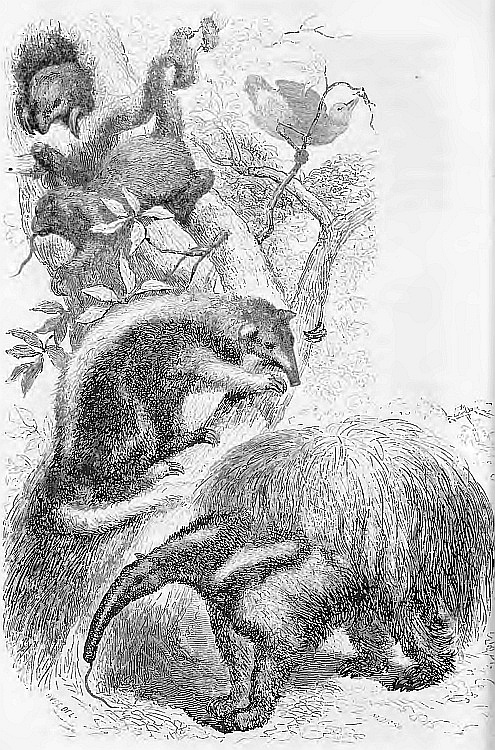
Soon after the ant-eater had gone to sleep, a little bird about the size of a starling was seen flitting about. It was of the ordinary shape of the shrikes, or fly-catchers, and, like them, of sombre plumage,—a dull grey blended with bluish slate. As already said, it was flitting about among the tree-tops, now and then rising above them, and hovering for a while in the air; then lighting again upon a branch, and from this hopping to another, and another, all the time giving utterance to twittering but scarcely musical notes.
“An ant-thrush,” Munday said. “It’s hunting about for the very creatures that are swarming on that log. If it should spy them we’ll have no more trouble with the tocandeiras. That friend will clear them out of our way. If it but gets its eye on that red crowd, it’ll treat them very differently from what the beast has done. In twenty minutes there won’t be a tocandeira to sting us. May the Great Spirit prove propitious, and turn its eyes upon the dead-wood!”
For a time the bird kept up its flickering flight and twittering cry, while our adventurers watched it manoeuvres, keeping quiet, as a precaution against scaring it away. All at once the ant-thrush changed its tactics, and its louder note proclaimed a surprise. It had come close to the tree that contained the tamandua, and saw the quadruped taking its siesta upon the branch. From the presence of the ant-eater it argued the proximity of their common prey.
The swarm of fire-ants, reddening the log, formed too conspicuous an object to escape being seen. The ant-thrush soon saw them, and announced the discovery with a screech, which was a signal to scores of hungry companions. It was answered by what seemed a hundred echoes, and soon the air resounded with whistling wings, as the feathered ant-eaters came crowding to the feast.
Boy reader, you have bred pigeons, and fed them too. You have flung before them whole baskets of barley, and pecks of oats, until the pavement was thickly strewed. You have observed how quickly they could clear the ground of the grain. With the like rapidity was the log cleared of the tocandeiras. In ten minutes not a single insect could be seen upon it; and then the feathered ant-eaters, without giving the tamandua a hint that his premises had been despoiled, flew off into the forest in search of a fresh swarm.
Chapter Sixty Four.
Ant-Eaters—Biped and Quadruped.
The spectacle of the bird ant-eaters engaged in their work of destruction is one that may be seen almost every day in the Amazonian region. The presence of an army of ants passing from place to place through the forest—themselves often bent upon a marauding and murderous expedition—may often be discovered long belong the insects themselves are in sight, by the twittering cries and excited actions of the ant-thrushes, that in large flocks are seen hovering above them. The traveller takes warning by the spectacle. Experience has long ago taught him that to stray into the midst of a party of foraging ants is no slight matter. It would be like dancing an Irish jig over a nest of hornets. He is sure of being attacked, bitten, and stung by the venomous insects; and on hearing the call of the ant-thrush, he beats an instant retreat. The quadruped licking up his insect prey is a sight of less frequent occurrence.
Of these four-footed ant-eaters there are many distinct kinds, differing very considerably in their habits of life. Four species are known to naturalists; but it is probable that there are many more yet to be discovered and described. The Indians who are best acquainted with the remote haunts of the great mountain wilderness of interior South America assert that there are others; and their testimony is generally derived from acute observation. Of the four known species there is the great ant-eater (Myrmecophaga jubata) called Tamanoir, large as a mastiff dog, and a match for most dogs in strength, often even killing one by squeezing the breath out of his body between its thick, muscular fore-limbs. This is the Tamandua bandeira, or “banner tamandua” of the natives, so called from the peculiar marking of its skin,—each side of the body being marked by a broad blackish band running obliquely from the shoulders, and suggesting the resemblance of an heraldic banner. It lives in the drier forests, making its haunt wherever the white ants (termites), those that construct the great hills, abound. Of the habits of this species a more complete account has been given elsewhere. (See “The Forest Exiles,” by the author of this story.)
The second species of tamandua—that is, in size—is quite a different creature. It scarcely ever descends to the earth, but passes from branch to branch and tree to tree by means of its strong, curving claws, and more especially by the aid of a very long and highly prehensile tail. Its food consists exclusively of ants, that construct huge earthy nests high up among the branches or against the trunks of the trees, where they present the appearance of grotesque excrescences. This tamandua often moves about during the day, in its slow progress much resembling the sloths, though its food is so very different from the animal of the Cecropia-tree (bicho de embaüba). This species dwells chiefly in the thick forests, and goes into the Gapo at all seasons of the year, and it was one of this sort which the party had seen.
But there are still two other kinds that make their home upon the trees,—both exceedingly curious little animals, and much more rarely seen than the large tamanduas. They are distinguished by the name of tamandua-i, which in the Indian language means “little tamandua.” One of them, the rarest of the family, is about the size of a half-grown kitten. Instead of hair, it wears a fine wool of a greyish-yellow colour, soft and silky to the touch. The other is of the same size, but dingy brown in colour, and with hair of a coarser kind. These little ant-eaters both sleep through the day, curled up in the cavity of a tree, or in some fork of the branches, and only display their activity by night.
Thus it is that the ants have no chance of escaping from their numerous enemies. On the earth they are attacked and destroyed by the great ant-eater, in the trees by his brother with the four curving claws. By day one species preys upon them,—by night, another. Go where they will, there is a foe to fall upon them. Even when they seek security under the earth, there too are they pursued by enemies of their own tribe, the savage ecitons, which enter their subterranean dwellings, and kill them upon their own hearths, to be dragged forth piecemeal and devoured in the light of the sun!
Chapter Sixty Five.
The Chase of the Tamandua.
If the tamandua had been surprised by the disappearance of the tocandeiras, it was not less so to see approaching a creature more than ten times its own size. This creature was of a dark bronze colour, having a long, upright body, a pair of legs still longer, arms almost as long as the legs, and a roundish head with long black hair growing out of its crown, and hanging down over its shoulders. If the ant-eater had never before seen a human being,—which was probable enough,—it saw one now; for this creature was no other than old Munday, who had taken a fancy to capture that tamandua. Perhaps the little quadruped may have mistaken him for an ape, but it must have also thought him the grandest it had ever set eyes upon. Swinging itself from branch to branch, using both claws and tail to effect its flight, it forsook the tree where it had slept, and took to another farther into the forest. But Munday had anticipated this movement, and passed among the branches and over the matted llianas with the agility of an ape,—now climbing up from limb to limb, now letting himself down by some hanging sipo.
He was soon joined in the pursuit by Richard Trevannion, who was an expert climber, and, if unable to overtake the ant-eater in a direct chase, could be of service in helping to drive it back to the tree it had just left, and which stood at the end of a projecting tongue of the forest. It is possible that Munday might have been overmatched, with all his alertness; for the tamandua had reached the narrowest part of the peninsula before he could get there. Once across the isthmus, which consisted of a single tree, it would have had the wide forest before it, and would soon have hidden itself amid the matted tangle of leaves and twigs. Richard, however, was too cunning to let the ant-eater escape him. Dropping into the water, he swam towards the isthmus with all his strength, and reached the tree before the tamandua.
By this time Munday had arrived from the opposite quarter, and was already climbing into the same tree. Seeing itself intercepted on both sides, the tamandua began crawling up towards the topmost branches. But Munday was too quick for it, and springing after, with the agility of a cat, he caught hold of it by one of the hind-legs. Being an animal insignificant in size, and apparently in strength, the spectator supposed he would speedily have dragged it down. In this however they were mistaken, not taking account of the power in its fore-limbs and tail.
Notwithstanding the tapuyo exerted all his strength, he could not detach it from the tree; and even when assisted by his companion, was only able to get the fore-legs free. The tail, lapped several times around a limb, resisted all their efforts. But Munday cut the clinging tail with his knife, leaving two or three of its rings around the branch. Then, twisting the stump around his wrist, he swung the animal back against the trunk with a force that deprived it at once of strength and life.
Chapter Sixty Six.
Roast Ant-Eater.
Instead of returning to the tree, the Indian and Richard swam directly to the dead-wood, where they were quickly joined by the rest of the party. Although the dead-wood was as hard as any other wood, and to sleep upon it would be like sleeping on a plank, still it would give them the feeling of security; so, as if by general consent, though nothing was said, they stretched themselves along the trunk, and were soon fast asleep.
The old Indian, tough as the sipos of his native forests, seemed as if he could live out the remainder of his life without another wink of sleep; and when the rest of his companions were buried in profound repose, he was engaged in an operation that required both energy and the most stoical patience. In a place where the bark was dry, he had picked out a small circular cavity, beside which he had placed some withered leaves and dead twigs collected from the tree that spread its branches above. Kneeling over this cavity, he thrust down into it a straight stick, that had been cut from some species of hard wood, and trimmed clear of knots or other inequalities, twirling it between the palms of his hands so as to produce a rapid motion, now one way, now the other. In about ten minutes a smoke appeared, and soon after sparks were seen among the loose dust that had collected from the friction. Presently the sparks, becoming thicker, united into a flame; and then, dropping the straight stick, he hastily covered the hole with the dry leaves and chips, and, blowing gently under them, was soon cheered by a blaze, over which a cook with even little skill might have prepared a tolerable dinner. This had been Munday’s object; and as soon as he saw his fire fairly under way, without dressing or trussing the game,—not even taking the hide off,—he laid the tamandua across the fire, and left it to cook in its skin.
It was not the first time by scores that Munday had make that repast, known among Spanish-Americans as carne con cuero. He now proceeded to prevent the spreading of the flames. The dead-wood around was dry as tinder. Stripping off the cotton shirt that, through every vicissitude, still clung to his shoulders, he leant over the side of the floating log, and dipped it for several minutes under the water. When well soaked, he drew it up again, and taking it to the spot where the fire was crackling, he wrung the water out in a circle around the edge of his hearth. When the tamandua was done brown, he then awakened his companions, who were astonished to see the fire, with the bronzed body of the Indian, nude to the waist, squatting in front of it,—to hear the crackling of sticks, the loud sputtering of the roast, and the hissing of the water circle that surrounded the hearth. But the savour that filled the air was very agreeable. They accepted his invitation to partake of the repast, which was found greatly to resemble roast goose in taste; and in an inconceivably short time only the bones of the ant-eater, and these clean picked, could be seen upon the ceiba.
Chapter Sixty Seven.
The Juarouá.
Postponing till the next day the task of making a canoe out of their log, the party soon betook themselves to rest again; but they had been slumbering only about an hour when a low whimpering noise made by the monkey awoke Tipperary Tom, close to whose ear the animal had squatted down. Its master raised himself up, and, leaning upon his elbow, looked out over the Gapo. There was nothing but open water, whose smooth surface was shining like burnished gold under the beams of the setting sun. He turned toward the trees. He saw nothing there,—not so much as a bird moving among the branches. Raising his head a little higher, and peeping over the edge of the dead-wood, “It’s thare is it, the somethin’ that’s scyarin’ ye?” he said to his pet. “An’ shure enough there is a somethin’ yandher. There’s a ‘purl’ upon the wather, as if some crayther was below makin’ a disturbance among the weeds. I wondther what it is!”
At length the creature whose motion he had observed, whatever it was, came near enough for him to obtain a full view of it; and though it was neither a snake nor a crocodile, still it was of sufficiently formidable and novel appearance to cause him a feeling of fear. In shape it resembled a seal; but in dimensions it was altogether different, being much larger than seals usually are. It was full ten feet from snout to tail, and of a proportionate thickness of body. It had the head of a bull or cow, with a broad muzzle, and thick, overhanging lip, but with very small eyes; and instead of ears, there were two round cavities upon the crown of its head. It had a large, flat tail, not standing up like the tail of a fish, but spread in a horizontal direction, like that of a bird. Its skin was smooth, and naked of hairs, with the exception of some straggling ones set thinly over it, and some tufts resembling bristles radiating around its mouth and nostrils. The skin itself was of a dull leaden hue, with some cream-coloured spots under the throat and along the belly. It had also a pair of flippers, more than a foot in length, standing out from the shoulders, with a teat in front of each, and looking like little paddles, with which the huge creature was propelling itself through the water, just as a fish uses its fins or a man his arms.
The Irishman did not stay to note half of these characteristics, but hastily woke Munday, crying, “What is it? O what is it?”
The Indian, rousing himself, looked round for a moment dreamily, and then, as he caught sight of the strange object, replied, “Good fortune! it is the juarouá.”
Chapter Sixty Eight.
A Fish-Cow at Pasture.
The Irishman was no wiser for Munday’s answer, “The juarouá.”
“But what is it?” he again asked, curious to learn something of the creature. “Is it a fish or a quadruped?”
“A peixe-boi,—a peixe-boi!” hurriedly answered the tapuyo. “That’s how the whites call it. Now you know.”
“But I don’t, though, not a bit betther than before. A pikes-boy! Troth, it don’t look much like a pike at all, at all. If it’s a fish av any kind, I should say it was a sale. O, luk there, Munday! Arrah, see now! If it’s the owld pike’s boy, yandher’s the young wan too. See, it has tuk howlt av the tit, an’ ’s sucking away like a calf! An’ luk! the old wan has got howlt av it with her flipper, an’ ’s kapin’ it up to the breast! Save us! did hever I see such a thing!”
The sight was indeed one to astonish the Irishman, since it has from all time astonished the Amazonian Indians themselves, in spite of its frequency. They cannot understand so unusual a habit as that of a fish suckling its young; for they naturally think that the peixe-boi is a fish, instead of a cetacean, and they therefore continue to regard it with curious feelings, as a creature not to be classified in the ordinary way.
“Hush!” whispered the Indian, with a sign to Tom to keep quiet. “Sit still! make no noise. There’s a chance of our capturing the juarouá,—a good chance, now that I see the juarouá-i (little one) along with it. Don’t wake the others yet. The juarouá can see like a vulture, and hear like an eagle, though it has such little eyes and ears. Hush!”
The peixe-boi had by this time got abreast of the dead-wood, and was swimming slowly past it. A little beyond there was a sort of bay, opening in among the trees, towards which it appeared to be directing its course, suckling the calf as it swam.
“Good,” said Munday, softly. “I guess what it’s going after up there. Don’t you see something lying along the water?”
“Yes; but it’s some sort av wather-grass.”
“That’s just it.”
“An’ what would it want wid the grass? Yez don’t mane to till me it ates grass?”
“Eats nothing else, and this is just the sort it feeds on. Very like that’s its pasturing place. So much the better if it is, because it will stay there till morning, and give me a chance to kill it.”
“But why can’t yez kill it now?” said Tom.
“For want of a proper weapon. My knife is of no use. The juarouá is too cunning to let one come so near. If it come back in the morning, I will take care to be ready for it. From it we can get meat enough for a long voyage. See, it has begun to browse!”
Sure enough it had, just as the Indian said, commenced pasturing upon the long blades of grass that spread horizontally over the surface; and just as a cow gathers the meadow sward into her huge mouth, at intervals protruding her tongue to secure it, so did the great water cow of the Amazon spread her broad lips and extend her rough tongue to take in the floating herbage of the Gapo.
Chapter Sixty Nine.
The Pashuba Spear.
Munday was now prepared to set out on a little exploring excursion, as he said; so, enjoining upon Tom, who was determined to awake the sleepers that they might share the sight of the feeding fish-cow, to keep them all strictly quiet until his return, he slipped softly into the water and swam noiselessly away.
The enforced silence was tedious enough to the party, who were all eager to talk about the strange spectacle they saw, and it would surely have been soon broken, had not the Indian returned with a new object for their curiosity. He had stolen off, taking with him only his knife. At his reappearance he had the knife still with him, and another weapon as well, which the knife had enabled him to procure. It was a staff of about twelve feet in length, straight as a rush, slightly tapering, and pointed at the end like a spear. In fact, it was a spear, which he had been manufacturing during his hour of absence out of a split stem of the pashuba palm. Not far off he had found one of these trees, a water-loving species,—the Martea exorhuza,—whose stems are supported upon slanting roots, that stand many feet above the surface of the soil. With the skill known only to an Amazonian Indian in the use of a knife-blade, he had split the pashuba, (hard as iron on the outside, but soft at the heart,) and out of one of the split pieces had he hastily fashioned his spear. Its point only needed to be submitted to fire, and then steel itself would not serve better for a spear-head. Fortunately the hearth was not yet cold. A few red cinders smouldered by the wet circle, and, thrusting his spear point among them, the Indian waited for it to become hardened. When done to his satisfaction, he drew it out of the ashes, scraped it to a keen point with the blade of his knife, and then announced himself ready to attack the juarouá.
The amphibious animal was yet there, its head visible above the bed of grass upon which it was still grazing. Munday, while rejoiced at the circumstance, expressed himself also surprised at it. He had not been sanguine of finding it on his return with the spear, and, while fabricating the weapon, he had only been encouraged by the expectation that the peixe-boi, if gone away for the night, would return to its grazing ground in the morning. As it was now, it could not have afforded him a better opportunity for striking it. It was reclining near the surface, its head several inches above it, and directly under a large tree, whose lower limbs, extending horizontally, almost dropped into the water. If he could but get unperceived upon one of those limbs, it would be an easy matter to drive the spear into its body as far as his strength would enable him.
If any man could swim noiselessly through the water, climb silently into the tree, and steal without making sound along its limbs, that man was the Mundurucú. In less time than you could count a thousand, he had successfully accomplished this, and was crouching upon a limb right over the cow. In an instant his spear was seen to descend as the spectators were expecting it to do; but to their astonishment, instead of striking the body of the peixe-boi, it pierced into the water several feet from the snout of the animal! What could it mean? Surely the skilled harpooner of fish-cattle could not have made such a stray stroke. Certainly he had not touched the cow! Had he speared anything?
“He’s killed the calf!” cried Tipperary Tom. “Luk yandher! Don’t yez see its carcass floatin’ in the wather?”
Still the spectators could not understand it. Why should the calf have been killed, which would scarce give them a supper, and the cow spared, that would have provisioned the whole crew for a month? Why had the chance been thrown away? Was it thrown away? They only thought so, while expecting the peixe-boi to escape. But they were quickly undeceived. They had not reckoned upon the strong maternal instincts of that amphibious mother,—instincts that annihilate all sense of danger, and prompt a reckless rushing upon death in the companionship or for the protection of the beloved offspring. It was too late to protect the tiny creature, but the mother recked not of this. Danger deterred her not from approaching it again and again, each time receiving a fresh stab from that terrible stick, until, with a long-drawn sigh, she expired among the sedge.
These animals are extremely tenacious of life, and a single, thrust from such a weapon as he wielded would only have put the peixe-boi to flight, never to be encountered again. The harpoon alone, with its barbed head and floats, can secure them for a second strike; and not being provided with this weapon, nor the means of making it, the old tapuyo knew that his only chance was to act as he had done. Experience had made him a believer in the affection of the animal, and the result proved that he had not mistaken its strength.
Chapter Seventy.
Curing the Fish-Cow.
Nothing was done for that night. All slept contentedly on the dead-wood, which next day became the scene of a series of curious operations. This did not differ very much from the spectacle that might be witnessed in the midst of the wide ocean, when whalemen have struck one of the great leviathans of the deep, and brought their ship alongside for the purpose of cutting it up.
In like manner as the whale is “flensed,” so was the fish-cow, Munday performing the operation with his knife, by first skinning the creature, and then separating the flesh into broad strips or steaks, which were afterwards make into charqui, by being hung up in the sun.
Previous to this, however, many “griskins”—as Tom called them—had been cut from the carcass, and, broiled over the fire kindled upon the log, had furnished both supper and breakfast to the party. No squeamishness was shown by any one. Hunger forbade it; and, indeed, whether with sharp appetites or not, there was no reason why they should not relish one of the most coveted articles of animal food to be obtained in Amazonia. The taste was that of pork; though there were parts of the flesh of a somewhat coarser grain, and inferior in flavour to the real dairy-fed pig.
The day was occupied in making it ready for curing, which would take several days’ exposure under the hot sun. Before night, however, they had it separated into thin slices, and suspended upon a sort of clothes-line, which, by means of poles and sipos, Munday had rigged upon the log. The lean parts alone were to be preserved, for the fat which lies between these, in thick layers of a greenish colour and fishy flavour, is considered rather strong for the stomach,—even of an Indian not over nice about such matters. When a peixe-boi has been harpooned in the usual manner, this is not thrown away, or wasted. Put into a proper boiling-pot, it yields a very good kind of oil,—ten or twelve gallons being obtained from an individual of the largest and fattest kind.
In the present instance, the fat was disregarded and flung back into the flood, while the bones, as they were laid bare, were served in a similar fashion. The skin, however, varying from an inch in thickness over the back, to half an inch under the abdomen, and which Munday had removed with considerable care, was stowed away in a hollow place upon the log. Why it was kept, none of the others could guess. Perhaps the Indian meant it as something to fall back upon in the event of the charqui giving out.
It was again night by the time the cow-skin was deposited in its place, and of course no journey could be attempted for that day. On the morrow they intended to commence the voyage which it was hoped would bring them to the other side of the lagoa, if not within sight of land. As they ate their second supper of amphibious steaks, they felt in better spirits than for many days. They were not troubled with hunger or thirst; they were not tortured by sitting astride the branches of a tree; and the knowledge that they had now a craft capable of carrying them—however slow might be the rate—inspired them with pleasant expectations. Their conversation was more cheerful than usual, and during the after-supper hour it turned chiefly on the attributes and habits of the strange animal which Munday had so cleverly dissected.
Most of the information about its habits was supplied by the Indian himself, who had learned them by personal experience; though many points in its natural history were given by the patron, who drew his knowledge of it from books. Trevannion told them that a similar creature—though believed to be of a different species—was found in the sea; but generally near to some coast where there was fresh water flowing in by the estuary of a river. One kind in the Indian seas was known by the name of dugong, and another in the West Indies as the manati or manatee,—called by the French lamantin. The Spaniards also know it by the name of vaca marina (sea-cow), the identical name given by the Dutch of the Cape Colony to the hippopotamus,—of course a very different animal.
The manati is supposed to have been so named from its fins, or flippers, bearing some resemblance to the hands of a human being,—in Spanish, manos,—entitling it to the appellation of the “handed” animal. But the learned Humboldt has shown that this derivation would be contrary to the idiom of the Spanish language, which would have made the word manudo or manon, and not manati. It is therefore more likely that this name is the one by which it was known to the aborigines of the southern coast of Cuba, where the creature was first seen by the discoverers of America. Certain it is that the sea species of the West Indies and the Guianian coast is much larger than that found in the Amazon and other South American rivers; the former being sometimes found full twenty feet in length, while the length of the fish-cow of South America rarely reaches ten.
Here Munday took up the thread of the discourse, and informed the circle of listeners that there were several species of juarouá—this was the name he gave it—in the waters of the Amazon. He knew of three kinds, that were distinct, not only in size, but in shape,—the difference being chiefly observable in the fashion of the fins and tail. There was also some difference in their colour,—one species being much lighter in hue than the others, with a pale cream-coloured belly; while the abdomen of the common kind is of a slaty lead, with some pinkish white spots scattered thinly over it.
A peculiar characteristic of the peixe-boi is discovered in if lungs,—no doubt having something to do with its amphibious existence. These, when taken out of the animal and inflated by blowing into them, swell up to the lightness and dimensions of an India-rubber swimming-belt; so that, as young Richard observed while so inflating them, they could spare at least one set of the sapucaya-shells, if once more compelled to take to the water.
Munday gave a very good account of the mode practised in capturing the juarouá, not only by the Indians of his own tribe, but by all others in the Amazon valley. The hunter of the peixe-boi—or fisher, as we should rather call him—provides himself with a montaria (a light canoe) and a harpoon. He rows to the spot where the creature may be expected to appear,—usually some solitary lagoon or quiet spot out of the current, where there is a species of grass forming its favourite food. At certain hours the animal comes thither to pasture. Sometimes only a single individual frequents the place, but oftener a pair, with their calves,—never more than two of the latter. At times there may be seen a small herd of old ones.
Their enemy, seated in his canoe, awaits their approach in silence; and then, after they have become forgetful of all save their enjoyment of the succulent grass, he paddles up to them. He makes his advances with the greatest caution; for the fish-cow, unlike its namesake of the farm-yard, is a shy and suspicious animal. The plunge of the paddle, or a rude ripple of the water against the sides of the montaria, would frighten it from its food, and send it off into the open water, where it could not be approached.
The occupant of the canoe is aware of this, and takes care not to make the slightest disturbance, till he has got within striking distance. He then rises gently into a half-crouching attitude, takes the measure of the distance between him and his victim, and throws his harpoon with unerring aim. A line attached to the shaft of the weapon secures the wounded animal from getting clear away. It may dive to the bottom, or rush madly along the surface, but can only go so far as that terrible tether will allow it, to be dragged back towards the montaria, where its struggles are usually terminated by two or three thrusts of a spear.
The sport, or, more properly speaking, the trade, of harpooning this river cetacean, is followed by most of the Amazonian Indians. There is not much of it done during the season of the floods. Then the animals, becoming dispersed over a large surface of inundated forest, are seen only on rare occasions; and a chase specially directed to discover them would not repay the trouble and loss of time. It is when the floods have fallen to their lowest, and the lagoas or permanent ponds of water have contracted to their ordinary limits, that the harpooning of the fish-cow becomes profitable. Then it is followed as a regular pursuit, and occupies the Indian for several weeks in the year.
Sometimes a lagoon is discovered in which many of these creatures have congregated,—their retreat to the main river having been cut off by the falling of the floods. On such occasions the tribe making the discovery reaps a plentiful harvest, and butchering becomes the order of the day.
The malocca, or village, is for the time deserted; all hands—men, women, children, and curs—moving off to the lagoa, and making their encampment upon its edge. They bring with them boiling-pots, for trying out the oil, and jars to contain it, and carry it to the port of commerce; for, being of a superior quality, it tempts the Portuguese trader to make long voyages up many remote tributaries where it is obtained.
During these grand fisheries there is much feasting and rejoicing. The “jerked” flesh of the animal, its skin, and, above all, its valuable oil, are exchanged for knives, pigments, trinkets, and, worse still, for cashaca (rum). The last is too freely indulged in; and the fishing rarely comes to a close without weapons being used in a manner to bring wounds, and often death.
As the old Mundurucú had been present at many a hunt of the fish-cow, he was able to give a graphic account of the scenes he had witnessed, to which his companions on the log listened with the greatest attention. So interested were they, that it was not till near midnight that they thought of retiring to rest.
Chapter Seventy One.
A Sail of Skin.
By daybreak they were astir upon their new craft; and after breakfast they set about moving it away from its moorings. This was not so easily accomplished. The log was a log in every respect; and though once a splendid silk-cotton-tree, covered with gossamer pods, and standing in airy majesty over the surrounding forest, it now lay as heavy as lead among the weeds and water-lilies, as if unwilling to be stirred from the spot into which it had drifted.
You may wonder how they were able to move it at all; supposing, as you must, that they were unprovided with either oars or sails. But they were not so badly off as that. The whole of the preceding day had not been spent in curing the fish-cow. Munday’s knife had done other service during the afternoon hours, and a pair of paddles had been the result. Though of a rude kind, they were perfect enough for the purpose required of them; while at the same time they gave evidence of great ingenuity on the part of the contriver. They had handles of wood, with blades of bone, made from the fish-cow’s shoulder-blades, which Munday had carefully retained with the skin, while allowing the offal to sink. In his own tribe, and elsewhere on the Amazon, he had seen these bones employed—and had himself employed them—as a substitute for the spade. Many a cacao patch and field of mandioca had Munday cleared with the shoulder-blade of a fish-cow; and upon odd occasions he had used one for a paddle. It needed only to shaft them; and this had been done by splicing a pole to each with the tough sipos.
Provided with these paddles, then,—one of them wielded by himself, the other by the sturdy Mozambique,—the log was compelled to make way through the water. The progress was necessarily slow, on account of the tangle of long stalks and broad leaves of the lilies. But it promised to improve, when they should get beyond these into the open part of the lagoon. Out there, moreover, they could see that there was a ripple upon the water; which proved that a breeze had sprung up, not perceptible inside the sheltering selvage of the trees, blowing in the right direction,—that is, from the trees, and towards the lagoa.
You may suppose that the wind could not be of much use to them with such a craft,—not only without a rudder, but unprovided with sails. So thought they all except the old tapuyo. But the Indian had not been navigating the Gapo for more than forty years of his life, without learning how to construct a sail; and, if nothing else had turned up, he could have made a tolerable substitute for one out of many kinds of broad, tough leaves,—especially those of the miriti palm.
He had not revealed his plans to any one of the party. Men of his race rarely declare their intentions until the moment of carrying them into execution. There is a feeling of proud superiority that hinders such condescension. Besides, he had not yet recovered from the sting of humiliation that succeeded the failure of his swimming enterprise; and he was determined not to commit himself again, either by too soon declaring his designs, or too confidently predicting their successful execution.
It was not, therefore, till a stout pole had been set up in a hollow dug out by his knife in the larger end of the log, two cross pieces firmly lashed to it by sipos, and the skin of the fish-cow spread out against these like a huge thick blanket of caoutchouc, and attached to them by the same cordage of creepers,—it was not till then that his companions became fully acquainted with his object in having cut poles, scooped the hollow, and retained the skin of the cow, as he had done to their previous bewilderment.
It was all clear now; and they could not restrain themselves from giving a simultaneous cheer, as they saw the dull dead-wood, under the impulsion of the skin sail, commence a more rapid movement, until it seemed to “walk the water like a thing of life.”
Chapter Seventy Two.
Becalmed.
Once out on the open lagoa, and fairly under sail, in what direction should they steer their new craft? They wanted to reach the other side of the lagoa, which the Indian believed to extend in the right direction for finding terra firma. They had skirted the edge upon which they were for several miles, without finding either the sign of land or an opening by which they might penetrate through the forest, and it was but natural that they should wish to make trial the other side, in the hope of meeting with better fortune.
Mozey, who prided himself on being the best sailor aboard, was intrusted with the management of the sail, while Trevannion himself acted as pilot. The Indian busied himself in looking after the curing of the charqui, which, by the help of such a hot sun as was shining down upon them, would soon be safely beyond the chance of decay. The young people, seated together near the thick end of the log—which Mozey had facetiously christened the quarter-deck of the craft—occupied themselves as they best might.