THE NON-DEALER’S PLAY OF A “NO-TRUMP” HAND
Reading edition
Usually lead from your longest suit, against a “no-trump” declaration, trusting that it will prove to be the weak spot in the maker’s hand, or that you may be able to take out any high cards held against you and eventually establish the suit. To make an established suit, it may be necessary to have a card of re-entry. Therefore, be careful not to lead aces and kings in order to see dummy. These cards should be reserved as re-entry cards, and will no doubt be found most useful later in the hand.
As leader infer from the fall of the cards, relying on your partner’s correct third-hand play, the position of the remaining cards of your long suit. Correct inferences will assist you to decide whether to continue or to abandon the suit. If you find the cards so placed that an advantageous lead of the suit must come from your partner, plan carefully how best to put him in the lead.
If you know that the adversary has two high cards of your long suit, especially when your card of re-entry has been taken out, abandon your suit, and endeavour to help your partner by leading the suit which you infer must be his. This may be your only chance to save the game.
If the dummy has a long suit, and no card of re-entry, do not be in a hurry to part with the commanding card of that suit. Wait until the suit is exhausted in the dealer’s hand, so that he cannot lead it to dummy. If, however, dummy has a sure card of re-entry there is little reason for holding up your high card. It is better play to take the first trick and hope that your partner holds a card that will stop the suit.
When a high card of dummy’s long suit is marked in your partner’s hand, it is well to take out dummy’s re-entry card before the suit is established.
Notice carefully your partner’s discards in order to determine his strong suit, as well as to be able to infer what high cards he is endeavouring to protect. This will help you to discard correctly. Avoid playing a selfish game, and do not feel indignant if your partner, instead of returning your lead, attempts to play for his own suit. His hand may fully justify the change of lead. By changing the lead he shows not only a good suit, but also a card of re-entry.
THE ORIGINAL LEAD
The long suit is the best opening lead against a “no-trump” declaration. While the declaration is, in itself, an indication of general strength, in the majority of makes by the dealer one suit is left to the dummy to protect, and your long suit may be the weak spot in the dealer’s hand.
The leads against a “no-trump” declaration differ from those that are in use against a trump declaration, for the reason that high cards cannot be ruffed. With great length or considerable strength in your long suit a high card should be led, but unless you can reasonably expect to catch all of the remaining cards, your partner should be given an opportunity to win the first trick in the suit.
If you hold no card of re-entry, except perhaps a high card in your own long suit, you should be careful not to take out of your partner’s hand the only card that he may have to return your lead, for if you have no card of re-entry, and your partner has none of your suit to return, your suit, even though established, is useless.
As unblocking is a very important feature of the play against a “no-trump” declaration, it is necessary that you show your partner from what combination of cards you are leading. The failure to unblock is largely due to a lack of confidence in partner’s lead.
Those who are not familiar with the correct leads at “no-trump” would do well to remember that the lead of a high card indicates three honours or seven cards in the suit.
Frequently in opening a hand you will have two suits of equal length to choose from. It is then advisable to keep the suit headed by the higher card, for re-entry. For instance, holding two suits, one headed by an ace and the other by the jack or queen, open the weaker of the two, saving the ace as re-entry. This principle is sound; in practice it may sometimes be found that your partner is strong in the suit you do not open. Nevertheless, this lead from the weaker of two suits, if consistently followed, will gain in the long run. If you hold a red and a black suit, of equal length, especially if the “no-trump” declaration has been made by the dummy, give the preference to the red suit, inferring that the dealer is weak in red cards.
When you are opening from a long weak suit, and especially when you hold no re-entry card, endeavour to inform your partner that your long suit is weak. Don’t encourage your partner to return your lead unless there is a fair chance to establish and make your suit. From each of the following combinations it is best to lead the highest card:
10 9 7 6
9 8 6 4
8 7 5 3
When the top cards are not in sequence the lead of the highest may lose a trick, and it is, therefore, safer to lead the second best. As with
10 8 7 5 2
9 7 6 4 3
The underlined card should be led.
If, however, you hold a long weak suit, and, say, two or more possible re-entry cards, do not hesitate to encourage a return of the lead by opening a low card.
THE ORIGINAL LEAD AT “NO-TRUMP”
LEAD HOLDING
Ace Ace, Queen, Jack, and others with a re-entry card.
Ace, with 7 or more others.
Ace, Queen, with 5 others.
Ace, Jack, with 5 others.
King Ace, King, Queen and others.
Ace, King, Jack and others.
Ace, King, ten, and 3 others, with a re-entry card.
Ace, King and 5 or more others.
King, Queen, Jack and others.
King, Queen, ten and others.
King, Queen and 5 others.
Queen Queen, Jack, ten and others.
Queen, Jack, nine and others.
Ace, Queen, Jack and others. No card of re-entry.
Jack Jack, ten, nine and others.
Ten King, Jack, ten and others.
4th Best From other combinations.
OPENING A SHORT SUIT AGAINST A “NO-TRUMP” DECLARATION
If, as leader, your long suit is worthless, and your hand is generally weak, there is a chance that your short suit may prove to be your partner’s long one, and that the lead may help him to establish his suit. While the odds are two to one against the success of a short lead, in this case it may gain and certainly cannot lose much. If, however, you hold five or six cards in your suit, open it; there is always a chance that your partner may hold sufficient length in the same suit to help you establish and bring it in.
If your long suit contains but four cards headed by one honour, king, queen, or jack, with no other re-entry card in the hand, and you hold a good supporting short lead, like jack ten or nine (particularly if the make has been passed, and your short suit is a red one) the short opening admits of no criticism.
If you hold a three or four card suit headed by ace, king, and queen, no matter the length in other suits, the opening lead should be from the ace king queen combination. With three cards of re-entry you can certainly afford to lead one of them to determine whether conditions justify the long suit lead.
The dummy hand may discourage the lead of your long suit and make it advisable to try for your partner’s suit instead.
UNBLOCKING
To be able to use proper judgment in ridding yourself of cards that you fear may block your partner’s suit, you should thoroughly understand the leads, and above all things, you should have perfect confidence that your partner has made the correct one. Remember that a high card led against a “no-trump” declaration indicates great strength or great length, and that you can rarely lose more than one trick by throwing your own high card on the one led by your partner; whereas a failure to unblock will often occasion the loss of several cards in your partner’s hand. If you hold four cards in the suit that your partner leads (provided of course the lead is high) save the lowest card, playing the third best to the first trick, and then play up. With five cards, play the fourth best to your partner’s high card lead, and then play up or down as the situation demands.
With length in the suit that your partner leads, especially as an original opening, it is often advisable to indicate your strength by playing first a high and then a lower card. This echo or signal encourages your partner to continue the suit.
With three cards in your partner’s suit two of which are honours, the lower of the honours should be played to the first trick. By playing the lowest card of all you will invariably block the suit.
With three cards including but one honour, the middle card should be played to a high card lead, and the honour should be thrown or played to the second lead. Be careful to return the highest card of your partner’s suit, as this will minimise loss from blocking and allow your partner to continue the suit without interruption.
The following are given as examples of unblocking:
Holding On Partner’s Lead of Play
J 9 8 7 2 K 7
J 8 5 3 K 5
K Q 7 A Q
Q J 8 K J
K Q 5 J Q
Q 8 3 K and A Q on A
RETURNING PARTNER’S LEAD
To return partner’s lead, or to play for your own long suit? At times you will find this a most difficult question to decide. It can be stated that ordinarily it is better play to return your partner’s original lead, for rarely are two suits made against a “no-trump” declaration. In fact, it is hard enough to bring in one suit.... It will assist you to settle this difficulty if you notice carefully the card led by your partner, and infer from it the length of his suit. You can often tell how many cards of that suit are in the dealer’s hand. If, for instance, your partner’s lead indicates four cards and there are three cards of that suit in dummy and two cards in your own hand, it is evident that the dealer must hold four, and the chances are, if the lead is returned, he will eventually be left with the master card. As it is, of course, your purpose to avoid making cards good for the adversary, should you hold a good suit under these circumstances and a sure re-entry card, abandon your partner’s lead by all means and play for your own hand.
When dummy holds four cards in your partner’s suit, hesitate to return the lead, if by so doing you may establish the suit for your opponent; but when dummy is weak in the suit, lead at the first opportunity, through the dealer’s hand. Sometimes, if your own long suit is headed by ace and king, it is well to lead the king before returning your partner’s lead. This should always be done if the queen is on the table, to make sure that your suit will eventually be led through dummy’s queen. If you hold ace queen or ace queen jack over the king in dummy, you would naturally prefer that your partner lead the suit; but with a hand containing a sure re-entry card in another suit, particularly when you hold the commanding card of the adversaries’ suit, do not wait for your partner to lead; establish the suit yourself. If, with no re-entry card, you intend playing for your own long suit, do not draw all the cards of your suit from your partner’s hand. If your partner has a card of your suit as well as a card of re-entry, your suit will make; otherwise it is useless.
With four cards or fewer of your partner’s suit, the highest card should always be returned. This is done in order that the suit may not be blocked, and also to show your partner what high cards are held by the dealer. When it is evident that you and your partner hold an entire suit with the same number of cards in each hand, it is well to arrange the lead on the last round of the suit according to whether you would prefer to lead up to weakness or to have your partner lead through dummy’s strength.
With five cards of your partner’s suit, especially if his lead indicates but four, it is very difficult to decide how the suit should be returned. If a low card is returned, it may lead your partner to believe that all the high cards are in the dealer’s hand, and induce him to discontinue the suit. On the other hand, the return of a high card may block the suit so that you will be left with a card which may never make. No rule can be given for this situation. It must be left to the judgment of the player.
HOLDING UP BY THE NON-DEALERS
Holding up is a strategy resorted to at “no-trump.” The idea is to retain a high card until one hand is exhausted and cannot lead the suit to the opposite hand. Holding up does not often gain when the hand with the long suit contains an entry card except at such times as the dealer does not or cannot overtake; usually it is better play to take the trick and trust that your partner can eventually stop the suit. Do not hold up a high card if you can block the suit later, or if there is a possibility that your partner holds an honour in the suit.
The following are examples of holding up:
(The underlined card indicates the lead.)


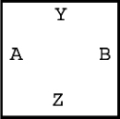


In this case, dummy holds no entry card. The ace should not be played by B until the dealer has no card of the suit.


If dummy holds no entry card, B should not take the first trick.
B should pass both the queen and the knave. By passing the second trick, if the dealer fails to overtake, or if the dealer does not hold two re-entry cards, the suit cannot be made.


Y has an entry card. B should refuse to win the trick, trusting that Z has no other card to lead.
A should refuse to cover the honour. If he waits until the third round, the suit is blocked. Z may have no re-entry card.
In this case, the honour should be covered. If Z holds the ace, the suit is blocked.
A should cover the ten led. It may establish the king and nine in B’s hands. If Y has no card of re-entry B can then hold up.
As Y has no other card to lead, B should refuse to part with the ace. Z cannot make the suit without two re-entry cards.
TAKING OUT RE-ENTRY CARDS
If you hold the commanding card of the adversary’s suit, endeavour to take out your opponent’s re-entry before the suit is cleared. It is equally important that you take out this re-entry card if you know that your partner has the command of the adversary’s suit. In extreme cases do not hesitate to sacrifice a king or queen in order to accomplish this purpose. When the dealer attempts to make a card of re-entry for an established suit, hold up a higher card in order to frustrate his scheme of play.