Front matter (continued 4)
Reading edition
He was not disappointed, for they opened up all their cannon on those poor, unoffending tents, and kept up a merciless fire for hours before they resolved to go and accept General De Wet's surrender. When the cannon ceased to roar, all the English lines advanced and when they were well away General De Wet made a rear attack on the cannon. The English were at once convinced that General De Wet was in front of them and that some strong Boer commando was in the rear of them, and possibly that terrible man, General George Brand, was in command of them. They became utterly demoralized, hustled to escape and did escape, but De Wet captured two of their guns and rode off, satisfied with losing a few old empty tents.
With all their thousands the English were always outwitted by General De Wet who generally enjoyed a signal success. In anticipation, the English people would become overjoyed by the glowing reports of the English generals describing the little pen into which they had driven and confined General De Wet and his men and from which it was impossible for him to escape. But when the following day they learned that General De Wet had not only escaped but taken some prisoners with him, they would sneak home, remain quiet and anxiously await more glowing reports from the English generals. Isn't this a sure sign of degeneracy? Well I think so.
Now I will leave the Free State and stop in Cape Colony for a moment. Of course, all was peaceful there and the people were loyal British subjects, for the London Times said so. But Lord Kitchener felt that a strong British force in those parts might induce the people to be more loyal, and accordingly he kept one there. General Kritzinger with 500 or 600 men showed himself on the Boer side and at once made it very uncomfortable for the English in loyal Cape Colony. The war was over, because Lord Roberts had said so, yet here was hard fighting in Cape Colony as well as in the Free State and the Transvaal.
Now I will go into the Rustenburg district and see to what a mass of pulp the English have crushed General de la Rey and his patriots. The English had a strong force in the town of Rustenburg, and of course they must be fed, and to feed them long convoys heavily guarded were necessary. General de la Rey never denied food to the hungry in his life, but on this occasion, when a long convoy surrounded with numerous Tommies was slowly moving towards Rustenburg to feed the hungry, he could not resist the temptation of making an attack, for his own men might be hungry in a week or so. The result was that the convoy was taken, many Tommies buried on the roadside, and several of them taken prisoners, only to be disarmed and set free again. In the middle of the month General Clements, in conjunction with other generals and their commands, planned to surround and take in this old farmer, de la Rey. They planned well and their intentions were good enough, but the old farmer did not exactly like the idea and acted accordingly.
At the base of the Magaliesburg Mountains but a few miles from Hekpoort there are a long line of kopjes excellently situated for defensive work. The place is known by the Boers as Nooitgedacht, "never thought of," but I am sure that the Boers will never forget, and that General Clements will ever remember it.
General de la Rey realized that it was a very strong position and concluded to take it for his own use. He had an exceedingly strong and capable brother officer with him, in young General Beyers, who commanded the Waterburg commando. I do not believe that there was a better fighting general in the field than this brave and patriotic Beyers, and like those great generals, Celliers and Kemp, he was always ready for daring work. The English had planned to surround and take General de la Rey, but this Commandant-General of Western Transvaal resolved to take in the English. So he told General Beyers to charge them from one side and he would charge them from the other. Of course, General Clements' force was much stronger than the combined forces of General de la Rey and General Beyers, but that made no difference so far as either de la Rey or Beyers was concerned.
About the middle of December, in the early morning, General Beyers, with his 350 men, charged over a half mile of open ground and came into close fighting quarters with Clements' force. Kopje after kopje was taken, and at times the Boers and English were within two yards of each other, yet the former continued to kill and drive till they completely routed the whole force and killed and captured nearly 800 men. The Boers did not know where Clements' cannon were, or they would have captured them, too. General Beyers' attack was a little previous, because General de la Rey had not had time enough to reach the charging point before Beyers had finished his work. Clements and his whole command, together with his cannon, would have been captured without doubt, had General Beyers delayed his charge for twenty minutes. But it was dark and very difficult for two forces to work in perfect unison. At any rate General de la Rey had the position he wished, and General Clements was in rapid retreat.
All this took place in the middle of December, yet the war was over, for Lord Roberts, the Mighty, the High, the Great Financier and Politician, had so declared nearly four months previously, and Conan Doyle had countersigned his declaration.
Before the end of December and the end of the year 1900, many Free Staters with General George Brand and General Hertzog, both able and determined officers, had crossed into the Colony, and other forces had entered Griqualand West, where some convoys were taken. So there was daily fighting in Cape Colony, the Free State and the Transvaal, and the Boers were successful in all the main engagements, this, too, in the face of the fact that the war was declared at an end both by Lord Roberts and Conan Doyle.
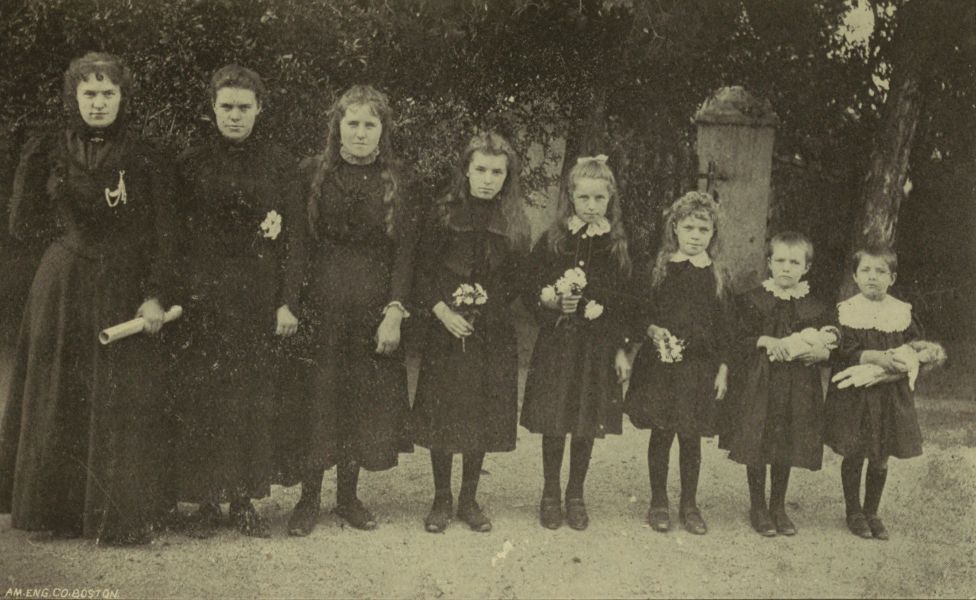
EIGHT BOER SISTERS OF WELLINGTON, CAPE COLONY
CHAPTER XVI.
BOERS BECOME AGGRESSIVE—AMERICAN GOVERNMENT COMES TO ENGLAND'S ASSISTANCE AND FURNISHES HORSES, MULES AND MEN.
The year 1901 began well, and the month of January was a very lively one, as there was hot fighting in every direction throughout the land and as far south as Cape Town. The English were alarmed; affairs in South Africa looked dubious and dark. The Boers were becoming more aggressive, Johannesburg was in a constant state of excitement, expecting every moment to be attacked and captured; the people were calling for protection, Kitchener was clamoring for re-enforcements from England, and England was calling for help from Ireland, Scotland, Wales, Canada, India, New Zealand and Australia. At the same time Lord Roberts was pulling the ropes for his earldom, and $500,000 for his proclamations annexing the Free State and the Transvaal, and declaring the war at an end. The English were short on horses and mules and these she must have at any cost, otherwise they were swamped.
There was but one country in the world from which she could hope to get them, and that was the last country in the world that should supply them.
The Government of the United States of America disgraced itself by violating the law and allowing British officers to establish recruiting camps for horses, mules and men on its sacred soil, thereby assisting the great monarchy of the British Empire to destroy two little republics in South Africa struggling so hard for their liberty and independence. One of these camps was in New Orleans, at Chalmette, a spot of ground sacred in the eyes and hearts of all true Americans.
The governor of the state protested against this camp. The mayor of the city protested against this camp, and the people of America protested against this camp, yet it was allowed to remain. The Government in Washington City sent two officers clothed in the army uniform to visit and report on this camp. The two officers went there, shook hands with the British officers, had some wine, returned to Washington, reported that all was well, and the Government established a police force to protect those British officers and that camp while recruiting horses, mules and men for the British Army in South Africa.
During the war of 1812 the English tried to lay waste our land, employed the Indian savages to murder our women and children, burnt our capitol, and the war closed, with one of its greatest battles, in 1815, at Chalmette, in New Orleans. So our English Government in Washington waited some eighty-five years for the opportunity to apologize to the British Government for the terrible thrashing that the famous Andrew Jackson gave General Pakenham and his English army at Chalmette, New Orleans.
It seems to me that this is enough to bring the blush of shame to the cheeks of every true American. If the people of the United States of America cannot find enough true Americans to fill the highest office in their gift, then the time has arrived when they should change their name and cease to call themselves Americans. Suffice it to say that just as the struggling Boers had all England alarmed and the English army pushed to hard straits, ship load after ship load of horses, mules and men from America began to arrive in Cape Town and Durban, and with them Lord Kitchener was soon able to put into the field ninety-one mobile columns. Many of these Americans were captured, and some of them said that the English forced them to enlist and fight, after they reached South Africa, while others declared that they were duly hired by the British in New Orleans to go with the horses and mules to South Africa and on arrival there take up arms against the Boers.
Little good it would do them, but all those who claim they were forced by the British to take up arms against the Boers, should at least vindicate themselves to the extent of laying their complaints with the proper officials in Washington City. Those who confess that they were duly hired by the English to take up arms against the Boers should be made to feel the stigma of their disgrace by being disfranchised and deprived of the rights of American citizenship.
I certainly feel that any republican who voluntarily assists a king or queen, or both, to kill or enslave other republicans, is not fit to live among republicans, for such a man in time of war is sure to commit treason if he gets an opportunity.
Strange as it may seem, it is yet true, the English never once attacked the Boers in the month of January. They were forced to fight on the defensive and the Boers made them do plenty of fighting. Without horses and mules what could the English do but spend their time in throwing up earthworks to defend themselves against Boer attacks, and I tell you the English were kept pretty busy from morn till night. The Boers were having a first class picnic with them, and had not the English Government in Washington, D.C., lent a helping hand, the British army in South Africa would have been hopelessly lost in the struggle. Now the reader can understand what I meant when I said some time back that the two little Republics would have won their independence had not the devil and his angels been against them. It is significant, and it means something when 35,000 Boers put an English army 250,000 strong strictly on the defensive, and the Government of the United States did not fail to come promptly to the British Army's rescue. But I must go ahead and tell what happened in the various and widely separated parts of South Africa during the month of January, 1901. It may not interest the reader, but it was a month of great worry and excitement both to the British army and the British Government.
Early in the month General Botha planned to attack Machadadorp, Dalmanutha, Belfast, Wonderfontein and Balmoral, all fortified stations of the Delagoa railway line. All the forts were well equipped both with men and guns, and the forts at each station were so placed that each could protect the other.
It was during the dark and rainy night of January 8th, that a simultaneous attack on all the stations on the line was to be made. For a distance of seventy-five miles the midnight hour was made hideous by the singing of rifle bullets, whizzing grape shot, and the roar of cannon.
The frightful noise could be heard for miles, and the Boers and English were face to face at the forts, some shooting and others using their rifles as clubs. The English lost heavily, but the attack was only partially successful. The Boers had tried to outdo ten to one against them in well fortified positions. The English at night always removed their guns at Belfast from the forts for safety and it was fortunate for them that they did, for General Viljoen with the Johannesburg boys took the big fort on Monument Hill with its maxims and men. He lost his bravest and best veldtcornet in the attack, Ceroni, who fell at the wall of the fort. Plucky Dick Hunt, of the Irish Brigade, was by his side, and he received three wounds, one in the lungs being a very severe one, from which he is suffering to this very day. He, however, with his three wounds, was among the very first to scale the walls and capture the fort. The fort at the coal mine was attacked by Major Wolmorans and about twenty-five artillery boys, including Sergeant Joe Wade, Sergeant Mike Halley, Joe Kennedy, John McGlew, Jim French, Captain McCallum and Jerry O'Leary, of the Irish Brigade. Here the Boers and the English were within two feet of each other, each trying to take the other's head off. Some of the Irish boys actually pulled the rifles out of the Tommies' hands. Finally the Tommies weakened and the boys jumped over the wall and took the fort. Lieutenant Cotzee showed remarkable bravery, was severely wounded and afterwards murdered by some Kaffirs that had been armed by the British. The Boers held the two forts a few hours, helped to care for the dead and wounded English, and then with all their booty returned to camp. At all the other stations the Boers had to fall back because the English were too strong for them.
This affair put all the English to work next day along the line, strengthening existing forts, building others, digging trenches and so forth, to make their positions as strong for defence as possible. They were not only frightened, but astonishingly alarmed by the boldness and the aggressiveness of the Boers. We were camped about seven miles from Belfast, about 150 strong, could see everyone in the town, and the English, about 3,000 strong, could see us, yet they never dared to attack us. We had no defences whatever and were camped on the open prairie. "We were as safe as the people in Piccadilly."
General Chris. Botha near Blauwkop and not far from Standerton, attacked the English and had a good warm fight, and at the end the English thought it wise to pull themselves nearer Standerton. Shortly afterwards General Chris. Botha found the English between Ermelo and Carolina and again attacked and made it warm for them. In fact, he made the English commands that had sufficient horses hustle away lively, and they kept close to the railway lines for protection. General De Wet in the Free State was at all times next to the English, who now were not striving to corner him, but to keep shy of him. Near Lindley he attacked and had a fight with a column much stronger in men and guns than himself, but he was eminently successful, and before all could escape he made several prisoners. In Cape Colony, south of Kimberly and as far down as Cape Town, there was good fighting in many places. It required an English army 30,000 strong to protect the various towns, and yet the Boers had no trouble in accomplishing their ends. Judge Hertzog and General Brand were in one section, Commandant Fouche and General Kritsinger in another, while Commandant Wynand Malan and Commandant Scheepers were near to Cape Town. All these generals and commandants were playing havoc with the English, and Commandant Malan, one of the most successful and daring young officers of the war, was within twenty miles of Cape Town when he captured a convoy. While he was here great excitement prevailed in Cape Town and the people were daily expecting the Boers to attack. Near Kimberly the other generals and commandants were attacking and driving the English, and once again Kimberly was in a great state of worry. So alarming were the conditions in Cape Colony that it became necessary to proclaim martial law in many districts, and re-enforcements were called for in order to try and suppress the invaders.
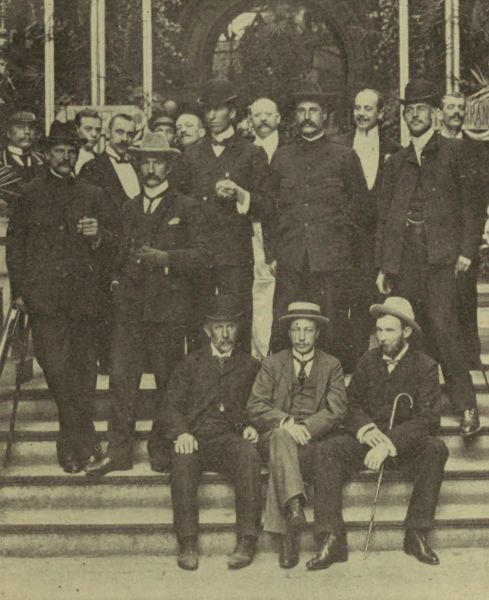
COMMANDANTS IN THE BOER SERVICE Colonel Blake, John Muller, Commandant Malan, Lieutenant Malan, Commandant Conroy, Commandant Lategan, Commandant Piet Moll.
Now we will see what General de la Rey is doing in the Western Transvaal. The English are numerous everywhere and protected by forts in all parts. At Zeerust a large command is tied up by General de la Rey's men, not one of them shows his head above the wall. They cry for food and relief, but in vain. Only a small number of General de la Rey's men are there, but the number seems quite sufficient. The English are hard pushed and much worried, yet they do not dare to leave their walls and face the Boers.
For many miles along the Magaliesburg Mountains southwest of Pretoria, de la Rey is attacking and driving the English, and before the end of the month had cleared them all from the mountains and taken possession himself. Every advantage, both in men, guns and fortified positions were in the hands of the English, yet so fierce was General de la Rey's attack that they had to give way and abandon that mountain range. Near Ventersdorp and Lichtenburg some of de la Rey's commandos attacked the intrenched and fortified English, and at Lichtenburg, where the general was in person, half the defences were taken and many English killed and wounded. Fighting continued here for several days, and had not re-enforcements arrived, General de la Rey would have captured or killed all the English commands.
In the Western Transvaal one of de la Rey's commandos attacked a convoy and its escort near Modderfontein, and a hard fight for several days, was the result. In the end, 250 men surrendered with two maxims, plenty of ammunition, loaded wagon train, and so forth. Having disarmed them and taken possession of the booty, the Boers sent the escort back to the English lines. It was during this month that General Beyers passed from the high veldt on the east to the Western Transvaal, crossing the railway line between Johannesburg and Pretoria. He did not forget to take a railway station as he passed. Some of his men made a raid to Johannesburg, upset the nerves of the whole population, took about two thousand cattle, a good number of goats and sheep and then returned to camp, satisfied with their day's work. Many other small fights occurred during the month, but not of sufficient importance to deserve mention. I think that I have given enough to show that Lord Roberts' war was at an end, and that he fully deserved his $500,000 and earldom for his proclamations. I have not heard yet what Conan Doyle received, but he is certain to have reaped a reward of some kind.
It was during the months of December and January that Lord Kitchener did some of his dirtiest paper work in the form of circulars praying the burghers to come in and surrender, and offering them all sorts of inducements to commit treason. He made use of the burghers who had long since surrendered and whom he had not shipped out of the country because they were so loyal, to carry out these circulars and distribute them among the Boer commandos.
When they began to arrive they were at once sent back and told to warn all persons who should in the future appear in the Boer camps with such treasonable papers that they would be shot. Lord Kitchener prevailed upon them, however, and out they came again. Generals De Wet, de la Rey, Louis Botha, Chris. Botha and Viljoen all had some of them shot. Lord Kitchener protested against the shooting of his loyal subjects, but he was very careful not to send any more out. These Anglo-Africans who did this work correspond to what is known in the United States as Anglo-Americans or Anglo-Saxons, and just as much confidence can be put in the one in time of war as in the other. For it is this class of people who, in time of war, will be sure to ally themselves with that power which they believe most likely will be victorious in the end, regardless of their citizenship. Any English lord or general, or any general who, to gain his end, puts a premium upon treason, will himself, under proper conditions commit treason, just as sure as he who offers a bribe is equally sure to accept one. An Anglo-African is a born or naturalized burgher of the Free State or the Transvaal who has an English heart, just as an Anglo-American is a born or naturalized citizen of the United States who has an English heart.
CHAPTER XVII.
KITCHENER ALARMED AND ASKS FOR MORE TROOPS—FRENCH TRIES TO CORNER BOTHA—FAILING MAKES WAR ON BOER WOMEN—BOTHA ATTACKS ENGLISH AT LAKE CHRISSI—DE WET ALARMS THE ENGLISH—DEFEATS THEM, GOES TO THE COLONY AND RETURNS.
Now I come to the month of February, 1901, and will give the reader a little idea of how the Boers conducted themselves during the twenty-eight days. The British Government had now granted Lord Kitchener's request, and started to South Africa 30,000 more men. England was so hard pressed for recruits that she had to send any and everything in the shape of a man, and most of her recruits were taken from barrooms, I imagine, for, of the 30,000 who came, Lord Kitchener had to send back some 10,000 as being utterly worthless for any use whatever. The remaining 20,000 were put in military training for six months, and in the end were unable to ride or fight, but he needed men so badly that he kept them to make a good display if for nothing else.
During the month before us General Louis Botha and his brother, General Chris. Botha, had a very lively time. They were in the vicinity of Ermelo on the high veldt, in the Eastern Transvaal. They had made so much trouble that Lord Kitchener resolved to make a determined effort to corner and capture them. He collected all his available cavalry and having supplied them with plenty of maxims and guns he started them in six columns to bring in the two Bothas. General French was put in command of the English and was considered the best cavalry officer in the British service, so then there was no doubt but that he would present to Lord Kitchener the two ordinary farmer generals that had been causing so much trouble and alarm. The Bothas had with them about 1,000 men, and French was to corner and capture them with 15,000 men. General French so placed his columns that when they all advanced they would enclose the Bothas within a circle from which it would be impossible to escape. The Bothas discovered French's object and before the columns could advance they attacked and put to flight one column and then moved off in the direction of Piet Retief. This was a surprise to General French, but he did not despair of capturing the farmer generals. He put all his columns in pursuit, and when the proper time came to cage them, the two farmers easily broke through the cordon and returned to the vicinity of Ermelo.
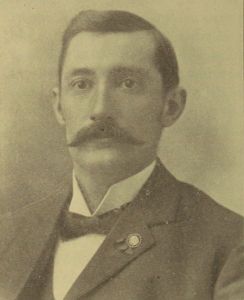
GENERAL JAN KEMP
French was discouraged. He made no further attempt to capture the farmers, but was determined to do something before he returned, so he made war on the women and children and spread great distress and suffering among them. Some of these women were raped, others dragged out of their homes at night and made witness all their possessions consumed in flames. Many were driven on foot to concentration camps and kicked and cuffed about as so many beasts.
Having made the women suffer as much as possible, he gathered in several thousand cattle and sheep and returned to report what a successful expedition he had completed. At Lake Chrissi, between Ermelo and Carolina, General Botha had the nerve to attack an English camp 2,000 strong. It was a foggy morning, and the noise of the battle stampeded a band of wild horses and they ran into the Krugersdorpers' horses, stampeding them too.
This spoiled the whole affair, for General Botha had the English camp all but taken, but when the burghers saw their saddled horses running away they at once started in pursuit of them. Fortunately they had already captured several hundred horses from the English, for many of their own horses evaded them. Commandant Kemp, one of the most enthusiastic, one of the most energetic, pluckiest and best commandants in the Boer army, was more than disgusted with his men for being so concerned about their horses, but he forgot for the moment that an infantryman is but of little practical use in war. The English, when the Boers retired, lost no time in fleeing to places of safety, and never again showed themselves on the high veldt until the horses, mules and men from America were put into fighting trim, and that was many weeks to come. The two Bothas had proved themselves equal to that almost, if not quite, unequalled De Wet, and such was the impression they made on Lord Kitchener that he requested General Louis Botha to meet and discuss with him some peace terms.
Before going elsewhere, I will tell what happened when last General Botha and Lord Kitchener met in Middleburg at the end of February. For the price of peace, Lord Kitchener told General Botha that after a time he would give the Boers civil government and give this, and that, and one million pounds to build up ten millions' worth of destroyed farms, and so forth. But Lord, or monacle-eyed Joe Chamberlain stepped in, and said "We will do nothing of the kind, and the Boers must make an unconditional surrender." Of course, General Botha smiled at both, and on his return to Ermelo told what had taken place at the conference, exhorted them to fight to the bitter end, and assured them that he would be with them heart, soul and body.
Now I will jump into the Free State and see what the wily De Wet is doing. De Wet, the Stonewall Jackson of South Africa, had all the English of the Free State on the run and, at the end of January, it looked as if he would sweep them from the country. Lord Kitchener resolved to corner and capture him, it mattered not what it might cost, for Lord Roberts and Conan Doyle had declared the war at an end, and if the English people should hear that De Wet was practically in control of the Free State, why, they would be inclined to think that both Roberts and Doyle were liars.
As a side remark, that might be expressing it mildly, but anyhow, Kitchener organized eight or ten columns, all he could get, because the English Government in Washington City had not yet succeeded in landing enough horses or mules for his needs, and sent them to surround and take in the troublesome De Wet. Now General De Wet was on the open veldt near Brandfort, where the English could see him from all directions, and all they had to do was to surround him and take or kill him. As De Wet had about 1500 men, of course it would be a very easy thing for 25,000 trained military men to gobble him in, in quick time. The several columns surrounded him, and despatch men were flying at full speed from column to column bearing instructions that would insure perfect unity of action. General De Wet, when he concluded that the several columns were in good readiness to bury him, saddled up, moved out and attacked the nearest column. He riddled it, put it to flight, and another column which came up quickly was also torn to pieces and scattered in all directions. He took two of their guns, a maxim and a portion of their convoy, a few prisoners whom he released, and went on his way to Cape Colony without consulting with or asking permission of the other columns. I do not know what the officer in command reported on his return, but I suppose he made the usual one, that some one had betrayed him or that his horses and men were so fatigued that he could not make a successful pursuit of De Wet and his fresh horses and men. General De Wet did not stop to hear what kind of a report the English commander did make, because he was anxious to reach Cape Colony, find out what was being done there and replenish his command with horses, and so forth. He had to pass many English commands on the way, but he succeeded in sweeping them aside and reaching the Orange River, where the English had made every preparation not only to prevent his crossing, but also to capture him. Again he outwitted the English, crossed the river, entered Cape Colony, saw Judge Hertzog and other commanders, supplied himself with plenty of horses, had a tough fight with the English, abandoned some of his wagons, and then started back on his way to the Orange River where the English were sure to catch him this time.
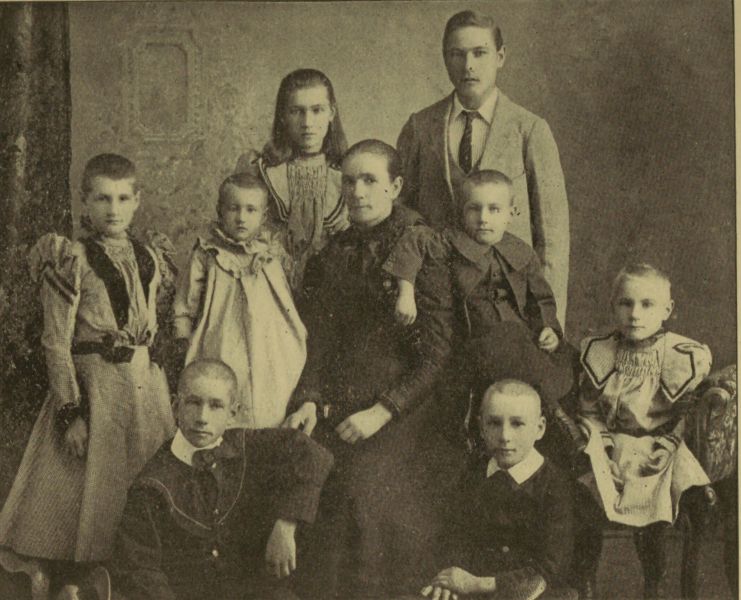
MRS. ABRAHAM MALAN daughter of Commandant General Joubert and her young family.
On arriving near the river he found the crossings in possession of the English commands, but he must cross, for he was anxious to go far to the north in the Free State, where he felt that his presence was necessary. He sent a detachment to a certain point up the river with instructions to show themselves, and in case the English advanced they were to retire, put spurs to their horses and overtake the command while crossing the river. The scheme worked beautifully, for as soon as the English saw the detachment they concluded that it was De Wet's advance guard and they prepared to attack him. The detachment played its part well, by going through the form of signalling to the rear.
The English made all possible haste to advance and attack De Wet and if possible hold him engaged until their other commands should come. As all were on the lookout for him, of course the different commands would lose no time in reaching the scene of action. The English completely abandoned the crossing in front of De Wet and made a hurried advance on the detachment. When 1200 yards away the detachment opened fire on the English and a short skirmish took place. At this moment De Wet rushed to the river, crossed it and put his men in fighting order to protect the detachment which he expected every moment. After firing a few shots, the detachment dropped behind the hill from which they had been firing, mounted their horses, put in the spurs and soon joined the wily De Wet across the river. Again the English were easily outwitted and De Wet was once more in the Free State. He had to fight his way all through the Free State, but the English were afraid of him, and he reached his destination at Heilbron without loss of time.
He had now made a round trip of about a thousand miles, had had many skirmishes, successfully fought two battles and landed home with but little loss. His trip had a great moral effect on the English army, the people of Cape Colony and Cape Town. The news of his invasion of Cape Colony had spread all over South Africa and had reached London. The English element in Cape Town and throughout the colony were crazy with fright, for all men were sure that De Wet would lay waste the country as the English had the Transvaal and Free State. The English forces in the Colony were concentrated that they might make a successful defense when De Wet should attack.
Lord Kitchener and his numerous force of cricketers felt the cold chill running down their backs and were at their wit's end to make out a report that would so mislead the English papers that they would not express any regret at having presented Lord Roberts with $500,000 and an earldom for his proclamations, and for declaring that the war was at an end. All were so undone and such nervous wrecks that they did not remember that Conan Doyle had also declared that the war was over.
I think General De Wet made a great mistake in returning to the Free State so soon. With his energy, his ability, his prestige and men he should have gone to the De Aar Junction, destroyed that most important railway point and then followed the railway towards Cape Town, destroying it and all the bridges on his way. Such were the conditions in Cape Town at the time that had he gone ahead and penetrated as far as the Paarl, it is safe to conclude that he would have received at least 15,000 recruits, and these Colonial Boers cannot be surpassed for fighting qualities. Having done this, before retracing his steps he would have had an army 20,000 strong before he reached the Orange River. I always felt that the war should have been carried into Cape Colony and there finished, for the people were ripe for rebellion, and had Generals Botha, De Wet and de la Rey gone there with their commands it is certain that they would have risen, as one, and all joined the Boers. This would have meant the defeat and downfall of the English army and the independence of the Africander race throughout South Africa. But they didn't go there, and the Africander race has yet to free itself.
During this month of February neither General de la Rey nor the English did anything worth recording. The English remained close in their forts, and General de la Rey was satisfied to rest his men and give his horses a chance to recuperate and fatten up.
CHAPTER XVIII.
HORSES, MULES AND MEN ARRIVE FROM AMERICA—THE AUTHOR AND MAJOR PRETORIUS MAKE A LONG RIDE WITH DESPATCHES—AN EXCITING TRIP.
Now I come to the month of March, during which but little was done except in Cape Colony and de la Rey's district of the Western Transvaal. General Louis Botha was at Ermelo and the various commands were in their respective districts on the high veldt. The English did not come out because enough mules and horses had not yet arrived from America.
We all had a quiet but good time lying in laager, smoking our pipes and growing fat on mealie pap (ordinary corn meal mush) and fresh beef. In the Free State General De Wet had a few little skirmishes and a few of his commandos had a brush with the enemy, but little or no damage was done. It seemed that the peace confab between Lord Kitchener and General Botha in the latter part of February had a soothing and quieting effect on everybody. In Cape Colony, General Kritsinger, Commandants Malan, Fouche, Hertzog and George Brand were going at a lively pace in many of the districts. They seemed to continue to have their own way and keep the English on the constant jump, and captured many prisoners. All of them supplied themselves and men with at least two horses each, and the English were kind enough to give them plenty of ammunition. So the Boers in Cape Colony had no reason to complain. In the western division of the Transvaal, General de la Rey's commandos had some pretty hard fights. The general attacked Lichtenburg and gave the English a good pounding. Had not reinforcements arrived just in time, he would have had the town and the English garrison. But as it was, he was forced to retire. One of his commandos near Klerksdorp attacked the English and forced them to retire. Near Kaffir Kraal General de la Rey had another fight, and although the English suffered severely, they were too many for him and captured his guns. The lieutenant in charge of the artillery was not to blame, however, for he was deceived by one of those Anglo-Africans who came to him and told him that General de la Rey wished the guns. Having obeyed he found himself and guns in the hands of the English. As this Anglo-African was evidently a burgher, the lieutenant thought nothing about it further than to obey instructions. Damn all Anglos, whether Americans, Boers, German, French or whatever their nationality.
Along the line of the Magaliesburg Mountains a few shots were daily exchanged between the English and the Boers, the English in the forts and the Boers in the foothills, but no actual fighting took place. General Beyers in the north was inactive, too, after he and General Plumer had had some hot fights, when the latter came to occupy the little town of Pietersburg, 180 miles north of Pretoria.
General Beyers had but a small command, but he kept General Plumer's force busy throwing up earthworks and preparing all sorts of defences. General Beyers placed his headquarters between Pietersburg and Pretoria and not far from the railway line, that he might continue to trouble the big force at Pietersburg.
Now I come to the month of April, when sufficient horses, mules and men had arrived from the United States of America for Lord Kitchener to put sixty-three mobile columns in the field, so the reader may be sure that the Boers had to make use of all of their natural wits to outwit the English. They did well, covered themselves with glory and again put the great English army to shame. The reader must remember at this time the actual fighting Boers numbered very nearly 30,000 men and no more. There were also on the farms several thousand women and old men, non-combatants, and children. I hope this will be remembered, for now comes the most interesting and marvelous part of the war.
During the next twelve months, the wonderful fighting qualities of the real fighting Boer came out and astonished the world, while the English army by its pitiful stupidity and unworthiness, becomes immortalized in the history of a fast declining and degenerated Empire. General Ben Viljoen and "Fighting Bill," General Muller, learned that a large convoy was leaving Machadadorp on the Delagoa railway line for Lydenburg, where there was a large English command. They resolved to try to take it, and with nearly 500 fine soldiers and determined men they left their laager, marched about thirty miles and concealed themselves near the main road to Lydenburg. At last, after waiting a day and a night, the convoy with six or seven hundred escort came in sight, and all the boys gazed at it with eager eyes. Nearer and nearer it came, till it came too near and the boys could not wait any longer. Off they went for it, fired a few shots, the escort fled, and the boys brought back about 100 loaded wagons with them. I tell you, the Tommies don't like the looks of the Boers when they come fast, and they put themselves out of danger as quickly as their horses can take them. Once again the English have supplied the Johannesburg commando with food, clothing and ammunition.
General Chris. Botha in the Vryheid district, like General Viljoen and General Muller, helps himself to a convoy that plentifully supplies him with all that is necessary in the way of food, clothing and ammunition, but the escort were all fortunate enough to escape.
Commandant Grobler ran against a large column of English five times his number, gave them a good short fight and then retreated as rapidly as he could. General Louis Botha and General Chris. Botha attacked a column 3,000 strong at Spitz Kop near Ermelo and kept these 3,000 Tommies moving lively all day. I really believe the English cavalry would do well if so many of them did not fall off when at a swift pace, and if they would not stampede and every man run for his life because a shell exploded near them. Here I saw over 600 cavalry put to flight by one shell from a French gun so directed by Major Pretorius that it struck and exploded in their midst. Major Pretorius had about twenty men with him, but the 600 Tommies had not lost any Boer guns and were not looking for any. As this body of 600 cavalry fled, several troopers fell off their horses and followed their fast flying comrades on foot. If the cavalry of other European countries is as bad as the English cavalry, my advice to them is to fight shy of the American cavalry—if it comes to a fight. This column intended to camp near Ermelo, but concluded that it was too warm for them and went several miles towards Carolina before going into camp.
Now there was a rest in this part of the world for about two weeks, and then, like a swarm of bees, the English columns fairly covered the whole high veldt, fifteen columns having shown up at one time. This was on the 29th of the month, so I will wait until the next month, May, to tell all that happened.
On this very day Major Pretorius, Gustave Preller and myself started on a round trip of 480 miles to the Western Transvaal with despatches for General de la Rey. We saw something, and before I forget it I must tell our experience. It was a perilous journey, but we felt confident that we would deliver the despatches and return to General Louis Botha with the replies. With a cart and four mules driven by a Pondo Kaffir, Kleinveld by name, two pack horses, and three riding horses, we started. On arriving at Olifantsfontein, about twenty miles from the Johannesburg-Pretoria railway line, we learned that it would be impossible to keep the cart with us because the English had every crossing so well guarded.
We decided to leave it, its Kaffir driver and the young burgher, Van Rensberg, and go ahead with the two pack horses. Young Van Rensberg, a brave and noble boy, was instructed to await our return, but if the English should show up before we did, he was to use his own judgment and save himself, cart and mules. Off we went, and on reaching a ridge about nine miles from the railway line we stopped, brought out our field glasses and found that the English were numerous all along the line. But we must pass through, and that was all there was to it; so we decided to pass the line very near to Olifantsfontein, because the English wouldn't think for a moment that any Boers would dare to take such desperate chances. We waited till the sun was down. It was the 3rd of May and the full moon came up in all her glory just as the sun dropped below the horizon. It seemed to us that it was as light as day, but go we must, and we did go. At about eight o'clock p.m. Major Pretorius said, "There is a line," and there it was. Cautiously we approached it, then crossed it and smiled a heavenly smile as we looked at the Tommies 600 yards away at the station, smoking, telling jokes and laughing by their camp fires. They had no guards out, and we passed by them without interruption, not seeing any trouble ahead. We rode on for a mile, stopped and rested our horses for fifteen minutes and then went on our way to the six-mile-spruit near Pretoria. We rode till one o'clock a.m. and we knew that we were near the Pretoria-Rustenberg main road, so we decided to stop, sleep until daylight and then hasten to Schurweburg, a farm settlement just twelve miles west of Pretoria. We hobbled our horses and went to sleep on the dry grass.
Just at daylight Major Pretorius stirred us up, and we caught, saddled and packed our horses and travelled at a gallop, because we were very near the English forts on the hill between us and Pretoria. Just as the sun rose we were crossing an arroya (a spruit), and Preller discovered a long canvas bag, well filled, by the roadside. It bore the name of one of Kitchener's scouts and had evidently fallen from a wagon during the night. The numerous horse and wagon tracks convinced us that we were very near an English command and therefore we must proceed very cautiously.
About one and a half miles to our right was the little farm settlement behind a ridge, and from the great column of black smoke that was rising in the air we concluded that the English must be there, engaged in a fight against the women and children and burning their homes. We turned to our right and went down the arroya and when at a distance of 400 yards, Major Pretorius, who was in front, leaped from his horse. Preller and I followed suit. About 500 yards to his left Major Pretorius discovered fifteen mounted English on a small ridge facing him. Near the arroya was a small clump of bush and in it we concealed our five horses as best we could. The Major and Preller crawled up a hill about sixty yards away to try and find out where the camp was, while I was to stay with the horses and keep an eye on the smoke. In a few moments I discovered between us and the smoking farm settlement, at a distance of about 800 yards, some 400 cavalrymen, all dismounted. The major had also discovered them and traveled back to tell me.
We now realized that we were in a bad box, and that it looked as if there was no hope to escape, for should we try to go back towards Pretoria we would be discovered and driven into that town and captured. In a few minutes the 400 cavalry mounted their horses and came up the arroya towards us, crossed it about 300 yards below us, passed about the same distance to our left and finally dismounted in the road just where a few minutes before we had picked up the bag. They were now about 400 yards from us and in plain view. Suddenly they mounted their horses, formed a semi-circle around us, in line of skirmishers, and began to fire, but in an opposite direction to us. Another 100 cavalry came up the arroya from the burning houses, driving some sheep, and passed behind us no more than seventy-five yards away. We heard distinctly all they said about burning and plundering the farmhouses. The firing became general all about us. Then we knew that some Boers had attacked the English, yet there was no possible chance for us to escape as far as we could see.
We all shook hands, and swore that we would not surrender, and having concealed the few valuables we had, we waited for the English to discover us. Should they kill us they would get nothing but our horses, and as a last resort we were going to mount our horses and run for our lives. The fight lasted till 10.30 a.m., about three and one half hours, and then the English formed columns, took their wagons and cannon and started for Pretoria. They had gone about 800 yards when they halted and dismounted. We did not like this, so we mounted our horses, rode down the arroya about 300 yards till we came to the wagon road that led to the farm settlement, and then put spurs and were away at full gallop. The English stood with their necks stretched like a flock of geese and gazed intently at us, but never fired a shot. We passed near five Boers in a kopje who were about firing on us, but seeing our pack horses they refrained. They could not understand how we could be Boers and come from the English lines, yet they knew that none but Boers had pack horses.
On reaching the farm settlement we found the houses were not burnt, but the barns and all food supplies were destroyed and hundreds of women and children left to starve. The object of this was to force the women and children to go to Pretoria and ask for supplies of food. Lord Kitchener would then send them to one of his prison camps for women and children, and cable to London that some 200 women and children from Schurweburg had come to him as refugees, seeking his protection, as all were in a starving condition. The Boers who had been fighting the English soon came in and reported their morning's work. We knew every one of them personally and were glad to see them again. When the fight began only six of the 110 men had horses, but when it ended they had nineteen more and six mules and one wagon loaded with supplies which they had captured from the English. With the mules they could now mount thirty-one of the 110 men.
During the fight a little fifteen-year-old boy by the name of Pretorius had walked about three miles to a point from which he could see if there were any more English coming from any quarter. He remained too long, and when he saw the English columns returning to Pretoria, it was too late for him to run and save himself. He had no idea that the English engaged in the fight intended to return to Pretoria so soon.
He followed the Boer instinct to save himself, and he crawled into an ant-bear hole about forty yards from the road and pulled his rifle with him. The whole column passed him by and when he could no longer hear the horses' feet beating the road, he ventured to peep out and see his position. He saw one man coming at a gallop about a half a mile away and he knew this man belonged to the column that had passed by, so he lay low and watched the lone trooper. When the trooper was about forty yards away little Pretorius jumped out of the hole, threw his rifle into position and called out, "Hands up!" The trooper was an English sergeant and thought at first that the little boy was joking, but soon saw that he was in earnest, and at once surrendered. Little Pretorius made him lay down his rifle, ammunition, and so forth, and then started him on his way on foot. After the trooper had gone about 100 yards the little boy with two rifles, plenty of ammunition and a fine horse, bridle and saddle, went cantering away to the farm settlements. On his arrival he was the hero of the hour, and every one, men, women and children, congratulated him on his pluck and good soldier sense. Now thirty-two of the 110 men were mounted.
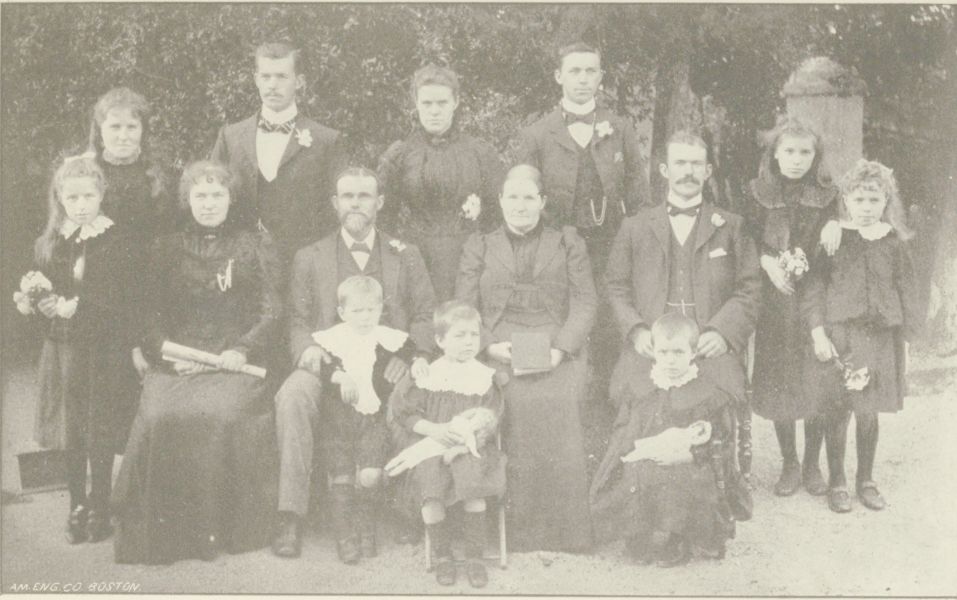
A TYPICAL BOER FAMILY OF FOURTEEN S.W. Joubert and Family.
We stopped here for three days to rest ourselves and horses and to have new shoes put on the horses, for we had to pass through a very rocky country. We learned that the English forts were very numerous between us and General de la Rey, and that it would be difficult to pass them by without being captured, but we must take the chance. Here we first met the famous Boer Spy, Captain Naude, a young man about twenty-three years old. In due time I will tell all about him and his marvelous spy system in Pretoria and Johannesburg. While in this farm settlement he and a few boys went into Pretoria every night and brought out a good bunch of the officers' horses, bridles and saddles, so that by the time we said good-bye to all and started on our long journey, seventy of the 110 men were mounted. We arrived at this farm settlement on May 4th and left on the 7th, passed near Krugersdorp, saw the English camps about there and went down through Hekpoort.
We were now about three miles from Nooitgedacht where General de la Rey and General Beyers had taken General Clement's camp and killed, wounded and taken prisoners 800 of his men. Ahead of us we could see a long line of English forts, so we knew that there must be Boers in the Magaliesburg just opposite to them. We moved cautiously and kept our eyes on the forts. When nearly opposite to them and about 5,000 yards distant, we found some Boers, and I tell you we felt much relieved. The English had spent the previous day trying to shell them out, but had signally failed. We could not learn just where General de la Rey was, but they knew he was somewhere near Mafeking on the western border. We remained here for the night and learned that the English had forts everywhere in front, and that we must be very careful.
In the early morning we started to run the gauntlet and pass the forts. Each rode about two hundred yards behind the other for about an hour and a half and then we found ourselves out of danger. Not a shot was fired at us, yet we were directly under them and not 3,000 yards away. We crossed a small mountain and were then in a great, wide rolling prairie, with Ventersdorp about five hours' ride to the left.
The many English graves we daily passed showed that heavy fighting had taken place along the whole line of the Magaliesburg. On reaching a tall ridge we could see immense forts on all high prominences in our front, and we were much puzzled as to how we could safely pass them. We would stop and use our glasses frequently, because we were on risky ground. There was one large fort that was directly in our way, and we could not see how we could possibly pass it without going at full speed, and our horses were too tired to do this. We slowly approached till within a thousand yards of this place, when we dismounted, sat down to rest and made the best possible use of our glasses. We had excellent glasses, and for one hour there was not a second passed without at least one of us having the glasses nailed on that fort. It was about noon time, and to save us we could not see the slightest sign of life about the fort. We concluded there was no one in it and we decided to take our chances and ride by it. We guessed right, and at a kraal near by the Kaffirs told us that the English had left the fort the day before.
This fort would accommodate about 1,000 men, so we knew that many English were prowling about somewhere and that we must keep a sharp lookout. We moved on rapidly, passed many of the forts, but were not delayed by any of them. Our horses were very tired and so were we, when we reached one of General de la Rey's commandos on May 10th. We felt relieved, for now we were sure that the despatches would be delivered and we could take a long rest. We were told that General de la Rey was at Mafeking, but would return in two or three days. In due time we learned that he had returned and that he was with his laager about six miles away. We went to see him, and there we found with him one of his bravest and most dashing fighters, General Kemp. We delivered the despatches, he wrote his replies, and in one hour was gone to see one of his commandos twenty-five miles away, to get matters in readiness for a fight. He had one horse, worth about twenty dollars, a mackintosh, a revolver and a pair of glasses. With him was his son and Secretary Ferrera. He eats with his burghers, shares their blankets and carries practically no staff. He makes every man fight.
Within an hour after his departure a most important despatch arrived from General De Wet telling him that he must come at once and see him in the Free State, for it was on a serious matter that they must act. The despatch was forwarded to the general in haste. We remained here a few days with General Kemp to give our horses a good rest for the return journey. We had bread to eat and it was the first we had tasted for many months. At night, General de la Rey had the ground plowed, the corn planted, and the wheat sowed, so that he always had plenty of everything to eat in the way of bread, mealie pap, pumpkins, sweet potatoes, Irish, etc.
On the 22nd of May we started back on the same route by which we had come. Two days after leaving General Kemp we heard heavy cannonading, as if some one had attacked somebody else. We were sure that General Kemp had a hand in it, because he was always looking for a fight and he was in that direction. We passed back through the English lines without any trouble whatever, and arrived at the farm settlements we had left on the 7th of May, on June 2nd. Seventy of the 110 men were mounted when we left and on our return the entire number was mounted and they had some forty horses to spare.
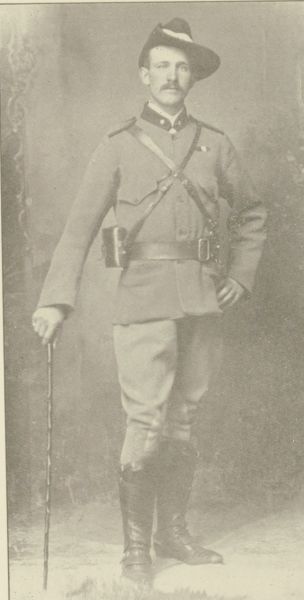
CAPTAIN J.J. NAUDE The Great Boer Spy.
Veldtcornet Pretorius and Veldtcornet Jones were in command and both were brave, energetic and daring commanders. We remained here till June 7th to rest ourselves and horses and try to find out what had happened on the high veldt since we left. All we could learn was that it was covered with English camps and that Bapsfontein, just across the railway line, was still free of English. This was good news to us, for we left our cart and mules at Olifantsfontein, just six miles further on than Bapsfontein. Captain Naude, the famous spy, and six other men joined us to go to the high veldt. They had helped to rid all the stables at Pretoria of the English officers' horses, bridles, and saddles and now they are seeking new fields for adventure.
We started about three o'clock in the afternoon of June 7th, in order that we might be near the railway line before sundown. There was no moon now, and as it was cloudy, heavy weather, the night was sure to be very dark. Veldtcornet Jones went with us a part of the way to be sure that we would strike the line at the safest place to cross. Night came and we made for the line. It was so dark we had to keep in touch almost, or otherwise we would be separated and lose each other. To make bad matters worse, a slow rain set in and we could not tell whether we were going north, south, east or west.
I remember one laughable incident which I must tell about, for it will require only half a dozen words. We had been wading through cornfields, reeds, muddy spruits and so forth for some time, but were getting along all right when we suddenly heard a most terrible splash. Oom Koos Bosch, horse and all, had suddenly disappeared in a deep pool of water that the rest of us had by mere luck escaped. We dragged him out, and after half an hour's hard work managed to get his horse out too. The banks were very steep and quite high. When La Blanche, his son-in-law, heard Oom Koos' voice, he rushed back to his assistance and in he went too, so we had to drag him out. It was a laughable affair, but both were so mad that one would have to take his life in his hand if he dared to give an audible smile.
We went on and rambled for hours trying to find the railway line. About nine o'clock all the large flash lights at various stations began to work. It was a sudden change from pitch darkness to almost broad daylight. We at once saw that we were very near the line and had the English opened their eyes they would have at once seen that we were near it. We had to hurry now, for the flash lights were playing all about us and we could see the entire line from Pretoria to Johannesburg. Soon we reached the line near Kalfontein station, and cut some thirty or forty barbed wires, the field telegraph and main wires, then crossed some deep ditches, then the railway track, then some more deep ditches, and then cut thirty or forty more barbed wires and were free to go our way, and be assured that we lost no time in going, for we were within five hundred yards of a big camp at the station. Soon we were as "safe as the people in Piccadilly," but having passed over a ridge, we were enveloped in pitch darkness again and the rain was still falling. We stopped and rested ourselves and horses for an hour, at one o'clock in the morning. Then we started again, but had no light except that reflected on the clouds behind or by the numerous flash lights, so we rambled and rambled in search of Bapsfontein, where we would strike a big road that would lead us straight and right. Just at early dawn in the morning we saw several specks of fire and some one cried out, "Look out! there is something in front. Don't you see the fire in their pipes?" Some laughed at the remark and some of us didn't, and when we had ridden twenty yards further out rang the cry "Who comes there?" and it was "Who comes there?" along a very long line. It was no laughing matter now, and like a lightning flash we whirled about, put the spurs in and away we went at a full gallop regardless of the awful darkness. We remained together, made a wide circuit, and having galloped for about a mile, we stopped on top of a ridge to await until there was more light. We did not know where we were, and we must find out. Sure we were that an English camp was near us, but where are we? When there was a little more light we saw a farm house about a half mile away, and two of the Boer boys rode to find out just where we were.
This was a "Hands-uppers" farm, and he was at home. He told them that we had just passed Bapsfontein, where there were camped about 2,000 English, and advised us to move rapidly for the reason that a detachment might be on the ridge in a few minutes. Fools we were, but we never thought about the fellow being a "Hands-upper," otherwise we would have taken him and his two good horses that were feeding near by us. At Bapsfontein we had actually passed between the main camp and the guards, and that is why they did not fire at us.
We now went on for three miles, for we knew now just where we were, and on reaching Kaffir Kraal, where there were plenty of mealies (corn) we stopped, unsaddled and bought a good feed for all our horses. While here we saw the English scouts on the ridge behind us and they saw us too, but made no move to disturb us. After an hour's rest, we saddled up and rode towards Olifantsfontein where we had left our cart and mules. When within a mile of this place we took up a gallop and when within a thousand yards we saw a lot of fellows preparing to fight. We came down to a walk, and the burghers who had prepared to fight saw that we were burghers too. We found here General Piet Viljoen, but not our cart and mules. Many and great changes had taken place along the scene since we had left it on May 3rd. No one had the slightest idea where General Botha or our cart and mules were, but all could tell us that the whole high veldt was fairly alive with English camps.
We remained here for the night and most of the following day, for our horses had been under the saddle for nineteen hours and necessarily they were exceedingly tired as well as ourselves. In the afternoon of the following day we boldly struck out on the high veldt to see what there was to be seen. On the 11th of June we came on some of the boys of the Bethel commando who told us that "Fighting Bill," General Muller, with 150 of the Johannesburg boys had just taken in an Australian camp about five miles away and captured over 300 men, two pom-poms, with 4,000 shells and some 400 horses. This was good news, and it was correct, too, and the Australians have not done much bragging since. They had not the slightest idea where General Botha was, but told us to look out, for the Englishmen were here, there, and so forth, pointing out to us the different directions of the English camps.
We went ahead towards Tritchardtfontein, which was near Bethel, and at night we came suddenly upon Commandant Mears and his men. Here was a spunky little commandant who had wrecked many trains and done his part towards worrying the English. He did not know where General Botha was, nor had he seen or heard of our cart and mules.
We camped with Mears for the night, and early next morning started out towards Bethel, but on seeing a lot of sheep that had just been killed, we changed our direction for Blauwkop, because the slaughtered sheep showed us that the English were in front. We reached the vicinity of Blauwkop just before sundown, and to our great surprise a Boer commando, too. A greater surprise was still in store for us, for on reaching the camp there was General Britz, another brave and capable officer, with his commando, President Steyn, General De Wet and General Hertzog, of the Free State, and our good old friend whom we had left some three weeks back, General de la Rey. It is unnecessary to say that we were delighted, yes, overjoyed, at our good luck, and as we all knew one another well, the reader may be assured that we spent a few hours most pleasantly.
I must here mention that General de la Rey and I each really first made out what the other was. During our short conversation three weeks back I had told him that certain conditions prevailed in another section and that to me matters looked serious. I went on and explained everything to him, but he could not but feel that I must be mistaken. Now we met again, and the first thing he said to me was "You were right, and we are here to correct and put things right." I had always distrusted the Acting President, Schalk Burger, and I had told General de la Rey so and given my reasons. I might as well finish up with this meeting before I take up the thread of happenings in April.
On the following day, June 19th, the Free State and Transvaal Governments were to meet at Waterfall, about twenty miles from Standerton and about six miles from a large English camp. Now we would see General Louis Botha, whom we had been seeking, and all the big bugs at one and the same time. It was just after sundown that all saddled up and started for Waterfall, where we arrived late at night and soundly slept.
About ten o'clock the next day we saw a long string of carts in the distance, and that was the approaching Transvaal Government. Soon they arrived and there was a general handshaking all around. Major Pretorius gave General de la Rey's replies to General Botha, although General de la Rey was there himself. In addition to these there were present, Acting President Schalk Burger, Secretary of State Reitz, General Ben Viljoen, General Smuts, President Steyn, General De Wet, General Hertzog, Commandant Ben Bouwers, a fine young officer, Major Pretorius and myself, and about 200 burghers. The burghers knew that something had gone wrong, otherwise President Steyn would not have taken the desperate chance of passing through so many English lines and crossing a well guarded railway line. In crossing this line the English poured a heavy fire into them and exploded a dynamite mine that had been carefully laid, but fortunately President Steyn and his men were clear of it by about thirty yards when the explosion took place.
Soon the council of war assembled and the secret leaked out. Acting President Schalk Burger and General Botha had written a state letter to President Steyn praying for a general surrender. That is the gist of the whole long letter. The council of war smashed that proposal into smithereens, and deprived all generals and acting presidents of the power to discuss peace terms with the English without the consent and presence of President Steyn, General De Wet and General de la Rey. I feel to this day that Acting President Schalk Burger was directly responsible for that state letter to President Steyn, yet I cannot understand General Botha giving his sanction to it by allowing his name to be coupled with that of Schalk Burger. Secretary Reitz in his official position had to sign it, but he was the most disgusted man I ever saw. Like President Steyn, General De Wet and General de la Rey, Secretary Reitz was as staunch a patriot as ever breathed, and one that would never say die, no matter what the conditions might be. He was game during the war, and as game as ever when the war came to an end.
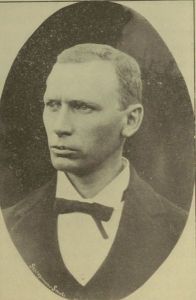
GENERAL SMUTZ State Attorney General of the Transvaal.
Here were the two Governments with no more than 200 men, in the very midst of thousands of English, holding a confab on the open prairie within six miles of a large English camp, and not one present in the least concerned, except Schalk Burger, who, I think, was pretty nervous. The English are wonderful soldiers, for they knew that the two Governments were near them and they never made the slightest effort to take them in.
All business having been finished and matters corrected and put right, President Steyn, General De Wet and General de la Rey started back to run the gauntlet and join their respective commands. Major Pretorius and I, on learning that General Smuts and Commandant Ben Bouwers were going with a good commando into Cape Colony, tried for permission to go with them, but were not allowed, much to our disappointment.
I will now return to my story of the April events in all parts. I have made quite a long side trip which may not prove to be of interest to the reader, but I assure him that had he been with us at the end of April he would have been equally interested with ourselves. As it was at the very end of April that the fifteen English columns suddenly invaded the high veldt, I will leave them till the first of May and go into the Free State. But little was done of any account, a little skirmishing here and a little there and not much more, for the English were making preparations for cornering and taking in the slippery De Wet once more.
In the Colony things were more than lively. General George Brand had captured a column and frightened two or three others half to death. General Kritsinger by his dash had made the English believe that there must be no less than 50,000 Boers in Cape Colony. Commandants Fouche, Scheepers, Malan and others were daily fighting in the different districts and captured several convoys. In fact, Cape Colony was truly in a state of war, and the Boers were in possession of the country. Lord Roberts was in possession of his $500,000 and his earldom, so he was not worrying, but General French was walking the floor day and night, for he realized that affairs in Cape Colony were very dark, and the position of the English in great jeopardy. Not a day passed without fighting during the month, and it was certain that fighting would continue for many months to come, for the Boer officers were superior to the English commanders and could lead them a song-and-dance wherever they pleased. In the Western Transvaal the English had made several attempts to corner General de la Rey, but he was not to be cornered. Near Klerksdorp there was some fighting when a large force of English pounced on General Smuts and deprived him of one cannon.
The English reported this as a great victory, and I will tell you why. They think far more of losing one cannon than they do of losing 10,000 Tommies, for they consider Tommies as cheaply made in England as the Germans could manufacture them, while cannon are expensive in all countries.
Throughout the month troops were constantly shifting about in the Western Transvaal, but nothing really occurred worthy of note, as no change had taken place at Zeerust, where the English were still penned in. Far away in the north General Plumer at Pietersburg, and the English force in the East at Komati Poort by a combined action tried to clear the whole country between them of Boers. Their task was easy, because there were no Boers in those parts, except some women and children. Their homes and their possessions were burnt and destroyed and they themselves were sent to concentration camps.
The English spent considerable time in arming the Kaffirs and giving them the necessary instructions for their murderous work. Chief Secockuni and his strong force, the worst Kaffirs in the country, had already been armed by the English and were near Lydenburg on the one side and Rosenekal on the other. These very Kaffirs murdered many men, women, and children with those English guns and ammunition, but further on I will go into the details of this dirtiest and most barbarous work of the English army.
Now we come to the month of May, and a very lively one, too. General Ben Viljoen and General Muller crossed the railway line near Balmoral Station, and left the six pursuing columns all to themselves north of the railway line. They had simply left one large army to run up against another stronger still, for there were fifteen columns on the high veldt bent on capturing the Government, General Botha and all the high veldt burghers. All these columns practically distinguished themselves by their puerile tactics. Not only did all the burghers easily evade them, but two or three trek wagons with women and children escaped being captured. Of course all the old men and women who remained in the few farm houses still standing were captured nd take away. Then off to London would go a flaming report of many burghers, horses and cattle being captured.
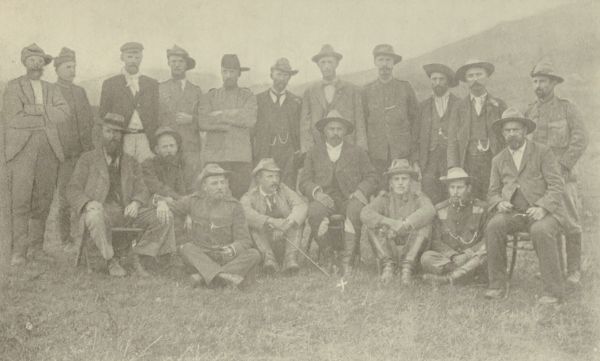
GENERAL "FIGHTING BILL" MULLER And his assistant commandants and veldtcornets near Lydenburg, just before the general surrender.
The English would enter all the good farm houses, tear up the floors, and dig, dig, dig in search of money and jewelry that might be buried under the floor. Having satisfied themselves, they would then burn and destroy everything. At the end of this month there was not a farm house standing on the high veldt.
We had the great pleasure of seeing about 600 cavalry charge a farm house. We had never before seen such a daring, reckless charge, and there was not a man among that 600 that did not eminently win the V.C. We had read of the charge of the 600 at Balaclava, and in imagination had often tried to draw the picture so glowingly painted by one of England's poet laureates; but this would sink into insignificance and pass into oblivion if only the charge of the 600 on the farm house filled with women and children could have been witnessed and depicted by some such realistic and blood-curdling poet as Alfred Austin or Rudyard Kipling. The one would never again have to describe in patriotic rhyme Jameson's raid, nor would the other have to live in "Barroom" ballads, for so delightfully red would the words that each could have drawn from his imagination have been, that they could have painted in thrilling phrases a picture so bloody and hair raising as to immortalize them. I cannot describe this charge. It was too much for me, but we seemed to hear the command, "Charge!" and on they came, every horse with distended nostrils and wild, glaring eyes doing his best, not one man dropping from the pace, not one faltering, all surely determined to do or die. And in another moment the farm house is taken together with its occupants, women and children, who filled the doors and windows. In another minute all were driven from the house, the floors torn up, search for money and jewelry made, then the oil spread and the house consumed in flames.
But, you ask me where the blood is to come from? I will tell you. Those brave men set to work and killed over one hundred chickens, ducks and geese, several pigs, some calves and 2,000 sheep which they drove into the sheep kraal and killed with the bayonet. They were two and three deep, and that great mass of butchered sheep were rising and falling in different parts for many days, for many were still alive buried under others and slowly dying.
I had seen much of the bloody work of the Apache Indians far away in Arizona, but I had never seen anything that could possibly compare in down right cruelty to this piece of savagery on the part of the English soldiers. The prisoners of war in the way of women and children were now marched off and driven to the murderous concentration camps, and a stirring report of the daring charge made to London, the bloody end being omitted. This famous column now joined with the fourteen others and all began to chase the several Boer commandos who were scattered about the veldt. Remember that the high veldt is a high plateau without rocks or mountains, and it is practically impossible for any command to conceal itself from the English. General Louis Botha and the Government were many times surrounded and cornered, but at picking up time, they were not present.
The various columns continued to follow them from place to place during the month, but no fighting men were lost. Quite a number of women and children were captured and sent to the concentration camps and invariably reported as so many burghers.
I now leave the English and Boers moving to and fro in all directions till the end of the month, and when all the high veldt is reported as swept clean of Boer commandos. Just before the end of the month General Ben Viljoen with Commandant Mears attacked General Plumer near Bethel and were prevented from taking in his column by the captured women and children being so placed that the Boers could not fire without killing some of them. This was a most cowardly piece of business, but it enabled General Plumer to rescue his men, with the exception of some thirty who were taken prisoners. These could not succeed in getting themselves behind the women and children without taking serious risk of being shot. General Plumer was satisfied to leave also a few horses and several thousand sheep which he had hoped to take with him to Standerton. No doubt some of those brave and chivalrous men who fought behind those Boer women and children were recommended for the V.C. and received it, such is the inclination of the British officer to report imaginary daring deeds in all engagements in which he may participate.
CHAPTER XIX.
DE WET CORNERED AGAIN—DE LA REY CORNERED TOO—GENERAL KEMP FIGHTS A GOOD FIGHT—THE WAY BY WHICH THE BOERS SO SUCCESSFULLY OUTWITTED THE ENGLISH.
In many parts of the Free State several skirmishes took place, but the English columns generally were occupied in trying to corner De Wet. A mighty army was brought to bear on him, for the English were convinced that, once he was cornered and captured, the war would come to a sudden end; but they did not reckon on the fact that a mighty army without a trace of military sense to guide its movements was a very harmless thing in the presence of such an able strategist as General De Wet. The Free State, with its broad, grassy, level plains, is a most beautiful country for cavalry and artillery operations, and although the English had thousands of cavalry, and guns without number, yet they seemed to be able to effect but little with either, or the two combined. They were so numerous that they fell over each other, and in the scramble General De Wet managed to pick up some of them. In Cape Colony matters were daily growing worse for the British, and the Boers, ever increasing in numbers, were very active and aggressive in many districts. General Kritsinger captured a convoy, some prisoners and one or two fortified towns. General Brand had helped himself to one of the English supply trains, and Commandant Malan in the far south was fighting and accumulating war supplies. Commandants Fouche, Wessels, Latigan and other officers were doing good work in their respective districts.
In fact, there was daily fighting throughout the Cape, and the English were so upset and worried that they scarcely knew how to defend themselves. In the Western Transvaal General de la Rey's commandos had done some damage, and all were progressing nicely. Lord Methuen was active enough, but his columns were misguided and made suffer severely. Near the Mafeking railway line General de la Rey was much interested in several columns that were trying to corner and capture him. He had several skirmishes with them, took some prisoners, among them being three burghers who had deserted and taken up arms with the British. These were afterwards shot, and the English were convinced that General de la Rey had committed a great crime. A pity it is that all the other Boer generals did not commit many such great crimes in the beginning of the war.
When these numerous columns were about to make it very warm for him, General de la Rey doubled back between two of them and left for other parts. It was a week before Lord Methuen discovered that his bird had flown and was creating trouble elsewhere. It was on his return from his Mafeking expedition that Major Pretorius and myself met him and delivered our despatches.
Some time ago I mentioned something about booming cannon in our rear a few days after leaving General Kemp, with whom we had spent a most pleasant week. It was this very General Kemp, who was always seeking a fight, that caused all that noise which so puzzled us. Shortly after we left, General Kemp's scouts reported an English column moving about from farm to farm and destroying all of them. He had his men saddle their horses, and off they went in search of this column. They found it at Vlakfontein, where Major Pretorius and I had slept the day after leaving General Kemp. He set the grass on fire to conceal his men in smoke, advanced to within short range, surprised General Dixon and his 1,500 men, and in a short time put them to flight. General Kemp killed and wounded over 200, captured more than 100 men and horses, and took two cannon, which they turned on the fleeing column. This was a good piece of work accomplished by General Kemp and his 400 burghers. General Dixon and his men never stopped running till far away from all danger, for they supposed that Kemp must have had two or three thousand men. No better men ever lived than those Krugersdorp men, and, taking the war from start to finish, I believe they did more and harder fighting than any other commando in the field. Like the Johannesburg boys they were brave, reckless, dashing patriots who defeated the English in many battle-fields. General Beyers in the north troubled Pietersburg a great deal, but no fighting of any consequence took place. He had with him a most capable man, in the person of Captain Henry Dutoit, who commanded his scouts. Captain Dutoit was an artillery officer and was nearly torn to pieces at the battle of Modderspruit on October 30, 1899. He was patched up by such able and competent surgeons as Dr. Max Mehliss, Dr. Lillepop, and Dr. Wepner, and in some way managed to survive.
A year afterwards some of his numerous wounds were still open, yet he was one of the most active and energetic officers in the field. He spurned all danger and fought like a very tiger to the end of the war.
Now I come to the month of June, a cold bleak month with piercing winds. We had but one blanket each, no overcoats, no tents, no shelter of any description, and how well I remember how near all came to freezing stiff every night. Still we had to keep on the alert, for the English were on all sides of us. They had burnt the entire high veldt, and but a little patch of grass could be found here and there. All houses were burned, all property was burned, all the grass was burned, and the scene was a most dreary, desolate one.
Before relating the events of this month I will try to tell in as few words as possible how we lived and managed so successfully to outwit the thousands of English about us and with whom we practically lived, because we were never out of each other's sight. The Boers were divided up into small bands 100, 200 or 300 strong, and each little band went as it pleased, and when it pleased, but generally confined itself to its own little district. These small commands were always in close touch with each other and could quickly come together if there was a chance of taking in some single English column that might be passing by. During the day, when not fighting, we would camp near some old ruins where we would find a little patch of grass that had escaped the fire. The English would generally see us and we were sure to see them at all times. After sunset and darkness had set in, we would saddle up, dodge behind the English, find another little patch of grass, and then unsaddle, hobble our horses and try to get a little sleep. So cold it was that precious little any of us had during the night. We would put out no guards, but at four o'clock in the morning all would get their horses, saddle up and prepare for fight. We would then send out a man here and there, say about 1000 yards distance, to wait for daylight and to locate the English if possible. If none were to be seen at hand after the sun came up, we would unsaddle, hobble our horses again and try to get in some sleep under the warm sunshine. If the English were found near, we would probably have a short skirmish with them, knock a few from their horses, and then fly away to some other part of our district where we would be safe to get something to eat. We were surrounded many times at daylight, but I will tell something about that later on.
As everything was destroyed on the high veldt, the reader will naturally ask how we got anything to eat, as we had no carts or wagons to carry food. I will tell him just how we managed to live and grow fat and strong on nothing. Before the rainy season set in, about October, the burghers would pull out their hidden plows, put the fields in good shape and then plant their mealies, (Indian corn). All this had to be done under the cover of darkness, and it meant a great deal of hard, tiresome work. In the following March and April we would have plenty of green mealies, and, later on, dry mealies. The English could not destroy these crops, though they tried and failed. If they turned their horses out to eat and trample it down, the green corn would kill them. When the corn ripened and became dry they tried to burn it, but failed because there was little or no grass in the fields. The result was that we had mealies on the stalk in all the districts. Many would be gathered, hidden in the high reeds along the small rivers, or buried in nice, dry pits. The English have often ridden over these without discovering them. Now, the reader may understand how we had mealies to eat ourselves, and some besides for our horses.
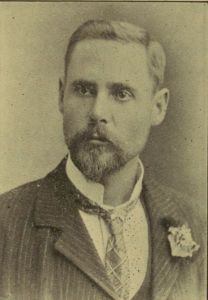
CAPTAIN WILLIAMS Commanding Boer Scouts.
The English took all the Kaffirs away and burnt their kraals. In these kraals there were large Kaffir baskets, some that would hold fifty bags of mealies or Kaffir corn. The English would set these on fire, but they would not burn. Then they would destroy the baskets and scatter the corn. In a pinch we would take this corn, wash and dry it and find it as good as ever with the exception of a little sand or gravel that might be in it. But a hungry soldier has little regard for sand and gravel under the circumstances. Now, we always had cattle near by, and generally two or three good fat bullocks with us. These we would drive along with us, until they were wanted. In every mess of two or three men, there was one ordinary coffee mill, but of course we had neither coffee nor sugar. We used these mills, however, to grind the corn into a rather coarse meal. It was hard, tedious work, but do it we must, if we were to have anything with our fresh meat. Having ground sufficient meal for breakfast, a small tin pot filled with water would be brought to the boiling point, the meal carefully stirred in and constantly stirred for about forty minutes, when it would be cooked. Of course we had no salt; so our fresh meat would be thrown into the ashes, broiled to suit each one's taste, and then breakfast was ready. There is ammonia or some other kind of salts in the ashes, that help the meat out. For coffee, we had in each little mess another small tin bucket, which would be filled with water and boiled. Some meal would be burnt in a small pan, till black, and then put into the boiling water; this makes a very good drink, but I don't believe, reader, that you would like it.
When near the bush veldt, we often used acorns for the same purpose, and the coffee was very good. At times, during peach season, we dried some peaches, charred them and had a really delicious drink. Sweet potatoes prepared in the same way make a nice beverage, too. So you see that, after all, we lived very well. Live on mush and fresh meat, as we did, and you will never be sick.
We lived in this way for two long years, fighting all the time or trying to evade the English, and we lost but one man from sickness; this, too, in the face of the fact that we had nothing to protect us against the cold of winter, or the severe rain storms of summer.
Of course many English convoys were taken, and many railway trains, too, but the Boers have good sense, and will not eat any canned stuff. They would destroy all such, and only take what they could comfortably carry on their horses. To every man's saddle you would see tied either a small tin bucket, or a coffee mill, and these constituted our complete cooking outfit. On this high veldt there is practically no wood. So for fuel we would go about the veldt and collect dry cow dung, just as they did in Texas, New Mexico and Arizona in the early days.
Now, reader, you are sure to tell me that the English captured all our cattle, because you read it in the paper. Well, I confess they did; and let me tell you about it. When the war began, the number of cattle in the Transvaal and Free State together, was nearly 300,000. The English captured all these cattle, time and time again, and if you will take the trouble to look up their official reports, you will find that during the war they captured some 2,000,000 head from us, although we had less than 300,000 to begin with. Here is the explanation: the English would capture our cattle to-day, and make their report. Tomorrow, we would take the cattle back, but the English would make no report of it. They always reported the capture, but not the re-capture, and that is how they captured some 2,000,000 head of cattle. The cattle were captured and re-captured so often that they grew to know the khaki's uniform as well as the Boer's rags; so when they saw a man or two coming, if he or they wore khaki uniforms, they would at once start toward the railway line. If the men were recognized by their rags as Boers, they would all start for the high veldt, where the Boers always took them.
The poor, patient and willing cattle had hard lives, and many and many miles they travelled during the war. At the end of it, the Boers still had nearly one-fifth the original number, and all were fat and in good eating condition.