Front matter (continued 3)
Reading edition
When Methuen's lines arrived within about seventy-five yards of Cronje's trenches, the demolished or absconded "dirty" Boers sent a greeting in the form of a long, dazzling line of fire, which instantly died away, and with it General Wauchope and almost his entire Black Watch, the crack regiment of the English army. Never in all history was such a bloody and disastrous battle fought and won in such a short time. Methuen's men, one and all, regardless of orders or order, fled as fast as their legs could carry them, and the Boers did not fail to apply the whip and spur at every stride they made. Although the battle was now virtually over, yet some hard fighting took place during the day. Methuen could not reconcile himself to his most disastrous and disgraceful defeat at the hands of such a small force of Boers, so spent the greater part of the day in losing more before he finely concluded that he would have to return to his old camp on Modder River.
It is not my purpose to give long descriptions of battles in this narrative, for I know they are tiresome, but, painful to me as it may be, I must say something of that little band of Scandinavians who were with Cronje in that great victory. I knew personally almost every one of that band of sixty men. The Scandinavian is quiet, gentlemanly, and the most tractable soldier in camp, but the most daring, reckless and fearless soldier I have ever seen, when it comes to fighting. Not satisfied with the early morning's work, this little body moved out, on its own account, after the sun was well up, and deliberately attacked Methuen's army. They actually engaged a force of at least fifteen to one against them, and fought till they were practically exterminated as a body. Sure it is that each one of that reckless little band accounted for at least one Englishman before he forfeited his own life. Having practically wiped them out, the English set to work to rob and strip them, and punch their bodies full of holes. General Cronje captured a small bunch of prisoners during the day, but sent them to Pretoria to play football. Early in the afternoon, Methuen, having satisfied himself that he had murdered enough of his own men, decided to retreat, and did so, but at a much more rapid pace than he had expected, for now Cronje's guns were turned upon him, and induced him to move more rapidly, and quickly vanish in the distance. Here was a fearful slaughter of English, the greatest so far during the war, but only because this great battle was fought just three days before that of Colenso, near Ladysmith, where General Louis Botha so terribly defeated General Buller and his fine army.
After Lord Methuen reached his old camp on Modder River, I have an idea that he did some really hard thinking, for he must make a report, and in that report he must show that his defeat was a victory, because a lord cannot be defeated. Unfortunately, I have never seen his report, but it is safe to conclude that he saw the Boers in overwhelming numbers and that some Colonial had proved traitor to him and led him into an ambush. I merely mention this as a guess, because it is the usual method adopted by the British officer to hide his incapacity. Methuen's soldiers are not through to this day damning him for his conduct in this battle, but we all know that soldiers' words are but naught in England when a lord speaks. It is an awful shame, but very true.
Methuen returned to his old camp fully convinced that he had had enough. He had no desire to try his luck again against Cronje and he never did. Cronje stopped just where he was for several weeks, looking for another advance of Methuen, or some other English army. He did not care how many came, for he was there to fight. I must say this about General Cronje that he may be thoroughly understood. He is stubbornness itself, will take advice from no one, is absolutely fearless, and constantly craves a fight with the English. I do not believe the world's history can show his equal as a commandant, but as a general he is an absolute failure. He must have some one over him, and under no circumstances must he be allowed to command. Order him to take a kopje, and he is sure to take it. Order him to hold a position, and he is sure to hold it. Order him to retreat, and he will do it. But put him in supreme command, and the combined influence of the immortal gods could not induce him to retreat, it matters not what the odds against him, or what the circumstances might be. Every drop of blood that courses through his body literally burns with patriotism, and of the whole Africander race I believe that General Piet Cronje would be the first to step forward and lay down his life for the freedom and independence of his people.
But I must say of General Cronje that he is a man wrapped up in his own conceit. He considered himself the only great fighter in South Africa, and, when captured, he is the very man to say that the Boers should surrender because the great Cronje can no longer lead them. In this respect he is a fool, but fools often become wise men by experience. If I should hear that General Cronje was condemning his fellow countrymen for prolonging the war after his capture, I should not be surprised, because he is so eaten up with his own importance.
Such is the man, General Piet Cronje, and may he live long, and have, as a commandant, one more crack at the British, and then I think all will be well for South Africa!
After the Battle of Magersfontein, General de la Rey was sent to Colesberg to take command of the forces against General French. General Piet De Wet and General Schoeman had been fighting French daily, and had been gradually driven back to their strong defensive position at Colesberg. The Boer forces were about 2,500 strong, but were divided into small commands in order to guard a wide extent of country. General French had only 15,000 men and thirty guns, so he made but small progress in his advance on Colesberg. The Boers hotly contested every inch of ground, and almost every one of the little commands did some daring work. Early in January, General de la Rey arrived and at once assumed command. Hot skirmishes were now the general order of the day all along the lines, and on January 25th, west of Colesberg, General de la Rey had made it so warm for him, that, instead of continuing to advance, General French changed his mind and retreated. De la Rey followed him, but never came in touch with him again because he had left for Cape Town. It seems that after the Battle of Magersfontein, Lord Roberts became much frightened at the presence of Cronje and called for help.
French was ordered to report to him at once, and left early in January to help Roberts out of his troubles. General Clements took French's place, but could do no better than his predecessor against de la Rey. On February 11th, the Battle of Slingersfontein was fought. It lasted for many hours and was stubbornly contested by both sides, but in the end de la Rey proved too much for him, and General Clements fled to Arundel, forgetting to take his camp with him. The burghers were hungry and thirsty and this camp amply satisfied all their wants. General de la Rey was now directed to return to the Modder River and co-operate with General Cronje against General Roberts and his mighty army. During his short period of operating about Colesberg he had captured some 500 prisoners, driven French's army back and made good his record of never having been defeated.
In a few weeks after Magersfontein, General Cronje saw that the British were appearing in thousands in all directions, and he finally made up his mind to move his little command to Paardeberg. His very stubbornness prevented his moving earlier, but he was satisfied. He saw that he was being gradually but surely surrounded by an enormous army, yet he never quailed. He was begged by such patriots and great and competent generals as Christian De Wet, de la Rey, Phillip Botha and even Com.-Gen. Joubert, of the Transvaal, to get out of the ring nearly completed about him while he had an opportunity. He utterly ignored all of them, practically told them to go to Hades, and silenced them, for he was there to fight, and was going to fight. He did fight, and can history show anything to compare with it?
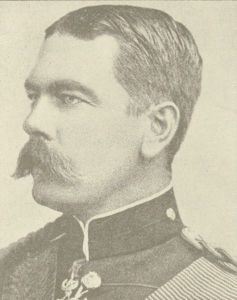
GENERAL LORD KITCHENER. One who believes that the only way to establish permanent peace in South Africa is to destroy the Boer women and children.
I am not going into the details of this nine days' fight, but will give the main features and the result. Here was a common, ordinary farmer, without any military training or education, in command of a little more than 4,000 equally untrained farmers, and four or five old Krupp guns. With him were a great number of refugee Boer women and children, who had come to him for protection against the insults and outrages of the British soldiery. Sad to relate, this is the actual truth, yet we still hear Anglo-Americans speaking of the civilized English. Opposed to him was the very flower of the English Empire. There were Lord Roberts, Lord Kitchener, General Kelly-Kenny, that able commander, Hector MacDonald, General French and many other stars of the British army. Altogether they had some 50,000 men around General Cronje. These men were all tried military men, trained and educated. Besides, Lord Roberts had 120 cannon, field guns and lyddite guns. The British may tell you that there were mountains there higher than Mount Everest, but believe me, there are no mountains there whatever. General Cronje and his little band of patriots were on the banks of the Modder River, where infantry, cavalry and artillery could manoeuvre without any difficulty. It was, I think, on the 18th of February that Roberts began with all his guns to bombard Cronje. Almost continually for nine days, 120 cannon were busy trying to destroy that little band of patriots. Once Lord Kitchener thought he would play a Khartoum act. He recalled the time when he charged upon and murdered some 10,000 to 15,000 unarmed negroes at Khartoum, and saw no reason why he could not do the same thing with 4,000 Boers. He forgot that the negroes were armed only with sticks, while the Boers had mausers. He advanced boldly, had hundreds and hundreds of his men slaughtered, and then fled as rapidly as he could. After the battle had been raging for two or three days, General Cronje asked for an armistice to bury his dead. Lord Roberts positively refused. During the whole war the Boers never once denied the English an armistice for that purpose, although they knew that the English, in every instance, took advantage of it to strengthen their position. There is a wide difference between a Boer savage and a civilized Englishman. Give me the former, but deliver me from the latter!
As Roberts had captured Cronje's ambulance wagons and would not allow any doctor to go and attend to his wounded, and as he was not permitted to bury his dead, of course, the condition of the camp became such that the women and children could not endure it; and the Boers too were suffering on account of it, so Cronje's commandants and veldcornets forced him to hoist the white flag on February 27th. The battle was over and Lord Roberts had Cronje and his 4,000 men as prisoners of war. No doubt General Cronje would have been shot had there not been about 750 British officers and 4,000 soldiers as prisoners of war in Pretoria. This alone saved the old patriot's life, and we all know it.
On receiving the first news of the capture of the great Cronje and his army by the wonderful Lord Roberts, Commander-in-Chief, A.B.C.D.E., etc., all London took a holiday, went crazy mad, and the papers put out their posters showing that Cronje with 15,000 or 20,000 or 30,000 "dirty" Boers had been captured. When they finally learned that Cronje had only 4,000 men against Lord Robert's big army, all slunk their heads and retired to their homes. What Lord Roberts considered his greatest victory the world at large considered his greatest defeat.
What the English losses were we do not know, and I know that the English people do not know either, for Mr. Chamberlain says that the death lists are not yet completed. If the complete returns are ever made known, I think we shall see that Roberts had as many men put out of action as Cronje had in his command. General Cronje had about seventy men killed and about three times that number wounded.
I will now go to Stormberg and Aliwal North, the two really most important points on the Free State border, for here was the easy and natural way for the English to reach Bloemfontein.
At the beginning of the war the English occupied and well fortified Stormberg, and this was the only sensible thing they did. After a few weeks occupation, they, for some reason unknown to me, abandoned this position and fell back to Molteno. Of course the Boers lost no time in taking possession of the good work the English had done and abandoned. Generals Olivier and Grobler were there, and old General Hendrik Schoeman was near at hand. Schoeman was a fraud and afterwards joined the English to be blown up by a supposed empty lyddite shell in his home in Pretoria while engaged in a plot with others against his people. That empty shell had a little lyddite caked in the bottom, and Schoeman, having struck a match and lighted his pipe, threw the still burning match into the empty shell. An explosion followed, tearing out the side of the building, killing Schoeman, another traitor by the name of Van Der Merwe, and Schoeman's daughter, and seriously wounding old man Viljoen. This proves that it is a good thing for traitors to make useful souvenirs of empty lyddite shells. It was a source of regret to all, however, that Miss Schoeman should have entered the room just as the explosion took place, and lost her life.
Both Grobler and Olivier were good officers and did good work. The total Boer force was less than a thousand with which they had to oppose General Gatacre and 3,000 men. Besides, Gatacre had six or eight cannon, as well as several maxims. Few shots were fired by either side until the 10th of December, when General Gatacre attacked. The fighting was very hot while it lasted, but it did not continue long before Gatacre saw his little army cut into pieces, and in a rapid and disorderly retreat to Molteno. In addition to his severe loss in dead and wounded, two cannon and over 600 of his men were taken. Before this battle all the English and Colonial papers were full of the wonderful deeds and the great capacity of this distinguished soldier, General Gatacre, and it was certain that he would make a skip to Stormberg and then a jump and land in Bloemfontein, leaving nothing but dead Boers behind him. The British officer is a wonderful genius on paper, but a very weak sister on the battlefield. General Gatacre did a great deal in this district towards the ultimate independence of South Africa; for the number of men he arrested, charged as spies and then shot, is very great, and all their names are dearly cherished in the hearts of the Africanders. This battle finished the great Gatacre; at any rate, we never heard of him again during the war.
CHAPTER XI.
DE WET LOOMS UP.
Now we will go to the western border of the Transvaal and see what has been done at Mafeking. No one ever displayed any interest in Mafeking, yet some skirmishing and letter writing was going on daily. General Snyman commanded the Boers and Baden-Powell the English. Mafeking is situated in an open flat dotted with a few small hills here and there. Baden-Powell dug holes and put his men and some women in them. They lived like prairie dogs. He had three or four years' supply of good ammunition, and there was no reason why he should not have been happy and contented. He laid big mines, but they never caught any one. He loaded cars with dynamite and tried to explode them among the Boers, but he always failed. He would make bold attacks, lose a lot of men, then run back, crawl into his hole, and write a long letter complaining of ill-treatment. So it went on from day to day until the place was relieved. Captain Eloff had the place taken once, but old Snyman failed to come up with his 300 men, so the brave Eloff was left alone and captured. Snyman had given his solemn word to Eloff that he would not fail him.
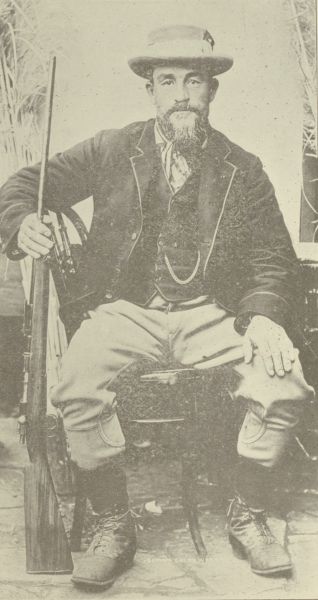
GENERAL DE WET
Of all of the many utterly worthless generals the Boers had at the beginning of the war, I am sure that Snyman was the worst, and I am not certain that he would be a success at herding sheep. After Baden-Powell was released from Mafeking, we heard but little more about him as a fighting man. Judging by the volume of insane letters that he wrote while imprisoned, it is easy to conclude that he had at least two screws loose in his head. Many of the constabulary police we captured told us that although Baden-Powell was nominally in command, yet he never exercised any authority over them.
"Every little while," they said, "he would have to go home for private treatment because there was something wrong about his head." I fully believe this, for the papers would announce his departure for London on account of sickness, and, after a three or four months' absence we would see him in some of the London illustrated papers togged up in great style, with a huge Texas sombrero on his head, the loose flowing cowboy shirt, trousers to match, and a very tall pair of top boots. Then it was that he intended to return. To be shot—with a camera—is his greatest delight, and to write foolish letters is his hobby.
After all, General Baden-Powell, there were worse specimens than you in the English army during the war, and there are still many worse specimens in that same army to-day, many of whom hold higher rank than you. When I say that you have two screws loose in your head, I may be doing you a good service in the eyes of humanity, for you know that you armed several hundred Kaffirs and had them with you in Mafeking, and that several hundred of the British-armed Kaffirs outside of Mafeking murdered many old Boer men, women and children in their homes, who took no part in the war. No sane man, no honorable man, no true soldier would resort to such beastly methods to outdo his ten-fold weaker foe. In fact nobody but a Britisher would be guilty of such infamous conduct. Colonel Plumer with his mixed command of regulars and volunteers north of Mafeking and on the northern boundary of the Transvaal came so near doing nothing, that I will pass him by and give some of the reasons why the Boers laid siege to Ladysmith, Kimberley and Mafeking. I admit that I cannot give a good one, for I don't believe there is one. However, the Boer officers generally thought it the best thing to do. Commandant-General Joubert told me that he thought that by holding Ladysmith closely invested, General White would soon consent to a surrender, and thereby save much bloodshed. The idea of killing people was repulsive to him, and, furthermore, he could see no reason for it. We could easily have gone to Maritzburg and then to Durban before Buller arrived, and at the same time held General White's line of communication. This would actually have put General White in a worse predicament than he was in at Ladysmith. He could have done nothing, for all bridges and the railway behind would be destroyed and our total force was as large as his by the fifth of November. Once the Boers had seized Maritzburg, General White could have done nothing. It was all in our hands, and besides we would have received several thousand recruits from the Natal Boers. For no other reason except to save life was Ladysmith besieged.
Kimberley could have easily been taken, but here another factor came in. To take the place, all the Boers had to do was to destroy De Aar Junction, the supply depot there, and the branch line to Kimberley. Having done this, the next step was to proceed on the Cape Railway line and destroy it. The English could have done nothing without these lines, and Kimberley would have fallen without one shot being fired. But President Steyn prevented this because it put the Dutch Cape Ministry in a bad dilemma. This Ministry was friendly to the Boers and no doubt wished them every success, but had the Boers proceeded as I have suggested, the British Government would have charged the Ministry with treasonable conduct. So De Aar Junction and all the railway lines were allowed to remain in good order for the use of Lord Roberts and his army. The Boers in their every act were always swayed by their love of justice and humanity, and were always ready to sacrifice themselves in order to do good to others. It was a vital mistake they made, and I repeatedly told them so, because they knew, and I knew, that the liberty and independence of their land were at stake. I used to beg General Joubert to throw the whole force of the Boers in the Free State into Cape Colony and destroy all bridges and railway lines, for I knew, if this was done, we would get 15,000 or 20,000 recruits in Cape Colony, and the English could never then push their way across the Orange River. But the good, humane General Joubert would never consent to do anything that might cause trouble for his friends in Cape Town. I respected him for the stand he took; in fact, I admired and loved him for it; but it was not business in dealing with such an unscrupulous enemy as Great Britain.
Ladysmith and Kimberley were practically relieved on the same day, February 27th, and a few days afterwards followed the relief of Mafeking. To lay siege to Mafeking was positively foolish, and had the Boers allowed General Baden-Powell to come out, why, they would have had him and all his men in Pretoria for their Christmas dinner at President Kruger's expense. Mafeking was of little or no importance to either party in the war, so long as the English were not permitted to cross the Orange River, and they never could have crossed or reached the Orange River if all the bridges and railways in Cape Colony had been destroyed. The Karoo, a wide desert, must first be crossed, and no large army would dare make the venture of crossing.
The way the English managed their transportation, and the food they furnished to the soldier, would have sufficed to kill half the army. Had the Boers of the Free State combined and entered Cape Colony, General Buller would have given up all hope of relieving Ladysmith, and General White would have been a prisoner of war. What a fatal, fatal mistake it was to give so much consideration to the personal feelings of others, when the very life of the land was at stake! There were so many ways by which the Boers could have beaten the English and maintained the independence of the two little Republics, that it is positively painful for me to think or write about the incidents and outcome of the war. I hope with all my heart that the Boers in the future will remember and never forget that it is absolutely impossible for religion and humanity to contend successfully against unscrupulousness and treachery in this civilized age of the twentieth century. If they will only remember this, and act accordingly, the day is not far distant when they will drive the British from South Africa's shores, and the Africander race will, for the first time in 250 years, breathe the air of permanent peace and be recognized by all the nations of the earth as a free and independent people, in a land over which will wave the Africander flag to the end of time.
In the last days of March General De Wet scored another victory against a far superior force under the command of General Broadwood. It was at Sanna's Post that General De Wet placed his 300 men in the bed of Koorn Spruit on both sides of the road crossing, and gave orders that not a shot was to be fired until he gave the command. The previous day he had directed Generals P. Cronje, J.B. Wessels, C.L. Froneman and Piet De Wet with some 1,100 burghers and four guns, to proceed to the east side of the Modder River, and bombard Sanna's Post as soon as it was light on the following morning. This would drive General Broadwood, his 2,000 men and nine guns, by him and his men concealed in the Koorn Spruit, for this was directly on their line of retreat to Bloemfontein. When General De Wet gave these orders, General Broadwood was at Thaba'Nchu but, to his surprise, he, General Broadwood, after it became dark moved his force to the Bloemfontein Water Works in the very presence of General De Wet and his men concealed in the Koorn Spruit. At daylight General De Wet discovered this overwhelming force at close quarters, but he was not frightened for he felt that in his position he was equal to it. General Broadwood was breaking camp, and some of his teams and men were just starting on their way to Bloemfontein. The Boers by strict orders, lay low and said nothing until the carts and wagons reached them, when, as fast as they arrived, they were made prisoners and concealed in the bed of the spruit, that is, a deep ravine. After nearly all the wagons and carts and some 200 Tommies had been made prisoners, General Broadwood discovered that there was something wrong about that spruit, and as he had five cannon very near to it he concluded to withdraw them and put them in a safer place. He was sorely disappointed for General De Wet had his eye on those five guns and besides the other generals with their 1,100 men opened fire on Broadwood's camp at the same time. Now was the time for confusion, and General Broadwood and his 2,000 men were so terribly confused that they lost no time in running for their lives, but they had sense enough to dodge the ford where General De Wet and his 300 men were concealed. On both sides of General De Wet, General Broadwood's brave 2,000 Britishers passed within easy rifle range and as fast as they could run.
As the 2,000 panic-stricken brave Britishers passed in review, General De Wet and his 300 patriots did not fail to make their mausers sing in unerring tones and give them a good send off. General Broadwood and two-thirds of his men escaped. He left behind 350 men killed and wounded, 480 prisoners, seven cannon and 117 wagons to the tender mercies of General De Wet. The total Boer loss was three killed and five wounded. The British Government and all London rejoiced over General Broadwood's escape. I must confess that he deserved a great deal of credit and merited the gratulations of his Queen, for some other British general might have fared worse.
In the first days of April, after his great success at Sanna's Post, General De Wet collected more men and went to Reddersberg where he knew there were some English troops. On his arrival he found the English, but they did not make much resistance. They abused the white flag, and by so doing, killed one of his veldcornets and killed six of his men. The English having hoisted their white flag and all firing having ceased, General De Wet and his men advanced to receive their arms, ammunition, etc. On arriving within close range the English suddenly began firing again although their white flag was still flying. General De Wet's men followed their example, and within five minutes several more white flags were flying, but so furious were the burghers at the English treachery that General De Wet was unable to restrain them till 100 English had been killed and wounded. Now the remaining 470 gladly and promptly laid down their arms. That one act of treachery caused the death of that brave and good veldtcornet, Du Plessis, and General De Wet failed to appreciate the cause of humanity when he did not shoot down every officer among his 470 prisoners.
CHAPTER XII.
PAYING AN INSTALMENT ON THE IRISH DEBT.
I will now return to the Irish boys whom I left at Smaldeel station, thirty miles north of Brandfort in the Free State. During the few days we spent here, every preparation was made for hot, lively work, for we knew that it was near the time when orders would come to advance and meet Lord Roberts and his great army of 90,000 men, with cannon in proportion. On the afternoon of May 1st, 1900, we received instructions to proceed to Brandfort and join with General de la Rey, so, having packed all tents, baggage, etc., in a freight car—which we scarcely ever expected to see again,—we started on our way, and never a happier or more delighted lot of boys went to a holiday picnic than those that went to face English bullets and shells.
It was a long, cold ride, and late in the afternoon of the following day we were camped in the bush on the bank of the little creek at Brandfort. Rumors were soon going the rounds that the British were near at hand, but it was so dark that we could not have seen them had they been only twenty feet away. So we decided to go to sleep and get up before daylight in the morning, that we might be ready to meet trouble.
In the early morning we learned that the English had slept in the bush on the same creek, a few miles below us, and as soon as the sun came up we saw them. There before us was Roberts with his 90,000 men, by far the largest army that any of us had ever seen, and, as far as we knew, there was to oppose him a mouthful of Irishmen at Brandfort. The Russian attache, Colonel Gourko, the French attache, Captain Demange, and the American attache, Captain Carl Reichmann, were there too. I think everyone of them came near being captured, for they were a plucky lot of fellows and were determined to see how the English would act in the face of a handful of Irishmen. I don't know how the spectacle struck the attaches, but the English reminded me of a lot of ants whose routine of action had been disturbed by some mischievous boy, for they seemed to be moving aimlessly in all directions. I really believe that Roberts and his 90,000 men were afraid that a few hundred Boers might lay an ambush for them at Brandfort. This idea is preposterous, but I tell you that Englishmen are terribly afraid of Boers, and when they see one, that one will appear as many as at least ten to them.
South of Brandfort about three miles, there is a line of kopjes running east and west. Several columns of cavalry were moving south of them and parallel to them. It was plain that they intended to attack that line of kopjes. There were no Boers in them at the time, but the English imagined they were full of them. Early in the morning the Heidelburg Commando, about 600 strong, joined with us at the tall hill by Brandfort. All then went at full speed to reach the kopjes before the English. We barely succeeded, for no sooner had we dismounted than the English began with both cannon and rifle to make it warm for us.
The new boys from Chicago and Massachusetts, although it was their first time under fire, were in great glee, and with the old men of the brigade began to fire. Although huge shells tore up the earth about them, and thousands of bullets were chipping stones and singing in the air, yet not one of them seemed to realize that he was in any danger whatever. They were all too intent on their own work to realize their danger. Between the Irish boys and the Heidelburg Commando there was a large and very high kopje, so that neither party could see the other. The Irish boys succeeded in driving the English right back and were much pleased with their work. About two p.m., a courier came near me and yelled out, "General Spruit says get your men away as quickly as possible." In loud tones I asked, "What is the trouble?" But he was in too much of a hurry to give answer, and he was soon far on his way across the flat in our rear. I called to the boys and told them to come quickly, as there was imminent danger somewhere. Irish-like, they wanted to argue the case, for they saw no danger and besides they were having a really good time. I quickly told them to come, as there was no time for argument. I knew General Spruit well, and when he says "get out quickly," I know it is time to get out. We raced down the kopje, mounted our horses and started across the flat towards Brandfort. Much to our surprise, we saw all the hills about Brandfort literally covered with English cavalry. I looked for the Heidelburg Commando and found that it must have retreated hours before, for not a man of it could be seen in any direction. We were certainly in a serious position, for our line of retreat was cut off by thousands of English, and there were thousands in front of us. To get out at all, we had to march across an open flat and pass within 2,500 yards of the English, for there was only one pass through the mountains in our rear. We crossed the flat and, having reached the base of the mountains, I called the men and told them that it looked like a hopeless case for us. There really was not the slightest show for us because all the English had to do was to ride down 1,000 or 1,500 yards, and we were completely hemmed in.
I always swore that I would never be captured alive, and told the boys so. I also told them that I was going to make a run for the road that leads through the pass, and asked them what they wished to do. They said they would make the run with me. We started at once in single file along a path that wound its way through the bush. This led us to the left and front of the English. Every man had his eye pinned on the English, and a dead silence reigned. I was terribly worried and frightened too, for I fully expected to see the English move at every moment and interpose themselves between us and the road. On we rode until we were right in front of them and about 2000 yards distant. I felt a little better, for the English had not yet moved. I was constantly watching the hills on my left, in the hope that I might see a chance of climbing them. Fortune favored me, for I discovered a good path running up the hills, and I concluded that, as it was an emergency, we could go where the goats had gone, and so turned to the left on to this tiny little path. It was a hard climb, but we reached safe ground on top just as the British made up their minds to take us in. They were too late, as usual, and only advanced a small distance, when they turned about and went back. It was a very cold day, but the terrible strain the men and I had passed through, warmed all of us into a heavy perspiration. It was General Hutton who kindly allowed us to escape. He said in his report that he thought we had some English prisoners with us, and therefore did not dare to fire on us. The Chicago and Massachusetts boys had on khaki uniforms, and that is why Hutton was deceived. His excuse was a poor one, just the same, for he could easily have blocked our way without firing a shot, and besides any ordinary field glass at his distance would have shown him that every man carried a rifle. We owed our escape entirely to British stupidity.
As no Boers could be seen from the hills, we made up our minds that we were very far behind everybody. As it was now nearly sundown, we started out to put a few miles between us and the British. We had not gone far when we found ourselves in the camp lately occupied by the Heidelburg Commando. Here we found coffee, sugar, bread and meat, and as we had had nothing to eat all day, we stopped and had a good feast. Then our poor, tired horses enjoyed their feast too, and it gave me more pleasure to see them at their mealies than to eat myself.
It was dark before we saddled up and started on our way in search of the Boers. Finally we reached the main road and near by was a stack of oats at a farm house. I told the boys to help themselves, and every man piled on his horse all the oats he could well manage. We then went on our way until we reached a little farm in the open flat that I knew was about nine miles from Brandfort, so here we concluded to camp for the night. It was about ten o'clock when a courier rode into camp looking for me. He pointed out the direction of General de la Rey's camp and told me that the General wished to see me early in the morning. I was anxious to see the General too, for I did not like the idea of being alone in front of Lord Robert's army. Early on the following morning I took two men and started in search of General de la Rey. My directions carried me obliquely towards Brandfort and I concluded that the General must have camped very near the English. We had gone about a mile when I saw seven men dressed as the Boers usually are, riding alongside a hill between us and Brandfort. The two Africander scouts with me declared they were Boers, and I declared they were English in Boer clothes. The way they held their legs and their position in the saddle had formed my opinion. An Englishman on a horse always reminds me of a wooden clothespin. We decided to go ahead, for our direction would not lead us into trouble, yet I did a lot of thinking about those seven men, for there was a very deep kloof near them, and the whole English army could be easily concealed in it. We had gone about another mile when we came upon one of General de la Rey's men on the look out. I knew him and asked him if he had seen the seven men. He said no, and then pointed out to me just where General de la Rey was encamped. I galloped all the way, because I thought there was danger in that kloof. I was so certain that I told Commandant Trichardt, of the artillery, that the English were near at hand, and that he would do well to inspan and prepare for business.
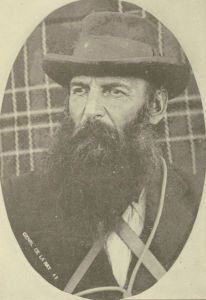
GENERAL DE LA REY. WHO NEVER LOST A BATTLE
I did not get to see General de la Rey because he had gone to see his brother who had been seriously wounded the previous day. I must say that before reaching General de la Rey's camp I sent one of the men with me, Hendrik Slegkamp, after giving him my wire-cutters, back to the Irish camp with instructions to saddle up as quickly as possible and fall back to some kopjes about two miles in the rear. All the farms in that country are entirely surrounded by wire fences and one can't get through without wire-cutters. The last I saw of Hendrik, he was going at a full gallop. After chatting with Colonel Trichardt for about fifteen minutes, he ordered all mules and horses to be spanned in and saddled up, and then we started back towards my own camp. Knowing the exact direction, we took a short cut and, having reached the top of a ridge about one mile from General de la Rey's camp and about two miles from my own, we were fired upon from a mealie field. Across the flat I saw the Irish boys under fire and flying to the kopjes in the rear. We could not get through the wire fences because I had let Hendrik have my cutters, and the English at long range were making it very warm for us. There was a little cottage about 400 yards away, and we put spurs to our horses and reached it as quickly as possible. A little Dutch woman showed us a sheep path which would lead us to the small gates that opened from one farm to the other. That was about the hottest path that we ever travelled, for the English had found our range and were making use of it. My boy's horse was slightly wounded; otherwise we were all right. I saw that the Irish were safe on the kopje, but we could not get to them on account of the wire fences. Just as General de la Rey's men had saddled up and all were ready to move, the English opened fire on him, but he managed to get his guns, wagons and everything out safely. The whole country seemed to be alive with English, and they all came out of that deep kloof where I had seen the seven men. I felt it in my very bones that the English were in that kloof, and acted accordingly. It was a lucky thing for all of us that I did.
During the evening I reached the Irish boys, and we crossed the Vet River and went into camp. Early next morning we met General de la Rey and his men, and there was general rejoicing. The general said he was going to give fight on the river, and put Roberts to a little trouble. With the Irish, he had about 2,500 men to fight Roberts and his 90,000.
The position was a good one, but of course the general knew that he could do no more than make the English do a lot of work, and possibly knock a few of them down before he had to retreat. Roberts finally showed up, and the deployment of that great body of men into fighting formation, with absolute mathematical precision, was really beautiful. I was so interested that I could scarcely take my eyes from such beautiful military figures. That awful man, that brave man, that gallant man, Major J.L. Pretorius, seemed to have no idea of the beautiful at all, for just before the military figure was completed in all its beauty, he fired a shell that fell right among them. That shell simply played the deuce and ruined a most artistic picture. Instead of order, precision and beauty, we now had to witness disorder and pandemonium generally, for the English soldiers broke away, some running one way and some another, not one seeming in the least inclined to take a chance on the next shell that might follow. It was marvellous what havoc one tiny shell could raise in a military-trained and thoroughly disciplined army. Major Pretorius was nothing but a youngster, but then there was nothing in the British army that was anywhere near his equal. For a change, and as the Irish boys were the latest arrivals, General de la Rey said he would hold us as reserves. Major Pretorius started the fight with that shell, and soon 30,000 English with cannon and shell were trying to lay low General de la Rey and 2,500 patriots. When the fighting became really hot and close, the reserve, the Irish boys, were sent for and told to come as quickly as possible to the road crossing the river. We went, but to go into the firing line we had to pass through the belt especially shelled by the English guns. The boys did not murmur; they went out. Strange to say, not one of them received a bullet. Now, they had a close range, and didn't they send the bullets to the right place? I think they did, and I know they did. There were a lot of British to our right and front in a kopje about 1,000 yards distant. I think they were Irish, for the English turned their maxims on them, killed many of them and kept them from firing on us. We did not fire on them because the English were doing the work for us.
That was really a pretty fight in which the Boers did not suffer, and about sundown General de la Rey ordered us to fall back. The Irish boys kept firing away until it was fairly dark, and I became frightened for fear they might be captured. The Boers had all left, and had those fool Englishmen known anything, they might have given us a run for our lives. We remained in order to see out of danger a few young Boers who were in an arroya very close to the English. When we did finally go back, mount our horses and start towards Smaldeel, we ran into the very boys that we had assisted to get out of the arroya, and by a mere piece of luck they didn't fire on us. I was calling to the men to hurry up and my voice was recognized, otherwise we would have received a volley. I had a very excellent pair of field glasses given to me by a Russian Count and I made good use of them when the English were arriving to engage us. In Natal, the Transvaal and the Free State, from the day the war first began, I had tried to convince the Boers of the great importance of destroying the enemy's line of communication. I never succeeded in making any headway, however, for they could not be made to believe in the destruction of property. Here at Vet River I handed General de la Rey my glasses and told him to witness the trains on the opposite ridge from which thousands of infantry were tumbling to give us battle. The general realized now for the first time the strength of my argument, and was thereafter bent on destroying the railway lines. He succeeded in partially convincing General Louis Botha that the destruction of the lines was of the first importance. Volunteers for the purpose were called for, and it was the Irish Brigade that promptly responded. In fact, I believe that the men of the Irish Brigade were the only ones that did, and I believe that they were the only ones among the Boers that understood the business. It having been decided by the Council of War that the bridges and railway lines were to be destroyed, I selected the men that I knew would do the work well. There were little Mike Halley, the ever to be remembered Joe Wade, Jim O'Keefe, Dick Barry, Tom Herlihy, Tom Tierney, and several others whom I selected for this most important work.
In blowing up the long and high bridge at Sand River, the Irish boys were exposed both to cannon and rifle fire, but not one flinched and their work was well done. It was while some Anglo-American engineers were trying to repair this bridge, that Majors Seymour and Clements, (both Americans) were killed by General De Wet and his men. I am sure that neither I nor the Irish boys would have shed a tear had the whole lot been killed. All were mercenaries in the strict sense of the word, and this class of men are not fit to live in any country.
Here I must mention a little incident in which Mike Halley was the principal actor. At the time that the bridges and railways had been blown up in good form and we had crossed Sand River and arrived at Riet Spruit very near the Sand River, General Botha had sent for Sergeant Joe Wade, Mike Halley and Dick Barry to give them further instructions. Strange to say, General Botha always waited until the last moment, in fact, to the moment when it was too late to do good work. The boys were always on the alert and sometimes acted without orders, blew up the bridges according to my instructions and felt much satisfaction. Now, when they were called up, General de la Rey happened to meet Mike Halley and bounced on him for too much enthusiasm. Mike did not know the general, and thinking he was an ordinary Boer, said "What in hell do you know about it, anyhow?" This settled the general and he replied, "Go ahead. You know your business, my boy."
When Mike was informed that he was addressing General de la Rey, he promptly went to him to offer his apology.
The boys were now given full swing and rails, ties and bridges were constantly flying in the air till we reached the Vaal River, the Transvaal border, where orders were received from General Louis Botha to destroy nothing more. What a puerile display of military knowledge! Lord Roberts moved along this long line across the flats of the Free State. He had three columns, each 30,000 strong. One followed the road along the railway line and the other two were on the right and left flanks. There were not over 2,500 Boers and three or four cannon to oppose him on these wide open flats, yet it took him twenty-three days to drive that little band of patriots a distance of 110 miles, and every foot of the distance was hotly contested.
When we reached Kroonstad all were very tired, but the Irish boys wished to do some more work before they left the town. The English, of course, were at our heels, but that did not concern them in the least. We rigged up a spring wagon with six mules, loaded it with provisions and ammunition and were ready to move out just after blowing up the bridge and thoroughly alarming the town, when it suddenly occurred to Mick Ryan to destroy the provision depot. It was an immense building filled with sufficient supplies to support an ordinary army for many days. I told Mick to go ahead and do his work well. He built a good fire against the building, and some Englishmen came up with water and put it out. Mick then warned them not to try to do it again. He kindled another fire, and when it blazed up, one of the same Englishmen dashed up with a bucket of water and put it out. Mick struck him on the head with his rifle, knocked him senseless and then warned the others that if any attempt was made to put out his fire again he would give them some bullets. He made up his fire again, and this time no one disturbed it. When the building was well on fire, some one yelled out that there were several cases of dynamite near the burning part of the building. Everybody fled for their lives, and Mick saw that immense supply depot burn to the ground. It was about eleven o'clock at night, and the great light was plainly visible to Lord Roberts and his army who were about three miles distant. The English are not yet through damning the Irish Brigade for their good piece of work.
The main part of the brigade went forward with the cannon, and it was just thirty of us that remained behind to finish up the good work.
After the supply depot was burned we left town and camped about three miles out on the Heilbron road. We had learned that the English had put themselves between us and the Boer forces, so we had to take this route. Early next morning we were just ready to move out when we saw about 400 cavalry coming for us. We hastened off and kept ourselves in safety although the English pursued us as rapidly as they dared. They did not give up the chase until we were near the little town of Heilbron.
Here we met President Steyn, and Judge Hertzog, and I can remember that the only subject discussed was the importance of playing on Lord Roberts' line of communication. I finally convinced them that it was the only way they could successfully fight such an immense army, and President Steyn telegraphed President Kruger for permission for the Irish Brigade to remain in the Free State. President Kruger wanted us in the Transvaal, so we said good-bye, and left for Rhenoster River at the railway crossing, where we learned that the Boers had taken up positions. General De Wet, however, went to work on Roberts' communications, and soon established for himself the greatest name of all the Boer officers in the field. Had we done in the Transvaal what De Wet did in the Free State, Roberts would have been driven into famine, and utterly disgraced himself in the eyes of the world; but this is not the place to explain, so we will wait until we reach Pretoria. We left Heilbron early in the morning, and at night we were with General Botha and the Boer forces. We now learned that General Botha had officially reported us as captured in Kroonstad and he was very much surprised when I reported to him. Having told him what we had done in Kroonstad, and assured him that we had not been in any real danger, he instructed me to take position at the road crossing, on the river. These road crossings of rivers are always the warmest places when it comes to a fight, and as the English were then near at hand, I fully expected on the following day to have a most interesting time. On reaching our position, and having taken a good look at it, I was then convinced that the English would not attack, but would go around our flanks. I told General Botha that he would find that I was right, because this Rhenoster River is the best defensive position I had seen in the country. The banks were very deep and steep, and the river bed was caked sand, over which flowed a skim of water. We could gallop our horses for miles in that river without being seen or in any way exposed to artillery fire. To attack the position, the English would have to advance over a grassy plain, gently sloping to the river, and 2,500 Boers in the river could easily have killed as many English without taking any risk whatever. I was certain that the English knew all about the strength of this river position and would therefore dodge it. It was about three o'clock on the following morning when we received orders to retreat, as the English had crossed the river on our left and right flanks. As it was very dark, we concluded to wait until daylight before retreating. Just as it was good light we moved away, and an English battery on a ridge some 2,500 yards distant, sent three shells at us, to move us along more lively. There was no more fighting of any consequence until we reached Klip River, near Johannesburg. The little band of patriots were always in touch with the big English army, and occasionally, some shots would be exchanged near the bridges which the Irish boys were charging with dynamite, but no damage was done. I didn't understand then, nor do I understand now, why that great British army did not at least make an effort to capture that small band of Boers and all their cannon, while crossing the great open plain between Brandford and the Vaal River. For the operations of cavalry and artillery, there is no country in the world more favorable than those immense Free State prairies, and had Roberts made any use of his thousands of cavalry, he could have taken the Boer guns at any time, and the 2,500 Boers with them. He seemed frightened, and I believe he was, for he had not yet forgotten the slaughter at Magersfontein. We could never understand, either, why he followed the small Boer force, and left behind that daring man, General Christian De Wet, with 10,000 men. But more about this after we reach Pretoria. To the south of Johannesburg, General Botha had some short but lively fighting, and forced the English to move around to the west, where General de la Rey warmed them up in good form.
The English also came in on the east, where there was a little skirmishing that did not amount to anything. We passed through Johannesburg, and went to within six miles of Pretoria. The Boers and British were actually camped side by side just north of Johannesburg, but the Boers were the first to find this out at daylight and so managed to escape being captured. General Botha is a pretty reckless man, and he did not get out any too quickly.
I urged the council of war at Vaal River to allow me to blow up certain mines in Johannesburg, but it was no use talking, not one of them would agree to it. They did not believe in the destruction of property. It was the mines of the very men who, with Chamberlain, Milner and Rhodes, had labored so hard to bring on the war, that I was so anxious to blow up, and I regret to this day that we did not destroy them. All the immense stores of provisions in Johannesburg and Pretoria I wished so badly to destroy, that I fairly begged for permission to do it, but all in vain. With De Wet and 10,000 men behind Roberts, and on his line of communications, and all provisions in Johannesburg and Pretoria destroyed, Lord Roberts would have been a defeated man, for the reason that he had no food for his army. As it was, his men came nearly starving to death on half rations. I can never forgive the Boer generals for leaving such quantities of good supplies for the British. The railway and telegraph lines between the Vaal River and Pretoria should have been completely destroyed, yet General Botha gave me strict orders not to disturb either. We were simply playing into the hands of the English, and doing more for them than they could possibly do for themselves. On the fifth of June we had to leave Pretoria, and, strange to say, we left the Pietersburg and Delagoa railway lines, all in good order with plenty of engines and cars for immediate use by the English. Why General Botha insisted on leaving all these lines intact, and well equipped for the English, I cannot understand. There was not a burgher in the field, that did not realize that the destruction of all railway facilities was a matter of grave importance. Much as I admire General Botha, not only as a brave man, but as a first-class fighter and an able general, I must condemn him for his opposition to the destruction of the enemy's communications, and for his failure to destroy the enemy's supply stores. General De Wet had done his work so well that General Roberts was cut off from all communications with the Colony, and there was no food to be had in the country, except in the Boer supply stores.
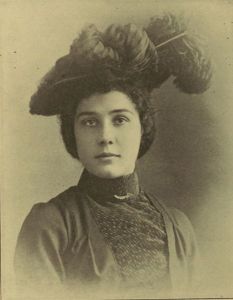
KOOTIE HEYSTEK, A BOER BELLE, OF PRETORIA
CHAPTER XIII.
LORD ROBERTS BREAKS HIS PLEDGE MADE IN PROCLAMATION—BOERS IN GREAT DISORDER ON LEAVING PRETORIA—MAKE GRAND STAND AT DONKERHOEK—GENERAL BULLER ARRIVES IN TRANSVAAL—BATTLE OF DALMANUTHA.
After the occupation of Pretoria, Lord Roberts issued his usual proclamation, to induce the burghers to lay down their arms. They were not to be sent away, their property was not to be molested, and they were to be allowed to peacefully occupy their farms. Thousands of the burghers, really believing that the war was over, took advantage of this proclamation and surrendered their rifles. Almost the entire Rustenburg district surrendered, and hundreds of men of the other districts did likewise.
As in the Free State, so in the Transvaal, as soon as Lord Roberts had the men and the guns in his possession, he at once violated his pledge, sent the men away, and afterwards destroyed all their property. The reason that the Boers did not make a stand at Pretoria, was that every shell the English might fire would land in the town, and kill women and children. Of course, this would please the English immensely, but the Boers never gave them the chance. As it was, they fired a few shells on the outskirts of the town, and wounded three Boer women. The English are bent on killing women, because they know that, so long as they are in the land, the Union Jack trembles with fear as it floats above them.
The Boers were in the greatest disorder when leaving Pretoria. There seemed to be no head, and burghers were going in all directions, north, east, south and west. General Botha ordered as many as he could reach, to proceed on the Delagoa railway line toward Middleburg. The English now made up their minds that there was no more fight in the Boers, and that the time was ripe to make a gallant display of dash and bravery on the fast retreating Boers. All titled persons of noble blood, were anxious to fill the London press with long accounts of their brave exploits, and Lord Roberts himself was not behind them in his desire for praise. The result was, that a large force was started in pursuit of the Boers, with Lord Roberts in command. The fleeing Boers, on reaching Donkerhoek, about fifteen miles from Pretoria, were assembled by General Botha and General de la Rey, and all agreed not to run any further. There were about 7,000 of them, and they took up a position on a line about twenty miles long. It was on the 12th of June, that the British army, and the lords, dukes, earls and so forth, appeared on the scene, and proceeded at once to wipe out what was left of the Boer forces. A very hot fight was the result, and the Boers wiped up the English, and gave them such a shock that they did not recover their nerve for months. Go to the graveyard in Pretoria, read some of the inscriptions on the head-boards, and you will find some missing earls, dukes and soforth, accounted for. Lord Roberts turned tail also and went back to Pretoria, to get out some more proclamations. He is a wonderful general, on paper, but on the battle field he is a pitiful failure.
After this fight, General de la Rey, with 1,500 men, went to the Rustenburg district west of Pretoria, where all the burghers had laid down their arms. Lord Roberts had not had time yet to violate his pledge, so the men were still on their farms. General Botha now made Commandant Ben Viljoen a fighting general, and he proved a most excellent man. The Boers regained hope, and were as full of fight as ever. From Donkerhoek to Machadadorp is about 110 miles, a long stretch of beautiful, rolling prairie, well watered, dotted here and there with beautiful farms, and in all respects suited for cavalry, infantry and artillery to display great skill and excellent work. General Botha is a nervy man, and he determined to contest every inch of ground to Machadadorp, and make it cost the English much time and many men to cross the fair prairie. Every day General Botha and his small force fought the English army, and in all the engagements he was generally successful, as is shown by the fact that it required sixty days to drive him back to Dalmanutha, nine miles from Machadadorp. Here he took up a position to make a firm stand. He had to scatter his men along a line about twenty-four miles long, in order to prevent the English from turning his flanks. I think the position at Machadadorp was much better and stronger, but he did not think so. I believe now, however, if he had the opportunity again, he would try his luck at Machadadorp, for his line would not be over ten miles long, his flanks would be safe, and in case of defeat, he could retreat in good order.
I left General Buller and his army at Ladysmith on February 28th. Now he appears on the scene again. He had a most difficult task to fight his way through the mountains of Natal and cross into the Transvaal, but at last he had succeeded, and was on his way to join the army opposed to General Botha. It was about the middle of August that General Buller arrived. The entire British force now to attack the Boer forces was about 65,000 strong, while General Botha had less than 7,000 men. He did not have hills and mountains, as in Natal, but, instead, open, rolling prairies. It looked as if the English would ride right over us and kill or capture our whole force, but they didn't. Lord Roberts sent about 600 women and children in open coal trucks to Belfast when it was midwinter and so cold that no one could keep warm. He did this, thinking that the Boers, rather than see their women and children suffer, and probably die, would come in and surrender. He was fooled, however, for General Botha put them all on the train and sent them to Barberton, where it was warm and where all had friends. Lord Roberts likes to fight women and children and takes as much pleasure in seeing them suffer as does Lord Kitchener. After General Buller arrived and took command, there was fighting daily on some part of the line for nine days before the final effort was made on the 27th of August. In the centre of our line were seventy-two of the Johannesburg police, who were on the ridge between Belfast and Dalmanutha. They had built for themselves stone breastworks about two feet high, but a shell would easily destroy any of them.
On the night of the 26th, General Buller changed his plans and concentrated his force on the centre, instead of on our left flank, and at six o'clock of the morning of the 27th he began with thirty-six guns to bombard the seventy-two Johannesburg police. As the railway line had been left in good order by General Botha's instructions, two huge siege guns came up on some flat cars. When they were fired, the whole earth seemed to tremble and the explosion of the shell was fairly deafening, yet they did no damage. I could see every one of the seventy-two police plainly, for I was with a Long Tom on a high point to their left. For seven hours without intermission, heavy lyddite shells were bursting on the ground about them and a dozen or so shrapnel were bursting over their heads at the same time. When at about two o'clock in the afternoon I saw a long line of cavalry put in readiness to charge their position, I felt sure that there was not one of them alive, for it did not seem possible for them with their little protection to escape.
Suddenly all the cannon ceased to roar and a dead stillness reigned for a moment, but only for a moment, for here comes the long line of cavalry at full gallop. It rapidly approaches and when within about 100 yards of the police there was a ring of musketry heard that positively filled me with an ecstacy of joy. The police were still alive, and with such rapidity did they use their rifles, and to such good effect, that saddles were emptied fast, and loose horses were running frantically across the veldt, some dragging wounded men whose feet were caught in the stirrups. They could not stand such a deadly fire, and turned and fled back, the police continuing to mow them down. They form line, are re-enforced, and again they charge, only to be driven back as before after a heavy loss. Four charges were made, and four times the charges were driven back, and no doubt a fifth charge would have followed had General Botha not ordered the police to retire. These brave men retired as coolly as they had passed through the seven hours' shell storm, and four times driven back that long line of cavalry.
Of the seventy-two men, nineteen were killed and wounded, among the killed being three officers.
Lord Roberts, who arrived at twenty minutes to one o'clock, according to his own report, pronounced this the severest bombardment of the war, and could not understand why the whole Boer force was not annihilated. Of course, Lord Roberts came up just as the battle was over, to save General Buller the trouble of making his report announcing a victory. There is no getting round the fact that Roberts is cute and smart and knows how to use the pen and steal the credit that belongs to others. He certainly deserves the title of Lord, or Earl, or any big-sounding name like that, with at least double the number of letters in the alphabet following it as a tail, for he has the gall to keep his title up to the high-water mark. General Botha having ordered a retreat, of course Lord Roberts hastened back to Pretoria to issue another proclamation. He didn't say very much this time, for he was very tired sending cablegrams telling of his great victory, but he still had strength enough to proclaim the war at an end, annex the Transvaal to the British Empire, entreat the burghers to come in like good boys and lay down their arms, and forget his many dastardly deeds.
It was during this battle that that wonderful artillerist, Major J.L. Pretorius put Long Tom to the test that I had so strongly advocated at Ladysmith and other places. The Boer officers were all convinced that it would be dangerous to fire Long Tom except when fastened down to a heavy wooden platform. To build these platforms to stand the work a great deal of labor, at least twenty-four hours of time, and a great deal of strong material were required. My contention was that Long Tom could be used as an ordinary field gun, and would do good work without a platform as well as with one. To have so used this big gun at Ladysmith would have kept the British guessing, and the results would have been very different. At Dalmanutha, Major Pretorius did not have time to finish the platform, so he took the chances of firing Long Tom as he stood without one, and the result was excellent. He found his shooting was just as accurate, and that the recoil was never more than two or three yards. Thereafter Long Tom was always used as an ordinary field gun, and Major Pretorius took him over the mountains by Lydenburg. With the exception of about twenty men, the Irish boys were all dismounted, having lost their horses near Pretoria. They were in position under Commandant Kruger, and when the English broke through our centre it looked as though they would be captured. They had to make about ten miles to reach Machadadorp, where they could take the train, and they barely made connection before the English arrived. The Boers scattered in all directions, some going towards Lydenburg, some to Neil Spruit, some to Devil's Kantoor, and others southward towards Ermelo and Carolina. President Kruger and the Government were at Neil Spruit.
CHAPTER XIV.
DARK PERIOD OF THE WAR—PRESIDENT KRUGER FORCED TO LEAVE FOR HOLLAND—LORD ROBERTS' ATTEMPTED ATTACK ON BOER WOMEN AND CHILDREN—LONG TREK THROUGH BUSH VELDT—ENGLISH FORTIFY—BATTLE OF RHINOSTER KOP—KITCHENER ORDERS ALL FARMS DESTROYED—ENGLISH SAVAGERY
We now arrive at what I call the dark period of the war. For the first time I really felt that our situation was serious. The Boers were discouraged in spirit and much scattered, and several hundred of them deliberately rode into the English lines and surrendered. At one time it looked as if there would be a general surrender, but President Kruger was firm and said the war must go on.
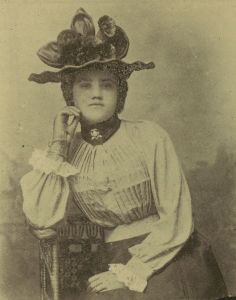
MISS ANNIE OLLIVIER OF PRETORIA A Typical Boer Girl
President Steyn had arrived from the Free State. He, together with all the Transvaal officers and officials, concentrated their influence on President Kruger to persuade him to go to Holland, as he was very feeble and it required so many men to guard his safety. He positively refused to go, saying that he could not leave his people and that he would look after himself. His idea was to go to Pilgrims' Rest, but that little town was far away and it required many days of hard travel through the fever stricken bush-veldt to reach it. In the end President Kruger was practically forced to take the train for Delagoa Bay en route to Holland, and as the train moved off the staunch old patriot's eyes filled with tears and he sank down broken hearted. He handed to General Botha 40,000 sovereigns, ($200,000) for the use of the burghers. This was his own money. He had no government money in his possession and the few thousand dollars that he carried to Holland belonged to him. All the burghers felt very sad at the good old man's departure and such was their love for him that they one and all resolved to fight harder than ever and bring back their great friend and patriot.
On hearing of the old hero's departure, Lord Roberts found a good opportunity to use his pen again. In effect he cabled the news that Ex-President Kruger had deserted his wife, his people and land, and gone to Holland, taking with him a very large amount of gold belonging to the people. He also had some abusive opinions to express about the good old man.
When Lord Roberts wrote and sent those cablegrams, he knew that he wilfully, maliciously and deliberately lied and I would be exceedingly happy to tell him so to his face.
Of course, Robert's idea in sending such a slanderous statement was to deceive the Boers throughout the land, and lead them to believe that President Kruger was really guilty of such infamous conduct; but the Boers had known the good old man too many years to be so deceived, and Lord Roberts only succeeded in making them love him still more. Roberts and Kitchener each issued many proclamations, all teeming with treachery and unscrupulousness, and if either had a grain of honor, and were forced to read his own proclamations to a public audience in any civilized country, I am sure that each would be stricken with a vomiting fit. I will have more on the subject of proclamations before I finish.
Now Lord Roberts had a most excellent opportunity to make an attack on the Boer women and children, who were helpless and in his hands, and one may be assured that he did not fail to take advantage of it. He notified General Botha that he would send all the women and children to him and that he must take care of them. General Botha replied that he would be pleased to receive all of them, as he wished to send them to Holland to remain during the continuance of the war, but that he must not rush them out all at one time, as it was very cold weather, in which all would suffer and many die. He wanted no more than a ship load sent at one time, so that he could properly care for them and send them at once to Holland.
This floored Roberts and he never answered. He could not stand the idea of the Boer women and children being sent to Holland, for in that case he could not fight them, nor could they be killed off in his concentration camps.
Before the President departed I discussed the position of the Irish Boys with him, and it was his opinion that all those who were dismounted should go at once to Koomati Poort and then, if hard pressed, go to Delagoa Bay and thence to America. All Boers who were dismounted were sent to the Poort, so the Irish boys went also. Shortly after they reached Koomati Poort I telegraphed Captain O'Connor that I thought it best for them to go to America at once. I did this because I did not wish any of them to be captured. Should any be so unfortunate, I knew that it would go very hard for them, and probably cause them to suffer a slow death in some prison. Major McBride thought it best for them to go too, and he went.
General Botha soon put things in order now at Hector Spruit, and we started on our long, perilous journey through the bush veldt, our destination being, for some Pietersburg, for others Pilgrims' Rest and that vicinity. We left enough coffee, sugar, flour and soforth unharmed to last the whole British army for at least a month. How I did long apply the torch and destroy those great stacks of stores! There were about thirty Irish boys mounted, and determined as ever, with us, but distributed in small bunches with the different commandos.
I had joined with Major Pretorius of the artillery near Bronkhorst Spruit in July, but was now separated from him because the English cut in between us at Dalmanutha when he was with one Long Tom and I was with the other. My aim was to find Pretorius, and when near Pilgrims' Rest his brother-in-law, Gustav Preller, and myself set out to find him. Just before we reached the town of Pilgrims' Rest, we saw the English, about 15,000 strong, at the drift on the Sabi River, but we moved rapidly, reached the little town and heard that Major Pretorius with his guns, was about twenty miles ahead, near Aurichstad. We spent but little time at Pilgrims' Rest, because the English were very near us. Three days later we caught up with Major Pretorius near the Devil's Pulpit on the Olifant River. We had been separated from August 26th at Dalmanutha till this day, October 1st, so that we had plenty to talk about. He had saved all his guns and had fought the English at close range for more than three weeks. We had a hard time getting the guns down the mountain to the river bank. He had six guns, including one Long Tom, and twenty-four artillery men with him. So steep and long was the open way to the river bank that we had to dismount the guns, put them on slides and turn them loose. Some would roll over, some would glide nicely, and then some would skip off into the rocks on the side. It meant a great deal of work, but every gun was landed safely without any damage whatever. We had a lookout, of course, and on the last day he reported several thousand English about six miles from us. They could certainly see the trail of the guns, and why they did not come over and take us we do not know, unless it was that they were afraid of an ambush. We now pushed on to Leydsdorp and finally reached Pietersburg on October 7th. Here we met President Steyn and his escort under command of a good soldier, Koos Boshof. In two or three days two or three thousand burghers had assembled. General Botha cut through by Kruger's Post near Lydenburg and finally reached Botha's-berg near Middleburg. He had with him quite a good command. South of the railway the Ermelo, Carolina, Bethel, Wakkerstroom and in fact all the commandos on the high veldt had gotten themselves into fighting trim.
General de la Rey had assembled 6,000 men in the Western Transvaal who had surrendered their guns, armed them again, and put them in excellent fighting condition. General De Wet had put the whole Free State in perfect order, so that when we finished counting noses we found that we had about 30,000 fighting men in the field, while the English did not have over 250,000 men. Our chances were excellent, and the two little republics would have won their independence if the devil and all his angels had not been against them.
By the 15th of October General Botha had all his forces in the Eastern Transvaal along the railway line from Pretoria to Dalmanutha and on the Natal line from Heidleburg to Laing's Nek. General de la Rey was close to Johannesburg and Pretoria on the west. General Byers, a most excellent man and soldier, was north of Pretoria, and General De Wet was general traffic-manager for the railway line through the Free State. In fact, we were stronger and in better condition than we had ever been before, because we were concentrated. Of course, at one time during the war the Boer force was 35,000 strong, but it was too scattered and too much used for siege work to be of practical use.
During our six weeks' absence the English had busied themselves in building all sorts of forts along the railway lines. On a high commanding mountain a few miles north of Machadadorp they built eight forts at Helvetia and armed them with cannon, one being a 4.7 naval gun, bearing in large letters the name "Lady Roberts." English commands were moving about freely, believing that the Boer men were so scattered and demoralized that they would not dare to make a stand and fight. They were soon to be sorely disappointed for that able and most successful fighting general, Ben Viljoen, had gone to Rhinoster Kop, about fifteen miles north of Balmoral Station, to find out what the English were doing near Pretoria. Soon General Paget with 3,000 men, advanced, and attacked General Ben Viljoen and his 600 brave fighters of the Johannesburg Commando. Captain McCallum, Sergeant Joe Wade, Joe Kennedy, Mike Hannifin, Mike Halley, John McGlew and Jerry O'Leary, of the Irish Brigade were there too. General Viljoen took positions near the Kop, and on the 29th of November General Paget boldly attacked. For hours his cannon roared, and thundered, and tore up the earth and rocks generally, but the Johannesburg boys were there and they were there to stay.
Having fired enough shells to have killed each man at least five times, then General Paget advanced his lines and the rifles came into play. Time and again these lines were driven back, and the last time they advanced to within fifty yards of the Irish boys. Didn't they keep the air filled with steel and didn't they do good work? Well, I guess they did. The English were driven back once more all along the line and did not try again. General Viljoen's men had used up almost all their ammunition and could not have repelled another advance. At night he retired a few miles back, in the hope of meeting his ammunition wagons, which were already due to arrive. General Paget was satisfied. He had had enough and made no further attempt to molest General Viljoen and the Johannesburg boys. A board over one pit accounts for seventeen officers. The other pits bear no mark, so it is not yet known how many men were killed. However, the slaughter was so terrible, and General Paget so terribly thrashed, that he was relieved and sent home. Had he simply made a feint on General Viljoen's right flank the latter would have been forced to retreat without fighting, but it never occurred to General Paget for he was so sure that his frontal attack would be successful. General Viljoen lost three men killed and two wounded, and taught the English that the demoralized Boers were still able to defeat the disciplined English army.
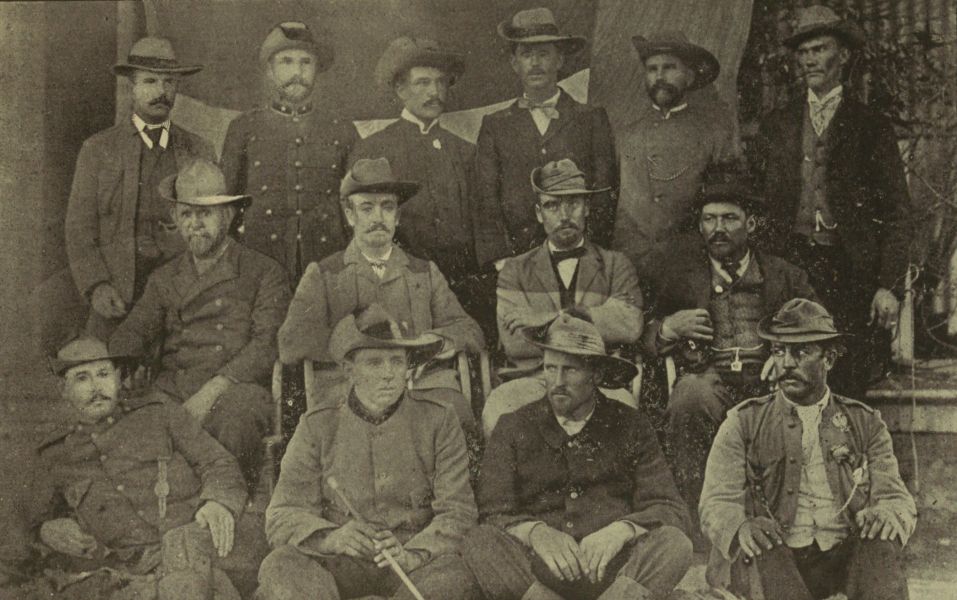
Dr. Nethling GENERAL BEN VILJOEN Docks Young. And some of his Commandants and Veldtcornets.
It was about this time that Lord Kitchener's proclamations and orders for the burning and destruction of Boer farms was given. The English visited, and destroyed in the end every farm, both in the Transvaal and in the Free State. All fences, crops, agricultural implements and soforth were destroyed. Even the towns of Dulstroom, Carolina, Ermelo, Bethel, Piet Retief, and many others were razed to the ground. Churches were torn down and the corner stones robbed of old church papers. Some of these papers were afterwards advertised for sale at fabulous prices. It was not until November, 1901, that this burning and destruction of property was completed, and the whole country left as a desert waste. On searching a farm house the officer in command would give the family ten minutes to get out what they could, but would at once spread the oil around and then apply the torch. All fowls, pigs, sheep and cows would either be shot down or driven off, and then without a mouthful of food, without shelter or clothing, the women and children would be left to starve to death on the veldt.
I do not believe that in the history of the world, one could find more acts of barbarity and brutality committed by any people in any land than by the English in the two little republics of the Transvaal and the Free State.
There were about fifteen of us near Dulstroom watching the movements of the English in November, 1901. A column of about 500 strong rode up to a farm house occupied by a widow and eleven girls, her daughters. Soon we saw the girls pushing the organ out of the door and the smoke began to fill the windows and roof. Of course, one of the girls brought out the family bible too, for that is one of the most precious things in the household to them. The organ was pushed about forty yards away and placed by a stone cattle kraal. The mother sat down and began to play and her girls collected about her. The house was now enveloped in flames, the soldiers were killing fowl, etc., while the officers were cracking jokes at the poor mother and her children. Of course, we thought that the old lady and her children were singing a hymn or psalm, because these are nearest to the Boer heart. The English, having completed their pleasant duty, rode off in search of other farms. We then went to the scene of destruction, because we knew that immediate help was necessary, as the sun would soon go down. On meeting them we asked the old lady how she could play and sing hymns while her home behind her back was burning and all her possessions were being destroyed? She replied, "We were not singing hymns or psalms, but our 'Boer War Song.'"
Here you have a fair sample of the Boer women. They are ready and willing to suffer from lack of food, to suffer from lack of clothing and bedding, to endure the cold of winter and the heat and fearful rainstorms of summer without any shelter over their heads, and, yes, they are ready and willing to face death itself, if the men will only stand and fight for the liberty of the people and the land. Yes, they are noble women, brave and patriotic women, the very women whom the English strove so hard to exterminate and whom they did murder by thousands in those prison camps.
So long as the Boer woman lives so long will there be a race of liberty-loving people in South Africa, so long will there be great Boer generals and fighting patriots daily born, and sure it is that such fighting blood will assert its independence. No one is more certain of this than Roberts, Kitchener, Joe Chamberlain, Alfred Milner and the thousands of other women-fighters in England.
CHAPTER XV.
WAR DECLARED AT AN END BY ROBERTS—LADY ROBERTS CAPTURED—DE WET CORNERED—GENERAL CLEMENT'S CAMP TAKEN BY GENERAL DE LA REY—DE WET'S STRATEGY.
But little was done by General Botha in the Eastern Transvaal; but General Chris. Botha, one of the best generals in the war, gave General French a great deal of trouble in the Ermelo district. French with his 11,000 men could make no headway and had to content himself with burning farms. In the Free State, during this month, General De Wet was having a very warm time. About 50,000 men were trying constantly to surround him, but he was too smart for them. He continued to capture and turn loose many men, and kept the English in a constant tremble. During the same month, the English left General de la Rey severely alone in order to concentrate their whole attention on General De Wet, who was fairly disgracing the English army and driving Roberts and Kitchener crazy.
Lord Roberts had declared the war at an end, and here was General De Wet daily tearing his army to pieces. He hates De Wet yet. During December—although the war was at an end,—there was some very warm and interesting fighting, Generals De Wet and de la Rey being the principal actors. In fact, there was so much fighting, and the Boers were so successful, that Lord Roberts pulled up stakes, fled for London and left Kitchener to continue his dirty work. I assure him that he could not have left a man more capable for such work than Kitchener, and he must have known his man pretty well. During this month General Louis Botha was inactive. General Ben Viljoen played havoc, however, with the English at Helvetia on top of the fortified mountain just north of Machadadorp. With 150 men General Viljoen made a night march and attack on Helvetia forts, took several of them, over a hundred prisoners and the 4.7 gun marked in big letters, "Lady Roberts." Many of the officers and men were killed or wounded and his night venture was a great success.
He did not lose any men killed or wounded, although on the following day the English in force pursued them. He brought "Lady Roberts" to his laager where she was greeted with shouts of joy, thoroughly inspected and admired by about 600 demoralized Boers. He kept her for a while then blew her up with dynamite. What a savage brutal act this was! It was just like the cowardly Boers! When all the ammunition was exhausted, we blew up our Long Toms, and Lord Kitchener, having found the remains of one of them, collected the pieces and shipped the whole to London to show what the English army was doing in South Africa. We would have given him Lady Roberts' remains too, had he shown any desire to have them, but he didn't and they are wasting away on top of the Totausberg Mountain. The same Irish boys with one other, Dick Hunt, were in the attack on the Helvetia forts. Dick and Mike Halley were both barefooted and were looking for boots, yet they didn't have the heart to fit themselves out with the dead Tommies' boots. Shortly afterwards, however, they threw aside modesty and were always well supplied. On the return from Helvetia Mike Halley's horse gave out, so he stopped, unsaddled, and put him out to feed and rest while he himself lay down to take a nap. In a little while Veldtcornet Ceroni came along, found Mike and asked him why he did not go ahead, as the English were following up. Mike told him that his horse was played out and that he had stopped to give him some rest and grass. "Yes," replied the veldtcornet, "he will take plenty of rest now, for there he lies stone dead." Sure enough he was dead, and Mike's bare feet must now beat a long road. The veldtcornet took his saddle and soforth, and brave little Mike smiled and went on his way, and when he reached camp the veldtcornet gave him a present of a good horse.
I have forgotten the name of the captain who was in charge of "Lady Roberts" and who was captured with her, but remember that he was brokenhearted, felt disgraced and was disgusted generally because such a small force had attacked and taken those forts, the guns and so many prisoners. He was a terrible Englishman, and the sight of the Irish boys made him wild. He could not understand why an Irishman would fight against the Queen and her forces. Had he asked any of those Irish boys he would have had their reasons in a very few sharp words.
In the Vryheid district near the Natal border, General Chris. Botha, a most lovable man, was firing away at the English, and putting them into shivers and doing good execution as well, yet Lord Roberts had declared that the war was over. In the Free State General De Wet was again in great trouble, for he was completely surrounded and it was impossible for him to escape, for Lord Roberts and Lord Kitchener had said so.
All England was ablaze with joy. The people of London were literally wild, so rejoiced were they, but when next day they learned that the wily De Wet had departed and taken their two guns with him, and several prisoners, a heavy gloom seemed to settle over that city. I will, for a change, go into the details, to a small extent, to show the difference between the British and the Boer officers. De Wet had his laager among some small kopjes where he put up a dozen or so tents. The English could just see the tops of the tents and knew that the dangerous De Wet was in one of them. They completely surrounded those tents and at daylight the following morning they were to make a determined attack and take not only those tents but all their occupants. General De Wet saw the English and determined they might have the tents, but that they would not get the occupants. When night came, he left his tents standing, made a sly march and passed between the English commands. When daylight came he was in their rear, patiently watching for them to attack his abandoned tents.