Front matter (continued 2)
Reading edition
He might have added with truth, that he and his comrades cut off many fingers in order to remove the rings, and that they are to-day wearing those rings on their fingers as souvenirs of their savage and bloody deeds.
May the day be not far distant when a humane and God-fearing people can erect a monument on that bloody battle field to perpetuate, from generation to generation, the memory of those loathsome deeds of pelf and murder committed by self-convicted British officers and soldiers on the plains of Elandslaagte!
We now mentally resolved to deal with every British soldier caught with a lance in his hand as the interest of humanity might demand, and marched on towards Ladysmith, the last resting place of many of Elandslaagte's cowardly murderers, and the grave of cold British steel. We came in sight of Ladysmith on October 27th.
We halted to discuss and make plans. It was very necessary, too, for there was a much larger force in Ladysmith than we had, and the chances were that we would get a good thrashing. I was asked if I would go to the Tugela River and blow up the railway bridge, which was fifteen miles south of Ladysmith, that no guns and re-enforcements might come from Maritzburg. I said I would if they would provide me with a guide. The guide having been presented, I called upon my men for volunteers, and explained to them that it was a dangerous piece of work, but that I thought we were equal to it. Fifteen promptly responded, and that was all I wanted. The entire Boer force then moved on, and the fifteen men and myself remained where we were.
As we had no dynamite, I sent little Mike Halley and two other men back to a coal mine, about six miles distant, for about 100 pounds of it. A coolie was in charge of the mine, and he swore that there was no dynamite there. Mike made him get a candle and show him into the mine, that he might see for himself. On reaching a dark shaft, the candle was lighted, and at once there was an explosion. McCormick was badly burned about the face, Dick McDonough's hands suffered, and Mike looked as if his head had been submerged in a pot of boiling water. However, they did not give up their search, and at last found some dynamite, fuse and detonators. Just as they returned, General Joubert came upon us from another direction, and asked me what I was doing, and why I had not gone on with the main force. I told him what I had been requested to do, and that the boys had just arrived with the dynamite. He said he could not think of allowing us to do it, that it was too dangerous, that all of us would be killed, etc. I told him that in war people had to take chances, and that I thought we could do the work and come out all right. But he would not allow us to go, and directed that we should go with him to the main force near Ladysmith. He afterwards acknowledged that he had made a mistake, for had the bridge been blown up, neither marines nor naval guns could have reached Ladysmith. It was this force and these guns that enabled the English to stand the siege and save Ladysmith from being captured.
This town is situated in a little valley on the banks of Klip River, and is almost completely surrounded by mountains, high and precipitous. Modderspruit runs from the east through a narrow valley between Lombard's Kop and Pepworth Hill, and empties into Klip River near the town. The distance from the tops of the mountains and from the crest of Pepworth Hill was, on an average, about 6,000 yards. General Sir George White, with his 13,000 trained soldiers and fifty cannon, held and occupied all the mountains, but ignored Pepworth Hill, lying to the north-east at a distance of about 6,000 yards from the town. Nickolson's Nek on the north did not command the town, so that, too, was not occupied by the British. Some low hills to the north-west were also unoccupied, so it was plain what we had to do in the first instance.
The Free Staters came in through Van Reenen's Pass and occupied the low hills to the north-west and a part of Nickolson's Nek. The Transvaalers were on the hills on the north, Pepworth Hill, and along the ridge near Modderspruit, and in an easterly direction from the town.
Ladysmith with its surrounding mountains is certainly a most excellent position both for offensive and defensive operations; and had a good commander been in Sir George White's place, he could have easily defeated and routed the Boers on their first appearing.
It was White's stupidity and inability that locked him up in Ladysmith, and kept him there, just as it was someone's great love of humanity that prevented us from taking the town on October 30th. The Irish Brigade and Ermelo Commando were placed in the centre, on Pepworth Hill, as a guard to Long Tom, two French field guns and two pom-pom maxims. Christian De Wet with some Free Staters, and Erasmus with some Transvaalers, together with the Johannesburg police, were in and about Nickolson's Nek on the right, Lucas Meyer and Schalk Burger, and Captain Pretorius with his cannons on our left, occupied a long ridge and some small hills near the eastern part of Lombard's Kop. The total Boer forces did not exceed 8,000 men with ten cannon.
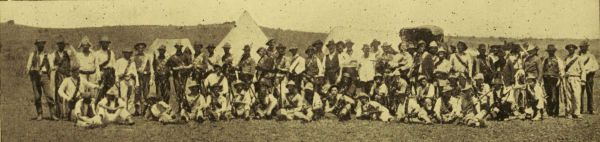
A PART OF THE IRISH BRIGADE AT LADYSMITH.
Saturday, the 28th, passed without a shot being fired. Sunday came, and some of the Irish boys grew restless and complained that they were hungry. I am sure they were, too, for I know I was. We had precious little to eat for about two weeks, for it had been raining steadily for that time and we had been constantly on the move. Three of the boys urged so earnestly their request to go to a farm house near the town for a pig, that I finally gave them permission. When within about 500 yards of the house they discovered and shot a fat, half-grown pig. Much to their surprise, within the wall around the house were some English soldiers, who at once opened fire upon them. Hot times then ensued, but in the end the boys came out all right and brought the pig to camp. These were the first shots exchanged between the English and our men at Ladysmith.
The Irish camp was about 300 yards in the rear of the guns, and our guards were posted in front of them and on the crest of the hill. About two o'clock on Monday morning one came down, woke me and told me that a balloon was moving along the valley not far from the hill, and he evidently felt excited about it, for he asked me if I didn't think "they were after dropping dynamite on us." When I told him that the object of the men in the balloon was to find out our strength and position, he felt perfectly satisfied and returned to his post.
During the night, Tom Haney was on guard and Mick Ryan was to relieve him. When the hour arrived, Mick picked up his rifle and went to take his post. On approaching, Tom said "Halt! Who comes there?" "It is Mick," was the reply, and he approached. Tom said, "See here, Mick, you must not answer 'Mick' when you are challenged, but 'friend.'" Mick's reply was, "Now, Tom, how can I answer, 'friend,' when I haven't a friend in the world?"
From the balloon incident I knew there would be trouble in the early morning. At the first sign of dawn I got up and went to the hill crest. I had not sat there long before it became light enough for me to use my glasses. Within about two minutes, I discovered twenty-four cannon about 2,500 yards distant, and pointed right toward Pepworth Hill. Near them was a long line of Lancers and some cavalry. Beyond them and nearer to Lombard's Kop, I saw a lot more cavalry. To our right and front, I saw ten companies of infantry marching towards us. They were halted and concealed behind some rocks, at about 1,500 yards from us. I had seen enough to be convinced that there was going to be a fight, and that no time was to be lost. I sent one of the guards to tell the boys to come quickly, for there was going to be a hot fight. He found them making coffee and preparing pig for breakfast. They forgot their coffee and pig and every thing else, except their rifles and ammunition, and came running up that hill like a band of wild Apaches. As fast as they arrived they would call out, "Where are the English?" After all had taken a good look at the cannon and cavalry in front of them, I simply told them to remember that they were Irishmen, and then put them in a position on the right of the guns. Commandant Trichardt had discovered the English batteries at the same time that I did, and after the Ermelo Commando had taken its position at the left of the guns, he prepared for immediate action. It was just 5.45 a.m. Sunday when a long column of curling blue smoke rising from Long Tom told us that a six-inch shell was on its way, to extend to the English an early welcome.
Within ten seconds the British batteries responded with twenty-four fifteen pound shells, and the Battle of Modderspruit was begun. The shells continued to come so thick and fast that by seven o'clock, Pepworth Hill was so enveloped with smoke that it was with difficulty at times to see the enemy.
Shells were bursting over our heads, on the ground, among us, and great chunks of iron were whizzing about from stone to stone. At times the uproar was so great that we could scarcely hear each other speak, yet the Irish boys, who had not the least protection, never once showed any inclination to waver. They were there to protect their guns, and to fight the English, and though they could be killed, they were not to be driven away. It was about this time, seven o'clock, that the Ermelo Commando could not stand it any longer, and nearly all of them fell back about one mile, and there awaited further developments.
Afterwards this same commando proved to be one of the best, bravest, and most reckless in the field.
It was about this time, too, that six of those artillery boys were killed and several wounded. This so weakened the artillery force at Long Tom that he could not be supplied with shells, and so had to stop fighting. Shells continued to rain upon us, and the English undoubtedly thought that Long Tom was disabled, as he had ceased to respond.
As no Boers could be found who would carry ammunition to Long Tom during such a shell storm, Commandant Grobler came to me about seven o'clock and asked for four volunteers from the Irish Brigade, to serve Long Tom, and I called upon the boys. In an instant every one clamored to go, and I sent seven instead of four, as being necessary. In another three minutes Long Tom roared again and it was plainly to be seen by the commotion it raised in the valley, that the English were utterly amazed. Of the seven men who volunteered and served Long Tom, two were shot. Now Long Tom and the two French field guns made it so very uncomfortable for the English that the number of shells that had been raining upon us for the past hour and a half was reduced at least fifty per cent.
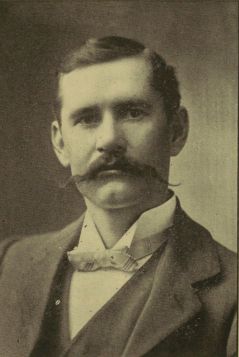
MAJOR J.L. PRETORIUS The acknowledged greatest artillerist of the world by those who know him and his deeds.
Between seven and eight o'clock the commandos under Lucas Meyer and Schalk Burger came into contact with French's cavalry on the extreme English right. We could plainly see warm rifle firing, and soon it grew to be terribly hot, and then we knew that the English would be so hard pushed that they would have to abandon any hope of breaking through our centre and capturing Long Tom and the French field guns. After a time that brave, keen-eyed artillerist and dashing officer, Captain J.L. Pretorius appeared on the scene with his pom-pom maxims, and so deadly was his fire that French's cavalry had to fall back.
Major Wolmorans brought his French guns into play on the English right also, and this forced some of the English guns to drop Pepworth Hill, and try their luck with Wolmorans. Wolmorans was too much for them, and we could see that the whole English line was beginning to tremble, yet the battle continued to rage and the bullets and shells were flying to and fro so thick and fast that it would seem impossible for any one to come out alive.
It was about this time, eight o'clock, that a shell caught me, smashed both the bones of my arm near the elbow, cut the tendon, nerve and artery and completely paralysed my whole arm. I went to my horse, about 300 yards away, and was fortunate to find him alive, because most of them near him had been killed. A young Boer boy helped me to mount and I managed to reach a hospital tent about a mile away, but it was a close call, for I had grown very weak from loss of so much blood. As I passed my camp, I could not help smiling, for it was completely destroyed, and I knew that when the Irish boys saw it again, there would be plenty of Irish wit in the air.
Finally about two p.m. the Boer fire became so warm and deadly that the Lancers with their cold British steel, and the whole British army, bolted, and a pell-mell retreat followed, in which everyone seemed bent on getting into Ladysmith as quickly as possible, regardless of consequences. Such was their anxiety to escape, that they crowded together like a flock of sheep, and it may be taken as a fact that Captain Pretorius did not fail to try his pom-pom guns on such a magnificent target.
The Lancers threw away their cold British steel, helmets, guns, ammunition, and everything of weight that might impede fast running; and so ended the Battle of Modderspruit.
On our right at Nickolson's Nek, something happened that we on Pepworth Hill knew nothing about, till the battle was over, although the Nek was in plain view. During the previous night, General White sent two regiments under Colonel Carleton to take possession of Nickolson's Nek and the adjoining big hill. Before they reached the Nek, some Boer guards saw them and fired upon them. Colonel Carleton, who was in command, had with him a lot of pack mules carrying several mountain guns. It seems these mules did not like fighting, so they deserted with their cannon and joined the Boers. However, Colonel Carleton got the Nek and the big hill much to his regret. The wily Christian De Wet (afterwards General De Wet) happened to be near at hand. In the early morning some Pretoria town boys, Johannesburg police, and a few Free Staters discovered the unwise Colonel and his men on the Nek and hill. Having placed themselves in a sluit about 1,000 yards away, they gave the Colonel a warm rifle salute. Carleton and his men of course responded. Cunning De Wet took about 200 Free Staters, slipped around the hill, crept up it and fired into Colonel Carleton's rear. No man likes to be shot in the rear, so Colonel Carleton hoisted his white flag, and with about 900 of his men went to Pretoria to see Oom Paul. Of course General White thinks that if the mules with the cannon had not stampeded, Colonel Carleton would have been all right and would have given the Boers particular—well, I will put it mildly and say fits.
Now a word about those mountain guns. The Boers would take a good look at them, give a sarcastic smile and walk away. Those guns are about as much use in war as so many popguns would be, and it is a question with me whether I would rather fire one of them or stand 100 feet in front of it, and let some one fire at me. They might prove useful in scaring unarmed niggers, who had never heard a loud noise. The Boers are not niggers, notwithstanding the fact that the whole British press labored hard during the year preceding the war to make the world believe they were niggers, and savage ones, too. The Boer has heard too many lions roar to be frightened to death by a popgun; but an incompetent British general must have some kind of an excuse to explain away his blunders, so General White attributes his defeat to the unfaithfulness of a mule, and receives the congratulations of his Queen. At the conclusion of the battle Commandant General Piet Joubert called up the Irish boys, thanked them, congratulated them, and told them that the brave stand they had made and their serving of Long Tom had prevented a grave disaster and enabled the Boers to gain a great victory over the enemy.
Young Tommie Oates, who carried the green flag, and young Cox, another brave boy, were both shot dead, and buried on Pepworth Hill, facing the enemies' position. Hugh Carbury was shot through the head, the bullet striking the very centre of his forehead. How he lived for even an instant no one could understand. Dr. Max Mehliss and Dr. Lilpop took him, operated upon him and within three days he was walking about the temporary hospital. Finally orders were received for all the wounded, eighty-five in number, to be sent to Pretoria. I would not go, because I knew that I must stay near the Irish Brigade. Hugh Carbury went to Pretoria and so far recovered that he was walking around the town. In about three months he had a stroke of paralysis and died, and the Irish Brigade lost one of its best and bravest boys. Andy Higgins, Olsen, Kepner, Tinen, Barnes and Gaynor were also wounded, but all recovered. Many others had holes shot through their clothing but escaped uninjured. For months after this battle, the Irish boys and the Boers amused themselves playing a game known as "mumble peg" with the cold British steel that the Lancers on their hurried retreat thought unnecessary to carry with them into Ladysmith. The Lancers were now armed with rifles and converted into mounted infantry, and I don't think that a lance was ever after seen on any battle field during the rest of the war. When we captured the Eighteenth Hussars, we asked them for their flag and we were informed that they didn't carry any. Now Christian De Wet had captured two regiments, the Dublin Fusiliers and the Gloucesters, and when asked for their flags they answered that all regiments had received orders to leave all colors and flags behind, locked up in the vaults at Durban, Pietermaritzburg and Cape Town. Of course every regiment was provided with the necessary white flag, and everyone found that flag a most useful and life-saving piece of cloth. Not a battalion and not a regiment carried either its own colors or its country's flag into the battle field, throughout the whole war. This alone should be sufficient proof of the cowardice and degeneracy of the British army, and at the same time explain the pig-sticking at Elandslaagte and the use of the dum-dum and split bullets by the soldiers.
There can be neither pride nor honor among either officers or soldiers of any army when they hide away their country's flag for safe keeping, on the eve of battle. I have an idea that every regiment considered the carrying of its colors and flag into battle from a business point of view, for if their flag were not carried into battle it would not be necessary to make requisition for a new supply after the battle. However, I will guarantee that any one visiting the various regimental headquarters throughout England, will find in every one of them a tattered and torn flag bearing the names of many great battles in South Africa in which it floated; and in which its brave defenders performed wonderful deeds and added another glorious victory to the British army in the face of overwhelming odds.
Every one asks "why didn't the Boers follow up this pell-mell retreat of the English into Ladysmith?" The fact is that the Boer is too pious, too religious and, therefore, too humane to battle with such an unscrupulous people as the English. Commandant General Piet Joubert was a grand man, grown old and mellow in the service of his country, a most religious and humane man, who looked upon the English as a Christian people, and he felt that it would be unchristian-like to follow up and shoot down his retreating enemy.
When the English were well out of range, and the commandos returned to their laagers, they held their services, and then began to make their coffee and prepare their food, as if nothing had happened. Every pot, kettle, blanket and tent, etc., in the Irish camp was simply riddled by shells, so that they had to be supplied with a completely new outfit. This resulted because our camp was about 300 yards in the rear of the guns, and the English guns were so located that every shell that passed over our heads must fall in or near it. Judging by appearances one could easily be made believe that about all the shells fired by the British landed in the camp, for it was certainly a total wreck.
Now that the battle was over, the dead and wounded must be cared for, and our ambulances were very busy the whole afternoon, because they had to pick up a dead or wounded man here and there along a line six miles in extent.
General White sent out his white flags requesting truce after truce, for one or two days or more, that he might be permitted to care properly for his dead or wounded. His ambulance men certainly were busy; at the same time his men were very busy in another way. All were occupied day and night in building forts, digging holes and throwing up earth works of various kinds. General Joubert, being very humane, granted White all the time he wished, to take care of his dead, but, of course, never once suspected that advantage would be taken of the truce to prepare defenses. The humanity of the Boer in time of war is his greatest weakness, while the unscrupulousness of the Englishman is his greatest strength in time of peace or war.
As a result of the English retreat, the Boers took possession of all the hills and mountains around Ladysmith, with the exception of one, and that one was of the greatest importance of them all. It was the Platrand, lying just south of Ladysmith. As the Boers did not occupy Platrand, the English after a time took possession of it. Had the Boers seized this Platrand, as well as the other positions, General White could not have held Ladysmith three days. About one-half the Boer forces were used to invest Ladysmith, the other half went to the Tugela River, and took position along the hills in front of Colenso, a little town about fifteen miles south of Ladysmith. Within a week from the investment of Ladysmith, we had our maximum force in Natal, numbering nearly 12,500 men. They were distributed about Ladysmith, along Tugela River and at Helpmakaar, about fifty miles eastward of Ladysmith. The Irish Brigade took its position in the Modderspruit valley, about one mile to the east of Pepworth, and about 1000 yards from the hospital, where I could see it plainly. The Platrand and Ladysmith were in plain view, and about once a week the Irish brigade and camp was shelled. No damage was ever done, however. Although not yet recovered, I returned to duty on December 12, for I was needed. The Long Tom and howitzer on Pepworth Hill, were our especial care, and fifty of the boys slept with the guns every night during that long siege of four months. The hill is low and of very easy ascent on all sides, yet not once did the English ever try to interfere with the guns by any night attack. Commandant General Joubert's headquarters were to our left and rear about one mile, as we faced Ladysmith, and every white flag bearer from General White had to pass us to reach General Joubert. We would stop the bearer, forward the report, and have a chat with the gentleman from the city. They were always anxious to know just where the Irish camp was, and were always told just where it was, and had it pointed out to them besides; yet the English never once attacked that camp except with cannon, either day or night during the siege. The English seemed to want us badly, but never could make up their minds to come and get us, although we offered them every inducement. In my opinion, it was a good thing for us that they didn't come, for we had no defences and were very few in number; still they would have had to pay a heavy price for anything they might get in that camp, for the Irish boys were fighters, and not to be frightened at the appearance of a large force of English. One Long Tom was placed on Lombard's Kop, another at Bulwana Kop, and still another on the low hills west of the town. Early in December, a strong force came out, ascended Lombard's Kop, blew up the Long Tom and a howitzer, and returned to town very jubilant, and they had reason to be, too, for it was a plucky piece of work.
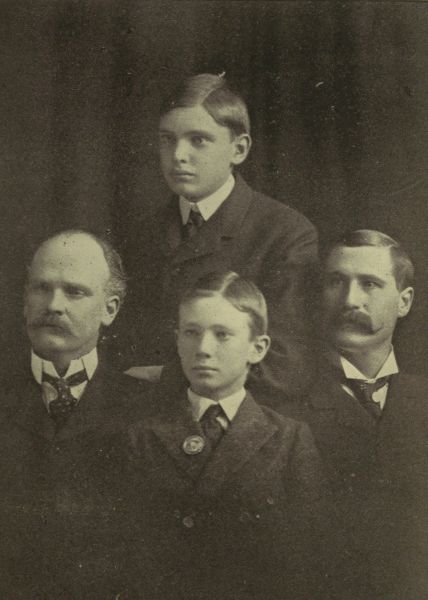
Col. Blake, his two sons, Aldrich and Ledyard, in America, and Lieut. Wynand Malan who was so undeservedly held partially responsible for the destruction of Long Tom on Lombard's Kop.
There were twelve artillery boys with these guns, and no more. They managed to kill one, and wound four or five Tommies before they left their guns. Long Tom was sent to Pretoria, and in about two weeks, began to tell the English that he was well and hearty once more. Major Erasmus and Lieutenant Wynand Malan were highly censured by the Boer Government for neglect of duty, etc., in allowing these guns to be blown up, but they were truly innocent. They had tried by letter and every other way to get General Daniel Erasmus and Schalk Burger to give them a guard for the night, but no guard was ever given. If any one or two should be censured or shot, that one or two was General Erasmus and Schalk Burger. Lieutenant Malan proved himself to be a patriotic, efficient and brave soldier to the very end of the war. About ten days later the English made another night excursion to a high hill near Nickolson's Nek, and succeeded in blowing up a howitzer. They were about 700 strong, and to defend the howitzer, there were about 150 Pretoria town boys, and no better boys or soldiers ever shouldered the rifle. They were fighters, and met the English in a hand-to-hand combat. After the howitzer was blown up, a contest took place between the mauser and cold British steel. The mauser won easily, cold British steel was buried, and we have never heard from it from that day to this. The Boer's loss in the contest was three killed and four wounded. The British officially reported fifty-four killed and wounded, but I don't know how much truth there is in this report, because no faith can be put in any British report. The British officer always gives his report as so many killed and wounded and so many missing. The missing seldom show up, but this gives them the opportunity of fooling the British public, and creates an impression among the people that they have gained a victory and not suffered a defeat. Of course people are always convinced that the missing will turn up either during the day or the night.
CHAPTER V.
BESIEGING LADYSMITH.
Not a day passed without a set-to taking place between one or more of the commandos and the English. If the latter did not come out, the Boers would go in, and, in many instances, some very hot skirmishes resulted. Such sports lasted usually about half an hour, when the English, almost invariably turned tail and ran back into their places of safety.
All burghers not directly engaged in these skirmishes, would secure good seats among the rocks and light their pipes and enjoy themselves watching these shooting matches, as much as they would Barnum's circus. One day about fifty of the Irish boys were induced to go on a visit to a big fort, right at the town, and they went; but just how they got out of the circle of fire within which they found themselves is a mystery to them and to me to this day, but all came back safe and sound, bringing with them a few good horses and mules, and reported one captain and three Tommies killed. They went without my knowledge, and certainly I would never have given my consent, for it was an idiotic act on their part. The boys themselves, however, were not to blame. They were induced to believe that the Boers were going too, and that they would be strongly re-enforced by them. The Boers had no idea of going, for they had too much sense, and had the boys known this, they would never have gone; so they told me on their return. I was still in the hospital, and that is the reason I knew nothing about it. They complained to me that "they" were making fools of them and wanted me to return to camp and stop that kind of business. Nothing could possibly be gained by the venture, and the chances were a hundred to one that much loss of life would result. When the Boers saw them actually at the town they thought the Irish had gone crazy or had deserted to the English. For several days afterwards, some of the boys would slip around the ravines, get near the town, jump some horses and mules, and, at full speed, under cannon and maxim fire, return to camp. The English always kept some coolies on guard over their horses and mules, but just one shot was enough to put each coolie to flight. The English finally put up a trap to catch the boys and some of them came nearly falling into it. They concealed a hand maxim and two men in a pit near the horses, and with a small, but strong rope, tied each horse to a stake. The coolie had orders, of course, to run as soon as the Irish boys came in sight. It was supposed that the boys would make a rush to start the horses off on a run, and, on finding the horses tied, would stop to loosen them. But the boys discovered the ropes, surmised that a trap was laid, and made a hasty retreat, though not before this concealed maxim and two men popped up above the ground and began to pepper them. Sergeant Major O'Reilly was particularly smart at this business, and he took no less than thirty horses and mules. He is Africander born, but an Irishman to the backbone, and has all the pluck and daring of his race. They were not permitted to go again after horses, because it was thought too risky.
The English were constantly trying to break through the Free Stater's line on the west side, for, having broken through them, they could cross the Tugela River near Spion Kop, go around the Boers at Colenso, and proceed to Maritzburg, so here it was that most of the heavy fighting took place during the siege. Yet with all their cannon and men, they could never break through that weak little line. The Free State men were bold, and would often rush through the English lines and bring out thousands of cattle, horses and mules. Almost every night there was an alarm, and, with two or three exceptions, it proved to be always a false one, but all had to turn out just the same, because it would not do to take any chances. The result was that everybody, at night, would roll up in his blanket with boots and clothes on, that he might be ready in an instant to use his rifle. These alarms would generally occur between one and two o'clock in the morning, and when we heard the rifles popping away in many directions, out we would run, take our fighting positions and there sit and watch till daylight. I never rolled out of blanket but twice without feeling that the alarm was false, and on the first occasion I told the boys that we were in for a red hot fight. It was on this occasion that about 200 of the Lydenburg Commando were posted on guard to our left and front, that is, just in front of General Joubert's headquarters. It was about two o'clock in the morning when we were aroused by a rifle fire so terrific that one could easily have believed that all the forces about Ladysmith were engaged in a hot fight. Those Lydenburgers were so close that we felt we were actually in the fighting line, yet were not engaged. You may be sure that we did not lose a second in getting into our positions.
As the fighting continued, we could easily see the sparks of fire from the rifles, yet we could not see any English, nor could we discover any return fire. In this state of doubt and anxiety we sat and watched for half an hour, when the firing ceased. It ceased because the Lydenburgers, feeling that they could not hold their position any longer, retreated and took up another post at General Joubert's headquarters. For a circuit of three miles all the commandos were in a terrible state of excitement because they believed that the English had made a strong attack on Joubert's headquarters. All the men felt that the English would have to clean up the Irish boys before the General's camp would be taken, but they didn't know but that the Irish boys had been finished. General Joubert was not in the least excited, but was very angry at the Lydenburgers for leaving their position, for he knew there were no English on the ground, otherwise they would have followed up. He sent a couple of good men to investigate. They found that a poor old mule had escaped from Ladysmith and had come out our way in search of something to eat and that poor old mule was quietly eating his grass as if nothing had happened, although at least 10,000 shots had been fired close to his ears. The Lydenburgers were then ordered back to their post and all was serene once more.
Now I shall tell about another alarm when I was sure we had a fight on hand. It was about two or three o'clock in the morning when hot firing was heard right by our camp, not to the left and front as before, but to our left and rear this time. I felt terribly frightened and hustled the men out as they were never hustled before. I felt sure that the English were actually firing into General Joubert's headquarters. The firing did not last more than three minutes; then all was quiet again. One of the Irish boys went out to investigate. He moved carefully, and after awaiting about twenty minutes, returned and reported, "Oh it is those damned Lydenburgers again." Some Lydenburgers were guarding an English Kaffir spy that some of the Boer boys had captured, and, the night being dark, the Kaffir made a break for liberty. Not only the guard, but all the Lydenburgers, 1,000 strong, jumped out and began to fire, on the supposition that there must be some English somewhere in front.
That Lydenburg Commando could stir up more false alarms than all the other commandos around Ladysmith put together, yet during the whole war, I don't believe they were ever in a fight. David Schoeman was commandant and Piet Swartz was the chief veldtcornet, and wherever you found them, you might be sure you would find no English, and that you could lie down to sleep without any fear of being disturbed, except by a false alarm.
Every morning when it was sufficiently light to see moving objects in and about Ladysmith, all the Long Toms and howitzers would open up and drive every one into the hole provided for safety. After that, silence would reign until about ten a.m., when an artillery duel of ten or fifteen minutes' duration would be fought, just to vary the monotony. Then all would be quiet again until about four p.m. when some English cavalry would come out to see if there were any gates open in the Free Stater's line. A lively skirmish would ensue, the English would fly back to their holes, and the day's work was done. As the English were kept in their holes all day, of course they had to get out and do their necessary work at night. The Boers thought they would hamper them somewhat in their work, so at sundown, they would load and aim all their cannon and at the hour of midnight would all fire at once. This caused the English so much annoyance that they in turn tried the same game on us, but never did us any harm. I have now given the usual program both for the day and night during the siege of Ladysmith, and while I could write page after page describing incident after incident that occurred during the long siege, yet I do not care to do it, because it would mean more work for me and prove tiresome to the reader.
In a nut-shell, the Boers had a delightful time, lived in luxury, had their sports, smoked their pipes, drank their coffee, entertained visiting friends and when there was a fight they were always ready for it.
CHAPTER VI.
BRITISH TREACHERY AT COLENSO.
Now I pass on to Colenso, where, in a short time some lively work was to be done, and, in passing, I must try to put the reader in a position to see the situation as it really was. Do not be frightened, however, for I am not going to give you long descriptions of positions or battles in the future, but will confine myself to relating just what I think will prove most interesting and nothing more. If my life depended upon it, I could not write even an approximately correct history of the war; and I am sure that no one else could do it, because the military operations were spread over such a large extent of country. Of course the London Times has published a correct history of the war, and so has Conan Doyle written and published a correct history of the war; the only time that a great newspaper and a popular novelist ever competed in the art of fiction. Both won.
During the Battle of Modderspruit, General Lucas Meyer fell sick and went home. No one wished him to die, but no one was sorry that he had to go home. He was as hopelessly incompetent to command as either General Erasmus or General Schalk Burger, and that is saying a great deal. The gods were with us now, sure enough, for Louis Botha, a private, was made a general in Meyer's place. Botha was young,—about thirty-five,—energetic, brave, a quick and able soldier, and he at once put himself to work. He made the Boers dig trenches in the hills and along the river bank in front of Colenso, and built stone walls for protection, for he knew that Buller would come with a strong force and many cannon. Certain it was that a big battle was to be fought at Colenso, because Ladysmith must be relieved. The Tugela wound along at the base of the hills, and beyond it was an open plain over which Buller must come. Botha was now ready for any army that might show itself. The railway bridge and the wagon road-crossing were just in front of his line of trenches, and there the heavy fighting must take place.
Buller with about 35,000 men and ninety-six cannon finally came into view, camped at the little towns of Chieveley and Frere, about six or seven miles away, and from there sent out his reconnoitring parties.
The Boers "laid low and said nothing," not a rifle or cannon was fired, and all was as silent as the grave.
On December 15th, General Buller made up his mind to relieve Ladysmith, as, apparently, there was no obstacle in his way. He moved out his forces in beautiful battle-array, brought his cannon into position and opened fire upon all the hills. If there were really any Boers in those hills his heavy lyddite shells would soon make them shift and abandon those parts. Soon the earth seemed to be in a tremble, gravel and stones were whizzing through the air, and the roaring of the bursting shells on the hills and mountains in the rear was simply terrific and deafening, yet the Boers "laid low and said nothing." Soon the English became convinced that there was no enemy in the hills or along the river banks, so all the cannon ceased firing and a deadly silence reigned as the English-Irish regiments with steady step advanced toward the river. When within easy range, the silent Boers along the river banks raised their mausers, made them sing in unerring tones, and, at the same time, Captain Pretorius roared from the hills his pom-pom and cannon to make complete the scene of death and destruction. Soon the plain of Colenso was strewn with dead and wounded Irish Tommies, and at the very time when the battle was raging at its highest pitch, ambulances in great numbers rushed into the field, apparently to assist the unfortunate, but, in fact, to stop the Boers in their deadly work.
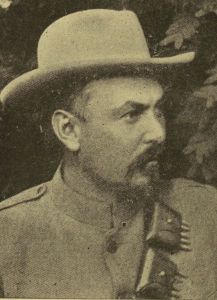
COMMANDANT GENERAL LOUIS BOTHA.
Screened by these ambulances, twelve Armstrong cannon came into the field, but the quick eye of Captain Pretorius detected them, and at once he sent some shells that landed among them. These then scattered and fled for safety and exposed the twelve cannon to the Boer and his mauser. Artillery men and artillery horses were quickly shot down and the guns rendered useless. Rescuing parties made bold attempts to save the guns, but the Boer and his mauser mowed them down. Here it was that Lieutenant Roberts, a son of Lord Roberts, an English politician and financier, bravely met his death.
Now the British began to fall back, and about 200 Boers and Irish boys rushed across the river, seized ten of the guns (two had been rescued), Colonel Bullock and a good bunch of prisoners, and recrossed the river, landing in safety within their own lines. Strange to say, all this was accomplished right under the eyes of the whole British force, without any resistance being offered. They all evidently felt sick, had had enough and wanted to go home, and they did, without delay or ceremony return to their homes in Chieveley and Frere.
General Louis Botha had now fought his first battle, won an easy victory and destroyed British prestige, and that, too, with a loss of but six men killed and a small number wounded. I don't know what the English loss was, and I don't believe the English know either, for it was only last September or October that Mr. Chamberlain, in answer to a question on the subject made by a Scotch member, stated that the list of the dead in South Africa was not yet completed. It is barely possible that Mr. Chamberlain is still waiting for his missing thousands to show up. Sure it is, St. Peter has completed the list, and when Chamberlain and Milner follow up Rhodes, no doubt each will be supplied with certified rolls of the names of their thousands of victims in South Africa. I can see a very warm future ahead for the South African Trinity.
After all was over, the British sent a wail to the remotest part of the civilized world, to the effect that the Boers had deliberately fired upon the red cross ambulance, in utter disregard of the rules of the Geneva Convention. Those ambulances were rushed into the immediate line of fire in order to stop the Boers from shooting down the English soldiers, and, at the same time, to serve as a screen for the two batteries in reaching their coveted position. The infamous game was detected, a shell scattered and put to flight the ambulances, the Tommies continued to fall, and ten guns of the two batteries being now completely exposed and within easy mauser range, were quickly captured. Yes, Mr. Englishman, as you cannot fight honorably and win, you must resort to infamous methods and manufacture excuses for failure out of deliberate falsehoods. Had your little game succeeded, the batteries reached their coveted position and proved disastrous to the Boer forces, it would never have occurred to you to mention this ambulance incident.
General Botha having granted General Buller all the time he wished for to care for his thousands of dead and wounded, the Boers returned to their pipes and coffee, their usual daily services and their peaceful way of camp life, without its once occurring to them that their deeds, on that day, had made them known, respected and honored throughout the civilized world.
Of course this does not include the British Government in London, Silly Billy of Germany or the English Government in Washington, D.C. The fifty Irish boys who went down for the day and were in the very hottest of the fight, and who particularly distinguished themselves by being among the very first to seize the English cannon, now returned to camp at Modderspruit; but they were so restless and jubilant that it was plain that something must be done to pacify them, so it was suggested that we arrange for some sports, as Christmas was very near at hand. This suggestion hit just the right place with all of them, and it was decided to have horse races, athletic sports and some kind of a banquet too. Christmas day was to be the day, and the boys went to the different commandos, invited all who had fast horses to come and try their luck, and all who felt that they could run, jump, throw heavy weights, etc. Nor did they fail to tell every one that all would have an opportunity to take a smack at Irish cooking. Every thing went beautifully, a half-mile track was prepared, plenty of food was cooked, and all was in readiness when Christmas day came.
Boers with fast horses from all the commandos were there. Athletes representing all commandos; generals, commandants and veldtcornets were there; young ladies and old ones, too, from Pretoria, Johannesburg, Dundee and other towns, were entertained by the Irish boys. All gazed in admiration at the colors that waved to and fro with the breeze, for they saw the Vierkleur, the Green Flag with the Harp, the Star and Stripes, the Tricolor of France, and the German and Holland flags that floated over the Irish camp.
It was a day of jubilee without a queen, a day for brave and patriotic hearts to assemble, a day for a liberty-loving and God-fearing people to rejoice and be merry. It was not a day for a titled figurehead, not a day for dissolute lords, not a day for an unscrupulous Colonial Secretary, a weak, High Commissioner of South Africa, or the moneyed rascals of Kimberley. For them the day must smell of rottenness, and therefore be celebrated in London. With one horse the Irish boys easily won in all the races, while the Boers captured nearly all the prizes in athletics. The Irish, however, played an English trick in the races on the unsuspecting Boers. By the art of commandeering, they had possessed themselves of a good race horse in Pretoria, and it was this horse that so easily took all the prizes. The sports having come to an end, all went to camp and enjoyed the Irish boys' meats, cakes, pies, etc., but it was a painfully dry banquet. Several cases of liquid refreshments had been ordered and they had arrived at Modderspruit, but some thirsty party had appropriated and removed all of them before the Irish boys arrived at the station, so we had to use coffee as a substitute.
Now, coffee is all right, and it is wet, but that little something is missing in it that puts such a delightful tingle into the blood. I felt sorely disappointed because it was Christmas day, the boys had distinguished themselves only a few days before, and I fondly hoped to give them a drink or two, their guests a drink or two, and besides I wanted a drink or two myself. Having feasted, all joined and sang first, God save Ireland, then the Volkslied of the Transvaal and that of the Orange Free State, and then, after giving three cheers for the Irish boys and Ireland, all, happy and satisfied, dispersed and returned to their respective camps to attend evening services. During that whole afternoon, I confess that I felt nervous, for there was a large crowd of men, women and children assembled in the camp, and I was afraid every moment that I should hear a big lyddite shell come whizzing over from Ladysmith. I was happily disappointed, however, and felt much relieved after the people had dispersed.
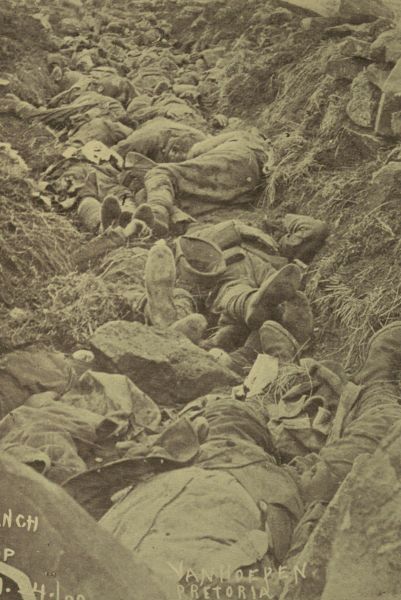
THE FIRST BRITISH TRENCH ON SPION KOP, SHOWING THE ENGLISH DEAD LYING THREE DEEP.
CHAPTER VII.
SPION KOP.
From the middle of November to the end of December, some one would come around every week to ask for volunteers to rush Ladysmith. The Irish boys responded to a man every time, but for some reason the rush was never made. Personally I considered the scheme idiotic, because every foot of ground in and around Ladysmith was strongly fortified, and our investing force was very small as compared to General White's army of 12,000 men.
At the conclusion of the Battle of Modderspruit, I strongly urged the Boers to storm the town, and I continued to urge them every day for the ten following days, but Generals Erasmus and Schalk Burger thought that all such talk was nonsense. The English as yet had practically no defences that we could not overcome. As soon as White got everything in apple-pie order and had finished all his defences and well surrounded them with barbed wire, then it was that Generals Erasmus and Schalk Burger and their kind were most anxious to rush and take Ladysmith. They really thought that the burghers would then refuse, but they didn't. So it happened that on January 5th a fellow came to the Irish camp, as they had often done before, for volunteers, and received the same answer, "We'll be with you." General Erasmus sent around the necessary orders—and may have sent one to White, too, as far as I know,—and all the men were to be in positions agreed upon by 3 a.m. the following morning, January 6th. During the night General Erasmus sent a countermanding order to some of the Transvaal Commandos, but forgot to let the Free Staters know that he had done so. Much to my surprise, we were ordered to go with four field guns and take position on a small hill near the Pretoria Town laager, and just in front of the English guns and forts on the Rooirand, north of Ladysmith. We were in our position at the proper time, and there sat for hours awaiting further orders and developments.
Just at the first break of dawn we heard the mausers of the Free Staters singing in the distance. There was no pause; it was continuous, and I knew that the brave Free Staters were carrying out their part of the program faithfully and well, because they had brave and dashing commandants and veldtcornets. Pretty soon we heard the mausers begin to sing right in front of us, and then we knew that the brave Pretoria Town boys were right at the English forts, yet it was not light enough for us to see them. Before we could see distinctly, the firing in front of us ceased, but with the Free Staters it continued as lively as ever.
Just before the sun peeped above the horizon, Long Tom on Bulwana, the guns on Lombard Kop, on Pepworth Hill and all the guns about Ladysmith sent shells whistling through the air. Every one fired his gun when he pleased and where he pleased, although the night before it was ordered that the guns should be concentrated on some one point in due time to be named. The artillery boys were not to blame in the least, because they had not received any instructions. Now we saw about 150 of the Pretoria Town boys in a sluit about 100 yards from the English forts. They had tried to scale a high stone wall, and, failing, left four of their number dead at the foot of it and taken refuge in a sluit where we could now see them. Only daring and fearless men would rush that fort and try to scale that twelve-foot wall. Our guns were now trained and turned loose on the forts just above the Pretoria boys. The English with five or six guns made a quick response, and for hours shells were flying back and forth with such rapidity that we were strongly reminded of our experience on Pepworth Hill. The Pretoria boys were in no danger, as long as we were firing, for the English had to keep themselves well protected. There was a Pretoria District Commando, about 700 strong, not more than 1,000 yards to our left. I mounted my horse and went to see them, for help was necessary. I found them lying under shade trees smoking their pipes and drinking coffee, as peacefully and unconcernedly as if there was no firing about Ladysmith. I told them of the position of the Pretoria Town boys, and tried to convince them that if they would turn out we would take the forts on the Rooirand. They simply answered that General Erasmus had told them that they would not be needed, and I rode back feeling disgusted.
General Erasmus had promised to support the Free Staters and the Pretoria Town boys, but instead of sending them any assistance, he went back about a mile out of danger, and left all to their fate. Some Transvaal Commandos had come up from the Tugela and partly taken the east side of the Platrand. They fought hard and bravely on the east, while the Free Staters who had captured some of the forts on the west side were still in possession, and almost engaged in a hand to hand fight with the English. They were constantly expecting re-enforcements promised by Erasmus, but none ever came. On our side we had simply an artillery duel, while on the east and west side of the Platrand the burghers continued hotly engaged in rifle fire at very close range for the whole day. About four o'clock in the afternoon a terrific rain and hail storm fell upon us. We were ordered to pull down the guns and return to camp, regardless of the fact that the Pretoria Town boys were still held in the sluit by the English. The storm did not effect those on the Platrand, for the firing continued as heavy as ever. During this storm the Pretoria boys made a run for life and liberty, and although the English gave them a hot fire, all came out safely. It was not till late at night that the Free Staters and Transvaalers gave up all hope on the Platrand and returned to their camps. Every one spent the next day in damning Erasmus, yet he was not dismissed, nor laid aside for reflection, because he was very wealthy, and belonged to one of the best families in the Transvaal. We had a heavy loss on that day, fifty being killed and 135 wounded. Of course the Free Staters were heavy losers. The English made a poor defence, and I feel sure that if Erasmus had sent his promised re-enforcements, the Platrand would have been taken, and of course that would have caused the immediate surrender of Ladysmith.
General White reported that he sent back eighty dead to the Boer lines. Another officer wrote that he counted 135 dead on the field. By just such official lying as this the British forces succeeded in killing off the entire Boer forces more than four times during the war, yet almost the entire Boer force was still alive at the end of the war. The military colleges of England must be special schools for turning out trained liars to command in the British army, otherwise the conduct of the British officer in his report of the battles, etc., of the Boer war is beyond my understanding. I have spoken very harshly of Erasmus, Meyer and Burger, but they eminently deserve all I have said. The bravest and the most daring of the Boer commanders will always find the rank and file ready to follow him, but not to lead him. This statement will apply and prove equally true in all armies except the British, and it will not apply there, for the reason that there is such a wide chasm between the British officer and soldier, that the latter has neither respect for the former as an officer, nor confidence in him as such; consequently the British officer must drive the soldier into the fighting line. When once the British soldier has respect and confidence in his officer, he will follow him, without a murmur, into the very jaws of death. But I must here state one condition, and that is, that the British soldier who is ever ready to follow his respected officer must be either an Irishman or a Scotchman, for the Johnny proper, being degenerate, and no longer a warrior, does not believe in risking life for the off-chance of taking life.
Now I return to Buller and his army, and I see them making grand preparations to do something. I thought to myself that he had at last discovered the key, Langwani Hill, that alone would open the gates of the Boer lines, and lead him to Ladysmith, where many thousand starving people were praying for his coming. I was mistaken, for soon he and his whole army were seen coming around the bend of the Tugela towards Spion Kop. It was now evident to all that a big fight must take place to the west of Ladysmith, and in plain view of both besieger and besieged.
He pitched his camp behind what is known to the Boers as the Bosch-rand, a high, wooded mountain ridge that commanded all the hills on our side of the river. This river ran up to the very foot of the Bosch-rand, and then making a pretty sharp curve, wound its way back to the foot of the hills on our side. The river valley was perfectly flat and about 4,000 yards wide, and as the river wound its way through it, first touching the hills on one side and then on the other, it made a succession of U's. This was an ugly river, with steep, muddy banks, and as I looked at it and its beautiful valley, bounded by high hills, it reminded me of a great amphitheatre in which a few scattered Boers were to occupy the top seats, and a big English army the ring. Both the English and Boers were to be actors, and the gods above were alone to witness and judge one of the greatest, most exciting and destructive contests-at-arms of modern times, in which the Boers were destined to wear the crown of victory.
Buller's first attempt was to turn Botha's right, but after five days hard fighting he withdrew and fixed his attention on Spion Kop. General Botha had left only a guard of fifteen men on this kop, and in the very early morning of January 24th, a large force of Buller's men surprised them and drove them off. General Buller now had possession of the kop, and there was no valid reason why he and his big army should not march into Ladysmith with but little trouble or delay. But they didn't, and I will tell why they didn't.
General Buller had failed to get permission of a small band of Boer patriots who were near at hand. About ninety men of the Carolina Commando crawled up the kop, and, having reached the crest, immediately opened fire on the British force. Thus began the great battle, the bloody and disastrous Battle of Spion Kop. The ninety Boers were soon re-enforced by small detachments following each other up the kop until the total number reached about 250 men. The English held the kop, occupied the defences, and besides had at least fifteen men to every Boer.
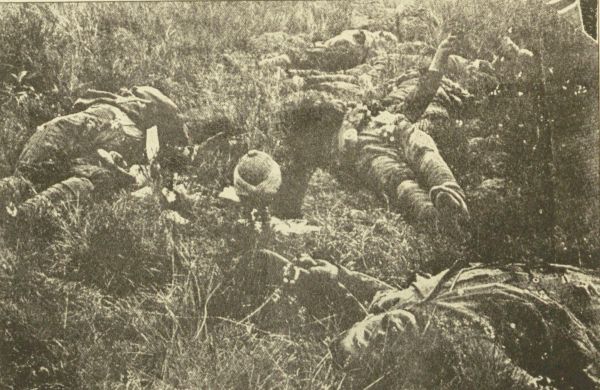
GOOD ENGLISHMEN AFTER SPION KOP LYING ON THE SIDE HILL.
Counting the Boers on the right and left sides of the kop who also took part in the fight, the total number of them engaged was about 600, but the actual number on the kop, who alone fought the big English force, was about 250 men. The Boers and the English were within easy point-blank range of each other, and at some points no more than fifty yards separated them. Here was the time, the place and the opportunity for the British to display that bold courage, that dash and fighting quality of which they have been boasting for centuries, for, with their overwhelming numbers, they would have easily swept that little handful of Boers off the kop. But they positively declined to take advantage of such conditions to display British pluck and courage, and, in the end, were themselves swept off. In their wars with the blacks, it had been their rule to hoist the Union Jack, boldly advance as at Khartoum, and when they discovered a horde of unarmed and defenceless negroes, make a mad rush, fall upon them and shoot them down; then apply the cold steel, and when they have murdered the last one and see him lying at their feet, with blood gurgling from his mouth, give three cheers for the Union Jack, and everyone at once apply for a Victoria Cross.
But on Spion Kop it was different, for no Union Jack was hoisted, no Union Jack brought to the battlefield, no rush was made, because a Boer was there, with a mauser in his hand—and that was a horse of another color.—So the British halted and trembled, and then threw up the sponge and retreated as fast as their legs would take them, each hoping that he might escape the fatal bullet and receive his well deserved Victoria Cross. I may here add that when you find any one so decorated with the Victoria Cross, you may generally put him down as a worthless son of a lord, or as a puny specimen of a puny, dissolute, diseased nobility, or the son of some moneyed, unscrupulous politician to whom the English Government must bow in obeisance. One in a thousand who has been decorated may deserve it, but I even have my doubts about that. Nearly all the officers and men of the British army who have been given the Victoria Cross you will find in an English company's cigarette packages, and that is just where they belong.
I shall not try to tell all that happened about Spion Kop, because every reader would cry out, "the same old story." I must tell this, however; Buller's fifty or more cannon fairly tore the top off all our hills on both sides of Spion Kop, ploughed them up, pulverized them, and put them in perfect condition for sowing oats and planting mealies, but up to January 24th had killed only two Boers, an old man and his son, although more than 3000 lyddite shells had been fired. Joe Chamberlain and his pals made plenty of money that week, for tons of lyddite were consumed. The whole atmosphere was fairly laden with the yellow, sulphurous-looking lyddite fumes, and the Boers who finally emerged from their trenches looked like so many Chinamen. They were yellow about the eyes, nose, mouth and neck, and their clothes were yellow too; but when they washed their faces they were Boers again, and very lively ones at that. The effect, and the only affect of Mr. Joe Chamberlain's lyddite fumes was to give the Carolina boys strength and courage enough to paralyze the Tommies as fast as they could show themselves on Spion Kop. This was a great blow to Mr. Chamberlain, because it meant a great future loss to him financially, for it disclosed the fact that lyddite in itself was very harmless; indeed, if any of Mr. Chamberlain's lyddite should, by accident, strike a Boer squarely in the chest, it is my honest opinion that that Boer would be put out of action; but, as is usually the case, if Mr. Chamberlain's lyddite shell should happen to miss the Boer by an inch or two, why, that Boer would be liable to drop more Tommies before that fight was over.
Louis Botha showed himself in great form, for he so placed his cannon and maxims that they could sweep the side hills and the Tugela Valley below Spion Kop, and, like a new broom, they made a clean sweep of everything. How that fight did rage during that whole day! It was heartrending to stand and watch the little band of heroic Boers face fifteen bullets for every one they could send; but bravely and unflinchingly they held their ground and won the admiration of the world. Spion Kop and the adjacent hills were in a shiver, convulsion after convulsion followed, as lyddite shell after lyddite shell penetrated and tore up the earth.
I must here mention that at one time during the struggle on the kop, the English felt that it was too hot for them, and naturally they hoisted three or four white flags. The Boers stopped firing at once, and four or five of them advanced to accept the surrender. Before reaching the defences, Colonel Thornycroft with re-enforcements arrived on the scene, hauled down the white flags and ordered the firing to recommence. The four or five Boers would have been shot down, had not the twenty-three English, who had already laid down their arms, accompanied them as they ran back to their lines. Fighting was now resumed and continued as if nothing had happened, until it grew too hot for the English again, and once more the white flags were hoisted. The Boers continued in their good work, regardless of the flags, and, as a result, the English are howling to this day about the Boers firing upon the white flags. If they hadn't fired upon them every one would have deserved being shot himself. Time and time again during the war, the English would hoist the white flag for no other reason than to get the Boers to cease firing until they could get their own men in proper position, when they would declare that no one was authorized to hoist the white flag, and that the fighting must continue. The result was that after a time the Boer would not recognize the white flag, for he could no longer trust the English, and to surrender, the latter had to throw down their rifles, hold up their hands and advance towards the Boers. Although the English denounced this way of having to surrender as low, suspicious and cowardly, yet thousands upon thousands of them went through the formula before the war came to an end. It never occurred to them that the Boers were forced to adopt that precaution as a safeguard against treachery!
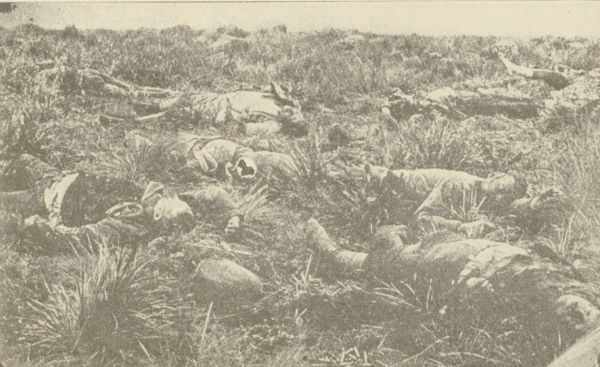
MORE GOOD ENGLISHMEN LYING ON THE SIDE HILL.
During the six days' fighting the Boers lost fifty killed and about 120 wounded. I don't know the British loss, but I hope that at some time during the twentieth century, the truth will leak out, and the number of the British killed and wounded become known. The top of the kop was covered with them; the sides of the kop and the Tugela Valley were also strewn with the dead and wounded, and the Boers were not curious enough to take the trouble to count them. The Boers requested the English to come and bury their dead, and the English, in reply, asked the Boers to bury them, and send them the bill. The gods might be able to make a comment to fit that bill, but earthly mortals would do well to hold their tongues. So I will pass on to General White and his inactivity.
CHAPTER VIII.
WHITE'S INCAPACITY.
Our investment circle was thirty-six miles in length, and at the time the Battle of Colenso was fought, was held by not more than 4,000 men. From Ladysmith to Colenso is about fifteen miles by the main road. By Colenso was General Buller with his army 35,000 strong. In Ladysmith was General White with his army 12,000 strong. Between these two armies was General Botha with his army less than 6,000 strong, including the investment forces south of Ladysmith. General Botha had, all told, ten guns. The two British forces had 150 guns. If, when Buller attacked at Colenso, December 15th, White had moved out with his whole forces to the south and attacked at the same time, the Boers would have been swamped in a few hours, and most of them would have been captured, for there was no way out of it except by Ladysmith, and, besides, they would have lost all their guns. On January 24th, the same conditions prevailed, except that there were no mountains between Ladysmith and Spion Kop, and the intervening distance was about eighteen miles. Spion Kop is plainly visible from all parts around Ladysmith. The Boer force on the west side of Ladysmith was less than 1,000 strong. Had General White moved out with his entire force and fifty guns, he could have marched to Spion Kop almost without interruption. What did he do on both occasions when he should have been up and doing, if he wished to join Buller, see Ladysmith relieved, and the Boer forces captured and destroyed? Why, he and his 12,000 men simply lay in their holes and silently prayed for Buller's success. When all the conditions are considered, it must be plain to the most simple minded that General White deserved to be forever buried in utter disgrace, but, instead, he was congratulated, promoted and dined by his queen for his gallantry and success in nearly starving to death some 15,000 soldiers, women and children in Ladysmith. On both of these memorable days the Boers around Ladysmith were all on needles and pins, for they fully expected White and his army to move out, and they knew that if he did it would be impossible for them to prevent a union with Buller, and the consequent destruction of the Boer forces in Natal.
While General Botha was fighting the Battles of Colenso and Spion Kop, Commandant-General Joubert remained at his headquarters by Ladysmith, and on the first of these occasions I remember hearing him say: "No, General White will not make any attempt to unite with General Buller, because he has been defeated so often, that both he and his men are thoroughly cowed and will be satisfied to remain concealed, and fervently hope for Buller's success." As it turned out, he proved to be perfectly correct in his surmises.
About ten days after Spion Kop, February 5th, another attempt was made to break through our lines at Vaal Krantz, by about 3,500 men and several batteries. To oppose these was General Viljoen with less than 100 men. An exciting, hot fight ensued, and, wonderful to say, the English forces retired, recrossed the river, and made no further attempt to accomplish anything in the vicinity of Spion Kop. During the fight General Viljoen with two or three men took a desperate chance to save a pom-pom from capture. Under a terrific rifle fire, they hauled the pom-pom across a long flat, and then turned it on the English with great effect. Neither he, nor his men, nor any of the horses were touched, yet all passed through a perfect shower of bullets. In this fight at Vaal Krantz, the Irish Brigade lost three of its bravest, noblest and most patriotic men: Pat Fahey, Mat Brennen and Jim Lasso. They fell as the most advanced men, and they will ever be remembered most affectionately by the Irish boys.
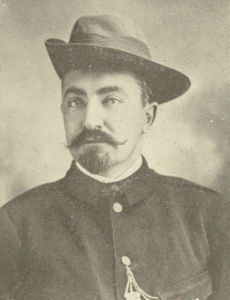
GENERAL BEN VILJOEN
Now I come to the final struggle at Ladysmith, when that awful hole was relieved, and the Boer forces retreated to the Biggarsberg Mountains, eighteen miles back on the road to Dundee.
To meet Buller, General Botha withdrew all his forces from Spion Kop and vicinity, and put them in their old positions in front of Colenso. As to whether General Buller really discovered that Langwani Hill was the key to our positions, or tumbled on to it by accident, I do not know, but, certain it was, that he was intent on getting possession of this hill, by making a flank attack on our extreme left. Langwani Hill was on Buller's side of the river, and once our left was turned, we could no longer hold it. It was not till February 18th that General Buller brought fifteen or sixteen batteries to play upon the Boer positions. It would prove tedious to describe the ten days of terrible fighting that preceded the relief of Ladysmith; so I will simply speak of it in a general way.
Buller finally succeeded in turning the Boers' left, and so Langwani Hill was abandoned, but not until the English had suffered severely. At Pieters Hill, Groblers Kloof, and the neighboring hills where the Boers were well placed by General Botha, the hardest fighting took place. In the struggle to force the Boers from their positions, the English were driven back repeatedly to the river, although their numbers were about twenty-five to one against ours. Their dead and wounded ran well into the hundreds at each attempt, and on two or three occasions were allowed to remain as they had fallen on the open veld, during the whole night, to suffer and die. The English have little or no regard for their dead and wounded, as I will in time to come show. In all these advances the English shells were constantly bursting among their own men and were directly responsible for many of their own dead and wounded. Three Irish regiments were always placed in front, and these were supported by English regiments who kept safely in the background. As on previous occasions, some Irish regiments had surrendered after making a slight resistance. I believe, and hundreds of others believe, that the English deliberately and intentionally made the "mistake" of firing their shells into the Irish regiments, to drive them on and force them to take the entrenched positions from the Boers. This was not the first time, nor was it the last time that they made a mistake of this kind, and in every case it was the Irish who were chosen to suffer. Twice during these first five days of fighting, the good General Botha had granted an armistice to Buller to be used in caring for his dead and wounded, but these were wofully neglected and advantage taken to make better dispositions of his troops.
It is just as much of a latter-day Englishman's nature to be treacherous as it is for an American Indian to be suspicious. Every repulse was followed on the next day by another advance. The heavy lyddite shells kept continually pounding the hills, tearing off their very tops and filling the air with smoke and stones; yet the brave Boers remained unmoved in their positions, and kept up their deadly fire on the advancing Irish regiments. Each day's work was practically a repetition of the preceding one, until the 27th of February, when there was a great change. The Boers had now lain in the mud and water that half filled their trenches and, without relief and without food, fought incessantly for ten days till, being weary and worn and completely exhausted, they reluctantly left their positions and began their retreat.
The famous Krugersdorp Commando under Kemp held Pieter's Hill to the very last moment, and no one about Ladysmith, be he Boer or English, will ever forget the wonderful stand made by those 400 patriots against Buller's whole army and 100 guns. It is perfectly certain that every man of them accounted for at least one Tommie before the final retreat.
On the 28th, Ladysmith was relieved, and the Boers went back to the Biggarsberg Mountains. General White in Ladysmith could plainly see a line of wagons fifteen miles long, yet he made no move to delay or capture them. Worn out and exhausted as the Boers really were, I do not believe that Buller would have been successful in relieving Ladysmith had they not received the report of General Cronje's surrender at Paardeberg on the 27th. This news was deeply felt, and it so thoroughly discouraged the Boers that they lost heart and left positions without orders, which they could have easily continued to hold. To relieve General White and his 12,000 skeletons, General Buller had exploded hundreds of tons of Mr. Chamberlain's lyddite and lost as many men as he succeeded in relieving. Mr. Chamberlain was a big winner, the English heavy losers, and the Tugela Valley is now renowned as an Irish graveyard. A few more wars like the South African would settle all of Ireland's many troubles, because the Irish would all be laid under the sod. How strange it is that a people who have fought against England's tyranny for centuries to secure their freedom, and are still fighting for the same end, will voluntarily join with their old and detested oppressor to deprive another people of their liberty, knowing, too, as they must, that in every instance they weaken themselves and strengthen their old enemy.
Yet, this is exactly what the Irish have done, and I have no sympathy for those who are to-day sleeping in the Tugela Valley as a result of their own voluntary acts.
During a terrific rain storm on the night of the 27th, and in the very eyes of Buller's army on one side and White's on the other, our Irish boys were the chief instruments in pulling down Long Tom from the top of Bulwana Kop. It was fearful and exasperating work, and it was not until two o'clock in the morning that our large gun safely landed at the foot of the kop and started on its way to Elandslaagte. General Botha was near at hand with some 300 or 400 men, but he could have offered little or no resistance had an attempt been made to capture the gun.
Our hundreds of wagons, with all our cannon and maxims, were hauled through heavy mud and across an open flat for twenty miles, and safely landed in the Biggarsberg Mountains, and that, too, in the very presence and before the eyes of an English army of 45,000 trained officers and men, who never moved an inch in our direction.
Quite a cavalry force came out of Ladysmith, but when a few of the Irish boys opened fire on them, they all turned and fled back to town. The English should have captured all our wagons and cannon, and would have done it, too, had they known anything about their business. Buller and White together could have easily trained 150 cannon on us and forced us to abandon everything, but they seemed satisfied to stop just where they were, and, no doubt, congratulated themselves that the Boers had escaped without doing them further damage. Some time before the relief of Ladysmith, the Free State Commandos had left and gone to meet Lord Roberts, who was advancing towards Bloemfontein; so it was only the Transvaal Commandos who took up positions in the Biggarsberg Mountain passes. As the English had a big force on the Tugela River, about eighteen miles in front of Helpmakaar, the Irish Brigade was ordered to go to Helpmakaar and hold them back. Should the English get hold of this place, our positions in the Biggarsberg would no longer be tenable, for the line of retreat to Laing's Nek would then be seriously threatened. We found the Piet Retief Commando there, but about four miles behind the position it should have occupied. We learned, on questioning the officers, that it was too dangerous a place for Piet Retief men, and they would not risk a stand there. We then went and had a look for ourselves, and we decided that 200 men in the position could easily prove a match for any 5000 Englishmen who might come, so we were satisfied to try our luck. It was the strongest position for defence that I had yet seen, for it was impossible to flank it; and to take it, the attacking force had to come along one road, and the distance from the foot of this steep mountain to the top was at least two miles. The English knew that position and that mountain, and never made any effort to take it during our month's residence there.
In the month of April, I received word from Pretoria that about 1,000 Irish and Irish-Americans had arrived at Delagoa Bay, on their way to join my brigade. I was in great glee on receiving this long expected news, and lost no time in going to Pretoria, not only to meet them, but to prepare for them a red hot time with the English. I arranged with the President and Executive Council, to recall the brigade from Helpmakaar, bring it to Elandsfontein, where I would join it with something like a thousand Irish-Americans, and all proceed to Fourteen Streams, where I knew there would be some interesting fighting. Having done this, I at once took the train to Middleburg where I would meet the good boys from free America. I was thoroughly convinced that the Irish and Irish-Americans were intent on doing something good for down-trodden Ireland by proving that England's difficulty was Ireland's opportunity. My hopes were high, and all sort of plans and schemes were passing through my mind when the steam whistle announced that I was in Middleburg. Here I found that the long expected boys would arrive on the following morning. The whole town learned of their coming, and all turned out to greet them. Finally came what I at first supposed to be the advance guard, the American Ambulance Corps of fifty-eight men from Chicago and Massachusetts. They were warmly received with the shouts and hurrahs of the assembled multitude. When I found time to breathe I asked when the fighters would arrive. The answer was "We are the fighters! No more coming that we know off." Now I felt so thoroughly disappointed that I made up my mind to drop dead on the spot, but was saved from such a terrible ordeal by the idea suddenly occurring to me that possibly others would soon follow. I long lived in hope, but only to be disappointed in the end, for no more ever came.
Later on I will give the reasons, for I have since learned just what the trouble was. I was genuinely glad to see the Irish boys, and from them learned that it was through the efforts of my trusted old Arizona friend, Colonel John F. Finerty, of Chicago, and my new and most highly esteemed friend, Patrick J. Judge, of Holyoke, Mass., that sufficient money was raised by private subscriptions to equip thoroughly the Ambulance Corps of fifty-eight men and land them in the Transvaal.
It was not the fault of those two patriotic Irishmen that 100,000 Irish and Irish-Americans were not sent to South Africa to assist that little handful of Boer patriots in their struggle with the mighty British Empire for liberty and independence. In due time I will put the fault just where it belongs. The Boers had enough ambulance corps, so the Chicago and Massachusetts boys removed their red cross chevrons and, after being well equipped, as fighting men, we all went to Johannesburg to join the boys of the old brigade who had just arrived from Helpmakaar. Having met, what a rollicking, joyful good time all these jolly Irish boys had!
CHAPTER IX.
THE FIGHTING IN THE FREE STATE.
Our orders for Fourteen Streams were countermanded and we were instructed to proceed to Brandfort in the Free State. We took the train without delay and went on our way rejoicing. On reaching Smaldeel, a small station thirty miles from Brandfort, we were ordered to stop and wait for instructions; so we pitched our camp and put everything in readiness for a hot time, for we learned that Lord Roberts and his army of 90,000 men were advancing from Bloemfontein. Before our new arrivals receive their baptismal fire I will relate what had taken place in the Free State while we were engaged at Ladysmith.
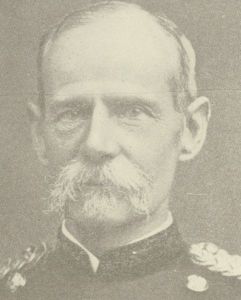
GENERAL LORD ROBERTS, F.M. Notorious for destroying women and children and for helplessness when confronted with an armed foe.
During the month of November while we were in daily skirmishes with the English, who were trying to find a way of escape, there was heavy fighting south of Kimberley. Unfortunately we had there one thoroughly incompetent commander, General Prinsloo, of the Free State. General Prinsloo had most excellent commandants and veldcornets, any one of whom would have made every fight a victory in those parts. General de la Rey was with Prinsloo, but the latter had higher rank, much to our regret. General de la Rey is a remarkable man and the Napoleon of the South African War. In due time I will give a short account of this great and good man and the deeds he accomplished.
Generals Prinsloo and de la Rey, with their combined force of some 2,000 men and, I think, two guns and two maxim Nordenfelts, were attacked on November 23rd by Lord Methuen with a force of 10,000 to 12,000 men and two or three batteries, together with several maxims. Of course Lord Methuen had an overwhelming force as compared to that of the Boers, yet, had Prinsloo acted with General de la Rey, the British would have suffered a severe defeat.
Prinsloo left his position just at the moment of victory, and, by so doing, came near getting General de la Rey and his men captured. They had actually to fight their way out. The republican forces fell back to Rooilaagte in the direction of Kimberley. Here the burghers to some extent fortified themselves, and awaited the arrival of Methuen. He, with his re-enforced army appeared and opened up their batteries on the Boer positions in the early morn of November 25th. A very hard and bloody battle was fought here, and it was Prinsloo again who gave way at the wrong moment and allowed Methuen to credit himself with another victory. Prinsloo was always bent on giving way just at the wrong time, much to the disappointment and disgust of General de la Rey, and this, too, in the face of the fact that General de la Rey always took the brunt and did the hardest fighting. The world now has read Methuen's reports of these fights and the Boer reports too, so it is only necessary for me to say that the former's losses were exceedingly heavy, while those of the latter were exceedingly small. Judging by the losses, Methuen was badly defeated in both instances, but an English officer does not care how many men are shot dead so long as he does not lose a gun or have to retreat. To show the true character of this lordly Methuen, I will say that every low and beastly epithet his vulgar imagination could invent, he applied to the enemy, that he might excuse himself for shooting some twenty or thirty Boers, some of them wounded, whom he had captured. Of course he must add another lie, English-like, by claiming the abuse of the white flag.
Now the time was ripe for the Boers to begin to shoot in retaliation the British officers and soldiers at Pretoria, who were spending their time playing football, etc. But the Boer is strictly governed by his religion, and the whole world could not induce him to resort to retaliation under any circumstances. I longed to be in chief command just for a few hours, but, fortunately for many British, I was not. The Boers were convinced that Lord Methuen would receive his punishment on the Day of Judgment, and I was just as thoroughly convinced that I did not believe in such long postponements in dealing with Englishmen.
The Boers fell back from Rooilaagte to Modder River, not many miles from Kimberley. Here Generals Prinsloo and de la Rey were re-enforced by the long expected General Piet Cronje, with about 500 men. He had come all the way from Mafeking on the western border of the Transvaal, but, tired as he and his men were, they were all ready and game for fight. Before Cronje's arrival, General de la Rey had practically assumed command over General Prinsloo, and placed the Boer forces in position on the Modder River to give Methuen and his army another fight. On his arrival, General Cronje, being known to be the best fighter in the land, was given command over all the Boer forces. He looked over the ground and having thoroughly approved in every detail the dispositions of the men that General de la Rey had made, he calmly awaited the arrival of Methuen. Lord Methuen will never forget the battle of Modder River, and hundreds of his men will never remember it. The English were then and are now as afraid of General Cronje, as a baboon is of a snake, and I might say here, that if you bring a baboon in contact with a snake, dead or alive, and prevent him from running away, he will actually have a spasm. Methuen did not find out, however, until it was too late, that Cronje was there, for otherwise he would have asked for something like 20,000 men additional. Finally the 28th of November came, and there was Methuen and his army.
After carrying out his usual program of bombarding for several hours, Methuen advanced his lines, and the rifle firing began. After hours of terrific fighting, during which Cronje and de la Rey had unmercifully slaughtered, and in the end driven back the English, and during which time the Free Staters, too, had covered themselves with glory, and just at the moment when a great victory was really won, General Prinsloo suddenly withdrew his men and allowed the English to turn his flank. He seemed to be afraid to win a victory, and it is a marvel that General Cronje or General de la Rey did not shoot him or drive him to his home and put one of his thoroughly competent commandants in his place. The result of this sudden withdrawal was that the Boer forces had to fall back, and now we find them at Magersfontein.
As Methuen had made but slow progress in killing Boers in honorable fight on the battlefield, he now gave way to his savage inclination and had some twenty or thirty wounded Boers whom he found in a farmhouse near the battlefield, deliberately shot in cold blood. Of course Methuen had seen his men fall by the hundred, and no doubt he was highly enraged at the sight, but it requires a brute to deliberately take the lives of helpless, wounded men, and, in my experience with the brute creation, which is considerable, I am sure that there are exceedingly few brutes that would do such a thing. Even the sneaking hyena would refrain unless he were dying of hunger. Now Lord Methuen had learned that Cronje was on deck, and in the best of health, so he called for all the re-enforcements at hand and brought up his decimated force to something like 15,000 men and six batteries. Cronje was lucky too, and increased his force to something more than 4,000, but not much more. Methuen's were all trained and tried men, and, as the English would put it, invincible; Cronje had his ordinary farmers who knew nothing whatever about military training. No doubt Methuen did lots of thinking, but I do not believe he called any council of war, because he is too conceited and arrogant to do such a thing. He who deigns to make a suggestion to a lord is very liable to be sent away and told to attend to his own business. Although he is supremely arrogant, I think he did some shaking in his boots because he knew that Cronje was in front. For several days after his terrible smashup on Modder River, Methuen spent his time in recuperating and awaiting re-enforcements. Cronje and de la Rey spent their time in preparing for a fight at Magersfontein. In front of the ridge on which they concealed their small guns and maxims they put the Boers to work digging a trench. The trench being finished, it was so well concealed that the English could not see it. They knew that this scheme would work, because Methuen would not think of sending out any reconnoitring parties to find out just how the Boers were to make their fight. He would tell you that it was unnecessary because he had a balloon, and from that balloon he could see the Boers far behind their actual, but unknown to him position. The Boers were not in the trenches by day, but were far behind them. At night you could find everyone of them there, and in perfect readiness for battle.
CHAPTER X.
MAGERSFONTEIN AND PAARDEBERG.
At last the day came. It was Dec. 10th when Methuen and his big army came up and without delay began with their usual introduction, by turning six batteries upon the supposed position of the Boer force. For two days this formidable array of field and lyddite guns continued to roar and keep the very heavens filled with heavy steel shells that tore up the earth generally. No reply was sent back from any part of Cronje's lines, so Lord Methuen alone can lay claim to making all that deafening noise that so frightened birds and beasts during the 10th and 11th; but when you say noise, you have the sum total of the work accomplished by his vigorous display of fireworks. It was in the very early morning of the 12th, that Lord Methuen decided that the fearful Cronje and his "dirty" Boers were either demolished or so terribly demoralized that they had fled for safety miles to their rear, because he had not heard a murmur from them for two days. Any man with a little grain of sense would, at least at this early hour in the morning, have sent in advance a well extended line of skirmishers to find out if the enemy were near at hand or had actually fled. No; this way of doing business would never meet with the approval of an English lord who had, by the accident of birth, inherited the brains of all past generations in his family line; so he moved his lines forward in close order.