LESSON XXV
Reading edition
IMITATIONS OF PRECIOUS STONES
"Paste" Gems. Large volumes have been written on paste jewels, especially on antique pastes. Contrary to a prevailing belief, the paste gem is not a recent invention. People frequently say when told that their gems are false, "But it is a very old piece, it must be genuine." The great age of a jewel should rather lead to suspicion that it was not genuine than give confidence that a true gem was assured. The Egyptians and Romans were skillful makers of glass of the sort used in imitating gems and some of the old pastes were very hard or else have become so with age.
Glass of one variety or another makes the most convincing sort of imitation precious stones. The term "paste" as applied to glass imitations is said to come from the Italian pasta meaning dough, and it suggests the softness of the material. Most pastes are mainly lead glass. As we saw in Lesson XVIII., on the chemical composition of the gems, many of them are silicates of metals. Now glasses are also silicates of various metals, but unlike gem minerals the glasses are not crystalline but rather amorphous, that is, without definite geometric form or definite internal arrangement.
The optical properties of the various glasses vary chiefly with their densities, and the denser the material the higher the refractive index and the greater the dispersion. Thus to get the best results in imitation stones they should be made of very heavy glass. The dense flint glass (chiefly a silicate of potassium and lead) which is used for cut glass ware illustrates admirably the optical properties of the heavy glasses. By using even more lead a still denser glass may be had, with even a greater brilliancy.
Unfortunately the addition of lead or other heavy metals (such as thallium) makes the product very soft and also very subject to attack by gases such as are always present in the atmosphere of cities. This softness causes the stones to scratch readily so that when worn they soon lose their polish and with the loss of polish they lose their beauty. The attack of the gases before mentioned darkens the surfaces of the imitation and further dulls it. When fresh and new a well cut piece of colorless paste has a snap and fire that approaches that of diamond. The surface luster is not adamantine, however, and the edges of the facets cannot be polished so sharply as those on a diamond. Moreover the refractive index, while high, is never so high as in a diamond and hence the brilliant cannot be so shaped as to secure the amount of total reflection given by a well-made diamond. Hence, the paste brilliant, while quite satisfying as seen from squarely in front, is weak and dark in the center as seen when tilted to one side. By these differences the trained eye can detect paste imitations of diamond at a glance without recourse to tests of specific gravity, hardness, etc.
Pastes, being amorphous, are singly refracting, as is diamond. This fact helps the appearance of the paste brilliant, for light does not divide within it to become weakened in power. This singleness of refraction, however, betrays the paste imitation when it is colored to resemble ruby, sapphire or emerald, all of which are doubly refracting.
The color is imparted to pastes by the addition, during their manufacture, of various metallic oxides in small proportions. Thus cobalt gives a blue color, copper or chromium green, copper or gold give red (under proper treatment) and manganese gives purple. By experiment the makers of pastes have become very skillful in imitating the color of almost any precious stone. Fine paste emeralds may look better than inferior genuine emeralds.
As pastes are singly refracting and hence lack dichroism, the pleasing variety of color of the true ruby cannot be had in a paste imitation, but the public is not critical enough to notice this lack. The expert would, however, note it and could detect the imitation by that difference as well as by the lack of double refraction. The use of direct sunlight and a white card as already explained in the lesson on double refraction (Lesson III.) will serve to expose the singleness of refraction of paste imitations. Spinels and garnets are about the only true gems (except diamond) that are single refracting. Any other color stone should show double refraction when tested by the sunlight-card method. The file test will also expose any paste imitation as all the very brilliant pastes are fairly soft.
Doublets. To give better wearing quality to paste imitations the doublet was devised. This name is used because the product is in two parts, a lower or back portion of paste and an upper or top portion of some cheap but hard genuine stone. Garnet is probably used for this purpose to a greater extent than any other material, although quartz or colorless topaz will do very well.
The usual arrangement of the parts can be seen in Fig. 15, the garnet covering only a part of the upper surface, namely the table part and a small portion of the sloping surface of the top. In high class doublets the hard mineral covers the paste to the girdle. (See Fig. 16.) The color of the garnet does not interfere seriously with that of the paste.
Fig. 15. ONE FORM OF CHEAP DOUBLET.
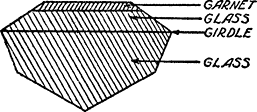
If a "diamond" doublet is desired the slice of garnet is made nearly as thin as paper and it covers only the table of the brilliant. It is thus practically colorless. A thin slice of red garnet over a green background is not noticeable, as all the red is absorbed in passing through the green material beneath. With a blue base, the red upper layer may give a very slight purple effect. With yellow a slight orange tint results and of course with a red back no perceptible difference would result.
Fig. 16. ANOTHER FORM OF DOUBLET.
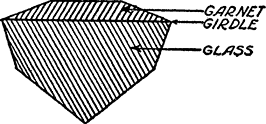
The two materials are cemented together, by means of a transparent waterproof cement. The triplet has already been described in Lesson XII. It is even better than the doublet and more difficult to detect. Both the file test and the sunlight-card test serve to detect doublets, as well as paste imitations, except that in the file test with the fully protected doublet the back of the stone must be tested with the file, as the girdle and top are of hard material.
In the sunlight-card test of a doublet (the refraction of garnet being single like that of glass), single images of the facets will be had on the card when the sunlight is reflected onto it. A reflection of the lower or inner surface of the garnet top can be seen also and this serves to still further identify a doublet or a triplet. The appearance of this reflection is much like that received on the card from the top of the table. It is larger than the reflections of the smaller facets and is but little colored.
Tests for Doublets. A trained eye can also detect a doublet or a triplet by noting the difference in the character of the surface luster of the garnet part and of the glass part. Garnet takes a keener and more resinous luster than glass. By tipping the doublet so that light is reflected to the eye from the sloping top surface, one can see at once where the garnet leaves off and the glass begins. Even through a show window one can tell a doublet in this way although here it is necessary to move oneself, instead of the stone, until a proper position is obtained to get a reflection from the top slope of the doublet.
If the garnet covers the whole top of the imitation then it is not possible to get so direct a comparison, but even here one can look first at the top surface and then at the back and thus compare the luster. It is also well to closely examine with a lens the region of the girdle, to see if any evidence of the joining of two materials can be seen. Frequently the lapidary bevels the edge so as to bring the line of junction between real and false material at the sharp edge of the bevel. Boiling a doublet in alcohol or chloroform will frequently dissolve the cement and separate the parts.
The dichroscope also serves to detect the false character of doublets and paste imitations, as neither shows dichroism. As rubies, emeralds, sapphires, and in fact most colored stones of value, show distinct dichroism, this test is a sure one against these imitations.
Triplets and doublets too may be exposed by dipping them sidewise into oil, thus removing the prismatic refraction almost completely, as the oil has about the same refractive index as the stone. One can then look directly through glass and garnet, or other topping material, separately, and each material then shows its proper color. Thus zones of color appear in a doublet or triplet when under the oil. A real gem would appear almost uniform in color under these conditions.
Round gas bubbles can frequently be found in paste, and hence in the paste part of a doublet. Also, the natural flaws of the real stone are never found in paste, but may be present in the real stone part of a doublet or a triplet. Some imitation emeralds on the market, however, have been made in a way to counterfeit the flaws and faults generally found in this stone.
Altered Stones. In addition to the out and out imitations made of paste, and the doublets, there are numerous imitations current in the trade that are made by staining or by otherwise altering the color of some genuine but inexpensive gem material.
For example, large quantities of somewhat porous chalcedony from Brazil are stained and sold in imitation of natural agate or sard or other stones. In many cases the staining is superficial, so that the stone has to be shaped before it is stained, then stained and polished.
Large quantities of slightly crackled quartz are stained to resemble lapis lazuli, and sold, usually with the title "Swiss Lapis." A file test will reveal the character of this imitation, as it is harder than a file, while true lapis is softer. The color too is never of so fine a blue as that of fine lapis. It has a Prussian blue effect.
Turquoises of inferior color are also sometimes stained to improve them. A better product is made artificially.
Opals are sometimes impregnated with organic matter, which is then charred, perhaps with sulphuric acid, thus giving them somewhat the appearance of black opal.
Opals are also imitated by adding oxide of tin to glass, thus imparting a slight milkiness to it. The imitation is then shaped from this glass by molding, and the back of the cabochon is given an irregular surface, which may be set over tinsel to give the effect of "fire."
Pale stones are frequently mounted over foil, or in enameled or stained settings and thus their color is seemingly improved.
Diamonds of poor color are occasionally "painted"; often the back of the brilliant is treated with a violet dyestuff, which even in so small an amount that it is difficult to detect, will neutralize the yellow of the stone and make it appear to be of a fine blue-white color. The "painting" is, of course, not permanent, so that such treatment of a diamond with a view to selling it is fraudulent. The painted stone may be detected by washing it with alcohol, when the dye will be removed and the off-color will become apparent. If the stone is unset one can see with a lens a wavery metallic appearance on the surfaces that have been "painted." This effect is due to the action of the very thin film of dye upon the light that falls upon it.
Besides the staining of genuine materials, they are sometimes altered in color by heat treatment, and this topic will be discussed in the next lesson.